




Abstract
The use of wearables in the workplace allows for close monitoring of work processes and might also have consequences for work content and skill requirements. Past research has emphasized the detrimental effects of wearables, particularly those caused by the standardization of work and monitoring of workers. By contrast, this study asks under what conditions the implementation of wearables as part of digital assistance systems is beneficial for workers. Based on recent contributions in the field of labor process theory, this study analyzes the implementation of new technologies using the concepts of the regulatory regime, organizational first-order factors, and workplace second-order choices. The analysis is based on findings from 48 interviews with 83 interviewees in 16 German manufacturing workplaces along with making site visits. It examines the implementation of wearables and the impacts on work content, skills, working conditions, and employment. Besides showing how labor agency affects the implementation of new technologies, the particular contribution of this study lies in analyzing the differences in the implementation of wearables in capital- and labor-intensive organizations. While standardization of work and reduction of work content prevailed in labor-intensive processes, capital-intensive processes were most often characterized by the extension of skill requirements and the risk of work intensification.
Keywords
Wearables—a technology worn on the body, such as data glasses and smartwatches—are an often-cited aspect of the current upheavals in the world of work when it comes to digitalization and Industry 4.0. Wearables are intended to link employees to digital assistance systems and serve as an interface, providing employees with situation-specific information while feeding data about the work process into IT systems. The technology promises an improvement in the quality of work. It could help detect ergonomic problems and eliminate unnecessary movements and bottlenecks in the work process while providing information in difficult work situations. Yet, it could also result in a streamlining of processes, a new level of surveillance of workers, and de-skilling.
Little empirical research has been done on the use of wearables in the workplace, even though initial studies have assessed the ways in which wearables are used in private life (Katz and Marshall 2018; Lyall and Robards 2018). The first sociological studies focusing on the workplace particularly emphasized the surveillance and de-skilling potential of wearables (Lupton 2013; Moore and Robinson 2016; Delfanti 2021; Wood 2021), but these studies are not based on systematic empirical evidence. In the current study, we provide empirical grounding for the nascent discussions and claims about the role of wearables in the workplace. We also use the empirical analysis to elaborate a conceptual framework for the introduction of wearables (and digital assistance systems in general) into the workplace, drawing on labor process theory. It is important to note how labor process theory has changed throughout its history: Claims about a technology-driven trend toward de-skilling and control have given way to the insight that the workplace represents a “contested terrain” (Edwards 1979) and that technological change can have different consequences for control regimes and skills. However, this leads to the question of what factors structure bargaining and conflicts in this terrain. While some recent contributions (Vidal 2022) have focused on managerial imperatives and aspirations, Thompson and Laaser (2021) have proposed an approach in which they conceptualize the implementation of technologies in the workplace as a second-order process shaped by organizational first-order factors and embedded in a specific regulatory regime. We build on this concept and develop it further with a focus on the operationalization of organizational first-order factors. In this regard, we distinguish between capital-intensive organizations in manufacturing and labor-intensive organizations in logistics, each with different skill requirements and different use cases for wearables. When considering second-order decisions on the implementation of technologies in the workplace, we focus on the role of the power of organized labor in bargaining with management.
Our analysis is based on a total of 32 interviews with 60 interviewees in 16 companies in Germany, as well as 16 additional interviews with 23 experts, in particular technology developers. We focus on the following question: Under what conditions is the implementation of wearables (as part of digital assistance systems) in the workplace beneficial for workers?
In agreement with other studies, we argue that the strength of organized labor has an important influence on the processes of technology implementation and the outcomes for workers. We examine developments in Germany, which has a specific regulatory regime that (at least in sectors such as manufacturing and partly in logistics) is still characterized by relatively broad unionization and strong codetermination rights enjoyed by works councils. This case provides a contrasting and comparative case to those in the United States and United Kingdom, which have been the focus of previous studies on wearables (Moore and Robinson 2016; Delfanti 2021; Wood 2021).
In contrast to existing research, which emphasizes the detrimental impact of wearables on work because of standardization and the monitoring of workers, we argue that organizational first-order factors (in our case the differences between labor-intensive and capital-intensive processes) create scenarios that differ from earlier research in terms of the impact of wearables on work, skills, employment, and the major bargaining issues for labor representatives and management. Our main contribution to the research discussion lies in our analysis of these first-order factors and the resulting scenarios.
State of the Research and Heuristic Model
Wearables as Digital Assistance Systems
As defined by Hobert and Schumann (2017), wearable computers are end devices that are worn on the body and enable casual and hands-free use. Examples include data glasses, smartwatches, and gloves equipped with sensor technologies. These devices can network with IT systems and specifically with digital assistance systems, enabling the flexible provision of information from machines, databases, and enterprise resource planning (ERP) systems. At the same time, devices worn on the body make it possible to permanently localize and monitor movements and even measure bodily functions.
Wearables have been in development since the 1980s, but they have been used in actual work processes since only the 2010s. The prerequisite for their emergence was the miniaturization of computers and, above all, batteries. With the Internet of Things, an infrastructure emerged that made it possible to embed wearables into existing IT systems. According to Krzywdzinski, Pfeiffer, Evers, and Gerber (2022), the first emerging use cases for wearables in manufacturing and logistics have included the following:
Order picking: The wearable (e.g., data glasses) displays data, for example, the number of parts to be picked in connection with the corresponding shelf. The wearable can also be used to acknowledge orders, for example, with the help of the data glasses’ camera or with a wristband equipped with a radio-frequency identification (RFID) chip.
Assistance in manufacturing tasks (assembly, maintenance, remote maintenance, and so forth): The wearable shows the assembly sequence and assists in the execution of work steps.
Occupational safety and ergonomics: Warnings on hazard protection are given via the wearable, for example, gas leaks in chemical plants.
Training: Training processes are supported by wearables.
Wearables can be understood as a core part of digital assistance systems and can have beneficial and detrimental impacts on job quality. The potentially beneficial impact includes improved ergonomics and the expansion of employees’ responsibilities (and thus their skill requirements). The potentially detrimental impact relates to the issue of control and monitoring in the work process. The technology allows for the collection of data, which can be used to create employees’ movement and performance profiles. In addition, because wearables can be used to transmit information and instructions in the work process, they can lead to a reduction in the scope for decision-making and thus in employees’ skill requirements. If the use of wearables is linked to the goal of increasing efficiency, it may lead to a reduction in employment.
The current literature emphasizes the detrimental effects of wearables (Lupton 2013; Moore and Robinson 2016; Delfanti 2021; Wood 2021). The detriment is related to the role of this technology in the transformation of what labor process theory traditionally called control regimes (Thompson and Laaser 2021). The new element of these control regimes is algorithmic management, based on the use of digital infrastructures for directing, evaluating, and disciplining workers (Möhlmann and Zalmanson 2017; Griesbach, Reich, Elliott-Negri, and Milkman 2019; Kellogg, Valentine, and Christin 2020; Jarrahi et al. 2021). Kellogg et al. (2020) have argued that algorithmic management is fundamentally different from other (earlier) forms of control and that its outcomes are primarily disempowerment and stress, which arouse worker resistance. While only a few empirical studies have been carried out on management strategies in the introduction of digital assistance systems and wearables, the existing publications conceptualize wearables as a form of algorithmic management associated with control strategies in which technology is used to bring about an increased standardization of work processes, objectification of knowledge, and continuous monitoring of work (Moore and Robinson 2016; Delfanti 2021; Wood 2021). Moore and Robinson have emphasized that the use of wearables in work processes allows for the control of “microsocial and inner processes in open-ended working environments” (2016: 2781), in some cases even outside of working hours and the workplace. Green, Felstead, Gallie, and Henseke (2022) see the digital monitoring of workers as an important mechanism that leads to work intensification.
While the debate on algorithmic management has the merit of drawing attention to the new quality of diffusion of digital technologies in the work process, some studies have pointed out the limitations of this concept. Woodcock (2021) argued that this concept tends to overemphasize the power of the new digital technologies. The overestimation of the power of technology is often accompanied by a focus on the detrimental effects of technology in the sense of a degrading of work. While, to take one prominent example, Kellogg et al. (2020) have recognized that algorithmic management systems are contested and implemented in a variety of forms in organizations, they have conceptualized the potential outcomes of technology implementation only as “manipulation, disempowerment, surveillance, discrimination, precarity, and stress” (p. 367) and the role of labor as resistance. Thus, the current discussion reproduces theses put forward in early contributions to labor process theory (Braverman 1974). This control–resistance model has been criticized in the history of labor process theory (Burawoy 1978; Attewell 1987; Thompson and Laaser 2021). In agreement with industrial and labor relations studies in general (e.g., Adler 1992; MacDuffie and Krafcik 1992), the labor process debate had come to accept that workplace bargaining over the implementation of technology can lead to diverse outcomes, including degrading/de-skilling and upgrading/upskilling of work—even though cost competition between companies and power relations between management and workers might lead to a dominance of de-skilling strategies (Thompson 1983; Thompson and Laaser 2021; Green et al. 2022).
Building on Adler’s (2007) work, Vidal (2022) has recently developed a theory that explains why management might be interested in using technology in a beneficial way for workers. He argues that management must fulfill two contradictory imperatives: First, it must ensure sufficient work effort and adherence to standards in the work process, thus developing a labor control regime; second, it must ensure the valorization of capital, which may require worker involvement in improving processes and products. The best performance is shown by a high-involvement regime that combines a standardization of labor processes and a high degree of worker participation in process design and optimization (Appelbaum and Batt 1994; Macduffie 1995). It is difficult to develop such a regime, however, which is why many managers are satisfied with a “lean-enough” regime that relies primarily on the standardization and control of workers and participation that is, at most, symbolic. In a high-involvement regime, digital assistance systems would be used for both standardization of work and empowerment of workers, while in a lean-enough regime the focus on standardization and surveillance would dominate.
Developing a Labor Process Theory-Based Approach
If the relationship between new technologies, control, and skills is a contested field, how can it be analyzed? What factors structure the field, and what factors can support beneficial outcomes for workers?
In the recent debate on technological change in the workplace, Thompson and Laaser (2021) proposed a three-level model based on labor process theory (see Figure 1 for our adaptation for the goals of this article) that distinguishes 1) regulatory regimes that define the supply conditions of labor and labor rights regarding the implementation of new technologies, 2) organizations that implement workplace control regimes and are embedded in the regulatory regimes, and 3) the labor process in which technologies are implemented and used.
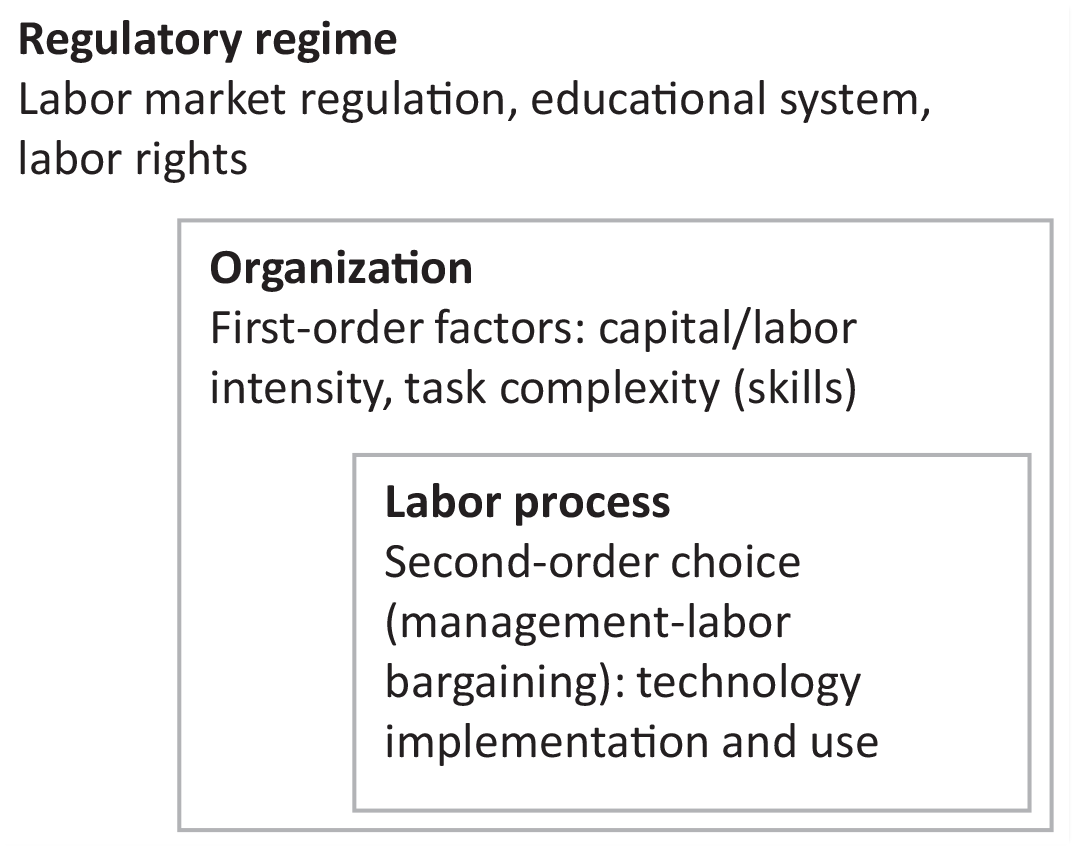
Theoretical Model
The specific way technology is used in the work process is a second-order choice, shaped by management’s bargaining (or conflicts) with the labor side. However, this choice is restrained by first-order factors, which include the company’s business model and basic decisions about the fundamental technologies and skills needed. These organizational first-order factors evolve in a given regulatory regime. Although Thompson and Laaser (2021) wrote of first-order choice, we prefer the term first-order factors because, in our understanding, it refers not to a free decision of individual companies but rather to concepts and standards historically given for respective industries or value chains.
Previous research has focused on the two levels of regulatory regimes and management–labor bargaining in the labor process. The central elements of the regulatory regimes are educational systems, labor rights, and labor market regulation (see Doellgast and Wagner 2022 for an overview). Powerful educational systems that contribute to broad skill upgrading in society will support managerial strategies that use technology to augment rather than to control or replace workers (Goldin and Katz 2008; Frey 2019). Strong institutional labor rights support collective bargaining over technology (Frey 2019). Labor market regulation influences labor supply: If labor market regulation promotes the emergence of a low-wage employment sector (e.g., via deregulation), it can weaken labor and support de-skilling trends (Fernández-Macías 2012; Murphy and Oesch 2018). In contrast, policies that prevent such developments can strengthen overarching upskilling trends. As we (Krzywdzinski et al. 2022; Krzywdzinski, Schneiß, and Sperling 2024) argue, the regulatory regime shapes the skill structure, management–labor relations, and specific organizational traditions with regard to technology use.
Regarding management–labor bargaining, Bélanger and Edwards (2007) have emphasized the (associational and structural) strength and the strategies of both labor and management. Management strategies can be classified by whether they prioritize control of the labor process or development of the company’s productive forces. Labor representatives also have certain preferences regarding, on the one hand, (avoiding) labor control and, on the other hand, the development of productive forces. When management prioritizes control and the labor side prioritizes resistance, fierce shop floor battles result. When management prioritizes the development of productive forces and encounters an equal response from the employee side, “productivity coalitions” emerge (see Litwin 2011). A recent review of studies of management–labor collective bargaining over digitalization (Doellgast and Wagner 2022) has confirmed the role of these factors.
By contrast, in the role of regulation and management–labor bargaining, research on digitalization and work has largely neglected the role of first-order factors (or choices) as understood by Thompson and Laaser (2021), and the two authors themselves have not defined and investigated them systematically. Our central conceptual contribution is that we systematically consider these first-order factors. To analyze them, we build on Child’s (1985) classic analysis of decisions about new technologies in the labor process. Child distinguished two strategies of redesign of the labor process with the help of technology: 1) the focus on the “polyvalence of workers” (p. 482), and 2) the degradation of work. (We disregard Child’s two other strategies of elimination of work through automation and the use of technology for outsourcing because they are not relevant for the technologies we studied.) Child mentioned several factors influencing the strategies chosen by management: government policy and institutions (regulatory regime), labor market conditions, organization (product, process, size), and task complexity/skill requirements.
Regarding the first-order factors, we focus on organization and task complexity/skill requirements (and abstract from the concrete labor market conditions). For our analysis, we suggest a distinction between capital-intensive and labor-intensive organizations and a simplified distinction between high-skill and low-skill processes.
We suggest that capital- and labor-intensive processes differ in terms of the core challenges for management and thus also for the use of digital assistance systems. In labor-intensive processes, it is particularly important for management to ensure work effort as well as an efficient design of the workflow and the division of labor among the workers. Labor-intensive processes are the major application field of Taylorist process design. They differ from highly automated, capital-intensive manufacturing, in which workers’ tasks consist primarily of monitoring production, retooling the machines, securing material flows, and solving problems. Labor costs here are negligible compared to the fixed cost of machinery. The high capital intensity leads to specific organizational priorities: To avoid interruptions of the production process, workers must react quickly to problems and be close to the machines. At the same time, a key management challenge is to avoid workers spending idle waiting (i.e., non-value-adding) time when monitoring machines, as advocated by lean production concepts (Sugimori, Kusunoki, Cho, and Uchikawa 1977).
No deterministic relationship exists between labor intensity and the skill level of the workforce. Some labor-intensive processes have high-skill requirements (typically in the craft sector) and others have low-skill requirements. Capital-intensive processes also consider high- and low-skill requirements.
Our distinction between labor-intensive and capital-intensive processes allows us to derive expectations regarding the organizational first-order factors that influence the implementation of wearables in workplaces:
We expect that, in the labor-intensive work processes, the focus of management will be on the standardization and reduction of the task contents. This expectation excludes the potential for upgrading and upskilling. The role of labor representatives will primarily be to defend workers’ scope for action. This role corresponds most closely to the scenario of algorithmic management, as formulated in contributions such as Kellogg et al. (2020).
In capital-intensive processes, however, we expect a focus on flexible deployment of workers (the polyvalence strategy in Child’s 1985 terms). This flexibility opens up opportunities for upskilling, and we can expect these opportunities to be used in “productivity coalitions” between labor and management. The risks for labor are primarily in work intensification, such as when workers’ responsibilities are simply expanded, creating pressure on break times.
Research Design and Data
This analysis focuses on Germany; therefore, it does not include variance at the level of the regulatory regime. All studied companies had works councils and were unionized. Although the strength of the works councils and unions varied across the companies, the companies’ regimes were all, at their core, consistent with the classic “German model” (Müller-Jentsch 2003). This model has experienced significant erosion for decades (Hassel 1999; Streeck 2009), but it continues to exist, especially in the manufacturing industries. German codetermination law—which defines the role and the rights of works councils in the companies—shapes the strategic orientations of management and works councils and promotes the prioritization of “developmental concerns,” as described by Edwards, Bélanger, and Wright (2006), which often leads to the emergence of productivity coalitions between management and works councils (Tüselmann and Heise 2000; Haipeter 2011).
Workplace bargaining between management and employee representatives in Germany is based on the Works Constitution Act (BetrVG). Generally, when technical innovations are introduced, German works councils have only the right to be informed and consulted about the plans in good time (§90 BetrVG). In addition, however, §87 BetrVG gives works councils the right to co-decide (a veto right) on the introduction of technical solutions if they are “intended to monitor the behavior or performance of employees.” In the case of wearables, the potential for monitoring is obvious. Works councils can also draw on §5 of the Occupational Safety and Health Act (ArbSchG), which stipulates that employers must conduct a risk assessment if the design of work processes can generate physical or mental stress. Finally, the General Data Protection Regulation (GDPR) demands that if systems are installed that enable the monitoring of employees, a Data Protection Impact Assessment must be carried out by the employer to show how the privacy of employees is guaranteed (see Körner 2019). These legal rules limit management’s ability to introduce new technologies that may be entirely against the interests of employees. Nevertheless, the processes of introduction, the goals, and the outcomes differ among companies, as we will see.
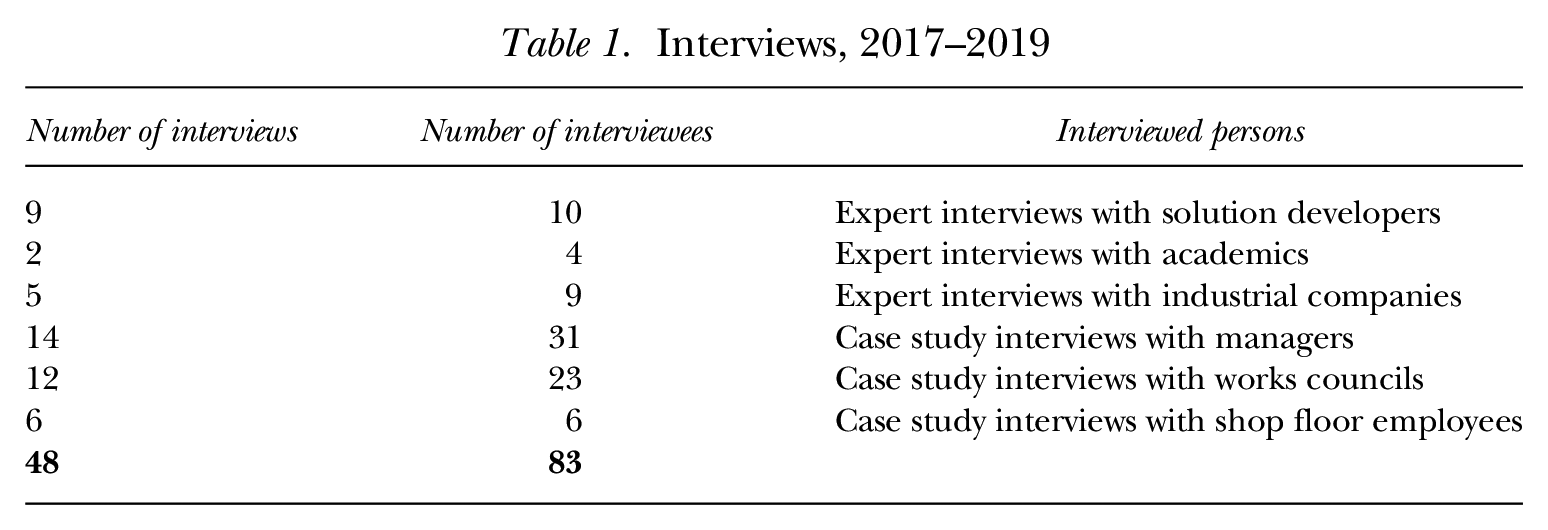
Our study was based on one- to two-hour interviews with 83 interviewees conducted in 48 meetings from 2017 to 2019 (see Table 1). This group included 23 experts (Bogner, Littig, and Menz 2009) and 60 interviewees from 16 companies. Almost all companies were globally active corporations (though the sites we examined are in Germany); such corporations have the resources to implement new technologies quickly. Typically, a case study in a company consisted of an interview with the responsible managers and works councils; in some cases, shop floor employees also participated in the interviews. We conducted worksite visits in every case study to observe the implementation of the wearable in the work processes. We also included every available report, from magazines, journals, online sites, and the companies themselves, in our analysis. The interviews with management representatives often involved different functions (e.g., operations, IT). When conducting interviews with the works councils, the chairperson often took part, along with the works council members responsible for IT and data protection. The composition of the interviews by type of interviewee is shown in Table 1.
Interviews, 2017–2019
Case selection was guided by three major considerations regarding diversity (Seawright and Gerring 2008: 301). First, we tried to include as many of the wearable usage scenarios as possible. To capture the population of the ongoing implementation projects of wearables, we identified 25 solution providers, totaling 87 reference cases in 2018. We contacted all these cases and continued to seek access until we collected 16 case studies that offered enough diversity on our three dimensions of interest. Table 2 provides an overview of the case studies and the interviews conducted in each company.
Case Studies Overview
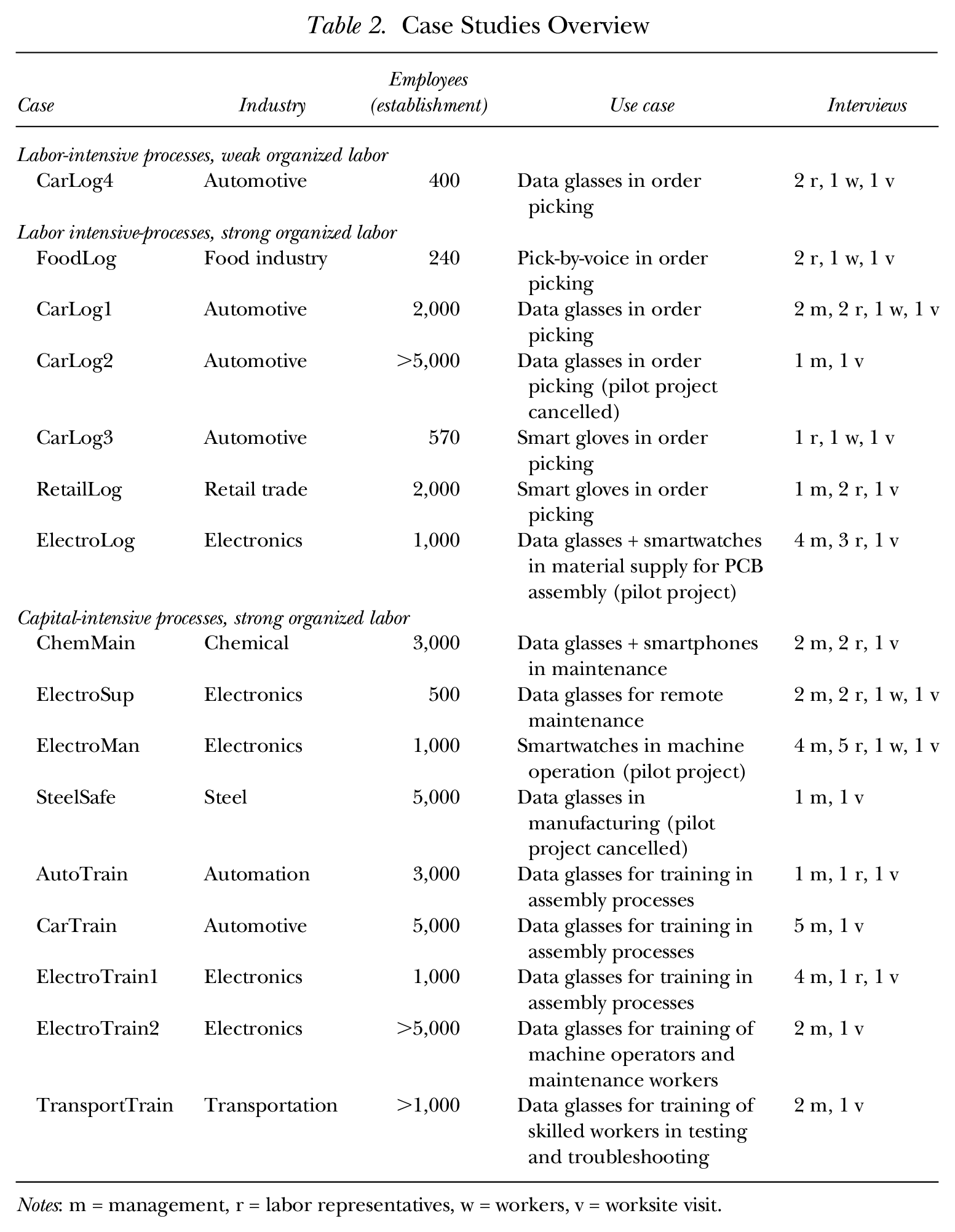
Notes: m = management, r = labor representatives, w = workers, v = worksite visit.
Second, we aimed at including the two major types of first-order factors described earlier in this article, namely labor-intensive logistics processes and capital-intensive manufacturing processes.
Major examples of labor-intensive processes include logistics and assembly. They are characterized by tasks with a low complexity that can be standardized but not automated. Semi-skilled workers are mostly used for these tasks. Computer-based systems have been used in assembly processes since the 1980s and 1990s, with information about the product, the required parts, and sometimes assembly steps being displayed on a screen to ensure the standardization of processes and to reduce errors (Krafcik 1988; Liker and Hoseus 2008). The use of assistance systems also has a long history in logistics. In the 1990s, workers still received orders on printed paper lists and recorded the work steps performed by scanning barcodes. However, during this time, efforts were being made to control logistics workflows more closely, for example, by prescribing work steps via handheld computer screens in place of the previously used paper lists (Bonacich and Wilson 2008; Hompel and Schmidt 2008).
Our cases in manufacturing come from capital-intensive production areas (automotive, automation, chemical, electronics) dominated by skilled workers. These cases have a longer history of using assistance systems in the form of large display panels, sound signals, and other solutions, making information from the machines visible or audible far into the production halls and enabling workers to move away from a machine and take on a larger number of tasks.
Third, we tried to ensure that we included cases that differed regarding the power of organized labor, that is, unionization levels and the strength of the works council. Despite our efforts, we were unable to conduct case studies in companies without works councils, but we considered cases characterized by various levels of labor strength and included at least one case of very low unionization and a weak works council (see Figure 2).
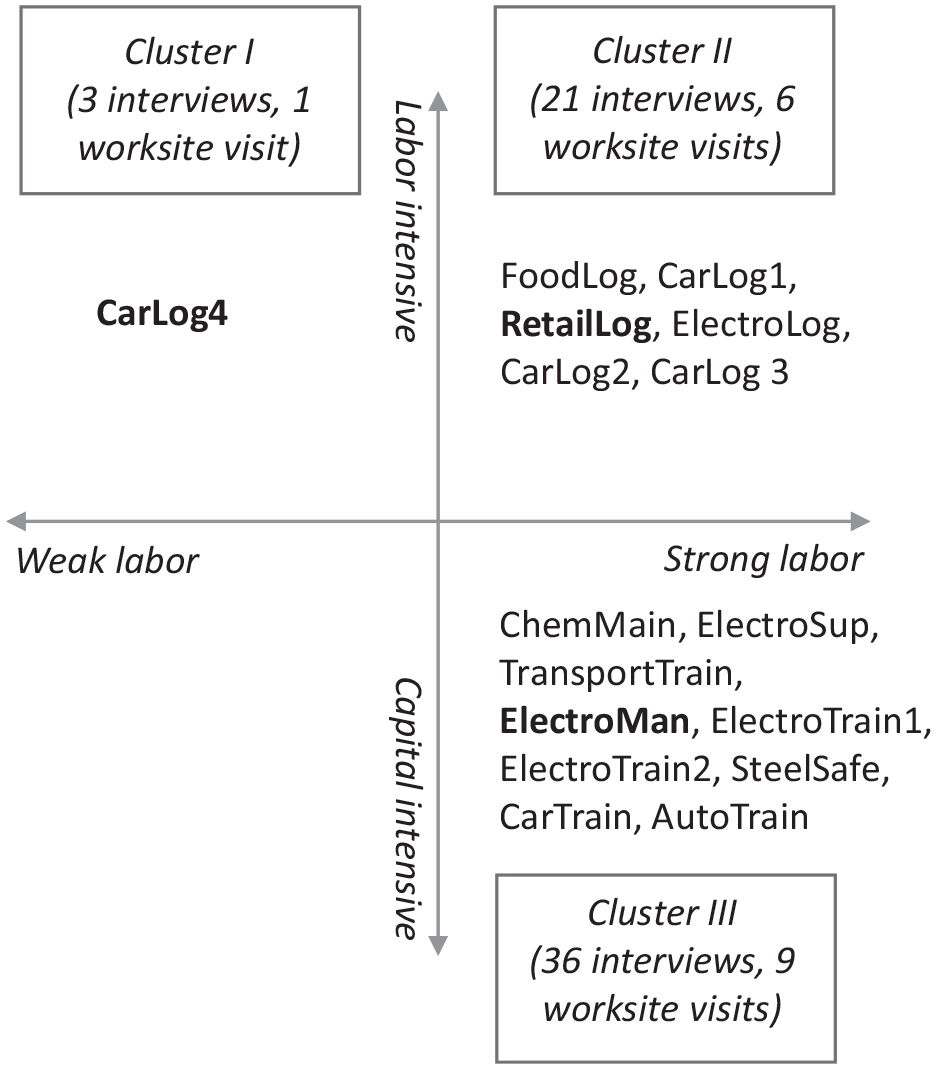
Clusters of Cases by Strength of Labor and Capital/Labor Intensity
The dual nature of employee representation in Germany must be borne in mind when measuring labor strength. Employee interests are represented by the works council, which is elected by all employees. It has extensive institutional power, as explained above. However, its ability to mobilize the workforce is also important for its actual influence, and the degree of unionization is a good indicator of this. In works council elections, the respective sectoral union runs its own list, and a high degree of unionization is usually accompanied by a very high union majority in the works council. We will therefore use the unionization degree as the indicator of labor strength in the case studies.
Our workplace interviews form three clusters, as illustrated by Figure 2. Cluster I (weak labor/high labor intensity) consists only of CarLog4 (three interviewees plus a worksite visit). This cluster is significant because it is the only case that allows us to discuss the impact of differences in the power of organized labor. The focus of our analysis is, however, on comparing Cluster II and Cluster III. Cluster II (strong labor/high labor intensity) represents 21 interviewees and six worksite visits in companies. We focus on the RetailLog case to illustrate the characteristics of this cluster. Cluster III (strong labor/high capital intensity) represents 36 interviewees and nine worksite visits in companies. We will discuss the characteristics of this cluster using the case of ElectroMan.
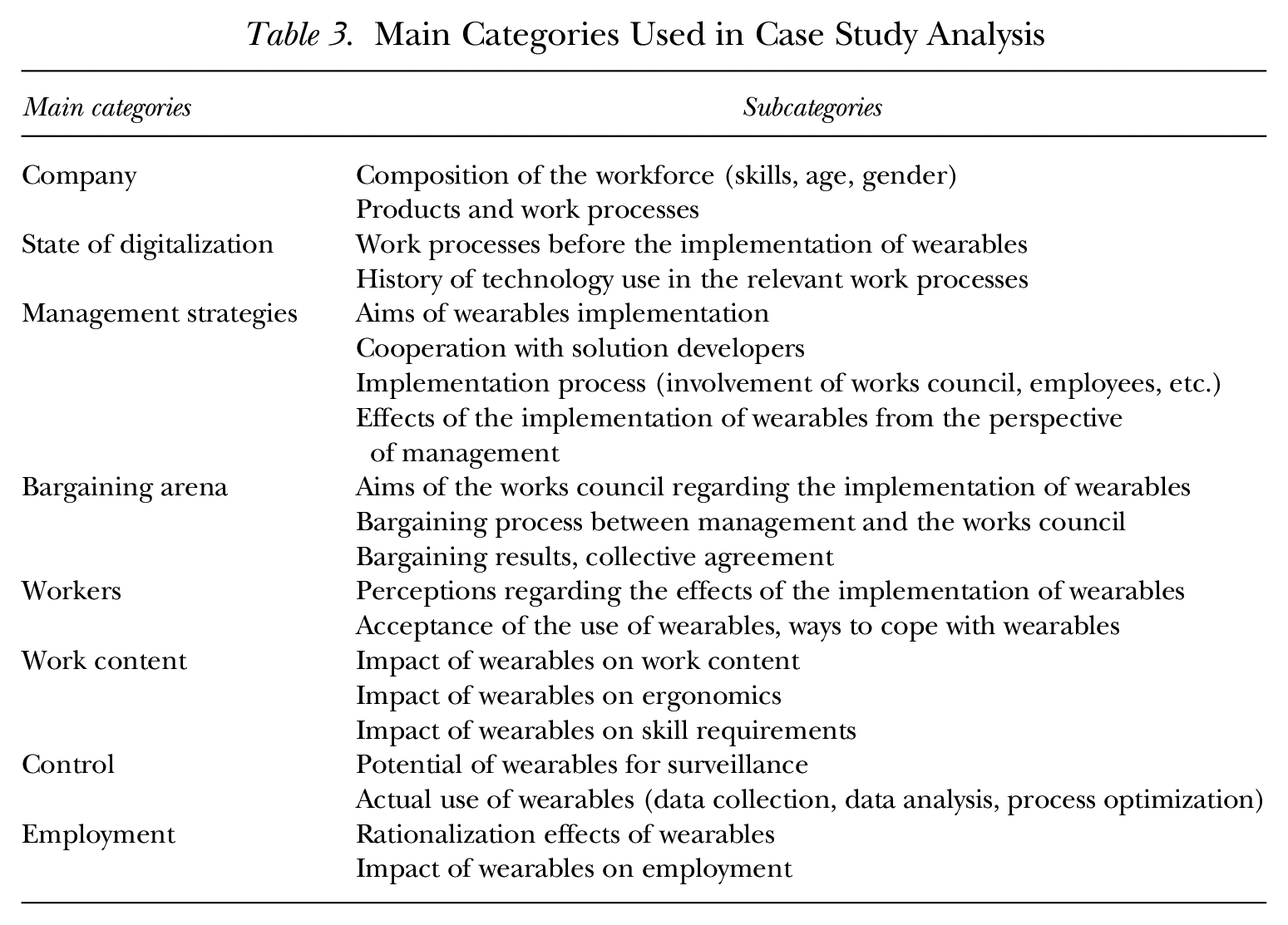
The interviews were recorded and transcribed. In some cases, the interviewees did not wish us to record the interview; in these cases, we took extensive notes. Analysis of the interviews was guided by our conceptual model and based on qualitative content analysis (Mayring 2004). The main categories of analysis are presented in Table 3.
Main Categories Used in Case Study Analysis
Note that the interviews with works councils were our major source regarding the employees’ perceptions of wearables. We spoke with shop floor employees in six case studies; this was not possible in the other case studies, where we could only observe the usage of wearables during worksite visits. In our assessment, however, works council members had excellent knowledge of the processes, problems, and perceptions on the shop floor, and we consider their accounts to be reliable.
Empirical Findings
In the following section, we illustrate the characteristics of the three clusters with one case study each. In the subsequent comparative discussion, we place the case studies in the context of all interviews in the respective clusters to draw general conclusions.
Cluster I: Labor-Intensive Process, Weak Works Council
Cluster I consists of only one case, CarLog4, and is based on interviews with two works council members and one worker as well as a worksite visit. The labor process of CarLog4 shares many characteristics with the other cases in logistics, but at the same time it represents a constellation with a particularly weak works council and low unionization (<10% of employees). CarLog4’s parent company is a global logistics company with more than 20,000 employees worldwide. CarLog4 is a logistics site located directly at an automotive plant and responsible for the just-in-time (JIT) delivery of a variety of components (molded headliners, center consoles, handles, wiring harnesses, exterior mirrors, seats, and exhaust systems) to the plant. Approximately 400 employees work at CarLog4.
The work process in logistics at CarLog4 has long been controlled digitally by means of the car manufacturer’s JIT logistics management system. Parts call-offs, with details of the parts, delivery locations, and delivery times required, are transmitted through the JIT system directly to the picking systems in use at CarLog4. The case study focused on the use of wearables in an area where larger parts are picked and where, previously, three employees per shift worked with paper lists and hand scanners. One of the company’s key goals was to speed up the picking process. At the same time, according to the works council, it was a prestige project with which the company wanted to demonstrate its technological capabilities.
The introduction of wearables meant that employees were equipped with data glasses connected to the JIT system. The glasses displayed information about the parts to be picked, as well as the location of these parts. The workers had to confirm each step of the work process either by scanning the code of the picked parts with the camera integrated in their data glasses or by reading the code and recording it with the glasses’ microphone.
The weakness of the works council had a clear impact on the implementation of the technology. Despite the legal requirements, no risk assessment regarding the impact of wearables was carried out by the management, and the works council was not informed and consulted. The data glasses were used for two years, but it soon became clear that they worsened the ergonomics of the work process. The employees complained of headaches throughout the period because the glasses were too heavy and the displays too small. In addition, the data glasses and their batteries broke down repeatedly, interrupting the work process and causing additional stress for workers. Without a strong works council, it took two years before the employees’ complaints convinced management that the use of data glasses would not bring any benefits. Instead, the system was changed to a combination of tablets and RFID wristbands. The employees now moved around the warehouse with their carts, on which a tablet was mounted. Based on the retrievals in the JIT system, the tablet showed which items were to be taken from which boxes and in what numbers, along with the baskets in the cart in which they needed to be placed. When the employees loaded the parts, the RFID chip automatically registered the pickup.
The impact of the new technology on the work process was double-edged. On the one hand, the use of wearables continued the trend of standardization of work, eliminating even the few decision-making options about the sequence of work steps that still existed when working with paper lists. On the other hand, the intensity of work hardly changed because this was primarily determined by the speed of call-offs from the automotive plant and staffing levels in the logistics warehouse. The use of the RFID wristband even slightly reduced work intensity at the beginning because barcodes no longer had to be scanned during the picking process.
However, the company used the time savings to reduce the number of employees working in the affected area from three to two, along with a floater who was assigned to two areas (in other words, 2.5 employees). In this way, the slight reduction of work intensity because of the introduction of wearables was compensated for by the adaptation of staffing levels. The works council complained about the combined impact of the pressure from the automotive manufacturer and the logistics company’s strategy of understaffing:
We are, after all, dependent on the [car manufacturer]. They determine the quantities and call-off times. If they want to build 3,000 units, we can’t say that we’ll only deliver 2,800 so that the people don’t have too much work. [In some areas], the targets are already tough and people have to run to reach them. (IV27 [interview 27])
Both the data glasses and RFID wristbands could be used for individual performance monitoring, especially because of the lack of a works agreement on this topic. The works council and management, however, reported that there were no such efforts. Given the already existing pressure on workers, the works council did not believe that management would benefit from additionally monitoring individual performance in this way.
Cluster II: Labor-Intensive Process, Strong Works Council
Cluster II consists of 21 interviews and six worksite visits in companies. To illustrate its characteristics, we chose the case of RetailLog; it shows strong similarities to CarLog4 regarding the work process, but it differs considerably regarding the role of the works council. We interviewed two works council members and one worker and conducted a worksite visit to observe work processes. RetailLog is a global retail group with more than 200,000 employees worldwide. The site under study is a large warehouse that supplies the group’s sales locations and has about 2,000 employees. Approximately 600 employees work in administrative functions; the remaining 1,400 are industrial employees.
The work process in logistics has long been guided by digital systems. Employees drive through the warehouse on tugger trains equipped with a computer that displays the exact list of goods to be picked up and their locations. Workers confirm the pickup by entering control numbers indicated at the location and scanning the goods’ barcodes. Although the system precisely specifies the sequence of steps for processing the order, employees could always deviate from it and plan their own work steps, as both management and works councils agreed that the workers can often make better judgments than the system.
The case study’s focus was on the introduction of smart gloves in the picking process. These are special gloves that have a lightweight scanner, which is connected to the picking system through Wi-Fi. The smart gloves replaced the large handheld scanners previously used. The company’s goals were to try out the technology and further increase the efficiency of the picking process.
The strength of the works council (the majority of workers are unionized at the site) and the cooperative management–labor relations resulted in a technology implementation process that differed strongly from that at CarLog4. Management and the works council agreed on a pilot project: Twenty-four employees tried out the smart gloves for one month and were surveyed afterward. Works council members also tried out the smart gloves for one day. The gloves’ use was evaluated very positively overall, but the team identified a need for ergonomic improvement. Special gloves were introduced for use in summer and winter. Once these issues had been solved, the use of smart gloves was extended to all picking workers.
The impact on the work process was regarded as positive. The work content had not changed, but the picking process had become faster and smoother because the handheld scanners were no longer needed. The company estimated that scanning time had been reduced by 50%. The works council emphasized three points to explain workers’ positive perception.
First, despite the reduced picking time, the introduction of wearables was not directly linked to an increase in targets. There were, indeed, regular negotiations between management and the works council about an adaptation and increase of performance targets, but the works council emphasized that the performance targets needed to be kept within a framework that could be well managed by the employees:
Nobody gets their head torn off if they talk to someone for two minutes. And as a rule, these are . . . feasible figures that you can actually manage in eight hours. (IV28)
Second, when the smart gloves were introduced, the works council agreed with management that no personal data would be collected and that no functions allowing the surveillance of workers (such as GPS) would be installed. The works council argued:
I will tell you about the actual practice in our company. . . . There is also technical data that you can’t fend off and where you say, “okay, this has to be collected.” But even then, this data will never be analyzed or used against workers. (IV28)
Third, it was important for the works council that the assistance system gave employees discretion in how they used it. Employees were free to decide whether to follow the instructions of the digital assistance system or to plan the sequence of work steps themselves. This design is certainly more human centered than the rigid system in the CarLog4 case (where workers had to follow the orders of the system), but it also presupposes a setting of performance targets that leaves employees time to plan their own work steps.
Cluster III: Capital-Intensive Process, Strong Works Council
Cluster III consists of 36 interviews and nine worksite visits. We illustrate the characteristics of Cluster III using the case of ElectroMan, in which we were able to interview four managers, five works council members, and one worker. ElectroMan is a global industrial corporation with more than 200,000 employees worldwide. The site under study is an electronics plant that manufactures electronic assemblies and programmable logic controllers (PLCs). More than 1,000 employees work at the plant. The case study took place in a semi-automated line consisting of six stations. The line was controlled by two skilled workers per shift who took care of material feeding, setup, and reprogramming as well as maintenance tasks.
The introduction of wearables meant the development of an assistance system for machine operation. The assistance system ran on a smartwatch that was connected directly to the production line and the machines’ controls. It read the status of the machines and could thus issue error messages in the event of malfunctions and provide information on the status of order processing. Employees could confirm that they were taking on the task when they received error messages or messages about retooling or material replenishment. All this information was previously displayed by light signals at the stations, which required employees to be near the stations.
The strength of the works council and the cooperative management–labor relations had a direct impact on the technology implementation process. The works council was involved from the very beginning and the whole project was monitored by a joint management and works council group. The group decided that six production employees would test the system over the course of nine months. After this tryout, management and the works council would decide together whether to implement the new technology in regular work processes.
After the nine months, the use of wearables was assessed positively by workers and the works council. The works council emphasized several reasons for this outcome. First, management and the works council agreed that the system should not be used to monitor workers. The company developed its own operating system for the smartwatches and disabled some functions (such as sensors for body temperature) that were built into the technology. The company’s general works agreement defined the data protection rules. Management and the works council agreed that they would additionally develop a specific agreement for the usage of wearables. The works council emphasized the most important points for this agreement:
Now that the [pilot] project is coming to an end, we will establish some key points. We have to ensure the hygiene conditions, so make it clear that the watches are permanently assigned to workers and not rotated. We need to make sure that people can turn off the smartwatches during the breaks and not be interrupted. We need to make sure that there is no analysis of the data for performance monitoring, so that, for example, the data is deleted on a daily basis. We’d also like to have the ability to include cellphones in case some employees don’t want to wear a watch. (IV41)
Second, the use of smartwatches made the handling of problems on the line easier for workers and broadened the scope of their work and their responsibilities, making work more interesting. The use of smartwatches allowed the workers to be deployed for other tasks if they were not currently needed on the line and to be informed about the functioning on the line at all times.
Third, management and the works council agreed that the introduction of smartwatches would not be used as an opportunity to cut staff on the line. The works council recognized the danger that the flexibility of deploying workers on several lines could result in work intensification: We discuss this in the works council: Will people be more broadly deployable? Will jobs be cut? Is there that risk? Our plant management promises that this will not happen. They want to use the time gains for people to work on new ideas, on improvements. We will see. . . . We’re counting on building mutual trust. (IV41)
Managers emphasized that the company has rationalization targets of 8–10% every year and that the use of smartwatches would simply help achieve them. So far, such rationalization targets have always been compensated by growth in production volume, and management expected the same in the future.
An interesting aspect of the ElectroMan case study was how the implementation of new technologies such as wearables changed the way the works council itself had to operate. It had to deal with a high number of technology implementation projects but lacked the time and expertise to assess the changes right at the start of the projects. The works council therefore did not try to regulate projects immediately but agreed with management that it would be a project participant and develop its position over the course of the projects. The challenge for the works council was to mobilize sufficient personnel for this approach:
We have our agreements, we have our Works Constitution Act, but it’s often not practical. We have discussed how we need to change our work to find more workable ways. . . . In the past, we would have made an agreement at the beginning and regulated everything. Now we do it iteratively. We run projects and go with it. Everything is simply developing too fast for us to do it any other way. (IV39)
The works council also needed to communicate on an ongoing basis with the workers and the engineers about the status and implementation of the project—this was the only way for the works council to understand what a specific technology in the workplace really meant.
Comparing the Clusters
We have presented the three case studies in more detail to illustrate how wearables function in work processes, how their use is negotiated, and how they affect work. They each represent characteristic traits of their cluster. In what follows, therefore, we place them in the context of all interviews and case studies to identify general findings. Table 4 provides an overview of the three clusters focusing on the three core dimensions of our analysis: the specific challenges management is facing, the managerial goals and strategies when introducing wearables, and the outcomes for workers.
Case Study Summaries
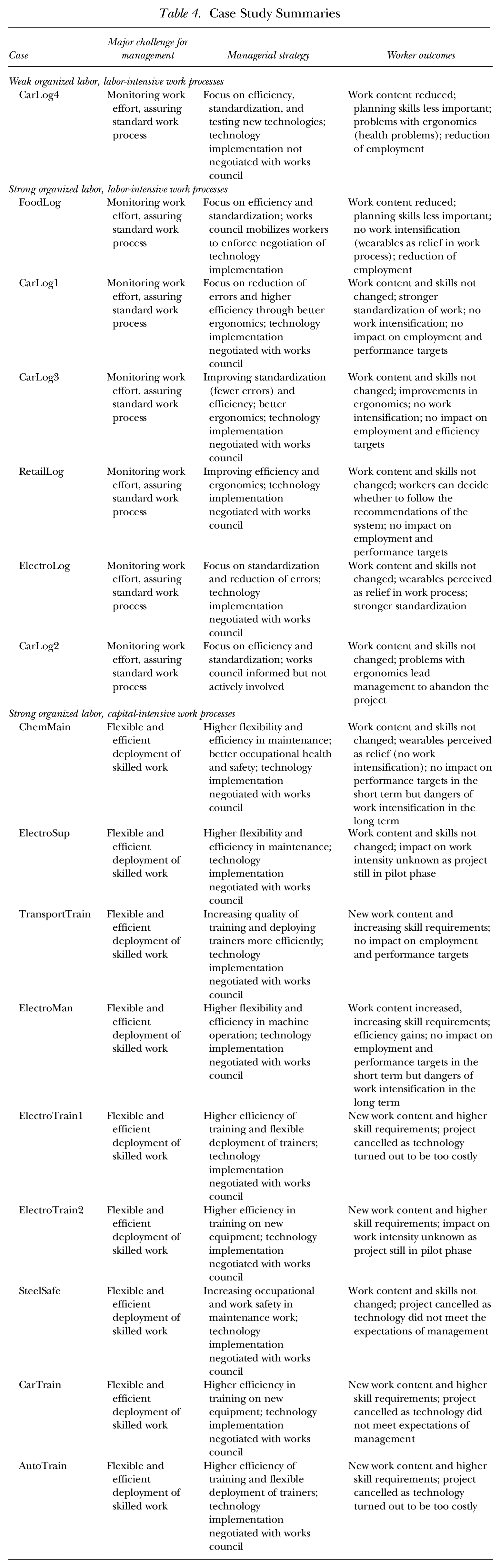
With regard to the first axis of interest to us—the strength of organized labor—we see a difference between Cluster I (with the extreme case CarLog4) and both Clusters II and III in terms of the involvement of the works councils in the planning and testing of technologies, in the implementation of measures such as risk assessments, and in the consideration of workers’ interests with regard to technology design. In the extreme case of CarLog4 (Cluster I) with a weak works council, management can neglect even the basic legal requirements and introduce a technology that is not ergonomic and causes health hazards. The technology design is focused on standardization and control of the work process. All the cases in Clusters II and III feature strong works councils, and works council members were involved early on in technology selection and implementation; the technologies were thoroughly tested and then designed with workers’ demands in mind. These findings underline the interdependence of labor’s institutional and associational power, as recent studies from other contexts also show (Anner, Fischer-Daly, and Maffie 2021).
The strength of organized labor affects the issue of ergonomics. CarLog4 (Cluster I) is the only case study in which management was able to ignore the ergonomic problems of wearables, at least for an extended period of time. The resistance of workers was an issue in the cases we studied, and it was primarily roused by issues regarding the ergonomics (and, in some cases, the lack of functionality) of the technologies. Ergonomic problems with wearables also occurred in Clusters II and III. In these cases (e.g., CarLog2), however, implementation was canceled after objections from workers and labor representatives.
The strength of organized labor also affects employment and performance management. In the German regulatory setting, it is generally difficult for management to use technologies such as wearables for direct individual monitoring of workers—this clearly distinguishes Germany from countries such as the United States (Doellgast and Wagner 2022; Vallas, Johnston, and Mommadova 2022). We did not find direct individual monitoring of workers through the use of wearables in any of our clusters/cases. However, CarLog4 (Cluster I) operated with an understaffing policy and passed on the performance demands of its customers directly to the workers. The efficiency gains from wearables were directly used for corresponding reductions in the number of employees (even if the workers were not laid off but were instead shifted to other work processes). In most cases in Clusters II and III, we observed no such direct link between technology introduction and employment reduction. These companies, too, had regular productivity targets, but their implementation was negotiated on a larger scale between management and the works council, and both sides agreed to compromises regarding staffing levels.
One exception was FoodLog (Cluster II), a company with a high degree of unionization and a strong works council. While the other companies introduced wearables in settings that were already digitalized, FoodLog was a laggard and the introduction of wearables was accompanied by a digitalization push in switching from paper lists to completely digital systems. In this context, wearables implied a massive reduction in work content: If workers previously had to plan their picking routes themselves, the software now took over and showed them the sequence of work steps and the locations of the goods or parts. This reduced staffing in order picking by 50%. The works council mobilized the workers and obtained a promise that no one would be laid off. The workers were transferred to other jobs.
We emphasize, however, that even in Clusters II and III, works councils reported considerable uncertainty regarding the long-term impact of wearables on employment and performance management. They expressed fears that the mere visualization of performance data through wearables (and digital assistance systems) could put “soft” pressure on workers. They also noted that, in practice, supervisors might well secretly keep their own notes on workers, even when such individual performance monitoring was precluded by regulation.
The second axis of comparison is the introduction of wearables in work processes that were labor intensive (characterized by semi-skilled work) and capital intensive (characterized by skilled work). A key finding of our study with special regard to Clusters II and III is that the impact of wearables on work differs massively between these two clusters and is associated with different bargaining issues and challenges for works councils.
In labor-intensive work processes, wearables strengthened the standardization of work and sped up the work process—this development was independent of the strength of organized labor. This did not necessarily mean higher work intensity. In most cases, the efficiency gains were small and primarily reduced the time pressure on employees, who no longer had to handle scanners and tablets to enter data. These work processes have long been organized according to lean principles and conducted using digital assistance systems; in this context, wearables often reinforced the existing systems.
It was striking that, despite standardization and rationalization, across nearly all cases in Cluster II, the works councils and workers reported a relatively positive perception of digital assistance systems and wearables. They argued that wearables created small time savings that slightly reduced work intensity—at least as long as performance targets remained the same. In addition, because work processes were now planned by the software, delays could no longer be blamed on employees. This finding can be illustrated by quotes from many interviews and cases. In the abovementioned FoodLog case, for example, the company introduced a pick-by-voice system that guided employees step by step through all picking operations, taking over all the planning. However, this planning responsibility had been perceived as stressful because of the time pressure, and the new pick-by-voice system was seen as a relief. We report a similar situation in the CarLog1 case. Here, the pickers worked on an assembly line, with call-offs from the line dictating the work cycle. A pick-by-vision system based on data glasses was introduced, replacing handheld scanners. Although the process had hardly changed, the workers reported a reduction in their workload:
I can work much more quietly with the glasses and have more time. With the scanner, I sometimes lost time; I had to run twice to put the scanner down and pick it up again. . . . Before, with the scanner, it was a real mental pressure to see if I can make the round. (IV20)
Fears of surveillance and employee concerns about data protection were rarely reported. Some works councils complained about this, and the FoodLog works council in particular reported that it had to work hard to mobilize employees to build up pressure on management, so that management would clearly rule out the storage of wearables data. The reasons for this behavior cannot be systematically investigated here, but it seems that many employees rely on the regulatory power of the works councils and, at least in part, somewhat underestimate that this power must occasionally be supported by exerting direct pressure.
The cases in Cluster III—capital-intensive work processes—show very different developments when compared to Cluster II. As the ElectroMan case study showed, efficiency gains emerged from the ability to detach production workers (e.g., machine operators) from specific machines or production lines and use their labor more flexibly. In other cases, wearables were used to allow trainers to be more flexibly deployed to take care of a higher number of workers. To deploy skilled workers more efficiently and flexibly, companies used digital assistance systems and wearables to reduce unnecessary information procurement and waiting times. This trend led to an expansion of work content and thus higher skill requirements.
In the long term, however, some of the interviewees also considered it possible to link digital assistance systems with knowledge databases, enabling less experienced workers in production and maintenance to perform more complicated control or maintenance operations with the help of a software system. Future systems could also automatically generate precise instructions for problem solving—this development could reduce the need for worker skills. However, today’s technology is not yet sufficiently developed for this. Works council representatives also emphasized that even elaborate digital assistance systems would not make skilled workers redundant. In some cases, such as the chemical industry, they pointed to specific legal requirements related to occupational safety. Automated equipment in the chemical industry can only be operated by workers with a high level of vocational training, regardless of the use of digital assistance systems.
Thus, the key challenge for works councils in Cluster III was to avoid an intensification of work. The flexibilization opportunities could have been used by companies to simply expand workers’ tasks. In our case studies, such work intensification had not yet taken place. In the case of ChemMain, the very strong works council even argued that the work-related data created by wearables facilitated negotiations because the works council could document the work overload of maintenance workers and convince management to increase staffing levels to avoid problems with machinery. Nonetheless, uncertainty remained. We observed the implementation of wearables in an early phase in which the long-term consequences for performance could not yet be observed.
Conclusion
Wearables are seen as emblematic of a new world of work. In conjunction with digital assistance systems, they open up new possibilities, not only for context-specific information but also for controlling and standardizing work. While we lack systematic empirical analyses of the use of wearables in the workplace, initial studies have assumed that management possesses an unchallenged power to introduce these technologies, argued that they are used for surveillance and de-skilling, and addressed workers’ agency primarily as resistance (Kellogg et al. 2020; Jarrahi et al. 2021; Wood 2021). These arguments effectively repeat argumentative figures from the early labor process analysis (Braverman 1974) without reflecting on the developments this theory has taken since that time.
By contrast, this article builds on the concept of the workplace as contested terrain and the recent contributions from labor process theory distinguishing regulatory regimes, first-order factors, and second-order choices of technology (Thompson and Laaser 2021). It develops two core contributions to the research literature.
First, it argues that managerial strategies must assert themselves in workplace bargaining and conflicts with labor. The case studies presented in this article show that a strong labor voice is just as associated with positive effects on the implementation and use of new technologies for workers as with efficiency gains in the labor process. This finding is consistent with other studies on the positive impact of participation on performance (Litwin 2011), the advantages of labor–management productivity coalitions (Edwards et al. 2006), and the need for a stakeholder theory of the firm (Kochan and Rubinstein 2000). The case studies also illustrate the relationship between the institutional and associational power of labor. The struggle for human-centered technology implementation and usage in the workplace might need both the mobilization of workers’ voice and the establishment of institutional participation rules.
In systems with strong associational and institutional power of organized labor, we see a type of performance regulation that we can describe as “soft pressure.” In the German context, we find few cases of digital “despotism” (Wood 2020), but the new technological systems promote forms of performance control with visualization of processes and direction of workers, which can lead to an intensification of work or to an improvement in the quality of work, depending on the context. Further research is needed here.
The second core contribution of our analysis lies in linking the second-order process (in terms of Thompson and Laaser 2021) of technology implementation with organizational first-order factors. We are still lacking comparative studies that explore how organizational factors influence the impact of new technologies on work. For our case of wearables and digital assistance systems, we distinguish at the level of first-order factors capital-intensive and labor-intensive organizations, which are each associated with specific challenges for management, strategies of technology implementation, and a range of outcomes for workers. Table 5 summarizes our theoretical argument.
Managerial Strategies and Worker Outcomes in Labor- and Capital-Intensive Work Processes
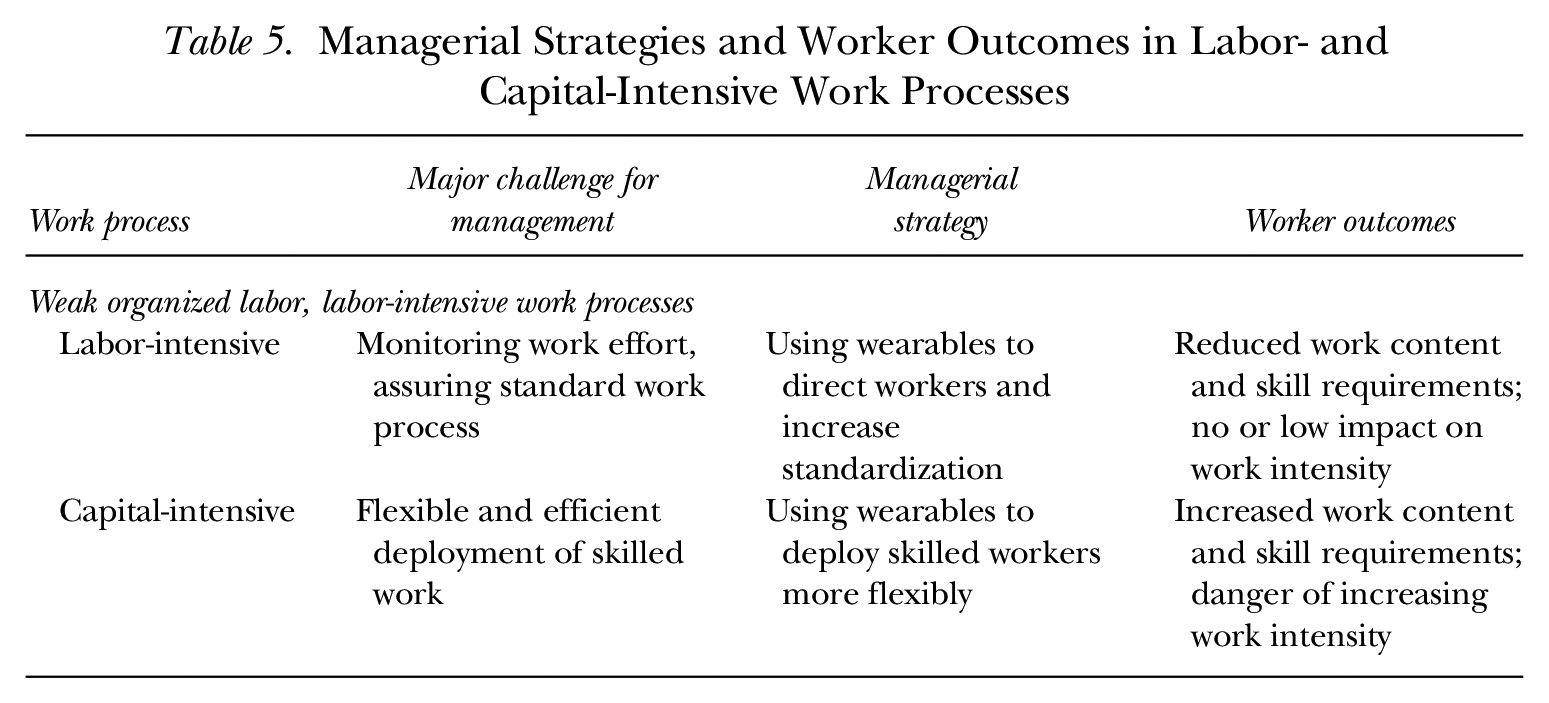
We show that the managerial interest in standardization and monitoring of workers was stronger in the area of labor-intensive processes, while in capital-intensive processes, the main focus was on making labor deployment more flexible. The impact on work content and skill requirements also differed: While standardization of work and reduction of work content prevailed in labor-intensive processes, capital-intensive processes were most often characterized by the extension of skill requirements and the risk of work intensification. This trend is linked to the challenges management faces in labor-intensive and capital-intensive processes. In the first, securing work effort and enforcing standards is a core challenge, while in the second the focus is on avoiding idle times and deploying workers as flexibly as possible.
Our comparison of labor-intensive and capital-intensive work processes differentiates the findings of previous research, which has focused primarily on the labor-intensive processes (e.g., platform work, logistics work) (Moore and Robinson 2016; Wood 2021). With regard to these work processes, research emphasizes the standardization of work, monitoring of workers, and reduced scope of action for workers as core outcomes of digitalization. We show, however, that in capital-intensive settings, management is less interested in standardization and monitoring of work than in the flexible deployment of skilled workers in order to efficiently manage as many systems and processes as possible. The use of wearables and digital assistance systems is intended to enable this flexibility and therefore tends to increase work content and to promote upskilling—beneficial outcomes for workers that have not yet been taken into account in research.
Our analysis also sheds an interesting light on the research debate on the connection between digitalization and work intensification (Wood 2020; Green et al. 2022). Thus far, researchers have argued that digitalization generally promotes work intensification (“effort-biased technological change”; Green et al. 2022). Our findings suggest that this argument needs to be differentiated along the regulatory regimes and organizational first-order factors (labor-intensive versus capital-intensive processes) that we have analyzed:
In the case of labor-intensive processes, we find work intensification above all where the power of organized labor is weak and management alone controls technology implementation. In constellations with strong labor, the main problem is less work intensification than the reduction of work content and thus the degrading of work.
The dangers of work intensification are more pronounced in capital-intensive work processes and with regard to skilled work, precisely because the managerial focus is on the flexible deployment of workers. Labor representatives must strike a balance here by supporting the upskilling associated with technological change, while at the same time avoiding an excessive expansion of workers’ responsibilities.
Finally, we want to point to two limitations of our empirical study. The first lies in our case selection. We examined companies with works councils, but in companies without works councils (or other forms of employee representation), management has much more freedom to implement new technologies. The second limitation is the time frame in which our study was conducted. We captured the early phase of the introduction of wearables and digital assistance systems. The short-term effects that we have observed could differ from long-term effects.
An important task for future research is further development of the concepts of regulatory regimes, and first-order and second-order factors/choices. For our subject matter, the distinction between capital-intensive and labor-intensive processes proved useful. For other technologies, however, this concept may be extended to include factors such as business models and organizational cultures. We focus on a single regulatory regime, but future research should develop comparative approaches. In this way, a more complex understanding of algorithmic management can be developed that goes beyond the control–resistance schema dominant in current research. The penetration of work processes by digital technologies and the capabilities of algorithmic management are only just beginning and will increase massively. A comprehensive research program must combine the analysis of technology implementation with studies of how these technologies are designed to identify ways for incorporating workers’ interests (Bailey and Barley 2020).
Footnotes

This article is part of the ILR Review’s ongoing Special Series on Novel Technologies at Work. Funding from Hans Böckler Stiftung 2016_200-1.
For general questions as well as for information regarding the data and/or computer programs used for this study, please contact the corresponding author at