



Abstract
Employers seek to transform labor power into labor by implementing multiple forms of labor control. These multiple control practices, however, may not obtain consent but rather resistance from workers. Why do employers’ multiple control practices fail, and how is this failure related to workers’ acts of resistance? The author draws on existing research to classify employers’ control practices into three categories—technical, organizational, and ideational—and argues that these practices contradict each other systematically and give rise to resistance. An ethnographic study at factories in China shows that employers’ control practices impose conflicting demands on workers. These tensions create the basis, grievance, and mentality for workers’ acts of resistance. This article provides a unified theoretical framework for analyzing contradictions within labor control and contributes to a long tradition of Chinese factory life ethnographies.
The conversation below occurred in an electronics workshop after 3 p.m. on May 24, 2019, between me (YG) and my line supervisor (H):
Everyone works on easy boards first. Only you do easy and difficult ones together!
We must finish all of them sooner or later, right?
Yes, but you will get off work soon, right?
Yes.
So, it will be the other team that finishes them. Moreover, you will be reprimanded if you make mistakes on the difficult ones. Why would you do that?
Right . . .
So, you work on easy boards first. The other team is doing the same.
We were discussing which printed circuit boards to prioritize so that our team could meet production targets. The boards came in order, but some were less complicated and more productive to work on than others. Working on the boards as they came was the rule—printed in large fonts, laminated in clear plastic, and pinned to my workstation. Managers reiterated the rule during workshop meetings and asked teams to support one another and take responsibility, sometimes with emotional appeals. However, these rules and requests were brushed aside on assembly lines.
As the context of this conversation suggests, employers implement multiple measures simultaneously to control workers, “reflecting the increasingly hybridised nature of managerial systems” (Thompson and van den Broek 2010: 7). These control practices include “technical control,” specifying work processes and standardizing workers’ activities; “organizational control,” arranging workers in a chain of command; and “ideational control,” motivating workers with inspirational ideas related to work and life. As the conversation exemplifies, however, these widespread control practices may not join forces to produce desired behavior, let alone consent, but rather encourage resistance—workers’ acts “intended either to mitigate or deny” employers’ demands “or to advance” their claims regarding labor (Scott 2008: 290). Why do employers’ multiple control practices fail, and how is the failure related to workers’ acts of resistance?
I argue that multiple labor control practices contradict each other. The tensions between technical, organizational, and ideational control undermine employers’ authority and generate the basis, grievance, and mentality of workers’ resistance. First, technical control reduces the requirement for workers’ skills, making workers replaceable. However, organizational control requires some unskilled workers to manage others, entailing the former to differ from the latter. Although employers attempt to differentiate between unskilled workers with and without supervisory roles, this difference is shallow: these workers face similar difficulties, such as long hours and low wages. This similarity in circumstances becomes the basis on which unskilled workers reciprocally ignore each other’s evasion of employer demands or cooperate in rewriting factory rules, as in the opening example. Second, organizational control ranks workers, demanding that those at the lower level comply with the instructions of those at the higher level. Meanwhile, ideational control tries to instill a strong work ethic in workers, encouraging them to take initiative at work. For example, workers are told to actively identify production problems and think outside the box for solutions. But, workers’ initiative often clashes with the labor hierarchy, the conflicts of which repeatedly give rise to workers’ grievances against employers and contempt for their demands. Third, ideational control emphasizes a worker’s individual responsibility, interest, and growth, but technical control makes no room for a worker’s development other than becoming familiar with specific tasks through repetition. The contrast between the ideal and the reality constantly reminds workers about their conflict of interest with employers. This situation incentivizes workers to view their relationship with employers from a zero-sum perspective and defy factory rules whenever the rules are unaligned with their interests, especially near the end of their employment term.
I witnessed these tensions during my ethnographic study of factory life in an industrial hub of China. From May to November 2019, I worked at two factories and lived in dormitories for workers in Guangdong Province. At the first factory, I worked as an ordinary worker—that is, an unskilled laborer without supervisory responsibilities—on the assembly line; at the second factory, I worked as an assistant to the human resources director. I wrote field notes every day and analyzed the data on an ongoing basis, moving iteratively between data and theory. The participant observation allowed me to join with ordinary workers, interact with managers and employers, and reflect on factory experiences. Moreover, working as a frontline worker and a junior manager offered me a unique perspective to compare how workers, managers, and employers interactively interpreted what happened in the workspace, such as whether a practice of control worked. These details were difficult to uncover through surveys, one-on-one interviews, or focus groups.
This article makes two contributions. First, it builds on the labor process literature and juxtaposes multiple forms of labor control. Although existing research typically studies only a single form of control and the related tension, in practice, multiple forms of control are deployed at the same time and in the same place (Veen, Barratt, and Goods 2020; Lei 2021). Juxtaposing employers’ multiple control practices reveals systemic tensions and their connection with workers’ acts of resistance. This approach further illuminates the hybridized form of labor control that the literature tends to view as complementary and thus enhancing labor control (Callaghan and Thompson 2001; Cooke 2006; Reed 2010; Thompson and van den Broek 2010). However, instead of emphasizing that employers effectively combine multiple control practices, the juxtaposition draws attention to the incompatibility and contradictions within the hybridized control.
Second, this article adds to the long-standing research about factory life in China. Existing ethnographies have shown how employers control workers through despotic workplace rules and gendered social networks (Lee 1998: chap. 6; Pun 2005: chap. 3). I show that employers continue these control practices, albeit less punitively. Moreover, employers turn to motivational ideas for labor control. Employers’ new control practices undermine the old ones, however, exposing their conflicting interests with workers and disposing workers to resistance. Although many acts of resistance are individual, some emerge from preliminary cooperation among workers. As Scott (2008: 298) put it, “these forms of resistance will win no set-piece battles, but they are admirably adapted to long-run campaigns of attribution.” My article thus sheds light on employers’ contradictory control as a source of labor agitation in China beyond the well-discussed despotic factory regimes or the government’s legal intervention (Lee 2007; Gallagher 2017; P. Chen and Gallagher 2018).
The Control Perspective in Labor Process Theory
Employers must transform labor power into labor and thus control workers at the point of production. Labor control can take various forms. First, employers can adopt technologies to (re-)design the production process and standardize each production task, increasing productivity and decreasing reliance on workers’ skills (Braverman 1974; L. Chen 2020; Veen et al. 2020). Second, employers can (re-)organize workers according to production needs and make some workers manage other workers, breaking original bonds and creating competition and conflict within workers (R. Edwards 1979; Burawoy 1982; He 2009). Third, employers can promote inspirational ideas for work and life, grant autonomy, delegate tasks, and institute grievance channels, thereby moderating workers’ collective militancy and playing up their individual interests (Friedman 1977; Burawoy 1982; Liang 2016; Wood, Graham, Lehdonvirta, and Hjorth 2019).
Despite these control practices, employers can solicit only varying degrees of consent and must confront resistance from workers (Thompson and Smith 2010). The limited effects of control stem from structured antagonism between capital and labor (P. Edwards 1986) and management’s bounded rationality and competing interests (Hyman 1987; Littler 1990). The uncertainty rooted in the structure and contingencies raises questions about treating labor control as a linear process that employers improve to counter resistance from workers, crystalizing into a dominant form at a specific period (Sturdy, Fleming, and Delbridge 2010). On the contrary, employers simultaneously engage in multiple control practices to convince and constrain workers (Storey 1985; Thompson 1990; Thompson and van den Broek 2010).
Following this line of inquiry, recent studies tend to focus on how employers can combine, blend, or hybridize multiple practices to control workers (Callaghan and Thompson 2001; Cooke 2006; Reed 2010). This research focus leads to two theoretical expectations. First, multiple control practices are compatible, if not complementary. Second, the combined force of multiple control practices can enhance labor control. However, the co-existence of control practices does not imply that they complement each other or can even operate independently. Indeed, employers’ control practices can become piecemeal or inconsistent as a result of managerial incapacity or contingent circumstances (Hyman 1987; P. Edwards 1990). The current focus underestimates the difficulty of bringing together multiple control practices; thus, a systematical analysis of the interaction of control practices can shed new light on the capital–labor struggle.
Theory: Control, Tension, and Resistance
I classify labor control practices discussed in the literature into three categories. First, “technical control” refers to ways of making products that divide production processes, standardize each task, and reduce manual operation. Second, “organizational control” refers to structures that employers impose on workers to regulate who directs whom to do what and who reports to whom for what. Third, “ideational control” refers to ideas that encourage or discourage certain workplace behavior and the ways of interpreting such behavior. In all three cases, the term “control” refers not to the intention but the consequence of the practice. For example, the intention of Taylorism might have been to increase efficiency, but the system has the consequence of pressuring workers to compete with one another (Braverman 1974; Taylor, Mulvey, Hyman, and Bain 2002). Similarly, establishing a chain of command might be necessary at a large factory, but it separates workers (R. Edwards 1979; Pachirat 2011); and emphasizing personal growth might motivate workers and save on monitoring, but it blames failure on individual workers (Zheng, Sun, and Wan 2015; Yan 2020). Each individual control practice thus weakens worker power.
That said, when these control practices are deployed at the same time or in the same place, they can conflict with each other and enable workers to resist. Figure 1 shows the tension that arises from the conflict between each pair of employers’ control practices. It also suggests how the tensions can give rise to workers’ acts of resistance.
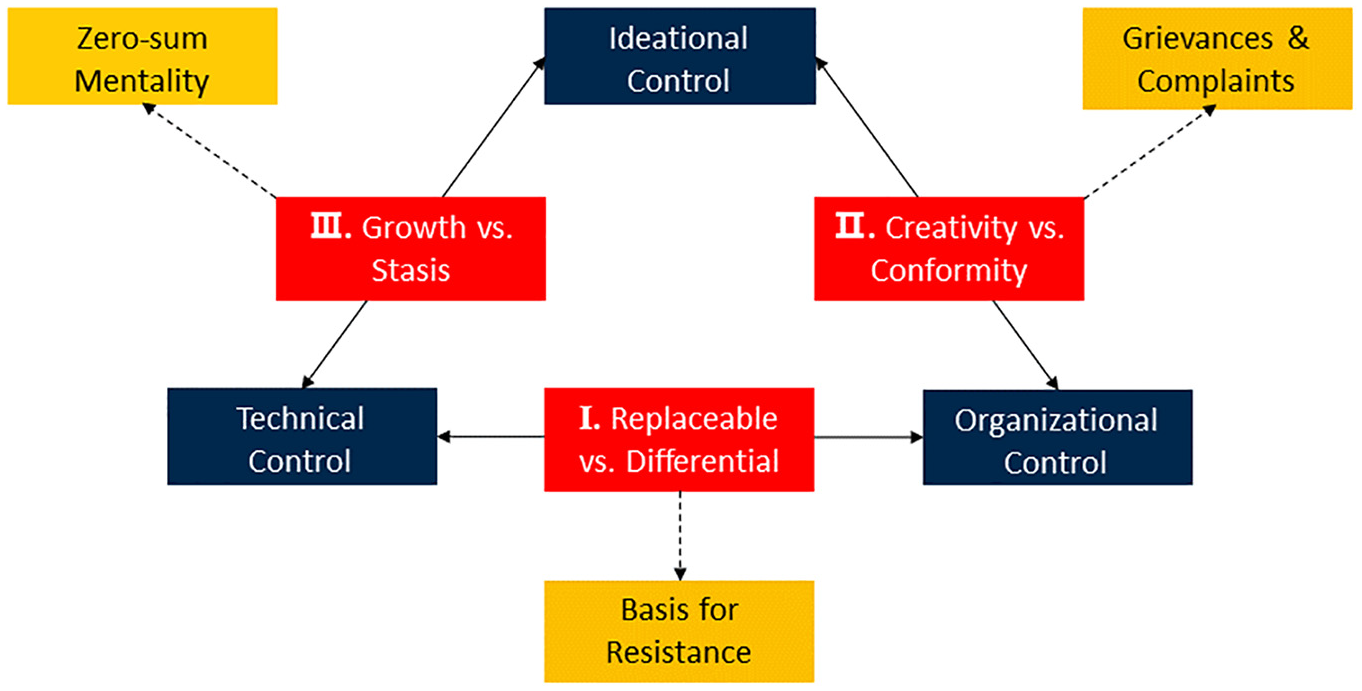
Theoretical Relationship between Control, Tension, and Resistance
Tension I, “Replaceable vs. Differential,” is rooted in the simultaneous practice of technical and organizational control. On the one hand, the practice of technical control entails automating some production tasks and reducing the dependence of other tasks on workers’ skills. It subjects workers to simplified, standardized operations. Thus, advances in technical control tend to be accompanied by an increasing number of replaceable, unskilled workers. On the other hand, mass production needs a scalable unit of production, such as an assembly line. To operate these units, employers organize unskilled workers into teams and promote some unskilled workers to manage others. I refer to such unskilled workers promoted to supervisory positions as “supervisors,” whereas I call other unskilled workers “ordinary workers.” Since both are unskilled, employers differentiate supervisors from ordinary workers as much as possible to justify this organizational structure. The combination of de-skilling jobs and differentiating workers creates a situation in which replaceable workers facing similar hardships of factory life occupy different factory positions. This tension lays the basis for supervisors and ordinary workers to assist each other in evading employer demands individually or bending factory rules collectively, especially when the demands or rules bring into focus common hardships unskilled workers face, such as long hours and low wages.
Tension II, “Creativity vs. Conformity,” mounts because the practice of organizational control emphasizes conformity, whereas the practice of ideational control valorizes creativity. Beyond the grassroots level, employers institute a full hierarchy in the workplace. This hierarchy ranks workers from the lowest to the highest: the higher a worker’s level, the greater that worker’s management responsibility. Workers at a lower level must comply with the instruction of those at a higher level, and workers at a higher level must firmly command those at a lower level. Consequently, the greater a worker’s management responsibility, the more likely that worker clashes with ordinary workers for conflicting interests. While maintaining the hierarchy, however, employers seek to improve productivity by motivating workers to work harder and take initiative. They encourage workers at a lower level to take pride in their work, identify problems in production, and think outside the box for solutions. Encouraged by such ideas, workers can question established rules or propose new ways of doing things. But when workers’ questions are ignored by employers or their proposals are suppressed by superiors, conflicts can break out and threaten the hierarchy. This tension disposes workers at the bottom of the hierarchy to nurture grievances against employers, complain about management, and disregard their rules.
Tension III, “Growth vs. Stasis,” arises from the contradiction between employers’ attempts at ideational control and technical control, particularly when it comes to ordinary workers. Employers promote ideas such as “individual responsibility” and “personal growth” to motivate workers to view their work not only as a way of exchanging labor for wages day after day but also as investing in themselves for the future. When workers perceive the labor that they put into work as a personal investment, they are incentivized to make more effort without extra monitoring or payments. In reality, however, these ideas can seem like pretexts for exploiting workers. When employers ask workers to work harder because they will learn more, employers’ encouraging words contrast with workers’ repetitive tasks involving few skills, especially for ordinary workers. Employers, nevertheless, may not have alternatives, as they are constrained from taking disciplinary action or unwilling to offer monetary rewards. The contradiction can expose how meaningless the ideas are that employers promote to workers; it can motivate workers to view their relationship with employers as only about material interests in the short term. When the relationship ends, or the stakes are high, workers with such a mentality can resist the claims made on them and settle the score with employers by, for example, sabotaging equipment or coordinating a work stoppage.
In sum, employers’ control practices can contradict each other and cause tensions. These tensions can undermine employers’ authority and inspire workers’ resistance, as they lay the basis of worker reciprocity and cooperation, generate grievances against employers, and cultivate a zero-sum mentality for workers to act on self-interests. The acts of resistance bear testimony to employers’ incomplete and contradictory control over workers.
Ethnography of Two Electronics Factories in Guangdong, China
To study how employers exercise control and how workers experience it, I worked at two electronics factories in Guangdong Province, China, from May to November 2019. China accounted for 24.8% of the net global industrial output in 2019, 1 ranking first worldwide and making it a prime site for studying labor control and resistance. In this section, I explain how I selected and accessed fieldwork sites and collected and analyzed data.
Selecting and Accessing Fieldwork Sites
I chose Guangdong because the province is where previous scholars have examined the capital–labor relationship in China and developed theoretical accounts of control and resistance, such as localistic despotism (Lee 1998), dormitory labor regime (Pun and Smith 2007), and minor and multi-sited resistance (Pun 2005). Furthermore, Guangdong continues to attract numerous private businesses and migrant workers. In 2019, Guangdong hosted at least 30,961 private industrial enterprises and 44.18 million migrant workers, ranking third and first, respectively, among all provinces in China. 2 The influx of capital and labor generates new forms of control and resistance in addition to those documented and analyzed in the literature. The multiplicity of control and resistance in Guangdong thus provides rich data to adjudicate competing theoretical expectations regarding whether employers can combine control practices to contain workers’ acts of resistance.
Moreover, I chose the electronics industry because it is both capital- and labor-intensive. This fact made the industry appropriate for studying the conflict between employers and workers. In 2019, for example, the industry of Computer, Communication, and Other Electronic Equipment employed 3.2 million of 12.4 million manufacturing workers (24.7%) and contributed 867.0 billion yuan to the manufacturing industry’s added value, which totaled 2,964.9 billion yuan (29.2%), in Guangdong (Guangdong Bureau of Statistics 2021). The nature and scale of the industry suggest a variety of control practices and acts of resistance, offering plenty of fieldwork opportunities to address the theoretical questions of this study.
That said, accessing specific electronics factories in Guangdong took a long time and some luck. I began fieldwork in Guangdong in May 2018 and spent the next three months volunteering at labor nongovernmental organizations (NGOs) and meeting lawyers, scholars, and officials. In December 2018, I revisited Guangdong and attended a business dinner. Over the dinner, I asked a business owner whether I could work at his factories for some time, and to my surprise, he agreed. Afterward, I followed up on the conversation with him and sorted out details with his administrator. On May 13, 2019, I joined the first factory (henceforth FGD1) and, four months later, switched to the second one (henceforth FGD2). I worked as an ordinary worker on an assembly line in FGD1 and as a human resources (HR) assistant in an administrative office in FGD2. Both were small and medium-sized enterprises (SMEs) and owned by the same businessman. 3 They set similar rules for worker compensation, promotion, and discipline. This similarity allowed me to assess the same practice of labor control from both workers’ and employers’ perspectives.
At both factories, I introduced myself as a doctoral student researching labor processes, which co-workers half-jokingly interpreted as “a student tasting factory life.” As vividly described in Chinese factory ethnographies (Lee 1998: 174–75; Pun 2005: 17–18), my co-workers also showed interest in why I was there and what I was doing. That interest, however, faded quickly due to the breathless factory pace and my unimpressive performance, especially on assembly lines. At FGD1, I suspected that the owner did not bother informing managers of my background, given how often they reprimanded me, but word about my identity eventually reached them. At FGD2, managers knew my identity, but since I worked in the office and most managers attended college, the difference in positionality did not seem to interfere with our office conversations or social activities after work. I did not bring notebooks or record conversations, including those with the owner and executives, for ethical considerations. Instead, I wrote daily fieldwork notes on my phone if I was at the dormitory or on my laptop if I was away. I anonymized all fieldwork notes by code-naming workers and managers throughout, given the small number of them in the workshop and the HR office. 4
Collecting and Analyzing Data
I collected data primarily through participant observation at work (Dewalt and Dewalt 2011: chaps. 1 and 5). In FGD1, I was given the job of putting printed circuit boards (PCBs) on an assembly line in a surface mounting technology (SMT) workshop. 5 The SMT workshop housed three assembly lines, as shown in Figure 2. Each assembly line was attended by two workers positioned at the beginning and the end, respectively. I sat in the front of the third assembly line. This position was less than ideal in that it was so close to the office areas that the SMT department’s senior managers could easily check on me. The position was optimal for participant observation, however, because I could hear and see these senior managers as well. 6
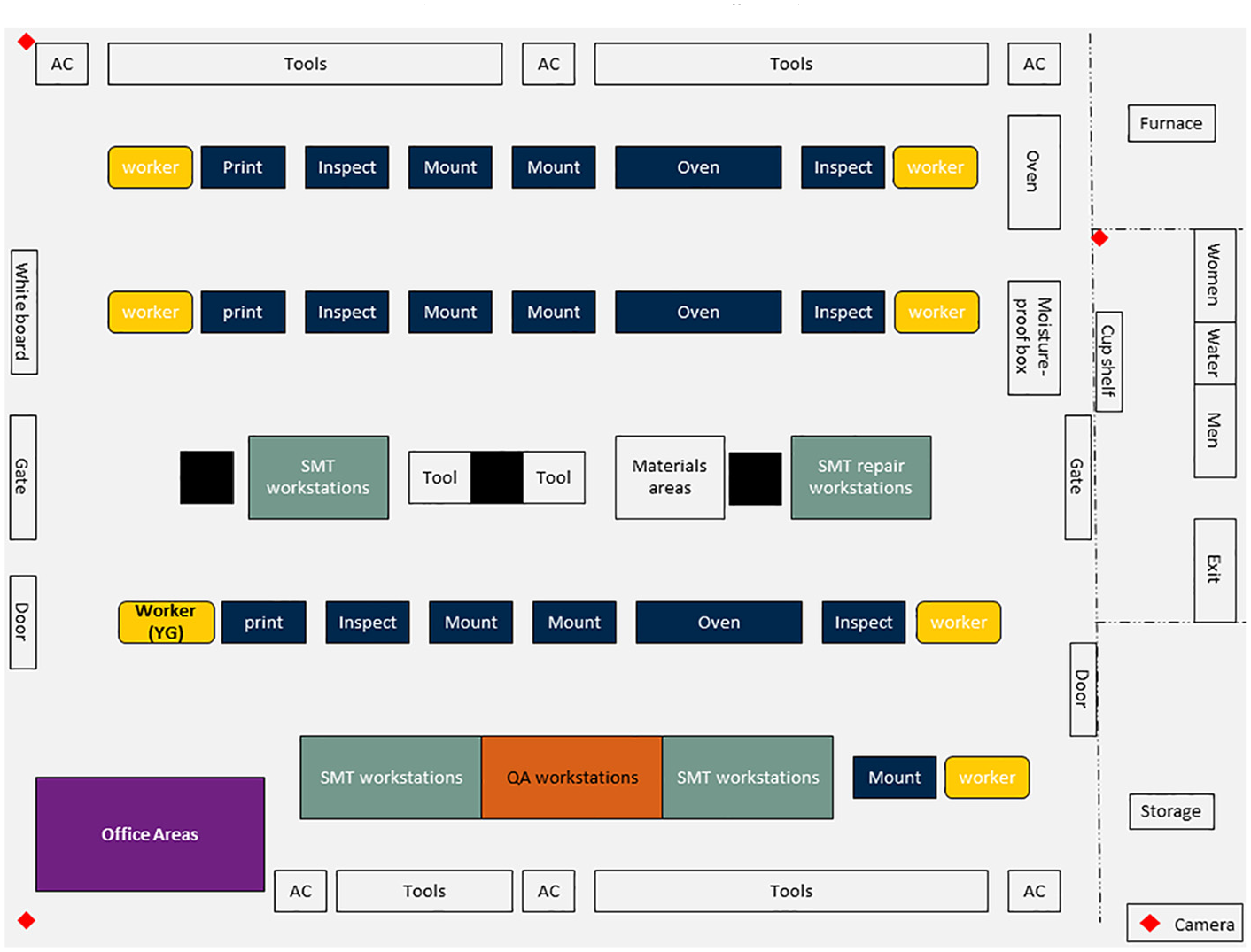
SMT Workshop Layout
In addition, I frequently engaged in conversations with co-workers. In the SMT workshop, workers—including supervisors—were organized into two teams to operate two 12-hour shifts. The team I belonged to had 24 workers in total: 16 workers were female, 22 workers were between 20 and 40 years old, and all workers attended at least junior high school. 7 Similarity in circumstances made it easy for workers to talk to one another and for me to join the conversation.
A significant part of our conversations concerned working hours and wages because of an uncertain work schedule. On a typical weekday, a team worked for 11 hours, with 8 being normal working hours and 3 being overtime. Owing to a low base hourly wage, workers had to or wanted to work overtime for higher rates. 8 However, management attempted to avoid overtime as long as they could complete the production plan. The plan was based on maximum production capacity and thus subject to changes due to, for example, inaccurate estimates of productivity or breakdowns of machines. Consequently, our work schedule was uncertain, particularly on weekends and holidays. Inquiring about the work schedule was a common topic among workers, often leading to conversations about workloads, stresses, and grievances.
After work, I continued my participant observation by living in dormitories for workers and spending leisure time with co-workers. Half of my co-workers in the SMT workshop lived in dormitories provided by FGD1. A standard dormitory had four 2-level bunks, but occupants changed quickly. For example, I had one roommate when moving in, five when moving out, and seven in total for three and a half months. After a long workday, we usually had a little chat but spent most of the time playing on our smartphones in bed before falling asleep. The other half of my co-workers rented apartments with partners or families in neighborhoods close to FGD1. These neighborhoods were villages encircled by industrial areas. Villagers divided their residence into cramped apartments and rented them to workers migrating from other places for jobs. Migrant workers like my co-workers had little access to public facilities or services in these neighborhoods. Therefore, our after-work conversations occurred mostly at restaurants near FGD1 and covered additional topics, including personal experiences and family issues, which help to situate my workplace analysis in a broader social context.
I wrote daily field notes detailing what happened during my shift and analytical memos when certain phenomena appeared repeatedly (Ryan and Bernard 2003; Dewalt and Dewalt 2011: chaps. 9 and 10). This intermediate analysis then directed my data collection at FGD1, as I focused attention on certain aspects of work and discussed certain topics in further conversation with co-workers. Findings from this iterative process were triangulated with materials accessible only to managers at FGD2 and interviews with the owner and executives of both factories.
Findings: Contradictory Control
This section presents evidence for the article’s theory. It examines every pair of technical, organizational, and ideational control in three subsections. A subsection first explains what each form of control implies for workers and then shows how they contradict each other and induce acts of resistance.
Technical vs. Organizational Control
The Implication of Technical Control
Seeking productivity, employers divide the production process and standardize each production task, subjecting workers to technical control. For example, my job in the SMT workshop involved four steps. First, after an assembly line supervisor gave instructions specifying what types of PCBs and solder pastes to use, I retrieved the PCBs from a moisture-proof box and added the paste to a printing machine. Second, a technician adjusted a tool that kept a PCB at the correct position on a metal plate. I then used that tool to fix PCBs onto metal plates. Third, I placed the metal plate with a fixed PCB onto a conveyor belt that fed the PCB through machines that printed the paste on the PCB, inspected the position of the paste, and put electronic components on the PCB where the paste was printed. Last, I attended to any warnings issued by these machines. I was told to repeat these four steps until I finished all PCBs or break time came.
This practice of technical control prioritizes machines over workers and reduces workers’ skills to time spent on a job, giving employers more autonomy than workers. Machines automate tasks that entail speed, accuracy, and consistency. Workers need no special knowledge but must cooperate with machines because deviating from a standard operation brings machines to a standstill. Consequently, employers can train and replace workers quickly. For example, in the SMT workshop I joined, the majority of workers finished their education before high school. One of the first things taught to us involved stopping machine alarms and asking for help. On my first day of work, I was asked to watch a worker who was quitting her job fix PCBs on metal plates and put these plates on an assembly line. After two shifts (less than 24 hours), I replaced her. When I started this job, I could put 300–400 pieces of the most common PCB per hour on an assembly line; after one and a half months, I could place 600–700 pieces per hour.
The Implication of Organizational Control
Although the practice of technical control de-skills factory jobs and makes workers replaceable, employers still must organize unskilled workers into production units. This organizational arrangement needs supervisors to head production units and oversee ordinary workers, which extends employers’ control down to the point of production. For example, FGD1 had two SMT workshops, which housed three and four assembly lines, respectively. Correspondingly, employers organized workers into two teams, which were further separated into three and four sub-teams. The team I belonged to had one assembly line supervisor and one technician. The team also appointed two workers to assist these supervisors. The need for production units and supervisors grew as employers sought to start or shut down assembly lines and scale the workforce up or down quickly, depending on the number of orders.
To establish supervisors’ authority and exert organizational control, employers differentiate supervisors from ordinary workers. At FGD1, the most visible difference manifested itself in the clothing the factory required workers in each position to wear. Supervisors wore long coats, whereas ordinary workers wore jackets and trousers. This visual contrast became real when people changed clothes in a packed, sweltering locker room. While supervisors easily put on or took off their coats, ordinary workers leaned on lockers or jumped on one leg in the crowd to change trousers, blocking and annoying others. Ordinary workers understood the significance of the difference: When one of my roommates was promoted to technician, he immediately replaced his bulky jacket and trousers with a slim long coat.
Technical-Organizational Tension and the Basis of Resistance
The employers’ attempt to create a replaceable and differential workforce—each intended to enhance labor control—causes tension. The difference in position between supervisors and ordinary workers rests on shaky ground because they are both replaceable laborers. In particular, employers select supervisors from among ordinary workers who have been doing a job for some time and thus can do it quickly. In the team I belonged to, for example, the line supervisor in her early 20s, H, was promoted after she had worked in the workshop for two years, and her predecessor had quit. She recommended another ordinary worker to become her assistant when a former assistant left the workshop. I witnessed this promotion path at FGD2: The HR office recruited ordinary workers almost every day, but never interviewed anyone for a line supervisor or assistant position.
A replaceable workforce then undermines the effort of differentiating workers. The most telling indication of the superficial difference between supervisors and ordinary workers comes with rush orders. When employers struggle to hire ordinary workers to meet rush orders, supervisors must fill the vacancies on assembly lines. Supervisors’ experience makes them suitable for filling various vacancies. In the SMT workshop, the technician, X, sometimes must put PCBs on assembly lines along with ordinary workers. The technician’s task mostly involved changing templates in a computer program when assembly lines switched between producing various PCBs. Despite appearing technical, the task took little time for a young worker familiar with smart devices to learn. Indeed, an ordinary worker in his early 20s took over the position of X’s former assistant in a week. The moments of working shoulder to shoulder on assembly lines exposed the false difference, revealing common hardships faced by both supervisors and ordinary workers.
As employers promote ordinary workers to supervisors, workers who face common hardships occupy various positions on the shop floor. This scenario lays the basis for workers to empathize with one another and develop connections across positions. To measure such connections in the SMT workshop, I counted how many times people engaged in non-work-related conversations when at least some interlocutors were not at their posts. 9 Since superiors could punish people—ordinary workers in particular—for chatting at work, these chats indicated the closeness of those taking the risk. In Figure 3, I use nodes and arrows to denote people and chats. The darker a node, the lower a person’s position. As found, most arrows pointed to and from darker nodes, connecting nodes of various shades of blue. This network shows that supervisors and ordinary workers constantly chatted, even though they might be caught by senior managers. By contrast, supervisors and senior managers rarely chatted; indeed, senior managers seemed isolated in the network.
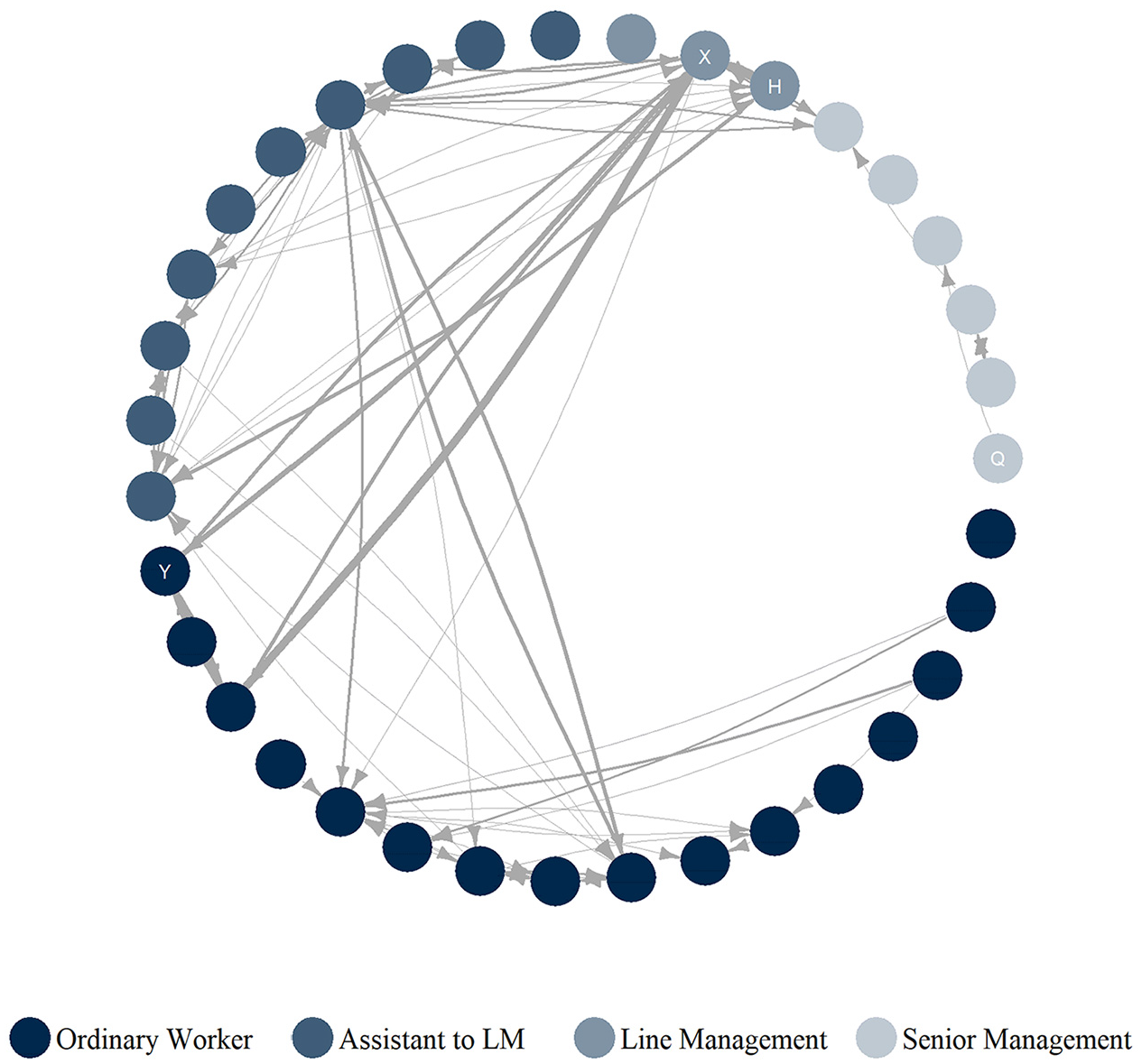
Network of Chats in the SMT Workshop
The connection between supervisors and ordinary workers reflects their dependent relationship: Supervisors rely on ordinary workers to complete orders on time, while ordinary workers rely on supervisors for news such as overtime schedules or favors such as half a day off. This interdependence disposes supervisors and ordinary workers to assist each other in denying employers’ exacting demands and mitigating the hardship of factories. For example, a senior manager once caught my co-worker watching a live webcast late in the evening when our team had worked on a rush order for a few weeks. The senior manager sneaked a photo, sent it to a WeChat group of managers, and commented, “Given how important the product is to us, our employees dare to watch webcasts on the workstation.” 10 My line supervisor, H, immediately replied, “I have already educated her and will make an announcement in tomorrow’s meeting. From now on, no one will be allowed to bring smartphones to the workshop.” 11 She then took a snapshot of that conversation and sent it to our team’s WeChat group. However, H made no further comments either in the chat or the next day, partly because disallowing smartphones would agitate workers and bring her trouble. She wordlessly warned us not to shirk our jobs or get caught, but she also leveraged her intermediate position between workers and managers to protect my co-worker from punishment.
That said, supervisors and ordinary workers are not united. Supervisors sometimes distinguish themselves, consciously or not, from ordinary workers. For example, when I complained to H that the job was stressful, she replied, “If we do not pressure you, you do not have the motivation to improve.” 12 Despite such disunity, however, supervisors and ordinary workers remain connected through their common hardships. In everyday, grueling factory life, supervisors frequently interact with ordinary workers. In these interactions, they find fellow villagers, recommend shops for food or clothes, and exchange news and gossip. Such connections span the shop floor, shielding their everyday evasion of employer demands and sometimes facilitating their cooperation in bending factory rules, as evident in the opening example about which PCBs to work on first. These findings shed new light on the literature expecting synergy between technical and organizational control, in which despotic managers or machines exploit workers while formality such as rules and titles lends such exploitation legitimacy and reduces labor militancy (R. Edwards 1979; Burawoy 1982; Callaghan and Thompson 2001). In contrast to the expectations, organizing differences among replaceable workers can help supervisors and ordinary workers connect and support one another in resistance, thereby undermining employers’ control.
Organizational vs. Ideational Control
The Implication of Organizational Control
Employers institute organizational control not only at the workshop level but also throughout the workplace. For example, beyond supervisors overseeing PCB production, the SMT workshop had managers at higher levels, as well as workers brought in from other departments, as shown by the full labor hierarchy in Figure 4. Specifically, people came from two departments (SMT and Quality) and were sorted into four levels: senior management (one vice manager of the SMT department, 13 one director of the SMT workshop, and four SMT engineers); line management (two line supervisors and two technicians of the SMT department, 14 and one line supervisor of the Quality department 15 ); assistants to line management (four assistants to line supervisors, four assistants to technicians, two workers repairing PCBs, and one senior worker packing PCBs); and ordinary workers (23 from the SMT department and five from the Quality department). Employers further ranked people at the same level by their proficiency level or service time and paid those higher up with additional allowances, which I verified with HR records at FGD2.
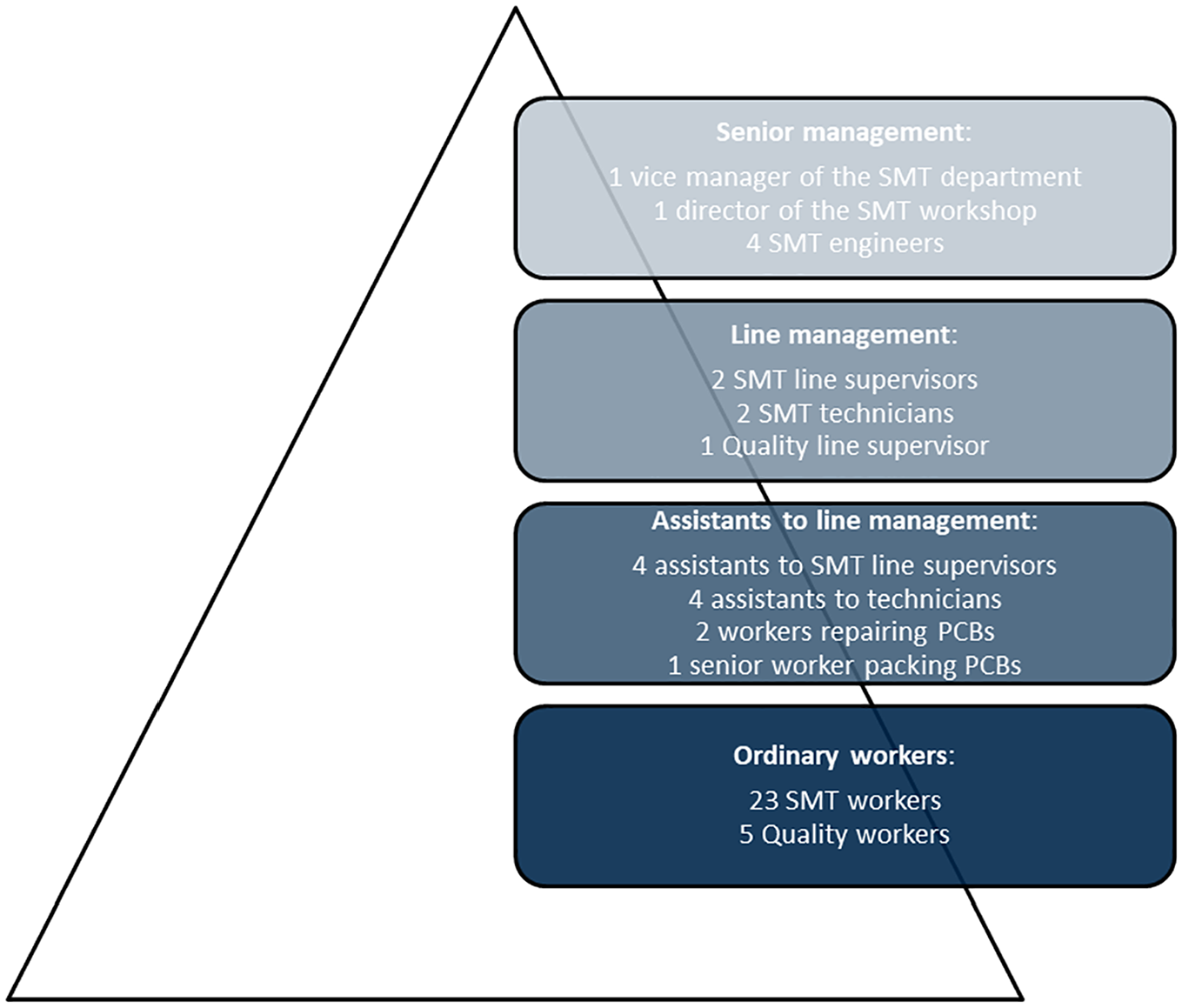
Labor Hierarchy within the SMT Workshop
Behind the facade of order intended to discipline workers, this formal hierarchy of labor is put into practice through ordering and reporting. From the top to the bottom, senior management planned which assembly line produced which PCBs during which shift, at what rate, and for how long. They then asked line management to implement the plan. Supervisors checked a planning spreadsheet throughout a shift to decide whether to continue producing certain PCBs or switch to other ones. They asked ordinary workers to arrive 10 minutes earlier than their shift started to take over assembly lines from the previous shift. From the bottom to the top, ordinary workers lined up before every shift to receive assignments for each assembly line from line management. Supervisors monitored how many PCBs each assembly line produced and wrote the hourly output on a big whiteboard next to the SMT workshop gate (see Figure 2). They would remind workers on an assembly line if that line fell behind schedule. At the end of their shift, supervisors reported the total output to senior management. If the number fell short, senior managers would ask supervisors to explain why it happened and propose how to improve it.
The practice of organizational control, therefore, relies on the top’s authority and the bottom’s conformity, which reproduce the hierarchy and underpin its discipline. Since a break in the chain of command slows production, senior managers often assert authority even if their demands are unreasonable. For example, since FGD1 did not compensate workers for the 10-minute transition before every shift, some workers resisted following it. After H reminded an ordinary worker several times, the vice manager, Q, stopped the worker when the shift meeting was about to end: 16
[looking at the worker coming late] It is late! [turning to H] Shall we get rid of this person? [H did not answer, and Q turned to the worker again] I remember you were late yesterday, too! [turning to H again] Did she come late yesterday? [H murmured something, and Q shouted at the worker] I asked you to come ten minutes early, but you came ten minutes late. Shall I deduct half an hour from your working hours? [Q pointed at the worker and asked] Explain why you came late.
I came late . . .
Why did you come late? [the worker did not answer, Q asked us to reflect on the incident, improve our behavior, and implement the ten-minute policy, and then Q turned to the worker] Do not be so hopeless! 17 I need to see you here ten minutes earlier tomorrow!
Besides such dramatic incidents, senior managers systematically punished and rewarded certain behaviors for maintaining the hierarchy and disciplining workers. Arriving late or dirtying dorms was bad and fined; producing more PCBs or keeping workstations tidy was good and acclaimed. At FGD2, the HR office even went so far as to post a thick stack of punishment and reward announcements every month at the factory entry so that people walking through could see them.
The Implication of Ideational Control
Although employers can order workers to execute production plans, employers also want to instill creativity into workers, so that workers can solve unplanned problems. Such problems, small and large, often break out and delayed responses will hurt production. However, workers avoiding initiatives would rather wait for managers to fix problems than risk being reprimanded for unauthorized operations. For example, an assembly line in the SMT workshop once stopped because an oven malfunctioned. 18 The vice manager, Q, became so worried that he sat on the floor and tried fixing the oven himself. By contrast, workers stood idly. Some even flashed a grin at others while Q stuck his head under the oven.
Employers thus turn to ideas that can motivate workers. Besides emphasizing workers’ sense of responsibility, these ideas are aimed at playing up workers’ passion for living up to challenges and seeking creative solutions. When the SMT department struggled with an important order, for example, Q made the following speech in a department-wide meeting, which showcased the mixing of production pressure and creativity rhetoric: 19
Do you know how much pressure I bear? The boss issued a diktat that we must deliver 350,000 pieces of [a PCB model] every month. There is no bargaining! I woke up at five this morning and did the math. We could only meet the target if each shift gave me 14,000 pieces every day. . . . Our engineers and technicians must think hard and be creative. Can we speed up the conveyor belt? Can we streamline the process? There is no limit! We accomplished this before. Remember, we thought that the productivity of [a PBC model] could not increase, but eventually, the output doubled last year. . . . The supervisors must reflect on how we can save more time. Can we make the transition of shifts smoother and faster? Can we prepare materials for the next model before finishing the current one? I came in the morning and saw that the machine stopped, and people did nothing for half an hour! Do not think it is good enough. Do not become complacent. There is a lot of room for improvement!
This practice of ideational control motivates workers to identify bottlenecks in production and management and to think outside the box to address them. When such ideas take shape and hold, workers will not only refrain from shirking, but also have incentives to innovate. The practice thus gives employers more control by aligning workers’ interests with theirs. For example, an inspecting machine in the SMT workshop once failed to recognize PCBs. Managers and technicians ran up and down the assembly line to find out why. My line supervisor, H, figured out a way of manually entering the ID of PCBs. She was so excited to teach me and another ordinary worker how to enter the ID and help resume the assembly line. She clearly felt encouraged and wanted to show her solution to someone—so much that she went through the steps so fast that she failed to notice we got lost in the middle.
Organizational-Ideational Tension and the Grievances Underlying Resistance
Employers’ demand for conformity, however, often contradicts their encouragement of creativity. During peak production seasons, managers focus on fulfilling orders. They postpone activities that are not urgent but are important for instilling a sense of belonging and the spirit of innovation. For example, when I joined the SMT workshop, Q told me, “We are trying to exercise management that puts people first.” 20 To show care and respect for new workers, he spent an afternoon teaching and quizzing us about basic electronic components. No managers organized—and no workers expected—a second session, dissipating whatever goodwill emerged during the first afternoon, as the workshop geared up for a big order.
Out of the peak season, workers’ suggestions fall on deaf ears, if not rejected outright by managers. Q once saw me fixing PCBs on a worn metal plate and asked the technician, X, why not replace it. X replied grumpily, “I have suggested replacing it many times!” Their conversation escalated uneasily. X insisted that he had asked for a new metal plate for a long time and blamed ordinary workers—me implicitly—for not knowing how to use the old one, whereas Q pushed back, “We’re doing technical things, and we should not let them [putting his hand on my shoulder and referring to ordinary workers in general] worry about the technical stuff!” 21 In the end, Q and X angrily left my post, and I still used the worn metal plate.
The tension between conformity and creativity stirs up grievances against management at the bottom of the labor hierarchy, a necessary condition for resistance. My co-workers resented managers’ excessive demands and scoffed at their call for innovation. X complained to me from time to time that “management does not put people first,” the opposite of what Q intended. The grievances sometimes erupted into heated arguments between workers and managers, as in the example above, but more often they accumulated. Hidden from managers’ sight, workers in small groups constantly complained about how managers ignored their requests or chided them for mistakes. They recounted their experiences among fellow workers and rehearsed their rebuttals of managers’ incompetence. Indeed, many chats among workers depicted in Figure 3 were such complaints and rebuffs, if not curses.
The tension and resulting grievances are inconsistent with the theoretical expectation that ideational control can complement organizational control. Employers stripped of despotic power can draw on motivational ideas to frame workers’ interests in line with theirs, offsetting lost productivity attributable to organizational rigidity (Friedman 1977; Burawoy 1985; Sturdy et al. 2010). Although such rhetoric can incentivize workers if implemented successfully, employers may be unable to weave such rhetoric with their extant control practices in the first place. The tension between conflicting practices can thus deteriorate rather than improve the capital–labor relationship.
Ideational vs. Technical Control
The Implication of Ideational Control
Employers’ ideational control aims at convincing workers that, by working diligently and creatively, they are investing in their own growth. Such an investment will help them make more money or take on bigger roles. Workers should thus work hard not only in pursuit of quick money or out of inspiration but as an investment in long-term personal growth. In the end, ideational control suggests that workers share interests with employers. When I talked with the owner of FGD1 and FGD2 about workers’ low income, he said:
22
[But] how do you know workers are unsatisfied? If they are, they will make one of two choices: either leave [the job] or improve [themselves]. The average monthly salary of 4,500 yuan [690 US dollars at the time] is the anchor, the equilibrium price, in this area. If my factory does not provide a competitive salary, they will vote with their feet. If they want to get promoted, they will get along with managers and report to work whenever needed.
To drive the idea home, FGD1 and FGD2 periodically launched campaigns that invited workers to submit proposals for improving production. These calls for proposals were posted at the entrance of every workshop, highlighting rewards for accepted proposals. Workers whose proposals were accepted or whose performance stood out would receive bonuses highlighted in their monthly pay slips (see Items 18, 20, and 22 in Table A.2). At FGD2, the HR office and Engineering department collaborated to create position-specific evaluation criteria for workers. During the evaluation, we requested the presence of an engineer and observed workers demonstrating their tasks and handling unexpected incidents. These evaluations played a crucial role in decisions concerning wage raises or promotions. The HR office also publicized such decisions by posting workers’ evaluation results on the wall of the factory hallway. The practices of ideational control suggest that, in the end, workers’ investment in themselves determines whether they will succeed or fail.
The Implication of Technical Control
While depicting workers as free decision-makers in charge of their own destinies, employers nevertheless attempt to control every part of workers’ jobs. Ordinary workers can learn a specific task, but the narrowness of tasks prevents them from translating this knowledge to another task. Those knowing many tasks may find themselves promoted to supervisors, but such advancement depends on whether current supervisors quit and offers scant opportunities to develop new skills. In the SMT workshop, ordinary workers repeated several standard operations day and night. Nobody seemed passionate about their jobs or looked forward to becoming supervisors. Even supervisors felt stuck in their positions. When I asked if X planned to change his job, he kept saying, “Everywhere is the same,” implying no obvious path for improvement. Another technician living in the same dormitory with me explained further, “I do not have much education; if [my job] is not unacceptable, I will stay on [the job].” 23
Ideational-Technical Tension and the Mentality toward Resistance
This stasis, rooted in the practice of technical control, contradicts the growth highlighted by the practice of ideational control. While repeating simple tasks on assembly lines, workers can feel that employers fool—not motivate—them with self-help, forward-looking rhetoric. Ordinary workers and supervisors see through the ruse and do not hesitate to ridicule it. After Q delivered his motivating speech, one of my co-workers, Y, whispered to me, “Do not talk ideals with ordinary workers.” 24 He then leaned toward me and made a gesture of counting money, suggesting that ordinary workers go through hardship for money, not ideals. At the end of my first month at FGD1, H asked me to sign two timesheets—one real with excessive overtime and one fake with legitimate overtime. I felt uneasy and complained about overtime. Finding little growth herself through working on assembly lines for 12 hours a day, six to seven days a week, she teased me—instead of relaying managers’ rhetoric—“Are we going to eat earth if we do not work overtime?” 25
As the quotes above suggest, the tension between ideational and technical control incentivizes workers to view their relationship with employers in temporary, monetary terms. Workers see that investing in their jobs makes no sense; they thus put up with repetitive tasks—as well as motivating speeches—to make money. For example, a worker who joined FGD1 the same day I did worked for three consecutive weekends in July. When I asked whether she was tired, she said, “Of course, but I want to work on the weekend and must grit my teeth, so I can save 20,000 yuan by September.” 26
This state of mind leads workers to evade factory rules, seek intermittent distractions at work, and eventually leave factories, as the short-term tactic and the long-term goal help workers ease the tension. Acts of resistance thus abound on the shop floor. In particular, workers divert their attention away from repetitive tasks by looking at smartphones, denying employers’ claims on their attention. When the SMT workshop was busy, workers sneaked peeks at messages; when it was less busy, they gossiped on WeChat, checked Weibo, played Mahjong, watched Douyin videos, shopped on Taobao, and read free online novels. Both FGD1 and FGD2 nominally banned smartphones on assembly lines, but neither could enforce it, making tacit concessions to workers.
Eventually, workers hope to leave factories with their money. At FGD1, ordinary workers, on average, stayed for 16.79 months—10 months shorter than the factory’s overall average. 27 In the SMT workshop, five workers left, and five workers joined, between the middle of May and the end of August. A few more hesitated about when they would ask to leave. 28 No worker in my shift planned to stay on the job or settle in the city. 29 Y’s experience was particularly illuminating. He was born in 1990 and came to Guangdong after middle school. After working in logistics for years, he invested in a shipping business but lost his investment as a result of a car accident. He went directly from the accident site to a furniture factory in Zhejiang Province to work to pay back clients. After clearing debts, he married at home in Yunnan Province and started a business selling aluminum doors and windows. As he said, “One can make a living in villages, but cannot make money.” 30 So after more misfortune—being cheated by his business partner—he returned to Guangdong with his pregnant wife and joined FGD1. His goal was to save 30,000 yuan and pay back loans. After a long night of work, we were used to eating noodles and sharing beers in a shop near FGD1. He said he would go home and not come out again after this factory. He quit the job on January 17, a week before the 2020 Chinese Spring Festival, and his wife gave birth to a boy at home.
As Y’s story illustrates, workers’ temporary, monetary relationship with an employer ends when they leave factories. They do not expect to interact with the employer again; they want all their money from the employer. Some workers may also want to settle a score with employers if not exact revenge for their factory hardships. This mentality encourages workers to confront employers, especially when employers cut corners on workers’ payments. Some studies suggest that Chinese workers’ countryside upbringing and migrant status can buffer exploitation or temper militancy, complicating the formation of the working class (Lee 2007; Pun and Lu 2010). However, at least at specific points of their employment, the same upbringing and status can provide workers with a cold heart and mind to see through employers’ rhetoric intended to disguise the repetitive factory job, thereby strengthening workers’ resolve to pressure employers for what they have earned.
Conclusion
I examine why employers’ multiple control practices generate not consent but rather resistance from workers. Through participant observation from contrasting angles at two electronics factories in Guangdong, China, I analyze the practices of labor control—technical, organizational, and ideational—from both employers’ and workers’ perspectives. The practices of technical and organizational control require workers to be both replaceable and differential; the practices of organizational and ideational control demand of workers both conformity and creativity; and the practices of ideational and technical control ask workers to focus on personal growth while repeating de-skilled tasks. The contradictions between these control practices cause workplace tensions and undermine employer authority. Moreover, the tensions compress workers at the bottom of the labor hierarchy to form reciprocal links, nurture grievances against management, and cultivate a zero-sum mentality, all favoring acts of resistance.
These findings contribute to the labor process theory and ethnographies of Chinese factory life. The labor process theory has moved beyond periodizing the development of labor control with one new form dominating extant forms (Sturdy et al. 2010). Instead, multiple forms of control co-exist (Callaghan and Thompson 2001; Cooke 2006; Reed 2010; Thompson and van den Broek 2010). This literature has yet to systematically analyze the co-existence of multiple control practices, however, especially whether these practices are complementary for extracting labor. I build on the co-existence of control practices and extend the labor process theory by systematically juxtaposing multiple control practices. The analysis illuminates the contradiction—rather than complementarity—of these practices, questioning employers’ ability to hybridize multiple forms of control and pointing out the connection to workers’ acts of resistance.
Moreover, I add to Chinese factory ethnographies by showing the continuity of employers’ control practices and identifying new forms of control. The tensions between employers’ old and new practices enable workers’ acts of resistance in addition to the much-discussed Chinese government’s legal intervention (Lee 2007; Gallagher 2017; P. Chen and Gallagher 2018). This tension-resistance connection concerns not labor control’s legality but its multiplicity and, thus, differs from the extensive literature on Chinese labor politics that studies non-workplace sites such as NGOs or courts and puts laws at the center of Chinese workers’ resistance. The findings highlight Chinese workers’ non-institutionalized resistance despite the government’s heavy-handed legal regulations. They also suggest that China can be more than a testing ground for theories developed in industrialized countries. The continual influx of capital and labor and emerging forms of control and resistance render China a fertile field for developing the labor process theory.
My theoretical framework, grounded in an ethnography of two electronics factories in Guangdong, China, sheds light on future research. First, contradictory control can exist in other industries, localities, or countries. Although employers can put into practice various forms of control contingent on specific contexts, analyzing these practices through a contradictory lens can provide new insights into the dynamics of capital–labor relationships. For example, although the platform economy reinvents the service sector with flexibility-centered hiring pitches and big-data-driven algorithms, viewing its labor processes from the perspective of the ideational-technical tension can reveal intensified schedules and dictating algorithms (S. Li and Jiang 2020; Veen et al. 2020). As the service sector becomes increasingly important in economies, an emerging, blurring boundary between supervisors and ordinary workers can also be analyzed from the perspective of the technical-organizational tension. 31 Second, the relationship between employers’ contradictory control and workers’ acts of resistance merits further research. Notably, the link between supervisors and ordinary workers, stemming from the technical-organizational tension, can contribute to collective action initiated by workers, at least in China (Leung 2015; C. Li 2021). Research in this direction can help extend the labor process theory’s focus on informal, everyday resistance.
Supplemental Material
sj-pdf-1-ilr-10.1177_00197939251357273 – Supplemental material for Contradictory Control: How Employers’ Multiple Control Practices Clash and Enable Workers’ Acts of Resistance
Supplemental material, sj-pdf-1-ilr-10.1177_00197939251357273 for Contradictory Control: How Employers’ Multiple Control Practices Clash and Enable Workers’ Acts of Resistance by Yuequan Guo in ILR Review
Footnotes
Acknowledgements
I thank Kayonne Christy, Sarah Van Cleve, Iza Ding, Mary Gallagher, Nahomi Ichino, Robert Jansen, Ethan Johnston, Chelle Jones, Cynthia Magallanes-Gonzalez, Jen Triplett, and Xiaohong Xu for comments.

Open Access publication was funded by the WZB Berlin Social Science Center.
For general questions as well as for information regarding the data and/or computer programs used to generate the results presented in the article, please contact the author at
Notes
References
Supplementary Material
Please find the following supplemental material available below.
For Open Access articles published under a Creative Commons License, all supplemental material carries the same license as the article it is associated with.
For non-Open Access articles published, all supplemental material carries a non-exclusive license, and permission requests for re-use of supplemental material or any part of supplemental material shall be sent directly to the copyright owner as specified in the copyright notice associated with the article.
