




Abstract
Through an ethnographic study of a manufacturing monitoring technology, the author examines how the relations among workers, managers, and third-party technologists impact the ongoing configuration of cloud-based workplace technologies. Because these technologies are broadly networked, data-driven, and highly malleable, the author argues that technologists have an increasingly prominent role. By tracing issues raised by workers and managers in the focal customer firm, the study shows that the employment relation can explain only a limited set of outcomes. An analysis that accounts for technologists’ innovative and economic relations with their users fully explains which issues are resolved and how. In contrast to research that implies technologists amplify institutionalized patterns of labor–management relations through their design choices, this study shows that technologists are complex organizational actors with situated interests, values, and identities. Through the development of a triadic model of relations, the author demonstrates why technologists must be included in analyses of contemporary technologies.
The question of who shapes workplace technologies has long been a contested issue. Research on employee involvement (EI; e.g., Litwin 2011) has shown how workers can share in decision-making about firm-level technology configuration, while the field of science and technology studies (STS; e.g., Noble 1984) has explored how institutional pressures influence technology development over time. However, with the increasing advancement and diffusion of cloud-based technologies, ranging from productivity monitoring software to reprogrammable robotics, understanding the dynamics that shape workplace technologies and their outcomes has become both more urgent and more complex.
Three characteristics of cloud-based technologies are relevant in this study, and all three result in an increasingly central role for technologists. First, cloud-based technologies are networked beyond the bounds of the firms that use them. External vendors are active hosts of these technologies and often offer them “as a service” to firms, providing personalized and longitudinal customer support. Second, cloud-based technologies are data driven, relying on interconnected components to collect, analyze, and display data that can be used to derive insights about workplace activities. For example, the “Internet of Things” refers to the integration of cloud-based software into physical components. Third, cloud-based technologies are malleable in ways and at rates that outpace prior generations. Technologists become key actors in this ongoing reconfiguration, often releasing technologies with the intention of further developing their features through continuous design-use cycles.
The increasingly central role of technologists is a prime example of the multiplicity and distance that characterize contemporary employment relationships (Riordan and Kowalski 2021). As a third-party actor to the labor–management relationship, technologists pursue their own goals while shaping ongoing configuration. The externalization of technology decision-making from the firm creates a complex arrangement in which the distribution of power can be difficult to map. Existing EI and STS theories are insufficient to explain how various parties and pressures affect technology configuration because they do not adequately treat technologists as complex organizational actors, nor do they address the increased blurring of design and use. This context motivates the question: How do the relations among managers, workers, and technologists shape the local configuration of cloud-based workplace technologies?
My approach to this question leverages ethnographic data centered on the case of a manufacturing monitoring technology. I integrate data across multiple field sites, including the technology company and one focal customer firm, to theorize how the relations between multiple parties shaped ongoing technology configuration within the focal firm. In an analogue to the employment relation between managers and workers, I conceptualize the innovation relation between technologists and their users, which guides technologists’ decisions about whether and how to dedicate scarce design resources to reconfiguration. I also show how technologists can use a set of relational tactics to manage their economic dependency on their customers.
These findings make three contributions to existing research. First, I develop a triadic model that specifies how the relations among technologists, managers, and workers impact ongoing technology configuration, which extends research focused on the dyadic employment relationship. Second, my theorization of the innovation relation reveals the underlying components that shape technologists’ approach to technology configuration. Third, my identification of technologists’ relational tactics shows how they navigate competing priorities during configuration. Together, these contributions underpin the argument that researchers need to extend their lens to encompass additional actors and dynamics to fully understand how cloud-based technologies shape and are shaped by power relations in the workplace.
Configuration of Workplace Technologies
Studies of technology and work have shown that technology configuration is a highly social process, shaped by choices made by managers, designers, users, regulators, and others (Garud and Rappa 1994; Orlikowski 2000; Boudreau and Robey 2005; von Hippel 2006; Suchman 2007; Leonardi 2011). Configuration includes initial and ongoing changes to the design and functionality of technical artifacts, as well as choices made about how artifacts are incorporated into workplace routines (Trist and Bamforth 1951). Through sociotechnical configuration, technologies display local variation as they are shaped through ongoing use in specific firms (Barley 1986; Orlikowski, Yates, Okamura, and Fujimoto 1995).
Technology configuration is an important input into downstream effects on skills, authority, and the division of labor (Barrett, Oborn, Orlikowski, and Yates 2012; Mazmanian, Orlikowski, and Yates 2013). As a result, control over configuration has historically been highly contested (e.g., Noble 1984). Two streams of literature discuss the roles and relations of managers, workers, and technologists in this process.
Employee Involvement in Technology Configuration at the Firm Level
Starting in the 1980s, researchers showed that Japanese automotive firms achieved superior performance through practices that allowed workers to give “wisdom” to how new technologies were used (MacDuffie and Krafcik 1992; MacDuffie 1995). This insight led employment relations scholars to examine EI practices that promote shared input into workplace technology decisions. For instance, Adler, Goldoftas, and Levine (1997, 1999) demonstrated how the NUMMI automotive plant achieved flexibility and efficiency by responding to workers’ suggestions, such as raising the height of the assembly line to accommodate a taller workforce and avoid ergonomics issues. Studies of information technologies in the workplace (e.g., Litwin 2011; Hitt and Tambe 2016; Avgar, Tambe, and Hitt 2018) have since made similar observations.
Separately, Scandinavian participatory design projects starting in the late 1970s and 1980s aimed to equip unions with knowledge about workplace technologies so that workers could “codetermine the development of the information system and of their workplace” (Clement and Van den Besselaar 1993: 29). To accomplish this objective, technologists incorporate EI during ideating, prototyping, and customization (Muller and Kuhn 1993; Bødker 1996). Participatory design is now widely seen as a way to improve the quality of workplace technologies (Bødker, Kensing, and Simonsen 2009), even as its original ideological component has diminished, especially in North America (Spinuzzi 2002).
The nature of the employment relationship is a critical determinant of employee involvement in technology configuration, including the extent to which EI represents a genuine commitment to shared decision-making. To facilitate EI, workplace-level practices, such as quality circles, design workshops, peer trainers, and technology super users (e.g., MacDuffie 1995; Kellogg, Myers, Gainer, and Singer 2021), must also be supported at higher levels. At the functional level, firms may have established processes for negotiating technology issues with workers or their representatives (Kochan, Katz, and McKersie 1986; Budd 2004). The presence of positive union–management relations furthers the use of EI practices in the workplace (Litwin 2011). The codetermination processes used in countries such as Germany and Sweden have been shown to yield meaningful worker involvement, including in issues of data use and access (Bender and Söderqvist 2022; Krzywdzinski, Pfeiffer, Evers, and Gerber 2022). At the strategic level, firms may leverage technological investments to complement the use of skilled labor (Bresnahan, Brynjolfsson, and Hitt 2002; Chi, Freeman, and Kleiner 2011). This process supports EI by giving workers the assurance that their input will not directly result in job losses or wage cuts (Litwin 2011).
Science and Technology Studies of Institutional and Political Contexts
Research in science and technology studies (STS) has examined the institutional and political factors shaping the dynamics that occur at the firm level (e.g., Zuboff 1988). These studies are often historical, tracing the longitudinal influences on technology design for specific artifacts (Noble 1984; Pinch and Bijker 1984; Garud and Rappa 1994; Kline and Pinch 1996). In accounts of workplace technology design in North America, researchers have described how technologists are complicit in furthering the dominant ideology of managerial control (Braverman 1974; Levy 2022). For example, in his analysis of numerically controlled (N/C) manufacturing machines, Noble (1984: 191–92) outlined how technologists supported managers’ assertion of their own decision-making “rights” under the backdrop of an anti-labor political environment. As a result, the dominant design for N/C machines became one that de-skilled manufacturing work, despite other available alternatives that involved an enriched role for machine operators.
Today, technology adoption and configuration are not mandatory topics of collective bargaining in North America (Kochan 2019). Technologists have often continued to adopt economic logics of increased efficiency and control, with troubling implications for workers (Bernhardt, Kresge, and Suleiman 2023). By contrast, European codetermination practices are supported by institutional environments that grant rights for workers to negotiate over some technological changes and to hold up implementation if they have not been adequately consulted (Bender and Söderqvist 2022). These policies, alongside the strong presence of unions and works councils, shape the strategic orientations of employers and employees, making it more common for the parties to negotiate with relatively less conflict. Accordingly, European technologists are likelier to be responsive to government-led innovation policies and partnerships that preserve a strong role for workers and their representatives (Doellgast and Wagner 2022).
A Relational Perspective on Technology Configuration
Although EI and STS research has developed important findings about the institutional and firm-level barriers and determinants of technology configuration, this research is incomplete in two ways relevant to the present study. First, while both streams of research examine the role of technologists to some extent, neither treats technologists as complex organizational actors with specific interests, values, and identities (for an exception, see Forsythe 2001). For instance, it is unclear how and why technologists might pursue worker involvement within an institutional context that does not legally protect workplace democracy in technology decisions (e.g., North America), despite evidence that technologists’ approaches vary within a country (e.g., Markoff 2016). Second, because of the temporal and spatial distinctions that have historically separated design and use (Thomas 1994; Bailey and Barley 2020), neither stream of research has adequately examined the intersection of design and use. Spatial distinctions remain for cloud-based technologies, with third-party technologists maintaining a key role in design decisions. Increased malleability, however, compresses the time between design and use, with design changes being easily deployed throughout the technology life cycle. This makes it more pressing to examine technologists as a somewhat distant, but important, actor (Riordan and Kowalski 2021) in the way technologies are configured within individual firms.
To address these limitations, I adopt a relational approach that can yield insights into the dynamics surrounding emerging technologies by considering actors including occupational groups, technologists, regulators, and consumers (Barley 2020; Bailey et al. 2022; Anthony, Bechky, and Fayard 2023). Recent articles in information and organization studies have used this approach to highlight the power of technologists, as they act in accordance with their own goals, make assumptions about use, and decide how to involve users in design decisions. This process can variably result in the replacement (Pachidi, Berends, Faraj, and Huysman 2021), de-skilling (Barrett et al. 2012), or augmentation (Van den Broek, Sergeeva, and Huysman 2021) of workers as technologies are reconfigured. These studies do not fully theorize the triadic relations among technologists, managers, and workers, though, which is necessary to explain and predict the effects of technology configuration.
Ethnographic Methods
Setting
This study was largely conducted at MetalWorks (a pseudonym), a family-owned manufacturing shop with fewer than 100 employees, located in the New England region of the United States. MetalWorks used computer numerical controlled (CNC) machines to manufacture highly precise metal and plastic components for a variety of industries. I first selected MetalWorks for study to examine the influence of progressive employment relations on the use of advanced manufacturing technologies in the North American context. Although it was non-unionized, the firm paid competitive wages, offered a flexible attendance policy and a profit-sharing program for all employees, and had a small on-site gymnasium and garden.
As I began data collection, I became interested in a digital monitoring technology system that MetalWorks managers had implemented several months earlier in partnership with a third-party company that I call ProdTech (a pseudonym). I adopted the tenets of relational ethnography (Desmond 2014), which allows the researcher to follow the phenomenon of interest across multiple field sites. In this case, I collected data at both MetalWorks and ProdTech.
ProdTech was founded in 2014 and had approximately 60 employees in teams that included Customer Success, Sales, Data Science, and Product (including software engineering and product design). ProdTech had between 100 and 200 clients at the time of this study, in industries such as aerospace, metal fabrication, and consumer products.
Before adopting ProdTech’s monitoring system, MetalWorks staff had monitored production with paper and pencil, but my informants stated that this method was tedious and ineffective, given that no one was responsible for data analysis. By contrast, ProdTech’s technology used highly visible touch-screen tablets at each machine that displayed graphics and data drawn from sensors installed in the machines, including machine cycle time, real-time parts production, and utilization. Each tablet also displayed a bright color that reflected the machine’s production rate: green (for machines making over 90% of their production goal), orange (80–90%), or red (under 80%). Production goals were cycle times that were specific to each job and were set by engineers based on a job’s past or expected rate. The technology also included reporting and analysis features aggregated in a cloud-based website. Finally, the real-time status of all connected machines was displayed on large TV screens in the engineers’ office and CEO’s office.
Because the technology was offered on a subscription basis, ProdTech technologists (such as Customer Success managers and Product managers) regularly interacted with MetalWorks staff to encourage its effective use and to discuss issues. These interactions occurred mainly by video call but were supplemented with in-person visits of ProdTech technologists to MetalWorks.
Data Collection
Upon approval from my Institutional Review Board, I conducted an 18-month ethnography (September 2018–February 2020). My data collection relied strongly on observations, which allowed me to trace real-time interactions and record activities and behaviors as they occurred (Barker 1963). I averaged seven hours per week at MetalWorks over the first ten months, shadowing employees in all production and non-production functions to understand their roles. Participants could frequently talk while they worked, so I conducted informal ethnographic interviews (Spradley 1979). I also observed meetings of the MetalWorks management team and attended biweekly meetings between ProdTech and MetalWorks.
After 10 months of observation, the meetings between MetalWorks and ProdTech occurred on an as-needed basis. Accordingly, I scaled back my observations but returned to the field periodically to conduct semi-structured interviews on themes I had identified through my observations. All but two of my interviews with MetalWorks managers and engineers were recorded with interviewees’ permission and later transcribed. Because of the noise of the production floor, I did not record my interviews with machinists, but I took handwritten notes in real-time that I typed as soon as possible after leaving the field.
In the last two months of the study, I collected data at ProdTech by observing several “product design” meetings and interviewing technologists. During this time, I focused on understanding how technologists interpreted and responded to user feedback. I also collected data on ProdTech’s product road map, including which new technology features were prioritized for reconfiguration. See Table 1 for a summary of my data collection.
Summary of Data Collection
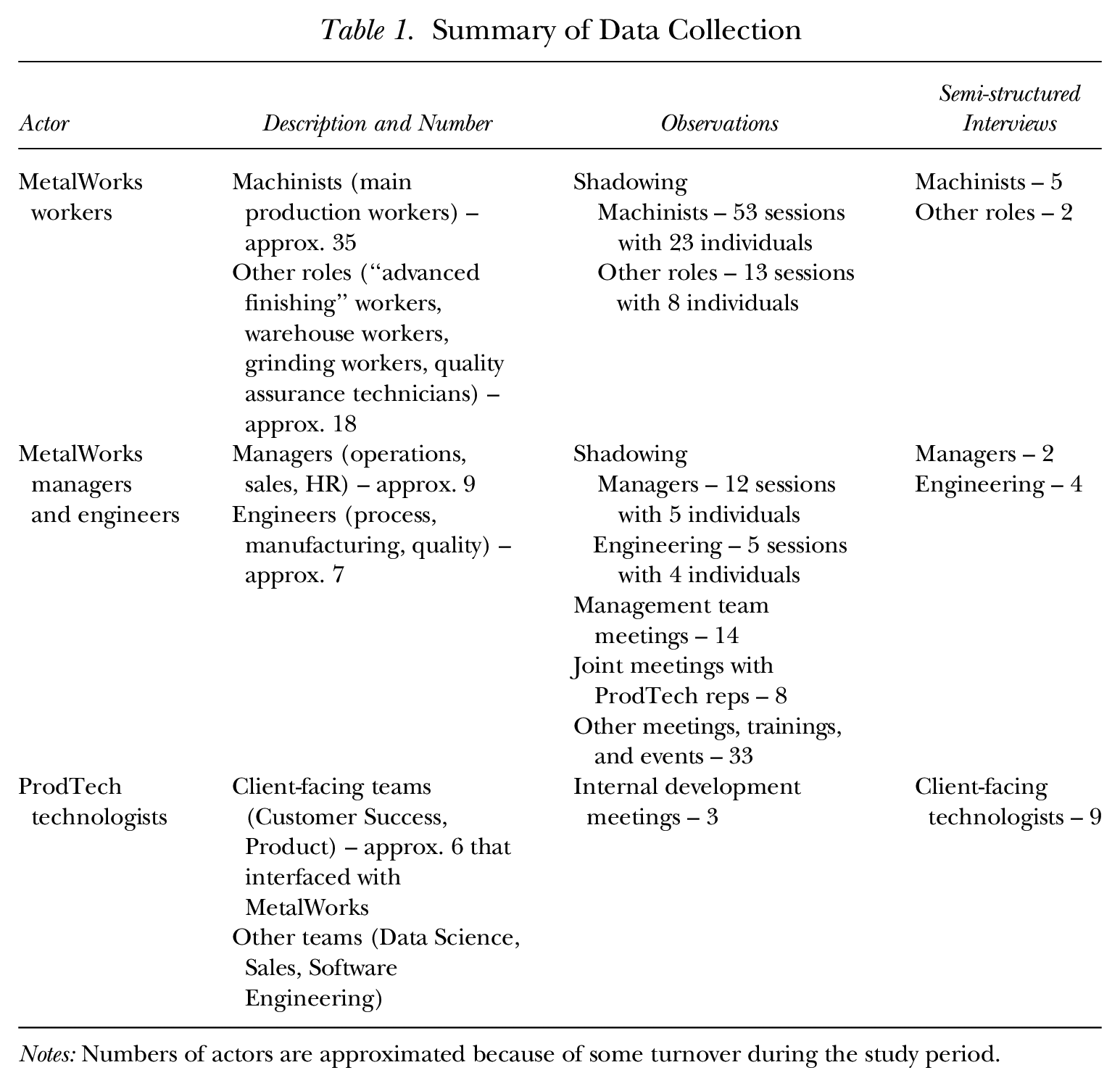
Notes: Numbers of actors are approximated because of some turnover during the study period.
Identification of Cases and Analysis
I used an inductive approach to identify and develop insights (Glaser and Strauss 1967). Through regular analytic memos, I noted that changes to the technology were considered and implemented on a semi-regular basis, including for several years after its initial adoption. I also noted that the relationship between MetalWorks and ProdTech seemed to be important in shaping these changes.
Identification of Cases
Based on these early insights, I began identifying a series of conversations and decision points about technology configuration. I used these configuration issues as my unit of analysis to understand when and how some issues were resolved while others were not. My approach resembles that used by Satterstrom, Kerrissey, and DiBenigno (2021: 380), which focused not on a single dyadic event but the “collective, interactional [voice] process.” In all, I identified 24 issues, several of which had been raised before I entered the field. I relied on retrospective accounts and incorporated data from multiple informants to examine these issues (Miles and Huberman 1994). For descriptions of the cases, their actors, and outcomes, see Table 2.
Technology Configuration Issues
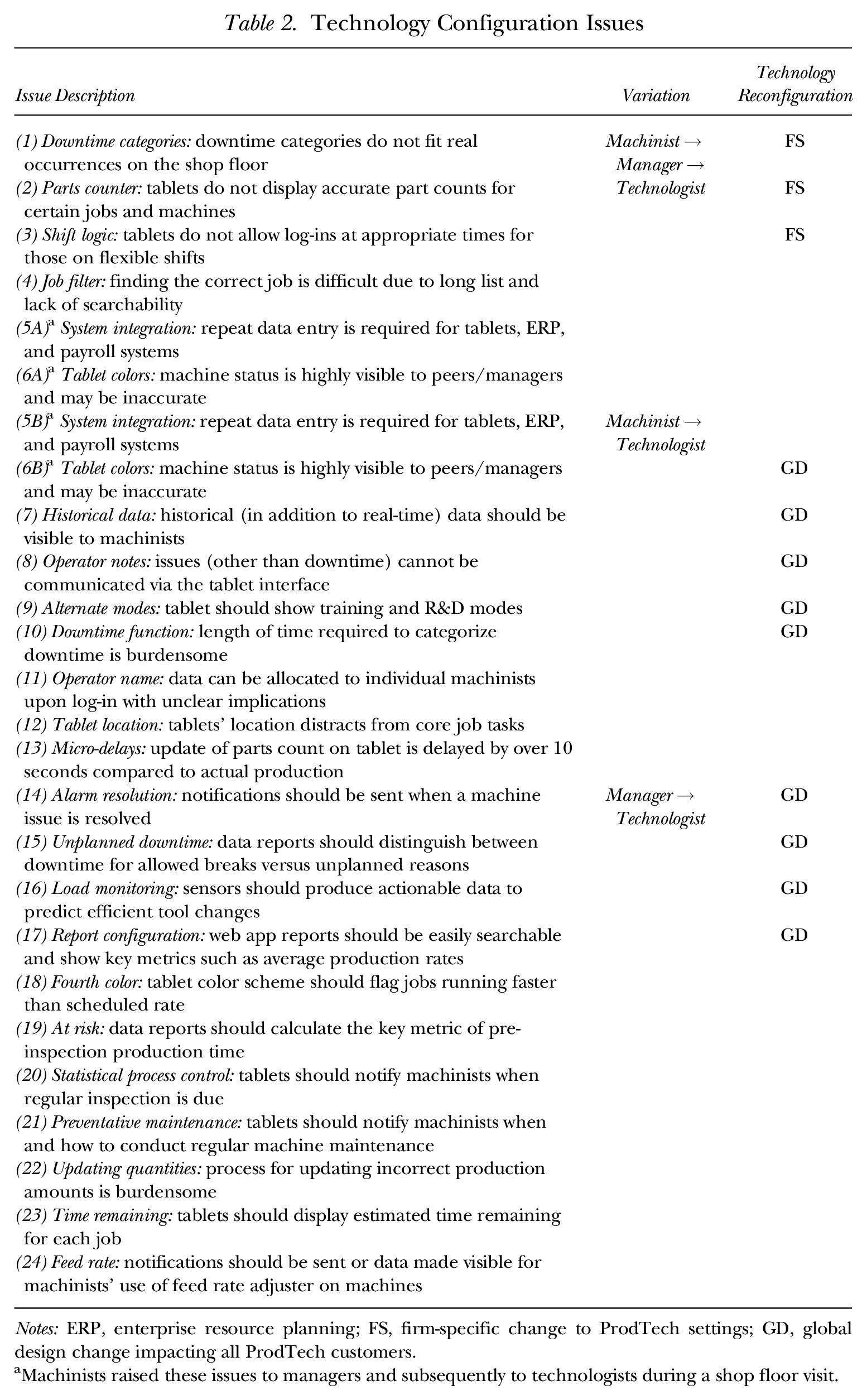
Notes: ERP, enterprise resource planning; FS, firm-specific change to ProdTech settings; GD, global design change impacting all ProdTech customers.
Machinists raised these issues to managers and subsequently to technologists during a shop floor visit.
Analysis of Technology Configuration
I adopted a relational perspective (e.g., Bailey et al. 2022; Anthony et al. 2023), which is useful for analyzing shifting dynamics of interaction and can incorporate insights about “the power and politics involved in [technology] development and implementation” (Anthony et al. 2023: 1680). It is related to actor-network theory (Latour 2007) in assigning agency to both human and non-human actors (e.g., artifacts) to explain technological innovation.
I first coded each case for the actors involved and whether a technical resolution was achieved through a change to the technology settings at MetalWorks or through a change to the overall technology design in ways that affected all of ProdTech’s customers. I focused on collectives (e.g., machinists) rather than individuals, as my theoretical aims relate to research on group relations. I distinguish between machinists, on the one hand, and managers and engineers, on the other hand, because this creates a clear delineation between subordinate actors who required mechanisms for employee involvement versus actors who had positions of organizational authority. Additionally, because MetalWorks was a small shop, both managers and engineers had a similar level of interaction with machinists and had some opportunity and authority to address their issues. In other settings, the engineer role is likely to differ greatly, including less direct interaction with frontline workers. In the empirical and theoretical tables and figures that follow, I use the terms “manager” and “management” to encompass both managers and engineers for simplification and generalizability. I also focused on the components of ProdTech’s technology, including interfaces, features, and data collection nodes.
Next, I compared cases in which a technological resolution (i.e., reconfiguration) was achieved to those in which it was not, attending to the relative power and interests of the actors. For instance, I identified situations in which managers acted as gatekeepers for machinists’ issues and situations in which managers relied on technologists to reconfigure the technology. I found that technologists often played a key role in determining the trajectory of an issue in ways that could not be explained by prior research. In a second round of coding, I examined the temporal order and frequency of my core concepts. At this stage, I developed linear process models depicting the empirical path of issue resolution for each case (see Online Appendix Table A.1 for a description of each case and, for example, Figure A.1; hereafter, numbering for Online Appendix material is prefaced with an “A.”)).
To build theoretical insights, I next analyzed the relations between the actors. When theorizing the employment relation, I adapted the classic three-tier framework of Kochan, Katz, and McKersie (1986; see also Litwin 2015) to examine the strategic-, functional-, and workplace-level determinants of technology configuration. For example, at the functional level, the terms and conditions of employment at MetalWorks included a profit-sharing program and an implicit contract valuing worker input—factors that facilitated machinists’ involvement in technology configuration. I developed my own codes that define the economic and innovation relations involving technologists, as I discuss below. I also examined prominent variations. In some cases, only machinists and managers interacted to address an issue. In others, only machinists and technologists interacted, while in others, only managers and technologists interacted. I further developed my theoretical model to account for these variations. The final model outlines the triadic relations among workers, managers, and technologists (see Figure 1).
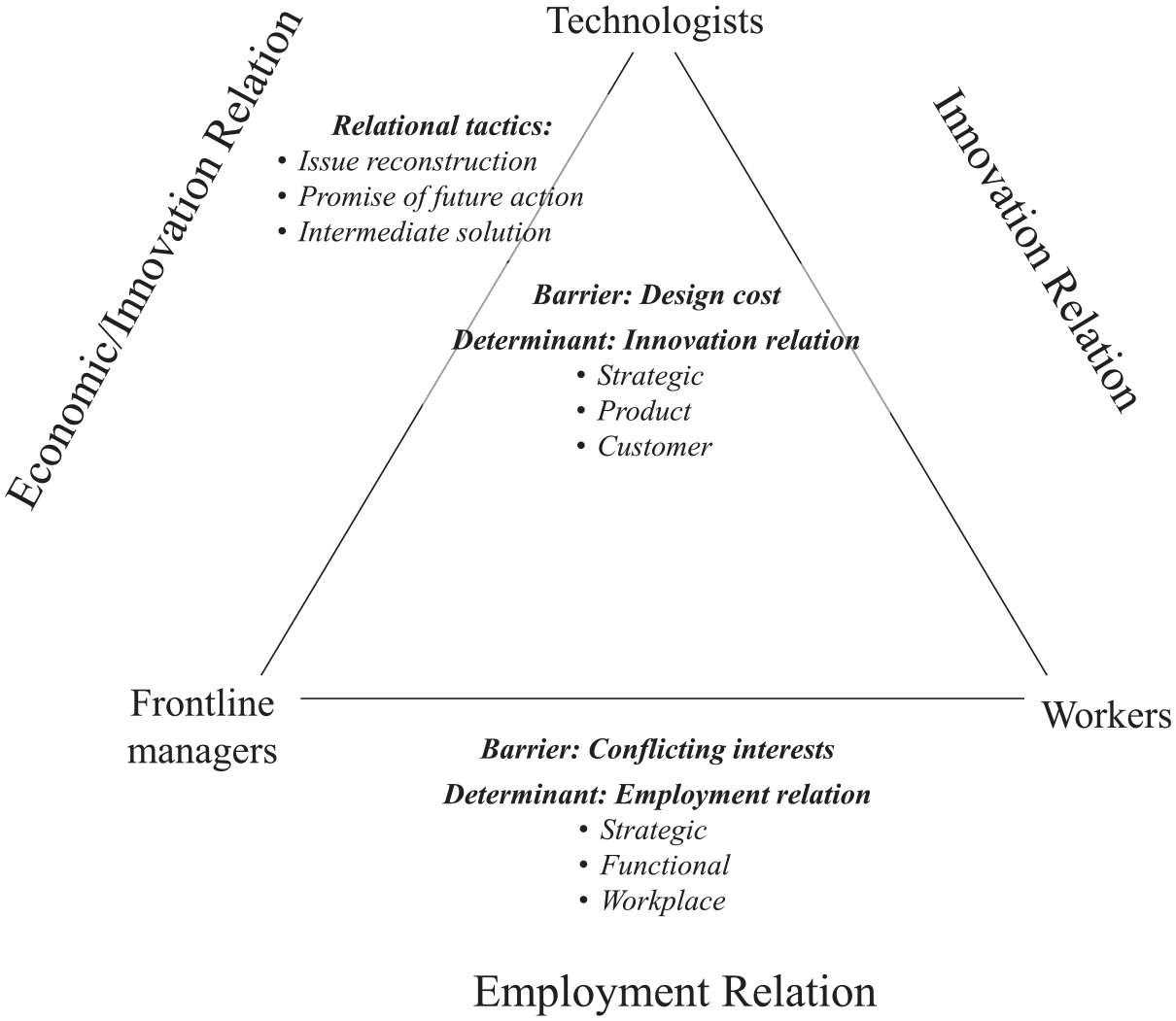
Theoretical Model of Triadic Technology Configuration
Findings
Technology Configuration through Employee Involvement at MetalWorks
Like other cloud-based technologies, ProdTech’s system could be continually reconfigured, including by changing firm-specific system settings, as well as through updates, fixes, and redesigns that affected all of ProdTech’s customers. Accordingly, MetalWorks managers encouraged machinists to use established employee involvement mechanisms to raise issues with the technology. Machinists did so in part because MetalWorks’ profit-sharing program incentivized them to support the firm’s production goals. One machinist said that he kept an eye on the tablet because, “If it’s red, there’s less chance for a bonus.” The bottom vertex of the triadic model in Figure 1 depicts these machinist–manager interactions.
Barrier: Conflicting Interests
As suggested by prior research, managers and machinists had conflicting interests that presented a barrier to technology configuration despite some common interests. One key conflict involved the distinction between process monitoring and performance monitoring. For instance, during a regular all-hands “communications meeting,” the MetalWorks CEO framed the technology as furthering a shared goal of process improvement: On ProdTech: We know we all want [the tablets] to be green, but if you’re red, it’s not a reflection of the individual, it’s a reflection of the [work] process. . . . If it’s red, we want to determine why. If it’s that the pieces per hour are wrong, the process, the tooling. . . . That’s why we have this.
Machinists generally accepted this frame. One said to me, “It’s all about the process.” Another explained, “If [the tablet] is red, [managers] don’t necessarily come over here. They’re just trying to improve the process.” Sometimes, however, the distinction between process monitoring and performance monitoring was blurred. A process engineer explained, “I would say it also identifies personnel issues. . . . The raw data show us that you’re not hitting your numbers for a reason. . . . It raises a question to look at what’s going on.” Indeed, the ProdTech data revealed to operations managers that one experienced machinist had not been running his jobs during his lunch break as he was instructed to do, which resulted in managers issuing a corrective.
An additional conflict involved the manual data entry requirements of the ProdTech tablets, including machinists’ new task of categorizing instances of machine downtime that extended beyond five minutes. During these instances, a screen appeared on the tablet with categories including “Troubleshooting,” “Break,” and “Tool Change.” This categorization helped managers and engineers identify areas for process improvement, but it was viewed as an additional, distracting task by some machinists, such as one who said, “My attention should be [on the machine], not over here [on the tablet].” A process engineer agreed this was a problem: It’s only two or three buttons you’ve got to push, but still. . . . You’ll notice a few of the guys who will either not put a downtime reason or just not look at the tablet. In a way, I think we would prefer them to do that because their focus is on running that machine.
These conflicting interests were consistently present during my study but specifically presented a barrier for one of the six issues that machinists raised directly to managers. For this issue (Tablet colors; issue 6A in Table 2), machinists disliked the tablet colors because they created extra pressure, and they sometimes inaccurately showed machinists as being behind on production. As one machinist said, “I hate being in the red.” Another said, “You feel like you’re under the magnifying glass. . . . It puts pressure on you.” Managers, however, considered the tablet colors as critical devices for identifying process improvements, so managers attempted to solve the issue by “coaching” the machinists to accept the tablet colors. One engineer said, “I would say get over it. Get over it. Has anyone gotten in trouble from it?” The MetalWorks CEO separately said, “We should do a better job of coaching them on why [the tablet colors are useful].”
Determinant: Employment Relation
Also as suggested by prior research, the employment relation was a determinant of technology configuration (e.g., Litwin 2015). At the strategic level, MetalWorks managers set strategies and structures including the commitment that technology investments would have no impact on the firm’s demand for labor. For instance, the CEO said during a strategy meeting, “We have to integrate robotics . . . but we will still need people.” At the functional level, managers developed formal and informal rules, such as the informal rule that issues would be negotiated. One machinist said, “I believe every [issue] is given consideration. . . . If something won’t be changed, it’ll be considered.” Another machinist said, “There’s a good general trust among people that work here.” At the workplace level, managers implemented daily practices for involvement, such as encouraging machinists to collaborate on problem-solving with engineers and maintaining an open-door policy across the management team. One machinist commented how unusual these practices were, saying, “[CEO] comes around every day and interacts [with us]. I have never seen that [at other shops] before.”
The employment relation was consistent over the course of my study and specifically shaped the resolution of one issue (Downtime categories; issue 1 in Table 2), in which managers agreed with machinists’ concern and had the ability to address the issue. In this issue, machinists were concerned that the existing downtime categories were inadequate to provide information about all incidents and that typing in additional details was distracting. One machinist said, “I wish I could put in more information.” Another said, “There are too many reasons why [a machine could be down].” In response, an operations manager shared her willingness to address this issue by saying, “[One machinist] wants more [downtime categories]. I said, ‘Tell me what you want, we’ll talk about it.’” Eventually, managers resolved the issue by changing some of the downtime categories available on the tablet, which reduced machinists’ complaints about this issue.
In sum, the firm-level barriers and determinants of technology configuration were consistently present in all 24 issues I observed. They can explain the outcome in only two cases, however (Tablet color; issue 6A, and Downtime categories; issue 1). For these issues, ProdTech technologists were not involved in issue resolution, and firm-level dynamics determined the outcomes. For the remaining issues, even when conflicting interests did not present a barrier to resolution, MetalWorks managers did not have the ability to change the required setting or design themselves. (See Table A.1 for these details.) Therefore, to fully understand technology configuration, it is necessary to consider the role of ProdTech technologists.
Influence of ProdTech Technologists on Technology Configuration at MetalWorks
Although MetalWorks managers controlled some technology settings themselves, addressing most issues required technologists’ involvement. In some cases, technologists assisted managers to change firm-specific settings, while in other cases, technologists adjusted capabilities or designs in ways that affected all customers. The side vertices of the triadic model in Figure 1 depict these interactions.
Barrier: Design Costs
While ProdTech technologists could modify user interfaces, data collection protocols, and system integrations, such changes involved time and effort for redesign and reprogramming. As one technologist said, “These development efforts are significant. . . . It’s hard for customers to understand, why would it take three to six months to upgrade [a set of features]? Well, because it’s a lot of programming.” For instance, she described to MetalWorks managers the costs involved in integrating ProdTech’s data with various manufacturing enterprise resource planning (ERP) vendors—a high priority for both managers and machinists (System integration; issue 5A): “[ERP integration typically] takes months to complete. We haven’t gone down the path of building a lot of these [integrations] because it’s labor intensive.”
Design costs presented a barrier in all but two of the issues managers raised to technologists (see Table A.1 for details). Regarding one of the issues that did not involve high design costs (Parts counter; issue 2 in Table 2), machinists had noticed that the “parts counter” on the tablets sometimes did not match their actual production count. This parts counter was connected to a line of code used within the computer programs in each machine. An engineer told me that different machine types and jobs used distinct codes to signal an “end of program” (i.e., that a part had been completed), which had not been fully accounted for when ProdTech was implemented: “It comes down to program format, and every shop is a little different. . . . M20 is the code that the Swiss [machine] uses. M30 is the code that the lathes use for an ‘end of program.’” After several machinists raised the issue of the inaccurate part counts, managers worked with technologists to identify a universal code that could be used as a parts counter. This resolution did not require any redesign, and it only affected MetalWorks, not ProdTech’s other customers.
Determinant: Innovation Relation
Despite high design costs to ProdTech technologists in the remaining issues raised, technologists occasionally prioritized these issues for reconfiguration. The nature of the innovation relation between ProdTech technologists and their customers determined these decisions. I characterize this relation as one of innovation because technologists could learn from customer use and rapidly reconfigure the software in response.
In an analogue to the employment relation, I found that the innovation relation can be understood to exist at three levels—strategic, product, and customer. First, at the strategic level, ProdTech technologists made decisions about what market to pursue and whether to develop various in-house capabilities or enable integration with other vendors. According to one ProdTech co-founder, the company’s initial vision was “to build an operating system for a robotic factory” for discrete manufacturing. This co-founder described to me that the “lowest hanging fruit” in achieving that vision was to make machine data more actionable: “We can pull the data from the [machine] control, and then we can visualize it and make it actionable for people.” In line with this strategy, technologists pursued developments that helped connect the different “nodes” of the manufacturing process, and they aimed to establish a broad market share. This strategy influenced technologists’ response to user issues, in part because it compelled them to address issues that were broadly applicable, as one technologist told me: For us, the right [approach] is really looking at what’s best for the industry, what’s best for the majority of our customers. . . . It’s very hard to justify spending three months of development on [customer-specific requests].
Accordingly, many of the reconfigurations involving technologists were released to all of ProdTech’s customers, even if they originated with a request from one specific customer, such as MetalWorks.
Second, at the product level, ProdTech technologists made decisions about what feature sets should be prioritized, what design styles should be established, and what interactional rules should guide technology use. For instance, ProdTech’s product strategy included building out “notifications” as a core feature set, since notifications made machine data more actionable for managers. Technologists also pursued tablet designs that required minimal interaction from machinists to reduce complaints about burdensome data entry. One technologist justified a new design idea by saying, “The number of taps [on the tablet] is significantly different [for the new prototype].” Additionally, because ProdTech’s strategy involved the pursuit of machine learning and artificial intelligence, technologists prioritized product features that involved predictive capabilities. One technologist said that his team was interested in developing “tool life” features, which involved using algorithmic monitoring to predict when a machine tool would fail due to wear and tear: We’re moving from 1-hertz sampling to 1,000-hertz sampling [of machine data]. As we’re collecting data, that’s moving from 1 to 1,000 times per second. . . . Once you get that level of data, you can start to use it to make predictions. Tool life is a key one.
Requests that aligned with priority feature sets such as notifications and predictions were more likely to be supported by ProdTech technologists.
Third, at the customer level, ProdTech technologists made decisions about how to interact with customers, including how often and with what communication style. These decisions related to technologists’ understanding of manufacturing culture and occupational relations. Technologists understood combatting the negative aspects of “shop floor culture” to be an important factor in the overall success of their product. One technologist described to me the importance of “operator engagement”: The understanding that . . . the operator is critical for the process has always been fundamental to ProdTech. . . . Even if you look at the tenets of Lean and continuous improvement, it’s about going to the source, [to] the people that do the job. . . . Without that . . . [customers] are not going to get as much benefit out of the product.
Whereas this technologist described operator engagement in economic terms, others at ProdTech held a stronger ideological stance toward “making sure that operators were heard.” One technologist said, “Operators have feedback that trumps everything else [right now, because] . . . the operator is a user and can influence things and complain, but he doesn’t have control [within the firm].” As a result, requests coming directly from machinists, or ones that furthered operator engagement, were more likely to be supported by the technologists.
In sum, the innovation relation was a determinant of technology configuration at MetalWorks. When managers or machinists raised issues that aligned with ProdTech’s priorities at the strategic, product, and customer levels, these issues were more likely to be addressed by the technologists, even when they involved high design costs. For example, managers raised the idea to receive notifications when machine incidents were resolved (Alarm resolution; issue 14 in Table 2). This idea aligned with ProdTech’s strategic goal to make “actionable data” and with its product goal of improving the notifications feature set, as the following interaction demonstrates: MetalWorks manager: [Operations manager] set up a notification where if a machine has an alarm, it sends an email. It did that last night. My question is do we get a follow-up notification that [the machine is now] up and running? ProdTech technologist: That’s interesting. . . . There’s a big push this year to have notifications drive activity. . . . At task closing, you could probably get an email when the task is resolved. Let me mention that to engineering.
Accordingly, ProdTech prioritized this issue for reconfiguration in its product road map.
Actions: ProdTech’s Relational Tactics
ProdTech’s relation with its customers was not only one of innovation but also one of economics. ProdTech received ongoing payment from MetalWorks and other customers to provide access to the technology via a subscription model. When MetalWorks managers raised issues that did not align with ProdTech’s innovation relation, technologists used several tactics to maintain customer satisfaction. I observed three relational tactics: 1) reconstructing the issue, 2) making a promise of future action, and 3) presenting an intermediate solution.
First, ProdTech technologists occasionally reconstructed managers’ issues to better align with their own priorities. This tactic was possible because managers often articulated a problem without posing a specific solution. Technologists held technical knowledge of the multiple ways in which the problem might be solved, and they suggested solutions that were aligned with reconfigurations already under consideration. In the following example, an engineer asked about the ability to track the amount of time that jobs were run “at risk,” which meant calculating the amount of time that production had proceeded before any inspection had been done (At risk; issue 19 in Table 2). The technologist responded by suggesting a partial solution that reconstructed the issue to align with ProdTech’s current priorities: MetalWorks process engineer: Are we able to talk to engineering about giving a notification when the first piece [inspection] is done? . . . Say [the part was produced] at 1 p.m., and they finished first piece [inspection] at 4 p.m. So, you would allocate three hours of “at risk.” If there’s an issue [with the job], you could go back to see where we were running at risk, and it gives us how many hours the production floor runs at risk [overall]. ProdTech technologist: We have talked [internally] about the ability for people to send messages to the tablets. I’m thinking that functionality would be best for that.
Notably, sending a message to the tablet that a “first piece inspection” had taken place for a given job did not enable MetalWorks engineers to easily view the total amount of time that all jobs had run “at risk,” which had been a key part of the request. Making these calculations required further reprogramming to backend data, which was not a current priority for ProdTech.
Second, ProdTech technologists made a promise of future action if managers raised an issue that could not be addressed without high design costs or easily reconstructed to align with current priorities. Because the technologists present at meetings with MetalWorks managers were not members of ProdTech’s engineering or data science teams, they regularly responded to issues with a promise to speak with these technical teams. For instance, a technologist said in response to one issue, “I’ll ask [our engineers] about this. It’s a good time to ask them. With the quality side, we haven’t built out the UI [user interface] yet.” On another occasion, she responded, “Would you like me to request [that]? I don’t know if the data science department has a tag [to address that issue].” This tactic also involved technologists advising managers that an issue was slated for development but would not be addressed in the near term.
Third, ProdTech technologists presented an intermediate solution to managers’ issues if one was available. This tactic often involved leveraging an existing feature to solve part of the issue. For example, in response to a request by a MetalWorks operations manager for a fourth color to be added to the tablets to indicate when a job was running faster than predicted, a ProdTech technologist suggesting setting up a notification instead (Fourth color; issue 18 in Table 2), “We haven’t been able to support other colors getting added [to the tablet] . . . mainly because it’s tied back into all kinds of forms and things. . . . Would a notification suffice [for now]?” The manager responded, “Yes, to the right people,” though managers occasionally continued to ask the technologist about the possibility of adding a fourth tablet color.
Variations on Triadic Relational Dynamics
Incorporating the barriers, determinants, and actions related to ProdTech technologists into my inquiry reveals new relational dynamics that explain technology configuration at MetalWorks. These dynamics are triadic—involving varying arrangements of relations between MetalWorks machinists, MetalWorks managers, and ProdTech technologists, which are indicated by the Variation column in Table 2. I discuss two in-depth examples in the sections that follow to illustrate prevalent variations of the model.
Machinist–Manager–Technologist Dynamics
In the first variation, machinists raised issues to managers. If managers agreed they should be addressed but did not have the ability to do so themselves, managers raised the issues to ProdTech technologists, who often used relational tactics in response (issues 1–6A in Table 2; see also Figure A.1). Figure 2 depicts the specific example discussed below.
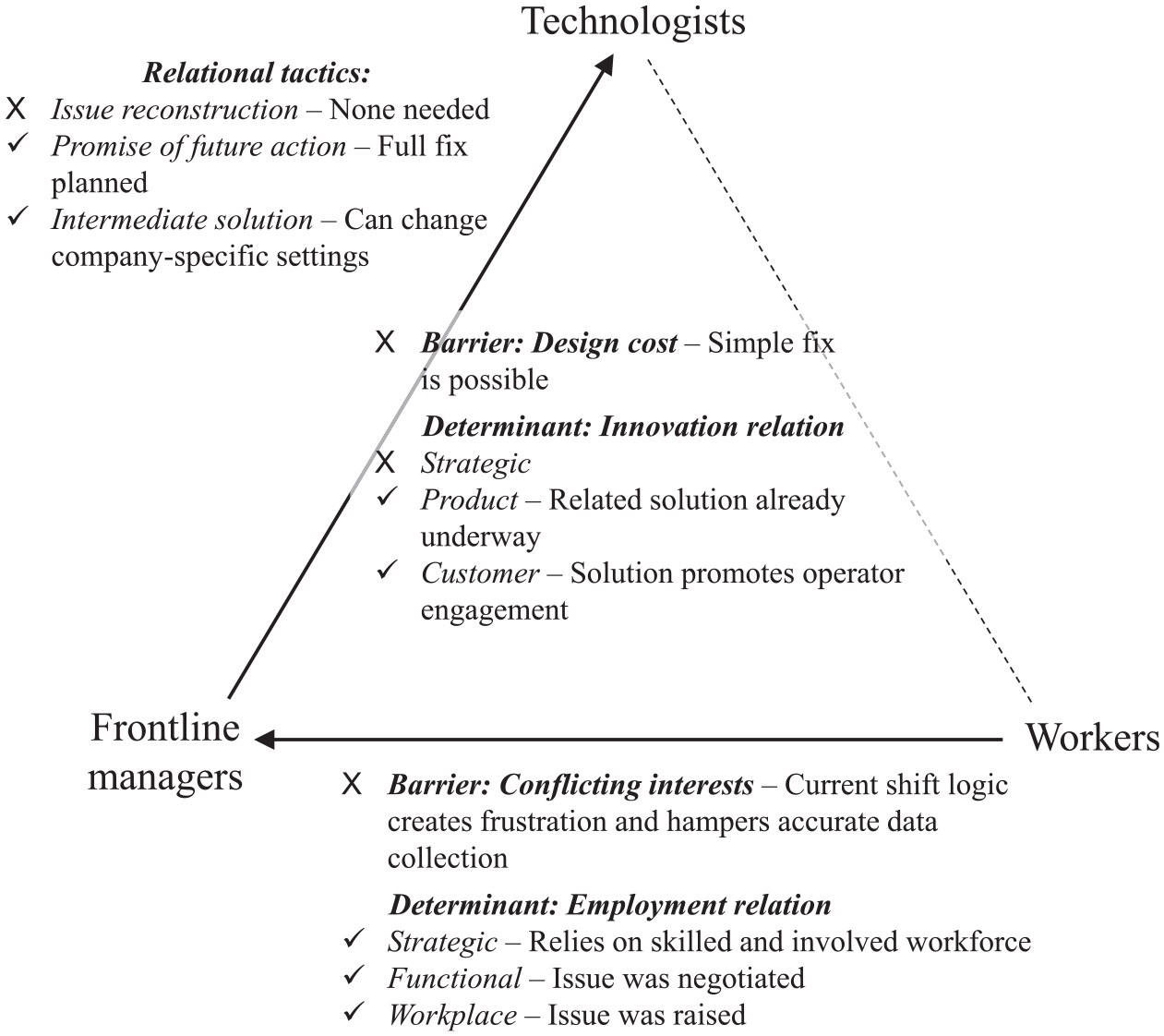
Shift Logic Issue
The issue in this example centered on the way the ProdTech system was programmed to allocate machine data to specific production shifts (Shift logic; issue 3 in Table 2). At implementation, ProdTech technologists had set up the technology to differentiate production data from first versus second shift. This setup had implications for machinists, who could only log in and out of their tablets during these pre-specified time frames. A process engineer described to me how this created annoyances for machinists who worked on flexible shifts: “[One machinist] would always complain that [the ProdTech tablet] would kick him out. [He] is one of the guys that could stay until 4 p.m. It kicks him out [at the end of] that 3:30 shift, and he had to go back and clock in again for that last half hour.” Other machinists identified additional problems: machinists arriving early were unable to log in to their tablets, and machinists arriving late (by permission) were inaccurately considered by the tablet to be behind on production.
An operations manager agreed this issue required a solution by saying, “We don’t gain anything from seeing the spread [of data across two shifts]. We work with those guys to help them out, but seeing first versus second shift creates confusion and frustration.” Therefore, conflicting interests did not present a barrier to technology reconfiguration for this issue, and the employment relation presented a facilitator.
Because managers could not change the relevant setting themselves, however, the manager asked ProdTech technologists whether the distinction between shifts could be removed. A technologist responded: The short answer is yes, but the long answer is not yet. . . . We’re doing away with “shift logic” . . . over the next six to nine months. . . . In the meantime, . . . we could collapse first and second together [to create] one 24-hour shift.
Although fully addressing the issue required high design costs for ProdTech, which might have presented a barrier, the necessary programming was already underway. Additionally, the MetalWorks manager had described the ways in which this issue was causing problems for machinists and lowering data accuracy. Therefore, ProdTech’s innovation relation facilitated technology configuration because solving the issue aligned with their current product road map and would likely yield increased data accuracy and operator engagement. Accordingly, the technologist promised future action to fully address the issue (relational tactic #2) while posing a satisfactory intermediate solution (relational tactic #3) that applied only to MetalWorks.
Note that a related variation existed in which managers raised issues to technologists that had not first originated from machinists (issues 14–24 in Table 2; see also Figure A.2). This variation proceeded similarly, as technologists considered design costs and the alignment with their innovation relation before determining whether and how to pursue a technology reconfiguration.
Machinist–Technologist Dynamics
Machinists generally were dependent on managers to speak to technologists on their behalf, as in the prior example. However, ProdTech technologists occasionally asked to speak directly to machinists to obtain feedback on the technology. As one technologist said about the machinists, “There’s no way you can build a product like that for a user and never ever talk to them.” So, in this second variation, machinists raised issues directly to the technologists (issues 5B–13 in Table 2; see also Figure A.3). Figure 3 depicts the specific example discussed below.
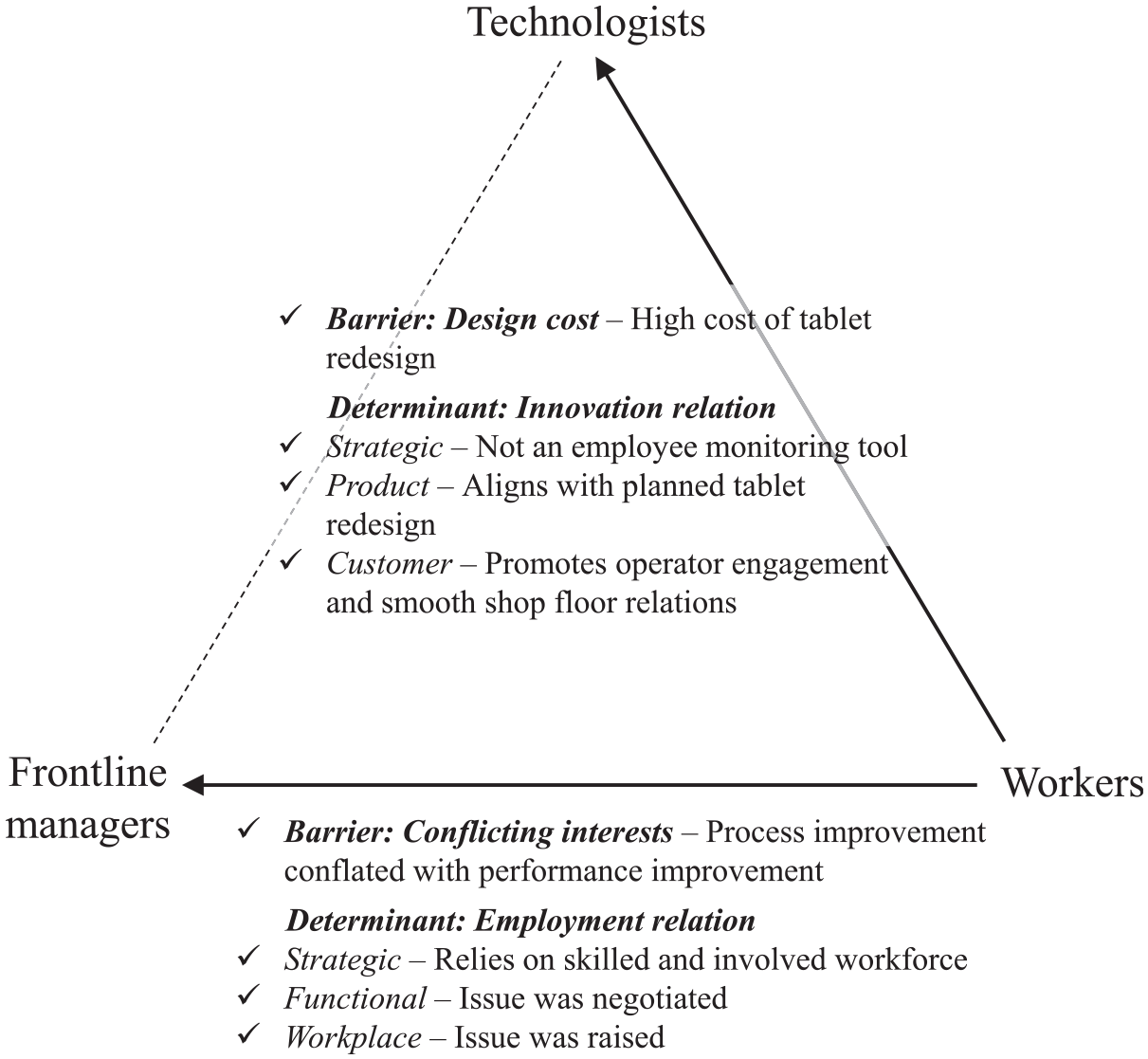
Tablet Colors Issue
In this example, machinists raised an issue to technologists that they had previously raised to managers without success. The issue centered on the bright tablet colors that indicated the machines’ real-time status (Tablet colors; issue 6B in Table 2). As described earlier, several machinists had indicated to managers that they disliked the distinct visibility of these colors, including because the colors sometimes inaccurately or unfairly showed machinists to be behind on production (issue 6A). However, conflicting interests between managers and machinists had presented a barrier to configuration.
Machinists again raised the issue when talking directly to technologists, who visited MetalWorks on several occasions. After hearing this issue from several machinists, one technologist prompted another machinist, “If it’s red, it makes you feel . . .” The machinist responded, “Bad [tapping his chest over his heart]. It’s hard for us.”
Reconfiguring the tablet colors presented high design costs to the technologists; however, ProdTech’s innovation relation facilitated reconfiguration. At the strategic level, machinists’ perceptions of being unfairly monitored diverged from ProdTech’s goal of creating actionable data for process improvement. As one technologist said, “We really weren’t trying to be the operator tracking platform.” At the product level, technologists had begun to consider options for tablet redesign, and revisiting the status indicator colors aligned with this priority. At the customer level, machinists’ complaints raised the specter of operator disengagement, which technologists believed would harm the value customers gained from the technology and cause customer churn. As he was exiting MetalWorks, one technologist mused to himself, “The tool was not [initially] designed with the emotional component at all.” He later told me that a marker of success for the tablet redesign would be, “If there’s less nagging and less feeling surveilled.”
When addressing this issue, technologists did not use relational tactics with machinists because they did not have a direct economic relation with them (i.e., machinists did not pay for the ProdTech subscription). Ultimately, however, the technologists revisited MetalWorks to show machinists a prototype of the new tablet design. This prototype incorporated other ideas that machinists had raised, such as adding additional graphics to allow machinists to view historical, as well as real-time, data. A technologist said of one machinist during this visit, “His mind was blown that we listened to him and tried to solve a problem for him.” Technologists speaking directly with machinists therefore presented an alternative path for reconfiguration, particularly when conflicting interests presented a barrier for machinists to resolve their issues internally with management. Further, these reconfigurations were made available to all ProdTech customers.
Discussion
Existing research on employee involvement (EI) examines firm-level practices to encourage worker input on workplace technologies, and the field of science and technology studies (STS) elaborates how technologists act to reinforce institutionalized patterns of labor–management relations (e.g., Noble 1984; Clement and Van den Besselaar 1993; MacDuffie 1995; Adler et al. 1997; Litwin 2011). This research, however, fails to show how configuration is shaped through ongoing design-use cycles or to examine the influence of technologists’ motives and behaviors. As this study shows, analyzing cloud-based technologies that are broadly networked, data-driven, and highly malleable instead requires viewing technologists as key players throughout the technology life cycle. By tracing technologist–worker–manager relations across 24 configuration issues at MetalWorks, I show that, in addition to barriers and determinants related to the employment relation, we must tend to barriers, determinants, and actions that involve technologists.
Technology Configuration through Triadic Relations
A core contribution of this study is its development of a triadic model (see Figure 1) that explains technology configuration through the relations between managers and workers in a focal firm, as well as third-party technologists. Specifically, this study shows that the configuration of cloud-based technologies is shaped not only by factors such as local work organization practices or institutional pressures but also by technologist–user relations. While earlier generations of EI research may have also benefited from an analysis of technologists, the increasingly central role of technologists makes their inclusion more urgent.
Technologists’ expanded role is a prime example of the multiplicity and distance that characterize contemporary employment relationships (Riordan and Kowalski 2021), and the triadic model usefully expands EI theory by enabling the mapping of power in various types of cloud-based technology ecosystems. Crucially, whereas the employment relation is largely shaped by the choices of managers, the innovation relation is largely shaped by the choices of technologists. Mapping these relations through the triadic model can generate nuanced predictions about technology configuration that could not be made using insights from existing EI research. For example, an employment relation lacking EI mechanisms will likely silo workers from technology configuration interactions with both managers and technologists (since managers must typically grant technologists permission to speak to workers). Similarly, an innovation relation is likely to minimize worker involvement if, at the strategic level, it emphasizes a strategy of employee monitoring or if, at the customer level, it does not incorporate an understanding of how frontline worker involvement affects adoption and use. In these cases, “high road” customer firms (see Osterman 2018) must rely on managers to transmit workers’ concerns to technologists. Further, technologies with higher design costs (e.g., involving complex hardware components or algorithms) will present barriers to reconfiguration, all else being equal. Future research should examine how employment and innovation relations interact, such as the interaction of technologists with a worker-centric innovation relation and customers with a “low road” employment relation.
The triadic model also adds to calls for EI to be reconceptualized to include a direct channel between workers and technologists during adoption, implementation, and use. The technologist–worker relations described in this study (the right-hand vertex of Figure 1) present some of the first empirical evidence of an “integrated model” of technology and work design (Kochan 2021), in which workers are included in conversations about design throughout the technology life cycle including before new features are released in the workplace. Such a channel presents a complement to firm-level mechanisms for EI, which is particularly important for issues that are unlikely or unable to be addressed internally. Note that direct machinist–technologist relations resulted in reconfiguration of ProdTech’s system in ways that had significant implications for machinists’ skills and authority, including by expanding their access to historical production data and limiting their sense of being surveilled.
Direct technologist–worker relations are also more likely to resolve workers’ issues that involve conflicting interests with managers. Research in European contexts has shown that a strong tradition of codetermination allows workers to give input on important issues of data use and control (e.g., Bender and Söderqvist 2022; Krzywdzinski et al. 2022). In North America, legal protections for workers are a critical step (Bailey 2022; Bernhardt et al. 2023). Until this step is taken, however, policymakers and researchers should continue to study and advocate for organizational solutions. This research and advocacy will be especially important for emerging technologies, such as cloud-based technologies that offer fadvanced monitoring and control capabilities in ways that present new threats to worker interests (Bailey 2022).
Finally, this model implies that workers (and managers) can influence how cloud-based technologies are used across multiple firms. While broad applicability may not be the intent of any individual worker, direct interactions with technologists enable worker input to affect technology configuration even at firms in which managers do not allow workers to speak directly with technologists. Existing research has described how workers may enlist allies such as customers or buyers (e.g., Marquis 2017; Anner 2018), who push for change across sectors or industries. I suggest that technologists may similarly be enlisted as a third-party ally to scale worker voice through technology reconfiguration. Notably, because workers are less likely than managers to have consistent contact with technologists because of their lower power in the employment relationship (e.g., Noble 1984; Budd 2004), workers may be more likely to present ideas that generate new and valuable use cases for technologists.
Technologists’ Innovation Relation
Another contribution of this study is its elaboration of the innovation relation as a determinant of technologists’ responses to user issues. Through an analysis of ProdTech’s interactions with machinists and managers, I show how the innovation relation stems from technologists’ impetus to innovate their product through ongoing design-use cycles that involve user feedback. Three aspects of the innovation relation shape whether technologists decide to pursue reconfiguration for a given issue. First, at the strategic level, technologists determine whether issues align with their strategic intent and with the needs of the broader market. Second, at the product level, technologists determine whether issues align with prioritized feature sets and philosophies for the user interface and user experience (UI/UX). Third, at the customer level, technologists determine whether addressing issues furthers positive interactions between users and the technology and among different occupational user groups.
Existing STS research attends to the ways institutional contexts shape how technologists engage with their users to develop designs that are further adapted through use within individual firms (e.g., Braverman 1974; Noble 1984; Clement and Van den Besselaar 1993). Elaborating the technologist–user innovation relation contributes to this research by treating technologists as situated organizational actors rather than mere conduits or amplifiers of institutional power relations. Although the importance of actors’ strategic choices has long been inherent to STS research, studies of emerging technologies have sometimes treated institutional pressures for increased surveillance and control as a given without examining the micro foundations of and responses to these pressures in context (e.g., Bernhardt et al. 2023). In ProdTech’s case, technologists were attentive to operator engagement and positive worker–manager relations, despite developing a process monitoring technology within an American manufacturing sector that is broadly averse to unions. This change of perspective is meaningful because it goes beyond identifying technologists as an important actor to explaining why technologists use diverse approaches to technology configuration within the same institutional context.
This finding broadens our understanding of the factors that influence decision-making about workplace technologies. In an echo of mainstream employment relations theory (Riordan and Kowalski 2021), STS research has treated economic interests as the main motivators for technologists’ design decisions (Noble 1984). The innovation relation, by contrast, incorporates technologists’ values and identities. For example, while ProdTech technologists pursued their economic interests by dedicating scarce design resources to reconfigurations that benefited broad segments of their customer base, many technologists inherently valued frontline worker feedback and held the identity of belonging to a leading industrial “Internet of Things” company. As a result, the technologists mediated between user groups (managers and machinists) according to their own priorities and understandings. Mapping the innovation relation can help predict when technologists will respond to user issues even when high design costs might otherwise present a barrier and the degree to which different types of users (e.g., managers and workers) will have input in the reconfiguration process.
This finding also suggests important areas for future research on technologists. One potential area is examining sources of variation in the innovation relation. For instance, entrepreneurial technology companies pursuing rapid growth or those having received large capital investments have strategic priorities that differ from companies at more established stages (von Hippel 2006; Karp 2022) and may interact differently with customers. Additional research might examine how the innovation relation is initially shaped. My findings suggest that the strategic level is likely to be strongly influenced by executives; the product level by software engineers, data scientists, and product developers; and the customer level by sales and customer support representatives, though all three levels are interdependent. While these areas are beyond the scope of the current study, they present fruitful ways to build on the concept of the innovation relation.
Technologists’ Relational Tactics
A final contribution is specifying the relational tactics that technologists can use to maintain positive customer relations. Because technologists’ relation with managers is economic, in addition to innovative, technologists must account for actions that go against managers’ wishes or risk losing customers. I describe three tactics technologists use when managers raise issues that do not align with technologists’ priorities: 1) reconstructing the issue, 2) making a promise of future action, and 3) presenting an intermediate solution.
This finding contributes to the emerging body of research in information and organization studies that examines the relations between technologists and users (e.g., Barrett et al. 2012; Pachidi et al. 2021; Karp 2022; Van den Broek et al. 2021). I demonstrate that managing customer relations is an important aspect of technology configuration as technologists use relational tactics to push back against undesirable user ideas while maintaining ongoing economic exchange with customers. This finding echoes studies that show how technologists must navigate the competing requirements of offering significant and relevant innovations to their users, on the one hand, while avoiding threatening powerful groups’ expertise and jurisdictions, on the other hand (Van den Broek et al. 2021; Karp 2022). This study differs, however, by examining ongoing technology configuration, rather than adoption, and by showing how technologists can use rhetorical tactics rather than design and deployment decisions, to appease important user groups within customer organizations. The attention to post-adoption dynamics may be particularly important when studying cloud-based technologies that are offered for relatively modest ongoing fees rather than requiring significant up-front capital investments.
Limitations and Conclusion
I identify several limitations to this study that also present additional opportunities for future research. First, as in any analysis of a single case, this study has limits to its generalizability. The findings will apply most directly to technology ecosystems that do not involve advanced artificial intelligence and machine learning. While such technologies are data-driven, broadly networked, and highly malleable, they are also defined by their opacity (e.g., Kellogg, Valentine, and Christin 2020; Lebovitz, Lifshitz-Assaf, and Levina 2022). When the inner workings of technologies are opaque to users and technologists alike, technologists may be less able to direct the configuration process, which might shift the relations between technologists, managers, and workers in unexpected ways.
Second, because of the timing of my data collection, I was unable to consider MetalWorks’ initial adoption of ProdTech’s technology or the long-term effects of the reconfigurations profiled here. While technology configuration is an important input into downstream effects on skills, authority, and the division of labor, the reconfigurations likely had variable, unpredicted, or undesirable effects, even when they were broadly supported by managers, workers, and technologists.
Third, the relations considered here were bounded to include only technologists, managers, workers, and focal artifacts across ProdTech and MetalWorks. This analytic choice excludes the ways in which regulators, ProdTech investors, and ProdTech competitors, for instance, may have shaped technology configuration decisions. Although valuable insights can be gained by narrowing the scope of analysis, it is important for future work to maintain a wide lens to fully analyze the power relations surrounding the configuration and use of advanced workplace technologies.
Supplemental Material
sj-pdf-1-ilr-10.1177_00197939241232992 – Supplemental material for Triadic Technology Configuration: A Relational Perspective on Technologists’ Role in Shaping Cloud-Based Technologies
Supplemental material, sj-pdf-1-ilr-10.1177_00197939241232992 for Triadic Technology Configuration: A Relational Perspective on Technologists’ Role in Shaping Cloud-Based Technologies by Jenna E. Myers in ILR Review
Footnotes
This article is part of an ongoing ILR Review special series on Novel Technologies at Work.
Funding for this research was provided by the Good Companies Good Jobs Institute at MIT Sloan.

For general questions as well as for information regarding the data and/or computer programs used for this study, please contact the corresponding author at
References
Supplementary Material
Please find the following supplemental material available below.
For Open Access articles published under a Creative Commons License, all supplemental material carries the same license as the article it is associated with.
For non-Open Access articles published, all supplemental material carries a non-exclusive license, and permission requests for re-use of supplemental material or any part of supplemental material shall be sent directly to the copyright owner as specified in the copyright notice associated with the article.
