




Abstract
The gradual shift in power relations between organized employers and employees since the 1970s has increasingly affected the functioning of national industrial relations systems. According to a broad literature, the most important of these consequences is an increase in employer discretion. This article tests this claim by performing a longitudinal content analysis on three Dutch collective contracts. It develops an analytical framework based on four dimensions of employer discretion. Results show that although employer discretion did increase on all four dimensions between the mid-1970s and the 2020s, significant temporal and sectoral variation has occurred. In addition, the article argues that a loss of democratic influence by employees intensified the increase of the one-sided decision-making powers of employers, and that the collective contract is being transformed from a joint labor–capital effort to solve workplace problems to a management instrument.
According to significant scholarship on labor markets, the current era of capitalism can be defined as a gradual but steadfast re-liberalization of national industrial relations systems. Over the years, various liberalization scholars have argued that while national differences remain significant, the trend toward liberalization characterizes all advanced capitalist democracies. The liberalization of industrial relations results from organized employers engaging in political activism to take back economic and societal control and restore managerial authority on the shop floor. This “class struggle from above” (Baglioni, Campling, and Hanlon 2020: 915) unleashed the intrinsic unruly character of capital and put pressure on the common normative understandings underpinning corporatist institutions, such as collective bargaining. According to Baccaro and Howell (2017), the defining feature of this trend toward liberalization is a gradual increase in employer discretion. To what extent existing constraints on individual employers have diminished remains unclear. This article investigates whether and to what extent individual employer discretion has increased because of changes in the language of Dutch collective agreements since the 1970s.
This article makes three contributions to the liberalization and industrial relations literature. First, it tests Baccaro and Howell’s aforementioned claim. Although considerable research has been done on collective agreements, little research has been done on the language of these agreements. Instead, most studies have focused on macro-level variables, such as coverage levels, to allow for international comparisons (e.g., Palier and Thelen 2010; Visser 2016; Dølvik et al. 2018; Brandl and Bechter 2019; Paster, Oude Nijhuis, and Kiecker 2020). These contributions have provided us with considerable insights into transformations in the organization of national political economies but do not give us much information on the role of collective agreements in changes in the power dimension and nature of the employer–employee relationship.
Second, this article extends Baccaro and Howell’s definition of employer discretion by adding democracy as an analytical dimension. Existing studies often use the three dimensions of employer discretion as defined by Baccaro and Howell (2017), specifically, wage-setting, workplace organization, and control over hiring and firing. In many countries in the Global North, though, a process of democratization of production was an integral component of the post–World War II class compromise and influenced the discretionary power of employers. Therefore, this analysis includes two additional elements: changes in the governance of the production process, and changes in the incorporation of workers in decision-making processes on the firm and industry levels. Both elements will expand our understanding of changes in employer discretion as an indicator of liberalization and of the role of collective agreements in the process of this transformation.
This article’s third contribution is its engagement with several current debates about how and when the liberalization of industrial relations took place in coordinated market economies with relatively stable institutions, and what the driving forces were.
To achieve this, the analysis focuses on whether and how collective agreements have increased individual employer discretion in three sectors in the Netherlands between 1977 and 2021. It utilizes a conceptual framework that measures the degree of employer discretion along the four previously mentioned dimensions based on 15 indicators.
The remainder of this article first scrutinizes the existing literature on liberalization and the democratization of industrial relations to clarify the theoretical framework. The sections thereafter explain the case selection and methodology, the results, and, finally, the conclusions and limitations of my approach.
Liberalization and Democratization in Collective Agreements
The discussion in international political economy and labor relations has shifted in recent years from an emphasis on stability and preservation, often attributed to varieties of capitalism (VoC) scholars, to change and convergence. The liberalization thesis claims that processes of deregulation, individualization, and privatization have led to neoliberal drift, that is, increased employer discretion leading to changes in the income distribution, increased economic inequality, and the destabilization of the postwar Fordist growth model (Streeck 2014; Baccaro and Howell 2017; Biebricher 2019; López-Andreu 2019; Müller, Vandaele, and Waddington 2019; Greer and Umney 2022). It also claims a commonality of these trends in capitalist democratic countries. In response, new debates arose on whether this conclusion of commonality leads to determinism and an unjustifiable lack of agency of the involved actors or the underestimation of the stabilizing role of institutions (Thelen 2014; Picot and Tassinari 2017; Dølvik and Marginson 2018; Meardi 2018).
Two elements of this debate are especially critical regarding changes in collective agreements. The first concerns the role of stabilizing institutions. It relates to the issue of whether liberalization in coordinated market economies is primarily the result of a compositional and coalitional shift, as VoC scholars and Thelen argue (Hall and Soskice 2001; Hall and Thelen 2009; Thelen 2014), or the result of employers canceling the postwar pact between them and unions to liberalize their industry, as Baccaro and Howell (2017) argue. If the latter is correct, a change in the orientation and interests of manufacturing employers must be visible in the respective sectoral collective agreements. While following the VoC logic, collective agreements in manufacturing remained a stabilizing factor, and change will become visible in service contracts and the coalition between service employers and employees. Another option is also possible: The nature of the coalition and the collective agreements in manufacturing and services already differed in the 1970s. Organized employers were stronger in manufacturing than in services. Thus, they might have already realized some flexibility in their contracts.
The second element concerns the level of analysis. The evidence in the liberalization literature often focuses on macroeconomic outcomes, such as changes in collective bargaining levels and coverage rates or increased income inequality (Grimshaw, Johnson, Marino, and Rubery 2017; Ibsen and Keune 2018; López-Andreu 2019). Baccaro and Howell (2017) used the Institutional Characteristics of Trade Unions, Wage Setting, State Intervention and Social Pacts (ICTWSS) database. Although this approach provides valuable insights, it has some limitations as well. For example, changes in government policies, such as deregulating collective bargaining legislation or implementing austerity policies, are often an important explanatory factor for these outcomes and for the accompanying increase in employer discretion; although the result is the same, the driving force is not primarily employer behavior. This distinction seems especially relevant because, according to VoC scholars, the presence and extent of coordination, and thus the behavior of employers, is one of the main differences between limited market economies (LMEs) and coordinated market economies (CMEs). It is thus helpful to isolate the distinct forces driving increased employer discretion, and collective agreements are especially suited to realize this. Although these, too, are informed by legal changes, they still have to be affirmed in the collective contract.
Another limitation is that focusing on macro-level institutional variables may give us a false sense of stability (Ulfsdotter Eriksson, Larsson, and Adolfsson 2021). For instance, Ibsen and Keune (2018) concluded that only limited possibilities for wage-setting at the firm level exist in Dutch collective agreements, supporting Rojer’s (2004) conclusion that wages are highly coordinated. The option that erosion occurs within collective agreements and is coordinated in collaboration with trade unions is considered too infrequently, especially since we know that trade unions adopted a liberalized agenda in the 1990s and early 2000s (Mudge 2018; Humphrys 2019; Boumans 2023).
A longitudinal analysis of changes in the language of collective agreements helps clarify the questions and overcome the limitations mentioned above. Collective bargaining has the advantage that it is essentially the result of negotiations between employers and employees, making it easier to identify and isolate changes, continuities, and directions in employers’ interests and strategies. It is necessary, however, to be precise in defining employer discretion because the term is sometimes used loosely. Therefore, I next discuss in detail the four dimensions of discretion and the expectations arising from the liberalization literature.
Four Dimensions of Employer Discretion
The first dimension concerns increased individual employer influence on wage determination, which is often linked to decentralization and associated with the transformation from Fordism to post-Fordism. In the Post-Fordist era, employers preferred decentralized bargaining because it eased tailor-made wage setting, unlike the previous conditions under Fordism (Pontusson and Swenson 1996; Visser 2016; Müller et al. 2019). Individualization of wage setting, wage moderation, differentiation of wage-setting systems, and variable pay systems are results of decentralization (Gazier and Petit 2007; Dølvik and Marginson 2018; Brandl and Bechter 2019; Ulfsdotter Eriksson et al. 2021). Following this line of argument, changes in the provision of collective agreements that stimulate individualization of wages through performance pay and changes in the pay structure, decentralization, shifting decision-making authority to lower levels, and wage moderation would be signs of increased employer discretion in wage determination.
The second dimension of employer discretion is “the ability to organize work time flexibly to accommodate peaks and lulls in demand and to deploy labor across functional specializations or job categories” (Baccaro and Howell 2017: 20). This dimension, too, connects the reorientation of the political economy with the reorganization of production processes. While the Fordist firm is associated with in-house mass-production, hierarchal relations, and wage-driven growth, the post-Fordist firm is lean, based on outsourced and just-in-time production, and characterized by decentralized decision-making processes. To facilitate this agility and enhanced competition built into production processes, employers focused on temporal and contractual flexibility accompanied by broad job descriptions rather than long-term, full-time contracts (Streeck 1987; Lambert 2008; Jaehrling and Méhaut 2013; Baglioni et al. 2020; Wood 2020).
Changes in the language of collective agreements that enhance time flexibility, such as changes in the standard working time and the organization of shift work, can be considered indicators of liberalization in the realm of this second dimension. Also, changes that increase flexibility in the allocation of personnel, for instance, through changes in the job classification system, can be categorized as such.
The third dimension of employer discretion refers to “the degree to which the employment relation approximates the model of employment at will,” which is the termination of an employment contract whenever either party wishes (Baccaro and Howell 2017: 20). Employment at will is at present not a common practice in most European countries, including the Netherlands, and hiring and firing are mainly regulated by law and not by collective agreements (Bhargava and Young 2021). Nonetheless, several provisions on dismissal (and protection thereof) can be found in collective contracts, such as the probationary and notice period and provisions on mass dismissal. Moreover, using a wide range of temporary contracts creates de facto employment at will. In this analysis, therefore, changes in provisions regulating (mass) redundancies and contractual possibilities that allow for more employer discretion are included as indicators.
The fourth dimension of employer discretion, as I propose in this article, relates to changes in governance and strategic decision-making within an industry or firm and is defined as the ability of employers to unilaterally make strategic decisions regarding the organization of production without having to consider the collective voice of workers.
The desire to democratize the production process and give decision-making powers, or at least voice, to workers is rooted in the understanding that “[w]ork is not seen as a private affair but as a public activity that shapes the economic and psychological well-being of individuals, the physical and emotional health of a community’s families, and the quality of a country's democracy” (Budd 2014: 508). Following the end of World War II, the labor movement directed its efforts to extend citizenship to the workplace and to the macro-economic level. Works councils and neo-corporatist institutions are well-known institutional examples. This countervailing process limited the disruptive social effects of market liberalism (Hyman 2001, 2015; Ferreras 2017; Jirjahn and Le 2022).
From the 1980s on though, workers’ interests were gradually reconceptualized to align them with management's needs in response to market-making and reorientating corporate governance to profit maximization (Godard 2020). The corporation as a “polity” and the worker as “a rights-bearing member of that polity” (Dukes and Streeck 2022: 4) with distinct interests were replaced by notions of worker voice and participation as a means to increase business efficacy and productivity (Palier and Thelen 2010; Doellgast 2012; Holst 2014). The shared normative beliefs that had formed collective bargaining and other corporatist institutions slowly eroded (Budd 2004).
This dimension of democracy thus relates to collective workers’ say in the governance of the firm or industry. It is measured by indicators such as the presence of bipartite structures, changes in the provisions concerning the governance of the industry or firm, and changes in contract partners. It differs from the second dimension because the latter concerns the degree of temporal and spatial freedom employers have in organizing the workforce.
Case Selection and Methodology
I analyze three Dutch collective agreements in this article. Dutch collective contracts are especially appropriate case studies because the Netherlands is an excellent example of how liberalization manifests itself in a coordinated market economy that continues to have a high degree of coordination between employers and employees. Its institutional framework of collective bargaining has remained relatively stable: Most sectoral collective agreements are extended, the bargaining coverage remains reasonably high for decades (only since 2015 has it dipped under 80%), and supporting legislation has rarely been adapted. Despite this systemic robustness, the country followed a growth model based on export combined with a significant deregulated financial services sector, wage moderation, and increased precarization of contracts (Thelen 2021). The Netherlands thus represents those countries whose industrial relations system did not change. It does, however, produce diverse outcomes and shows the gradual transformation that cannot be fully explained by examining institutional factors such as legislation, collective bargaining rate, or social pacting (Visser 2016; De Beer and Keune 2018). Opening the black box of collective agreements might provide us with answers to understand this puzzle.
The three collective agreements I have chosen to analyze are: 1) Metal-Electronics, as the core of manufacturing-driven postwar growth; 2) Banks/Rabobank, as an example of the emerging financial services sector; and 3) the Hospitality sector, representing hotels, restaurants, cafés, and related businesses, as a large, domestic, labor-intensive service sector.
The analytical framework to assess the development of employer discretion developed for this study consists of the four dimensions of employer discretion and 15 corresponding indicators. See Table 1 for a definition of the indicators and how changes in employer discretion were assessed.
Indicators of the Four Dimensions of Employer Discretion
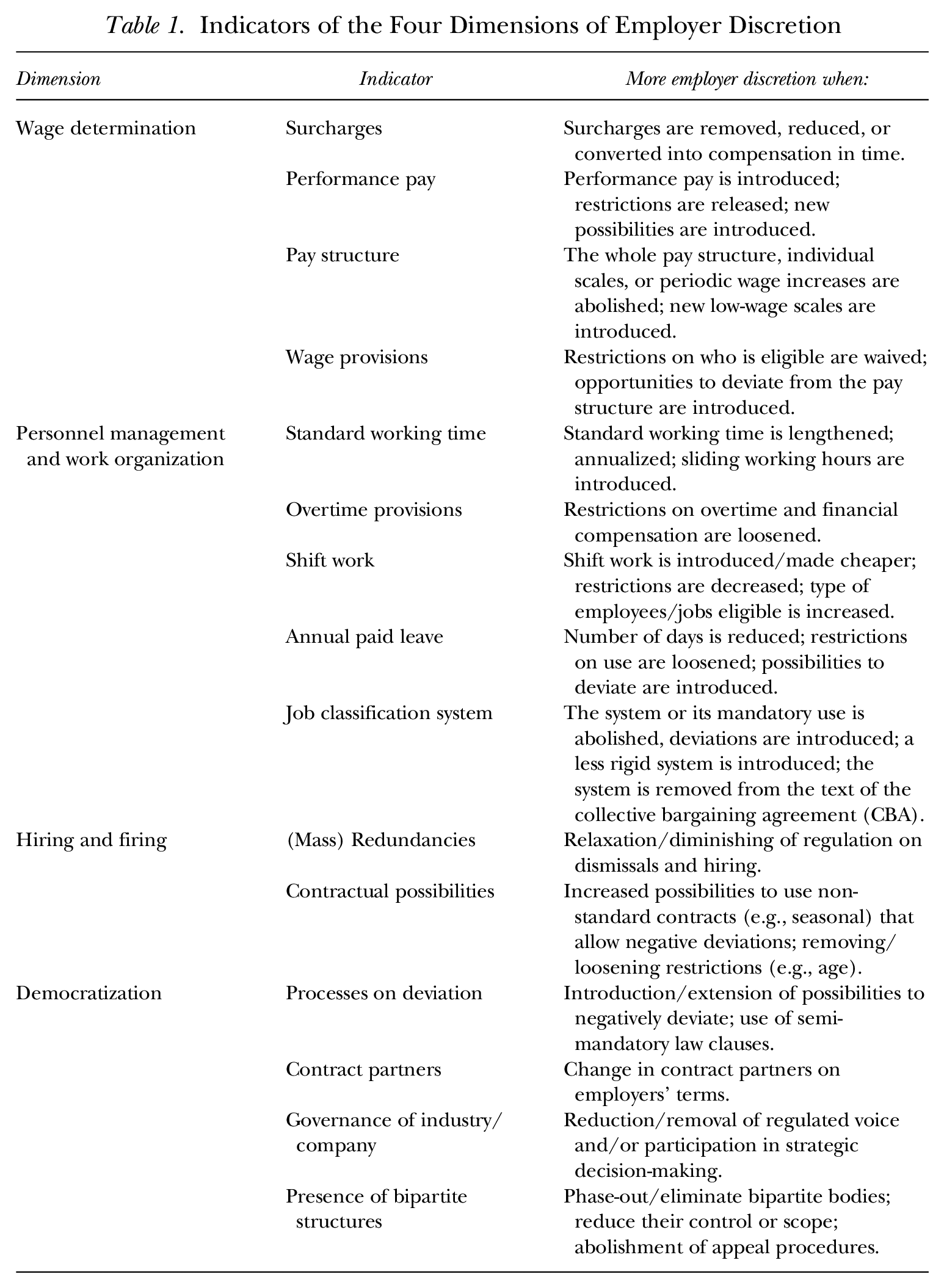
I set up a longitudinal study to observe the development of employer discretion over an extended period. By taking a research period of more than 40 years, it is possible to look at developments and changes within as well as over the entire period. The data collection consisted of 16 collective agreements. The Metal-Electronics; Banks/Rabobank; and Hospitality agreements for 1977, 1987, 1997, 2007, and 2017 were analyzed. The analysis also includes the Hospitality agreement of 2021. 1
The analysis consisted of four steps. First, I coded the 16 agreements using the 15 indicators. Then, per indicator, I formulated a baseline for the 1977 agreements. In step three, I added a description and summary of changes—or stability—per indicator compared to the previous period of observation for all the years of observation (1987–1997–2007–2017–2021). In step four, I introduced a second coder into the process. Because the second coder’s availability was limited, the indicators “Governance of industry/company,”“Presence of bipartite structures,” and “Mass redundancies” were not double coded. The results of step three were independently interpreted and ordered by both coders on an ordinal scale, using four categories: increase or decrease of employer discretion, and an unchanged or mixed situation. The Hospitality agreement was used to align the coding and interpretation of the 15 indicators between the two coders. If this agreement is included in determining the intercoder reliability, it is 85%; without it, reliability reached 88%. When a difference in coding occurred, both coders entered into a discussion until an agreement was reached, which was successful for all points of difference. However, I determined reliability based on the independently assigned categories before the consultation.
Developments of Employer Discretion
This section presents the results of the analysis of the three Dutch case studies. The starting point of the analysis coincides with the beginning of the economic crisis. Dutch industrial relations were highly organized then, with relatively radical trade unions, a center-left government, and organized employers that felt cornered (Boumans 2022). As in most CMEs, the labor market was liberalized from the 1980s onward by, among other things, the deregulation of working-time legislation (in 1996 and 2007), the institutionalization of non-standard contracts (in 1982 and 1997), and an increase in the number of opportunities to deviate negatively from the law through the use of collective contracts (Houweling and Langedijk 2011; Rayer 2014). Simultaneously, the role of works councils has been strengthened. Works councils now have the right to advise on reorganizations and mergers and a right to take initiatives and receive information. Dutch trade unions do not have a legal or institutional role in the dealings of the works council, and their relationship is historically tense. Even though trade unions have the exclusive legal right to negotiate and sign collective agreements, the decentralization of setting terms of employment has caused confusion, or a practice of stretching the boundaries, over the exact range of control works councils possess (Jansen and Zaal 2017).
Metal-Electronics
In 1919, the Metal Association was founded, the forerunner of today’s employer’s organization for the technology industry, FME. In 1947, the first nationwide chemical and metalworking, and electrical engineering industries (hereafter, Metal-Electronics) collective agreement was signed. It developed into the most critical collective agreement and set the standard for all agreements in the Netherlands until the mid-1990s (Van Gaal 2001).
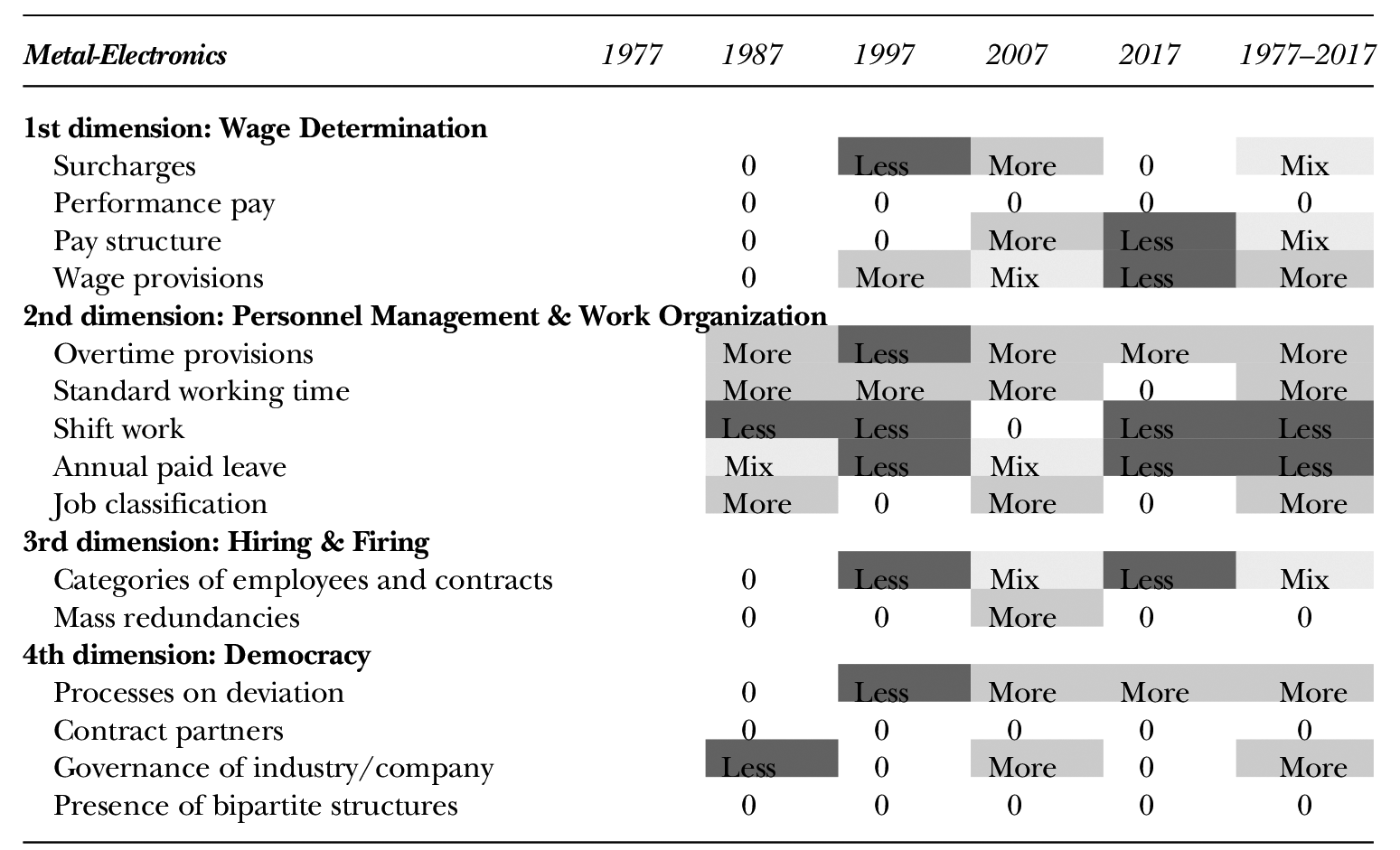
Table 2 shows the results of the development of employer discretion over time on the four dimensions. A zero means no changes, “less” refers to a decrease in discretion, “more” to an increase, and “mix” refers to both an increase and decrease in that specific indicator. The result of 1987 is the difference in employer discretion compared to the same provision in the 1977 agreement, and so forth. The last column shows the difference between 1977 and the last survey year, 2017, for Metal-Electronics.
Four Dimensions of Employer Discretion in Metal-Electronics, 1977–2017.
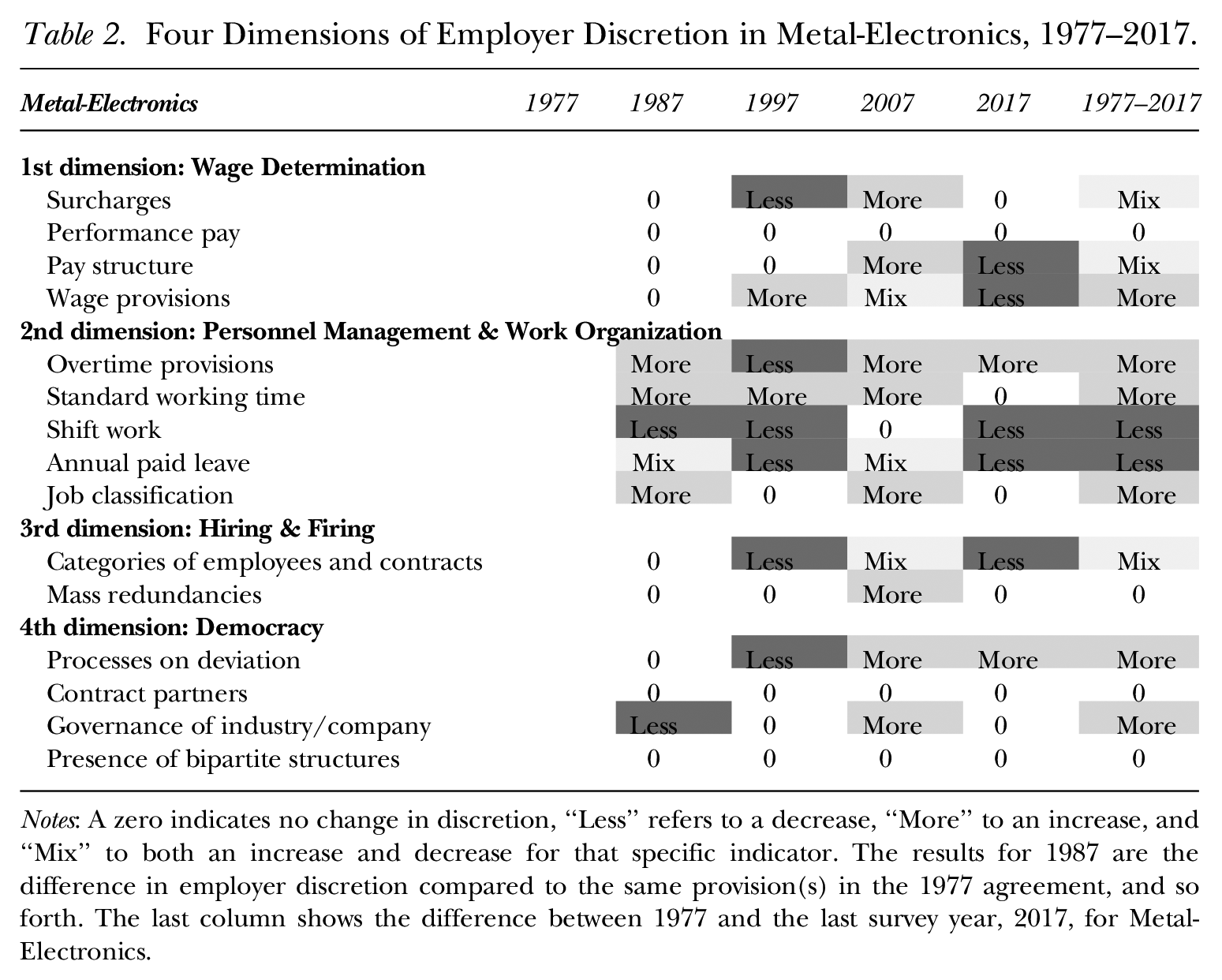
Notes: A zero indicates no change in discretion, “Less” refers to a decrease, “More” to an increase, and “Mix” to both an increase and decrease for that specific indicator. The results for 1987 are the difference in employer discretion compared to the same provision(s) in the 1977 agreement, and so forth. The last column shows the difference between 1977 and the last survey year, 2017, for Metal-Electronics.
A few findings stand out. Change in employer discretion rises and falls, it is not linear. Also visible is that the most turbulent period is the first decade of the 2000s; the collective agreement of 2007 shows the most changes. This is also the only benchmark agreement in which employers did not lose control of any indicator. The last column shows that between 1977 and 2017, employer discretion increased for six of the 15 indicators, decreased for two, remained the same for four, and was mixed for three. Overall, an increase of discretion on the part of employers is established, but not overwhelmingly so.
Compared with the Banks collective agreement and certainly with the Hospitality agreement, the Metal-Electronics contract was already relatively flexible in 1977 in two distinct ways. First, the individual employer had several possible ways to deviate from collective provisions if an agreement with the works council and/or unions was reached. Note, though, that in the 1970s, the FME opposed decentralization; the unions were actively campaigning to increase their strength at the company level (Korevaar 2000). Both bodies also had prominent roles in the collective agreement, and local employers were required to inform or involve one or both in decision-making on various issues. These provisions were subject to tensions, however; in the 2010s, court cases advanced to the High Court about the exact interpretation of what consultation means: merely informing or consenting. The second way flexibility is organized is that “higher personnel”—those paid above a particular pay scale—fall under a separate, more flexible agreement (Van Klaveren and Tijdens 2012).
In the mid-1980s, the employers’ association set out to decentralize and flexibilize (Huiskamp 1985). The trigger was two-sided. The FME was confronted with a deep employment crisis, and an industry-wide process from manufacturing to process management was set in motion, requiring fewer and different personnel. Unions had lost strength as well. The FME president connected both trends in 1985: “Due to larger numbers of highly educated workers, the [firm] is increasingly becoming a cooperative enterprise. . . . Many material matters can henceforth be settled on firm-level because the old conflict of interests between employers and employees has disappeared. Therefore, over time there is no longer a place for unions within the company’s gates” (Arts and Van Haren 1985). Nevertheless, further decentralization did not take off at that time. Unions resisted, and many employers also were not enthusiastic (Tros 2001). It did so in the 2000s, though, when customization options were further strengthened, primarily by introducing B-clauses: A-clauses allow for positive derogations, and B-clauses for negative derogations if an agreement is reached with trade unions and/or the works council. A majority of all provisions are categorized as B-clauses.
The second dimension, on the organization of working hours and the allocation of labor, is the most dynamic; this is where the struggle takes place and not on labor costs (first dimension). Whereas in the 1970s, unions were fighting for higher wages, from the 1980s onward, this focus was replaced by an orientation on job security (Boumans 2023). Within the second dimension, a trade-off was made between the employers’ desire to make working hours and the allocation of labor more flexible and cheaper and the unions’ desire for more vacation days and humanizing shift work. In the 1990s, the Working Hours Act was liberalized after a long struggle. The unions did not agree, and the expanded possibilities offered by the legislation change were not yet visible in the 1997 contract, but they were in the 2007 contract.
The outcome of the indicator “categories of employees and contracts” in the third dimension on hiring and firing is unexpected, with the high prevalence of precarious employment in the Netherlands. A constant in the agreements is the trade unions’ attempts to impose restrictive conditions on the legally expanded possibilities to use short-term contracts and “foreign labor” through provisions such as this one from 2017: “When it has been established that costs . . . of non-employed workers on average per position and age group are more than 10% above or below that of comparable employed workers . . . the employer shall not use or discontinue the use of these non-employed workers unless, in consultation with the trade unions, the cost difference is reduced to no more than 10%.” Two rebuttals can be made that shift the perspective again: 1) the agreement does not impose numerical limits on the use of non-employed workers, the goal is mainly to establish a level playing field, and 2) the data do not show when tasks such as cleaning and facilities services have been outsourced to cheaper contracts.
The fourth dimension, democracy, shows stability and increased discretion in the agreements of the 2000s. Each analyzed collective agreement begins with a joint statement of goals and each party's role: The unions recognize that under the present societal conditions, it is management alone that determines company policy and bears responsibility for its implementation. . . . The employer's association and its members recognize the trade unions as independent representatives of the collective and individual, material and immaterial interests . . . of their members working in the company.
Other than the already mentioned increased possibilities to negatively deviate, the indicator “governance of the industry” changes as well. The 1977 and 1987 contracts included provisions—for example, that the FME would take part in “the joint study . . . on the relationship profit/work . . . [and] the FME has expressed its willingness to hold regular consultations with the unions . . . on the economic situation in the metal industry”—that disappear in later contracts.
Banks
The first collective agreement for Banks was ratified in 1950. Rabobank, a bank of independent cooperatives oriented to the agricultural sector, joined in 1977. In 2000, all large banks started their company agreements in response to the deregulation of the financial sector. Therefore, my analysis follows the Rabobank agreement from 2007, the most significant financial employer. It is a dynamic sector in terms of employment: Approximately 100,000 people worked in banking in 1975, 129,000 in 2000, and 66,000 in 2019 (Tijdens 1995; Haegens 2020).
The Employers Association for the Banking Sector (WGVB), the only employers’ association in the industry and party to the collective agreement, has a density level close to 100%. As is FME, WGVB is a focal member of the peak employers' federation, the Confederation of Netherlands Industry and Employers (VNO-NCW). Trade union membership grew from 10% in the mid-1980s to 25% in the late 1990s in response to concerns over job losses (Visser and Jongen 1999) and dropped again to 10% in 2020 (CBS 2021).
Table 3 shows the development in employer discretion in Banking, and just as in Metal, the 2000s show the most significant increases across the board. This outcome is largely but not wholly attributable to transitioning from a sector-collective agreement to a company agreement. One-sided decision-making powers of employers grew more in Banks than in Metal, although, again, it is not a linear process. Especially in the 1980s, a steep decline in employer discretion is evident. This is probably linked to the boom period the industry was experiencing and the increased union power. The last column shows an increase in 10 of the 15 indicators over the entire period. Only in shift work, which was becoming increasingly marginal, is employer discretion limited. This restriction, as in Metal-Electronics, is particularly notable because legislation has imposed fewer restrictions (Rayer 2014).
Four Dimensions of Employer Discretion in Banking, 1977–2017
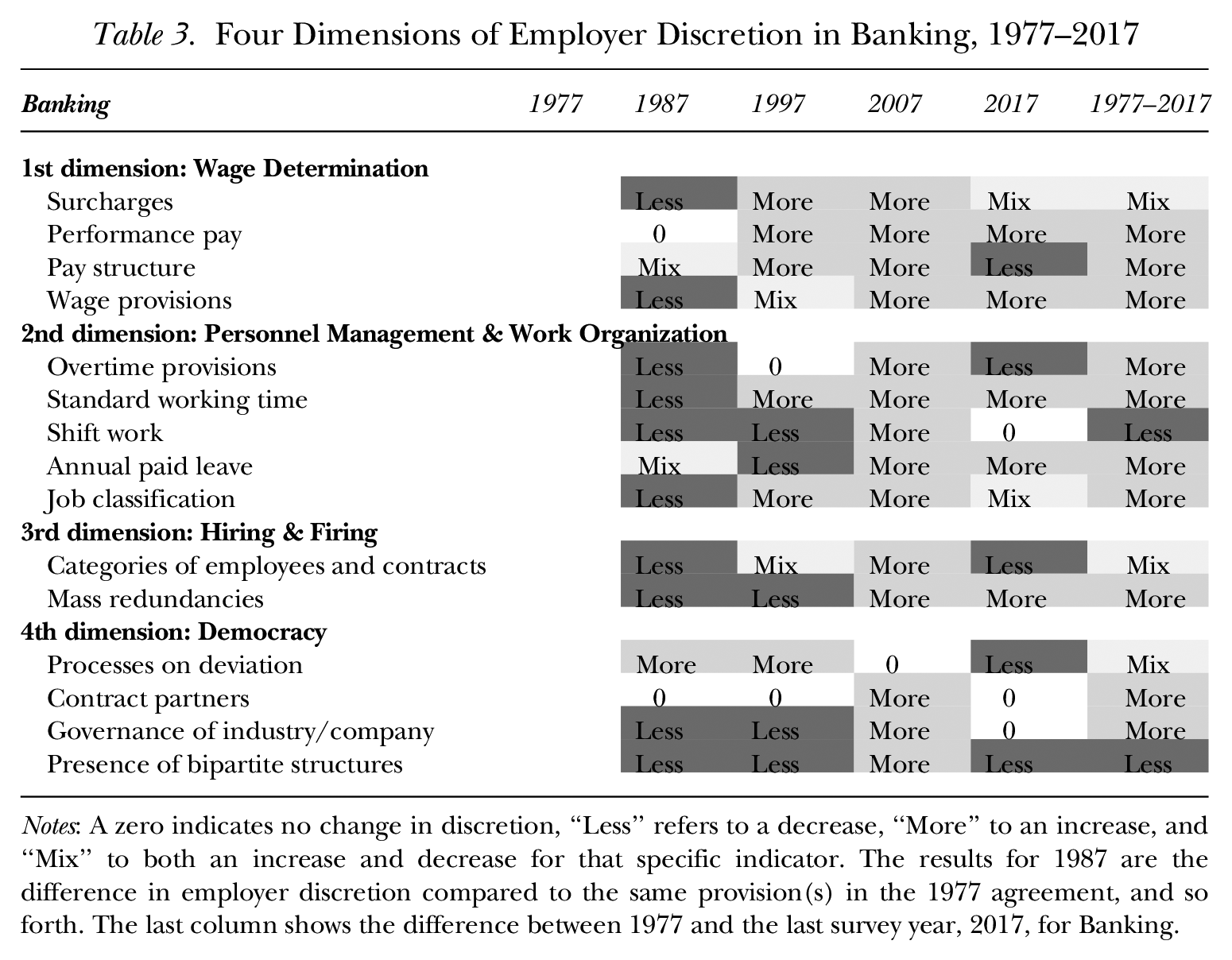
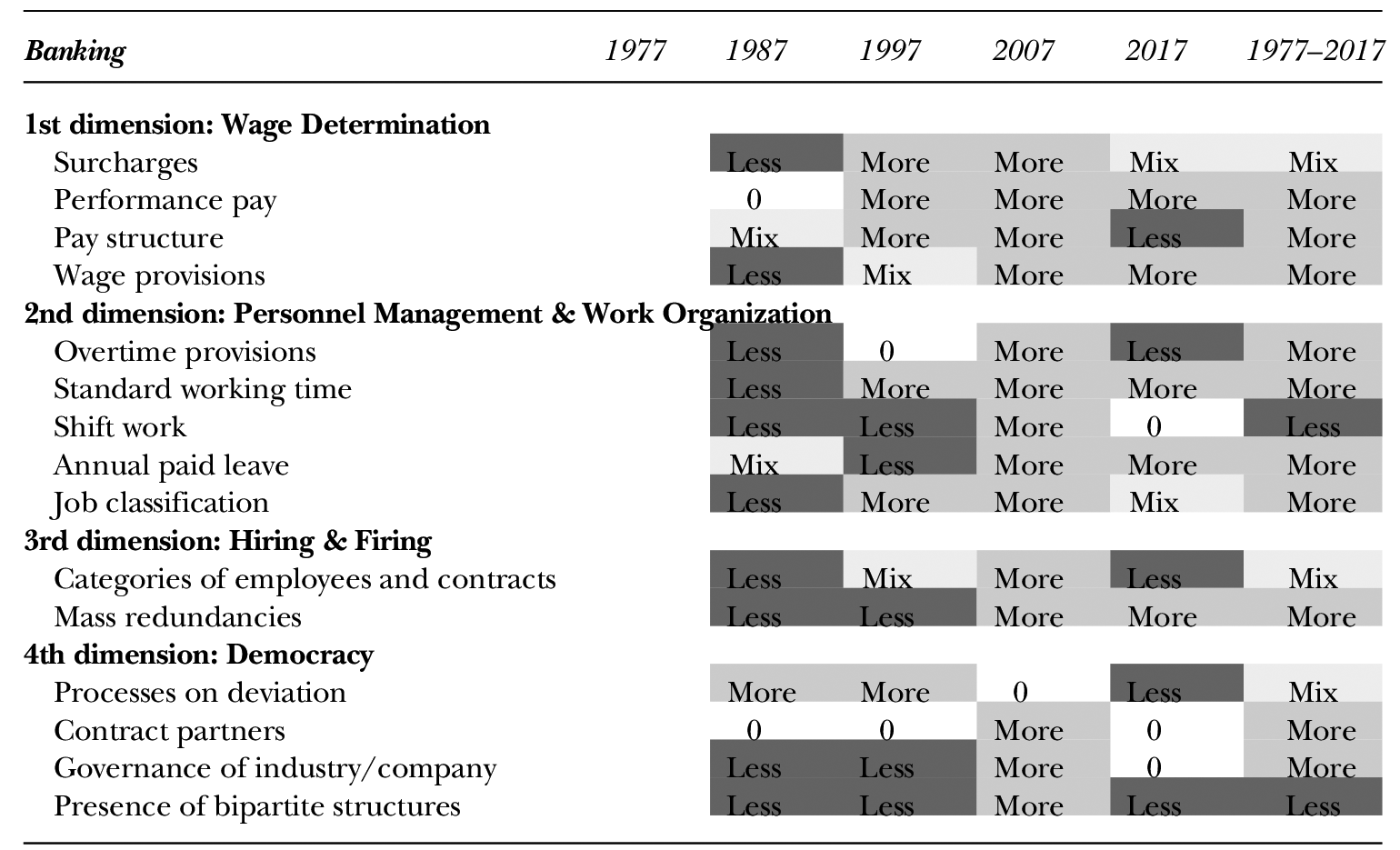
Notes: A zero indicates no change in discretion, “Less” refers to a decrease, “More” to an increase, and “Mix” to both an increase and decrease for that specific indicator. The results for 1987 are the difference in employer discretion compared to the same provision(s) in the 1977 agreement, and so forth. The last column shows the difference between 1977 and the last survey year, 2017, for Banking.
In 1977, the Banks contract included a broad provision that allowed for negative deviations: “The parties may by mutual agreement authorize an employer, at his request, to derogate in special circumstances from the provisions of this collective agreement or its annexes.” This provision was slightly expanded in the following years until 2017, when local banks were given less room to deviate. One difference between the sectoral Banking and Rabobank agreements is that the latter is much more detailed. The federal structure of the bank can explain Rabobank’s tight grip. The agreement is not only a critical human resources tool but also had to manage the more than 100 independent branches that formed Rabobank. Only in 2015 did the local banks merge into a single bank, with one banking license and one central governance, albeit still cooperatively managed. The collective agreement is thus also an instrument for managing internal corporate relations.
Unlike in Metal-Electronics, the first dimension of wage determination changes heavily in Banks. The changes are not caused by haggling over raises but are about carving up a comprehensive performance pay system, reducing all surcharges coupled with an extension of the workday and workweek. The main goal was to increase productivity and optimize the allocation of labor, but after the Great Recession, austerity became increasingly important.
A much more vital link is made in this contract, compared to the Metal-Electronics contract, between provisions on wage determination and provisions on working hours and personnel management (second dimension). The decrease in discretion in the 1980s is a combination of improved rights of part-timers, a more finely tuned job evaluation system with a dispute procedure, employment pacts, and an increase in overtime pay and improved surcharges.
The increase of discretion on both dimensions is also coupled, however. In the second half of the 1990s, the Banks contract was the first sectoral contract to include a collective reduction of working time to 36 hours a week, combined with an annualization of working hours made possible by the change of the Working Hours Act of 1996. It met the wishes of both employers (far-reaching flexibilization of working hours) and unions (reduced working hours). As in Metal-Electronics, the deal also included less say from employers over the use of vacation days and better regulation of shift work. It was combined with a renewed pay structure with more opportunities for employers to push individual employees faster or slower through the pay structure, pay new employees more or less depending on individual preference, and give out bonuses. Financial incentives, however, were not new, as these already existed in the 1977 agreement contract.
An excellent example of the shared governance of the sector (fourth) dimension is how the wish of employers to broader opening hours was managed. The 1987 contract included a provision that the bipartite dispensation committee could decide whether individual banks were entitled to expand their opening hours on Saturdays, depending on the bank’s competitive position in the area. In 1997, union control was also established over social plans and the redesign of the work organization. A shared interest was likely at the root of this provision: It allowed the various banks to share the responsibility of the many layoffs with the unions, which could show both employers and their members that they were “taking responsibility.” In the 2000s, this responsibility was redirected to the works council, in line with its increased legal powers.
Employer discretion increased in 2000 when Rabobank negotiated a company agreement. Although Rabobank's discretion in its company agreement was curtailed on a small number of issues, they pale in comparison to the changes that have increased its discretion.
Hospitality
Dutch hospitality employers had already organized themselves in the late 19th century, albeit in two separate associations. A century later, in 1991, they merged into the Royal Hospitality Netherlands (KHN), the leading employers’ association in the branch and the only party to the Hospitality collective agreement. In 1994, some small business owners split off and formed their own association. This new employers’ association ratified a highly competitive collective contract in the late 1990s with a small trade union, which was decisive for the stark changes in the Hospitality agreement.
Table 4 shows the same change in discretion as seen in Metal-Electronics and in Banks: In 1987, employer discretion on many indicators declined, and in the 2000s, the increase rose sharply. In Hospitality, this process continued in 2017; the sector did not have a sectoral collective agreement, but individual employers could use a company regulation drawn up unilaterally by the KHN. Also, just like in Banks and Metal-Electronics, we observe a decrease in discretionary employer’s rights on using holidays (there is no provision for shift work) as a trade-off for highly flexible working hours. The annualization of working hours, though, only happened in 2007, not when it became legally possible in the 1990s as was the case in both Metal-Electronics and Banks. An essential difference between the three contracts is that the 1977 Hospitality collective agreement was more thorough and prescriptive. In the end, the 2021 Hospitality agreement is the most lenient contract with the most employer discretion; it increased on 11 of the 14 indicators.
Four Dimensions of Employer Discretion in Hospitality, 1977–2021
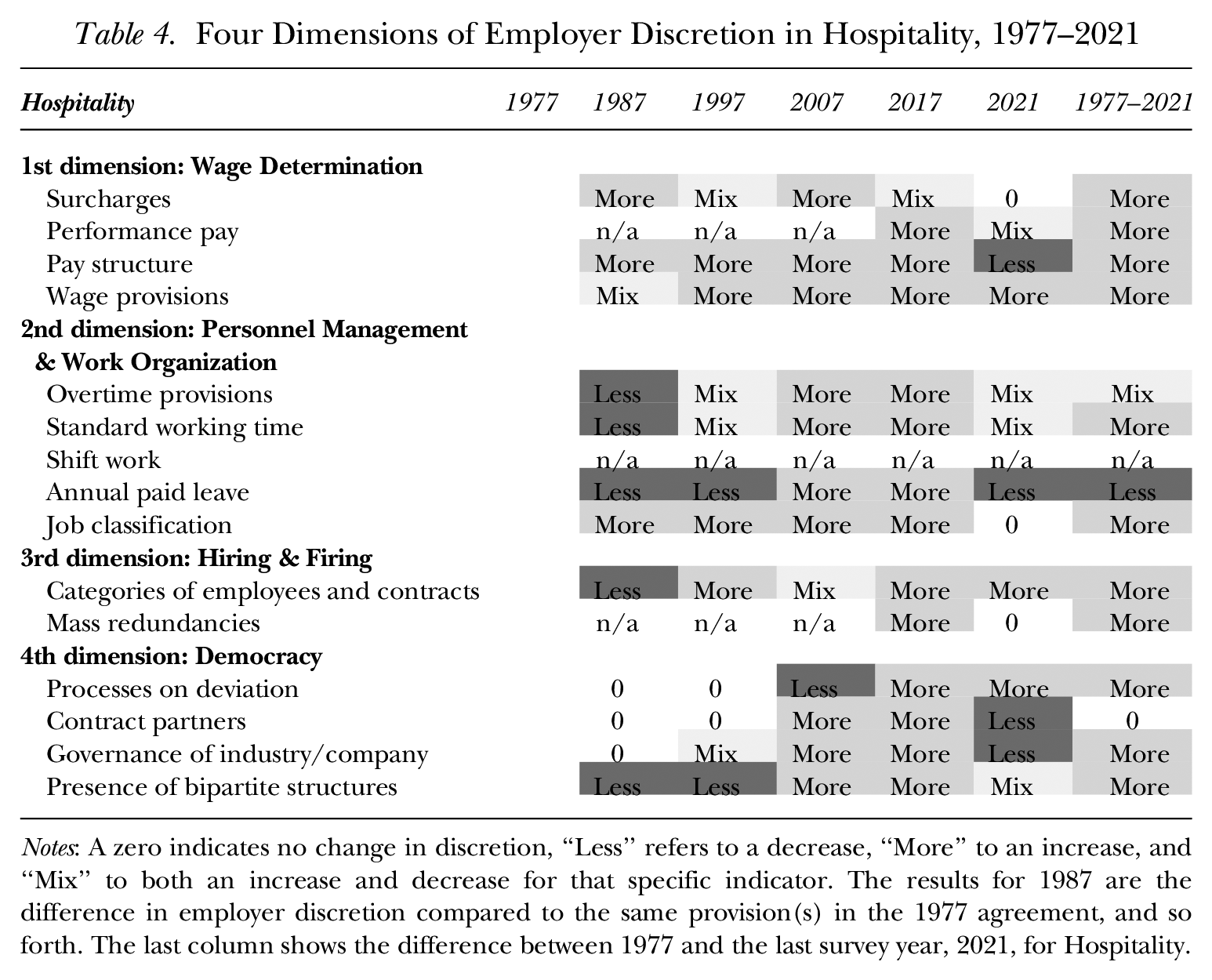
Notes: A zero indicates no change in discretion, “Less” refers to a decrease, “More” to an increase, and “Mix” to both an increase and decrease for that specific indicator. The results for 1987 are the difference in employer discretion compared to the same provision(s) in the 1977 agreement, and so forth. The last column shows the difference between 1977 and the last survey year, 2021, for Hospitality.
The prescriptive nature of the contract is visible in the first three dimensions. In the 1970s and 1980s, the contract prescribed which workers were eligible to receive an end-of-year loyalty bonus, which holidays were acknowledged, when the Sunday and night shifts started and ended, which type of professional clothing had to be paid for by whom, and whether and which workers were eligible for a warm meal or just a cup of tea. Similar to the contract for Banks, it also included number ratios for hiring specific staff positions, restrictions on who could be asked to do heavy-duty tasks such as cleaning windows and mopping floors, and preparatory jobs such as setting tables. The only sentence left of all these prescriptions in 2021 is: “You may be asked to perform work other than your usual work if your employer deems it necessary. You must comply with such a request.” This wording makes the complex job classification system obsolete.
The early Hospitality contract, however, was also quite detailed and prescriptive regarding the (limited) provisions that compose democracy, the fourth dimension of the industry's governance. Until 1997, extensive provisions on the management and distribution of the tip jar were included. The contract prescribed, for instance, the democratic election of two managers of the tip jar, the upper limit of the service fee by business category and product (chocolate 5% and tobacco 3%, for example), and the obligation of the employer to transfer the contents of the tip jar to its managers within eight days. In the 2007 contract, any reference to these articles disappeared. It also no longer contained the previously limited provision on the consultation on employment promotion. The complex nature of the many provisions and changes, sometimes back and forth, suggest that many struggles occurred between the two negotiating parties.
The continuous struggles between the trade unions and the KHN ended in 2003. Then the KHN signed a contract with a new partner, the smallest of the three institutional trade unions, in response to the cost-competitive collective agreement signed by its competitor in 1998. The two traditional contract partners refused to sign because of all the deteriorations. The 2007 contract showed that the wage structure was redesigned to allow as many workers as possible to be classified at the legal minimum wage. Individual employers could introduce performance pay if they wished to. It also maximized the legal possibilities to deviate negatively from the labor law; overtime provisions are minimized, and the most restrictive conditions for organizing working hours disappear.
A period of tense negotiations with the three unions followed this 2003–2005 agreement, until a “collective agreement free” era started in 2014, and lasted until 2018. Then, the KHN drew up a unilateral company regulation (AVR) that members could apply or change at their discretion. In the 2017 AVR, working time was annualized, the steps in the pay scale disappeared (giving the employer more freedom of choice in scaling), and a limited right to weekends off was also taken away. However, a paid day off to attend family weddings was reinstated.
Regarding the presence of bipartite bodies, the most significant changes appeared in 2017. The KHN used the unions' absence to dismantle most sectoral, commonly governed structures. Over the years, employers and employees had established a jointly managed social fund, a dispute committee, training institutes, and a pension fund. Starting in the 2010s, employers withdrew from the various funds. In the 2017 AVR, no reference is made to a jointly managed structure whatsoever, and the external dispute committee for employees was also abolished. As of 2021, these items have not returned to the collective agreement.
Overview
As expected, perhaps, employer discretion has increased on most of the indicators in the collective agreements in all three industries, but with distinct industrial and temporal differences. The changes in Metal-Electronics were the smallest and in Hospitality the largest, while the latter began as the collective bargaining agreement that imposed the most restrictions on employers.
The increase concentrates on wage determination and personnel management and work organization but is visible on all four dimensions. The most substantial changes in Metal-Electronics, Banks, and Hospitality on the wage determination dimension are the introduction of flexible and lower pay scales, increased opportunities to deviate from the collective agreement on wage provisions, and the phasing out of surcharges. The increase of employer discretion on the personnel management and work organization dimension mainly concerns changes in discretion on working hours in combination with lengthening the workday, the use of time banks, and the loosening of job classification systems. These changes have enabled the internal flexibilization associated in the liberalization literature with the transition from Fordism to lean production in two ways (Streeck 2014; Bloem et al. 2018). The first is that employers’ grip over the design and use of working hours was increased, often simultaneously with an increase in operating time, that is, the number of productive hours per week per company was negotiated. This movement has been accompanied by making labor cheaper. Previous cost-increasing trade-offs for using labor on inconvenient hours, such as surcharges, which served both as financial compensation for employees and as a negative incentive for employers, were, for the most part, converted to time-for-time arrangements and then often phased out or scaled back. The collective agreements contain more possibilities to adjust terms and conditions of employment at the company and individual level than previously expected by Ibsen and Keune (2018). The second way internal flexibilization was facilitated was through the easing of job definitions and a reduction in job control practices. These movements, over time, often followed the pattern of first trimming down existing restrictions and then expanding on newly created possibilities. The increased legal possibilities introduced from the early 1990s to organize the labor process flexibly (working hours, contracts, derogations, and so on) have been used in all three sectors: the Banks collective bargaining agreement was the first to make use of this; later—and more gradually—various Metal-Electronics agreements did so; and in Hospitality, from the 2007 collective bargaining agreement onward, the legal possibilities have been fully exploited.
As for the fourth dimension, democracy, the agreements in all three industries initially included workers’ rights and tools that increased workers’ control over the organization of the sector or company and their work, albeit in distinct ways. During the period 1977–2021, most of these instruments from the tradition of industrial democracy have either disappeared from the collective agreements or have been integrated into the increased competencies of the works councils that have occurred over time.
Discussion and Conclusions
The main question this article explores is whether and to what extent individual employer discretion has increased because of changes in the language of Dutch collective agreements since the 1970s. That initial question led to a number of others, such as, is the conclusion of Baccaro and Howell (2017: 18) that liberalization manifests itself in industrial relations as increased employer discretion also accurate for collective agreements? Did liberalization start in manufacturing because of changes in employer behavior (Baccaro and Howell 2017), or did it start with the growth of services and the non-willingness of these employers to engage in coalitions with trade unions (Thelen 2014)? Moreover, is a process of erosion in collective agreements visible despite institutional stability in coordinated market economies? Additionally, does the added fourth dimension of democracy deepen our understanding of the liberalization of industrial relations?
The empirical analysis shows that employer discretion has indeed increased in the collective agreements I have studied; restrictions on the behavior of employers were limited, and possibilities expanded on a majority of the indicators. The Hospitality agreement became the least restrictive and the Metal-Electronics agreement the most. The expectation in the liberalization literature that the Metal-Electronics contract, as the most significant contract in manufacturing, was the backbone of the Dutch economy and the corporatist institutional landscape appears to be well founded, as is the belief that employers set out to increase their discretion, not in the 1970s, but from the 1980s onward. Baccaro and Howell’s conclusion that liberalization started in manufacturing (2017: 18) does not hold, though; it was not on the front line of liberalization. Thelen’s (2014) alternative scenario of “socially embedded flexibilization,” namely, the preservation of collective risks, attention to vocational training and education, and a persistent focus on boosting productivity, seems more fitting but does no justice to the whole story either. The collective agreement does indeed combine flexibilization within a solid collective framework, but the Metal-Electronics agreement was already much more flexible than the other two agreements in the 1970s. Additionally, Thelen argued that the upcoming service-sector employers were not interested in joining coalitions as manufacturing employers had done decades before with the trade unions. Hence service sectors were more poorly organized from the beginning, with more employer-serviced working conditions and lower labor costs. This might hold for specific service sectors such as cleaning, which were influenced significantly by outsourcing. The banking and hospitality industries were strongly organized, however, with long-standing collective contracts and well-organized employers’ associations.
The earlier suggested option that the nature of the coalition between trade unions and employers within manufacturing and the collective agreement itself already differed in the 1970s might complement the analysis of Baccaro and Howell and Thelen. To start with the latter, the Metal-Electronics contract is and was not only more flexible than the contracts in Banks and, especially, Hospitality, it was also more procedural than substantive from the start in comparison with the others. The A- and B-clauses, the many arrangements to involve the union or the works council, the organization of working hours, and the provisions dealing with non-contracted workers and job evaluation are all mostly procedural agreements. Each employer, for example, may use its own job evaluation system as long as there is one. This focus on procedures is reminiscent of English collective bargaining (Sisson 1991). The liberal character thus was already present in the Metal-Electronics contract, unlike the other contracts.
Concerning the nature of the coalition, despite FME’s firm words in 1977, it failed to corner the trade unions for a prolonged period. The coalition between both parties remained viable, possibly thanks to the union’s strength that was played out in numerous industrial conflicts during the whole period. Union density is 21% in manufacturing. No data are available for Metal-Electronics, but the union density rate is likely higher than the overall 21%. In both Hospitality and Banking, no industrial actions were registered in the International Institute of Social History (IISH) strike database between 1977 and 2019. In the Metal industry (broader than just Metal-Electronics), 99 industrial conflicts were noted (Van der Velden 2021).
The coalition in Metal-Electronics did not crumble as Baccaro and Howell suggested, nor did it in Banks. Only in Hospitality was the cooperation between the contract parties subverted by a new employers’ association and an earlier not-involved trade union that agreed to far-reaching liberalization.
The analysis also shows that the change in employer discretion was not linear. The most significant shifts happened in the 1980s and the first decade of the 2000s. Part of the explanation is that in the 1980s, even though union power was already in decline, it was yet relatively intact. An additional and more powerful explanation for the changes in the 1990s that does justice to the agency of the trade union as a negotiation partner is that in the late 1990s, a different kind of Dutch trade unionism came to the foreground in the wake of Third Way social democracy. This approach focused more on the individual worker and his modern-day desires within an ideological framework of freedom and self-determination: improving work–life balance through differentiated working times, individualized pay systems, and the promotion of self-employment to enlarge individual workers’ influence over their career paths; and decentralization of collective bargaining to integrate works councils in the industrial relations systems (Boumans 2023). As a result, the bargaining agenda of both organized employers and employees began to overlap in part.
The unions did not successfully convert this focus on self-determination into enforceable individual rights in the Banks and Hospitality agreements, which mainly contributed to increasing employer discretion in the first decade of the 2000s. It appears that the procedural nature of the Metal-Electronics contract was a better fit to capture these individualized and de-collectivized employment rights of workers.
The most important explanation of the process of de-collectivization of the collective contract, though, is the continued commitment of central employer organizations to the individualization of working conditions and decentralization of bargaining along with the flexibilization of labor market legislation in favor of employer preferences (Kremer, Went, and Knottnerus 2017; Nagelkerke and Wilthagen 2000; Boumans 2022). The analysis shows that legislative changes helped employers realize their agenda. Even though transposing the liberalization of the Working Hours Act into provisions in collective agreements was somewhat held back in Metal-Electronics and Hospitality, eventually, the possibilities provided by the law were implemented in all contracts.
The result of the changes in discretion is that collective contracts now more closely resemble a management instrument to allocate and organize labor and, as such, a source of legitimacy (Sisson 1991) than a joint labor–capital effort to solve workplace problems and amplify workers’ voices. The nature of the collective agreement changed from a negotiated agreement stipulating the rights and obligations of both employers and employees to a more one-sided document that manages the labor force. Dukes and Streeck (2020) described this change as a shift from industrial citizenship to private status, that is, a marketized relationship characterized by the absence of the need for employers to ascertain the goodwill of employees.
Despite the increase in discretion and the simultaneous loss of employee control over terms and conditions of employment, however, a shift toward a situation in which Dutch employers are constrained only by law and by supply and demand has not taken place. What did happen is that the individual power relationship between employer and employee became more decisive in shaping the employment relationship. The protection previously offered by the collective agreement has thus diminished. As such, institutional conversion is set in motion (Streeck and Thelen 2005). This seems an accurate description, especially in Hospitality. An illustrative example is that the Hospitality agreement is written entirely as one-sided from employer to employee, as if both bargaining parties forgot that a collective agreement initially granted requirements and rights to both employee and employer.
The results of the analysis of the fourth dimension, democracy, deepen this understanding of the shift from a collective to an individualized relation. This movement can be partly explained by a focus on the individual and self-determination by society at-large, including trade unions (Boltanski and Chiapello 2005; Boumans 2023). While the works council has assumed some of these democratic powers thanks to an extension of its legal jurisdiction, some limitations also remain. First, the works council, through its legal role, also serves the corporate interest. Second, a works council is company-specific and is therefore unlikely to develop an overall vision and policy on work and the labor market, unlike unions and their counterparts.
This study has some limitations. The developments of provisions on vocational training and education, and on pensions, for instance, have not been considered although we know these have grown in importance. It might be that this study, therefore, misses some essential trade-offs. We also do not know how the analytically established increase in discretion works out in practice on the shop floor. Ulfsdotter Eriksson et al. (2021) have shown, for instance, that local practices influence day-to-day practice. It may therefore be interesting to examine how discretion works out in practice in various situations: Does the presence of a union matter? Or of a works council? For example, is there a difference between salary or education levels in who ultimately has a say in working hours? Recent research has shown that wage inequality is slowly increasing in the Netherlands and points mainly to wage differentiation through increasing differences between high- and low-wage firms (Schneck 2021). Future research could also link these outcomes to discretion in collective agreements and the workplace.
Footnotes
Acknowledgements
I thank Simone Monquil for her rigorous work as second coder, and Maarten Keune and Dennie Oude Nijhuis for their comments that greatly improved the manuscript.
This research was made possible by Instituut Gak.

For information regarding the data and/or computer programs used in this study, please address correspondence to
1
The 2021 Hospitality agreement is included to document changes vis-á-vis the one-sided company agreement that the employers’ association used between 2014 and 2018 instead of a sectoral collective agreement.