




Abstract
Reducing human-made greenhouse gas emissions is crucially important for life on earth, but it requires restructuring industries in ways that could disrupt millions of workers’ lives globally. Whether this transition is “just” from the perspective of workers depends on the magnitude of job losses, the quality of new jobs, and the transitions workers experience from their current jobs to new ones. Using the example of the German automotive industry, where the shift to electric vehicle production has recently accelerated, the authors identify recommendations for unions and policymakers in North America and beyond. This article provides an overview of the tools for workers and trade unions in Germany to steer the transition and shows how analogous tools could be strengthened or created elsewhere.
Keywords
Greenhouse gas (GHG) emissions are causing significant changes to the earth’s climate, and governments are under pressure to promote a carbon-neutral economy. The Paris Agreement’s aim to limit global warming to 1.5°C, the European Commission’s target to reduce net GHG emissions by at least 55% by 2030 compared to 1990 levels, and the US government’s goal to achieve a net-zero economy by 2050 are just three examples.
A critical step toward reducing global GHG emissions is to phase out internal combustion engine vehicles (ICEVs) and increase the number of battery electric vehicles (BEVs) 1 on the road. National and regional governments have introduced increasingly ambitious regulations and funding programs that aim to accelerate this shift (Lefeuvre and Guga 2019). The European Commission has set ambitious emissions standards and a goal for 100% reduction in carbon dioxide (CO2) emissions from new cars by 2035, while individual EU member states are introducing subsidies to decarbonize the economy (Lechowski, Krzywdzinski, and Pardi 2023). In the United States, the Biden administration aims to reach a 50% market share for electric vehicles (EVs) by 2030 through tax credits, grants, and lines of credit, with some states adopting stricter regulations and offering additional incentives (Alochet, MacDuffie, and Midler 2022; Archsmith, Muehlegger, and Rapson 2022). Canada’s federal government plans to ban new ICEV sales by 2035 (Rabson 2023).
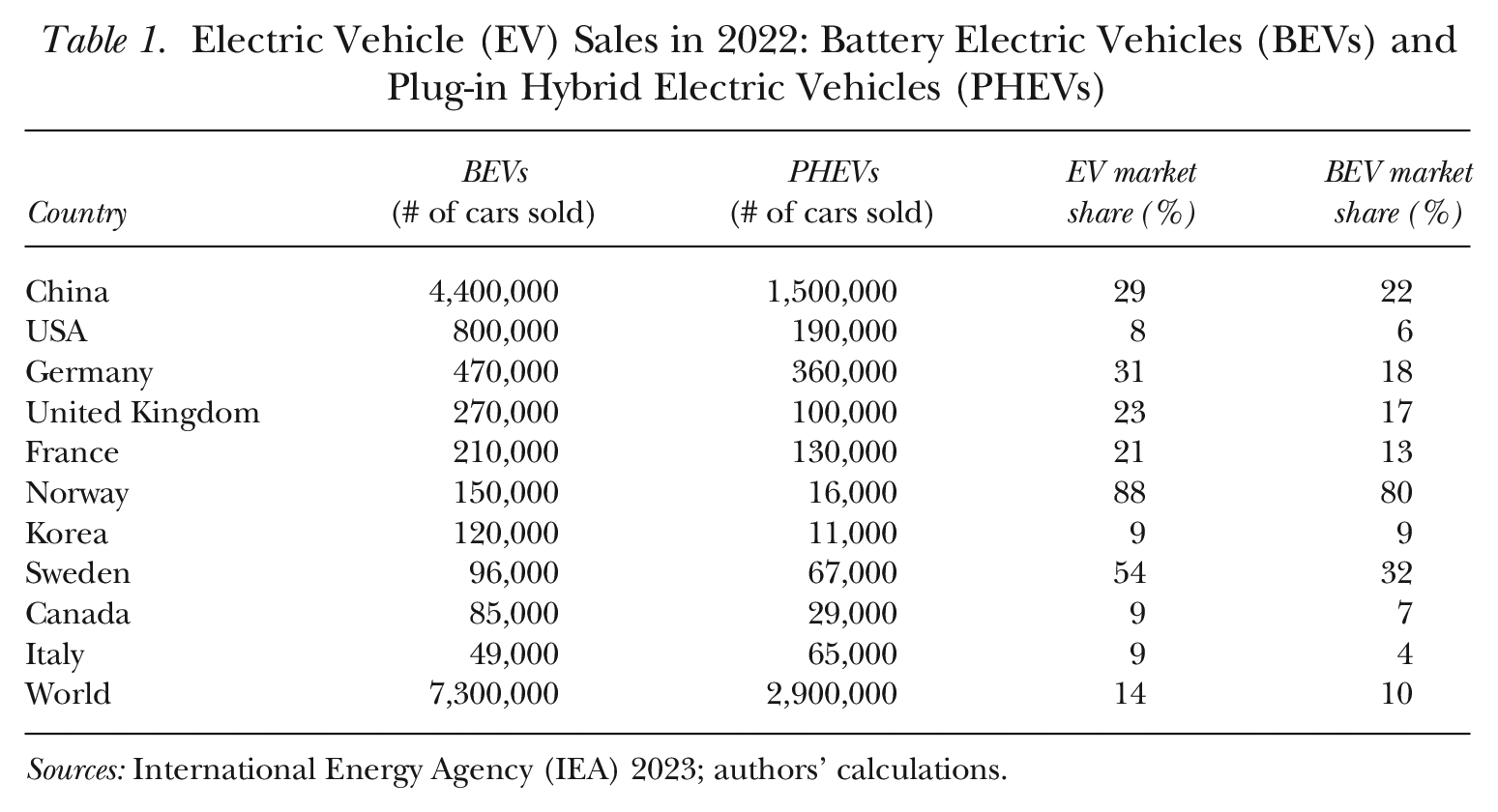
These policies have led to major changes in the automotive industry. Specialist producers of BEVs such as Tesla and Rivian have emerged, while incumbent automakers have announced dozens of new BEV models and timelines to reduce or phase out ICEV production. Reports from the International Energy Agency (IEA 2023) show rapid increases in EV sales (see Figure 1 and Table 1). In 2022, 10.2 million EVs were sold worldwide, or 14% of all cars sold; 7.3 million of these were BEVs and 2.9 million were plug-in hybrid EVs (PHEVs).
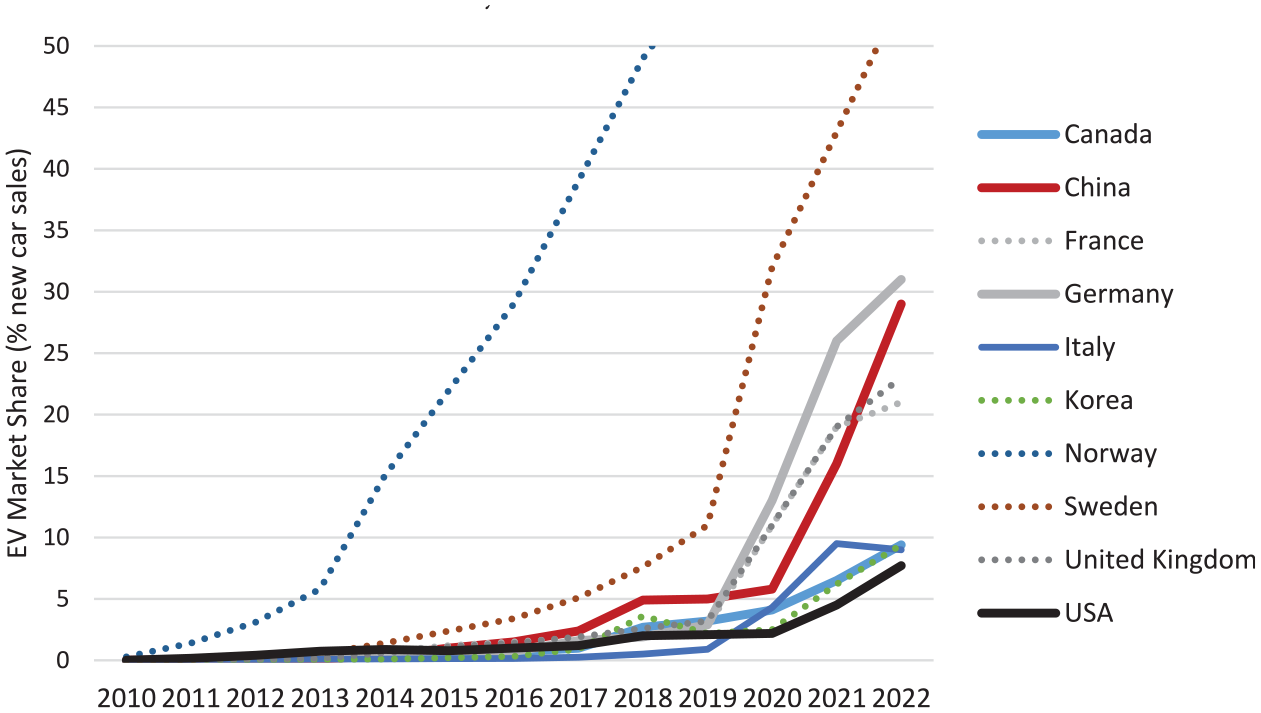
Electric Vehicle (EV) Market Share of Total Car Sales, 10 Largest National Markets by Total Number of EVs Sold
Electric Vehicle (EV) Sales in 2022: Battery Electric Vehicles (BEVs) and Plug-in Hybrid Electric Vehicles (PHEVs)
Sources: International Energy Agency (IEA) 2023; authors’ calculations.
China has led the transition, with approximately 58% of worldwide EV sales in 2022, the vast majority of which were BEVs. EVs represent 29% of all new cars sold in China in 2022. Europe has also experienced rapid growth in EV demand with EVs representing 21% of all new cars sold in Europe in 2022. In Germany, the third-largest national EV market with over 8% of worldwide EV sales in 2022, EVs had a market share of 31% of all new cars sold, although a substantial share of these were PHEVs. By contrast, the United States and Canada lag China and Europe, with an EV market share of only 8% and 9% of all new cars sold in their national markets in 2022, respectively. That said, in 2022 the United States was the second-largest EV market with approximately 10% of worldwide EV sales (IEA 2023).
Although the shift toward BEVs will reduce GHG emissions caused by transportation, it also poses significant risks for workers in the automotive sector. First, the BEV transition will eliminate many industrial jobs across the automotive value chain, including the production of key components such as internal combustion engines, fuel systems, exhaust systems, axles, and transmissions. While new jobs will be created to produce emerging automotive technologies—such as batteries, electric motors, and IT components—these may be fewer in number than the jobs related to ICEV production. Second, it is still unclear whether work and employment conditions in BEV production will be “good” and how workers will make the transition out of ICEV production into future jobs. Although policymakers hope to upgrade their domestic industrial base by attracting EV-related work, some new employers have been cited for worker rights violations, low pay, and dangerous working conditions. Finally, displaced workers in ICEV-related production face a perilous transition into the new work and may not have adequate support to find what good jobs are available. Net job losses, bad jobs, and precarious transitions are three challenges facing unions and policymakers in the EV transition.
Labor studies scholarship often treats just transition in terms of how unions frame the issues, their support of or opposition to decarbonization, and their strategies to influence the transition. The focus of the present article, by contrast, is on the challenges faced by unions and workers in a particular sector. We examine the German automotive industry, where the transition is further advanced than in North America, and where a powerful union, Industriegewerkschaft Metall (IG Metall), has recently become an important actor supporting and shaping the transformation path. Our focus is on how trade unionists are shaping this transition in Germany, including the policies to promote the BEV transition and tools to shape its effects in the workplace. We also discuss what North American policymakers and trade unionists can learn from the German experience to strengthen worker influence in the transition.
Conceptualizing Just Transition in the Automotive Sector
The just transition narrative was first popularized in the trade union movement in the 1990s by American union leader Tony Mazzochi and was adopted later by national governments, global governance institutions, and EU policymakers (Galgóczi 2020; Morena, Krause, and Stevis 2020). This narrative emphasizes the need to reconcile climate protection reforms with efforts to minimize socioeconomic risks for workers and communities that face job loss.
Much research examines union approaches to decarbonization, including whether they accept the jobs-versus-the-environment narrative and how they involve themselves in the transition (Stevis and Felli 2015; Lefeuvre and Guga 2019; Galgóczi 2020; Kalt 2022). Researchers have found that manufacturing unions, facing the prospects of significant job loss at the sectoral or company level, tend to emphasize the downsides of ambitious climate policies (Thomas and Pulignano 2021), and polluting industries receive “double representation” in the policymaking process from both labor and management (Mildenberger 2020). Thomas and Doerflinger (2020) categorized union statements about decarbonization in terms of opposition, support, and “hedging,” and found that manufacturing unions often opt for the latter—accepting the need to change but favoring a slow and incremental approach to protect workers. Others argue that social dialogue and strong partnership between the union, employers, and government have slowed the expansion of BEV production in Germany (Galgóczi 2020). Union priorities include making sure the jobs created are high quality (Vachon 2021), supporting workers displaced by the phasing out of jobs that depend on fossil fuels (Snell 2018), and connecting this to broader struggles such as that for racial justice in “front-line communities” (Cha et al. 2022). Some of these studies identified possible conditions of success. Stevis (2018), for example, emphasized the importance of the unions’ depth of commitment to the transition, the geographical scope of their endeavors, and the proactive character of their agency, while Cha et al. (2022) emphasized the breadth and intersectional character of coalitions.
The net employment effects of the EV transition are subject to debate. Most macro-level forecasts of net employment impacts of decarbonization optimistically predict that investment in clean technologies will lead to employment growth in “green” industries that will outpace job losses in “brown” industries (Montt et al. 2018). In the auto industry, however, estimates vary depending on their assumptions. Estimates of German automotive employment focused only on the sector indicate potential job losses between 50,000 (Mönning et al. 2018), 130,000 (Kaul et al. 2019), and 165,000 (Falck, Czernich, and Koenen 2021). More optimistic estimates include ripple effects in other related sectors (Krzywdzinski, Lechowski, Ferdinand, and Schneiß 2023). Agora Verkehrswende (2022) predicted a net increase of 25,000 jobs by 2030. Beutler et al. (2021) suggested that up to 100,000 jobs could be created manufacturing batteries for EVs across Europe, and other writers predicted significant employment increases from more comprehensive mobility reforms that would expand public transportation (Candeias and Krull 2022). Similar trends appear in US employment projections, with growth in BEV research and development–related fields and a modest increase in miscellaneous assembler employment (Colato and Ice 2023). These studies, however, may underestimate the labor intensity and employment demand created by BEV manufacturing tasks (Cotterman 2022).
The well-being of autoworkers, however, does not merely depend on net employment effects. Just as important are their qualitative transitions out of ICEV-related work. Curtis, Okane, and Park’s (2023) study of 300 million job transitions in the United States showed that fewer than 1% of workers who lost “dirty” jobs made the transition into “green” jobs. Thus, regardless of overall positive or negative employment effects in the auto industry, many autoworkers have already faced the harsh reality of layoffs and plant closures disrupting their lives. Those making soon-to-be-obsolete components are particularly vulnerable; for instance, Ford’s Romeo Engine plant in Michigan has already been idled in mid-2023. Assembly plants are also vulnerable, in the short run because retooling can lead to extended periods of layoff, and in the longer run because the market is unlikely to expand in tandem with the new auto-assembly capacity put online by new players. In 2021 Ford announced that it would stop producing cars at its plant in Saarlouis, Germany, and rather retool its plant in Valencia, Spain, for EV assembly (Campbell 2022). Similarly, Stellantis decided to idle its Belvidere, Illinois, assembly plant, partially due to the BEV transition. This decision was later reversed in 2023 after a nationwide strike (Isidore 2023), but it still illustrates the ongoing trend of marginalization of worker voice in corporate decisions. Bosch (2022) noted that a central problem with these transitions is that from a worker’s perspective they are involuntary and are generally associated with steeper declines in earnings than are voluntary work transitions.
Converting existing plants from ICEV to BEV production will reduce this disruption. Some battery plants are being built next to assembly plants, some ICEV assembly plants are being retooled for BEV assembly, and some plants making internal combustion engines (ICEs) and components are being converted to make batteries and propulsion systems for BEVs. Such developments allow workers to transfer directly into new jobs rather than facing a spell of unemployment. Factors such as worker skills, proximity to assembly plants and natural resources, as well as government subsidies play a role in the selection of these sites (Friedman 2022). Beyond numbers of jobs, these investments secure existing industrial capacities, making the productive tissue of these industrial regions more resilient. Strategic decisions over investment are made through the complex processes of corporate politics, in which trade unionists are sometimes involved but often excluded (Dupuis and Greer 2022).
When new jobs are created inside the strongholds of union power, union members can often avoid unemployment by securing their jobs or transferring to other jobs in the same plant or company. Trade unionists can put pressure on, or partner with, the management to help workers pursue internal redeployment or attract investment in existing plants. Their ability to navigate corporate politics, however, depends on the rules governing worker participation, plant closures, and mass layoffs. Collective bargaining agreements in North America typically safeguard managerial prerogatives, but also permit areas of joint labor–management decision-making. In Germany, far more areas are subject to bargaining, information, and consultation set out in law, with elected worker representatives on corporate boards and works councils. Their hand is strengthened by employment protection legislation and their rights to negotiate over the process of restructuring (Interessenausgleich) and measures to support laid-off workers (Sozialplan).
German unions and works councils can also influence technological advancement, as illustrated by their “Arbeit 4.0” campaign (“Work 4.0”). Launched by three unions, including IG Metall (metal), IG Bergbau, Chemie und Energie (IGBCE; mining, chemicals, energy), and Gewerkschaft Nahrung-Genuss-Gaststätten (NGG; food and hospitality), this initiative was a direct response to “Industry 4.0” strategies promoted by leading manufacturing firms and the German federal government. Analyzing this campaign, Bosch and Schmitz-Kießler (2020) showed that unions successfully influenced the framing of digitalization and negotiated agreements over Industry 4.0 because of their ability to influence legislation, their institutionalized role in vocational education and training, and their associational power that enables them to coordinate works councils in diverse firms. Adding to this perspective, Doellgast, Wagner, and O’Brady (2023) stressed the importance of works council legislation for enabling unions and workers to effectively tackle the challenges posed by the rise of algorithmic management in the telecommunications sector. Given the nature of the EV transition as a major technological shift, it is reasonable to expect that German unions are better equipped to manage this transition effectively.
In North America, unions such as the United Auto Workers (UAW) in the United States and Unifor in Canada have limited institutional resources due to weak legislative support for employee voice at work (Groshen, Helper, MacDuffie, and Carson 2019). Despite a history of union–management negotiations in areas such as the adoption and implementation of new technology, mitigating the impact of new technology in the workplace, and the use of technology in workforce management (Kresge 2020), US unions still face limitations in their capacity to directly influence and address disruptions caused by technological changes. For instance, the UAW engaged in negotiations with automakers on Industry 4.0 during the 2019 bargaining rounds. As Rutherford (2021) noted, although their partnership-oriented approach enabled them to negotiate over some issues, the prevailing practice of decentralized bargaining in the United States often restricts the role of unions to managing workplace issues predominantly at the local or workplace level. Further, many workplace representatives lack the necessary knowledge and training to effectively negotiate on these complex issues. As a result, much of the decision-making power regarding technological implementations remains with management.
What Is at Stake?
Against this backdrop, several questions warrant consideration. First is the issue of how to support workers who are at risk of job loss. The United States and Canada both have relatively low spending on programs to assist the unemployed, such as unemployment insurance and worker training. According to the Organisation for Economic Co-operation and Development (OECD) (2023), this spending was well below 1% of gross domestic product (GDP) in the years before the pandemic, compared to Germany’s 1.3% to 1.6% of GDP range in the years 2014 to 2019. Examples of innovations in skills development and training exist in both countries (Lowe 2021; Dupuis, Murray, and Wu 2022), but they tend to be fragmented, temporary, and conceived for specific occupations in certain regions, in a context in which skill training tends to be for a specific job rather than a broad occupational classification. By comparison, Germany is better equipped, with a more comprehensive welfare state, a stronger focus on occupational skills, and more spending on retraining.
When the new jobs are created, it is unclear whether they will be high quality. Although US President Biden speaks of “good union jobs” (White House 2023) and Canada has adopted “just transition” in its official policy discourse (Natural Resources Canada 2021), this does not mean that “green” manufacturing jobs are “good” jobs. The new battery plants are typically built by electronics companies, or as joint ventures between them and automakers, and may provide worse wages and working conditions than existing automotive plants. Employees at Ultium Cells, for example, owned by GM and LG Energy Solution, received an entry wage of $16.50 per hour when the plant opened, markedly less than the $18 to $32 range for assembly plant workers (Welch 2023) and also short of the average US manufacturing wage of $29.27 (U.S. Bureau of Labor Statistics 2023). The emergence of a new wage tier alongside the already-existing multi-tier wage structure of unionized automakers in North America was striking given the crucial strategic role of battery facilities as a “technological bottleneck” (Baldwin 2015) in the scaling-up of BEV production. Under the first collective agreement, the entry-level wage at Ultium Cells was raised (Hall 2023) and, as a result of the 2023 UAW national bargaining agreement with GM, will be included in the master contract, with further wage increases anticipated (Feeley 2023). As the battery value chain expands and new jobs and companies emerge, unions will need to continue organizing unorganized firms.
The job quality problems in BEV production extend beyond wages. Tesla has retaliated against union activists in California (Scheiber 2023) and New York State (Ewing and Scheiber 2023) and has been found guilty of allowing racist discrimination and harassment in the workplace (Wiessner 2023). The company has also violated the Worker Adjustment and Retraining Notification (WARN) Act by laying off employees without the required 60-day advance written notice (Jin 2022). Similarly, Rivian has recently faced accusations of violating workplace safety standards, including creating hazardous and unhealthy working conditions (Eidelson, Ludlow, and Bloomberg 2022). The UAW (2023) has documented chemical hazards and low pay as serious concerns at Ultium Cells in Ohio. Union representation and national agreement coverage at new battery plants were pivotal issues in the negotiations for the American (e.g., United Auto Workers) and Canadian unions (e.g., Unifor) in 2023 (Welch 2023).
Behind the question of job quality is the problem of union power (Doellgast 2022). For many scholars, the involvement of unions is both part of the definition of a just transition and a precondition of its realization (Snell 2018; Galgóczi 2020). In North America’s Wagner model of labor law, employers normally oppose union recognition and collective bargaining (Kallas, Park, and Aleks 2023; Silvia 2023), and much of the new work making BEVs and components will likely be non-union (Lafer 2019; LeRoy, Tarczynska, and Ochojska 2022). If the EV transition seems to be creating more jobs inside union strongholds, facilitating organizing outside of union strongholds, and reinforcing union power, it will be far easier for trade unionists to embrace the just transition narrative.
The German Transition to BEV Production
We argue that understanding whether the transition is “just” requires understanding specific national institutional settings, evolving policy frameworks, and sector-specific risks and opportunities facing autoworkers and their unions. Examining the tangible processes involving unions, management, and government that shape the BEV transition in the German case will help us illuminate how the dilemma between job protection and low-emission transition has been managed in a sector with strong coordinating institutions, such as sectoral bargaining, corporatist policymaking, vocational training, and co-determination, as well as well-resourced unions and business associations.
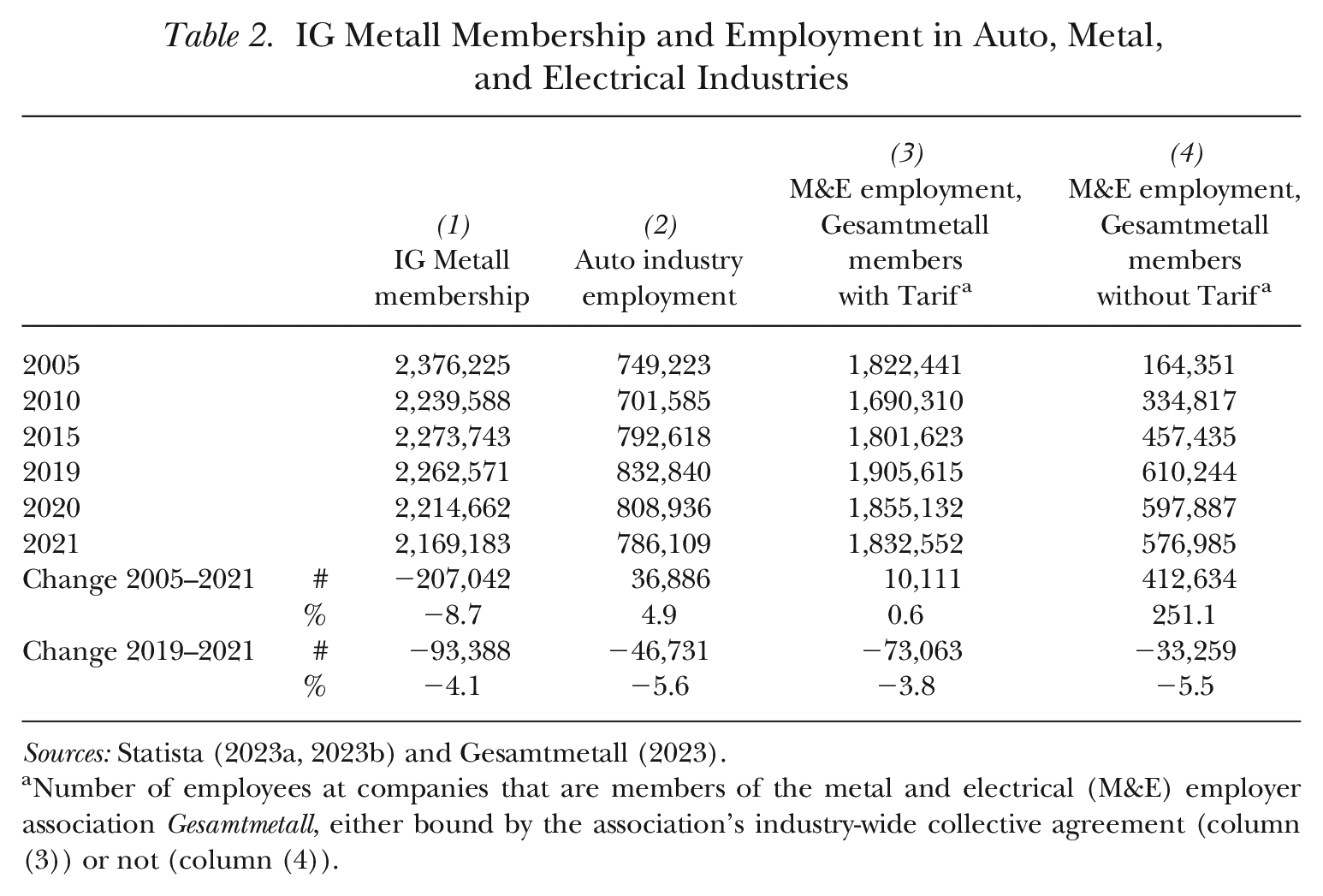
In Germany, too, the role of unions in the new world of BEVs remains unsettled. Union membership density statistics are not available for the German auto industry, but Table 2 shows that IG Metall has not been immune from broader trends of declining union membership and collective bargaining coverage. In the period 2005–2021, the union’s membership declined by nearly 9%, while auto industry employment increased by nearly 5%. Employment at companies that are members of the main employers’ association for metal and electrical manufacturing has increased. Most of this growth, however, was in the “without Tarif” part of the association; these member firms are not a party to industry-wide collective agreements. In 2019–2021, both employment and union membership declined, possibly foreshadowing deeper job cuts ahead.
IG Metall Membership and Employment in Auto, Metal, and Electrical Industries
Sources: Statista (2023a, 2023b) and Gesamtmetall (2023).
Number of employees at companies that are members of the metal and electrical (M&E) employer association Gesamtmetall, either bound by the association’s industry-wide collective agreement (column (3)) or not (column (4)).
The German automotive industry is a critical case for the just transition debate, not least because IG Metall has used the label Fairer Wandel (literally, “Fair Transition”) in publicizing its demands to promote decarbonization while strengthening worker rights. After a period of skepticism (Hancké and Mathei 2020), the union now supports legislation to facilitate the transformation, arguing that the transition will succeed in keeping jobs in Germany only if workers are involved (Pulignano, Hauptmeier, and Frans 2023). The union’s strategy includes policies to promote the industry and protect workers, as well as supporting works councilors in negotiating workplace change. It has done so in partnership with government and employers to safeguard employment in the German automotive industry. In this section, we discuss Germany’s evolving government policies to facilitate the BEV transition, the institutional and regulatory framework of worker protection, and the active involvement of IG Metall in the transformation process.
German Industrial Policies
Through the 2010s, Germany’s transition to BEVs was slow, largely because of the automotive industry’s weight in the national economy. Despite offshoring to regions with lower wages, German producers of ICEVs and their powertrain components maintained consistent employment (Schwarz-Kocher, Krzywdzinski, and Korflür 2019). The political influence of manufacturing unions and automakers, reinforced by Germany’s tripartite traditions, contributed to this inertia. This resistance is evident in the unsuccessful Nationale Plattform Elektromobilität (National Platform for Electric Mobility) project initiated in 2010 and later renamed Nationale Plattform Zukunft der Mobilität (National Platform for the Future of Mobility), which intended to boost BEVs but was criticized as “half-hearted” (Haas 2021) and stymied by industry and union opposition (Meckling and Nahm 2018).
Starting around 2020, the German government adopted a clearer policy to promote BEVs. The Dieselgate scandal of 2015 was one catalyst, which put pressure on German automakers to change their technological and product strategies and weakened their lobbying capacity at the EU level (Mujkic and Klingner 2019). The immediate trigger for the policy shift was the tightening of EU emission regulations. Initially introduced voluntarily in the late 1990s, the European fleet-wide carbon dioxide emission standards have evolved into mandatory regulations, accompanied by financial penalties for non-compliance. In 2020, the European Commission introduced stricter emission regulations, targeting 100% carbon dioxide emission reduction in new cars by 2035. These regulations became effective with EU regulation 2023/851 in 2023. Although the German government still advocated exceptions—including permitting ICEVs powered solely by “e-fuels” after this deadline (Galgóczi 2023)—the overall push from the EU level is for BEVs.
The German government has recently introduced several industrial policies to develop domestic BEV production capabilities. These policies are restricted by EU-level regulations, notably competition law and state aid rules (Meunier and Mickus 2020; Lechowski et al. 2023). The most important ones are:
Grants for technological development. The German government used the EU legal framework, Important Projects of Common European Interest (IPCEI), to provide direct financial support for firms involved in strategic technological innovations (Pichler et al. 2021). Rarely used before 2014 (European Commission 2019), the government approved two major IPCEI initiatives in 2019 and 2021 worth approximately €6 billion for German automotive firms in partnership with specialized battery-technology firms.
Demand-side policies. First introduced in 2016, incentives for buyers of electric vehicles doubled during the COVID pandemic as part of the national stimulus program (Lechowski et al. 2023). These subsidies were eliminated in 2023, first for PHEVs and then for BEVs.
BEV infrastructure development. The federal government has introduced two consecutive Master Plans for charging infrastructure, aiming to create one million charging points by 2030 and establishing a dedicated agency to implement the plan (Nationale Leitstelle Ladeinfrastruktur). Approximately €6.3 billion are available in 2023–2026, mainly grants to the private sector (Bundesregierung 2023).
Support for established supplier firms and small- and medium-sized enterprises (SMEs). Despite its increasingly BEV-focused policies for the automotive sector, the German government also supports traditional suppliers, especially SMEs, that still produce ICEV components. The COVID-era sectoral stimulus package targeted support at regional automotive clusters, extending beyond BEV technologies.
From the perspective of the “just transition” debate, these programs do little to ensure that new BEV-related jobs are high quality. This approach is in contrast to the Biden administration’s discourse and the objective of the Inflation Reduction Act (IRA), which explicitly emphasizes creating “good jobs.” It also diverges from the broader trends in Europe toward using ecological and social criteria in public procurement, such as paying wages according to collective bargaining agreements (Jaehrling and Stiehm 2022). At the EU level, the “strings” attached to state aid programs for industry aim to reduce inter-regional economic disparities by targeting subsidies at lesser-developed regions.
Worker Protections in the Workplace and Labor Market
Independent of industrial policy, worker voice in Germany already benefits from strong institutional support. Workers elect representatives to the corporate board (Aufsichtsrat), who join in corporate-level strategic decision-making and access information not available to the public. Works councils have statutory rights to information and joint decision-making over plant-level restructuring. They often create additional structures to coordinate across the whole corporation and involve themselves more deeply in corporate decision-making than is required by law; with World Works Councils and European Works Councils, trade unionists have extended some of these practices from within their own companies to the international stage.
IG Metall’s policy agenda includes strengthening regulations that promote worker voice, further building on an already solid legal framework. Rules governing layoffs are centrally important. Works councilors facing job cuts in their plants have the right to negotiate an Interessenausgleich and Sozialplan, including a detailed timeline for restructuring and compensation and job-search assistance for laid-off workers (Laßmann and Riegel 2017). Some instruments are subsidized by the government, whereas others are permitted but not funded. Typical instruments include:
Transfers to other plants within the same company or corporate group or owned by a third party. Often workers can stay employed if they accept a transfer outlined in the Sozialplan, which defines the conditions under which transfers are offered and outlines the concept of “reasonable burden” regarding the “equivalence” of a transfer job and consequences for workers who turn down a transfer job offer. Pay protection, or Entgeltsicherung, safeguards workers’ pay in case of a transfer to an inferior job.
Retraining of workers for the requirements of new jobs. Requalification measures may be included in the Sozialplan to determine training needs, define training objectives, and outline participation criteria and payment for trainees. Noting changing skill requirements likely brought about by the EV transition, especially in small- and medium-sized firms, trade unionists are arguing for strengthening works councils’ roles in the planning of training by firms (Bosch 2022).
Establishment of temporary corporate entities to employ and retrain workers after they are laid off (Transfergesellschaften and Beschäftigungsgesellschaften). These entities are set up together with the public employment service, employ workers facing unemployment for up to 12 months, and aim to place them in new jobs. Workers are paid Transferkurzarbeitergeld (transfer short-term work allowance) funded by unemployment insurance and the employer (Knuth and Mühge 2009).
Working time reduction to redistribute the work. This instrument is most common for older workers (Altersteilzeit) and is intended to reduce their working time and move them into retirement (Laßmann and Riegel 2017). Often the Sozialplan does not introduce specific conditions but refers to provisions in sectoral- or plant-level agreements; otherwise, they are codified as an annex to the Sozialplan. Reduced work time is a long-standing IG Metall demand, and a four-day week without loss of pay is a central demand in the 2023 collective bargaining round in the steel industry.
Early retirement to transition older workers into voluntary retirement before the legally defined retirement age. This instrument protects jobs for younger workers and allows overall job cuts by not filling many of the jobs freed up through early retirement (Laßmann and Riegel 2017). The Sozialplan draws on established retirement laws to define conditions for early retirement.
Severance pay to compensate workers for the financial loss they face when agreeing to exit the company. It is normally a lump sum paid to the worker when employment is terminated. The works council and the employer negotiate the parameters to calculate individual severance pay.
Short-time compensation, known as Kurzarbeit, to prevent layoffs during temporary reductions in the volume of work. Under Kurzarbeit, workers are paid part of their wage from unemployment insurance funds to remain employed for up to 12 months with reduced working hours and wages. Typically, the program covers 60% of a worker’s lost income or 67% if they have children. During the economic crises of the past two decades, German unions have worked with government to increase access to Kurzarbeit by simplifying the application process and to increase generosity, up to 87% of the wage of workers with children receiving the benefit longer than 6 months (Weishaupt 2021). They have also expanded training offered to workers on Kurzarbeit by giving them a legal right to it and providing more scholarships to those switching to a university path, especially for workers leaving their employers or industries (Burmeister 2020; Beutler et al. 2021).
Collective bargaining plays a role in all of this. For most automotive workers, wages, working time, and other working conditions are set through the sectoral agreement for the metal and electrical industry between IG Metall and Gesamtmetall (the Federation of German Employers’ Associations in the Metal and Electrical Engineering Industries). This agreement also governs the conditions and procedures of concession bargaining for troubled firms through “opening clauses.” In some cases, IG Metall negotiates directly with the individual firm. The current sectoral agreement for the metal and electrical industry includes provisions for future-oriented agreements (Zukunftstarifverträge) that enable works councils and IG Metall to proactively request plant-level negotiations about investment and future products with management. The sectoral agreement includes a yearly lump sum payment (Transformationsentgelt), which amounts to 27.6% of monthly pay.
These institutional resources give German trade unionists many advantages. They are better positioned to participate in workplace negotiations and influence corporate strategy than their North American counterparts. The high costs of mass layoffs deter plant closures, and instruments such as Kurzarbeit give them resources to keep workers employed. Other government-backed schemes help workers who are laid off, most notably through retraining.
Change in industrial relations institutions, however, has taken place more slowly than changes in industrial policies. Significant numbers of German workers are employed under “atypical” work arrangements and therefore normally excluded from the instruments discussed above (Hassel and Schröder 2021). “Core” workers directly employed by large firms on permanent contracts are well protected, but workers at the “periphery” (i.e., those on temporary contracts or working for temporary employment agencies) are not (Holst, Nachtwey, and Dörre 2010). Also, in new workplaces, the governance of wage and working conditions is subject to negotiation and contestation. IG Metall activists seek to establish worker representation and initiate collective bargaining, and they may or may not succeed.
Active Involvement of IG Metall
Above we examined Germany’s institutions that encourage worker participation within companies and collective bargaining over wages and hours. They also mitigate the risk of unemployment to workers and help maintain their skills. However, these institutions do not in themselves prevent job loss or ensure high job quality and have in fact been under pressure due to offshoring and outsourcing (Greer and Doellgast 2017). Much depends on what the union does.
IG Metall has considerable power resources to shape the BEV transition, extending beyond the institutional framework (see Refslund and Arnholtz 2022 for an update on power resource theory). In 2023, it had just over 2.2 million members, 2,600 staff, and 260 offices across Germany (IG Metall 2023). It also has a near-monopoly in union membership and bargaining in its jurisdiction, which includes steel, textiles, wood, electrical goods, machine tools, shipbuilding, aerospace, trains, automotive, as well as related logistics, staffing, repair shops, and other services. Union members in work contribute 1.0% of their gross earnings in union dues, with much lower dues for students, trainees, and workers who are unemployed or on medical or parental leave. Strikes happen regularly but are normally brief: In 2018, for example, 418,123 working days were lost, and 574,740 workers participated, the highest numbers since 1993—but only 186 of these workers were on strike for more than 7 days (Gesamtmetall 2023). IG Metall has a commanding presence in works councils: In 2022 its members secured 76% of seats in the metal and electrical sector works council elections (IG Metall 2022).
The union brought these power resources to bear in October 2021 when it mobilized 50,000 members for a nationwide day of action to support the transformation of manufacturing (IG Metall 2021). This action was timed to coincide with the formation of the incoming federal government. IG Metall organized a large demonstration next to the Reichstag building in Berlin, in which senior politicians answered questions posed by trade union leaders in front of a noisy crowd of union members. Similar events were held in other German cities. Under the overarching slogan “Germany must remain an industrialized country!,” the union presented demands in four areas:
“Safe bridges into the working world of tomorrow – no layoffs in the transformation!” The union called for expanding training and scholarships for a second apprenticeship or course of study, expanding Kurzarbeit to provide training and personnel planning and additional wage subsidies in line with companies’ transformation plans (see also Strötzel and Brunkhorst 2019: 262), and subsidizing reduced working time and early retirement.
“Sustainable jobs and secure training – in our workplaces, in our regions!” This means strengthening collective bargaining and worker rights to secure corporate commitments in employment, investment, and skills training. Co-determination reforms could increase the topics in which works councils have veto power in strategic corporate decision-making and increase the number of worker-elected board members. The union also argues for increasing funding for regional economic development and skills provision and making collective bargaining coverage a prerequisite for public procurement.
“Public investments in infrastructure and the conversion of our industries – and reliable framework conditions!” The union demanded increased government funding for EV charging infrastructure, public transportation, carbon-neutral energy, green steel, and research and development (R&D) to decarbonize long-haul trucking, commercial aviation, and maritime shipping, where batteries are inappropriate (Strötzel and Brunkhorst 2019: 262–63).
“Solidaristic funding – distribute burdens and costs fairly, ask winners of the crisis to pay!” IG Metall called for €50 billion annually to pay for the proposals above, funded by an increase in the top income tax rates.
Beyond the 2021 day of action, an important part of IG Metall’s strategy has been maintaining close working relationships with government and corporations. This tripartism is present not only at the level of national government but also at the level of German states and local governments. In the Land Berlin, for example, the union participates in a steering group with industry federations and local government, with the aim of developing a Masterplan Industriepolitik (industrial policy master plan). In Baden-Württemberg the union has initiated a Strategiedialog Automobilwirtschaft (automotive industry strategic dialogue) with the state government that includes the Ministerpräsident (state premier), the original equipment manufacturers (OEMs), suppliers, employer associations, universities, research institutions, IG Metall, and works councilors. The Land funds a think tank called E-Mobil Baden-Württemberg that supports industrial policy deliberations with research studies. In Bavaria, similarly, IG Metall has agreed with the government and the main employer association on a process for the government to support environmentally friendly manufacturing (Strötzel and Brunkhorst 2019: 263). Across Germany, 27 federally funded “regional transformation networks” with trade unionists, managers, elected officials, researchers, and others promote regional solutions to the challenges of industry restructuring.
A central part of the union’s strategy has been coalition-building, to spread ideas, develop policies, and steer the transition. This effort often goes beyond traditional “social partners.” For example, environmental activists are deeply involved in some of these coalitional bodies. Some work with IG Metall and works councilors in the context of local struggles. Members of the environmental activist group “Fridays for Future,” for example, have talked with workers threatened with plant closures about developing alternative forms of production (Hoben 2022). Still, the dominant actors in these coalitions are government and business as social dialogue partners within Germany’s tripartite industrial relations system.
At the company level, the union supports works councilors in their everyday work of representing workers. The form this support takes depends on whether it is a greenfield site or an existing employer with collective bargaining and works councils. Greenfield sites are challenging in Germany for the same reason they are challenging in North America—the union has to organize them. This effort includes recruiting members, helping members win seats on works councils, and pressuring employers to engage in collective bargaining. There is no legal requirement that the company bargain with IG Metall. At Tesla’s plant near Berlin, a works council has been elected, but it is unclear whether the company will ever bargain with the union, and politicians have criticized Tesla for poor working conditions, spying on workers, and deviating from the German model of social partnership (Neuerer 2023). Joint ventures present a similar problem: ACC, a battery production joint venture in Kaiserslautern, is situated on the former premises of an Opel/Stellantis component plant but is a formally separate entity, initially with no works council or collective agreement (Sebald 2021).
At established employers, IG Metall sees its task as exerting an influence on location, employment, innovation, and investment; negotiating to prevent plant closures; and identifying future products for all plants. As mentioned earlier, in 2021 IG Metall negotiated a collective agreement that serves as a framework for company-level collective agreements with corporate management (Zukunftstarifverträge). At the larger OEMs and suppliers, such agreements often cover all locations and define the parameters for plant-level agreements between a works council and management (Betriebsvereinbarungen) about future products and investment. The company-level collective agreements are more enforceable and may include concessions over pay and working hours. Strötzel and Brunkhorst (2019) gave three examples:
Daimler has divided itself into three divisions and is planning €35 billion in investment in Germany. Projekt Zukunft (Project Future) banned mandatory layoffs until 2030 and applied to all Daimler employees, including logistics and branch offices. This agreement also gives works councilors a say in purchasing of new products, electronic components, and development and mobility services, as well as seats in the company’s innovation committees, in which it is informed about future products and can make proposals.
Volkswagen anticipates extensive job cuts due to technological change and new products. As early as 2016, the works council negotiated a “Future Pact”: By 2025, 25,000 jobs would be eliminated and 9,000 created. The company agreed to produce new e-mobility products at German plants, creating a clear future for those sites and avoiding some offshoring and outsourcing. The pact expands part-time work for older employees.
At the supplier Schaeffler, an agreement on the future (Zukunftsvereinbarung) states that works council committees must be involved in new product development; apprenticeships and other training are to be expanded; work organization should be designed so that workers can use the skills they gain; existing agreements to prevent plant closures will be maintained and standardized; and layoffs will be avoided. A committee with equal numbers of labor and management representatives oversees implementation.
Although the aim of these agreements is to convert ICE-related plants to BEV-related work and minimize the pain of restructuring, many union members face layoffs and plant closures. The use of existing instruments discussed above can reduce the damaging consequences of restructuring: for example, early retirement, severance payments, short-time work, assistance with job search, internal transfer within the company or corporate group, retraining, and transfer corporations. The union’s role is to support works councils in negotiating over this—a Sozialplan and Interessenausgleich governing restructuring plans and associated protections of the workers. In some cases, workers stay employed on the premises as a new owner comes and repurposes the facility. This happened, for example, at a Michelin tire plant in Bamberg, which was converted from a production facility to an R&D park for green technologies, funded by the state of Bavaria (Josipovic 2022). Another case of green transition is currently attracting attention. Automotive supplier Continental has decided to shut down its plant in Gifhorn, which produces parts for car brakes, by 2027. Two IG Metall union leaders and the Head of HR at Continental created the program “From work into work” (Von Arbeit in Arbeit) to find alternative employment for some of the plant’s approximately 1,000 workers. The heating products manufacturer Stiebel Eltron has formally agreed to employ 300 Continental employees to produce heat pumps at the Continental site, and Siemens will employ 100 workers to produce rail infrastructure at a nearby site (Franz 2023; Reitmeister 2023).
IG Metall officials and works councilors face difficulties building solidarity, as plants compete for investments. At a firm with multiple locations and a declining amount of work, plant closures become increasingly likely, as the abovementioned closure of the Ford plant in Saarlouis shows. This case of management whipsawing shows how difficult it is to build solidarity among plants of the same company, even at Ford in Europe, which has a long history of cross-border union solidarity (Fetzer 2010). Building solidarity is also difficult within Germany, especially at suppliers, which have begun closing smaller parts plants that make ICE-related components, with the Bosch fuel pump plant in Munich a noteworthy example (Kniekamp 2022).
Worker-to-worker competition for investment is also taking place between suppliers and OEMs. The major system suppliers are developing BEV-related products, such as components for batteries and electric motors and IT systems, but OEMs are also developing the capacity to produce many of these same components in-house. While works councilors at OEMs, particularly in plants that currently make engines, axles, and transmissions, see insourcing as an opportunity, those at suppliers see it as a threat.
The EV transition has certain similarities to the restructuring of the 1990s and the first decade of the 2000s that put pressure on the established German model of industrial relations. The union had to cope with intensified competition for investment due to the internationalization of the companies and vertical disintegration, against a backdrop of high unemployment, often through concession bargaining (Greer 2008). One difference is that workers are currently in a strong position of structural power. The companies are ramping up EV production while maintaining ICE production in the context of an already tight labor market; the union is currently making gains in bargaining. In the longer run, however, it appears that workers’ collective power will decrease. The end of subsidies to consumers will intensify price-based competition, squeeze corporate profits, and favor low-cost production in low-wage countries. Unlike the 1990s, when the European consumer market was growing and incumbent players internationalizing, the current transition includes new players in a product market that is already saturated. The resulting problem of overcapacity will intensify, in the assembly sector and the independent parts sector, leading to plant closures. The strategic questions facing the union are therefore familiar: how to influence offshoring and outsourcing decisions, cope with production overcapacity, organize new subsidiaries and joint ventures, and build solidarity between workers competing for investment.
IG Metall is in many ways well-equipped to face these problems. Its power resources include the current tight labor market (structural power), its large membership (associational power), its institutionalized channels of influence (institutional power), a clear just transition narrative about Fairer Wandel (ideational power), and strong working relationships with government, employers, academics, environmentalists, and more (coalitional power). A well-resourced union bureaucracy deploys those power resources with a clear message about the nature of the transformation and the need to maintain a strong manufacturing base in Germany. It is unclear how much success the union will have as the EV transition progresses, price-based competition intensifies, and job losses mount. In the face of job losses and plant closures, works councils in companies will be competing against one another for investment, market share, and ultimately jobs.
Toward a Just Transition for North American Auto Workers
Drawing lessons for North America from Germany’s experience with the BEV transition may seem difficult given the many institutional, political, and economic differences between countries. Nevertheless, many of the challenges are shared. In North America, as in Germany, a significant number of workers face the risk of job loss and potentially poorer job quality in the long term. The 2023 strikes and collective bargaining round showed that, like IG Metall, North American unions are in a strong position of structural power and able to win concessions. The UAW and Unifor achieved significant gains in terms of wages, especially for temporary and in-progression workers and for in-house parts plants. In addition, the inclusion of battery joint ventures in master contracts and the right to strike over plant closures represent crucial EV-related gains. For the UAW, the next step was to build on this momentum through an organizing drive at 13 non-union automakers, including Tesla.
A widespread misconception about unions is that they tend to oppose technological and organizational change. In Germany, workers have long had strong rights to participate in change, reducing the incentive to oppose it (Turner 1991). But even in countries with weaker frameworks of worker rights, union opposition to innovations in the workplace appears to be declining (Doucouliagos and Laroche 2013). Indeed, in 2023 the UAW went on strike to secure EV-related investments. This acceptance of change may be because of the tightness of the labor market; because the amount of future job loss is uncertain; or because of the widespread view that new investment is needed for the long-term viability of unionized factories.
Nonetheless, a notable gap remains in North America: Workers still lack influence in policymaking and in corporate decision-making to ensure that the transition to EVs is both just and equitable. Industrial action and collective bargaining on their own will not produce a “just transition.” The institutional power of the UAW and Unifor is much weaker than that of IG Metall. Policymakers in the United States and Canada need to strengthen workers’ capacities to participate in workplace restructuring and navigate through the labor market. Based on the insights from our German case study, we identify four areas in which they can accomplish this.
Make It Easier for Unions to Organize the Unorganized and Build Broad Worker Solidarity
Unlike in Germany, where the auto industry had no major non-union player until the arrival of Tesla, an important challenge in achieving a just transition in North America is competition between the union and the non-union sector. This condition creates significant opportunities for automotive firms to lower wages, undermine job security, and compromise workplace safety in the context of the BEV transition. Organizing the unorganized is needed to level the competitive playing field.
Union density in the US “motor vehicles and motor vehicle equipment” sector has declined from 58.8% to 11.8% between 1983 and 2021 (Hirsch and MacPherson 2003) and is higher at OEMs than at parts suppliers. In Canada, density has fallen from 73% in 2005 to 58% in 2014 in the assembly sector and from 31% in 2005 to 21% in 2014 in the automotive parts sector (Sweeney and Mordue 2017). According to Unifor, union coverage in 2021 was 65% in assembly and 23% in the independent parts sector.
The challenges in unionizing are not limited to Tesla or the battery plants. Union organizing has failed at incumbent firms in the face of management opposition at Toyota, Nissan, Honda, Hyundai, Mercedes-Benz, and BMW. In Republican-dominated states, where much of the new US BEV investment is sited, politicians and local businesses have also mobilized against union organizing campaigns, most notably at Volkswagen in Tennessee (LeRoy et al. 2022; Silvia 2023), where UAW activists were defeated in two union elections before winning in April 2024. Successes by the UAW at Daimler truck plants in North Carolina and by the Steelworkers at the Bluebird bus plant in Georgia in 2023 (Leon 2023) are exceptions. Much government funding to promote the BEV transition goes to firms that violate worker rights. In Canada, unions are facing similar challenges. While many reconversion investments have been announced in union shops, battery components and assembly plants will be “greenfield” sites and management is expected to oppose the extension of union representation. Like the UAW, Unifor has not been able to organize the Toyota and Honda assembly plants, and most workplaces in the supplier sector are non-union.
Building solidarity to shape this process is made difficult by the real pressures of worker-to-worker competition. Much of it is intentionally orchestrated by management, as in Ford’s decision to close the Saarlouis plant, a classic example of management whipsawing (Greer and Hauptmeier 2016). Competition also occurs between firms, as seen with Tesla, whose expansion is likely to push other brands out of the market and increase overall overcapacities in the industry. A lesser-known example of inter-firm competition occurs along the supply chain, as OEMs decide whether to produce certain parts in-house or purchase them from independent suppliers. As the past history of whipsawing in the auto industry shows, organizing solidarity between competing plants and firms is necessary but not easy. The challenge is therefore not only to ensure that workers can form unions but also to make it possible for them to organize in a way that competition is countered with solidarity.
One way to level the competitive playing field is to restrict employer opposition to union organizing. Improving the enforcement of existing labor laws would greatly facilitate organizing. The recent Cemex decision is notable for altering this dynamic. It requires employers to petition the National Labor Relations Board (NLRB) for a secret-ballot election if a union seeks recognition based solely on a show of union authorization cards. As such, employers who are presented with cards signed by a majority of employees must decide to either immediately recognize the union or submit a petition for an election within a two-week time frame. Beyond this, government should encourage broad coordination of collective bargaining at the sector level. Government incentives should mandate that these plants automatically fall under sectoral agreements or that financial support comes with a neutrality agreement. In Canada, the newly introduced Canadian Sustainable Jobs Act promoting union jobs during the environmental transition is a step forward, but more robust measures supported by government financial schemes will be needed.
Give Trade Unionists More Rights to Participate in Corporate Decision-making Where They Are Organized
A second barrier in North America is inside the unionized sector, where, although management’s decisions are constrained by collective bargaining agreements, management still has very strong rights to make unilateral decisions, unaffected by the worker voice and support required under German law. Participation is often understood as a function of labor–management partnership (Vidal 2022) or bargaining over investment (Dupuis and Greer 2022), and in recent years, the UAW has negotiated to create procedures to govern sourcing and technological change (Rutherford 2023). Despite its evident militancy, the UAW leadership did not abolish joint programs in the 2023 master agreements.
Labor–management partnership and negotiation over investment has taken place against a background of union weakness. Dupuis and Greer’s (2022) study of insourcing found that nearly all the work brought in-house was carried out under worse pay and conditions than that done by the core workforce of the OEMs, both in Canada and the United States. This situation was remedied to some extent with the 2023 collective agreements, at least in the Detroit “Big Three” (General Motors, Ford, and Stellantis) plants. Improving union capacity to influence corporate investment decisions would also alter the politics of unionized corporations in ways that would protect industrial jobs in the United States and Canada.
The solution is to require corporations to bargain with unions over investment, to require workplace-level information and consultation, and to include worker representatives in corporate governance. One way to strengthen worker participation is to enshrine it in collective bargaining, a proposal OEMs will oppose at the bargaining table; unions will have to weigh these demands against others that could be more important for their members in the short run. Another path is that state investments in new capacities should require such mechanisms that promote information and consultation. A third path is to strengthen worker voice through labor law reforms to create North American equivalents to the instruments described above.
Involve Unions in Industrial Policies to Encourage BEV Expansion
Not only do North American workers lack the participation rights that German workers rely on in co-determined firms, their unions lack the corporatist forums that give IG Metall a strong voice. Trade unionists can be involved in the national policies that govern this transition, including trade rules, subsidies, emissions standards, BEV mandates, energy policy, public procurement, and other areas of industrial policy. The German example shows that much can be done at the regional level as well. Even compared to other kinds of climate jobs in the United States, manufacturing unions hold limited sway. For instance, in the energy transition, building trade unions can continue their past practice of negotiating project labor agreements with apprenticeship targets that favor the unionized sector; manufacturing unions lack these forms of leverage.
Despite the discourse of political leaders, unions are not involved in government efforts to promote BEVs, and they therefore have less information and influence than their counterparts in Germany. The weakness of workers’ rights in the workplace makes it all the more important to include unions in policymaking processes. Without the involvement of organized labor in this process, the language of “just transition” and “good union jobs” may ring hollow to many workers.
To create good jobs through industrial policy, states, provinces, and federal governments need the kinds of forums that exist in Germany in which labor, management, and government discuss industrial policy, from formulation to implementation. The newly proposed Canadian Sustainable Jobs Act envisions the creation of regional tables and jobs partnership councils including union representatives, and in Québec labor–management sectoral committees supported by the provincial government could provide a vehicle to promote policy discussions and solutions to workers affected by climate transitions. Past experience, however, shows that funding is sometimes inadequate for unions to fulfill the potential of these forums.
Expand the Use of Existing Tools for Managing Restructuring
Strengthening worker rights is also necessary outside the workplace, when making transitions in the labor market. Although the regulatory landscapes of North America are less stringent than Germany’s regarding plant closures and mass layoffs, with no worker consultation rights or “social plans,” North American trade unionists have access to comparable tools, just in weakened form.
Approximately half of the US states have short-time compensation programs, with names such as Workshare or Shared Work, and Canada has a national Work Sharing Program. Similar to Kurzarbeit, these programs provide support from the unemployment insurance system for employers that reduce working time, rather than resorting to layoffs. However, these programs are underutilized. Whereas Kurzarbeit aided 6 million German workers at their peak in April 2020 (Mueller 2021), state short-time compensation programs in the United States supported only 450,000 workers at their peak, which came three months later, in July 2020 (U.S. Department of Labor 2020). Similarly, the services of Germany’s Transfergesellschaften and Beschäftigungsgesellschaften are similar to those funded by the US government’s Trade Adjustment Assistance (TAA) program, which offered workers various services to facilitate re-employment, including targeted retraining, income support, and job-search assistance. TAA, however, expired in 2022 and has yet to be reauthorized by US Congress (Congressional Research Service 2023). US job banks had a similar function, albeit one set in collective bargaining and confined to the unionized sector. At Detroit’s Big Three they were eliminated as a condition of the auto industry bailout of 2009 (Rattner 2011).
Most Canadian provinces require measures to soften the impact of collective layoffs through retraining or transferring workers to new workplaces or new occupations, often governed by a “reallocation committee” with labor representatives. These tools should be strengthened and include climate transition language that would apply in situations like the EV transition. Union participation should also be mandatory when such episodes of restructuring occur.
The programs that exist to support workers fighting against layoffs and making transitions in the labor market should be expanded and modernized. Retraining programs need more funding, short-time compensation should exist in every US state, and TAA should be reauthorized by Congress. Improvements to unemployment insurance, including the involvement of unions in its administration, would support workers looking for good jobs and attempting to avoid bad ones.
Conclusion
The risk for auto workers worldwide is that the BEV transition will produce job loss, spells of unemployment, and worse jobs in the future—in other words, downward social mobility. This transition may well be unjust by most measures. The United States and Canada have some tools in place that could prevent this (Kresge 2020), but without institutional change the future looks quite bleak for auto workers. The German case reveals some lessons for policy, which includes the importance of powerful and strategic trade unions, but also tools such as work sharing, job banks, and reallocation committees. Introducing, reviving, or expanding similar tools in North America will require bold proposals from the unions and mobilization of their members. This has already happened in the workplace in the fall 2023 bargaining round at the Detroit Big Three, but it will also require political proposals for institutional change.
Even in countries where unions have strong institutional power resources, the German case shows that this is not enough. The union’s other power resources also matter in this case, in particular its large membership and well-resourced organization as well as its structural power stemming from the current labor shortage. Beyond this is its ability to mobilize these resources at the national, regional, and workplace levels in the context of its own version of the just transition narrative. The ultimate success of this strategy is far from certain.
Footnotes
Acknowledgements
The authors thank seminar participants at The Inter-university Research Centre on Globalization and Work (CRIMT) 2022 international conference for their valuable comments.
This article is part of an ILR Review Special Issue on Transnational Employment Relations in the European Union. The article is also part of the ILR Review’s ongoing Policy Paper Series.

For general questions as well as for information regarding the data and/or computer programs used for this study, please contact the corresponding author at
1
We define battery electric vehicles (BEVs) as full-electric plug-in vehicles with an electric motor and a battery pack instead of an internal combustion engine. The other major category of electric vehicles (EVs) are plug-in hybrid electric vehicles (PHEVs) that also have an internal combustion engine.