



Abstract
This article contributes to explaining the rise of labor unrest in Egypt in the early 2000s, led initially by public-sector workers. Using two case studies in textile and transport, the author shows that perceptions of sector potential affected workers’ ability to protest and compensated for the decline in their sectors’ roles in the economy. The perceptions of underutilization due to corruption and to sector viability based on squandered profits help explain workers’ militancy and capacities to mount an extended protest campaign. These perceptions build on discourses that critique the state’s adoption of neoliberal policies associated with privatization. Workers could develop these perceptions because their sectors still played a role in the economy despite their decline. The analysis contributes to the Power Resource Approach by showing how perceptions of sector potential enhance capacities among Global South workers in declining sectors. To explain labor unrest, the author engages labor scholarship on Egypt that focuses on grievances rather than on workers’ economic position and sources of power.
A key question for labor scholars is how marginalized workers have been able to mobilize under neoliberalism despite increasing labor market precarity and attacks on workers’ institutional and associational capacities. In Egypt, neoliberal policies have led to stagnating wages, significantly increased labor precarity and informality, undermined labor’s institutional rights, and decreased union density. These policies were compounded by the fact that workers faced antagonistic state-allied unions and, because of authoritarian politics, restrictions in utilizing coalitional power. Yet at a time when these policies accelerated in Egypt in the early 2000s, labor unrest was strong. Workers initiated labor unrest in Egypt and utilized strikes to advance their interests in an extremely challenging context. Labor unrest, in fact, reached unprecedented levels, involving the industrial, service, and government sectors, and shaped a massive social upheaval involving at least 2 million workers and building the groundwork for the Egyptian uprising of 2011 (Beinin and Duboc 2015). What explains the rise in unrest?
Though public-sector enterprises have experienced a declining role in the economy as a result of privatization policies that accelerated in the early 2000s, public-sector workers were the leading force that initiated this unrest. My newspaper research and interview data in two case studies with textile and bus public-sector workers 1 show that these workers were able to wage an extended protest campaign and utilize workplace protests in spite of the risks. I show that perceptions of sector potential affected their ability to protest and compensated for the decline in their sectors’ role in the economy. Workers were cognizant of their sectors’ decline, but they attributed the decline to underutilization and suggested ways to improve their sectors’ performance. Because workers framed their demands as a fight for a public good, this imbued their struggle with a moral cause that contributed to their militancy and empowered them to make radical demands even after making economic gains. Workers also thought that their sectors were still viable and made profits that were squandered by managers as a result of corruption and elite interests in privatization. Thus, for workers, workplace protests could lead to concessions to avoid further losses. Their beliefs encouraged them to wage an extended protest campaign. These perceptions built on pre-existing discourses in Egypt that critiqued the state’s adoption of neoliberal policies associated with privatization, corruption, and underdevelopment.
I contribute to the existing literature in three main ways. First, I show that labor scholarship should account for how workers’ perceptions of sector potential could affect the capacities of workers who experience marginalization. Second, rather than the dominant focus by Egyptian labor scholars on grievances and the role of institutions, I present an alternative approach that highlights the importance of economic position and perceptions of power. Third, my work contributes to understanding how public-sector workers, who historically have played a leading role in authoritarian Global South countries, responded to their declining role in the economy with the acceleration of neoliberal policies. As a result of the incomplete process of privatization, these sectors still played a role in the economy, one that allowed them to imagine a potential for their sectors, encouraging them to protest.
Theory
The question of worker power has been at the center of labor debates. The main puzzle has been to explain how marginalized workers who lack the traditional economic power of being in key industrial sectors have been able to wage labor struggles and sometimes win concessions. Mobilizations are especially surprising given the fact that under neoliberal transformations, workers experience increasing labor market precarity, attacks on their institutional rights, and the growing practice of outsourcing that undermines labor rights, all amid a decline in union density (Chun 2009; Rojas 2018; Schmalz, Ludwig, and Webster 2018).
Many scholars utilize the Power Resource Approach (PRA) to identify workers’ sources of power. The approach details four main factors: structural, institutional, associational, and societal power (Lehndorff, Dribbusch, and Schulten 2018; Schmalz et al. 2018). The method initially builds on the work of Wright (2000), who distinguished between structural and associational power. Wright explained that workers build capacities based on their associational power when they are able to gather resources, form solidarities, and recruit large numbers of workers to their association. Alternatively, structural power is based on workers’ position in the economic system. Two kinds of structural power are in play, Wright contended: one that derives from labor market structures and the other from the strategic position of a group of workers in the industry (Wright 2000: 962). Building on Wright (2000), Silver (2003) called the latter “workplace bargaining power,” which results from employers’ vulnerability to worker disruption at the point of production, especially when a group of workers are able to strike and shut down production completely. Marketplace power, Silver explained, is augmented in tight labor markets—for example, when workers have scarce skills and/or when surplus labor is at very low levels and workers cannot be easily replaced, thus increasing their leverage (Silver 2003: 92–93). The institutional power resource is largely based on power derived from enshrined laws, such as the institutionalization of collective bargaining rights (Doärre, Holst, and Nachtwey 2009; Gumbrell-McCormick and Hyman 2013).
Workers’ associational, structural, and institutional power have experienced serious attack under neoliberalism. Thus, other power resources have been added to the PRA to explain how some labor groups could mobilize under hostile circumstances. Societal power is based on coalitional and discursive power—the ability of workers and unions to join forces with other social movements to advance their interests and to be opinion leaders on union-related issues in the public sphere (Chun 2009; Schmalz et al. 2018: 122). Symbolic power is another form of coalitional power aimed at restoring dignity for socially and economically marginalized groups by using public dramas to highlight dramatic struggles waged in the public arena. Chun showed that “workers are seeking to rebuild the basis of their associational power by rearticulating the moral norms and cultural values that underpin the social exchange of labor for wage (2009: 13). By building on and rearticulating social norms, labor hopes to attract other social groups to its struggle. Thus, in coalitional power, workers depend on “boosting their associational power by harnessing the resources of other players” (Schmalz et al. 2018: 122). Labor scholars contend that workers depend on such sources of power to overcome the marginalization caused by the neoliberal turn.
The neoliberal turn in Egypt has also undermined workers’ sources of power. In addition to the neoliberal changes outlined above of increasing precarity and decline in union density (Hartshorn 2019), the authoritarian state poses another level of constraint on labor and makes the use of protests risky and therefore less appealing. Nonetheless, analysis of labor unrest among two sectors of public workers shows that they initiated the wave of unrest in Egypt in the midst of the first decade of the 2000s and mounted an extended protest campaign, using even the risky and illegal activity of striking. This bold move is surprising given that public-sector workers have experienced, as I will show shortly, a decline in their power resources under neoliberalism. And though public-sector workers have more job security relative to that of the private and informal sectors, there has been a significant rise in temporary contracts in the public sector as well. Why were some public-sector workers able to wage an extended protest campaign?
Scholarship on Egypt largely tends to attribute labor unrest to rising grievances and not to an examination of workers’ power resources. In the moral economy framework that many scholars employ to explain state–labor relations in Egypt, a pact was established between labor and the state under Gamal Abdel Nasser (Egypt’s president from 1954 to 1970) in the 1950s by which workers committed to production in return for job security, stable wages, and benefits (Posusney 1997; Pratt 2001). Workers, according to these scholars, protested when their wages declined and when state commitments were not met—that is, as a result of rising grievances. Recent work on Egypt pays more attention to how changes in workers’ access to institutions affected unrest, but these scholars also do not examine workers’ sources of power. Scholars explain that the acceleration in neoliberal transformations and the implementation of the Unified Labor Law of 2003 created a rupture in state–labor relations that undermined the power of the Egyptian Trade Union Federation (ETUF) (Alexander and Bassiouny 2014; Abdalla 2016: 124; Bishara 2018: 34; Hartshorn 2019). Under the previous corporatist arrangements, Anwar el-Sadat (Egypt’s president from 1970 to 1981), for example, made sure that the ETUF had sufficient resources and that top leaders within the institution were in fact empowered (Abdalla 2016: 126–27). This focus had changed by the beginning of the 2000s. Union density decreased significantly (Azbawi 2011), and workers in the growing private sector were outside of the union structure (Hartshorn 2019: 30), thereby cutting into ETUF resources. Significantly, with the flexibility of labor markets, the ETUF lost its capacity to protect workers as the Unified Labor Law gave employers flexibility in hiring and firing (Beinin 2009; Bishara 2018; Hartshorn 2019: 33). One of the ways the decline in corporatism directly shaped worker experiences was that, by the early 2000s, it was much more difficult for workers to elect representatives to union committees who were not loyal to the regime and who represented workers’ interests (Abdalla 2016: 127–28; Hartshorn 2019: 44, 51; Matta 2021). As workers were no longer able to advance their interests from within state institutions and the ETUF, they began mobilizing in their workplaces (Bishara 2018; Hartshorn 2019).
But again, this explanation does not account for workers’ sources of power; rather, it details how workers lost their previously acquired powers through changes in laws and declines in the trade union density. Power that used to provide workers with protections and support. One could argue that these developments should have disempowered workers as a result of attacks on their institutional rights and union capacities. In addition, in the first decade of the 2000s the threat of privatization of public-sector enterprises also posed increasing risks for these workers, significantly reducing their role in the economy, thereby undermining their structural power. For example, in 2004–2005, with the acceleration of neoliberal policies in Egypt, the state sold 59 firms worth $2.6 billion, in comparison to nine firms in 2002 worth $17.5 million (Rutherford 2008: 223). Thus, unionized public-sector workers who historically played a leading role in the economy saw their shares in the sector decline while those of non-unionized private- or informal-sector workers grew. Yet, in spite of the decline in their structural power resulting from privatization, workers were able to play a leading role. Prior to the wave of privatization, and during the previous wave of unrest among workers in the 1980s, industrial public-sector workers, such as textile but also transport, enjoyed significant structural power and disruptive capacities. In addition, in the 1980s, not only did workers advance their interests through official unions but also unions had militant workers who were instrumental in the strike wave of the 1980s. 2 Workers even enjoyed the benefits of coalitional power. At that time a significant number of laborers belonged to left-leaning parties that supported labor unrest, and these laborers even ran left-leaning candidates for union elections (Posusney 1997). This is not the case in the 2000s. Though some parties and alt-labor groups provided workers with legal and financial support after they began organizing, workers were keen on distancing themselves from parties and were even very suspicious of alt-labor groups. What, then, were public-sector workers’ sources of power?
Some scholars point to the role of declining repression, as the state was reluctant to use excessive force against labor (El-Mahdi 2011; Alexander and Bassiouny 2014: 113; Bishara 2018: 44). But the threat of violence did not stop workers from calling for their first protest, and repression has declined only in relative terms. In the early 2000s, as my cases will show, workers operated under the threat and execution of violence made through intimidation and arrests. Finally, decline in repression also does not say much about workers’ power resources.
Bishara (2018) directly tackled the question of workers’ sources of power to explain rising unrest. She suggested that anger attributable to state neglect led to rising frustration and to workers’ sense of collective identity, contributing to their power and mobilization. Neglect and anger could indeed have played a role in labor unrest and affected labor’s collective identity and power. And as unrest escalated in Egypt into 2010, labor journalists noted that the state began neglecting workers’ demands (Interview 49). The two cases I discuss, however, received concessions from the state right after their initial mobilizations.
Finally, some public-sector workers have a history of militancy, and some scholars argue that associational capacities explain unrest in some of the large public-sector companies. 3 But these capacities have been undermined by the changes outlined above of declining union density and the growth of precariat workers in the public sectors.
Thus, under neoliberalism, public-sector workers experienced a decline in their structural, associational, and institutional power. Which power resources helped them make radical demands and wage an extended protest campaign? And why did they think workplace protests and strikes could lead to concessions? Workers utilize strikes to build on their structural power when their company and/or sector is important to the functioning of the economy, and employers will be inclined to concede to avoid losses. But when workers are in declining sectors, I found, perceptions of sector potential could compensate for this decline in structural power. Perceptions of sector potential build on workers’ ideas that their sectors are underutilized and more viable than what their managers claim. For workers, their sectors are underutilized as a result of privatization policies that otherwise could be very successful and profitable. Therefore, workers discuss ways to improve their sectors to benefit the public and the economy at large, which imbues their struggle with a moral cause, in turn empowering them to be militant, make radical demands, and continue protesting even after making economic gains. Workers also think that contra to what management and the state claim, their sectors are still viable, profitable, and important for the functioning of the economy. 4 This belief also helps explain why workers think protests could lead to concessions to avoid further losses, encouraging them to continue protesting in their workplaces despite the risks. Workers’ critiques of states’ economic policies of privatization build on discourses and movements that oppose neoliberal policies associated with corruption in the Global South. 5
Perceptions here share some similarities with symbolic power, but also significant differences. For Chun (2009), janitors utilized symbolic power by waging classification struggles to redefine what it means to be a worker after their employers (the universities) outsourced janitorial work, thereby reducing their wages and adversely affecting their work conditions. Perceptions of potential challenge the employers and the state on the viability of the sector and on the correctness of management and state policies. In addition, similar to symbolic power, perceptions of sector potential also build on discourses from pre-existing movements.
But whereas in symbolic power workers drew power from societal groups and utilized public dramas and marches to shame universities and to gain community support, in perceptions of sector potential, workers resorted to workplace protests, rather than lobbying state officials, for example, because they perceived their sectors as viable and therefore management was likely to concede. The case of Egypt shows how workers who used to be in leading economic sectors respond to neoliberal marginalization when the process of privatization associated with workers’ declining role in the economy has not yet been completed. Both textile and transport bus workers still play a role in the economy that allows workers to identify untapped potential for their sectors.
Methods
Research for this article builds on extensive work on labor unrest in Egypt starting in 2009. The methodological strategy employed for this project builds mainly on in-depth interviews in two extended case studies in textile and transport, supported by newspaper research, interviews with workers from other sectors, analysis of labor reports, documents provided by workers, and macroeconomic data analysis.
Since 2004, the number of labor protests in Egypt has increased dramatically, leading to an unprecedented rise in labor unrest. Yet, as mentioned earlier, questions about labor’s sources of power are nearly absent from the literature on labor in Egypt. To identify the sectors that took part in large numbers of labor protests in the early 2000s, I used labor reports by the Land Center for Human Rights (LCHR) 6 and the Egyptian Center for Economic and Social Rights (ECESR). These labor reports are based on newspaper protest data collected by field workers, and these reports are considered reliable sources that are used by scholars who study Egypt. Labor reports counted strikes, sit-ins, demonstrations, and leafleting in the public, private, and government sectors, such as textiles and transport. The analysis of labor unrest in the 2000s showed that public-sector workers initiated the unrest and were overrepresented relative to their share in the labor force. Between 2004 and 2010, protests in the public sector hovered around 15% to 36% of all protests, although these workers account for 3% of the labor force. 7 The peak in labor protest prior to the 2011 uprising reached 614 protests in 2007. By 2010, more government employees and private-sector workers joined the wave of unrest (ECESR 2013). To examine questions related to workplace power and perceptions of profitability, however, I needed to identify protests in a variety of jobs, so I conducted a sectoral analysis by job of the LCHR reports for 2007 and 2010. This analysis by jobs allowed me to identify the public- and government-sector workers for which perceptions of profitability could potentially have an impact on mobilizations, because for some workers, such as schoolteachers, perceptions of profitability could not have affected their protests.
I selected two case studies from the early mobilizers among the public- and government-sector protesters who were able to disrupt all of their sector and wage an extended protest campaign, one in textile and the other in transport. Textile workers at the public Misr Weaving and Spinning Company of Mahalla, an industrial city north of Cairo (I will refer to the company as Mahalla), began protesting in 2006 and continued well into 2008, and resumed their activism after 2011. They were able to protest and strike, disrupting their entire large company, gaining concessions, and making radical demands, such as replacing management. Mahalla includes 38 factories in spinning, textiles, clothing, and others (Raja’y 2008: 43). As for the transport sector, I chose the Public Transport Authority (PTA) bus workers in the Greater Cairo (GC) area, who started mobilizing in 2007 and continued into 2016. They were able to disrupt their entire bus sector and make radical demands, such as transforming their management. Prior to the 2011 uprising, the PTA employed approximately 34,000 workers, of which 18,000 were bus drivers and ticket collectors who worked in 19 garages, and the rest were in maintenance and services. The escalation in privatization in the public bus sector happened after the 2011 uprising under the military regime.
Both of these sectors experienced a decline in their status under privatization, but nonetheless they still played a role in the economy. It is important to note that textile dominated Egyptian exports in the 1980s, and it was still a key export sector in the 2000s, accounting for 10% of exports. Clothing exports have also been rising in importance, dominated by the private sector, since the 2000s. The public textile sector used to dominate the exports of textiles and clothing in the 1970s, at approximately 90%. This share had decreased to 35% in 2003. In 2007, the Public Holding Company exported $155 million worth of textiles from a total of $463 million in clothing and textiles, accounting for 33% of exports. 8 Though statements by the head of the Public Holding Company show that Mahalla had debt in 2007, Mahalla was at the top of the exporting list (El-Morsi 2007). 9 And, though numbers of workers at Mahalla significantly declined from 35,000 in the 1970s, the company still employed 24,000 in the first decade of the 2000s. Although a declining workplace, it still plays a role in the economy.
Transport is also an important sector in the economy, accounting for 5% of GDP, and is key for development; the Egyptian state has been investing large sums of money in the sector in recent years (Hegazy 2022). The public transport sector is, however, in decline, and the bus sector suffers from deteriorating fleets and lack of service in many areas of large cities such as Cairo. This decline in turn leads to higher levels of motorized trips of private cars and other collective rides, such as minibuses, which causes congestion, especially in Cairo and other large cities. Thus, while the public sector used to dominate the transport sector, this is no longer the case. A World Bank report shows that in 2001, 55% of collective trips and 37% of total trips were by the semi-informal minibus and shared-taxi sector in the GC area (World Bank 2006: 20–21). Public transport is, nonetheless, subsidized and affordable, and in the early 2000s it still had significant shares of overall passenger transport. For example, in the GC area, 3 million daily passengers used PTA buses, representing 24.6% of collective transport and 16.7% of total trips (World Bank 2006). In addition, the “Private Bus Decree” by the Cairo governor was issued in 2004 and initiated privatization in the bus sector, allowing private mini- and large buses to operate under the supervision of the public sector through concessions (Hegazy 2022: 9). 10 Yet, in 2009–10, the PTA still deployed 4,883 (3,005 of which were operational) vehicles and employed 33,890 workers in the GC area. From a total of approximately 1.5 billion annual passengers using public transport in Greater Cairo, 692 million used public buses, representing the second-largest percentage of transportation, at 45%. 11 Similar to textile in the first decade of the 2000s, the bus sector continued to play a role in the economy despite the decline.
To gain insight into workers’ perceptions of power, I conducted in-depth interviews with workers from these two sectors, supported by newspaper and secondary sources. I interviewed 40 workers during my four visits to Mahalla city between 2009 and 2012, and I also spent the summer of 2010 living in Mahalla, hosted by Hamdi Hussein, a retired company worker and a leading militant from the 1980s. I re-interviewed approximately seven workers from Mahalla a number of times into 2021. Some of the workers had been at the company for more than 40 years, and others started working in the early 2000s, largely on temporary contracts. I interviewed workers from different factories, age groups, genders, and work status.
I interviewed PTA and other transport workers. Transport workers belong to a number of administrative authorities. While bus workers in the GC area work under the authority of the PTA, railroad and Metro workers fall directly under the Ministry of Transport; other bus transport workers work directly for the governorates. I conducted three interviews with PTA workers, two interviews with bus workers in Mahalla, two drivers at a petrol transporting company, and a journalist who worked closely with PTA employees. I conducted three in-person interviews in 2012, and the rest by phone through 2021. I also re-interviewed two of the PTA workers in 2021. The interview material for transport was supplemented with newspaper research and documents provided by transport workers.
I conducted interviews with 10 civil society activists who were involved in labor issues, including labor journalists and lawyers. Five of them were re-interviewed a number of times as well. I also utilized interviews with other labor groups, such as teachers and tax collectors for comparison, reaching a total of 64 interviews. Conducting research in Egypt is risky for both researchers and interviewees. To ensure the safety of my interviewees, I consulted them about interview locations to minimize risks, and I promised them anonymity. The interviews were conducted in Arabic and lasted between one and three hours (see Table A.1 in the Appendix for interview data).
My questions sought to uncover the nature of work and grievances, the history of labor unrest in the workplace and the sector, workers’ understanding of their power resources, and mobilization strategies, including the risks and difficulties facing labor organizers in Egypt in the 2000s. I also asked about the changing role of unions and workers’ relationships to employers and to state institutions more generally. My inductive analysis consisted of multiple readings of my transcripts, field notes, memos, and archival newspaper data in order to establish theory-informed causal mechanisms, as suggested in Kiser and Hechter (1991). I show that to compensate for the decline in their power, perceptions of sector potential contributed to workers’ mobilization capacities in my two in-depth case studies.
Mahalla Case Study
In this section, I show that the growing economic and union-related grievances motivated workers, but they cannot on their own explain the workers’ militancy and capacities to wage an extended protest campaign. And though workers with a history of militancy played a role in the unrest, prior organizing also cannot explain the call for protests in Mahalla. I argue that workers’ perceptions of company potential contributed to workers’ power by increasing their militancy and by solidifying the idea that workplace protests could lead to concessions, encouraging them to make radical demands and to continue protesting. Finally, I will show that workers mobilized despite facing the threat of repression.
The Mahalla workers’ protest campaign was instigated by knowledge of a government decree that public-sector workers have the right to two months’ pay in bonuses. When management rejected their request for the bonus, the workers approached the local union, but the union dismissed their demands as unwarranted. A number of workers began discussing the possibility for action and then called for a strike to demand their bonus pay. On December 7, 2006, approximately 24,000 workers responded to the call for the strike and marched toward the company headquarters office. After a three-day strike, management conceded to the workers’ main demand. Workers continued to protest in front of management offices and utilized strikes into 2008 to make radical demands, such as the unprecedented demand for independent unionism, the demand to transform management, and to enact minimum wage for all Egyptians.
My interviews show that workers had growing economic and union-related grievances, but workers themselves stated that while the state wanted to frame their demands as only about economic factors, they had union-related and other objectives from their protests (Interview 3). For example, workers were keen on making demands that would improve their company, especially because of the threat of privatization and competition from other textile companies. Workers also explained that the union had become less representative, and militant workers were blocked from being elected to the union. Thus, had the union been more responsive to their demands, workers might not have resorted to protesting. Economic and union-related grievances, however, do not tell us much about why workers were able to make radical demands to challenge their unions and management. After all, not all public-sector workers were making such demands during this time frame. In an unprecedented move, right after the first strike in 2006 and before workers developed their capacities, they started organizing to form an independent association, and thousands of workers joined in 2007. Workers also made other radical demands, such as the dismissal of El-Jabali, head of the Board council, and by 2008 he was ousted from his position. Economic and union-related grievances also cannot explain why and how more than 10,000 workers protested in front of management offices in February 2008 demanding to enact minimum wage laws for all Egyptian workers (Interview 1). Note that these demands were made after making economic gains. As I will argue shortly, workers were empowered to raise these demands because of their perceptions of underutilization and of working for the public good. Finally, grievances cannot explain why workers thought workplace mobilizations could advance their interests and lead to concessions, encouraging them to continue with their protest campaign despite the risks. In fact, in an unprecedented move, state officials and company management met directly with the militant workers, bypassing the official union (Interview 5). Thus, militant workers could have opted for the less risky route of negotiations, for example. But according to workers, one of the main achievements of their unrest is to gain the right to strike. This right is key, workers explained, because for them strikes are the most effective way to gain concessions after strikes had been criminalized. The emphasis on the importance of strikes, I will show in the next section, is related to their perceptions of company viability.
And though a few of the older generation helped in the call for protests, there was minimal prior organizing that could explain workers capacities, militancy, and the success of the first protest in 2006. In fact, the workers who became the leaders of the campaign were from the younger generation who had no experience in labor organizing or history of militancy. Indeed, it was during the first strike that some of the workers who later became part of the organizing committee met and began to know one another. For the workers who called for protests, the positive response to it was far from guaranteed: “In the morning of the strike, I did not expect that so many workers [would] strike. They responded to our call in half an hour. I was stressed out because there was no plan” (Interview 9). Another leading worker later explained that “what was most beautiful about this strike is that it was spontaneous” (Interview 4). What “spontaneous” means here is that there was no clear plan for or knowledge of who would participate and what workers would do in case of success or failure. Notably, it was through the first strike in December 2006 that workers in the company began planning their next steps: There are a lot of things that needed to be done and people were protesting but they were not aware of all the problems. . . . I felt that I am in trouble. So there needs to be organizing. And there was no plan, and so we needed a plan. The people have been already on strike for a number of days. (Interview 9)
Thus, planning for next steps started after workers joined the strike in large numbers. Prior organizing abilities could not have helped workers initiate the protest campaign nor explain worker militancy.
I argue and show later in this article that workers’ perceptions of sector potential contributed to worker militancy and to the belief that protests could lead to concessions. These beliefs partly explain how despite the risks, workers were empowered to wage an extended protest campaign and make radical demands.
And though repression decreased relative to the 1980s, as scholars contend, workers were intimidated by security services and operated under the threat of violence throughout their unrest. For example, workers received regular warnings from security, and some were interrogated. Therefore, workers were keen on devising strategies that would reduce the level of repression. For example, they often distributed leaflets secretly and used the help of workers who were not public about their activism (Interview 36). In the lead-up to workers’ 2008 protests, some of the leading workers were arrested. Following the failed protest attempt in April 2008, leading workers were punished by job relocation, which created suffering in their lives and salary. And yet, Mahalla workers resumed their activism after 2011. For the large number of workers who participated in activism for the first time, the threat of repression and intimidation loomed large over them, and some of them paid a high price for their activism.
Mahalla workers had economic and union-related grievances that contributed to unrest in the company, but on their own neither these grievances nor prior organizing can explain workers’ militancy and capacities.
Perceptions of Company and Sector Potential
Analysis of workers’ ability to mount a protest campaign is partly explained by workers’ perceptions of the company’s potential. Mahalla workers were cognizant of the decline in their sectors, but their perceptions of company potential—as underutilized and viable—contributed to their militancy, which may help explain why they thought workplace protests could lead to concessions and encouraged them to make radical demands and wage a long protest campaign.
Perceptions of Underutilization
Workers thought that corruption led to the underutilization of their company. They believed their company could do much better if it were not run by corrupt managers, and this could benefit the public and the economy at large. These perceptions of underutilization empowered workers and imbued their mobilizations with a moral cause that had larger political and social implications, encouraging them to make radical demands. A young worker from the general secretariat department who was initially on the fence about joining the protests explained how he was moved by the workers’ demands: What impressed me is that workers started to raise the level of their demands to include the restructuring of the company and the hospital. When I heard this I was thinking, why are they talking about restructuring the company? Why don’t they only want the two-months’ pay? Why do they want to develop the company? I discovered that these workers love their country, and this company is theirs. They are invested in it. This is why I started reading about strikes in the company and in Egypt. (Interview 7)
Workers also demanded change in management policies, specifically in how the company was run. One worker explained, “Since 1999, they do not improve in the product design and do not send workers abroad for training like other companies” (Interview 12). Another worker explained why the company has the potential to be very competitive: “This company was second on a world scale. It was built to be self-sufficient so that the product becomes cheaper to produce” (Interview 13). Thus, the company has the potential to be very profitable, workers stressed. Improving the company also had a social dimension: “There are more things to do than just increase wages. The company needs to be renewed and developed. There are possibilities for opening markets. I care that my company [is] the biggest in the Middle East. And there is a social dimension to it as well” (Interview 2). The social dimension was mentioned by other workers as well, who explained how Mahalla provides jobs for workers with varying skill levels, contributing to good employment, something that has been lacking with the neoliberal turn and rise in unemployment. Perceptions of underutilization contributed to workers’ sense that their struggle is necessary and just, contributing to their militancy, radical demands, and power. These perceptions empowered workers to challenge their official unions and management, and more broadly they demanded enactment of the minimum wage for all Egyptian workers.
Perceptions of Viability
Workers challenged their employers on the viability of their company and the reasons for company debt. Company viability partly explains why workers thought that protests could lead to concessions. Perceptions of company viability rest on the belief that the company is run by corrupt managers, that the company is still important for the functioning of the economy, and that the company is doing much better than what the managers claim.
Workers attribute debt—real or presumed—to corruption and to privatization policies and not to company viability: In the second strike [in 2007] the company was making profits, now it is in debt. People feel that the company is losing on paper, not in reality. On 30 October 2008, with the change in leadership in the company, the new manager said that the company lost 144 million pounds, and he attributed it to low production in the company. This is a lie. Under the previous manager, El-Jabali, we made 205 million pounds in profits and 34 million pounds in the second year. How could that be? This is a huge difference. It is a lie. They did the same thing with Elamria company and Alexandria company [two public-sector textile companies]. They want to sell the public sector. (Interview 4)
Another interviewee explained, “For years we were responsible for allowing this company to make profits, so we have the right for the added pay” (Interview 8). Workers based their knowledge on information they gained from the administration through employee friends who work in finance departments, and their knowledge was also based on their experience in the company. The management, workers argued, put the company into debt by ceasing to pay interest installments on the debt. Workers, however, also have their own rationale for why the debt is illogical: “The electricity and garage sections work in full capacity, and that means that the company has the same productivity. [. . .] Where are the returns from production then?” (Interview 4). Workers also said that clothing and spinning are very productive sectors that are important for exports and thus profitable for the company (Interview 23). These statements show that workers think their company is a strong and productive one that is being intentionally ruined. One of the leading workers said, “This strike will cause the state a lot of economic losses and they want to avoid that” (Interview 8). Beinin (2009: 84) stated that published figures show that Mahalla was making profits between 170 and 217 million Egyptian pounds in the fiscal year that ended in July 2007, and workers thought they were entitled to bonuses. 12
These perceptions about company viability are based on stories of corruption that the workers revealed about management: “There is talk that the head of the company sold the land of the daycare. They all steal money from us” (Interview 27). Another worker stated, “The strike organizers revealed information about the selling of company land by the head of the board council. He sold it for 15 million and took 5 million to his pocket” (Interview 11). Other corruption-related stories were about sales and productivity: “The sales department in the company gives products to private companies and takes commission on it. They work for their own benefit. We exposed all of this corruption” (Interview 12). Flagging corruption at the managerial level, workers chanted during the protests: ento btoklo lahim wifrakh wah’ina elfoul dawkhna wdakh (“you eat meat and chicken, while fava beans makes us dizzy”). To reiterate, for workers, corruption and bad management, not lack of company viability, resulted in their worsening economic condition. This corruption is associated with privatization policies and deals made with the World Bank and the International Monetary Fund, which explains why Mahalla workers chanted during their protests, “We will not be ruled by the World Bank” (Beinin 2009: 84).
Perceptions of underutilization and viability contributed to Mahalla workers’ power. They help explain worker militancy and radical demands, and why the workers thought protests could incur costs on management. The fact that the company, as explained in the Methods section, still played a role in the economy despite the decline allowed workers to develop such perceptions of potential. Similar patterns help explain public bus workers’ protest campaign.
PTA Bus Workers Case Study
Bus workers’ economic and union-related grievances also motivated them to protest. But on their own, these grievances cannot explain workers’ militancy and capacities to protest. And like Mahalla workers, PTA workers’ prior organizing could not have explained their ability to wage their campaign, as planning followed their initial protest. I argue that perceptions of sector potential help explain workers’ militancy, and their conception that workplace protests could lead to concessions encouraged them to wage an extended protest campaign and make radical demands. I will also show that PTA workers continued to protest in spite of mounting threats and repression.
Bus workers had mounting grievances against the PTA and accused it of rampant corruption and of the deterioration of the public bus sector because of privatization. The trigger for protests were changes in PTA policy and in street regulations that aggravated bus drivers’ difficult conditions. The PTA devised new incentives based on revenues from the number of passengers, which led to a significant increase in road accidents. Bus drivers had to also incur costs from increasing numbers of ticket violations that reached thousands of pounds for some bus drivers in the early 2000s. Unrest among PTA workers—including drivers, ticket collectors, and mechanics, among others—started in 2007. In their first strike, on May 1, 2007, 1,500 workers stopped work in two garages in Cairo for two days. They demanded the elimination of ticket violations and other wage-related increases. Their demands for wage supplements and wage increases were met, but security officers attacked some of the leading workers in the strike (al-Masry al-Youm 2007; Interview 44). Bus drivers continued with their protests inside their garages and utilized strikes throughout their campaign into 2016, making demands to form an independent union and to move out of their institution.
Like Mahalla workers, PTA workers had rising economic and union-related grievances. These grievances help to explain the unrest among bus drivers, but first, as workers themselves stated, their demands were not only about increases in wages but also the development of their sector. For example, workers discussed at length the need to develop bus maintenance because of the growing competition from the private sector. Second, if wages on their own could have explained unrest, we should have expected the initial rise of protests in 2007 to be among workers with a pay scale lower than bus drivers, who earn more than other public-sector workers. Also, the group of workers that initiated the unrest among PTA workers were the bus drivers, who earn more than many other workers in the institution. As for the union-related grievances, PTA workers paid dues to the Union of Land Transport, and in 2006 some PTA workers ran for the local union, making demands for change (union flyer provided by PTA workers in 2006). Like Mahalla workers, these workers were blocked from entering the union, and had it been representative and willing to act on their behalf, they might have avoided protesting. But more so than the younger generation of Mahalla workers, PTA bus drivers could not have been frustrated from a lost role of their union. The leading workers explained that the only interaction they ever had with their union was that it “took from us 2.30 pounds a month but we never felt we had a union” (Interview 41). In addition, economic and union-related grievances do not say much about workers’ militancy and capacities to mobilize. They cannot explain why, unlike most public-sector workers in Egypt at the time, PTA workers organized for an independent union prior to the uprising of 2011 (El-Jaml 2009). In addition, after making economic gains in 2007 and even after Prime Minster Ahmad Nathif promised to grant them their demands to end the strike in 2009, workers continued to demand to be transferred to the Ministry of Transport (Interview 46; Interview 41). Such a demand would effectively shut down the PTA. These demands are related to workers’ perceptions of underutilization and interest in developing their sector. Economic and union-related grievances also cannot explain why workers thought that workplace protests could lead to concessions encouraging them to continue protesting. Some PTA workers pursued lobbying state officials and parliamentarians about their demands, but still believed that workplace protests were key despite the risks. For example, PTA workers stated that “no government official can tolerate our strikes” (Interview 41). This stance, I will show, is impacted by perceptions of viability.
And even more than their counterparts at Mahalla, bus workers could not build on a history of old militant cadres to help organize their protests. The call for their first strike, which attracted a significant number of workers, did not involve prior organizing. When asked how they convinced workers to join the first strike, leading militant workers explained that workers were very angry and wanted to join. It did not require organizing. It was also following and not before the initial call for protests that workers began planning and developing their capacities, and leading organizers were able to enlist bus workers from many other garages. Thus, prior organizing abilities cannot explain worker militancy and capacities.
In addition, PTA workers protested despite mounting threats and repression. As mentioned above, during their first strike in 2007, bus workers were attacked by the security services. A strike attempt in May 2009 was aborted as security officers were able to obstruct the movement of the organizers by arresting tens of them at 5 o’clock in the morning, but they called for another big strike in three months, in August 2009 (SJP 2021: 12). In January 2010 they planned for another big protest that involved not only bus drivers and ticket collectors but also maintenance workers. The protest, however, was frustrated by security agents who coalesced with their official union, and workers received threats of arrests (SJP 2021: 13). In addition, after 2011 a number of PTA workers served jail sentences, including some of my interviewees. Nonetheless, PTA workers continued to protest and strike into 2016. Workers operated under an unfriendly and repressive atmosphere (Interview 46), even if it was less so than what other workers had experienced in the 1980s.
PTA workers had economic and union-related grievances that partly explain their motivations to protest, but these, I argue, were not enough to explain workers’ capacities to mount a long protest campaign and make militant demands despite the risks.
Perceptions of Sector Potential
In this section, I show that PTA workers’ perceptions of sector potential help explain unrest. Similar to those of Mahalla workers, perceptions of potential build on concepts of underutilization and sector viability, which contributed to workers’ power by enhancing their militancy and convincing workers that protests could lead to concessions. These beliefs encouraged them to make radical demands and to continue protesting.
Perceptions of Underutilization
PTA workers believed that corruption among PTA leadership led to underutilization of PTA services, and they discussed ways in which their sector could be developed to benefit the public and the economy at large. For example, workers demanded new uniforms, new bus fleets, new auto parts, and improvements in maintenance to respond to the decayed service in the public buses (Interview 43). PTA workers explained that because many of the buses operating in Cairo were old and should have been taken out of service, this led to confrontations with the public, which blamed the bus drivers and the inspectors for working on run-down buses. Among the problems that led to confrontations were slow movement, buses that stopped operating in the middle of a shift, and chairs being ripped and tainting passengers’ clothes. Though personally blamed, PTA workers sympathized with passengers’ outrage. PTA workers also repeated that because public buses are subsidized, they serve large numbers of workers and employees who cannot afford private transport and who deserve decent transportation.
In addition, workers explained that Cairo is congested, and that public transport can address a lot of the problems that the informal minibuses cause. The increasing numbers of informal minibuses in the 2000s symbolize for workers the lack of state planning and development. It is noteworthy that the informal transport sector of minibuses has a very bad reputation in Egypt for being thuggish and causing many accidents (Abed El Raouf 2010). Some PTA workers who were involved in the fight against privatization explained that they are interested mainly in developing the transport sector, even if doing so involved privatization. They said that in 2004 a professional private company offered to run PTA buses and give 20% of its revenues to the public purse, benefiting the sector and improving the service. The PTA leadership, however, rejected this offer in order to continue profiteering. Perceptions of working for the public good contributed to workers’ militancy, radical demands, and power. Interest in developing their sector empowered workers to challenge their official union and management.
Perceptions of Viability
Although the PTA is an ailing institution that faced a debt crisis in the early 2000s, transport bus workers, like Mahalla workers, contend that the authority’s economic dysfunction is attributable to corruption and not to a lack of viability. Perceptions of available funds also help explain why workers think that workplace protests could advance their interests. For example, workers stated that the PTA gives them minimal wage supplements. But contra to what its managers claim, the authority makes a lot of money, reaching 2 million pounds (around $360,000 in 2007) a day (al-Masry al-Youm 2007). Workers also explained that the PTA board of directors earn astronomical salaries, leading workers to believe there is money in the institution and that corruption is at the root of its debt (Interview 42). This chant from 2012 reveals workers’ perceptions about corruption and the existence of funds: “Listen up, Lords and Ladies, a kilo of meat is ten pounds. Who are they and who are we? They’re the ones who travel by plane while we die on the buses. They’re all dressed in the latest fashion and we’re living ten to a room. Listen up, moneymen, you’re a bunch of thieves!” (see MENA Solidarity Network 2012).
As in the Mahalla situation, corruption is associated with interests in privatizations that, as mentioned earlier, started in 2004 with the “Private Bus Decree.” The PTA, workers explained, basically made money from privatization by providing licenses to a certain number of private buses to operate. As private companies chose only the profitable lines, this cut into the PTA budget but without devising a development plan for transport in Cairo. In response to my question about the reason for the rise of strikes since 2007, one leading worker explained, “Since transportation became a profitable business, we want to get some of the profits” (Interview 42). Profits were squandered by the policies of privatization and corruption and not by lack of sector viability. Perceptions of viability also stem from workers’ conception that their sectors are still important for the functioning of the economy. One bus driver explained to me that they transfer approximately 2,300,000 people every day in the larger Cairo governorate (Interview 41). For workers, their sectors are viable and still important to the economy, but profits were squandered through policies of privatization and corruption.
Perceptions of viability and that money is being squandered were also based on newspaper leaks about corruption in the institution. The leaks showed that although the PTA deducts money from workers’ wages for Social Security, it is indebted by more than 8 million pounds to the Social Security Fund (Bassiouny 2010). Indeed, workers mentioned that their Social Security money was “stolen” from them (Interview 43). One of the main ways PTA workers thought corruption was cutting through profits was that PTA structure allows it. Some workers explained that because this institution is led by different representatives from the governorates, the Ministry of Transport, and the military, its structure absolves its leadership and its council of accountability, leading to corruption and waste of public money (Interview 41).
Perceptions of sector potential based on underutilization and viability help explain why bus workers became militant, and why they thought protests could help them gain concessions, empower them to make radical demands, and wage a long protest campaign. These perceptions of potential are possible because as I explain in the earlier Methods section, public buses still play a role in the economy despite their decline.
Conclusion
My research shows that perceptions about the workplace help explain how public-sector workers in Egypt enhanced their capacities to mobilize despite the decline in their sectors and despite the attack on their power resources under neoliberalism. Under neoliberalism and accelerated privatization, workers experienced a steep decline in their role in the economy and an attack on their institutional rights as well as on their associational capacities. Economic and union-related grievances also motivated workers to protest, but on their own, these grievances cannot explain workers’ capacities to make radical demands and wage an extended protest campaign. In addition, prior organizing could not, on its own, explain their call for protests, and though the regime was less repressive than in the 1980s, workers faced mounting intimidation and repression, especially because strikes were illegal. In fact, public-sector workers had to face extremely antagonistic unions. Though workers were aware of the decline in their sectors, I found that perceptions of sector potential compensated for that. Workers discussed the underutilization of their sectors and identified how they could potentially have been very successful and profitable had it not been for corruption. This belief in corruption is why they suggested ways in which to improve their sector to benefit the public and economy at large, and it imbued their struggle with a moral cause that empowered them to protest and make radical demands, such as changing management. Workers also challenged their managers and the state on their sectors’ viability. For workers, their sectors still played a role in the economy and made profits that were seen to be squandered through corruption. Workers concluded that management and the state would not be able to bear the losses caused by their workplace protests, encouraging them to wage an extended protest campaign despite the risks.
Perceptions of sector potential have some similarities with the role of symbolic power (Chun 2009) in helping marginalized workers build their capacities, but they also have significant differences. They both build on pre-existing movement discourses. But the main difference is that while symbolic power depends on public drama to enlist external support for marginalized workers, in my case, workers’ belief that their sectors are underutilized and viable empowered them to be militant and to protest at the workplace because they thought concessions would be made to avoid losses. These beliefs were possible because some public-sector workers in the Global South still play a role in the economy despite the steep decline in their strategic weight, which allows them to think about viability and to identify a potential for their historically significant public sectors. As explained in the Methods section, Mahalla company is a leading export company in the Public Holding Company, and PTA buses still have a significant share of transportation in Cairo. Perceptions of viability could also be tied to structural power because workers partly rationalize the profitability of their sectors by the sectors’ remaining relevance and role in the economy. Unlike structural power, however, perceptions of relevance to the economy and profitability are contested by management and state actors, who are devising plans to privatize the sectors. 13 More research is needed to examine how perceptions of viability are connected to perceptions of structural power.
In addition, perceptions of public-sector potential are especially powerful because privatization and the neoliberal turn have not produced the promised advancements. In fact, in countries such as Egypt the acceleration of neoliberal policies, especially the increasing privatization of public-sector enterprises, was associated with an increase in state debt, rising economic difficulties, and inequality—all amid rising unemployment and lack of growth in private-sector jobs in the 2000s (Achcar 2013).
Though more research is needed to confirm the role of perceptions of sector potential on workers in Egypt, my interviews with other public-sector workers support my argument. For example, unrest also increased in the education sector in 2007, but it remained very decentralized, and schoolteachers were not able to build up their associational capacities until the wider 2011 uprising happened. Schoolteachers had similar grievances of decline in wages and similar attacks on their institutional rights, and they too suffered from very corrupt unions. But they could not develop their capacities and started to know one another and organize on a collective scale only after the revolution and through the independent union federation that formed in Tahrir Square during the 2011 uprising (Matta 2017: 162). As a sector that is not revenue-producing, schoolteachers’ perceptions of underutilization and viability could not have helped them build their associational capacities. The schoolteachers’ case can be contrasted with that of the thousands of government property tax collectors who managed to form the first independent union in Egypt and gain significant increases in their wages prior to the 2011 uprising. Revenues generated from their door-to-door collection of property taxes, especially since property tax collectors themselves made very low wages, gave workers power and motivated them to protest. 14 More research is needed, however, to examine the role of sector potential on other public-sector workers in Egypt.
Relatedly, my research raises questions about state response. We know from Bishara’s (2018) work that state neglect played a role in motivating workers to protest. Though the state in Egypt conceded to bus transport workers in 2007 and to some other sectors in 2010, many other workers were neglected. Some scholars have suggested that the economic rationale was key in the state’s response (Alexander and Bassiouny 2014). The state’s varied response, however, requires more attention. State rationality, especially when it concerns public-sector workers in Egypt, is still awaiting more research.
Finally, my work contributes to scholarship on workers’ resistance to neoliberal transformations in the Global South. Some scholars have shown that unions were able to delay and resist neoliberal changes if they had developed institutional prerogatives prior to the neoliberal turn (Paczynska 2009). Other scholars have shown that in spite of their declining power as a result of the neoliberal turn, public-sector unions retained some of their capacities to delay policies of privatization that directly affected their constituencies by utilizing coalitions with ruling parties (Dion 2010). Others have shown that industrial structure combined with union ideology shaped workers’ strategies and resistance to globalization (Anner 2011). In my case, by 2005, workers could not build on union power, ideology, or coalitions with the ruling party. In fact, unions mobilized against workers. Yet, workers were able to mobilize and, in some cases, such as that of the PTA workers, even delay privatization in their sectors (Ramadan 2016). I show that when workers in historically significant sectors experience decline but still play a role in the economy, perceptions about the potential of their sectors could empower them to protest. More research is needed, however, to examine how workers who no longer have the support of their unions are influenced by perceptions of sector potential in defiance of states and managers’ legitimizing the turn to privatization.
Footnotes
Appendix
Interview Data
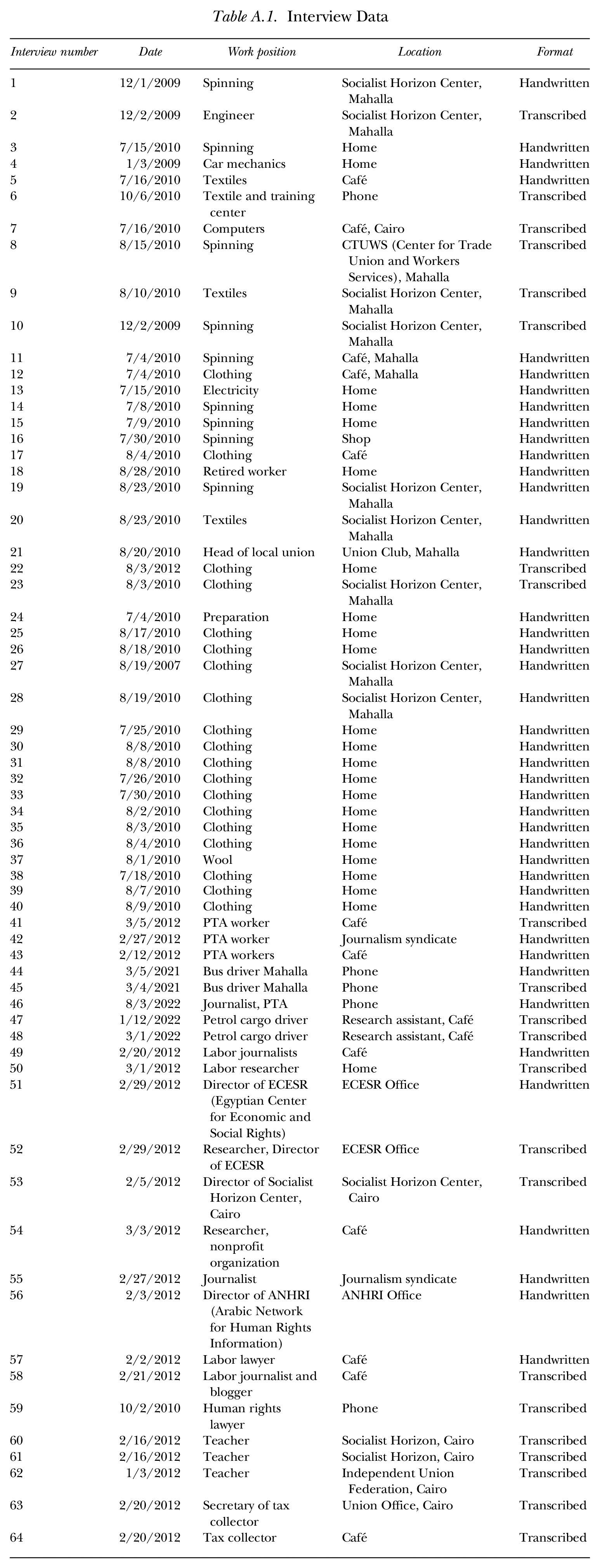
| Interview number | Date | Work position | Location | Format |
|---|---|---|---|---|
| 1 | 12/1/2009 | Spinning | Socialist Horizon Center, Mahalla | Handwritten |
| 2 | 12/2/2009 | Engineer | Socialist Horizon Center, Mahalla | Transcribed |
| 3 | 7/15/2010 | Spinning | Home | Handwritten |
| 4 | 1/3/2009 | Car mechanics | Home | Handwritten |
| 5 | 7/16/2010 | Textiles | Café | Handwritten |
| 6 | 10/6/2010 | Textile and training center | Phone | Transcribed |
| 7 | 7/16/2010 | Computers | Café, Cairo | Transcribed |
| 8 | 8/15/2010 | Spinning | CTUWS (Center for Trade Union and Workers Services), Mahalla | Transcribed |
| 9 | 8/10/2010 | Textiles | Socialist Horizon Center, Mahalla | Transcribed |
| 10 | 12/2/2009 | Spinning | Socialist Horizon Center, Mahalla | Transcribed |
| 11 | 7/4/2010 | Spinning | Café, Mahalla | Handwritten |
| 12 | 7/4/2010 | Clothing | Café, Mahalla | Handwritten |
| 13 | 7/15/2010 | Electricity | Home | Handwritten |
| 14 | 7/8/2010 | Spinning | Home | Handwritten |
| 15 | 7/9/2010 | Spinning | Home | Handwritten |
| 16 | 7/30/2010 | Spinning | Shop | Handwritten |
| 17 | 8/4/2010 | Clothing | Café | Handwritten |
| 18 | 8/28/2010 | Retired worker | Home | Handwritten |
| 19 | 8/23/2010 | Spinning | Socialist Horizon Center, Mahalla | Handwritten |
| 20 | 8/23/2010 | Textiles | Socialist Horizon Center, Mahalla | Handwritten |
| 21 | 8/20/2010 | Head of local union | Union Club, Mahalla | Handwritten |
| 22 | 8/3/2012 | Clothing | Home | Transcribed |
| 23 | 8/3/2010 | Clothing | Socialist Horizon Center, Mahalla | Transcribed |
| 24 | 7/4/2010 | Preparation | Home | Handwritten |
| 25 | 8/17/2010 | Clothing | Home | Handwritten |
| 26 | 8/18/2010 | Clothing | Home | Handwritten |
| 27 | 8/19/2007 | Clothing | Socialist Horizon Center, Mahalla | Handwritten |
| 28 | 8/19/2010 | Clothing | Socialist Horizon Center, Mahalla | Handwritten |
| 29 | 7/25/2010 | Clothing | Home | Handwritten |
| 30 | 8/8/2010 | Clothing | Home | Handwritten |
| 31 | 8/8/2010 | Clothing | Home | Handwritten |
| 32 | 7/26/2010 | Clothing | Home | Handwritten |
| 33 | 7/30/2010 | Clothing | Home | Handwritten |
| 34 | 8/2/2010 | Clothing | Home | Handwritten |
| 35 | 8/3/2010 | Clothing | Home | Handwritten |
| 36 | 8/4/2010 | Clothing | Home | Handwritten |
| 37 | 8/1/2010 | Wool | Home | Handwritten |
| 38 | 7/18/2010 | Clothing | Home | Handwritten |
| 39 | 8/7/2010 | Clothing | Home | Handwritten |
| 40 | 8/9/2010 | Clothing | Home | Handwritten |
| 41 | 3/5/2012 | PTA worker | Café | Transcribed |
| 42 | 2/27/2012 | PTA worker | Journalism syndicate | Handwritten |
| 43 | 2/12/2012 | PTA workers | Café | Handwritten |
| 44 | 3/5/2021 | Bus driver Mahalla | Phone | Handwritten |
| 45 | 3/4/2021 | Bus driver Mahalla | Phone | Transcribed |
| 46 | 8/3/2022 | Journalist, PTA | Phone | Handwritten |
| 47 | 1/12/2022 | Petrol cargo driver | Research assistant, Café | Transcribed |
| 48 | 3/1/2022 | Petrol cargo driver | Research assistant, Café | Transcribed |
| 49 | 2/20/2012 | Labor journalists | Café | Handwritten |
| 50 | 3/1/2012 | Labor researcher | Home | Transcribed |
| 51 | 2/29/2012 | Director of ECESR (Egyptian Center for Economic and Social Rights) | ECESR Office | Handwritten |
| 52 | 2/29/2012 | Researcher, Director of ECESR | ECESR Office | Transcribed |
| 53 | 2/5/2012 | Director of Socialist Horizon Center, Cairo | Socialist Horizon Center, Cairo | Transcribed |
| 54 | 3/3/2012 | Researcher, nonprofit organization | Café | Handwritten |
| 55 | 2/27/2012 | Journalist | Journalism syndicate | Handwritten |
| 56 | 2/3/2012 | Director of ANHRI (Arabic Network for Human Rights Information) | ANHRI Office | Handwritten |
| 57 | 2/2/2012 | Labor lawyer | Café | Handwritten |
| 58 | 2/21/2012 | Labor journalist and blogger | Café | Transcribed |
| 59 | 10/2/2010 | Human rights lawyer | Phone | Transcribed |
| 60 | 2/16/2012 | Teacher | Socialist Horizon, Cairo | Transcribed |
| 61 | 2/16/2012 | Teacher | Socialist Horizon, Cairo | Transcribed |
| 62 | 1/3/2012 | Teacher | Independent Union Federation, Cairo | Transcribed |
| 63 | 2/20/2012 | Secretary of tax collector | Union Office, Cairo | Transcribed |
| 64 | 2/20/2012 | Tax collector | Café | Transcribed |

This article is part of an ILR Review Special Issue on Labor Transformation and Regime Transition: Lessons from the Middle East and North Africa.
Funding for this research was provided by the Social Science Research Council.
For information regarding the data and/or computer programs used for this study, please address correspondence to