




Abstract
How do digitally enabled movements of workers reshape, replace, or reinforce the role of unions? Based on a comparative case study of the 2018 #RedForEd teachers’ strikes in West Virginia, Oklahoma, and Arizona, this article argues that despite the hierarchical and bureaucratic character of statewide teachers’ unions, the infrastructure they provided to organize, connect, and legitimize teachers’ actions was critical for statewide strikes. Facebook provided a forum for teachers to express frustrations, scale participation, and in some cases, organize actions. However, the unions’ coordinating capacities were also central. These findings show how combining the mobilizing capacities of social media with existing movement infrastructure can facilitate collective action. In contrast to predictions of digitally enabled activism ushering in an era of “organizing without organizations,” these findings suggest that 21st-century labor movements must meld old and new organizational forms, and not discard the century-and-a-half accumulation of labor infrastructure won by previous generations.
In February 2018, West Virginia took the country by surprise when educators in all 55 counties refused to teach until they received a meaningful raise and more health care funding. Following this nine-day strike, walkouts 1 ranging from one to nine days took place in five other states: Oklahoma, Arizona, Colorado, Kentucky, and North Carolina. The states with the three longest strikes, West Virginia, Oklahoma, and Arizona, had daily rallies with more than twenty thousand, forty thousand, and seventy thousand people participating—drawing bigger crowds than the teacher population itself. The similarity in outcomes is noteworthy, given the very different labor histories and levels of teacher union density in these three states. Facebook is a major focus of the small body of literature that has emerged analyzing this strike wave, as it allowed tens of thousands of teachers to express their anger and coordinate collective actions. Credit for the strikes is often given to the teachers who started these Facebook groups. While some authors also discuss the importance of the unions (e.g., Blanc 2019), others downplay the role of the unions, noting their top-down structure, hesitancy to strike, and “business model” tactics (e.g., Dyke and Muckian Bates 2019). Notably, none of these accounts theorize the role statewide teachers’ unions and local union associations played in the 2018 strike wave.
How did digitally enabled movements of teachers expressing frustrations about their working conditions interact with their relatively weak teachers’ unions to organize successful strikes? This question is critical to the labor relations field, as scholars have noted that teacher militancy is never consistent, but rather, has emerged in fits and starts throughout the 20th century, in the United States and globally (e.g., Thornton 1982). Furthermore, in the US context, the June 2018 Janus v. AFSCME Supreme Court ruling that public-sector union dues for non-members are a violation of the First Amendment has increased the stakes of understanding strategies for public-sector union revitalization. Drawing on a comparative study of West Virginia, Oklahoma, and Arizona, I argue that the infrastructure unions provided to organize, connect, and legitimize teachers’ actions was critical for strike coordination. The energy of teachers, invigorated through Facebook, fed into this infrastructure—school-site union meetings, regional gatherings, strike votes—and gave this infrastructure life. Following Zeynep Tufekci, in this article I refer to Facebook activism as a “networked movement,” or the “reconfiguration of movements and publics through the incorporation of digital technologies and connectivity” (Tufekci 2017: xxiii). In all three cases explored in this article, the role of union infrastructure was similar, regardless of union leaders’ hostile, neutral, or supportive attitude toward social media activists. Furthermore, both horizonal and vertical social media networks required the coordinating capacities of the union to facilitate statewide strikes. My findings highlight the continued importance of working-class infrastructure for collective action, even in the digital era.
Social Media, Organizations, and Collective Action
As noted above, the question of whether highly structured organizations have the capacity to spark collective action predates the digital era. Skepticism about organizations’ capacity to facilitate protest traces back to Robert Michels’s (1915)“iron law of oligarchy” and Max Weber’s (1930)“iron cage,” which argue that organizational development leads to conservatism. Mayer Zald and Roberta Ash (1966) critiqued this “Weber-Michels thesis,” claiming that movements undergo distinct changes based on their environment. By the late 1970s, many other scholars defended the importance of organizations in movement emergence (e.g., Jenkins and Perrow 1977; Tilly 1978). Frances Fox Piven and Richard Cloward (1977) brought this debate to the forefront again, arguing that disruptive protest is more effective than formal organizations, which most often inhibit social change. This debate continued for the next two decades (e.g., Gamson and Schmeidler 1984; Piven and Cloward 1991). By the early 2000s, however, while some researchers continued to decry organization, most social movement scholars accepted the importance of both “intentional and appropriable social organization” (Edwards and McCarthy 2004: 127) in movement emergence.
The explosion of information communication technologies (ICTs) in the early 2000s reinvigorated the debate on organizations and collective action. Clay Shirky (2008), for example, suggested that ICTs effectively eliminate the need for formal management, creating an era of “organizing without organizations.” Other scholars made more nuanced, albeit similar, arguments about how technologies overcome the free-rider logic of collective action (Bimber, Flanagin, and Stohl 2005), reduce costs for participation or need for physical togetherness (Earl and Kimport 2011: 15), and make individual actions more important than organizations (Margetts, John, Hale, and Yasseri 2016: 11). Another body of literature has looked at the relationship between digital technologies and mass protests such as the Arab Spring, Spanish Indignados, and Occupy Wall Street. Manuel Castells (2015) referred to these protests as “networked movements,” spontaneous and leaderless and emerging from digital networks not mediated by political organizations. Lance Bennett and Alexandra Segerberg (2012) claimed that the logic of these mobilizations has changed from collective action to “connective action.”
Scholars offer three main critiques of this digitally enabled–spontaneous protest perspective. One set of critics refutes digital media as the primary catalyst of large-scale mobilizations, as well as their spontaneity and lack of leadership (e.g., Morozov 2011; Ketchley 2017). Other scholars critique the claim that we have entered a new era of “organizing without organizations” by examining the actual and often conservative effects of digital media on social movements (e.g., Schradie 2019). Finally, a third angle of critique questions the long-term sustainability of networked movements. Most prominently, while Tufekci affirmed the networked, spontaneous, and often leaderless nature of 21st-century protests, she questioned their ability to sustain momentum and facilitate difficult collective decision-making (2017: xiii).
How networked movements—defined as movements at least partially enabled through their utilization of digital technologies—can draw on previously inactive social infrastructure and give it new life has not been explored in the literature. I draw on Kenneth Andrew’s concept of movement infrastructure, defined as leadership, resources, and organization (2004: 23), to argue that networked movements can utilize pre-existing social infrastructure to facilitate collective action. An important part of social movement infrastructure are memories of previous repertoires of contention (Tilly 1978: 232). This argument aligns with Jeremy Heimans and Henry Timms’s (2019) thesis that social movements are most successful when blending “new power” strategies that emphasize participation, self-organization, and crowd wisdom with “old power” strategies that prioritize institutionalization, hierarchies, and authority. In other words, networked movements can draw on and renew relevant social infrastructure, combining, in Peter Evans’s (2010) formulation, “rhizomic” and “tree” structures.
Unions, Social Movements, and the 2018 #RedForEd Strike Wave
Labor unions have a complex and ever-changing relationship with social movements and mass protest. Zald and Ash, two of the earliest critics of the “Weber-Michels thesis,” admitted that unions are more likely than other organizations to become “becalmed” movements, because they have a base of support independent of membership sentiment (automatic membership dues); leaders with commitments to other goals (stable life, social position); and are susceptible to co-optation by other groups (1966: 338). Often unions are not even considered social movements. For example, in John McCarthy’s (1996) typology of mobilizing structures, he called unions “nonmovement” organizations.
In the labor relations literature, however, the connections between social movements and unions have become a central focus (e.g., Grote and Wagemann 2019; Li 2021). For example, although Kim Voss and Rachel Sherman (2000) argued that unions are bureaucratic organizations that often look like institutionalized interest groups, they also documented how some unions have returned to their “social movement roots” after decades of conservatism. Similarly, Lowell Turner (2009) showed how grassroots mobilization can transform seemingly stable institutions such as labor unions. Other scholars of “social movement unionism” illustrate how unions make connections with community organizations (e.g., Tattersall 2010), and why centering “common good” concerns is in unions’ own self-interest (Fiorito and Padavic 2022). Jürgen Grote and Claudius Wagemann (2019) argued that the distinction between social movements and labor unions is increasingly blurred, as social movements take up the material interests of new sections of the working class, and union federations adopt social movement repertoires and demands.
Dan Clawson (2003: 194) made an even stronger argument that labor unions should “fuse” with other social movements, “such that it is no longer clear what is a ‘labor’ issue and what is a ‘women’s’ issue or an ‘immigrant’ issue.” Clawson’s book directly addressed the tension between institutionalization and movement building, arguing that “established organizations can be a tremendous resource and can also be an obstacle; can bring hope, skills, and resources to workers in need or can discourage and try to clamp down on anything new, risky, or different” (2003: 14). Clawson offered concrete examples of how labor struggles have centered on feminism, anti-racism, and global justice. Although written in the early 2000s, the questions he poses about how to merge US workers’ rights struggles with racial and social justice movements are as important as ever in the wake of #MeToo, Stand with Standing Rock, and the movement for Black Lives. For teachers’ unions, this question is particularly acute, as these predominantly women and most often white workers are directly situated within diverse communities. Contemporary innovations in what is commonly referred to as “social justice teacher unionism” have included the Chicago Teachers Union’s 2012 strike for the Schools that Chicago Students Deserve, Bargaining for the Collective Good, and more recently, union-inspired curriculum to make Black Lives Matter at School (for a summary of these and other intiatives, see Givan and Lang 2020; Charney, Hagopian, and Peterson 2021).
Building on this literature, I examine how social media–enabled movements can help reinvigorate the labor movement, if and when they become a means to increase participation in established union infrastructure. In examining these relationships between official/institutionalized and unofficial/community-based/networked forms of labor activism, this article takes up the call for a more relational analysis that views “the labor movement as a fluid and multidimensional social formation that is produced and reproduced relationally, along the continuum between direct action and institutionalized power, between democracy and bureaucracy” (Fantasia and Stepan-Norris 2008: 557). From this perspective, it is important not to study the labor movement as a “bounded thing in itself” (p. 557) but rather to analyze how interactions between movements and unions shape the trajectory of workers’ rights struggles.
How has scholarship on the 2018 #RedForEd teachers’ strikes analyzed the relationship between networked teacher activists, the bureaucratic and arguable hierarchal state unions, and the broader community? Eric Blanc (2019: 104) provided the most comprehensive account of the West Virginia, Oklahoma, and Arizona strikes, highlighting the teachers he referred to as “militant minorities”: “individuals with a class struggle orientation, significant organizing experience, and a willingness to act independently of (and, if necessary, against) the top union officialdom.” And although the union is not the central focus of his account, Blanc references their strategic role throughout his analysis (e.g., 2019: 204). Blanc also drew on divergent strike outcomes in West Virginia and Arizona on the one hand, and Oklahoma on the other hand, to argue that “a big part of what made West Virginia’s and Arizona’s strikes so successful was their use of social media to promote buildup actions, workplace organization, and collaboration with the union” (Blanc 2020: 95, emphasis mine; see also 2021a).
In much of the literature on the 2018 teachers’ strike wave, however, the focus is on constructing a separation between the rank-and-file teachers and the union. For example, Tithi Bhattacharya wrote that in West Virginia when “business-model” unions “failed to ‘deliver,’ that’s when a leap in consciousness and struggle was made with strikers defying their union” (cited in Webber 2018: 129–30). Noah Karvelis (2019a), one of the social media activists in Arizona, argued that Arizona Educators United (AEU), a networked movement, had strategic power because it existed outside the established boundaries of union power with no defined leadership or political affiliations. Lois Weiner contrasted the democratic decision-making on teachers’ Facebook pages to the “secretive functioning of officers and staff of the state unions” (cited in Webber 2018: 132). Finally, Erin Dyke and Brendan Muckian-Bates (2019) critiqued KY 120 United, an independent group of educators, for joining with their union and moving toward lobbying efforts rather than contentious politics.
The overarching theme in this literature on the 2018 #RedForEd strike wave is the agency of rank-and-file teachers, who against all odds organized statewide strikes. The union is at best insignificant and at worst vilified as defending “business model” tactics. In this article, I take a divergent approach by explicitly theorizing the role of union infrastructure in the 2018 teachers’ strike wave and how this infrastructure channeled networked protest. In doing so, I contribute to the ongoing debate about the role of previously existing social infrastructure on collective action in the digital era and to a more relational analysis of the labor movement that takes seriously the interplay between official and unofficial labor activism.
Cases and Research Methods
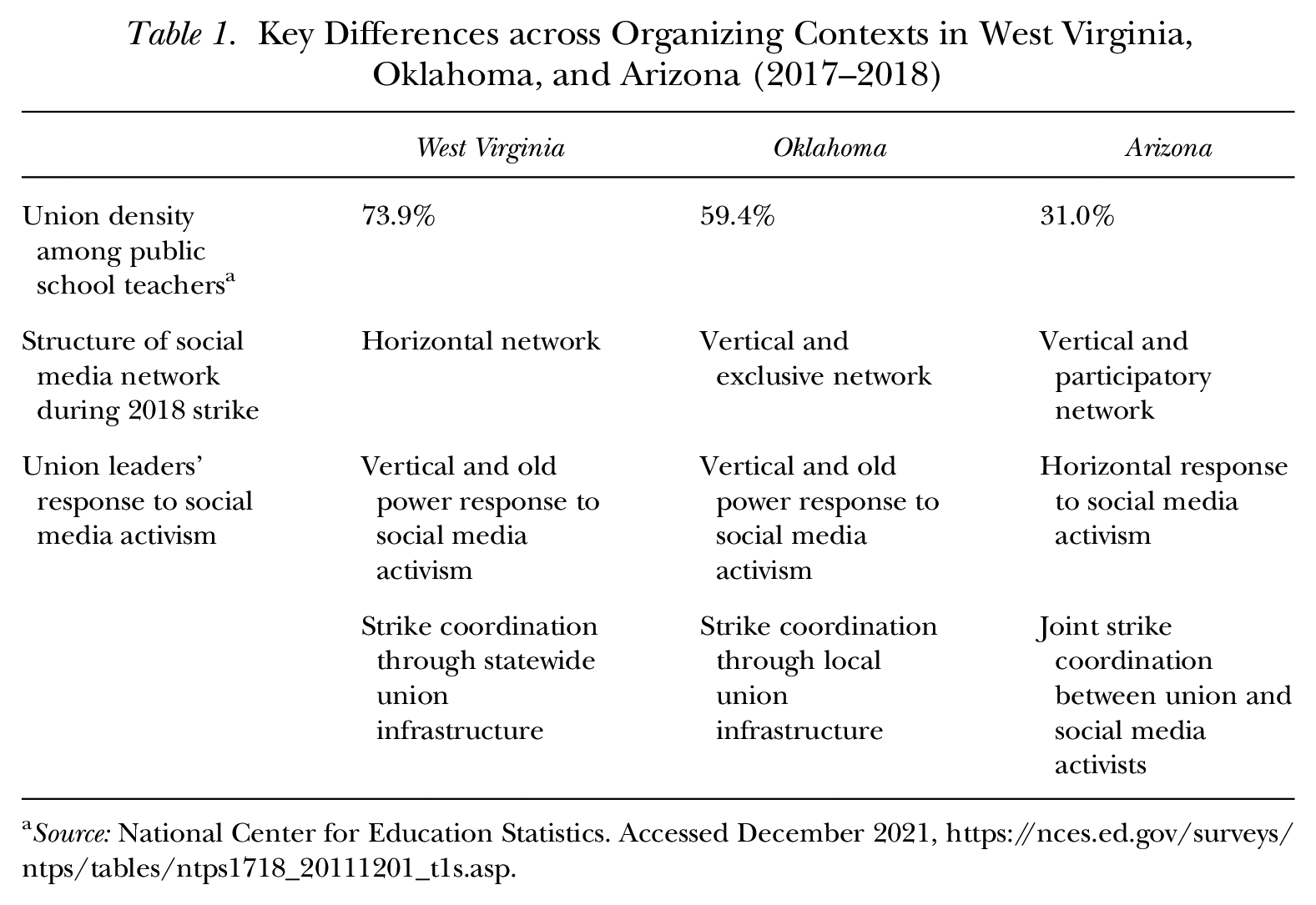
My research focuses on West Virginia, Oklahoma, and Arizona, the three states with the most similar strike outcomes during the 2018 strike wave. In contrast to Blanc’s (2019, 2021a) analyses of divergence—how the strikes in Oklahoma and Arizona resulted in different subjective and objective outcomes (feelings of success, gains won)—I am theorizing a story of convergence across diverse cases. Robert Yin refers to this as literal replication, or cases chosen because of their similar results, or “exemplary outcomes in relation to some evaluation question” (2018: 59). My goal is to document the interactions between two independent variables—union infrastructure and Facebook activism—not to determine the exact combination of variables that will lead in all cases and contexts to a strike. This latter objective would require a less thorough comparison that includes all six states with strikes in 2018 and the many states with no strikes at all. By contrast, an in-depth and ethnographic comparison of West Virginia, Oklahoma, and Arizona offers unique insights into organizing processes, or the interactions between the independent variables that eventually lead to similar outcomes. This story of convergence is particularly powerful in light of three contrasts across the cases: 1) the different levels of teacher union density; 2) the distinct structures of the Facebook networks; and 3) the divergent reactions of union leaders to social media activism. These differences are summarized in Table 1.
Key Differences across Organizing Contexts in West Virginia, Oklahoma, and Arizona (2017–2018)
Source: National Center for Education Statistics. Accessed December 2021, https://nces.ed.gov/surveys/ntps/tables/ntps1718_20111201_t1s.asp.
In terms of the legal context for teacher organizing, the challenges that West Virginia, Oklahoma, and Arizona teachers face are relatively similar. In all three states, teachers’ unions have never had the legal right to charge agency fees, which means that these unions were already facing the financial constraints that all public-sector unions began to face after the June 2018 Janus v. AFSCME Supreme Court ruling. Collective bargaining for teachers is also limited, and where it is most common, in Oklahoma, school districts are not legally bound by agreements. Consequently, union advocacy is generally focused on state legislatures not school districts. Teachers’ strikes are illegal in all three states. I argue that teachers were able to overcome these challenges only by combining networked protests with existing union infrastructure to coordinate collective action.
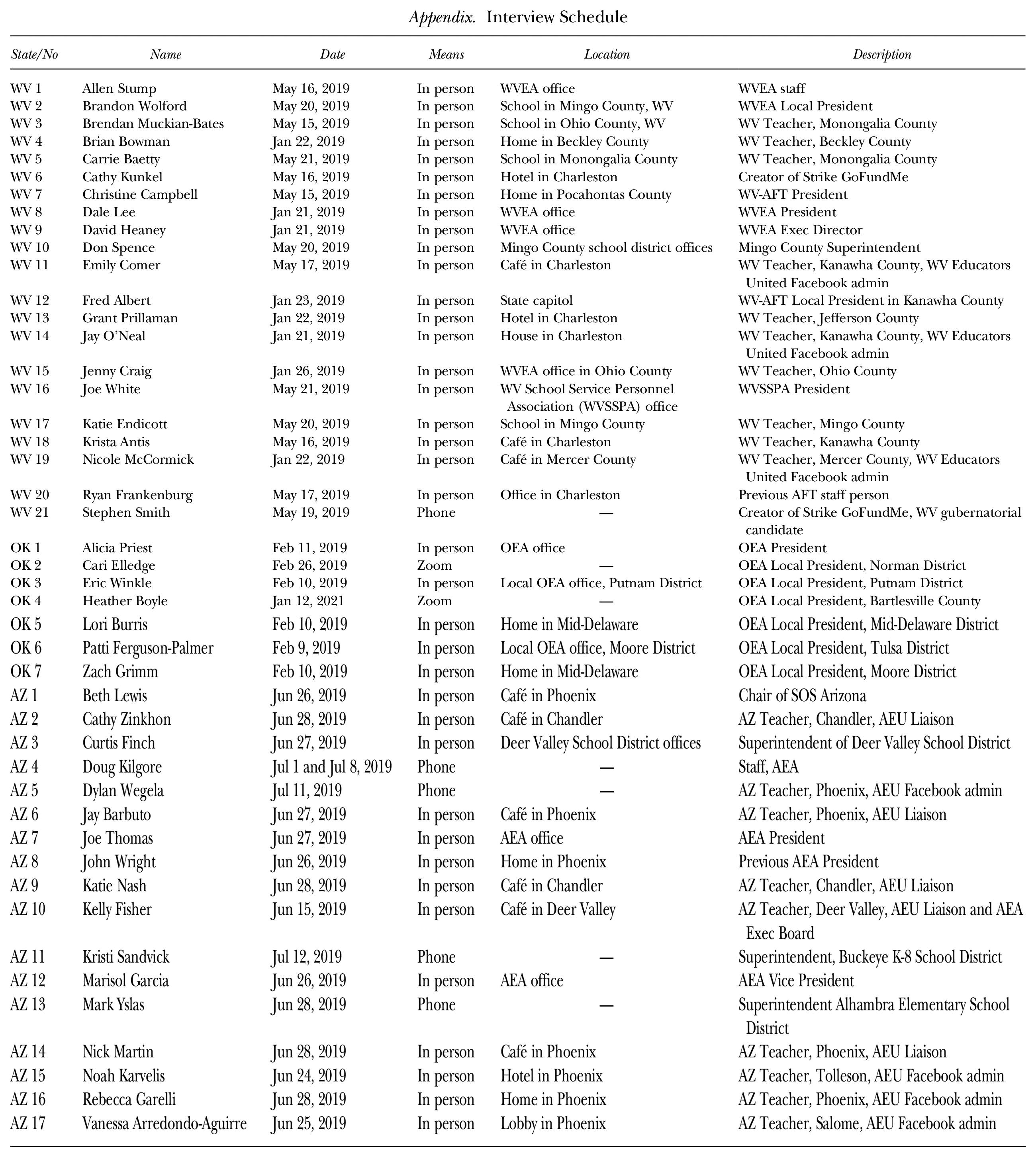
For data collection, I visited West Virginia three times, July 2018 and February and May 2019, and observed meetings of teachers discussing their strike. I also interviewed 21 people, including teacher activists, union leaders, administrators, and community leaders. In February 2019, I spent a week in Oklahoma and participated in a meeting of 60 teachers reflecting on their strike. I interviewed seven key Oklahoma union leaders. In June 2019, I participated in a series of reflection circles with Arizona strike leaders, and I interviewed 17 of the key actors involved in the strike (see Appendix for the full schedule of interviews). I chose my participants through a snowball methodology, beginning with the most well-known union leaders and social media activists and then identifying through those initial interviews and participant observations other key actors who could speak to the relationship between rank-and-file teachers and the union leadership. I also drew on news articles and social media posts. I analyzed data by process tracing and triangulating sources to piece together the events that led to statewide strikes. Of note, almost all of the central actors in the lead-up to the three strikes, including union representatives and social media activists, were white and more economically secure than the general population; however, the issues teachers organized around were widely supported as broad community concerns.
West Virginia: Divisions between Union Leaders and Social Media Activists
Union: Historical Memory and Repertoires of Contention
The West Virginia teacher union movement includes two equally important actors, the West Virginia Education Association (WVEA) and the American Federation of Teachers West Virginia (AFT-WV), which in 2017–2018 represented, respectively, approximately 8,250 and 9,550 workers 2 for a total 73.9% union density among teachers. West Virginia also has a long history of labor militancy in other sectors. Teachers’ unions, however, have been largely separated from this tradition. Nonetheless, in 1990, the WVEA and AFT-WV came together to organize a nine-day strike with 27 of 55 counties participating, winning many of their demands. Everyone I talked to in West Virginia discussed the importance of the legacy of the 1990 strike for catalyzing teachers’ collective actions in 2018. The formal union institution was the carrier of the memory of this important repertoire of contention among teachers. The story of the 2018 West Virginia strike, however, did not begin with the statewide teachers’ unions; it began with rank-and-file teachers inspired by this previous strike and “agitating” colleagues to take action. 3
Social Media: Scaling Anger through a Horizontal Network
The two most central “agitators” in West Virginia were Jay O’Neal and Emily Comer. Jay grew up in a conservative Evangelical family in Amarillo, Texas, but his politics shifted left after living abroad and reading works by Noam Chomsky. Jay became a teacher in West Virginia in 2015 and joined the WVEA, hoping to find like-minded colleagues. He quickly became “a very frustrated union member.” Emily grew up in West Virginia in a liberal family. In graduate school, she became involved in organizing for tenant rights and against wage theft. After Emily started teaching in 2015, she joined the AFT-WV but never thought about her union. In the summer of 2017, Emily joined the Democratic Socialists of America (DSA) and met Jay, who had joined the group earlier that year. Jay said, “Teachers felt like a possible group to radicalize. . . . The conditions are terrible and teachers had a strike before.”
After trying other approaches to organizing their colleagues, Jay created a Facebook group on October 1, 2017, originally calling it West Virginia Teachers United. He remembered, “I was just spinning my wheels. I know there’s gotta be more of us across the state. Can we just talk, work across unions to do something?” For weeks, Jay posted on the Facebook group, trying to generate discussion. “I’d post an article and it was just like, boop. Nothing.” Later that fall, however, major changes were announced to the WV Public Employees Insurance Agency (PEIA), the health insurance for all public employees in the state. Changes to PEIA occurred every year; however, this year, Jay and Emily used them as an organizing opportunity. At a PEIA hearing in Charleston, Emily and Jay asked people to sign up for a mailing list they called “PEIA Action.” That night, Jay and Emily emailed everyone to join the Facebook group. Emily remembered, “We added a bunch of people to the [Facebook] group that way.”
In mid-November, Jay decided to change the name of the Facebook group to WV Public Employees United, to be more inclusive about who in the community was being affected by the “public health crisis.” Right around this time, Jay also helped his assistant principal organize a town hall about public education, with local union officials invited to participate. Jay created a Facebook event, which received 71 responses, a major increase in interest from the previous month. Jay and Emily live-streamed the event and 200 people viewed the video. Then, at a PEIA legislative hearing in early December, they tried to live-stream again, but the head of the committee said it was not allowed. Emily confronted the legislator, filming him in a tactic called “bird dogging” that she had learned through her previous activism. The 47-second video was shared more than 350 times on Facebook.
By this time, some union leaders also began paying attention to the Facebook group. In December, the WVEA executive director asked Jay to the office and questioned him about why he was organizing outside of the union. Jay said he wanted to unite all the teachers in the state, not only WVEA members, who represented less than half. This meeting was the last time the union officials reached out to Jay. Meanwhile, the Facebook group was getting more attention. On December 10, Jay posted: “WE NEED YOUR HELP! . . . Could you please ADD anyone you know who is a public employee (or on PEIA) to the group? If everyone added 1-2 people, we would have over 1,000 members.” At that point, on December 10, the group had 378 members. By December 17, the Facebook group had 1,224 members. On January 9, Jay posted a comment on his original post, “We are now over 2,000! That's amazing! Keep it up—let's shoot for 3,000!” The Facebook group was beginning to create a horizontal and statewide communication network, and some teachers were already using that network to discuss the possibility of a strike.
This “strike talk” influenced the elected union leadership. On January 15, a modest crowd of 200 people showed up for the WVEA’s lobbying day. To Jay and Emily’s surprise, WVEA President Dale Lee mentioned a “strike” in his speech. “I’ve heard people talk about ‘It’s time for a walkout or time for a strike.’ But those are not the first steps in that decision. . . . If we were to get back to that, there’s a lot of groundwork that needs to be laid beforehand” (McElhinny 2018). In this statement, Dale was clearly referencing the Facebook group in which teachers were actively discussing a strike. Even as Dale attempted to slow this momentum, by discussing a strike in his capacity as an elected union leader, he gave the idea more legitimacy.
After this event, the Facebook group started to grow exponentially, with 11,000 members by the end of the week, 18,000 the following week, and more than 22,000 by the beginning of February (see Figure 1). This explosion of activity took place because Facebook was situated as a horizontal statewide communication hub when the cuts in teachers’ health care were announced. Although this was a traditional “bread-and-butter” union issue, teachers’ concerns garnered broad support because the issue was framed as something that was harmful to the entire community. Facebook enabled teachers to share stories about how health care changes were personally affecting them and their families. For example, in one viral post at the end of January, a teacher announced that he had less than $3 in his bank account. This led to hundreds of teachers posting screenshots of their bank accounts. Jay said, “[Teachers] got their letter from PEIA and go ‘This is how much my premium is going to be?’ . . . They were making their own videos and showing people [the new premiums]. . . . It [Facebook] just explodes.”
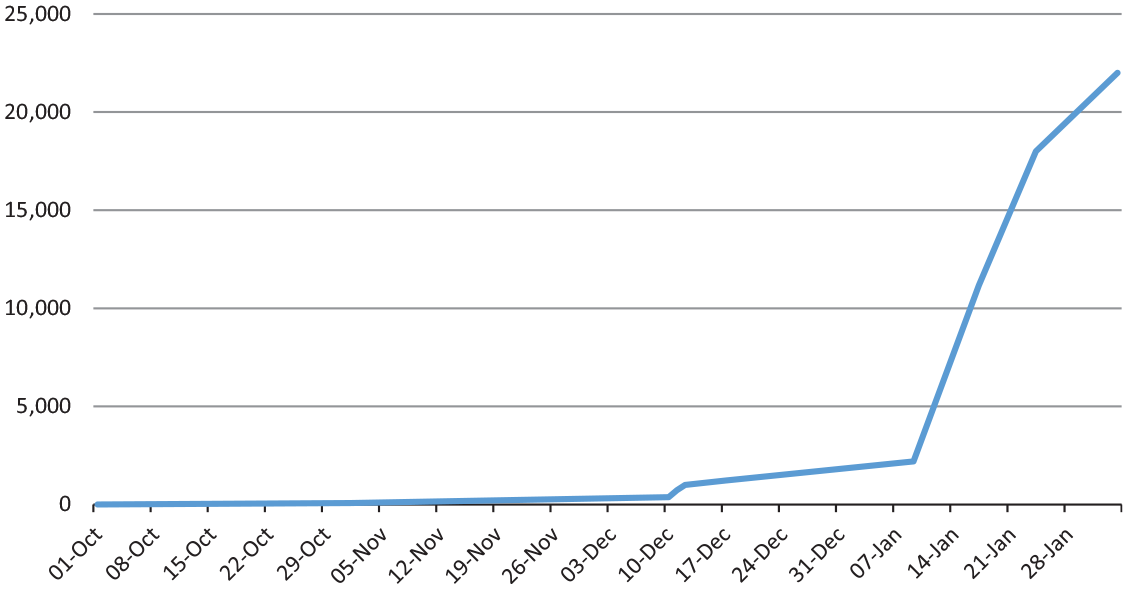
Growth in WV Public Employees United Facebook Group
Union: A Vertical and Old Power Response
How were the union officials reacting to this incredible surge of teacher activism? AFT-WV President Christine Campbell agreed that Facebook played a major role pushing forward the idea of a strike. She lamented, however, that teachers prioritized the information they learned from social media over union communications: “I monitored that thing [Facebook] constantly to gauge the difference in . . . our communication and what people were saying.” Christine said the Facebook group was “like a hurricane of information. It’s just blowing in all these different directions, like a cyclone.” WVEA President Dale Lee, for his part, minimized the role of Facebook. “They get a lot of play for it. . . . But it was a preparation.” Dale said the WVEA had been educating members on the loss of public education funding for the previous five years, building up to what they knew would be a big action. Dale never mentioned Jay’s name, even though he knew Jay was a WVEA member and the moderator of the Facebook group. Instead, Dale said that the Facebook group was controlled by “socialist bots.” Clearly, Dale had a deep distrust of the Facebook group. Although Christine was less antagonistic, at no point did either union leader reach out to work directly with the social media activists. This response epitomizes what Heimans and Timms (2019: 11) referred to as “old power values” that prioritize exclusivity, authority, specialization, and representational governance over radical transparency and crowd wisdom. These union responses contrasted with the social media activists themselves, who consciously channeled people’s energy into the union.
Strike Coordination through Statewide Union Infrastructure
The strike did not begin, however, at the epicenter of Facebook organizing in Charleston, but rather, in Mingo County, which is geographically rooted in a long history of labor activism. The event that sparked the strike mobilization was the January 15 union rally that elementary school teacher Justin Endicott attended. Justin was part of the WV Public Employees United Facebook group. The day of the rally he published a post expressing frustration with the turnout. Then, he created a 33-minute Facebook Live video, “Call to all teachers and communities,” about his experience in Charleston, saying that teachers needed to unite. The number of viewers went from 3 to 205 during the live-stream, eventually receiving 29,000 views. As West Virginia teacher and Justin’s sister, Katie Endicott, exclaimed, “It went West Virginia viral.”
This Facebook activism launched a series of intensive organizing efforts in Mingo County. As WVEA staff representative Allen Stump remembered, “Everybody was upset, but Mingo County, they were fighting mad.” However, rather than organize a meeting independent from the unions, the outlet for teachers’ anger became the unions themselves and their established repertoires of contention. First, the WVEA president in Mingo County set up a public meeting for all Mingo County teachers in coordination with the AFT-WV local president. These county-level leaders had ties to school representatives throughout the county. As Katie explained, “We were all part of the WVEA or the AFT. . . . I was the school rep at Mingo Central. That’s how we organized. We had a group chat with every building rep in it.” Union leaders had the organizational structure to convene a county-wide teacher meeting. Although this movement infrastructure had been inactive, social media activism pushed it into action.
This joint meeting of the WVEA and the AFT, an unprecedented example of union collaboration, took place on Tuesday, January 23. Allen attended the meeting with more than 150 teachers. Everyone immediately started talking about striking. Allen tried to stick to his talking points, but a woman stood up and shouted: “I can tell you all one thing. You all can either get behind us on this or we’re going run your ass over.” Allen said that after that comment, he just asked everyone what they wanted to do: “They wanted to strike. So we all just started kicking ideas around.” The teachers agreed to a one-day walkout. Although this initiative did not come from Allen, as a WVEA staff person he felt responsible for helping to coordinate. Two days after the Mingo County meeting, Allen helped organize a joint WVEA–AFT meeting in Wyoming County, with more than 200 people. In Logan County, 275 people showed up. Allen said, “Every meeting got bigger and bigger. People were getting more angry.” Although Allen did not create this anger, he helped coordinate the teachers’ collective decision about taking a high-risk action. Examples of support included establishing agendas, facilitating discussions, sharing information, planning next steps, and calling for votes. Eventually, teachers in four counties voted to authorize a series of rolling walkouts, the first on February 2.
The February 2 walkout inspired emergency meetings in other union locals across the state. Jenny Craig, for example, remembered that after the walkout the question of striking became much more real for teachers in northeastern Ohio County. “That was a big turning point. We needed to get our shit together.” Their local president was hesitant, so Jenny worked with a union staff representative to organize a meeting at which they found out most teachers wanted to strike. Nicole McCormick, an elected leader in Mercer County and administrator of the Facebook page, helped organize a similar meeting that filled the gym of the high school. Approximately 80% of teachers rose their hands to walk out the next day if needed. The union’s infrastructure—meeting spaces, lists of teachers, local union leaders—enabled teachers’ capacity to act.
Eventually, the statewide unions decided that they needed, in Dale Lee’s words, “to get in front of this.” Christine described this moment: “All these mass meetings are happening. More people are saying we want to vote, we’re going to vote. And saying [to us], ‘Stop trying to educate us on it.’ They saw it as stifling them.” The AFT-WV and WVEA decided to organize a strike authorization vote in every county. As this voting took place, the union leaders called for a statewide meeting on February 11; there, local union presidents from all 55 counties announced their vote tallies. Christine said this type of joint meeting “had never been done.” But the two unions had the infrastructure to organize it. At the meeting, all 55 counties wanted to strike. The unions now had the legitimacy to call for a statewide strike, despite teachers’ strikes being illegal.
Social Media: Scaling Participation Not Coordination
What was the role of social media at this point? The Facebook group continued to aid in sharing information and scaling participation; however, Emily and Jay were no longer in charge. Emily said, “As we get closer to the date of the actual strike, it all becomes less and less in our hands. And it gets more and more turned over to the official union structure.” Similarly, Jay said, “Having that union structure in every county was helpful because it was an easy way to get that stuff out and especially for that state-wide vote. I don’t think we would have been able to do it . . . we really didn’t have much organization at all.” Although Facebook continued to generate the energy and broad community support necessary for a strike, the coordination happened through the union. During the strike itself, staff from the NEA and AFT also flew to West Virginia to help. Jay admitted that a strike without the unions’ infrastructure would have been impossible; Facebook was a horizontal communication hub, facilitating teachers’ capacity to call publicly for a strike, however, to organize a strike, infrastructure for hundreds of tough conversations and processes for democratic decision-making were needed.
Oklahoma: Local Union Presidents Lead the Way
Union: Historical Memory and Repertoires of Contention
In Oklahoma, the main teachers’ union is the Oklahoma Educators Association (OEA), which in 2017–2018 represented approximately 16,400 members—or the vast majority of unionized teachers—in comparison to the American Federation of Teachers Oklahoma, which represented 2,000 members. Together, the two organizations reflect a 59.4% teacher union density in the state. Although Oklahoma has a radical organizing tradition, the state turned increasingly conservative after World War II. The last time the OEA organized a strike was in 1990, when OEA called for a walkout to support education funding. As in West Virginia, this legacy still loomed large for Oklahoma educators. As Patti Ferguson-Palmer, president of the OEA local in Tulsa, said about the 1990 strike, “People look back on it very fondly. It was short but teachers say, ‘Oh we did this great thing.’”
Unlike the case in West Virginia, however, the idea for a “major job action” in 2017–2018 did not begin with social media activists; it began within the infrastructure of the union. Faced with more students and less funding every year, the OEA local in Bartlesville, a small county in northern Oklahoma, began to act. Heather Boyle, local union president from 2014 to 2018, was trying to organize teachers in her local to lobby their legislators. In July 2016, the new Bartlesville superintendent, Chuck McCauley, became an ally to Heather’s cause, allowing teachers to take personal days to go to the state capitol. Although superintendents and union leaders are often in conflict, in Oklahoma the financial situation and the reframing of educational defunding as a community-wide crisis led them to find a common cause. Despite these efforts, the legislature did not increase education funding during the 2017 session. Disappointed, Heather said, “We had our first serious conversation about a potential . . . I don’t even know what we called it. I think we called it a work action.” In September 2017, Chuck drafted a letter to all superintendents in the state, letting them know Bartlesville’s plan “to hold the legislature responsible that year.” Heather even began to do research on the 1990 walkout: “By October, November, Chuck and I were saying, ‘There will be another teacher walkout. We have to figure out how to do this.’”
What was the OEA leadership’s response to this local organizing? Heather said, “I got the impression that they were like, ‘What is this random local in Northern Oklahoma doing?’” Nonetheless, Bartlesville influenced the statewide association. When I talked to OEA President Alicia Priest, she described 2017 as a turning point: “We were not getting any additional funding and there’s more unrest . . . teachers are verbalizing that they’re willing to do more and to do things differently.” The OEA had multiple rallies, some with thousands of teachers. However, they were not yet talking about a “walkout.” As Alicia said, “We used job action, work action, those kinds of terms.” Eric Winkle, president of the OEA local in Putnam City, confirmed OEA was discussing a big action in early 2018: “They were saying maybe one-day rallies weren’t working. Maybe it’s time to go to the capitol and stay at the capitol.”
The breaking point was on February 12, 2018, when the OEA state leaders organized a rally to support the only education funding bill that year, which was defeated. Exasperated once again, at the next OEA meeting Heather asked other local presidents if they would participate in a work stoppage. Meanwhile, Chuck wrote another letter asking superintendents to support a statewide walkout. In mid-February, third-grade teacher Teresa Danks created an online petition “Oklahoma Teacher Walkout: Fighting for Funding, Fighting for Our Children,” 4 which quickly gained thousands of signatures. On February 19, a news article, “Frustrated Teachers Consider Walkout, Shutdown for Pay Raises,” referenced both the petition and the 1990 walkout (Hertneky 2018). All of these events suggest that Oklahoma teachers had their own momentum to go on strike several weeks before West Virginia teachers. Nonetheless, in that same article, an OEA spokesperson is quoted as saying that no walkout was planned.
Social Media: Scaling Anger through a Vertical and Exclusive Network
The same week, on Thursday, February 22, West Virginia teachers went on strike. All six Oklahoma local union presidents I interviewed stressed the importance of this strike for the actions that followed. For example, Patti of Tulsa said, “West Virginia opened the door for us. . . . Everything was bubbling under the surface and West Virginia gave us permission to boil over.” However, none of the Oklahoma union leaders thought to draw on a tool that was central to the mobilizing of West Virginia teachers: Facebook. It was not until the fifth day of the West Virginia strike, February 28, that a teacher from Stillwater, Oklahoma, Alberto Morejon, created a Facebook group: “Oklahoma Teacher Walkout—The Time is Now!” The Facebook group had 18,000 people within a few hours and over the following weeks it grew to include 50,000 participants, mostly teachers (Blanc 2019: 143–44). In direct contrast to social media activists in West Virginia, however, Alberto was not in the OEA and never developed a relationship with the union. Interviewees described Alberto as an individualistic person, only allowing himself to post on the group; everyone else was restricted to commenting on Alberto’s posts. This example illustrates how the same social media platform that had created a horizontal communication network in West Virginia could be used to create a vertical and exclusive network in Oklahoma.
Nonetheless, similarly to the group in West Virginia, Alberto’s Facebook group provided a space for teachers (members and non-members of the OEA) to express their anger about the public education crisis in Oklahoma. As Eric of Putnam City explained, “This was a place for 50,000 people to spout out they were upset about education funding.” Heather, for her part, saw the Facebook group as helping local organizing. “It helped fuel the flame. . . . It created a spot to unite everybody and give us this common goal.” Heather created a Bartlesville Facebook group and organized in-person meetings for all the districts’ teachers. “We kind of put a temporary hold on ‘you have to be a union member.’” She also helped to found “Public Education Advocates for Kids, a bipartisan group of parents and community members who were also seeing the impact of the severe budget cuts and loss of teachers.” The parent group was one of the many examples of how teachers engaged the broader community in a struggle that was no longer about only themselves.
Union: A Vertical and Old Power Response
Rather than reach out to local union presidents or social media activists, the OEA state leadership responded to the Facebook activism by unilaterally calling for a walkout, which they announced for April 28. This top-down decision outraged Alberto and the tens of thousands of teachers on his Facebook group, who thought the date was too late. Alberto posted a survey on Facebook about the date; nearly 7,000 people voted for April 2, with only 250 voting for April 28 (Will 2018). Teachers’ anger also flowed into the local union infrastructure. When Heather heard the announcement she called OEA president Alicia and said, “Absolutely not. They are legally required to fund public education by April 1st. . . . We’re not giving them until April 28th.” At Heather’s request, Alicia went to Bartlesville that evening and spoke to 100 teachers. According to Heather, “By the time she left, the date had changed to April 2nd.” Alicia posted a Facebook Live video apologizing for the previous “miscommunication” and announcing April 2 as the walkout date: “Our members are ready to act now. And so, we are accelerating our strategy. . . . Today we are putting lawmakers on notice, they must work swiftly to follow the law and pass an educational budget by April 1.” 5 The OEA leadership had tried and failed to enact old power: their authority to make decisions as elected union representatives. Now there was less than three weeks to organize one of the largest labor actions in Oklahoma’s history—as a result of the pressures of social media and local organizing.
Strike Coordination through Local Union Infrastructure
At this point, as was the case in West Virginia, Facebook took a back seat, continuing to be a forum for teachers to feed off each other’s anger and excitement, but not contributing to on-the-ground organizing efforts. It was the union locals that became critical, particularly in the large urban districts where union density was highest. Although the OEA statewide association was taking actions as well, putting their money and staff toward organizing logistics, a disconnect existed between these state-level OEA efforts and teachers at the local level. As Eric of Putnam City explained, on paper there is a flow of communication between the OEA and locals. In Eric’s experience, however, statewide leaders were disconnected from locals, leading local presidents to take organizing into their own hands.
Patti of Tulsa, the largest OEA local in the state, provided a great example of how this organizing took place. After the new date of the walkout was announced, Patti waited for direction from the OEA leadership. “As a good soldier, locals, we wait and when it comes to legislative stuff, we do what OEA tells us to do. I was waiting, watching all this stuff happening on Facebook. . . . When’s OEA going to give us the plan?” Facebook served to highlight the gap between the union’s local organizing and people’s energy. Patti decided to accelerate organizing efforts in the Tulsa school district on her own. As she described, “We started planning. I got together what I called my Tulsa strike force. Just people I knew would be reliable.” Tulsa teachers organized several actions, including a “work the contract” campaign for the three weeks leading up to the strike whereby teachers worked only the hours stipulated in their contract. Through this organizing, Patti said teachers who had never been involved “found their voice.” “They started doing informational picketing. It was spontaneous. A school would say, ‘Hey, we're going to do it on this corner at this time.’” Patti said that her team was “amazing,” organizing a 110-mile march to the capitol during the strike, which received an incredible amount of support from diverse Oklahoma communities. Patti played an important role, providing financial support and connecting teachers through her union local’s infrastructure.
Social Media: Scaling Participation Not Coordination
Patti’s story matched what I heard from other OEA local presidents. During the lead-up to the strike, union locals were the sphere for organizing escalating actions, reaching out to the community, and coordinating logistics for the walkout. Facebook fueled teachers’ anger, but this anger flowed into locals, making them spaces of on-the-ground coordination. These organizing efforts clearly had an effect. On March 29, Oklahoma’s governor signed a bill that would generate $400 million to fund teacher pay raises—$6,100 on average per teacher. The OEA leadership considered cancelling the walkout; however, Alberto’s Facebook group, as well as local organizing efforts, pressured the OEA to go ahead with the plan. On Monday, April 2, tens of thousands of teachers participated in the first day of a nine-day walkout. A networked teacher movement, inspired by West Virginia and enabled by Facebook, had scaled the anger necessary for this action. The statewide teachers union, along with NEA staff, prepared the logistics for the strike itself; however, it was local union officials who drew on their relationships and the limited but important infrastructure and resources they had available to organize teachers to strike.
Arizona: A Networked Movement and a Union in a Tenuous Partnership
Social Media and Union Infrastructure: Blended Power
The best way to describe AEU and AEA was that AEA was this existing structure. We've got locals everywhere. We have officers. We have constitutions and bylaws. We've got functioning committees and we're structured. AEU was energy. —Joe Thomas, AEA President, June 2019
In 2017–2018 the Arizona Educators Association (AEA) represented approximately 17,500 members and the American Federation of Teachers Arizona had 240 members, adding up to a 31% union density among teachers in the state. The Arizona statewide walkout itself, however, included many more teachers than teacher union members and was organized through a collaborative partnership between the AEA and a new networked teacher movement, Arizona Educators United (AEU). In contrast to the situation in West Virginia and Oklahoma, AEU was not only a Facebook group but, moreover, a team of nine teachers that planned and executed direct actions through a statewide network of 2,000 “school liaisons.” In other words, Arizona represents an extreme case in terms of the organizing capacity of its Facebook-enabled teacher movement. If any networked movement could pull off a strike on its own, AEU was that group. However, AEU did not organize their six-day walkout by themselves. Rather, it was through constant collaboration with the state union that Arizona’s statewide strike took place.
Social Media: Scaling Anger through a Vertical and Participatory Network
The major catalyst for the organizing efforts in Arizona was the West Virginia strike. AEA President Joe Thomas said, “West Virginia changed the game. We had educators who didn’t want to engage, a union that couldn’t find a way to inspire them. . . . [The WV strike] spurs them to do something massive.” After the West Virginia strike, several organizing efforts unfolded. First, Joe sent out a tweet asking teachers, “Have you seen what happened in West Virginia? What do you want to do?” Noah Karvelis, a young and liberal music teacher—who was not even an AEA member at that time—responded: “I told him we wanted to go on strike cause people did, like we talked about it all the time.” Joe’s response was pragmatic: “Talking is good. The first step toward any statewide action are local actions. What can you do locally—at your site—to reveal the level of readiness for a statewide action? . . . Having everyone wear Red for Ed (a red shirt) on the same day would be a fine indicator” (Karvelis 2019b). Joe’s response surprised Noah: “I’m just talking shit on Twitter. . . . He’s like, could you just get people to wear red shirts on the same day? I was like, probably not, but we could try.”
At the same time, middle school teacher Rebecca Garelli also began to act. Rebecca had been inspired by her participation in the 2012 Chicago teachers’ strike. In 2017, she moved to Arizona, shocked at the “lack of workers’ rights.” Rebecca did not even become a member of the AEA because the union’s plug for joining was “good car insurance.” It was on the Badass Teachers Association’s (BAT) Facebook group that Rebecca saw Lois Weiner, a professor at New Jersey City University who has written extensively about teachers’ unions (e.g., Weiner 2012), post about the West Virginia strike, asking, “What state is going to be next?” Rebecca commented: “I wish it was AZ, sigh.” Jay O’Neal, the West Virginia strike leader, responded: “Why can’t it be? If we can do it you can do it!” Jay told Rebecca about the WV Public Employees United group and invited her to check it out. On Friday night, March 2, Rebecca created the Facebook group Arizona Teachers United, then went offline for the weekend. On Sunday evening, Rebecca realized that a thousand people had joined the Facebook group, and some were posting about striking. She panicked and closed the group.
Dylan Wegela, a middle school teacher in Phoenix, Derek Harris, a band teacher in Tucson, and Noah were all members of the Facebook group. Dylan and Derek were active in their AEA union locals. Noah, Dylan, and Derek were upset that the Facebook group had closed, so Noah created a new group, Arizona Educators United, with Dylan and Derek as administrators. Rebecca saw it and asked to be an admin as well. Noah solicited other volunteers and in total nine people—three white men, five white women, and one Latina woman—became administrators of Arizona Educators United (AEU), what quickly become a powerful networked teachers’ movement. The first major decision was to divide tasks. For example, Rebecca became the actions point person, due to her experience in Chicago. Noah became the media point person. Kelly Fischer, an AEA board member, became the community and union liaison. As Rebecca recounted, “It just like magically happened. There was no thought.” In contrast to both West Virginia and Oklahoma, AEU had created what would become a vertical yet participatory social media network, with a small group of activists determining strategy while also creating structures for teachers throughout the state to participate in making that strategy a reality.
The team threw their energy into publicizing their first event—the #RedForEd day Noah had committed to on Twitter, which took place on Wednesday, March 7. Thousands of teachers found out through social media and participated. Noah said, “It was nuts . . . pictures were starting to come in from other schools and I’m seeing it on Twitter and it starts to trend locally #RedForEd. It felt amazing.” The first event was a huge success and by that evening the AEU Facebook group had 20,000 people (Cano and Mendoza 2018). Notably, this was more people than the total amount of AEA members.
Joint Strike Coordination between Union and Social Media Activists
After the first #RedForEd event on March 7, the number of actions the AEU organized proliferated rapidly. The relationship between the AEU teachers and the AEA also evolved into a collaborative partnership. AEA President Joe was already connected to Noah through Twitter, so the same day as the #RedForEd event he invited the AEU activists to a meeting. Noah recalled, “They wanted to just talk about it. . . . How did it feel? What do people on your campus want to do? We had a conversation about it. . . . They were very positive.” Union staff representative Doug Kilgore remembered the teachers expressing their support for building a strong union, which helped AEA overcome fears they were trying to create a parallel organization. Doug brought the activists to his office where he had buttons that read, “I don’t want to strike, but I will.” The buttons had been created three decades before for a strike that never materialized. Doug told them, “I have been waiting 30 years for you guys. This was long overdue, and these buttons need to be used this time.” Critically, after this first meeting all of the AEU leaders became AEA union members.
A close and mostly horizontal relationship developed between the AEA and the AEU over the next two months. The groups were in constant communication, meeting weekly, sharing ideas, and developing joint strategy. Doug said, “I participated in all their weekly and sometimes more than once a week conference calls where they worked through strategy and tactics. I think they saw value [of our participation].” Union leaders also began to invest resources into AEU’s efforts; in other words, they used AEA’s infrastructure to support AEU’s organizing. For example, the AEA improved the AEU’s communication, creating an Action Network database from the Facebook group. However, AEU remained the “face” of the movement. In fact, most teachers saw the AEU as an independent organization. This factor was important because for many conservative teachers, the liberal AEA did not have the legitimacy to represent them.
Still, tension existed between the two groups. For example, on the first #RedForEd day, the AEA announced their gubernatorial endorsement. Consequently, media claimed that the teacher action was about mobilizing support for the Democratic party. The AEU leaders, for their part, felt the union had hijacked their event. Noah referred to this as the union “fumbling right out of the gates.” In response, the union wrote a press release that AEU was a “nonpartisan organization that did not endorse any political candidate” (Blanc 2019: 186).
On Monday, March 12, Governor Doug Ducey was speaking at a radio event and “300 educators marched outside of the studio in protest, chanting ‘Red for Ed’ and ‘Arizona what’s the plan?’” (Cano and McCrory 2018). Given the AEA’s endorsement mishap, it was important for the action to be seen as grassroots, not a “union” event. Despite these precautions, Ducey refused to meet with the teachers, claiming AEU activists were “political operatives.” As AEU and AEA navigated their relationship, the stakes increased as other powerful actors were searching for reasons to dismiss the movement.
Union: Historical Memory and Repertoires of Contention
Social media activism, previous repertoires of contention, and the statewide union’s resources facilitated another important development: AEU’s decision to create a network of 2,000 school liaisons. Rebecca’s experience in the Chicago Teachers’ Union inspired the idea. Of course, in many schools, union reps were already in place. I asked AEU leader Dylan, who was also the secretary of his AEA union local, if it had occurred to him to use the union representative structure. He said they did draw on his experience training school reps to develop the liaison network; however, AEU made the decision to distance itself from the union’s structure. As Dylan explained, “Teachers had frustrations with the union. . . . We went with the word liaison to be clear this is something different. You didn’t have to be in the union to serve in that position.” According to Dylan, this was why the network “blew up so fast.” Nonetheless, many union school representatives became AEU liaisons, and the union also supported the liaisons’ capacity by organizing trainings.
The AEU liaison structure allowed hundreds of teachers to take on new leadership roles in their schools. Preschool teacher Cathy Zinkhon said, “I was a liaison and that is how I found my power at my site.” Although Cathy had tried participating in her local, she had never felt supported by the leadership. When she became an AEU liaison, however, she felt she could act independently to organize other teachers at her school. Similarly, Jay Barbuto became one of the three AEU liaisons at his school. Jay believed it was critical that AEU was not a union effort. “We talked to everyone in our building, union and non-union, we made them part of the conversation.” Cathy and Jay had no official union experience but by becoming AEU liaisons they started to “act” like union school reps, agitating their fellow teachers to take action. For these local leaders, the AEU became an organizational infrastructure they could use to exercise power in their schools; they saw AEU as independent to and more effective than AEA.
I asked Noah if they realized they were creating a parallel union structure. Noah said, “Towards the end we started to see that. We knew we had more political capital than the union . . . I mean they needed us. Cause if we break away from them, which we didn’t want to do, but if we break away, we don’t think they have a ton of people. People will go with us, not the union.” Noah’s response shows the complex, collaborative, yet tenuous relationship between AEA and AEU. AEU had greater mobilizing capacity than AEA, however, AEA helped develop that capacity by investing in AEU’s communication structure, running liaisons trainings, and offering suggestions and logistical support for actions. Although AEU leaders had an increasing sense of their power vis-à-vis the union, it is unclear if the AEU could have reached that point without the benefit of that union infrastructure, including drawing on the union’s previous repertoires of labor contention. Moreover, the AEU core leaders never wanted to be separate from AEA; they saw their efforts as increasing the effectiveness of the union itself.
Finally, the forces influencing these organizing efforts were not only in the state of Arizona. Both AEA and AEU leaders had connections to other national union networks. Joe was in communication with NEA state presidents, including Dale from West Virginia and Alicia from Oklahoma. As Joe recalled, “Dale said the movement had been impacted by, um, socialists and it had been impacted by, um, Russian bots on Twitter . . . he said, watch out for them. They just want chaos.” Alicia also warned Joe to “control the message and communicate with the public and get out in front of it.” Joe said he did not take their advice. Although Dale and Alicia were fearful of losing control, for Joe the partnership with AEU in the spotlight and the union in the background was working. A major difference in the Arizona organizing context that most likely contributed to this decision was union density; AEU now “represented” double the number of teachers as AEA itself.
Meanwhile, in early April, AEU activists were invited to present at a conference organized by Labor Notes, an education and organizing project of rank-and-file unionists. The AEU activists who attended gained a new sense of confidence about how ready they were to strike. Although AEU, in Noah’s words, had been “kicking around the idea of a strike for weeks,” after Labor Notes AEU leaders were fired up and pushed the AEA to set a strike date.
Social Media: Scaling Participation with Joint Coordination
By early April more than 40,000 people had joined the AEU Facebook group. With the union’s behind-the-scenes support, AEU organized a series of “walk-ins” in which hundreds of teachers would stand outside and enter the school building together to teach. By Wednesday, April 11, 1,200 schools and 110,000 school employees were participating. Despite the whiter and more privileged status of the teacher population, as well as the perceived liberal bias of the AEA, the broader public was supportive of the teachers, who they saw as defending Arizona public education. Although the decision to strike had not been finalized, AEU leader Derek Harris posted a Facebook Live video saying teachers should prepare for a “long-term walkout.” Noah was afraid the union leaders would be angry. However, Noah said, “They were like, this is fine. We thought it would come to this and let’s go for it.”
Meanwhile, the day after the walk-in, Governor Ducey announced a net 20% raise for teachers by 2020. In a joint press conference Joe and Noah questioned the funding source and said it would not stop their organizing efforts (Kuhn and Dale 2018). The pieces had come together to set a strike date, but the AEA insisted that teachers vote. Joe said, “We weren’t gonna go out unless we had a strike vote. That’s a union influence”—an established repertoire of contention. On April 20, the AEU and AEA announced a walkout for April 26.
Discussion
For more than a decade, public-sector unions have been under assault (Greenhouse 2019), beginning in Wisconsin with the anti-labor legislation Act 10, followed by copycat legislation in other Midwestern states, and culminating with the 2018 Janus v. AFSCME Supreme Court decision. Such legal restrictions, however, are not new to teachers’ unions in West Virginia, Oklahoma, and Arizona, where agency fees for non-members have never been allowed, collective bargaining rights have always been minimal, and teachers’ strikes are illegal. Teachers’ unions in these three states and throughout the South typically rely on other mechanisms of influence, including legislative lobbying and electoral mobilization. Union leaders in West Virginia, Oklahoma, and Arizona only embraced large-scale collective action in 2018 when networked teacher movements emerged and demanded a more aggressive approach.
Rebecca Garelli, one of the Arizona teachers who invested her heart and soul into making a statewide strike possible, sent me the following text in June 2019, several days after our interview: “I’ve been thinking about our conversation a lot. I truly struggle with the union relationship. I was skeptical to join with AEA from the beginning. They were absolutely a necessary part of our organizing and provided lots of resources. But in the back of my mind, I always wondered could we have done it without them?” Rebecca’s quandary reflects a central debate in the social movement literature: Do networked movements, enabled by the “affordances” (Earl and Kimport 2011) of digital technologies, need organizations? The findings in this article suggest that yes, prior organizational structures are most likely needed to coordinate high-risk collective action. In none of the cases explored in this article were networked movements able to organize statewide strikes on their own.
Union infrastructure is clearly not the only condition necessary for striking; unions existed in many states where no teachers’ strikes occurred. Furthermore, the unions highlighted in this article had not organized an action like this for decades, if ever. Yet, in all three states, networked teacher movements, larger and often outside of unions, drew on their unions’ infrastructure to organize strikes. This shared outcome was true despite the huge differences in union densities, structures of social media networks, and relationships between unions and social media activists (summarized in Table 1).
West Virginia was the state with the highest level of teacher union density, 74%, and the most extensive labor history. There, however, union leaders’ reactions to Facebook activism were the most antagonistic, embodying “old power values” that ranged from hostility and paranoia to surprise and close monitoring. In the context of a health care crisis, Facebook provided a horizontal network for West Virginia teachers to share frustrations and scale up their participation, while the statewide union infrastructure offered meeting space, leadership networks, and the memory of previous repertoires of contention. Oklahoma had the second highest union density of the three states, 59%, with the majority of unionized teachers in large urban districts. By the time West Virginia teachers went on strike, local Oklahoma union presidents were already organizing; however, the West Virginia strike and a Facebook group of 50,000 people increased the energy for a militant action. Even though Oklahoma’s Facebook group was vertical and exclusive, created by someone with no link to the union, the networked movement it produced fed into the locals, whose union leaders prepared to strike. Finally, in Arizona the union represented only 31% of teachers, which made the networked movement of 40,000-plus teachers that emerged a formidable actor in comparison to the union. As Blanc (2021a) argued, in Arizona activists were savvier, using Facebook to create a non-digital organization and escalating in-person actions—a vertical yet participatory social media network. Even in the case of Arizona’s robust networked movement and relatively weak union, however, social media activists also drew on the leadership, resources, organization, and repertoires of contention of the teachers’ union.
Several implications emerge from this research. First, these findings contribute to the social movement scholarship by contesting the claim that the affordances of digital technologies require a 2.0 theory of social movements (Earl and Kimport 2011), with little to no need for formal organizations. In many ways, the three statewide strikes discussed in this article fall into Bennett and Segerberg’s typology of connective action through “self-organizing networks,” whereby Facebook allowed for the mobilization of “diverse large-scale personal expression rather than through common group or ideological identification” (2012: 745). Teachers’ unions were not leading these efforts. Nonetheless, in all three cases networked teacher movements enabled through social media also drew on previously inactive union infrastructure. As Evans argued, the marriage of traditional bureaucratic “tree”-like structures, which “offer the reach and simplicity of hierarchical coordination,” with “rhizomic” networks that are “more agile and flexible, more immediately responsive to new circumstances” can be a powerful combination (2010: 360–61). Heimans and Timms (2019) referred to this as blending “old” and “new” power. These findings support long-standing research about the important role of movement infrastructure in collective action (Andrews 2004).
Second, this research offers a direct contribution to the labor studies scholarship by taking up Rick Fantasia and Judith Stepan-Norris’s (2008) call for a more relational approach to understanding the labor movement. This approach centers the influence of outside social movements, but “focus[es] less on the bounded social movement group per se, and more on the group’s relationship to the larger configuration of institutional relations of power from which the movement develops and to which the movement therefore owes a good deal of its shape and character” (2008: 571). Aligned with this perspective, I have described how three networked teacher movements emerged from a highly institutionalized context (teachers’ unions) and the ways in which the subsequent trajectories of these movements were defined by their relationship to those institutions. My findings suggest that digital activism initiated outside established union infrastructure can have huge influences on previously inactive labor unions.
Third, these findings point to the need to create and expand working-class movement infrastructure, in particular unions, even in an era of social media. As David Karpf (2012) has argued, although the internet produced a new ecology of “netroots” advocacy organizations, their infrastructure facilitates a particular activist niche that tends to be most effective at the national level. Netroots groups are “never going to sit across the table from management and negotiate a new collective bargaining agreement” (2012: 16). Although scholars have examined a range of other indigenous organizations that enable collective action, unions hold a unique infrastructure for working-class organizing given their representativeness (fighting for all workers in a workplace regardless of membership), explicit purpose (defending workers’ collective rights), and their grounding in place (particular worksites and social relations). For these reasons, many workers dedicated to social justice form caucuses in their unions, to wield power within these often-bureaucratic organizations. Furthermore, these findings suggest that within the labor movement, attempts to “go it alone” and form organizations independent of and distanced from established unions might be less effective than channeling new organizing energy into old infrastructure. In other words, new labor leaders should not disregard the century-and-a-half accumulation of labor infrastructure that was hard fought for and won by previous generations.
Finally, in all three case studies both union leaders and social media activists were privileged actors, whiter and more economically well-off than the wider community. In Arizona this contrast was particularly acute, as two white males became the figureheads of the strike, in a state in which only 53% percent of the population is white (non-Hispanic). Nonetheless, these strikes still garnered broad community support, not because they articulated themselves as feminist or racial justice movements but because, as Bhattacharya (2018) pointed out, they centered what became framed as a community in crisis. Blanc referred to this as teachers reshaping the public’s “moral economy” by “transforming perceptions of teachers from being a papered constituency to a force fighting for broader economic and educational justice” (2021b: 196). For both networked teacher movements and teachers’ unions to maintain community support in the future, however, it will likely be necessary to center more directly on racial and gender justice in order to prioritize the needs of the increasingly diverse communities in which teachers work.
Conclusion
Without a guiding organization . . . energy of the masses would dissipate like steam not enclosed in a piston-box. But nevertheless what moves things is not the piston or the box, but the steam. —Leon Trotsky, quoted in Gamson and Schmeidler’s (1984) critique of Piven and Cloward
The 2018 #RedForEd movement swept across the country and mobilized teachers for collective action in places unions had failed, resulting in more workers on strike than the previous three decades. Often, these strikes were much larger than the unions themselves. And, in many ways, these were quintessential 21st-century movements, seemingly spontaneous, sparked by social media, and highly suspicious of traditional organizations and their leaders. Facebook was critical to their emergence. Nonetheless, these networked teacher movements fed into the infrastructure of the unions, bringing union members and non-members together to discuss what was happening, make decisions on what to do, and put into motion statewide strikes. Without this infrastructure, coordinating prolonged, statewide strikes might not have been possible. Without the “piston-box” of the union, this “steam” might have dissipated. As a new wave of labor activism currently spreads across the United States, the question of how this energy can help to reimagine and reinvent our labor unions will be critical.
Footnotes
Appendix
Interview Schedule
| State/No | Name | Date | Means | Location | Description |
|---|---|---|---|---|---|
| WV 1 | Allen Stump | May 16, 2019 | In person | WVEA office | WVEA staff |
| WV 2 | Brandon Wolford | May 20, 2019 | In person | School in Mingo County, WV | WVEA Local President |
| WV 3 | Brendan Muckian-Bates | May 15, 2019 | In person | School in Ohio County, WV | WV Teacher, Monongalia County |
| WV 4 | Brian Bowman | Jan 22, 2019 | In person | Home in Beckley County | WV Teacher, Beckley County |
| WV 5 | Carrie Baetty | May 21, 2019 | In person | School in Monongalia County | WV Teacher, Monongalia County |
| WV 6 | Cathy Kunkel | May 16, 2019 | In person | Hotel in Charleston | Creator of Strike GoFundMe |
| WV 7 | Christine Campbell | May 15, 2019 | In person | Home in Pocahontas County | WV-AFT President |
| WV 8 | Dale Lee | Jan 21, 2019 | In person | WVEA office | WVEA President |
| WV 9 | David Heaney | Jan 21, 2019 | In person | WVEA office | WVEA Exec Director |
| WV 10 | Don Spence | May 20, 2019 | In person | Mingo County school district offices | Mingo County Superintendent |
| WV 11 | Emily Comer | May 17, 2019 | In person | Café in Charleston | WV Teacher, Kanawha County, WV Educators United Facebook admin |
| WV 12 | Fred Albert | Jan 23, 2019 | In person | State capitol | WV-AFT Local President in Kanawha County |
| WV 13 | Grant Prillaman | Jan 22, 2019 | In person | Hotel in Charleston | WV Teacher, Jefferson County |
| WV 14 | Jay O’Neal | Jan 21, 2019 | In person | House in Charleston | WV Teacher, Kanawha County, WV Educators United Facebook admin |
| WV 15 | Jenny Craig | Jan 26, 2019 | In person | WVEA office in Ohio County | WV Teacher, Ohio County |
| WV 16 | Joe White | May 21, 2019 | In person | WV School Service Personnel Association (WVSSPA) office | WVSSPA President |
| WV 17 | Katie Endicott | May 20, 2019 | In person | School in Mingo County | WV Teacher, Mingo County |
| WV 18 | Krista Antis | May 16, 2019 | In person | Café in Charleston | WV Teacher, Kanawha County |
| WV 19 | Nicole McCormick | Jan 22, 2019 | In person | Café in Mercer County | WV Teacher, Mercer County, WV Educators United Facebook admin |
| WV 20 | Ryan Frankenburg | May 17, 2019 | In person | Office in Charleston | Previous AFT staff person |
| WV 21 | Stephen Smith | May 19, 2019 | Phone | — | Creator of Strike GoFundMe, WV gubernatorial candidate |
| OK 1 | Alicia Priest | Feb 11, 2019 | In person | OEA office | OEA President |
| OK 2 | Cari Elledge | Feb 26, 2019 | Zoom | — | OEA Local President, Norman District |
| OK 3 | Eric Winkle | Feb 10, 2019 | In person | Local OEA office, Putnam District | OEA Local President, Putnam District |
| OK 4 | Heather Boyle | Jan 12, 2021 | Zoom | — | OEA Local President, Bartlesville County |
| OK 5 | Lori Burris | Feb 10, 2019 | In person | Home in Mid-Delaware | OEA Local President, Mid-Delaware District |
| OK 6 | Patti Ferguson-Palmer | Feb 9, 2019 | In person | Local OEA office, Moore District | OEA Local President, Tulsa District |
| OK 7 | Zach Grimm | Feb 10, 2019 | In person | Home in Mid-Delaware | OEA Local President, Moore District |
| AZ 1 | Beth Lewis | Jun 26, 2019 | In person | Café in Phoenix | Chair of SOS Arizona |
| AZ 2 | Cathy Zinkhon | Jun 28, 2019 | In person | Café in Chandler | AZ Teacher, Chandler, AEU Liaison |
| AZ 3 | Curtis Finch | Jun 27, 2019 | In person | Deer Valley School District offices | Superintendent of Deer Valley School District |
| AZ 4 | Doug Kilgore | Jul 1 and Jul 8, 2019 | Phone | — | Staff, AEA |
| AZ 5 | Dylan Wegela | Jul 11, 2019 | Phone | — | AZ Teacher, Phoenix, AEU Facebook admin |
| AZ 6 | Jay Barbuto | Jun 27, 2019 | In person | Café in Phoenix | AZ Teacher, Phoenix, AEU Liaison |
| AZ 7 | Joe Thomas | Jun 27, 2019 | In person | AEA office | AEA President |
| AZ 8 | John Wright | Jun 26, 2019 | In person | Home in Phoenix | Previous AEA President |
| AZ 9 | Katie Nash | Jun 28, 2019 | In person | Café in Chandler | AZ Teacher, Chandler, AEU Liaison |
| AZ 10 | Kelly Fisher | Jun 15, 2019 | In person | Café in Deer Valley | AZ Teacher, Deer Valley, AEU Liaison and AEA Exec Board |
| AZ 11 | Kristi Sandvick | Jul 12, 2019 | Phone | — | Superintendent, Buckeye K-8 School District |
| AZ 12 | Marisol Garcia | Jun 26, 2019 | In person | AEA office | AEA Vice President |
| AZ 13 | Mark Yslas | Jun 28, 2019 | Phone | — | Superintendent Alhambra Elementary School District |
| AZ 14 | Nick Martin | Jun 28, 2019 | In person | Café in Phoenix | AZ Teacher, Phoenix, AEU Liaison |
| AZ 15 | Noah Karvelis | Jun 24, 2019 | In person | Hotel in Phoenix | AZ Teacher, Tolleson, AEU Facebook admin |
| AZ 16 | Rebecca Garelli | Jun 28, 2019 | In person | Home in Phoenix | AZ Teacher, Phoenix, AEU Facebook admin |
| AZ 17 | Vanessa Arredondo-Aguirre | Jun 25, 2019 | In person | Lobby in Phoenix | AZ Teacher, Salome, AEU Facebook admin |
Acknowledgements
The author thanks Eric Blanc, Ellen David Friedman, Eleni Schirmer, Jen Schradie, and John McCarthy and his Penn State social movement reading group for comments on previous versions of this article.
For information regarding the data and/or computer programs used for this study, please address correspondence to
1
I use “strike” and “walkout” interchangeably to refer to teachers’ collective decision to refuse to work.
2
All references to union membership numbers are taken from the Education Intelligence Agency. Accessed at http://www.eiaonline.com/NEAMembership2017-18.pdf, and  (December 2021).