




Abstract
The authors use data from the British Skills and Employment Surveys to document and to try to account for sustained work intensification between 2001 and 2017. They estimate the determinants of work intensity, first using four waves of the pooled cross-section data, then using a constructed pseudo-panel of occupation–industry cells. The latter approach suggests biases in cross-section models of work intensity, associated with unobserved fixed effects in specific occupations and industries. The pseudo-panel analysis can account for slightly more than half (51%) of work intensification using variables that measure effort-biased technological change, effort-biased organizational change, the growing requirement for learning new things, and the rise of self-employment. The authors interpret the work intensification and these effects within a power-resources framework.
Increasing or especially high work intensity in a range of occupations and settings has been commonly reported in the modern era (Green 2006; Kelly and Moen 2020). Studies of abating work intensity, by contrast, are rare (Willis, Toffoli, Henderson, and Walter 2008). While work intensity is not found to increase everywhere in all periods, sustained aggregate work intensification across whole nations or groups of nations has also been extensively reported (e.g., Gallie and Zhou 2013).
What is behind this seemingly widespread phenomenon? In this article, we deploy new data to document and to try to understand a sustained period of work intensification experienced by workers in Britain between 2001 and 2017. This period encompasses the financial crisis of 2008–2009 and nearly a decade of post-crisis, austerity-driven low economic growth. The main sources of work intensification evoked in earlier studies include technical, organizational, and industrial change; declining worker power; and increased insecurity. In addition to studying this particular period in the evolution of work intensity in one liberal market economy, our article aims to contribute a better understanding of which aspects of technological and organizational change are the salient determinants of work intensification. We also consider other potential contributory factors behind high work intensity: the demands of a learning environment in the developing knowledge economy, the perceived degree of competition, gender, and changing forms of employment.
We ask how much any or all of these factors can account for the rise in work intensity. We study the association between these factors and the trend in work intensity, first in the context of cross-sectional models using the pooled data between four separate waves of the survey data. We then re-estimate the model using a pseudo-panel formed of occupation–industry cells over four waves of data. We ask whether the factors associated with high work intensity in cross-sectional analyses remain important after controlling for unobserved occupation–industry-specific fixed effects in a pseudo-panel analysis.
High and rising work intensity matters because of its detrimental effects on well-being, according to multiple theoretical perspectives and a considerable body of evidence (Eurofound 2019). In economics, a direct negative effect is evident—the marginal disutility of effort. For psychological and sociological theories, the detrimental effects of high work intensity on well-being may be direct—for example, in predicting suicidality (Younès et al. 2018). More commonly, work intensity is also seen as a job demand with effects theorized to be mediated and/or mitigated by other factors, notably the degree of autonomy in the job demands-control model (Karasek 1979), or the level of social support (e.g., Fletcher and Payne 1980; Deery, Iverson, and Walsh 2010). In the more general job demands and resources model, work intensity is a job demand with both direct and mediated effects on stress (Bakker and Demerouti 2007). The effects have been studied across Europe (Avgoustaki and Frankort 2019) and in many sectors and industries in recent years: for example, public-sector workers in Australia (Omari and Paull 2015); Mercedes Benz workers in Sao Paolo (Pina and Stotz 2015); and school principals (Wang, Pollock, and Hauseman 2018) and nurses (Zeytinoglu et al. 2007) in Ontario.
Work intensity is also one of many factors that directly affect productivity and is therefore of interest to employers—even though the negative influence on well-being may moderate this effect. Ackroyd and Bolton (1999) illustrated this point in their analysis of nurses in an English hospital, where increased patient throughput was achieved through work intensification (see also Willis et al. 2016).
Work Intensity and Work Intensification
Work intensity is one dimension of work effort and is sometimes referred to as intensive work effort. The other dimension of work effort is the extensive dimension, that is, hours of work. Defined as “the rate of physical and/or mental input to work tasks performed during the working day” (Green 2001: 56), work intensity comprises several elements, including the rate of task performance; the intensity of those tasks in terms of physical, cognitive, and emotional demands; the extent to which they are performed simultaneously or in sequence, continuously, or with interruptions; and the gaps between tasks. Work intensification, then, refers to an increase in work intensity.
A modern-day understanding of the trend in work intensity has its origins, in part, more than half a century ago. The theory of rising managerial control (Friedmann 1946; Braverman 1974) led to the expectation of work intensification as managers increasingly gained command of the labor process. With the rising complexity of corporations and workplaces, and increasing worker resistance to restraints on their autonomy, distinct forms of control evolved. These forms were identified by Friedman (1977), for example, as “direct control” and “responsible autonomy,” and by Edwards (1979) as “simple,”“technical,” and “bureaucratic” control of the workplace. With these foundations, work intensity was an important feature in the subsequent labor process literature, as indeed it had been a century earlier in Marx’s own writings. In recent years, with the negative effects of high work intensity on well-being acknowledged, it has come to be considered a key domain of job quality. In Europe, work intensity is one of seven dimensions of job quality that the European Foundation for Living and Working Conditions is tasked by the European parliament to monitor (Eurofound 2012; European Parliament 2017; Eurofound and ILO 2019).
Yet work intensification had already become something of a puzzle in late 20th-century capitalism (Green 2006). Increased affluence in the latter half of the century was accompanied in most countries by rising real wages for many workers, for long periods of time; and yet this growth coincided with significant periods of declining job quality in the form of work intensification. Work intensification has been recorded, inter alia, among managers (Hassard, McCann, and Morris 2011), nurses (Ackroyd and Bolton 1999; Adams et al. 2000; Zeytinoglu et al. 2007), government service workers (Carter et al. 2013), automobile and aerospace workers (Stewart, Danford, Richardson, and Pulignano 2010), apparel industry workers (Taplin 1995), meat processing and confectionery industry workers (Caroli, Gautie, and Lamanthe 2009), school teachers (John 2008; Wotherspoon 2008; Beck 2017; Braun 2017), university lecturers (Ogbonna and Harris 2004), domestic workers (Hopkins 2017), IT workers (Kelly and Moen 2020), and care workers (Cooke and Bartram 2015). Periods of work intensification across whole nations are also widely reported: in the United States between 1997 and 2006 (Maume and Purcell 2007; Kalleberg 2011); in Britain in the early 1990s (and likely before) and then again in the mid-2000s (Green 2001, 2006; Burchell 2006; Green and Whitfield 2009; CIPD 2013); in France from the mid-1980s until 1998 (Gollac and Volkoff 1996; Valeyre 2004); in New Zealand and Australia in the 1990s (Morehead et al. 1997; Allan, Brosnan, and Walsh 1999); in Ireland between 2003 and 2009 (Russell and McGinnity 2014); and in Finland from 1977 to 1997 (Mustosmäki, Oinas, and Anttila 2017). According to the European Working Conditions Survey, 9 out of 15 European nations saw work intensification between 1995 and 2010 (Green et al. 2013); according to the European Social Survey, work intensification was found in all types of employment regimes throughout the European Union between 2004 and 2010 (Gallie and Zhou 2013).
This late 20th-century puzzle was reinforced by the discovery of declining worker autonomy in Britain, another highly important aspect of job quality (Gallie, Felstead, and Green 2004). A similar story is found for Norway between 1989 and 1997 (Olsen, Kalleberg, and Nesheim 2010), and for a group of continental European countries between 1995 and 2010 (Holman and Rafferty 2017). The combined trends for rising work intensity and declining autonomy may have interacted to generate rising work strain and associated consequences for workers’ mental health, even while wages were mainly still rising.
A possible partial resolution of this apparent paradox—job quality rising in one important dimension (wages) while falling in another—can be derived from hypotheses about the nature of technological change in the modern era (Green 2004a). While recognizing that technological change is endogenous, determined by both economic and social factors, we argue that the general purpose technology of the modern era—information and communication technology (ICT)—has been effort-biased.
We propose two mechanisms. According to the first, ICT facilitates more efficient organization of tasks during the workday by diminishing gaps, enabling multi-tasking, and streamlining workflows (for illustrative case studies, see Fernie and Metcalfe 1998; Boggis 2001). Workers willing to undertake the harder work involved take advantage of the flexibility that ICT brings in order to be more productive and earn higher wages as compensation, as in a conventional Smithian labor market. According to the second mechanism, ICT enables managers to better monitor and discipline workers’ effort and thereby enforce higher work intensity requirements and lower efficiency wages (e.g., Bain and Taylor 2000; Skott and Guy 2006). Though not without its critics (Timmons 2003), this “panopticon” theory of work intensification leads to the hypothesis that work will become more intense in jobs in which tasks become more easily monitored.
Several pieces of empirical evidence testify to a positive association between computerized and/or automated technologies and work intensity (Green and McIntosh 2001; Green 2006; Chesley 2014; Bigi, Greenan, Hamon-Cholet, and Lanfranchi 2018; Felstead, Gallie, Green, and Henseke 2019). Bittman, Brown, and Wajcman (2009) found that mobile phones at work intensified the work of men, though not of women, in a sample of Australian workers. By contrast, Menon, Salvatori, and Zwysen (2019) found only small effects in a pan-European Union study. Taken together, these studies do not establish that growing ICT use alone has a large enough effect to explain the observed widespread extent of work intensification. Furthermore, none distinguishes between the mechanisms through which work intensity is raised. Reported effect sizes vary across studies, reflecting in part the diverse ways that computerization is measured. Most studies (an exception is Felstead et al. 2019) derive their findings from cross-sectional analyses.
An alternative account of work intensification, drawing on a variety of literatures, sees its origins in new forms of industrial organization (Grimshaw, Cooke, Grugulis, and Vincent 2002; Ramioul 2008)—including outsourcing, subcontracting, joint ventures, and long-term contractual arrangements across value chains—and in the parallel spread of new management practices with associated reorganization of work. Scholars have argued that widespread work re-organization has a sustained impact on work intensity—a process we term “effort-biased organizational change,” also with two mechanisms similar to the hypothesized effects of ICT.
First, changes in work organization that raise efficiency can require engaging and selecting workers who accept working harder. In some studies, work reorganization is predominantly found to entail decentralization with accompanying additional responsibilities and work intensification (e.g., Maschino 2008). More generally, teamworking, polyvalence, and organizational flexibility enable hard-working workers to become more productive; eliciting increased work intensity may also involve an explicit link of pay with performance (Weitzman and Kruse 1990; Gallie, White, Cheng, and Tomlinson 1998; Appelbaum, Bailey, Berg, and Kalleberg 2000; Green 2004a; Ogbonnaya, Daniels, and Nielsen 2017).
Second, work intensification may be a consequence of the closer control and discipline afforded by modern forms of management, including Just In Time (JIT) and Total Quality Management (TQM) practices that originated in Japan (Delbridge, Turnbull, and Wilkinson 1992); lean production systems; high-performance work practices including teamwork (Sewell and Wilkinson 1992; Baldry, Bain, and Taylor 1998; Harley 1999; Ramsay, Scholarios, and Harley 2000; Stewart et al. 2010; Rees and Gauld 2017); and management through target-setting (Bain et al. 2002). Target-setting is assumed to be a key part of efficient management (Awano et al. 2018). While our analysis mainly stems from studies of for-profit sectors, studies of lean production reveal similar outcomes in the public sector (e.g., Carter et al. 2013).
In this line of argument, team cooperation and discipline, together with incentive pay, target-setting, and other elements of the high-involvement package, constitute key modern forms taken within the long-term trend toward work intensification. Yet, before accepting that effort-biased organizational change through the spread of new management practices could provide a plausible account of sustained economy-wide work intensification, two points need to be noted. First, the evidence from recent literature is mixed: Some studies confirm a link between high-performance work practices (including teams) and high work intensity (e.g., Kalleberg, Nesheim, and Olsen 2009; Omari and Paull 2015; Garcia, Javier, and Pelaez 2017), whereas others find the connection tenuous, confounded by other changes that are introduced at the same time as new management practices (Lindsay et al. 2014; Stanton et al. 2014). The scarce longitudinal quantitative evidence is also mixed (Felstead et al. 2019). Second, there is no certainty that high-performance practices continue to proliferate in Britain; by the early 2000s they no longer merited the epithet “new.”
Earlier studies have also noted a relationship between upskilling and work intensification (Harvey 1995; Gallie et al. 1998; Green 2004b). This correlation might derive from the twin effects of technical and organizational change affecting both skills and work intensity (e.g., Stewart et al. 2010). More directly, Forrester (2002) posited that learning initiatives may have become a new form of work intensification in the knowledge economy and been incorporated into managerial strategies. Redesigning or upgrading jobs can involve multiskilling and increased workloads through the addition of new tasks to job descriptions, such as requirements to undertake new training and provide instruction to others (Adams et al. 2000). Dysvik, Kuvaas, and Buch (2014) found that more training leads to higher work intensity when there is a lack of support from managers.
The organization’s changing environment, with greater external competitive pressure, may also be expected to be reflected in greater work intensity, either directly or indirectly through work reorganization and new technology. Trade unions have provided a counterbalancing force (Green and McIntosh 2001); yet while unions remain much stronger in Britain’s public than in its private sector, their power to influence job quality was greatly diminished after 2000 (Bryson and Green 2015). Even though public-sector workers might be subject to less commercial competition, commercial pressures have been substituted by quasi-market pressures in many parts of Britain’s public sector in recent decades.
Three additional factors merit attention. First, work intensity may be affected by the form of employment. Self-employment expanded significantly through the Great Recession and beyond in Britain. We hypothesize that, ceteris paribus, self-employment requires higher workloads associated with self- and business-management, and hence greater work intensity. Yet here the previous evidence is scarce and inconclusive (Baumberg and Meager 2015). A temporary labor contract could also signal insecurity and greater work pressure. However, no major rises in the use of temporary contract labor in Britain have been observed (Felstead, Gallie, Green, and Henseke 2018). Moreover, the evidence as to whether job insecurity is a significant stimulant of high work intensity is also mixed, with some studies finding small effects, and others none (Gallie 2002, 2005; Green 2004a; Gallie and Zhou 2013).
Second, earlier research has mostly found that gender discrimination is reflected in differential effort requirements for men and women, with women having to commit to higher work intensity (Burchell and Fagan 2004; Gorman and Kmec 2007; Floro and Pichetpongsa 2010; Kmec and Gorman 2010; Russell and Mcginnity 2014; Lindley 2016). This gender differential constitutes a potential contributor to overall work intensification, given the ongoing rise in female labor force participation.
Third, the regulation of work hours is a potential influence. In France, beginning in 2000, the Aubry laws afforded workers the protection of the 35-hour workweek but led to many employers instituting compensatory increases in work intensity, which cannot be easily regulated (Askenazy 2002). A similar story accounts for the failure of the Five-Day Working reform in the Republic of Korea to deliver hoped-for benefits for employee well-being (Rudolf 2014). In Britain, however, work hours are regulated weakly, with widely used opt-out possibilities from the European Directive on Working Time.
To summarize our assessment of current understanding, there are well-established negative associations of work intensity with health and well-being. While there is some understanding of the factors associated with high work intensity, there remain several empirical questions about the strengths of the influence on work intensity of technical and organizational factors, the skills environment, and other factors such as gender and the form of employment. One leading issue is whether the cross-sectional correlations that feature as evidence in most studies reflect genuinely causal underlying factors. Moreover, as yet, no evidence has suggested a general account of sustained, modern-day generic work intensification.
In what follows, we document the extent to which work intensification took place between 2001 and 2017 in Britain. We then ask, first, whether the level of work intensity over this period is associated with workplace characteristics in ways consistent with the above theories. Second, we investigate whether these explanations retain support in the longitudinal setting of an occupation–industry pseudo-panel. Third, we ask how far the work intensification over the period can be accounted for, in a statistical sense, by the evolution of the labor process and labor market, as indicated by trends in the explanatory variables.
Data and Measurement
We utilize data from the Skills and Employment Survey (SES), a consistent series of nationally representative sample surveys of employed individuals in Britain, conducted at five- or six-year intervals, for which we and previous coauthors are responsible. In every case the samples were drawn using random probability principles subject to stratification based on socioeconomic indicators; one eligible respondent per address was randomly selected for interview. Below we describe data on work intensification from 1992, although the four waves of data from 2001 until 2017 are our main focus of analysis since these are years for which consistent data on relevant explanatory variables are available. We restrict our analyses to those aged 20 to 60 years old. We exclude Northern Ireland and the Highlands of Scotland, since these areas were sampled in 2006 only. For each survey, weights were computed to take into account some differential probabilities of sample selection, the over-sampling of certain areas, and some small response rate variations between groups (defined by sex, age, and occupation). All of the analyses that follow use these weights. For more information on the series, see Felstead, Gallie, and Green (2015); the data can be accessed at the UK Data Archive. 1
The measurement of work intensity is not straightforward for well-known reasons (Green 2006). Most notably, it relies on workers’ self-reports and has no obvious metric unit equivalent to, for example, the weekly work time that measures extensive work effort. One general question used in a number of studies to capture work intensity in multiple settings asks respondents how much they agree or disagree with the statement, “My job requires that I work very hard,” using a 4-point scale (“strongly agree/agree/disagree/strongly disagree”) (Green 2001; Kalleberg 2011; CIPD 2013). This question was first used in a nationwide context, to our knowledge, in the 1977 US Quality of Employment Survey. Although this item has the advantage of potentially capturing several proximate contributors to hard work, and therefore being comparable across work settings, it may also be affected by the length of the working day. Indicators that measure proximate contributors to the rate of work input avoid that potential contamination, yet these will vary across work settings. Two such indicators in common use are the frequency of having to work at high speeds, and the frequency of having to work to tight deadlines (e.g., Avgoustaki and Frankort 2019). This same approach has been taken since 1990 in successive waves of the European Working Conditions Survey. Respondents are asked, “How often does your work involve working at very high speed”; they can answer based on a 7-point frequency scale. Next, using the same scale, jobholders are asked, “How often does your work involve working to tight deadlines.”
Whatever approach is taken, it is essential that job holders’ self-reports use absolutely consistent wording and scales over time, and it must be assumed that no major changes have altered the understanding of that wording. The SES has the advantage that two of the above three items are available and consistent from 1992, and all three are available and consistent in every wave since 2001. To capture as many elements of work intensity as the data allow, we use all three variables. As may be expected, these are positively correlated (see the Online Appendix), but since we aim to capture the various contributors to the input of effort across different settings we do not view these as manifestations of a single latent contributor to work effort. Rather we define an index, Required Work Intensity, to be the first principal component of these variables, thereby capturing the maximum amount of variance in the items across individual work settings. 2 We compute this for the pooled sample of all waves from 2001 on. For ease of interpretation in the analyses to follow, we normalize the index so that it has a mean of 0 by construction and a standard deviation of 1. Its distribution has skewness –0.20, indicating a left-hand tail of jobs with low work intensity. Work intensification for any consistently defined subgroup is then computed from the differences in average required work intensity between waves.
A valid indicator of job quality should be a determinant of worker well-being; accordingly, we ran a number of checks to test the validity of the required work intensity index (see the Online Appendix). We find that required work intensity is unconditionally and conditionally (controlling for demographic variables) associated with six indicators of workplace well-being. It is associated negatively with Warr’s Enthusiasm–Depression scores and Contentment–Anxiety scores; positively with workplace tension, exhaustion from work, and dissatisfaction with the amount of work; and positively with pay (as predicted by compensating differentials theory). In nearly all cases the index is more closely correlated with the well-being indicators than are any of its individual components. We also check whether our index is correlated with alternative proxy measures of work pressure. We find that required work intensity is high when more factors (other than the worker) control it, including machines, clients, bosses, colleagues, pay incentives, and appraisals. The index is also highly correlated with a measure of “total generic task load” (an additive sum of generic task importance measures). Finally, we find that those respondents with high required work intensity are much more likely to report having to work extra time beyond normal work hours. We can, therefore, have some confidence that our index is validly measuring the concept of work intensity. Nevertheless, it remains possible that some respondents interpret one or more items in part in terms of their extensive effort. Accordingly, in the analyses that follow we include working hours among the control variables where appropriate; our findings are not sensitive to the inclusion or exclusion of hours. Moreover, we do not claim that our approach is the last word on the measurement of work intensity. We respect the fact that some investigators from the psychology tradition would prefer that items that exhibit sufficient correlation be developed to allow the construction of an internally consistent scale, while being applicable to a large, nationwide survey with finite interview time.
We use three main indicators of automated or computerized technology to capture the role of technology. These indicators cover personal use, the workplace as a whole, and innovation. First, respondents were asked about the complexity of their own use of computers. Those who use computers grade their usage as straightforward, moderate, or complex, with examples presented as anchors; we thus have a 4-point scale from non-use to complex use. We expect that increasing penetration of ICT will be reflected by jobs moving up this complexity scale over time. Second, respondents report the proportion of employees at their workplace who work with computers, with a banded scale running from “zero” to “more than three-quarters.” Third, respondents were asked whether, over the previous five years, “new computerised or automated equipment was introduced into the workplace,” with the question appropriately adjusted for those with fewer than five years of job tenure.
We use several indicators to measure organizational and labor process factors relevant to hypotheses on work intensity. First, respondents indicated whether they work in a team. Second, respondents were asked “how often does your work involve carrying out short, repetitive tasks?” and they answered on a 5-point scale from 1 (never) to 5 (always). We treat this as a proxy measure of how easily jobs can be monitored and controlled; thus, we expect that jobs with more repetitive tasks will entail higher work intensity. As a partial validation of this indicator, we can call on other available indicators related to the direct controllability of work: We find that those in jobs that more commonly entail repetitive tasks are more likely than those in less repetitive jobs to cite a supervisor, a machine or assembly line, and colleagues as agents that control their pace of work; they also indicate that they could be dismissed for poor performance earlier than those in non-repetitive jobs. Nevertheless, we recognize that this indicator is not a perfect measure of work controllability. Third, as an additional potential proxy for work controllability we include an indicator for working at home, though again this will be far from ideal (Felstead and Henseke 2017).
Fourth, we use an indicator of incentive pay: namely, whether pay is linked to performance at the individual, team, or organizational level. Fifth, we include whether employees participate in quality circles—groups that meet regularly to discuss organizational improvements. Sixth, respondents were asked whether there had been a change over the previous five years “in the way work was organised” (with the question adjusted, as above, for those with shorter job tenure). Finally, an indicator for whether management uses targets to direct work is derived from a question to employees: “Are any targets set for improving the quality of work?” Unfortunately, this variable is only available in the 2001 and 2017 waves.
To measure job skill level, we use the first principal component of three related variables that capture the highest required qualification level for new recruits to the job, the amount of prior training done at the start of the type of work involved, and the amount of learning time required to become competent in the job. To measure learning requirements of the job, respondents are asked how much they agreed with the statement, “My job requires that I keep learning new things; then, “My job requires that I help others learn new things.” Each response scale is linearized from 1 to 4, and the two scales are summed to create the Learning Requirement index with a 7-point scale, on which 6 signifies strong agreement with both statements, and 0 indicates strong disagreement with both statements.
To capture external competitive pressure, respondents were asked to rate the degree of competition faced by their organization on a 6-point scale from “very high” to “not applicable”/”very low.” We also include a dummy variable for public sector. Union recognition is an indicator of potential counterbalance to competitive pressure.
The other key explanatory variables arising from our literature discussion are gender and forms of employment (whether self-employed or employee; and, if employee, whether job contract is permanent or temporary).
Findings
Trends in Work Intensity
Figure 1 presents trends in indicators of high work intensity, as shown by the proportion of jobs in the “high” part of each scale. For required work intensity this is defined as “above the mean”; for very hard work, “strong agreement”; for high speed work and for high deadline work, “at least three-quarters of the time.” Our findings confirm earlier studies that had reported a rapid intensification of work in Britain in the first part of the 1990s followed by a plateau of flat or declining work intensity in the latter part of that decade (Green 2001; Green and McIntosh 2001; Gallie 2005). The story from 2001 on is one of renewed work intensification. Between 2001 and 2006, two out of three high-level indicators rose, as did the overall index; from 2006 until 2017 all three indicators and the overall index increased. The prolonged steady rise of the average required work intensity index between 2001 and 2017—by some 20% of its standard deviation (see Table 1, panel A)—is the focus of this study.
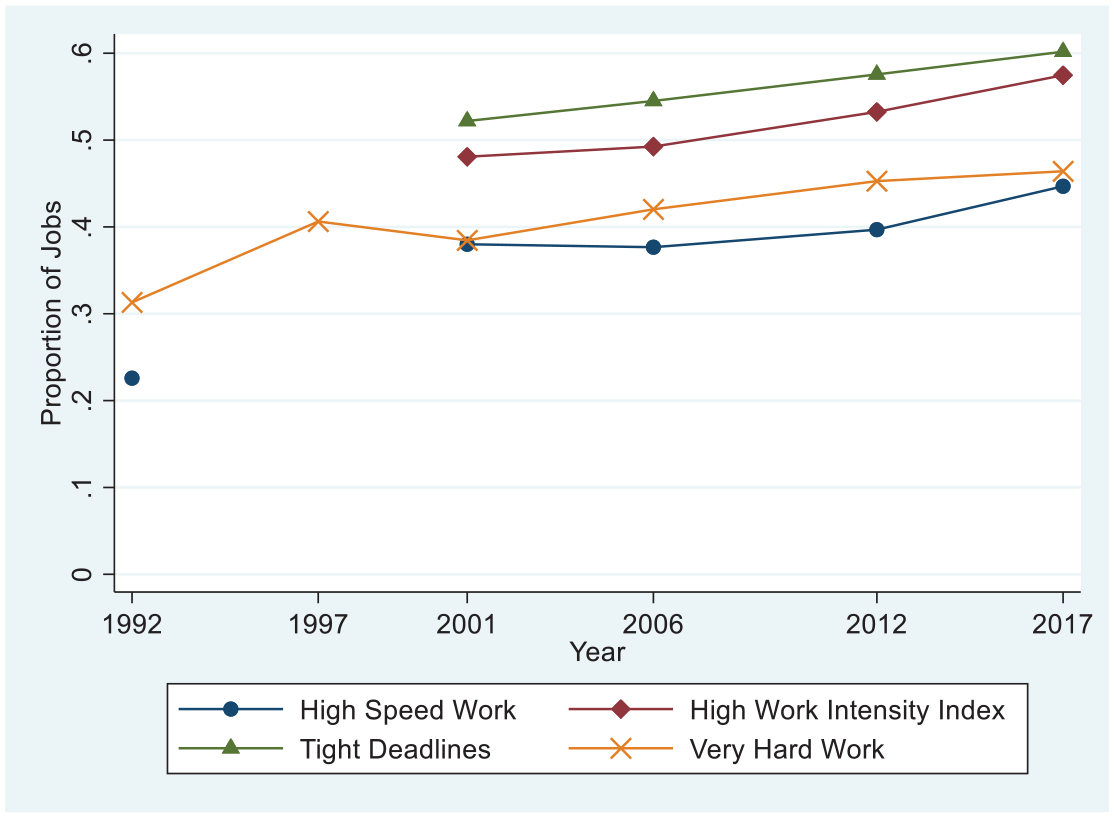
Trends in Work Intensity in Britain, 1992–2017
Descriptives of Work Intensity and Key Explanatory Variables
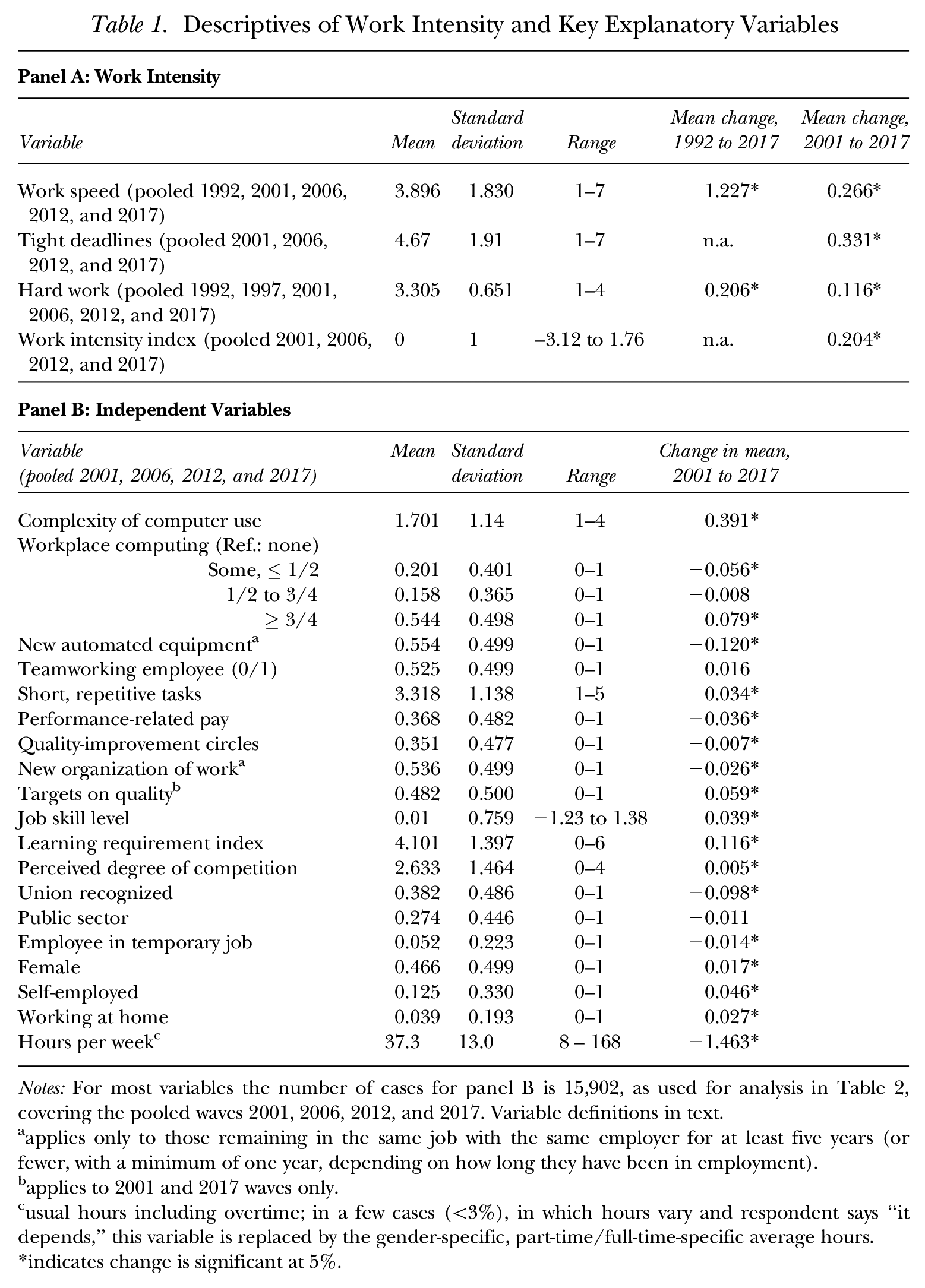
Notes: For most variables the number of cases for panel B is 15,902, as used for analysis in Table 2, covering the pooled waves 2001, 2006, 2012, and 2017. Variable definitions in text.
applies only to those remaining in the same job with the same employer for at least five years (or fewer, with a minimum of one year, depending on how long they have been in employment).
applies to 2001 and 2017 waves only.
usual hours including overtime; in a few cases (<3%), in which hours vary and respondent says “it depends,” this variable is replaced by the gender-specific, part-time/full-time-specific average hours.
indicates change is significant at 5%.
Figure 2 presents a kernel density plot of the distribution of the work intensity index for the first and second halves of the period and shows a rise across both low and high parts of the distribution. Significant work intensification is found across most industries, in almost all occupations, and across almost all regions. No sector, occupation, or region experiences a fall in work intensity. The timing of the work intensification varied between the private and public sector. Work intensification was greatest for the private sector between 2006 and 2012 (spanning the financial crisis and recession) and for the public sector between 2012 and 2017 (a period of severe austerity for public expenditure). Notwithstanding such variations, the widespread experience of work intensification suggests that generic factors may be behind the trend.
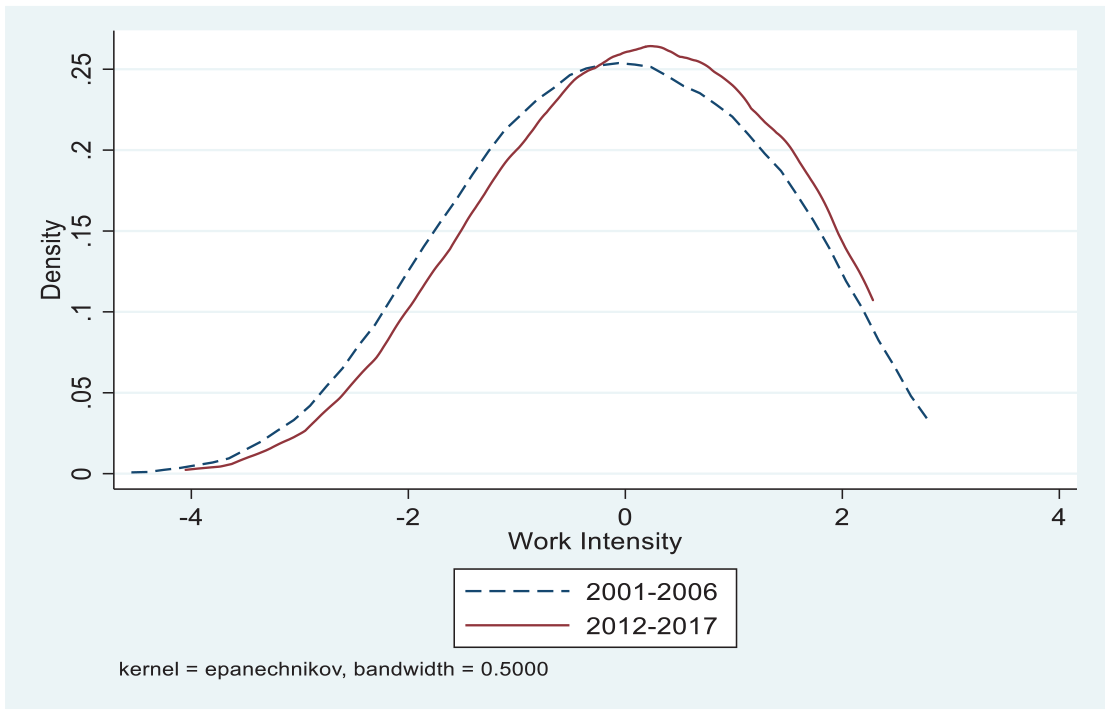
Work Intensity Index in Britain, Kernel Density Plots
Trends in Explanatory Variables
A number of indicators changed in ways that are potentially consistent with work intensification (see Table 1, panel B): Union recognition declined by 10 percentage points between 2001 and 2017; the average level of computer complexity moved 0.4 points up its 4-point scale of importance, while the proportion of workplaces in which more than three-quarters of employees used computers rose by 8 percentage points; the proportion of workers who had to work to targets on quality rose by 6 percentage points; and the learning requirement index increased by 11.6 percentage points (8% of its standard deviation). Yet, counterbalancing these changes, the rates at which new automated equipment and new work organization were happening were both lower in 2017 than in 2001, and the overall skill level, the proportion of teamworking employees, and the perceived level of competition changed very little.
Approach to Analysis
We first investigate the determinants of the required work intensity index using regression models with the pooled cross-sectional, individual-level data. Work intensity for individual i at time t is expected to depend on a set of covariates

A comparison of the estimate of
Multivariate cross-section regressions do not provide unbiased estimates of effects if the unobserved job–individual effect is correlated with the relevant covariates. One issue could be common-reporter bias: Work intensity and the explanatory variables are reported by the job-holder, whose attitudes and personality may influence responses to both the dependent variable and covariates. To assess common-reporter bias, in one robustness test we add short-form measures of the “Big Five” personality domains (which are available for some but not all waves) and examine whether their inclusion significantly alters the estimates (Gosling, Rentfrow, and Swann 2003).
Another issue is that unobserved job–individual effect factors may be associated with occupation–industry factors linked to certain key explanatory variables. An example might be the use of industry-specific technologies that permit greater work control. To reduce bias associated with these unobserved job-related factors, we undertake a separate, longitudinal analysis at the level of occupation and industry.
We average over individuals i in each industry–occupation j; thus, we have for the average work intensity in j:

If we assume that the
Results from Pooled Cross-Section Analysis of Work Intensity
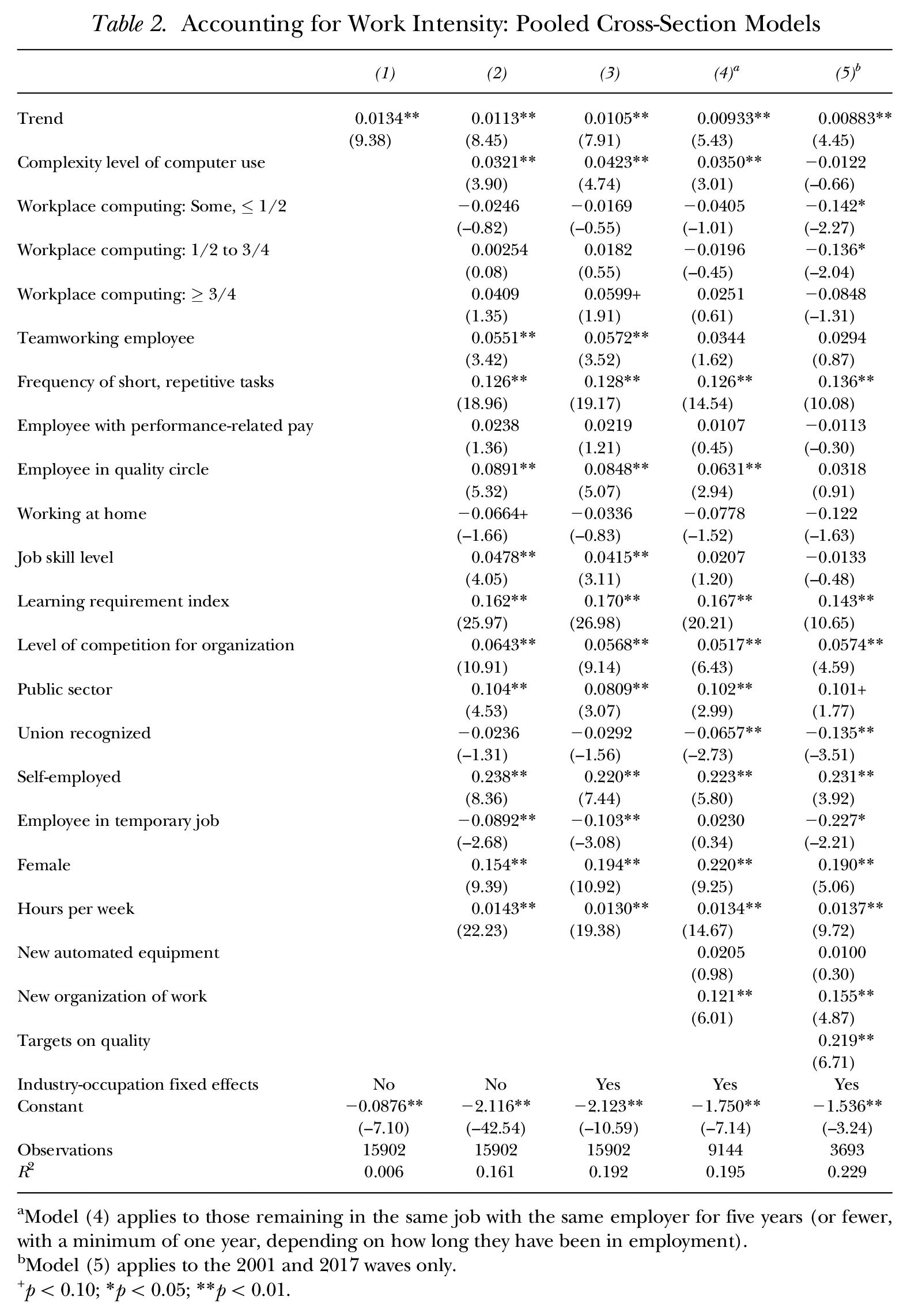
Model (1) in Table 2 is a raw regression on year, giving the overall time trend. We tested for nonlinearity using a regression on year dummies and the hypothesis of a linear trend between 2001 and 2017 could not be rejected (p = 0.41); hence, we use a linear trend specification in all models for parsimony and ease of presentation. In model (2), all explanatory variables for the full sample are introduced. In model (3), we include a set of dummy variables for the industry–occupation combination, in which industry and occupation are each categorized at the 1-digit level. In model (4), we introduce the two workplace change variables; this model must be applied to a somewhat reduced sample, consisting of those who had not recently changed jobs. Finally, model (5) introduces Targets on Quality as an explanatory variable: This substantially reduces the sample to those from the 2001 and 2017 waves only.
Accounting for Work Intensity: Pooled Cross-Section Models
Model (4) applies to those remaining in the same job with the same employer for five years (or fewer, with a minimum of one year, depending on how long they have been in employment).
Model (5) applies to the 2001 and 2017 waves only.
p < 0.10; *p < 0.05; **p < 0.01.
Model (1) reconfirms the presence of positive significant work intensification over 2001 to 2017. The estimated coefficient is the average annual trend rise in work intensity, 1.34% of its standard deviation.
Effort-Biased Technological Change
Consider first the hypothesis of effort-biased technological change. Model (2) shows that the complexity level of workers’ computer use is positively associated with required work intensity. Comparing the lowest with highest complexity level, work intensity varies by 0.096 of a standard deviation (= 3 × 0.032). In model (3), controlling for industry–occupation fixed effects, the gap is somewhat higher at 0.13. In model (3), we see a small additional effect from other workers: Compared with establishments in which none are using automated equipment, respondents in workplaces in which at least three-quarters are doing so have their work intensity rise by 0.06. Models (4) and (5) show no significant effect from new computerized equipment having been recently introduced. Since the trend is toward more complex levels of computer use, these findings together give support to the view that technology change in the form of computerization is effort-biased.
The key indicator is the intensity of personal computer use, graded across levels of complexity (but see the sensitivity tests reported below). The use of computerized technology generally at the establishment, similarly increasing, may also have a role.
Effort-Biased Organizational Change
Turning next to the hypothesis of effort-biased organizational change, it is instructive initially to consider whether this hypothesis is consistent with workers’ own perceptions of organizational change. Respondents to the 2017 wave who had reported a recent change in the way work was organized at their workplace were asked, “Thinking about the effort you personally have to put into your work, has this change required you to work [much harder/somewhat harder/neither more nor less hard/somewhat less hard/much less hard] than before.” A considerable majority—63%—reported harder, 32% neutral, and only 5% said less hard. This majority reporting harder work was greater (at 69%) among respondents when the organizational change was indicated to be a major, rather than a minor, change.
Perceptions, however, cannot on their own be taken as sufficient evidence for effort-biased organizational change. In model (2), work intensity is higher—by 0.055 of a standard deviation—for employees engaged in teamworking. The effect of short, repetitive tasks in a job is quite substantial, consistent with the hypothesized greater potential to monitor work in jobs with more repetitive tasks. Moving just 1 point up the 5-point scale toward greater repetitiveness is associated with a 0.126 rise in work intensity (model (2)). Higher work intensity is also reported for jobs that involve taking part in quality improvement circles (by 0.089 standard deviations, model (2)), but the effects of performance-related bonuses are insignificant. The effects of working at home are negative, as in model (2), but the estimates are relatively imprecise and the coefficient is statistically insignificant in our other three models. Work intensity also increases significantly (by 0.121 standard deviations) in workplaces with recently introduced organizational innovation (model (4)). Finally, model (5) shows that, for the restricted sample from the 2001 and 2017 waves only, work intensity is also strongly associated with the use of targets (by 0.219 standard deviations).
Pressure of the Learning Environment
Turning next to the links with skill, work intensity is associated positively with job skill level (model (2)), confirming previous research. We also find, for the first time, a strong link with a job’s requirement to learn. A 1-point change in the learning requirement index is enough to alter work intensity by 16.2% of a standard deviation (model (2)).
Competitive Environment
As we expected, for those who perceive that the degree of competition is “very high,” compared with those for whom it is “very low,” work intensity is significantly greater by 0.256 (= 4 × 0.064). Allowing for that, working in the public sector is also associated with greater work intensity, on average by 0.10 of a standard deviation. Our hypothesis that unions can counterbalance work pressure and reduce work intensity is given only weak support. Unions’ effect is small for the main, full sample (models (2) and (3)) but is larger and statistically significant for the restricted samples of models (3) and (4), which exclude those with fewer than three years’ job tenure. After interacting union recognition with the trend, we found no evidence that the union effect had changed over time (not shown in the table).
Form of Employment
The form of employment is found to matter. In particular, work intensity is significantly higher—by 0.238 of a standard deviation—among the self-employed, compared with employees (model (2)). By contrast, no evidence supports that work intensity among employees is positively associated with having a temporary job contract. Indeed, models (2) and (3) show instead a negative association with being in a temporary job. In an alternative specification (not shown), we replaced temporary contract status with indicators of job security and the probability of employment after job loss: Together these had no significant effects on work intensity.
Gender and Hours
All models confirm the majority of earlier studies in establishing that women report considerably higher levels of required work intensity than men: In model (2) the gender gap in work intensity is 15.4% of a standard deviation. Work intensity is also higher for those working more hours per week.
Proportion of Work Intensification Accounted For
In comparing the time trend coefficients between model (1) and model (3), which includes the industry–occupation dummy indicators, model (3) accounts for only 22% of the time trend. With the reduced sample used in model (4), the reduction in comparison with a raw regression on time trend is 23%; in the two-wave sample for model (5), the reduction is 26%. We note that the model and this calculation assumes that, in the absence of theoretical reasons for supposing otherwise, the effects of the independent variables (
Results from Pseudo-Panel Models
In all the above, coefficients could only be assumed to be unbiased estimates of the effects of changes in the covariates on the strong assumption that the covariates are exogenous. Table 3 presents findings from fixed effects and difference estimators of the determinants of the work intensity index, using the pseudo-panel construction of the data. These models remove biases deriving from time-invariant associations between covariates and particular industry–occupation cells, though they could still be subject to other biases.
Accounting for Work Intensity: Pseudo-Panel Models
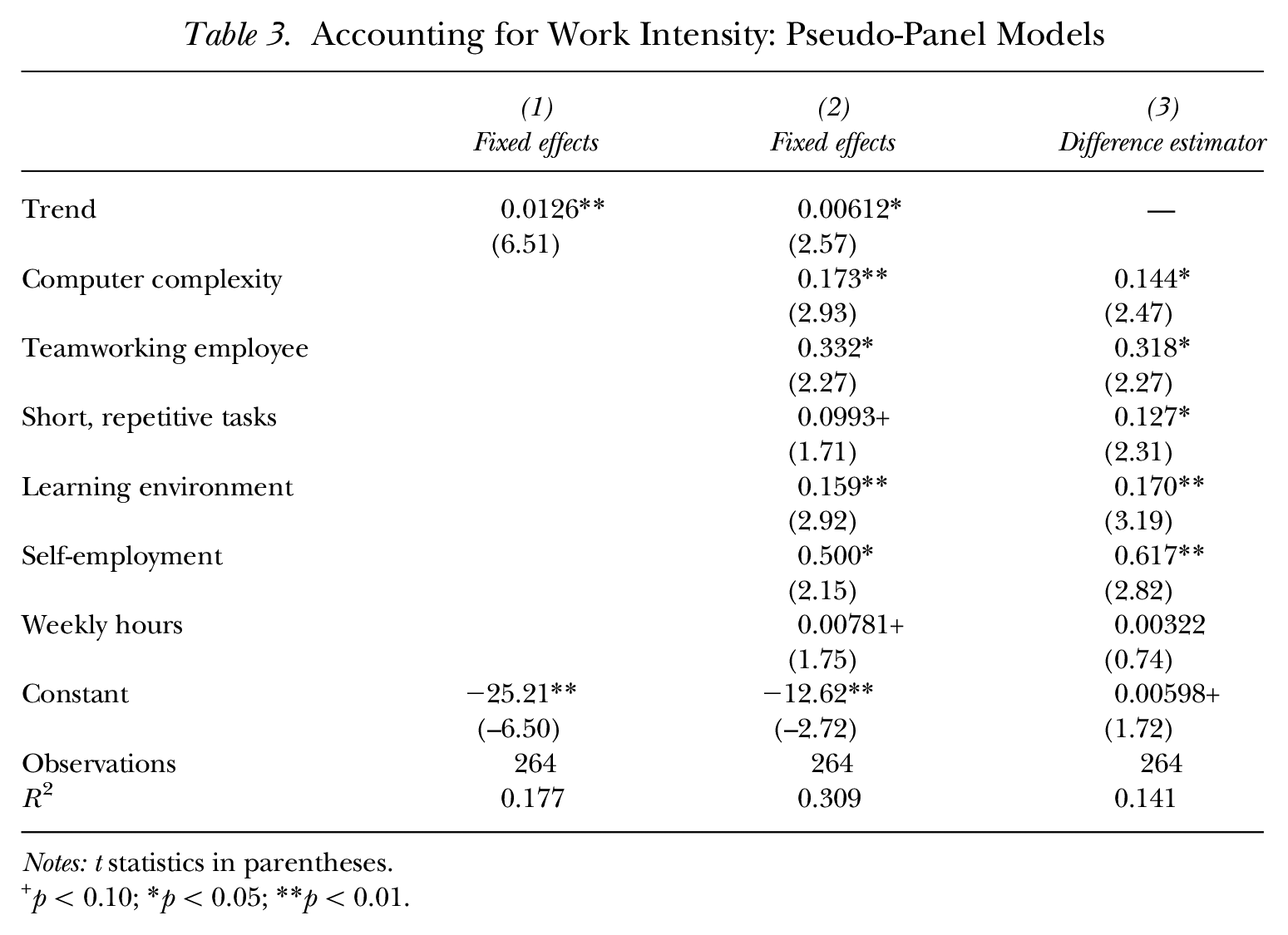
Notes: t statistics in parentheses.
p < 0.10; *p < 0.05; **p < 0.01.
To account for work intensification we first entered all variables used in the cross-section analysis of Table 2, model (2). Given the relatively small sample size, we selected a parsimonious model, after omitting variables with very low explanatory power. Following the rule to omit variables with a t value less than 1, we arrived at the models shown in Table 3. The full model with all variables included is presented in Online Appendix Table A.4. Several variables that are significant in the cross-section analysis do not appear in the parsimonious model.
Table 3, model (1), shows the raw annual time trend of work intensity: It reveals a similar degree of work intensification over time as shown previously in the pooled cross-section. Model (2) shows the conventional fixed-effects panel estimator. Model (3) is a simple difference estimator. In effect, it is a regression of the determinants of between-wave annual work intensification. However, this estimator is less efficient than the fixed effects estimator.
The estimates confirm our hypothesis of effort-biased technological change, in that increases in computer complexity raise work intensity. Using the preferred (fixed-effects) estimates in model (2), stepping up one level of computer complexity is associated with a 0.17 increase in work intensity. Effort-biased organizational change is also confirmed, through the positive impact of teamworking, consistent with earlier studies that have shown this link. Compared with workers not in a team, those in a team are estimated to experience a substantial 0.33 higher work intensity. The estimates also show that work intensification is greater when the prevalence of short, repetitive tasks in occupation–industry cells increases, which is consistent with the hypothesis that work intensification is associated with a greater potential for managers to control the pace of work. Finally, the positive effects on work intensity of raising the learning environment and of increasing self-employment are likewise strongly reproduced in this panel context. The difference estimator coefficients are quite similar.
Compared with the cross-section estimates in Table 2, the effects of computer complexity, teamworking, and self-employment are notably higher; that of the learning environment quite similar; and that of short, repetitive tasks slightly lower.
Proportion of Work Intensification Accounted For
Comparing the trend coefficients in columns (1) and (2), the extent to which overall work intensification is accounted for in this panel framework is just over one-half (51%). Calculating the contribution of each variable from the product of its annual trend and its estimated coefficient, we derived a simple decomposition, giving the contribution of each covariate: 32% from computer complexity, 6% from the growth of teamworking; and 5% each from increased prevalence of short, repetitive tasks, the growth of the learning requirement index, and the growth of self-employment.
Sensitivity Tests
In sensitivity tests, we added to Table 2, model (2), by including the Big Five personality variables in an analysis restricted to the 2012 and 2017 waves (see Online Appendix Table A.3). This analysis shows that workers with higher measures of conscientiousness and of extraversion recorded lower levels of work intensity; however, this effect is orthogonal to the effects of our explanatory variables, with coefficients that do not significantly change when the Big Five are introduced. Reporter personality, therefore, seems unlikely to be a source of major common-reporter bias in the main cross-section results. Next, we replaced our measure of the complexity of computer use with a measure of the importance of computer use (see Online Appendix Section 5). This alternative produced a similar pattern of findings, in both the cross-section and pseudo-panel estimates. When we replaced it with a simple dummy for computer use, however, the estimated coefficient was significant in the pseudo-panel, but small, negative and insignificant at the 5% level in the cross-section estimates. Third, we divided teamworking into three sub-types (see Online Appendix Section 5): self-directed teams, semi-autonomous teams, and other teams (Gallie, Zhou, Felstead, and Green 2012) (respectively 14%, 13%, and 73% among all teams). All three types carried positive coefficients in both cross-section and panel models, significant in most but not all cases. Finally, in the pseudo-panel analysis we conducted sensitivity checks around the industry–occupation cell size cut-off, setting this to be either 40 or 60. We found that these variations did not alter the pattern of results (see Online Appendix Table A.5b).
Discussion: What Accounts for Persistent, Generic Work Intensification and Will It Continue?
We have documented a steady process of moderate work intensification in one country over the 16 years following 2001—a rise in the required work intensity index by 0.20 of a standard deviation, which, from the cited evidence, will have had significant effects on workers’ health and well-being. To put this work intensification into perspective, the rise in the computer complexity level in this prime era of workplace computerization was similar (0.25 of a standard deviation). Far from an isolated episode, the rise follows an earlier period of work intensification in the 1980s. In the 1990s, too, work intensification was especially rapid according to one of our three component indicators. Similar processes were evident in other countries as well.
One might question whether this aggregate intensification is real or illusory, drawn as it is from workers’ personal reports of their work. We argue that it is unlikely to be a statistical artifact, given the care taken to ensure consistent survey questions and context throughout, the high-quality clustered random sampling methods, the consistent trend shown by the three constituent measures, and the validations of our key index. Even if a hidden process of habituation had occurred during the period, which cannot be ruled out, that involved respondents softening how they answer questions about a high pace of work, this would lead to an underestimation of change. Beyond this, we must also acknowledge some limitations of the methodology. Although in our robustness tests the inclusion of personality variables, where available, does not alter the findings, it remains possible that other unobserved person-fixed-effects within occupation–industry cells, which are not controlled for, may induce biases; and no appropriate instruments for the explanatory variables are available.
Previous studies have not attempted to explain this generic process. We find that four factors—effort-biased technological change, effort-biased organizational change, the growing requirement for learning new things, and the rise of self-employment—together account in a statistical sense for part of this work intensification. In the case of our preferred fixed-effects estimator in the pseudo-panel analysis, the proportion accounted for is 51%.
Although we characterize the role of computerization in multiple ways, the rising complexity level of personal computer use turns out to be the most important factor accounting for work intensification in this period. Grading the intensity and/or level of individual computer use, with a scaled, rather than a dichotomous measure of computer use, seems advisable at least when studying a country that is advanced in its level of computerization. The large majority of British workers (89% in 2017) make some use of computers or automated equipment in their jobs. Our finding contrasts with that of Menon et al. (2019), who reported insignificant computer effects on work intensity except for among routine cognitive occupations. This difference may have arisen from both methodological and data differences, including that their study combines two dichotomous indicators to measure work intensity, uses a dichotomous indicator of computer use, and focuses on Europe as a whole. For future research we recommend using multi-level indicators to estimate the effects of computer complexity. It may also become important to allow for the effect of given levels of computer complexity to change over time.
As for effort-biased organizational change, the key variables turn out to be teamworking and the design of work as short, repetitive tasks—suitable, we argue, for closer control. By contrast, other variables highlighted in high-involvement management literature, in particular, the use of quality circles and performance pay, were not found in our panel analysis to have a significant effect on work intensification, even though they are significantly correlated with work intensity in the pooled cross-section.
Consistent with earlier cross-sectional studies, gender is a significant factor, with women in jobs that require higher work intensity than men. From the pseudo-panel estimates, however, the within-cell gender changes over time did not alter work intensity. Similarly, within-cell changes in union recognition, workplace computerization/automation, use of quality circles, working at home, or weekly hours were not significant determinants of work intensification. The implication is that these effects are associated with time-invariant occupation–industry-specific characteristics, which are themselves linked with required work intensity.
How can this collective evidence be interpreted to provide a coherent understanding of generic work intensification? Power-resources theory provides a plausible framework. According to this framework, a combination of financialization with increased international outsourcing, changing social norms, and institutions supported by the state, alongside rising monopsony power in labor markets, has both increased the degree of competition in product markets and shifted the balance of power between firms and employees in favor of the former, bringing about a decisive shift in the distribution of income (e.g., Elsby, Hobijn, and Sahin 2013; Darcillon 2015; Flaherty 2015; Krueger 2018; Kohler, Guschanski, and Stockhammer 2019). We would suggest that because of the declining power of both organized and unorganized labor to resist pressures from employers in Britain’s liberal market economy, technical and organizational changes have been harnessed in combination to intensify work. Consistent with Braverman’s neo-Marxian prediction of half a century ago, work intensification has turned out to be an ongoing tendency in modern-day capitalism, at least in this part of the world where we have consistent measures over a long period. Yet there is a difference: This work intensification is not associated with an ongoing de-skilling and simplification of work. The onetime assumption that greater job skill meant lower management control and less power to intensify work has been thrown into question (Jackson and Jordan 2000).
It is important to note that we do not see technological change as an exogenous factor. The ways that new technologies are adapted for use in industry reflect firms’ objectives. Whether technologies are designed and used to facilitate harder work directly, or to enhance surveillance of the labor process, they form the channels through which the increased power of employers can be exercised. Similarly, rather than take organizational change as following the technology in a deterministic manner, how organizations arrange themselves reflects the institutional environment, alongside managerial agency. The same applies also to the other prominent proximate factors: the requirements in the knowledge economy to engage more in learning new tasks and more workers turning to self-employment, each channel an increased imposition of tasks and greater work intensity. But these links should be regarded not as manifesting some abstract learning requirement or a magically risen preference for self-employment, but as reflecting a world of work in which learning requirements can be imposed on top of, rather than instead of, other tasks, and where some workers turn to self-employment and all its demands, rather than consent to declining wages and working conditions as employees or, worse, to unemployment.
We have presented no formal evidence for this interpretation, and doubt that it would be possible to find adequate measures to test it. The circumstantial evidence, however, is suggestive. The long-term decline in the wage share of national income in many countries (including Britain), 3 which shows labor’s inability to fully capture the rewards of rising productivity, is one common indicator of the shifting balance of power. Recent firm-level evidence shows the declining extent to which British workers have claimed a share in rents (Bell, Bukowski, and Machin 2019). Unlike earlier periods in Britain and elsewhere, the current era of work intensification presents no apparent paradox: Rather than occurring at a time when job quality was improving in other dimensions, the work intensification since 2001 has taken place alongside a decline in several other job quality facets. Wages began falling in the mid-2000s, and there have been declines too in workers’ task discretion and in workplace training opportunities (Green et al. 2016; Gallie, Felstead, Green, and Henseke 2018). The long-term decline in weekly work hours that had resumed in the middle of the 1990s slowed to a halt by 2010, and the zero-hours contract, a quintessentially precarious form of employment, spread rapidly after 2000 (ONS 2019). The EU’s index of physical working conditions, which had been improving in the United Kingdom until 2005, slipped back between 2005 and 2010 (Green et al. 2013). If the declining bargaining power of labor is the central explanation for work intensification, this simultaneous decline or stagnation of other dimensions of job quality is what one would expect.
As a counter to this explanation, one might have expected respondents’ perceptions of product-market competition, declining union recognition, and temporary contracts to have played a more significant role in our findings. Perceived competition, while an important factor in our cross-section estimates, was insignificant in the pseudo-panel. Yet our measure is a loose indicator, at best, of respondents’ power to influence how their work is organized and how hard they work. Union recognition was significant in only two out of the four cross-section models and not in the pseudo-panel. Part of the historical decline of unions since the 1970s lies in their substantially diminished influence (where they remain present) over wages and over work intensity (Bryson and Green 2015). Spillover effects from union to non-union sectors can also be discounted over the period of our investigation. And while some unions retain important roles inside the opposition Labour Party, declining union power at the state level inhibits their ability to affect the legislative agenda. Finally, unlike the growth of self-employment, temporary job contracts have not grown and are not the route to work intensification in this liberal market economy, possibly because there are fewer regulatory differences from permanent contracts than are found in much of continental Europe.
As for the future, getting people to work harder is inherently self-limiting as a growth strategy, unlike investing in their human capabilities or new capital. Our measures also have scales with built-in ceilings. Yet, there is a long way to go before those ceilings are reached. Substantial variation exists within the work intensity index, and its negative skewness testifies to the presence of a minority with rather low work intensity. Thus there remains scope for continued work intensification in the coming years, and a corresponding need for policymakers and researchers concerned with work-related health and well-being to monitor this important dimension of job quality. Work intensification could be abated if there were a concerted move to facilitate trade unions to bargain over working conditions, or if employers could be persuaded by successful experiments in job re-design (Kelly and Moen 2020). The deleterious effects of work intensification on well-being could at least be alleviated by affording employees better social support, designing jobs to have greater task discretion, and providing more opportunities for organizational participation.
Supplemental Material
sj-pdf-1-ilr-10.1177_0019793920977850 – Supplemental material for Working Still Harder
Supplemental material, sj-pdf-1-ilr-10.1177_0019793920977850 for Working Still Harder by Francis Green, Alan Felstead, Duncan Gallie and Golo Henseke in ILR Review
Footnotes
For the Skills and Employment Survey series since 2001 used in this article, the authors gratefully acknowledge funding from the Economic and Social Research Council (ESRC), the Department for Education (and its predecessors), the UK Learning and Skills Council, the UK Commission for Employment and Skills, FutureSkills Scotland, the East Midlands Development Agency, the Wales Institute of Social and Economic Research, and the Welsh government. Cardiff University contributed funding for the 2017 survey. Francis Green and Golo Henseke received additional funding from the ESRC’s LLAKES Research Centre at UCL Institute of Education, and support is also acknowledged for the 2001 survey from the ESRC’s SKOPE Research Centre at Oxford University.
For information regarding the data and/or computer programs used for this study, please address correspondence to

2
An alternative is to sum the three standardized items. Implicitly, an additive approach weights variables equally in their contribution to the index, whereas data reduction through principal component analysis generally derives distinct weights. In practice, an additive index turns out to be very highly correlated with the index we use (ρ = 0.998).
References
Supplementary Material
Please find the following supplemental material available below.
For Open Access articles published under a Creative Commons License, all supplemental material carries the same license as the article it is associated with.
For non-Open Access articles published, all supplemental material carries a non-exclusive license, and permission requests for re-use of supplemental material or any part of supplemental material shall be sent directly to the copyright owner as specified in the copyright notice associated with the article.
