




Abstract
Using a 20-month qualitative study of four US states that implemented career pathways spanning from high schools to colleges to employers, the authors illustrate the potential for state government actors to facilitate coordination of workforce development systems across geographies and industries. As a complement to explanations situated in workforce intermediary practices or formal state policies, the authors show that state actors can address barriers to coordination by using state actor orchestration—structuring provisional goal setting and revision, encouraging experimentation, and framing coordination to inspire collective action. This approach involves three types of practices: structural (building statewide governance structures and modifying governance processes), political (providing initial direction and piloting and broadening the set of stakeholders), and cultural (identifying key problems and collective action solutions and building social accountability for new roles). These practices vary according to states’ institutional environments: Where governance is more centralized, state actors gain latitude to guide regional workforce development.
Workforce development in the United States has long existed in the shadow of the esteemed vocational education and training systems of countries such as Germany and Switzerland. There have been many calls to reproduce these systems in the United States, including from a US Task Force that issued a 2018 report following a Presidential Executive Order; the report suggested that “establishing tailored frameworks comparable to those in other countries that have robust apprenticeship programs would increase the U.S. global competitive advantage” (Task Force on Apprenticeship Expansion 2018: 17; see also Osterman 2007; Parilla, Trujillo, and Berube 2015; Council of Economic Advisors Issue Brief 2016).
In the vocational education and training (VET) systems of other countries, responsibility for skill formation is split among employers, workforce intermediaries, and nation-states. In the United States, the need for increased employer investment in education and training is well-documented. In addition, workforce intermediation has emerged as a promising strategy for connecting job seekers and employers, improving job quality, and building local economies that result in equitable outcomes for diverse groups. Yet, much of the workforce intermediation in the United States currently takes place in small regions within states, and the critical role of states in creating more organized systems has been neglected.
US states are responsible for distributing federal workforce development funds and for setting employment policy, including for wages and industrial recruitment. State governments also have a broad view of the resource landscape and are well-positioned to connect economic, education, and workforce efforts. This arrangement suggests that stakeholders interested in how US workforce systems can more closely approximate the articulated VET systems in Europe should examine the interactions between region-based workforce intermediaries (WIs) and state policy and administration.
Although the vast institutional differences between the United States and Europe mean that VET systems cannot be imported wholesale, US states and regions together have the potential to bring order and structure to US labor markets that can functionally approximate European VET systems. Research on successful WIs helps to illuminate the ways that state policy can support individual WIs and improve outcomes in a local labor market for a given population, including by driving employment opportunities to regions. This research does not address a key question, however: How can state government actors facilitate statewide coordination of workforce development systems across multiple geographies and industries? Coordinating across geographies and industries is particularly challenging because WIs are built on long-term relationships with companies in particular industries and on fine-grained knowledge of local resources and needs. This rootedness strengthens WIs but presents challenges to the development of statewide workforce development systems.
By using a qualitative study of four US states—California, Delaware, Illinois, and Tennessee—that successfully implemented career pathways in partnership with the Pathways to Prosperity Network (PtoP), we shift from a traditional focus on evaluating the workforce development outcomes of regional WIs to instead investigate the variety of implementation practices that state actors can use to successfully coordinate statewide workforce development. PtoP, as part of the nonprofit organization Jobs for the Future, promotes the spread of career pathways that span from secondary to postsecondary education and involve WIs and employers. By using a longitudinal methodology and focusing in-depth on four states, we elaborate the process of state actor orchestration—structuring provisional goal setting and revision, encouraging experimentation, and framing coordination to inspire collective action across sectors—which state actors used to address the broad societal challenges of inadequate skill attainment and employment. In addition, we explore state actors in two different institutional contexts—centralized and decentralized—and outline the ways in which state institutions that structure education and employment inform the use of state actor orchestration practices (Figure 1). As a complement to explanations that situate workforce development primarily in either regional WI practices or formal state policies, we show how state actor orchestration can contribute to the coordination of workforce development across multiple geographies and industries.
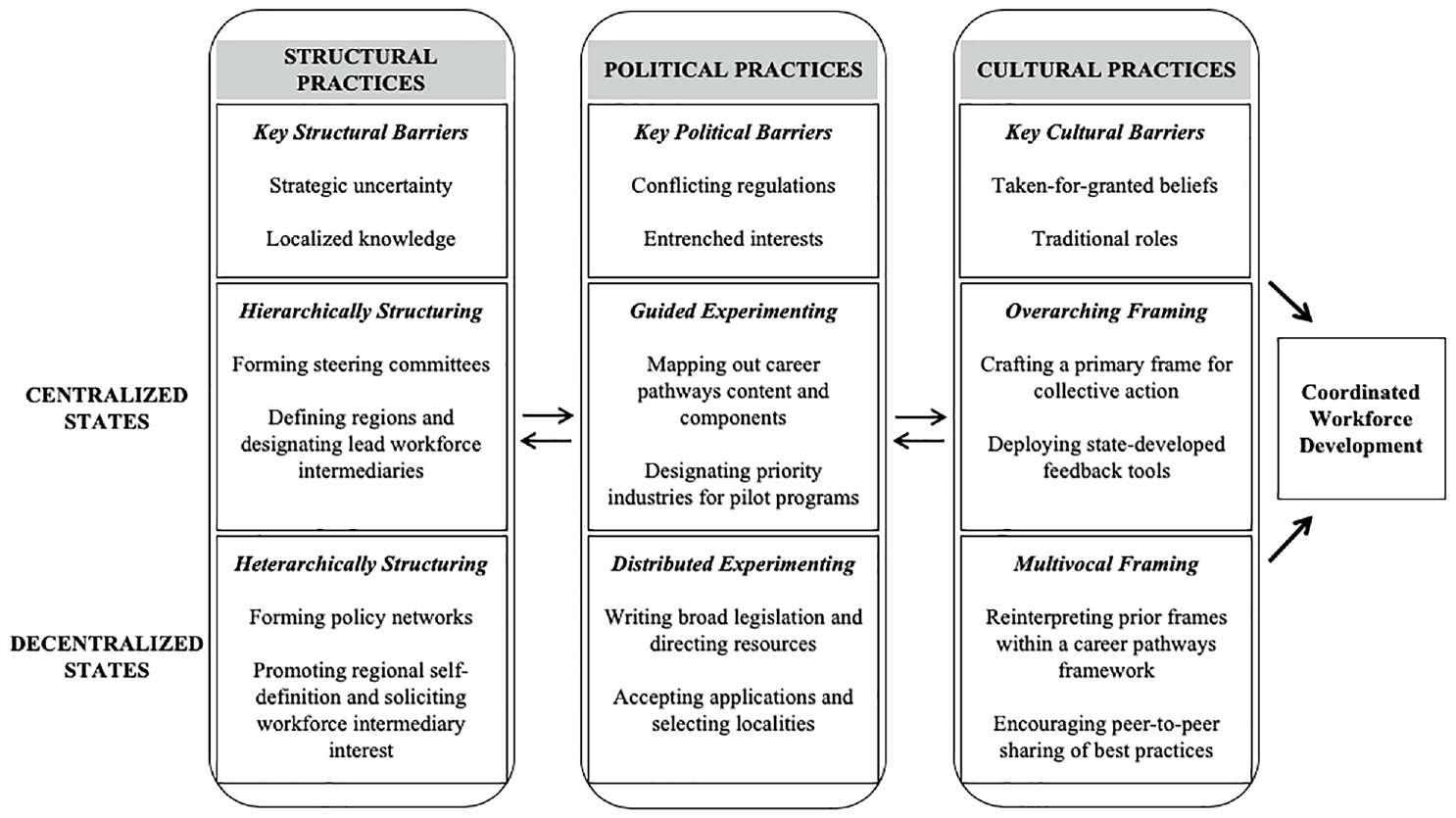
State Actor Centralized versus Decentralized Orchestration Practices
The Workforce Intermediary Approach
Historically, the absence of coordinated skill formation systems, such as those that exist in Germany and Switzerland (e.g., Busemeyer and Trampusch 2011), has been less problematic for employers and job seekers in the United States, because many individuals moved relatively successfully through the “first chance” education and employment systems, including traditional K–12 and higher education (Giloth 2004), as well as internal labor markets within firms (Doeringer and Piore 1985; Osterman 2007). Internal labor markets have declined, however, and employers increasingly perceive skills gaps (Cappelli 2015; Weaver and Osterman 2017). For the bottom half of the labor market, largely ineffective labor market institutions have proliferated (Osterman 2007; Lowe 2010). In this fractured system, workforce intermediation has emerged as one promising strategy for job matching, creation, and improvement (Giloth 2000; Bernhardt, Hatton, Pastor, and Zimmerman 2001; Kazis 2004; Osterman 2007).
WIs use a dual customer approach to mediate the relationship between specific employers and job seekers (Fitzgerald 2004; Giloth 2004; Holland 2016). WIs include a variety of organizations, such as labor-management partnerships, community colleges, employer associations, and public workforce boards (Benner 2003; Giloth 2004; Conway 2014), and typically focus on lower-income and lower-skilled workers (Giloth 2000; Fitzgerald 2006). On the supply side of the labor market, WIs provide both pre-employment and post-employment services to job seekers, including career advice, training, and social services (Kazis 2004; Poppe, Strawn, and Martinson 2004). On the demand side, WIs aggregate employer demand for skills to identify broad trends (Benner 2003; Lowe 2010), they encourage employers to reward skill development by developing internal career advancement policies (Giloth 2000; Dedrick 2014), and they provide resources to firms. For instance, the Wisconsin Regional Training Partnership, a labor–management partnership, provided its member firms with manufacturing training centers and modernization funds for new technologies (Bernhardt et al. 2001; Giloth 2004; Buford and Dresser 2014).
While many WIs have successfully coordinated employers and service providers within particular regions, fewer examples portray coordination across multiple local labor markets. One notable exception is the North Carolina biomanufacturing industry studied by Lowe and colleagues (Lowe 2007, 2010, 2014; Lowe, Goldstein, and Donegan 2011; Lowe and Feldman 2018). To support this industry, 13 community colleges in North Carolina offered a certification program called BioWork. The BioNetwork Capstone Center coordinated activities between colleges (Lowe et al. 2011), and the state Department of Commerce led industrial recruitment efforts (Lowe 2010, 2014).
Such coordination efforts are critical for several reasons. First, job seekers can more easily navigate coordinated systems, especially when they are searching across multiple labor markets or are unsure of the best industries to target (Osterman and Batt 1993; Lowe et al. 2011). Second, entities such as policy networks and public agencies have the mandate and resources to operate broadly (Fitzgerald 2004). Third, working at a systems level has the potential to confer political power and resources on WIs through coalition-building and the efficient use of funds (Osterman and Batt 1993; Kazis 2004).
Yet, coordinating workforce intermediation across geographies and industries meets significant barriers. First, WIs often face uncertainty regarding available resources (Giloth 2000), and they are often dependent on local knowledge transmitted through face-to-face meetings or phone calls (e.g., Fitzgerald 2004; Lowe et al. 2011; Holzer 2015). Coordinating these programs can risk the loss of the local knowledge and personal relationships that are important to successful service delivery (Benner 2003). Second, WIs often offer programs in response to historical state policies and regulations, which poses problems for building coordinated statewide systems (e.g., Schurman and Soares 2010). In addition, jurisdictional boundaries and entrenched interests can cause resistance to statewide coordination attempts. For example, community colleges and other public workforce agencies sometimes compete for clients and employer partners (e.g., Osterman and Batt 1993; Giloth 2000; Osterman 2007, 2011). Finally, taken-for-granted beliefs about the traditional roles of business, government, and education pose barriers to coordination. In particular, employers often fear that they will be unable to secure the benefits of training investments if higher-skilled workers move to other firms (Osterman 2008).
In sum, while we understand practices that regional WIs can use to help coordinate the supply and demand sides of industry-specific local labor markets, we do not have much insight into how regional workforce development can be coordinated across multiple geographies and industries given the barriers they face. Because states distribute a large portion of federal workforce dollars, lead industrial recruitment efforts, and govern secondary and postsecondary education systems, state actors’ efforts have important implications for WIs and their partners. Forward-thinking states have begun to connect education and employment through high-quality career and technical education (Holzer, Linn, and Monthey 2013), community college workforce programs (Holzer 2011, 2017), and industry-based partnerships (Dedrick 2014). To accomplish this, states are increasingly joining national and regional learning networks similar to the Pathways to Prosperity Network (Holzer 2011, 2017; Holland 2016; Hoffman and Schwartz 2017). The analysis presented in this article shows how state actor orchestration can facilitate the coordination of workforce intermediaries statewide, and how states’ institutional environments shape the practices that state actors use for effective change.
Methods
Research Setting
Using a grounded theoretic approach (Glaser and Strauss 1967), we conducted a 20-month field study of the coordination of workforce development in four US states that were members of the Pathways to Prosperity Network: Tennessee, Delaware, California, and Illinois. Each state paid a $100,000 annual membership fee for technical assistance to develop statewide career pathways. These pathways are designed to start young people in a high-demand occupational field while still in high school; to connect them to a related postsecondary certificate or degree program; and to furnish necessary skills, credentials, and experience, while leaving open the option for further education (e.g., King and Prince 2015; Hoffman and Schwartz 2017). Under the PtoP framework, these pathways included 1) sequences of courses spanning secondary to postsecondary education; 2) early college and career advising opportunities for students; 3) regional intermediary organization support; 4) employer engagement; and 5) supportive state policy. See Figure 2 for the regional organizational structure and the student activities of a career pathway.
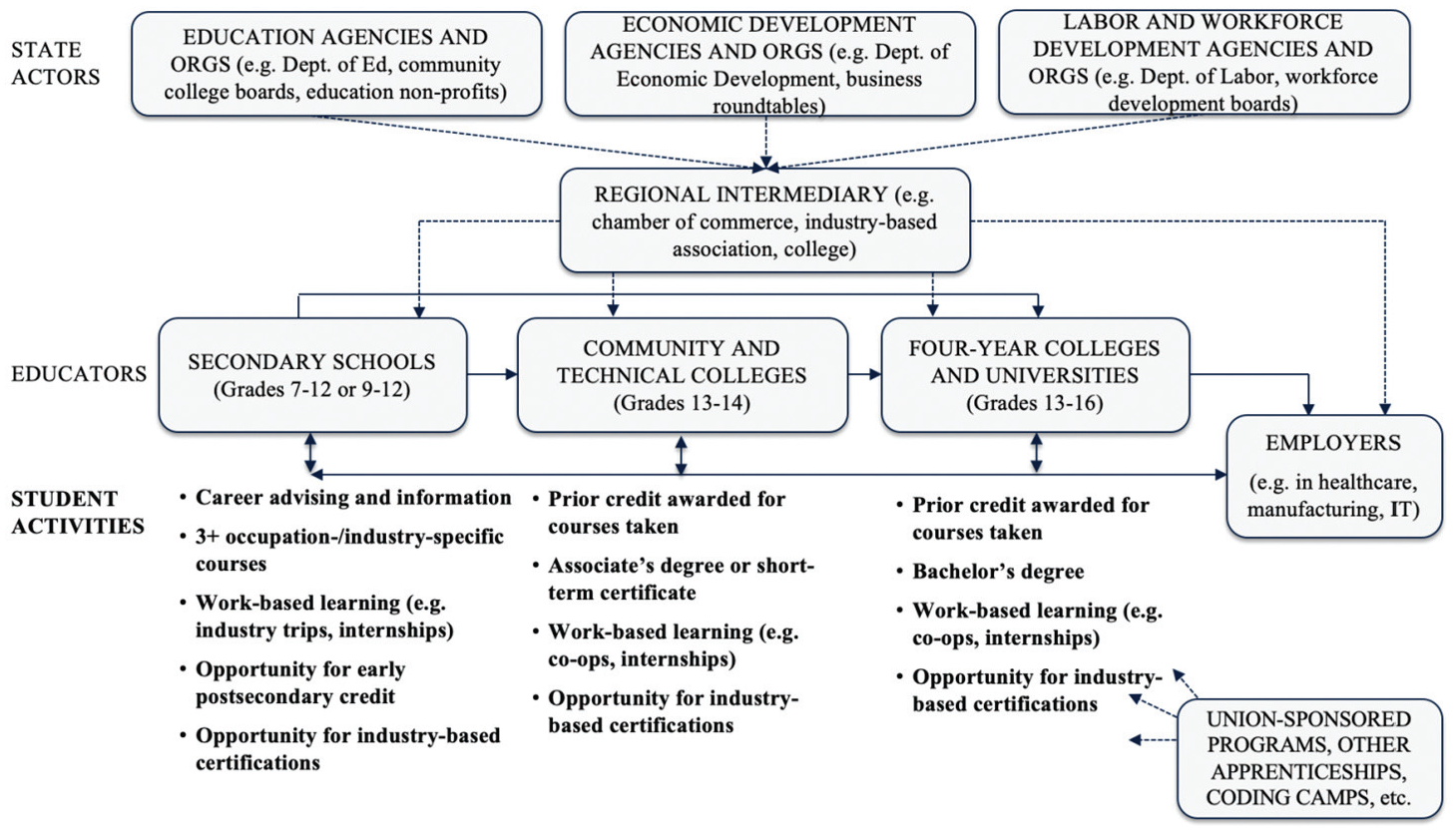
Regional Organizational Structure and Student Activities for a Career Pathway
Data Collection
Phase 1
Because of the many confounding factors surrounding program and policy implementation, qualitative methods are appropriate for analyzing changes in workforce systems (King 2014). During Phase 1 of our study (8 months; May 2016–December 2017), the first author was given digital access to all archived and current documents used by PtoP staff and spent an average of two days each week at PtoP’s office conducting ethnographic observations of career pathways development with Tennessee (TN). We conducted interviews with and made observations of PtoP actors and TN actors at the state and regional levels. This step included actors from the TN state government (bureaucratic officials in state departments including Education, Labor, and Economic Development), from TN WIs who connected educators and employers across a small region within the state (such as chambers of commerce or employer associations), from TN employers and employer associations, and from TN secondary and postsecondary education institutions.
We focused first on TN because its partnership with PtoP was well-established and was recognized as generally successful by PtoP staff members, so we believed it could provide lessons for statewide coordination of workforce development. In our observations and interviews, we noted that state actors played an important role in coordinating workforce development across multiple geographies and industries within TN. For this reason, we began a new phase of data collection on state actor practices.
Phase 2
In Phase 2 (12 months; January–December 2017), we used a logic of replication (Eisenhardt and Graebner 2007) to determine which additional states to include in our sample. Because we were interested in studying statewide coordination of workforce development, we selected additional states for interviews and observations according to whether PtoP and the state had established a formal partnership for statewide work and where efforts to coordinate across regions were underway. This sampling strategy led us to add three additional states—California (CA), Delaware (DE), and Illinois (IL)—to our study. We excluded some states that had discontinued their membership with PtoP and other states that had not progressed beyond an initial planning stage. Therefore, our approach does not allow us to identify key sources of failure in the early stages of state–PtoP partnerships. This sampling strategy does allow us to analyze the processes underlying statewide coordination of workforce development, on which existing research is limited (Eisenhardt and Graebner 2007).
In CA, DE, and IL, we interviewed actors at the state and regional levels from the same kinds of organizations as we did in TN. In each of the four states, we observed (typically by phone) meetings of state and regional actors; where possible, we attended events, such as committee meetings, tours, and conferences; and we analyzed archival PtoP documents. See Table 1 for a description of our data collection and analysis across phases, and see Table 2 for data collection by state.
Data Collection and Analysis
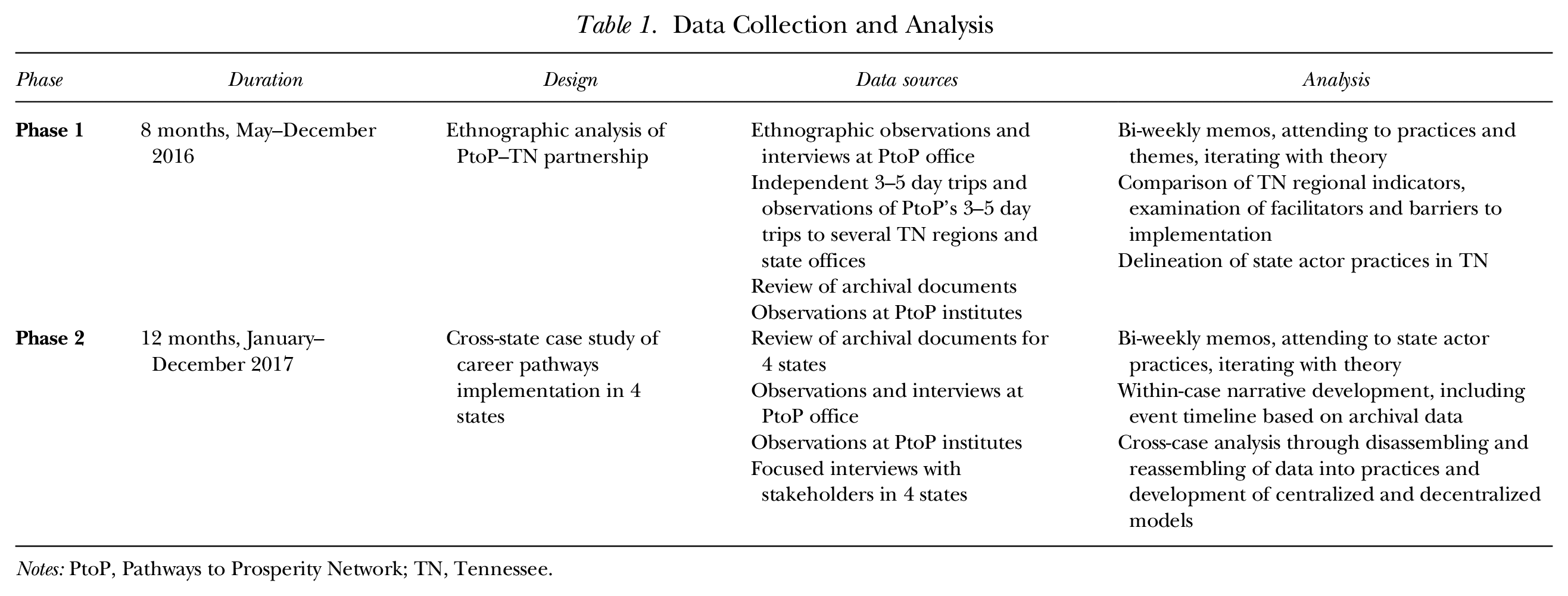
Notes: PtoP, Pathways to Prosperity Network; TN, Tennessee.
Detailed Data Collection by State
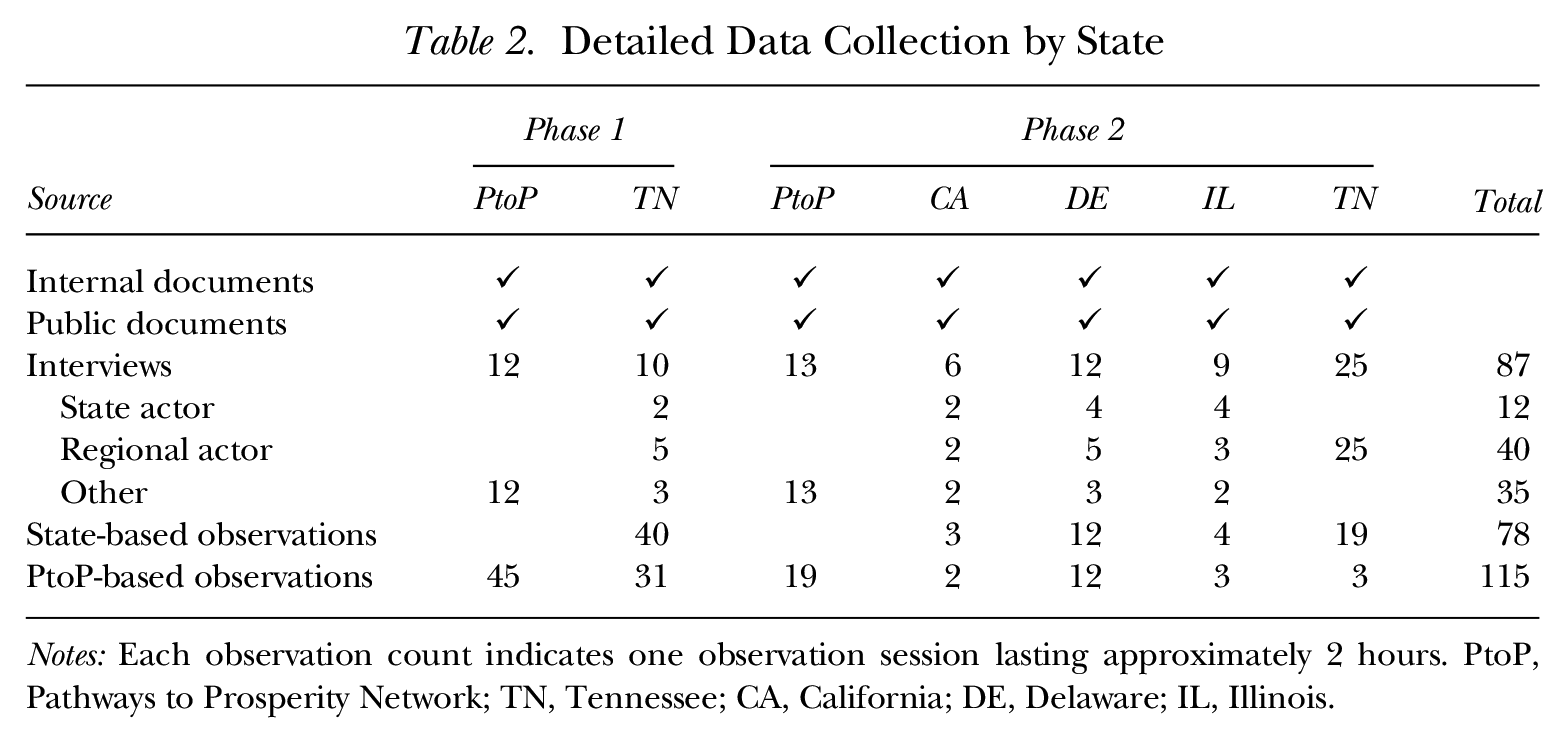
Notes: Each observation count indicates one observation session lasting approximately 2 hours. PtoP, Pathways to Prosperity Network; TN, Tennessee; CA, California; DE, Delaware; IL, Illinois.
Data Analysis
Throughout our data collection, we wrote biweekly memos using inductive, qualitative techniques based on multiple readings of data, and iterations between data and theory (Glaser and Strauss 1967). During Phase 1, we developed an understanding of the PtoP framework and the barriers to statewide coordination of workforce development in TN. We also identified a preliminary set of practices that we saw TN state actors use to accomplish coordination.
During Phase 2, we analyzed our data from across the four states. We first developed narratives of each state’s trajectory to develop an understanding of within-case practices (Miles and Huberman 1994). Next, we analyzed cross-case patterns and identified common coordination practices. Our emerging analysis showed that state actors in all four states sought to address a common set of barriers as they attempted to coordinate regional workforce development efforts. We also became attuned to instances when our informants explained why a certain approach might work for other states but would not work for their state. These explanations sensitized us to the importance of the level of centralization of state governance to state actor coordination practices.
To deepen our understanding of the practices we identified, we drew from the literature on collective action around “wicked problems”—complex, societally significant problems that involve diverse stakeholders and entail substantial uncertainty over the best solutions and the most effective means to achieve them, such as climate change and poverty alleviation (e.g., Ferraro, Etzion, and Gehman 2015; Eisenhardt, Graebner, and Sonenshein 2016; Grodal and O’Mahony 2017). This literature suggests that three kinds of practices—structural, political, and cultural—are critical to allowing diverse field actors to work collectively with one another to solve such problems. Structural practices include building architecture to facilitate joint goal setting and adjustment based on emergent learning (e.g., Ostrom 1990; Dietz, Ostrom, and Stern 2003; Callon, Lascoumes, and Barthe 2009). Political practices include encouraging experimentation to enable a situated and deliberative approach to problem-solving to manage conflicts among diverse actors (e.g., Girard and Stark 2002; Sabel and Zeitlin 2012; Sabel and Victor 2017). Cultural practices include providing culturally resonant frames to diagnose key problems and propose collective action solutions (e.g., Creed, Scully, and Austin 2002; Lounsbury, Ventresca, and Hirsch 2003; Weber, Heinze, and DeSoucey 2008). We drew on this literature to help develop our concept of state actor orchestration, which state actors used in our context to address the broad societal challenges of inadequate skill attainment and employment. Where we differ from this literature is in our elaboration of state actor practices (rather than practices used by field-level institutional entrepreneurs), and in our detailing of how states’ institutional environments shape state actor practices.
When our formal data collection in Phase 2 had finished, we checked our emerging conclusions with informants to ensure that these interpretations represented their experiences (Yin 2017). These checks did not affect the actions of informants during the study.
Successful Coordination of Workforce Development in All Four States
TN, DE, CA, and IL successfully implemented statewide career pathways during the first five years of their partnerships with PtoP. These career pathways shared three core components: 1) high school occupation-based programs of study with at least three sequential courses that were 2) aligned to regional college programs, and 3) included intensive work-based learning experiences (e.g., student internships or co-ops). In each state, state actors coordinated career pathways across regions with WIs. We do not count career technical education (CTE) programs that existed prior to the states’ membership in PtoP, including locally negotiated programs, because they did not share all three of these characteristics.
Table 3 describes this implementation and the degree of statewide coordination of workforce intermediation in the four states. We report two indicators: 1) the five-year change in the percentage of students with access to career pathways, as measured by the percentage of public secondary school students in districts where career pathways were available (91% in TN, 94% in DE, 45% in IL, and 60% in CA), and 2) the geographic coverage by WIs in each state, as measured by the square miles of the counties (or school districts, in the case of DE) served by WIs that were formally partnering with state actors (100% in TN, 100% in DE, 43% in IL, and 83% in CA).
Successful Coordination of Workforce Intermediation in All Four States
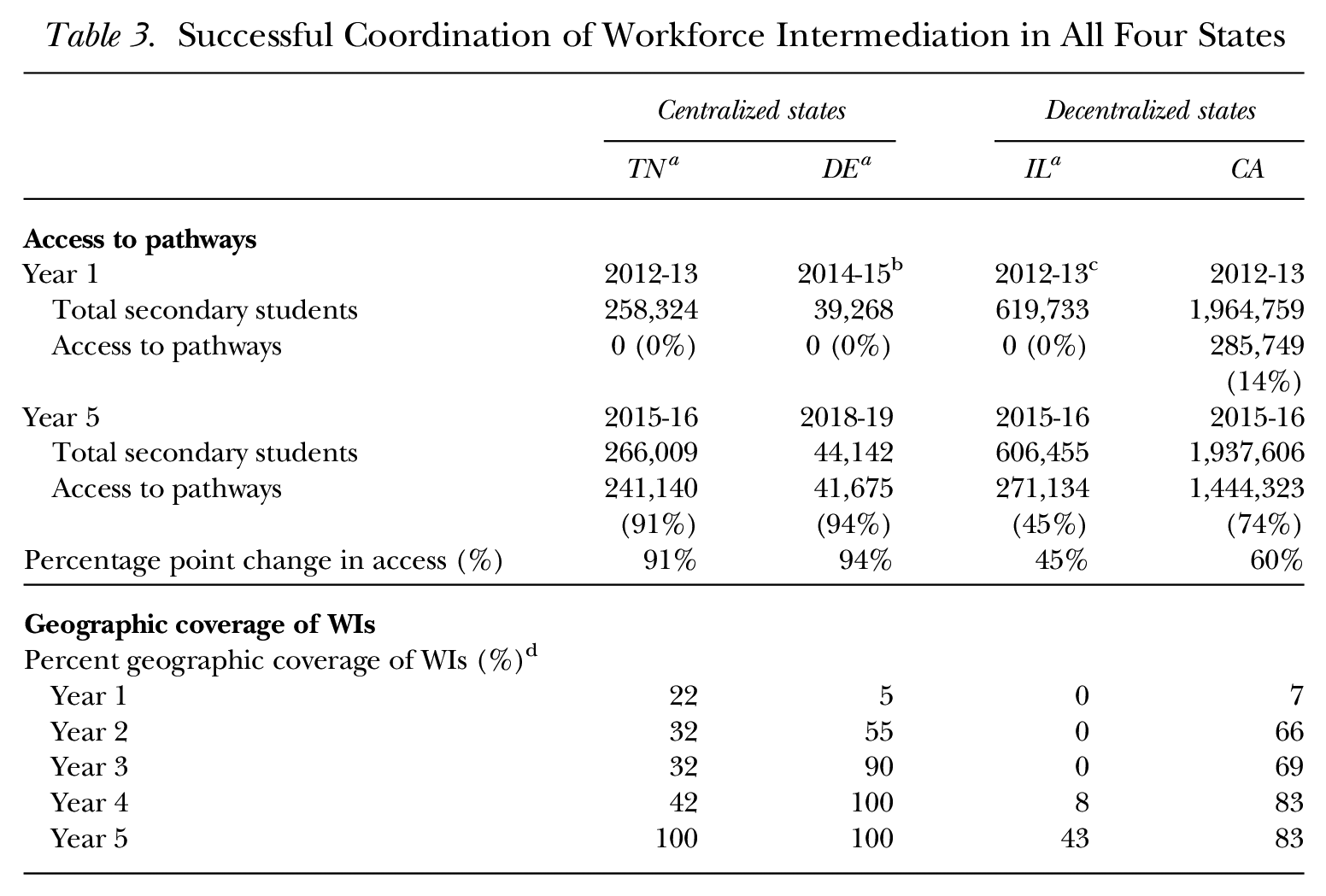
Notes: State agencies in the four states had different data collection protocols, so we contacted state Departments of Education and other advocacy and nonprofit organizations that collected this type of information and cross-referenced the data we collected from each type of organization. We included data for only those programs that each state considered to be part of its career pathways efforts. TN, Tennessee; DE, Delaware; IL, Illinois; CA, California; WIs, workforce intermediaries.
DE, IL, and TN designed career pathways by building on career technical education (CTE) programs that had existed in the state prior to their membership in the Pathways to Prosperity Network (PtoP), whereas CA legislated new career pathways programs. However, these states significantly overhauled the existing CTE programs by developing explicit connections to postsecondary degree programs and industry credentials, as well as engaging with WIs for regional, rather than district-level, implementation. We therefore list 0% as the starting percentage for student access to pathways, because the CTE programs that existed prior to the states’ membership in PtoP, including locally negotiated programs, did not have these characteristics.
For DE, years 1–5 represent academic years 2014–15 to 2018–19 because the state’s membership in PtoP did not begin until 2014.
IL’s membership in PtoP began in 2012, but due to delays in the legislative process, the state did not begin implementing career pathways until academic year 2014–15. Preliminary data from 2019 indicate that student access to pathways continued to expand beyond Year 5 to at least 50%, and the Illinois State Board of Education continued to expand implementation of career pathways into additional regions during subsequent academic years. Percent geographic coverage increased to 52% by 2019.
For TN, CA, and IL, percent geographic coverage indicates the percentage of the state’s area (in square miles) of counties that were occupied by a regional workforce intermediary. For DE, percent geographic coverage indicates the same measure, except by school district rather than by county. DE has only three counties, so examining school districts gives a more fine-grained and realistic geographic measurement.
Together, these indicators demonstrate that career pathways reached large percentages of each of the four state’s populations— not just in cities but also in rural and suburban areas. While all four states were successful, there was variation in these outcomes across states. We discuss this variation in our Discussion section but focus our findings on state actor orchestration practices and the role of states’ institutional environments in shaping these practices.
State Institutional Environments Shaped State Actor Orchestration Practices
We found that state actors played an important role in orchestrating the coordination of workforce development across multiple geographies and industries in all four states, but their orchestration practices varied. Our informants told us that the level of centralization in their states was the key factor that affected the specificity with which state actors guided regional behavior. A PtoP actor told us, “Everyone has a sense if their state is local control [decentralized] or not.” A CA state actor explained that decentralization affected the CA Department of Education’s relationship with school districts because districts “can make their own decisions on [things like] how they use their money, how they implement things.”
While the four states had very different populations, this population difference was infrequently discussed by our informants. In particular, DE’s small size was remarked upon by some state actors. Yet, DE state actors reported that they needed to coordinate a similar number and type of state agencies and organizations as did the other states, and they emphasized that it was the level of centralization of DE rather than its small size that shaped the practices they used to facilitate this coordination.
To more clearly characterize the states’ institutional environments, we gathered data on a set of indicators for the degree of centralization in education, workforce development, and economic development institutions by state (Table 4). As our informants suggested, we found that TN and DE have fewer local governing institutions than do IL and CA, and that TN and DE vest more authority in centralized state institutions. For example, Secretaries of Education in TN and DE are appointed by state governors, whereas Secretaries of Education in IL and CA are elected. State Boards of Education in TN and DE have more control over issues concerning vocational education, higher education, teacher credentialing, and adult basic education than do State Boards of Education in IL and CA. We also gathered data on the number of public workforce boards and local government units by state. Table 4 indicates that the workforce development institutions of TN and DE are more centralized than those of IL and CA.
Level of Centralization of the Four States’ Governance Institutions
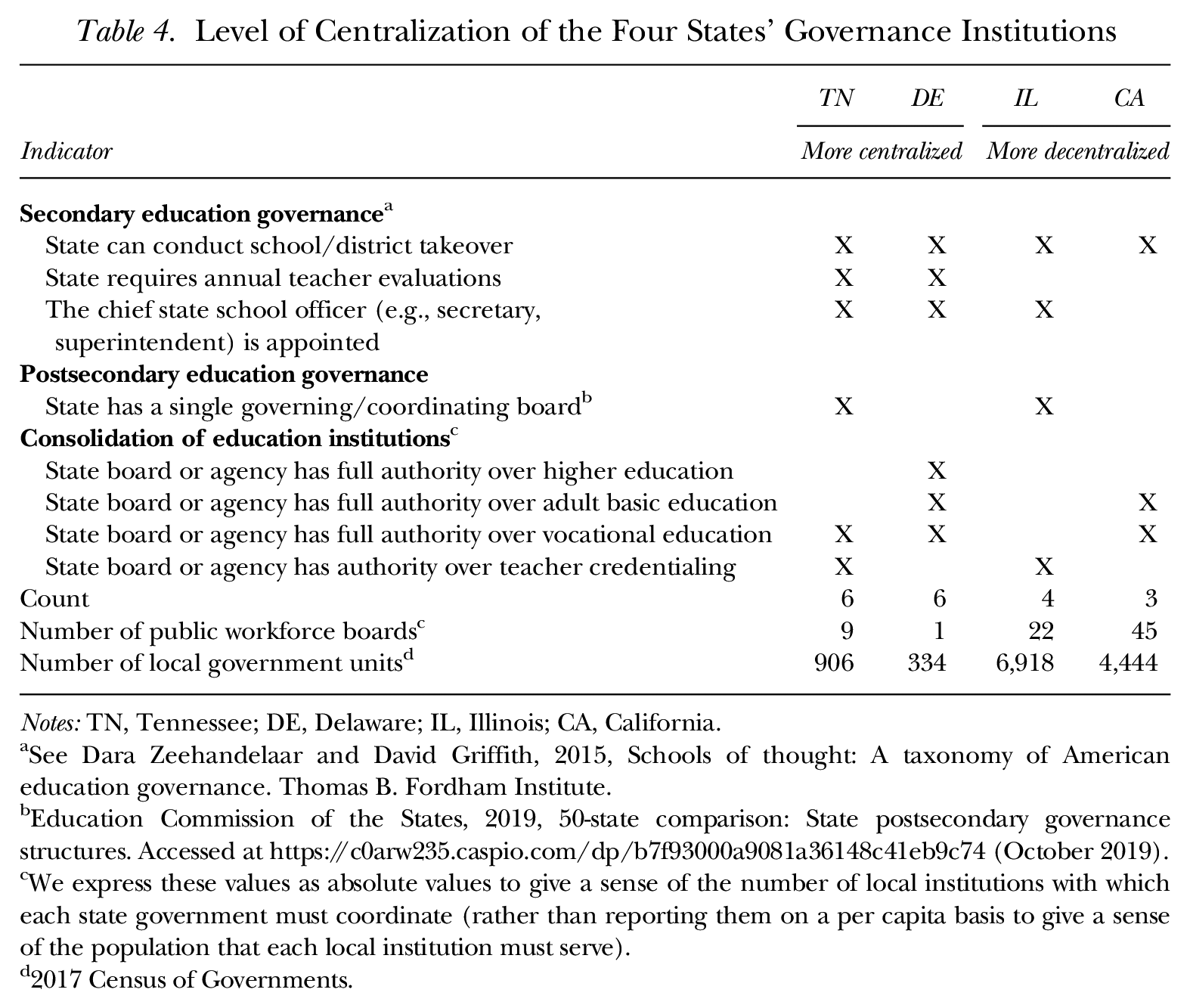
Notes: TN, Tennessee; DE, Delaware; IL, Illinois; CA, California.
See Dara Zeehandelaar and David Griffith, 2015, Schools of thought: A taxonomy of American education governance. Thomas B. Fordham Institute.
Education Commission of the States, 2019, 50-state comparison: State postsecondary governance structures. Accessed at https://c0arw235.caspio.com/dp/b7f93000a9081a36148c41eb9c74 (October 2019).
We express these values as absolute values to give a sense of the number of local institutions with which each state government must coordinate (rather than reporting them on a per capita basis to give a sense of the population that each local institution must serve).
2017 Census of Governments.
State Actor Orchestration
State actors responded to a common set of barriers—structural, political, and cultural—when facilitating statewide coordination of workforce development. State actors addressed these barriers by engaging in state actor orchestration—structuring provisional goal setting and revision, encouraging experimentation, and framing coordination to inspire collective action across sectors (Table 5; also see Figure 1). The specific structural, political, and cultural practices that state actors used varied according to states’ institutional environments.
State Actor Practices in the Centralized and Decentralized States
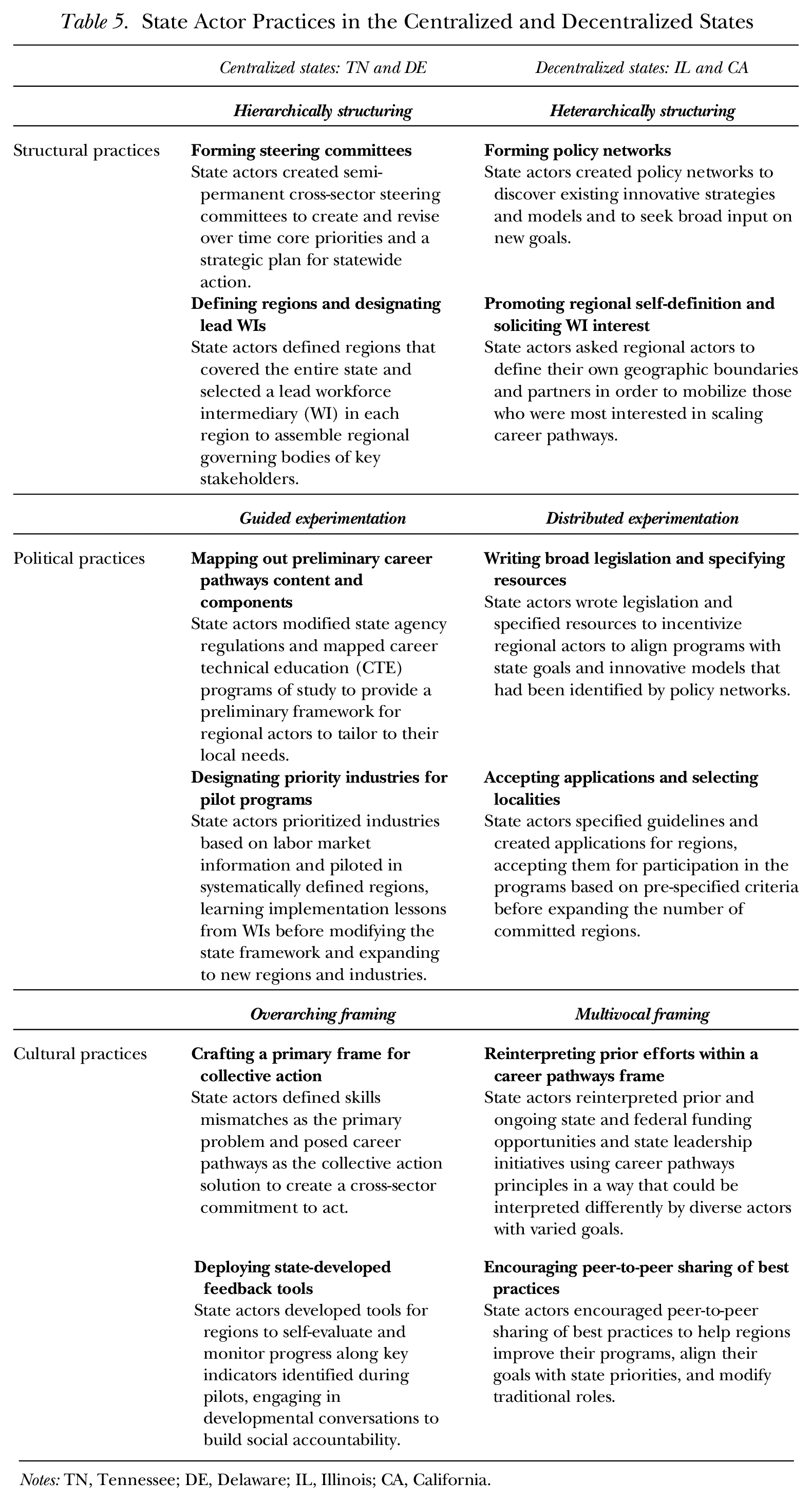
Notes: TN, Tennessee; DE, Delaware; IL, Illinois; CA, California.
For clarity, we present a detailed discussion of only two states, using TN to illustrate the centralized states and using IL to illustrate the decentralized states. We selected TN and IL because they are more similar in population and more representative of other US states than are DE and CA. Table A in the Online Appendix includes state actor practices used in DE and CA.
State Actor Structural Practices
Key Structural Barriers
State actors faced two key structural barriers to coordinating statewide workforce development. First, state actors and WIs faced strategic uncertainty regarding goals and available resources. Second, scaling regional programs risked losing the local knowledge that was based on regional cultures, histories, and relationships, which was important to successful service delivery.
Regarding strategic uncertainty, a TN WI actor explained to us how discussions at an early conference had surfaced uncertainty about how to involve educators in regional workforce development efforts. She said, “At that point, [we just needed to] build some momentum and generate ideas. . . . [Our early efforts were] a little bit of a hot mess logistically.”
Regarding localized knowledge, one former industry leader and educator in TN described that a regional economic development organization had historically acted as a lead WI in his region, because the local public workforce development board was not a high-functioning organization: In essence, [the public workforce development board] isn’t performing as it should be. . . . [The economic development organization] created work-around programs. We just go do it ourselves. . . . The true fix is to get [the public workforce development board] involved, [but] we’re still not there yet.
To coordinate WI efforts in the face of these structural barriers, state actors built architecture to structure provisional goal setting and revision. While all states built statewide governance structures and modified governance processes, the specific structural practices that state actors used to do this varied according to states’ institutional environments.
Centralized State Actor Structural Practices: Hierarchically Structuring
State actors in centralized states addressed the barriers of strategic uncertainty and localized knowledge by hierarchically structuring—building hierarchical architecture with formal roles and accountability mechanisms to set strategic direction and adjust goals in an ongoing manner, and to accomplish the division and integration of work across specialties.
First, to address the barrier of strategic uncertainty, state actors formed semi-permanent, cross-sector steering committees. For example, in TN, state actors created a steering committee of high-level state actors from state agencies, which created and revised core priorities and a strategic plan for what they called “Tennessee Pathways.” This steering committee met quarterly to provide updates and analyze their progress. To provide day-to-day support to regional leaders, state actors also established a complementary group staffed by mid-level state actors, including several from the state Department of Education.
Next, to address the barrier of localized knowledge, state actors in the centralized states defined regions and designated a lead WI within each region, parsing the state into non-overlapping regions that were led by effective intermediaries. State actors helped guide these lead WIs to assemble regional governing bodies of key stakeholders—including high schools, colleges, and employers. In TN, a state actor from the Department of Education told us that the steering committee decided to follow the state Economic Development agency’s delineation of regions because these regions represented “laborsheds”—areas from which employment centers drew their commuting workers. A TN state actor told us that they helped designate lead WIs for each of these regions based on which entity “has regional presence [and reputation] with the capacity to take on work.”
State actors worked with lead WIs—including a chamber of commerce, a workforce investment board, and a manufacturers association—to divide and integrate key pathways work in their regions across the areas of education, workforce development, and economic development. For example, one lead WI in TN organized committees that conducted pathways work for specific industries in her region (e.g., a manufacturing committee and a health care committee), and each committee had representation from educators and employers. State actors also asked lead WIs to take turns presenting at state meetings, so that state actors could better understand the issues that were arising on the ground in the regions.
Decentralized State Actor Structural Practices: Heterarchically Structuring
While state actors in centralized states addressed the barriers of strategic uncertainty and localized knowledge by hierarchically structuring, state actors in decentralized states did so by heterarchically structuring—providing guidance at the state level to set strategic direction and adjust goals in an ongoing manner, while decentralizing decision-making to the regions. These heterarchical structures relied on horizontal rather than vertical relations and utilized multiple sources of expertise and accountability.
At the state level, rather than creating steering committees, state actors formed policy networks to discover existing, innovative models and to seek broad input on goals. For example, before IL’s partnership with PtoP, state actors and business leaders in IL had partnered with one another to improve secondary education in STEM disciplines (science, technology, engineering, and mathematics). Upon joining PtoP, similar state actors and business leaders now formed a policy network called the College and Career Readiness (CCR) committee to discover career pathways strategies and models already existing within IL and other neighboring states. The committee arrived at recommendations that helped to identify and scale the lessons learned from earlier initiatives. A state actor in IL told us: It’s not that [past initiatives] have gone away. . . . It’s actually that the [same] organizations are still carrying out many of the same functions. . . . It’s just been different shifts and pivots as we’ve learned [lessons] from [those initiatives].
Next, rather than addressing the barrier of localized knowledge by defining regions systematically and designating lead WIs in each region, state actors in decentralized states promoted regional self-definition and solicited WI interest from WIs that were already doing career pathways work. For example, IL state actors asked regional actors to define their own geographic boundaries and partners: We’re agnostic as to how communities define themselves . . . [but they] had to document their partnerships and define a geographic community of focus—which is harder than it sounds; one rural community has about fifteen [school] districts.
Grassroots regional definition mobilized the regional actors who were most interested in partnering with IL state actors. It also allowed WIs to build buy-in and to leverage existing regional assets. For instance, several regions in IL chose to focus solely on the health care industry because of its large presence in their regions.
State Actor Political Practices
Key Political Barriers
State actors faced two key political barriers to coordinating statewide workforce development. First, WIs operated under conflicting regulations, and second, they had entrenched regional interests based on existing jurisdictional boundaries.
Cluttered policy landscapes from past state efforts created complicated regulatory hurdles for new types of cross-organizational partnerships. Many employers and educators had been involved in multiple failed or short-lasting education initiatives, so they were hesitant to forge new partnerships. An IL WI actor told us, “I’ve been on every [workforce development] committee over the past fourteen years. . . . [For one of our past initiatives, the partners] weren’t on the same page, and none of the high schools adopted it.”
In addition, WI coordination required reworking formal and informal jurisdictional boundaries. For example, individual high schools and colleges had existing relationships with employers that they felt they “owned,” and colleges sometimes had overlapping jurisdictional boundaries. A TN WI described how it was difficult to partner with all the colleges in her region because of a prior “turf war” between two of them. She explained, “[One college] was in [another college’s] territory . . . so the chancellor [of the community college system] had to get involved [and specify their jurisdictions].”
In the face of these political barriers, state actors coordinated statewide workforce development by encouraging experimentation. While all states provided initial direction and then piloted programs and broadened the set of stakeholders over time, the specific political practices that state actors used to do this varied according to states’ institutional environments.
Centralized State Actor Political Practices: Guided Experimentation
State actors in centralized states addressed the barriers of conflicting regulations and entrenched regional interests by engaging in guided experimentation—creating a common framework for action and then allowing regional actors to test the framework with discretion and report back on their progress.
First, state actors created a common framework by mapping out preliminary career pathways content and components. This framework relied on modifying state agency regulations to specify the type of student coursework and work-based learning components for each pathway (e.g., the nursing pathway), and to provide guidance on creating connections across certain types of secondary and postsecondary education programs. For instance, in TN, high school career and technical education (CTE) programs of study (series of courses for high school students that related to a particular occupation area such as welding, network security, or agriculture) formed the backbone of the state’s career pathways framework. Previously, programs of study in TN had been ill-specified because they were associated with outdated or unvalued industry certifications; programs had been misaligned because they were not linked to local postsecondary organizations; and programs had been inconsistent because school districts had been able to offer a program of study without offering the same courses across different schools in the same school district.
The TN steering committee facilitated an audit of all programs of study through the state Department of Education. Next, state actors modified agency regulations by mapping potential linkages between industry-related high school programs, on the one hand, and community or technical college degree programs, on the other. For example, the linkages specified that completing a high school healthcare pathway would give students some college credit at nursing or medical technician college programs in the state. The mapped linkages sometimes disrupted existing jurisdictions, particularly when educators felt threatened by the phasing out or modification of programs that did not align with high-demand occupations. To manage this conflict, state actors relied on committed and visible state and regional actors to help explain these actions.
Next, state actors addressed the barrier of entrenched regional interests by allowing regional actors to implement the framework with discretion and report back on their progress. State actors did this by designating priority industries for pilot programs and working with lead WIs to help implement and experiment with the pilots. State actors then responded to ongoing problems and possibilities by adjusting their framework. For example, in TN, state actors analyzed state labor market information and selected the priority industries of advanced manufacturing, health care, and information technology. State actors then helped each lead WI use local labor market information to choose which of the three priority industries to pilot. The pilot programs acted as “proofs of concept” for the new career pathways since they were targeted to high-demand occupations and therefore had strong industry support. This facilitated successful pilots and allowed the steering committees to draw on lessons learned as they expanded the programs.
Decentralized State Actor Practices: Distributed Experimentation
While state actors in the centralized states addressed the barriers of conflicting regulations and entrenched interests by engaging in guided experimentation, state actors in decentralized states addressed these barriers by using distributed experimentation—identifying and directing resources toward innovative general strategies and then allowing regional actors to adapt these strategies to their own contexts.
First, to address the barrier of conflicting regulations, rather than mapping out preliminary career pathways content and components, state actors wrote broad legislation and directed resources toward innovative strategies identified by their policy networks. For example, in IL, after an extensive policymaking process that included both regional and state actors, the state House of Representatives passed the Postsecondary and Workforce Readiness (PWR) Act in 2016. The PWR Act established four strategies: 1) college and career pathway endorsements: stamps on high school diplomas to demonstrate student mastery of industry-aligned competencies; 2) a college and career readiness accountability framework with 8th–12th grade benchmarks; 3) transitional math: high school coursework to guarantee placement in college-level math, rather than remedial math, at IL community colleges; and 4) competency-based learning systems: school district-defined sets of competencies required for high school graduation (such as demonstrated knowledge of math topics in a workplace or project-based setting) rather than requirements to take a series of courses (like four years of math). For all four of these strategies, regional actors had control over implementation, but the PWR Act signaled to regional actors the type of initiatives that state actors supported.
Next, to address the barrier of entrenched interests, rather than designating priority industries for pilot programs, state actors accepted applications and selected localities to implement PWR Act programs. For example, in IL, state actors developed applications that required school districts to specify plans for their competency-based systems, including professional development opportunities for teachers. Ten school districts applied for the program in its first year, and state actors selected all ten after evaluating the applications. State actors repeated their “request for applications” several times in subsequent years in order to expand the number of districts offering the programs. An IL Department of Education actor said, “[The application process means that] a district has to do it for the right reasons upfront, in terms of investment and commitment.” This created some early wins that state actors leveraged to support the expansion of the programs.
State Actor Cultural Practices
Key Cultural Barriers
Finally, state actors faced two key cultural barriers to coordinating statewide workforce development. First, state and regional actors had taken-for-granted beliefs about the best way to educate students. Second, these beliefs reinforced traditional roles for employers, educators, and the state that conflicted with the new roles associated with career pathways.
Regarding taken-for-granted beliefs, an IL educator told us that most stakeholders historically had a belief that high school graduates should either go to a four-year college or go straight into the workforce. She noted that many students’ parents asked, “‘What is apprenticeship, and what are these different models? If I don’t send my kid to college . . . will they go back to school?’ We’re really trying to [communicate] what that continuum looks like.”
Traditional roles posed another cultural barrier. One PtoP actor told us that implementing career pathways required educators to rethink the role of career technical education (CTE) and the purpose of secondary education by asking “what the CTE side . . . does that could be useful to what the academic side does, and vice versa.” Further, community colleges had historically educated students in terminal or transfer degree programs, but most colleges had not also provided employers with resources to help improve local job opportunities. And, many college-level educators and most employers historically had not participated in secondary education or workforce training programs.
In the face of these cultural barriers, state actors coordinated statewide workforce development by framing coordination to inspire collective action across sectors. While all states identified key problems and collective action solutions and built social accountability for new roles, the specific cultural practices that state actors used to do this varied according to states’ institutional environments.
Centralized State Actor Practices: Overarching Framing
State actors in centralized states addressed the barriers of taken-for-granted beliefs and traditional roles by engaging in overarching framing—defining an overarching problem and specifying each actor’s role in a collective action solution.
First, to overcome the barrier of taken-for-granted beliefs, state actors crafted a new primary frame for collective action—skills mismatches. This primary frame defined the key problem as mismatches between the skills that graduates had and the skills that employers in middle-skilled industries needed, and it emphasized career pathways as the collective action solution. This frame appealed to educators’ interest in preparing their students for work and life, and it encouraged non-education stakeholders such as employers to join the effort. One state actor from the Department of Education explained: We’re a top recruiting state for manufacturing, but . . . we struggle with who [has the skills to] do the work. . . . We believe [career] pathways are the vehicle for that change—aligning educational opportunities with workforce interests and leading to a skilled talent pool driven by [employers’] workforce demand.
Next, to address the barrier of traditional roles, state actors built social accountability by deploying state-developed feedback tools that specified each stakeholder’s role in career pathways. For instance, TN state actors held meetings in which lead WIs and their partners completed a “site observation tool.” This tool asked regional actors to rate their region’s progress on elements such as “use of data” and “outreach to employers.” The tools were not used for formal state-level accountability but to stimulate regional deliberation and learning. A state actor from the Department of Education explained to us: I wanted to make it clear to our stakeholders that this [process] is to allow for some self-reflection. . . . It’s not a stick [a sanction]. [They are] going to have the opportunity to provide recommendations [to others] in the region, and to tell us what the state can do to help support [them].
State actors asked lead WIs to share the process and results from their meetings with other regional stakeholders and to use these discussions to prioritize next steps. A lead WI actor said about her region’s steering committee: We sent out the [rubric] materials to everyone [on the regional steering committee] because not everyone participated [in the meeting]. . . . When everyone had viewed [the results], we determined . . . employer engagement was the top [priority], so [we’re] developing a more strategic approach to get more employers engaged.
State actors compiled and shared results from these meetings during an annual statewide career pathways conference, where regional actors gathered to receive policy updates and engage in team planning. Overall, the feedback tools allowed regional actors to measure themselves along critical dimensions, including the expansion and modification of traditional roles.
Decentralized State Actor Practices: Multivocal Framing
While state actors in centralized states addressed the barriers of taken-for-granted beliefs and traditional roles by engaging in overarching framing, state actors in decentralized states addressed these barriers by engaging in multivocal framing—defining a primary problem and collective action solution, but in a way that could be flexibly interpreted.
First, to overcome the barrier of taken-for-granted beliefs, rather than crafting a new primary frame for collective action, state actors reinterpreted within a career pathways frame the state leadership’s priorities, federal and statewide funding opportunities, and high performing state and local approaches. As in the centralized states, the primary frame defined skills mismatches as the key problem and emphasized career pathways as the collective action solution. However, decentralized state actors used this frame in a way that could be interpreted differently by diverse actors with varied goals. For example, IL had previously received short-term federal funding to improve STEM education under the Obama-era federal program, Race to the Top. State actors reinterpreted these prior efforts as relating to the goals of career pathways. An IL state actor from the community college governing agency explained this process: We have worked very hard as an agency to push some of the concepts of career pathways, including employer engagement, [curriculum] alignment, stackable credentials . . . and [to emphasize them] as being core to everything that we’ve done in our system [under prior initiatives].
Reinforcing the career pathways frame provided regional actors with new views of the problems and collective action solutions within the current system. It also created sustainability through shifting political administrations that wished to put their own brand on new policies.
Next, to address the barrier of traditional roles, rather than deploying state-developed feedback tools specifying each stakeholder’s role, state actors encouraged peer-to-peer sharing of best practices. For example, IL state actors held conferences for districts to share lessons they learned from the competency-based systems pilots. One state actor from the Department of Education said: We’ve done one [statewide] convening and we’re going to do a couple of regional convenings. . . . [At the state level,] we’re trying to hire a unique role—storytellers. . . . [Their role will be] tied to building relationships with the districts . . . to allow that peer-to-peer . . . sharing of sparks across districts.
Statewide conferences stimulated new ideas and generative conversations about challenges and best practices; regional conferences allowed stakeholders to receive information that was relevant, granular, and appropriate for their particular regions. Peer-to-peer sharing of best practices allowed regional actors to track progress along key dimensions, including the expansion and modification of traditional roles.
Discussion
Contributions to Workforce Intermediation Research
In this article, we elaborate the importance of state actor orchestration—structuring provisional goal setting and revision, encouraging experimentation, and framing coordination to inspire collective action across sectors—to the coordination of statewide workforce development systems. In recent years, studies of regional workforce intermediaries have contributed to our understanding of how workforce development can be delivered effectively for workers, employers, and communities (e.g., Giloth 2004; Kazis 2004; Lowe et al. 2011). However, without efforts to coordinate their activities into a broader, coherent workforce system (e.g., Lowe 2010, 2014; Lowe et al. 2011), the United States has lagged behind the employment and skill attainment outcomes achieved in some European countries.
We demonstrate that US states and regions together have the potential to bring some order and structure to US labor markets to functionally approximate the connections between education, training, and employment that exist in European VET systems. State actors can overcome historical barriers to coordinating workforce development across multiple geographies and industries by engaging in three types of orchestration practices: structural practices (building statewide governance structures and modifying governance processes), political practices (providing initial direction and piloting and broadening the set of stakeholders), and cultural practices (identifying key problems and collective action solutions and building social accountability for new roles).
While state actors used these general orchestration practices to accomplish statewide workforce development, the specific practices varied according to states’ institutional environments. Where the states’ governance institutions are more centralized, state actors gained more latitude in guiding regional workforce development. Centralized institutions may allow state actors to build hierarchical architecture, encourage guided experimentation, and use overarching framing to accomplish statewide workforce development. Yet, even in states where institutions are more decentralized, state actors may be able to coordinate statewide workforce development by building heterarchical architecture, encouraging distributed experimentation, and using multivocal framing (see Figure 1).
Contributions to Workforce Development Research
Our findings also provide five contributions to recent research on US workforce development, which has highlighted the ways that innovative states can integrate their workforce development, economic development, and education systems (e.g., Holzer, Linn, and Monthey 2013; Dedrick 2014; Holzer 2011, 2017). First, we demonstrate that state actors can take a more interventionist role than has been described in previous literature (cf. Osterman and Batt 1993) by building strong connections with regional workforce intermediaries in pursuit of statewide systems change. Through these connections, regional actors can provide input into state-level practices and mobilize additional regional support. These findings suggest that state government staff capacity may need to be increased for the purposes of supporting and connecting regional change efforts.
Second, we provide a theoretically grounded account of workforce institution-building in the US context to complement the numerous evaluation studies of regional workforce development interventions (e.g., Buford and Dresser 2014) and policy implementation efforts (e.g., Holzer 2015). In particular, we demonstrate that the centralization of state governance is an important source of variation that affects how workforce models can be designed, implemented, and expanded and with what outcomes. Our findings suggest that a state’s institutional environment may affect the speed and breadth of workforce development coordination. Specifically, centralized states may achieve quicker and broader coordination, because centralized state actors may have latitude to pursue regulatory changes within state departments that help structure provisional goal setting and revision and that encourage experimentation in regions. By contrast, decentralized state actors may need to use a lengthy legislative policymaking process that may result in slower and narrower workforce development coordination. Based on these findings, we argue that attempts at program replication, scaling, and coordination should consider not only regional contexts (Giloth 2000) but also state governance contexts.
Third, we show how state actor orchestration in centralized states can result in flexible and relatively rapid systems-level outcomes in three main ways. Centralized state actor practices can allow regional actors to align their existing programs to modified state regulations rather than requiring them to submit applications to offer new state programs. Centralized state actor practices can allow for relatively quick action, because diverse regional actors can use provisional settlements to address conflicts, rather than binding themselves to particular courses of action under formal policies. And, centralized state actor practices can allow states to quickly test a preliminary framework and iterate on it.
Fourth, we demonstrate how state actor orchestration in decentralized states can result in relatively slower, but perhaps more sustainable systems-level outcomes in three main ways. Decentralized state actor practices can result in formal policies that may be protected from new political administrations with different priorities. Decentralized state actor practices can allow regional actors to co-opt programs from new formal policies and adapt them to fit diverse regional contexts, which can increase regional actors’ commitment to the programs. And, decentralized state actor practices can allow regional actors to voluntarily adopt new programs, which can reduce resistance to changing jurisdictional boundaries attributable to the new programs.
Finally, we show that an important aspect of an articulated workforce development system includes connecting the “first chance” and “second chance” education and training systems. Though state actors in all four states implemented career pathways in secondary and postsecondary education institutions, they also attempted to align with their state workforce development plans under the federal Workforce Innovation and Opportunity Act of 2014 (WIOA). WIOA provides funds for public workforce development boards and One Stop Career Centers—organizations that are part of the second chance system and frequently studied in workforce development research. Perhaps surprisingly, these public workforce development actors did not feature prominently in our study, though some did serve as WIs and as committee representatives. In these cases, regions could expand beyond youth career pathways programs to also coordinate programs that served adult workers.
Future Research and Practical Implications
Our findings raise several important questions for future research. First, we focused on the implementation stage of state actor orchestration and identified heterogeneity in state actor practices related to states’ institutional environments. We did not analyze earlier stages of states’ partnerships with the PtoP Network, including why some states assembled broad state-level support to form partnerships with PtoP and others did not. These questions are important for future research, and our findings are conditional on states successfully moving through these early stages.
Second, while our study highlights the importance of state actor practices, we were not able to provide rigorous quantitative evaluation of the new workforce development systems, because the states in our study did not themselves do this. Future research could explore better ways to design such systems to be flexible and context-dependent while also facilitating such rigorous evaluation. It could also evaluate the effects and validity of the practices we have identified here, as well as key sources of failure and whether equitable outcomes can be achieved. Future research could also explore whether state actor orchestration is useful in addressing challenges other than inadequate skill attainment and employment.
Third, while the PtoP–state partnerships were established beginning in 2012, such partnerships take a long time to mature. It is unclear whether the systems we studied will persist through changing economic conditions, and whether this may differ by states’ institutional environments. For example, decentralized states may achieve more sustainable implementation because decentralized programs may be better adapted to individual regions and less threatened by the introduction of new administrations with different priorities. However, programs dependent on short-term funding may be unsustainable. Future research could evaluate these questions.
Finally, in terms of practical implications, our study presents a sobering view of how difficult it is to build coordinated workforce and education systems in the United States, which lacks the supportive infrastructure of European VET systems. And yet, we identify a toolkit of practices that state actors can use to orchestrate more coordinated workforce development systems without funneling resources toward a limited set of organizations or committing to scaling a single programmatic strategy. Given increasingly rapid economic changes (Carnevale, Gulish, and Strohl 2018), it is important to preserve the flexibility of the US labor market and to empower effective local leaders, no matter what type of workforce organization they lead (Marano and Tarr 2004). US workforce and education systems will always be complex, but our study demonstrates that they need not remain fragmented.
Supplemental Material
ILRR_Myers_Kellogg_Supplemental-Online-Appendix – Supplemental material for State Actor Orchestration for Achieving Workforce Development at Scale: Evidence from Four US States
Supplemental material, ILRR_Myers_Kellogg_Supplemental-Online-Appendix for State Actor Orchestration for Achieving Workforce Development at Scale: Evidence from Four US States by Jenna E. Myers and Katherine C. Kellogg in ILR Review
Footnotes
Acknowledgements
Thank you to Paul Osterman for insightful comments on multiple earlier versions of the paper. This article also benefited from the thoughtful feedback of Tom Kochan, Lotte Bailyn, Emily Truelove, Summer Jackson, Michael Wahlen, and seminar participants in the MIT Economic Sociology Working Group and the MIT Work and Organization Seminar. This article would not have been possible without the time given by the Pathways to Prosperity Network staff at Jobs for the Future and their many state and regional partners.

For information regarding the data and/or computer programs used for this study, please contact the first author at
References
Supplementary Material
Please find the following supplemental material available below.
For Open Access articles published under a Creative Commons License, all supplemental material carries the same license as the article it is associated with.
For non-Open Access articles published, all supplemental material carries a non-exclusive license, and permission requests for re-use of supplemental material or any part of supplemental material shall be sent directly to the copyright owner as specified in the copyright notice associated with the article.
