




Abstract
As temporary employment has become a pervasive feature of modern labor markets, reasons for wage growth have become less well understood. To determine whether these two phenomena are related, the authors investigate whether the dualized structure of labor markets affects macroeconomic developments. Specifically, they incorporate involuntary temporary workers into the standard wage Phillips curve to examine wage growth in 30 European countries for the period 2004–2017. Relying on individual-level data to adjust for a changing employment composition, their findings show, for the first time, that the incidence of involuntary temporary workers has strong negative effects on permanent workers’ wage growth, thereby dampening aggregate wage growth. This effect, which the authors name the competition effect, is particularly pronounced in countries where wage bargaining institutions are weak. The findings shed further light on the reasons for the secular slowdown of wage growth after the global financial crisis.
Keywords
Temporary employment has become a pervasive feature in European labor markets. The reason is simple: Temporary employment is more flexible in terms of labor cost adjustments than permanent employment. Further, it is well established that temporary employment comes with a wage penalty (Pavlopoulos 2013; Kahn 2016). For many employers, temporary employment is, thus, a cheaper source of labor. Yet, the flexibility of temporary contracts often disproportionately benefits employers instead of workers (Hyman 2018), resulting in substantial levels of involuntary temporary workers. Involuntary temporary employment has behavioral implications central to our analysis. Notably, involuntary temporary employment, by definition, forms part of the labor supply for permanent employment and thus may foster competition between different segments of workers.
We propose a mechanism through which the presence of involuntary temporary employees dampens the bargaining power and wage growth of permanent workers. This competition effect is not captured by the unemployment rate. To empirically identify a potential competition effect, we draw on a sample of 30 European countries in the period 2004–2017. Given the large country heterogeneity with respect to the incidence of involuntary temporary employment in Europe, the effect is expected to be mainly driven by differences across countries. To what extent temporary employment can influence the bargaining power of workers likely depends on a country’s institutional framework. Therefore, we expect the institutional framework to reinforce or dampen the impact of temporary employment on wage growth.
While cross-country variation of temporary employment might predominate, the within-country variation linked to business cycle dynamics should not be neglected. The incidence of temporary workers increases in the early stages of a recovery (i.e., when the unemployment rate starts to decline) and falls swiftly in the downturn. Hence, temporary employees can create an additional source of slack in labor markets, which necessitates examining potential competition between temporary and permanent workers that occurs over the time dimension. At the same time, fluctuations in temporary employment also affect aggregate wages by changing the share of workers who incur a wage penalty due to their temporary contract. For instance, temporary workers are typically the first to be laid off during a recession, which mechanically increases average wages through a pure composition effect. To adjust for a changing composition of employment, we use worker-level data to construct an adjusted wage growth variable that allows us to focus on competition effects only.
Building on the insights of a relatively recent strand of literature (Damiani, Pompei, and Ricci 2020; Bellani and Bosio 2021), we thus explore how labor market dualities have affected wage growth in Europe since 2004. We do so by investigating the impact of involuntary temporary employment on wage growth in a wage Phillips curve model and by exploring the role of institutions. We then examine whether involuntary temporary employment helps to understand the Phillips curve flattening in the recovery period after the 2008 Global Financial Crisis (GFC).
Labor Market Dualization and the Competition Effect
Involuntary temporary employment is pervasive in European economies (ILO 2016) with an increasing share of workers experiencing temporary employment (Latner 2022). Driving this trend of labor market dualization are structural changes, such as the service sector’s growth (Marx 2011) and deregulation policies (Polavieja 2006; Emmenegger, Häusermann, Palier, and Seeleib-Kaiser 2012; Biegert 2014; Thelen 2014). Shares vary across countries (Figure 1), averaging 5.5% in 2017 compared to a 7.4% average unemployment rate. Does its prevalence impact wage-setting?
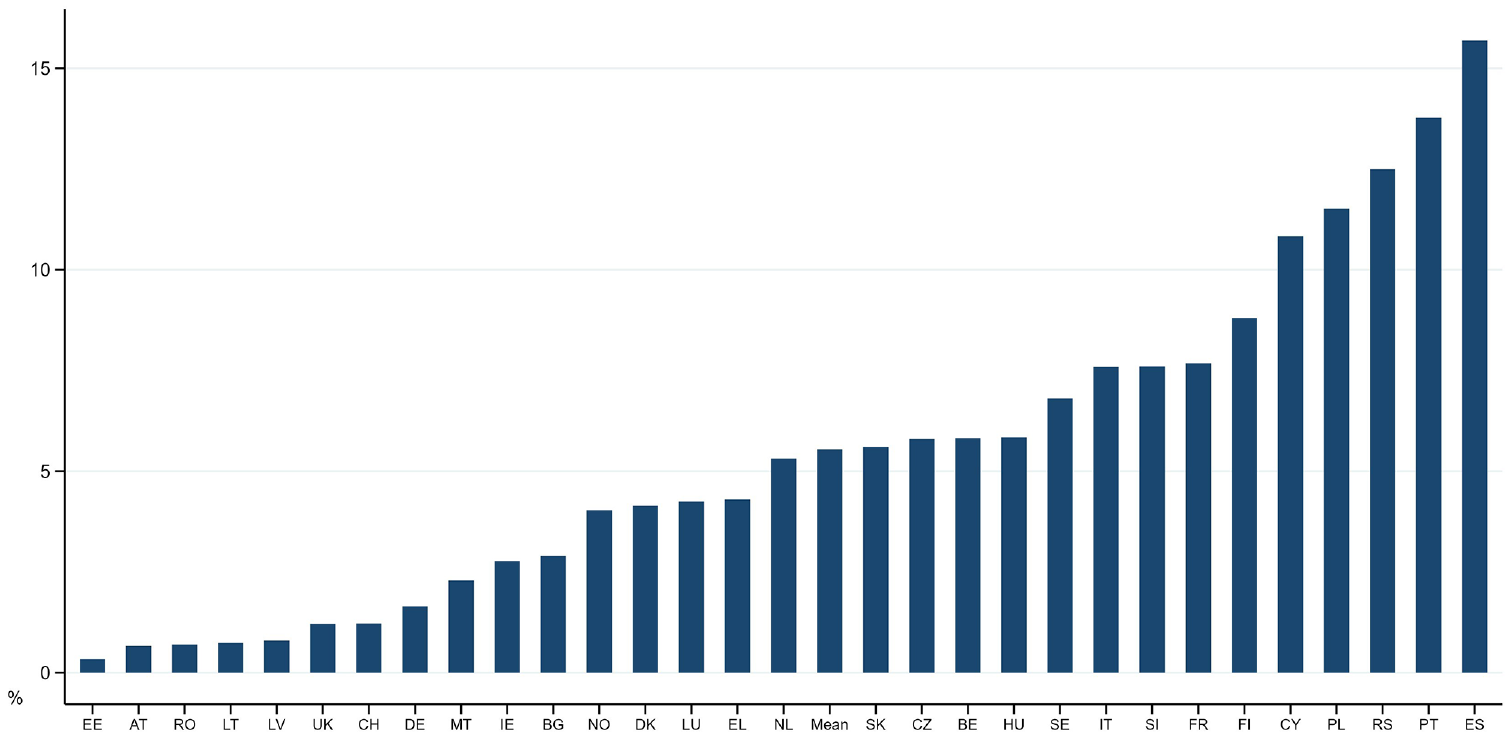
Involuntary Temporary Employment in Europe, 2017
Relationship between Temporary and Permanent Workers
We introduce the competition effect to understand the relationship between temporary and permanent workers and to investigate its macroeconomic consequences. Drawing on industrial relations scholarship, we hypothesize that the presence of involuntary temporary workers restrains wage growth by elevating job insecurity for permanent workers, which weakens their bargaining position. Indeed, temporary employment contributes to a rise in perceived job insecurity (Kuroki 2012: 564), which has been suggested to explain wage restraint (Katz and Krueger 1999). Our hypothesis is supported by Damiani et al. (2020), who showed that reductions in employment protection for temporary workers can reduce overall wage shares. Bellani and Bosio (2021) found that, at the occupational level, wages of permanent employees are negatively affected by the incidence of overall temporary employees (i.e., voluntary and involuntary). Ramskogler (2021) indicated that overall temporary employment has a negative effect on aggregate (unadjusted) wage growth in Europe.
Exacerbating the competition effect, employers may foster discord between workers to prevent the emergence of a unified labor bloc (Bellani and Bosio 2021). For instance, temporary agency workers are used to mitigate wage pressures (Houseman, Kalleberg, and Erickcek 2003; Drenik, Jager, Plotkin, and Schoefer 2023), and reforms in temporary employment have worsened conditions for permanent employees (Dolado, García-Serrano, and Jimeno 2002), in particular for those with lower and middle incomes (Weisstanner 2020). Empirically, findings have shown evidence of competition between permanent and temporary employees (Voinea 2018). In line with earlier work (Piore 1979; Western and Healy 1999), we suggest that segments of workers and their interaction with labor market institutions affect the wage-setting process over and above standard macroeconomic factors.
The competition between temporary and permanent workers could invert the established insider-outsider logic (Lindbeck and Snower 1988, 2002), which in its early work on dual labor markets challenged human capital theory (Doeringer and Piore 1971; Rosen 1972; Reich, Gordon, and Edwards 1973; Piore 1983; Dickens and Lang 1985). Applied to temporary work contracts, the insider-outsider theory suggests that larger hiring and firing transaction costs for insiders create two labor market segments. Insiders enjoy relatively higher economic security than outsiders and can extract rents to the detriment of outsiders by securing higher wages. This imbalance results in the wage penalty that is well established: Under equal conditions, temporary workers receive smaller paychecks than do permanent workers (Pavlopoulos 2013; Kahn 2016). Employers have the incentive to replace permanent employees with temporary ones if the transaction costs associated with hiring and firing permanent employees are lower than the wage penalty (Koutentakis 2008).
As such, the wage penalty can obscure the empirical analysis of the competition effect. Changes in the share of temporary workers who suffer from the wage penalty mechanically affect aggregate wages. This mechanism results in a composition effect on wage growth, which we correct for.
Role of Labor Market Institutions
The competition effect hypothesized interacts with labor institutions. Olson (1971) proposed that significant but non-encompassing collective interests are detrimental at the societal level. The implications for wage determination are widely discussed (Calmfors and Driffill 1988; Soskice 1990). In the insider-outsider model, it is easier for insiders to protect their rents at moderate levels of worker organization. At high levels, fewer outsiders are available to bear externalization costs, while at low levels, insiders face stronger competitive pressures.
The simplest measure of the inclusiveness of trade unions is their membership density (Lange 1984). According to Olson’s theory, we expect a negligible competition effect in countries with moderately encompassing membership. We expect a large effect in countries with low membership, as insiders lack sufficient power to protect themselves. In contrast, countries with encompassing membership are expected to experience no competition effect, as outsider interests are likely to be internalized. 1 Only the Nordics, Belgium, Malta, and Cyprus still have high membership rates above 40% of the labor force (Appendix Figure A.1 ["Appendix" refers to the Supplementary Online Appendix file]). Determining the cutoff between low and medium trade union density (TUD) is less obvious. The distribution of membership rates suggests a cutoff at 20%, which we follow, but we test for robustness using various cutoff values.
While TUD seems a suitable measure to capture how encompassing unions are, we also use collective bargaining coverage (CBC) for robustness. We again assign countries into three groups: The high group with above 85% coverage comprises mainly countries with an automatic extension of CBC including France, Spain, Belgium, Austria, Finland, and Sweden, while the low group with less than 35% coverage comprises exclusively the Central Eastern European countries and the United Kingdom.
Another measure of robustness is wage bargaining coordination (OECD and AIAS 2021), which describes the vertical and horizontal relations between bargaining units, such as national confederations, sectoral associations, and at the firm level, employers and worker representatives (Traxler and Brandl 2012). The high group comprises countries with established norms about wage bargaining, predominantly Nordic and Continental European countries. The middle group includes countries that rely on procedural guidelines for coordination with no regularized patterns, such as Spain, Ireland, and Switzerland. The lowest group again contains traditionally Central Eastern European countries, the United Kingdom, and some Mediterranean countries.
We also analyze the impact of employment protection legislation (EPL), which refers to the level of protection provided to permanent workers against individual and collective dismissals. We expect the effect of EPL to be ambiguous: Stricter employment protection may enhance workers’ bargaining power but also incentivize employers to hire temporary workers to avoid dismissal costs, thus intensifying competition between temporary and permanent workers. Furthermore, workers subject to more stringent EPL may find themselves in a golden cage, where they have more to lose if they were to be replaced with temporary employees and, thus, accept lower starting wages (Lazear 1990). We categorize countries into high and low EPL groups. Appendix Table E.2 displays the descriptive statistics and country groupings.
Post-Crisis Phillips Curve Flattening
After the GFC, wage growth fell short of expectations based on the established relationship between unemployment and wages (Kahn 1980; Blanchflower and Oswald 1995). Early signs of a weakened relationship between wages and inflation emerged around 2012 (Anderton and Boele 2015; Ciccarelli and Osbat 2017; Moretti, Onorante, and Saber 2019). To explain the wage growth slowdown, conventional measures of labor market slack were adjusted for hidden slack, including discouraged workers and involuntary working time reductions, which had increased during the recession (Hurley and Patrini 2017; IMF 2017; Hong, Koczan, Lian, and Nabar 2018; Nickel et al. 2019). Bell and Blanchflower (2019) constructed a labor underutilization index, which enhances the fit of the Phillips curve for Europe (Bell and Blanchflower 2021) and the United States (Blanchflower, Bryson, and Spurling 2022).
Involuntary temporary employment constitutes a specific form of labor underutilization, commonly used by firms to absorb labor market fluctuations (Draeger and Marx 2017; Hijzen, Mondauto, and Scarpetta 2017). Temporary workers have lower job stability (Autor and Houseman 2010; Gebel and Giesecke 2011; Hirsch 2016), which suggests they are more likely to be laid off during unfavorable economic conditions (Costain, Jimeno, and Thomas 2010). Consequently, temporary employment declines faster than permanent employment during economic downturns. An increase in temporary jobs does not provide the same employment opportunities for job seekers and may result in elevated uncertainty among permanent workers as no functional equivalent jobs, and thus outside options for job switchers, open up. If newly created jobs predominantly offer temporary contracts, the reduction in the unemployment rate may thus have a smaller effect on wage growth.
Given the negative correlation between temporary employment and unemployment, fluctuations in temporary employment may balance out the effect of unemployment changes (Appendix Figure A.2). Notably, the incidence of involuntary temporary employment reached a historical peak during the 2013–2017 recovery. This trend warrants investigating whether the high prevalence of temporary workers has contributed to the Phillips curve flattening. Involuntary temporary workers, desiring permanent contracts, represent part of the labor supply for permanent employment and constitute a form of hidden slack. Therefore, any job created based on temporary contracts should reduce the impact of unemployment rate reductions on wage growth, resulting in a flatter Phillips curve.
Empirical Approach
Macroeconomic research as discussed in our theory section has relied primarily on country-level data. As available aggregated wage data do not distinguish between permanent and temporary employees, macroeconomic approaches were unable to disentangle competition from composition effects. The distinction is fundamental since variation in our main independent variable—the incidence of involuntary temporary employment—mechanically affects wages as an inherent component of the employment composition. Hence, an observed negative relationship between temporary workers and wage growth may be the result of changes in the composition of workers with wage levels that differ across workers. We therefore correct for this composition effect to identify the competition effect. In contrast to macroeconomic approaches, industrial relations research has distinguished between wages of temporary and permanent employees by using individual-level data to investigate heterogeneous effects on employment and wages at the meso- or micro-level. We contribute by bringing both strands together. This approach allows us to account for changes in the share of temporary employees to assess whether competition effects influence macroeconomic outcomes.
More specifically, we rely on worker-level data to construct a country–year panel for wage growth of only permanent employees. If a competition effect exists, temporary workers have a negative impact on the wage growth of permanent employees. As permanent workers make up approximately 90% of Europe’s labor force, wage growth of permanent employees is very likely to be close to overall wage development. Nevertheless, the use of worker-level data allows us to construct a wage growth series for all employees in a country, while netting out potential composition effects. Hence, we also estimate the sensitivity of overall aggregate wage growth with respect to the prevalence of temporary work in Europe.
Adjusting Wage Growth for a Changing Employment Composition
To construct our dependent variable, wage growth, we rely on EU Statistics on Income and Living Conditions (EU-SILC), a representative population survey containing the longest-running cross-national data set available with annual information on employment and wages. 2 It allows us to distinguish employees on temporary contracts from permanent ones, which is crucial for our research question. Although the primary focus of EU-SILC lies in collecting representative data on income rather than on the labor market status, the share of temporary employees in total employees in EU-SILC (11.7%) is quite comparable to the respective figure in the EU Labour Force Survey (13.9%). 3 We discuss the data and aggregation of country-level time series in Appendix B. To confirm the validity of our aggregation, we compare our time series to Eurostat’s officially published EU-SILC country-level data (Appendix Figure B.1–B.2) and to the OECD’s time series on wages based on national accounts as well as on survey and admin data (Appendix Figure B.3).
In addition to the unadjusted aggregate wage growth variable of all employees, we calculate the wage growth of permanent workers based on the information about employees’ contract type. Figure 2 illustrates wage dynamics in Europe for both contract groups separately. What stands out immediately is that wage growth has slowed since the onset of the GFC, a stylized fact discussed in our theory section. Interestingly, this applies to both groups but seems to be more pronounced in the group of temporary workers. It might be related to the strong relative demand for temporary employees before the onset of the crisis (Appendix Figure A.2), which could have accelerated wage growth for temporary workers compared to permanent workers. Likewise, the weakened relative demand during 2008–2014 might explain the observed slower wage growth of temporary workers, while the economic recovery gaining traction from 2015 has fueled demand for temporary labor, thereby lifting their wages.
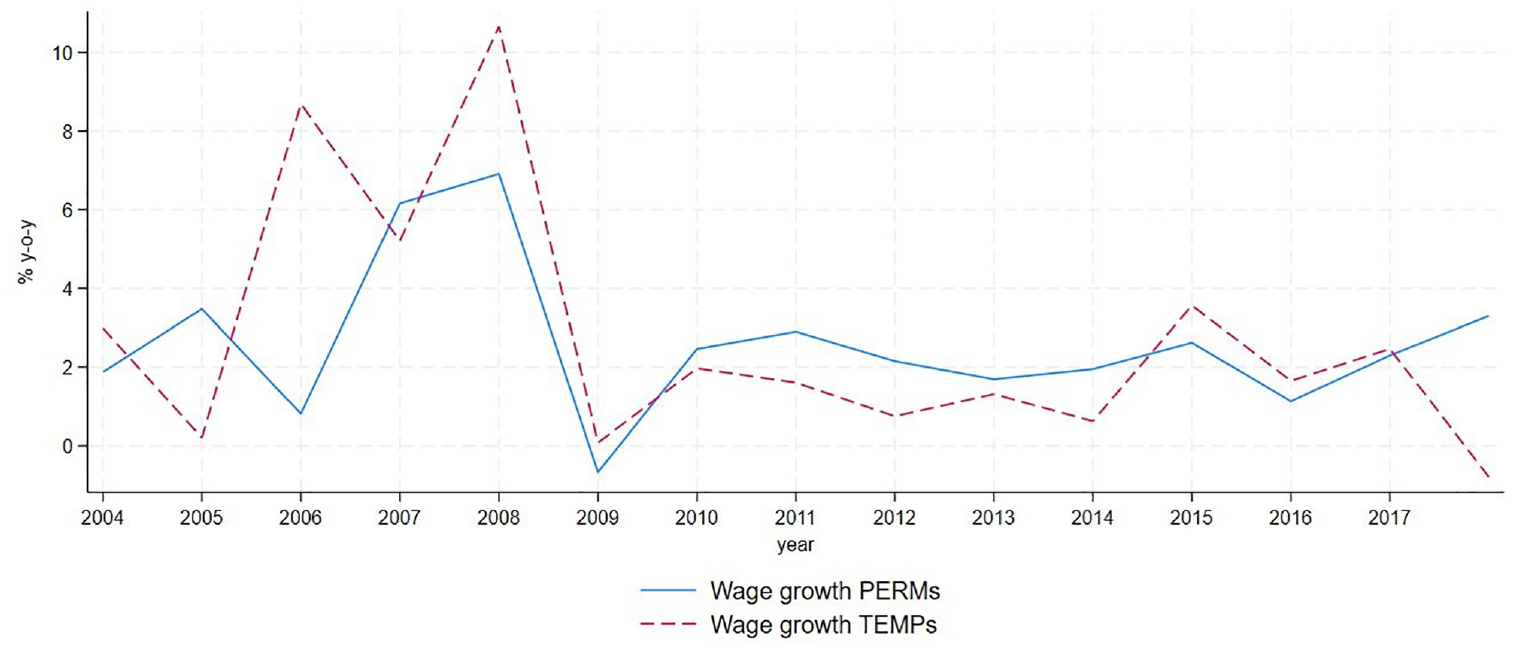
Wage Growth Permanent and Temporary Workers
To obtain the wage growth of a pseudo-workforce with a constant employment composition over time, we employ inverse probability weighting (IPW) (Rosenbaum and Rubin 1983; DiNardo, Fortin, and Lemieux 1996; Fortin, Lemieux, and Firpo 2011). First, we use a logit model to predict the probability of each observation of being in temporary employment per year and country, pairing the base year t (2004 or earliest available) with each of the following years,
Figure 3 presents the adjusted wage growth variable for each country (averaged over the whole sampling period) and the employment composition effect. The latter purely represents a mechanical effect from the changing share of temporary workers over time. Since temporary workers suffer a wage penalty compared to permanent workers, an increasing share of temporary workers lowers the aggregate average wage given a constant penalty. Adjusted wage growth represents the counterfactual rate of wage growth if the share of temporary workers would have remained constant over time. The size of the composition effect is very heterogeneous at the country level and sizeable in some countries, in particular Denmark, Serbia, and the United Kingdom. However, interestingly, it does not play a large role for Europe as a whole. Some countries are characterized by substantial wage differences between temporary and permanent workers and have experienced a strong increase in temporary work. Even in those cases though, temporary workers as a share of all employees have changed by only a few percentage points over several years, resulting in a minor impact of employment composition changes on wages. For robustness, we adjust wage growth additionally for employment composition changes by gender, migration background, educational attainment, and work experience, which warrants slightly larger effects (Appendix Figure C.1).
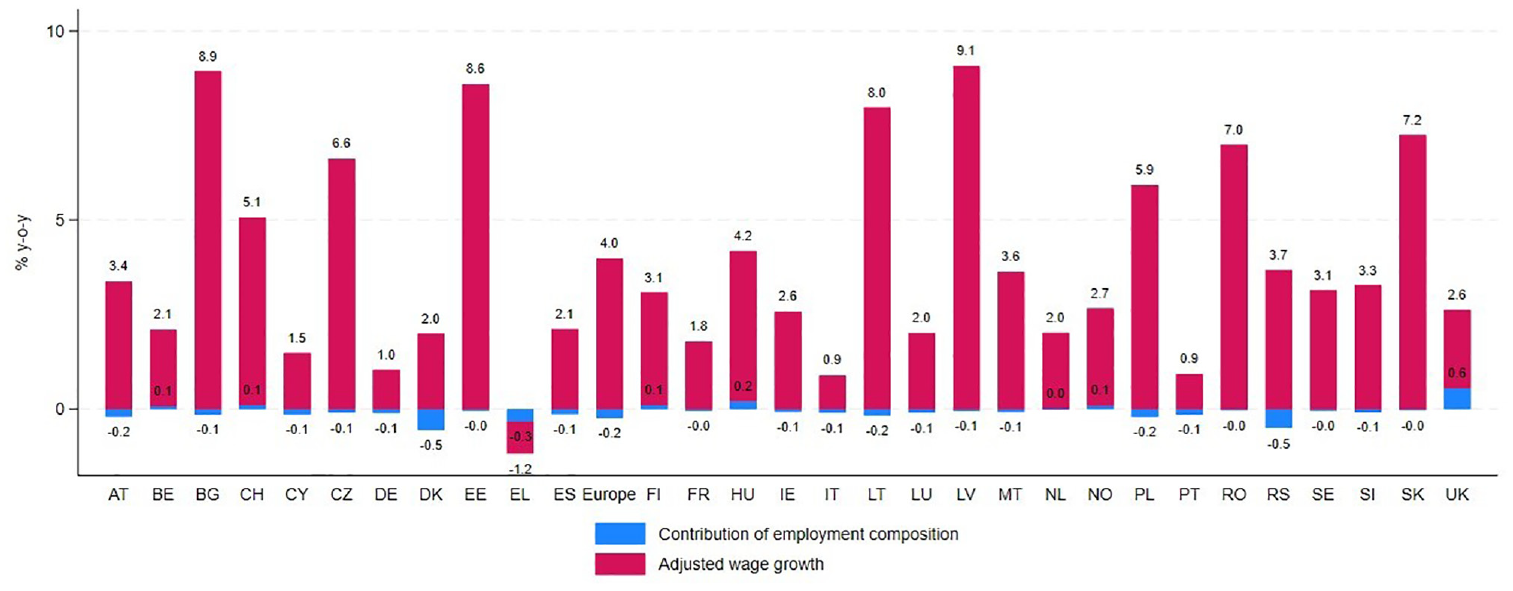
Wage Growth 2004–2017 Divided in Contribution of Employment Composition and Adjusted Wage Growth
Although the difference between adjusted and unadjusted wage growth is quite small overall, it must be stressed that only by adjusting can we identify the underlying mechanism that impacts wage growth. Without the adjustment for employment composition, we would not know whether composition or competition is driving our results.
Estimating Factors of Wage Growth
The most widely used empirical model to study the determinants of wage growth is the wage Phillips curve. The traditional wage Phillips curve relates nominal wage growth to labor market slack. Additional determinants typically considered are (expected) inflation and labor productivity growth (Nickel et al. 2019). We use such an augmented Phillips curve model to study the impact of dualization on nominal wage growth in Europe. We estimate a standard reduced form equation in a panel data framework of the form:

As outlined in the section above, our dependent variable is nominal wage growth obtained from EU-SILC. As a benchmark, we first study the dynamics of the unadjusted aggregate wage growth to represent the workhorse Phillips curve model. In the second step, we analyze the nominal wage growth of permanent workers only, and we finally implement our main dependent variable, which is nominal wage growth net of composition effects
As a baseline, we use the conventional labor market slack indicator, which is the headline unemployment rate Ui,t, but we also consider several other measures of slack for robustness. Further, we control for the impact of labor productivity (Prodi,t) on wages, which we measure as the growth rate of real output per employment, as well as for inflation (πi,t). Studies using quarterly wage growth data often employ (one quarter) lagged inflation implying backward-looking expectations (IMF 2017; Nickel et al. 2019; Ramskogler 2021). Given the annual frequency of our data, we assume a contemporaneous effect from inflation (measured as the annual change in the harmonized index of consumer prices) on nominal wage growth. 7
Finally, and most important, we add to our Phillips curve specification a variable to identify the competition effect. So far, studies exploring the impact of dualized labor markets on wages have considered overall temporary employment (Bellani and Bosio 2021; Ramskogler 2021). However, the limitation is that not all temporary workers look for a permanent contract. We identify the competition effect by focusing on involuntary temporary employees as a share of the active working-age population (Invol. Tempi,t). This segment of disadvantaged workers prefers a permanent contract over their temporary one, which we expect to cause the competition effect. A detailed description of the measurement of all variables and their sources is included in Appendix Table E.1.
Results
In the first part of this section, we present estimation results concerning the identification of the competition effect and its macroeconomic consequences (Table 1, Table 2). In the second part, we test whether the magnitude of the competition effect depends on labor market institutions (Table 3). Finally, we explore whether the rise in involuntary temporary employment can explain the flattening of the Phillips curve in Europe during the post-GFC recovery period (Table 4).
Identifying the Competition Effect at the Macroeconomic Level
We present the workhorse Phillips curve specification augmented by involuntary temporary employment in column (1) of Table 1. The coefficient estimates have the expected signs and are statistically significant. Labor productivity has a positive effect on wages. We also observe that inflation drives up wages with a regression coefficient of approximately 1. 8 By contrast and as expected, an increase in the unemployment rate reduces nominal wage growth. Yet, Invol. Tempt—our variable of main interest—is also negatively associated with nominal wage growth and is statistically significant. A rise in the share of involuntary temporary employees by 1 percentage point leads to a decrease in nominal wage growth by almost 1 percentage point. As we have considered the unadjusted growth rate of wages so far, the coefficient estimate captures both potential composition and competition effects. However, before we alter the dependent variable to isolate the competition effect, we include time dummies in our model to control for common shocks that might have affected wage dynamics equally across countries over time, such as the GFC. In fact, a test of joint significance shows that the time dummies have high explanatory power. Their inclusion also reduces coefficient estimates of all variables except Invol. Tempt, as we can see in column (2). This observation is particularly true for inflation, which becomes statistically nonsignificant. 9 As time dummies are significant in all the following model specifications, we included them to avoid biased estimates (Baltagi 2005).
Identifying the Competition Effect
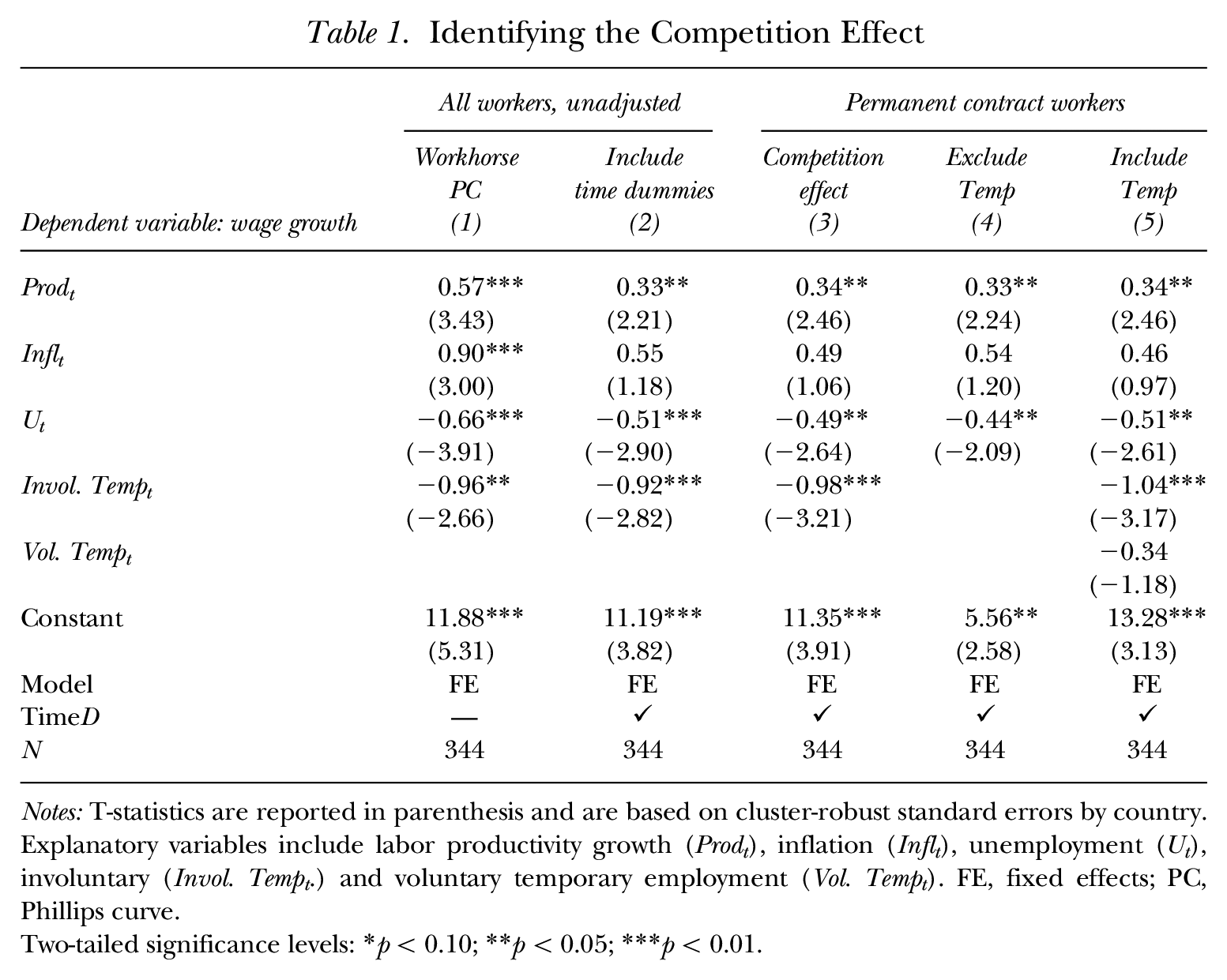
Notes: T-statistics are reported in parenthesis and are based on cluster-robust standard errors by country. Explanatory variables include labor productivity growth (Prodt), inflation (Inflt), unemployment (Ut), involuntary (Invol. Tempt.) and voluntary temporary employment (Vol. Tempt). FE, fixed effects; PC, Phillips curve.
Two-tailed significance levels: *p < 0.10; **p < 0.05; ***p < 0.01.
We now alter our dependent variable in column (3) by considering the nominal wage growth of employees with permanent contracts only. This step allows us to estimate the competition effect, as we isolate the part of wage growth that cannot be affected by changes in relative weights between temporary and permanent workers. Compared to column (2), all coefficient estimates remain broadly the same. This result has two main implications. First, it strongly supports our thesis that the incidence of a dualized labor market has negative spillover effects on the dynamics of wages of employees with permanent contracts. This finding is consistent with Bellani and Bosio (2021) who found that the density of temporary contracts within occupation- and age-specific groups negatively affected average wages for permanent workers belonging to the same group. In addition to their findings, our results show that competition effects are also relevant in a macroeconomic context, where other important wage growth determinants, such as the unemployment rate, are accounted for. The second important implication is that composition effects seem to be negligible in Europe in the period 2004–2017. A first indication of these rather small composition effects is the relatively low contribution of employment composition to adjusted wage growth across countries presented in Figure 3. In column (4) we show that the sensitivity of wage growth with respect to the unemployment rate decreases when the Phillips curve is specified without controlling for temporary employment.
Unlike in previous studies (Bellani and Bosio 2021; Ramskogler 2021), our empirical setting allows us to focus on involuntary (rather than on overall) temporary employment to measure the degree of labor market dualization. To reveal whether this is indeed the relevant measure in our context, we add the share of voluntary temporary employees and report the results in column (5). Comparing the coefficients of both indicators reveals involuntary temporary employees drive wage growth of permanent workers, while the impact of workers who have voluntarily chosen to have a temporary contract (Vol. Tempt) is nonsignificant. Hence, when measuring dualization, it is crucial to quantify those employees who would prefer to be employed on a permanent basis. Note also that the magnitude of the coefficient estimate (and its statistical significance) would drop substantially if we considered overall temporary employment (instead of Invol. Tempt). To proxy labor market dualization, our results, thus, strongly suggest that whenever feasible involuntary rather than overall temporary employment should be considered.
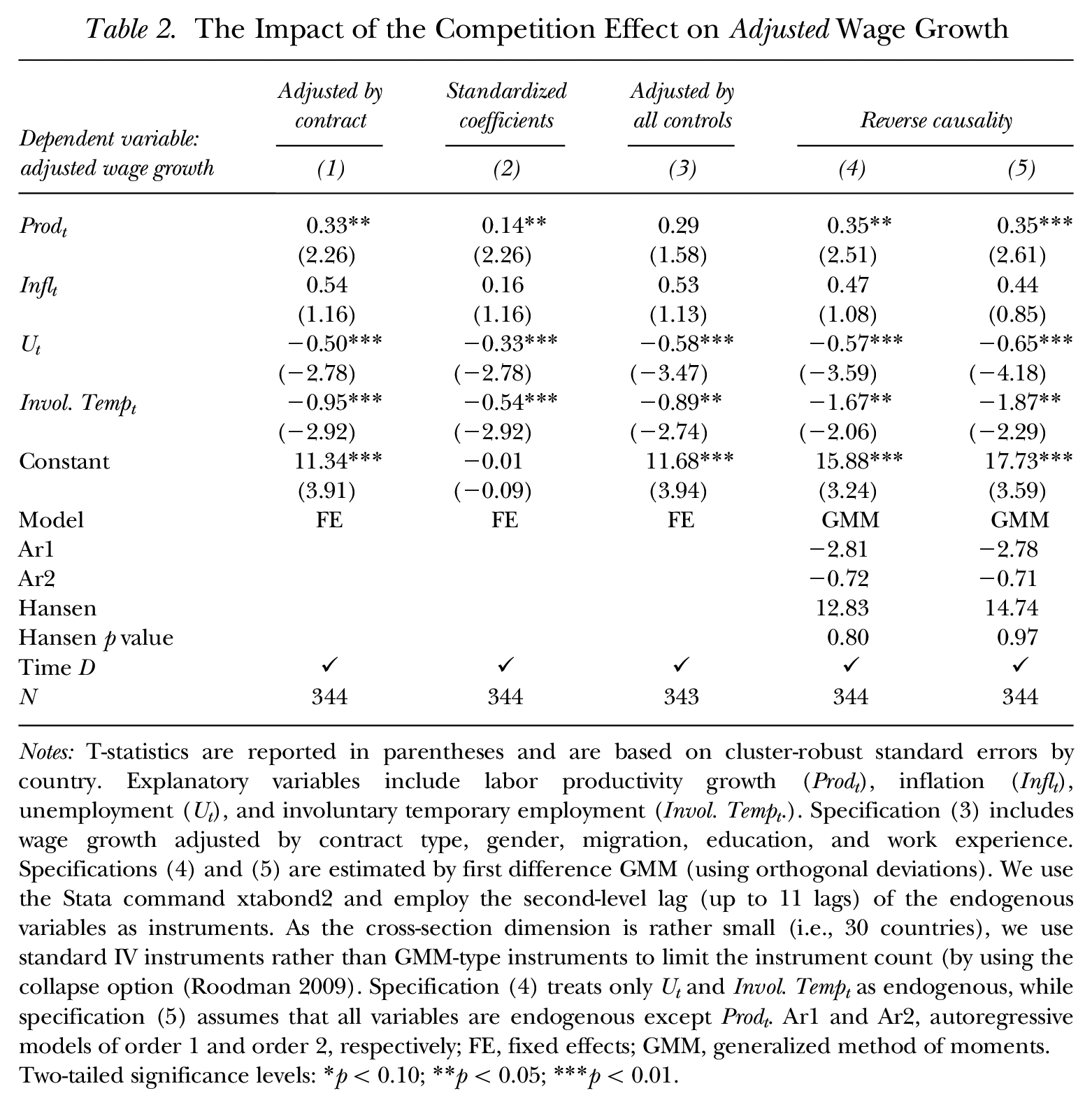
To investigate the impact of involuntary temporary employment on overall aggregate wage growth, we re-estimate specification (2) by employing adjusted wage growth, that is, wage growth net of composition effects. The results are depicted in column (1) of Table 2 and show almost unchanged coefficient estimates (compared to column (2) in Table 1). This finding is consistent with our previous observation, namely that composition effects are empirically of only minor importance. Further, our results resemble Ramskogler (2021), who found a significant negative effect from temporary employment on unadjusted wage growth in Europe. Additionally, we confirm that the underlying mechanism behind the observed negative relationship arises from a competition rather than a composition effect. 10
The Impact of the Competition Effect on Adjusted Wage Growth
Notes: T-statistics are reported in parentheses and are based on cluster-robust standard errors by country. Explanatory variables include labor productivity growth (Prodt), inflation (Inflt), unemployment (Ut), and involuntary temporary employment (Invol. Tempt.). Specification (3) includes wage growth adjusted by contract type, gender, migration, education, and work experience. Specifications (4) and (5) are estimated by first difference GMM (using orthogonal deviations). We use the Stata command xtabond2 and employ the second-level lag (up to 11 lags) of the endogenous variables as instruments. As the cross-section dimension is rather small (i.e., 30 countries), we use standard IV instruments rather than GMM-type instruments to limit the instrument count (by using the collapse option (Roodman 2009). Specification (4) treats only Ut and Invol. Tempt as endogenous, while specification (5) assumes that all variables are endogenous except Prodt. Ar1 and Ar2, autoregressive models of order 1 and order 2, respectively; FE, fixed effects; GMM, generalized method of moments.
Two-tailed significance levels: *p < 0.10; **p < 0.05; ***p < 0.01.
In column (2), we assess the economic significance of dualized labor markets by re-estimating specification (1) based on standardized variables. Involuntary temporary employment turns out to be the most relevant determinant for wage growth followed by unemployment. 11 Taking into account the uncertainty surrounding the parameter estimates, however, both variables are equally meaningful in explaining nominal wage growth. 12 Hence, involuntary temporary employment has been at least as important as unemployment in shaping nominal wage dynamics in Europe.
While in specification (1) we control for composition effects with respect to the type of employment contract, other possible aspects of composition could affect wage growth as well. Some demographic groups may have more bargaining power (e.g., prime-age, native-born males) or a higher marginal productivity than others. The composition of who is selected into temporary jobs may change over the business cycle. Hence, in addition to contract type, we adjust wage growth for changes in the employment composition by gender, migration background, educational attainment, and work experience. As highlighted in Table 2, column (3), this new measure does not alter the observed results with respect to the competition effect. However, the impact of productivity on wage growth becomes nonsignificant. This outcome is most probably because productivity is largely captured at the worker level by having netted out changes in the share of skilled and experienced workers.
We now turn to the issue of a potential simultaneity bias arising from reverse causality between nominal wage growth and labor market slack. Usually, reverse causality is approached by inserting the slack variable in its one-period lagged form into the Phillips curve model (Nickel et al. 2019; Byrne and Zekaite 2020; Ramskogler 2021). While this is certainly a valid approach when using quarterly data, it is not feasible in our case given the annual frequency of the data. 13 Fortunately, in the case of reverse causality, the fixed-effect estimate of the impact of unemployment on wage growth would be downward biased rather than upward, as higher wage growth should cause higher labor market slack (Wooldridge 2009; IMF 2017). The same logic applies to the dualization measure. If wage growth accelerates, it is presumable that employers increasingly demand temporary employees as they are cheaper and associated with lower firing costs. Hence, our findings concerning the importance of temporary employment for wage growth are likely not mistaken even in the presence of reverse causality.
An alternative approach to account for a potential simultaneity bias is to use instrumental variable techniques. As exogenous instruments are not at hand, neither for unemployment nor for temporary employment, we use internal instruments, that is, time lags of the variables in the model. In particular, we employ the difference generalized method of moments (GMM) estimator 14 (Arellano and Bond 1991; Blundell and Bond 1998) and treat both variables as endogenous (by using the lagged levels of the variables as instruments). As displayed in Table 2, column (4), involuntary temporary employment and unemployment have the expected negative signs and are statistically significant. However, compared to the fixed effect estimation in column (1), we observe an increase in the coefficient estimate for both variables. Obviously, controlling for simultaneity has an effect on the estimates in the direction that we expected. A very similar result can be found in Bellani and Bosio (2021). Finally, in column (5) we add inflation to the set of endogenous variables and show that this alteration does not have any significant influence on the estimation outcome.
Effect of Institutions
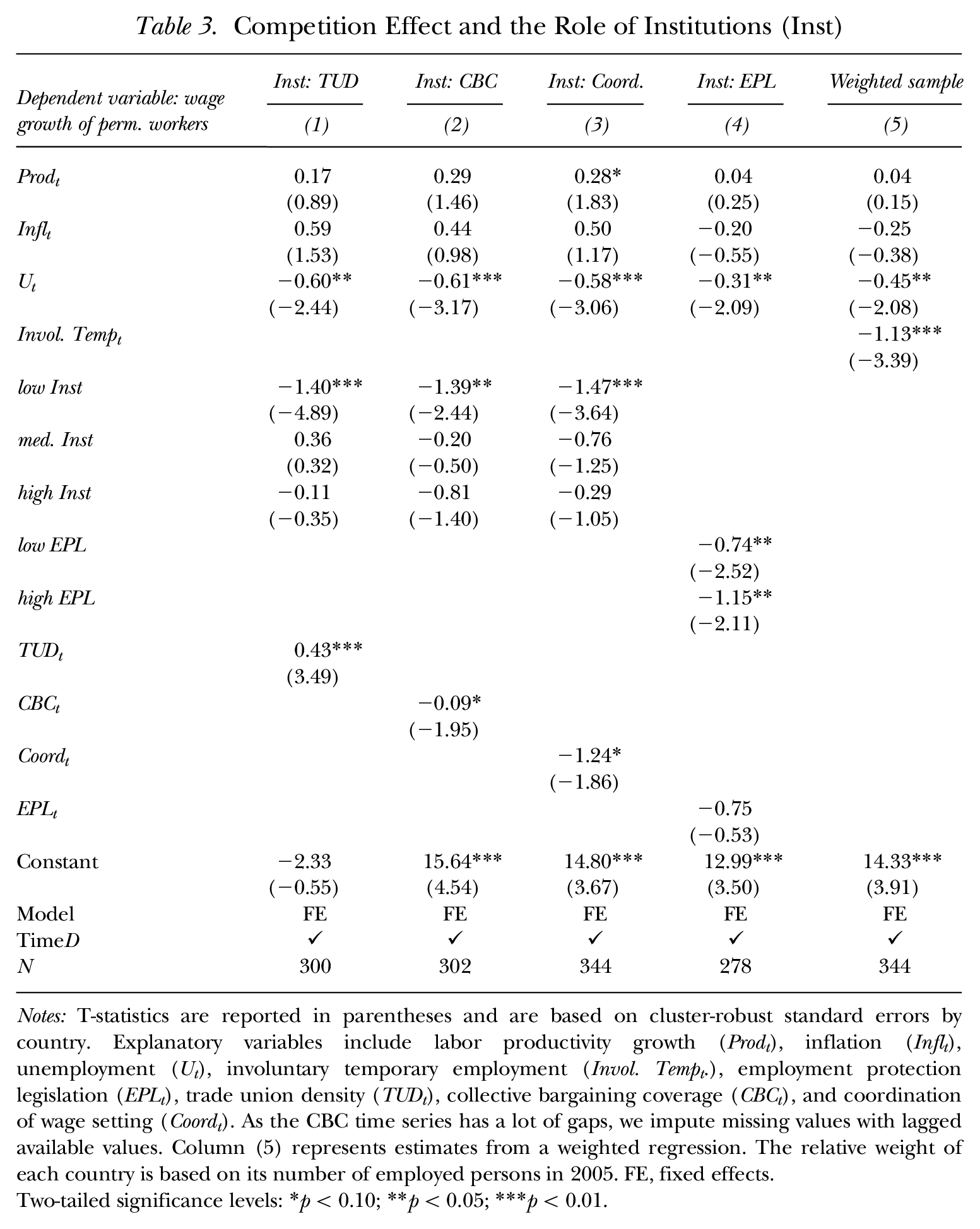
As highlighted in the theory section, the magnitude of the competition effect may depend on a country’s labor market institutions. We take account of these considerations in Table 3, where we interact involuntary temporary employment with institutional variables. We consider the wage growth of permanent workers as the dependent variable in all specifications. In addition to interaction effects, we control for the direct effect that institutions might exert on wage growth. This approach rules out a potential omitted variable bias that might arise if weak trade unions were to cause higher shares of temporary employment because of their inability to prevent the substitution of good jobs with bad jobs.
Competition Effect and the Role of Institutions (Inst)
Notes: T-statistics are reported in parentheses and are based on cluster-robust standard errors by country. Explanatory variables include labor productivity growth (Prodt), inflation (Inflt), unemployment (Ut), involuntary temporary employment (Invol. Tempt.), employment protection legislation (EPLt), trade union density (TUDt), collective bargaining coverage (CBCt), and coordination of wage setting (Coordt). As the CBC time series has a lot of gaps, we impute missing values with lagged available values. Column (5) represents estimates from a weighted regression. The relative weight of each country is based on its number of employed persons in 2005. FE, fixed effects.
Two-tailed significance levels: *p < 0.10; **p < 0.05; ***p < 0.01.
Following our country grouping based on trade union density (TUD), we report group-specific differences in the competition effect in column (1). As we anticipated, the competition effect is significant and large only in countries with low TUD. Moreover, we can conclude that the competition effect does not arise because weak trade unions cause higher shares of involuntary temporary employees, as we have controlled for the direct impact of institutions. Rather, the observed effect in countries with weak institutions results from the fact that permanent employees cannot use union power to protect themselves from negative wage pressures caused by temporary employment. Trade union density (TUDt) affects wage growth positively, as expected (Kahn 1979; Stansbury and Summers 2020).
Analogously, our findings are confirmed when investigating proxies for how wage bargaining encompasses workers. These proxies include collective bargaining coverage (CBC) as in specification (2) or wage bargaining coordination (Coord) as in specification (3). In all these cases, the competition effect is most pronounced at the lowest institutional level. 15 Our results, thus, support the hypothesis that competition effects from labor market dualization heavily depend on domestic labor market institutions.
Further, we stress that the competition effect is higher in countries with more stringent employment protection legislation (EPL) as shown in specification (4). This likely is the result of the golden cage effect: Permanent workers in countries with more stringent EPL have more to lose if they were to be laid off. The monetary value of a job can be understood as a function of the wage received per period and the probability of future job loss, which amounts to the discounted income stream expected. In this logic, workers trade job security, corresponding to the likelihood of wage receipt in the future, against higher wages in the present. More stringent EPL increases the chance of continued employment and thus can correspond to lower starting wages (Lazear 1990).
In the last specification of Table 3, we want to highlight that the competition effect, although it varies in magnitude across country groups, is significant in determining weighted aggregate wage growth in Europe. In fact, the competition effect remains highly significant and increases in magnitude when we put more weight on countries that are larger, as we demonstrate in column (5). 16 This observation is consistent with the fact that low TUD countries expose a particularly strong competition effect, as the countries belonging to this group (composed of 14 countries) make up more than 75% of overall employment in Europe and drive the aggregate weighted effect.
Finally, empirically analyzing differences across country groups always involves choosing the “right” threshold that divides countries into the respective groups. In the case of TUD and Coord, a disproportionately high share of countries is clustered in the first group (i.e., countries with the weakest institutions) as rationalized in the theory section. This categorization might work against finding a statistically significant effect for the medium and high groups. As a robustness check, we consider an alternative clustering procedure that groups the countries more evenly by using terciles of the institutional variables. We report our results in Appendix Table D.2. In columns (1) to (4), we show that our results hold when the number of countries does not vary across groups.
In column (5) of Appendix Table D.2, we base our country grouping on a joint set of institutional variables to form three equally sized clusters. Concretely, we perform a principal component analysis (PCA) to understand the correlation of the institutional variables, as the PCA reduces their multi-dimensional character by identifying their common grounds (components). We consider the first resulting component, which explains 75% of the overall variation of TUD, Coord, and CBC. 17 Using terciles of the constructed index to form the grouping again confirms our main finding. The magnitude of the competition effect decreases with the strength of institutions. Last, in column (6) we employ an index for union strength developed by Metten (2021) who used a more sophisticated theoretically informed PCA to identify determinants of trade union strength. Employing this index again supports our hypothesis that the competition effect is large in countries where insiders do not have sufficient power to shelter themselves from competitive pressure. 18
Phillips Curve Flattening
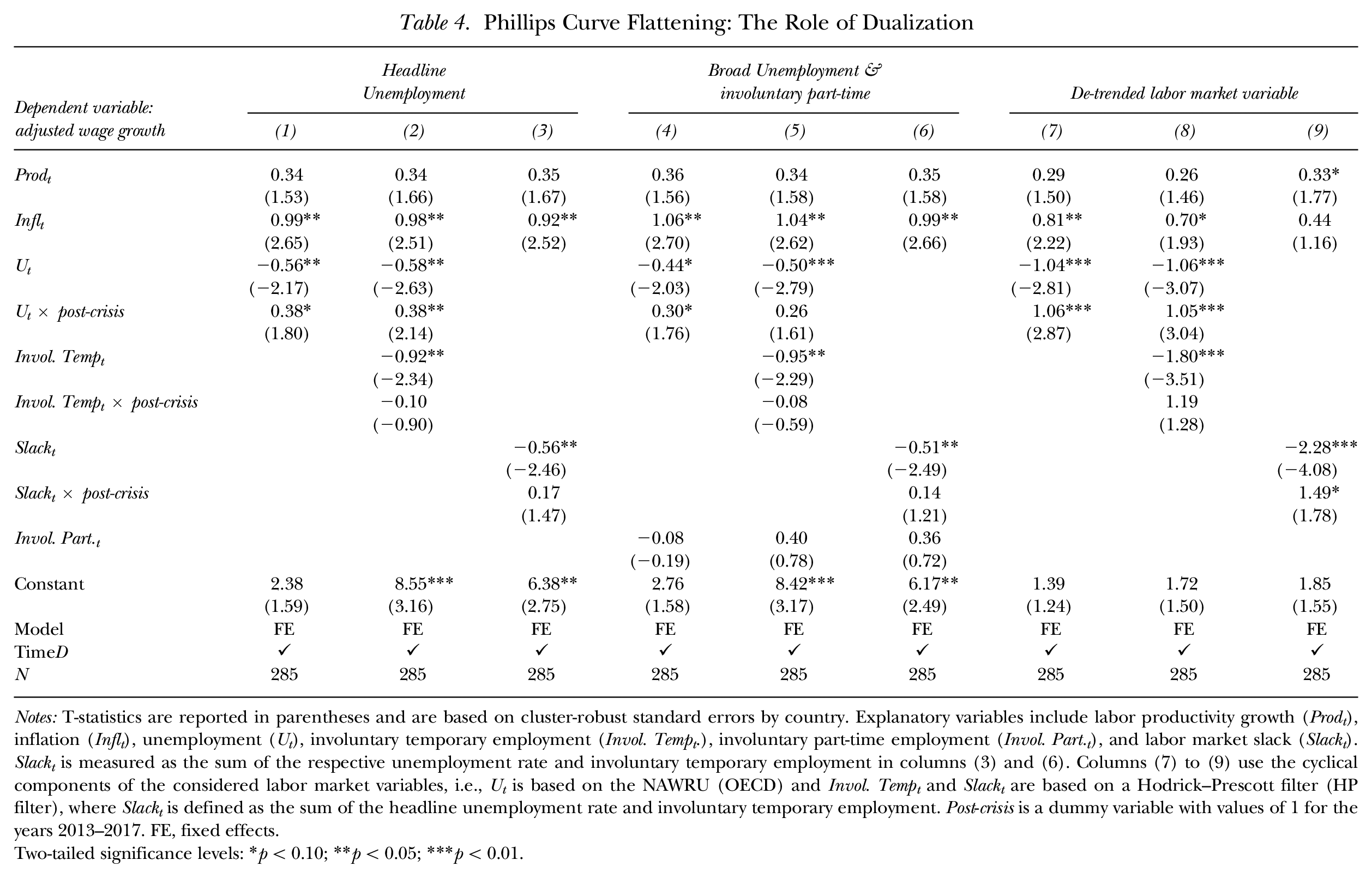
So far, we have shown that competition effects play a statistically significant role in explaining aggregate nominal wage growth and that they interact with the institutional dimension. Does this help to understand the observed flattening of the Phillips curve in Europe after the GFC? To tackle this question, we extend the Phillips curve framework by allowing for a different unemployment parameter after the crisis. This approach allows us to test the Phillips curve flattening and to study possible interaction effects with temporary employment. We employ adjusted wage growth in all specifications to rule out possible composition effects and to obtain results that reflect the wage dynamics of both temporary and permanent employees. To investigate post-crisis differences, we first interact unemployment as well as involuntary temporary employment with a post-crisis dummy that equals 1 for the period 2013–2017 and 0 for the preceding period. 19 Second, following the hidden slack literature, we construct a labor market slack measure by summing up unemployed and involuntary temporary employees (Slackt) to study their joint impact on wage growth before and after the crises. 20
The corresponding results are summarized in Table 4. Column (1) shows a model that allows for a crisis interaction term on the unemployment rate without considering temporary employment. The slope parameter of the unemployment rate is statistically different across the two time periods and points to a decreased sensitivity of wage dynamics to unemployment of more than 50% since the post-crisis period. While a decrease in the unemployment rate boosted wage growth by 0.56 percentage points before 2013, this sensitivity declined to 0.18 percentage points 21 in the post-crisis period. Our results, thus, support the empirical findings in the literature that indicate a lower explanatory power of labor market slack measures in the post-crisis period (Byrne and Zekaite 2020).
Phillips Curve Flattening: The Role of Dualization
Notes: T-statistics are reported in parentheses and are based on cluster-robust standard errors by country. Explanatory variables include labor productivity growth (Prodt), inflation (Inflt), unemployment (Ut), involuntary temporary employment (Invol. Tempt.), involuntary part-time employment (Invol. Part.t), and labor market slack (Slackt). Slackt is measured as the sum of the respective unemployment rate and involuntary temporary employment in columns (3) and (6). Columns (7) to (9) use the cyclical components of the considered labor market variables, i.e., Ut is based on the NAWRU (OECD) and Invol. Tempt and Slackt are based on a Hodrick–Prescott filter (HP filter), where Slackt is defined as the sum of the headline unemployment rate and involuntary temporary employment. Post-crisis is a dummy variable with values of 1 for the years 2013–2017. FE, fixed effects.
Two-tailed significance levels: *p < 0.10; **p < 0.05; ***p < 0.01.
In column (2), we add temporary employment into the model and allow for different slope parameters on this variable as well. Two things stand out. First, the sensitivity of nominal wage growth with respect to involuntary temporary employment remains largely unchanged. Even though we observe an increase in the impact of temporary employment after 2012, it is not statistically significant. Second, adding labor market dualization into the model does not help to understand the flattening of the Phillips curve as the slope parameter of Ut×post-crisis remains unchanged. Interestingly though, employing the variable that summarizes unemployment and temporary employment (i.e., Slackt) leads to a different conclusion, as can be seen in column (3). The flattening is still observable since the slope parameter on Slackt×post-crisis is positive, but it is smaller and statistically not significant.
Given the thus far inconclusive results concerning the role of temporary employment for the Phillips curve flattening, we follow the literature on hidden slack by considering a broader measure of the unemployment rate as well as involuntary part-time employment (as another source of potential hidden slack) and re-estimate the first three specifications accordingly. We extend the headline unemployment rate by additionally considering discouraged as well as marginally attached workers (U-5). Moreover, we account for employees who work part-time but do so involuntarily. Note, however, that unlike Bell and Blanchflower (2019), we are not able to account for labor underutilization based on desired hours of work given data availability. Instead, we have to rely on head counts to capture the degree of underemployment. The flattening disappears when adding involuntary temporary employment next to the broader unemployment measure (columns (4) to (6)). The same holds true when investigating overall slack as defined above. 22
Finally, in the remaining three specifications, we employ the cyclical components of our independent labor market variables. In specifications (7) and (8), we rely on the concept of the non-accelerating wage rate of unemployment (NAWRU) and consider the unemployment gap arising between the headline unemployment rate (U-3) and the NAWRU. In column (8), we add the cyclical component of involuntary temporary employment, which we compute by applying a Hodrick–Prescott filter (HP filter). 23 For the final model, we use the same filtering technique to de-trend the time series of labor market slack (Slackt). The results of the last three models are quite similar to the ones obtained when considering the narrow definition of the unemployment rate (U-3). Adding labor market dualization does not explain the flattening of the Phillips curve as can be seen from a comparison of columns (7) and (8), but dampens the flattening in specification (9), where unemployment is considered jointly with involuntary temporary employment.
Overall, the presented results concerning the interaction between dual labor markets and the flattening of the Phillips curve are not robust. In our view, though, the findings point to a potential role of involuntary temporary employment in the hidden slack debate. One reason for the inconclusive results might be the relatively short time period of our analysis. Adding more observations might eventually result in more robust findings, especially if temporary employment were to increase further. Moreover, becoming more granular concerning the slack variable (e.g., by considering the variable created by Bell and Blanchflower 2019) could help to improve estimation efficiency for future research.
Conclusion
In this article, we have demonstrated that competition between involuntary temporary and permanent workers has suppressed wage growth in Europe. The higher the incidence of temporary workers who are involuntarily on a temporary contract, the lower the growth rate of wages. The effect is clearly present when investigating the rate of wage growth of permanent employees alone and when employing adjusted aggregate wage growth that nets out potential composition effects caused by fluctuations in the share of temporary employment. Moreover, we have illustrated that involuntary temporary employment has been at least as important as the unemployment rate in shaping wage dynamics in Europe. Hence, the competition effect is not only statistically but also economically significant.
Furthermore, the cross-country nature of our analysis allowed us to investigate the role of institutions. We have shown that the competition effect is more pronounced when wage bargaining institutions are weak, which is consistent with industrial relations scholarship. Crucially, our findings are robust when we put more weight on larger countries, thus ruling out the possibility that only small countries drive the results.
Finally, we have presented some tentative evidence that the competition effect might help to understand the strange flattening of the Phillips curve in Europe during the post-GFC recovery period. We have shown that accounting for the incidence of involuntary temporary employees in defining labor market slack explains the flattening of the Phillips curve to some extent; however, our findings in this regard are the least (statistically) significant and thus leave ample room for further research.
Overall, our analysis shows the important macroeconomic consequences of the dualized structure of labor markets. Despite the recent uptick in wage growth, the entrenchment of temporary employment calls for macroeconomic policies that are cognizant of the labor market structure.
Supplemental Material
sj-pdf-1-ilr-10.1177_00197939241248162 – Supplemental material for BEGGARING Thy Co-Worker: Labor Market Dualization and the Wage Growth Slowdown in Europe
Supplemental material, sj-pdf-1-ilr-10.1177_00197939241248162 for BEGGARING Thy Co-Worker: Labor Market Dualization and the Wage Growth Slowdown in Europe by Lukas Lehner, Paul Ramskogler and Aleksandra Riedl in ILR Review
Footnotes
Acknowledgements
We are grateful for feedback and suggestions from Brian Nolan and Bernhard Ebbinghaus as well as from Bastian Betthäuser, Joshua Cova, Tony Dobbins, Chris Featherman, Pirmin Fessler, Michael Ganslmeier, Jakob Kapeller, Andrew Messamore, and Tim Vlandas. Thanks also to the participants of the SASE EC workshop and annual conference 2022, the BUIRA doctoral workshop and annual conference 2022, and the Social Policy and Politics Research Group at the Department of Social Policy and Intervention, University of Oxford.
The views expressed in this study do not necessarily reflect the official viewpoint of the Oesterreichische Nationalbank or of the Eurosystem.
This article is part of an ILR Review Special Issue on Transnational Employment Relations in the European Union.
This work was supported by the Economic and Social Research Council (grant number ES/P000649/1); the Scatcherd European fund; and the Saven European fund. Lehner acknowledges funding from the European Union (ERC Starting Grant, ExpPov, #101039655). Views and opinions expressed are however those of the authors only and do not necessarily reflect those of the European Union or the European Research Council; neither the European Union nor the granting authority can be held responsible for them.
For general questions and for copies of the code used to generate the results presented in the article, contact the corresponding author at
EU-SILC data are available from Eurostat.
1
We demonstrate in the empirical analysis that the competition effect is stronger in countries with weak institutions, and that this relationship does not result from weak trade unions causing higher shares of temporary employment.
2
The EU Labour Force Survey (EU-LFS) does not contain the wage level. The EU Structure of Earnings Survey (EU-SES) is conducted only every four years.
3
The reported figures represent the weighted average of the share of temporary employees in total employees of all European countries in our sample in the observation period 2004–2017. Note also that the share of temporary employment according to EU-SILC seems to follow a quite similar pattern over time compared to the respective series from the EU-LFS. This observation is reflected by a relatively high correlation coefficient of 0.88 between both series.
4
5
Examples are Bonam, de Haan, and van Limbergen (2021), Nickel et al. (2019), and  .
.
6
Data for some countries are available only after 2004. We drop 19 observations when a break in the time series of wages occurred according to Eurostat (due to a change of source or survey methodology).
7
We also consider a survey-based measure capturing forward-looking inflation expectations provided by the European Commission (expected inflation). As this variable is not available for two of our countries (Switzerland and Norway) and does not improve the explanatory power, we stick to realized consumer price inflation.
8
This finding is likely linked to the annual context of our estimations (Kiss and Van Herck 2019). Rusinova, Lipatov, and Heinz (2015) showed that if four lags of inflation are considered in quarterly estimations, the aggregate effect again accumulates to close to 0.9.
9
Obviously, price dynamics across countries have followed a very similar pattern over time. For example, a common driver of inflation across countries could be oil, which is known to significantly affect consumer price dynamics.
10
11
An increase in the rate of involuntary temporary employment by one standard deviation leads to a drop in nominal (composition adjusted) wage growth by half a standard deviation.
12
A test on parameter equality is not rejected.
13
Although lagging unemployment is generally effective in accommodating, for most periods, the relatively minor shifts in unemployment that occur, it is contemporaneous unemployment that affects wage growth (). The reason is because wage demands are negotiated under the constraints of the prevailing bargaining power, despite wage demands in Europe typically being formulated based on the purchasing power losses of the past year.
14
Our dependent variable is not persistent. For this reason, we choose a static representation and the difference rather than the system GMM estimator.
15
Moreover, we find a negative impact from CBC and Coord on wage growth, which corresponds to common expectations (; Hancke and Soskice 2003). This happens as higher levels of centralization and coordination help to prevent wages from taking an inflationary turn (i.e., internalizing negative externalities). Coordination is expected to be the most relevant factor (Soskice 1990), which is confirmed by our findings.
16
The relative weight of each country is based on the number of employed persons in 2005.
17
We have not considered EPL in constructing the index, as EPL does not load the first component of the PCA in the same direction as the remaining three institutional variables. Hence, EPL does not seem to capture the inclusiveness of wage bargaining but other underlying institutional factors. Recall that the competition effect is more pronounced for countries with high EPL.
18
The index is not available for Malta. Moreover, because of several missing values at the beginning and end of the individual time series, we have not imputed missing values and therefore did not include the index as an additional regressor into the model.
19
We have tested other thresholds as well. Results show that the break in slope parameters is most pronounced when the post-crisis period is defined from 2013 onward.
20
Both Unempt and Invol. Tempt, representing Slackt, are measured as a share of the active working-age population.
21
The slope parameter of unemployment after 2012 is obtained as follows: –0.56 + 0.38 = −0.18.
22
That is, summing up the broader unemployment measure U-5 and involuntary temporary employment.
23.
To avoid the end-point problem of the HP filter (Orphanides and van Norden 2002), we consider the most recent data, which are available until 2021 for all countries in our sample. Following , we set the smoothing parameter to 6.25. As the filtering technique does not allow gaps within the time series, we impute four observations in Austria (2004, 2005), Malta (2004), and Spain (2005). However, we do not use these observations for estimating our models.
References
Supplementary Material
Please find the following supplemental material available below.
For Open Access articles published under a Creative Commons License, all supplemental material carries the same license as the article it is associated with.
For non-Open Access articles published, all supplemental material carries a non-exclusive license, and permission requests for re-use of supplemental material or any part of supplemental material shall be sent directly to the copyright owner as specified in the copyright notice associated with the article.
