



Abstract
The author analyzes the effects of further training subsidies for low-skilled employees on individual labor market outcomes in Germany. Using detailed administrative data, the author exploits cross-regional variation in the policy styles of local employment agencies to identify causal effects of program participation. Findings show that training subsidies significantly increase cumulative employment duration and earnings in the short run and middle run for compliers, that is, those workers who additionally participate due to a more generous policy style in their agency. These gains are particularly pronounced for certain subgroups, such as women. A rough cost-benefit analysis, however, suggests that the program overall is not beneficial for the public budget.
Keywords
In recent decades, low-skilled workers in particular have been affected by the structural changes in employment due to globalization and skill-biased technical change. The demand for a flexible and suitably skilled workforce calls for repeated investments in education and training. Acknowledging this trend, the European Commission encouraged governments to develop strategies to make lifelong learning available for everyone in 2000. Consequently, European policymakers directed great attention to lifelong learning policies to support workers and firms in their training activities and to help them adapt to structural changes. In order to judge whether such government programs effectively improve the economic situation of workers, we need empirical evidence.
This study examines the impact of public subsidies for the further training of employed low-skilled workers on employment and earnings using high-quality register data. Because I am particularly interested in heterogeneous treatment effects, I also investigate subgroups. Several robustness checks confirm the validity of the results.
Methodologically, I make use of exogenous variation in the local participation rate (LPR) at the regional level among unemployment agencies that provide these subsidies in Germany. Specifically, I exploit residual variation in the LPR after purging it from regional-, establishment-, and individual-level confounders. I call this residual variation “policy styles.” Policy styles vary across agencies because of differences in their organizational structures and nonformal behavior of caseworkers. Although this affects the implementation of the subsidy program and thus the propensity to be treated, policy styles are exogenous to the employment durations and earnings of low-skilled employed workers. This allows me to address problems of selectivity, that is, workers selecting into the program based on unobservable characteristics, and identify causal effects.
I contribute to the literature in several ways: First, the bulk of literature is concerned with subsidized further training for unemployed workers. The existing literature on training subsidies for low-skilled employed workers installed to prevent unemployment presents mixed results on earnings. Providing new results, including the effects on employment, of a program that so far has not been analyzed, I enhance the current state of knowledge. Second, this study uses register data that are highly reliable, have daily precision, and offer a broad range of information on individual, establishment, and regional characteristics. Third, exploiting regional variation I choose an approach that has only occasionally been used to evaluate training programs. Focusing on compliers, I estimate the program effect for additional workers who participate due to a more generous policy style of their agency. This approach is informative as one can learn about the effects of a potential extension of the program.
German Training Subsidy Program
Organization of the Program
Germany has experienced striking structural changes in its workforce. Many OECD countries experiencing the same changes fund training through loans, subsidy programs, or tax deductions (Bassanini et al. 2007). Since 2002, the German Federal Employment Agency (FEA) has financially supported further training for low-skilled employed workers, supplementing further training for unemployed workers. However, only approximately 4,500 low-skilled employed workers were trained between 2002 and 2006 (Lott and Spitznagel 2007). Therefore, in 2007, the FEA created a new program called WeGebAU to promote further training of employed workers with training subsidies. These subsidies are intended to encourage the participation of low-skilled workers, who show disproportionately low interest in further training (Ok and Tergeist 2003; Fouarge, Schils, and de Grip 2013), and to raise employers’ (particularly small- and medium-sized firms) propensity to further train their workforce.
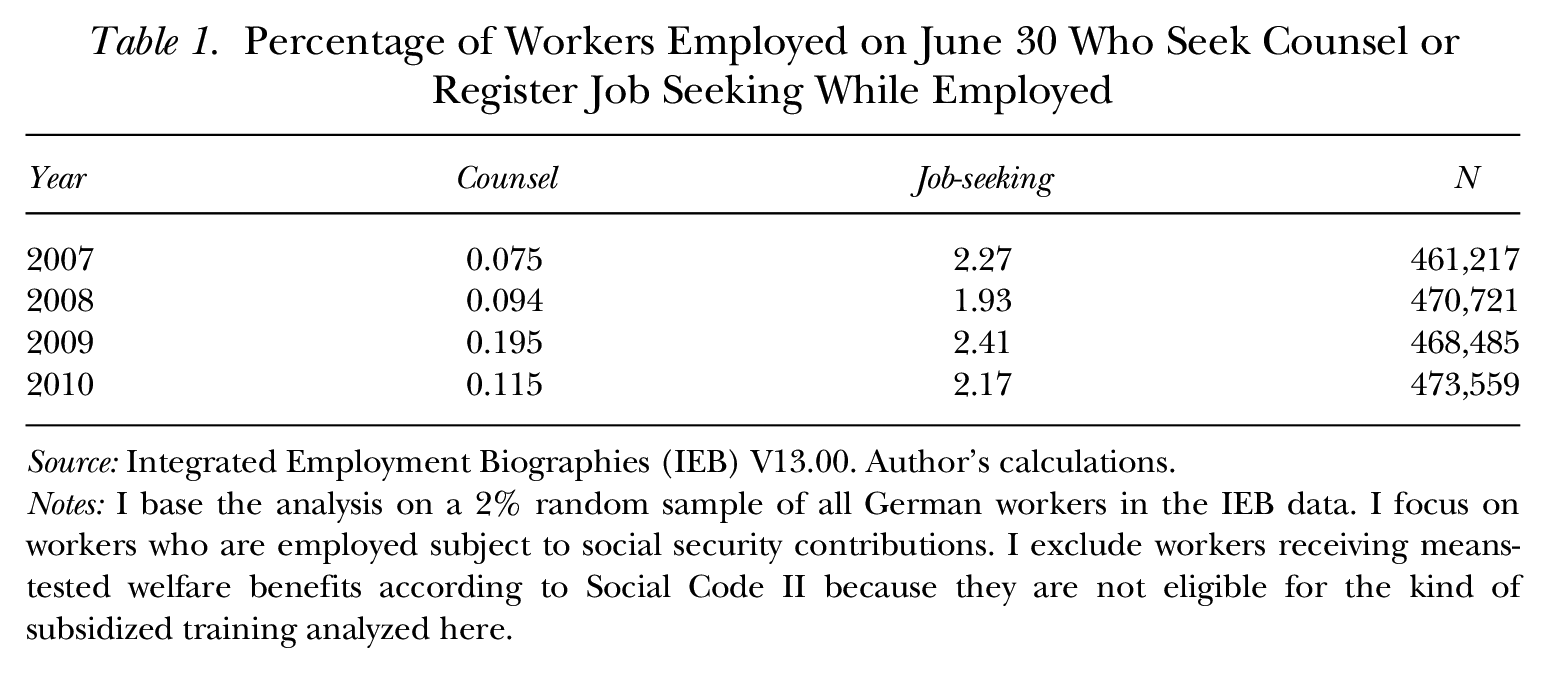
The major responsibilities of the FEA are the reintegration of unemployed workers and the distribution of unemployment benefits. The FEA has the obligation to counsel both employed and unemployed workers. For the cut-off date June 30, however, Table 1 shows that very few employed workers were in contact with the FEA (for more details, see the section, LATE Assumptions). Only approximately 0.1% of all employees sought counsel by the FEA, and about 2% registered as job seeking, which they are required to do when their current employment contract is about to end.
Percentage of Workers Employed on June 30 Who Seek Counsel or Register Job Seeking While Employed
Source: Integrated Employment Biographies (IEB) V13.00. Author’s calculations.
Notes: I base the analysis on a 2% random sample of all German workers in the IEB data. I focus on workers who are employed subject to social security contributions. I exclude workers receiving means-tested welfare benefits according to Social Code II because they are not eligible for the kind of subsidized training analyzed here.
The subsidy program I analyze in this study is the only FEA program that targets employed workers. Thus, in contrast to other FEA programs, which are directed at unemployed workers, the subsidy program considered in this study is unique. Another federal training voucher program for employees (Bildungsprämie) has been implemented by local educational centers (Görlitz 2010; Görlitz and Tamm 2016, 2017). That program is very different from the program I study, however, because it subsidizes training that is independent of the current employment relationship. The FEA program, by contrast, subsidizes training that needs to be arranged with the employer and is therefore directly linked to the current job.
The program is primarily targeted at low-skilled workers. 1 Potential participants are considered low skilled if they lack a vocational qualification or have worked for at least four years in a helper job that did not require any qualifications. Further eligibility criteria are that the employer releases the employee from work to participate in training and continues wage payments during this absence. Subsidized training courses must focus on general rather than firm-specific learning because the objective is to improve knowledge that is applicable in the general labor market. Only specially accredited private providers can offer training courses. Moreover, a subsidized training course is supposed to terminate with the receipt of a certificate. Courses include, for example, retraining to become an elderly care nurse, nursery school teacher, greenkeeper, security guard, or machine and plant operator with a duration of two to three years. Shorter training consists of courses in the field of IT (such as UNIX, CAD, or MS Office), language courses, and forklift and truck licenses.
Once these criteria are met, two possible types of subsidies are available: First, the FEA may cover up to 100% of the training costs. Second, employers may receive wage subsidies to compensate for the workers’ reduced productivities during training. If training takes place outside the firm, these wage subsidies may cover up to 100% of the full wage. If training takes place inside the firm, the employer is expected to share these costs. In this case, the FEA covers a maximum of only 50% of the wage because firm-specific elements of training are more likely.
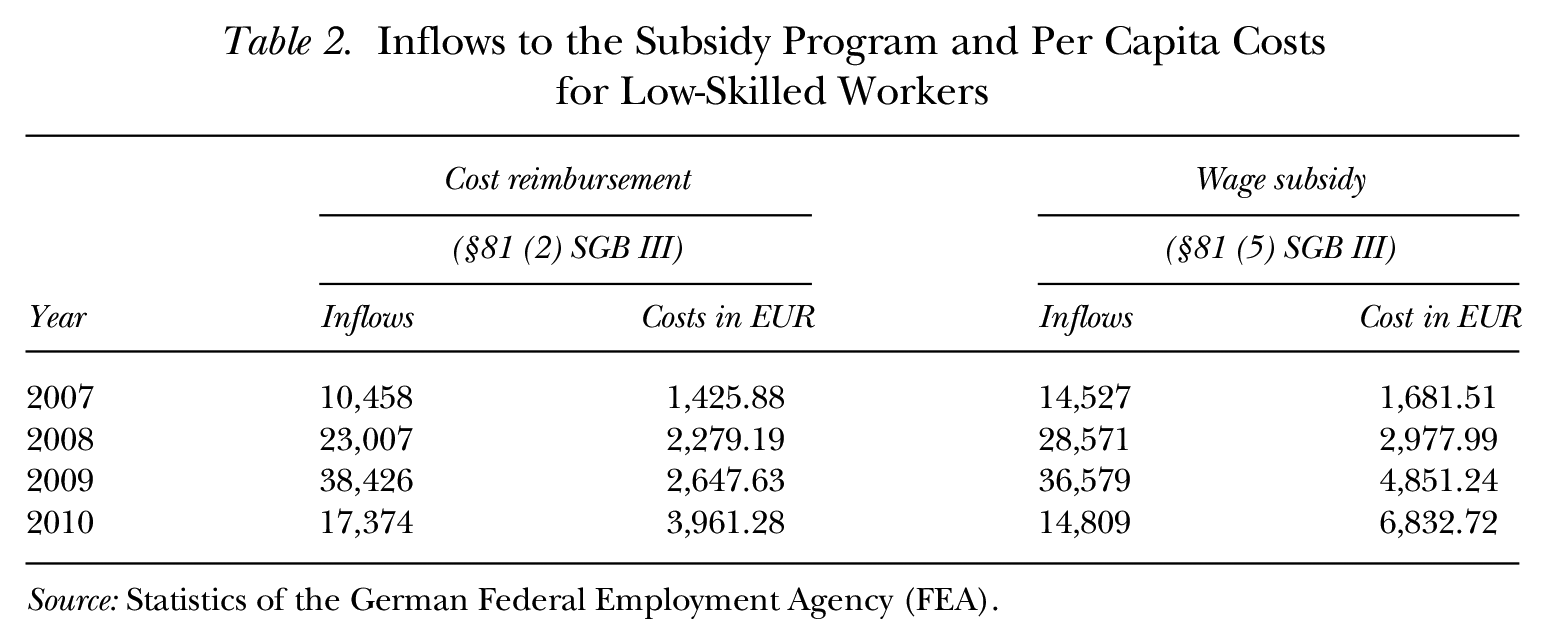
Table 2 shows the inflows into the program by year and kind of subsidy. Compared to other German active labor market policies (ALMP), the number of subsidy recipients is rather low (Büttner, Schewe, and Stephan 2015). There were few entries during the introductory phase because awareness of such subsidies was limited (Lott and Spitznagel 2007).
Inflows to the Subsidy Program and Per Capita Costs for Low-Skilled Workers
Source: Statistics of the German Federal Employment Agency (FEA).
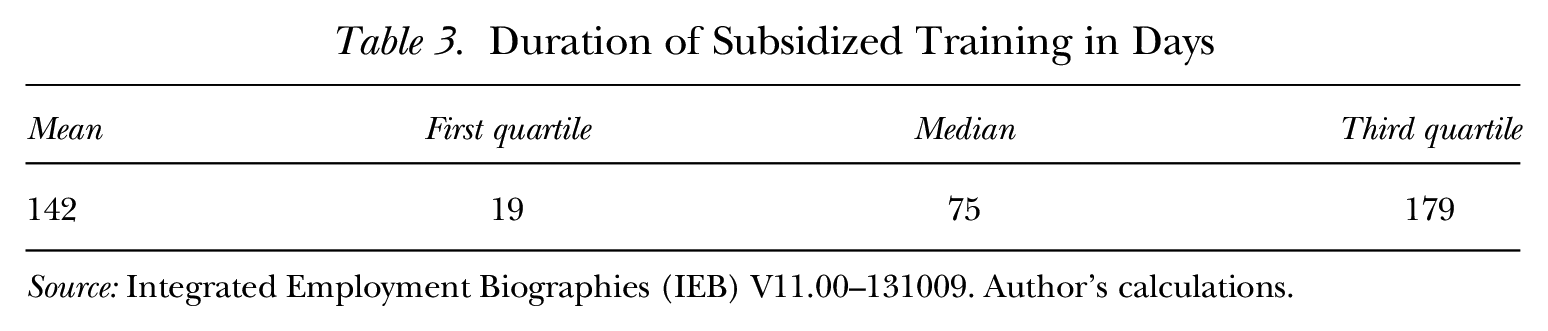
Table 3 displays the duration of subsidized training in days. Duration refers to the period when an individual was officially registered as participating in further training. A training course lasted on average 142 days; the median duration was 75 days. However, this is only a rough indicator for actual training intensity as training can be both full and part time. Nevertheless, we can expect substantial effects on employment and earnings.
Duration of Subsidized Training in Days
Source: Integrated Employment Biographies (IEB) V11.00–131009. Author’s calculations.
Role of Employers in the Selection Process
Because training is to take place during working hours, workers need to arrange for training with their employer. Both parties need to agree on training participation and the type of training, but there is no rule regarding whether the firm or the worker has to initiate the training subsidy. It is not well documented whether workers or firms initiate training or how firms identify potential participants.
To infer how frequently employers or employees initiate training, I draw on the WeLL data set from the project “Further Training as a Part of Lifelong Learning” (Berufliche
Once potential participants are identified, they meet with a caseworker at one of the 176 local employment offices. The caseworker verifies whether the worker meets the eligibility criteria and whether the training course selected was certified by one of the 31 accreditation bodies in Germany. The employee then receives a training voucher for either occupational retraining or a shorter training course. Workers can search for retraining or training courses using KURSNET, a database on the website of the FEA that contains information on certified courses regarding provider, content, duration, the number of slots, and so forth.
In the introductory phase, the program was little known. Therefore, caseworkers promoted the program and actively reached out to firms to inform them about the subsidy program. Consequently, more and more firms became familiar with the program (Lott and Spitznagel 2007). The 2008 IAB Job Vacancy Survey reveals that approximately 44% of all firms with fewer than 100 employees and 75% of all larger firms knew about the program (Lott and Spitznagel 2010). Given the establishment size structure of the underlying sample, at least two-thirds of all firms in the sample should have known about the program. However, only about one-quarter of the firms who knew of the program used subsidized training (Lott and Spitznagel 2010). Approximately 80% of those firms stated that they did not use the program because there was no current operational need for training. Industry, firm size, and firm performance are therefore likely confounders of the LPR.
Firms’ motives to use subsidized training might have changed over time. Between 2009 and 2011, the German government introduced short-time work. Short-time work refers to publicly financed work-time reductions. It enables firms to temporarily reduce their employees’ working hours instead of firing them when labor demand is low. Short-time work was implemented primarily in manufacturing, the most export-oriented branch of the German economy and thus the most strongly affected by international markets during the crisis (Crimmann, Wießner, and Bellmann 2012). Workers who were on short-time work were not eligible for WeGebAU-subsidized further training. The FEA introduced another temporary program, however, that subsidized further training for low-skilled employees during short-time work. The requirements were the same but there were no wage subsidies for firms, only cost reimbursement (Deeke 2009). Training duration could not exceed the duration of short-time work. Subsidized training during short-time work was only important in 2009, when about 25,000 workers of the overall 30,000 participants took part. 2 Thus, employers who use short-time work are probably less likely to use the WeGebAU program. This affects firms in the manufacturing sector in 2009 in particular. By contrast, employers who did not use short-time work might have used the training subsidy for labor hoarding. The firm’s industry and the timing of training are therefore likely to affect the unconditional LPR.
Literature Review
The training literature offers several reasons for legitimate interventions in further training activities by official institutions if there is an undersupply in training (Booth and Bryan 2005). Moreover, a large and growing body of literature has investigated the determinants of (privately funded) firm-based further training, for example, for the United States (Lynch 1992; Lynch and Black 1998; Lerman, McKernan, and Riegg 2004) or Europe (Brunello, Garibaldi, and Wasmer 2007). Trained workers are usually younger, male, better educated, and employed full time. The training firms are relatively large. By contrast, low-skilled workers participate in further training less often due to capital constraints (Leuven and Oosterbeek 1999; Bassanini et al. 2007; Albert, García-Serrano, and Hernanz 2010; Grund and Martin 2012; Fouarge et al. 2013).
The bulk of the literature on subsidized training is concerned with programs for unemployed workers (Card, Kluve, and Weber 2010, 2018; Crépon and van den Berg 2016) and mostly concludes that training for the unemployed yields positive gains in the long run.
A number of studies evaluate training programs that are open to both employed and unemployed workers. The Chilean training voucher program known as Bono Trabajador Activo (BTA) (Novella, Rucci, Vazquez, and Kaplan 2018) covers the costs of training courses for workers who contributed to social securities for a certain minimum duration before applying for the program. After five years, the program decreases employment probability by 2 percentage points, but increases earnings by 5% for low-educated workers. The U.S. Workforce Investment Act (WIA), particularly the WIA Adult and WIA Displaced Worker program, target disadvantaged workers with poor work histories or workers seeking job-search assistance (Barnow and Smith 2015). In general, program participation benefits both WIA adults and WIA displaced workers in terms of earnings and employment, even though the effects, in particular for earnings, are smaller for the latter (Hollenbeck 2009; Heinrich et al. 2013; Andersson et al. 2016). Training is more beneficial during economic downturns because of the composition of participants (Heinrich and Mueser 2014). Women profit more than men do because they are trained in fields with higher returns, for example, health care (Jacobson and Davis 2017).
In contrast to these studies, the literature on the returns of training subsidies predominantly targeted at low-skilled employed workers provides mixed evidence regarding earnings and take-up rates. Abramovsky et al. (2011) did not find any effects of UK subsidies for low-skilled training on firms’ or employees’ training take-up rates. By contrast, Görlitz (2010), who evaluated the above-mentioned Bildungsprämie–German vouchers that partially cover direct training costs, found positive effects. They ranged from 10 to 15% for the share of firms investing in training. Individuals receiving the voucher participated in 1.04 more training courses (Görlitz and Tamm 2017). Providing additional information about these vouchers to workers, however, did not increase training take-up at the worker level (Görlitz and Tamm 2016). Hidalgo, Oosterbeek, and Webbink (2014) found that a random distribution of training vouchers for low-skilled workers in the Netherlands increased take-up rates by 44%. Also using an experimental setup, Schwerdt, Messer, Woessmann, and Wolter (2012) found an increase of training take-up of 13 percentage points for workers of all skill groups in Switzerland.
Evidence on the effects of subsidized training on income is also mixed. The Bildungsprämie does not affect wages (Görlitz and Tamm 2016). Hidalgo et al. (2014) also did not find any short-term wage effects, and Schwerdt et al. (2012) confirmed this result. They objected, however, that workers with compulsory education, or whose highest educational degree is one of vocational training, might have positive returns. Large effects were detected for Sweden, where an additional year of adult education for low-skilled workers increased annual earnings by 4.4% (Stenberg 2011).
Regarding the effects on employment, previous evidence is rather scarce. Schwerdt et al. (2012) and Görlitz and Tamm (2016) did not find any effects of training subsidies on workers’ employment. Dauth and Toomet (2016) analyzed the impact of subsidized training on the employment duration of workers older than 45 years in small- and medium-sized enterprises (SME) in Germany. They found improved employment among participants of the subsidy program, which they attributed to the postponement of retirement due to increased job satisfaction. Even though they did not look at low-skilled workers but focused on a certain age group in SME, their analyses are the most similar to this article, as the institutional implementation of the subsidy is very similar and their analyses are based on the same administrative registers.
My article differs further from the ones noted above in various aspects. First, I focus exclusively on employed low-skilled workers. Given that they are not unemployed or do not necessarily have poor employment histories, they differ from participants of the WIA and BTA with better labor market attachments. Second, WeGebAU subsidizes training that needs the consent of the employer because it takes place during working hours. It is therefore much more linked to the current job than other training subsidies such as the Bildungsprämie. Third, exploiting regional variation, I strike a new path to identify causal effects compared to these previous studies. Measuring the effect on compliers, that is, those who participate additionally due to a more generous policy style, I evaluate what would happen should the government decide to extend the program further. Fourth, contrary to previous European studies that primarily evaluated program take-up rates and earnings, I focus on employment, unemployment, and earnings. Fifth, studying a large set of subgroups in order to unravel the training mechanisms, I put a great deal of emphasis on program heterogeneity.
Empirical Approach
Instrumenting with Policy Styles
Regional variation in employment offices’ policy styles has been exploited to evaluate ALMP instruments in recent studies (Frölich and Lechner 2010; Lechner, Wunsch, and Scioch 2013; Boockmann, Thomsen, and Walter 2014; Doerr et al. 2014; Markussen and Roed 2014; Dean, Pepper, Schmidt, and Stern 2015; Eppel 2017). In this study, agency-specific policy styles reflect the part of the program implementation that is solely due to local employment agencies’ unique features, which are independent from structural or economic specifics. Knodt (1998) defined policy styles as persisting differences in paradigms, problem-solving mechanisms, and cooperative behavior between agents. Adopting this idea, Doerr and Kruppe (2014) elaborated on the exogeneity of conditional policy styles for the employment agencies between 2005 and 2010. By combining unique survey data of caseworkers’ and managers’ assessments of a training voucher program with German register data, they found that particularly cooperative behaviors and high degrees of communication within employment agencies and with firms determine policy styles.
Unlike previous studies that exploit local autonomy for the identification of treatment effects, I cannot draw on survey data that capture concrete details on the local policy styles (Boockmann et al. 2014; Doerr et al. 2014). I can rely on qualitative evidence, however. In 2011, nine IAB experts located in different employment agencies across Germany interviewed caseworkers. The objective of this qualitative survey was to learn about the implementation of the subsidy program. This involves, for example, information on who initiates the first contact between employment agency and employer/employee, who is involved in the decision-making process, and how the decision is made regarding who is eligible for the subsidy. The interview protocols illustrated that local employment agencies have different styles regarding the implementation of the program.
First, differences occur regarding the organization within employment agencies. Whereas in some agencies all caseworkers responsible for the contact with firms are obliged to implement the program, other agencies have specialists who process all program applications alone, and still other agencies hire training counselors. These counselors are responsible for helping caseworkers promote the program and for advising firms and workers on the program. The FEA adapted the number of specialized caseworkers and training counselors continuously over time according to the overall program policy. From 2007 to 2009, the FEA pushed the program by increasing advertising efforts and personnel. Enrollment peaked in 2009 with the financial and economic crises. Starting in 2010, the FEA offered the program less actively and decreased staff based on a report by the German Federal Court of Auditors (Bundesrechnungshof 2009). Because of this report, local employment agencies applied the eligibility criteria more strictly and accurately documented the allocation of subsidies. Further organizational differences concern the handling of applications. Although some caseworkers process further training applications by themselves, other caseworkers need final consent from the head of the team or other superiors, and still other caseworkers are responsible only for certain parts of the process (e.g., checking workers’ and firms’ eligibility or instructing payout).
Second, differences occur regarding the informal behavior and attitudes of caseworkers. When granting a training subsidy for employed workers, caseworkers draw on the legal framework that is given by law, that is, the German Social Code and the FEA’s rules of procedure (Geschäftsanweisungen and Handlungsempfehlungen). Beyond these guidelines, caseworkers enjoy a certain level of discretion. This concerns, for example, their judgment on the necessity of the further training course for the current job or for the occupation in general, which would justify a subsidy. Caseworkers also have discretion when judging whether applicants are eligible for the subsidy. For example, they must determine whether someone can be categorized as low skilled, which—given workers’ employment histories—is not always trivial.
The financial resources for the further training of unemployed workers are usually limited. Therefore, caseworkers thoroughly consider whether training participation will be profitable for the worker based on the workers’ abilities and motivation. Regarding employed workers, caseworkers never had to deal with budget constraints. The FEA annually provided an extra 200 million euros, which were never fully exploited. Consequently, expected program outcomes for employed workers are less important for the caseworkers’ decisions regarding who should receive training.
In sum, organizational differences and caseworkers’ informal behavior affect the personnel capacities of local employment offices, which in turn affect how quickly and carefully applications are processed and how familiar single caseworkers are with the program. Organizational differences do not directly affect employment and earnings of workers, however, but only the treatment probability, given that potential participants are employed. After the subsidy program’s introduction in 2007, instructions for caseworkers for the implementation of the program were not yet very specific, as internal documents of the FEA reveal. Therefore, it is likely that employment agencies had different interpretations of which firms and workers were eligible for the program and which types of training could be subsidized. As a result, some agencies were more prone to grant the subsidy than were other agencies. Policy styles may have changed over time because the FEA adjusted the caseworker staff, program content, and eligibility criteria over time and because caseworkers became more familiar with the program.
Local Average Treatment Effect (LATE) Framework
I consider participants entering the subsidy program between January 2007 and December 2010 and follow them over a period of up to five years. I estimate the causal effect of compliers’ program participation on cumulative earnings and employment duration, exploiting regional variation in the residual LPR of training subsidies as an exogenous instrument (see also Angrist and Pischke 2009: 151–61). I consider the linear model

where Titq is a dummy that indicates subsidy recipience, Xitq controls for individual characteristics, and Fft controls for employer characteristics. Aat denotes the labor market characteristics, including the composition of the population and the workforce, that allow correction for regional, structural, and economic differences. Observations at the individual level are indicated by i, at the firm level by f, and at the agency district level by a; q indicates observations by quarter and t by year. There remain ηiq = M’itqγi+νi unobservable variables, such as Mitq, which might indicate workers’ ambitions for which I cannot control. The effect of Mitq influences both the outcome Yitq and the treatment indicator Titq, such that E(Titqηitq)≠ 0.
To estimate the causal effect of Titq on Yitq, I need an instrument for subsidy program participation. I start by constructing the following variable

for every German local employment agency district a per quarter q in year t. Tiatq denotes a low-skilled employee who starts subsidized training in a given quarter and agency district. LSiat indicates a low-skilled employee within an agency district and is observable only on a yearly basis. Hence, LPRatq corresponds to the unconditional local participation rate of low-skilled employees in the subsidy program by quarter and agency district.
The unconditional LPR is by construction endogenous and thus invalid as an instrument. 3 The unconditional LPR is partially driven by regional labor market conditions, employer, and worker characteristics:

These factors are also likely to impact individuals’ probabilities of participating in the subsidy program and participants’ labor market outcomes. Therefore, I purge variation in the LPR from region-, establishment-, and individual-level confounders. Consequently, I exploit only the remaining variation in the probability of treatment between different agency districts as an instrument. I refer to this residual variation as the policy style. Figure 1 displays the variation of the average residual LPR across German employment agency districts aggregated over 2007 to 2010, showing clear differences across local employment agencies.
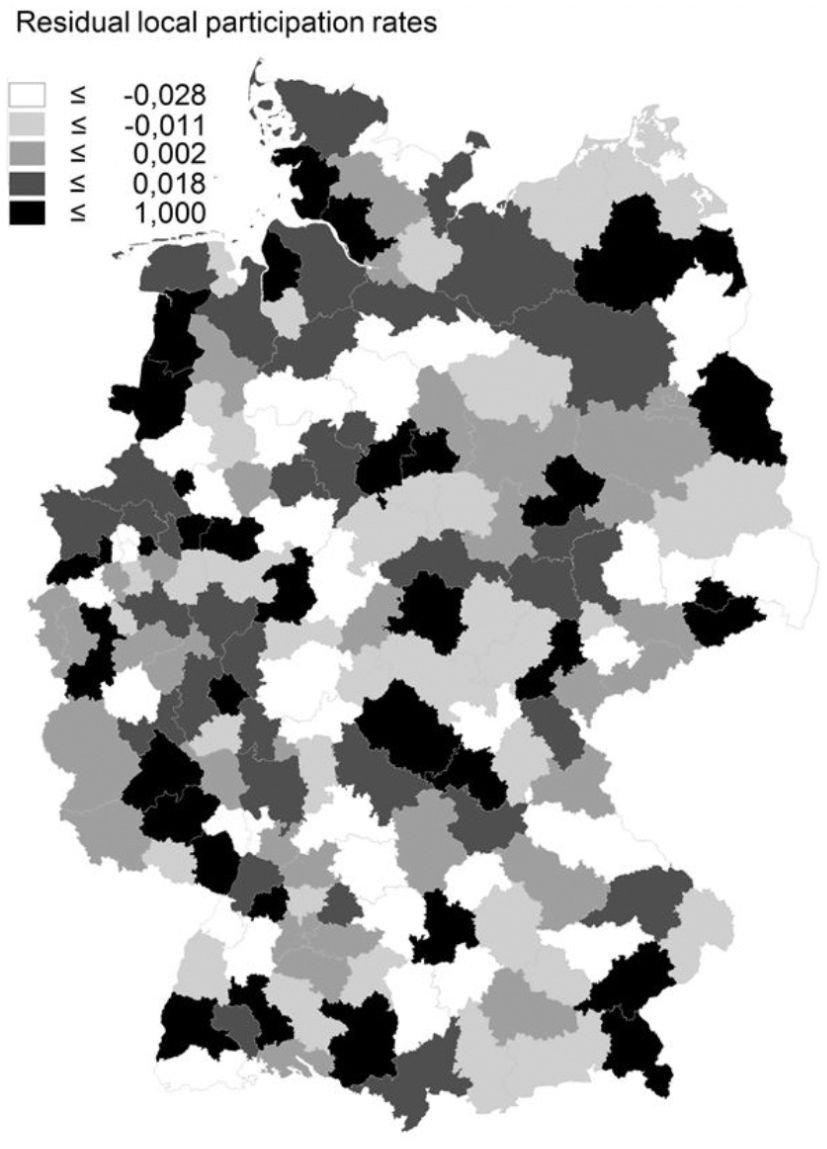
Average Residual Local Participation Rates (Policy Styles) from 2007 to 2010 by Employment Agency District
Figure 2 displays binned scatter plots of the residual LPR and the probability to be treated. The graphs show that the relationship between the two variables is quadratic rather than linear, also when dropping outliers. The probability to be treated increases with the residual LPR, but at a decreasing rate. Therefore, I create two instruments, Z1itq and Z2itq, that capture both the linear and the quadratic relationship between the residual LPR and the treatment probability.
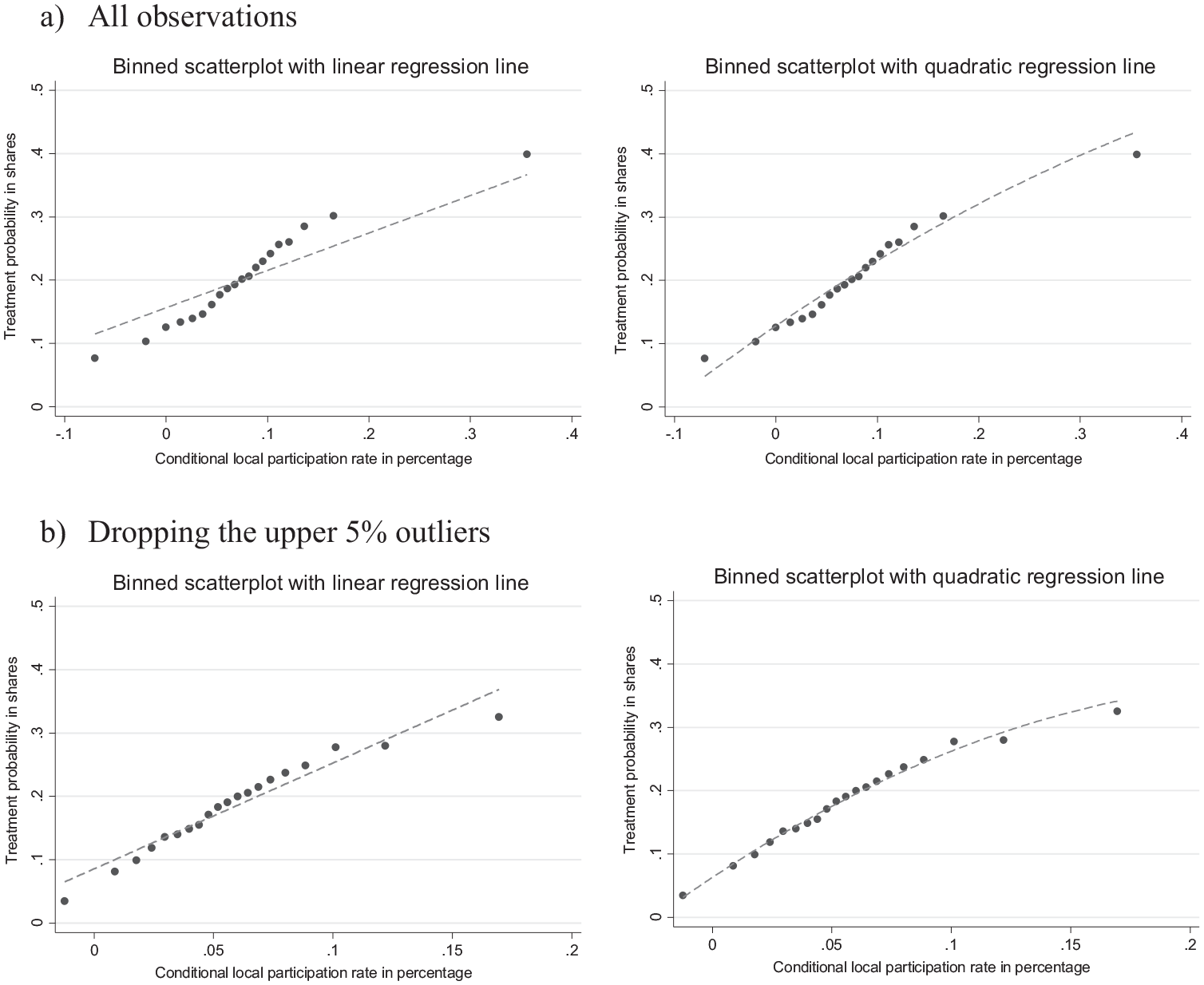
Binned Scatterplots of the Treatment Probability and the Conditional Local Participation Rate (LPR) with Linear and Quadratic Regression Line


The implementation of the instrumental variable (IV) is accomplished by using two-stage least squares (2SLS) estimation. In the first stage, I regress the treatment indicator Titq, which takes the value 1 if a worker participates in the subsidy program in a certain quarter, on the instruments Z1itq and Z2itq. Then I regress the outcome on the predicted treatment probability. This corresponds to regressing Titq on LPRatq, LPR2 atq , and control variables Xitq, Fft, and Aat in the first-stage regression and including the same set of control variables in the second-stage regression.

with
Substituting Equation (6) into Equation (1) in the second step yields a regression of the outcome of choice Yitq on the predicted treatment probability

Thus,
The resulting coefficient
LATE Assumptions
Policy styles are positively correlated with the probability of participating in the program but are not directly connected to participants’ employment or earnings. Thus, the instrument purges the treatment effects of confounders that might simultaneously affect both the individual outcomes and the probability of subsidization. However, the quality of the instrument hinges on several important conditions.
First, to avoid the problem of weak instruments, the instrument should have sufficient explanatory power. In a later section (The Baseline Model), I will show that this assumption is fully met.
Second, policy styles must be independent of unobservable confounding factors at the agency, establishment, and worker levels. Such a correlation might arise if a certain policy style attracts certain workers or firms or if certain workers or firms drive the instrument. The former scenario can be excluded because it is unlikely that workers or firms relocate to regions with specific policy styles (which are likely unknown to them). The latter scenario is more likely because very motivated workers or firms might actively seek further training subsidies from local employment agencies, which would then drive the LPR. Table A.12 in the Supplemental Online Appendix shows that the LPR is uncorrelated with most worker and firm characteristics. It is affected by variables that represent skill, however, such as schooling, type of vocational degree, and being an unskilled blue-collar worker. This impact is not very surprising, given that the subsidy program targets low-skilled workers. Moreover, workers with professions in manufacturing drive the LPR upward, whereas workers with positions in the restaurant, security, and cleaning industries affect the LPR negatively. Other variables at the individual level, for example, gender, age, nationality, and variables that present the employment history, are uncorrelated with the LPR. Larger firms with human resources departments, which are probably better informed about available subsidies, affect the LPR positively. By contrast, industry, firm age, or the skill composition inside firms is uncorrelated with the LPR. The richness of the register data allows me to account for numerous potential confounders and to create conditional independence.
Third, there should not be any direct correlation between policy styles and employment or earnings because this would violate the exclusion restriction. Regarding the validity of the exclusion restriction, recall that I exploit policy styles concerning a program that addresses employed rather than unemployed workers. The underlying subsidy program is the only FEA training program directed at employed workers. The primary task of employment agencies is the integration of unemployed workers, even though employment agencies are obliged to counsel both employed as well as unemployed workers.
To find out to what extent this might pose a problem, I conducted separate analyses based on a 2% random sample of German workers who were employed subject to social security contribution on June 30. As Table 1 shows, approximately 0.1% of all employed workers seek counsel from the employment agency. The main reason for contact between employed workers and employment agencies is to register job seeking at least three months before their (usually temporary) employment contract ends, which they are obliged to do. This type of contact takes place for approximately 2% of all employees. Thus, little interaction occurs between employees and the local employment agencies, which could thread the validity of the instrument. This bias is limited, however, and it should be even lower for workers with a firm tenure of at least two years. These workers should, according to German law, have permanent employment contracts and are therefore unlikely to register job seeking. Therefore, any FEA actions or policies should have no—or only very limited—direct effects on the employment durations or earnings of employed workers, except through the incidence and frequency of subsidized training.
Fourth, monotonicity requires that employed workers within an employment agency district react in the same way when the instrument takes a higher value. Thus, a higher residual LPR makes workers strictly more likely to participate. Consequently, workers who receive subsidized training in employment agencies with low residual LPRs must also receive subsidized training in employment agencies with higher LPRs. As outlined earlier, employment agencies’ policy styles vary due to differences in the organization and the informal behavior of caseworkers. Agencies without specialized WeGebAU staff might be less sure about the implementation of the program and thus stick to subsidizing workers who can easily be identified as eligible workers. For example, this is the case if workers are unambiguously low skilled and have a clear necessity for further training to keep the current job or for the occupation in general. In that sense, employment agencies, which may be prone to give away the subsidy and which potentially may be more likely to subsidize disputable cases, should also subsidize those workers whose program eligibility is easy to identify.
Fifth, the stable unit treatment value assumption (SUTVA) requires that individual decisions to participate in the program do not affect other individuals’ labor market chances. The training subsidy program is rather small compared to other ALMP instruments, and the mean share of treated workers in the workforce per participating firm is approximately 3.5% in the sample, thus this assumption very likely holds in the underlying case.
Data, Variables, and Sample Selection
Data
The analyses are based on administrative records drawn from the Integrated Employment Biographies (IEB) V11.00.00. The IEB data are provided by the German Institute for Employment Research and document the employment careers of all individuals liable for social security contributions (approximately 80% of the German workforce). Data provide information on benefit receipts, job searches, and participation in active labor market policies. These data are process generated and highly reliable (Dorner, Heining, Jacobebbinghaus, and Seth 2010). From these records I draw information on gender, age, nationality, schooling and vocational degree, occupation, blue- or white-collar status, tenure since January 2000, and other variables in the employment history for one, three, five, and seven years prior to treatment. The latter comprises periods in employment, welfare and UI benefit receipt, unemployed job-seeking periods, and participation in previous subsidized training.
The IEB data are merged with data from three other sources. The Establishment History Panel (EHP) includes the universe of German establishments employing at least one worker liable for social security contributions (Hethey-Maier and Seth 2009). As these data are of the same administrative origin as the IEB data, they have the same high reliability. From these records, I draw information on firm age, size, and workforce composition in terms of gender, age, and qualification. Moreover, I add regional data on the population (density, share of women, age structure) from the Federal Statistical Office and data on the composition of employees (age and skill structure, employer’s size, industry structure) at the agency level from the Labor Placement Statistics.
For the analysis, I identify all low-skilled, first-time participants entering subsidized further training between 2007 and 2010 and the type of subsidy, that is, wage subsidies or reimbursement of training costs. The corresponding numbers based on the final sample are displayed in Table 4. Given that nearly 60% of all participants received a combination of wage subsidies and reimbursements, I adjust for parallel treatment spells in the empirical analyses by counting workers receiving both measures only once. The potential bias from subsequent treatment spells should be low because only approximately 9% of all participants had a second treatment spell at some later point. From the resulting sample, I drop apprentices, part-time workers, and workers outside the age range of 25 to 65 years. Finally, I drop all workers from the Bochum employment agency district, as this agency reported an extremely high share of low-skilled participants relative to all low-skilled employees in that district in the fourth quarter of 2007 for no obvious reason.
Inflows to the Subsidy Scheme for the Adjusted Sample by Legal Basis
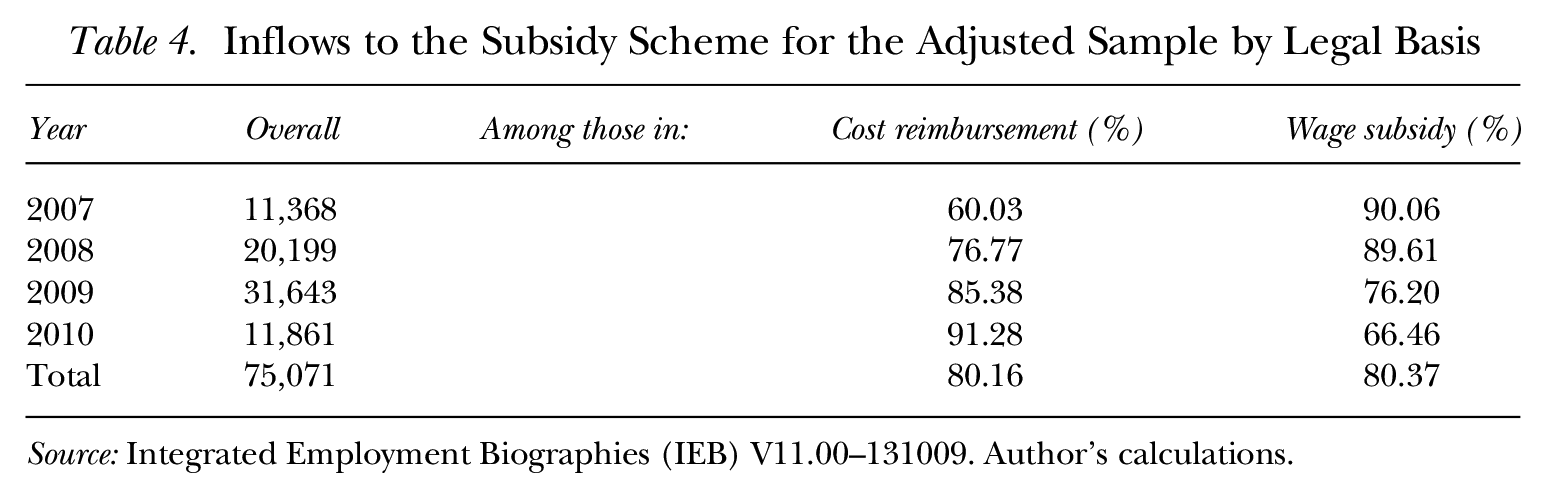
Source: Integrated Employment Biographies (IEB) V11.00–131009. Author’s calculations.
I create a quarterly panel for the years 2007 to 2010. I calculate all control variables relative to the first day of each quarter. Outcome variables are calculated relative to the last day of each quarter. Table 5 summarizes how the outcome variables are defined. 5 For the treated workers, I pick the employment sequence that leads to the first treatment. For the comparison workers, I pick a random employment sequence, that is, subsequent employment quarters at a given employer. This is the data set I use for the estimation of the dynamic treatment effects presented in the Supplemental Online Appendix material. For the static estimations I keep only one random observation among control workers and the observation of program start among the treated workers for computational reasons. This trims the sample size and increases variation compared with keeping multiple random observations for a subset of workers.
Definition of Outcome Variables
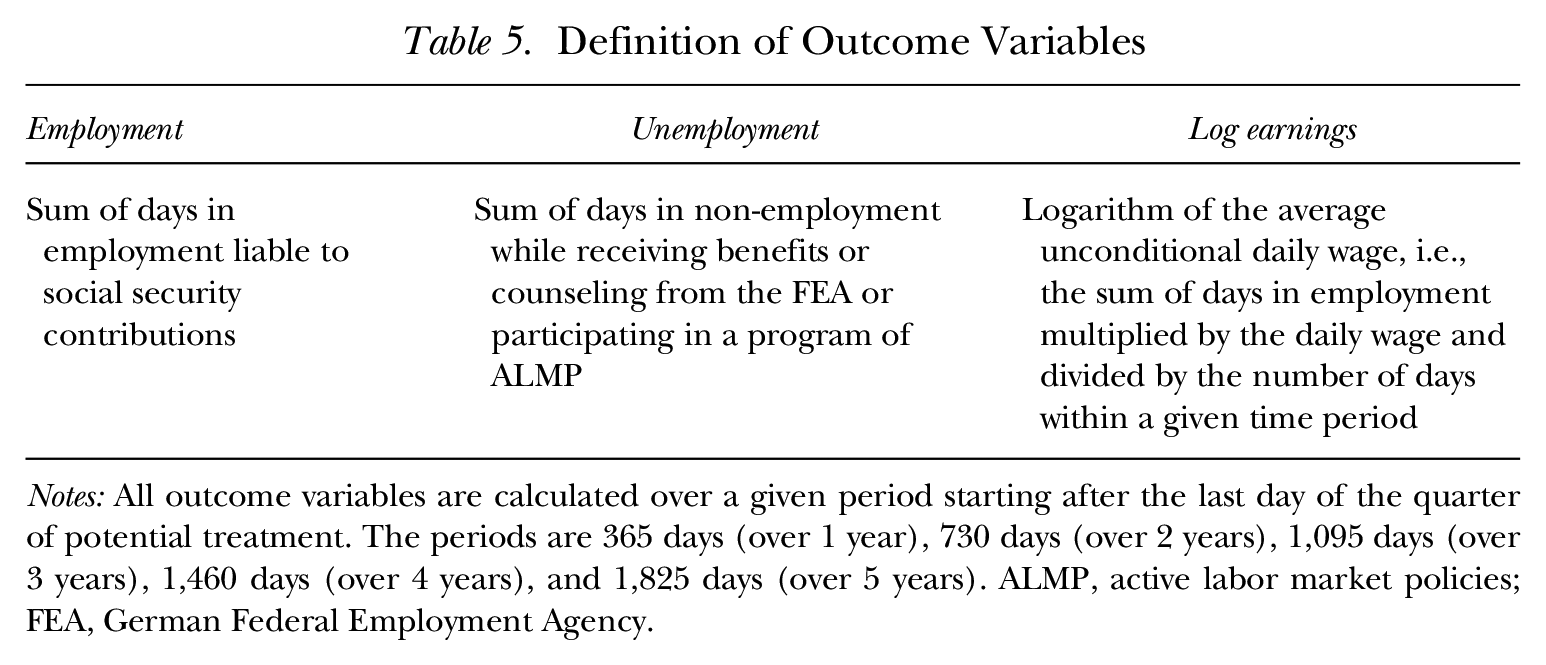
Notes: All outcome variables are calculated over a given period starting after the last day of the quarter of potential treatment. The periods are 365 days (over 1 year), 730 days (over 2 years), 1,095 days (over 3 years), 1,460 days (over 4 years), and 1,825 days (over 5 years). ALMP, active labor market policies; FEA, German Federal Employment Agency.
Sample Selection
Three sources of potential selection into the subsidy program include regions, firms (establishments), and workers. 6 As discussed earlier, it is also likely that the LPR is correlated with a number of these confounding variables.
Table 6 shows that worker-level selection into the program is likely. 7 Men and foreign workers are over-represented in the treatment group. More than twice as many workers without a vocational degree (37%) and with lower educational levels are in the treatment group. Concerning occupational groups, subsidized workers are over-represented in manufacturing, transportation, and logistics but under-represented in management and organization. Treated people have longer tenure and employment durations than do people in the control group in the five years before treatment start. However, they collect lower earnings in the year before treatment (74 vs. 85 euros per day) and spend more time in unemployment.
Selected Worker, Establishment, and Regional Characteristics
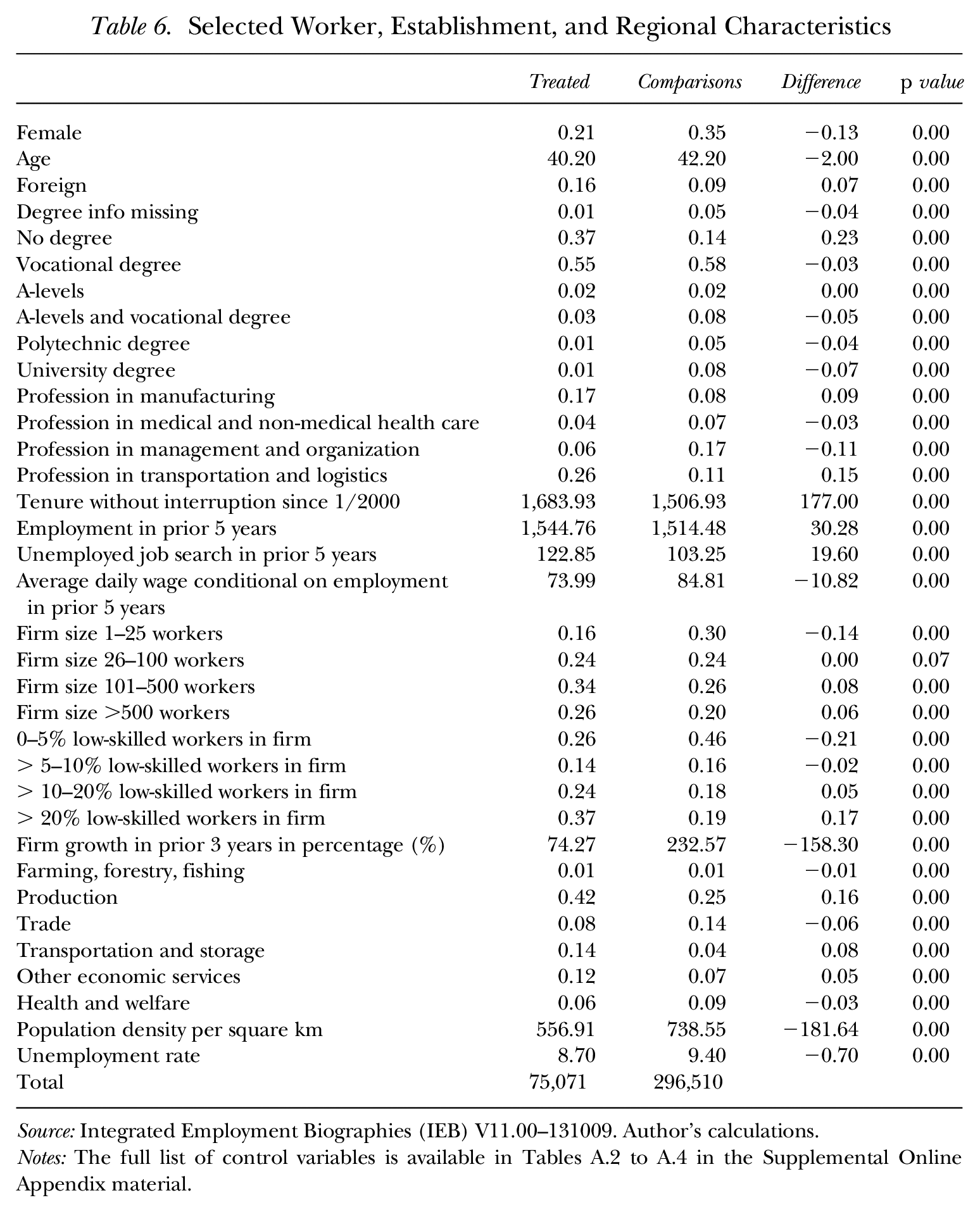
Source: Integrated Employment Biographies (IEB) V11.00–131009. Author’s calculations.
Notes: The full list of control variables is available in Tables A.2 to A.4 in the Supplemental Online Appendix material.
Establishments that use the subsidy program differ from other firms, particularly in terms of firm size, industry code, workforce, and economic situation. Table 6 shows that participating individuals tend to be employed in larger establishments with higher shares of low-skilled workers. They work in firms that grow more slowly on average. Moreover, firms in transportation, production, and economic services are more likely to use the subsidy.
Another crucial factor is implementation at the regional level of employment agencies. Participants work in less densely populated regions with slightly lower unemployment rates. Other structural differences are economically unimportant.
Results
The Baseline Model
This section discusses the results of the econometric analysis. Because the underlying data lack information on privately funded training, I am interested only in the effects of the public training subsidies rather than the actual programs. I estimate whether public subsidies for certain training courses have any effect on the employability of the participants. 8 Throughout the analyses, I do not distinguish between the two components of wage subsidy and cost reimbursement, but estimate a combined effect for program participation. Because training costs are generally borne by the employer, both components affect the same subject, that is, the firms’ training decisions. 9
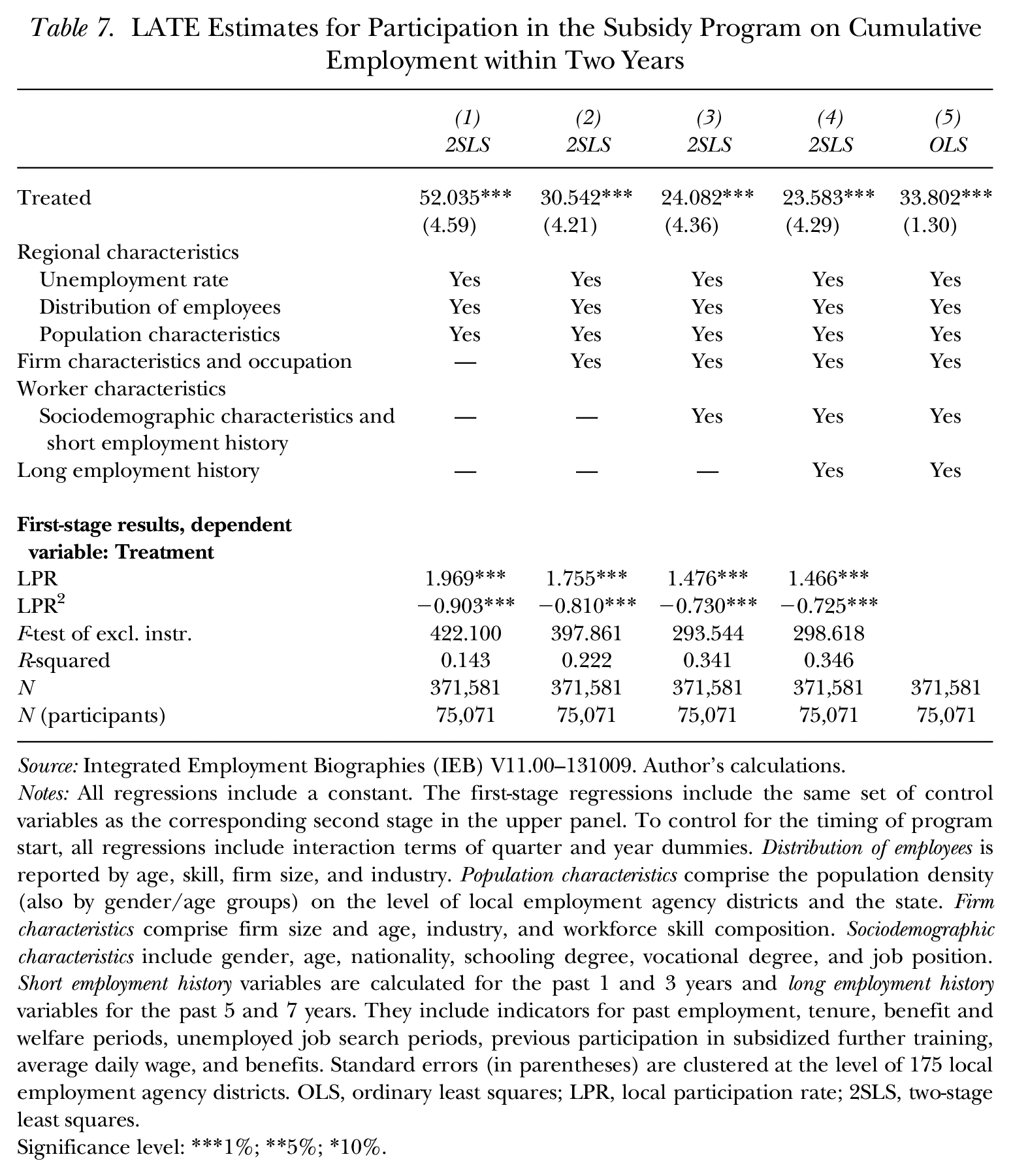
Table 7, column (1) shows the most parsimonious specification, controlling for quarter dummies that account for the timing of treatment and regional characteristics. 10 The latter include the district unemployment rate (to roughly control for regional labor market characteristics and regional labor supply and demand); the composition of all individuals living within a regional employment agency district in terms of density, gender, and age; and variables that control for the composition of the workforce within an agency district. The first-stage results reported in the bottom panel imply that the LPR and LPR2 of employment agency districts have strong correlations with treatment. The F-test statistic of the excluded instruments is well above conventional threshold levels. Turning to the second-stage results, I find that participation in the subsidy program has a positive and significant impact of approximately 52 days (seven weeks) on compliers’ cumulative employment duration over a period of two years.
LATE Estimates for Participation in the Subsidy Program on Cumulative Employment within Two Years
Source: Integrated Employment Biographies (IEB) V11.00–131009. Author’s calculations.
Notes: All regressions include a constant. The first-stage regressions include the same set of control variables as the corresponding second stage in the upper panel. To control for the timing of program start, all regressions include interaction terms of quarter and year dummies. Distribution of employees is reported by age, skill, firm size, and industry. Population characteristics comprise the population density (also by gender/age groups) on the level of local employment agency districts and the state. Firm characteristics comprise firm size and age, industry, and workforce skill composition. Sociodemographic characteristics include gender, age, nationality, schooling degree, vocational degree, and job position. Short employment history variables are calculated for the past 1 and 3 years and long employment history variables for the past 5 and 7 years. They include indicators for past employment, tenure, benefit and welfare periods, unemployed job search periods, previous participation in subsidized further training, average daily wage, and benefits. Standard errors (in parentheses) are clustered at the level of 175 local employment agency districts. OLS, ordinary least squares; LPR, local participation rate; 2SLS, two-stage least squares.
Significance level: ***1%; **5%; *10%.
In column (2), I include a large set of firm characteristics, because factors such as firm size and age, workforce composition, and industry are important determinants for firms’ training investments and the operational need for training as well as for workers’ average employment durations. Thus, these variables potentially affect the LPR, the treatment probability, and workers’ employment outcome. As a consequence of including these characteristics, the positive effect and the first-stage coefficients decrease significantly. Finally, I gradually add control variables for individual characteristics, in particular, sociodemographic controls and variables that reflect both the employment career and any unobservable personal traits, as suggested by Caliendo, Mahlstedt, and Mitnik (2017) in a similar setup. The effect on employment decreases to 24 days on compliers’ cumulative employment over two years.
The lower panel shows that the first-stage coefficients remain highly significant and do not change further when adding more controls for employment histories. Column (4) is the preferred benchmark specification in the following analysis, as it contains the most important control variables. For this model, I also report the results of a corresponding OLS regression in column (5). Comparing the coefficients of columns (4) and (5) shows that the OLS regression generates a significant positive effect of 34 days more employment and the LATE a positive effect of 24 days more employment over a two-year period. This indicates that the OLS coefficient might be overstated.
The preferred specification above contains a large set of control variables to purge the LPR from potential confounders. Yet, potentially important factors that I cannot control for may still impact the LPR. Personality traits, for example, might affect the LPR positively, when I assume that more motivated workers actively initiate the program. This factor might affect the validity of the instrument. I expect the bias to be small, however. After having controlled for regional and firm characteristics, increasing the number of control variables for individual characteristics, in particular in the employment history, changes the first-stage coefficients only slightly, as a comparison of columns (3) and (4) shows.
Additional Labor Market Outcomes
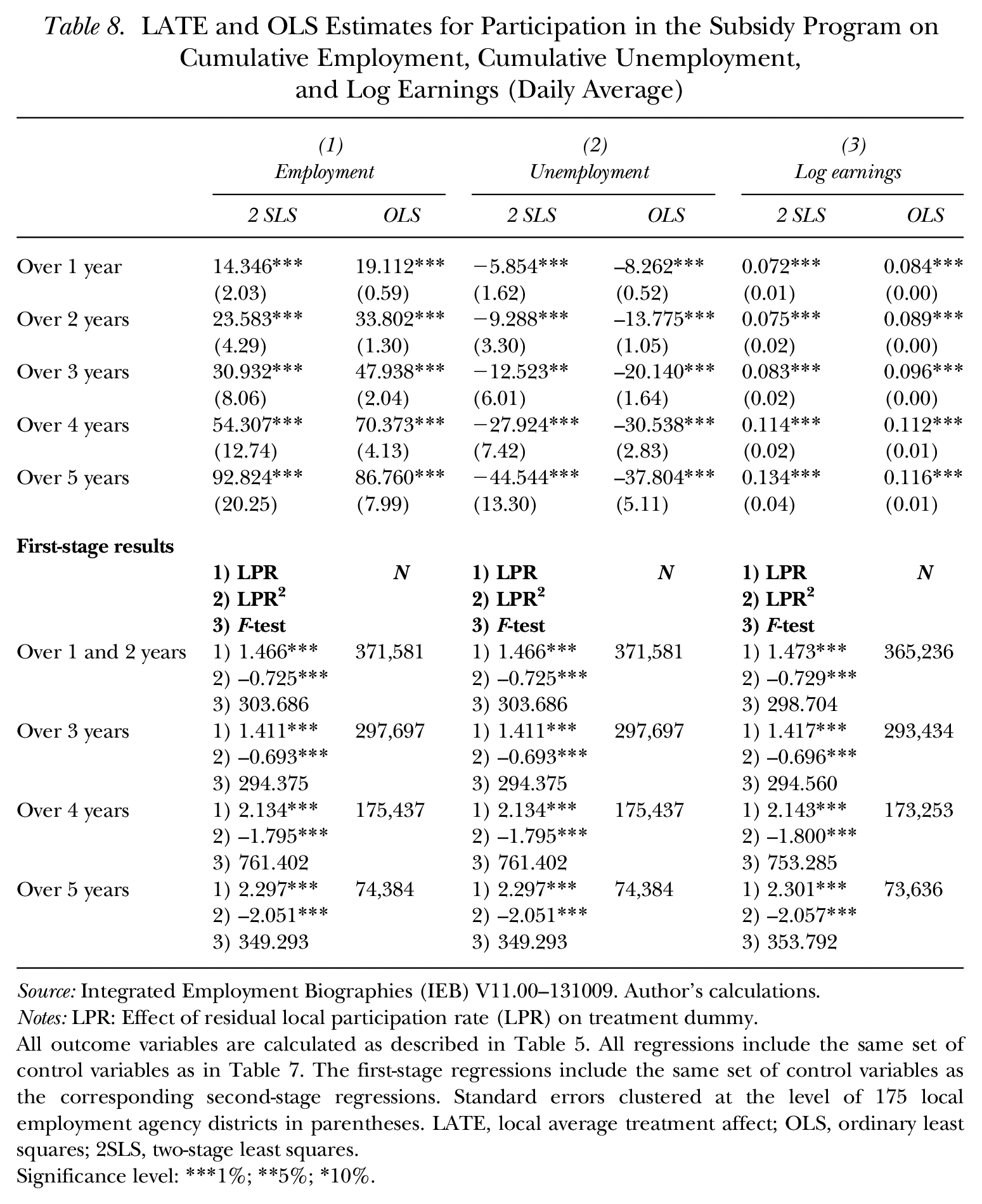
The previous section showed that participation in the subsidy program affects employment liable for social security contributions in the two years after treatment. Because the data end on December 31, 2012, I can observe individuals over different periods: the longest period, five years, is for workers who started participation in 2007 and the shortest period, two years, is for workers who started participation in 2010. Table 8 shows that the effect on employment is steadily increasing over time to approximately 90 more days of employment for treated workers within five years.
LATE and OLS Estimates for Participation in the Subsidy Program on Cumulative Employment, Cumulative Unemployment, and Log Earnings (Daily Average)
Source: Integrated Employment Biographies (IEB) V11.00–131009. Author’s calculations.
Notes: LPR: Effect of residual local participation rate (LPR) on treatment dummy.
All outcome variables are calculated as described in Table 5. All regressions include the same set of control variables as in Table 7. The first-stage regressions include the same set of control variables as the corresponding second-stage regressions. Standard errors clustered at the level of 175 local employment agency districts in parentheses. LATE, local average treatment affect; OLS, ordinary least squares; 2SLS, two-stage least squares.
Significance level: ***1%; **5%; *10%.
Outcomes are measured starting at the end of the quarter of potential program start. Thus, short training courses of only a few days might already be over before I begin measuring the outcome. By contrast, longer training courses might still be ongoing when I begin measuring the outcome. Positive employment effects could then be the consequence of workers being locked in the current employment relationship because they still receive subsidized training. As shown earlier, however, training has a median duration of 75 days and many courses end before the outcome variable is measured. Moreover, as employment effects are persistent and increase over the years, they must be the causal result of program participation and not solely due to the described “lock-in effect.”
A second outcome considered in column (2) is cumulative days of unemployment. I define unemployment as a period during which a worker is non-employed and receives benefits or counseling from the FEA or participates in a program of active labor market policy. Compared to employment, the effect on unemployment is less pronounced. A steadily increasing significant negative effect is seen on unemployment, indicating that complying program participants are approximately 45 days less unemployed within the first five years. Thus, more employment for compliers does not automatically translate into the same amount of less unemployment. Consequently, the program causes employment for some workers who otherwise would have dropped out of the social security records, for example, due to self-employment, retirement, or withdrawal from the labor market. Further analyses reveal that female rather than older workers drive this shift.
Finally, to see how the economic situations of compliers translate into earnings, I consider cumulative earnings as an outcome. For this, I calculate the average unconditional daily wage as described in Table 5. Participants’ gains in earnings from the program are relatively high. In the first year after treatment start, the gain in earnings already amounts to 7% and increases to 13% within five years.
A direct comparison of the OLS and IV estimates is possible only if the treatment effects are constant across all participants and if the average treatment effect on the treated is similar to the LATE. Here, the OLS coefficients are higher in most cases. This implies that OLS either cannot fully control for the positive selection of workers into the subsidy program or that the subgroup of compliers gains less from the subsidy program than always-takers.
Robustness Checks
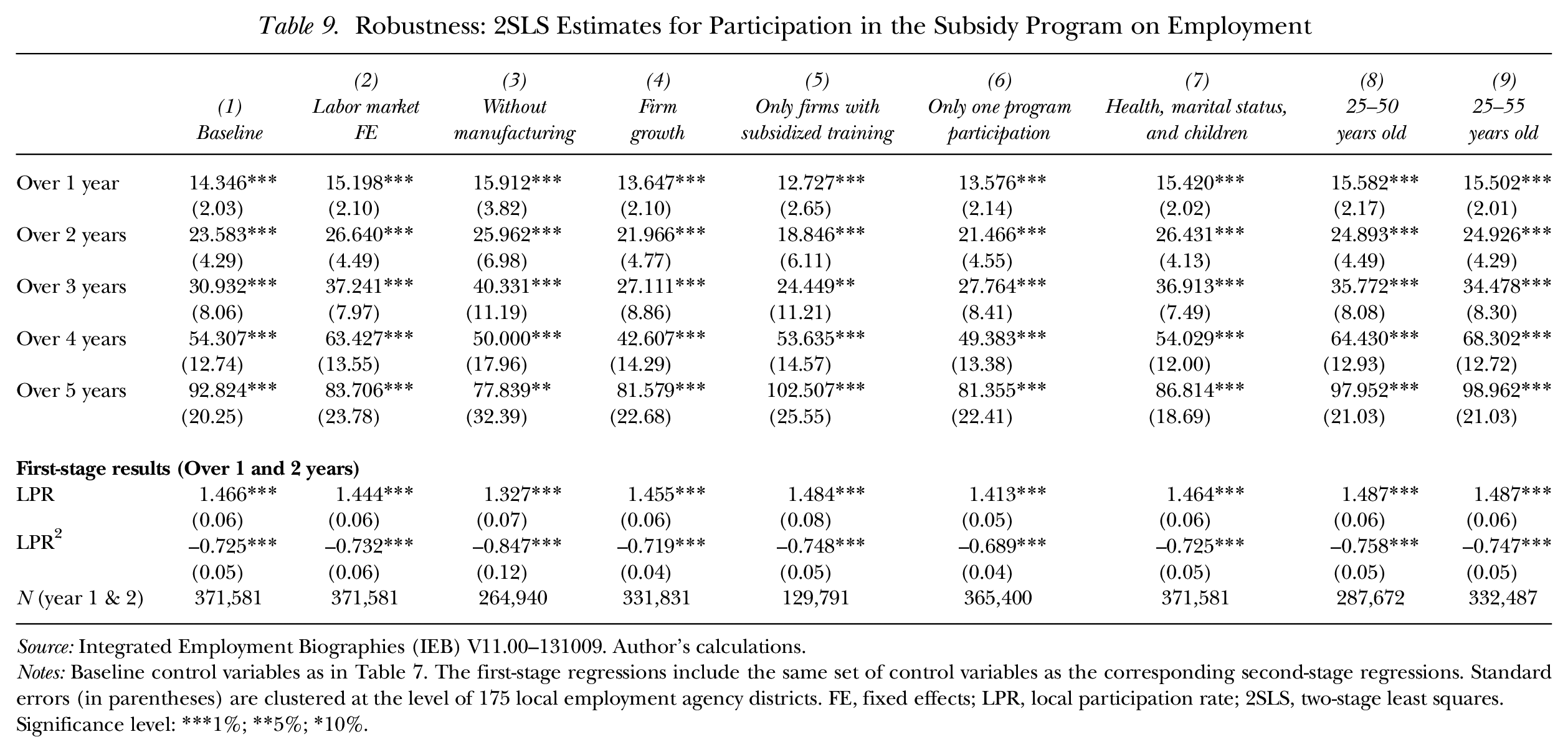
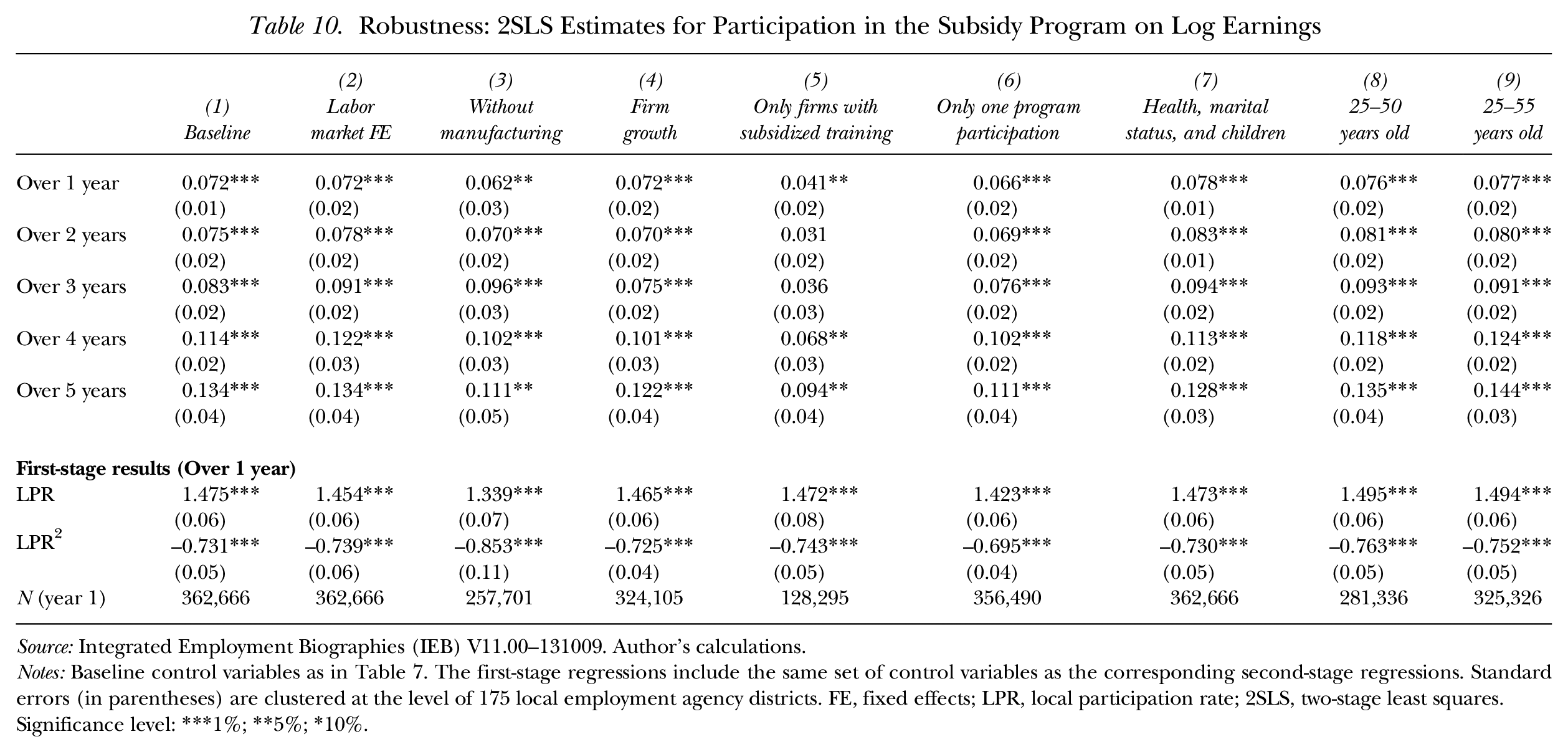
To verify whether unobservable confounders affect the instrument and thus the validity of the empirical approach, I conduct a number of robustness checks. Table 9 and Table 10 summarize the findings on employment and earnings. A look at the first-stage results reveals that throughout all robustness tests, the residual LPRs are hardly affected. This finding strongly supports the validity of the instrument and suggests that the model includes all relevant confounders.
Robustness: 2SLS Estimates for Participation in the Subsidy Program on Employment
Source: Integrated Employment Biographies (IEB) V11.00–131009. Author’s calculations.
Notes: Baseline control variables as in Table 7. The first-stage regressions include the same set of control variables as the corresponding second-stage regressions. Standard errors (in parentheses) are clustered at the level of 175 local employment agency districts. FE, fixed effects; LPR, local participation rate; 2SLS, two-stage least squares.
Significance level: ***1%; **5%; *10%.
Robustness: 2SLS Estimates for Participation in the Subsidy Program on Log Earnings
Source: Integrated Employment Biographies (IEB) V11.00–131009. Author’s calculations.
Notes: Baseline control variables as in Table 7. The first-stage regressions include the same set of control variables as the corresponding second-stage regressions. Standard errors (in parentheses) are clustered at the level of 175 local employment agency districts. FE, fixed effects; LPR, local participation rate; 2SLS, two-stage least squares.
Significance level: ***1%; **5%; *10%.
Labor Market Fixed Effects
If the regional controls for agency districts insufficiently account for structural and economic differences, unobservable confounding factors of program participation at the agency level are correlated with the residual LPRs. In an alternative specification, I therefore control for labor market fixed effects, exploiting only variations in the residual LPRs that occur within the same labor market. Following the classification by Kosfeld and Werner (2012), I identify 141 local labor markets for Germany. Those markets are characterized by close commuter links and high seclusion from other regional labor markets. Local labor markets are based on aggregations of 402 counties. Because agency districts are not based on aggregated counties, labor markets and agency districts are not nested but overlapping, enabling the fixed effects estimation. In both Table 9 and Table 10, column (2) shows that the LATE estimates on employment are generally larger, but the overall effects on earnings are nearly identical. More important, the first stage is almost unaffected, suggesting that the applied regional controls sufficiently purge the instrument of economic and structural components. 11
Dropping Workers in Manufacturing
As discussed previously, short-time work was a popular instrument to hoard workers during the economic downturn, in particular in 2009 and for firms in manufacturing. The existence of short-time work and the possibility for low-skilled workers to receive subsidized training during short-time work might coincide with unobserved interactions between firms and local employment agencies. To determine if this is relevant, I drop workers in manufacturing from the sample. Column (3) shows that the effects on employment and earnings remain relatively constant in the short run. The first-stage coefficients change at the first decimal place. Thus, among all specifications, this specification is the most conservative because the first stage is the most affected. Even though there seem to be unobserved confounders in the manufacturing sector, the overall impact is still rather limited.
Including Employee Growth
Firms’ economic performance or expected mass layoffs potentially affect the employers’ decisions to claim subsidized training, which might drive the LPR. Column (4) shows that the first stages remain nearly constant. The coefficients on earnings and employment become slightly smaller, indicating that firm performance is not a relevant factor for the LPR.
Dropping Firms That Do Not Use Subsidized Training
Firms’ tendency to use public subsidies might be correlated with unobservable characteristics that also affect the LPR. Limiting the sample to workers from firms that have at least one employee who received subsidized training, I again find that the first stage changes very little, which supports the validity of the instrument. Column (5) shows that the coefficients on earnings become significantly smaller and partially insignificant in the short run, suggesting that the subgroup of firms that uses training subsidies is selective. One explanation for the coefficients on earnings becoming smaller is that workers profit less from program participation because coworkers might also be trained but without subsidies. Another explanation is that these firms work in branches where gains in earnings can only be realized in the medium and long run.
Dropping Workers with Multiple Treatment Spells
Approximately 9% of the treated workers participate in the subsidy program a second time at some point later, which could be an outcome of the first participation. To see how this affects the validity of the instrument and program effectiveness, I conduct another test and restrict the sample to workers who participate only a single time in the observation period. As before, the first-stage coefficients are only slightly affected by this restriction. As one can expect, the program effectiveness decreases somewhat compared to the baseline specification: employment declines by 10 days and earnings by 2 percentage points within five years.
Including Variables on Health, Marital Status, and Children
Workers’ labor market participation is affected by their health status. Particularly for women, the existence of children often involves care responsibilities and marital status affects the preference for having one’s own income. To determine whether these factors also affect LPRs, I include additional variables in a separate regression. 12 Column (6) shows that the first stages are almost identical to the baseline specification and that the coefficients remain very comparable, which implies that health and the family status are irrelevant factors for the local policy style.
Dropping Workers Older Than Age 50/55
Finally, I am interested in how workers at the upper edge of the age distribution who are relatively close to retirement affect the results. I conduct two further robustness checks, limiting the sample to workers between 25 and 50, and 25 and 55 years, respectively. Columns (7) and (8) show that the first stages as well as the coefficients on employment and earnings vary only slightly. Thus, workers’ age is not a relevant factor for the local policy style.
Results by Selected Subgroups
Results by Cohort
During the observation period from 2007 to 2010, the rules regarding the implementation of the program were adjusted several times. Therefore, examining the effects by year cohort might offer valuable clues as to whether changes in regulations or the macroeconomic situation affected the outcomes of participants. I observe 2010 participants only for two years. To have a common outcome period across all cohorts, I restrict the observation window to two years.
I find larger effects on employment and earnings for participants in 2007 and 2008 than for the two later cohorts (Figure 3). In the two years after treatment, 2007 (2008) compliers are employed for approximately 29 (40) more days and earn 10% (13%) more than non-participants. The effects for later cohorts are smaller, with approximately 20 more days employment and 5% higher earnings in the first two years (partially statistically insignificant). The difference in these effects can be attributed to the compositional differences of participating workers (see Table A.6 in the Supplemental Online Appendix). Particularly in 2007 and 2008, subsidized workers had the least favorable characteristics. They were more likely to be without any vocational degree and were less attached to the firm, which reflects approximately twice as much unemployment compared to participants in 2009 and 2010. Moreover, they had substantially less employment and shorter tenures. Thus, training might be particularly beneficiary for compliers with low skills and high marginal returns to training. This finding is primarily driven by men, as they constitute 80% of all participants.
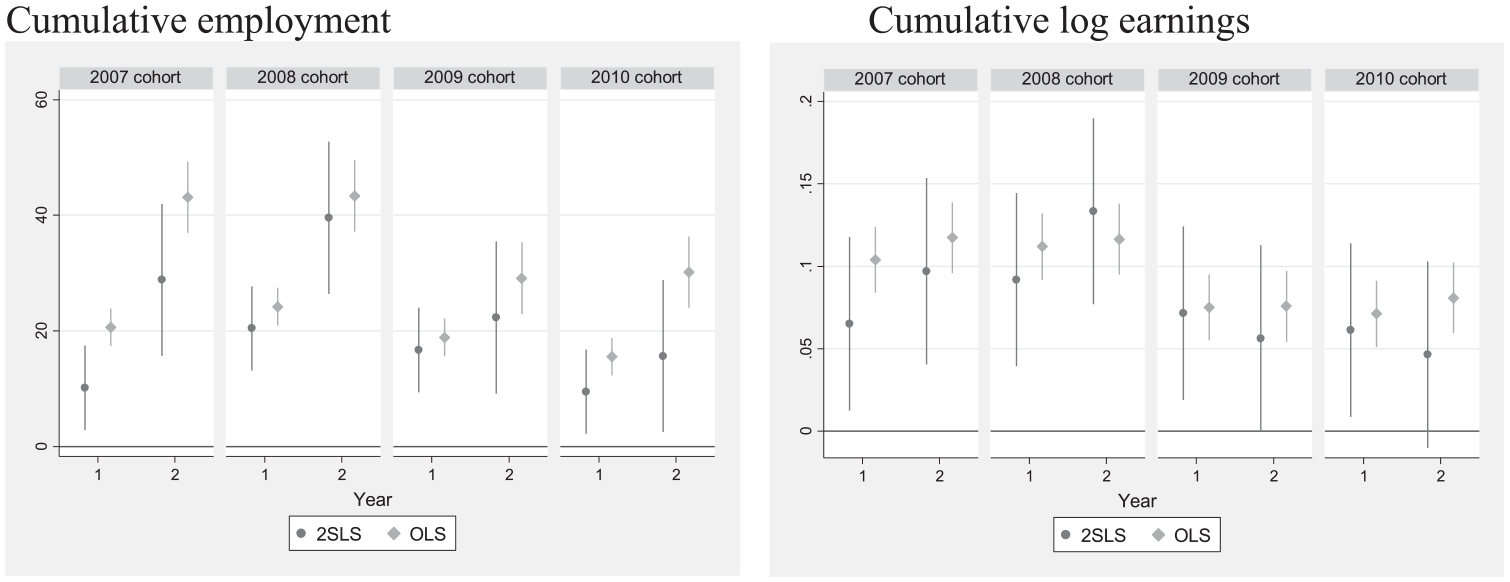
LATE and OLS Estimates for Participation in the Subsidy Program by Cohort of Treatment Start
This shift in the composition of the participating workforce can be explained by changes in legislation: During the introductory phase of the program, implementation was ambiguous to caseworkers; for example, it was unclear which courses were fundable. Moreover, in 2008, the FEA expanded the program to include recently re-employed workers who had left unemployment directly before entering the program. As a result, from 2007 to 2009 funded training courses were shorter than they were later on, making it easier for very low-skilled workers to obtain subsidized training.
In April 2009, the FEA introduced written rules and procedures for the implementation of the subsidy program. Moreover, the Federal Court of Auditors requested detailed documentation of the allocation of funds that same year. These steps resulted in a trend of longer training courses that granted a certificate at the end. This caused a steep decline in program entries in 2010, as training became more costly for employers (indirect costs). Compared to the introductory phase, this drew more employable workers to the program in 2009 and 2010 (see Table A.6 in the supplementary material).
These changes in implementation are also linked to the economic and financial crisis and thus the changing economic conditions that took place between 2007 and 2010. In 2009, the FEA introduced further training during short-time work as discussed in the section titled Role of Employers in the Selection Process. Additionally, an economic stimulus package in January 2009 prompted the FEA, among others, to expand subsidized training for employees to give firms the incentive to train surplus workers instead of firing them (Möller 2010). A new law introduced a third target group for 2009 and 2010 to the existing target groups (workers in SME analyzed by Dauth and Toomet [2016] and low-skilled workers analyzed here). This new target group comprised workers who had not been funded by a public project for the previous four years and workers whose vocational degree was at least two years old (§ 421 t (4) Social Code III). As a consequence, this third target group induced a general relaxation of the subsidy program which—even though this third target group is not analyzed in this study—potentially also affected the composition of the low-skilled target group such that more able workers were trained during the crisis.
In sum, compositional differences over time explain the larger program effects in the introductory phase and the smaller effects later on, assuming decreasing returns to training and skills.
Results by Individual Characteristics
In the next step, I conduct subgroup analyses, pooling data for all cohorts from 2007 to 2010. I include interactions with quarter and year dummies to control for the timing of the (counterfactual) treatment start. I consider the same outcome variables as in the previous section. I restrict the outcome variables to the first three years after treatment, because for later outcomes, I lose more observations and 2007 and 2008 participants would primarily drive the results. Again, the first-stage values and F-test statistics confirm the high quality of the instrument in most cases.
Looking at the effects on employment and earnings by gender (Figure 4), I find significantly higher returns to training on employment for women working full time (+75 days) than for men working full time (+20 days) in the first three years. This effect is even more pronounced in terms of earnings, with complying women earning approximately 23% more than non-treated women and men approximately 4% more. This outcome is likely attributable to different distributions of women and men across sectors of the economy. Table A.6 in the Supplemental Online Appendix material shows that women are concentrated in the professions of health care, management and organization, and humanities and arts, whereas men are concentrated in the fields of manufacturing, construction, and transportation and logistics. In their respective sectors, women receive training courses that are, on average, 60% longer and that probably impart deeper knowledge. Moreover, unsubsidized women earn on average less than men in these sectors, which translates into larger relative gains for women compared to men.
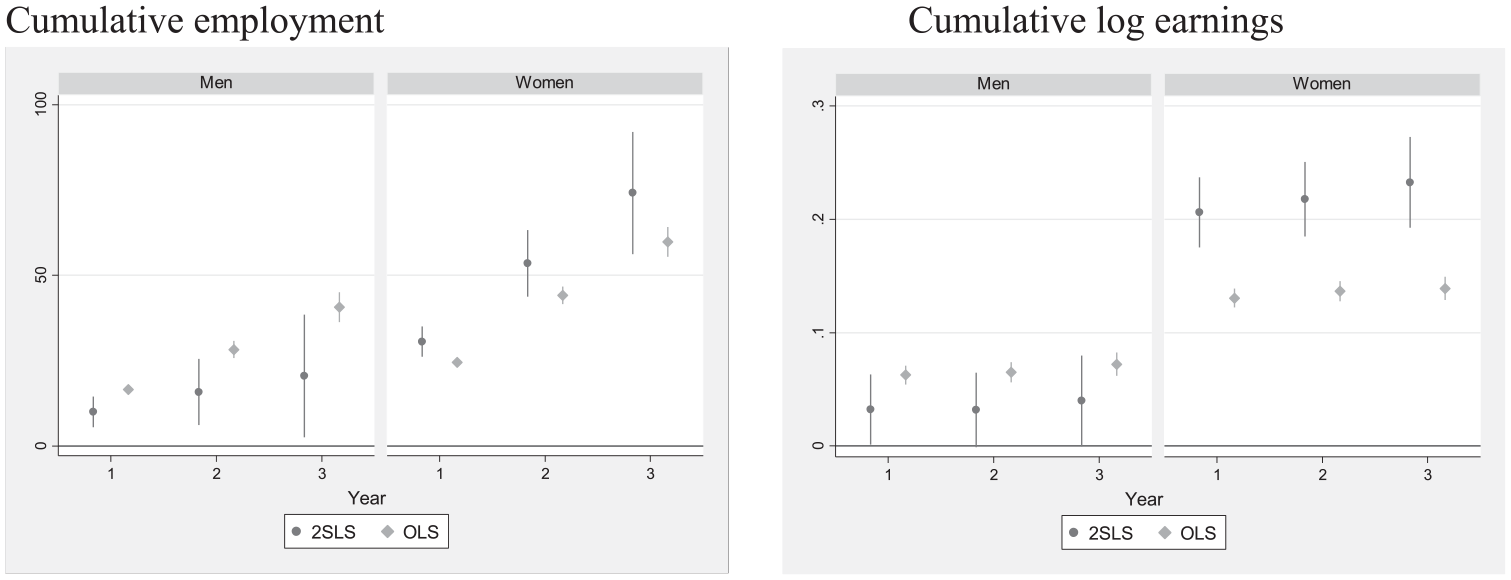
LATE and OLS Estimates for Participation in the Subsidy Program by Gender
In contrast to the previous estimates, the 2SLS coefficients are larger than the OLS coefficients for women. This suggests either that participating women are a negative selection or that complying women, who participate due to higher residual LPRs, profit more than female always-takers. Thus, drawing more women into the program might increase its efficiency.
In Figure 5 I separate the program effect by age group, and the youngest participants, aged 25 to 35 years, seem to realize the highest gains in employment (+56 days) and earnings (+12% earnings) within three years. The employment gains for workers between ages 35 and 55 accumulate to approximately 30 days. Earnings increase by about 8%. The differences are not statistically significant, however. The oldest age group of workers, 55 to 65 years, profits neither in terms of employment nor earnings. Thus, contrary to the findings of Dauth and Toomet (2016), who found that treatment postpones retirement for workers 55 years and older in SME, low-skilled workers above age 55 do not similarly profit from the program. This difference might be attributable to more firm-financed training for non-treated, low-skilled workers in larger firms—compared to SME—and thus a better comparison group. Also, although Dauth and Toomet (2016) analyzed average treatment effects on the treated, compliers in that age group simply might not profit as much as always-takers. Overall, the marginal returns on employment and earnings seem to be particularly high at the beginning of the employment career due to a lower initial level of knowledge, lower opportunity costs, and better cognitive skills.
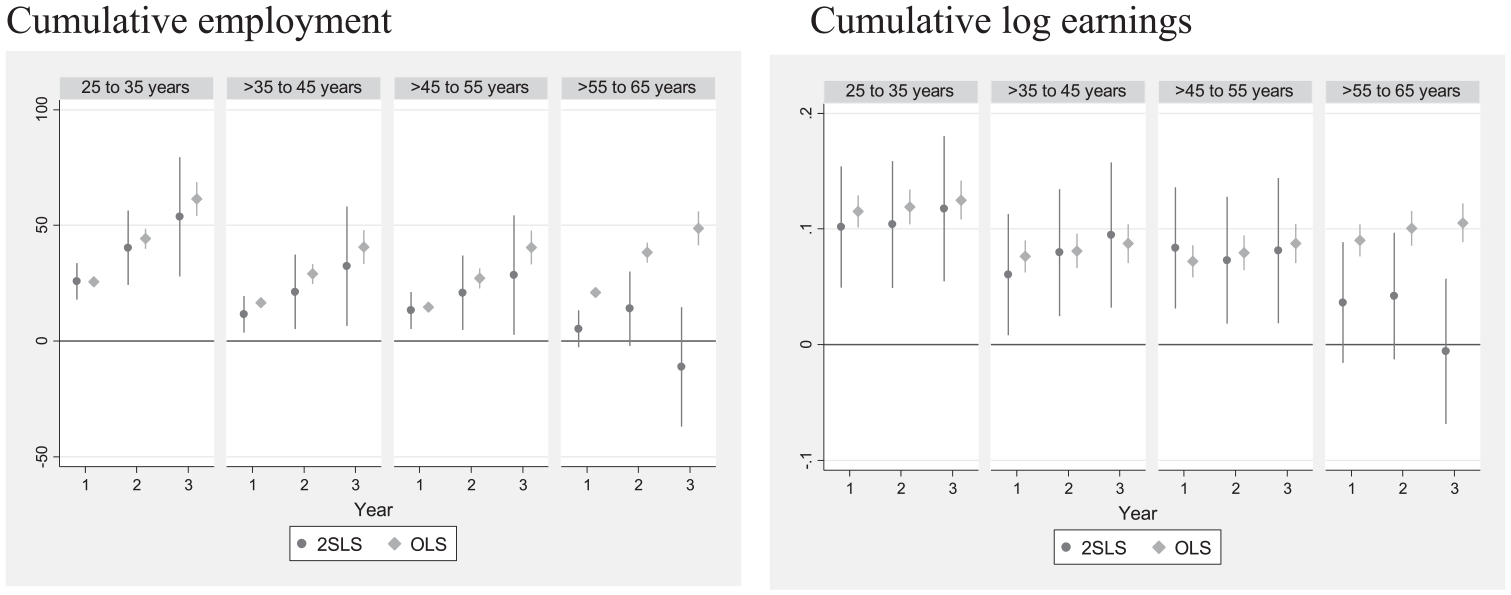
LATE and OLS Estimates for Participation in the Subsidy Program by Age
Figure 6 shows that the LATEs on employment do not differ significantly between workers with German citizenship and workers without German citizenship. Regarding earnings, non-Germans benefit more than Germans. In the three years after treatment, complying non-German participants receive earnings that are approximately 14% higher than those of other workers. Germans profit by 8% in earnings. Given that the marginal returns are decreasing in the skill level, the lower skill and earnings levels of non-Germans compared to Germans (see Table A.6 in the supplemental material) imply higher marginal returns for non-Germans and explain the differing treatment effects. 13
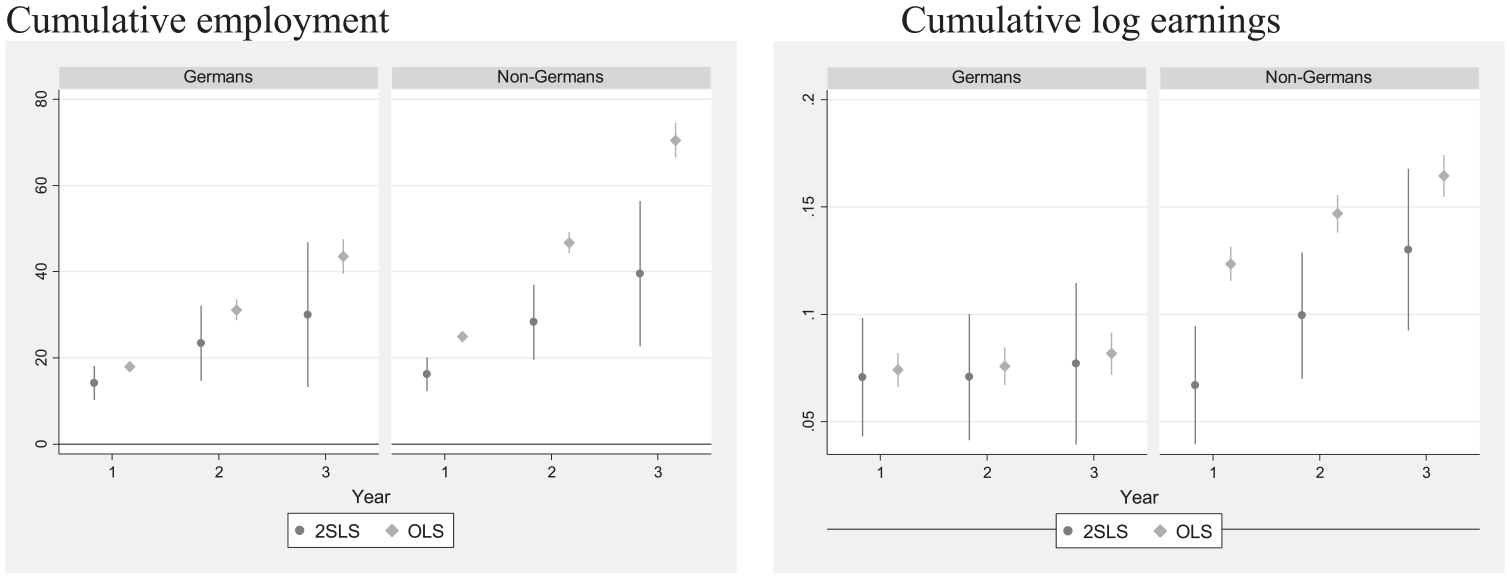
LATE and OLS Estimates for Participation in the Subsidy Program for Germans and Non-Germans
Results by Tenure
In the literature on the evaluation of ALMPs for unemployed workers, the timing of participation during the unemployment spell matters (Sianesi 2004; Fredriksson and Johansson 2008). Thus, researchers often apply dynamic approaches to account for the correlation between the probability of being treated and unemployment duration. 14 Adapting the timing in my setting, I examine whether treatment differs by tenure, that is, for new hires versus long-serving workers. As outlined earlier, the program analyzed in this study was introduced on January 1, 2007. Theoretically, one can distinguish between two types of workers: On the one hand, there are workers who were already employed in January 2007 for whom the risk of treatment starts with the introduction of the program. I call these workers “incumbents.” On the other hand, there are workers who began employment after that date for whom the risk of treatment starts with employment in a given firm. I call these workers “entrants.” Tenure is measured at the beginning of the quarter of potential treatment. Thus, I assign negative tenure to workers starting employment that quarter.
Figure 7 shows that by tendency employment and earnings effects are larger for workers with short tenure. 15 Among compliers who just entered the firm, the employment and earnings effects (+109 days and +26% in three years) are largest. However, this group might also comprise workers who just left unemployment and therefore had contact with the local employment agency. Consequently, the exclusion restriction might be violated for this particular group and therefore the results should be interpreted with caution. 16 Apart from that, tenure does not drive program effectiveness significantly. The point estimates remain comparable and are all statistically insignificant due to imprecise estimations. Further distinguishing by entrants and incumbents does not reveal any meaningful patterns.
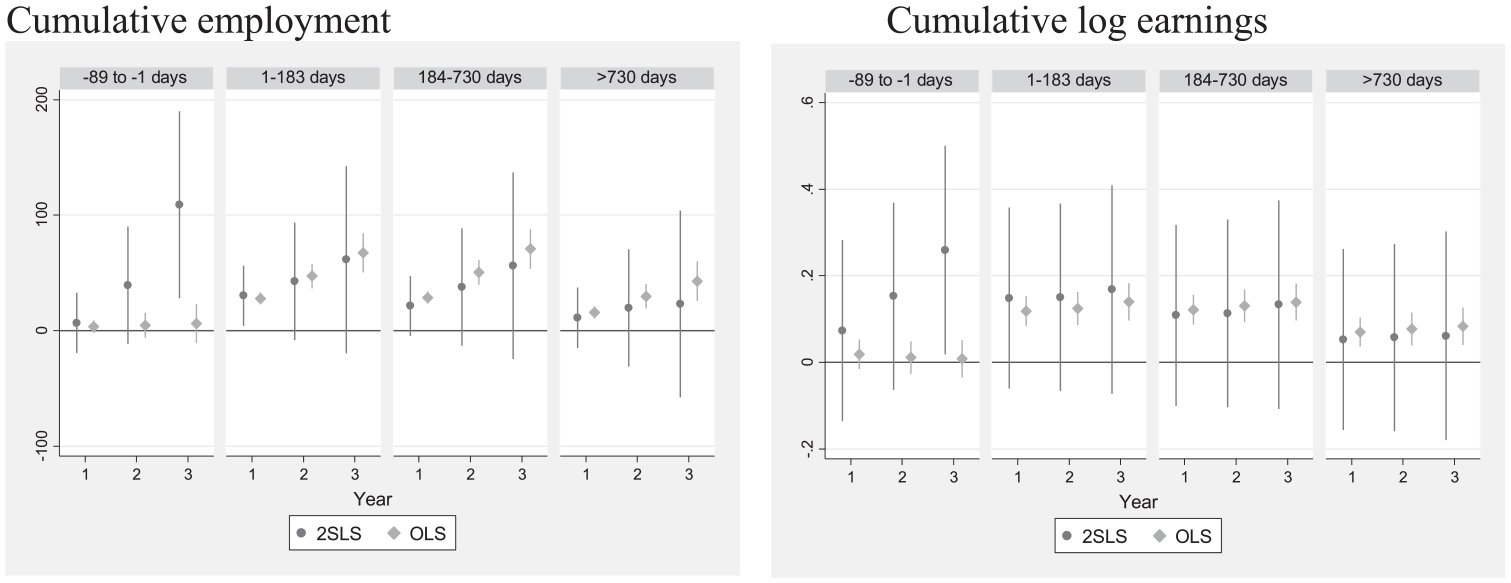
LATE and OLS Estimates for Participation in the Subsidy Program by Tenure and Worker Type
Cost-Benefit Considerations
In this section, I provide a rough cost-benefit analysis at the participant level for the first two years after entry into the program. Approximately 129,000 workers entered the program. FEA controller data reveal that total expenses for the subsidy program amounted to approximately 626 million euros between 2007 and 2010. Over a two-year period, this amounts to a daily cost of 6.67 euros per person. On the benefit side, I assume that workers receive the same average daily wage of approximately 74 euros as during the three years before participation. Multiplying these daily wages by the estimated LATE on earnings from Table 8 and Figure 3 yields an increase in daily per capita earnings of approximately 5.54 euros. Thus, comparing daily per capita costs and daily per capita benefits over a two-year period, the program seems to cost more than the benefits that are gained on average (Table 11).
Costs and Benefits of the Subsidy Program
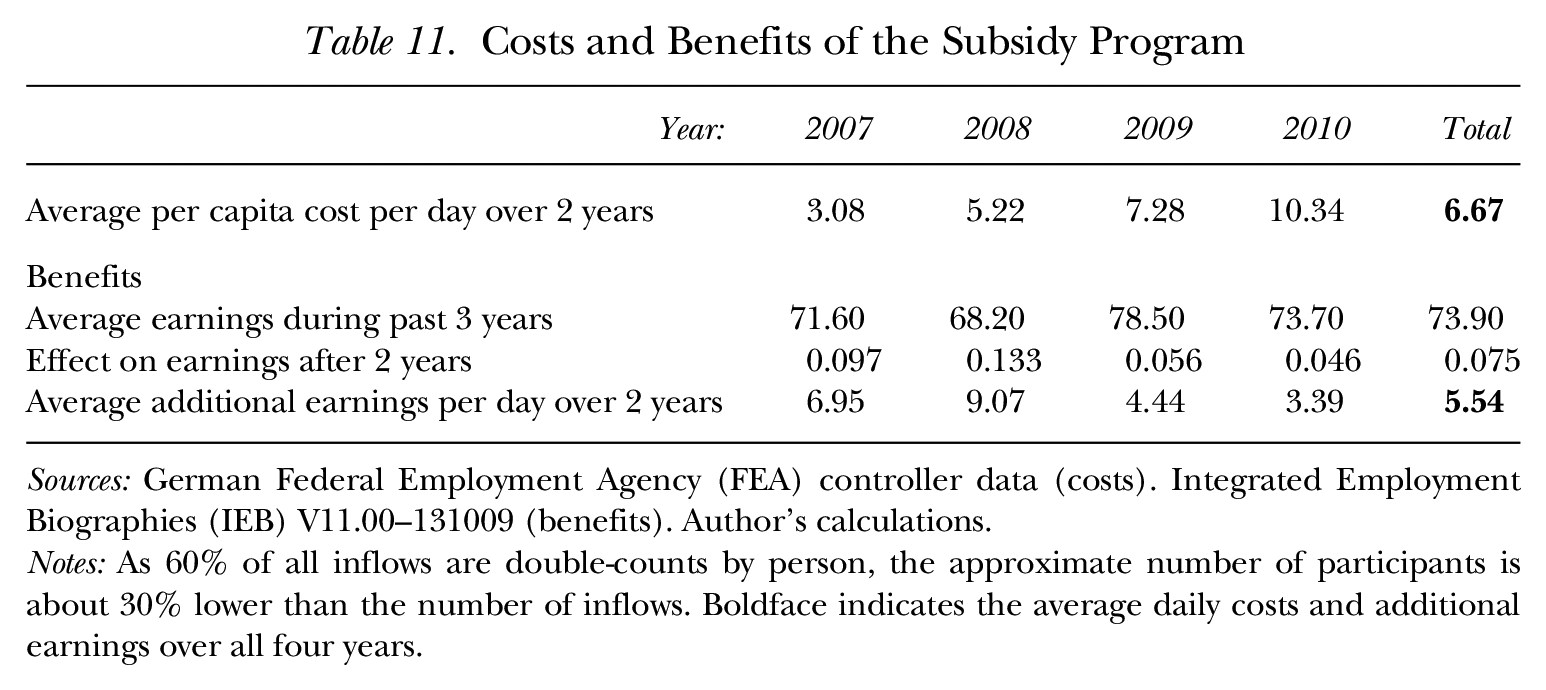
Sources: German Federal Employment Agency (FEA) controller data (costs). Integrated Employment Biographies (IEB) V11.00–131009 (benefits). Author’s calculations.
Notes: As 60% of all inflows are double-counts by person, the approximate number of participants is about 30% lower than the number of inflows. Boldface indicates the average daily costs and additional earnings over all four years.
To break even, the program should pay for the daily average cost of 6.67 euros. Given that the additional daily earnings are lower than that in most years, except for 2007 and 2008, it is unlikely that additional tax revenues will approach those costs. Thus, in budgetary terms, the program might not be a good investment for the government, at least over a two-year period. Further gains in employment or earnings beyond a two-year horizon might improve the benefits from the program. However, I ignore any general equilibrium effects that might arise. Moreover, to conduct a correct analysis I lack further necessary information, such as administrative costs for the caseworkers, changes in firm productivity, reduced benefit transfers, and higher social security contributions.
Conclusion
In this article, I have analyzed the impact of further training subsidies targeted at low-skilled employed workers between 2007 and 2010. Thereby, I contribute to the scarce literature on the effects of subsidized further training for low-skilled employed workers rather than for unemployed workers. For identification, I rely on an IV approach, exploiting residual regional variation in the local participation rates in subsidized training between local employment agencies, which I call policy styles. These policy styles are exogenous to the labor market outcomes of employed workers, hence enabling me to predict program participation and to obtain local average treatment effects.
The evidence suggests that the subsidy improved the labor market outcomes (employment, unemployment, and earnings) of subsidy recipients. For compliers, I find positive effects of 93 more days of employment, an increase in earnings by about 13%, and a reduction of unemployment of 45 days over a period of five years. Given that Haelermans and Borghans (2012) reported an average return to privately funded training of 3.5%, these estimates are nearly four times as large as those reported in the literature. With one additional quarter of employment, the effect on cumulative employment is also substantial. Half of this effect is attributable to a shift from unemployment to employment. The other half is likely attributable to a shift from labor market withdrawal to employment.
Substantial heterogeneity occurs across groups of compliers, however. In particular, workers starting program participation in 2007 and 2008 profit more in terms of employment and earnings than do later cohorts. This finding is related to a compositional change in the participants, which was triggered by an economic crisis and adjustments in FEA regulations. Consequently, low-skilled workers who entered the program later had characteristics that are more favorable and therefore gained relatively little from the subsidy program. Further beneficiaries of the program include women, younger workers, and non-Germans. I complement the analysis with several robustness checks, which support the validity of the empirical approach and the robustness of the previous findings.
From a political perspective, the results of this study suggest that targeting females, younger workers, and non-Germans might increase the subsidy program’s efficiency. In fact, recent adjustments by the FEA emphasize these groups (e.g., training in the female-dominated occupation of elderly care and focusing on younger workers since April 2012). Recently, the program has increasingly been used to qualify refugees who found a job. In this sense, my study provides ex post justification for these adjustments.
Note that employer involvement determines training participation. Even though I conduct various robustness tests, I cannot guarantee that I exclude all potential firm confounders that simultaneously affect both the worker’s program participation and employment prospects. Moreover, I cannot rule out that firms substitute subsidized training for unsubsidized training. Nevertheless, I believe that a substantial part of the effect I measure is in fact training that would not have occurred otherwise. Workers with low schooling or without a vocational degree have a below-average training participation rate, that is, about half the rate of workers with high school or college degrees (BIBB 2016). The low incidence of existing training for low-skilled workers makes it less likely that the program subsidizes training for workers who would have been trained anyway.
Supplemental Material
ILRR_Dauth_Supplemental-Online-Appendix – Supplemental material for Regional Discontinuities and the Effectiveness of Further Training Subsidies for Low-Skilled Employees
Supplemental material, ILRR_Dauth_Supplemental-Online-Appendix for Regional Discontinuities and the Effectiveness of Further Training Subsidies for Low-Skilled Employees by Christine Dauth in ILR Review
Footnotes
Acknowledgements
I am grateful to Wolfgang Dauth and Gesine Stephan for generous advice. I also thank Daniel Hamermesh, Øivind Anti Nilsen, Yolanda Rebollo Sanz, Regina Riphahn, Núria Rodríguez-Planas, Bastian Stockinger, the FBC1 unit at the IAB, and participants at numerous conferences, workshops, and seminars for helpful comments. Specific thanks go to the DIM unit at the IAB for providing the data. My study uses proprietary data that I am not authorized to post.
I use data of the German Institute for Employment Research (IAB), the so-called Integrated Employment Biographies (IEB). The IEB data are social data with administrative origin, which are processed and kept by IAB according to Social Code III. The data contain sensitive information and therefore are subject to the confidentiality regulations of the German Social Code (Book I, Section 35, Paragraph 1). Consequently, external researchers need to close a contract with the IAB to access social data on-site in Nuremberg or at other on-site locations in Germany.
This contract needs to be authorized by the Federal Ministry of Labour and Social Affairs. I can provide additional results and copies of the computer programs used to generate the results presented in the article at
2
Numbers come from the 2018 statistics of the Federal Employment Agency (data warehouse).
3
The unconditional LPR is on average driven by the numerator. I run a standardized regression of the LPR on the sum of subsidy participants and the sum of local low-skilled employees at the level of employment agencies. Increasing the number of participants (low-skilled employees) by one standard deviation changes the LPR on average ceteris paribus by 0.93 (–0.49) standard deviations. However, the relative importance of one or the other factor varies by year-quarter. Results are available on request.
4
One can distinguish among four different groups in the LATE framework: Always-takers participate in the program irrespective of the policy style. Compliers participate only in agency districts that are conditionally more prone to grant further training subsidies. Never-takers never participate, whereas defiers participate only in districts less prone to grant subsidies. The monotonicity assumption (see section LATE Assumptions) excludes the existence of defiers.
5
Table A.5 in the  compares the outcome means by treated and potential comparison workers.
6
8
The propensity scores for program participation of treated and control workers overlap mostly. Only 37 observations fall outside the common support in the baseline specification. Therefore, I do not address the potential common support problem further.
10
For the purposes of organized presentation, I indicate the variables included in the regressions but do not display their coefficients.
11
Table A.8 in the supports this conclusion. The residual LPR remains stable with the subsequent addition of regional controls. This confirms that potential remaining local confounding variation in the baseline model, which might drive unobserved selection into treatment, is irrelevant.
12
Information on health, marital status, and the existence of children under the age of 15 is only available for a selective subset of workers in the sample, that is, workers who registered as job seeking at least once since January 2000. I create extra variable categories for the missing values in order not to lose observations.
13
I conduct additional subgroup analyses; however, they do not provide further insights. There are no differences in terms of the degree conferred at the end of a training course (see Figure A.1 in the supplemental material). Firm size also does not seem to matter much for the effectiveness of the program (see ). If anything, complying workers of small firms with up to 25 workers seem to benefit more than others. This effect holds only for earnings and only within the first two years after treatment. Thus, in the short run, small firms profit more from training subsidies than do larger firms, which likely rely on their own training funds.
14
The supplemental material contains a section in which I discuss the results of the dynamic approach.
15
For a direct comparison, I only consider outcomes within three years. Entrants with a tenure >730 days start treatment the earliest in 2009. For these workers I observe the outcome only for a maximum of three years.
16
Dropping this group of workers from the sample does not alter the overall estimates much. They aretherefore not an important driver of the LPR. Results available on request.
References
Supplementary Material
Please find the following supplemental material available below.
For Open Access articles published under a Creative Commons License, all supplemental material carries the same license as the article it is associated with.
For non-Open Access articles published, all supplemental material carries a non-exclusive license, and permission requests for re-use of supplemental material or any part of supplemental material shall be sent directly to the copyright owner as specified in the copyright notice associated with the article.
