



Abstract
Decentralization as an organizing principle has drawn growing interest from scholars and practitioners because of its perceived suitability for contemporary market conditions and alignment with employees’ evolving work expectations. However, efforts to decentralize authority face significant obstacles and often end in failure. I propose that existing research on decentralization has struggled to generate insight into how such barriers can be overcome because it has treated decentralization as a static outcome imposed by organizational designers. In contrast, this article treats decentralization as a dynamic and situated achievement that must be continually enacted, and it leverages ethnographic data from a decentralization effort in order to build theory on the organizational practices that support enactments of decentralized authority. I find that successful enactments of decentralized authority were supported by practices that established clear boundaries of authority and focused collective attention on these boundaries, as well as by practices that depersonalized collective attributions of the source of authority. At the same time, the practices were difficult to sustain because they were cognitively, emotionally, and temporally demanding. Through this study, I show that decentralization is not merely a one-time structural change but an ongoing collective process that requires navigating and neutralizing the structural and psychological forces pulling organizations back toward hierarchy.
Keywords
Nearly a century ago, Mary Parker Follett (1933/2013: 34) wrote, In the best managed plants today there is a tendency for each man to have the authority which goes with his particular job rather than inhering in a particular position in a hierarchy. . . . When the form of organization is such that he has authority which belongs to his function, we automatically get rid of that kind of authority which puts one man “over” another because he is higher up on the page in an organization chart.
This observation captured a dream that burns just as brightly today: a desire to organize in ways that reduce or eliminate authority based on rank in a hierarchy. In rank-based authority structures, also called hierarchical authority, authority accrues to those of higher rank such that they command deference and subordination from those of lower rank (Simon, 1947). While the alienating and demotivating aspects of rank-based authority (Freeland and Zuckerman Sivan, 2018) have long led scholars and practitioners to seek alternatives, this search has taken on greater urgency in recent decades as changes in market conditions and the nature of work—the rise of knowledge work, heightened competition, and accelerated technological disruption—have indicated the need to depart from command-and-control modes of operating, by pushing decision making to the front lines and fostering lateral coordination across boundaries (Barley, 1996; Kellogg, Orlikowski, and Yates, 2006; Turco, 2016; Reitzig, 2022).
Despite the interest in horizontal alternatives to rank-based authority, organizations do not appear any closer to realizing this dream: rank-based authority structures remain dominant and ubiquitous (Gruenfeld and Tiedens, 2010; Child, 2019). Efforts to decouple authority from rank—from incremental decentralization initiatives to radical decentralization efforts (see Lee and Edmondson, 2017 for a review)—tend to fail, and organizations eventually revert, either formally or informally, to conventional rank-based structures (Diefenbach and Sillince, 2011; Foss and Klein, 2022). Explanations for the failure of these efforts are abundant: resistant leaders have difficulty giving up control (Argyris, 1998); skeptical subordinates are reluctant to take up their authority (Turco, 2016); alternative authority structures have internal contradictions such as misaligned incentives (Zenger, 2002) or conflicting messages and ideologies (Vallas, 2003); humans have psychological preferences and biases toward hierarchy (Gruenfeld and Tiedens, 2010); hierarchical forms are institutionalized in every facet of social life (Rothschild-Whitt, 1979); and centralization confers numerous functional benefits for organizations that may prompt leaders to reclaim their authority, a right enabled by the legal structure of private firms (Baker, Gibbons, and Murphy, 1999; Foss, 2003; Zuckerman, 2010). The conclusion from this research is unmistakable: efforts to depart from rank-based authority face numerous obstacles that make their achievement difficult and precarious, always under threat.
Existing research has generated little insight into how organizations can overcome the barriers to departing from rank-based authority. This void, I propose, stems not merely from scholarly pessimism but also from the ontological perspective taken by this research—that structure is a static entity imposed by organization designers. Research adopting this perspective tends to view decentralization as either present or absent, focusing on why efforts to decentralize failed (e.g., Foss, 2003; Vallas, 2003; Burton et al., 2017) or, in rare cases, the conditions that supported their success (Rothschild-Whitt, 1976; Baldwin, 2015; Young-Hyman, Magne, and Kruse, 2022). Furthermore, this work, with few exceptions, has relied on archival or publicly available data to draw conclusions from afar. By viewing decentralization as a fixed end state rather than a dynamic process, this approach has limited our understanding of how organizations and their members can navigate the micro-level tensions involved in shifting toward decentralization in the messy context of everyday work.
This article adopts the perspective that authority is not something that an organization or its members have but is something that an organization and its members do. I draw on recent scholarship that has treated authority as a situated and probabilistic achievement enacted and negotiated in everyday work interactions (Ewick and Silbey, 2003; Huising, 2015). To uncover the microdynamics of authority being enacted in practice, this recent work has relied on ethnographic studies of individuals doing authority (e.g., Huising, 2015; Bourgoin, Bencherki, and Faraj, 2020; Karunakaran, 2022). While this research has not focused on decentralized authority per se, the perspective used is crucial to understanding how authority can be decentralized because any effort to deviate from the deeply rooted patterns of rank-based authority will be inherently situated and contingent, vulnerable to backsliding. From this perspective, decentralization is not a destination that organizations reach once and for all but, rather, an ongoing and contested process. In addition, adopting this perspective focuses attention on the behaviors and practices that support moments, or enactments, of decentralized authority. This article therefore asks, which organizational practices support enactments of decentralized authority, and how and why might such practices break down?
To examine these questions, I leverage an 18-month ethnography within an organization seeking to decentralize authority: it granted authority to individuals to make decisions in their roles without needing managerial approval, and it removed from managers several conventional supervisory authorities, such as the right to hire, fire, and promote. The effort to decentralize authority unfolded with mixed results, revealing successful enactments of decentralization as well as momentary reversions to rank-based authority. Analyzing these varied micro-level outcomes revealed distinct organizational practices that facilitated enactments of decentralization, as well as frictions that contributed to breakdowns in the practices. This case thus reveals insights into the dynamics of decentralizing authority, the practices that support its enactment, and the limits of those practices.
From Rank-Based Authority Toward Decentralized Authority
In line with this article’s dynamic practice-based perspective on authority, I refer to rank-based authority structures as patterns of enacted authority in which a rank ordering of individuals exists such that individuals lower in rank defer to the wishes and commands of those higher in the rank ordering. Rank-based authority structures can be constituted formally or informally. Formally, the conventional hierarchical firm is structured so that individuals’ rank is made explicit and superiors hold formal authority over subordinates (Simon, 1947; Puranam, 2018). Informally, rank-based authority structures can be constituted through social stratification processes whereby members lower in informal rank (or status) defer to those higher in rank (Magee and Galinsky, 2008; Diefenbach and Sillince, 2011; Freeman, 2013). A core feature of rank-based structures is that the authority of those higher in rank is not bounded topically; instead, it operates as an authority over persons (Simon, 1947) that allows those higher in rank to elicit broad compliance from lower ranking members (Diefenbach and Sillince, 2011; Freeland and Zuckerman Sivan, 2018; Magelssen, Rich, and Mayer, 2022). The far-reaching centralized authority of superiors in rank-based structures provides a powerful mechanism of coordination and control (Swaab et al., 2014; Puranam, 2018) and is simple and repeatable, making it a suitable structure for handling complexity and scale (Puranam, 2018; Child, 2019). Given these functions, rank-based structures have formed the basis of nearly 200 years of economic expansion (Chandler Jr., 1977).
The dysfunctions of rank-based authority structures, however, have long raised concerns about their suitability for evolving market conditions and the changing nature of work. Organizational responsiveness to increasing market dynamism requires agile decision making by frontline experts (Barley, 1996; Rigby, Sutherland, and Noble, 2018), yet decision making and coordination in rank-based structures tend to occur through the chain of command, which slows decision making, creates organizational silos, and reduces information flow (Puranam, 2014; Reitzig and Maciejovsky, 2015). Organizational resilience to market disruptions increasingly relies on sourcing novel ideas from across the organization (Hamel and Zanini, 2020), yet rank-based authority tends to reduce psychological safety, a critical antecedent to learning, adaptation, and innovation (Edmondson, 2018). Engaging and retaining expert talent is increasingly important in the knowledge economy, yet rank-based structures often contain coercive dynamics that lead to employees’ alienation (Freeland and Zuckerman Sivan, 2018; Adler, 2019). Overall, some dynamics of rank-based authority structures are increasingly at odds with contemporary market conditions and employees’ evolving work expectations.
Organizations seek to decentralize authority in part to address this misalignment. Decentralizing authority means shifting patterns of enacted authority so that authority is exercised by a wider and broader group of organizational members than it is in rank-based structures (Barley, 1996; Kellogg, Orlikowski, and Yates, 2006; van Baarle et al., 2021). Conceptualizing authority structures as patterns of enacted authority emphasizes that the choice between rank-based authority and decentralized authority is not dichotomous. Rather, these options exist as poles on a dynamic spectrum, along which organizations shift. The move toward decentralization is often indicated by two shifts in patterns of enacted authority (Barley, 1996). First, decision making shifts downward from managers to knowledgeable actors who act autonomously in their roles (Barley, 1996; Puranam, 2014). Second, work requests and coordination increasingly occur in a peer-to-peer fashion rather than through the chain of command (Kellogg, Orlikowski, and Yates, 2006; Turco, 2016). Both features of decentralized authority structures represent significant departures from the patterns of rank-based authority structures.
Structural and Psychological Forces Keeping Rank-Based Authority in Place
Despite growing recognition of the limitations of rank-based authority structures, and despite efforts to find alternatives to them, such structures have proven remarkably resilient. When organizations try to formally decentralize authority, they often fail and revert to formal rank-based structures (Foss, 2003; Turco, 2016; Reitzig, 2022), or they may remain formally decentralized but operate informally as a rank-based structure. Evidence of the latter comes from research on democratic organizations and leaderless task groups, which shows that informal rank-based structures emerge quickly and consistently in the absence of a formal rank-based structure (Michels, 1915; Bales et al., 1951; Correll and Ridgeway, 2003; Freeman, 2013). This finding has led many scholars to consider the existence of rank-based authority structures to be an “iron law” (Michels, 1915: 342). Thomas Diefenbach (2013: 184) wrote, “Hierarchy is much more persistent than people might think when one looks at the same time at formal and informal hierarchy . . . whenever formal hierarchy decreases, informal hierarchy increases.” Echoing this viewpoint, scholars have noted that despite the rhetoric promoting decentralization, flatness, self-management, and agile methods, the vast majority of organizations still operate hierarchically (Gruenfeld and Tiedens, 2010; Foss and Klein, 2022).
Scholars across disciplines have highlighted the structural and psychological forces pulling organizations toward rank-based authority. Structurally, decentralizing authority conflicts with the interests of those in formal positions of power, who often resist and undermine such efforts (Argyris, 1998). In addition, the legal structure of firms gives ultimate responsibility and authority to top managers (Baker, Gibbons, and Murphy, 1999). While authority can be decentralized, accountability to outside stakeholders cannot (Zuckerman, 2010). As a result, leaders may feel the need to reclaim authority, whether for functional reasons, such as to resolve conflicts, set strategy, or establish control (Bernstein et al., 2016; Puranam, 2018), or simply out of overconfidence in their own judgment (Foss, 2003). Firm ownership structures allow leaders to reclaim authority as such authority is always “loaned” to rather than “owned” by workers (Baker, Gibbons, and Murphy, 1999: 56). However, leaders who reclaim authority often initiate a chain reaction that triggers workers’ disillusionment and ends in firms reverting to traditional rank-based structures (Foss, 2003; Foss and Klein, 2022). At an institutional level, rank-based authority is structured into nearly every sphere of social life, from the family, to schools, to the workplace. As a result, decentralizing authority involves the difficult task of breaking from ubiquitous, taken-for-granted patterns (Rothschild-Whitt, 1976; Child, 2019).
In addition to structural forces, myriad psychological forces pull individuals to enact rank-based authority. Several streams of research have underscored that the enactment of rank-based authority is rooted in automatic psychological processes that are difficult to counteract (Magee and Galinsky, 2008; Gruenfeld and Tiedens, 2010). Research on dominance complementarity in social psychology shows that people unconsciously prefer rank-based relationships in task settings and automatically organize themselves into dominant or submissive positions even when there is no formal hierarchy present (Tiedens and Fragale, 2003; Tiedens, Unzueta, and Young, 2007). Research on expectation states theory shows that informal rank-based patterns of interaction emerge in leaderless groups based on any differences that can be construed to relate to task performance (Berger, Rosenholtz, and Zelditch, 1980; Correll and Ridgeway, 2003). Through largely unconscious processes, group members form differential expectations of performance that become the basis of a rank ordering, prompting corresponding dominant versus submissive behaviors (Correll and Ridgeway, 2003). The formation of rank orderings often derives from characteristics that are unrelated to the task itself, such as race or gender, indicating that humans automatically seek out and attend to any characteristic that could form the basis of a rank ordering.
Human attributional biases also support and reinforce rank-based authority. Individuals tend to internalize rank orderings, attributing their own and others’ rank to personal characteristics rather than contextual factors, thus legitimizing the rank ordering and keeping it in place (Haines and Jost, 2000; Magee and Galinsky, 2008). The human penchant for making personal rather than situational attributions, referred to as the correspondence bias or the fundamental attribution error (Gilbert and Malone, 1995), also contributes to the mystification of leadership, the process by which a leader’s authority is made inaccessible and obscure to others, which reinforces the leader’s legitimate authority and prompts broad deference to that person (Rothschild-Whitt, 1976; Diefenbach and Sillince, 2011). The mystification of leadership serves deep and often unconscious psychological needs, such as to make order out of chaos or to alleviate anxiety or ambivalence (Petriglieri and Stein, 2012; Petriglieri and Petriglieri, 2020). In sum, decentralizing authority is difficult not only because legal and institutional structures pull organizations toward rank-based authority but also because humans have a psychological urge to rank. As social psychologists Deborah Gruenfeld and Lara Tiedens (2010: 1275) wrote, Within the management literature, the challenges associated with creating more hierarchy are simply dwarfed by the challenges associated with creating their opposite. Presumably, these former capabilities come more naturally. In contrast, the capabilities associated with making organizations flat require special training, management education, even intervention by consultants, and the industries devoted to providing this training are thriving. Yet, despite the proliferation of these abundant training resources, there is little evidence that the pendulum swings the other way.
The forces pulling toward rank-based authority intensify when authorities are unevenly distributed. Under such conditions, the urge to rank is magnified. Scholars of democratic organizations, or organizations that seek to eliminate inequality in both formal and informal authority (Rothschild-Whitt, 1979; Lee and Edmondson, 2017), have noted that any sign of differentiation can prompt the formation of rank orderings and threaten egalitarian relations. To combat this, democratic organizations engage in various difference-minimizing strategies, such as equalizing pay and office space and standardizing dress codes. More radically, these organizations attempt to minimize role inequality through practices such as role rotation and role sharing, aspiring toward a goal of “universal competence” (Rothschild-Whitt, 1979: 518).
The tendency for any visible sign of difference to form the basis of a rank ordering underscores how unequal distributions of authority, in the form of unequal roles, can make decentralization even more challenging. Furthermore, given that most firms of even modest size or complexity rely on some inequality in roles for the sake of efficiency and coordination, an additional challenge arises related to my research question: how can organizations decentralize while accommodating unequal authorities? Doing so would necessitate disrupting the usual progression from unequal authority to hierarchical relations, instead fostering a form of equality that can coexist with the presence of leadership, what sociologist Francesca Polletta (2012: 13) called a “complex equality.”
While there are many explanations for the persistence of hierarchy, insights into successful decentralization are scarce. Organization design research has often attributed the failure of decentralization efforts to breakdowns in coordination and control, which prompt leaders to recentralize. Given this attribution, scholars have sought to identify the ingredients of successful decentralization by detailing the conditions under which organizations are less likely to experience coordination breakdowns. For example, scholars have noted that organizations with fewer interdependencies, small size, and homogenous employees face fewer coordination demands and less conflict and thus can more easily decentralize (Hansmann, 1990; Puranam, 2018). Other organization design scholars have focused on how organizations can prevent leaders from recentralizing through mechanisms such as formal decision procedures and reducing managers’ information access (Foss, 2003; Stea, Foss, and Foss, 2015). However, by focusing on coordination breakdowns and leader behaviors as the primary causes of decentralization failures, extant research in organization design has overlooked how failures to enact decentralized authority evolve from interactions between leaders and workers and may be triggered not just by functional concerns about coordination loss but also by psychological drives, tendencies, and biases.
I argue that the ontological stance and methods used in organization design research have limited its ability to produce insight about how decentralization can be supported. This research has tended to view decentralization as a static outcome driven by organizational designers rather than a dynamic process and to view individuals as rational agents rather than psychologically nuanced and complex actors (e.g., Aghion and Tirole, 1997; Baker, Gibbons, and Murphy, 1999). Furthermore, this stream of research has employed methods and data sources, such as formal modeling and publicly available archival data (Baker, Gibbons, and Murphy, 1999; Foss, 2003), that cannot illuminate the nuances of how authority can be shifted in everyday work interactions. I address these gaps by using ethnographic methods to examine the dynamic push and pull occurring in an organization trying to decentralize authority without equalizing authority.
Methods
Research Setting
This study draws on an 18-month ethnographic study of CashCo, a company in the eastern United States that radically decentralized its formal authority structure. CashCo produces hardware products related to the management of physical and digital currency, with its main product being a cash recycler: a system that automates the process of accepting and dispensing physical currency. Founded in 1998, CashCo saw rapid growth starting in 2012, doubling its head count to 125 people (and doubling its revenue) within two years. Growth led to increased hierarchical layers, prompting concerns about diminished empowerment and organizational agility. To address these concerns, CashCo adopted Holacracy, a system developed externally that hundreds of organizations have adopted to decentralize authority (Robertson, 2015).
CashCo’s adoption of Holacracy formally decentralized authority according to a documented rule set called the “constitution.” The new system came with its own terminology of “roles”: defined elements that each consisted of a stated purpose and a set of what Holacracy calls “accountabilities.” The notion of roles in the new system was similar to the concept of work roles in the management and information science literatures, which refers to distinct sets of activities that form the building blocks in the relation between work and workers and that break up the organization’s work into meaningful units (Griffin, Neal, and Parker, 2007; Huvila, 2008; Valentine and Edmondson, 2015). 1 At CashCo, roles were grouped into “circles,” or formal work groups, which were hierarchically arranged and fed into the General Company circle (GCC), the organization’s broadest circle.
The new system formally allocated decision rights to role holders so that the rights were equivalent to their work responsibilities, authorizing employees to take any action in service to their roles without needing managerial approval. In addition, the system required that role holders respond to work requests from others as long as the requests fit their roles. Both rules formally constrained the authority of managers, who previously held sole authority to direct the work of subordinates. Managers became “Lead Links,” a pre-defined role in the new system that had partial oversight authority. The Lead Link role could assign and remove individuals from roles in the circle, but individuals could decline role assignments. In addition, Lead Links were authorized to set priorities, develop metrics, and allocate resources within the circle. However, Lead Links, unlike managers in the prior structure, did not have formal authority to direct employees’ work, conduct formal employee evaluations, or hire or fire employees.
The new system also established a governance meeting process in which circle members could propose changes to the roles within the circle. During these meetings, any member could propose a role change, with each proposal requiring the consent of all circle members to be adopted. All changes to the circle’s roles required adoption through the governance process. Post adoption, all employees could access role descriptions via an online platform called GlassFrog.
CashCo’s adoption of Holacracy provided a fitting research site to study decentralization. First, it exemplifies a radical attempt to decentralize formal authority in the organization, making it an extreme case of attempted decentralization (Lee and Edmondson, 2017). Extreme cases facilitate theory building because the dynamics under investigation tend to be more visible than in other cases (Eisenhardt, 1989). Second, Holacracy, as a system of radical decentralization whose adoption involves ongoing and collective mobilization around a set of rules and processes rather than a one-time structural change, provided an ideal setting to investigate the practices that support decentralization enactments and their enduring tensions. Third, CashCo’s recent growth and hierarchical differentiation made it a fitting context to examine the practices that support decentralization in the presence of unequal roles and authority.
Data Collection
I contacted CashCo one month before they adopted the new system, and I began collecting data 1.5 months post adoption. Data collection took place over a period of 18 months, with monthly site visits during the first six months, bi-monthly visits (one visit every two months) during the next six months, and a final visit in the last six months. Each visit lasted one week, during which I attended meetings and conducted interviews. Between visits, I conducted virtual interviews and meeting observations. My data comprise three sources: interviews, observations, and archival data.
Interviews
I conducted 125 interviews with 60 employees, nearly half of the company’s workforce. Using the logic of theoretical sampling (Strauss and Corbin, 1998; Pratt, 2009), I interviewed employees who operated at different authority levels prior to the adoption of the new system, i.e., workers, managers, and senior leaders. Interviews were semi-structured and focused on how work and authority were changing in the new system. To ensure open disclosure, I emphasized that I had no stake in the success of the implementation and was interested only in informants’ experiences (Small and Calarco, 2022). As specific themes emerged, I asked questions to explore them in more depth. Nearly all interviews lasted between 60 and 90 minutes. I conducted most interviews in person, but I also conducted some interviews virtually between site visits. All interviews were recorded and transcribed.
Observations
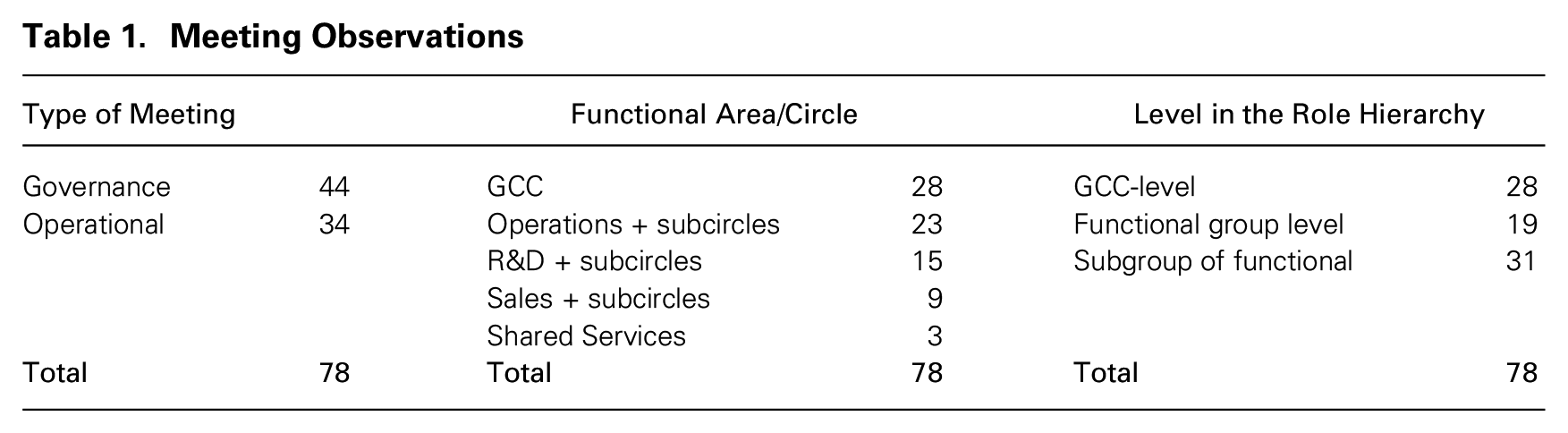
I observed meetings of the core functional circles (Operations, R&D, Sales, and Shared Services) and their associated subcircles, as well as the GCC, which consisted of the Lead Links of the four core functional circles. For each circle, I observed operational meetings as well as governance meetings, totaling 78 meetings, with the majority lasting between 60 and 120 minutes. Table 1 shows the meetings observed by type, functional area, and level. Meetings were recorded and transcribed when possible; otherwise, I took detailed field notes. I also observed monthly organization-wide presentations on the state of the business and trainings related to the new system. When not observing meetings or conducting interviews, I shadowed individuals and was “hanging out” (Browne and McBride, 2015: 34) in common spaces.
Meeting Observations
Archival data
I had access to several sources of archival data, including data on all role changes that were decided during governance meetings, employees’ demographic data, and email messages from organizational leaders to the entire company. I also had access to results of periodic, voluntary, and anonymous surveys that CashCo sent out to employees related to their satisfaction and work experience. I used these archival data to test emerging interpretations from my interviews and observations as well as to quantify some of the dynamics I observed.
Data Analysis
My data analysis followed an inductive, grounded approach (Strauss and Corbin, 1998; Charmaz, 2006), which involved iterating between collecting data, analyzing and interpreting data, and reading relevant literature. Consistent with a grounded theory approach, these steps did not follow a strict sequence but did occur in distinct phases.
In the first phase of analysis, I wrote analytical notes for each interview and meeting observation to highlight insights and questions that merited further investigation. I then wrote memos to compare themes and identify emergent puzzles. Early memos focused on the organization’s successes and failures in decentralizing authority and the ways in which individuals felt more empowered—or not. Early memos also focused on the effort that went into codifying roles and workers’ engagement with them in daily work. These memos led to the discovery that the codification of roles and workers’ engagement with them were deeply intertwined with enactments of decentralized authority.
In the next phase of analysis, I focused on the different ways in which employees codified roles and engaged with them to support successful enactments of decentralized authority. Codes related to codification included “capturing authority and responsibility into role” and “defining roles to not get run over.” Codes related to the way that employees engaged with the roles in daily work included “claiming authority from role to make decisions,”“looking up roles to direct work requests,” and “speaking and acting in role.” Coding at this phase was descriptive, focusing on identifying and preserving action and reflecting terms used by the informants themselves (Charmaz, 2006). I engaged in constant comparison of the detailed codes to explore distinctions between them and in order to develop higher-order categories (Strauss and Corbin, 1998; Charmaz, 2006). Three categories of codes emerged: “publicly codifying work roles,” which related to codifying roles to delineate boundaries of authority and responsibility and making them visible by publishing them on a digital platform; “working from work role boundaries,” which related to individuals attending to the codified roles to determine their authority; and “relating through work roles,” which captured the use of the codified roles as a frame for interactions. These three categories of codes constituted organizational practices that my analysis revealed were central to enacting decentralized authority.
In the final phase of analysis, I explored the interplay between the practices and the mechanisms by which they supported enactments of decentralization. Through this, I realized that the combined practices of publicly codifying work roles and then working from the role boundaries established clear limits on each role, bounding each role’s authority and constraining leaders while empowering workers. The practices of publicly codifying work roles and then relating through work roles shifted attributions of authority, grounding authority in impersonal rather than personal sources. Bounding authority and grounding authority emerged as key mechanisms by which the practices supported decentralization enactments.
Simultaneously, I systematically analyzed variation in my data by compiling all data on breakdowns in the enactments of decentralized authority. For each breakdown, I analyzed which practice(s) it related to and the reasons for the breakdown. While various reasons emerged from this analysis, most breakdowns stemmed from the complexity of the decentralized authority structure and cognitive effort required to sustain the practices. This analysis highlighted the important role that cognitive processes such as attention and attribution played in both the efficacy of the practices and their breakdown. These insights prompted me to consult the literature on the social psychology of hierarchy and led me to refine the core insight of my research: that organizations can mitigate the forces pulling them back toward hierarchy through practices that establish clear boundaries of authority and depersonalize attributions of authority. At the same time, these practices have their limits and are difficult to sustain. These results reveal that efforts to decentralize authority are akin to swimming against a powerful current. Progress can be made, but without continual vigilance, effort, and attention, reversion to enactments of rank-based authority is likely.
Findings
After the new system’s adoption, leaders and workers initially resisted enacting the new decentralized authority structure and persisted in enacting rank-based authority. Some leaders feared losing control: one Lead Link notably continued to impose decisions on his circle members, which a circle member attributed to him being a “command-and-control type” of leader. Habituation to institutionalized rank-based authority relations made change difficult for both workers and leaders. One worker reflected on her continued habit of seeking approval before taking action: “You get used to doing one thing over and over. So you’re just programmed [to ask for permission].” Leaders also found it difficult to change, or as one senior leader said, “habits are hard to break.” Expressing a common sentiment, a former manager described the shift in authority structure as “radical,” and a worker said it was “really hard” to enact. Additionally, workers were hesitant to exercise decentralized authority, knowing that legally, decision authority still resided at the top. One worker said, I think about the repercussions. What’s going to happen to me if I don’t just do what I think I’m supposed to do? You know, I have a six-year-old daughter and I need to be able to work. It’s very frightening to think that if you don’t just go along with it, that you’re going to end up in a place you don’t want to be.
The transition was made even more difficult by the continued presence of individuals with greater authorities than others. Lead Link roles, which were held by former managers, still held significant authority. One worker said, We probably shouldn’t have made former managers the Lead Links. If you’re going to take away the power structure, we should have made different people those link points. It may not have been 100% different but you have former managers who look at that and say, well, this is the same thing, just a different name.
Thus, I initially observed many of the barriers to decentralizing authority that existing theory would predict. However, in the face of these obstacles, successful enactments of decentralized authority did emerge, and three interconnected practices helped to bring them about.
Publicly Codifying Work Roles
The first practice that supported enactments of decentralization after the company adopted the new system was publicly codifying work roles. This practice was not itself a decentralization enactment, but it was foundational—the other practices were not possible if the broader collective did not continuously engage in this first practice. When work roles were publicly codified, subsequent decentralization enactments were more likely; when work roles were left ambiguous or implicit, enactments of rank-based authority crept back in.
Prior to the new system’s launch, the organization’s rank-based authority structure was represented by a pyramid-shaped chart with four hierarchical layers. The founder and CEO, Oren, oversaw R&D, finance, and continuous improvement functions, and the president, Bryant, oversaw sales, marketing, and operations functions. 2 Each individual’s work was loosely formalized with titles, such as “VP of sales” or “customer service manager,” but without further detail on key responsibilities.
The practice of publicly codifying work roles, which occurred in periodic governance meetings when each circle met to consider changes to the circle’s roles, involved three shifts to the organization’s structural representation. First, this practice involved continuously clarifying and making explicit each person’s work responsibilities and authorities to a much greater degree than existed before adoption. For example, in one governance meeting, a worker proposed a new codified work role because “I want to create a role to capture the work that’s being done.” In another governance meeting, someone asked a worker proposing additional accountabilities to his role, “Is this capturing everything that you currently do?” The goal, as many individuals understood it, was to ensure that every task responsibility and corresponding authority within the organization had a codified role associated with it. One worker explained, “[Roles and] accountabilities should capture, end to end, what your work is so that other people collaborating with that role understand exactly what they’re doing and not doing.” Second, the practice transitioned from defining roles around individuals to codifying roles around coherent task bundles. This shift meant that individuals often held multiple work roles, which contrasted with the previous representation in which each person had exactly one role. One worker said, “People are understanding that a role is not one person in a full-time job—you can hold seven roles. A role is just holding part of the circle’s work that needs to be executed.” Third, the practice involved making the codified work roles publicly visible to the entire organization via a digital platform, moving away from the prior system in which only managers and HR personnel had access to job descriptions. Public codification of work roles led to a significant increase in both the number of codified roles and the amount of text to define the roles, with the number of roles growing by 3.1 times and the amount of text by 5.6 times in the first six months of adoption.
Publicly codifying work roles supported decentralization enactments by making each worker’s authority clear and explicit. For example, in preparation for a trade show, a senior leader asked Iris, who held the Trade Show Manager role, to bring more units of CashCo’s products to the show than she thought was appropriate. Out of fear, she complied. Iris explained, I was too timid to say no to somebody because before Holacracy, they were above me. [They] were my boss or my boss’s boss. And so we end up with seven machines in a tiny booth and it was too much. . . . We need to change that in our next governance meeting. Because the way that Holacracy is designed, you’re not supposed to get run over on those types of decisions.
That Iris deferred to this senior leader despite her disagreement highlights the continued presence of rank-based dynamics in the organization. To counter this, in the circle’s next governance meeting, Iris proposed a new accountability to her role—“Determining which products will be displayed at a given show”—which clarified her role’s authority to make decisions for future shows. She explained her intent: “Basically, so the line was drawn. Because there was no line before. It just said ‘manages trade shows.’ That doesn’t give a clear picture.” Thus, when workers’ role boundaries were ambiguous, former managers were liable to step in and exert their informal authority, and workers deferred to them. Publicly codifying work roles helped counteract these incursions. After the clarification, Iris felt more able to enact her authority: “We’ve been able to make more of the decisions for trade shows.”
Publicly codifying work roles also helped establish clear boundaries on managerial authority. Nearly all managers became Lead Links after the system’s adoption; this was one of the system’s core roles that was pre-specified and could not be changed. The role explicitly granted Lead Links some managerial authorities, such as assigning and removing people from roles and allocating resources in the circle. But it excluded other authorities, such as hiring and firing workers, giving performance evaluations, and directing workers in how to fulfill their roles. The delimited authorities of the Lead Link role relative to the traditional managerial role were salient to both managers and workers. Bryant, the former president of CashCo, explained it this way: [The Lead Link role] is not an operational type of role as far as operations of the business. It’s guiding that circle to make sure it’s fulfilling the purpose—that’s differentiating the work . . . making sure the roles are filled properly, some mentoring about making sure people are in the right roles. . . . And then it’s resource allocation. So it’s not—where it gets dangerous is taking a managerial stance on something, like we shouldn’t be doing this or we should be doing this. It’s easy to cross back into management by decree if you’re not careful.
As indicated by the last sentence (“It’s easy to cross back into management by decree”), former managers felt the gravitational pull of enacting rank-based authority even after the new system’s adoption. However, the clear boundaries of their authority supported them in resisting this pull.
Notably, the new system did not make authorities equal. Managers retained most of their functional authorities in the shift to the new system. The clearest evidence of this was that former managers had to codify additional roles beyond the Lead Link to capture the full extent of their prior authority. For instance, the Lead Link of the R&D circle created a Product Roadmap Owner role that captured his pre-existing responsibility and authority to define the company’s product roadmap. In the Production circle, the Lead Link codified and filled several operational roles, such as Manufacturing Optimization and Strategy, SAP Key User, and Production Model Specialist, to capture work he performed prior to the new system’s adoption.
Capturing the full set of managers’ responsibilities into specific roles, while indicating the persistence of role inequality, signaled that former managers’ authority was now restricted to their codified roles and not unbounded, as in the prior rank-based structure. In addition, it framed their authority as coming from their codified work roles rather than from their informal rank as former managers. In contrast, when former managers acted in their prior functional capacities without an associated codified role, multiple workers commented that they were “acting like managers.” A senior leader explained, I don’t know how you change [the perception that the Lead Link is the same as the manager] other than talk about what the Lead Link should be doing. . . . If you take an action as a Lead Link, it should be a red flag that there’s work that hasn’t been differentiated, that hasn’t been created for a role. . . . I think if Lead Links were really careful about that, if they’re having to take operational action, then it should point to some role that needs to be created or an accountability that needs to be added.
This quote underscores the concern that when former managers exercised authority that was not captured in a codified work role, workers perceived them to be wielding the unbounded managerial authority associated with the prior rank-based authority structure. Publicly codifying their authority into work roles mitigated this perception.
Publicly codifying work roles was a continuous practice and required updating the roles as new work needs emerged and roles shifted. For example, when the Sales circle decided to implement a new customer relationship management (CRM) system, Bryant, who held the Lead Link of Sales role, proposed the creation of a new role to oversee the CRM system’s implementation. In the prior rank-based structure, he said he simply “would have gone to somebody and given them a project,” but publicly codifying a new role to capture this work reinforced the worker’s autonomy and established limits on former managers’ authority to assign work. In contrast, former managers informally assigning work undermined decentralized authority. Jared, an employee who also held the Holacracy Lead role, which was responsible for implementation, lamented an instance when Bryant informally assigned new sales reporting responsibilities instead of publicly codifying a new role: That is just a total miss on [the] Holacracy front. . . . Somebody has a need for reporting from Sales. Sales should figure out who should do that. It’s either a role within Sales or a role in another circle. Instead, what happened was, they thought, “We need somebody to do it, let’s just see who could do it. Let’s just find an appropriate person and lean on them.” It doesn’t reinforce the autonomy. It made [the worker] feel pressured. It’s going to remain outside of the system.
Failing to update the codified roles as work needs changed undermined the shift toward decentralization. The notion of remaining “outside of the system” suggests that without explicit codification, authority defaulted to the implicit rules of the prior rank-based structure.
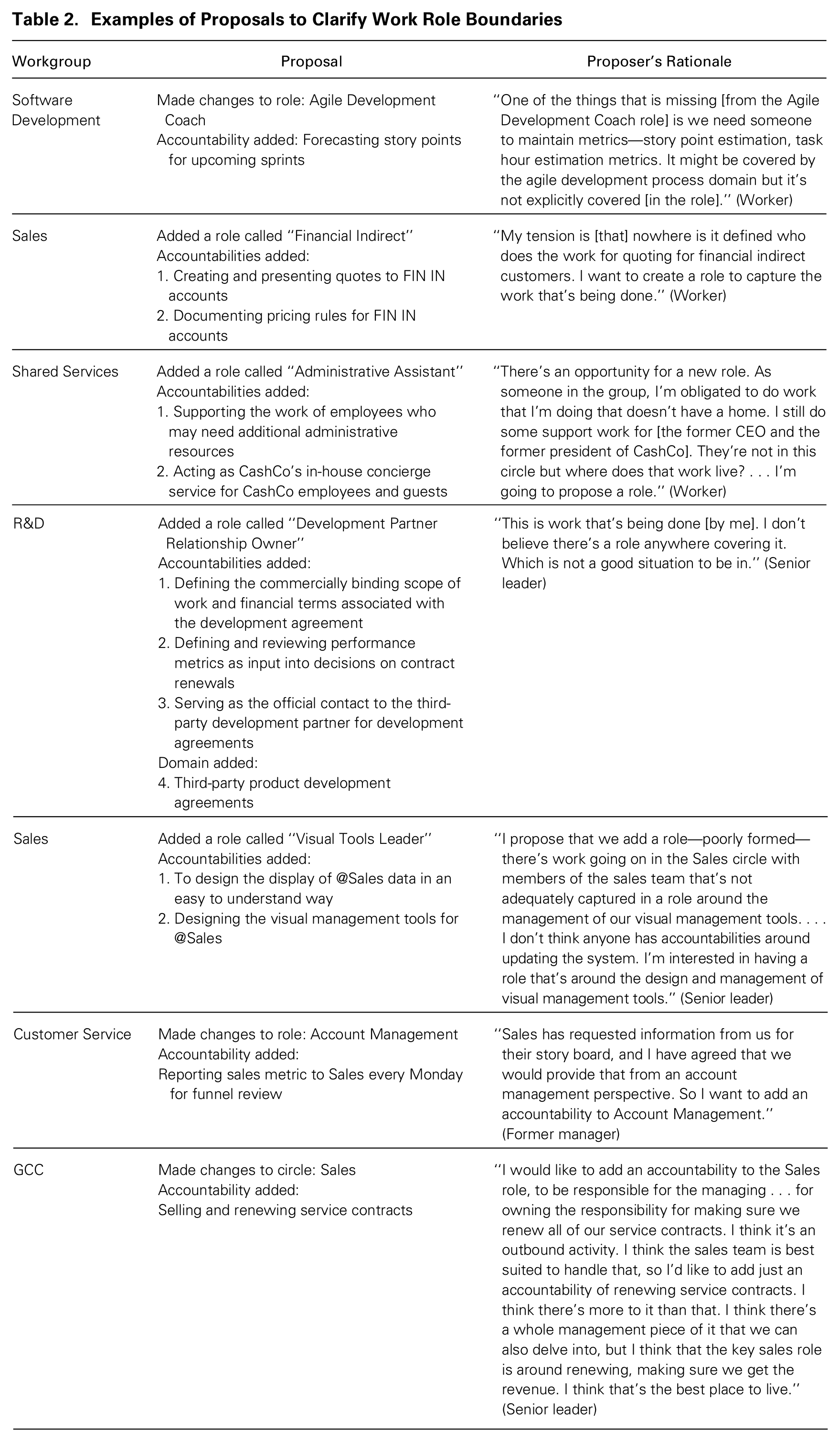
In short, while authority in the new system remained unequal, with Lead Links retaining many of the authorities they held as managers in the prior rank-based system, publicly codifying work roles established clear boundaries around the authority of both workers and former managers and also framed authority as coming from work roles rather than one’s rank or personal status. Both of these features of public codification marked a significant departure from the prior rank-based structure and laid the groundwork for two subsequent practices—working from work role boundaries and relating through work roles—through which enactments of decentralization occurred. Table 2 provides additional examples of proposals that publicly codified work roles.
Examples of Proposals to Clarify Work Role Boundaries
Working from Work Role Boundaries
The practice of working from work role boundaries involved people attending to the publicly codified role artifacts published on the online platform and enacting the authority and responsibility captured within the boundaries of the work role. One indication that employees paid attention to the codified work roles was the number of visits to the online platform: in the first three months, there were 30,000 visits to the online platform; in the first 12 months, there were 100,000 visits. The Lead Link of R&D said, “I’m in [the online platform] all the time looking up roles in R&D and other circles.” The importance of working from work role boundaries was highlighted when some employees ignored the publicly codified roles and instead acted in rank-based fashion. For example, early after the system’s adoption, workers complained that the Sales circle’s Lead Link continued to act like a manager: So you’re the manager before of this group of Sales. Now you’re the Lead Link. What’s the difference? Even though yes, it says in the constitution that this role is constrained and you can’t add accountabilities, if that person in the Lead Link role doesn’t become well-versed in what their accountabilities are and works off of their accountabilities before, then there’s no difference.
In short, the public codification of roles was not enough; enactments of decentralized authority relied on individuals attending to and working from the boundaries of their codified roles.
Working from work role boundaries decentralized decision making
Working from work role boundaries decentralized decision making by constraining leaders while empowering workers. For former managers, working from these boundaries involved paying attention and adhering to the limits of their authority set by the codified roles, thereby voluntarily restricting the scope of their influence. For example, in a Marketing circle meeting, a worker asked the Lead Link to sample the gourmet coffee being considered as a customer Christmas gift. The Lead Link, recognizing the limits of his role, said, “I can just tell you if we have the money, but if you think it’s a good idea then you should do it.” Despite being granted more authority, some workers still hesitated to act without the Lead Link’s approval. Successful decentralization in these cases required Lead Links to consciously reinforce the limits of their own authority in such interactions and encourage workers to make autonomous decisions.
Former managers who worked from their role boundaries viewed doing so as a practice of discipline, attenuating their natural tendencies to weigh in on decisions and giving space for others to exercise authority. For instance, a worker in a forecasting role asked Edward, a member of the executive team in the prior structure, which numerical assumptions she should use in her forecast. One of Edward’s roles involved helping people access data from the company’s enterprise resource planning system but did not extend to making forecasting decisions. He deflected this worker’s attempted deference to him, encouraging and guiding her to make the decision. He later reflected, The organization still needs leaders and leadership, but in a traditional organization, this wisdom came from the top and it wasn’t often the right wisdom, and it wasn’t necessarily role-based. Because I happened to be on the executive team [before the new system], somebody might ask me about facilities or different things like that. I always had an opinion because I always have opinions as most people do and I would always be glad to share them. But this is holding me tight to stay in the role that I’m in. So, when Amanda was saying, “What numbers should I report?” I said, “You know the numbers and you know what you want them to be. I don’t know and I’m not going to tell you, but I’ll tell you how to get them and I’ll help.”
Workers were vulnerable to deferring to former managers, who were themselves tempted to wield their prior rank-based authority and influence. Edward’s use of the phrase “holding me tight to stay in the role” reveals how the presence of the codified roles and bringing attention to them helped former managers resist the temptation and instead create space for workers to make decisions.
Working from role boundaries was a collective practice as both workers and leaders were involved in reinforcing such boundaries. When workers subordinated themselves to former managers, the leaders redirected these efforts, pushing authority downward. Similarly, when former managers sought to exercise authority beyond their role boundaries, workers could push back. For example, in a meeting of the Operations circle, members discussed who had authority to decide supply chain order sizes. At one point in the discussion, the Lead Link claimed decision-making authority, as the Lead Link role had authority for allocating resources. However, another member countered, “It’s a resource decision but not necessarily an allocation decision.” The member proposed that a different role could make the decision and simply ask the Lead Link for the budget. The rebuttal succeeded, and the decision was given to the Supply Chain role holder, effectively decentralizing decision making. Maintaining the integrity of role boundaries was thus a collaborative effort, with the visibility of the roles allowing for collective attention to the boundaries and communal regulation of them.
While working from work role boundaries constrained the authority of former managers, it had the opposite effect on workers, empowering them to exercise greater authority by clarifying their legitimate authority within the new system. One worker said, What I like about Holacracy is what is defined for me are my accountabilities and my purpose, which even I have control over. . . . The only thing I need to concern myself with is am I working toward my goals and purposes. If I think [what I’m doing fits with my purpose and accountabilities], then I take action and get it done.
Enacting decentralized authority required workers to take interpersonal risks, real and perceived. Some workers still feared punishment for exercising their new authority, especially given that leaders could reclaim such authority at any point. Furthermore, enacting decentralized authority involved overcoming habitual behaviors and pre-existing norms, marking a profound departure from the established order. Attending to the codified role boundaries gave workers the confidence to act. For example, when the Lead Link of the Product Engineering circle (a subcircle of the R&D circle) tried to make a unilateral change to the circle’s roles, violating the constitutional rule that role changes had to be made in governance meetings, a worker holding the circle’s Secretary role, responsible for enforcing the system’s rules, faced the daunting task of confronting her former manager: “It was very intimidating for me because I’m like—here sits the person who used to be my manager. . . . I realized that as Secretary, my role was to make that decision. . . . It’s my role. I control it. And I have to make this decision.” The Lead Link accepted the worker’s ruling, in no small part due to the transparent nature of the violation and the Secretary’s explicit authority to overrule him.
Working from work role boundaries counteracted workers’ inclination to seek permission prior to taking action, a legacy of the rank-based structure. Knowing the limits of their authority emboldened workers to act decisively. One worker explained, I was realizing later that the benefits of distributed authority are really just about clarity to me. Prior to the new system . . . it was really unclear who had what authority. There was no real way to know if you were acting within your authority or not. So you acted within what you expected what your authority likely was. You probably generally erred on the side of caution. . . . And so distributed authority is an awesome thing that can be really powerful for the organization. But it’s really that authority is clearly distributed.
Working from work role boundaries thus focused attention on the limits of authority, prompting former managers to narrow their decision-making scope while encouraging workers to broaden theirs.
Working from work role boundaries distributed the pattern of work requests
Besides bestowing the power to make decisions, rank-based structures also grant managers authority to oversee subordinates’ work (Puranam, 2018), leading to the conventional pattern whereby work requests occur through the hierarchical chain of command. CashCo was no different prior to adoption of the new system. However, after the system’s adoption, individuals operated from their work role boundaries in ways that distributed the pattern of work requests.
Working from work role boundaries entailed matching work requests to roles and aiming work requests directly to relevant role holders rather than channeling requests through Lead Links. The clarity of the role boundaries helped workers feel confident that they could bypass the chain of command, which felt liberating. A worker remarked, One of the things I’ve dealt with over the years at CashCo is the lack of project planning. When you are a solutions company, that’s a problem. . . . So this afternoon, I touched Bill on the shoulder and said, “I need to sit down with you on your [new product introduction] process, and I need to talk about a project planning methodology for making that happen so that we’ll either feed or replace your plan.” . . . Now in the past, Bill works for Larry and I work for Bryant. . . . Me being a polite person, I certainly would have wanted to go through the chain of command. . . . [With the publicly codified work roles,] It’s the clarity of it. You can see it. It’s clear. You know it’s there. You have the ability to work in a much more efficient manner.
The employee’s mention of being polite in the past signals the powerful prior norm of routing work requests through the chain of command. The new ability to unambiguously match requests to a publicly codified work role supported workers in skirting this customary practice.
Working from work role boundaries was apparent in the way that individuals discussed and resolved problems without relying on the Lead Link. For example, in a meeting of the R&D circle, Roger, who was the product owner for a soon-to-be-released software product targeted at the company’s original equipment manufacturer (OEM) customers, brought up his concerns about the lack of marketing support for the product release: “My marketing needs are really that basic. A press release, pertinent websites or whatever.” The discussion that followed highlights the distributed nature of the discussion:
(Software Development role and Facilitator role): Yeah, I’m just going to ask you a question. I’m not suggesting you do this, but in the PO [product owner] class that we all took, you know that whole idea of writing the press release when you do the project. Have you, and maybe you haven’t, but have you written a press release for this? Do you feel like you could? I’m just wondering if it would grease the tracks for you with Marketing.
(OEM Solutions role): It could be. Part of it is, really, to challenge Marketing in a way that they feel involved in the process of launching a product, rather than just . . . I’m sorry. I don’t mean it sarcastically but rather than just writing a blog article and being done with it.
(Tech Intro Project Manager role): So Roger, I can make that a checklist item for Marketing to make sure we have a plan for that type of communication. Or the introduction.
(OEM Solutions role): That’s a good idea.
(Tech Intro Project Manager role): So if you want to create an action for me to make sure that’s included in the marketing checklist for [the new product launch], I would accept that.
(Lead Link role): It’s in the Tech Intro Project Manager role?
(Tech Intro Project Manager role): Yes.
(OEM Solutions role): All right, so that role is the Tech Intro Project Manager. You’re welcome to add the action for me to meet with Marketing. Really, Matt [the holder of the Marketing role], and go over what requirements are for the launch. They haven’t done that yet.
(Facilitator role): That would be in your OEM Solutions role?
(OEM Solutions role): Yes.
Two important features of this conversation highlight the practice of working from work role boundaries. First, individuals’ respective work roles were explicitly mentioned in conversation, highlighting the collective awareness of and attention to what roles individuals were holding in the context. With this awareness, individuals matched the issues being discussed to their own roles, proactively volunteering to take actions that fit their role responsibilities and requesting work from others with relevant roles. Second, the Lead Link played a minimal role in resolving the issue, stepping back and creating space for others to problem solve. In this way, working from role boundaries facilitated peer-to-peer problem solving.
Working from work role boundaries also enforced limits on the Lead Links’ authority to request work from others. In rank-based structures, declining a managerial request carries significant risk. In the new system, however, workers were able to reject Lead Link work requests that did not fit their role by comparing incoming work requests to their role boundaries. For example, the Lead Link of Shared Services asked a circle member who held the Administrative Assistant role to purchase groceries for the company kitchen. The worker declined the request despite the request coming from her Lead Link and despite her role being typically associated with low status scut work (Huising, 2015; Ranganathan and Shivaram, 2021). She attributed her courage to the fact that the task was explicitly defined as part of a different role: I generally don’t say no. I’m a pretty good trooper. I don’t know if I would have turned it down if I was just in a company where I was an administrative assistant. The fact that it was a separate role, Supply Purchasing, that wasn’t part of my role, made it clear that this was not in the scope of my accountabilities, to me. When I’ve been an executive assistant in the past, it’s really a job they can just give you whatever shit they want and make your life really horrible and there’s not much room to say no to things because that’s what you signed up for.
The ability to assess whether a request fell within their work role boundaries gave workers the confidence to securely reject tasks that lay outside their designated responsibilities.
Notably, workers saying no to extra-role requests elicited frustration at times. A mid-level employee said, “Some of the adopters of [the new system] seem to be unwilling to take on something that is not a very clearly defined accountability. That is a very different experience to my startup background where everyone pitches in and does everything.” While such complaints were not the norm, they reveal both the extent to which individuals worked from role boundaries and how doing so could slide into bureaucratic formalism (e.g., Merton, 1940).
Together with the practice of publicly codifying work roles, the practice of working from work role boundaries defined and drew attention to the new boundaries of authority in the decentralized structure. This bounding of authority, in turn, catalyzed the enactment of a new decentralized pattern of decision making and work requests, prompting former managers to constrain themselves while empowering workers to self-manage in their roles.
Relating Through Work Roles
The second practice that complemented the public codification of work roles was individuals relating through work roles: referencing roles in interactions when enacting their authority and using roles as an explicit frame through which they viewed themselves and others. Relating through work roles supported enactments of decentralization by shifting attributions of authority enactments away from personal sources and toward the impersonal codified work roles. In doing so, this practice legitimized often contentious or risky enactments of decentralization, and it established a sense of equality that offset the pull back toward rank-based authority.
Relating through work roles legitimized enactments of decentralized authority
One way that workers related through work roles was by referencing one another’s codified roles in interactions when enacting decentralized authority. Given workers’ habituation to the rules and expectations of rank-based authority, their enactments of decentralized authority risked negative judgments of impropriety or insubordination. By invoking the relevant work roles that authorized them, workers reduced the risk of such judgments. One worker described intentionally referencing his role when making a decision in order to legitimize his authority to do so: If I’m sending out an email to make a decision, I often will go back to the online platform and figure out what role I’m in when I’m making a decision. . . . [For example, I will write] “I’m entitled to do this because as a Software Engineer, I’m required to write good code.”
The shift toward decentralization opened the door for a new class of interpersonal conflicts to emerge as individuals began receiving work requests from across the organization, not just from Lead Links. Individuals making work requests to peers were sensitive to requests being taken personally, and they invoked the relevant roles to defuse potential conflict: I think it’s mostly for me when asking somebody to do something, it’s really helpful to be able to point to accountabilities. To do that, you have to frame it in the role. It would seem different to say, “Mike, you are accountable for producing the report. Can you send it to me?” But instead, if you say, “Your role is accountable for this report,” somehow it makes it sound less pushy. It makes it seem like you’re not pushing them to do something that they don’t want to do.
Invoking roles during a work request signaled to the receiver that the request was made for work reasons rather than personal reasons, depersonalizing attributions of the motives of requests.
The legitimating power of referencing roles was especially relevant when work requests defied the prior rank-based rules and were made upward in informal rank. In a GCC operational meeting, Ryan suggested that his former superior, Bryant, take on a project related to forecasting. In doing so, Ryan pointed to Bryant’s Operations role:
(Sales role): I think as soon as possible, we need to determine a way that we can forecast for the entire company. . . . My opinion is that this should become a project at the GCC level . . . that probably is most appropriately owned by—[the] forecast lives in Operations. Bryant, I don’t want to throw a project on you, but—
(Operations role): I think it’s legitimate. I have to figure that out.
Ryan’s hesitance to give a project to Bryant—“I don’t want to throw a project on you”—signals the awkwardness of asking a former superior to take on work. By referencing Bryant’s role, Ryan highlighted that the work request fit Bryant’s work responsibilities, and Bryant’s response, calling the request “legitimate,” underscores the legitimating power of this practice.
Relating through work roles established a sense of equal treatment despite unequal distributions of authority
At a deeper level, relating through work roles involved using the roles as explicit frames through which people saw themselves and related with others. It involved individuals perceiving and interacting with each other not just as two people but also as two roles and calling each other by respective role names. For example, in a meeting of the GCC, a member discussed the need for clearer and more global key performance indicators (KPIs). In response, a group member chimed in, “Seems like a good project for Integration Office to look at these global KPIs.” The Facilitator then asked the Integration Office role holder, “Oren, as Integration Office, do you guys have that on your scope?” Oren replied that he was not focused on global KPIs but would be happy to take on a project to define them. The Facilitator instructed the Secretary to log a project in the online platform: “Create project—‘Global KPIs Defined’—for Oren, as Integration Office.” Although the work request was made to CashCo’s founder, Oren, the conversation centered on the responsible role rather than the person. This interaction illustrates how relating through work roles foregrounded role responsibilities over personal identities or interests.
As existing theory would predict, the presence of unequal distributions of authority reinforced status hierarchies and prompted some individuals to perceive and interact with others through the lens of rank. For example, one senior leader described how he saw his roles: The fact of the matter is that some of us have accountabilities that are very different from others. And if you look at the roles that I currently hold today, there are some pretty strong accountabilities around those roles. That means I’m a more senior person in the organization. . . . What does that mean to the outside world? It means that I’m one of the seven or eight people at CashCo that sit in the executive group. You know, the real executive group as opposed to the GCC. Depending on the type of accountabilities that you carry in the roles, that really determines salaries. . . . So that creates another type of org chart.
As is clear from this passage, the authority and number of one’s codified work roles could easily serve as indicators of rank for some, reinforcing rank-based authority enactments.
However, the practice of relating through roles counteracted this tendency by framing authority as coming from work roles rather than from rank or one’s personal attributes. This shift in attributions helped to level the playing field, even as roles remained inherently unequal. One worker described his journey from resistance to acceptance of the new practice: I call people by their Christian names [rather than their role names]. That was resistance on my part. I realized that I wasn’t accepting of this change. And so I thought about this a bit and came to a conclusion that there was value in this approach and that I really needed to change the way I was working. There’s less politics. I don’t have to be politically correct. Once I know the role that is relevant, then I can go directly to that role.
As suggested by this worker’s comments, relating through work roles required a change in the way one perceived and interacted with others, focusing on the impersonal demands of the roles that were being represented rather than the rank or personal interests of the individuals involved. The change in perspective led to a distancing and depersonalization of interactions that freed workers to bypass the politics of rank-based authority and to enact decentralization.
Relating through roles was particularly useful for reframing former managers’ exercises of authority. Whenever Lead Links exercised authority, there was a risk that workers would perceive them to be leveraging their informal authority as former managers. To mitigate perceptions that they were simply managers in another guise, Lead Links, when exerting authority, referenced their work roles and others’ work roles. One Lead Link said, “I’m very careful to say, ‘In my role as.’ I’m kind of averse to conflict anyways. If I’m asking something unpleasant, it’s always going to be in my role.” In meetings, Lead Links frequently asked for action items from various group members but made sure to cite the relevant work roles. For instance, in an Operations circle meeting, the Lead Link, Edward, asked the Technical Services role holder, Cameron, to investigate the status of invoicing on the company’s service contracts. “I’m looking for a report that gives us an overall status of our current invoicing for service contracts. Are we behind? Current? Do we need to beat up Finance? I’d like for Technical Services to take that project.” Cameron resisted the request, saying, “I don’t have a role in that.” Edward then suggested reviewing the Technical Services role, pulled up the role on the online platform, and pointed to a specific accountability that he felt fit the request: “The one I’m looking at—third accountability—‘Fulfilling service contract expectations in a profitable manner.’ Do you think it fits into that third accountability?” Following this exchange, Cameron accepted the project. By highlighting their roles as context for their actions, Lead Links could exercise authority without undermining the effort to decentralize, grounding their authority in formally designated responsibilities rather than in an assumed rank.
Perhaps the most notable example of how relating through roles reframed leaders’ authority came when senior leaders decided to formally centralize authority to set strategy. When CashCo adopted the new system, Oren eliminated quarterly executive team strategic off-site meetings but did not replace them with a new process for strategy formulation. Several groups scrambled to claim authority for setting strategic decisions, sewing confusion. Recognizing this power vacuum, six months after adoption of the new system the five most senior leaders at CashCo held an off-site meeting to develop a new company strategic plan although none of them held a formal role granting them this authority. Upon returning, they engaged in the foundational practice of publicly codifying work roles, proposing a new Strategy Council role in the GCC that formally captured their authority for “Publishing corporate strategy on a regular basis.”
While leaders felt it necessary to centralize strategy formulation to maintain organizational alignment, the centralization raised questions about whether the company was serious about decentralization. For some, the creation of the Strategy Council role confirmed suspicions that the new system was a façade that obscured the persistence of rank-based authority. One worker lamented, “We’re struggling in that the authority and power of the company hasn’t changed. It’s the same top several managers, executives, making the decisions for the company.” However, the codification of the Strategy Council role along with the practice of relating through roles shifted the way that some workers perceived leaders and related to their authority. Rather than viewing leaders’ authority as coming from their rank or status, relating through roles enabled workers to see leaders’ authority as coming from their roles. One worker emphasized this point: I really liked [the creation of the Strategy Council role] because I knew, and I’m sure most people knew, that the [group of people on the Strategy Council] is where the true true [sic] highest power at CashCo lied. I’m pleased that at least it’s transparent now. . . . It makes explicit shadow power structure. But in making them explicit, they’re less mythical. It takes the power out of the person and moves it to a role that anyone could fill and anyone could understand.
Thus, even though senior leaders retained centralized control over strategy setting, viewing this authority through the frame of the Strategy Council role depersonalized attributions of this authority, making it “less mythical” and more accessible. This passage reveals that rank-based authority, despite typically being treated as a structural, impersonal basis of authority (e.g., Pfeffer, 1981), is in practice attributed to the personal characteristics of the individual holding the position. In the process, their authority becomes mystified, emanating from an inaccessible source and operating without clear limits (Rothschild-Whitt, 1976; Diefenbach, 2018). Relating through work roles countered this bias, depersonalizing attributions of leaders’ authority and grounding authority in a set of clear rules and limits that applied equally to workers and leaders.
One effect of relating through roles was a reduction in the power distance between leaders and workers. One senior leader described feeling like people were on a more similar level now despite their unequal roles: “With Holacracy . . . It’s not just me going role-to-role. It’s also others talking to me. I feel more approachable.” The notion of “going role-to-role” signals how individuals increasingly viewed their interactions through the frame of their respective roles, and the senior leader’s sense of feeling “more approachable” indicates how relating through work roles fostered a sense of equality even as authority remained unequally distributed. While workers and leaders held different levels of authority, they were all subject to the same rules of authority, namely, the authority demarcated by the boundaries of their codified work roles.
Together with the practice of publicly codifying work roles, relating through work roles had the effect of shifting attributions of authority from personal sources to the impersonal codified roles. This shift, in turn, legitimized risky and contentious enactments of decentralized authority while also democratizing perceptions of power. For additional data illustrating the three practices, see Table A1 in the Online Appendix.
Frictions in Practices That Led to Reenactments of Rank-Based Authority
Engaging in the three practices supported successful enactments of decentralized authority, but sustaining these practices proved challenging. Analyzing the breakdowns in each practice highlighted distinct frictions that disrupted their consistent enactment. Various hurdles, such as resistance to change and the difficulty of breaking out of habits and routines, initially hampered engagement with these practices. However, most breakdowns emerged later in the process, stemming from frictions that hindered the continuous application of the practices among committed and motivated members. I focus on these frictions as they illuminate the potentially inherent limits of these practices. While each practice encountered its own distinct frictions, the frictions shared similarities. By and large, individuals struggled to consistently enact the practices because of the complexity of the decentralized authority structure and because doing so required effort—time and energy to be sure, but also cognitive and emotional effort. The psychological strain of maintaining these practices took a toll, leading individuals to occasionally revert to the comfort and ease of rank-based relating.
Frictions with publicly codifying work roles
The frictions with publicly codifying work roles emerged from the complexity of the new decentralized authority structure, which allocated authority to each role based on task responsibilities rather than rank. While publicly codifying work roles required making the limits of managerial authority explicit and visible, ambiguity in the boundaries of managers’ authority persisted because of the organizational need for managers to hold residual responsibility (Zuckerman, 2010). For example, the Lead Link role was explicitly limited to five core accountabilities that constrained its authority, but the role also held responsibility for anything in the circle that was left unassigned to another role. This arrangement was necessary, as codifying all of the work in a circle was impractical, but it left the boundaries of the Lead Link’s authority ambiguous. One Lead Link said, The Lead Link is fascinating to me. The whole concept that you’re in an organization structure that doesn’t have a traditional manager, but the Lead Link is responsible for the work of the circle, adding people to roles, prioritizing as required, also resources. If you add all those up and you think about it—isn’t that everything that a manager did?
The ambiguity caused by the Lead Link role having residual responsibility led to frequent complaints that Lead Links were still acting like managers. To combat this, Jared, the Holacracy Lead, set up trainings to help Lead Links better understand the role and how it differed from a manager. Still, he acknowledged the complexity: “It’s confusing. . . . If the difference were greater, it would be a much easier conversation. At the end of the day, there’s a whole lot of overlap.”
Senior leaders especially grappled with the challenge of clearly defining the limits of their authority given their residual responsibility. Bryant, for example, felt that his sense of responsibility for the whole company made it difficult to clearly bound his authority: I do feel responsible for the whole company. I don’t know if it’s just being at the company for so long. I am in a slightly different position than most other people here, being an owner. . . . I take on an added sense of responsibility in a way that a lot of people wouldn’t because of [my] roles. I should probably have a role for that. . . . It’s technically, I have the responsibility—if I’m doing work, I’m supposed to bring it to governance. Can you bring worry to governance?
Unlike in rank-based structures, in which leaders’ broad authority matches their residual responsibility, in the decentralized authority structure, leaders’ residual responsibility created ongoing friction in effectively establishing clear boundaries on their authority.
Another way that the complexity of the decentralized authority structure made publicly codifying work roles challenging was the amount of time it took to continuously update roles as work needs evolved. It was easy to deprioritize updating the codified roles in order to focus on more-urgent demands of work. Yet, without continuously updating the codified work roles, the shift toward decentralization suffered. Jared, the Holacracy Lead, observed, I think there has been some success pushing down authority and decision making. . . . One challenge I’ve been appreciating even more is how much more governance you need to get to that point. . . . I think that issues come up all the time where there’s not clear governance. So someone who gets a project, massages it into their role, does it, which is good, but there’s never follow-up governance about it. So one example of that is that our Strategy Council met in Europe. They added a core value for the company—the fifth core value is that we deliver great technology. I don’t have any problem with them adding it. If there’s a person who should do it, they were there. But I don’t know if the role that would do that is in the Strategy Council. . . . How do you go back and create governance for that especially if nobody really cares? The way you get rid of the multiple lenses on power is very clear governance records. It will take a long time to get the governance clear.
To ground authority or “get rid of the multiple lenses on power” required people to update the formal roles on a continuous basis. The fact that “issues come up all the time where there’s not clear governance” points to the difficulty, and perhaps impossibility, of adequately codifying work roles to prevent rank-based relations from reemerging. Instead, work demands often took priority. One worker said, “A lot of us have gotten jaded. We do so many things that aren’t in our roles. We have come to accept that we would lose more time keeping up with that than just doing the work.”
Frictions with working from work role boundaries
The complexity of the decentralized authority structure also presented frictions for the practice of working from role boundaries. Workers and leaders complained that working from role boundaries was too effortful given the complexity of the new decentralized authority boundaries. At times, they yearned for the simplicity of rank-based structures. One senior leader remarked, In some ways, the traditional style is compelling. God, we could just get that stuff done. You don’t have to go through machinations to change something. There is that yearning to just make some decisions and do things. But it misses the long-term benefit. I see that pretty clearly, but there are moments when I feel—let’s just go back to the old reporting structure.
The longing for the simplicity of rank-based authority extended to some workers. One said, I would suggest that before in a traditional hierarchy where if I needed to wrestle authority to the ground, and get it and plead it to my case, and work the system to effect change, I had to go to one or two people to do that. I could make an articulate case to a couple of stakeholders, get them on board and that would disseminate downstream, and we’d start to execute. In this environment, I have got 40 people that I need to get on board.
Because of the complexity of the new authority boundaries, workers sometimes resorted to using the heuristic of informal rank to determine whom to engage rather than searching for the right roles. For example, one worker who was working on a go-to-market strategy in a new vertical market invited senior leaders to review his strategy even though some of them had no related role. Jared, the Holacracy Lead, described his frustration: I see that kind of stuff all the time. Oh wait, why are you asking [senior leader] for that— what do you need there? Or people sending people emails who know an answer or would approve something whose roles don’t have anything to do with it. . . . I don’t know how much to even push on this, but it doesn’t feel right. It feels person-based and not role-based.
But Jared acknowledged how these breakdowns revealed the complexity of working from role boundaries and the attention it required: “It connects to how complicated this stuff can be and how I don’t think we’re doing an adequate job paying attention to it.”
To be sure, some breakdowns in working from roles stemmed from leaders’ functional desires to facilitate coordination and efficient decision making. For example, the Lead Link of Finance at one point mobilized workers across different circles to build the company forecast, a challenge that had vexed the company in the past. While many felt that he exercised authority beyond his roles and that workers felt pressured to participate—one senior leader referred to it as the “shadow power project”—others also recognized it as a valuable project for the organization. Oren said, “I see that specific instance as an example of something we should do more of. . . . Martialing resources and prioritizing work is something we have to do more of.”
Working from role boundaries also broke down for less-functional reasons, because workers desired the comfort and security of a traditional rank-based relationship with their Lead Links. One worker described her Lead Link as a manager but in positive terms: Yeah, absolutely, [he’s a manager and not the Lead Link]. People call him with all their problems. Whenever something isn’t done that isn’t getting done, people cc him. He’s not a micro manager but he’s the dad and we’re all the children and we go to dad with any problems we have.
The use of the parent–child metaphor conjures traditional paternalistic images of authority that organizations often adopt decentralized authority to escape. In some cases, however, rather than perceiving this paternalism as unwelcome, workers related to their Lead Link as a child would to a caring parental figure who satisfies needs for security. In this sense, reversions to rank-based authority represented at times a regression to a simpler, more comforting state of affairs.
Frictions with relating through work roles
Relating through work roles as a practice broke down at times due to the greater cognitive effort required and the sense that it felt unnatural. Breakdowns in this practice looked like workers relating to each other without the relevant roles foregrounded in conscious awareness and workers attributing authority to leaders based on who they were rather than the role they held. For various reasons, workers reverted easily to making personal attributions of authority. First and foremost, making personal attributions felt more natural. One worker remarked, The idea is that you’re talking about the role and the role is independent of whoever happens to be currently filling it. That’s the idea. I think often the reality is that it does seem personal. . . . We have not had much fluidity in terms of role fillers yet, which isn’t surprising. But I think it often comes across as personal and sometimes it is personal.
Another worker spoke with frustration that relating through work roles was awkward and unnatural: “People are people. You can’t get around people. The weakness is we are people. We’re not roles. We’re not accountabilities.”
Another factor exacerbating the difficulty of relating through work roles was the dual presence of inequality in roles and stability in who held leadership roles. The same individuals who were managers in the rank-based structure operated as Lead Links after the new system’s adoption. Jared viewed changing the composition of Lead Links as critical to helping people see authority as coming from the role rather than from the person. He said, “I think there’s a real opportunity for Lead Links to voluntarily relinquish the Lead Link role, and that would really socialize some of these ideas about the shift in authority.” However, Lead Link composition did not change, making it hard for workers to attribute leaders’ authority to their impersonal roles. Instead, workers often attributed leaders’ roles to their personal authority. One worker said, “It’s too easy to confuse their role as Lead Link with what they were before. It feels too similar.”
Finally, relating to leaders through their work roles was undermined when leaders exercised authority beyond their role boundaries. This gave the impression that the rules of authority that applied to workers did not apply to leaders. For example, Bryant, who became the Lead Link of Sales after the previous Lead Link, Ryan, was replaced, hired a sales consultant who required circle members to make cold calls to customer leads and use a new CRM system to track their calls. Bryant felt that his other role as Sales Process Engineer gave him the authority to make this change, but many members of the group disagreed with both the substance of the change and the legitimacy of Bryant’s authority to make it. One circle member described the frustration that spilled out during a circle meeting when Bryant was not present: There were a lot of tensions in that meeting about how people felt like bringing in this consultant who didn’t add accountabilities through [the governance meetings] and told people to use this new CRM system and asked them to make robo calls. . . . There was a lot of feeling that it wasn’t in the spirit of Holacracy.
While some circle members questioned the legitimacy of Bryant’s actions, others were uncomfortable on other grounds: they felt that while Bryant’s role of Sales Process Engineer may have technically granted him the authority to make these changes, his actions made it harder to relate to Bryant through his roles. Jared, who was also a member of the Sales circle, observed, [Bryant] has the right role. I think the problem is that if it weren’t Bryant in that role, the imposition of a new CRM system would seem like it’s coming from that role. But because it’s Bryant, it’s easy to see it coming from the person. If it’s coming from the person, people are less comfortable saying they don’t like it. It’s what we’re doing either way is the truth, but you can model it a lot better is my point. I think Oren is a good example—he tries to do things in the Holacracy-friendly way, often just for the sake of modeling it.
Bryant’s actions, which marginally fit within his role boundaries, made it harder for workers to perceive the authority he was exercising as deriving from his roles rather than who he was. Without care and consistency on the part of former managers to ensure that their actions unambiguously fell within their new role boundaries, it was hard for leaders’ authority to become demystified. Some senior leaders, like Oren, were better at ensuring that their behavior clearly fit within their role boundaries, enabling others to relate to them through their roles.
These results highlight the difficulty of overcoming the human tendency to relate to others, particularly leaders, through a personal rank-based frame rather than an impersonal role-based frame. To relate through work roles required great care and consistency on the part of leaders to be mindful about how much authority they wielded just because of who they were and to ensure that everything they did could be attributed to a work role they held. Furthermore, relating through work roles involved working upstream against psychological tendencies to turn role differences into rank orderings and to make personal rather than situational attributions of authority. Given the many frictions impeding relating through work roles, Jared lamented that getting to the pure state of depersonalized attributions of authority felt unrealistic: I always refer to pure Holacracy that it’s so theoretical that it may not exist anywhere. . . . Here, there are people who are vested with authority by virtue of who they are rather than roles or through the governance process. That seems like a tough thing to overcome.
A Model of the Practices That Support Enactments of Decentralized Authority and Their Limits
From these findings, I offer a model, shown in Figure 1, that depicts dynamic tensions involved in enacting decentralized authority in organizations, practices that support its enactment, and frictions that make such practices difficult to sustain. The model identifies the three interconnected practices—publicly codifying work roles, working from work role boundaries, and relating through work roles—that support enactments of decentralized authority through two mechanisms: bounding authority and grounding authority.
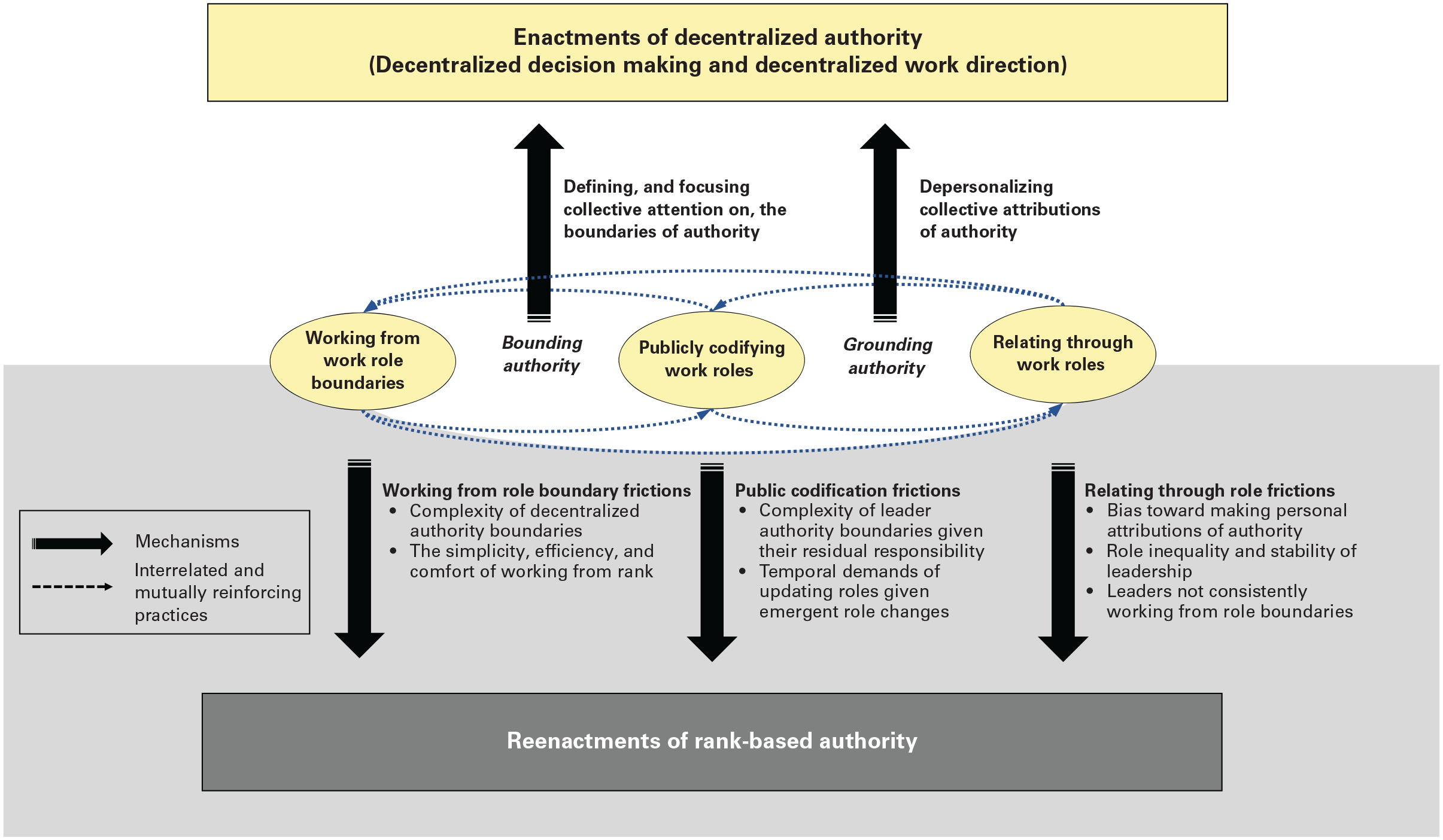
Model of Organizational Practices That Support Enactments of Decentralized Authority and Their Limits
The practices of publicly codifying work roles and then working from work role boundaries collectively define and focus collective attention on the boundaries of authority. Given the broad and diffuse nature of a superior’s authority in rank-based structures (Baker, Gibbons, and Murphy, 1999; Freeland and Zuckerman Sivan, 2018), this bounding of authority supports enactments of decentralized authority by constraining leaders while empowering workers. The practices prompt leaders to be mindful of the limits to their authority and to demonstrate self-discipline and discretion regarding when and how they exercise it. Meanwhile, the bounding of authority empowers workers by reducing the uncertainty and risk associated with enacting decentralized authority. Fear and discomfort often accompany workers’ attempts to enact decentralized authority (Argyris, 1998; Kegan, 1998; Vallas, 2006), as workers are habituated to hold implicit beliefs about the negative consequences of breaking the rules of rank-based relations (Rothschild-Whitt, 1976; Detert and Edmondson, 2011). In the absence of clear rules to the contrary, individuals often revert to rank-based patterns of behavior (Gruenfeld and Tiedens, 2010; Freeman, 2013). By demarcating the zone in which workers have unambiguous authority, the practices I identify here counteract these conservative tendencies and instill confidence in workers to move past their anxieties.
The interconnected practices of publicly codifying work roles and relating through work roles collectively ground authority in the organization, shifting the perceived source of authority from personal sources toward impersonal ones. Because authority relations in decentralized authority structures are more complex and multi-directional than those in rank-based authority structures (Kegan, 1998; Zitek and Tiedens, 2011), they have the potential to elicit more conflict over the legitimacy of an individual’s actions. By grounding authority, the practices make these potentially contentious actions seem less personal and more legitimate. Also, by locating authority in impersonal roles that anyone could fill, these practices support the demystification of leaders’ authority, making leaders’ authority more accessible and less exclusive (Rothschild-Whitt, 1979; Diefenbach, 2018). As leaders’ authority becomes subject to the same rules and limits that others experience, the sense of power distance between workers and leaders diminishes.
The model depicts the three practices as mutually reinforcing. Publicly codifying work roles served as a foundational practice that provided the base from which the practices of working from role boundaries and relating through roles could be enacted. But the relationship also operated in reverse: the more that individuals worked from role boundaries and related through roles, the more they were prompted to ensure that the codified work roles were clear and updated. The practices of working from role boundaries and relating through roles were also reciprocally supportive: when people, especially leaders, worked from roles, it enabled others to relate to them through roles. Conversely, when former managers and senior leaders exercised authority beyond their roles, relating through roles became untenable.
Together, the practices support enactments of decentralized authority through distinctly psychological mechanisms. Working from roles operates through harnessing collective attention and focusing it on the boundaries of authority and away from other considerations like status, personal interests, and politics. Relating through roles operates through shifting collective attributions of authority away from personal attributions and toward situational attributions. Given the psychological forces that condition organizing by rank, it makes sense that the enactment of decentralized authority would be supported by practices that activate and redirect organizational members’ attention and attributions.
The practices, and the mechanisms by which they operate, provide a way for organizations to decentralize authority while accommodating some degree of inequality in distributions of authority. While unequal authority typically leads organizations back toward rank-based authority structures, the practices interrupt this process in two ways: first, by setting definitive boundaries that prevent the excessive concentration of authority among leaders; and second, by transforming how authority is perceived—from being a reflection of personal traits to operating from a transparent set of rules applicable to all. This cultivates a sense of mutual respect and equal treatment that preserves decentralized relations even as some hold more authority than others.
The model also depicts the specific frictions that make consistent engagement in the practices difficult to sustain. Each practice is vulnerable to countervailing pressures that can lead to breakdowns and to reenactments of rank-based authority. Both the practices of publicly codifying work roles and working from work role boundaries are difficult to continuously enact because of the complexity of the authority rules in a decentralized structure. Decentralization’s complexity stems from the fact that it divides authority by domains of work rather than by people supervised, creating the potential for substantially greater jurisdictional ambiguity and conflict (Barley, 1996; Kegan, 1998), and from the fact that leaders still must hold residual responsibility (Jaques, 1996; Zuckerman, 2010) but are not granted residual authority. As a result of this complexity, publicly codifying work roles in sufficient detail so that workers can work from and relate through them is difficult and temporally demanding. Similarly, the added effort involved in working from role boundaries leads workers and leaders at times to revert to the simplicity, ease, and comfort of working from rank. Disrupting the practice of relating through work roles are the many forces pulling individuals toward making personal attributions of authority, including leadership stability, role inequality, leaders not working from their role boundaries, and the sense that making depersonalized attributions can feel unnatural and effortful, as well as cold and inhuman.
At the heart of the model sits this tension: enacting decentralized authority requires fighting against gravitational forces that pull individuals in organizations back toward enactments of rank-based authority. These forces are structural and psychological and are magnified when authority is unequally distributed. By engaging in practices that set clear boundaries around authority and that ground authority in an impersonal source, organizational members can collectively neutralize the pull toward rank-based interactions and support decentralization. However, the practices are difficult to sustain because they are cognitively, emotionally, and temporally demanding. They involve attending to a structure that is more complex than rank-based structures, and they run counter to human psychological tendencies, such as to seek out dominance complementarity (Tiedens and Fragale, 2003), to form rank orderings out of role differentiation (Correll and Ridgeway, 2003), and to make personal rather than situational attributions (Ross, 1977; Gilbert and Malone, 1995). The model proposes that meaningful progress in decentralization can be made through consistent, conscious, and collective effort but also that decentralized authority may remain a dream deferred, always in process and never fully realized.
Discussion
Implications for Theories of Decentralization
Past research on decentralization has treated successful implementations of decentralization as hinging on the organization’s ability to achieve coordination and control. According to this scholarship, reversions to hierarchy occur when coordination breakdowns occur or control is lost, prompting leaders to reclaim authority (see Baker, Gibbons, and Murphy, 1999; Foss, 2003; Burton et al., 2017; Foss and Klein, 2022). Conversely, resisting the pull back to hierarchy rests on leaders’ designing organizations to minimize interdependencies and leaders’ exercising restraint (Foss, 2003; Stea, Foss, and Foss, 2015). I have argued that because of its ontological commitments, prior research has revealed minimal understanding of how organizations can shift toward decentralization. While past studies have viewed decentralization as a static outcome imposed centrally by designers, the present research adopts a distinctive approach by conceptualizing decentralization as a dynamic process that is collectively enacted. This perspective prompts researchers to engage in the inherent messiness of efforts to decentralize authority and to attend to the microdynamics of authority as it is enacted in everyday work interactions.
Adopting this perspective, this study offers three key theoretical insights that challenge our current understanding of how organizations can shift toward decentralization. First, reversions to rank-based authority are not just initiated by leaders to restore coordination as past research has suggested. Rather, reversions are driven both from above (by leaders) and below (by workers) and occur for various reasons that are rooted in structural forces and psychological tendencies. This study underscores that regressions to rank-based authority stem not only from rational desires to maintain coordination but also from human cognitive biases and limitations, highlighting the importance of incorporating psychological theories of hierarchy’s production and reproduction into research on decentralization.
Second, this study reveals that enacting decentralization in the presence of unequal authorities involves not simply leaders’ restraint but a concerted, collective effort on the part of both leaders and workers to draw and define the boundaries of authority and to change the way people perceive and relate to one another’s authority. Effectively bounding authority at CashCo involved an ongoing collective process of role codification and attending to role boundaries that relied on the active participation of all members. In addition, the importance of bounding authority to enacting decentralization contrasts with the standard treatment of decentralization as a matter of redistributing authority down the hierarchy (Puranam, 2014; Reitzig, 2022). Simple redistribution often leaves boundaries ambiguous, allowing informal rank-based dynamics to manifest, especially in the presence of leaders with greater authority (e.g., Foss, 2003; Turco, 2016). For example, in Catherine Turco’s (2016) ethnography of a company trying to decentralize, leaders simply told workers to “use good judgment,” distributing authority but not clearly bounding it. The lack of clear authority boundaries led to workers’ confusion and continued deference to leaders. I propose that unless organizations are explicitly bounding authority, their efforts to decentralize authority will be less likely to take hold or endure.
Effectively grounding authority also involves an active collective effort by all members of an organization to adopt new frames for seeing and relating to authority and, by extension, to one another. While extant theory suggests that decentralization occurs by managers distributing their authority to willing and eager subordinates, we learn from this study that without changing how workers perceive authority, they will continue to subordinate themselves to higher-ranking alters. Unlike existing theoretical treatments of rank-based authority, which have conceptualized such authority as impersonal because it derives from one’s structural position (Weber, 1970; Pfeffer, 1981), this study reveals that leaders’ authority in rank-based structures is not experienced by workers as impersonal. Instead, workers perceive and attribute the positional authority of leaders to their personal qualities, which both mystifies this authority, rendering it inaccessible to others (Rothschild-Whitt, 1976), and leads to authority following leaders like a shadow even after it has been formally redistributed. Supporting decentralization calls for changing the basis of legitimate authority and grounding attributions of authority in a source that operates by clear and consistent rules. This rule-bound authority creates a basis for relating to one another on equal terms even in the face of unequal distributions of authority. In short, supporting decentralization requires more than leaders’ restraint; rather, it involves an active and collective effort to draw clear and visible boundaries of authority and to redirect attention and attributions in the organization, changing how individuals relate to authority and one another.
The third key insight from this study is that shifting toward decentralization is not a one-time structural change but a continuous process marked by ongoing tensions. Organizations will inevitably need to centralize authority in certain domains, such as for formulating strategy. The challenge of decentralization thus lies in supporting decentralization while judiciously allowing centralization where desired without triggering a reversion to the winner-take-all dynamics of rank-based authority. While this case reveals practices and mechanisms that can help organizations strike that delicate balance, it also reveals how the complexity of decentralization and the effort required to engage in these practices will continue to pull individuals back toward rank-based enactments. In short, shifting toward decentralization involves managing the tensions between desired decentralization and necessary centralization while resisting the constant pull toward even greater centralization. Managing these tensions is possible but involves continuous effort and a perpetual balancing act.
Contributions to Theory on Organizational Structure and Alternative Forms of Organizing
This research makes several contributions to research on organizational structure and alternative forms of organizing. First, while extant theory often conflates hierarchy with centralization (Foss, 2003; Reitzig, 2022), this research underscores that hierarchy and centralization are not synonymous. Hierarchy organizes authority by rank, yet this study demonstrates that authorities can be centralized without being sourced from rank. Centralization, instead, can stem from impersonal sources and be bounded. This distinction between rank-based centralization and role-based centralization is vital because critiques of hierarchy often focus on its winner-take-all centralization dynamics. At the same time, centralization is extolled for its ability to ensure accountability and control. My research suggests that organizations may be able to harness the functional benefits of centralization without succumbing to the pitfalls of hierarchy by selectively centralizing authority through mechanisms not governed by rank.
Second, this research reveals the importance of decoupling role formalization from hierarchy when considering alternatives to the bureaucratic hierarchy. Most descriptive accounts of alternative forms portray organizations that are minimally structured with decentralized authority and ambiguous roles. Postbureaucratic organizations exhibit “decentralized decision making” with “fuzzy” boundaries and “blurred” role differentiation (Kellogg, Orlikowski, and Yates, 2006: 23); network organizations are characterized by “vague roles and responsibilities” within which “organizational members autonomously work out relationships” (Baker, Nohria, and Eccles, 1992: 404); adhocracies have “little formalization of behavior” and “a good deal of decentralization” (Mintzberg, 1980: 337); and project-based organizations contain “decentralized teams” and an “underspecification of structure” (Lindkvist, 2004: 14). Across these streams of research, informality and lack of rules are viewed as central to decentralized organizing, part and parcel of granting greater freedom and flexibility to workers (Burns and Stalker, 1961; Hedberg, Bystrom, and Starbuck, 1976). However, this study suggests that formalization of work role boundaries can play an important facilitative role in the process of decentralization. In contrast, the lack of formalization of role boundaries was associated with reversions to rank-based authority. This finding supports the perspective that ambiguous and informal rules are often the foe, not the friend, of decentralization because in the absence of rules, informal social structures emerge that not only exhibit similar dynamics to formal rank-based structures (Diefenbach and Sillince, 2011; Freeman, 2013) but also are governed by criteria of questionable relationship to organizational efficacy, such as membership in culturally dominant subgroups (Meyers, 2011; Koppman, Bechky, and Cohen, 2022) or friendship ties (Polletta, 2012).
This finding raises the following question: how do formality and informality interact with decentralization? A systematic answer requires further research, but I speculate that while both formality and informality may be compatible with decentralization, they will tend to yield different distributions of authority and organizational dynamics. On one hand, decentralization governed by formal rules likely results in patterns of enacted authority that align more closely with organizationally relevant criteria and that minimize authority accruing to people based on social factors such as gender, ethnicity, or internal politics. Moreover, this research suggests that formality-powered decentralization, because of the presence of clear authority boundaries, will reduce the likelihood of winner-take-all authority dynamics emerging, thus fostering a more equitable distribution of authority compared to informality-powered decentralization. On the other hand, decentralization through formal rules may nurture bureaucratic formalism and lead to less social solidarity than will decentralization powered by informality. Future research should examine the different implications of decentralization governed by formal rules versus the lack of formal rules.
Third, this research bridges the gap between studies of democratic organizing and research on decentralization in organization design. Traditionally, these bodies of research have remained separate. While decentralization researchers have focused on firms that have distributed decision making but have not tried to foster egalitarian relations (e.g., Foss, 2003; Burton et al., 2017), democratic organizing researchers have studied social movement organizations and worker cooperatives in which maintaining egalitarian relations is not simply a means to an end but one of the core objectives of the organization (e.g., Rothschild-Whitt, 1976; Meyers, 2011). In addition, decentralization researchers have focused primarily on describing how decentralized firms operate and through what mechanisms they are able to foster coordination without rank-based authority (Puranam, 2014; Baldwin, 2015; Foss and Dobrajska, 2015). Democratic organizing researchers, in contrast, have focused on how such organizations can democratize relations and prevent oligarchic concentrations of power (Rothschild-Whitt, 1979; Meyers, 2011; Polletta, 2012).
Despite this study’s focus on a firm seeking to decentralize (and not trying to foster social equality), its results share similarities with the findings of recent democratic organizing research. For example, Polletta (2012) examined how twentieth-century American social movement organizations at times succeeded and at times failed to facilitate a sense of continued equality even as unequal roles threatened the democratic project. She argued that achieving this complex equality stemmed from a combination of relational forms (such as friendship or religious fellowship) that provided a basis for interacting on equal terms and formal rules that enabled the organization to centralize some authority even as it protected and institutionalized the participatory rights of all. Joan Meyers (2011), studying worker cooperatives, similarly found that formal rules that institutionally constrained further centralization were critical for maintaining egalitarian relations.
In recent democratic organizing research, the importance of rules limiting concentrations of authority and of relationships that are founded on a basis of equality echoes the mechanisms of bounding authority and grounding authority identified in my study. The similarities suggest that although decentralizing firms do not inherently aim to foster equal social relations, democratizing authority and social relations is an important and perhaps necessary means to support downward distributions of decision making and lateral coordination.
Limitations, Boundary Conditions, and Future Directions
Certain features of the case make the generalizability of these findings difficult to assess. Most notably, the study occurred at an organization that was relatively small and that encountered difficulty codifying its roles to a level that could consistently support decentralization. In larger organizations, the complexity of the decentralized authority structure and the challenges of public codification would intensify. I would expect two conditions to mitigate this challenge and make public codification possible even as organizations scale: modularity and role stability. Modularity and role stability foster uniformity and stasis of roles, reducing the need to spend time codifying and updating roles to ensure clear boundaries of authority. For example, at Valve, the computer game maker known for its decentralized structure, the modularity of team structures, in which the roles within each team remain relatively uniform and standardized, establishes clear role boundaries across the organization while incurring minimal costs in negotiating and defining them (Baldwin, 2015; Foss and Dobrajska, 2015). Similarly, when roles are standardized and stable (across an industry, for instance, as in Bechky, 2006), public codification will face less friction. I therefore expect organizational size, role stability, and modularity to operate as boundary conditions for the sustainability of the practices identified in this study.
Technology played a crucial role in facilitating the practices identified here and in easing the frictions associated with them. The use of a digital platform at CashCo brought attention and visibility to the codified roles, supporting the practices of working from and relating through roles. Anecdotal case studies of decentralized organizations suggest that technology plays an important role in supporting decentralization in numerous ways (Bernstein, Lee, and Minnaar, 2022). Yet, little empirical research has examined the role of technologies in the process of decentralization. Given the continued advancement of communication technologies and the emergence of artificial intelligence, future research should investigate the process and mechanisms by which new technological innovations can support enactments of decentralization.
This study was limited in its temporal scope, covering a period when I observed both role-based decentralized authority and rank-based authority enactments. The long-term viability of such a hybrid model—whether it can achieve a stable equilibrium or whether organizations will ultimately gravitate toward either a predominantly rank-based authority structure or a role-based decentralized authority structure—remains an open question. Future research should examine the long-term process and dynamics of decentralization adoption.
Conclusion
The longstanding dream of decentralizing authority in organizations is becoming more prominent given the changing work landscape, but scholarly views of the potential to decentralize organizations have swung between wild optimism and dark pessimism. This study offers a balanced perspective. Decentralization may never be fully achievable due to the multitude of forces, both external and internal, that pull organizations back toward rank-based relations and because some centralization will always be necessary. Nonetheless, certain organizational practices can support the emergence of more-bounded and less-personal forms of authority, which in turn can promote more-distributed patterns of authority enactments and more-equal bases for relating. As with many aspects of human life, real progress can be made in the journey of decentralizing, even if the prospect of fully departing from hierarchy may never be realized.
Supplemental Material
sj-pdf-1-asq-10.1177_00018392241257372 – Supplemental material for Enacting Decentralized Authority: The Practices and Limits of Moving Beyond Hierarchy
Supplemental material, sj-pdf-1-asq-10.1177_00018392241257372 for Enacting Decentralized Authority: The Practices and Limits of Moving Beyond Hierarchy by Michael Y. Lee in Administrative Science Quarterly
Footnotes
Acknowledgements
It took a village to write this paper. Amy Edmondson, Leslie Perlow, Teresa Amabile, Ethan Bernstein, and Jennifer Petriglieri provided invaluable support and guidance throughout the evolution of this work. Callen Anthony, Julia DiBenigno, Spencer Harrison, Arvind Karunakaran, Katherine Kellogg, Michaela Kerrissey, Wesley Koo, Melissa Mazmanian, Gianpiero Petriglieri, Melissa Valentine, Trevor Young-Hyman, Maxim Voronov, Tiona Zuzul, and members of Harvard’s Craft of Qualitative Inductive Research Seminar and INSEAD’s Inductive Brown Bag Group contributed valuable feedback on prior versions of the manuscript. Michael Pratt and three anonymous reviewers offered patient guidance and insightful feedback throughout the review process. Holly Shelton listened to my countless efforts to make sense of my data, offering her perspective and support throughout. Finally, members of CashCo welcomed me into their work lives and allowed me to learn from their experience. Their generosity brought this project to life.

1
The notion of work roles is similar to the notion of jobs as “bundles of tasks performed by employees under administrative job titles” (Cohen, 2013: 432). However, a key difference is that work roles are not usually associated one-to-one with an individual employee, whereas jobs typically are. Given that most individuals at CashCo held multiple roles after adoption of the new system, the notion of work roles in the literature matches most closely with the notion of roles in Holacracy. Therefore, I use the terms “roles” and “accountabilities” in the new system as identical to the notion of work roles and work responsibilities in these literatures.
2
Both Oren and Bryant, who initiated the shift to decentralization, gave up their titles of CEO and president, respectively, in the transition to the new system.
Author’s Biography
References
Supplementary Material
Please find the following supplemental material available below.
For Open Access articles published under a Creative Commons License, all supplemental material carries the same license as the article it is associated with.
For non-Open Access articles published, all supplemental material carries a non-exclusive license, and permission requests for re-use of supplemental material or any part of supplemental material shall be sent directly to the copyright owner as specified in the copyright notice associated with the article.
