



Abstract
What enables top management teams (TMTs) to turn trust into entrepreneurial action? This article answers this question by proposing a novel theoretical account to explain why and when trust-based relationships within TMTs create strategic benefits. Drawing on social exchange theory, we examine a moderated-mediation model that shows how: (a) TMT psychological safety mediates the effect of TMT cognitive and affective trust on corporate entrepreneurship (CE; the why) and (b) social integration within TMTs moderates this mediated effect (the when). We tested our model through a multi-wave survey of 372 TMT members in 124 established firms in Ghana. Our findings reveal that the two distinct dimensions of trust (i.e. cognitive and affective) influence CE through TMT psychological safety. Our results also demonstrate that the mediated effects are more pronounced when TMT social integration is high rather than low. Implications of these findings for theory and practice are discussed.
Keywords
Introduction
A growing body of literature highlights the critical role played by interpersonal dynamics within top management teams (TMTs) in shaping strategic outcomes, with trust emerging as a critical construct (Faherty and Clinton, 2025; Schaubroeck et al., 2011). Trust, which is defined as ‘a psychological state characterised by the willingness to accept vulnerability based on positive expectations regarding another’s intentions or behaviors’ (Rousseau et al., 1998: 395), has attracted significant scholarly attention. Within organisational contexts, trust is commonly conceptualised along its cognitive and affective dimensions (Legood et al., 2023; McAllister, 1995). Cognitive trust is grounded in rational assessments of the reliability, competency and dependability of others (McAllister, 1995; Tomlinson et al., 2020), while affective trust is rooted in emotional bonds, mutual care and interpersonal concern (Schaubroeck et al., 2011).
Extant research has affirmed the crucial role of both cognitive and affective trust (Legood et al., 2023). Cognitive trust, for instance, supports task-oriented behaviours and facilitates open communication and collaboration within teams (Tomlinson et al., 2020). Affective trust, by contrast, enhances emotional cohesion and interpersonal support, contributing to team satisfaction and cohesion (Han et al., 2019). These dimensions of trust have been found to differentially impact team and organisational outcomes (Legood et al., 2023; Schaubroeck et al., 2011).
Despite the widespread recognition of cognitive and affective trust, theoretical clarity regarding how these trust dimensions within TMTs affect strategic decision-making is far from complete. While prior research has established the importance of trust in TMT research (Faherty and Clinton, 2025; Legood et al., 2023), less is known about the mechanisms and contextual conditions through which different forms of TMT trust translate into strategic outcomes like corporate entrepreneurship (CE). We addressed this gap by theorising and empirically testing the mediating role of TMT psychological safety and the moderating effect of TMT social integration.
We draw on social exchange theory (SET; Blau, 1964) to develop a theoretical model to explain how cognitive and affective trust within TMTs influences CE. SET posits that interpersonal interactions are shaped by reciprocal exchanges, with trust acting as a catalyst that promotes cooperation, commitment and risk-taking (Cropanzano and Mitchell, 2005; Cropanzano et al., 2017), all of which are central to CE. Our findings reveal that TMT psychological safety mediates the relationship between TMT trust and CE. We assume that team-level trust perceptions help seed a shared psychological safety climate. Trust-based interactions foster openness and interpersonal risk-taking (Roussin, 2008), and trusted environments show higher collective safety (Joo et al., 2023). In TMTs, such aggregated trust plausibly enables the psychologically safe conditions that support candid exchange and CE. Additionally, we identified TMT social integration, that is, the degree to which team members share cohesive relationships and collaborate effectively toward common goals (Smith et al., 1994), as a key boundary condition. Prior research indicates that trust-related outcomes can vary as a function of context (Feitosa et al., 2020; Han et al., 2019) and that social integration may determine when trust leads to greater psychological safety and, in turn, higher levels of CE.
Our contribution to the literature is threefold. First, we clarify the distinct roles played by cognitive and affective trust in shaping CE through psychological safety. Affective trust fosters the relational foundation of psychological safety by enabling members to feel respected, supported and comfortable revealing vulnerabilities. Cognitive trust strengthens the confidence required for interpersonal risk-taking, encouraging members to voice concerns, raise unconventional ideas and challenge assumptions without fearing negative consequences. By unpacking these distinct pathways, we advance research on TMT trust in organisations (Legood et al., 2023; Schaubroeck et al., 2011) by theorising how both dimensions of trust jointly create a psychologically safe TMT environment that enables CE. Second, we offer an alternative account to the dominant assumptions that emphasise individual leader traits (Chen and Nadkarni, 2017; Chen et al., 2022) rather than team-level interpersonal processes in explaining CE. Third, we identify TMT social integration (Martin et al., 2022; Smith et al., 1994; van der Vegt et al., 2010) as a critical moderator, revealing the conditions under which cognitive and affective trust more effectively translate into CE through psychological safety. Together, these contributions offer a more comprehensive and context-sensitive understanding of how TMT trust dynamics shape CE.
Theory development
Affective and cognitive-based trust: SET
Affective- and cognitive-based trust are foundational constructs in organisational behaviour, with each offering distinct but interconnected pathways through which interpersonal dynamics influence organisational outcomes. Building on this foundation, SET, which was originally articulated by Blau (1964), frames trust as a critical mechanism that facilitates reciprocal, mutually beneficial relationships. SET views interactions in organisational settings as ongoing exchanges wherein trust enhances cooperation, commitment and reduces uncertainty (Blau, 1964; Cropanzano and Mitchell, 2005; Cropanzano et al., 2017).
Cognitive-based trust is grounded in rational evaluations and is developed through individuals’ perceptions of the reliability, competency and dependability of others (McAllister, 1995). This form of trust, which is elicited by consistent performance and predictable behaviours, enables individuals to rely on accumulated knowledge and evidence concerning their colleagues’ capabilities and integrity. Tomlinson et al. (2020) emphasised that cognitive trust is task-oriented, as it arises from observed or inferred professional competency and consistent behaviour. In organisational settings, cognitive trust is particularly salient in environments that demand technical expertise and strategic decision-making, as it enables team members to depend on one another’s professional strengths, thus reducing any perceived risks associated with uncertainty.
Conversely, affective-based trust stems from emotional connections and interpersonal relationships characterised by mutual care, empathy and emotional attachment (McAllister, 1995). This dimension of trust is cultivated through frequent social interactions, open communication, and experiences that foster genuine interpersonal concern. Affective trust promotes psychological safety, encouraging team members to express themselves without fear of negative consequences.
Although these two dimensions of trust operate differently, they are both crucial to organisational effectiveness. Cognitive trust facilitates knowledge sharing, enhances collaboration on task execution, and supports rational decision-making processes. In contrast, affective trust strengthens interpersonal relationships and emotional investment, promoting cooperation and mutual support. Given that the quality of interpersonal exchanges within organisations is heavily influenced by trust, SET provides a framework suited to interpret these findings (Blau, 1964; Cropanzano and Mitchell, 2005; Cropanzano et al., 2017). When exchanges are perceived to be fair, reliable and emotionally supportive, individuals are more likely to reciprocate positively, reinforcing organisational cohesion. However, any breaches or inconsistencies in exchanges can erode trust, leading to adverse effects on both individual and organisational performance. For example, Cropanzano et al. (2017) underscored the dynamic nature of exchanges, whereby trust shapes the expectations and responses of interacting parties.
The empirical evidence further underscores the need to distinguish between cognitive and affective trust. For example, De Jong et al. (2016) revealed significant empirical overlaps, nevertheless emphasising that cognitive trust primarily affects task-related outcomes like team effectiveness, while affective trust influences relational outcomes such as job satisfaction and organisational commitment. Legood et al. (2023) critically reviewed the literature and identified shortcomings in how these trust dimensions are operationalised. They advocated for refined measures to distinctly capture the rational and emotional elements of trust, arguing that clearer definitions are essential to the advancement of the theoretical and practical understanding of trust in organisations. To summarise, the affective and cognitive dimensions of trust act as distinct yet complementary forces that significantly shape organisational behaviour. Viewed through the lens of SET, these dimensions help explain how interpersonal relationships and evaluations influence organisational processes. Improving conceptual clarity in the study of trust remains vital for both advancing theory and informing practice.
TMT psychological safety
Psychological safety, defined as the belief shared among team members that the environment supports interpersonal risk-taking (Edmondson, 1999), enables TMTs to engage in open dialogue, raise difficult issues and challenge one another constructively. Distinct from the individual-level construct, team psychological safety ‘must characterize the team rather than individual members of the team’ (Edmondson, 1999: 354), emphasising that it reflects a collective property rather than a set of isolated perceptions. This construct has emerged as a central concept in understanding team dynamics within TMTs. Previous studies show that psychological safety helps team members to express ideas, voice concerns, admit mistakes and offer constructive criticism without fear of embarrassment, rejection or retribution (Brown and Leigh, 1996; Edmondson, 1999). Given the strategic significance of TMTs, scholars are increasingly emphasising the importance of psychological safety in enhancing team effectiveness, fostering innovation and improving strategic decision-making processes (Edmondson and Lei, 2014).
Psychological safety comprises the two primary dimensions of relational and interpersonal openness. The former refers to mutual respect and supportive interactions that make team members feel appreciated and valued (Edmondson, 1999). The latter, on the other hand, pertains to a team’s capacity and willingness to engage in candid communication that challenges assumptions, discusses sensitive issues and addresses conflict without incurring social penalties. Together, these dimensions enable a high-functioning environment marked by continuous learning and adaptability (Edmondson and Lei, 2014).
Although trust and psychological safety both involve perceptions of interpersonal vulnerability, they remain conceptually distinct and sequentially ordered. Trust concerns expectations about the intentions and reliability of specific others, whereas psychological safety reflects a shared belief that the team context allows open expression, dissent and interpersonal risk-taking without fear of negative consequences (Edmondson, 1999). Prior work shows that trust-related cues, whether rooted in leader–member relationships or in broader organisational interactions, shape individuals’ willingness to engage candidly and to test the interpersonal environment, thereby laying groundwork for a psychologically safe climate to develop (Roussin, 2008). Complementing this, empirical evidence demonstrates that when people perceive a trusting organisational environment, they are more likely to report stronger feelings of psychological safety, suggesting that trust forms part of the contextual foundation from which team-level safety emerges (Joo et al., 2023). In the TMT context, where interdependence, scrutiny of strategic thinking and exposure to high-stakes disagreement are routine, cognitive and affective trust among members thus provides the relational infrastructure necessary for psychological safety to form. Trust reduces relational uncertainty and lowers the perceived personal risk associated with surfacing concerns, sharing dissenting views or engaging in exploratory dialogue. Accordingly, TMT trust enables the emergence of a shared sense of psychological safety, which in turn supports the open exchange, collaborative problem solving and constructive risk-taking that underpin CE.
Moreover, psychological safety is highly context-dependent – it does not emerge uniformly across all teams but is shaped by factors such as team composition, power dynamics, social integration and leadership behaviours. In the TMT context, in which strategic decisions often involve conflict and ambiguity, the translation of trust into psychological safety is more likely to occur when the team environment encourages both openness and accountability.
Extending Edmondson’s (1999) team-level notion of psychological safety, we introduced TMT psychological safety as a central dynamic within TMTs (Tang et al., 2021). This construct stands apart from established interpersonal processes such as social cohesion (Smith et al., 1994), behavioural integration (Simsek et al., 2005) and conflict (Amason, 1996). Social cohesion and behavioural integration emphasise closeness and collaboration but neglect the critical element of interpersonal risk-taking. Psychological safety, by contrast, reflects a collective belief that members can voice concerns, challenge assumptions and question others without fear of reprisal (Edmondson, 1999; Tang et al., 2021). As Edmondson (1999: 354) clarified, it is ‘a sense of confidence’ that encourages candour, not ‘a careless sense of permissiveness’ or ‘unrelentingly positive affect’. This sharply contrasts with affective conflict (Amason, 1996), which highlights personal disputes, negative emotions and diminished trust. By incorporating both mutual trust and a willingness to speak up, TMT psychological safety offers a powerful framework suited to explain how top teams navigate difficult conversations, surface diverse perspectives and shape firm-level strategies. Thus, we propose that cognitive and affective trust function as enabling conditions that set the stage for, but do not guarantee, the emergence of psychological safety. This nuanced perspective enables us to contribute to ongoing debates by theorising not only on the enablers of psychological safety but also on the boundaries of its effectiveness within high-stakes, strategic contexts like CE.
Corporate entrepreneurship
CE is an essential prerequisite for firms to adapt and attain long-term survival (Boone et al., 2019; Chin et al., 2021). For instance, research has found that CE is positively associated with the profitability and growth of firms (Lee et al., 2019). Given the critical role played by CE in driving firm growth (Chin et al., 2021), it becomes essential to examine the forces that shape its development.
Given that TMT psychological safety enables members to openly raise controversial issues and challenge each other in a trusting and supportive manner for strategic decision-making, it is likely to benefit the firm’s strategy at large. Psychological safety is likely to impact the particularly critical activity of CE, which, due to the role it plays in fostering organisational adaptability, sustained competitive advantage and long-term performance, has become an essential area within the strategic management literature (Adomako et al., 2025; Chen et al., 2022; Heavey and Simsek, 2017). Broadly defined as the set of innovative initiatives, strategic renewal activities and corporate venturing undertaken by organisations (Zahra, 1996), CE positions firms to proactively navigate environmental uncertainties and dynamic market conditions.
We focus on CE driven by TMT psychological safety for two reasons. First, CE is a fundamental strategic process that involves initiating and sustaining innovative strategic renewal and corporate venturing activities aimed at achieving organisational adaptability and sustained competitive advantage (Girma Aragaw et al., 2025; Heavey and Simsek, 2017; Zahra, 1996). These entrepreneurial activities demand substantial interpersonal interactions within TMTs, which necessitate an environment conducive to open communication, mutual trust and collaboration. Psychological safety directly supports these requirements by facilitating a culture in which team members can freely articulate innovative ideas, openly debate strategic alternatives, and comfortably challenge established organisational norms without fear of negative interpersonal repercussions. Thus, the supportive and communicative nature of psychological safety significantly enhances the ability of TMTs to effectively engage in entrepreneurial processes. Second, successful CE requires the integration of ambitious, goal-oriented strategic initiatives with strong relational foundations. TMT psychological safety embodies precisely this balanced dynamic: its relational component promotes a supportive environment grounded in mutual respect and trust, while its voice-raising dimension encourages rigorous discussion, proactive feedback and critical assessment. This dual dimension uniquely positions psychological safety as an essential facilitator, enabling TMTs to effectively engage in corporate entrepreneurial activities by creating an atmosphere to enable a productive, risk-tolerant discourse essential for strategic innovation and renewal.
TMT cognitive trust and CE
Prior research suggests that cognitive trust significantly enhances individual and team performance outcomes by promoting effective collaboration, knowledge sharing and cohesive goal-oriented behaviours among employees (Kaltiainen et al., 2017). Within TMTs, cognitive trust plays a pivotal role in facilitating the strategic alignment and effective decision-making necessary CE. Consequently, we posited that TMT cognitive trust positively influences CE by (i) enhancing the effective integration and utilisation of diverse functional expertise and (ii) fostering cohesive strategic efforts to achieve organisational innovation and renewal objectives (Kaltiainen et al., 2017; Legood et al., 2023).
The literature indicates that cognitive trust emerges from clear demonstrations of competency, consistent performance, shared values and credible leadership attributes (Newman et al., 2014). Such trust motivates team members to effectively identify and seize strategic opportunities, thus enabling a proactive and entrepreneurial mindset. TMTs characterised by high cognitive trust are more adept at integrating external information, effectively leveraging their collective expertise to identify novel opportunities and strategically implement entrepreneurial initiatives (Van Doorn et al., 2017). Furthermore, cognitive trust facilitates the interdependence and collaborative knowledge sharing essential for proactive competitive behaviours, including aggressive strategic initiatives aimed at achieving superior competitive advantages (Giannikis and Nikandrou, 2013). This form of trust enhances team confidence in collective expertise, stimulating innovative thinking and enabling members to embrace the calculated risks inherent in entrepreneurial activities (Hu et al., 2021). Therefore, we hypothesised:
TMT affective trust and CE
TMT affective trust, characterised by favourable emotional attachments, genuine kindness, interpersonal care and concern among team members, significantly contributes to fostering a supportive and cohesive team environment (Feitosa et al., 2020). Emotional connections within TMTs encourage reciprocal support and facilitate meaningful social exchanges, creating conditions conducive to innovative discussions and strategic creativity (Cheung et al., 2016; Newman et al., 2014). Such affective bonds, developed through repeated managerial interactions, enhance shared beliefs and collective satisfaction among TMT members, thus fostering a robust commitment to common strategic objectives (García-Granero et al., 2018).
Moreover, affective trust serves as a unifying force that bolsters resilience and dedication within TMTs during complex and uncertain entrepreneurial initiatives (Dong et al., 2020). Emotional ties among TMT members enhance mutual support and confidence, establishing a secure atmosphere where team members feel comfortable engaging in open, genuine and candid discussions regarding entrepreneurial strategies and potential risks (Hu et al., 2021). This supportive environment encourages proactive engagement in exploring innovative ideas and constructively resolving conflicts, ultimately enhancing the effectiveness of strategic decision-making processes.
Finally, affective trust facilitates efficient conflict resolution within TMTs by encouraging collaborative, creative solutions and prompt decision-making, which are essential for successful CE activities (Adamovic et al., 2020). The emotional bonds and interpersonal care inherent in affective trust enable teams to swiftly overcome any interpersonal disagreements and maintain strategic alignment, thereby fostering a dynamic and proactive approach to CE. Thus, we hypothesised:
TMT psychological safety and CE
The successes of CE require that TMT members collaborate to genuinely share creative ideas and take calculated risks based on their knowledge and expertise (Chen et al., 2022). If they do not perceive that they are operating within a psychologically safe environment, TMT members may not express genuine opinions about CE strategies for fear of negative consequences from their colleagues (Tang et al., 2021). Thus, psychological safety is confirmed to have a direct favourable outcome on teams and firm-level achievements (Frazier et al., 2017; Lv et al., 2022; Tang et al., 2021). Additionally, team psychological safety sets up knowledge-sharing and learning opportunities suited to improve team creativity (Harvey et al., 2019). Considering the risks, uncertainties and costs characteristic of CE initiatives, TMTs must be motivated to engage in open discussions through knowledge exchange to ensure minimal risks in CE ideas for optimal success. Moreover, the mutual respect, team support and sense of security that are inherent in psychological safety (Vallabh et al., 2024) encourage constructive debates within TMTs (Coutifaris and Grant, 2022) and alleviate team conflict and intense competition (Lee et al., 2018) regarding pursuing CE opportunities. We therefore proposed that:
The mediating effect of TMT psychological safety
Cognitive trust among TMT members, which is based on confidence in each other’s competency and reliability, strengthens the quality of strategic interactions and decision-making processes (Luo and Lin, 2022). TMT members’ trust in their colleagues’ capabilities and in their intentions to act in the team’s best interest reduces their inclination to engage in defensive behaviour and enhances their willingness to engage constructively. Such a trust-based climate sets the stage for psychological safety, reflecting a shared sense that engaging in any risky interpersonal activities, such as sharing unconventional ideas or admitting mistakes, will not result in negative repercussions (Newman et al., 2017). Research shows that psychological safety emerges in environments in which team members demonstrate respect for each other’s competency and intentions (Frazier et al., 2017). Furthermore, recent studies have indicated that psychological safety significantly influences innovation-oriented behaviours, including CE by facilitating experimentation, initiative-taking and collaborative risk engagement at the executive level (Fyhn et al., 2023; Lee et al., 2023). While cognitive trust creates the conditions for these behaviours, psychological safety acts as an enabling mechanism that translates trust into action. Therefore, we hypothesised that:
Affective trust, which is built on mutual care, emotional bonds and interpersonal concern, enhances psychological safety by reducing any interpersonal fears and defensive behaviours among TMT members. When team members trust that their colleagues value and support them emotionally, they are more likely to express ideas, concerns or failures without fear of ridicule or rejection (Frazier et al., 2017; Newman et al., 2017). First, such emotional attachments stimulate informal interactions and reciprocal support (Lehmann et al., 2023), which, in turn, foster an environment in which team members feel respected and accepted, which is a key element of psychological safety. Second, this supportive climate boosts expressive behaviours, risk-taking and creativity within TMTs (Gardner and Prasad, 2022), facilitating active engagement in CE. Third, affective trust encourages the acceptance of diverse perspectives and minimises interpersonal conflict (Johnson and Avolio, 2019), further reinforcing psychological safety. As a result, TMTs become more willing to engage in collaborative strategic conversations and to utilise resources to pursue entrepreneurial initiatives (Gissel and Johnstone, 2017). Accordingly, we predicted that:
The moderating role of TMT social integration
The influence of TMT dynamics on firm behaviour is often contingent on contextual conditions (Tang et al., 2021). One such condition is social integration, reflected in the degree of informal interaction, familiarity and relational closeness developed through social events, off-site activities and ongoing unstructured exchanges (Martin et al., 2022; Smith et al., 1994; van der Vegt et al., 2010). Such interaction strengthens interpersonal understanding and fosters alignment around team goals (Torres de Oliveira et al., 2020). We argue that high levels of social integration amplify the extent to which TMT trust translates into psychological safety, thereby enhancing its indirect effect on CE. First, socially integrated TMTs engage in more frequent and meaningful interpersonal exchange, which improves members’ understanding of one another’s values, reasoning patterns and professional capabilities (Knight and Eisenkraft, 2015). These interactions provide richer opportunities to observe competence and consistency, thereby reinforcing cognitive trust. When such trust cues are repeatedly shared and validated in an integrated team, they are more likely to generalise beyond dyadic ties and support the formation of a broader psychologically safe climate. Second, higher social integration reduces relational uncertainty by increasing predictability and mutual familiarity during decision-making. When TMT members interact regularly and informally, they gain clearer insight into each other’s intentions and constraints, making trust signals easier to interpret and reciprocate. This strengthens the likelihood that both cognitive and affective trust will translate into a shared sense of interpersonal safety, thereby supporting candid discussion and exploratory behaviours necessary for CE. Third, social integration facilitates the emergence of shared norms and expectations that govern how dissent, risk-taking and interpersonal disagreement are handled. Informal interactions help reinforce norms of openness and respectful engagement, which allows trust to be enacted in ways that reinforce psychological safety. In highly integrated TMTs, trust cues are thus more consistently interpreted as supportive, creating a reinforcing loop between trust and psychological safety. In low-integration TMTs, by contrast, trust may remain fragmented or localised, reducing its likelihood of forming a team-wide climate. Thus, we hypothesised:
Social integration also plays a crucial role in strengthening affective trust within TMTs. Frequent informal interaction deepens interpersonal familiarity, encourages personal disclosure and helps form emotional bonds, which contribute to the development of affective trust (Richter et al., 2021). Such informal engagement, free from immediate task pressures, allows TMT members to express genuine opinions and exchange experiences more openly (Torres de Oliveira et al., 2020). Socially integrated teams also tend to develop a stronger sense of shared identity and loyalty (Smith et al., 1994), making members more committed to collective goals and more willing to support one another’s entrepreneurial ideas. These affective relationships, in turn, help sustain a psychologically safe climate conducive to innovation-oriented discussions and joint problem-solving. Accordingly, we argued:
Method
Study setting, sample and data collection
We chose Ghana as the context to test our hypotheses for three reasons. First, it is an emerging economy with a growing entrepreneurial ecosystem (Adomako et al., 2023), which made it ideal for our study of CE. Second, the country is increasingly the target of foreign investment (Benfratello et al., 2025), which intensifies the strategic role played by TMTs. Last, its institutional transitions provide a rich context suited to examine how trust and psychological safety influence strategic decision-making in dynamic environments.
We collected data from firms in Ghana in three waves, using a face-to-face survey approach. Our sample consists of firms from the manufacturing and service sectors in the Association of Ghana Industries (AGI) database. We piloted our survey questionnaire on a sample of 10 TMTs (excluded from the final sample) and incorporated their feedback to improve face validity and ensure that all questions were free from ambiguity. The data collection process involved several steps. First, we compiled a list of all the pertinent firms located in major cities in Ghana. We then applied the following criteria to select 250 of them: firms with at least 5 years of business experience to ensure organisational maturity; firms with a minimum of three TMT members to capture team-level dynamics; and firms with complete contact information of the CEO to facilitate the data collection and ensure the reliable identification of the firm leadership and team structures. Out of the 250 CEOs we contacted, 205 agreed to participate in the study. One of the authors personally arranged face-to-face meetings with each CEO, providing an overview of the research project, expectations for top executive participation, and assurances of confidentiality. The CEOs were asked to identify their TMT members and to send them a memo encouraging participation (Chin et al., 2021). Following this designated approach, we reached out to the TMTs to complete the survey (Boone et al., 2019; De Massis et al., 2021). This process involved either the human resource managers or the CEOs’ assistants collecting the completed survey questionnaires from the CEOs and TMT members. The surveys were collected in sealed envelopes devoid of any personal identifiers to ensure confidentiality (Chen et al., 2022; Van Doorn et al., 2017). To leverage this advantage, we hired three research assistants, one for each city, to assist with the data collection. The research assistants hand-delivered the questionnaires and collected the completed responses from the human resource managers or the CEOs’ assistants.
We collected the data across three different time periods from different informants. Our use of a time-lagged, multi-source design helped mitigate concerns about common-method variance (CMV; Podsakoff et al., 2012).
At time T1, the CEOs and TMT members answered questions pertaining to cognitive and affective trust, social integration within their respective TMTs, and details about their respective firms’ characteristics, business environment, past performance and slack resources. Four weeks later, at Time T2, they reported on their psychological safety perceptions. Finally, 6 weeks later, at Time T3, the CEOs answered questions related to their respective firms’ CE.
Ultimately, we included in our final sample only those firms for which we had received responses from the CEOs and at least two TMT members (Colbert et al., 2008). This criterion yielded a final sample of 372 TMT members from 124 firms. Our 63.49% response rate exceeded the 12%–14% response rates typically reported in previous TMT survey studies (Chen and Nadkarni, 2017; Chen et al., 2022). We were able to achieve this high response rate thanks to the official support of the AGI officers, whose personal relationships with the CEOs contributed to their participation.
Measures
Unless otherwise stated, we measured all the multi-item constructs on a 7-point Likert scale ranging from 1 = strongly disagree to 7 = strongly agree.
TMT cognitive and affective trust
We measured TMT cognitive and affective trust by means of, respectively, six and five items (McAllister, 1995) that, for their strong reliability and validity of findings, have been widely utilised in trust research (Legood et al., 2023). Consistent with prior research (García-Granero et al., 2018; Newman et al., 2016), our sample TMT members rated their trust in their colleagues. We found the team-level Cronbach alphas to be 0.91 and 0.87, respectively. When we checked for aggregation of the individual TMT cognitive trust scale at the TMT level, we found acceptable values: ICC(1) = 0.77, ICC(2) = 0.91, rwg(j) = 0.93; F = 10.93. We also found acceptable values for the aggregation of the individual TMT affective trust scales at the TMT level: ICC(1) = 0.87, ICC(2) = 0.95, rwg(j) = 0.94; F = 21.50. This justified our aggregation of the TMT cognitive and affective trust responses.
TMT psychological safety
We assessed TMT psychological safety by means of a 7-item scale developed by Edmondson (1999), which has been established to be robust (Greenbaum et al., 2020). We found the Cronbach’s alpha at the team level to be 0.90. Our checks for scale aggregation yielded acceptable values: ICC(1) = 0.84, ICC(2) = 0.94, rwg(j) = 0.96; F = 17.32. Thus, we averaged the TMT members’ responses to derive our TMT psychological safety scores.
Corporate entrepreneurship
To assess each sample firm’s actual innovation, venturing and strategic-renewal activities (Lee et al., 2019; Ling et al., 2008), we measured CE by utilising the widely validated 16-item scale developed by Zahra (1996). This assessment, which involved only the CEOs of our sample firms, yielded a Cronbach’s alpha of 0.89.
TMT social integration
We measured TMT social integration by means of a 9-item scale developed by Smith et al. (1994), which was rated by both our sample firms’ CEOs and TMT members. We found the team-level Cronbach’s alpha to be 0.90, with checks for aggregation of the scale showing acceptable values: ICC(1) = 0.75, ICC(2) = 0.90, rwg(j) = 0.95; F = 10.07. Accordingly, we aggregated the individual TMT responses to derive the TMT social integration scores.
Controls
We used several control variables reflecting industry level, firm level, TMT level and CEO level demographic variables. A firm’s CE has been shown to be influenced by the industry in which it operates (Ling et al., 2008). Thus, we controlled for industry sector by means of a dummy variable (0 = manufacturing; 1 = service), wherein ‘service’ included wholesale/retail, banking, insurance and technology industries. We controlled for firm age, firm size and past firm-level performance as these factors can significantly affect strategic pursuits (Ling et al., 2008). Our respondents rated their respective firms’ past performance on a five-item scale (i.e. revenue growth, net income, productivity, return on sales and return on assets) using a 7-point Likert scale ranging from 1 = ‘far below average’ to 7 = ‘far above average’. Likewise, we included four TMT demographics as controls: TMT size, TMT member age, gender and educational level (i.e. high school, higher national diploma, bachelor or postgraduate). Research has demonstrated the influence of these factors on TMT responses to strategic pursuits (Ling et al., 2008; Tang et al., 2021). We controlled for TMT gender using dummy variables (1 = male; 2 = female). As research confirms its diverse impact on firm outcomes, we also controlled for CEO tenure (Allgood and Farrell, 2000; Darouichi et al., 2021). Furthermore, we controlled for firm slack resources, the extent and efficient use of which empowered them to promote innovative initiatives (Simsek et al., 2007). TMT members rated the magnitude of their respective firms’ slack resources on a four-item scale developed by Simsek et al. (2007). We found the Cronbach’s alpha to be 0.82. Finally, we controlled for environmental dynamism, which captures the unpredictability of those external factors that affect a firm’s strategic decision-making processes (Zhang et al., 2021). Accordingly, the TMTs rated the extent of their respective firms’ environmental dynamism on a four-item scale developed by Waldman et al. (2001). We found the Cronbach’s alpha to be 0.91. We assessed the presence of any nonresponse bias by performing an independent sample t-test to compare the means of the firm size (t = 0.430, n.s.), firm age (t = −0.635, n.s.) and TMT size (t = 1.916, n.s.) control variables between the respondent and non-respondent populations. As we did not find any significant statistical differences, we confirmed the absence of any issues related to nonresponse bias.
Reliability and construct validity
We assessed construct reliability and validity (Supplemental Appendix Table A1), and all constructs demonstrated acceptable reliability, with Cronbach’s α values exceeding the recommended threshold of 0.70 (Cronbach, 1951; Nunnally, 1978). The CFA results indicated that the hypothesised measurement model fit the data well (χ2 = 1727.76, df = 939, χ2/df = 1.84, root mean square error of approximation (RMSEA) = 0.04, standardised root mean square residual (SRMR) = 0.06, comparative fit index (CFI) = 0.95, TLI = 0.95; Hair et al., 2013; Hu and Bentler, 1999) and all factor loadings were above 0.70, supporting convergent validity (Fornell and Larcker, 1981). To evaluate discriminant validity, we compared the four-factor model with several alternative model specifications. As shown in Table 3, the four-factor model exhibited substantially better fit than any competing model, indicating strong discriminant validity among the focal constructs. In addition, we assessed the average variance extracted (AVE) and composite reliability to test the convergent validity of the scale items. We found values above the respective recommended thresholds of 0.50 and 0.60 (Nunnally and Bernstein, 1994). We established discriminant validity by comparing the square roots of the AVE for each of the study’s main constructs with the inter-construct correlation coefficients to ensure they did not correlate with each other (Fornell and Larcker, 1981).
Common-method variance
To address potential CMV, we implemented advanced latent-variable techniques suggested by Williams and McGonagle (2016). First, we estimated a latent method–factor model in which all items loaded on both their theoretical construct and a latent CMV factor. As shown in Supplemental Appendix Table A2, adding the method factor produced virtually no improvement over the hypothesised five-factor measurement model (CFI = 0.951 vs. 0.950; RMSEA = 0.039 vs. 0.040). The changes in global fit were negligible (ΔCFI = +0.001; ΔRMSEA = −0.001), and the additional method-factor loadings were small and largely non-significant. These results indicate that any shared method variance is minimal.
Second, we conducted a CFA marker-variable analysis using the unrelated marker item ‘I like watching TV’ to partial out potential method variance. As shown in Supplemental Appendix Table A3, the marker-only model demonstrated poor fit, confirming that the marker captured a distinct, unrelated construct. When incorporated into the full measurement model, the marker factor again produced no meaningful change in model fit (CFI = 0.951; RMSEA = 0.039; ΔCFI = +0.001; ΔRMSEA = −0.001). Consistent with the latent method–factor results, the marker-factor loadings were trivial, indicating minimal method variance. These supplemental analyses align with our CFA model comparisons (Table 1), which show that the hypothesised five-factor model (χ2 = 1727.76, df = 939, χ2/df = 1.84, RMSEA = 0.04, SRMR = 0.06, CFI = 0.95, TLI = 0.95, normed fit index (NFI) = 0.91) fits the data substantially better than either the one-factor model or the single-common-method-factor model. Together, these results indicate that CMV is unlikely to threaten the validity of our findings.
Results of model comparisons.
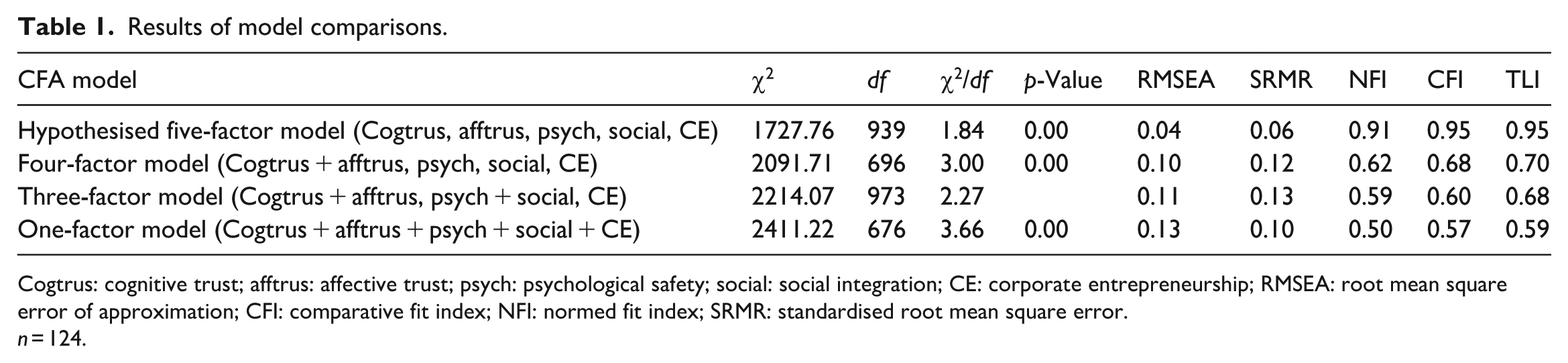
Cogtrus: cognitive trust; afftrus: affective trust; psych: psychological safety; social: social integration; CE: corporate entrepreneurship; RMSEA: root mean square error of approximation; CFI: comparative fit index; NFI: normed fit index; SRMR: standardised root mean square error.
n = 124.
Results
Table 2 shows the descriptive statistics and discriminant validity results. Table 3 presents the results of the direct relationships from the structural model. We tested our hypotheses in structural equation modeling (SEM) by utilising the maximum likelihood (ML) estimates structural model from SPSS AMOS (v29) (Cheung and Pesigan, 2023). We deemed ML in SEM to be appropriate for the main analysis of our study because of its consistent and unbiased robustness in simultaneously analysing multiple complex relationships in large samples (Lomax, 2004).
Descriptive statistics, correlations and discriminant validity results.
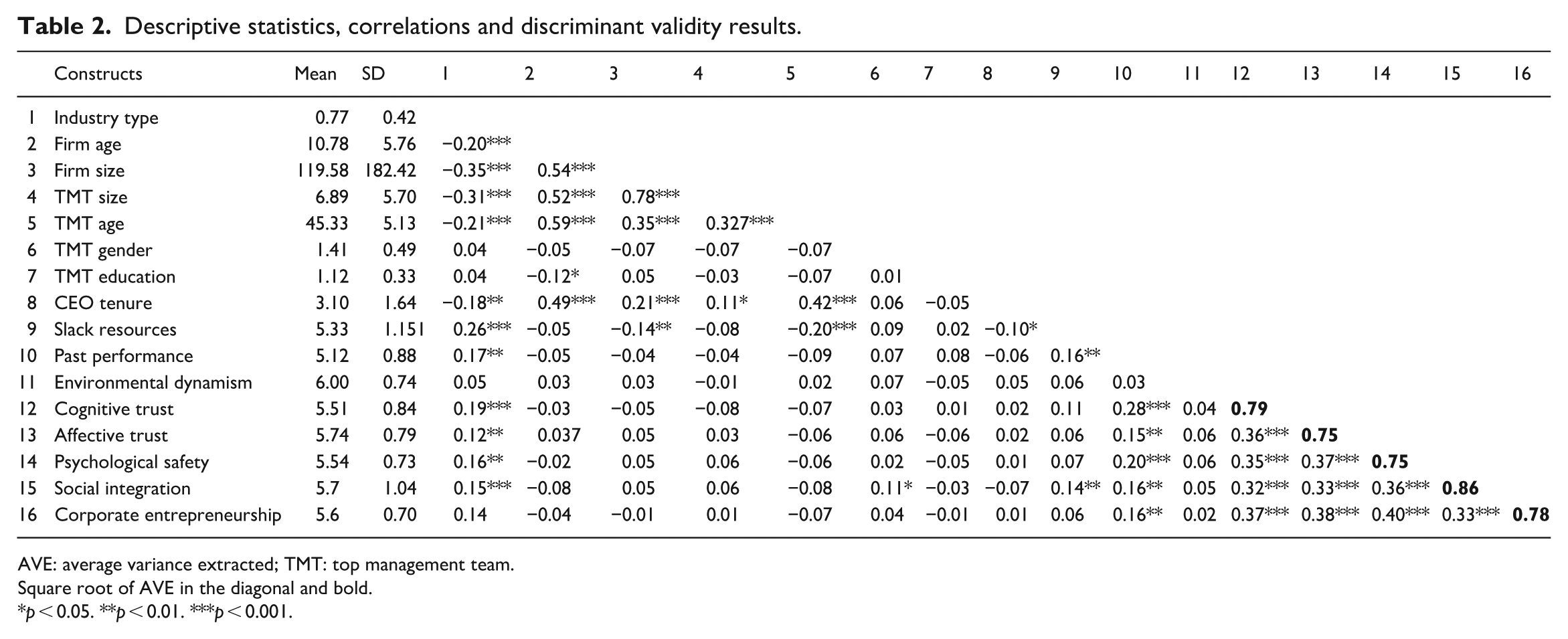
AVE: average variance extracted; TMT: top management team.
Square root of AVE in the diagonal and bold.
p < 0.05. **p < 0.01. ***p < 0.001.
Results of the direct effects.
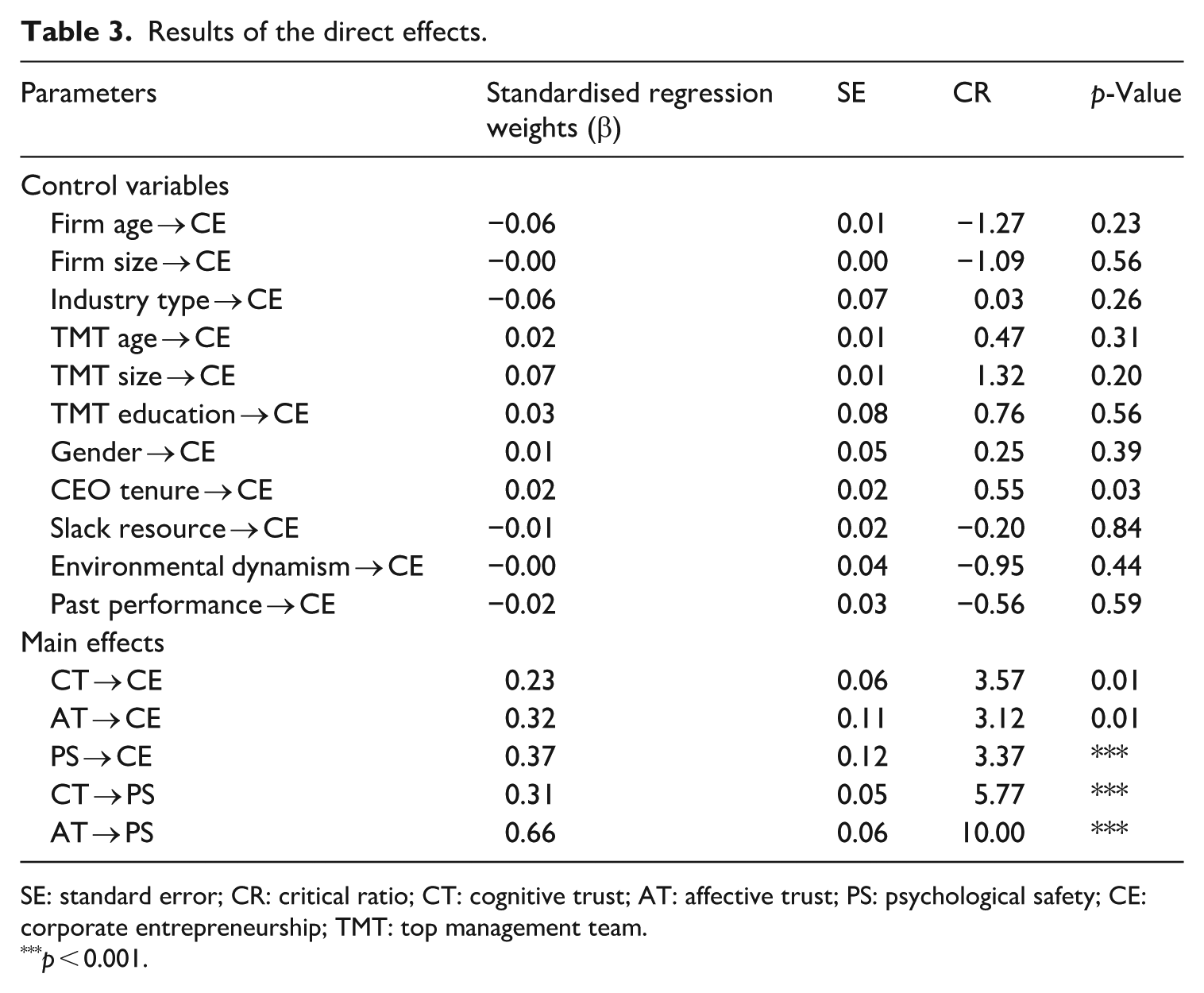
SE: standard error; CR: critical ratio; CT: cognitive trust; AT: affective trust; PS: psychological safety; CE: corporate entrepreneurship; TMT: top management team.
p < 0.001.
Direct effect hypotheses
In Hypothesis 1a, we posited a positive association between TMT cognitive trust and CE. The results of the direct effects (Table 3) support hypothesis 1a (β = 0.225, p ⩽ 0.01). In Hypothesis 1b, we proposed a positive association between TMT affective trust and CE. Our results provide support for hypothesis 1b (β = 0.317, p < 0.01). In Hypothesis 2, we argued for a positive relationship between TMT psychological safety and CE. The results provide strong support for hypothesis 2 (β = 0.373, p < 0.001).
The mediating effect of TMT psychological safety
To examine the mediation hypotheses (H3a and H3b), we performed the three-step mediation approach advanced by Baron and Kenny (1986). In addition, we examined the significance of the indirect effects using the PROCESS macro by using the bias-corrected bootstrapping test proposed by Preacher et al. (2007). Mediation would be supported if the bootstrapping results were to be found to indicate that the 95% confidence interval (CI) did not include zero.
First, we assessed the direct effect of the independent variables (cognitive and affective trust) on the dependent one (i.e. CE). Second, we examined the influence of the independent variables on the mediating one (psychological safety). Third, we analysed the effect of the mediating variable on the dependent one. Full mediation would have been supported had the second and third relationships been found to be significant, and the direct relationship between the independent and dependent variables not been supported. Had all three relationships been found to be significant, partial mediation would have been established (Chen and Nadkarni, 2017; Chen et al., 2014).
In Hypothesis 3a, we had posited that TMT psychological safety mediates the positive relationship between TMT cognitive trust and CE. The results (Table 4) were found to indicate a positive and significant mediated relationship (β = 0.341; p < 0.001; CI = 0.209, 0.483). This interaction was further proven to be a partial mediation by the significant relationship found between the independent variable (TMT cognitive trust) and the dependent one after the mediation process (β = 0.217; p < 0.05). Furthermore, the bootstrapping results (Preacher et al., 2007) were found to confirm the positive statistical significance of the indirect effect of TMT psychological safety (β = 0.372; 95% CI = 0.291, 0.443). Therefore, H3a was supported.
Results of the mediation effects.
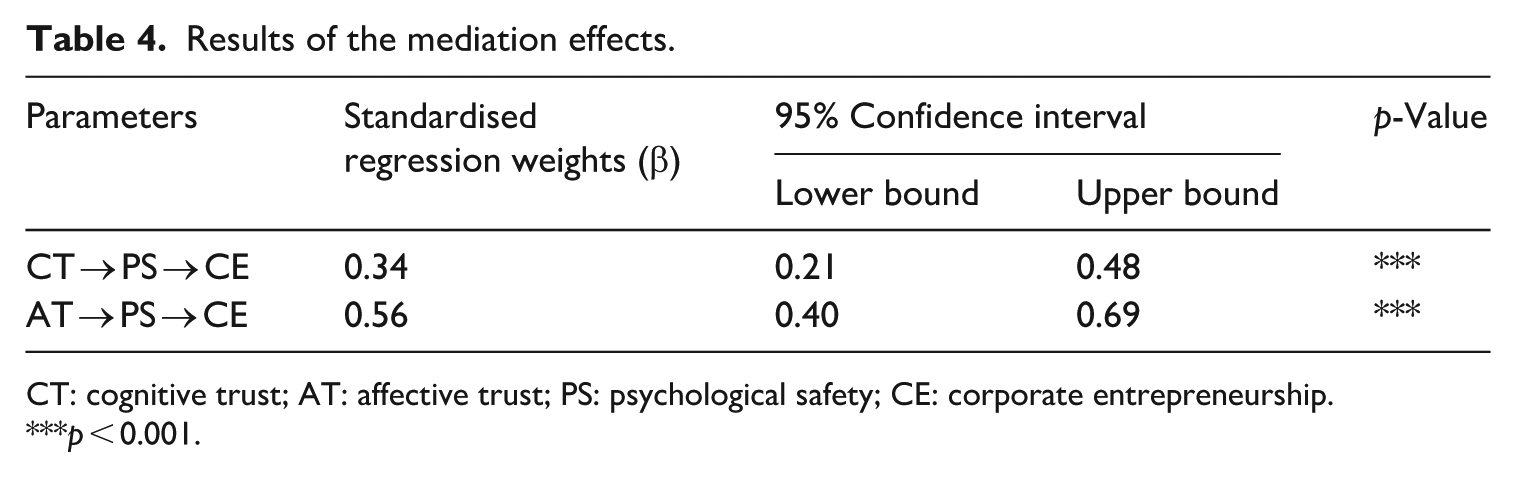
CT: cognitive trust; AT: affective trust; PS: psychological safety; CE: corporate entrepreneurship.
p < 0.001.
In Hypothesis 3b, we had argued that TMT psychological safety mediates the relationship between TMT affective trust and CE. We did find (Table 4) a positive and significant mediated relationship (β = 0.563; p < 0.001; CI = 0.404, 0.698), supporting H3b. The interaction confirmed the presence of partial mediation as we found a significant relationship between the independent variable (TMT affective trust) and the dependent variable after the mediation process (β = 0.300; p < 0.05). Likewise, we found the bootstrapping results (Preacher et al., 2007) to confirm the positive statistical significance of the indirect effect of TMT psychological safety (β = 0.402; 95% CI = 0.327, 0.474).
The moderating effect of TMT social integration
We analysed the moderated mediation effect using Hayes’ PROCESS macro model 58 in SPSS to assess the conditional indirect effects of TMT cognitive and affective trust on CE through TMT psychological safety at high and low levels of TMT social integration. This approach was suited to assess the product of the coefficients and bootstrapping tests in order to examine the significance of the conditional indirect effects (Preacher et al., 2007). We mean-centred the variables in SPSS to minimise any multicollinearity issues (Chen et al., 2014). Then, we established high and low levels of TMT social integration at one standard deviation above and below its mean-centred value.
Table 5 presents the results of the moderated mediation. In Hypothesis 4a, we proposed that under conditions of high social integration, TMT cognitive trust would have a greater positive indirect effect on CE through psychological safety. We found that a negative and significant interaction effect between cognitive trust and social integration on psychological safety (β = −0.167; p < 0.001). In addition, we found the effect to be stronger and more significant at low levels of TMT social integration (β = 0.316; CI = 0.258, 0.383) than at high levels (β = 0.073; CI = 0.015, 0.145). Thus, we did not find support for H4a.
Moderated mediation results of TMT cognitive and affective trust on CE through TMT psychological safety at different levels of social integration.
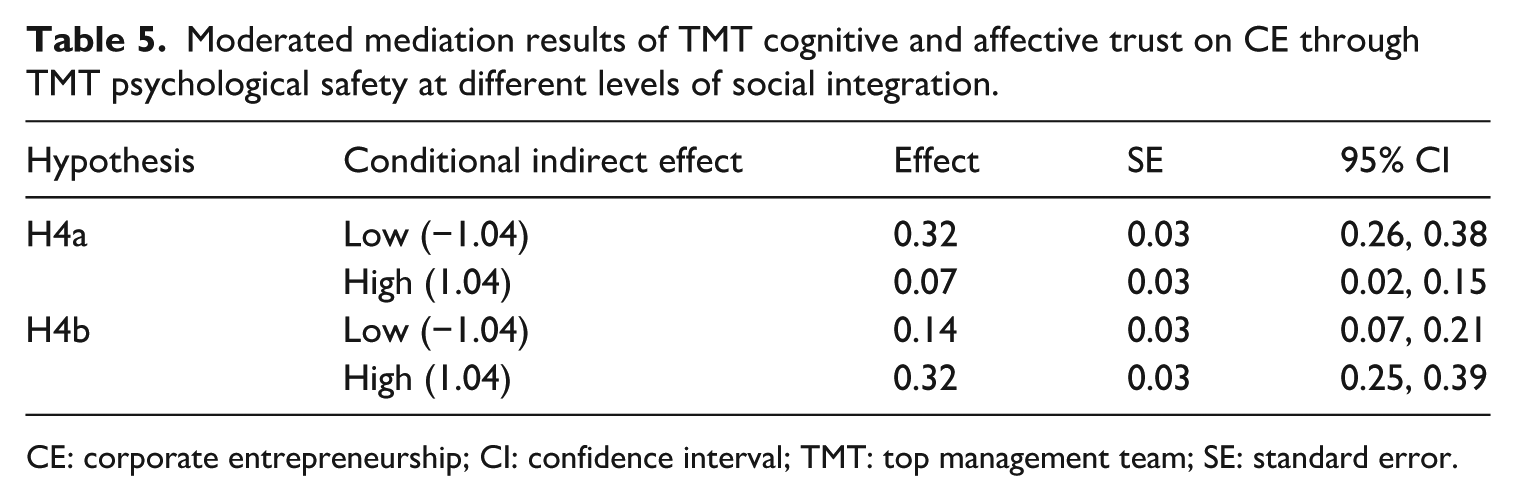
CE: corporate entrepreneurship; CI: confidence interval; TMT: top management team; SE: standard error.
Finally, in Hypothesis 4b, we contended that, under conditions of high social integration, TMT affective trust has a greater positive indirect effect on CE through psychological safety. Table 5 presents the moderated mediation bootstrapping results for TMT cognitive and affective trust at different levels of TMT social integration. Our analysis found a positive and significant interaction effect between affective trust and social integration on psychological safety (β = 0.099; p < 0.001). Furthermore, we found the effect to be stronger and more significant at high levels of TMT social integration (β = 0.319; CI = 0.251, 0.390) than at low levels (β = 0.136; CI = 0.071, 0.209). Accordingly, we found support for Hypothesis 4b. We acknowledge that the coefficient of the interaction term alone does not confirm our moderation hypotheses, as the direction of interaction effects requires graphical examination (Hoetker, 2007). Therefore, to aid interpretation, we plotted the interactions at one standard deviation above and below using mean-centred values (Cohen et al., 2013). Figure 1 presents a plot of the interaction effect of H4b.
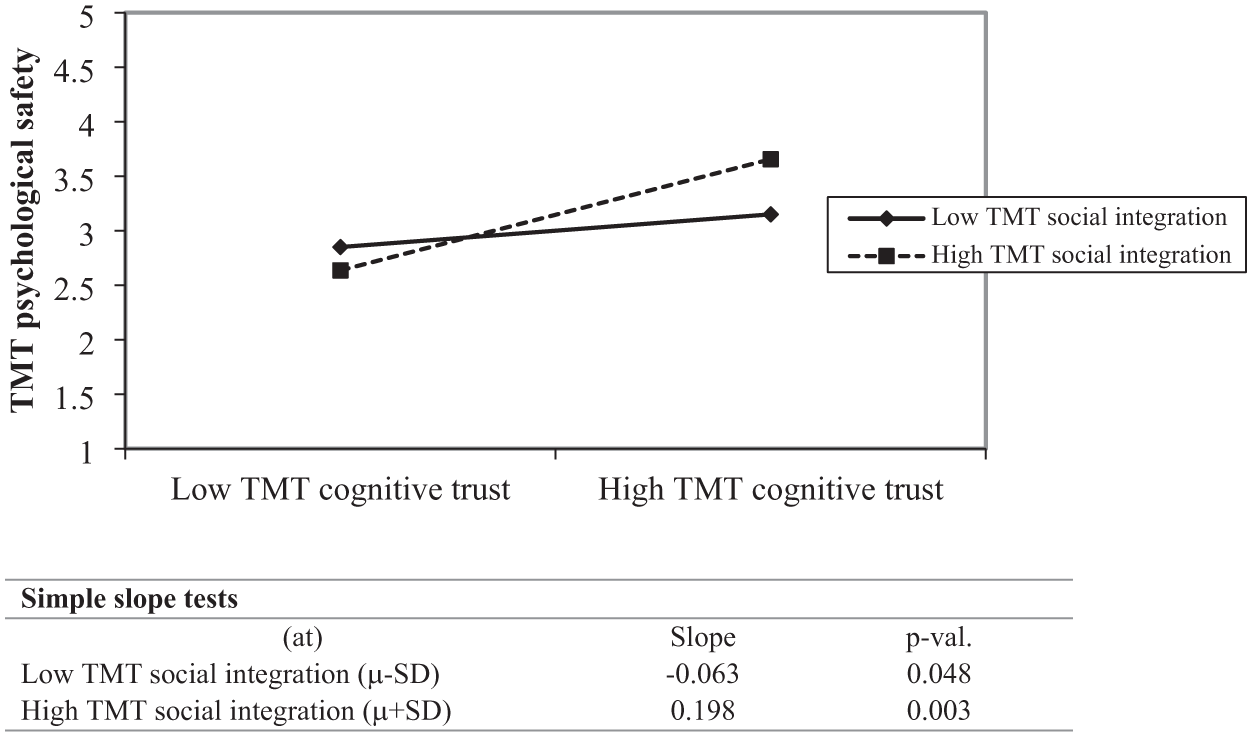
Interaction effect of affective trust and social integration on psychological safety.
Discussion and implications
Our study offers a nuanced theoretical explanation for why and when cognitive and affective trust among TMTs translates into strategic advantages through CE. Drawing from SET (Blau, 1964), we developed and tested a moderated-mediation model demonstrating that psychological safety mediates the relationships between both the cognitive and affective dimensions of TMT trust and CE. Furthermore, we identified TMT social integration as a critical boundary condition moderating these mediated relationships. Our findings enrich SET by showing how trust-based interactions among TMT members contribute to the emergence of a shared psychological safety climate. By emphasising how relational cues consolidate into collective perceptions, we clarify how SET explains the formation of team-level conditions that facilitate CE in TMT contexts.
Implications for theory
First, our findings contribute to the trust literature by clearly distinguishing between cognitive and affective trust within TMT contexts, thus directly responding to the recent calls made for greater theoretical clarity and empirical differentiation in trust research (Legood et al., 2023). While prior studies have often conceptualised trust as a unidimensional construct or have inadequately distinguished between its cognitive and affective components (De Jong et al., 2016), our research affirms the distinctiveness of these two dimensions, each of which has unique strategic implications. We argue that trust within the TMT initiates positive exchange cycles characterised by mutual respect and support, which evolve into a climate of psychological safety. This safety, in turn, enables discretionary behaviours, such as experimentation and initiative-taking, that are core to CE. Thus, we contribute to SET by showing how individual-level relational exchanges (trust) aggregate into a team-level climate (psychological safety) that facilitates high-order strategic outcomes.
Second, by positioning psychological safety as a core mediating mechanism, our study offers novel insights into the psychological processes linking TMT trust and CE. Although psychological safety has long been recognised as a critical foundation for firm ambidextrous strategic orientation (Tang et al., 2021), its strategic relevance at the TMT level has received comparatively less attention. Our findings fill this gap by demonstrating that psychological safety, activated through differentiated trust, creates a collective psychological environment in which TMT members feel safe to share unconventional ideas, challenge prevailing norms and engage in constructive dissent. This mediating role played by psychological safety reframes it not merely as a product of leadership style or individual disposition, but as a dynamic team-level condition shaped by trust-based interpersonal dynamics within senior leadership groups.
Third, our study introduces social integration (Martin et al., 2022; Smith et al., 1994; van der Vegt et al., 2010) as a critical moderating variable that conditions the strength of the indirect relationships between trust, psychological safety and CE. We found that the mediated effects of cognitive and affective trust on entrepreneurial behaviour via psychological safety are significantly amplified under high levels of social integration. This implies that social integration enhances a team’s capacity to leverage psychological safety toward entrepreneurial outcomes. TMTs characterised by strong social integration are therefore better positioned to translate trust and psychological safety into impactful entrepreneurial action. However, while prior research has suggested that social integration can enhance trust-based collaboration and knowledge sharing (Knight and Eisenkraft, 2015), our findings may indicate that cognitive trust alone may already suffice to elicit psychological safety, even in the absence of high levels of social integration. This is in line with the view that, in professionalised TMTs, task-related trust may operate independently of informal relational ties (Gibson and Gibbs, 2006).
Implications for practice
Our research provides valuable implications for leaders and organisations aiming to foster CE. Leaders should prioritise the development of both the cognitive and affective dimensions of trust within their senior executive teams, recognising that each dimension contributes distinctly yet complementarily to strategic effectiveness. Specifically, organisations should actively invest in building dependable, competent leadership that enhances cognitive trust while simultaneously nurturing environments that promote emotional bonding and mutual care in order to strengthen affective trust. Moreover, organisations should deliberately facilitate the establishment of conditions suited to encouraging psychological safety through leadership behaviours that support openness, respect diverse opinions and value constructive feedback. Moreover, organisations should acknowledge and actively cultivate TMT social integration by designing and implementing team-building initiatives, creating collaborative platforms, and embedding practices suited to enhance interpersonal relationships and communication among senior executives.
For TMTs operating in emerging economies such as Ghana, where institutional uncertainty heightens the interpersonal risks of strategic decision-making, our findings offer actionable guidance. Firms can implement structured team-building activities, cross-functional retreats or informal knowledge-sharing sessions to strengthen social integration and build trust. Leaders can also cultivate psychological safety through open-agenda meetings, routine reflection sessions and explicit norm-setting that encourages constructive dissent. These practices make trust more observable, support a shared sense of safety and enable TMTs to pursue entrepreneurial opportunities more confidently.
Limitations and future research
As with all empirical research, this study has several limitations that offer valuable avenues for future inquiry. First, in terms of context, our empirical setting was limited to Ghana, a sub-Saharan African country characterised by institutional transitions and increasing foreign investment (Adomako et al., 2021; Ahsan et al., 2021). While this context was suited to provide important insights into CE in emerging economies, our findings may not be generalisable to other regions with different cultural, institutional or economic environments. Future research could thus replicate our study across other developing and underdeveloped economies in order to enable cross-country comparisons and test the robustness of our model in varying institutional settings.
Second, from a methodological standpoint, our reliance on a cross-sectional, time-lagged survey design was not immune to concerns related to potential common method bias (Podsakoff et al., 2012) and causality issues (Antonakis et al., 2010). In addition, the CEO self-reports we used to measure CE may raise objectivity concerns. Future studies should thus consider adopting longitudinal designs, triangulating data from multiple TMT members or departments and incorporating secondary data sources to enhance the reliability and temporal validity of their findings.
Third, from the theoretical standpoint, while we examined psychological safety as a key mediator and social integration as a moderator in the trust–entrepreneurship relationship, we recognise that other mechanisms may also play significant roles. For example, constructs such as TMT problem-solving capability, conflict management and decision-making speed may offer alternative or complementary explanations and could be explored in future research. Furthermore, although we theorised a pathway from TMT trust to psychological safety, we acknowledge the conceptual proximity of these constructs. Future work could test alternative models or incorporate additional theoretical frameworks (e.g. social information processing theory) to provide a more nuanced understanding of trust dynamics in executive teams.
Fourth, we did not collect any data on TMT behavioural integration (Chen et al., 2022; Simsek et al., 2005), which has been identified as an important factor influencing strategic outcomes. This omission limited our ability to fully capture the interplay among TMT processes. We acknowledge this as a limitation and recommend that future research include behavioural integration as a control or mediator to better isolate the effects of trust and CEO behaviours on CE.
Finally, while our study was focused on TMT-level dynamics, we recognise that trust processes also operate at other organisational levels. Future studies could thus examine how trust among broader employee groups or across vertical levels affects innovation and entrepreneurial behaviour, contributing to a more multilevel perspective of CE.
Supplemental Material
sj-pdf-1-hum-10.1177_00187267261430254 – Supplemental material for TMT cognitive and affective trust, psychological safety and corporate entrepreneurship
Supplemental material, sj-pdf-1-hum-10.1177_00187267261430254 for TMT cognitive and affective trust, psychological safety and corporate entrepreneurship by Shirley Maud Acheampong, Samuel Adomako and Shlomo Tarba in Human Relations
Footnotes
Funding
The authors received no financial support for the research, authorship, and/or publication of this article.
AI usage declaration
The authors acknowledge that they have followed Human Relations’ AI policy. Accordingly, AI was used only for copy editing or proofing the manuscript.

Supplemental material
Supplemental material for this article is available online.
References
Supplementary Material
Please find the following supplemental material available below.
For Open Access articles published under a Creative Commons License, all supplemental material carries the same license as the article it is associated with.
For non-Open Access articles published, all supplemental material carries a non-exclusive license, and permission requests for re-use of supplemental material or any part of supplemental material shall be sent directly to the copyright owner as specified in the copyright notice associated with the article.
