




Abstract
We adopt a visual methods approach, in conjunction with an interview-based study, to investigate the identity work of creative workers who sell their services remotely as online freelancers via gig economy platforms. Based on visual self-portrayals elicited from 53 remote gig workers, including illustrators, animators and graphic designers, and their subsequent verbal reflections on these images, our study elucidates the generative power of visual images for gaining insights into identity work, especially in non-traditional work contexts facilitated by digital technologies. We distinguish key identity work strategies that remote gig workers use to construct their identities in relation to idealized, publicly available and free-floating imaginaries of platform labour. These strategies ranged from fully embracing such imaginaries to their vehement rejection, as well as strategies aimed at maintaining a balance between these extremes. Besides the embodied, sensorial intensities and imaginative projections underpinning such identity construction in the gig economy, our analysis foregrounds also the spatial aspects of identity work. Theoretically, we propose a redefinition of identity work as a multimodal accomplishment rather than exclusively a narrative one to better explain the elusive and contradictory aspects of identity work, including its affective and spatial character.
Keywords
Introduction
A surge in scholarship on identity work in recent decades (Brown, 2022) has yielded valuable insights into the processes whereby individuals actively engage in self-reflection, interpretation and strategic action aimed at constructing, maintaining, transforming and/or repairing coherent, stable and positive identities (Sveningsson and Alvesson, 2003). Such identity work processes have typically been researched through narrative and discursive approaches that treat the construction of identities as a narrative accomplishment.
Through this lens, an individual’s narrative and discursive construction of identities is seen as dialogically intertwined with an organization’s identity – that is, with what is interpreted as distinctive and enduring about that organization (Alvesson and Willmott, 2002). As such, it has become virtually de rigueur for studies of identity work to explore how employees tell ‘identity stories’ (Brown, 2015: 27) and engage in ‘identity talk’ (Brown and Coupland, 2015: 1316) to grapple with the question of ‘who am I in relation to this organization?’ (Bednar et al., 2020: 202). Given the importance of organizational discourses in relation to identity work, efforts to address this research question have focused predominantly on workplaces known to impose strict and strategically well-elaborated identity regulation and normative control over their employees, including banks and other financial institutions (Alvesson and Robertson, 2016; Frandsen et al., 2024), management consultancies (Costas and Kärreman, 2016) and military regiments (Thornborrow and Brown, 2009).
With the rapid increase in contractual work (Barley and Kunda, 2004) and boundaryless careers (Arthur, 2008) that entail frequent transitions between organizations (Ibarra and Obodaru, 2016), however, an increasing number of scholars have turned their focus onto the practices of talk with which people narratively craft ‘provisional’, ‘mobile’ and ‘agile’ identities that can endure deployment across multiple organizations (Ahuja et al., 2019; Gill and Burrow, 2018) and work-role transitions (Ibarra and Barbulescu, 2010). Among these studies, we can discern a growing acknowledgement that workers often forge identities in connection to a set of ideologies, values and norms that discursively underlie a particular profession. This is most obviously the case in professions associated with strong occupational self-identification, especially those with strict and arduous certification requirements. Identity work in these contexts has been found to entail connecting external discursive framings of ‘social identities’ with internal ‘self-identities’, and the ensuing self-narratives (Watson, 2008). In such contexts, workers author self-narratives to answer the question of ‘who am I?’ in relation to the discursive construction of an appropriate, desirable and even ideal member of a certain profession, such as a priest (Kreiner et al., 2009) or an airline pilot (Ashcraft, 2005).
However, the rapid rise of the gig economy challenges such dominant approaches to identity work. By facilitating job arrangements directly with clients, gig economy platforms impel workers to actively seek employment outside the confines of traditional organizational structures while imposing no professional or occupational entry barriers (Wood et al., 2019). Gig economy platforms have therefore intensified the degree and scope of contractual work and boundaryless careers (Caza et al., 2022) and have diminished the supremacy of both traditional organizations and occupational ideologies (Gandini, 2019), all of which pose distinct and complex challenges for the formation of stable and coherent work identities. These challenges arise in large part because the visibility and matching of gig workers with clients via platforms are executed primarily through complex and often opaque technological systems that exercise a data-driven form of labour control known as ‘algorithmic management’. This determines the likelihood of workers succeeding or failing to secure the kinds of gigs and rates of pay they need or desire (Rahman, 2021; Tirapani and Willmott, 2023).
At the same time, operating outside of established material (spatial) organizational environments, gig workers lack well-delineated institutional frameworks to regulate their identity work (Anicich, 2022; Petriglieri et al., 2019). Worker–employer relations barely exist in platform labour (Rahman, 2021). Occupational ideologies that once pertained to many professions are fast becoming dispersed, along with the wider trend of waning labour market regulation (Gandini, 2019). Indeed, platforms strategically refrain from explicitly regulating the identity work of their workforces, not least because it serves platform-owners’ interests to profile gig workers as ‘independent contractors’ rather than as ‘employees’ (Anicich, 2022).
When neither organizations nor occupations hold a strong sway over identity work, but complex and often opaque software systems do how do gig workers go about crafting their identities? This article seeks to answer precisely this question. We examine how remote platform-based gig workers – those workers delivering their work remotely over the internet via a gig economy platform – construct their identities. In contrast to previous studies of identity work that prioritized verbal narration, discursive construction and storytelling (Brown, 2022; Ibarra and Obodaru, 2016), our study adopts visual methods. It, therefore, includes the elicitation of both visual self-presentations and verbal self-interpretations of visual self-portraits, from 53 freelance creative workers, including animators, illustrators and graphic designers who sell their labour to clients on global gig economy platforms.
By challenging the predominance of narrative and discursive approaches to identity work, our study aligns with the ‘visual turn’ in organization studies (Boxenbaum et al., 2018). Although such a turn indicates a surge of interest in visuality within organization studies more generally (Bell and Davison, 2013; Meyer et al., 2013, 2018), identity work studies have been reluctant to engage with visual images and visual methods (Shortt, 2015; Shortt and Warren, 2019) Therefore, we know relatively little about how identity work is shaped not only by language, talk, discourses and verbal accounts but also visual images. We argue that narrative and discursive approaches alone are ill-equipped to capture the nuances and complexities of identity construction, also and particularly in the gig economy, given the important role visuality and visual self-presentation play on digital platforms (Leaver et al., 2020). In the absence of organizational and occupational templates for identity work, idealized public discourses, predominantly including glamorized pictorial and photographic representations of gig workers widely circulating across traditional and social media, are influencing how gig workers make sense of themselves and their work (Bonneau et al., 2023; Miguel et al., 2023).
In this article, we thus argue for a novel multimodal approach to, and understanding of, identity work, whereby the visual and verbal modes of identity construction are treated as complementary and even mutually reinforcing. We argue that remote platform-based gig workers grapple with the question of ‘who am I?’ in relation to the free-floating multimodal, both verbal and visual, ‘social identities’ (Watson, 2008) or ‘social imaginaries’ (Alacovska and Kärreman, 2023) of gig work that provide the resources for the construction of coherent and positive gig work identities. Based on data analysis, we show how the gig workers we studied engage in forging, negotiating and refining one or other of eight types of identities vis-a-vis idealized images of gig work: domestic, global, circular, mechanistic, animalistic, diabolic, foaming and gamified. Depending on the degree to which each participant identified with or disidentified themselves from a dominant social identity – that is, the ‘ideal images’ or imaginaries of gig work – their identity work ranged on a spectrum from literal to poetic re-interpretation of the self at work. Our analysis identifies three key strategies for pursuing multimodal, both visual and verbal, identity work vis-a-vis these ideals of gig work: embracement, balance or rejection. Such multimodal identity work strategies capture the more elusive, embodied, aesthetic, affective and spatial aspects of meaning-making with regard to the self.
Our article makes two main contributions. First, we extend current scholarship on identity work by engaging with visual methods and showcasing their usefulness for, in particular, the study of identity work in non-traditional work and organizational contexts, such as those of the gig economy. In so doing, we also respond to recent calls within management and organizational studies for greater methodological innovation and experimentation (Boxenbaum et al., 2018; Langley et al., 2023). Second, we re-conceptualize identity work from a narrative to a multimodal accomplishment.
Literature review
Identity work and verbal accounts: Narrative identity work
Irrespective of whether scholars of identity work adopt a psychodynamic (Fraher and Gabriel 2014; Petriglieri et al., 2019), dramaturgical-symbolic (Down and Reveley, 2009) or postmodern approach (Alvesson and Willmott, 2002), the single-most consistent theme to emerge from prior research is that identity work is closely intertwined with narration, rhetorical strategies and storytelling. In short, as Carroll and Levy (2010: 79) succinctly conclude, ‘identity research has consistently been associated with narrative’. Indeed, this is so much the case that Ibarra and Barbulescu (2010: 137) have, influentially, coined the catch-all term ‘narrative identity work’ to refer to people’s efforts ‘to craft self-narratives that meet a person’s identity aims’.
A shared assumption underlying these studies is that organizations possess the power to ‘control’, ‘regulate’ and even ‘manufacture’ the work identities of organization members through the imposition of discursive/narrative ‘identity templates’ (e.g. in the form of corporate mission statements and visions, socialization and professional training) and a range of ‘technologies of the self’ that include surveillance and bureaucratization. Most examinations of identity work have, accordingly, examined how employees make sense of, negotiate and shape their selves in relation to organizational identity regulation through the deployment of ‘self-narratives’ (Ibarra and Barbulescu, 2010), including in the form of fantasies and dreams (Fraher and Gabriel, 2014), internal soliloquies (Brown and Coupland, 2015) and life stories (McAdams and McLean, 2013). A common finding yielded by this approach is that employees engage in elaborate discursive strategies to narratively manoeuvre – resist, cynically re-interpret, reverse or parody – identity control to script and narratively perform a positive or preferred (meaningful, secure and stable) sense of self (Beech et al., 2016; Costas and Grey, 2014). Despite evidence of a plethora of identity work strategies, such scholarship has concluded unanimously that ‘narrative identities are authored by individuals and groups’ (Brown and Coupland, 2015: 1316, emphasis added). This insistence on understanding identity work as comprising processes of ‘self-authorship’ (Brown, 2017: 301; Fraher and Gabriel, 2014) reveals the deep-seated assumption that discourse is the principal means social actors employ to construct realities and make sense of themselves (Sveningsson and Alvesson, 2003). As such, identity work scholarship tends to proceed from the presupposition that narrative identities are formed, negotiated and restored primarily – and even exclusively – through discursive practices of talking and writing.
Problematizing these assumptions and reflecting a growing recognition in social semiotics that discourses do not exist only in the mode of language (or by that token, narratives), Kress and van Leeuwen (2001: 25) have argued that discourses ‘appear in the mode of language, among many others’, occurring and ‘articulated in’ a ‘multiplicity of practices and a multiplicity of modes’. Their study finds that while western cultures have historically been ‘monomodal’, with writing/talking dominating all other modes, ‘more recently this dominance of monomodality has begun to reverse’ (Kress and van Leeuwen 2001: 1), supplanted by the multimodal integration of both verbal and visual discourses.
Scholars of organizational identity who study the identity construction of organizations have been quick to latch onto ideas related to multimodality. For example, Meyer et al. (2018) identified the varying conditions under which the visual mode of communication outperforms the verbal mode (and vice versa) in promoting processes of institutionalization. Jancsary et al. (2018) have even advocated for viewing ‘institutions as multimodal accomplishments’, emphasizing the importance of examining how organizations generate meaning about themselves, typically through sensemaking and sense-giving processes, such as branding, marketing or annual reporting. Pursuing such an approach, Höllerer et al. (2019) have, for example, elucidated the use of logos in the post-merger identity construction of an institution of higher education. However, while the concept of multimodality has been widely embraced in studies of organizational identities, research on identity work – focusing on how individual employees or professionals construct self-identities – has not fully leveraged the potential of examining identities as multimodal accomplishments articulated through a combination of multiple modes of discursive practice. Put bluntly, identity work scholarship has so far proven somewhat ‘imagophobic’.
In treating identity work as monomodal by focusing squarely on the narrative underpinnings of identity work, scholars have nonetheless convincingly elucidated the temporal dimension of identities. Because narratives unfold in time, monomodal investigations into ‘narrative continuities’ (Brown and Coupland, 2015) have been able to show how reconstructions of the past and imaginations of the future provide the self with coherence in the present (Costas and Grey, 2014; Fraher and Gabriel, 2014; McAdams and McLean, 2013), and how such self-narrativization either evolves over the life course (Ibarra and Obodaru, 2016) or becomes entrapped in ‘perpetual liminality’ (Ybema et al., 2011).
These are valuable insights. But how much more might be revealed by complementing monomodal studies with research that taps into non-narrative identity work by having study participants draw or paint their self-portraits rather than only talk or write about their identities? Based on the premise that individuals not only ‘author’ self-narratives but also make sense of themselves and their environments visually, this question inspired the multimodal methodology we adopt in this study. Nor is this a controversial premise. After all, the urge to both (internally) visualize ideas and (externally) represent our thoughts in pictures and symbols was evolutionarily encoded in human consciousness long before the inscription of verbalization. As philosopher Bachelard (1987 [1960]) maintained, the imaginary constitutes the most primordial and universal mode of human thinking and expression; and as argued exhaustively by Durand (1999), much of whose work was devoted to contesting the devaluation of the image in western academic discourse, verbal images themselves are deeply rooted in visual images.
In sum, we hold it to be nigh-on self-evident that workers’ visual self-depictions merit exploration when investigating identity work. When it comes to studying identity construction among workers in the remote gig economy, moreover, and all the more so in the case of creative workers, we further argue that exploring such images gains additional relevance on account of the increasing importance of visuals as a means of self-expression facilitated by the advent of digital technologies (Leaver et al., 2020). On this basis, we now turn to review prior research that has used visual methods and argued their salience for exploring identity work in fields within management and organization studies.
Identity work and visual images: Towards multimodal identity work
The use of visual research and visual methods has long been a ‘blind spot’ in management and organization studies (Bell and Davison, 2013). This reticence in engaging with visual images stems in part from a long-standing preference for stochastic rationality, realist epistemologies and discursive cognition over affectivity and imagination in the study of work and organizations (Beyes and Holt, 2020). Scholars have long been reluctant to use ‘pictorial representations’ as a basis for research because of the purported non-systematicity and subjectivity of the analysis of polysemic and typically ambiguous visual representations as opposed to the exactitude of (critical) discourse analysis that has dominated studies of identity work since its inception (Bell and Davison, 2013; Langley et al., 2023; Meyer et al., 2013, 2018).
Overcoming these discipline-wide reservations, a few pioneering scholars have spearheaded the use of visual methods in organization studies, initially most notably as a way to capture people’s affective responses to large-scale organizational changes, such as the introduction of novel technical systems in the workplace (Zuboff, 1988), as well as mergers and acquisitions (Vince and Broussine, 1996). According to these scholars, tasking their study participants with drawing pictures of how they felt in the face of pervasive organizational change helped the informants convey the kinds of complicated, paradoxical and often difficult to verbalize emotional states, embodied intensities of feeling and visceral affectivities that inevitably arise in tumultuous and precarious work conditions and that would otherwise remain unarticulated in discourse. As Meyer (1991: 231) stated in a study of participant-generated visual data in organizational research, ‘people possess more complex, subtle, and useful cognitive maps of their organizations than they can verbalise’. This point has since been emphatically reiterated in a drawing-based study of career transitions in UK law firms by Gustafsson and Swart (2020: 1204), who found that visual accounts ‘provide insights into the felt experiences of critical career events and their underlying ambiguities and contradictions’. Furthermore, as Meyer et al. (2013) have argued in making the case for organizational research to attend to the ‘under-theorized “visual mode” of discourse and meaning construction’ (p. 487), the use of visual images in interviews ‘evoke deeper elements of human consciousness than do words’ (p. 517). While these calls have been heeded by a growing number of researchers in general organization and management studies (Boxenbaum et al., 2018); however, scholars of identity work have so far proven surprisingly less inclined to engage with visual representations of identity.
Among the rare instances of research using visual images to explore identity formation processes, several studies have opted to apply photo-elicitation techniques rather than having participants create their own images from scratch. For example, Slutskaya et al. (2012) tasked male butchers with photographically documenting their experiences of space within their workplaces, while Shortt (2015) and Shortt and Warren (2019) applied this same technique in the case of a hairdressing salon. Drawing on their informants’ mimetic (photographic) representations of reality (Kress and van Leeuwen, 2001), these studies usefully elucidate the role of ‘visual artefacts’, such as work-tools and their materialities for the delineation of ‘physical’ backstage spaces of privacy versus front stages of the exhibition (Shortt and Warren, 2019). While foregrounding the actual role of ‘identity-work spaces’, however, neither of these studies treat images as resources for the development, negotiation and refinement of identity-work strategies.
Adopting a multimodal approach to entrepreneurial meaning-making, Clarke and Holt (2017) elicited freehand drawings from their study participants. Unlike mimetic photographic representations, they argue, such drawings can better capture the role of imaginative thinking in identity work. In particular, they claim that using ‘visual metaphors’ served as vital resources for the entrepreneurs they studied in their verbal efforts to get to grips reflectively with their ‘many competing, even paradoxical identities’ (Clarke and Holt, 2017: 477). For researchers, meanwhile, Clarke and Holt contend that visual metaphors afford a more imaginative, multifaceted and holistic understanding of the often contradictory, fluid and ambiguous processes of identity formation than can be captured by verbal metaphors alone. Importantly, this capacity consists precisely on account of rather than in spite of the messiness, diffuseness and even excess of information readable from visual metaphors.
Our own multimodal study combines key elements from these previous studies, adopting and advocating an ‘imagophiliac’ approach aimed at tapping into the potential of analysing visual images (Sloterdijk, 2009, 2011) for capturing the imaginative, affective and spatial dimensions (Bachelard, 1987; Durand, 1999) of the fluid, contradictory and conflictual identity work of the gig workers we studied. Where we diverge significantly from some earlier studies in their use of visual images, however, is in our alignment with more recent approaches that accord equal weight to the visual and verbal accounts of our participants (Gustafsson and Swart, 2020; Shortt and Warren, 2019). This dual emphasis differs from the way earlier studies applied visual images primarily as a strategy for eliciting more emotionally laden and multidimensional responses to organizational change but subsequently subordinated these visual modes of expression to focus analysis first and foremost on the verbal discourse of their study participants (e.g. Zuboff, 1988). By contrast, in focusing on the multimodal interplay between verbal and visual images (Kress and van Leeuwen, 2001), our analysis addresses what Meyer et al. (2013) identified as the ‘strong need for simultaneously investigating verbal and visual discourse, as well as their mutual influence’ (p. 522, original emphasis). With this approach, we thus align with scholars who strive to advance a ‘multimodal agenda’ for organizational research (Boxenbaum et al., 2018). Applying a multimodal approach demonstrates how visual images foreground the elusive, embodied, affective and spatial dimensions of identity work rather than the temporal, analytical and rational dimensions accentuated by the methodological reliance on verbal talk found in most extant studies. By emphasizing multimodality, our approach further highlights that identity construction in non-traditional work contexts draws on ‘social identities’ (Watson, 2008) or ‘social imaginaries’ (Alacovska and Kärreman, 2023) constituted by free-floating visual and verbal images of an ideal persona – in our case, the idealized image of a platform-based gig worker.
Identity work in non-traditional organizational contexts and social imaginaries: The idealized image of a remote platform-based gig worker
Identity work scholars contend that in contexts in which self-employment and freelancing are the dominant forms of work organization, such as in the creative industries, identity work is primarily rooted in the work itself rather than in discourses imposed by organizations or occupational ideologies (Beech et al., 2016). In other words, the artistic self and the artistic work are so fused that the answer to the question ‘who am I?’ becomes a straight ‘I’m my work’. Such a fusion renders the experiences of work indistinguishable from the very processes of identity work (Ahuja et al., 2019). As Townley et al. (2009: 953) have argued, in the creative industries ‘what people do creatively is intimately related to who they are’. What counts as appropriate and desirable ‘doing creatively’ is, however, ultimately linked to collective and widely shared cultural conceptions, and even myths, of what creative work is and ought to feel like that, in turn, strongly shapes who the creative workers are or aspire to be (Bain, 2013).
In the absence of definitive criteria, and credentialization, of who is an artist and what is to be considered creative, Alacovska and Kärreman (2023) therefore recently proposed that identity work in the creative industries unfolds in relation to free-floating and publicly available ‘social imaginaries’ of what constitutes ‘authentic creativity’. Social imaginaries anchor creative workers’ identity work as they provide discursive resources in the form of collective and widely shared images of and affective guidelines for how creative workers should experience work and hence also how they should construct their ‘desirable’ artistic identities. For example, social imaginaries of the ‘tortured genius’ or ‘Romantic hero’ long propagated by mass media and pseudo-scientific accounts have shaped the popular imagination of what it means to be an artist (Alacovska and Kärreman, 2023; Beech et al., 2016). These widespread imaginaries inevitably feed into the conceptualization, and experience, of ‘authentic art-work’ as a self-expressive, self-realizing and anti-commercial undertaking (Bain, 2005; Lam, 2020), all of which, in turn, affects artistic identity construction. Such imaginaries resemble what Watson (2008: 131) has described as ‘social identities’ conveyed in pre-given ‘cultural-stereotypical personas’ (e.g. ‘a garrulous Frenchman, a boring accountant, a devoted mother’) found in popular culture (e.g. in mass-market films, music and media) that shapes the construction of identities. Importantly, this influence is evident as much in the rejection as in the acceptance of such social identities. As Ashcraft (2005: 78) has shown in the case of airline pilots, these social identities provide a ‘potent popular image’ that workers aspire not only to enact but also to resist via identity work.
An idealized image of gig work, including a glamorized persona of a digital nomad created by wider verbal and visual discourses promulgated in both traditional and social media, has recently been found to dominate how gig workers make sense of themselves (Bonneau et al., 2023). Such visual and verbal accounts, we further argue, provide the social identities in relation to which remote platform-based creative workers imagine, forge, align, refine and transform their (self-)identity. The role of social imaginaries in identity construction in the gig economy is not surprising as creative work has become the dominant model on which platform-based work in the remote gig economy has been moulded (Alacovska et al., 2021).
Unlike the kind of in-person and low-skilled work associated with ride-hailing and food delivery gig economy platforms, work in the remote gig economy is typically highly skilled and performed on a freelance and project-by-project basis (Gandini, 2019; Rahman, 2021). Remote platform-based work is untethered to any single organization, but closely linked to content production and knowledge entrepreneurship. As such, identity construction among online gig workers is driven not by any strict institution-driven identity regulation but rather by ‘mythologies of creative work’ (Duffy and Wissinger, 2017) and Euro-American imaginaries of ‘entrepreneurial personas’ (Wahome and Graham, 2020). In particular, the ‘mythos of passionate work’ has come to dominate these processes of identity work (Duffy and Wissinger, 2017: 4661). Echoing the Romantic artistic ethos and imaginaries of creative work, idealized images of platform-based work (and more widely of online cultural producers) have cast ‘an amalgamation of pleasure, authentic self-expression and autonomy’ as the most desirable and aspirational traits of gig work (Duffy and Wissinger, 2017: 4662). Gig work has been hailed as a ‘lifestyle’ opportunity, allowing workers to regain control over work and life and become ‘a boss of one’s own’ (Bonneau et al., 2023). The passionate entrepreneurial zeitgeist underlying gig work is encapsulated in oft-repeated exhortations in social media, the popular press and lifestyle TV to ‘do what you love’ and ‘get paid for it’; to ‘live your dreams, ignite your passions and run your business from anywhere in the world’ (Krieger, 2014). The idealized figure of the globetrotter has become one of the most predominant metaphorical personas with which gig workers self-present on social media (Miguel et al., 2023).
After presenting our methodological approach, we will expound on how the remote platform-based gig workers we studied engage with idealized images of gig work in the construction of their identities.
Methods
Data collection
We recruited freelance visual artists working remotely on two global gig economy platforms, Fiverr and Upwork, by posting a gig clearly declared as a research project and set up in compliance with the platforms’ terms of service. The data were generated during 2019 and 2020. Our final sample consisted of 53 participants, including animators, graphic designers and illustrators, selected according to the following diversification criteria: platform membership duration, job completion rates, reputation level, gender and geographical location. We interviewed 22 female and 31 male gig workers, whose country of residence at the time of the interview spanned 17 countries across three continents.
Interviewees were compensated US$ 50 for their participation, aligning with the highest hourly minimum wage in Europe in 2019. While compensating research participants is not without challenges, it has become increasingly common as precarious gig work – characterized by low pay, lack of protections and casualization – has become a more frequent subject of empirical research (McKenzie, 2024). As academic interest in gig work has grown, research participation has become just another source of income on gig economy platforms. To avoid perpetuating existing patterns of platform inequalities and precarity, researchers are asked to fairly compensate gig workers for their time and effort, rather than luring them into free labour (McKenzie, 2024). Moreover, throughout our interactions, we strictly adhered to the platforms’ terms of service and consistently provided our respondents with the highest rating, recognizing that on gig economy platforms compensation is not limited to money alone (Alacovska et al., 2024).
We first asked the gig workers to create visual images of their experiences of platform work, encouraging them to choose whatever expressive techniques, genres and media they wished. The resulting 53 artworks included watercolour paintings and charcoal drawings, as well as various forms of digital art (computer graphics, digital collage, digital painting and so on).
These artworks served as a starting point and guide for in-depth interviews in which we first asked the respondents to describe their artworks in detail by asking questions such as ‘Which elements are depicted in the artwork?’, prompting them where necessary to identify the protagonists, objects, colours and dimensions of their images (e.g. big vs. small, foreground vs. background, close together vs. far away). Still referring to these images, we then asked them to elaborate on their personal experiences and emotions being a visual artist on a gig economy platform, using questions like ‘What meanings/emotions are attached to these elements?’ Finally, we asked them to explain how their visual representations encapsulated being a gig worker, asking ‘What does this artwork tell us about being a gig worker?’
The interviews lasted 45 minutes, on average, ranging from 28 to 135 minutes. The interviews were generally conducted in English (as clarified in the recruiting process), though the planetary scope of gig economy platforms and the consequent diversity of our sample necessitated ‘cross-cultural interviewing’ and a ‘multilingual approach’ (Marschan-Piekkari and Reis, 2004: 224). Since not all respondents were as fluent in English as claimed in their self-descriptions on the platforms, five interviews were conducted in other languages in which the researchers possessed native or near-native fluency. (One interview was discarded owing to linguistic barriers.) Using our informants’ visual images thus also served a pragmatic purpose and indeed a ‘dialogical function’ (Meyer et al., 2013) by facilitating meaningful dialogue even when non-native language proficiency prevented them from fully articulating their thoughts and feelings. All interviews were transcribed, resulting in 796 pages of text.
Data analysis: Beyond the dialogical potential of visual images
Besides harnessing ‘the dialogical’ potential of participant-generated images, we also utilized their ‘archaeological’ potency and hence approached the visual images as ‘“a storage” of sedimented social knowledge’ – that is, as a repository of meaning structures that reflect, shape and are shaped by social realities (Meyer et al., 2013: 504). Such an approach enabled us, in turn, to treat both the visual images and the verbal accounts as ‘interlinked sources of knowledge’ (Langley et al., 2023: 712). To realize this dual potentiality, we looked at different modes of conducting multimodal data analysis. For example, Shortt and Warren (2019) have proposed ‘grounded visual pattern analysis’, while Gustafsson and Swart (2020) and Clarke and Holt (2017) have advocated ‘an intermediary approach’, combining spoken and visual accounts. However, neither of these approaches is entirely appropriate for analysing the visual self-accounts created by the professional artists we studied. As artworks in themselves, these creations do not lend themselves either to the approach taken by Shortt and Warren (2019) for studying photographic material and its information overload or to Gustafsson and Swart’s (2020) approach for studying relatively simple drawings. Given that our study participants are professionals skilled in visualization and proficient in using visual media, we employ Panofsky’s (1955) iconographical and iconological approach to reveal the intricate layers of meaning, aesthetics and affectivity in the visual images created by creative gig workers.
Panofsky’s approach to visual analysis
For the visual analysis of the artworks, we relied primarily on Panofsky’s (1955) method of artwork analysis. Drawing on a humanist tradition in art interpretation, Panofsky emphasized the need to reconstruct the historiographic and contextual meanings in which artworks were originally created. In this tradition, we proceeded along three interrelated steps of analysis and interpretation, as detailed in Figure 1.
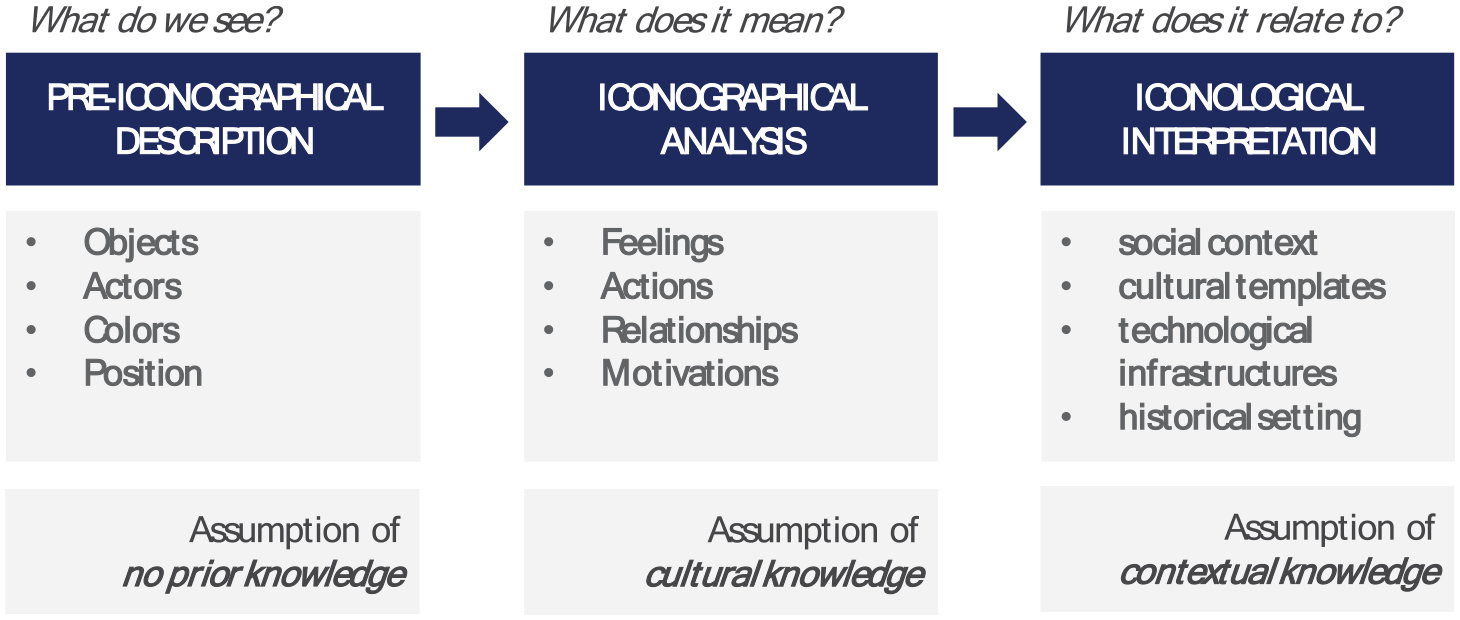
Three-step phenomenological analysis of collected artworks, following Panofsky (1955).
In the first step, two researchers independently wrote detailed descriptions of all 53 artworks, conducting a ‘preiconographic description’ of what was visible (prima facie analysis). This descriptive step captures what is present and grasps the pure, primary and natural object of depiction (Panofsky, 1955: 38). Here, the researchers as ‘interpreters’ were concerned with objects, lines, colours, volumes and the realm of motifs. Such prima facie analysis provides a crude record of visual representations devoid of interpretation, registering the constituent elements of visual representations in their entirety while avoiding overly monolithic descriptions by focusing also on smaller, less prominent and more easily overlooked signifiers. By way of finalizing this step, we cross-checked our prima facie descriptions with the workers’ descriptions of the images to identify possible divergences or aspects the researchers had missed. One striking difference was that the gig workers’ initial descriptions tended to focus primarily on capturing the protagonist and their gaze while neglecting smaller objects, colours, distances and differences in the level of detail. Because it proved difficult for most respondents to separate their descriptions from the meanings and emotions conveyed through their artworks, the interviewers often had to ask for further details – for example, ‘and what are these things in the background?’, ‘can you describe the colours you used in your drawing?’
In the second step, we conducted what Panofsky termed ‘iconographic analysis’ to uncover the embedded meaning of the metaphors, symbols and images contained in the visual representations. This necessitates greater acquaintance (and empathy) with the themes and concepts employed by the study participants. The intention here was to record the often internally contradictory, ambiguous and elusive expressions of experience implied by the participants while preserving the polysemic, emic quality of the participants’ self-interpretations. This analytical step was guided strongly by the interviews and the language used by the workers to conduct identity work through the overt use of metaphors and symbols. For instance, one worker described a floating bubble as a metaphor not only for ‘being happy’ and ‘being safe and protected’ but also for being in constant danger (‘I am constantly frightened’) – a seemingly inconsistent interpretation that would have been inaccessible through the researchers’ visual iconographic analysis alone. We strove to use as much of the workers’ ‘original’ phrasing as possible in their descriptions of this second step.
In the third step, we conducted an ‘iconological interpretation’ (Panofsky, 1955). At this stage, we were concerned with the hermeneutics of the symbolic and metaphorical aspects of the visual representations as situated in plural cultural, social and technological contexts. Such iconological interpretation is independent of ‘the eye of the beholder’ but directly contingent on the actual historical or technological context (Panofsky, 1955: 47). In our case, this involved reconciling our interpretations of the visual images with our knowledge of the specific socio-technical circumstances of gig work, including dominant idealized images of such work. Here, the researchers as interpreters exercised ‘synthetic intuition’ (Panofsky, 1955), condensing their knowledge of current tendencies in technology and working with the material and mental images subjectively rendered by the participants in their visual representations. This final step thus necessitated a thorough orientation to the time and context in which the visual representations were created (including the techniques employed) and an exploration of their overall meaning. The aim here was to identify any generalizable and essential tendencies of the human spirit visually present in the images (Panofsky, 1955: 48).
Here, we applied Bachelard’s (1987) and Sloterdijk’s (2011) phenomenological approaches to access what our visual and verbal data revealed of our participants’ subjective experiences of structures of consciousness through visual metaphors and verbal symbols, which are invariably connected to some archetypical (idealized) images (e.g. Durand, 1999). For Bachelard, ‘human imagination is pre-formatted by a limited set of guiding images or archetypes’ (Zwart, 2020: 64), from which it follows that people’s use of verbal or visual metaphors and images reflects an unconscious, unarticulated and affective understanding of themselves that is invariably linked to wider and free-floating imaginaries and idealized images.
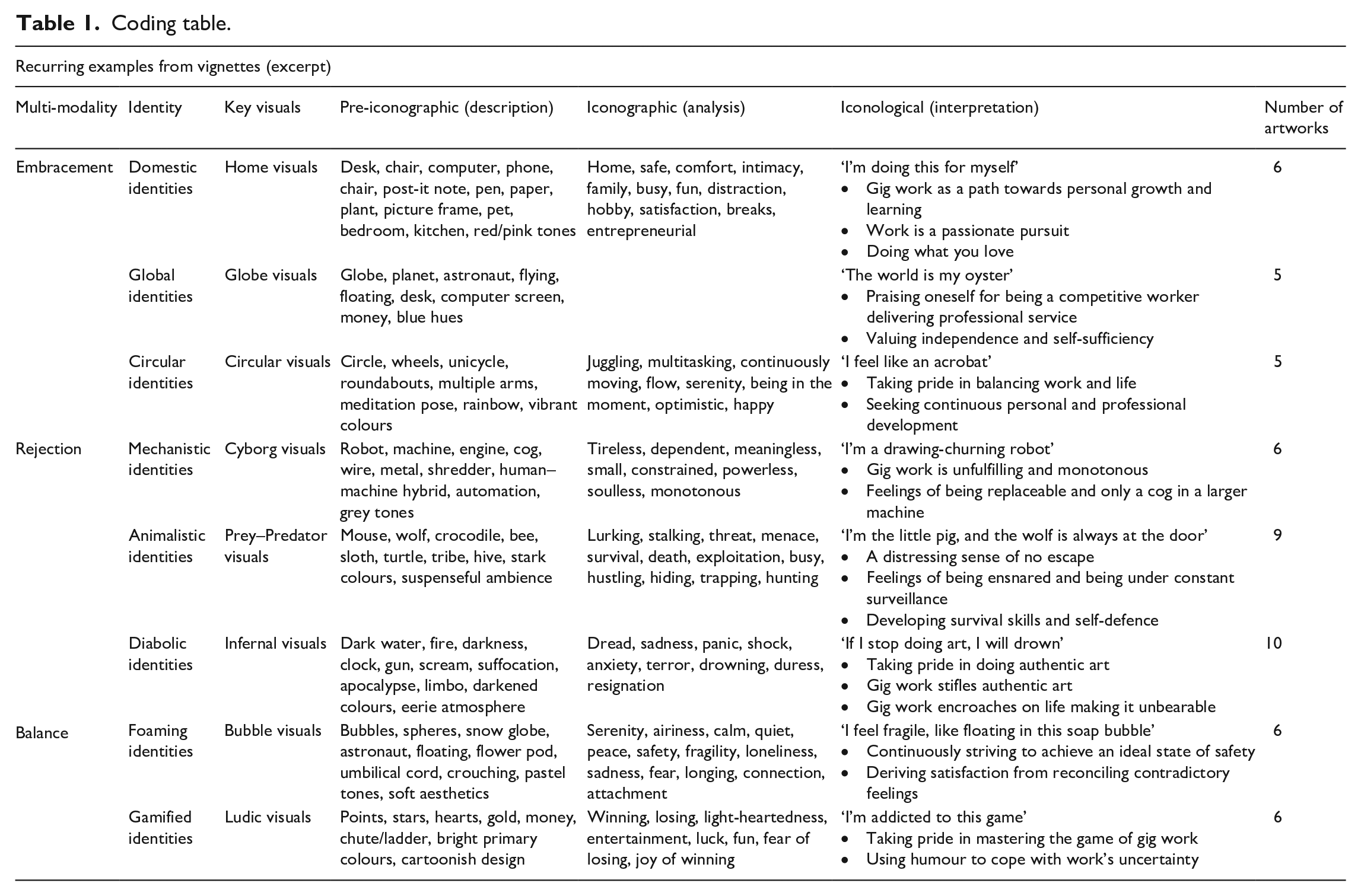
To operationalize our iconological interpretation, therefore, in this last step, we drew on available scholarship (Duffy and Wissinger, 2017; Miguel et al., 2023) to distil the ‘cultural templates’ (Panofsky, 1955) or ‘the guiding images’ (Bachelard, 1987) – imaginaries, archetypes, ideal-types – of work. Following analytical procedures for the study of identity work (Alacovska and Kärreman, 2023), we then reiteratively analysed the first-order verbal accounts of the visual self-portraits, focusing on instances of identity work that revealed alignment (identification) with the idealized images of gig work (e.g. ‘I’m a happy globetrotter’; ‘I juggle work and life. That’s why I painted myself as an acrobat’) or misalignment (dis-identification) (e.g. ‘I’m not passionate. I feel like a robot’; ‘This mouse on this image is me. I feel caught in a hamster wheel’; ‘The wolf is always at the door’). Here, we paid attention to the set of root metaphors (and their iconic qualities) that serve as basic shared conceptual and affective frames for understanding the self and the world. For example, the metaphor of ‘the robot’ was coded to indicate the experience of mechanistic work devoid of emotion, creativity and autonomy (similar ‘mechanistic metaphors’ were ‘a cog in the machine’, ‘hamster wheel’, ‘gears turning’ and so on). In this way, we identified eight distinct metaphorical types of identity work. Three second-order codes emerged from this data analysis, depending on the degree of alignment/misalignment with the idealized image of gig work: embracement, balance and rejection (see Table 1).
Coding table.
Findings: Multimodal identity work of remote platform-based gig workers
Our findings reveal the multimodal processes and mechanisms that enabled the gig workers we studied to forge a positive and stable sense of self. Whether by embracing, balancing or rejecting idealized images of gig work, such coherence was achieved even in the case of identities infused with ‘dark’ and ‘tormented’ emotional intensities.
Those participants who wholeheartedly embraced the idealized image of gig work and thus aligned their sense of self with dominant verbal and visual tropes mainly crafted what we categorize as domestic, global and circular multimodal identities through which they self-presented as competent, professional and service-minded providers of creative services. In stark contrast, those who outright rejected the idealized image crafted mechanistic, animalistic and diabolic multimodal identities through which they grappled imaginatively and poetically with the threats they felt gig work posed to their desirable ‘authentic artistic’ identities. Others strove instead to maintain a balance between the idealized image of gig work and their often humorously recalibrated artistic aspirations and fragility by crafting multimodal identities we term ‘foaming’ and ‘gamified’.
In what follows, we present the multimodal, simultaneously visual and verbal, identity construction of only two select informants per identity-type category. As opposed to the diversity and expansiveness of data presentation in the typical monomodal mode, the presentation of multimodality commands a focus on a more bounded and limited set of examples to preserve coherence while avoiding the separation of the verbal from the visual (see also Bell and Davison, 2013). Table 1, however, gives a fuller and richer range of empirical examples.
Embracement
Embracing the tropes of mobility, passion, ‘free’ lifestyles and a work–life balance, participants who aligned their sense of self with idealized images of gig work crafted multimodal identities amounting for the most part to quite literal re-interpretations of popularly idealized and romanticized conceptions. These multimodal identities took three main forms: domestic, global and circular.
Domestic identities: ‘I do this for myself’
The visual self-depictions of what we term ‘domestic’ multimodal identities crafted by gig workers conjure up intimate spaces and tend to play with the theme of a delineated interior space. These mostly invite the viewer into the confines of deeply personal spaces within the home to observe a scene wherein the protagonist – with their back turned to the viewer – is absorbed in concentrated work. The use of symbols in these visualizations tends to be straightforward and denotative, depicting the inner space of bedrooms, living rooms and kitchens filled with objects of ‘autobiographical’ importance to the artist. Work in such intimate spaces seems safe and safeguarded from whatever may lurk outside. Indeed, there are no doors, windows or any other allusions to the outside world. These spatial depictions of the self-emanate a sense of self-sufficiency and emotional tranquillity.
Maria (22, Italy) and Josh (32, United States) both drew themselves hunched over a desk in their bedrooms surrounded by items of personal importance, signalling the safety of home and the passion for doing gig work domestically (Figures 2(a) and (b)). Together with an aura of industriousness (post-it notes, drawing sheets, clocks), these items evince an optimistic, forward-looking and entrepreneurial spirit, including through motivational insignia such as Josh’s ‘Just Do It!’ slogan and Maria’s aspirational college-fund jar.
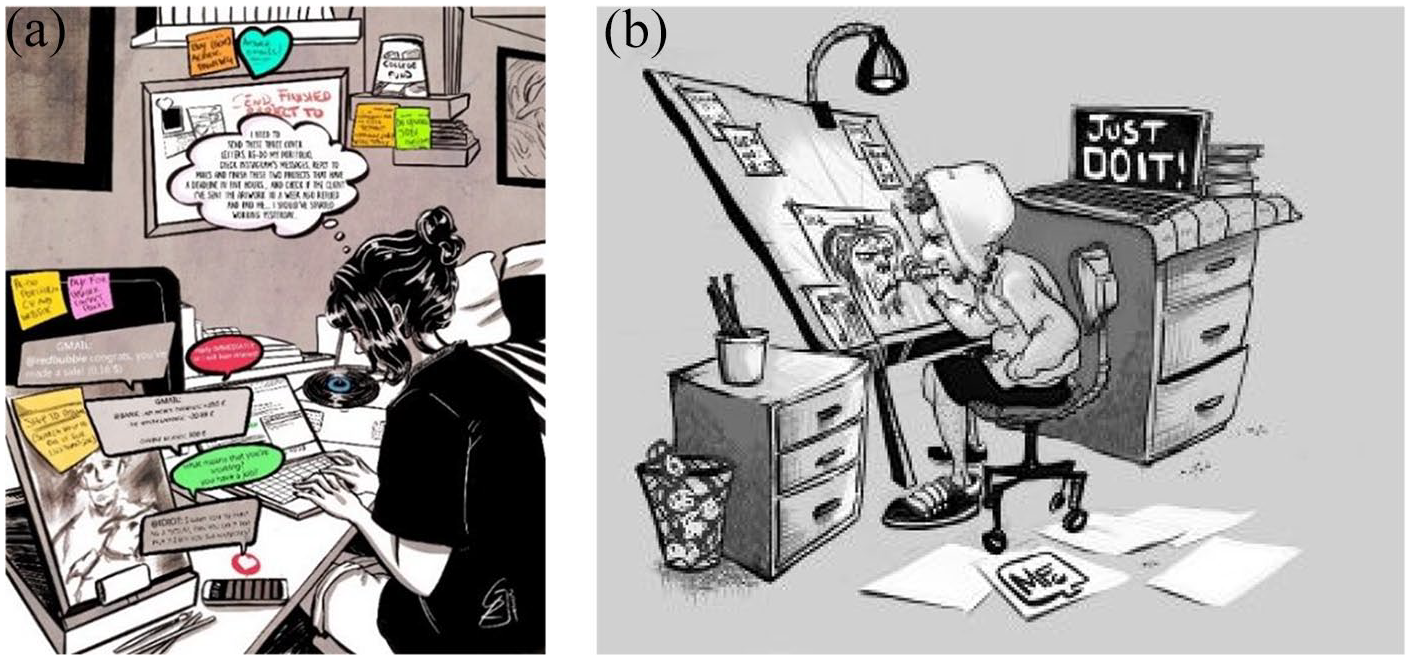
(a) Artwork by Maria. ‘Work on the platform is very helpful for
In Bachelard’s (1987: ix) phenomenology of imaginary spaces, these two artworks represent ‘felicitous’ or ‘eulogized’ spaces in ‘images of intimacy’ suffused with the ‘poetics of the house’. Such home metaphors derive their ontological force from ‘the sorts of space that may be grasped, that may be defended against adverse forces, the space we love’; and in this sense ‘the house image would appear to have become the topography of our intimate being’ (Bachelard, 1987: xxxvi).
Both Maria and Josh, like many other informants depicting domestic identities, described working on the platform as a privilege and a valuable opportunity for professional and personal growth. For them, passion, motivation, perseverance and a positive outlook were key to success. Such workers felt that the platform offered them a viable way of getting paid to pursue their love of art while enjoying the cosiness and security of their homes.
Global identities: ‘The world is my oyster!’
The imagery of home was reversed in five of our informants’ multimodal representations of a global identity. In these gig workers’ visualizations, the protagonists are (self-)depicted at workstations in spaces abstracted from almost any domestic topoi. Imageries of the globe are central in these artworks, while their foregrounds and backgrounds – often tinted in a blueish glow reminiscent of a computer monitor – merge physically with digital worlds. In sum, these images visually enact the central metaphorical figure of the gig worker as a ‘globetrotter’ (Miguel et al., 2023).
Genevieve (31, United States) sketched herself seated at a desk with the outside world encapsulated behind her in a floating terrestrial globe (Figure 3(a)). Through the canvas-like structuration of the depiction and the flowing nature of the ink, the scene implies a harmonious fusion of the self at home (Genevieve has a cat) with and amidst a rhythmic and global rotation of gig projects.
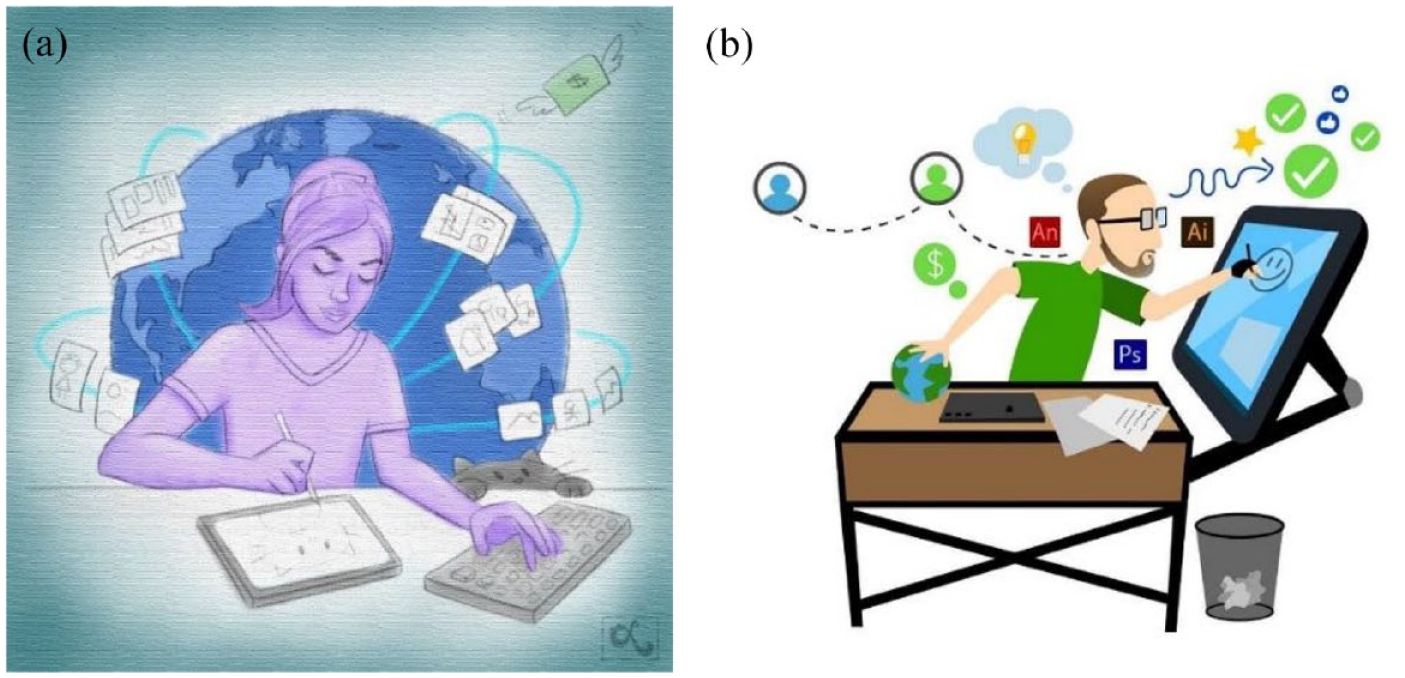
(a) Artwork by Genevieve. ‘I wanted to show how [. . .] the platform [. . .] brings me to my
In Greg’s (36, Ukraine) visual rendering of his gig work experience, the protagonist sits at his workstation in a space devoid of any geographical or domestic rootedness (Figure 3(b)). With one hand drawing on a screen and the other firmly placed on a globe, the artist is (self-)depicted against a background dotted with design software symbols and depicting a workflow stylized as a somewhat linear process. The drawing is very ‘clean’, bordering on clinical, with very little visible waste or clutter, altogether evoking a highly functional atmosphere.
In Sloterdijk’s (2009: 34) phenomenology of the sphere, images of the globe reflect our fundamental conceptualizations of the world or ‘hyperimage’ of the ‘all-encompassing sphere’, raising intriguing questions about the location of the self and the ‘human sojourn’ in the technological world. According to Sloterdijk (2009: 29), people ‘conceive of the form of the sphere’ to ‘place themselves in an intelligible, formal and constructive relation to the totality of the world’. Consistent with this interpretation, Genevieve and Greg’s artworks both convey their sense of being ‘at home’ in the gig economy. By working on the platform, their worlds had become more accessible and manageable, perhaps not least by becoming smaller. The platform connects them to the entire world, and they are securely ensconced in it (earning the bulk of their income from the platform). They see no mysteries, dilemmas or conundrums related to their working on the platform and know exactly how to maintain a top-rated status that ensures what Greg described as the ‘global reach’ of their work. Both feel appreciated by their clients and affirmed by their good ratings, top-rated status and solid reputation metrics – more so indeed than by the ‘human bosses’ in the companies they previously worked for.
Similarly to Genevieve and Greg, our informants who constructed global identities took pride in approaching gig work as a plannable, calculable and predictable pursuit. Intent on succeeding in the gig economy, such gig workers emphasized the need to ‘have a global mindset’ and be ‘professional’, ‘service-minded’, ‘deliver on time’ and be ‘happy to execute artwork on demand’.
Circular identities: ‘I feel like an acrobat’
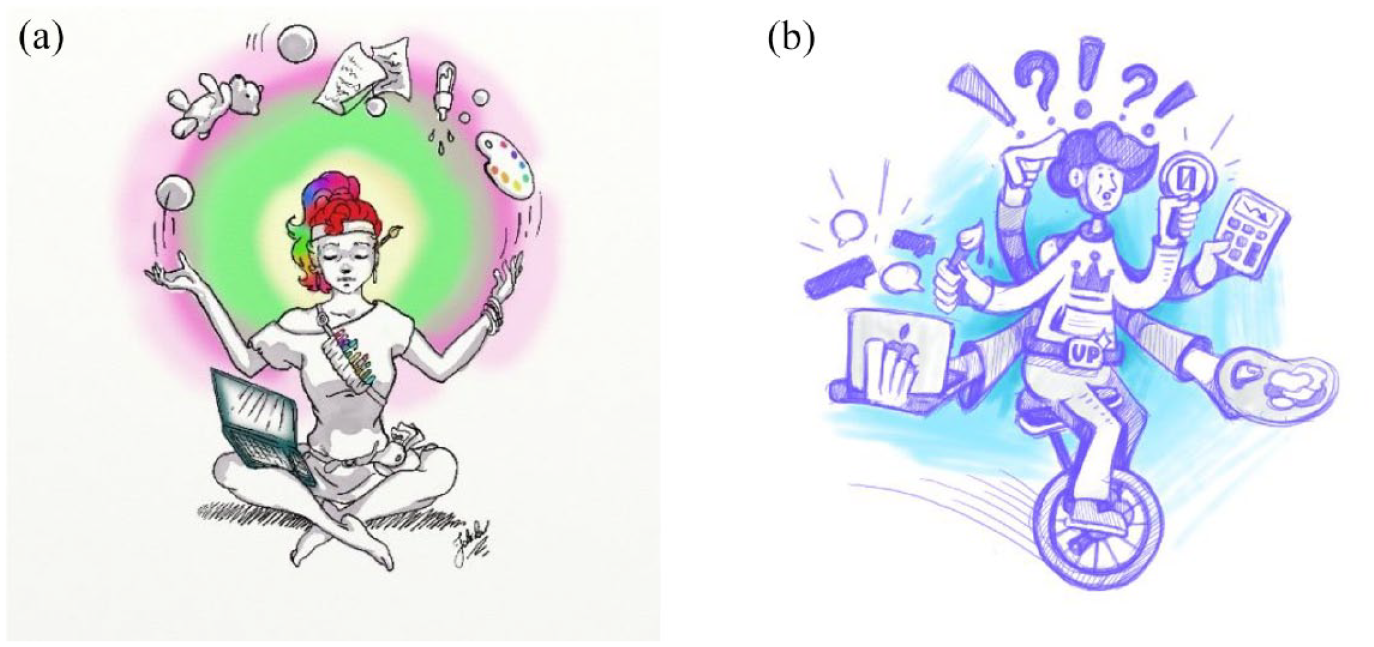
Circles featured prominently in five of our informants’ visual representations of their platform work, highlighting their perceptions of gig work as enabling them, however precariously, to maintain a life–work balance. Transcending the focus on spatiality in domestic and global self-depictions, these accounts thematize the temporal intensities of work and encapsulate the technology-induced acceleration of work–life pace. Almost all these metaphors are accompanied by composite human-like beings with multiple hands or objects circling above their heads. Such self-depictions emphasize a self-centred enjoyment in a nirvana-like state of being, capturing these workers’ self-fulfilling if exhausting sense of being ‘on top of things’ despite the high-speed velocity of gig-work environments.
Carina (30, Italy) drew a female figure in a state of zen-like bliss or even ecstasy in her work (Figure 4(a)) as she deftly juggles a miscellany of life–work items. The rainbow colours of the circle behind her radiate a positive, bright and optimistic atmosphere. For her, the cyclical and predictable rhythms of everyday online work are life-affirming. Rather than struggling with the high-speed turnover of online work, Carina visually and verbally described her work as a productive way of using the ‘slow time’ when her children were at school. (As she explained, her husband pays their rent and other expenses, enabling her to see gig work as a ‘pastime’.) Far from compressing her time, multitasking has enabled Carina to attain the ‘dream’ of protracting her artistic ‘self-time’.
(a) Artwork by Carina. ‘That’s me. The internet allows me to do many different things at once. Our brain is very wide – we can do
While Dmitry (32, Ukraine) also drew himself juggling in a circle, his face in this self-portrait exudes pain and dread as he perches atop a unicycle struggling to balance his ‘multitasks’ with six hands circling frenziedly in the air, emphasizing the visceral tribulations and existential distress of ‘keeping all the balls in the air’ (Figure 4(b)). The pressure to ‘constantly perform’ and ‘compete against the passing of time’ necessitates this metaphorical ‘growing of multiple hands’ to accelerate work output. Exhausting as such platform work may be, Dmitri nonetheless insisted that remote freelancing enabled him to ‘live the life he desires’. At the time of our interview, for example, he declared he was ‘enjoying a good life on a beach in Indonesia’.
In Durand’s (1999: 273) analysis of cyclical symbols, ‘cyclical time [and its spatial/geometrical image of the wheel] is like a gigantic identity principle applied to reducing the diversity of human existence’. According to Durand (1999: 272), the circle is a basic universal archetype of cyclical rhythm, in other words of repetition and hence also the fleetingness and fragility of existence, weariness with life and ‘the vicissitudes of time’.
For our five informants who had crafted circular identities the cyclical rhythm of such work – however exhausting – thus provided a sense of predictability and freedom to continue navigating multiple and often competing life roles (as represented in artworks by contrasting items such as a baby bottle, diapers and utensils on one hand, and a palette, laptop and calculator, on the other).
Rejection
Those of our informants who actively rejected, resisted or challenged dominant idealized images of gig work strove instead to redefine and reimagine their identities as artists within the gig economy, perceiving such idealized images as a direct threat to their aspirational and desired artistic identities. Many regarded platform work as a temporary phase to be endured on their way towards fully realizing ‘authentic’ and self-expressive artistic selves that would no longer yield to commercial and client demands (Lam, 2020). While some crafted ‘mechanistic’ identities to maintain a cynical distance from idealized images, others created ‘animalistic’ identities to reclaim agency, reimagining themselves as ‘predators’ instead of powerless ‘prey’. The most visceral of such idealized image-rejecting multimodal identities, however, were those we term ‘diabolic’, consisting in a fully fledged poetic – and perhaps also therapeutic – re-composition of emotional turmoil and torment ensuing from their efforts to reconcile their gig work identities with their artistic selves.
Mechanistic identities: ‘I’m a drawing-churning robot’
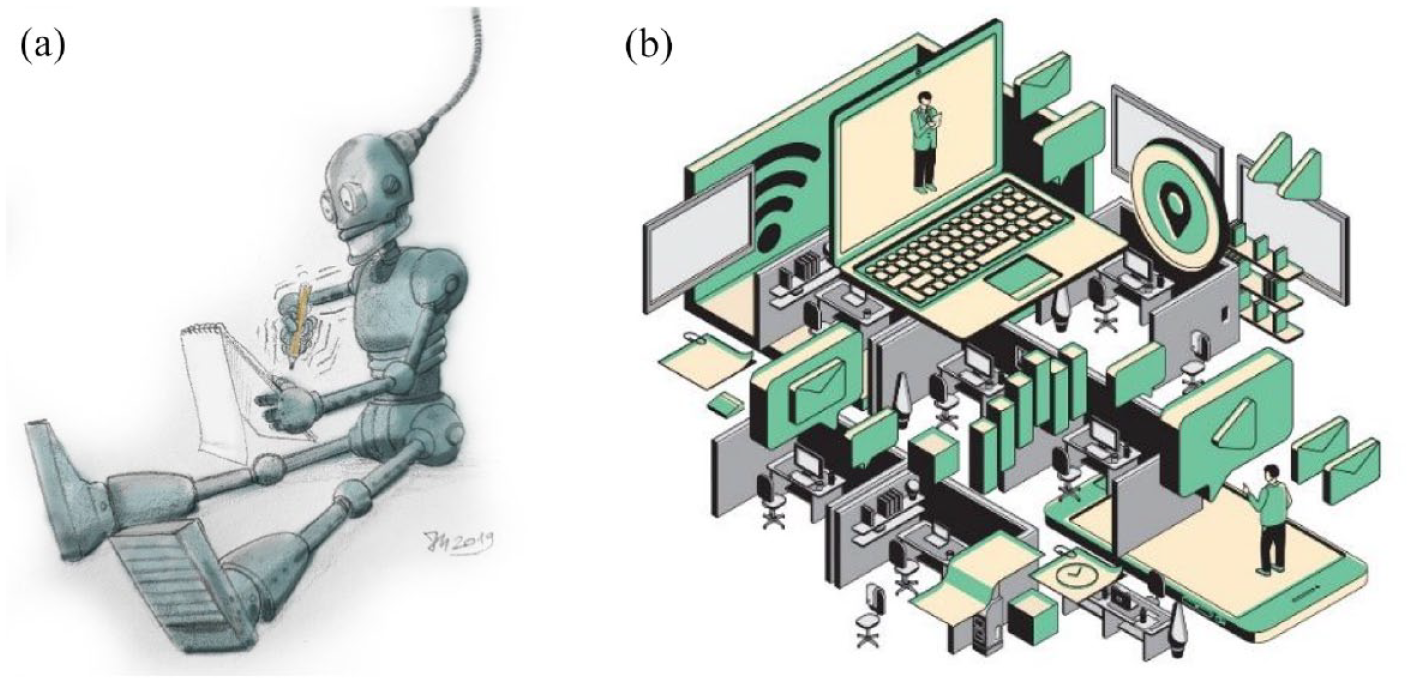
Six of our informants crafted multimodal identities in which their sense of self was realized through the invocation of verbal and visual metaphors involving machines or high-tech entities, such as robots, computers and smartphones, alongside low-tech objects like pencils, notepads and slides. These informants visually and verbally described gig work under algorithmic management as mindless, soulless and standardized (‘input-output’). Such ‘cyborg metaphors’ depict a gig worker’s body and mind as hybrid assemblages of mechanistic bodies and human traits (dis)located in composite techno-human environments wherein the alienating and disaffecting experience of intimate subjective states is mediated metaphorically by technoscientific knowledge. Thinking in and through cyborg metaphors helped these gig workers maintain a sardonic distance from platform labour to safeguard their artistic identities.
A respondent with a degree in fine arts, Victor (42, Croatia) depicted himself as a robot frantically drawing with a pencil on a notepad (Figure 5(a)). In this image, platform work is portrayed as monotonous and standardized, requiring rapid execution in strict compliance with clients’ demands. While defining himself verbally ‘first and foremost as an artist and then a gig worker’ and stressing that platform labour means having ‘to cave in to your clients’ needs’, Victor also somewhat contradictorily declared ‘I do art that I consider aesthetically right’, insisting he does not let the platform control his artistic identity because this would eventually ‘stifle your creativity [and] drain your creative juices’. Platform work, he told us, enables him to lead ‘a comfortable life’. By mobilizing the cyborg metaphor, Victor sarcastically and cynically distances himself from the accelerating, regimentalizing and dehumanizing power of the platform algorithm.
(a) Artwork by Victor. ‘I’m a robot that churns out as many illustrations and artworks as possible in the shortest period of time. I am
Digital artist Christof (26, Spain) depicted himself standing at the threshold of an unoccupied and highly mechanized/digitalized office cosmos (Figure 5(b)) in an image exuding what Durand (1999: 180) called ‘morbid geometrism’, evoking the isolation and alienation of mechanistic spaces through the rigidity of its interfaces and the formal logic of its sharp isomorphic lines and symmetry. Unlike work in the deserted traditional/obsolete office space in this image, Christof’s gig work is not supervised by any co-present managers; yet, algorithmic management exposes his work to constant scrutiny, obliterating any nooks and crannies where he might hide. As captured by the gigantism of the superimposed computer soaring over the greyscale miniature depiction of a mundane office, the platform’s techno-human (cyborg) arrangements colonize his mind and disrupt his sense of time. The spatial orientation of the superimposed computer here indicates ‘the godlike client’ and ‘all-powerful technologies’ controlling the small figure of the worker below. Such ‘up-down spatialization metaphors’ organize our physical experience of control in the world (Lakoff and Johnson, 1980: 22). As Christof explained in our interview, gig workers cannot escape the entrapment of mechanistic and spatialized control but can only ‘press or decline to press the play/entry button’. Despite describing the platform as a ‘soulless’ and ‘rigid, monotonous and repetitive environment’; however, Christof was confident he would know when to ‘press the exit button’, describing his gig work as only a ‘transitory phase’ endured to provide for the necessities of life. His ultimate goal, he confided, was to succeed as an artist, because ‘as an artist you can’t be treated the same way as an accountant’ but work instead according to ‘inspiration’.
Overall, for those gig workers who constructed mechanistic identities gig work was deeply unfulfilling. They felt drained of passion as the monotonous and platform-pleasing jobs threatened their intimate sense of being ‘an authentic artist’.
Animalistic identities: ‘I’m the little pig, and the wolf is always at the door’
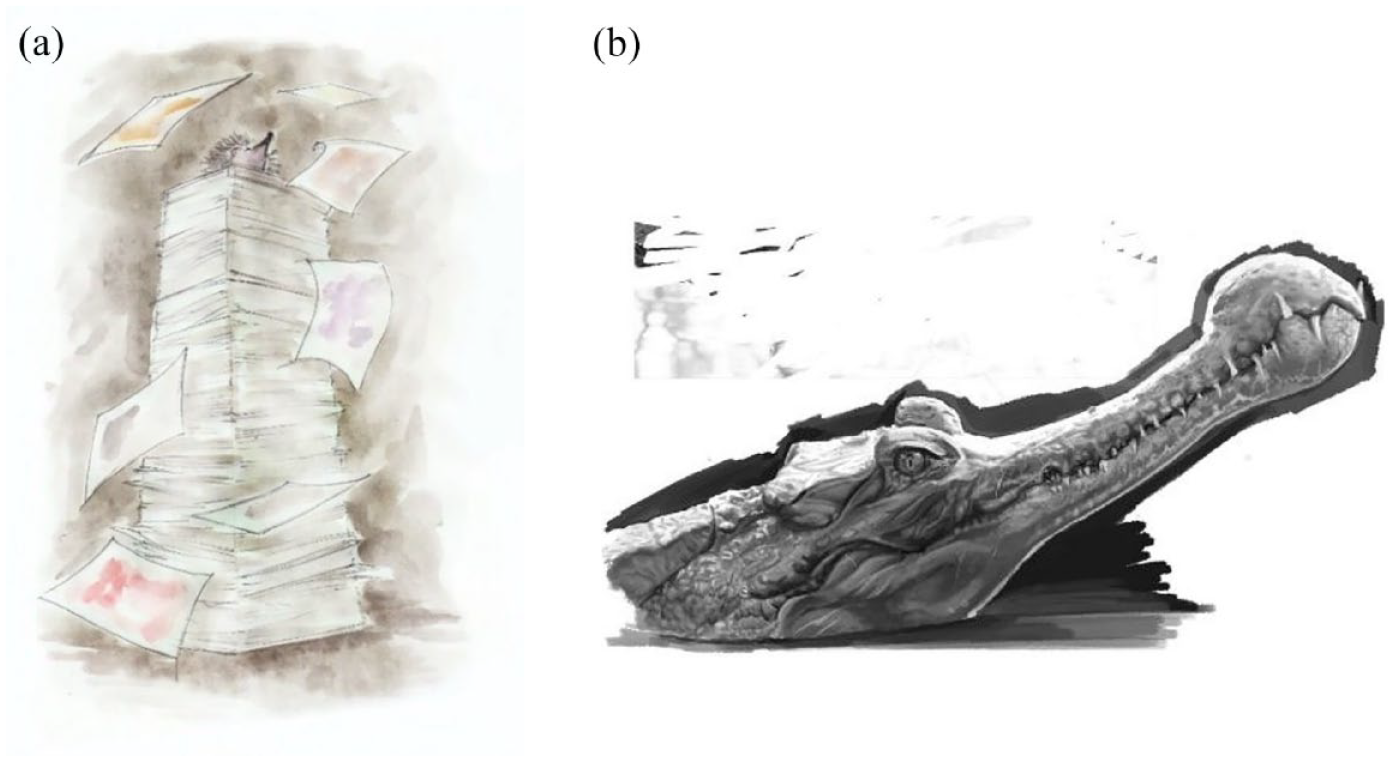
Animalistic metaphors featured prominently in nine of our informants’ visual and verbal accounts of their multimodal gig work identities, with self-depictions including both predators (a crocodile, an octopus, a wolf and a tiger) and prey (a sloth, a butterfly, bees, a hedgehog and a mouse). According to Durand (1999: 68), the centrality of animals in representations of identity reveals the deep sedimentation of the ‘thereomorphic orientation of the imagination’. As animals have long exerted a decisive influence over human imagination, owing at least in part to the ‘fabulous mythology’ of animal behaviour in fables and parables, the thereomorphic imagination typically defies causative logic. In accordance with long-standing fabulations of animality, carnivorous animals metaphorically configure bestiality, ferocity and cruelty, while herbivorous animals connote timidity, defencelessness and fearfulness (Durand, 1999).
Martina (27, Salento, Italy) drew herself as a hedgehog perched precariously atop a towering stack of papers, disproportionately small in relation to the enormous pile of work stacked up beneath her (Figure 6(a)). Reflecting the fear induced by a sense of being under constant monitoring of her performance, her visual and verbal accounts of her identity were permeated with nagging anxiety, torment and paralysis. The ‘capricious’ algorithm ‘belittles’ and does ‘inexplicable things’ to her. On the platform she feels vulnerable, ‘always at the point of collapse’ owing to so many ‘unreasonable client demands’. Describing her full-time gig work as ‘a necessary evil’, Martina told us she is also an active member of an art collective and that ‘this is where my actual work takes place [. . .] where I’m allowed to be an artist and discard stupid client wishes’.
(a) Artwork by Martina. ‘The hedgehog is myself. [. . .] The hedgehog is
Mario (32, Sicily, Italy) depicted himself as a crocodile lying in wait for its prey, its head lifted above the dark water with a menacing eye turned to the viewer (Figure 6b). Consistent with the archetypal image of crocodiles, Mario’s visual self-representation exudes a ‘devouring aquatic ferocity’ (Durand, 1999: 95). Although the platform enables him to pursue an artistic career in a rural town in Sicily, his livelihood depends entirely on ‘the goodwill of clients’ and the (questionable?) ‘fairness’ of the platform as his only source of income, making him vulnerable to the ‘mysterious machinations’ of the algorithm responsible for giving and taking gigs. Determined not to be victimized by the platform, however, Mario has honed his survival skills. In response to the ‘hostile’ and ‘deadening’ platform environment, he has become a ‘predator’ preying on less powerful clients, including by selling the same artistic solution multiple times to different clients and sub-contracting less expensive artists to complete his commissions: ‘In this way I’m able to spare more time for my own artistic work, the type of work that really matters’.
Similarly to Mario and Marina, in using animals as a verbal and visual modality of self-understanding, the gig workers who cultivated animalistic identities employed intricate strategies with the dual aim of resisting the close control over work exercised by platforms and of retaining a sense of self-preservation and self-defence. In this way, they have been able to carve out a space, however minuscule and endangered, for engaging in types of artistic work with which they identify intimately but that are ultimately incompatible with gig work.
Diabolic identities: ‘I’m drowning!’
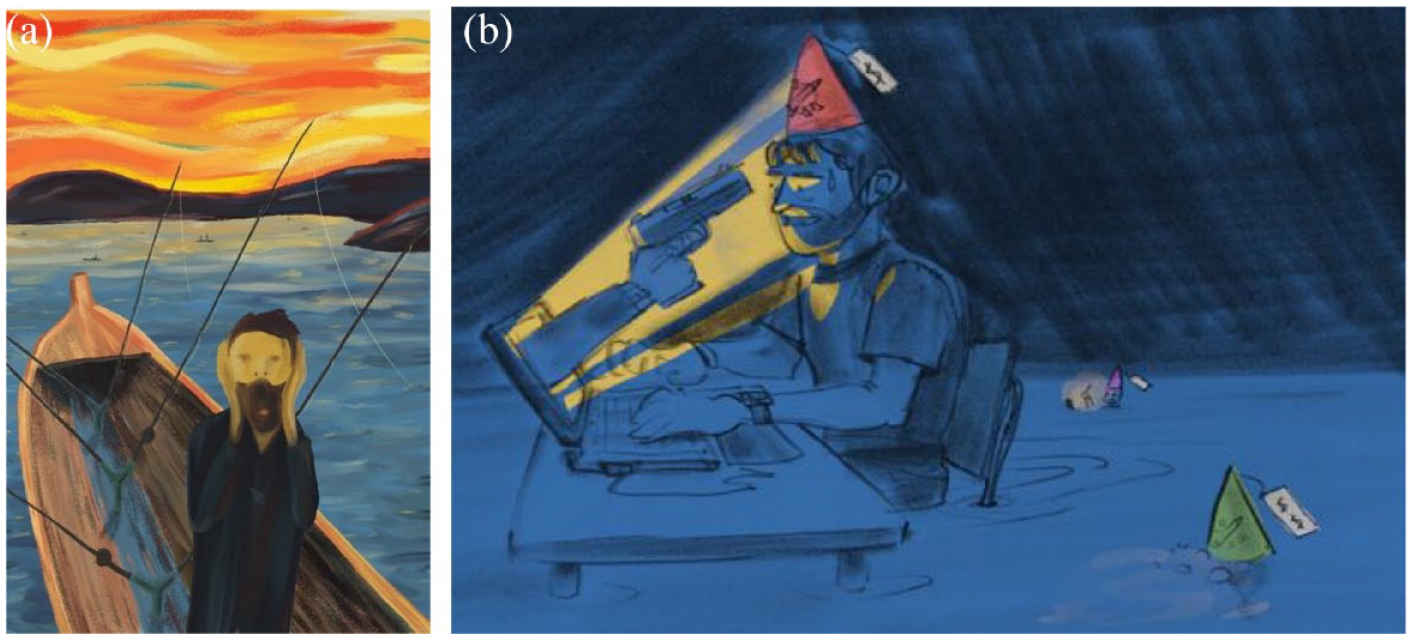
The most abstract and poetic of the multimodal accounts of gig work provided by our informants who rejected dominant idealized images consisted of verbal and visual evocations of infernal scenes – ‘hellscapes’ in which atmospheric and visceral intensities of hopelessness, anguish and despair are conveyed through the lyrical imaginary of floods, fire, sinking boats, drowning, deadly weapons and burning watches. These are not mimetically represented objects but poetically imbued sensualities, affects and resonances that Bachelard (1987) referred to as ‘radiating’ or ‘psychotropic images’. Such vibrant imaginaries are the product of a ‘sparkling consciousness’ (Bachelard, 1987: 156, 155) in which cognitive reflection of the self is mediated by reverie or dream-like effervescent images of material things and affective states with the power to grip the entirety of one’s being and make it live ‘at the center of a radiating image’ within a radically meaningless void.
Artist Enrico (38, Spain), who has been earning his livelihood on gig economy platforms for almost five years now, drew himself in the style of Munch’s ‘The Scream’, with the protagonist, in this case, painted as an anguished figure standing in a sinking boat surrounded by dark water (Figure 7(a)). As Enrico explained, he feels he constantly has to ‘bail out’ to stay afloat a little longer; and though with time he has gotten much better at staying afloat and currently maintains a perfect success score on the platform, ‘the anguish never goes away completely’. At least part of this anguish stems from not knowing how the platform works and his constant fear that his working conditions might change and ‘sink’ his boat (even if inadvertently). But another source of Enrico’s anguish is that the platform frustrates his ambition to create art full time. As he despairingly declared in our interview, platform work ‘numbs’ the creative impulse: ‘It’s a quarantine. So, that’s what I do most of the time’.
(a) Artwork by Enrico. ‘This pretty much captures the feeling of being an online worker. I took the original [painting by Munch] and just had to change a couple of little details. The water is more disturbed in my picture than in the original. It’s basically the
David (29, Italy), who has a degree in visual arts and has been doing platform work for over five years, drew himself half-submerged in the water while sitting at his desk in front of his computer, from which an arm reaches out holding a gun to his head (Figure 7(b)). The scene is very dark, with the only light emanating from the screen. David wears a pointed red hat with a price tag and we see similar price-tagged hats with different colours in the water, indicating that other workers may already have drowned – an image imbued with despair. In our interview, David complained of feeling coerced into compliance by clients ‘who don’t understand what real art is’ but ‘always want something to be changed that doesn’t make any sense . . . “This bigger”, “That smaller”, “Lighter colour”, “More lines” . . . It’s fucked up! Excuse my language’.
Similarly to Enrico and David, by visually and verbally drawing on infernal metaphorical images, the gig workers articulating diabolic identities both highlighted the psychological turmoil ensuing from the tension between the need to do platform work and their desire to practise art as a self-expressive and ‘authentic’ creative endeavour.
Balance
Those of our informants who sought to position themselves neither in full alignment with nor in outright opposition to idealized images of gig work crafted multimodal identities that reflected a striving for balance while ‘staying with the trouble’ of contradictory and highly ambivalent emotions induced by platform work. Determined to stay resilient and adaptable in navigating the ordeals of the gig economy, their identity work strategies took the form either of poking fun at popular tropes of gig workers through ‘gamified’ identities or of critically nuanced notions of fragility and success in gig work through what we term ‘foaming’ identities.
Foaming identities: ‘I feel fragile, like floating in this soap bubble’
Six participants created floating or weightless womb-like visual representations of work-life spaces, depicting themselves curled up inside bubbles, engulfing flower pods, turtles’ shells, snow globes and spacesuits. Such ‘images of full roundness’, according to Bachelard (1987: 234), ‘confirm our being intimately inside’. Hurled into a ‘monstrous world’, humans can survive only if they ‘spherically insulate’ themselves by creating bubbles – or what Sloterdijk (cited in Jongen, 2011: 206) describes as ‘a technologically enclosed external uterus [. . .] in which they nurture, protect and immunize themselves against the unliveable outside’. Consistent with this interpretation of roundness, our informants with ‘foaming’ identities created visually sharp contrasts between the safe, warm and comfortable worlds inside their bubbles and the threatening, cold, dark and lifeless spaces of nothingness or barren landscapes outside. These images evoke mutually contradictory notions of safety and vulnerability, control and uncertainty, isolation and community, adaptability and rigidity. Refraining from a simplistic either-or embracement or rejection of idealized images of gig work, these ‘foaming’ multimodal identities instead manifested a nuanced and emotionally delicate interpretation of the elusive and often contradictory experience of working as an artist in the gig economy. Such identities convey both the fragility of existence on platforms but also the robustness of a self, which while not completely immune to turmoil was intent on staying hopeful in spite of hardship.
Suleiman (34, Turkey), who studied visual arts in London and considers himself a ‘veteran freelancer’, depicted himself as an astronaut floating in fetal position through outer space, safely and snugly wrapped in his spacesuit connected womb-like by an umbilical-like cord to his laptop and thus the platform as a source of sustenance amidst the nihilistic void (Figure 8(a)).
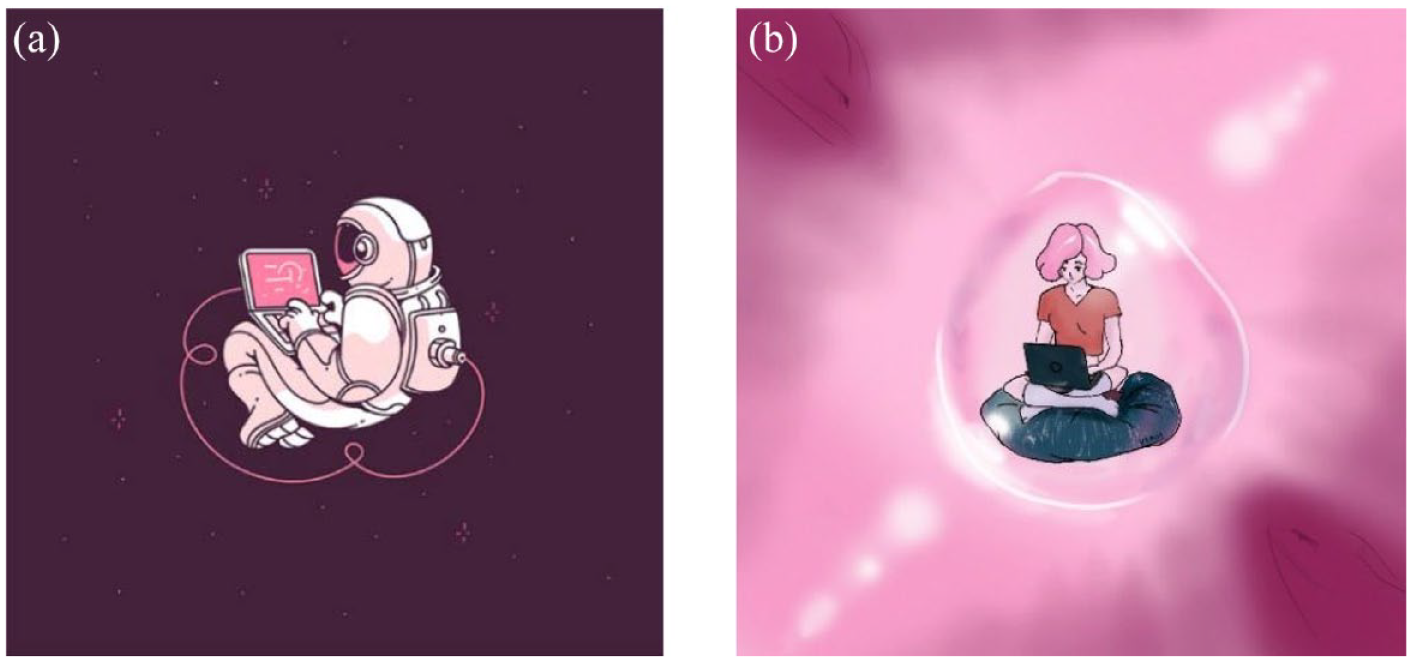
(a) Artwork by Suleiman. ‘I’m an astronaut
Barbara (27, Colombia), who told us she makes a ‘decent living’ as a freelance artist ‘to pay the bills’ and ‘to develop her art portfolio on the side’, drew herself sitting on a cushion working on her laptop inside a translucent floating bubble (Figure 8(b)). Pink shades render almost the entire scene upbeat, with the crucial exception of the darker upper left and lower right corners where, on closer inspection, we see lizard-like creatures menacing the bubble. Verbally, Barbara summarized her ambivalent feelings about gig work as follows: So it’s kind of perfect when you have the jobs, but it’s very fragile when you aren’t able to find them. When drawing myself [for this research task], I tried to be very positive. I tried to see everything very bright. Everything looks great, but then you see that at the edge there’s like a dark purplish evil.
Suleiman similarly self-interpreted his visual self-portrait as an attempt ‘to amplify the fact that it’s both positive and negative combined – merged together’.
In Suleiman’s and Barbara’s multimodal self-representations, the bubble metaphor links two contrasting worlds: the warm womb (the tame, intimate feeling of being at home in the world), and the cold (alienating, frightening) void of the platform. In both their accounts, the anxiety of being expelled from the womb is palpable: Suleiman’s spacesuit ‘bubble’ is both solid and vulnerable, since if the life-sustaining cord should ever snap – for example, through some inexplicable change in the algorithm – then the ‘astronaut’ will be thrown into chaos and perish, while Barbara’s bubble will burst if the lizards attack, sending her into neck-breaking freefall.
The gig workers who cultivated foaming identities, like Suleiman and Barbara, strove to achieve a sense of safety in a turbulent gig economy world while grappling tactically with the many challenges and threats. They found fulfilment in persistently managing the conflicting emotions stemming from the unpredictable nature of gig work.
Gamified identities: ‘I’m addicted to this game’
Those artists who had crafted ‘gamified’ identities used humour to depict ludic or game-like scenarios as the basis for their multimodal identity work, adopting the expressive modality of a cartoon to lampoon exaggerated ideal-type portrayals of gig work. Through comedic exaggeration and caricatured self-representations, they subverted the absurd expectations of freedom and autonomy associated with gig work stereotypes, inviting viewers to question the veracity of these portrayals. In their visual accounts, these gig workers configured themselves as gameplayers and the platforms as game spaces possessing both ludic components, as well as stressful and uncertain aspects that pose the threat of burnout. Many employed analogies with video games in which the player/gig worker must invest their skills and resources to find hidden treasures or earn and retain points, stars, coins and hearts. A certain degree of resignation nonetheless underlies the humorous tone of these depictions because no matter how hard the worker tries to earn rewards over time it is ultimately luck that defines the outcomes. As these informants confirmed in our interviews, humour helped them render their platform work-life slightly more bearable and purposeful.
Vasja (36, Serbia) who worked as an illustrator for an international magazine before taking up platform work, drew himself in the setting and aesthetic of an old-school console video game, complete with slightly pixelated ‘heart-symbols’ at the top of the screen to indicate the remaining ‘lives’ or ‘energy levels’ of his game character (Figure 9(a)). Vasja’s artwork shows three levels of progress in the game: in the first, he is rewarded with a golden coin for his hard work; in the second, he receives three more coins and a star, with his energy levels almost full; and in the third, he is completely exhausted, with only cacti falling from above.
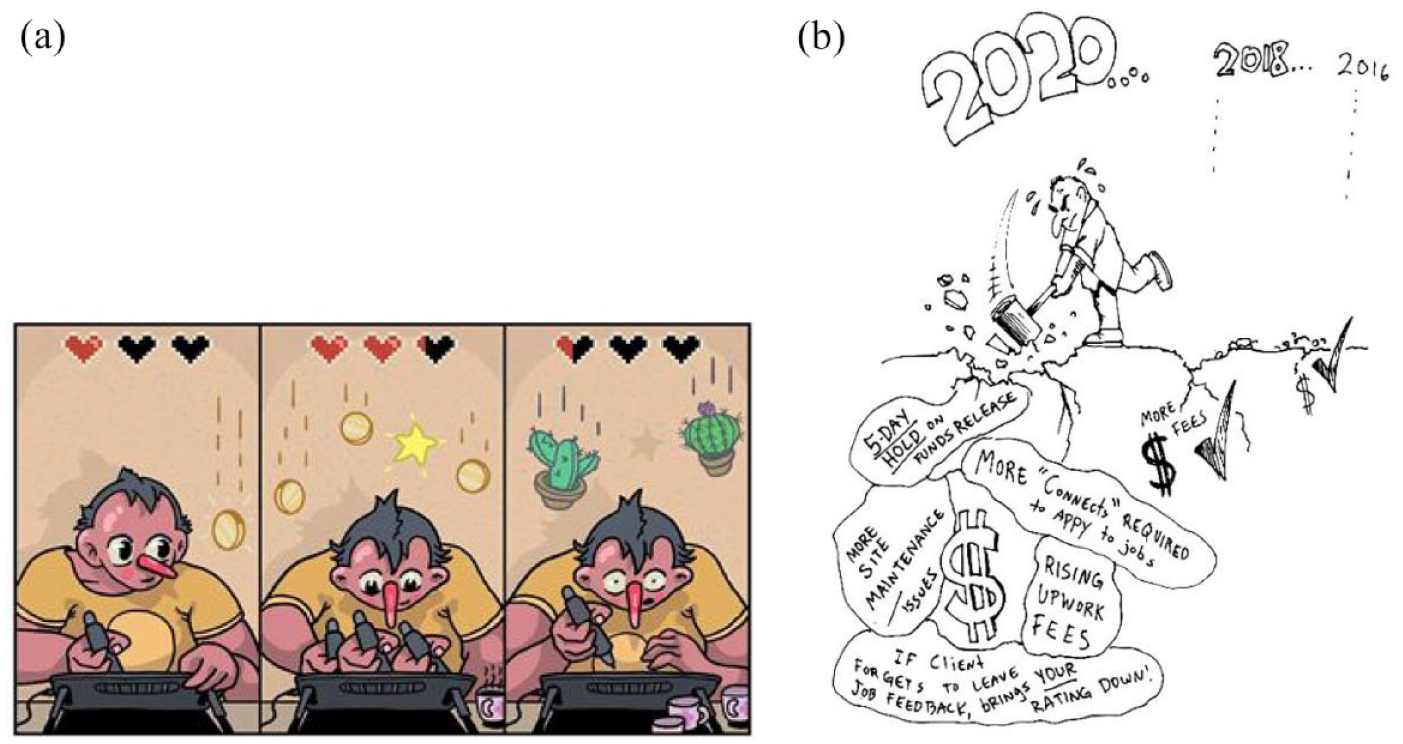
(a) Artwork by Vasja. ‘With time I learned from friends how to
For Vasja, the platform is like a video game in which some rules are very clear (such as what workers have to do to get another ‘coin’) but other rules are opaque or even arbitrary. Because Vasja has ‘never figured out how the scores actually work’, his picture conveys both playful and painful elements of his game-like work environment. On one hand, there is a clear relationship between work and reward that seems to be almost addictive: the more work is put into the game, the more (coveted) rewards one can earn. On the other hand, the game seems to be at least partially rigged and perhaps even unwinnable: just one unlucky streak can trigger a vicious cycle because when a player loses their status their opportunities on the platform dwindle; and even if they put in the same amount of work as before they only receive punishment (cacti). At the time of our interview, Vasja was proud to claim he had ‘finally cracked the game’, enabling him to take care of his baby son with the proceeds ‘tickling down’ from his gig assignments: ‘I can now combine work with my paternity leave. I doubt I’d have been able to do that with an 8 to 4 job’.
Max (41, United States) drew a caricature of himself frantically smashing a hammer into solid rock to reach buried treasure (Figure 9(b)). Before he can reach the treasure, he first needs to dig through several obstacles, including ‘rising Upwork fees’, ‘5-day holds on funds’ and ‘site maintenance’. From the timeline above, it seems the protagonist has been digging since 2016, though back then the treasure was buried much closer to the surface and he did not have to dig quite as deep or as vigorously. In our interview, Max repeatedly used ludic metaphors in describing his work, referring to knowing the ‘rules of the game’ and ‘how to play it’. The excitement of the continuous ‘hunt’ for good gigs, as well as the payoff for a successful gig, was a key aspect of his motivation for staying on the platform. As a seasoned player, he also has a lot of tricks or ‘hacks’ that put him ahead of other ‘players’, for example, keeping his browser open all day to ensure he can be the first to bid on interesting gigs (‘I really like the rush when it comes to winning job bids [. . .] The money’s there, you just have to dig them up!’), and screening potential clients’ comment histories so he can address them by their first names in personal messages and increase his chances of winning gigs.
For both Max and Vasja, as indeed for all the gig workers crafting gamified identities, humour served as a coping mechanism. Focusing their multimodal identities on moments of levity amidst the tribulations of gig work enabled them to maintain a sense of resilience and perspective.
Discussion
By analysing visual self-portraits elicited from remote platform-based creative workers alongside their verbal interpretations of the visual images given during in-depth interviews, this study has investigated how people pursue identity work in the gig economy. Our findings show that those freelancers who identified more strongly with idealized images of gig work tended to display an upbeat, settled and jovial self-identity. These informants were more prone to employ so-called ‘dead metaphors’ or literal and clichéd metaphors in their multimodal identity work. By employing standardized tropes such workers increased their sense of coherence, self-worth and purpose, including through depictions of hominess and/or globality, nirvana or circles. By contrast, those gig workers who had developed resistant and questioning views of the platform tended to create a cynical distance and poetically reimagine themselves in contradistinction to idealized images. These informants used complex, conceptual and abstract metaphors as a way of transcending an anguished, insecure and infernal sense of self. Those who neither outright rejected nor fully embraced idealized images of gig work tended to adopt a more humorous and critical stance towards such ideals in their efforts to craft resilient, adaptable and hopeful identities.
Our study elucidates two key implications of combining visual and verbal accounts for the study of identities. First, by proceeding from the premise that identity work should not be considered to be solely a narrative accomplishment but also a multimodal endeavour, we argue that recognizing that identity work unfolds through a combination of both visual and verbal meaning-making and self-accounts enables researchers to appreciate and capture the complexities, paradoxes and ambiguities of the emotional and affective underpinnings of identity work. Second, because visual images are governed by the logic of spatiality and design rather than the temporal sequencing of events intrinsic to narratives (Kress and Van Leeuwen, 2001), we argue that a multimodal approach foregrounds the long-silenced role of spatiality in identity construction. In this way, we enrich also the ‘multimodal agenda’ in organizational research (Boxenbaum et al., 2018; Meyer et al., 2013).
Emerging studies of identity work in non-traditional modes of work, such as platform labour, have nonetheless continued to proceed from the traditional premise that identity work is solely a narrative accomplishment (Wood et al., 2019). As such, these studies have emphasized the role of worker-created ‘holding environments’ (Petriglieri et al., 2019) in the form of routines, technologies and fellow workers in furnishing identity-building cues for workers untethered to traditional institutions (Anicich, 2022; Caza et al., 2022; Gandini, 2019; Rahman, 2021). Even in contexts with no direct organizational or occupational identity ideology, however, identities never come from ‘nowhere’ but tend instead to be interlinked with social imaginaries or social personas (Alacovska and Kärreman, 2023; Watson, 2008). Combining visual with verbal accounts, we argue, can help researchers capture dimensions of identity work that are not easily reducible either to holding environments or to widely accessible public discourses and social imaginaries underlying the social identities of an ideal gig worker.
Approaching identity work as an endeavour undertaken and manifested in modalities other than exclusively discursive-narrative forms enables more complex, multidimensional and sensorial investigation of the ways workers grapple with the question ‘Who am I?’, especially in non-traditional work. This is because the visual and the verbal ‘lead to a differential engagement by the body’ and a ‘sensory engagement with the world’ (Kress and Van Leeuwen, 2001: 127). To date, those studies that recognize the role of social identities in the construction of gig workers’ self-identities have focused only on the reproduction of idealized identity templates. Such studies have found that gig workers self-present themselves on social media both visually and verbally as globetrotters, gracefully balancing work and life and pursuing work for fun (Bonneau et al., 2023; Miguel et al., 2023). By contrast, our study has demonstrated that idealized images of gig work are by no means invariably embraced but also vehemently contested. A multimodal approach to identity-building thus appreciates that identities are not monolithic or reducible to a single dominant imaginary or public persona.
Approaching identity work multimodally enables researchers to stay attuned to gig work’s ambivalences, contradictions and complexities. As our study has shown, although some of the gig workers we studied embraced, complemented and even amplified idealized images of gig work, many others viscerally rejected such images. We further argue that giving our informants the opportunity to create visual self-representations and then verbally ponder these images helped these gig workers forgo common and often mindlessly regurgitated idealized images of gig work and instead create post-‘globetrotter’, ‘work-life-balance’ and ‘fun’ images of gig work. Indeed, images of fun, glamour and passionate work were conspicuously absent from our study.
The affective dimension of identity work
By evidencing the potential of a multimodal approach for facilitating a more sensorial and affective understanding of how gig workers go about identity work, we align with recent studies that call for more attention to be paid to the emotional aspects of identity formation – aspects that have long remained understudied (Frandsen et al., 2024; Gill and Burrow, 2018). Through their visual self-depictions, many of our informants who rejected and distanced themselves from idealized images of gig work provided accounts suffused with what Frandsen et al. (2024: 2) call ‘emotional dissonance’ that is dark emotionality, negative affectivities, and even ‘infernal’ visions of the self which contradict how they ought to feel as remote platform-based gig workers. By capturing these aspects of gig work, we contribute further evidence to support the findings of studies of identity work in the creative industries that emphasize the ‘terrible emotional suffering’ of creative workers (Beech et al., 2016: 516). Specifically, our study adds to evidence that creative gig workers – and especially those who long to pursue careers as artists – face distinct and powerful identity threats, often pursuing ‘tormented’ (Alacovska and Kärreman, 2023), ‘dejected’ (Ahuja et al., 2019) and ‘self-questioning’ (Beech et al., 2016) identity work.
As such studies have shown, there is a fundamental tension at the core of identity-building in creative work because of the putative incompatibility of art and commerce. Our study confirms this tension, showing that many of our informants engaged in a painful and distressed identity struggle to resolve identity threats posed by gig economy platforms and their demands for client satisfaction and commercial profitability. Contrary to claims that artists who reject commerciality craft heroic self-narratives to refashion a commercially corrupted artistic self into a rebellious and iconoclastic artistic self (Bain, 2005; Beech et al., 2016); however, heroic visual or verbal images were largely absent from our data. This finding again supports our contention that a multimodal approach reveals how identities are not a mere reproduction of linguistic or narrative metaphors by affording researchers access to more thoughtful accounts of multifaceted and even paradoxical affective experiences of work (Clarke and Holt, 2017).
In contrast to studies that typically emphasize the accomplishment of a positive sense of self in conformity with disciplinary regimes (Costas and Kärreman, 2016; Fraher and Gabriel, 2014), our findings indicate the possibility that a negative sense of self can just as often serve the purpose of constructing stable identities. By challenging and demystifying the false promise of idealized images of work, emotionally negative identity work sublimates – often poetically – the disappointments and frustrations of gig work. Yet, as Gill and Burrow (2018) have argued, negative emotional experiences often also serve the purpose of institutional maintenance. In our case, the gig workers expressing strong emotional detachment from the imaginaries of ‘jovial’ gig work have, paradoxically, conformed to, and even reproduced, the institutionalized myth of the ‘suffering’ artist (Alacovska and Kärreman, 2023).
By stressing the importance of extending the investigation of identity beyond idealized images of gig work, we further contribute to recent studies that have called for a wholesale rethinking of the research agenda in work and organization studies in response to rapidly changing new modes, technologies and environments of work (Caza et al., 2022; Gandini, 2019). In this, we concur with Barley and Kunda’s (2001: 82) observation that organization studies have failed to capture the dynamics of non-traditional work because they tended to fixate on ‘petrified images of work’. Already over two decades ago, these authors urged that prevailing definitions of ‘ideal-type workers’ required radical modification to stay relevant and valid. Heeding this call, our study has proposed an approach for radically re-imagining images of work in the gig economy – an approach that valorizes gig workers’ own multimodal thinking, speaking and imagining.
The spatial dimension of identity work
Our findings from analysing both visual and verbal self-representations indicate that spatial considerations, in the metaphorical sense, are central to the identity work of the gig workers we studied. Physical space, spatial configurations and locational positioning were the mainstay of their multimodal identity work, as depicted in their visual accounts. While extant studies building on photo-elicitation have usefully highlighted the ‘liminal’ physical and material dimension of workplace environments for how people make sense of their work (Shortt, 2015; Shortt and Warren, 2019; Slutskaya et al., 2012), our elicitation of visual self-depictions has foregrounded the more imaginative and metaphorical dimension of space (Bachelard, 1987). By depicting themselves as located (and dislocated) in outer space, at floating workstations, in deep muddy water, in dystopian work terminals, in soap bubbles, within virtual games and so on, our informants’ visual images revealed the paradoxical vitality of spatial imagination – or what Beyes and Holt (2020) call ‘topographic imagination’ – in identity construction.
Our informants who embraced idealized images of gig work tended to place themselves visually in literal or biographical space – that is, depicted themselves in lived, referential, embodied, confined places of intimacy and homeliness or global spaces waiting to be domesticated. These workers’ visual images were rife with imaginaries of nurturing places, sites of self-immunization such as bedrooms and kitchens, as well as macro-spherical globes and ecstatic circles reflecting the levity and the nirvana of computer-centred workplaces (Sloterdijk, 2009). Those who either balanced or rejected idealized images, by contrast, tended to configure themselves in more abstract, atmospheric, aestheticized or caricatured spatialities infused with emotional intensities and affective modes.
Identity work studies have long disregarded the spatial dimension of identity work, with the possible exception of Elsbach’s (2004) study of ‘workspaces’ and office décor – furniture, picture frames, personal mementos – as central artefacts in the construction of ‘workplace identities’. In a recent summative article reviewing identity work studies from the past few decades, for example, Brown (2022) does not mention spatiality as a direction for future research. Instead, temporality still features high on this research agenda. Given the prevalent focus on narrative identities, temporal considerations in identity work have always been dominant in such research, even if sometimes implicitly so (Costas and Grey, 2014; Costas and Kärreman, 2016). From this predominant perspective, identity work is undertaken to attain temporal coherence that stitches together the past, present and future (Alvesson and Robertson, 2016; Brown and Coupland, 2015; Ibarra and Obodaru, 2016). As Clarke and Holt (2017: 480) have argued, however, ‘the pictorial mimesis of representation can afford a more holistic representation of experience’ because ‘images are unbounded from the linear logic necessary to language’ and because, unlike verbal images, visual images ‘are governed by spatiality, composition, and simultaneity’ rather than temporality. Similarly, Meyer et al. (2018: 9) have argued that ‘visual text signifies more holistically than verbal text and can present its content in multidimensional form, including spatial depth and perspective, to convey information about potentially complex relations among many elements’. It is especially the spatial configuration of identity construction, we argue, that is emphasized by the use of visual images.
By drawing on imagological analysis in the philosophy of imagination (Bachelard, 1987; Sloterdijk, 2011), our study has further cast light on the corporeal and embodied aspects of such work spatiality. Here, we enrich the debate by arguing that identity work is co-extensive not only with temporal sequencing but also with spatial thinking, as indeed must be the case once we accept that imagination is ‘topohiliac’ (Bachelard, 1987). The importance of considering this dimension is evident, for example, from the stark contrast between (i) the rounded and secure dwellings and pictorial forms that dominated in the self-depictions of our informants with relatively stable and coherent identities who identified fully with idealized images, (ii) the spaces positioning the self within a ‘game’ that pervaded the visual self-representations of informants who strove for balanced identities and (iii) the hellscapes and dystopian workplace layouts depicted by the creative workers who were disgruntled and dejected by the uncertainties and tribulations of gig work. In sum, a multimodal view of identities that considers the spatial aspects of identity work affords valuable insights into the multidimensional processes of identity formation.
With Beyes and Holt (2020), therefore, we can confidently conclude that multimodal identity work is strongly interlinked with the ‘topographical imagination’ through which organizations are spatially performed (take place) and spatially situated (settled). Indeed, we contend that our findings provide unambiguous evidence that the topographic imagination that foregrounds spatiality is not less but even more accentuated in the identity work of gig workers, further arguing that this is so not in spite of but precisely because gig workers operate outside traditional, situated and physical workplaces. Digital technologies thus do not diminish but rather enhance the importance of space, including workspaces (Wahome and Graham, 2020). This is unsurprising, moreover, when we consider the ubiquity of the visual and its intrinsic spatial logic in the proliferating digital world. More research is therefore needed to account for how workspaces, especially mobile, nomadic, manifold, virtual and even imaginary, workspaces, are entangled with identity construction in the gig economy.
Conclusion
The article has argued that visual methods, in conjunction with the analysis of verbal accounts, are powerful tools for uncovering the nuanced processes of identity work in non-traditional work contexts enabled by digital technologies. Our multimodal approach has revealed key strategies that remote platform-based gig workers employ to construct their identities in relation to the idealized imaginaries of platform labour. Our findings highlight the importance of the affective and spatial dimensions of identity construction among gig workers. Based on such insights, we have advanced the argument that identity work in non-traditional work contexts is not just a narrative undertaking but a multimodal accomplishment. In light of these insights, future research should continue to explore the multimodal nature of identity work in the gig economy, considering the interplay of various emotional and spatial elements.
Footnotes
Acknowledgements
We acknowledge funding from the European Commission and the Research Council of Norway. We would also like to express our appreciation to the editors and the anonymous reviewers for their valuable guidance and developmental feedback that helped us bring this article to publication. We are very grateful to the artists who have kindly permitted us to reproduce images of their artwork in this article.
Funding
The author(s) disclosed receipt of the following financial support for the research, authorship and/or publication of this article: European Commission Horizon 2020 Grant Number 870726, project ‘ARTSFORMATION Mobilising the Arts for an Inclusive Digital Transformation’ Norges Forskningsråd Grant Number 275347, project ‘Future Ways of Working in the Digital Economy’.
