




Abstract
The rapidly expanding gig economy has been criticized for creating precarious and indecent working conditions. These critiques draw on decent work debates centred on employment classification, regulation and platform fairness, with less focus on the interactions between workers, platforms and clients, which are central to the experience of platform-mediated work. This article adopts a worker-centric relational perspective to explore decent work in the gig economy. Drawing on the experiences of workers in platform-mediated domestic care work, the insights from this study highlight the importance of social interactions and relationships, using an ethics of care lens, to elucidate how relational aspects shape workers’ experiences. The findings reveal platform workers centre mutuality of interests, responsiveness and reciprocity, attentiveness and solidarity to maintain a balance of care (care-for-self and care-for-others) when negotiating platform-mediated care work. This article contributes relationality as a key dimension of decent work currently overlooked in studies exploring gig work arrangements.
Introduction
Platform-mediated ‘gig’ work has grown globally, particularly in informal sectors such as food delivery, ride-hailing, maintenance and cleaning. The International Labour Organization (ILO) reports a fivefold increase in digital platforms over the last decade, with up to 22% of the global adult working population participating in some form of platform-mediated work (ILO, 2021b). Much platform-mediated work occurs in ride-hailing and delivery sectors, which on aggregate represent masculinized work serviced by a predominantly male workforce. Platform-mediated work in these sectors is proclaimed to have an emancipatory impact on vulnerable workers (Hoang et al., 2020), yet research suggests there is also a reproduction of traditional gendered, racialized and class-based inequalities, vulnerabilities and problematic work conditions (Altenried, 2020; Van Doorn, 2017). Studies have highlighted the inadequacies of existing regulatory frameworks and institutions to protect platform workers, classified as independent contractors, navigating the complex triangular relationships underpinning platform-mediated work (Dieuaide and Azaïs, 2020; Stewart and Stanford, 2017). Researchers have sought to understand opportunities for decent work in the gig economy by examining the quality of gig work and the fairness of platform design features and control mechanisms compared to established decent work standards (Dunn, 2020; Graham et al., 2020; Heeks et al., 2021; Holtum et al., 2022; Myhill et al., 2021; Wood et al., 2019). However, platform-mediated work emerges from networks of interdependent relationships (Posada, 2022). Therefore, the important role of relationality entrenched in the social dynamics, relationships and interactions shaping workers’ experiences cannot be overlooked in understanding decent work in the gig economy. Research taking this perspective has been limited to date. Moreover, there has been an increase in digital platforms offering domestic care work (ILO, 2021a; Trojansky, 2020), a feminized sector historically marred by exploitive work conditions and often excluded from protections under regulatory frameworks due to the intimate, relational and private nature of such work (Charlesworth et al., 2015; England et al., 2002). This important shift in the organization of care work has been speculated to improve conditions in domestic care work by creating visibility for care workers, improving protections and offering favourable income-earning opportunities (Ticona and Mateescu, 2018; Trojansky, 2020). However, there is also a lack of empirical investigation on the experiences of care workers in this sector of the gig economy and the associated decent work implications.
This article therefore focuses on the lived experiences of care workers using digital platforms, specifically illustrating how relationality, understood through care-based tenets (care-for-self and care-for-others) (Tronto, 1993), shapes their experiences and perceptions of platform-mediated care work. Arguably, relationality is enmeshed in all forms of work, including gig work arrangements; however, in using the platform workers’ experiences in the domestic care sector as an emblematic case, we make three rich contributions to understanding decent work in the gig economy. First, this study contributes empirical insights from an under-researched but rapidly expanding feminized context in the gig economy. Second, we illustrate how a relational approach to understanding workers’ experiences can illuminate granular relational aspects such as perceived mutuality of interest, reciprocity and responsiveness, attentiveness and solidarity that lend meaning to and influence interpretations of fairness and decency beyond minimum protections, standards and benchmarks of decent work. Finally, this study illustrates the importance of understanding the complex interrelations in platform-mediated work and their decent work implications. Explained through ethics of care as a theoretical lens, we demonstrate how workers, during interactions with platforms and care-seekers, maintain self-interests (care-for-self) while simultaneously valuing mutual concern, trust, wellbeing and welfare of others – the care-seekers (care-for-others).
This article commences with a synthesis of the literature exploring decent work in the gig economy and a contextual understanding of domestic care work as the empirical context. This is followed by an explication of ethics of care as the theoretical lens, including its application to an expanded understanding of the concept of decent work. Next, the methodological approach and empirical analysis are provided, demonstrating how workers foreground relational aspects in their experiences of platform-mediated care work. Finally, the findings and discussion advance existing knowledge in the gig economy and decent work literature, and lay the groundwork for future research.
Decent work implications of the gig economy
The ILO introduced the idea of decent work to serve as society’s rudder in negotiating new and emerging forms of work in both the formal and informal sectors of the economy, with a cross-cutting objective of achieving gender equality and reducing marginalization (Webster et al., 2016). At its core, the concept of decent work encapsulates the promotion of social justice, dignity at work, and economic and human flourishing (Pereira et al., 2019), with an aim to foster fair work conditions and govern insecurity, precarity and vulnerability in all work arrangements (Blustein et al., 2016; Di Ruggiero et al., 2015).
To date, research on decent work has predominantly focused on measuring lack of protection and economic independence in particular contexts. For example, decent work is commonly represented through standards that establish baseline conditions of work such as minimum wage, rights at work, or collective representation in a particular country or a specific industry. In practice, the term ‘decent work’ has become a surrogate for minimum regulatory protections often available in formal employment relationships (Stewart and Stanford, 2017; Webster et al., 2016). Kott (2019) argues, however, that commonly applied decent work standards do not reflect the experiences of workers in non-traditional work or in the informal economy. Rai et al. (2019) make a similar argument about the exclusion of women’s experiences in social reproduction work, suggesting that insights into what female workers value when interpreting work as decent are lacking. Rather, interpreting work conditions through baseline standards of decent work (Gibb and Ishaq, 2020) limits our understanding of why, when these standards are absent, some non-traditional workers remain in such work.
In non-standard working arrangements, including gig work, the idea of decent work is more tenuous as workers must often negotiate their own entitlements with those offering them work, such as pay and work hours to create favourable conditions. In many cases, gig work arrangements have been found to be below minimum entitlements in standard employment (Veen et al., 2020; Wood et al., 2019). Undoubtedly, workers also consider contextual and individual psychosocial aspects (Pereira et al., 2019), such as dignity at work, work–life balance, perception of fair remuneration or perceptions of being protected in case of illness or injury, when evaluating working arrangements as good or decent. As such, the negotiations that encompass workers’ micro-level relational and interactional aspects must also be taken into account as they relate to interpreting decent work (Gibb and Ishaq, 2020; Pereira et al., 2019). Consequently, this study focuses on the experiences of non-traditional workers in a specific context – care workers in the gig economy – to generate insights into how micro-level relational aspects can inform our understanding and interpretations of decent work.
The context for worker experiences, the gig economy, although characterized as a disruptive and distinct economic system, operates within the existing capitalist political economy (Altenried, 2020; Tucker, 2020) and is argued to reinforce power differentials and social inequality through precarious work conditions (Posada, 2022; Van Doorn, 2017). Platform-mediated work arrangements arise when digital labour platforms connect end-users to available workers (Dieuaide and Azaïs, 2020). The resultant ‘gig’ is usually short-term, intermittent, temporary work and involves multiple stakeholders: the platform worker(s), platform and platform end-user(s). This triangular arrangement creates complex social and financial interdependencies and obscures responsibilities and boundaries of social protection (Franke and Pulignano, 2021; Posada, 2022). Platform workers’ experiences and continued participation are jointly influenced by relational interactions with platforms, navigating platform features and engagement with platform end-users (Komarraju et al., 2022).
Platform-mediated work fosters precarious working arrangements, where workers may lack employment protections such as a minimum wage, leave entitlements or the right to collective bargaining or appeal, or social protections such as insurance or health and safety support (Stewart and Stanford, 2017; Sutherland et al., 2020). Moreover, a lack of regulation and governance in the gig economy allows platforms to exert normative control over workers through information asymmetries, monitoring, surveillance and arbitrary decision-making authority (Galière, 2020; Jarrahi et al., 2020; McDonald et al., 2021). These platform design features contribute to unfavourable working conditions; for example, by limiting access to work opportunities or sudden deactivation of worker profiles (Van Doorn, 2017; Veen et al., 2020). Unsurprisingly, researchers have begun to examine platform design features and control mechanisms such as algorithmic management to explore the decent work implications of platform-mediated work (Graham et al., 2020; Heeks et al., 2021; Wood et al., 2019), with studies focusing on evaluating fairness in ride-hailing and food delivery sectors (Gregory, 2021).
The commercial viability of service-driven digital platforms rests on capital accumulation strategies designed to continuously attract and maintain the demand and supply of both end-users and workers (Van Doorn, 2017; Williams et al., 2021). Workers continue to partake in platform-mediated work despite the precarity and lack of protections. Studies examining worker perspectives indicate that perceived benefits of platform-mediated work centre around freedom of choice, autonomy, physical and temporal flexibility (Hoang et al., 2020; Shapiro, 2018), as well as low barriers to entry, informal work arrangements and income-generating opportunities (Holtum et al., 2022; Milkman et al., 2021). Myhill et al. (2021) argue that although platform-mediated work is objectively considered ‘low-quality work’, workers intrinsically find meaning in such work, which aligns with their subjective expectations of what is a good opportunity. This is also reiterated in studies highlighting motivational aspects such as passion, enjoyment, creativity, social enterprise, autonomy and authenticity as reasons why workers undertake work otherwise characterizable as indecent (Dunn, 2020; Nemkova et al., 2019). These studies indicate that platform workers perceive work as more than transactional. For example, Milkman et al. (2021) showcase how platform food delivery workers, particularly women, described their low-wage work as emotionally rewarding when delivering to elderly or disabled customers. Yet there is limited examination of how relationships and interactions with the platforms and platform end-users influence platform workers’ experiences of work. Wood et al.’s (2019) study on working conditions in the gig economy drew attention to how workers’ future work opportunities are strongly influenced by their reputational ‘good standing’ (p. 69) with potential clients based on ratings by previous clients. Whereas, Alacovska et al. (2022) recently identified how creative gig workers perform relational work during labour exchange to establish, cultivate and maintain social ties with clients, indicating the hidden costs and emotional burdens associated with such efforts. These studies indicate the salience of exploring interactional and micro-level relational elements within different types of platform-mediated work, for a richer understanding of what platform workers consider when undertaking gig work.
The rapid expansion of platform-mediated work in contexts that include heightened relational in-person platform-mediated work, such as home-caring activities, presents a timely opportunity to adopt a relational approach to understanding the experiences of platform-mediated workers and associated decent work implications. The domestic care sector is, therefore, an ideal empirical context to undertake such an inquiry.
Domestic care sector as an empirical context
Care work has a long-standing history of being undervalued as an occupation due to its association with the private sphere and the assumed ‘quintessentially gendered’ nature of the work associated with women (Charlesworth et al., 2015: 598). Domestic care work refers to paid direct and indirect caring activities in private households, which include but are not limited to babysitting, nannying, personal care of elderly or disabled persons, and cooking or cleaning (Gutierrez-Rodriguez, 2014; ILO, 2018). Framed as an extension of feminine gender norms, domestic care work has historically been rendered invisible, subordinate and a means to perpetuate the exploitation of vulnerable workers (Banks, 2018; Charlesworth and Malone, 2017; Komarraju et al., 2022; Raval and Pal, 2019; Rollins, 1985). The increased participation of women in the global workforce triggered an outsourcing of social reproduction activities to either formalized institutions such as aged care/childcare centres or paid domestic carers in the home (Flanagan, 2019; Højlund and Villadsen, 2020). Unsurprisingly, paid domestic care work is predominantly undertaken by a female workforce (70%), often from marginalized backgrounds such as migrants, low socio-economic class or transient workers (Blackett, 2011; Ticona and Mateescu, 2018), whose experiences are influenced by class relations, racialized and gendered economic inequalities (MacLeavy, 2021; Yan, 2008). A legacy of the devaluation of paid domestic carers across contexts (Raval and Pal, 2019; Rollins, 1985) has resulted in a prevalence of exploitative work conditions such as long working hours, low wages, unstable earnings and even risk of workplace violence and abuse, without much legal recourse or protection (Blackett, 2011; England et al., 2002; Tomei and Belser, 2011). Moreover, the personalized, intimate and affective nature of care activities has traditionally confined access to paid carers via personal networks, kinship or private agencies (Hebson et al., 2015; MacLeavy, 2021).
Against this backdrop, the domestic care sector was perceived to be the least likely to embrace technology and digital platforms to organize work (Gutierrez-Rodriguez, 2014; Ticona and Mateescu, 2018). Yet the ILO (2021b) reports a global eightfold increase in care work via digital platforms in the last decade. Researchers have speculated that the emergence of digital care platforms could potentially improve the conditions of domestic carers by creating visibility for carers, benefiting low-income earners and contributing to the de-stigmatization of home-based care work (Ticona and Mateescu, 2018; Trojansky, 2020), Yet, at the same time, there is a risk of (re)producing existing decent work deficits and problematic conditions (MacLeavy, 2021). Van Doorn (2017) highlights this concern by drawing attention to a disingenuous representation of platform-mediated care work as inclusive and offering equal opportunity work, essentially ignoring the racialized history and inequalities entrenched in care work and downplaying how platform design features and control mechanisms adversely impact low-income workers. Similarly, McDonald et al. (2021) illustrate how design features of care platforms in Australia operate to extract value from and maintain power over workers, while Charlesworth and Malone (2017) highlight that digital care platforms in Australia continue to be positioned outside the protection of award classifications due to the ambiguous employment status of platform workers. These studies draw attention to the potential decent work implications arising from platform design features and control mechanisms that may create higher risks for workers in feminized sectors (Flanagan, 2019; Macdonald, 2021; MacLeavy, 2021), but an empirical examination of the worker perspective or the relational elements particular to care work is missing.
A concurrent argument in care work literature proposes that carers emphasize intrinsic job satisfaction, altruistic intentions, compassion and selflessness over poor and indecent conditions of work (Banks, 2018; England et al., 2002; Hebson et al., 2015), even framing care work as a ‘labour of love’ (England, 2005). Such an oversimplification is challenged by a nuanced, relational understanding of care work, suggesting carers govern their behaviour, emotions and expectations of work relative to their relationships with care-seekers, with other stakeholders and with themselves (Baines et al., 2022; MacLeavy, 2021). Little is known, however, about how the relational aspects and affective nature of care work interact with platform-mediated care work (Charlesworth et al., 2015; England, 2005). This study adopts an ethics of care lens to explore carers’ perspectives and illuminate how relationality shapes their experiences of platform-mediated care work.
An ethics of care approach to decent work in the gig economy
Relationality, understood through the theoretical lens of an ethics of care, foregrounds the importance of mutuality, interdependencies, responsiveness and attentiveness in interpersonal dynamics, relationships and interactions (Palmer and Stoll, 2011). Ethics of care proposes care is central to all human activity and is, in fact, an existential element of work as all work activity is tethered by relational tenets such as mutual obligations and a formation of bonds (Alacovska and Bissonnette, 2021; Gilligan, 2014; Tronto, 1993). ‘Care’ in this article is understood as a practice or frame that changes the meaning attached to concepts like fairness, obligation, responsibility or dependence with a focus on associated relationships (Held, 1995). Ethics of care provides a relational understanding of work, emphasizing that individuals’ perceptions and valuation of rights and responsibilities are entangled with and understood through their networks of relationships (FitzGerald, 2020; Gilligan, 2014; Tronto, 1993). Care-based relational tenets such as attentiveness to needs, recognition, reciprocity, affectivities, trust and mutual responsiveness in interactions influence how people respond to, assign value to and experience notions of vulnerability, dignity and respect (Branicki, 2020; Held, 1995, 2006). Therefore, adopting care as a frame to interpret relational interactions can help understand how meanings of fairness, justice and decency are applied to work across contexts (FitzGerald, 2020; Held, 1995; Sevenhuijsen, 2003).
Relationality is premised on recognizing interdependencies in relationships in work arrangements (Held, 1995). Examining decent work through a relational lens includes emphasizing a balance between self and others by exploring the interplay between rights and responsibilities (Tronto, 1993). ‘Care-for-self’ encompasses self-interests such as giving primacy to value, respect, trust, agency, attachment and affect in determining the meaning of fairness, desire for flexibility and control (Branicki, 2020; FitzGerald, 2020). ‘Care-for-others’ encompasses obligations, responsibilities and concern for wellbeing, welfare and attentiveness to others’ needs (Sevenhuijsen, 2003; Tronto, 1993), which could manifest through aspects such as affect, compassion or empathy towards others. In practice, these relational elements are intertwined and premised on perceptions of reciprocity and responsiveness (Held, 1995, 2006).
Within the context of triangular work arrangements in the gig economy, this study focuses on the worker experience, to examine relationality in micro-level interactions between the platform worker, and platform end-user. A more nuanced understanding of how granular relational aspects enmeshed in social dynamics, relationships and interactions influence meanings and perceptions of fairness and decency of work can be developed by interpreting the experience of platform-mediated care work through an ethics of care lens (Held, 1995, 2006). This article focuses on the experiences and perspectives of workers who use digital platforms for care work to address research questions: How do workers experience platform-mediated care work? How do these experiences inform our understanding of decent work in the gig economy?
Methodology
Data collection
Qualitative empirical data were gathered through 38 semi-structured interviews with workers registered on digital platforms in Australia as providers of care services such as babysitting, nannying, childcare, aged care, special needs and disability care. The interview participants (carers) were recruited through collaboration with one digital platform, referred to by the pseudonym CarePlatform. The platform operated on a paid subscription model where both carers and platform end-users (care-seekers) paid for membership but could also access basic features to access and match opportunities for free. Initial interactions between carers and care-seekers took place on CarePlatform. This was followed by in-person or phone-based interactions to organize care work. Payment arrangements were made in private. Although recruited via CarePlatform, the interviewees frequently used multiple digital platforms for care work and provided rich insights into the different features and operations, such as registration process, ratings, profile filters and payment methods. The service-driven model and capital accumulation strategies were consistent across all care platforms discussed, premised on matching the demand and supply of carers and care-seekers. The interviews were conducted via telephone from February to March 2020, and participants were offered a A$40 e-voucher as compensation for their time (Gregory, 2021; Myhill et al., 2021; Ticona and Mateescu, 2018). Table 1 summarizes the interviewee sample. The questions focused on understanding carers’ experiences of using digital platforms in general, interactions with care-seekers and their perceptions about platform-mediated care work beyond their experience of using CarePlatform only.
Sample details of interviewees.
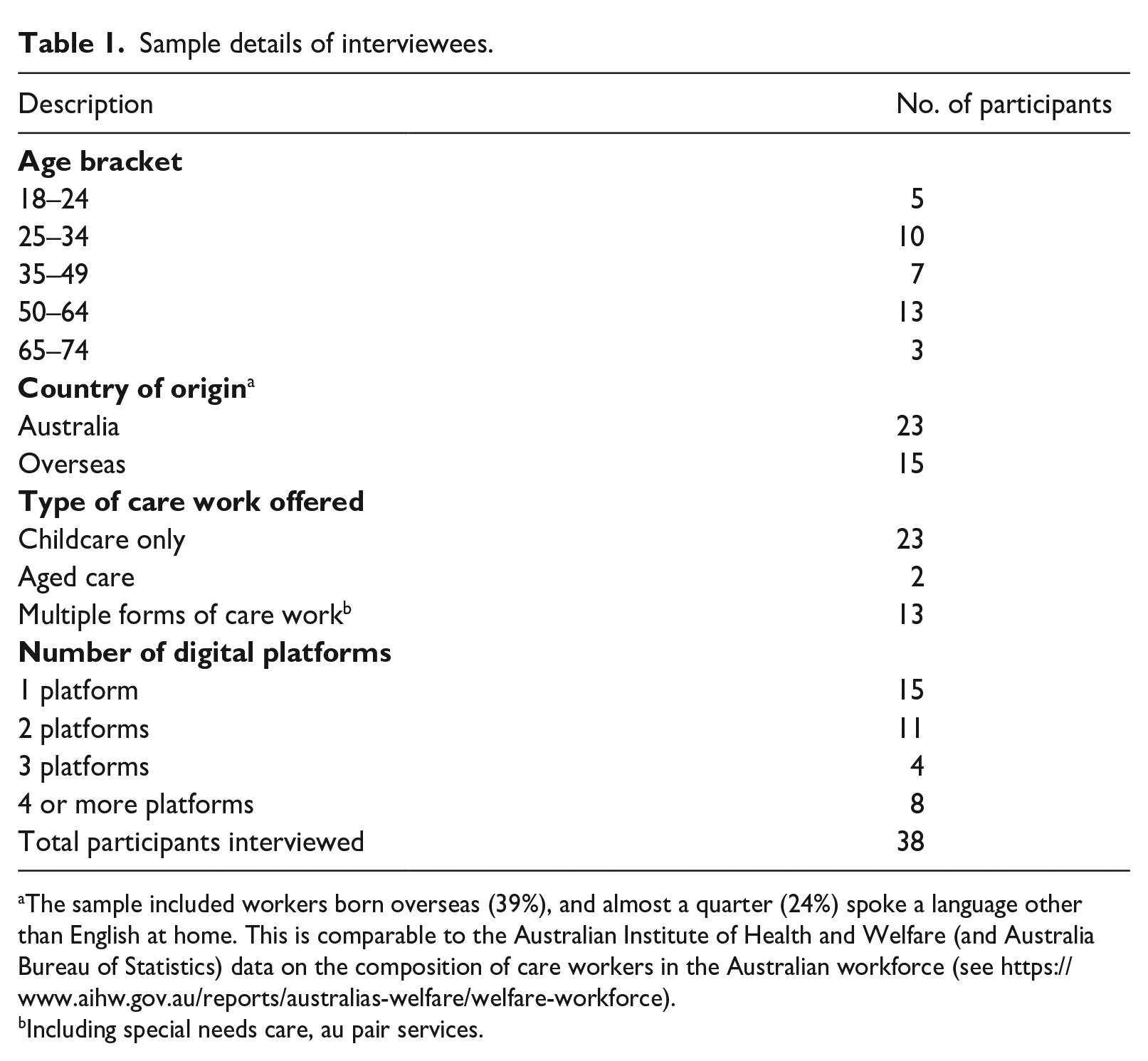
The sample included workers born overseas (39%), and almost a quarter (24%) spoke a language other than English at home. This is comparable to the Australian Institute of Health and Welfare (and Australia Bureau of Statistics) data on the composition of care workers in the Australian workforce (see https://www.aihw.gov.au/reports/australias-welfare/welfare-workforce).
Including special needs care, au pair services.
Data analysis
The transcribed interviews were analysed in three sequential stages. First, a template analysis (King and Brooks, 2017) was undertaken, which involved flexible open coding of the lived experience of carers against a priori elements, such as established dimensions of decent work – that is, creating jobs, guaranteeing rights, social dialogue and social protection (ILO, 2018) – and salient micro-social elements (Pereira et al., 2019) to identify how they emerged in the carers’ accounts. Second, the open-coding template was organized into dominant clusters and patterns reflecting carers’ experiences and perspectives. During this stage, the prevalence of relational aspects and the importance of social interactions emerged as dominant factors that shaped the carers’ experiences. Established decent work standards, such as access to work or rights, emerged as secondary elements relative to the interplay of relational elements in social interactions within the context of carers’ specific situations. Consequently, ethics of care was adopted as an appropriate theoretical lens for sense-making and deeper analysis to understand the granular relational aspects evident in social interactions such as trust, respect or responsiveness identified in the carers’ accounts. Using this lens, the interviews were re-analysed to identify higher-order themes that explained the relational aspects emerging in carer accounts and the associated implications for understanding decent work (Braun and Clarke, 2019). This methodological approach enabled a contextual-constructivist analysis, explicating that interpretation and meaning-making of people’s experiences in relation to the a priori elements depended on their social context, interactions and subjectivities (King and Brooks, 2017).
Findings
Detailed below, three overarching and interrelated relational themes emerged from the analysis of the carers’ accounts; that is, mutuality of interests, responsiveness and reciprocity and attentiveness and solidarity. These themes illustrate how relationality shaped carers’ experiences of platform-mediated care work, indicating the importance of relational dimensions in examining interpretations of decent work.
Theme 1 – mutuality of interests
Our analysis identified a perception of mutuality of interests premised on self-interests and a recognition of the needs and requirements of others as an important and distinguishable relational dimension for carers in platform-mediated care work. The data illustrated that platforms facilitate heterogenous care work arrangements, which in turn situate the carer at the centre of a complex array of interactions that occur with platforms, with care-seekers via platforms and with care-seekers directly. While platforms have been argued to expand the labour market by offering ‘on demand’ and flexible work opportunities to platform workers (Lehdonvirta, 2018; Shapiro, 2018), the data indicated that platform-mediated care work was not instantaneous (like Uber) or purely controlled by the platform, instead requiring carers to initiate a multi-stage process that involved connecting and following up with care-seekers to receive the work. In contrast to platform-mediated ride-hailing or food delivery, where access to work is often determined by an algorithmic function (Jarrahi et al., 2020; Wood et al., 2019), in platform-mediated care work, ‘matching’ carers and care-seekers via algorithms was merely an early step in a series of interactions. Within these stages of interaction, relational elements such as mutual recognition of needs and alignment of priorities shaped the carer’s experience. As illustrated below, recognition of mutual priorities and a sensitivity to concerns and needs were established early on through contact via the platform, outlining task expectations and availability:
I applied for the job and they [care-seeker] messaged me on [CarePlatform] and said that they were interested and if I’d be available on the dates that they needed, and I said, yes, I’m available and they just asked me to confirm my hourly rate and things. Then I just asked what would be required of me; if I would have to make the kids’ dinner and things like that and they just explained. Then they asked if they could call me, and so we called and had a phone conversation. (CW#18_F [19 yrs])
A sensitivity to a mutuality of interests was more pronounced during in-person interactions. Carers were cognizant of the tension between their self-interest of wanting work suited to their needs and recognition of care-seekers’ concerns about ‘fit’ and related wellbeing of the care-recipient, which extended to interaction with the recipient of care services (care-for-others). Simultaneously, they highlighted a need to maintain a self-interest and protect themselves from an ill-fitting work arrangement or unsafe environment (care-for-self). By emphasizing affective ties, ‘reaction’ and rapport as critical in their interactions, carers determined how considerations of individual vulnerability and dependency on care-seekers (Alacovska and Bissonnette, 2021; Laaser and Bolton, 2017; Palmer and Stoll, 2011) factored into their willingness to take on particular platform-mediated care work:
Certainly, when they’re interviewing me, they may or may not realize, but I’m also interviewing them. I’m trying to make sure that they, that I think they’re the right fit for me. (CW#06_M [59 yrs]) I like to meet their children too. That’s the thing. Just – how the children will react around me. What they think of me and how – I really like to know how the children react towards me and I like to get to know them a little bit. (CW#14_F [58 yrs])
Assumptions about the purely transactional nature of gig work were challenged by the relational dimensions underpinning platform-mediated care work; for example, carers emphasized the importance of interpersonal dependencies and the need to cultivate a connection or ‘build a relationship’ (CW#02 [21 yrs]) with care-seekers. Relational aspects such as affect, trust, concern and dependency evident during interactions with care-seekers (Sevenhuijsen, 2003) sensitized carers to an alignment of interests and informed how they perceived platform-mediated care work.
This theme demonstrated how relationality premised on tenets such as a mutual recognition and acknowledgement of needs, interests and affectivities (Alacovska and Bissonnette, 2021; Sevenhuijsen, 2003) is enmeshed in the interactions between carers and care-seekers. These tenets influence how carers experience platform-mediated care work.
Theme 2 – responsiveness and reciprocity
Relational elements such as mutual responsiveness and reciprocity also emerged in carers’ accounts as integral in shaping their experience of platform-mediated work. Distinct from recognizing a mutuality of interests in taking on work, this theme highlights that relationality influenced how conditions of work were negotiated by carers through interactions with care-seekers directly and via digital platforms. Evaluations of poor and harmful work conditions in the gig economy reflect a lack of basic protections, low wage rates, and a lack of social protection or entitlements often attributed to platforms’ design features (Graham et al., 2020; Heeks et al., 2021; Shapiro, 2018). The insights from carers highlighted that relationality and individual considerations also contribute to shaping favourable and unfavourable perceptions of platform-mediated care-work arrangements.
In contrast with other platform-mediated work (e.g. UberEats or DoorDash) (Veen et al., 2020), carers specified their own price point, which required acceptance from the care-seeker rather than the platform, adding a further layer of complexity in negotiations prior to commencing work. As illustrated below, carers emphasized care-for-self by factoring in their own costs and other individual preferences when deciding a rate they perceived as fair. It is notable that responsiveness from care-seekers and being unable to agree on an acceptable wage for caring activities was cited as a reason why carers decided not to take on work, indicating that mutual interdependency shaped their experiences of work:
Yeah, I tend to look at the rate and what they want . . . even though I do rely heavily on this money, I do draw the line. I’ll go, hang on a minute, you want me to make the kids their meal . . . blah blah blah, and you’re only going to give me $15. I think, no, it’s not worth it. It’s not worth me driving there for two to three hours to do that for $15. (CW#34_F [52 yrs])
Carers attempted to foster favourable work arrangements through relational considerations, in some situations negating misconceptions of care work as purely altruistic and self-sacrificing (Pettersen, 2011) by practising care-for-self through maintaining their self-interest and supporting self-determination in interactions with care-seekers (Sevenhuijsen, 2003). Carers valued and gave importance to relationships premised on reciprocity and mutual responsiveness when negotiating working arrangements. This was reinforced in accounts where carers lowered their asking rate for care-seekers. Relational aspects such as concern-for-others in the form of empathy and compassion interplayed with responsiveness in the form of positive connection and rapport with the care-seekers. Hamington (2015) explains that care as a practice is mobilized in situ where there is an interaction between the interests and needs of individuals involved in a relationship. Carers made value judgements about care-seekers and their ability to pay the higher asking price, consequently making concessions to help ease the financial burden on care-seekers, practising care-for-others. As argued by Held (2006), persons are affected and influenced by their social ties, moral dispositions and values, which arguably influence how they partake in economic arrangements:
I have been told, ‘Oh, why do you only charge so cheap? Is there something wrong?’. I go, ‘No, I believe some families are struggling’. (CW#14_F [58 yrs]) You’re in this like a middle – just a normal home and you can tell things are a bit tight. I think it’s more than reasonable to be $25 an hour. Even for them it’s a stretch. It’s a lot of money they’re sending you. (CW#25_F [25 yrs]) So, it really depends on the sense I get from people as well. Sometimes I’ve had people that have just kind of said, I really can’t fit you into my budget, but I’d love to have you. I’ve kind of thought, okay, maybe just for this one. But it’s usually for a short stint rather than something longer or more hours than normal. (CW#17_F [34 yrs])
Carers emphasized they perceived negotiating for work as a ‘private’ matter between them and the care-seekers, privileging the importance of mutually responsive relationships, fostering bonds and sensitivity to their (and others’) needs in shaping their responses to negotiating arrangements of platform-mediated care work. This theme demonstrates how the relational tenets of perceived reciprocity and mutual responsiveness informed how carers attributed meanings of decency and fairness in balancing care-for-self and care-for-others when negotiating work arrangements and undertaking platform-mediated care work.
Theme 3 – attentiveness and solidarity
Attentiveness, solidarity and affectivity were also emphasized by carers as important relational dimensions in platform-mediated care work. Challenging assumptions that platform-mediated work lacks authentic attachment due to its short-term, fungible and temporary nature (Sutherland et al., 2020; Wood et al., 2019), this theme illustrates how relationality can have a critical and transformative influence on the experience of platform-mediated work. Carers highlighted how they were deeply entangled in their work environments, where interdependencies derived from their relationships manifested as interlaced self-interests, rights, responsibilities and vulnerabilities (Kittay, 2015). The quotes below demonstrate how carers navigated between care-for-self and care-for-others through attentiveness to their interests and the needs, wellbeing and welfare of the care-seekers. This encompassed a recognition of blurred boundaries between self-serving aspects, such as a desire to ‘want to be with children’ (CW#23 [59 yrs]) or reminding care-seekers to pay them, and other-serving aspects, such as attentiveness to care-seekers’ discomfort around caring needs:
I do the washing and stuff, but I don’t let the parent have the expectation that that is what I’m there for. It’s a fine line. I want to be with the children; I don’t want to be doing the washing, cleaning, cooking, ironing. (CW#23_F [59 yrs]) It’s just because nannying is an intimate job; I’m in their home and they’re trusting me with the life of their kid. It’s like, I fold their undies, stuff like that, and I think, at least for a lot of parents, they don’t really want to feel like they’re paying someone to take their kid or paying someone to do their chores for them. So, I find sometimes it’ll be a bit weird when the parent hands me cash, or like, she’ll get a bit funny, when she’s like, ‘Did I send you money for the other day?’. Stuff like that. It’s a bit weird. So, I feel a bit uncomfortable reminding them that I’m your employee and you’re my employer. (CW#02 [21 yrs])
Importantly, this theme signifies that carers were not emotionally or affectively unencumbered from the contexts they operated in; they were influenced by relationships and actively avoided confrontation that may disrupt the social ties they had cultivated with the care-seekers. Pettersen (2011) proposes that relational and affective considerations for others impinge upon workers’ willingness to address differences that may divide them. This was more pronounced in situations where carers felt an imbalance in their concern and attentiveness to the needs of care-seekers, exposing them to exploitation and vulnerability (FitzGerald, 2020). Platform-mediated work in sectors like ride-hailing (Uber, Lyft or Ola) also encompasses exploitive aspects of relationality through an uneven reliance on positive interactions when performing the work to elicit high ratings or good reviews from customers (McDonald et al., 2021; Wood et al., 2019). A practice of care in social interactions and relationships can degenerate into unfairness or injustice where there is a lack of underlying mutuality, trust, respect and affectivity (Held, 2006), resulting in workers tolerating work arrangements they were uncomfortable with, found ‘off putting’ (CW#37 [37 yrs]) or perceived as unfavourable, unsatisfactory and indecent.
Carers emphasized positive relational dimensions as the anchor tying them to remain in work or seek the same care-seekers for future work, whereas negative experiences and adverse interactions with care-seekers led them to opt out or terminate the arrangement in some instances. In other situations, negative relational interactions led to carers avoiding future work with the same care-seekers (‘if you’re working for a grumpy family, it’s just a nightmare’) (CW#25_F [25 yrs]), although they temporarily accepted work arrangements they perceived as unfavourable. As evidenced in the carer’s experience below, where attentiveness to the needs of others and a concern for their wellbeing was not met with mutual responsiveness and respect (FitzGerald, 2020; Kittay, 2015), the work arrangement was perceived negatively:
So sometimes, she would come across quite short and strict. Obviously, I’m just trying to be friends with everyone. So, I’m obviously like, yep, yep, totally cool, that’s fine, and I’d just make sure to be extra careful with her so I wouldn’t upset her in any way. Sometimes you just have to be really nice, but I think if she’d ever gotten angry at me or raised her voice or something of the sort, I definitely would have just gotten out of there straightaway. She was just not a very nice lady sometimes. (CW#02_F [21 yrs])
In contrast, feeling valued or appreciated and being able to manifest solidarity with care-seekers and care-recipients (Alacovska and Bissonnette, 2021; Sevenhuijsen, 2003) served as a gauge of a good and decent experience of care work. As illustrated below by CW#02 [21 yrs] and CW#33_F [56 yrs], a solidaristic concern for the welfare of care-seekers (‘care about the families’) and carers’ ability to contribute to their wellbeing (‘do the best I can for them’), shaped carers’ perceptions of platform-mediated care work as work they ‘love’:
I’ve had people, parents say that [you’re like family] to me, and it means a lot because I care so much about the kids that I look after, and I care about the families and I want to do the best I can for them. (CW#02_F [21 yrs]) Yeah, it’s been a very poor career choice. But I love the work that I do. I love being the wind beneath people’s wings. (CW#33_F [56 yrs])
This theme highlights that platform-mediated care work was more than an outcome of paid labour for carers (Sevenhuijsen, 2003). A care-based approach to work recognizes that workers respond with more sensitivity to the needs of others with whom they establish a connection, share interests and have solidaristic ties, or alternatively they seek to maintain self-interests as best as possible within their circumstances of work (Held, 2006; Tassinari and Maccarrone, 2020). The relational dimensions enmeshed in interactions between carers and care-seekers shaped carers’ perceptions of how they had constructed the most favourable arrangements for themselves by balancing care-for-self with care-for-others, including trading off positive relational experiences against lower wages or conversely temporarily working in arrangements where they described the relational experience as negative.
Discussion and conclusion
This article focused on examining the lived experiences and perspectives of care workers using digital platforms. First, the insights generated from this study contribute knowledge from an underexplored empirical context offering platform-mediated work and can inform our understanding of decent work across broader contexts of the gig economy. Second, through the findings, we explicate how carers navigated a complex array of relational interactions with platforms and platform end-users and attempted to balance their self-interest (care-for-self) with concern for the wellbeing and welfare of care-seekers and care recipients (care-for-others) in platform-mediated care work. In doing so, this article extends the scholarship on decent work in the gig economy by illustrating how relationality and interdependence shape workers’ experiences of gig work. These findings, therefore, offer a deeper understanding of decent work interpretations in the gig economy beyond evaluations against baseline standards and minimum entitlements, by focusing on the subjective and nuanced interplay of workers’ expectations and interactions in platform-mediated work. Finally, the approach adopted in this article suggests the salience of relationality in all forms of work arrangements (Tronto, 1993), such as interactions between manager–workers, between colleagues or with clients (Pettersen, 2011). That is, the interplay of relational aspects such as mutuality of interests, responsiveness and reciprocity, attentiveness and solidarity in work relationships, as illustrated in this study, can contribute to understanding meanings of flourishing, dignity, fairness and justice (Held, 2006; Sevenhuijsen, 2003) and can shape workers’ perceptions of what is considered to be good, favourable, fair or decent work (Gibb and Ishaq, 2020; Pereira et al., 2019).
Within the context of platform-mediated work arrangements, prior research has presented relational ties between worker–platform and worker–client as mostly transactional, superficial or performative (Alacovska et al., 2022; Myhill et al., 2021). Our study, on the other hand, has demonstrated that relationality is a core tenet of in-person platform-mediated work, particularly where the worker is required to interact with the client. We provided a rich illustration of how relationality and the interplay between networks of relationships, social responsibilities and self-interest shaped workers’ experiences of platform-mediated care work. Care workers went beyond considerations of remuneration or social protection and emphasized affective ties, rapport and responsiveness as motivators to engage in frequent or long-term work arrangements with particular care-seekers or families. Conversely, where there was a lack of care received from care-seekers in the form of reciprocity, mutuality and cultivation of relationships, workers terminated social ties and exited the work arrangements, or opted to temporarily remain in situations where they had negative relational experiences but were cognizant of their vulnerable position in an unfavourable work arrangement. In this way, the study offers an additional lens to analysing work conditions in the gig economy by producing a richer understanding of hidden relational aspects associated with platform-mediated work, which adds to the vocabulary of work conditions in decent work debates. For example, this lens can be applied when interrogating decent work in other sectors of the gig economy, as all platform-mediated work is likely to comprise relational interactions between stakeholders with overlapping and competing interests, such as interactions between Uber drivers and customers, quality of gig work completed by cloud workers or how delivery riders elicit positive customer ratings.
Previous studies on decent work in the gig economy have vividly demonstrated the impact of platform design features, control mechanisms and algorithmic management in creating problematic work conditions, fostering precarity and vulnerability for platform workers (Galière, 2020; Jarrahi et al., 2020; Schaupp, 2022). In response, platform workers have begun to offer resistance through new forms of collective and individual expressions of solidarity and agentic behaviour, particularly where institutional or regulatory protection is inadequate (Heiland and Schaupp, 2021; Tassinari and Maccarrone, 2020). This article makes visible the nuances of how relational aspects in platform-mediated work can inform the ways in which platform workers engage in, negotiate or even resist work arrangements to maintain their individual interests (care-for-self), even in the absence of organized solidarity from other workers. Applying a care-based approach does not discount the influence of the social and political systems and discourses within which work emerges (Held, 2006; Pettersen, 2011). Workers may indeed accept or succumb to unfavourable and unsatisfactory work arrangements as indicated in the data, either due to a lack of alternative work options or unwillingness to confront care-seekers, suggesting the potential for ongoing imbalances between care-for-self and care-for-others. This points to a need to explore how and when relationality can contribute to precarity and exploitation in work arrangements in the gig economy. Nevertheless, this article provides insights that establish relationality as a key consideration when analysing perceptions of fairness, justice and decency in work arrangements.
This study focused on the worker experience by examining the relational interactions with care-seekers; however, the insights gleaned from their experience do not preclude the role of platforms in shaping social and relational dynamics. Much of the extant literature emphasizes the need to regulate and monitor digital platforms to improve conditions in the gig economy, often premised on macro-level interpretations and assumptions that platform workers perceive decent work through the frames of economic independence, entitlements and protections (FitzGerald, 2020; Galière, 2020; Gilligan, 2014). This study demonstrates that alongside fairness of platform design and control mechanisms, relationality must also be considered in evaluations and interpretations of rights, obligations, responsibilities and benefits as they relate to creating decent work within platform-mediated work arrangements. The insights gleaned from this article can be a stimulus for platforms to introduce mechanisms to support and nurture mutually beneficial relationships between workers and end-users, which will ultimately help maintain the supply and demand of workers and end-users on platforms (Williams et al., 2021).
Moreover, a relational perspective towards understanding decent work in the gig economy can also influence the debate on regulations, legislative policy and governance. Where the intent of legislation is to create fairness and decency of work in the gig economy – often through establishing baseline standards and protection benchmarks – this study draws attention to the need to expand regulatory policy to encompass relational dimensions through a consideration of the negotiation of work between platform workers and platform end-users. This could have implications for understanding how to govern discrimination and exploitative or unfair treatment of platform workers for work in private settings. The insights derived from an ethics of care lens foreground how the formation of bonds and cultivation of relationships take precedence in ways that are worthy of exploration in other sectors for a richer understanding of the platform worker’s relational experience. Further examination of the intersections of relational dimensions with class-based, gendered or racialized perspectives (Raval and Dourish, 2016; Van Doorn, 2017) could offer a more nuanced understanding of social dynamics and relationships across contexts and their influence on understanding decent work in the gig economy, particularly in global contexts where there is a heightened connection between social norms, cultural and political discourse on social dynamics and interactions in labour relations (Komarraju et al., 2022; Raval and Pal, 2019).
Lastly, the insights drawn from the domestic care sector, a historically devalued and marginalized context rife with poor working conditions (Baines et al., 2022; Banks, 2018; Charlesworth and Malone, 2017), bring into focus the importance of considering relational aspects when interrogating the complex experiences of workers and the associated decent work implications. Drawing on care-based tenets (care-for-self and care-for-others) to interpret the experience of agency, dignity and flourishing in platform-mediated care work offers an additional lens to explore and challenge the systemic devaluation and invisibilization of care workers in traditional sectors. The contributions from this article are a timely addition to the emerging literature in the gig economy focusing on social and labour relationships within platform-mediated work (Alacovska et al., 2022; Franke and Pulignano, 2021; Posada, 2022) and demonstrate the potential of a relational approach for future research into other industries to understand the complexity of work emerging from networks of relationships.
Footnotes
Funding
The authors disclosed receipt of the following financial support for the research, authorship, and/or publication of this article: This research was funded by an Australian Resarch Council Discovery Grant DP180101191.
