



Abstract
This article explores men’s psychic attachments to organisational masculinities in the context of gender equality initiatives in the UK finance sector. Deploying an object-relations psychoanalysis and generating interview data with 30 male executives and non-executives, it unpacks why and how men outwardly support but unconsciously repudiate workplace gender equality. We explain how this conflict indicates the presence of what Melanie Klein terms the paranoid-schizoid position. We examine two key unconscious processes of the paranoid-schizoid position in men’s accounts: gender-splitting, when men dissociate undesirable aspects of organisational masculinity, and projection, when repressed, negative parts of their masculine ideals are instead attributed to women. This article’s contributions demonstrate how the paranoid-schizoid position is defensive, enabling men to articulate support for gender equality, but also protect paranoid constructions of organisational masculinity when it is threatened by women. Empirically and theoretically, this article shows how organisational masculinities are ambivalent, which in Kleinian terms underscores how masculinity has ‘good’ and ‘bad’ components that are constituted unconsciously through its relationship with the object world. This article concludes by drawing out the implications for (re)positioning men within workplace gender equality debates and activities.
Keywords
Introduction
Drawing on psychoanalytic object-relations theory, this article examines the psychic components of men’s attachments to organisational masculinities, demonstrating how men defend their position in the context of gender equality workplace initiatives in the UK financial services industry. The issue of men’s position in gender equality and how men’s practices in organisations reproduce gender inequalities that disadvantage women has long occupied pro-feminist and feminist organisational scholarship (Acker, 1990; Bleijenbergh, 2018, 2022; Colley et al., 2021; Sherf et al., 2017; Williamson, 2020). This literature has repeatedly evidenced how and why men can ignore, resist and undermine gender equality programmes. Men have been shown to be ‘gender blind’, where they do not recognise gender inequality or acknowledge and critique their own gender privilege (Acker, 1990; Ainsworth et al., 2010), or where they do recognise gender inequality, they can choose to ignore it (Williamson, 2020). Additionally, research indicates that men can deny gender inequality as a serious workplace problem or actively seek to disrupt and undermine gender equality initiatives (Flood et al., 2018; Williamson, 2020). This has fuelled concerns among gender scholars about how and why men are the ‘missing ingredient’ in gender equality initiatives, and whether men are able to change and participate fully in eradicating gender inequality in the workplace (Smith and Johnson, 2020). Thus, debates about engaging men in gender equality and, potentially, with feminism both politically and theoretically, are well underway (Flood and Howson, 2015; Sweetman, 2013; Tienari and Taylor, 2019).
Notably, men’s actual contributions to gender equality projects in the workplace appear to be inconsistent and uneven (Bjørnholt, 2011; Levtov et al., 2014; Scambor et al., 2014). If men are to be (re)positioned in gender equality initiatives in ways that support the eradication of gendered inequalities in organisations, ongoing research is required that examines why men adopt specific positions on the equality gains made by some women, particularly within industries and organisations that are renowned for privileging men, organisational masculinities and men’s practices. Research associated with the critical study of masculinities and organisations, which draws deeply on feminist theories, has over the last three decades or so critiqued men, masculinity and men’s practices in the workplace, in particular how they reproduce gender inequalities (Connell, 2005, 2006; Hearn, 2004: Kerfoot and Knights, 1993). This scholarship has sought to ‘name men as men’ (Collinson and Hearn, 1994), which calls out and interrogates men in the workplace as gendered subjects, whose gender privilege warrants sustained critique. As such, we understand organisations as sites of gendered power relations that reproduce masculinities, which are referred to as organisational masculinities throughout this article.
Prior studies have shown how the gendered dynamics of the financial services sector have privileged organisational masculinities characterised as competitive, paternalistic, controlling and aggressive, which have reproduced gender inequalities that primarily disadvantage women (Baeckström, 2022; Figlio, 2011; Griffin, 2013; Kerfoot and Knights, 1993; Knights and Tullberg, 2012). Accountancy and gender research has painted a similar picture, problematising how men’s practices such as presentism and hyper-masculine work cultures create and sustain gender inequalities (Khalifa, 2013; Kornberger et al., 2010; Spence and Carter, 2014). The accounting industry specifically is facing significant challenges in maintaining its workforce, with up to half of newly trained accountants leaving within their first year (ICAEW Insights, 2023). Addressing this, some accountancy organisations and the financial services sector more widely have implemented gender equality initiatives, especially those that have aimed to improve work–life balance, flexible working conditions, cultivate diverse and inclusion work environments, and eradicate the gendered pay gap (ICAEW Insights, 2023). However, there have been significant challenges implementing them owing, in part, to the dominance of men and men’s practices that sustain men’s gender privilege and power (Baeckström, 2022; Khalifa, 2013; Kornberger et al., 2010).
Although the research cited above acknowledges that organisational masculinities can hinder gender equality in the financial services sector, few studies in this domain have provided insights into the ontological challenges men face when they unpack how and why they belong to the hegemonic social category of ‘men’ (Hearn, 2004, 2014), and how they may be mobilised to pursue gender equality. A small volume of organisational literature has sought to explain and reflect on how men can experience fear, defensiveness, depression, anger and frustration in how they tackle their own gender privilege (Bleijenbergh, 2018; Hearn, 2014; Styhre and Tienari, 2013; Tienari and Taylor, 2019). However, this research does not produce detailed analyses of the types of internal positions men adopt and why, as may be apparent in how men discuss women and gender (in)equality in the workplace. Raising important questions about how the role of the unconscious shapes men’s positions in gender (in)equality and their attachments to organisational masculinities, psychoanalytic theory has started to shed light on these issues, in particular how specific organisational masculinities are internally contradictory and in tension (Figlio, 2011; Morante, 2010; Stein, 2013).
Analytically, we mobilise concepts from Klein’s (1946) psychoanalytic object-relations theory to examine how the unconscious shapes men’s attachments to organisational masculinities. Understanding how men unconsciously become attached themselves to objects, which can assume different forms (e.g. people, concepts, bodies), we demonstrate how men can adopt what Klein terms a paranoid-schizoid position, that being an array of anxieties, defences and a splitting of the self and objects as ‘good’ and ‘bad’. Combining such psychoanalytic insights with the interview data gathered from 30 men employed in UK financial services, which explored their views about women and gender (in)equality workplace initiatives, we provide detailed analysis of how men adopt the paranoid-schizoid position when talking about gender equality, and what this tells us about their unconscious attachments to organisational masculinity. In so doing, we can understand how and why men conceal emotional ‘threats’ to their internal representation or self-image of themselves as men in organisational contexts.
This article contributes to extant organisational research on men and masculinities by examining the role of the unconscious in how men respond to gender equality in the financial services by re-forming attachments to masculinities that reproduce gender inequalities. Specifically, using Kleinian object-relations theory, the analysis sections explore how and why men adopt a paranoid-schizoid position and the organisational masculinities shaped by this position. This primarily builds on prior psychoanalytic research on organisational men and masculinities in the financial services (Figlio, 2011; Morante, 2010; Stein, 2013), by demonstrating how and why men appear to support women and gender equality in the workplace but go on to repudiate them. This contradiction cannot be fully explained discursively as it indicates a conflict within the psyche that requires an exploration of the role of the unconscious in the construction of organisational masculinities. Theoretically, this article contributes to an understanding of organisational masculinity as ambivalent, which in Kleinian terms forces attention on how masculinity has ‘good’ and ‘bad’ components that are constituted unconsciously through its relationship with the object world.
This article is structured as follows. First, we review the literature that has theorised organisational men, masculinities and men’s practices in the financial services, before outlining the theoretical insights this article derives from Kleinian object-relations psychoanalysis. The methodology section is then presented, followed by two empirical sections, organised around the psych-biographies of our study participants. The discussion section outlines the study’s principal empirical and theoretical contributions, while the conclusion flags avenues for future research.
Theorising organisational masculinities and men’s practices in the financial services
Over the last four decades or so, a commanding literature has been produced regarding men, organisational masculinities and men’s practices deploying an array of feminist and pro-feminist perspectives (Collinson and Hearn, 1994; Connell, 1995, 2005; Flood and Pease, 2005; Giazitzoglu and Muzio, 2021; Hearn, 2004; Kerfoot and Knights, 1993; Knights and McCabe, 2001). Theorising the hegemony of men, masculinities and men’s practices, Connell’s (1987, 1995: 77) seminal concept of ‘hegemonic masculinity’ has been profoundly influential, partly because it has theorised masculinity as a ‘gender practice’ that can shift over time and place, reproducing patriarchal gender relations that sustain the ‘dominant position of men and the subordination of women’. Acknowledging Connell’s work in this area but critiquing hegemonic masculinity for its inflexibility and imprecise meanings when applied in organisational analysis (Collinson and Hearn, 1996), some scholars have combined insights from feminism and poststructuralism to interrogate the sociocultural construction of organisational men and masculinities as discursive provisional social categories (Collinson and Hearn, 1994; Kerfoot and Knights, 1993). As in Connell’s (1995) approach, poststructuralist perspectives on organisational masculinities contest essentialist perspectives that treat masculinity as the ‘natural’ and fixed property of men, but differ in how they assign language a constitutive value, in how it constructs gender as an effect of discourse (Kerfoot and Knights, 1993). This article is partly aligned with a poststructuralist conceptualisation of masculinity since it directs attention to men’s gendered subjectivities as ambiguous, discontinuous, multiple and marked by internal contradictions (Collinson and Hearn, 1996). From this perspective, men’s gendered subjectivities are linked to gendered power relations in organisations, highlighting the symbolic and material differences through which gender relations are reproduced and sustained.
The financial services industry has attracted sustained attention from scholars of organisational masculinities (Griffin, 2013; Hodgson, 2003; Kerfoot and Knights, 1993; Knights and Tullberg, 2012). Foregoing gender analyses have demonstrated how the knowledge, qualities and behaviours deemed as essential, to be successful within this industry, are closely tethered to organisational masculinities that are characterised as competitive, paternalistic, controlling, rational and aggressive (Hodgson, 2003; Kerfoot and Knights, 1993; McDowell and Court, 1994). Kerfoot and Knight’s (1993) study of organisational masculinities in the UK financial services industry exposed this link, identifying ‘competitive’ and ‘paternalistic’ modes of masculinity that had become privileged, which elevated men over women, and those men who embodied these masculinities over the men who did not. Likewise, Hodgson’s (2003) study of a UK life assurance institution specified how masculine identities associated with autonomy and self-reliance were promoted and reproduced, reinforcing men’s organisational hegemony. However, these masculinities were shown to exist in tension and to be internally contradictory, as some men felt isolated and vulnerable to workplace mechanisms of control, relying heavily on line managers for security and affirmation of their identities as successful salesmen. Similarly, Knights and Tullberg’s (2012) gendered analysis of the global financial crisis sheds light on men’s insecurities around organisational masculinities, which are said to structure how financial organisations were mismanaged, with catastrophic economic effects.
Accountancy and gender research has also problematised the privileging of men and organisational masculinities that sustain gender inequalities (Haynes, 2017; Khalifa, 2013; Kornberger et al., 2010). Kornberger et al. (2010) analysed the impact of a new flexibility programme, ‘Sky Accounting’, on women. The initiative reinforced gender biases because those who participated were perceived as less career-committed, leaving work practices coded as masculine. Khalifa (2013) shed light on the ‘macho’ culture of accountancy where certain specialisms are seen as less valuable and deemed appropriate accounting careers for women. For example, personal tax was viewed as the ‘mummy track’ because it required less hours and commitment than other specialisms.
Baker and Brewis (2020) examined the psychological impact of masculine accounting structures on women as melancholia or depression that stem from a realisation that the profession’s promise of a successful career that balances personal and professional life is unattainable. Faced with fewer career options, women were compelled to adopt certain roles that supported these masculine structures, such as the ‘dumb blonde’ role, to build relationships with clients (see Bitbol-Saba and Dambrin, 2019). Spence and Carter (2014) have argued that subtler forms of gender segregation pervade accountancy through the expectation that to make partner value is placed on financial logics and selling work to clients. They suggest that men who may pose a risk of engaging in sexual harassment can still ascend to the highest ranks, even reaching partner, as long as they sell work to clients.
While this literature has provided insights into the interplay between organisational masculinities and men’s practices in the financial services and accounting sector specifically, much of it tends not to encompass specific issues associated with how men have responded to women’s advancements in the sector. Specifically, it does not address the internal anxieties and defences that are generated as a response to action taken within the UK financial services to improve gender equality. Yet, as this article reveals, this focal point of analysis can demonstrate how and why men may defend and/or repudiate organisational masculinities that may not only reinforce men’s practices that derail gender equality, but also confirm the position of men within financial services organisations as ‘natural’. Thus, a theoretical shortcoming in organisational poststructuralist gender analyses is apparent; namely, the neglect of the structure and processes of the psyche in the discursive constitution of relations between men and masculinities (Gough, 2004; Holmes, 2012). The next section develops the theoretical frame deployed in this article along these lines.
Men, masculinities, organisations and object-relations psychoanalytic theory
In line with other scholars of psychoanalysis and masculinity (Figlio, 2011, 2024; Gough, 2004), we emphasise an unconscious dimension to organisational masculinities to help understand how and why men attach themselves to masculinities that are implicated in reproducing gender inequalities. One advantage of this is that it can account for the psychic life of organisational men and masculinities, observable in a ‘defensive sense of superiority through the splitting of the ego’ (Figlio, 2011: 36). Within this, idealisation of the self is sustained through the projection of undesirable traits or ‘bad’ objects from one’s ego. Understanding these unconscious processes can help explain why men form certain attachments to organisational masculinities that can harm women (and some other men), and how these can be reformed so they are compatible with gender equality.
Psychoanalytic theory remains underutilised as a resource for organisational scholars of men and masculinities. One reason for this is that psychoanalytical theories of organisations have rarely examined gender (Lowe et al., 2002), although some scholars have taken steps to address this (Fotaki and Harding, 2013; Vachhani, 2012). Notably, a small body of psychoanalytically inspired scholarship has explored the interconnections between men, masculinities and organisations within the finance and accounting sector. Figlio (2011) argues that the 2008 global financial crisis was, in part, the result of a form of greed derived from the unconscious masculine phallus, which fuelled a greater hunger for ‘good’ objects to alleviate internalised trauma. Morante (2010) terms this a ‘psychic retreat’ from reality, where bankers and the public colluded in an illusion of an expansive market of everlasting wealth and home ownership. Stein (2013) analyses the role of Dick Fuld’s narcissism as CEO in the collapse of Lehman Brothers pointing out that widespread omnipotence and aggression meant that key warnings and breaches of conduct were ignored as they could not be challenged, for fear of being understood as personal attacks on Fuld. Eddington et al. (2023) argue that online manosphere spaces are deeply affective, focused on men reasserting traditional ‘idealised’ masculinities and privileges. They provide men with a discourse to articulate and, psychoanalytically, project their anger at feminists who are perceived as the cause of their disenfranchisement.
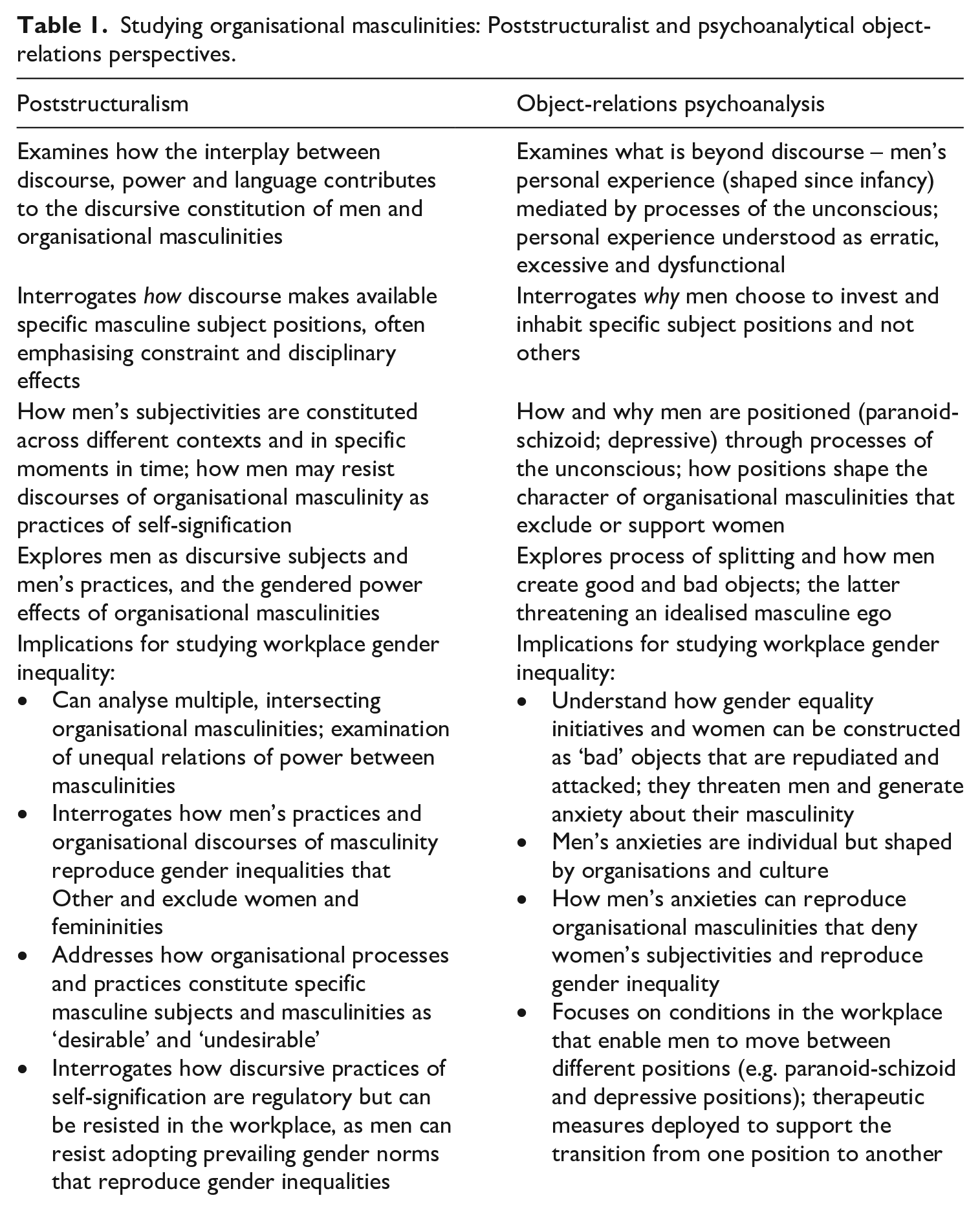
Taken together, these psychoanalytical insights can help to explain why certain men hold attachments to distinct organisational masculinities within specific work contexts and under particular circumstances, and how they are worked through internally in sometimes ‘eccentric, erratic or excessive’ ways (Frosh, 1999: 382). Crucially, psychoanalytical theories can address some of the limitations of popular sociological and poststructuralist inspired analyses of men, masculinities and organisations (see Table 1). For example, Gough (2004) points out that poststructuralist theories rely on discourse and discursive positions that men adopt and are located within, but they fail to explain the structure and processes of the psyche. Here, then, psychoanalytic theory is ontologically distinct and advantageous, because it recognises the role of the unconscious in how men attempt to present themselves and their practices in the workplace as rational. In this article, Kleinian psychoanalytic theory interrogates what appear to be fixed and stable attachments to organisational masculinities that privilege self-sufficiency and autonomy, when they may in fact be forms of defence against feelings of vulnerability, and internal fragility (Frosh, 1999).
Studying organisational masculinities: Poststructuralist and psychoanalytical object-relations perspectives.
Object-relations in psychoanalytic theory
To understand the role of psychoanalysis in the examination of men’s responses to issues of gender equality, we draw on object-relations theory (Klein, 1946). Using this, we can examine how men adopt a paranoid-schizoid position that sheds light on the specific nature of their attachment to organisational objects. In psychoanalysis, objects can take many forms, including concepts, ideologies, people, body parts and material things that an individual signifies with emotion and meaning (Klein, 1946). This includes mental representations of objects that have been internalised by the psyche. Our attachments with caregivers (e.g. mothers and fathers) are particularly important in that respect, as subsequent relationships are partly mediated by them, shaping how the paranoid-schizoid position is configured. Importantly, Klein identifies a number of unconscious positions that reflect how the mind connects with objects. It is important therefore to stress that individuals are not fixed in one position or another; for instance, the paranoid-schizoid position, but move in and out of different unconscious positions over time.
In the paranoid-schizoid position, the individual is anxious as they perceive themselves to be targeted and under attack. In the context of this article, men’s perceptions of being attacked and threatened are not associated with any one gender equality workplace initiative, but with a broader organisational and industry wide drive to eradicate gender inequalities that disadvantage women (Baeckström, 2022). As such, knowing how men feel threatened by gender equality is important as this is the basis for their paranoid-schizoid responses. While prior research has shed light on men’s various responses about gender equality gains made by women, such as denying the existence of gender inequality, downplaying its importance and ignoring it (Ainsworth et al., 2010; Flood et al., 2018; Williamson, 2020), we reason that men’s responses are deep-rooted in the unconscious. In object-relations terms, men may unconsciously engage in processes of splitting, introjecting and projecting: forms of self-defence that help an individual unconsciously manage a perceived threat. For our purposes, the salience of splitting is apparent in how objects are divided by men unconsciously into polarised ‘good’ and ‘bad’ parts; this indicates a fundamental division in how the psyche functions in relation to objects. Splitting fragments objects so that they are no longer a ‘whole object’ in the mind. Put differently, splitting leads to increased defensiveness in a person, as it limits them to viewing things as solely good or bad, without any complexity. Splitting also involves the introjection of objects: a process whereby objects are unconsciously internalised. Introjection aims to preserve idealised forms of objects and protect them from perceived threats (Klein, 1946). Importantly, this also functions to defend a person’s ego-ideal: people often have an idealised perception of themselves connected to an object and, in this sense, the introjection of an object is an unconscious way to preserve an idealised self-image.
Two characteristics of the paranoid-schizoid position pertinent to this article are omnipotence and paranoia. Omnipotence is where the individual presents themselves as knowing everything about an object and cannot recognise, or accept, any criticism of it. Klein prefixes the position ‘paranoid’ as the unconscious feelings resulting from splitting are disproportionate to reality; for instance, the experience of paranoia does not account for the object as ‘whole’, as both bad and good. While the unconscious splitting of objects alleviates a person of internal anxiety, it also concurrently skews their perception of both the object and reality itself. Projection continues splitting by fixing ‘bad’ parts of the object into external objects as a way to protect internal idealised forms of the object, and the ego-ideal. For example, an individual might attribute their own negative or ‘bad’ traits or actions to another person, as a means to maintain their own self-perception as ‘good’.
In summary, the literature on men, masculinities and organisations has shed some light on why and how men resist gender equality in the workplace. However, it has yet to examine men’s unconscious anxieties and defences as an internal response to organisational efforts to advance gender equality. Some psychoanalytically inspired research has addressed this, providing insights into why men re-form attachments to organisational masculinities within specific work contexts, and how they are worked through internally in sometimes contradictory and excessive ways that have harmful outcomes for both men and women. Building on this scholarship, we adopt Kleinian psychoanalytic theory to focus our analysis on how men variously adopt a paranoid-schizoid position, wherein attachments to organisational masculinities that privilege self-sufficiency and autonomy can be understood as a defence of their internal self-image as masculine men in organisational contexts.
Methodology
To recap, the research question this article addresses is: what do the psychic components of men’s attachments to organisational masculinities reveal about how men variously respond to women and gender equality in the UK financial services? The data selected for this article come from interviews carried out with 30 executive and non-executive men employed in accounting and finance roles in the UK. Executives were categorised as those men with a tenure of 15 to 20 years within the finance and accounting industry, occupying roles such as ‘Heads of Department’, ‘Partner’, ‘Board Member’ or other leadership positions in their respective firms. Non-executives were categorised as men in senior and mid-level managerial positions, occupying roles such as ‘Director’, ‘Senior Manager’ and ‘Senior Financer’. The recruitment of research participants was two-pronged: first, through an intermediary at a mid-tier global accounting firm; second, by directly reaching out to individuals via social media platforms and subsequently employing a snowballing technique to engage additional participants. The sample was comprised of white, well-educated, middle-class men, which we acknowledge as a limitation of the sample, but is typical of the type of men who dominate senior positions in the UK financial services. Industries like accounting, finance and the professional services more broadly, are key areas for such an inquiry, as these fields have high expectations of employees that are brought to life through strict performance standards and high remuneration, described as ‘up-or-out’ employee management models (Grey, 1994). In these sectors, career plays a pivotal role in the lives of workers, leading them to cultivate idealised self-images that prioritise dedication, self-discipline and career advancement, often sacrificing personal interests (Costas and Grey, 2014).
Addressing the research question required us to go beyond the discursive constitution of organisational masculinities towards the examination of the unconscious processes through which men can reproduce organisational masculinities detrimental to gender equality. We structured our interviews to generate what we termed ‘psych-biographies’. This approach was inspired by German biographical scholars, who, like psychoanalysts, frame questions to elicit detailed stories from participants (Kreher, 2002; Rosenthal, 2006). We wanted to generate psych-biographies that delved into the career stories, histories and experiences of the men to reveal deeply rooted ideas and beliefs about themselves, and their relationship to work and to others.
To facilitate a psychoanalysis, we adapted Freud’s Free Association Method, following the psychosocial scholarship of Hollway and Jefferson (2008). Our interviews centred on open-ended questions that allowed individuals to freely associate with questions regarding their career biographies. This included beginning the interview with a broad question about their career history, enabling participants to highlight key milestones without confining their accounts to specific time frames. We mirrored some of the techniques used by Freudian psychoanalysts in therapeutic settings: non-interruptive listening, using sensitive and broad probing questions when the dialogue was handed back to the interviewer – for instance, ‘Could you tell me more about that?’ or ‘How did you feel about that?’ – and identifying moments to practise empathic listening and containment of any participant projections, where we felt able to (Hollway and Jefferson, 2000). In contrast to clinical settings where interpretations occur during the encounter, our research setting involved interpreting the data post-interview (Holmes, 2012). We were therefore careful not to provide feedback to the participants that could be perceived as some form of therapeutic guidance (Hollway and Jefferson, 2000).
Our analysis of the interview transcripts was psychoanalytically inspired (Gough, 2004, 2009). Initially, we conducted a ‘surface-level’, discursive analysis, segmenting and coding the transcripts, then identifying discursive themes and contradictions. These moments indicated potential areas for deeper psychoanalytic exploration. Following a typical iterative qualitative approach, we coded the transcripts with labels such as ‘frustration’, ‘fear’ and ‘anger’, subsequently developing new codes and categories like ‘vulnerability’, ‘individualism’ or ‘personal choice’. The interviewer’s self-reflexive notes were integral to identifying unconscious processes during these later stages of analysis, including any feelings of discomfort, boredom or nervousness. This helped to raise questions about potential unconscious dynamics like projection, introjection or defensiveness, leading to what we termed a ‘sub-textual’ analysis of the data. Self-reflexive questions, which were posed at the end of the interview, such as ‘Was the response disproportionate?’ and ‘How did I feel when that was said?’ were crucial to our interpretation. We have been acutely aware of the risk of over interpretation, a potential risk when conducting psychoanalysis inspired research (Gough, 2004). To minimise this, we tried to avoid a ‘top–down’ or ‘wild analysis’ from imposing psychoanalytic theories onto the data (Edley, 2006). Following the psychoanalytic approach taken by Gough (2009: 535), we sought to let the accounts inform us from the ‘ground up’, deriving themes that were ‘faithful to the language of the interviewee’ as possible. When theorising psychoanalytically, we carefully considered its role both within the specific context of each participant’s account, as well as across accounts. For instance, we observed ‘projection’ both in the unique experiences of individual men and as a recurring theme across multiple accounts, revealing underlying psychic parallels. This approach was employed to ensure that we honoured the complexity of the participants’ experiences, but also that we did not mistakenly treat them as standalone incidents removed from their wider context (Gough, 2009).
Using these data, we wrote pen-portraits to maintain a comprehensive view of each participant’s account (Hollway and Jefferson, 2000). Psychoanalytic researchers, inspired in part by clinical case studies, have critiqued the common qualitative practice of fragmenting data into smaller extracts, as it loses the complex ‘wholeness’ of an account (Hollway, 2011). In contrast, pen-portraits focus on exploring and presenting a participant’s story in a more thorough and comprehensive manner.
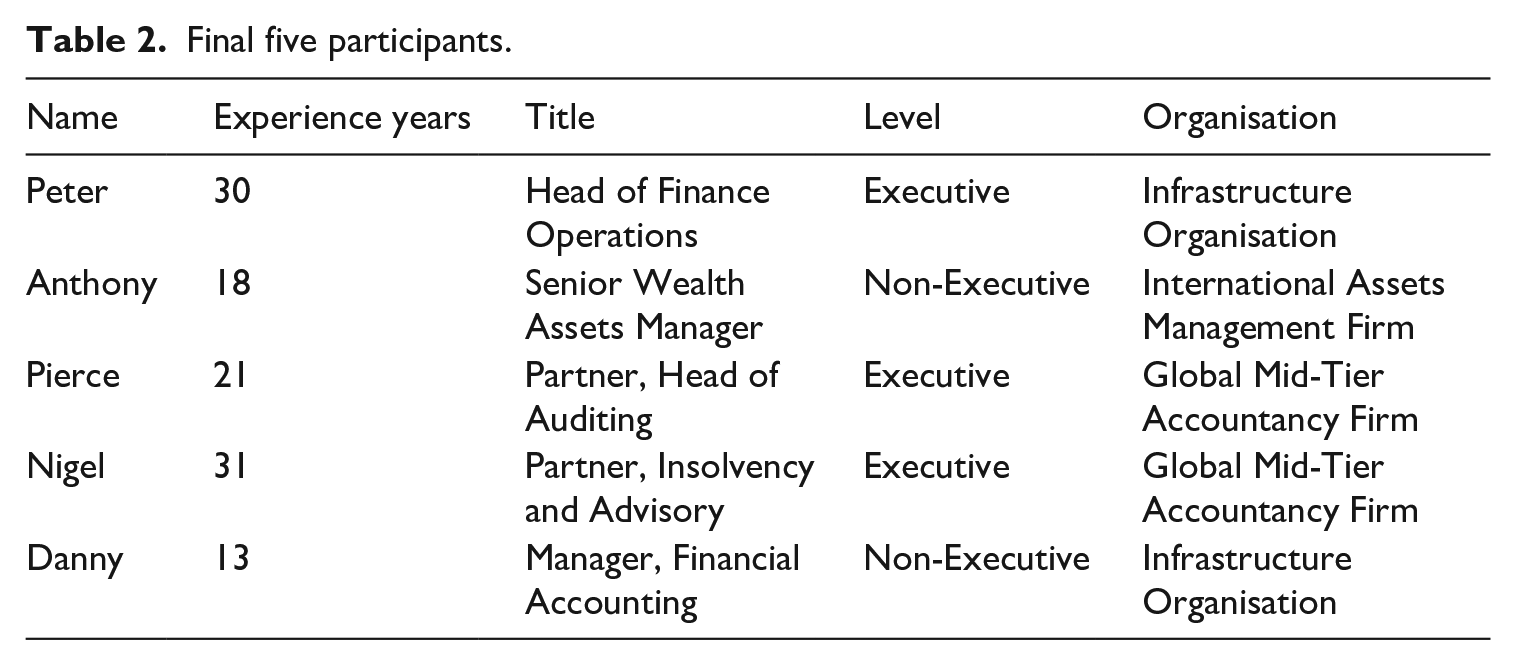
Our study leverages this approach, demonstrated in how we have chosen five men (see Table 2) as cases for analysis. The interview accounts of these five participants contained some of the most illuminating in-depth data about men’s attachments to organisational masculinities in the paranoid-schizoid position. As such, these accounts were analytically distinct from the others, and it was apparent that these men were especially open during the interview. The first author, who conducted the interviews, found these men to be reflective about their attachments to masculinities in work, which may be attributed to the interview techniques deployed, but also where these men were positioned in their lives and work careers.
Final five participants.
In psychoanalytic research, our positions as men are relevant also, not least because they have shaped the data generation and analysis process. For example, the first author used the pen-portraits to document how he was impacted by the interview process, which in turn began to influence his analysis of the participants (available from the first author upon request). As such, the accounts told by the study participants are contingent, partial and influenced by the researchers, both of whom identify as men who are concerned by men’s poor participation in gender equality initiatives. We are alarmed by how those organisational masculinities that obstruct gender equality are the same ones that are often privileged in the financial services. Additionally, we are motivated to interrogate how men and harmful organisational masculinities can change, so men can participate in gender equality. The first author’s experiences growing up queer in a working-class background were important, witnessing how some practices of masculinity routinely reproduced misogyny and homophobia. Likewise, the second author, a gay man, has experienced misogynistic and homophobic violence in and outside the workplace, prompting him to question why men maintain attachments to masculinities that are harmful. As such, we are both personally invested in psychoanalytic research for its potential to study and challenge gender inequality, the implications of which are outlined in Table 1.
Study findings
Gender-splitting: Repudiating gender inequality
In this section, we analyse interviews with five men to examine how gender-splitting aided their unconscious adoption of the paranoid-schizoid position. Gender-splitting allows these men to disassociate from the perceived ‘negative’ aspects of gender equality and hold onto traditional gender binaries, thereby preserving an idealised version of organisational masculinity. Gender-splitting reveals an unconscious conflict among men regarding gender equality: while men advocate for increased equality and fairness for women, they simultaneously feel at an unconscious level that it challenges their privileged status in organisations and, moreover, threatens an idealised gendered self-image of themselves as men.
To illustrate, we share interview excerpts from Peter, a Finance Executive, who repudiates gender inequality, asserting that the core problem lies in the idea of ‘authenticity’: I think it matters how you present yourself in the workplace, whether you’re a man or a woman! I do think that which sex you are is irrelevant but I think you’ve got to be authentic. So, one thing I cannot stand, I’ll tell you straight, is a woman pretending to be a man in the workplace or behaving like a man in the workplace. It is totally and utterly inauthentic and destructive and doesn’t do the women’s cause any favours whatsoever. A woman who is pretending to be something other than her real self, simply because she thinks that a male approach, whatever that is, is the right approach because that will be the one that gets them noticed. It’s very upsetting to see it, very annoying!
Peter appears to support gender equality in the workplace by asserting that a person’s gender should not be an obstacle to career progression. However, applying Klein’s paranoid-schizoid position, we see Peter splitting off the gendered aspects of his argument. Gender-splitting allows Peter to justify inequalities as a matter of ‘authenticity’, implying that it is tied to a person’s character, who ‘they truly are’, rather than their gender identity. Peter makes a specific argument that women who transgress traditional gender norms by behaving in a stereotypically masculine manner are ‘inauthentic’, which, according to him, detracts from the advancement of gender equality. Peter relies on a rigid gender binary that associates masculinity with men and femininity with women, such that women’s enactment of masculinity is constructed as unnatural and, therefore, ‘inauthentic’, in his words. In this normative organisation of gender, women are expected to be recognisable as feminine. From a Kleinian perspective, it can be argued that gender-splitting allows Peter to manage internal anxieties related to his masculine identity: by upholding traditional gender norms. Here, unconscious splitting acts as a defence mechanism to preserve an idealised self-image of his own masculinity from situations where it is threatened by women whom he perceives as acting in a stereotypically masculine manner.
Anthony, a Senior Wealth Assets Manager, repudiates gender inequality by suggesting that ‘being yourself’ is what matters most:
Do you believe men and women are equal in the workplace?
I would say ‘no’. I’m a strong believer in people being different. If you filled a room [with] people that had my background, experiences [and] education, you’d end up being less successful than [with] people with different generations that think differently. I’m technically Generation X, but I kind of think like Generation Y, as in, I was the first person I know to have a computer and things like that. Diversity of thinking is really valuable. They can be equally good at any role, but I don’t think they’re treated equally in any way, [. . .] in most circumstances [. . .] diversity of thinking, it’s kind of like that Venn diagram where you go, ‘How do men think?’ ‘How do women think?’ You get men that think more extreme than women, but generally speaking, there is a difference like there is with 50- and 30-year-olds, you get 30-year-olds that are more conservative than 50-year-olds and vice versa [. . .] So, are they equal? ‘No.’ Is that a good thing? ‘Yeah.’ That’s kind of what I mean is that you value diversity rather than try and create everyone into the same thing, and I think one of the worst things either way you can do, is try and be like someone they’re not.
Like Peter, Anthony believes that women can be successful in the workplace by being ‘themselves’. Anthony arrives at this conclusion by drifting away from the question posed and connecting it to separate ideas. From a Kleinian perspective, Anthony splits off the gender-related aspects of equality and reframes them as matters connected instead to age and diversity of thought. Although Anthony recognises the unequal treatment of women, gender-splitting here distances the issue of equality from women. The implication is that gender itself is not the root cause of inequality but the ability of women to stay true to themselves, implying that they must adhere to recognisable feminine traits, which, in turn, reinforces normative gender binaries. Anthony even goes so far as to suggest that if women can successfully do this, they will gain an advantage in the workplace because of their gender. Gender-splitting allows Anthony to not only separate out and disregard gender issues, but also rationalise inequality as an ‘advantage’ to women in organisations, providing they can uphold traditional gender binaries. Following Klein, gender-splitting helps Anthony preserve an idealised self-image of his own masculinity. This perception is ostensibly linked to age or generational gaps, but in reality, it is unconsciously rooted to a conflict in his gender identity as a masculine man in contrast to women, particularly those women who challenge traditional gender roles in the workplace.
Like Anthony, Pierce, an Auditing Partner, disavows gender inequality by implying that women are advantaged in the contemporary workplace:
Do you believe men and women are equal in the workplace?
God, I think that’s really complex. I think you can talk for hours about that subject. I think, ‘no, they’re not equal’. Twenty-one years in the profession [and] I’ve never seen sexual discrimination. I haven’t seen people say, ‘I wouldn’t employ that person because they’re a woman or a man’. I’ve heard about it. Is it inbuilt in our psyche? Yes! The research points in the direction of women still being discriminated against, unconsciously. I think ‘consciously’ it’s a massive advantage to be a woman, black, gay or a minority. I think consciously for people that’s a good place to be. I said it wasn’t equal, it probably is, because the subconscious discrimination against women is probably countered by the conscious discrimination for women, if that makes sense? Did we appoint a woman CEO because she was a woman? ‘No’, [. . .] we appointed her because she’s a great leader. Consciously, did it come into the decision? ‘No.’ Subconsciously, did it come to the decision? ‘It must do.’ Was that an advantage or a disadvantage? ‘Don’t know.’
In the excerpt above, Pierce acknowledges the existence of workplace gender inequality but then qualifies this by stating he has never personally witnessed it. Adopting a Kleinian perspective, this can be read as a significant shift in his account, indicating gender-splitting. From this point onward, Pierce splits off the aspects of gender-related equality and attempts to rationalise it by connecting it to issues of ‘conscious and unconscious biases’. While Pierce recognises the existence of discrimination on an ‘unconscious’ level, he contends that ‘consciously’, being a woman, or any minority, is seen as advantageous in contemporary organisations. He goes so far as to argue that any unconscious bias is counteracted by conscious biases, leading to his extraordinary assertion that women now have an advantage in today’s workplace. To support his argument, he associates with the recent appointment of his firm’s first female CEO and suggests that there might have been an unconscious bias that favoured her for the role.
In Kleinian terms, gender-splitting allows Pierce to draw on a discourse of psychology to rationalise gender as an ‘advantage’ in the workplace rather than recognising its structural disadvantage. His argument proceeds on the basis that historical gender injustices have been fully resolved and the opposite is true: women are now more favoured than men in the workplace. Following Klein, this shift may reveal a paranoid anxiety, wherein Pierce starts to view men, including himself, as victims of gender equality rather than women. To hold onto his self-image as a man, Pierce must split off the idea that women encounter inequalities to preserve an internal representation of masculinity from the threat of women’s burgeoning career success. Situated within the paranoid-schizoid position, Pierce can be seen to adopt a ‘victim’ stance, perceiving men as a marginalised gender category. This psychic reality, shaped by a mental construct where women are viewed as the privileged group, aids Pierce in preserving an idealised internal representation of his own masculinity.
Nigel, an Insolvency and Advisory Partner, disavows the idea of gender inequality by invoking the metaphor of the omnipotent client:
Do you think it matters how you present yourself as a man or a woman in the workplace?
No, I don’t think it does. I work with male and female partners. More male partners than female as that’s the ratio we’ve got. I don’t know what our ratio is now – out of 185 partners, we’ve probably got 35 women partners, which is nowhere near enough, but there’s lots of reasons and we’ll talk about those. Does it matter? ‘No, absolutely not.’ Do people make choices, do clients make choices, to use you whether you’re a male or a female partner? ‘I’ve never seen any evidence of that.’ In the business line I work in, out of 30 or so partners, we only have one woman partner – and in a sense, she is more internally focused now than client focused, so clients don’t really have much interaction with Christine. I did work with a partner called Sam who is now at a Big Four Accounting Firm. I worked closely with her because I recruited her and sort of coached her – did I ever see any evidence that clients wouldn’t choose her because she was a woman partner, and go with a male option? ‘No never, not once.’ So does it matter how you present yourself? ‘No.’
Similar to other men in our study, Nigel expressed support for gender equality and acknowledged the significant underrepresentation of women, especially at senior levels in the financial services industry. However, his stance becomes less clear when he poses the question, ‘Does this matter?’ and answers it with a firm ‘no’. Much like Pierce, Nigel tends to respond using question forms. In psychoanalytic scholarship, question forms are understood to induce anxiety in participants because they demand a more rationalised rather than emotional response (Hollway and Jefferson, 2008). Nigel’s tendency to question himself in the account reveals an underlying anxiety and an unconscious desire to avoid emotionally engaging with the issue of gender equality. From a Kleinian perspective, this behaviour suggests the beginning of the unconscious process of gender-splitting. Specifically, Nigel separates gender from the concept of equality by drawing on the analogy of ‘the client’. He portrays the client as a symbol of professionalism, implying that gender does not play a role in business decisions made by the clients they serve.
Danny, a Financial Accounting Manager, repudiates gender inequality by arguing that it is reasonable that organisations would not want to hire a woman who they believed was going to have children: Oh God! You mean that stuff you read in the paper about there not being enough females at CFO/CEO sort of roles. I think it is a problem but whether it’s just a case of. . . I mean, I know my girlfriend talks about it. She says ‘when we have kids that’s my career over’. I don’t know [. . .] if you do have a family it does kind of cut your career a bit. My girlfriend tells me that’s the case. She’s a lawyer and she says, ‘I want to get as much out of my career before I have children.’ I know you look at the facts about what you read in the papers, these executive roles, they are very male orientated. And I guess if you do look at these facts you’d say, well, ‘yeah, there probably is a problem’, but what drives the problem, I’m not sure? [. . .] Companies never try to discriminate against males and females [. . .] I know that some companies might say ‘we aren’t going to hire a female who’s 35 years old because she might be going to have children soon’. I can see the point where they are coming from as a fact of life. That might sound bad but if I was going to employ someone that might be working [. . .] for five years or someone that’s going to be here a year and then go and have some children [. . .] because I’m not saying that men are smarter than women, [. . .] because I don’t think there’s any difference there, and I’m not going to say based on relationships, that men have better relationships together and networking, I don’t think there’s a problem there, I think it does come down to the children side of things and taking time off and them not being able to step back in because they’ve had five years off and then kind of come back here and they’re quite happy with that as opposed to men who just work right through and do get more of that success and career progression. I think it’s more the way it is I think.
Danny’s recognition of gender inequity at executive levels is influenced by his partner’s preoccupations about the impact of motherhood on her career trajectory. However, he subsequently disavows gender equality. He rationalises that organisations are disinclined to employ women in their mid-thirties, anticipating their potential maternity leave. This stance, which he perceives as a pragmatic business consideration, signifies a departure from acknowledging gender-based disparities. From a Kleinian perspective, gender-splitting is apparent when Danny disassociates the notion of inequity from the broader discourse of gender equality. By doing so, Danny reframes discrimination not as a gender issue but as a justifiable economic or business strategy. The unconscious process of gender-splitting, alongside the idealisation of men for continuing to work, acts to reinforce traditional gender binaries around men and work. Gender-splitting permits Danny to extend his argument to the point where he proposes that the traditional division of gender roles is not merely ‘just the way it is’, but also preferable to women, further serving to deflect gender inequality.
Projection: Targeting women as responsible for gender inequality
In this section, we undertake an analytical examination of gender-splitting in the accounts of men that leads to an unconscious process of projection. In these accounts, men not only deny the existence of gender inequality, but also attribute responsibility and, in some cases, place blame onto women for such disparities. Projection is characterised here by the transference of repressed material associated with the idealisation of organisational masculinity. Instead of recognising the structural dimension to gender inequality in organisations, these men erroneously ascribe the responsibility for addressing gender inequality onto women through projection. This misattribution serves to uphold their idealised masculine self-image in the workplace, which reproduces a gender binary that sustains inequality.
In the interview extract below, we return to Peter’s account to examine how gender-splitting is continued through projection:
Can you give me an example?
Gillian [laughs] was adopting a male persona. She had a distorted view of authority [and] the difference between ‘assertiveness’ and ‘aggression’. I know she was not aggressive in her personal life; my best friend had gone to university with her, so unless she’d had a personality transplant, and become this ‘dragon’, she was in fact a very different person at work [. . .] and it was inauthentic. There was an unpredictable quality [. . .] and it was because she was acting. It’s like telling lies. You might slip up one day because you forget to act in character. I remember a massive boil on her face – it was obviously stress – she’s sitting there ballsy [. . .] a physical manifestation [. . .] sat on her face – it was obvious the real Gillian was stressed.
Peter draws on a gender binary through which women in the workplace are expected to be recognisable as normatively feminine. Gillian is one such woman, described by Peter as a ‘dragon’ and ‘ballsy’, and potentially deceitful for not operating within a normative gender binary as a recognisably feminine woman. Further, from a Kleinian perspective, Peter unconsciously splits Gillian into a ‘bad’ object. Gillian’s expression of masculinity, which Peter views as something typically reserved for men, is seen by him as a challenge to the idealised association between men and organisational masculinity.
Peter’s cruel reference to Gillian’s ‘boil’ takes on a particular psychic function. In Kleinian psychoanalysis, the boil can be understood as a specific object. Through gender-splitting, Peter perceives Gillian unconsciously as a bad-object as her perceived embodiment of masculinity threatens his self-image as a man. To shield himself from this perceived threat, Peter splits and fragments Gillian into a bad-object whereby he is unable to view her as a ‘whole object’. The presence of a boil on Gillian’s face facilitates the displacement and fixation of Peter’s anxieties onto an external object. In other words, it brings to life the idea that transgressing traditional gender binaries is repulsive: not only is Gillian’s comportment inappropriate, but it also results in unsightly dermatological outbreaks.
From an object-relations perspective, we can understand how, in order to hold onto an idealised construction of organisational masculinity, the psyche must exult it as a ‘good’ object and displace its negative aspects. The boil comes to represent, therefore, the repressed contents of Peter’s idealisations of masculinity. Instead of attributing the undue stress faced by women, especially those in senior roles, to the influence of patriarchy and the masculine demands of an organisation, Peter instead projects these anxieties onto Gillian’s boil, a fragmented part of her in his psyche. Projection enables Peter to distance himself emotionally from the challenges that Gillian is facing, which he feels unconsciously as repulsive, which enables him to shift the responsibility for these difficulties onto Gillian. Framed as such, Peter’s conclusion is that Gillian therefore only has herself to blame for ‘acting’ gender (e.g. masculinity) inappropriately at work. Gender-splitting and projection in tandem support Peter to alleviate anxieties that have built up within him, particularly those related to idealisations that represent men as strong and women as weak. This also suggests that within the workplace, only men are perceived as capable of meeting the expectations associated with masculinity, reinforcing the notion that the male body serves as its archetype for more senior, demanding organisational roles.
Much like Peter in the previous section, Anthony splits off the gendered aspects of equality and relates them to separate issues, thereby distancing gender equality from its primary association with women. In this second part of his account, continued gender-splitting results in projection whereby Anthony blames women for the persistence of gender inequality: There was a woman in my team that tried to be like an alpha male, acting the role, as opposed to who she was. I spent a lot of time trying to get her to be herself. You’re more successful when you’re yourself rather than trying to be one of the lads. The main thing was self-confidence. She was extremely capable and if she had confidence to match, she would have been more successful. The problem was she was in a team of powerful lads and was behaving that way to get into that role [. . .] She was different and that was why she was successful, because she stood out. So no, they’re not equal but that’s a good thing.
Anthony associates with a female colleague whom he believes exhibited behaviours commonly associated with an ‘alpha male’ and asserts that this behaviour did not reflect her ‘true nature’. In this process, Anthony limits the possibilities for women to express their gender identity beyond the traditional gender binary. Adopting a Kleinian object-relations perspective, this form of gender-splitting, where Anthony separates out the idea that his colleague was naturally embodying masculinity, preserves an idealisation that masculine behaviours only pertain to men. Gender-splitting here leads to projection: Anthony unconsciously assigns responsibility to women for the continued existence of gender inequality. He implies that if women embraced and conformed to the established gender norms associated with organisational femininity, they could achieve greater success in the workplace. Confidence plays a crucial role in this context: Anthony attributes women’s challenges to their perceived lack of confidence, thereby holding them responsible for these difficulties. Put differently, instead of acknowledging and problematising the normative status of some forms of organisational masculinity, women who embody characteristics coded as normatively masculine are chided as lacking self-confidence.
Anthony’s defence of organisational masculinity that is potentially harmful to women and gender equality leads him to construct men as facing disadvantage in the workplace. This compels Anthony to express a paranoid anxiety between men, masculinity and the male body in response to the unconscious threat of gender equality. Anthony unconsciously accomplishes this by engaging in gender-splitting and projecting these perceived workplace disadvantages onto women. In simpler terms, instead of recognising patriarchy and the roles of men and masculinity as factors that uphold gender inequality, these aspects are instead projected onto women who are seen as behaving in ways that are masculine. This defence mechanism allows Anthony to bring to life his paranoia and simultaneously protect his self-image as a man by reinforcing idealised gender norms.
In the earlier section, Pierce disavowed gender inequality by suggesting that women currently enjoy a gender ‘advantage’ in the workplace. In the interview extract below, we examine how gender-splitting enables Pierce to attribute the problem of underrepresentation of women at senior levels onto women themselves:
Yes, I don’t know whether it might actually be interesting reading for this . . . ‘Lean In’, by Cheryl Sandberg, have you read it? [. . .]
Well, I’ve heard enough about it.
Yes, as part of this research you should read it. I mean it’s a fascinating book, it really is. She says she’s experienced discrimination from both men and women as a result of being a woman.
Does she say that, does she?
Yes, absolutely. And there’s this thing about once a woman gets to the top table, she’d prefer to be the only woman there rather than let other women at the top table. Are we doing enough? I think in this organisation we probably are.
In the previous section of Pierce’s account, he implied that the appointment of his company’s current CEO was owing to a conscious bias in favour of her gender. In this next segment of his account, he attempted to draw upon the ideas of Cheryl Sandberg to argue that any persisting gender inequality is primarily attributable to successful women who do not enable other women to attain equivalent senior roles within their organisations. In this line of reasoning, a Kleinian analysis suggests that gender-splitting persists in Pierce’s account. Pierce separates out the notion of women facing gender-related disadvantages and takes it a step further by placing blame on women themselves for this situation. In object-relations psychoanalysis, when anxiety arises from gender-splitting, it can become overwhelming for the psyche and may need to be projected into external reality. In other words, Pierce appears to be unconsciously identifying an external object to support his earlier argument that women are currently advantaged while men are the less favoured gender group. He uses this argument to challenge the evidence that women are underrepresented in senior positions by suggesting that it is because women do not support each other.
To shield himself, Pierce’s psyche must elevate masculinity as the good ‘object’ while either repressing or projecting, as in this case, the negative aspects associated with it. It is not a coincidence that Pierce places blame on women for gender inequalities that are structural within his workplace and the financial services industry more widely. He unconsciously portrays women as advantaged, even though he recognises that it is men who hold the advantage. He faults women for not supporting each other, even though men have historically perpetuated this behaviour that has held back women from attaining senior positions.
In the following extract, Nigel defends an idealised organisational masculinity by blaming women for overcompensating and being aggressive:
We do have some women partners who perhaps [. . .] feel they have to be more robust, direct, [and] challenging than they might ordinarily be, because they feel there’s some sort of inherent undervaluing of their contribution [. . .] I do see that occasionally. That’s how it comes across. If I said they tried a bit too hard or it looks like they’re trying [. . .] more than they need to, [it’s] because I know that they don’t need to. I’ve done interviews with some of my women partner colleagues and I’ve been surprised at how aggressive one or two have been during the interview process [. . .] I’m not aggressive during those interviews – I’m quite challenging, quite robust when I need to be – but that’s a difference between that and being aggressive. I have found myself questioning, because I know these people quite well, ‘is that just how they are?’ ‘Is that just their style as a human being, or are they taking that approach because they want the candidate to see they are just being very robust about it?’ I’m digging a hole for myself now. I have a colleague who is not a partner [. . .] She’s extremely capable [. . .] She was always and remains very ambitious and wants to get to director level in the firm and potentially beyond that. She’s said to me openly ‘she needs to overcompensate in [. . .] meetings’ because ‘she feels that her contribution [. . .] will not be given as much value as her male colleagues’ [. . .] Her way of doing that is to be more robust, more direct, use more gravitas, and control the meeting more, [and] try to play a bigger role. Inevitably, that might be to the detriment of other people in that meeting because she’s trying to grab, take, share, more of the meeting than her fair share.
Are there men that behave like that too?
Definitely [. . .] so many meetings I have been to, where there are only men in the meeting [. . .] words ‘alpha male’ and ‘internal competition’ got used so many times. There were a small number of male partners who just seemed to think the way to get on was to be incredibly ballsy, vocal, macho and almost aggressive about it. A very small minority though.
In the previous section, Nigel disavows gender inequality, claiming he has never seen discrimination in his workplace. In the next segment of his account, Nigel criticises women for ‘overcompensating’ for workplace injustices. Nigel describes himself using typical men’s terms like ‘quite robust’ and ‘quite challenging’. However, he views similar behaviours in women as ‘aggressive’. Behaviours that are discursively coded as ‘masculine’ in his workplace are considered ‘normal’ for men, but inappropriate for women. Mobilising Klein’s ideas, we can understand how Nigel has unconsciously moved into the paranoid-schizoid position. He splits off aggressive behaviours from himself to represent women who embody them as ‘unnatural’. Nigel unconsciously perceives women who act outside of traditional feminine norms as aggressive, which in Kleinian terms, are understood as ‘bad’ objects.
To protect his internal attachments to organisational masculinity that are potentially harmful to women as ‘good’, Nigel must displace the negative contents of the workplace onto women. The implication is that Nigel blames women for an unfair workplace that implicitly favours characteristics such as aggression and individualism. By splitting off these traits from himself, while ignoring other men who do the same, Nigel can hold onto an internal idealised object of organisational masculinity. During the interview, the first author sensed an exaggeration in Nigel’s account, prompting him to question ‘if men exhibited similar behaviours’. Nigel admitted that some men did but he significantly downplayed this by claiming such cases among men were ‘rare’. The implication being that it was more common for senior women in his organisation to display aggressive behaviours. Again, Nigel splits off the unfavourable characteristics typically associated with masculinity, displacing them onto women, to maintain an internalised ideal of organisational masculinity and, moreover, an ideal self-image of himself as a man.
In the earlier interview account related to Danny, we saw how he repudiated gender equality, particularly issues related to the perceived organisational risk of women taking maternity leave, as rational and simply ‘the way things are’. In his commentary below, he shifts the focus of the issue onto his partner: [. . .] It’s just the way it works. I think she wants one child so in the next two or three years we’ll start thinking about that, and I don’t know what she wants to do, because she’s very career-driven, more so than I am. She doesn’t have much work/life balance. I don’t know how she’s going to be able to stop working [. . .] She will be a legal partner at her law firm [but] she’ll come back to just being, a kind of middle-market sort of legal team for a company that has a legal counsel that doesn’t require her to work too much, and to kind of just keep a work/life balance so that she doesn’t have to work too hard. She acknowledges that she works too hard at the moment, but she is getting out of that cycle. I mean, she’s quite happy doing it as well. I imagine if she wanted to come home and see her family, she might do so more often when she has a child, as opposed to just coming home to see me. [Laughter] She probably doesn’t mind too much not seeing me, I don’t know!
Throughout his account, Danny consistently associates with his partner’s concerns about the negative impact of motherhood on her career trajectory. He revisits these concerns, yet he places the onus of child-rearing and its potential career implications solely on her, rather than perceiving it as a mutual responsibility. On the one hand, we can interpret this as Danny recognising his partner’s apprehensions about balancing professional life and future maternal duties, indicating a concern for her. On the other hand, from a Kleinian viewpoint, we can suggest that Danny’s apparent inability to his partner’s anxiety is likely a contributing factor to his shift into the paranoid-schizoid position. In other words, Danny’s felt anxiety, manifested through gender-splitting, is the result of his partner’s expression of concerns that may reflect an unconscious plea for shared responsibility in childcare to support her continued career advancement.
Despite acknowledging his partner’s greater career orientation and success, Danny fails to alleviate her concerns, instead prioritising his own career advancement. This leads to what Klein has described as an ‘omnipotent’ assertion: Danny suggests that his partner would find greater happiness in reducing her work commitments, focusing on childcare and returning home to him. This perspective represents a form of projection, particularly in the context of his earlier repudiation of gender inequality, and his consistent association with his partner’s concerns. In this light, projection operates to assign her the responsibility for the career consequences of having a child, a decision they would presumably make together. This approach effectively shifts the burden of balancing professional and domestic life onto his partner, reinforcing a traditional gendered division of labour while neglecting the concept of shared parental responsibility. Therefore, it serves psychically to maintain an idealised fantasy of organisational men as breadwinners and women as caregivers.
Discussion
In this article, we have sought to examine the psychic components of men’s attachments to organisational masculinities and what they reveal about how men variously respond to women and gender equality in the UK financial services. Study data have demonstrated that men’s responses are structured by anxieties, defences and internal and external object relations that help to reproduce organisational masculinities and men’s practices that are detrimental to gender equality. Deploying theoretical insights from Klein’s (1946) object-relations theory, we have presented evidence of how men can adopt the paranoid-schizoid position, particularly through the process of gender-splitting. As indicated in the empirical analysis sections, one of the primary characteristics of the paranoid-schizoid position is the splitting of both the self and other objects as ‘good’ and ‘bad’. Study participants exhibited the tendency to dissociate gender-related aspects of equality, to reform attachments to normative organisational masculinity based on control, competitiveness and assertiveness, through which they are able to uphold an idealised self-image as organisational men. The unconscious process of gender-splitting provides insights into the internal state of organisational men and masculinities, especially the inner conflict within men concerning gender (in)equality in the workplace. While study participants may outwardly support increased fairness and equality for women, on an unconscious level they can respond to gender equality and women as a challenge to their privileged status within organisations, and as a threat to their idealised gendered self-image.
Empirically, this article contributes to extant organisational research on men and masculinities by examining the role of the unconscious in how men respond to gender equality in the financial services by re-forming attachments to masculinities that reproduce gender inequalities. The analysis sections have demonstrated how and why men have variously adopted a paranoid-schizoid position and the organisational masculinities shaped by this position. This builds on organisational research on men and masculinities in the financial services (Baker and Brewis, 2020; Figlio, 2011; Morante, 2010; Stein, 2013) by examining how organisational masculinity in its paranoid-schizoid state can involve gender-splitting and projection. As outlined in Table 1, these unconscious processes can help scholars to explain why men can be defensive and anxious about women and gender equality in the financial services. In the study data, gender-splitting can be understood as an unconscious and gendered response to anxiety about women and gender equality in the workplace, enabling study participants to feel they have contained their anxieties and fears. However, there are limits to splitting, and when anxiety becomes overwhelming, its contents may need to be projected into an external object to alleviate the distress. In our study, men displayed a tendency to attribute responsibility or even blame to women for the persistence of gender inequality. In Kleinian terms, this process involved men displacing perceived negative aspects of organisational masculinity and masculine norms onto women to absolve themselves of responsibility for reproducing existing gender inequalities through the maintenance of organisational masculinities grounded in control, assertiveness and competitiveness.
Within the paranoid-schizoid position, splitting, projection and introjection operate in a recurring psychic-cycle, where individuals divide themselves and others into polarised ‘good’ and ‘bad’ objects. In the accounts of the men we studied, these processes were interconnected and seamlessly transitioned between. This fluidity was crucial for them to preserve an idealised concept of organisational masculinity and their own self-image as men. Omnipotence emerged when men believed they knew what was best for women or had a deep understanding of women’s experiences, coupled with a paranoia that women were now the advantaged gender group, while they were victims of gender equality initiatives in the workplace.
One major implication of the above is the impact on both men and women in accountancy and financial services when organisational masculinities manifest in a paranoid-schizoid state. While the accountancy literature has shed light on how accountancy organisational structures and processes are gendered masculine in ways that routinely disadvantage women (Haynes, 2017; Khalifa, 2013; Kornberger et al., 2010; Spence and Carter, 2014), an object-relations psychoanalytic approach extends the study of such gender inequalities, because it underscores the psychic threat women and workplace gender equality can pose for men. At stake here is more than the potential loss of men’s gender privilege, but also the profound fantasy of their own masculinity. In a Kleinian vein, this represents a fundamental anxiety wherein men feel so threatened that they must unconsciously resort to preserving, shielding and internalising an idealised object of themselves as masculine. The continuous practice of splitting and fragmenting the self is concerning, as an unintegrated ego can culminate in a more rigid, regressive, narcissistic sense of self as masculine (Figlio, 2011). An object-relations psychoanalytic approach has considerable analytic power for studying gender inequalities in that regard, as it can understand this manifestation of masculinity as a ‘phallic masculinity’ (Figlio, 2011: 36) based on an ‘illusion of competitive superiority’, one that does not complement femininity, is destructive and usurping. One implication of this, underdeveloped in both the accountancy and organisational studies scholarship on men and masculinities, is that men can regress, such that they become less attuned to the emotional needs of others and potentially more disconnected from reality. For women in the workplace, the reproduction of organisational masculinity as paranoid-schizoid has potentially dire consequences, especially in accountancy and financial services work contexts where it is normative and unchallenged. As accountancy and financial services studies show, women and organisational femininities may be repeatedly disregarded and repudiated (Baeckström, 2022; Hodgson, 2003; Khalifa, 2013; Kornberger et al., 2010; Knights and Tullberg, 2012), but in our psychoanalytically inspired object-relations study, we can see how women are constituted as ‘bad’ objects that warrant derision and attack. As the study data show, disruptions to a paranoid-schizoid organisational masculinity can be dealt with by projecting them onto ‘bad’ objects, such as women in the workplace. As such, the repudiation of women and femininities persists, which may contribute to the reproduction of gender inequalities throughout organisational processes, cultures and practices (Cooper et al., 2021; Kark et al., 2024).
Theoretically, this article contributes to an understanding of organisational masculinity as ambivalent, which in Kleinian terms underscores how masculinity has ‘good’ and ‘bad’ components that are constituted unconsciously through its relationship with the object world. As such, this article contributes to the literature comprising the critical study of masculinities and organisations (Connell, 2005, 2006; Hearn, 2004; Kerfoot and Knights, 1993) by showing how theoretical constructs drawn from Kleinian psychoanalysis on object relations can enable scholars to understand the psychic components of organisational masculinities. As we contend, men’s perceptions of being threatened and attacked by organisational and industry efforts to tackle gender inequality through equality initiatives are deep-rooted in the unconscious, such that a Kleinian object-relations perspective can be deployed as an analytical tool for exploring how organisational men engage in unconscious processes of splitting and projection to defend and reinforce their attachments to organisational masculinities that are inimical to women and themselves. Conceptualising organisational masculinities in this way forces attention on the psychic interior of men that opens the terrain of the unconscious, prompting questions about how organisational masculinities may be conceptualised differently. Crucially, a Kleinian perspective theorises organisational masculinities as ambivalent, or in other words, an amalgam of good and bad components that are shaped by processes of the unconscious (Figlio, 2024). Acknowledging this, we do not wish to confine psychoanalytic organisational scholarship on men and masculinities to the study of masculinity in its negatively defensive schizoid-paranoid manifestation. As with organisational feminist psychoanalytic scholarship, we seek to expand the ways of understanding how gender inequalities are, in part, shaped by processes of the unconscious, which in the context of this article, raises pertinent questions about how organisational masculinities may complement femininity and women.
One implication of theorising organisational masculinities in the schizoid-paranoid state concerns the possibilities for change. Following Klein (1946), it could be argued that men’s recognition of gender equality implies, to some extent, that they acknowledge it as a ‘good’ object, even though our study data illustrate how they go on to repudiate it as a ‘bad’ object. Crucially, splitting can be the start of a healthier ego development because it allows an individual to assimilate and retain sufficient positive experiences of an object, forming a central core around which the contrasting aspects of the self can begin to be reintegrated. Klein has termed the formation of a positive internal object as essential for advancing into the ‘depressive position’, a separate but interconnected unconscious position where individuals can experience guilt, recognise others as having both positive and negative qualities, and endeavour to mend relationships with those they may have harmed unconsciously. Indeed, individuals can move from one position to another in a fluid manner. Theorising from a Kleinian angle also, Figlio (2011, 2024) argues that masculinities in the depressive state can be supportive of femininity and women, life enhancing and deeply concerned about their internal and external object relations. But it requires organisational men to engage in processes of reparation that disrupt the illusion of competitive superiority and men’s conviction in their own rationality.
Practical implications
The psychoanalytic object-relations study of men and organisational masculinities has practical implications for addressing persistent gender inequalities in accountancy and financial services organisations, especially those that struggle to recruit and retain talent (ICAEW Insights, 2023), and those committed to improving men’s contributions to workplace gender equality. The urgency of the latter has been articulated more broadly in the European Commission (Belghiti-Mahut et al., 2013: 3) report Study on the Role of Men in Gender Equality, which asserts that men have often been overlooked in gender equality research, which, going forward, ‘must address [all] genders in order to sustainably change predominant gender imbalances and inequalities in European societies’. Kleinian psychoanalysis can serve as a tool for managers and organisations to support well-intentioned assertions of increasing men’s participation in equality initiatives and women’s participation in accountancy and the financial service sector. In a managerially relevant capacity, object-relations psychoanalysis can be deployed by appropriately qualified specialists and consultants in human resource development activities (e.g. coaching, mentoring) that help men to understand how their internal state or unconscious can reproduce dysfunctional masculinities as normative, denying the subjectivities of women and sustaining gender inequality. Equally, as Arnaud (2012) asserts, managers can be trained in a psychoanalytical approach, not as therapists but as organisational members who can diagnose and help to resolve ‘psychic disturbances’ in the workplace, such as those that relate to employees’ internal defence mechanisms. Such knowledge can help managers to ‘foresee more acutely that certain unconscious processes are likely to draw on actors’ energy or provoke irremediable pathological harm’ to themselves and others in the workplace (Arnaud, 2012: 1128). For example, mobilised as a managerial tool of diagnosis, Kleinian psychoanalysis can help managers to recognise how organisational masculinity in the paranoid-schizoid form harms women, the men who establish attachments to it and reproduces gender inequality. As such, Kleinian psychoanalysis can adopt a perspective of change, which could help men to alter their relationship with gender equality at work to become meaningful participants in gender equality.
Conclusion
Deriving theoretical insights from Kleinian object-relations theory to examine the psychic components of men’s attachments to organisational masculinities, this article has shed light on the anxieties, defences and splitting of the self that are characteristic of men in the paranoid-schizoid position. Such masculinities in the financial services and in other organisational contexts and industries warrant further empirical investigation as they have potentially harmful effects for those who enact them and those who are adversely impacted by them. Our study has focused only on organisational masculinity as paranoid-schizoid, which demonstrates how and why men in the financial services can reproduce existing gender inequalities that disadvantage women. However, this limitation can be viewed as an opportunity for future psychoanalytic research on masculinities that are shaped by men and women who adopt Klein’s depressive position. In so doing, scholars could enrich existing organisational scholarship on men, masculinities and men’s practices, because masculinities that have progressive aspects to them, in terms of how they may be concerned by the nature of the object world in terms of compassion and collaboration (Figlio, 2024), could furnish supplementary insights into how men can shatter the illusion of normatively masculine competitiveness, superiority and control. In that regard, the psychoanalytical study of men and masculinities represents an important but underutilised facet of the ongoing endeavour to hold men to account so they recognise that gender equality in the workplace is also in their interest.
Footnotes
Acknowledgements
We extend our heartfelt thanks to the anonymous reviewers and the handling editor, Professor Karan Sonpar, for their generous engagement with our manuscript and their supportive and valuable feedback, which significantly strengthened this work. We also extend our gratitude to Dr Meredith Edelman, Monash University, for her constructive comments during the later development of this article. We also wish to thank Professor Thomas Roulet and the Cambridge Judge Business School for the invitation to present an earlier version of this article, and for their constructive and supportive advice.
Funding
The authors disclosed receipt of the following financial support for the research, authorship, and/or publication of this article: UK Research and Innovation, Economic and Social Research Council, Association of Chartered Certified Accountants.
