



Abstract
Commuting is a global phenomenon that has primarily been studied in terms of its costs. However, anecdotes and recent theorizing suggest that some employees enjoy their commutes. Is it, thus, possible that commuting can also be beneficial for employees? We integrate the Work–Home Resources model with the Conservation of Resources theory to conceptualize commuting as a source of recovery that facilitates daily resource gain spanning the commute-, work-, and home domain. Specifically, we hypothesize that morning commute recovery experiences (relaxation, mastery and detachment) trigger resource gains in the work domain, manifesting in increased subjective vitality as a manifestation of physical and cognitive energy. Higher levels of subjective vitality in the work domain, in turn, are positively related to work-to-home commute recovery experiences and associated subjective vitality in the home domain. Furthermore, we explore commute duration as a contingency factor of the relationships between commute recovery experiences and subjective vitality at work and home. A diary across ten workdays largely supports our hypothesized model. On days with higher levels of relaxation during the morning commute, employees experience daily resource gains that culminate in increased evening subjective vitality in the home domain through relaxation during the evening commute.
Commuting—traveling from home to work and back—is an activity at the interface between the home and the work domain that most employees engage in on a day-to-day basis. In 2019, the average one-way commute in the United States rose to a new high of 27.6 minutes (US Census Bureau, 2021), and in Europe, people commuted 25 minutes to work in 2019 (Eurostat, 2020). In urban India, 45 minutes on average to commute to work (MoveInSync, 2022). These statistics illustrate the significant amount of time that employees spend commuting. Although COVID-19 restrictions temporarily reduced work-related travel including work commutes (Kearney Hub, 2022), employees have been steadily returning to on-site work (Goldberg, 2022; Quinn, 2022) or availing of hybrid working arrangements that require them to commute at least on some workdays (Grote and Guest, 2017; Rofcanin and Anand, 2020). In other words, commuting is here to stay (Calderwood and Mitropoulos, 2021). Considering its implications for employee productivity, engagement, and well-being (Gerpott et al., 2022, 2023; Ma et al., 2019), studying daily commuting as an organizationally relevant phenomenon is focal for employees and employers alike.
Organizational research has predominantly focused on the commute-to-work spillover (i.e. experiences being transferred from the commuting domain to the work domain; Edwards and Rothbard, 2000). This stream of research has emphasized the detrimental role of aversive commutes on a range of outcomes such as employees’ job satisfaction (e.g. Clark et al., 2019; Torrent-Sellens et al., 2018) as well as in- and extra-role performance (e.g. Ma and Ye, 2019; Santhosh, 2015; for a review, see Calderwood and Mitropoulos, 2021). In comparison, we have a limited understanding of the work-to-commute spillover (i.e. the carryover of work experiences to the commute; Calderwood and Mitropoulos, 2021), with initial research indicating that high work demands can negatively affect safety during the home commute (Anderson et al., 2018; Clinton et al., 2021).
Although an established body of cross-sectional and longitudinal evidence has provided important insights regarding the costs of commuting (Murphy et al., 2023), previous research has mostly neglected that commuting does not have to be harmful and may even be beneficial for employees. Such a positive view of commuting has received some support from emerging micro-level research examining daily changes in employees’ commutes. This research indicates that commuting can be beneficial for employees on days when they use their commute for role transitions by preparing for work during the morning commute (Jachimowicz et al., 2021) or disengaging from their work role during the evening commute (van Hooff, 2015). Integrating these initial findings with the established body of research on the costs of commuting we argue that the effects of commuting may not be homologous across different levels of analysis (Chen et al., 2005). That is, in contrast to its costs that are supported by a substantial body of cross-sectional and longitudinal research (Murphy et al., 2023), the benefits of commuting are more likely to be observed at the micro-level when examining within-person changes across workdays or commute occasions (i.e. work commute vs. home commute). While offering a starting point for shifting the conversation toward the benefits of commuting, the aforementioned studies on the potential benefits of commuting are still based on the assumption that commuting is a negative experience as evidenced by their focus on boundary conditions that can reduce the harmful consequences of commuting. On the opposite side of the spectrum, recent theoretical work has outlined what may constitute positive experiences during daily commutes and how these experiences may affect employees’ functioning in the work and home domain (Gerpott et al., 2023; McAlpine and Piszczek, 2023; Pindek et al., 2023). However, one caveat of this emerging body of research is that these theoretical propositions need to be substantiated by corresponding empirical evidence. Thus, examining the benefits of commuting not only has the potential to expand our understanding beyond the costs of commuting but is also practically relevant as it can inform the ongoing debate about commuting as a part of the future of work (Ambade et al., 2021; Haupt, 2021).
The present study aims to expand our understanding of the potential benefits of commuting by developing and testing a research model that is based on the Work–Home Resources (WHR) model (ten Brummelhuis and Bakker, 2012a) and the Conservation of Resources theory (CoR; Hobfoll, 2002; Hobfoll et al., 2018)—two integrated theoretical frameworks. More specifically, we explore the role of relaxation (i.e. a state of low activation and increased positive affect), mastery (i.e. challenging experiences and learning opportunities in non-work domains), and detachment (i.e. mental disengagement from work; Sonnentag and Fritz, 2007) as focal recovery experiences during the daily commute for employees’ energetic resources after the commute. Drawing on the WHR model’s notion of cross-domain resource enrichment (i.e. the process whereby contextual resources in one domain lead to the development of personal resources in the other domain; ten Brummelhuis and Bakker, 2012a), we argue that commute recovery experiences represent psychological processes in the commute domain that enrich employees’ energetic resources in the domain after the commute (Bennett et al., 2016; Chawla et al., 2020). By conceptualizing recovery as a process that refers to experiences that bring about change in strain indicators (Sonnentag and Geurts, 2009), we argue that commute recovery experiences can facilitate cross-domain resource enrichment. Furthermore, drawing on CoR theory’s proposition that the initial availability of resources is associated with further resource investments, which facilitate additional resource gains (Hobfoll et al., 2018), we argue that on days when an employee experiences higher (vs lower) levels of recovery during the morning commute, they benefit from higher resource levels at the end of that workday. This is because recovering resources early in the day facilitates resource investment, which increases the likelihood of engaging and fulfilling experiences at work. In turn, higher resource availability at the end of the workday facilitates recovery experiences during the daily home commute, which results in higher resource levels in the subsequent home domain. We examine subjective vitality—a state of energy and aliveness (Ryan and Frederick, 1997)—as a personal resource in the work- and home domain not only because of its well-established links to recovery experiences (Gombert et al., 2020) but also to the WHR model (ten Brummelhuis and Bakker, 2012a) as it reflects the availability of physical and cognitive resources (Ryan and Deci, 2008). To further expand our understanding of the benefits of commute recovery experiences during the work and home commute, we consider daily variations in commute duration as a boundary condition of the proposed cross-domain resource enrichment. Here, we juxtapose arguments for the strengthening and buffering role of daily commute duration for the relationships between recovery experiences in the commute domain and subjective vitality in the work- and home domain (see Figure 1). Considering that our theorizing focuses on highly volatile psychological processes and energetic resources that exhibit strong fluctuations between and even within workdays (Calderwood and Mitropoulos, 2021; Gerpott et al., 2023), we examine the proposed model in a daily diary study that allows comparing workdays with different levels of commute recovery experiences.
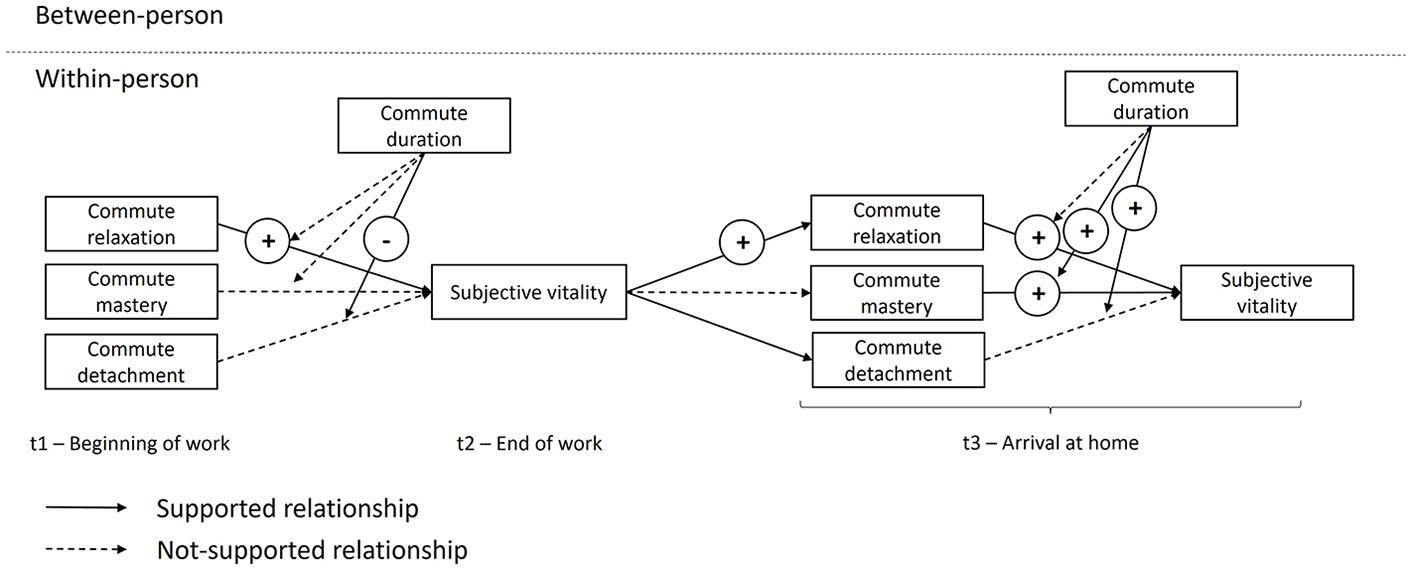
Research model.
Our research offers four contributions to the literature. First, we complement the dominant organizational research focus on the negative consequences of commuting by providing an initial empirical test of recent theoretical propositions of the potential benefits of commuting (Gerpott et al., 2023; McAlpine and Piszczek, 2023; Pindek et al., 2023). Drawing on the proposition that the commute offers employees “me time” to fulfill goals and motives that may not be associated with either the home or the work domain (Pindek et al., 2023), our research can identify which specific commute recovery experiences (i.e. relaxation, mastery, and/or detachment) are most beneficial during employees’ “me time” while commuting to and from work. Second, we expand our understanding of the psychological processes underlying the benefits of recovery experiences during the commute by drawing on CoR theory (Hobfoll, 2002) and, by extension, the WHR model (ten Brummelhuis and Bakker, 2012a) to highlight the crucial role of subjective vitality as a manifestation of physical and cognitive volatile personal resources linking the commute - and from work. This allows us to develop a parsimonious research model that relies on the same theoretical assumptions to explain both the beneficial role of - and evening commute recovery experiences in the domain following the commute. Third, our study links the work- and home commute by simultaneously considering how recovery experiences during the commute can contribute to employees’ resources in the work domain, back to the commute domain, and finally in the home domain. By integrating the literature on commuting and recovery, our study can provide a more integrated view of the work and the home commute by “dynamically connect[ing] commute-to-work and work-to-commute spillover processes” (Calderwood and Mitropoulos, 2021: 179–180). In addition, we contribute to the wider recovery literature (Sonnentag et al., 2022) by acknowledging the relevance of morning recovery experiences and extending previous research on breaks at work and recovery experiences after work. Finally, we contextualize the effectiveness of recovery experiences (Sonnentag et al., 2017) and add to the scarce empirical research on commute recovery experiences (McAlpine and Piszczek, 2023; for an exception see van Hooff, 2015) by considering daily variations in commute duration to and from work as a boundary condition that may shape the cross-domain resource enrichment of commute recovery experiences. We develop and test two competing assumptions about the role of commute duration and, in doing so, add to extant ambiguous literature by exploring the duration of the commute as a contingency of the beneficial effects of commute recovery experiences.
Theoretical background
Research drawing on the WHR model (ten Brummelhuis and Bakker, 2012a) predominantly focuses on the work and home domains as two salient domains in employees’ lives. These domains are separated by either physical, temporal, or psychological boundaries (Clark, 2000), which reflect lines of demarcation that define the point at which one domain begins and another domain ends. Conceptually, researchers still debate whether commuting reflects a unique domain (Pindek et al., 2022) or a liminal space between domains (McAlpine and Piszczek, 2023). On the one hand, McAlpine and Piszczek (2023; see also Nippert-Eng, 1996) conceptualize the commute as a liminal space, which allows employees to transition between the work and home domains as two socially salient domains. This is because, during the commute, individuals have already disengaged from one role (e.g. as an employee) but have yet to engage in another role (e.g. as a parent; Ashforth et al., 2000). On the other hand, Pindek et al. (2023; see also Gerpott et al., 2023; Livingston et al., 2023) suggest that commuting is a “third space”. These authors highlight that besides role transitions, employees may use their commute to engage in “me time”, which can fulfill goals or motives that are not specifically addressed within the work or the home domain. We concur with the latter perspective as commuting has clearly defined physical, temporal, and psychological boundaries. The commute is thus spatially and temporally separated from both the work and the home domain and is associated with specific psychological processes such as thoughts and feelings that can be unique to this domain (i.e. thinking about the best way to get to and back from work; Livingston, et al., 2023; Pindek et al., 2023). Further substantiating this proposition, although workers’ rights advocacy groups suggest that commuting should be considered part of the work domain, most organizations outsource the majority of the costs for commuting to employees because they do not consider commute time as work time (Gerpott et al., 2022). Accordingly, we propose that compared with the more salient work and home domains commuting can be considered a less salient domain, in which employees can either engage in their - or their home role, transition between roles, or engage in a role that is independent of the more salient roles.
The WHR model further suggests that resource gains (and losses) in a specific domain can spill over to another domain. This process is referred to as cross-domain resource enrichment (or conflict). Expanding on this theoretical proposition, we argue that commute recovery experiences reflect psychological processes that facilitate resource enrichment in the subsequent - or home domain. As opposed to early stressor-based conceptualizations (Craig and Cooper, 1992), in the present study, we conceptualize recovery as a psychological process (Sonnentag and Geurts, 2009). More specifically, we concur with Sonnentag and Geurts (2009) that recovery reflects a process during which a person’s increased strain level as a reaction to a stressor returns to its pre-stressor level. This conceptualization highlights that recovery refers to the experiences that bring about change in strain indicators (Sonnentag and Geurts, 2009), which allows us to integrate the recovery literature (Sonnentag et al., 2017) with the idea of resource enrichment outlined in the WHR model (ten Brummelhuis and Bakker, 2012a) as both processes reflect a positive change in resources spilling over between domains. Instead of suggesting that resources in the domain after the commute reach the same level or even higher level than before the commute (as implied by a stressor-based conceptualization of recovery), viewing recovery as a psychological process (Sonnentag and Geurts, 2009) implies that resource levels after the commute can also be lower than before the commute but to a lesser extent.
Drawing on Hobfoll’s (1989, 2002) seminal definition of resources, the WHR model differentiates between contextual resources that can be found in the social environment surrounding the individual and personal resources that are inherent to the individual such as personal traits and energies (Hobfoll, 2002). Further expanding on personal resources, the WHR model distinguishes between constructive resources (i.e. skills, knowledge experience, mental resilience, and health) and energies (i.e. mood, physical, and cognitive energy, attention, and time; ten Brummelhuis and Bakker, 2012a). The core difference between these personal resources is their temporal scope. On the one hand, constructive resources are more stable over time and thus are associated with chronic demands, structural contextual resources, and long-term outcomes. On the other hand, energies reflect personal resources that are highly volatile across shorter time frames and thus are dependent on volatile demands and contextual resources and are suggested to shape daily outcomes. Against the backdrop that our research focuses on daily commute recovery experiences as psychological processes that fluctuate across short time frames between- and even within days (i.e. between the morning and the evening commute), our study explicitly focuses on employees’ energies as short-term manifestations of highly volatile personal resources. More specifically, we examine subjective vitality as an organismic state of “having physical and mental energy” (Ryan and Deci, 2008: 703; see also Ryan and Frederick, 1997), which manifests in states of increased physical and cognitive resources as two specific personal resources that are highlighted in the WHR model. Consistent with our theoretical proposition of cross-domain resource enrichment through recovery experiences in the commute domain, we specifically focus on subjective vitality rather than attention, time, and mood as alternative volatile personal resources outlined by the WHR model (ten Brummelhuis and Bakker, 2012a). We argue that the cross-domain enrichment of time is unlikely to be affected by psychological recovery experiences such as detachment, mastery, and relaxation. This is because even if employees manage to engage in such experiences during the commute, they will not gain more time as a resource to dedicate to the domain after the commute. Furthermore, we propose that commute recovery experiences are unlikely to reflect a particularly effective way to replenish attentional resources. This is because previous research has demonstrated that attentional resources are particularly volatile. To illustrate, shifting attention away from a task—for example, through a short work break—can restore attention after the break (Bennett et al., 2020; Hunter and Wu, 2016). This however implies that because commute recovery experiences occur only twice a day (i.e. during the morning and evening commute), these experiences may only have a short-term impact on attentional resources. Based on the aforementioned arguments, we do not expect that commute recovery experiences are particularly relevant for attentional resources because of their short-term volatile nature, which requires engaging in more regular recovery experiences during the day such as short breaks (Bennett et al., 2020; Hunter and Wu, 2016).
Regarding mood, previous research has theorized and demonstrated that recovery experiences may impact this volatile resource (Sonnentag and Fritz, 2015; Sonnentag et al., 2022). However, empirical evidence suggests that distinct recovery experiences may not improve all affect dimensions uniformly. More specifically, previous research suggests that mastery experiences facilitate (high-arousal) positive affect, whereas there were no corresponding effects for detachment and relaxation (Sonnentag et al., 2022). These inconclusive findings allude to a potential deficiency in our theoretical understanding of how different recovery experiences are linked to affective resources and make it difficult to derive specific hypotheses. Moreover, we argue that compared with mood the cross-domain enrichment of cognitive and physical resources as reflected by high subjective vitality is more focal to employees’ functioning in the domain following the commute because to function well employees in most cases must exert some cognitive and/or physical effort. Accordingly, in the present study, we examine subjective vitality as a volatile personal resource, which reflects the availability of cognitive and physical energy rather than time, attention, or mood.
Drawing on the conceptualization of commuting as a unique domain, we propose that akin to resource enrichment between the home- and work domain and vice versa, commute recovery experiences facilitate cross-domain resource enrichment. This manifests in employees experiencing daily states of increased subjective vitality in the domain following the commute (i.e. when arriving at work or at home). We further draw on the theoretical notion of resource gains outlined in the CoR theory (Hakanen et al., 2011; Hobfoll, 2002) to delineate the mechanism through which recovery experiences during the commute can facilitate energetic resource gains in the domain after the commute. CoR theory outlines that individuals try to obtain, retain, and protect psychological resources (Hobfoll et al., 2018). The investment of these resources can, in turn, generate further resources (Hobfoll, 2002). This implies that once an individual has obtained resources in a specific domain, these resources can facilitate further resource gains by investing more resources in the respective domain (Hakanen et al., 2011; Hobfoll, 2002; ten Brummelhuis and Bakker, 2012a). To illustrate, on a day when they can recover during the commute, an employee can invest their restored resources to experience immersive forms of intrinsic motivation or interactions with colleagues at work (Gerpott et al., 2023; Rivkin et al., 2023). In comparison, on another day when the same employee experiences lower levels of recovery during the commute, they will try to conserve and protect their remaining physical and cognitive resources. This restricts their possibility to experience motivation and fulfillment that enhances energy throughout the workday. Consequently, on such a workday, the employee is less likely to experience energetic resource gains (Hobfoll et al., 2018).
The role of morning commute recovery experiences for resource gain in the work domain
The present research focuses on day-specific relaxation, mastery, and detachment during the commute as commute recovery experiences that help to start the workday “right” and facilitate energetic resource gains after the commute. We explore these specific experiences because they have been established as important components of successful resource recovery that can vary from day to day (e.g. Sonnentag, 2018; Sonnentag and Fritz, 2007). 1 Commute relaxation—a state of low activation—occurs, for example, when people watch the scenery or daydream (Malokin et al., 2015; Mokhtarian and Salomon, 2001). Commute mastery entails learning something new or spending time on challenging activities, for example, when people engage in intellectually stimulating activities such as listening to an interesting podcast or reading an article (see also Malokin et al., 2019; Petrou and Bakker, 2016). Commute detachment—the absence of work-related actions and thoughts when traveling to or from work—is, for example, experienced when playing video games, watching videos, communicating with friends about non-work-related topics, or planning leisure activities.
Consistent with previous research demonstrating that employees experience less (as compared with more) recovery when demands are high and associated resource availability is low (i.e. the recovery paradox, Sonnentag, 2018), we argue commute recovery experiences can not only facilitate resource enrichment but are also contingent on the availability of resources. On the one hand, we propose that experiencing recovery during the daily commute to work relies on the availability of physical and cognitive resources. For example, to experience daily relaxation and detachment during the home-to-work commute, employees must refrain from thinking about work-related matters or challenges that they will face once they start working. Furthermore, to experience mastery during the commute, they have to exert cognitive (i.e. to use a language learning app) or physical (i.e. to cycle to work) effort. While to the best of our knowledge, there is no empirical research examining the role of resource availability for recovery experiences in the morning before work, a study suggests that reduced availability of resources in the evening after work negatively impacts psychological detachment in the evening after work (Germeys and De Gieter, 2018). On the other hand, we argue that akin to how recovery experiences in the home domain positively impact people’s energetic resources on the next day in the work domain (Rivkin et al., 2022; Sonnentag, 2003; Zijlstra and Sonnentag, 2006), daily morning recovery experiences in the commute domain enrich employees’ subjective vitality as an indicator of physical and cognitive energy in the work domain. This is because experiencing relaxation, mastery, and detachment during the commute can revert psychological and physiological load reactions, which increases resource availability after the commute. Providing empirical support for the beneficial effects of these recovery experiences, research has found that daily relaxation can make individuals feel more energetic at work (Chong et al., 2020; see also ten Brummelhuis and Bakker, 2012b). Furthermore, a daily diary study by Niessen et al. (2017) demonstrates how having access to knowledge and learning (as facets of mastery experiences) is related to vitality at work. Lastly, a meta-analysis (Bennett et al., 2018) supports a positive relationship between detachment and indicators of people’s energetic resources. Similarly, daily experience sampling research has shown that detachment ensures the momentary mental removal of work demands, which restores resources that are subsequently available at work (Kühnel et al., 2009).
We further argue that the daily enrichment of physical and cognitive resources from the commute to the work domain increases an employee’s tendency to invest their resources when engaging in work-related tasks. In line with CoR theory, we thus propose that the investment of physical and cognitive resources in the work domain generates further resources (Hobfoll et al., 2018) because people experience high levels of motivation and fulfillment at work. These states require the investment of resources but once achieved, they also replenish said resources. Indeed, research argues that the availability of physical and cognitive resources positively relates to high levels of intrinsic motivation at work, which, in turn, facilitates additional resource gains as reflected by feeling alive and vital (Gerpott et al., 2023; Hakanen et al., 2008). We thus propose that daily recovery experiences in the commute domain facilitate further resource gains that manifest in higher daily levels of subjective vitality at the end of the workday. Accordingly, we hypothesize the following relationships:
Hypothesis 1: There is a positive daily (within-person) relationship between (a) relaxation, (b) mastery, and (c) detachment during the morning commute and subjective vitality in the afternoon.
The role of evening commute recovery experiences in bringing the resource gain back home
When experiencing reduced subjective vitality, employees strive to recover their resources to prevent short-term strain and long-term adverse effects on their functioning. However, this is often easier said than done. The “recovery paradox” suggests that individuals who lack resources find it more difficult to experience relaxation, mastery, and detachment when they stop working because engaging in these recovery experiences also relies on at least some availability of energetic resources (Sonnentag, 2018). This implies that on days with higher levels of subjective vitality before their home commute, employees will experience more relaxation, mastery, and detachment during their home commute. Intuitively, it may seem that people want to relax during the commute when experiencing lower levels of resources. However, lower levels of resources have been associated with repeatedly activated or prolonged stress responses, which make it difficult for individuals to reach states of low activation such as relaxation (Ragsdale et al., 2011). In contrast, higher levels of resources can help employees avoid the negative experiences associated with the recovery paradox. Specifically, on days with higher as compared with lower subjective vitality in the afternoon, employees are more likely to experience more relaxation during the evening commute because it is easier to control their thoughts and engage, for example, in mindful relaxation when they have sufficient resources (Roche et al., 2020). Relatedly, to experience mastery during the daily home commute, employees must engage in challenging activities or learn something new, which requires mental effort and is thus less likely to occur when energetic resource availability is low (Sjåstad and Baumeister, 2018). Lastly, in terms of detachment, Germeys and De Gieter (2018) found that available resources positively relate to detachment from work, whereas high demands prevent detachment. This can be explained by the higher difficulty of drawing cognitions away from work and stopping ruminative thoughts associated with lower levels of energetic resources (Sonnentag, 2018). Drawing on these theoretical propositions and corresponding empirical findings, we propose the following hypothesis:
Hypothesis 2: There is a positive daily (within-person) relationship between subjective vitality in the afternoon and (a) relaxation, (b) mastery, and (c) detachment during the evening commute.
Integrating Hypotheses 1 and 2 we propose:
Hypothesis 3: The positive daily (within-person) relationship between (a) relaxation, (b) mastery, and (c) detachment during the morning commute to (i) relaxation, (ii) mastery, and (iii) detachment during the evening commute is mediated by subjective vitality in the afternoon.
Adding further to people’s resource gains on that day, the final implication of our theoretical framework is that akin to the proposed replenishing role of morning commute recovery experiences, daily evening commute recovery experiences are positively related to employees’ subjective vitality when arriving home. In line with this notion, van Hooff (2015) found that on days when employees experienced high relaxation during the evening commute, they also reported higher serenity after returning home. Moreover, experimental research showed that feelings of mastery helped people to maintain their vitality during an effortful activity (Ryan et al., 2006), and there is also evidence linking mastery experienced during the lunch break to one’s state of being recovered immediately thereafter (Bosch et al., 2018). Providing additional support for the energizing potential of detachment, research showed that low daily levels of detachment can interrupt spillover processes and thereby weaken the relations between positive daily experiences at work and well-being at home (e.g. Derks and Bakker, 2014; Sonnentag and Binnewies, 2013). Integrating the aforementioned arguments, we delineate our full mediation model and propose:
Hypothesis 4: The positive daily (within-person) relationship between (a) relaxation, (b) mastery, and (c) detachment during the morning commute to subjective vitality in the evening is sequentially mediated by subjective vitality in the afternoon, as well as (i) relaxation, (ii) mastery, and (iii) detachment during the evening commute.
Daily commute duration as a boundary condition for the spillover of resource gain processes
We next turn to daily morning and evening commute duration—the time a person spends commuting—as a boundary condition of the positive relationships of commute recovery experiences and subjective vitality. Commute duration reflects the temporal dimension of the commute (McAlpine and Piszczek, 2023). It is one of the most investigated commute-related variables in extant research because it arguably increases the likelihood of experiencing interferences during the commute and thus facilitates more stressful commute experiences (Gottholmseder et al., 2009). This argument goes back to early work on the commute impedance model (Novaco et al., 1979; Stokols et al., 1978), which introduced commute duration or distance as a predictor of strain, particularly when it is unpredictable and varies between days. Accordingly, many studies considered commute duration as a risk factor that exhibits direct negative effects and strengthens the negative relationship between aversive commute experiences and subsequent employee effectiveness at work (Kluger, 1998). Transferred to our conceptual model, the impedance perspective suggests that on days with longer morning- and evening commute duration, the positive relationship between commute recovery experiences and employees’ subjective vitality should be weaker because the impedance experienced during a longer commute may interfere with the energetic resource recovery through commute recovery experiences that, in turn, prevents a cross-domain resource spillover.
The outlined conceptualization of commute duration as an impedance is challenged by preliminary evidence demonstrating that after controlling for commute variability across days, people with longer (vs. shorter) commutes tend to enjoy their commutes more (Kluger, 1998). To find an explanation for these results, Kluger (1998: 160) re-examined initially conducted qualitative interviews and found that employees mentioned that traveling to and from work (in non-congested areas) is their only opportunity for “downtime” or “me time” (see also Pindek et al., 2023; Wilhoit, 2017). The so-called positive utility perspective on commuting thus challenges the prevalent negative view of commute duration as a demand and suggests that one can also commute “too” little (Redmond and Mokhtarian, 2001)—a proposition that can be well integrated with the recovery literature. Specifically, a longer commute can facilitate the beneficial effects of recovery experiences as it gives employees enough time to unwind and thus benefit more from the recovering nature of their commute (McAlpine and Piszczek, 2023; van Hooff, 2015; Zijlstra and Sonnentag, 2006). Transferred to our conceptual model, the previously outlined arguments suggest that on days with longer morning and evening commute durations, the positive impact of commute recovery experiences on employees’ subsequent subjective vitality should be strengthened because the beneficial effects of recovery can better unfold during longer commutes.
Taking into consideration that both the impedance perspective and the positive utility perspective are theoretically plausible, we refrain from postulating directed hypotheses about the nature of the proposed interaction effect. Instead, we examine these relations to answer the following research question:
Research Question 1: Do daily variations in morning and evening commute duration moderate the relation between (a) relaxation, (b) mastery, and (c) detachment during the morning (evening) commute to daily subjective vitality in the morning (evening)?
Method
Participants and procedure
We conducted a daily diary study across 10 days to test the proposed model. The data collection was conducted before the COVID-19 pandemic as part of a larger study via Prolific Academic in the UK—an online provider that offers access to participants and guarantees high-quality data (Peer et al., 2017). Walter et al. (2019: 425) have shown that data collected via online providers “possess similar psychometric properties and produce criterion validity that generally falls within the credibility intervals of existing meta-analytic results from conventionally sourced data”. Compared with participants recruited via other platforms (e.g. Mechanical Turk, Crowd Flower), participants recruited via Prolific Academic are more diverse and are suggested to provide higher-quality data (Palan and Schitter, 2017; Peer et al., 2017).
Ethical approval for the study was obtained by the Research Ethics Committee of the Norwich Business School. We applied several best practice recommendations to ensure high-quality data collection (Porter et al., 2019). Before admitting participants to the study, we screened out people who were younger than 18 years, did not work full-time in the UK, were working in shifts, or were commuting to work on less than eight workdays during the study period. Out of 211 screened participants, 108 participants were admitted to the study. Each participant received a pre-survey in which they were informed about the study procedure and provided informed consent. Furthermore, we personalized the times when surveys were sent out to each participant by asking participants to indicate the times when they started and finished work as well as arrived home on each workday in the following two weeks after the pre-survey. Based on the indicated times, each participant received three surveys a day. The morning survey was sent one hour after the start of work and was completed by participants on average at 10.23 a.m. The afternoon survey was distributed one hour before the end of work and was completed on average at 5.18 p.m. The evening survey was sent one hour after arriving home and was completed on average at 7.58 p.m. Participants received a reminder if they did not complete a survey within an hour of receiving the initial corresponding survey. For each survey, participants were given 2.5 hours to respond; thereafter, the survey was automatically deactivated. Participants received compensation of £0.50 for each completed survey. In line with Gabriel et al.’s (2019) recommendations to increase the response rate, we offered a conditional monetary incentive of £10.00 if participants completed all three daily surveys on, at least, seven out of 10 days.
We excluded 18 participants from the initial sample N = 108 who did not complete any daily surveys. Furthermore, we excluded those days when participants reported a commute duration of zero minutes to and from work. In total, N = 90 employees (83% response rate on the person-level) completed surveys during a period of 10 workdays, resulting in 718 day-level data points (7.98 days per employee; 80% response rate on the day-level). 2 Participants (67% female) worked in various sectors (i.e. 17% teaching and education, 10% IT and communication, 9% health, 9% finance, and insurance, 8% construction, 7% retail, 7% public administration, 7% science, and 26% in other sectors). Their age ranged from 20 to 65 years (M = 36.74; SD = 10.47) and their distance to work ranged from 0.5 to 61 miles (M = 9.86; SD = 10.94). Most participants commuted by car (59%), followed by public transport (22%), cycling and walking (16%), and 3% by other means. The mean time of the commute to work and from work was 34.25 min (SD = 22.40 min) and 41.96 min (SD = 28.95 min), respectively.
Measures and control variables
Commute recovery experiences—morning and evening
We measured day-specific commute recovery experiences by adopting the items of the recovery experience questionnaire (Sonnentag and Fritz, 2007) to the morning- and evening commute. Specifically, we assessed the three recovery experiences—relaxation (e.g. “During my commute, I kicked back and relaxed”), mastery (e.g. “During my commute, I sought out intellectual challenges”), and detachment (e.g. “During my commute, I forgot about work”)—during the commute with four items each. Participants rated the items on a five-point response scale ranging from 1 (“Strongly disagree”) to 5 (“Strongly agree”).
Commute duration—morning and evening
Morning commute duration was measured with the item: “How many minutes did it take you to commute to work today?” and evening commute duration with the item “How many minutes did it take you to commute from work today?”.
Subjective vitality—morning, afternoon, and evening
We assessed subjective vitality with Ryan and Frederick’s (1997) seven-item scale. This scale measures the momentary feeling of being alive and alert (e.g. “Right now, I feel alive and vital”). The response format ranged from 1 (“Not at all”) to 5 (“A great deal”).
Control variables
First, to assess our theoretical proposition based on CoR theory that commute recovery experiences facilitate changes in subjective vitality from morning to the afternoon we controlled for morning subjective vitality when predicting afternoon subjective vitality.
Furthermore, to ensure that the proposed relationships reflect the daily spillover of resources rather than general relationships between positive daily states we assessed day-specific positive affect in the morning, and in the afternoon with six items (see Sonnentag et al., 2008) that were based on the Positive and Negative Affect Schedule (Watson et al., 1988; e.g. “Right now, I feel excited”). The response format ranged from 1 (“Very slightly/not at all”) to 5 (“Extremely”).
To account for the negative adverse effects of commuting that are dominant in the literature (Calderwood and Mitropoulos, 2021), we control for aversive commute experiences during the commute to and from work. We assessed aversive morning commute experiences with six items from the subscale developed by Novaco et al. (1990; e.g. “Today, my commute to work was: empty–crowded [e.g. heavy traffic, crowded buses]”). All items were rated on a five-point Likert scale with semantic differentials (e.g. 1 [“empty”] 5 [“crowded”]).
In addition, we control for several commute-related factors during the morning and evening commute to ensure that these factors did not bias the proposed relationships. These factors include mode of transportation, which we assessed with one item, “Please indicate all means of transport you used for commuting” (response options: car, public transport, walking/cycling and other), stops during the commute, which was measured by one dichotomous item, “Did you make a stop on your way to work this morning?”, and change in the mode of transportation during the commute, which was also assessed with one item, “How often did you change the means of transport to get from your home to your work place?”, where participants could indicate the number of times they changed their means of transportation.
Finally, to account for previous research that identified the beneficial effects of thinking about the upcoming work role during one’s commute (Jachimowicz et al., 2021), we control for reattachment during the commute, which reflects employees’ mental preparation for their upcoming work role. Reattachment was assessed in the morning through the five-item reattachment scale (Sonnentag and Kühnel, 2016), which was adapted to the morning commute (i.e. “During my commute, I prepared mentally for my work”). The response format ranges from 1 (“Strongly disagree”) to 5 (“Strongly agree”).
Construct validity
We conducted Multilevel Confirmatory Factor Analyses (MCFAs) to assess the psychometrical distinctness of our variables. In line with suggestions by Dyer et al. (2005), we specified the day-level variables in our model on the within-person level. To evaluate the goodness of fit of our models, we used cut-off values as recommended by Hu and Bentler (1999). The results of different models are displayed in Table 1. The overall fit of the theoretically proposed 14-factor model (χ2 [2536] = 3760.985, p < .01, root mean square error of approximation (RMSEA) = .023, comparative fit index (CFI) = .953, standardized root mean square residual within (SRMRw) = .034) corresponds with suggested cut-off values for good data fit (Hu and Bentler, 1999). This indicates that the theoretically proposed model is well represented by our data. In line with our theoretical proposition, the model that distinguishes between all constructs at each measurement occasion (Model 1) yielded a superior data fit compared to alternative models. To illustrate, the theoretically proposed factor model demonstrates a better data fit than models where either subjective vitality (Model 2) or positive affect (Model 3) are specified as a single factor across the day. Also, the theoretically proposed model outperformed a model where subjective vitality and positive affect at every timepoint were specified as a single factor (Model 4), which highlights the distinctness of these two variables. In addition, we examined factor models where we combined relaxation, mastery, and detachment each during the morning and evening commute into a single factor (Model 5) and where we specified all three commute recovery experiences in the morning and evening, respectively, as a single factor (Model 6). Both models exhibited an inferior data fit compared with the hypothesized model (see Table 1).
MCFA results.
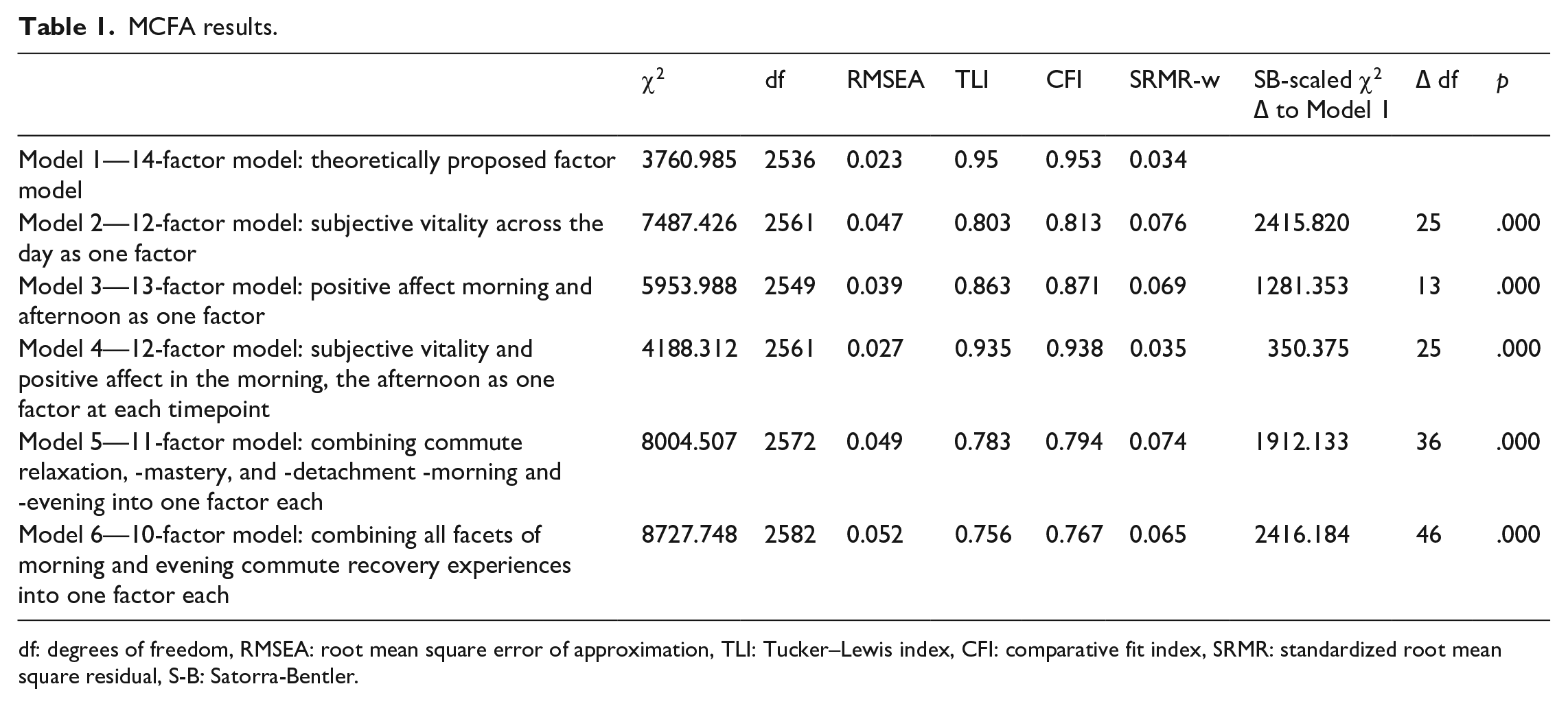
df: degrees of freedom, RMSEA: root mean square error of approximation, TLI: Tucker–Lewis index, CFI: comparative fit index, SRMR: standardized root mean square residual, S-B: Satorra-Bentler.
Analytical procedure
Because of the nested structure of our data, we used multilevel modeling to examine our hypotheses. All models were specified with the software Mplus 8.2 (Muthén and Muthén, 2017 [1998]) using Maximum Likelihood estimation with robust standard errors and Monte Carlo integration.
We tested the proposed hypotheses by specifying a 1-1-1-1 moderated-mediation model (Preacher et al., 2010). In this model on the within-person level, we first specified direct paths linking morning commute relaxation, -mastery, and -detachment to afternoon subjective vitality. Furthermore, we specified paths between all three exogenous variables (i.e. morning commute recovery experiences) and afternoon subjective vitality to evening commute relaxation, -mastery, and -detachment. Finally, all previously mentioned variables were modeled to predict evening subjective vitality. To test the interactions of morning- and evening commute duration with commute recovery experiences, we specified two-way interactions between morning- and evening commute duration and each commute recovery experience (i.e. relaxation, mastery, and detachment), respectively, and specified paths of the direct effect of the morning- and evening commute duration and the corresponding two-way interactions to afternoon- and evening subjective vitality, respectively.
To substantiate our theoretical proposition that morning commute recovery experiences in the commute domain facilitate daily resource gain processes in the work domain, we control for morning subjective vitality when examining the relationship between morning commute recovery experiences and subjective vitality in the afternoon. Accounting for the daily autoregressive effect of morning subjective vitality when predicting afternoon subjective vitality allows us to examine how the change in subjective vitality from the time an employee arrives at work to the afternoon is affected by commute recovery experiences (see Meier and Gross, 2015). Furthermore, as part of our model, we also consider the autoregressive effect of afternoon subjective vitality when predicting evening subjective vitality, which also allows us to model the change in subjective vitality from the afternoon to the evening that is predicted by evening commute recovery experiences. In sum, by controlling for the autoregressive effects of subjective vitality when examining afternoon and evening subjective vitality we examine how commute recovery experiences affect changes in subjective vitality during the day.
All relationships were specified in a single model. In our analyses, all exogenous variables were group-mean centered, which allowed us to focus exclusively on within-person relationships (Enders and Tofighi, 2007; Ohly et al., 2010). Evening subjective vitality as an endogenous variable was specified at both levels of analysis, which led to the application of latent mean centering, which at the within-person level corresponds with manifest group mean centering but does not change the mean of the variable at the between-person level (Asparouhov and Muthén, 2019).
Because the conventional bootstrapping method of re-sampling cannot be applied to multilevel modeling (Preacher and Selig, 2012), we utilized a Monte Carlo approach of re-sampling to estimate the confidence intervals for the 1-1-1-1 moderated-mediation model (Preacher and Selig, 2012). Specifically, we computed bias-corrected 95% confidence intervals for the indirect effects based on 20,000 re-samples using the software provided by Selig and Preacher (2008). For testing moderated indirect effects, we followed Hayes and Preacher’s (2010) recommendation and computed conditional indirect effects at lower (−1 SD) and higher (+1 SD) levels of commute duration. An indirect effect is significant if the confidence interval of the indirect effect does not include zero (Preacher et al., 2007).
Results
Table 2 displays the descriptive statistics, internal consistencies, and correlations among all variables of our study. Before testing our hypotheses, we examined the proportions of within-person variance in all study variables by computing intraclass correlation coefficients (Castro, 2002). The amount of within-person variance in our variables ranges from 23 to 67%, which justifies the application of multilevel analysis.
Means, standard deviations, internal consistencies (Cronbach’s alpha), and intercorrelations.
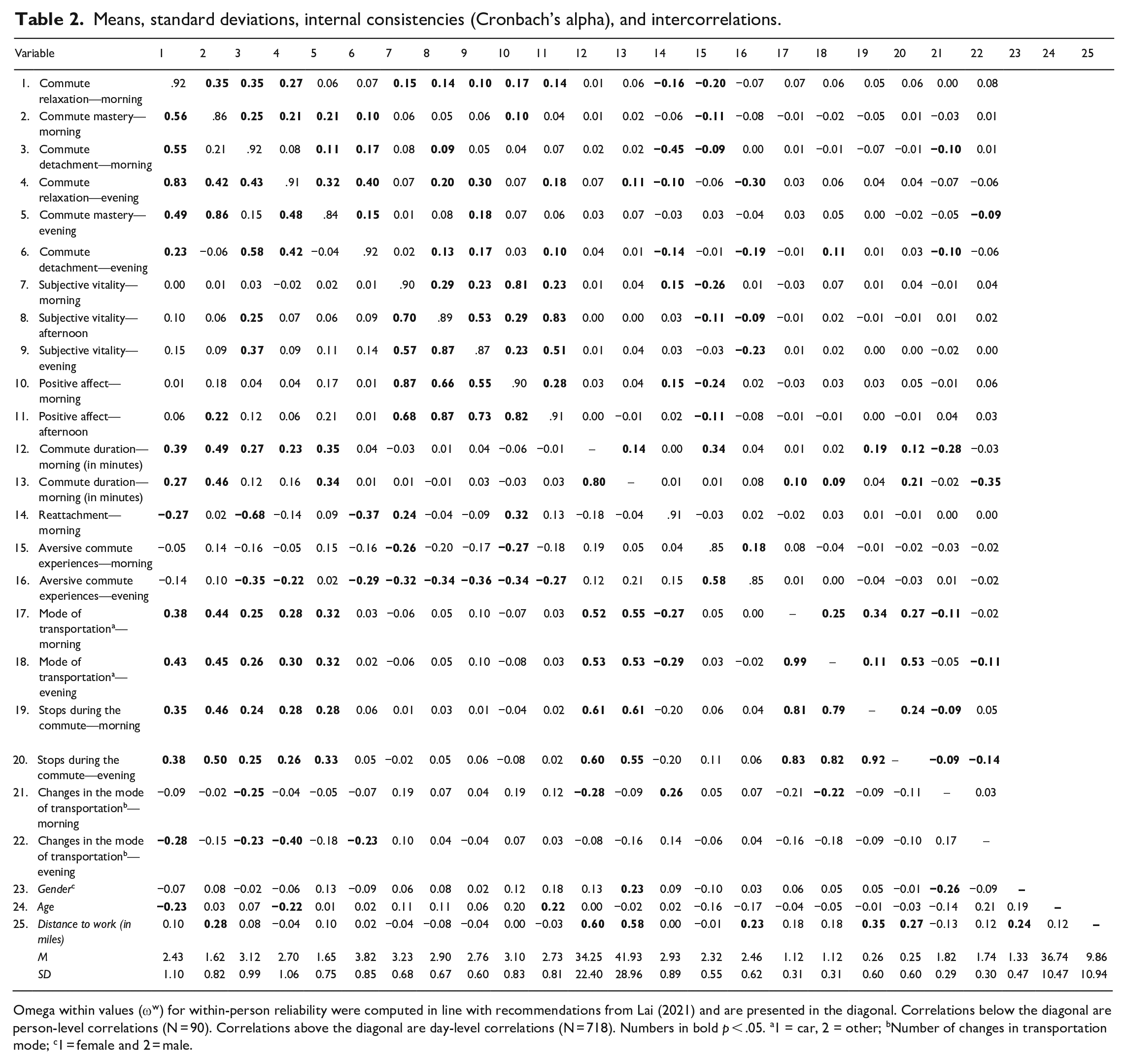
Omega within values (ωw) for within-person reliability were computed in line with recommendations from Lai (2021) and are presented in the diagonal. Correlations below the diagonal are person-level correlations (N = 90). Correlations above the diagonal are day-level correlations (N = 718). Numbers in bold p < .05. a1 = car, 2 = other; bNumber of changes in transportation mode; c1 = female and 2 = male.
The results are presented in Table 3. Hypothesis 1 predicts cross-domain energetic resource enrichment, which manifests itself in positive relations between day-specific (a) relaxation, (b) mastery, and (c) detachment during the morning and subjective vitality in the afternoon. Our data support Hypothesis 1(a) as there is a positive relationship between morning commute relaxation and subjective vitality in the afternoon (γ = 0.081, p = .02). Furthermore, controlling for morning subjective vitality substantiates our proposition that experiencing relaxation during the morning commute facilitates daily resource gains that manifest in an increase in subjective vitality from the morning when an employee arrives at work to the afternoon when an employee finishes work. However, we did not find corresponding relationships for mastery, and detachment during the morning commute thus Hypotheses 1(b) and (c) were not supported.
Unstandardized coefficients from the Multilevel Structure Equation Model.
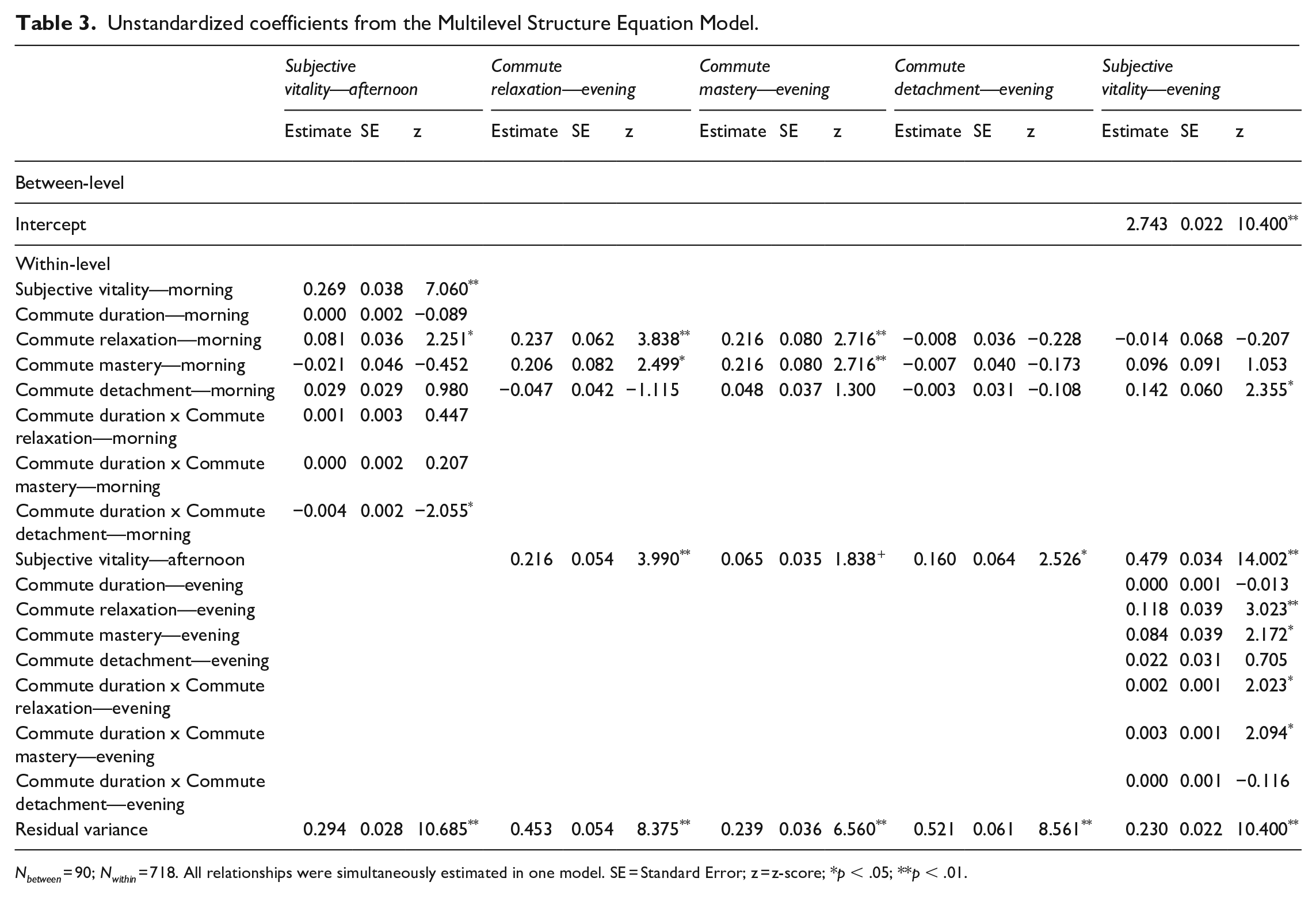
Nbetween = 90; Nwithin = 718. All relationships were simultaneously estimated in one model. SE = Standard Error; z = z-score; *p < .05; **p < .01.
Hypothesis 2 suggests that subjective vitality in the afternoon is positively related to commute recovery experiences during the evening commute back from work. Our results support the positive relationships between afternoon subjective vitality and evening commute relaxation (γ = 0.216, p < .01), and detachment (γ = 0.160, p = .01). In comparison, the relationship between afternoon subjective vitality and commute mastery (γ = 0.065, p = .07) was only marginally significant. Accordingly, our results support Hypotheses 1(a) and (c), whereas support for Hypothesis 1(b) was limited. More specifically, on those days where employees have a higher as compared with a lower availability of resources in the afternoon, they experience higher levels of relaxation and detachment during their evening commute from work.
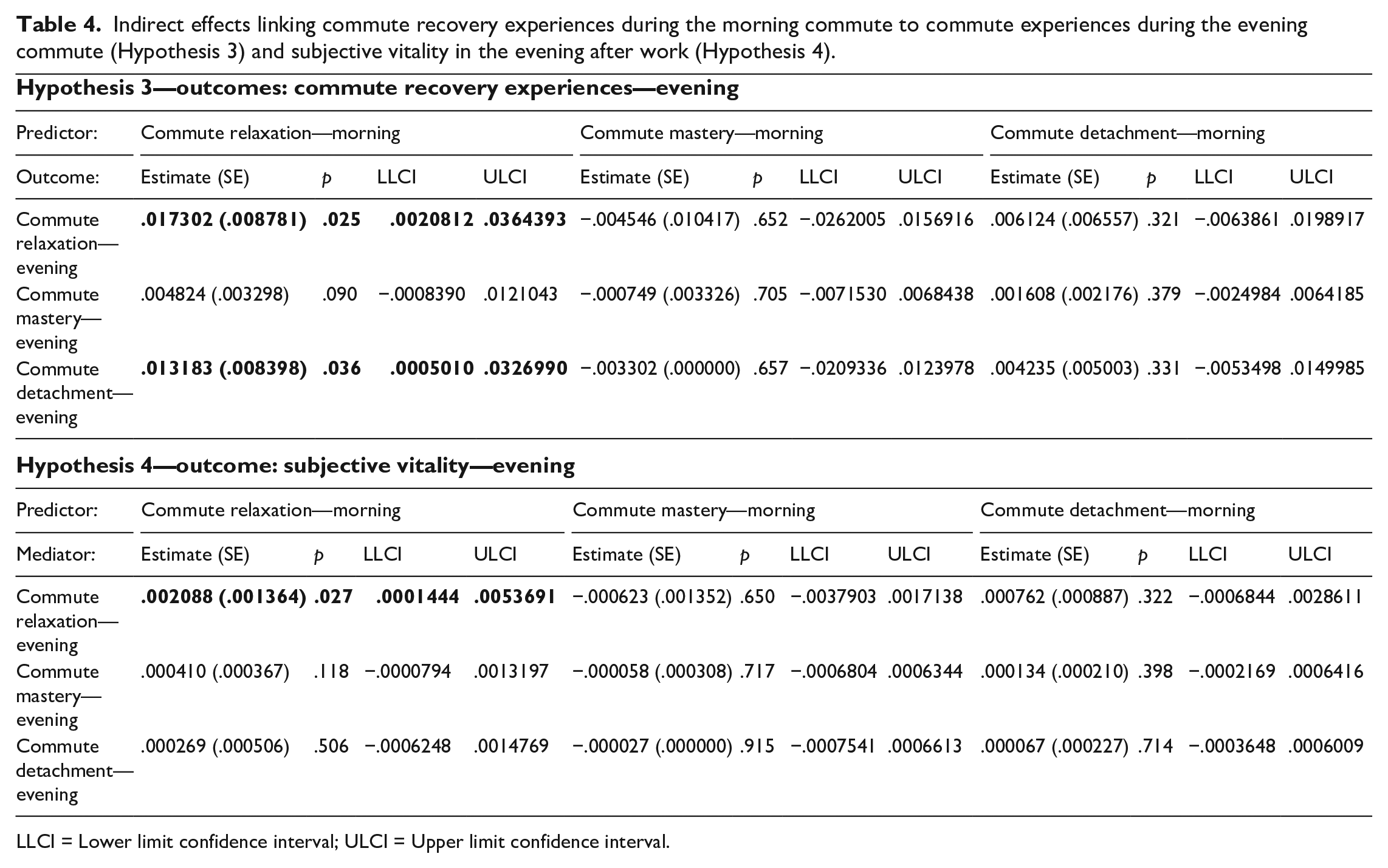
Integrating Hypotheses 1 and 2, Hypothesis 3 proposes indirect relationships between day-specific commute (a) relaxation, (b) mastery, and (c) detachment during the morning commute to day-specific (i) relaxation, (ii) mastery, and (iii) detachment during the evening commute via subjective vitality in the afternoon. We tested this hypothesis by computing the 95% CIs for the corresponding indirect effects. The results for testing this hypothesis are presented in Table 4. Corresponding with the direct effects described above, our data support an indirect effect for commute relaxation during the morning commute to work as a predictor of evening commute relaxation (Hypothesis 3(a) i) and detachment (Hypothesis 3(a) iii) as the corresponding 95% CIs did not include zero for evening commute relaxation (γ = .017, p = .03; 95% CI [.0021, .0364]) and -detachment (γ = .013, p = .04; 95% CI [.0005, .0327]) as outcomes. However, the hypothesized indirect relationships for morning commute mastery (Hypothesis 3(b) i–iii) and -detachment (Hypothesis 3(c) i–iii) as predictors and for evening commute mastery (Hypotheses 3(a)–(c) ii) were not supported as the 95% CIs for these corresponding indirect effects did include zero (see Table 4). Accordingly, our results suggest that compared with those days when employees experience higher compared with lower commute relaxation during the morning commute they experience higher levels of commute relaxation and detachment during the evening commute through higher levels of subjective vitality at work.
Indirect effects linking commute recovery experiences during the morning commute to commute experiences during the evening commute (Hypothesis 3) and subjective vitality in the evening after work (Hypothesis 4).
LLCI = Lower limit confidence interval; ULCI = Upper limit confidence interval.
Integrating the previous, Hypothesis 4 proposes our full mediation model suggesting that relaxation (Hypothesis 4(a)), mastery (Hypothesis 4(b)), and detachment (Hypothesis 4(c)) during the morning commute to work are positively related to evening subjective vitality via afternoon subjective vitality and (i) relaxation, (ii) mastery, and (iii) detachment during the evening commute from work. As indicated in Table 4, our results support Hypothesis 4(a) i, suggesting that the relation between morning commute relaxation and evening subjective vitality is mediated by afternoon subjective vitality, and evening commute relaxation (γ = .0021, p = .03; 95% CI [.0001, .0054]). The remaining parts of Hypothesis 4 concerning morning commute mastery (Hypotheses 4(b) i–iii) and detachment (Hypotheses 4(c) i–iii) as predictors and evening commute detachment (Hypothesis 4(c) ii) and mastery (Hypothesis 4(c) iii) as mediators were rejected as the corresponding confidence intervals included zero (see Table 4). In sum, our results indicate a dual spillover effect from the home- to the work- and back to the home domain. That is, our data suggest that on days when employees experience higher as compared with lower relaxation during the morning commute they benefit from resource gain processes that manifest as increases in subjective vitality in the work domain. These increases, in turn, facilitate relaxation during the evening home commute resulting in higher levels of subjective vitality in the home domain at the end of the workday.
Research Question 1 focuses on commute duration as a moderator of the relationships between morning and evening commute recovery experiences and subjective vitality in the afternoon and evening, respectively. Our data indicate that there was an interaction between commute detachment and commute duration during the morning commute to work on subjective vitality in the morning as indicated by the significant interaction term (γ = −0.004, p = .04; see Table 3). Furthermore, for the evening commute from work, the interaction of commute relaxation (γ = 0.002, p = .04) and commute mastery (γ = 0.003, p = .04) with commute duration were significantly related to evening subjective vitality. To explore the pattern of the significant interaction effects involving morning commute detachment and evening commute relaxation as well as -mastery with commute duration, we plotted the interactions and conducted simple slope tests as recommended by Cohen et al. (2003). For the interaction of detachment and commute duration during the commute to work, Figure 2 indicates a buffering effect as the relationship between morning commute detachment and afternoon subjective vitality for high commute duration is close to zero whereas the slope for low commute duration is positive albeit only marginally significant. For the evening commute from work, Figure 2 demonstrates that there is only a positive relationship between commute relaxation (β = 0.18, p < .01) and -mastery (β = 0.10, p < .01) with evening subjective vitality on days with a longer evening commute duration, whereas there are no significant relationships on days with a shorter commute duration. In sum, our data suggest an impedance view of morning commute duration as it buffers the positive relationship between morning commute detachment and subjective vitality. For the evening commute, our results suggest a positive utility view of commute durations as on those days when employees experience a higher commute duration they benefit from a higher subjective vitality when experiencing evening commute relaxation and/or mastery.
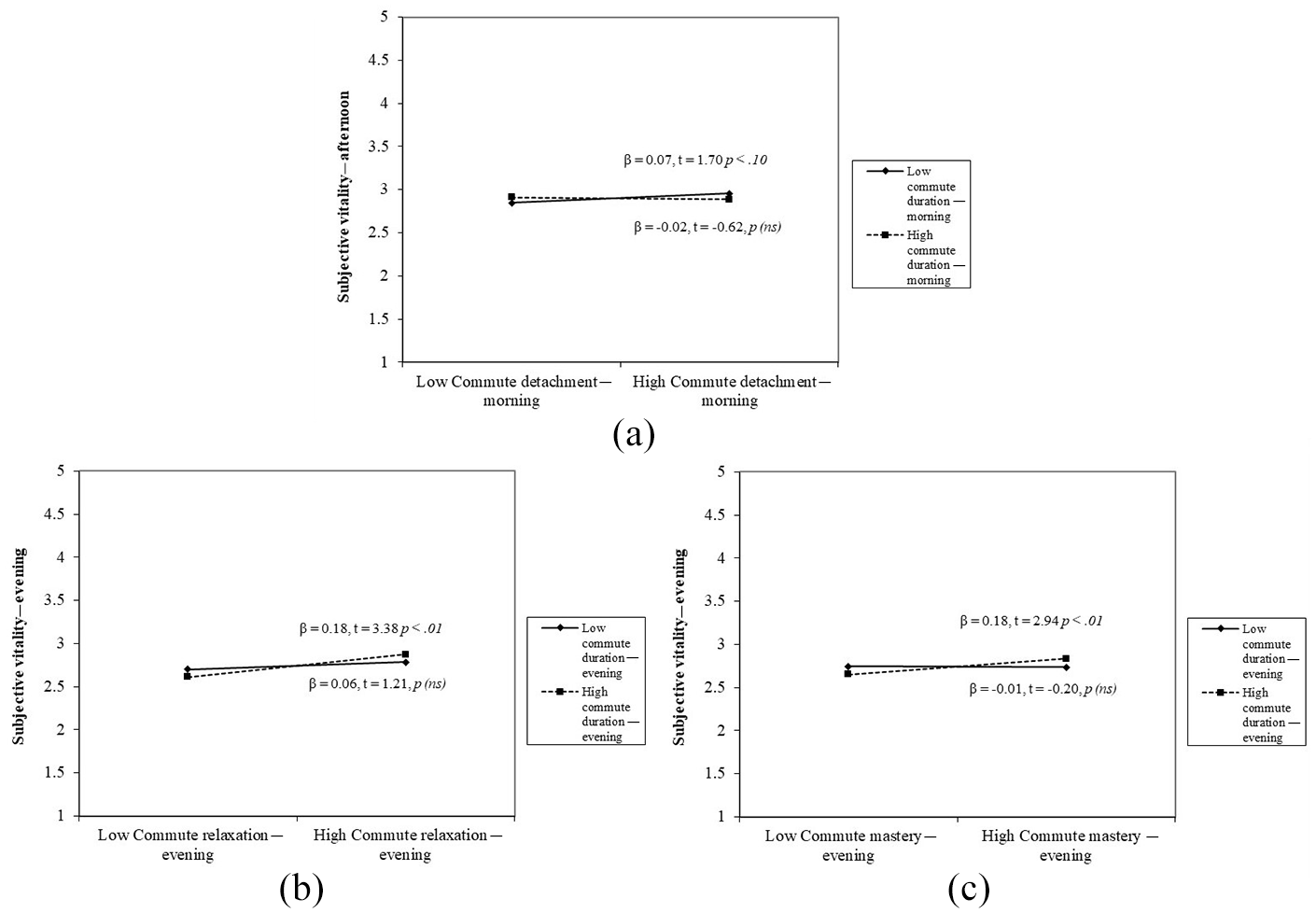
Two-way interaction effects of morning commute detachment with commute duration on afternoon subjective vitality (a) and interaction effects of evening commute relaxation (b) and mastery (c) with commute duration on evening subjective vitality.
To estimate the effect strength of the examined relationships, we calculated the amounts of variance in our outcome variables explained by our proposed model. For that, we followed recommendations by Snijders and Bosker (2011) to compute the proportion of explained variance, which was 8.8% for afternoon subjective vitality. For relaxation, mastery, and detachment during the evening commute, the proportions of explained variance were 11.2%, 5.2%, and 3.5%, respectively. Finally, for evening subjective vitality our model explained 32.8% of the variance. 3 The proportions of explained variance, particularly for evening subjective vitality, not only underscore the theoretical but also the practical relevance of our study.
Additional analyses
In our theoretical framework, we delineate that the proposed daily resource enrichment across domains and associated resource gain in the work and home domain is uniquely driven by subjective vitality as an indicator of high physical and cognitive energy rather than other forms of energy. To ensure that our model does not reflect intercorrelations of positive experiences across domains, we conducted additional analyses controlling for positive affect as an alternative affective resource when examining the proposed relationships. 4 More specifically, the WHR model outlines positive affect or mood—the extent to which a person feels enthusiastic, active, and alert (Watson et al., 1988)—as a unique manifestation of personal energy (ten Brummelhuis and Bakker, 2012a). Accordingly, both subjective vitality and positive affect as indicators of high availability of energy incorporate general aspects of employees’ positive experiences throughout the day. Thus, by controlling for employees’ levels of positive affect across the day, we can account for the shared portions of variance between subjective vitality and positive affect that are attributed to employees’ daily fluctuations of positive experiences. In other words, after controlling for positive affect the remaining relationships are unlikely to reflect daily fluctuations of positive affect and thus more strongly represent the effect of cognitive and physical resources facilitated through commute recovery experiences.
Accordingly, we added morning positive affect as a control variable when examining afternoon subjective vitality as an outcome. Furthermore, we added afternoon positive affect as a control variable when predicting evening commute relaxation, mastery, and detachment as well as evening subjective vitality as an outcome. To further substantiate the robustness of our findings, we controlled for aversive commute experiences, mode of transportation, 5 stops during the commute, and changes in mode of transportation during the commute to and from work. Finally, we also controlled for commute reattachment during the commute to work. We specified these control variables to predict all endogenous variables in our model.
The addition of these control variables did not have a major impact on our findings. Apart from the relationship between afternoon subjective vitality and commute mastery (γ = −0.084, p = .20), which was marginally significant in our main analyses, and the relationship between afternoon subjective vitality and commute detachment (γ = −0.19, p = .05), which was significant in our main analyses, all relationships remained robust when including control variables. Accordingly, we can conclude that our relationships are not affected by daily aversive commute experiences as well as different daily commute-related factors (i.e. commute mode, stops, and changes in mode of transportation during the commute to and from work). Furthermore, daily reattachment did not affect the proposed focal relationships. Finally, and most importantly our additional analyses support our theoretical proposition that subjective vitality is the focal resource that links morning commute experiences to evening subjective vitality rather than mood as reflected by daily positive affect. Accordingly, our focal relationships remain robust when including subjective vitality as a control variable.
Finally, we examined differences in commute-related variables such as commute recovery experiences, commute duration, commute reattachment, and aversive commute experiences by conducting a Multivariate Analysis of Variance (MANOVA) with the commute variables as respective outcomes. For the morning commute to work, our analyses reveal significant differences in commute relaxation (F(2, 84) = 13.52, p < .01), commute mastery (F(2, 84) = 10.06, p < .01), and commute duration (F(2, 84) = 12.30, p < .01) between different commute modes whereas we did not find any significant differences for the other variables. Furthermore, for the evening commute from work, our data also demonstrate differences for commute relaxation (F(2, 84) = 12.56, p < .01), commute mastery (F(2, 84) = 7.26, p < .01), and evening commute duration (F(2, 84) = 5.90, p < .01). Post hoc comparisons of different commute modes revealed that for both the work and the home commute relaxation was lower when driving whereas there were no differences between public transport and walking/cycling modes of commute in terms of experienced commute relaxation. Commute mastery during the commute to and from work was higher when commuting via public transport compared with driving but there were no differences in commute mastery between public transport commuters and those who walked/cycled to work. Finally, morning and evening commute durations were higher for those individuals who commuted by public transport as compared with commuters who drove or walked/cycled to work, whereas there were no differences between the latter commute modes.
Discussion
Drawing on our theoretical integration of the WHR model and CoR theory’s notion of resource gain, the present research explores the day-specific beneficial effects of commute recovery experiences for resource enrichment across domains. More specifically, we argue that daily morning commute recovery experiences facilitate a cross-domain resource enrichment process of physical and cognitive resources that manifests in daily resource gains of subjective vitality in the work domain. This daily increase in subjective vitality, in turn, is positively related to evening commute recovery experiences and subsequent higher daily subjective vitality in the home domain. Our results partially support the proposed research model. With regard to the morning commute, our results suggest that on days with higher (vs. lower) levels of relaxation during the morning commute, an employee is more likely to experience higher subjective vitality in the afternoon. Furthermore, on days with higher as compared with lower afternoon subjective vitality, an employee is more likely to experience higher levels of relaxation and detachment during the evening commute from work. Finally, daily relaxation during the evening commute has the potential to enrich an employee’s resources in the home domain as this daily recovery experience links subjective vitality in the work domain to subjective vitality in the home domain. In a nutshell, our findings offer initial support of the beneficial role of daily relaxation during the morning commute to work and the evening commute from work as a crucial recovery experience in the commute domain that is likely to be associated with daily gains of subjective vitality in the domain following the commute. Expanding on these findings, our additional analyses indicate that the proposed cross-domain enrichment process is likely driven by cognitive and physical resources as reflected by subjective vitality rather than mood, which becomes evident as the inclusion of positive affect among other control variables had no major implications for our core findings.
Concerning our exploratory research question the present study juxtaposes a negative impedance and a positive utility perspective of daily commute duration by examining commute duration as a boundary condition of the relationship between commute recovery experiences and subjective vitality after the commute. Our findings lend stronger support for the impedance perspective on the morning commute as commute duration is likely to buffer the positive relationship between commute detachment and subjective vitality. In comparison, regarding the evening commute from work, our data lend stronger support to the positive utility view of commute duration as commute duration is likely to strengthen the relationship between commute relaxation and mastery during the evening commute from work to subjective vitality in the home domain. However, taking the exploratory nature of these relationships into consideration there is a requirement to replicate these results before developing practical implications based on the present findings.
Theoretical implications
Our research offers several theoretical implications. First, our focus on the positive consequences of daily commute recovery experiences for facilitating daily gains of physical and cognitive resources addresses the “negativity bias” that so far has dominated between-person research on commuting (Murphy et al., 2023). To date, even studies focusing on the benefits of commuting (e.g. Jachimowicz et al., 2021) only investigated how experiences during the commute can reduce the aversive impact of commuting. In contrast, we shift the focus to the potential positive day-specific effects of commuting across domains, thus developing a conceptual lens and empirically investigating the many anecdotes of enjoyable commutes (Aoustin and Levinson, 2021). Our research indeed supports preliminary evidence that people prefer to commute instead of having no commute at all (Redmond and Mokhtarian, 2001). This perspective shift conceptually resembles the debate about the nature of factors in job satisfaction research (Herzberg et al., 1959), where hygiene factors—when satisfied—can facilitate neutral, but not necessarily beneficial states, motivators contribute to beneficial states. Before our research, commuting has been mostly considered as the equivalent of a hygiene factor—scholars have studied how its detrimental consequences can be prevented. In contrast, we conceptually argue and empirically show that daily recovery experiences in the commute domain can enrich resources in the domain following the commute as reflected by increased daily levels of subjective vitality.
Second, to the best of our knowledge, we are among the first to consider the daily benefits of experiences during the work and home commute in one study. Our work can thus help to integrate several disconnected streams of literature such as the recovery literature (Sonnentag et al., 2017) and research on the work–family interface by highlighting that it is important to consider differential forms of recovery during the morning versus evening commute. More specifically, our study suggests that day-specific relaxation during the morning commute to work, and during the evening commute home are likely the focal recovery experiences that facilitate employees’ resources gains in the domain after the commute. For commute mastery, our results suggest that it is presumably beneficial for employees’ vitality in the home domain when experienced during the evening commute from work rather than during the morning commute to work. This finding is intriguing because it highlights the temporal nature of the effectiveness of experiencing mastery during the commute. It is possible that during the evening commute experiencing mastery is more beneficial for employees as they can better immerse themselves in an absorbing activity during the evening commute from work as compared with the morning commute to work. This is because, during the morning commute to work, employees may have to plan their workday, which makes it more difficult to immerse in activities during the commute, which facilitate mastery. However, it is also important to note that the benefits of mastery experiences during the evening commute from work may also be more broadly associated with positive experiences rather than with physical and cognitive resource gains as the relationship becomes non-significant when controlling for positive affect. Regarding commute detachment, our data do not lend support for its beneficial role in cross-domain resource enrichment in the domain following the commute. This may be because the close temporal proximity of the commute to being present at work prevents employees from fully benefiting from commute detachment. Accordingly, our results may highlight that time may be a crucial contingency for the beneficial effects of detachment. This is further substantiated by the positive relationship between morning commute detachment and evening subjective vitality.
Furthermore, our research highlights the potential duality of the interplay between commute recovery experiences and employees’ resources. On the one hand, our findings suggest that by replenishing physical and cognitive resources, commute relaxation facilitates resource gains in the work domain across the workday. On the other hand, experiencing commute relaxation and detachment during the evening commute from work may require employees’ resources. These findings correspond with the theoretical notion of the recovery paradox, which suggests that to experience recovery employees must invest at least some resources (Sonnentag, 2018) but that at the same time recovery experiences replenish resources. In addition, these findings complement so far scarce empirical evidence on the recovery paradox by demonstrating that this theoretical proposition not only applies to detachment (Germeys and De Gieter, 2018) but also to daily relaxation, which is contingent on the availability of physical and cognitive resources. Moreover, the addition of several control variables does not majorly affect our results, which offers evidence for the robustness of our findings. In particular, by controlling for positive affect, we demonstrate that subjective vitality as a manifestation of physical and cognitive resources represents the focal resource that underpins the resources enrichment process triggered by morning commute relaxation rather than mood as reflected by positive affect.
Third, our study sheds light on the so-far ambiguous role of day-specific variations in commute duration (i.e. an aspect of the temporal dimension of the liminal commute space; McAlpine and Piszczek, 2023) as a boundary condition of the link between recovery experiences in the commute domain and subjective vitality in the domain following the commute (Sonnentag et al., 2017). Our exploratory findings suggest that detachment during the morning commute is more strongly related to subjective vitality in the work domain on days with shorter as compared with longer morning commutes, thus offering preliminary support for an impedance view of commute duration. For the evening commute from work, our results more strongly align with a positive utility perspective of commute duration as daily commute duration is likely to strengthen the relationship between commute relaxation and -mastery with subjective vitality in the home domain. Taking these diverging findings into consideration we argue that future theorizing may benefit from adding a temporal lens to the recovery literature to fully understand the role of commute duration. Commute detachment on days with a shorter as compared with a longer morning commute may be more beneficial for employees’ resources because a longer than average morning commute inhibits the benefits of detachment owing to being associated with intruding work-related thoughts (i.e. about rescheduling tasks or meetings) because the employee arrives at work later than anticipated. For the evening commute, the recovery literature suggests that it takes some time to reduce the physiological stress in the body and to sufficiently replenish one’s resources when one is in a depleted state (Meijman and Mulder, 1998). Accordingly, after a demanding workday, employees find it more difficult to relax (Sonnentag and Fritz, 2015), which entails that more time to do so during the commute may be needed to fully benefit from commute recovery experiences. Correspondingly, the benefits of experiencing mastery during the evening commute may be contingent on commute duration because employees have more time to immerse in a challenging activity so that they can experience immersive states such as flow during the commute that replenish resources (Gerpott et al., 2022). In sum, our findings of the differential moderating effects of commute duration between the morning commute to work and the evening commute from work highlight the importance of testing for the homology of relationships at the daily within-person level as compared with the more general between-person level. That is, although in general and at a daily level having a longer morning commute is more detrimental for employees (Murphy et al., 2023), having a longer evening commute on some days may be beneficial for employees’ vitality if they experience relaxation and/or mastery during the commute. Variations in commute duration may have resulted from deliberate changes that employees make such as commuting at a different time or changing the mode of their commute however this exploratory finding requires further empirical support.
Limitations and suggestions for future research
This research is not without limitations that can serve as an inspiration for future research. First, owing to the focus on people’s subjective experiences in the form of daily commute recovery experiences and the associated daily energetic gain process, we assessed our study variables through self-reports. Accordingly, our findings may be subject to common method variance (CMV) problems (Podsakoff et al., 2003). However, this issue is alleviated by the differential result patterns highlighting that during the - as compared with the evening commute only specific commute recovery experiences facilitate subjective vitality. The emergence of such differential result patterns is unlikely under the presence of high CMV, which inflates correlations between variables (Podsakoff et al., 2003). Furthermore, the identified interaction effects involving morning and evening commute duration further alleviate CMV concerns because CMV reduces the likelihood of detecting interaction effects (Siemsen et al., 2010). We also do not think that it is particularly feasible to obtain external ratings (i.e. from one’s partner, or of recovery experiences or subjective vitality) because such ratings may also be deficient (Gabriel et al., 2019).
Second, even though our study design with three measurement occasions per day allowed us to separate the measurement of some of our variables across time, which provides stronger evidence for the causality of the proposed research model, we could not obtain time-lagged measurements for all our study variables such as commute recovery experiences and subjective vitality in the evening. Furthermore, taking into consideration that our data are correlational strictly speaking we cannot claim that our data support a causal direction of the proposed relationships as this can only be established by conducting randomized experiments (Antonakis et al., 2010). To strengthen the evidence for the causality of the proposed relationships researchers could thus conduct within-person experiments (Schweitzer et al., 2022) to examine the effects of commute recovery experiences on employees’ subjective vitality by manipulating commute recovery experience through exercises or instructions.
Third, our initial exploratory findings imply that for the morning commute, we should adopt an impedance perspective of commute duration whereas for the evening commute a longer commute duration may have positive utility. Accordingly, future research could expand on these exploratory findings by not only examining the interplay of commute duration with commute recovery experiences but also with stressors or aversive experiences that occur during morning and evening commutes. In addition, future studies could systematically investigate how commute mode impacts the effectiveness of recovery effectiveness, which could inform organizations’ mobility policies. Furthermore, against the backdrop that the differential relations of recovery experiences during the morning and evening commute suggest that the timing at which the recovery experiences occur may be an important contingency, future research could more systematically consider the temporal aspects of engaging in recovery experiences as well as the duration of recovery experiences (Unger et al., 2015). Such research may help to find optimal time frames and durations for the benefits of recovery experiences.
Finally, while our theoretical arguments also imply that commute recovery experiences during the morning commute to work are contingent on the availability of resources, we do not explicitly examine this relationship in our study because we did not collect data before the morning commute. Accordingly, future research could unpack the morning commute by examining the role of resource availability in the morning before the commute for commute recovery experiences during the commute and associated daily resource gain. This research could add to our theoretical understanding by highlighting whether the same psychological processes underlie the beneficial effects of commute recovery experiences on the commute to work and home.
Practical implications
Our results hold implications for employees and employers alike. First, commuters should think about how to approach their commute more strategically in terms of using it as a domain for recovery. As our study shows that relaxation is beneficial during the morning and evening commute, a starting point may be to consider experiences that contribute to employees’ relaxation. Although there are different ways for people to relax during the commute, individuals report that taking a nap, listening to music, and daydreaming can be relaxing (Kim et al., 2017). Second, organizations could offer workshops in which they inform about the potential benefits of recovery experiences during the commute and encourage employees to proactively “own” or “craft” their commute as well as exchange best practices about how to do so (Bakker et al., 2016; Rofcanin et al., 2019). Additionally, organizations may provide resources that help employees to relax and detach during commutes. For example, an organization could offer free access to mediation apps or streaming services that employees could listen to during their commutes. Lastly, our findings can contribute to the ongoing lively debate about whether commuting should remain relevant for the future of work (e.g. Ambade et al., 2021; Haupt, 2021). Notably, many employees report having missed their commuting ritual when working from home during the COVID-19 pandemic (Aoustin and Levinson, 2021) or having simulated their commute when working remotely (Boyle, 2020; Haupt, 2021). Indeed, when asking people about their ideal commute length, they rarely respond “none at all” (Redmond and Mokhtarian, 2001). We thus conclude that scholars and organizational stakeholders should also consider the potential benefits of commuting when shaping the future of work.
Footnotes
Funding
The authors received no financial support for the research, authorship, and/or publication of this article.
