




Abstract
The COVID-19 crisis highlights a growing precarity in employment and the importance of employment for workers' well-being. Existing studies primarily examine the consequences of employment precarity through non-standard employment arrangements or the perception of job insecurity as a one-dimensional measure. Recent scholars advocate a multidimensional construct with a wide range of objective and subjective characteristics of precariousness. Using data from Eurofound's Living, Working, and COVID-19 surveys, I define employment precarity as the objective form of employment instability, as well as subjective terms of job insecurity and emotional precariousness. I also investigate whether and how various facets of employment precarity along with COVID-19 risk are associated with workers' mental and subjective well-being across 27 European Union member states during the pandemic. This study sheds light on a comprehensive understanding of objective and subjective dimensions of employment precarity, as well as their effects on workers' well-being during the COVID-19 pandemic.
Keywords
In the past few decades, the global precarization trend in employment has been influenced by de-unionization, financialization, and digitalization in an increasingly flexible but uncertain global labor market (Campbell & Price, 2016; Kalleberg & Vallas, 2018). The COVID-19 crisis highlights a growing precarity in employment and the importance of employment for workers' well-being (Nieuwenhuis & Yerkes, 2021). Since March 2020, Europe has been experiencing multiple waves of COVID-19 outbreaks as well as disruptions in economic life and employment. The economic fallout from the COVID-19 crisis has resulted in millions of Europeans losing their jobs, income, and working hours (Witteveen & Velthorst, 2020), as well as a decrease in overall satisfaction with work, family, and life (Möhring et al., 2021). Furthermore, mental health has become a priority as a result of social distancing, isolation, curfews, quarantine, lockdown, and economic hardship.
The COVID-19 pandemic, as well as the subsequent economic downturn, have heightened labor market uncertainty. On the one hand, previous workers who were concentrated at the low end of the labor market with nonstandard employment arrangements (e.g., temporary, part-time, and on-call jobs) were the hardest hit by the COVID-19 pandemic (International Labor Organization, 2020). They were more likely to be laid off, furloughed, have their wages and benefits cut, and be exposed to higher COVID-19 risk at work. Even if they did not lose jobs during the pandemic, they were concerned that their contracts would not be renewed. Millions of essential workers risking their health on the frontline were underpaid and struggling to make ends meet in the midst of the COVID-19 pandemic. On the other hand, the spread of labor market uncertainty and precariousness has increasingly permeated jobs that are commonly regarded as “good” (Cech & Hiltner, 2022). Due to the lockdown during the pandemic, professionals such as performers and musicians were forced to furlough or work reduced hours. Those who switched to compulsory remote working mode faced a lower COVID-19 risk at work, but they also experienced feelings of isolation, overwork, work-life imbalance, loss of passion for work, and job burnout.
Amid the uncertainty, no one can completely escape the “risk society” (Beck, 1992). Most forms of employment have become entangled in varying degrees of precarious conditions. Even having a “good job” does not necessarily weather existential uncertainty and guarantee “a secure livelihood” during the pandemic (Williams, 2021). As a result, it is plausible to expand our focus beyond precarious work that is restricted to specific groups of workers or particular characteristics of precarious employment (Benach et al., 2016; Ross, 2009). This raises research questions: how to define and understand employment precarity broadly in times of uncertainty? And how do these characteristics of employment precarity affect the well-being of European workers during the COVID-19 pandemic?
Despite no agreement on the definition of employment precarity, the bulk of current studies rely on either non-standard, unstable types of employment (Carr & Chung, 2014; Moscone et al., 2016; Nau & Soener, 2019; Rönnblad et al., 2019), or the perception of job insecurity (Hellgren et al., 1999; Lewchuk et al., 2008; Gallie et al., 2017). More recent scholars advocate a multidimensional construct of employment precarity that involves a wide range of precarious job characteristics. Some develop indicators of objective employment quality (Han & Hart 2021; Lewchunk, 2017; Olsthoorn, 2014), while others emphasize the subjective experience of precariousness from a psychological perspective (Allan et al., 2021; Seubert et al., 2019).
Eurofound's Living, Working, and COVID-19 (LWC) survey dataset offers an exceptional opportunity to study employment precarity and workers' well-being in the context of the COVID-19 pandemic across 27 European Union (EU) member states. Using the data from the LWC, I focus on three facets of employment precarity. The first two, employment instability and job insecurity, are aligned with the mainstream literature on precarious employment. I create a third dimension of emotional precariousness to incorporate the recent psychological approach that considers a “subjective feeling of precarity” (Alberti et al., 2018; Allan et al., 2021. Moreover, due to the spread of the COVID-19 virus and its unpredictable consequences, COVID-19 virus exposure at work becomes a new occupational health risk during the pandemic. In light of the foregoing, and building upon the existing precarious work literature, the present study aims to examine whether and how various aspects of employment precarity are associated with European workers' well-being amid the pandemic. This study sheds light on a comprehensive understanding of the objective and subjective dimensions of employment precarity, as well as their effects on workers' well-being during the COVID-19 pandemic.
Conceptualization of Employment Precarity in Europe
In the broadest sense, employment precarity is defined as any aspect of work that lacks security, stability, and decent quality. There are no standardized definitions of what constitutes employment precarity, but many related terms are sometimes used interchangeably, such as precarious employment, precarious work, precariousness, and job precarity. Despite extensive research over the last decades, these interchangeable terms still lack a universally agreed-upon definition and vary depending on context. Overall, there are three major strands for understanding employment precarity in the existing literature.
In Europe, the concept of employment precarity first emerged in the late 1970s, with the decline of the “Standard Employment Relationship”, which involves a full-time and permanent work arrangement with benefits, and the emergence of non-permanent forms of the employment contract (Bosch, 2004; Gutierrez-Barbarrusa, 2016; Rodgers, 1989). Part-time work, short-term work, fixed-term work, temporary work, on-call work, seasonal work, agency work, unpaid internships, and other atypical work have all been identified as contractually precarious. As the availability of standard full-time permanent jobs has decreased in an increasingly segmented labor market across Europe, these new forms of non-standard temporary employment have become more prevalent. Consequently, employment instability is the most common type of employment precarity in current scholarship. In other words, any employment arrangement that has a limited or definite duration is considered precarious in the European context.
The other major approach focuses on job insecurity as the marker of employment precarity. Job insecurity, as opposed to employment instability based on contractual status, is a perception of the potential job loss and the benefits attached to the job (Hellgren et al., 1999; Kiersztyn, 2017). Even if job insecurity does not result in actual job loss, it is a perception characterized by fear of losing one's current job and uncertainty about the future. As a result, several studies have found that the perceived threat of job loss is a stressor that is associated with a variety of negative outcomes (Sverke et al., 2002).
As the concept of employment precarity has become multifaceted, focusing on merely one or two characteristics is no longer sufficient. The third major approach highlights the multifaceted nature of employment precarity. For example, Olsthoorn (2014) identified three intersectional components of precarity: insecure employment; unsupportive entitlement; and vulnerable employees with few other means of subsistence. Mai (2017) defined three core features of work precarity, which include unstable work contracts, poor professional development, and low pay. Vives et al. (2010) created the Employment Precariousness Scale (EPRES), which comprises six subscales, including “temporariness” based on contract duration, “disempowerment” related to the ability to negotiate employment conditions, “vulnerability” in working conditions and treatment, “wages and rights” related to work benefits, and “exercise rights”. Padrosa et al. (2020) recently updated the EPRES for Europe with 13 indicators.
Apart from a multidimensional scale of objective precarious job characteristics, emerging literature has paid attention to “a subjective feeling of precarity” (Alberti et al., 2018; Umney & Kretsos, 2015). Seubert et al. (2019) proposed a five-dimensional scale of “Subjective Experience of Work-related Precariousness”, which includes low wages, job insecurity, lack of social support in the workplace, lack of labor protection and legal rights, lack of status and recognition, and lack of meaning and belonging. Allan et al. (2021) proposed a psychological framework that divided precarity into three broad categories: precarity of work; precarity at work; and precarity from work. First, precarity of work includes job insecurity and other subjective experiences of uncertainty, such as fear of unexpected organizational changes and fear of being unable to find a job after losing the current one. Second, precarity at work captures workers' experiences with physical and psychosocial insecurity at work, such as injury, harassment, and discrimination. Third, precarity from work reflects a sense of being deprived of basic material and psychological needs, such as inadequate living wages and work-life imbalance.
The COVID-19 pandemic has further heightened this emotional experience of precarity. From frontline workers to teleworkers, they may have encountered varying levels of emotionally precarious working conditions that they had little or no power to change. For example, excessive workload, increased job demands on free time, tight deadlines, exposure to emotional distress at work, and job burnout threats. Workers' perceptions of these precarious circumstances reflect psychological contracts and insecurity, which erode work quality and lead to withdrawal behaviors (Zheng et al., 2021). Given that, in this study, I develop an index of emotional precariousness that encompasses various workers' subjective experiences of vulnerability and powerlessness at work to expand the psychological dimension of precarity during COVID-19, in addition to employment instability and job insecurity, two conventional measures of employment precarity in current scholarship.
The risk of worker exposure to the COVID-19 virus represents a new hazardous work condition in the context of the COVID-19 pandemic, increasing workers' unpredictability of infection, transmission, medical complications, and psychological burdens. Most workers in critical industries and on the frontlines were at a higher risk of contracting and transmitting the coronavirus due to the nature of their jobs. Workers in essential industries, ranging from low-paid grocery cashiers and janitors to high-paid professionals in healthcare and finance, were less likely to work remotely when COVID-19 cases spiked and the country went into lockdown. During the periods of reopening, however, more nonessential workers returned to their workplaces and faced varying levels of virus risk depending on working conditions, access to personal protective equipment, job tasks, and characteristics, and workplace policies for protecting workers' health and safety. In this sense, when studying work and well-being during the COVID-19 pandemic, it is necessary to account for this new physical hazard and psychosocial risk in the workplace.
Consequences of Employment Precarity
Substantial empirical studies have been carried out to investigate the relationships between different forms of employment precarity and various aspects of workers' health and well-being. The general assumptions demonstrate that people who work in precarious jobs have worse health, more mental health problems, and lower levels of life satisfaction (Julià et al., 2017; Sverke et al., 2002; Van Aerden et al., 2016). However, the evidence is not always consistent and can be ambiguous (Bardasi & Francesconi, 2004; Lewchuk et al., 2008; Scott-Marshall & Tompa, 2011). I focus on a literature review on the consequences for workers' mental and subjective well-being in this paper and then propose two hypotheses.
Employment Precarity and Mental Well-Being
Significant empirical research has been conducted to examine the impact of employment precarity on workers' mental health, but these studies exclusively focus on employment instability or job insecurity as key characteristics of employment precarity (Rönnblad et al., 2019). The majority of studies that highlight job insecurity conclude that it has a negative impact on workers' psychological health (Fiori et al., 2016; Moscone et al., 2016; Pirani, 2017). The temporary nature of the contract also makes workers with non-permanent contracts more vulnerable to mental health issues. A few studies, however, address the counterargument that flexible and temporary work arrangements have little or no significant adverse effect on mental health (Artazcoz et al., 2005; LaMontagne et al., 2014; Lewchuk et al., 2011). The cluster of research on the perception of job insecurity has discovered that job insecurity is linked to poor mental health for both temporary and permanent workers (Dawson et al., 2015; Russo & Terraneo, 2020).
The detrimental impacts of employment precarity on workers' mental health are also supported by researchers who use multidimensional measures of employment precarity, such as EPRES (Jonsson et al., 2021; Julià et al., 2017; Vives et al., 2013). Other relevant research indicates that a volatile and unpredictable work schedule is detrimental to one's mental health (Schneider & Harknett, 2019). High job demands and poor working conditions are also harmful to one's mental health (Cottini & Lucifora, 2013). As a result, I anticipate that the following hypothesis:
Hypothesis 1: Net of individual characteristics and other external conditions, all types of employment precarity will be negatively associated with workers' mental well-being.
Employment Precarity and Subjective Well-Being
Studies related to the effects of employment precarity on subjective well-being show mixed results. Most research has shown evidence that perceived job insecurity, unstable work schedules, and temporary employment are all negatively associated with life satisfaction (Carr & Chung, 2014; Green & Heywood, 2011; Karabchuk & Soboleva, 2020; Schneider & Harknett, 2019). In contrast, Guest et al. (2010) found that temporary workers' well-being tends to be higher than that of permanent workers. Helbling and Kanji (2018) demonstrated that those who have subjective concerns about job security experience diminished life satisfaction, but fixed-term contracts do not negatively affect subjective well-being. Despite the contested findings in the prior research, in the context of the COVID-19 pandemic, where job loss risks and income loss are particularly high among workers on temporary contracts of various durations (International Labor Organization, 2020). This would negatively affect the subjective well-being of these workers. On balance, I put forward the following hypothesis:
Hypothesis 2: Net of individual characteristics and other external conditions, all types of employment precarity will be negatively associated with workers' subjective well-being.
Data and Methods
The present study is based on the data from the Living, Working, and COVID-19 (LWC) survey (Eurofound, 2020) conducted online among 27 EU member states. The cross-sectional e-survey has been carried out in five rounds: Round 1 during spring 2020; Round 2 during summer 2020; Round 3 during spring 2021; Round 4 during fall 2021; and Round 5 during spring 2022. To date, LWC has released three rounds of data. Due to the lack of data for some key variables in Rounds 1 and 3, I used only Round 2 for the analyses in this paper. The Round 2 dataset provides a full ensemble of questions related to the employment situation, quality of life, health, and experience of living and working through the COVID-19 pandemic across Europe. The response rate is over 76%, with a total sample of 24,123 from 27 EU countries.
Dependent Variables
To evaluate the association between employment precarity and workers' well-being, I utilized factor analysis to construct two scales as dependent variables to measure workers' mental and subjective well-being. Mental well-being is measured using an eight-item scale (Cronbach's Alpha = .900). It includes five items of the WHO-5 mental well-being index that measures positive mood, vitality, vibrancy, and general interest, as well as three additional rekeyed measures on negative feelings, including depression, tension, and loneliness. Subjective well-being scale (Cronbach's Alpha = .900) is made up of two items based on two questions asking respondents to rate their level of happiness and general life on a scale of 1 to 10. This measure considers both indicators of life satisfaction and happiness to reflect long-term personal life perception and short-term emotional state (Karabchuk & Soboleva, 2020). Higher values on the two scales indicate better mental and subjective well-being. Table 1 displays descriptive statistics for all scales and items.
Scale Construction and Descriptive Statistics.
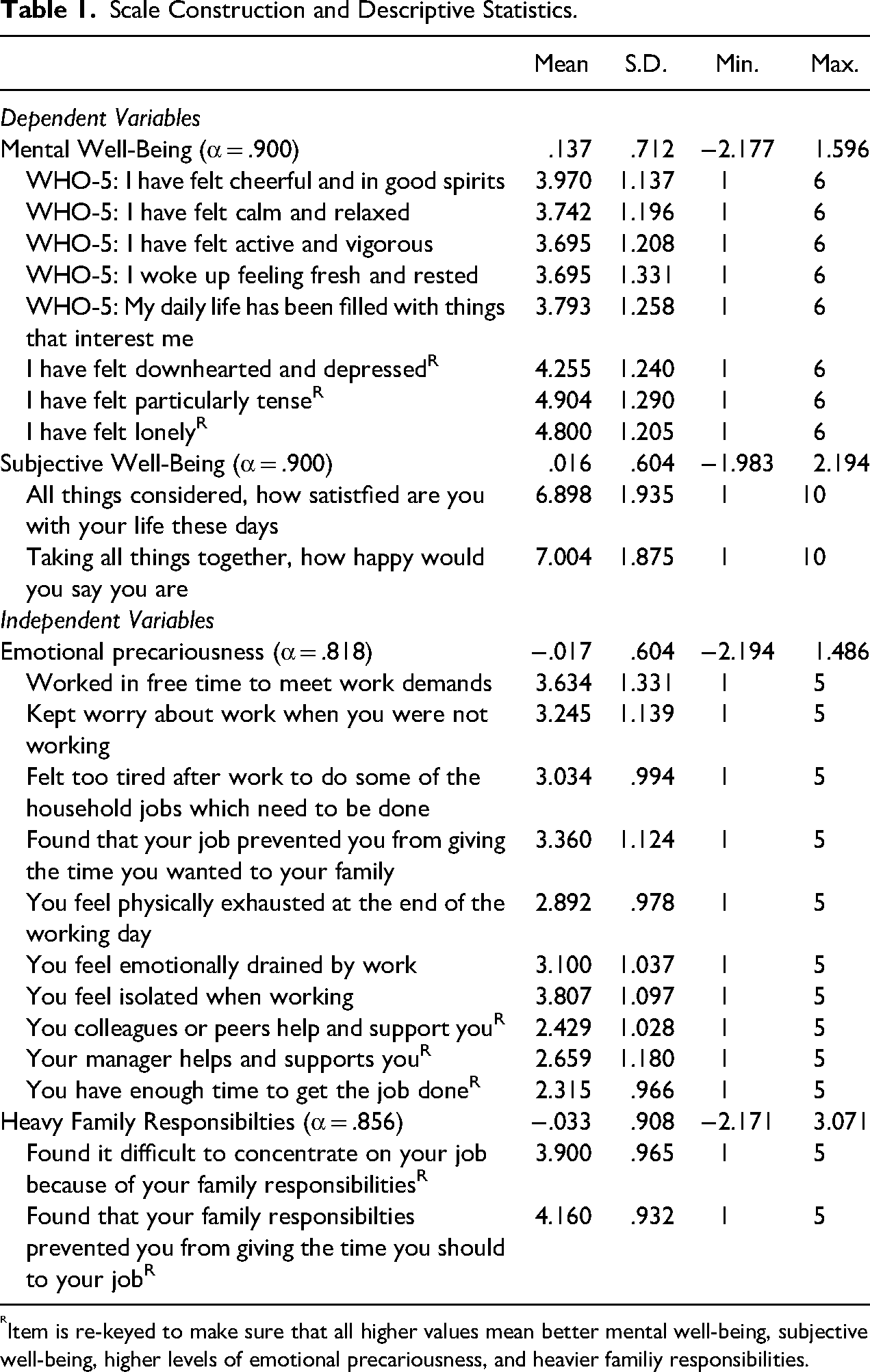
Item is re-keyed to make sure that all higher values mean better mental well-being, subjective well-being, higher levels of emotional precariousness, and heavier familiy responsibilities.
Key Independent Variables
Based on the data from the LWC datasets, I first constructed three variables—employment instability, job insecurity, and emotional precariousness—to measure various aspects of workers' employment precarity. In addition, I included an indicator of COVID-19 risk at work to capture the new occupational health hazard amidst the COVID-19 pandemic. Lastly, I summed all three aspects of employment precarity into a single indicator, overall precarity, to examine how they work together on workers' well-being.
The first variable, employment instability, measures objective contractual stability. It is coded 1 if the respondent is an employee with a contract of limited duration, a temporary employment agency contract, no contract, an apprenticeship or other training scheme, or self-employed without employees. The second variable, job insecurity, refers to the threat of job loss. For employees, the variable job insecurity is dichotomized into 1 if it is very likely or rather likely to lose the job in the next three months and 0 if the respondent's answer is “neither likely nor unlikely,” “rather unlikely,” or “very unlikely.” For the self-employed, job insecurity is coded as 1 if the business is very likely or rather likely to go bankrupt.
The third variable, emotional precariousness, is an index made up of a 10-item measure of respondents' subjective experiences of work situations, such as working during free time to meet work demands, worrying about work even when not working, feeling physically exhausted at the end of the workday, feeling emotionally drained by work, finding the job prevents from giving time to family, feeling isolated when working, and receiving no help or support from coworkers and managers. A high value of the emotional precariousness index indicates a more psychologically precarious work situation. Table 1 presents all of the item specifications. The Cronbach's Alpha of this scale is .818, indicating good reliability. The fourth variable risk of COVID-19 identifies whether the COVID-19 virus poses a risk to workers' health and safety at risk of the COVID-19 virus in their physical working environment. It is a dichotomous variable coded 1 if the respondent was at risk of contracting the COVID-19 virus because of his/her job duties.
Control Variables
Age is coded into 18–34, 35–49, 50–64, and 18–34 as the reference category. Gender has men as the reference group. Education is coded into primary, secondary, tertiary, and tertiary as the reference category. The country of residence includes all 27 EU countries, and Austria is treated as the reference group. City living is a dichotomous variable identifying respondents who were living in a city or city suburb. Self-rated as healthy is coded as 1 for those who rated their health status as very good or good and 0 for those rated less than good. Logged size of household is a natural logarithm of the number of people living in the respondent's household. Heavy family responsibilities consist of re-keyed two items: the level of difficulty concentrating on the job because of family responsibilities and how family responsibilities prevented the respondent from giving adequate time for the job. The Cronbach's Alpha is .856, and the higher value indicates heavier family responsibilities. Single parent is coded 1 if the respondent has children but no partner in the household. Insecure housing is coded 1 if the respondent is very likely or rather likely to leave his/her accommodation within the next six months because he/she cannot afford it. No household savings is coded 1 if the respondent's household has no savings or is able to maintain the same standard of living using savings for less than three months if there would be no more income.
Procedure
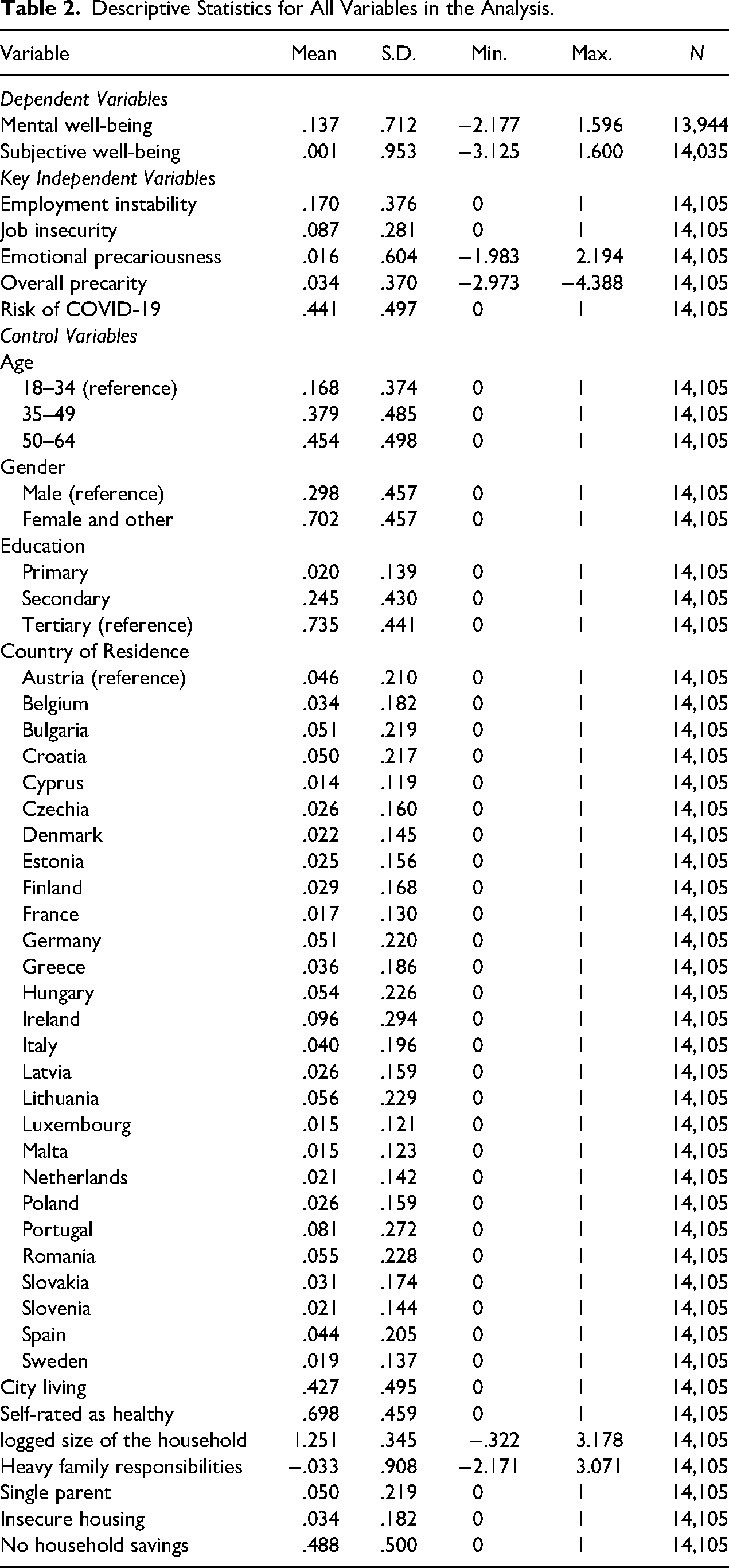
I first restricted the analyses to workers aged 18 to 64 who were employed during the survey period. Then, after using the MICE (multiple imputation by chained equations) methods of multivariate imputation to deal with missing data among independent variables (Royston & White, 2011), the final sample size for each analysis varies by the valid cases of each dependent variable. The sample size for the first set of analyses on mental well-being is 13,944, and the other set of analyses on subjective well-being is 14,035. I used ordinary least squares (OLS) regression analyses to examine the relationship between three dimensions of employment precarity, COVID-19 risk, and workers' mental and subjective well-being among 27 EU countries amidst the COVID-19 pandemic. Table 2 presents summary statistics for all variables used in the analysis of employment precarity and workers' well-being. Among the respondents who remained employed during the COVID-19 pandemic in 27 EU countries, about 17% did not have an indefinite contract and 9% had concerns about losing jobs. Approximately 44% of workers reported a potential threat of contracting or transmitting the COVID-19 virus in the workplace, putting their physical health and the safety of their families at risk.
Descriptive Statistics for All Variables in the Analysis.
All statistical models include the same set of control variables. I focus on reporting the standardized coefficients of key independent variables to compare their effects on mental well-being. Model 1 includes a measure that sums up all three aspects of employment precarity to examine the compound effect of employment precarity. As all forms of precariousness are summed up on a single scale, it may overlook potential dynamics across various dimensions (Cho, 2020). From Models 2 to 4, each model emphasizes one of the three dimensions of employment precarity separately. Model 5 examines the impact of COVID-19 risk at work on workers' well-being. The last model, Model 6, includes all three aspects of employment precarity and the risk of worker exposure to COVID-19 in the workplace to investigate how each component of the four key independent variables affects workers' well-being when controlling all other variables.
Results
Table 3 displays determinants of mental well-being during the COVID-19 pandemic in the EU's 27 member states. In Model 1, the overall precarity, which combines the three types of employment precarity, has a detrimental effect on workers' mental well-being. It has a standardized effect of −.188. Model 2 shows that employment instability has a negative but insignificant effect on mental health conditions. Model 3 reveals that the subjective fear of losing one's current job has a seriously negative impact on one's mental well-being (beta coefficient = −.127). Model 4 displays that how mental well-being is negatively impacted by emotional precariousness, which encompasses a variety of subjective feelings of precarity at work adversely affect mental well-being. With a standardized effect of −.434, it is the most significant contributor to workers' mental health degrading. According to Model 5, the risk of COVID-19 at work has a small negative impact on mental well-being (beta coefficient = −.04). However, when controlling for all other factors in Model 6, exposure to COVID-19 at work appears to be marginally beneficial to workers' mental health (beta coefficient = .015, p < .05). Furthermore, when controlling for other aspects of precarity in Model 6, the detrimental effect of employment insecurity is no longer significant. With a standardized effect of −.203, job insecurity continues to have a considerable negative impact on workers' mental well-being. Additionally, emotional precariousness continuously worsens workers' mental well-being. Its standardized effect is slightly reduced from −.434 in Model 4 to −.425 in Model 6 but is still the strongest overall.
Determinants of Mental Well-Being in 27 EU Countries During the COVID-19 Pandemic, N = 13,944.
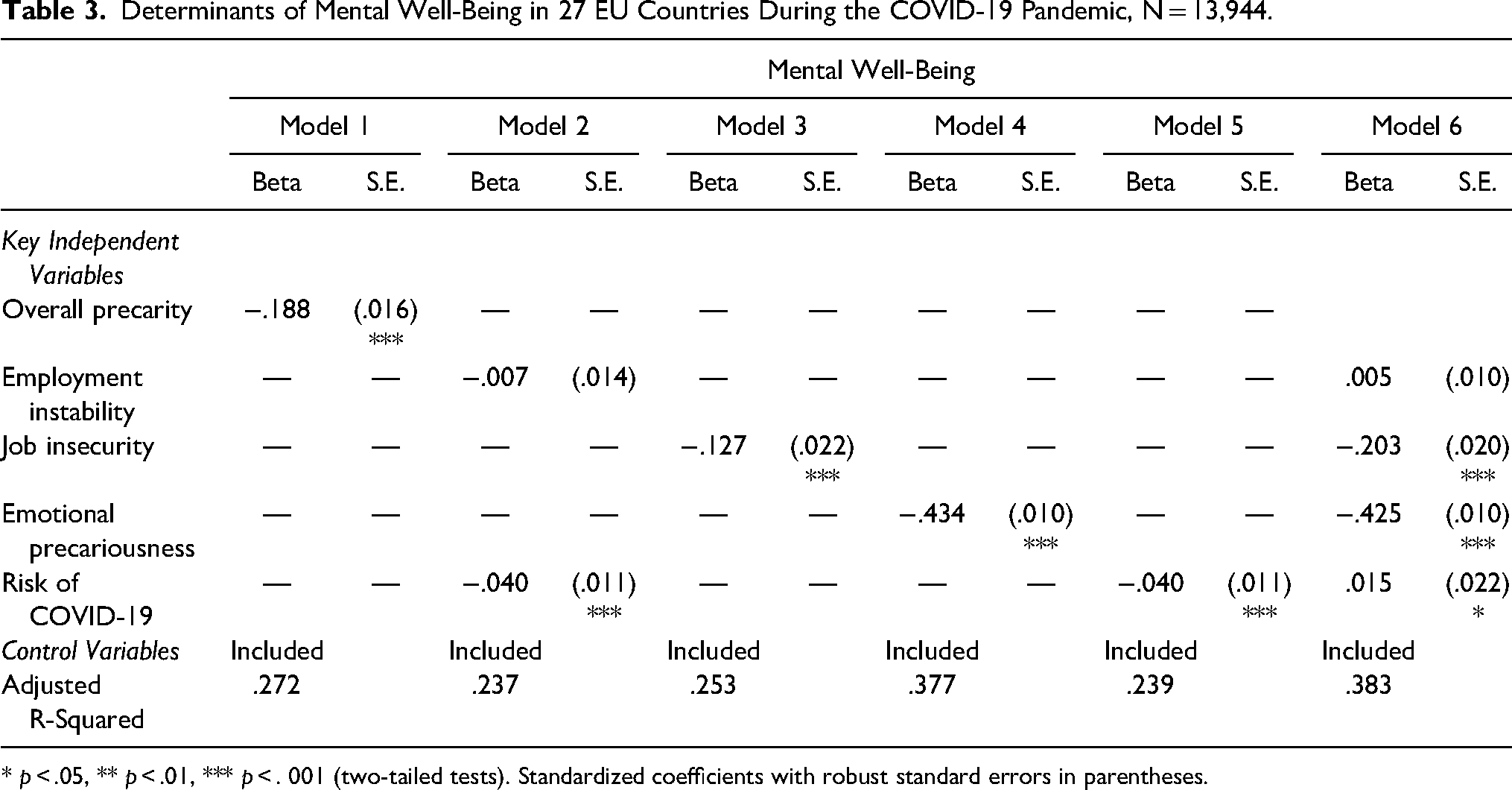
* p < .05, ** p < .01, *** p < . 001 (two-tailed tests). Standardized coefficients with robust standard errors in parentheses.
Table 4 examines the determinants of workers' subjective well-being in the same format as Table 3. Model 1 shows that overall precarity has a significant and negative effect on subjective well-being with a standardized coefficient of −.156. Model 2 reveals that workers without indefinite contracts are slightly more likely to feel unhappy and dissatisfied with their lives (beta coefficient = −.022). Model 3 demonstrates that job insecurity has a negative and significant impact on subjective well-being. With a beta coefficient of −.158, it has a greater impact on subjective well-being than employment instability. In Model 4, emotional precariousness has an even stronger negative association with subjective well-being (beta coefficient = −.311). As for the risk of COVID-19 at work, Model 5 shows that it has no significant negative effect on subjective well-being. When all other variables are controlled in Model 6, the negative effect of employment instability becomes insignificant. With standardized effects of −.124 and −.297, job insecurity and emotional precariousness remain the two most crucial dimensions of employment precarity that are detrimental to workers' overall happiness and life satisfaction. Model 6 also shows that when all other indicators are controlled for, the previous negative impact of COVID-19 risk at work becomes positively associated with workers' subjective well-being (beta coefficient = .024, p < .01).
Determinants of Subjective Well-Being in 27 EU Countries During the COVID-19 Pandemic, N = 14,035.
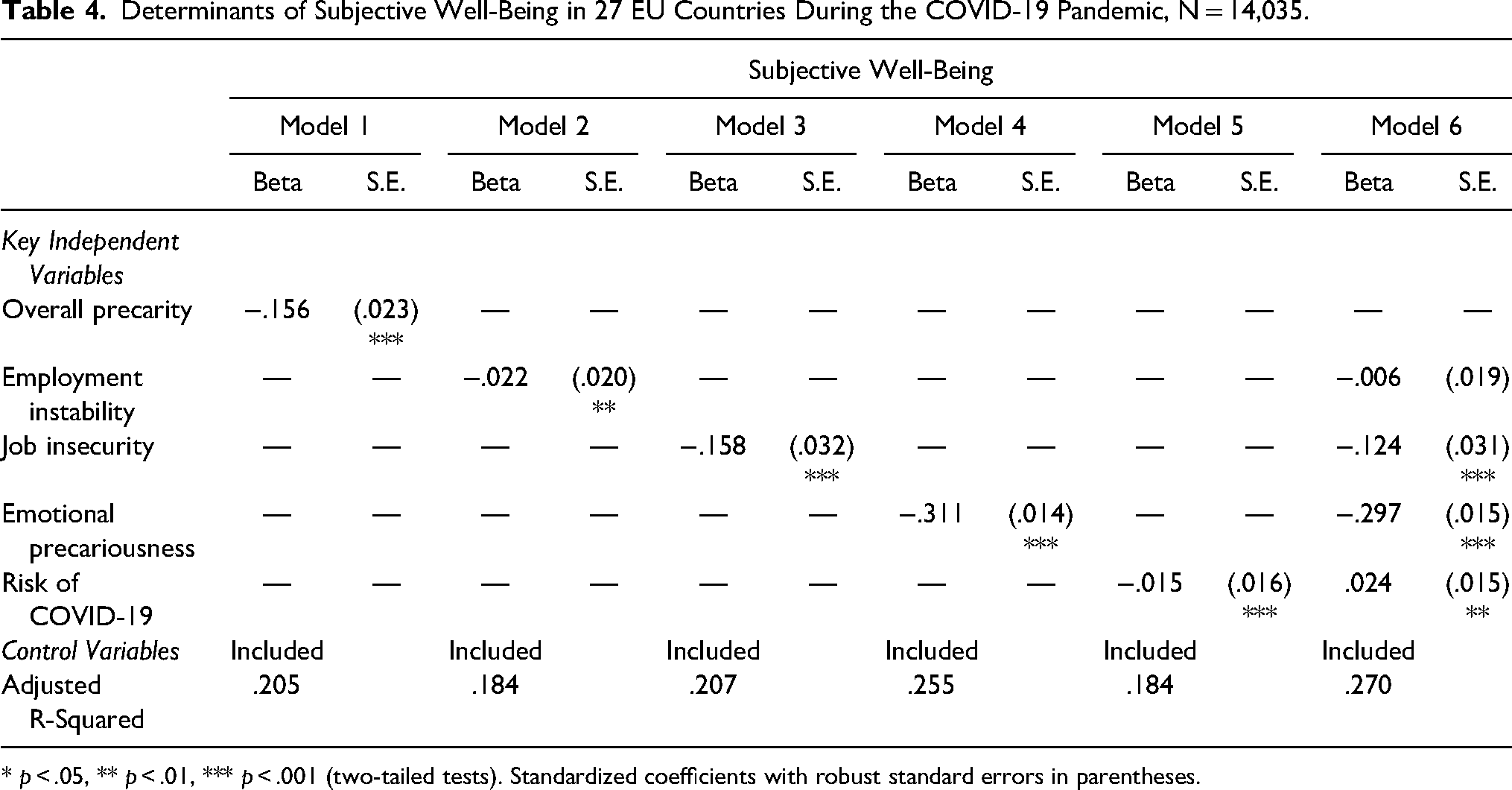
* p < .05, ** p < .01, *** p < .001 (two-tailed tests). Standardized coefficients with robust standard errors in parentheses.
Discussion
In this paper. I set out to investigate the relationship between various types of employment precarity, COVID risk at work, and European workers' well-being in the midst of the COVID-19 pandemic. Both Hypotheses 1 and 2 are partially confirmed. As expected, overall precarity, which consists of three aspects of employment precarity is negatively associated with workers' mental and subjective well-being. Both job insecurity and emotional precariousness have consistently negative effects on mental and subjective well-being. However, even when the household context is controlled employment instability has no significant impact on mental well-being (Lewchuk et al., 2011). The findings contradict the majority of existing studies that emphasize the role of contractual insecurity on poor mental health in the European context (Fiori et al., 2016; Moscone, et al., 2016; Pirani, 2017). The insignificant impact of employment instability implies that even workers with indefinite contracts in Europe faced mental challenges during the COVID-19 crisis. Unlike the previous research, which found no significant negative associations between employment instability and workers' subjective well-being (Guest et al., 2010; Helbling & Kanji, 2018), having a non-permanent contract has a significantly negative effect on subjective well-being, albeit a very weak effect. Furthermore, once job insecurity, emotional precariousness, and COVID risk are all under control, employment instability is no longer a significant factor influencing subjective well-being. This means that employment instability based on the contract types has only a minor and indirect impact on subjective well-being.
The risk of COVID-19 at work, as a unique hazard exposure that workers face during the COVID-19 crisis, is expected to jeopardize workers' mental health, particularly healthcare workers (Spoorthy et al., 2020). The findings support the notion that the risk of COVID-19 has a significant and negative impact on workers' mental well-being, but its effect on subjective well-being is not statistically significant. After controlling for all three aspects of employment precarity, COVID risk is found to be significantly and positively associated with mental well-being (p < .05) and subjective well-being (p < .01). In other words, despite the risk of contracting and transmitting COVID-19 at work, workers may feel happier and more satisfied with life if they have a permanent contract, job security perceptions, and fewer feelings and experiences of precarity at work. Possible explanations for the positive effect of COVID risk at work include increased engagement in personal, face-to-face interactions with real people during the pandemic; feeling less isolated at work; a stronger sense of community at work; a lower likelihood of high workloads and increased stress; and a clear switch-off after work. Furthermore, this finding suggests that workers' perceptions of job insecurity, social withdrawal and isolation, work-life imbalance, and overwork may be more detrimental to their mental health than the fear and risk of COVID-19 infection at work.
Conclusion
The COVID-19 pandemic has exacerbated forms of employment precarity and posed a threat to workplace well-being. Given that almost all workers experienced various degrees of precariousness, the COVID-19 pandemic has generated “new and heightened dimensions of precarity” (Loustaunau et al., 2021) which is not limited to the so-called precarious workers. As a result, employment precarity should be comprehensive, encompassing not only objective indicators of precarious job characteristics, but also subjective feelings and experiences of precarity.
Using the survey data from Eurofound's Living, Working, and COVID-19 (LWC), in addition to employment instability and job insecurity, I draw attention to emotional precariousness and COVID risk at work to investigate whether and how they affect workers' mental health and subjective well-being. The findings provide strong evidence that employment precarity, in most cases, jeopardizes workers' mental and subjective well-being. Nevertheless, the relative importance of different aspects of employment precarity indicates nuances in understanding the dynamics of employment precarity during the COVID-19 pandemic.
First, in contrast to other research demonstrating the detrimental effects of employment instability on mental health, this common indicator of employment precarity is not substantially connected with poor mental health during the COVID-19 pandemic. Moreover, employment instability has a very weak negative impact on subjective well-being, and this impact is largely attributed to job insecurity and emotional precariousness. Second, in line with previous research highlighting the negative impact of job insecurity, this perception of potential job loss has a consistently strong and negative association with mental health and overall quality of life. Third, emotional precariousness emerges as a new psychological dimension of employment precarity, becoming the most compelling factor influencing both mental and subjective well-being. The decreasing importance of employment instability and the increasing importance of job insecurity and emotional precariousness show that employment precarity is certainly not limited to “precarious employment” in the objective form of non-standard employment arrangements, but also includes subjective terms of perceptions of insecurity and precariousness.
Lastly, the COVID-19 risk at work negatively affects workers' mental health but not their subjective well-being. When the three aspects of employment precarity are controlled for, stories about the impacts of COVID-19 risk on mental and subjective well-being would challenge common assumptions. The high risk posed by COVID-19 has no negative impact on workers' mental and subjective well-being. Rather, in the absence of all forms of employment precarity, particularly emotional precariousness, the risk of COVID at work may be conducive to workers' mental health, overall happiness, and life satisfaction. This implies that workers at risk of COVID-19 may not be as bad as they appear if their jobs are stable and secure, have consistent interpersonal communication, social support, and reasonable workloads. Furthermore, the findings suggest that it is subjective aspects of employment precarity rather than the increased risk and fear of contracting and transmitting COVID-19 that degrade workers' well-being. The scale of emotional precariousness in the present study is derived from 10 relevant questions about workers' experiences and work situations during COVID in the LWC survey (See Table 1). Yet, the 10 items available from the LWC dataset alone cannot address the full scope of the psychological dimension of precarity, as Allan et al. (2021) suggest. Future research should broaden the psychological measures of precarity and incorporate objective characteristics of precarious work with subjective precariousness scales.
Several other limitations of this study also point the way forward for future research. First, due to the cross-sectional nature of the dataset, this study only provides a snapshot of the situations in Europe in the summer of 2020, when most European countries lifted lockdowns and eased COVID-related restrictions. Second, this study focuses on the main determinants of well-being at the individual level across the 27 EU member states. The findings suggest that some country-level factors, such as GDP per capita, unemployment, and national daily case numbers and restriction rules, may cause variations between countries. Future studies utilizing multilevel analysis with country-level data could benefit cross-country comparisons and offer policy implications for resilience in the COVID-19 crisis.
To conclude, the COVID-19 pandemic is still wreaking havoc on individuals, families, and societies. The worsening employment conditions wrought by COVID-19 can have a significant impact on workers' well-being. Future research will have both opportunities and challenges in terms of deepening our understanding of how the COVID-19 crisis exposed and exacerbated employment precarity in both incidence and intensity, as well as its implications for individual and societal well-being.
Footnotes
Acknowledgements
First and foremost, the author wishes to thank Eurofound for granting early access to the Living, working and COVID-19 dataset. The author further thanks guest editors, Quan Mai, Lijun Song, and Rachel Donnelly, for organizing the special issue and a virtual miniconference. The author would also like to thank two anonymous reviewers for their constructive comments. This paper also benefited from comments provided by 2022 Global Scholar Academy participants.
Declaration of Conflicting Interests
The author(s) declared no potential conflicts of interest with respect to the research, authorship, and/or publication of this article.
Funding
This publication is the result of research conducted for Central European University, Private University. It was made possible by the CEU Open Access Fund.
