



Abstract
Studies of meaningful work have proposed that work that holds personal significance and meaning can transcend pay. But how can workers who do not want, or cannot afford, to sacrifice pay for meaning commercialise their work to realise its market worth? We explore this question in the context of social media influencers who participated in the InfluencerPayGap community (an Instagram profile established in 2020 to expose pay disparities in the influencer industry). Combining concepts of worth from the meaningful work literature with a sociological theory of valuation, we identify three enrichment narratives engaged with by influencers to circumvent expectations of performing free labour. Besides illuminating how influencers construct and connect the personal worth of their work with its market worth, we show how these narratives of authenticity, relationality and quantification involve a ‘double loop of enrichment’. Consisting in the interplay between influencers’ own sense of the worth of their work and feedback from their followers and the algorithms of social media platforms, this loop can reinforce and transform but also undermine influencers’ perceptions of the worth and meaning of their work. Our findings contribute to a greater understanding of meaningful work and the valuation of work in non-traditional work contexts.
There’s not like a set rate on how much you should charge. So it’s kind of tricky to see if you’re getting taken advantage of or not – ’cause you don’t know what everyone else is offering . . . Yeah, it’s really hard to tell. You just have to charge what you think you’re worth. (Alana, Social Media Influencer)
Over 50 million people across the globe now class themselves as ‘influencers’, defined here as creators of social media content who aim to monetise their content by inducing their followers to engage in commercial transactions (Gagliese, 2022; O’Meara, 2019). For the members of this rapidly emerging profession, creating content is ‘meaningful’ work in the sense that it holds personal significance and worth for influencers, and also, value for others (Lysova et al., 2023). Influencers translate their interests and passions – for topics including travel, food and cosmetics – into specialist content that engages social media followers and creates commercial value for companies. In this context, pay becomes a proxy for the worth of meaningful work, especially since many influencers develop highly individualised content that brings their personal attributes to the forefront of commercial transactions (Ashford et al., 2018; Brydges and Sjöholm, 2019; Hesmondhalgh and Baker, 2010). Yet, many influencers work for free. Research has long since established that being paid inadequately or not at all for hours invested in work is a common experience in the influencing industry (Duffy, 2017). What is less clear is why this is the case and how this might be overcome.
Studies in the literature on meaningful work have found that individuals often accept low rates of pay or even forgo pay altogether for work they perceive as holding personal significance (e.g. Bailey and Madden, 2016; Bunderson and Thompson, 2009). Although structural and cultural barriers in social media industries can go some way to explain why many influencers struggle to get paid adequately for their work (Christin and Lu, 2023; Duffy, 2016), another reason why free labour exists is that some workers – and particularly those in creative industries like influencing – do not view paid work as the sole or primary goal of leading ‘a life worthwhile’ (see Alacovska, 2022). As illustrated by Alana’s quote above, however, many influencers do not wish to sacrifice pay for meaningful work (e.g. Ward, 2023). To avoid producing commercial content for free and get paid for doing what they love (Duffy, 2017), influencers must first ‘know’ the market worth of their work and how best to demonstrate it has commercial value. How influencers commercialise their meaningful work remains a largely underexplored puzzle in the literature to date.
To solve this puzzle, we combine insights from meaningful work with a sociological theory of valuation, thereby positioning our study at the intersection of two literatures to explore how influencers commercialise their meaningful work. From the meaningful work literature, we mobilise concepts of the worth of work to self, to society and to the market, as worth is a relational construct (Michaelson and Tosti-Kharas, 2024). However, we diverge from accounts in this literature that assume workers invariably engage in a trade-off between meaning and pay (i.e. between the worth of work to themselves and the market worth of their work) (e.g. Bunderson and Thompson, 2009; Hu and Hirsh, 2017; Ward, 2023). Instead, we introduce a sociological theory of valuation to explain how influencers construct and ‘enrich’ (Boltanski and Esquerre, 2020) the market worth of their meaningful work in their efforts to demonstrate and realise its commerciality and thus gain commensurate payment. Here, we identify the socially constructed process of valuation as the key mechanism that determines how influencers commercialise their meaningful work. In short, this is because commercialising their work involves connecting its personal worth to themselves with market worth by demonstrating their work has value for the market.
To elucidate the process of commercialising meaningful work, we present a narrative analysis (Czarniawska, 1998; Maitlis, 2012) derived from accounts provided by social media influencers and companies who participated in the InfluencerPayGap (IPG) community, an Instagram profile established in 2020 to expose and discuss pay disparities and discriminatory practices in the influencer industry. Our dataset comprises 19 interviews with influencers and six interviews with companies, as well 1087 posts and over 24,000 comments submitted to the IPG community between June 2020 and March 2021.
Our analysis reveals that influencers engage in three ‘enrichment narratives’ of authenticity, relationality and quantification in their efforts to construct, enhance and demonstrate the market worth of their work. First, through the narrative of authenticity presented as, ‘be true to yourself’, influencers construct market worth by performing work that is genuine and consistent. Second, through the narrative of relationality, or ‘build strong connections’, influencers demonstrate market worth through strong relational ties with their followers. And third, through the narrative of quantification, labelled as, ‘play the numbers game’, influencers measure and seek to increase the market worth of their work through drawing on metrics generated by social media algorithms. Our analysis reveals that these three narratives rely on a ‘double loop of enrichment’ as influencers combine their own personal valuation of the worth of their work with the valuations of other actors, namely their followers and social media platforms/algorithms. It is this double loop that enables influencers to know and evidence the market worth of their work. On the one hand, we find that influencers’ engagement with narratives of authenticity and relationality can reinforce and transform their perceptions of the meaningfulness and worth of their work. On the other hand, we find that the internalisation of algorithmic valuations through buying into the narrative of quantification can undermine influencers’ sense of the meaning and market worth of work.
Our findings advance understanding of meaningful work and its commercial valuation in two main ways. First, although previous studies in the meaningful work literature have shown that work can have worth to the self, to society and to the market (Michaelson and Tosti-Kharas, 2024), the three enrichment narratives we identify, together with our explication of the double loop of enrichment, provide novel insights into the social construction of the worth of meaningful work, particularly in the somewhat overlooked context of markets. We reveal how workers commercialise meaningful work (Bailey and Madden, 2019; Bailey et al., 2019a, 2019b; Lepisto and Pratt, 2017). Unlike previous studies, we do not find a trade-off between meaningful work and market worth but demonstrate instead how the worth of work to self and market worth both interact and shape each other as influencers strive to commercialise and legitimise their work as ‘entrepreneurs’ (Heizmann and Liu, 2022). The emerging industry of influencing affords the perfect context for exploring such dynamics, not only because the market worth of influencers’ work is inextricably tied to the self and the personal significance of work (Ashford et al., 2018; Brydges and Sjöholm, 2019; Hesmondhalgh and Baker, 2010) but also because remuneration is neither standardised nor guaranteed.
Second, we bring a sociological theory of valuation to the meaningful work literature (Boltanski and Esquerre, 2020; Plante, 2022). Applying this perspective to focus on workers and their work as the object of enrichment rather than as commodities, we show that valuation is not a one-off event but an ongoing, near-constant process that depends on shifting valuations from significant others. Influencers draw on valuations from others to construct and demonstrate their work as offering market worth for companies, a process we call a double loop of enrichment. Although we show how these social valuations in the form of quantification can undermine meaningful work by locking influencers into continuous vicious cycles of performing ‘free labour’ (Beverungen et al., 2015), we do not find evidence of influencers resisting such quantification (see Christin and Lewis, 2021; O’Meara, 2019). Instead, we reveal that influencers mostly acquiesce to the power of platform algorithms, accepting that their work may not be ‘worthy’ of remuneration unless they achieve certain industry markers of success, including a follower count of 10,000. This last finding casts new light on personal perceptions of meaningful work and thus provides a critical insight into work and its meaning in the digital age (Alacovska et al., 2022).
Theoretical background
The worth of meaningful work
Notions of worth have been related to the meaning of work in many previous studies, with research generally finding work to be meaningful if individuals perceive it as having purpose or significance to the self (e.g. Beer et al., 2022; Ciulla, 2012; Dutton et al., 2016; Weller et al., 2023). In exploring why and in which situations workers find their work to be meaningful, most studies in the meaningful work literature are thus primarily centred on individuals’ subjective perceptions (Rosso et al., 2010). Scholars in this field have argued that people seeking meaningful work look for work that provides a sense of enjoyment, self-actualisation and the realisation of certain personal needs, motivations and desires (Wrzesniewski and Dutton, 2001) including work that leads to personal fulfilment in contributing to a greater cause (Aleksić et al., 2022). In this sense, the work of influencers can clearly be conceived as meaningful, with most influencers aiming to get paid to ‘do what they love’ (Duffy, 2017) by combining work they find personally significant (e.g. learning about new trends in beauty and cosmetics) with a desire to help others (e.g. by guiding social media followers towards choosing a particular product that suits their skin).
Recent research in this literature has underscored the extent to which the worth people find in their work is informed by, and intertwined with, broader accounts and calculations of what constitutes worth in meaningful work, namely its ‘social worth’ and ‘market worth’, that is, the economic value it generates for markets (Michaelson and Tosti-Kharas, 2024). In relation to social worth, the worth of work ‘to self’ is thus argued to be shaped by societal, cultural and organisational evaluations, including of the contributions work makes to a given cause (e.g. Lepisto and Pratt, 2017; Lysova et al., 2023; Mitra and Buzzanell, 2017; Pratt and Ashforth, 2003). As such, these studies clearly recognise that the worth of work is relational and socially constructed by actors beyond the individual (Bailey et al., 2019a; Florian et al., 2019; Lepisto and Pratt, 2017; Michaelson and Tosti-Kharas, 2024), emerging from the interplay between individual self-perceptions and the evaluations of relevant social actors (Beer et al., 2022). These evaluations in turn operate according to norms generated by organisational and political structures (Mitra and Buzzanell, 2017), shifting social discourses (Florian et al., 2019) and stigmas associated with certain professions (Hancock, 2016).
From this relational perspective of the worth of work, individuals must engage in continuous efforts to understand what makes their work worthy in order to experience their work as meaningful or worthy to the self (Lepisto and Pratt, 2017). These accounts from other social actors can potentially bolster individual workers’ perceptions of their self-worth. For example, some employees may welcome performance measurement opportunities to see the worth of their work in organisational and personal terms (e.g. Beer et al., 2022). On the other hand, social accounts may clash with individuals’ own perceptions of the meaningfulness of their work. Besides cases of disagreement or even value conflicts vis-a-vis the criteria of performance measures, this can also happen when certain kinds of work – such as the service work of Santa Claus performers or exotic dancers – are socially stigmatised or regarded as somehow tainted even though the people doing these jobs may find great significance in their work (Ashforth and Kreiner, 1999; Hancock, 2016). Given that social accounts of ‘worthy’ work are contextually bound and constantly shifting, workers can never know the precise extent of the worth of their work (Lepisto and Pratt, 2017).
The worth of work to self can also be associated with its market worth or commerciality, including pay and other financial rewards that are often treated as reflecting how markets assess the economic value or worth of work (Beckert and Aspers, 2011). This relation between worth to self (meaning) and market worth (economic value) has been investigated in the meaningful work literature, where studies have explored how pay and financial rewards impact individuals’ own perceptions of the meaningfulness of their work (e.g. Hu and Hirsh, 2017). Paradoxically, while such studies have confirmed that individuals can lose confidence in the meaningfulness of their work if they feel they are being treated unfairly, for example, if they are asked to work for free or if they see that others are receiving more pay for similar work (Bailey and Madden, 2016), it has also been found that the market worth of work is unlikely by itself to contribute to an enhanced perception of the meaningfulness of work to self, that is, that receiving more pay does not equal more meaning (e.g. Bailey and Madden, 2016; Bunderson and Thompson, 2009; Gill, 1999). Indeed, some studies show that individuals may even forgo higher pay or other financial rewards if this entails no longer doing work they deem to be of worth to the self (e.g. Hu and Hirsh, 2017). Contrariwise, a recent review by Ward (2023; p. 1) of studies on the ‘relative importance of meaningful work and salary in evaluations of actual and hypothetical jobs’ found that the great majority of participants in most of these empirical studies ‘consistently preferred high-salary jobs with low meaningfulness over low-salary jobs with high meaningfulness’. In sum, the connection between the worth of work to self and the market worth of work remains something of a puzzle.
This ongoing debate has generated valuable if contradictory insights into how deeply workers’ experiences of commerciality in the form of pay – or lack of pay – are intertwined with their own experiences and estimations of the meaningfulness of their work. Aside from a focus on the purported trade-off between meaning and pay, however, research within the meaningful work literature has not further explored the relationship between the worth of work to self and its market worth. In consequence, extant scholarship can only help so far in addressing the questions of how workers can ascertain how other market participants assess the worth of their work and how they can commercialise work they perceive as meaningful vis-a-vis assessments from other actors. For this reason, we turn to a sociological theory of valuation that provides important insights into the processes whereby meaning can become ‘enriched’ with market worth (Boltanski and Esquerre, 2020).
The market worth of work: A valuation perspective
Grounded in seminal works by Boltanski et al. (e.g. Boltanski and Esquerre, 2020; Boltanski and Thévenot, 2006), the sociological theory of valuation we adopt here posits that the market worth of an object or service does not emerge from any intrinsic functional properties but from the value ascribed to it by different actors. In theorising the notion of worth in terms of economic value or ‘worth to the market’ (Michaelson and Tosti-Kharas, 2024), studies applying this perspective explain market worth or commerciality as being determined in commercial markets through the process of valuation, that is, ‘the assessment of goods and services in terms of how much money an actor is willing to surrender to obtain property rights to the good in question’ (Beckert and Aspers, 2011: 8). Valuation thus involves a dynamic interplay between people, intermediaries and machines (Kornberger, 2017; Orlikowski and Scott, 2014; Plante, 2022). It is on this basis, according to Boltanski and Esquerre (2020), that the commerciality and price of a commodity can be justified or critiqued. Whereas the focus of previous studies in this vein has been on how the market worth of highly sought-after objects is established, our own focus is on how the market worth of workers and their work is socially constructed, exploring this process in order to ascertain how social media influencers can commercialise their meaningful work.
As a key concept in our inquiry, the term ‘enrichment’ is employed by Boltanski and Esquerre (2015: 76, 2020) to denote an ‘act of improving the value of something’ and used by them to explain how market actors construct and potentially enhance the market worth or value of a given object. According to Boltanski and Esquerre (2020: 45), enrichment is ubiquitous and malleable, since ‘“anything” at all can be enriched in various ways’ to become unique and valuable to buyers and sellers in the marketplace. By their account, market worth is chiefly constructed through ‘narratives enrichment’ that exploit ‘craft, heritage, tradition, identity, or more largely, culture’ (Boltanski and Esquerre, 2015: 76). Such narratives are all the more important because markets – and especially newly emerging markets – typically provide insufficient information as to how prices are determined. This concept has been applied by scholars to examine enrichment in a variety of contexts, including how craft breweries narrate their products as authentic in order to add value and justify a higher than average price, how prices are formed in the real-estate industry and how human life is (de)valued in the insurance and compensation industry when disasters strike (Plante, 2022; Thurnell-Read, 2019). We align with this perspective in viewing ‘narrative construction’ as a resource of paramount importance for enrichment.
As Boltanski and Esquerre (2020) emphasise in their seminal work Enrichment: A Critique of Commodities, enrichment involves an increase in an object’s value over time. This is certainly a widely held belief – and well-established narrative in itself – within the influencer industry, where an unwavering belief prevails that remuneration is ultimately determined by personal aspirational efforts and the qualities that influencers accrue over time, including through their effortful building of relationships and numbers of followers via engagement rates (Begkos and Antonopoulou, 2020; Duffy, 2015). Boltanski and Esquerre’s (2020: 112) account of how commerciality is determined often long before a transaction takes place through a process of ‘presentation’ (and subsequent value assessment) is also consistent with how companies screen prospective influencers by carefully evaluating social media content before entering into any negotiations over work and pricing (Christin and Lu, 2023).
Enrichment is especially crucial in the context of ‘value trials’, that is, in situations where the value of an object is called into question when transferred from seller to buyer or when the process of valuation is particularly challenging, for example, in markets of ‘singularities’ such as art (Boltanski and Esquerre, 2015, 2020; Karpik, 2010). Influencers regularly experience the commerciality of their work as being ‘on trial’ when companies make decisions about whether or not to offer them paid work. This can be an especially emotional and intensely embodied experience for influencers given that identity is so deeply intertwined with content and projected at the forefront of commercial transactions (Ashford et al., 2018; Brydges and Sjöholm, 2019; Hesmondhalgh and Baker, 2010). Indeed, the very personal nature of influencing collapses most distinctions between work and individual workers, with influencers themselves becoming the commodity deemed more or less ‘worthy’.
Efforts to construct the market worth of their work through enrichment narratives are additionally necessary for influencers to undertake as they operate in the still emergent and rapidly evolving digital economy. Operating outside formalised and stable structures of remuneration and appraisal, influencers often perform work in exchange for free goods or the promise of future exposure in the form of high visibility on social media platforms (Duffy, 2017; Kuehn and Corrigan, 2013). In this context, remuneration cannot be assumed but must be earned because the ‘industry imaginings’ that govern influencer compensation are particularly ‘difficult to assess’ (Duffy and Schwartz, 2018: 2984). However, influencers face a lack of clarity as to how remuneration can be earned and thus must continuously strive to identify, understand and demonstrate what constitutes commerciality in their line of work.
In sum, thinking about meaningful work through the lens of a sociological theory of valuation alerts us to the extent to which the market worth of meaningful work relies on the skilful efforts of workers to enrich their work with economic value (Boltanski and Esquerre, 2020). The question that remains is precisely how such enrichment is achieved to commercialise meaningful work in contexts such as social media influencing.
Research design
Research context
Although social media platforms have been around since the early 2000s, the launch of the photo- and video-sharing platform Instagram in 2010 signalled a step change in social media interactions by placing an emphasis on ‘visual storytelling’ (Gurrieri and Drenten, 2019). In this way, Instagram arguably laid the foundations for social media influencers to become professionalised and get paid for doing what they love (Duffy, 2017), including engaging with topics they often feel passionate about such as food, beauty, sport and science. Although still a relatively new profession (Suciu, 2020), influencing is an increasingly lucrative industry that has recently been valued at £13.5b (Statista, 2022). The spectacular success of what for now remains a small handful of influencers – for example, fashion influencers Cole Sprouse or Karen Wazen Bakhazi (Frederick, 2023) – has also made this profession a tempting path to fame and fortune for many millions of aspiring influencers.
It is nonetheless widely acknowledged that many if not most influencers are not being ‘appropriately and consistently reward[ed] for their work’ and that payment ‘varies wildly’ (Milmo et al., 2022), with major pay gaps evidenced between women and men and influencers from marginalised backgrounds (Geyser, 2022). This situation has caused an ‘existential crisis’ for many influencers, particularly ‘middle range’ influencers who struggle to leverage their role as a valuable asset for social media platforms and companies in order to gain better pay (Tiffany, 2023). One reason for this is that free labour and work in return for ‘gifts’ (i.e. for free products rather than financial compensation), is often performed by influencers in the hope of future exposure (Duffy, 2015). What really makes free labour such a widespread practice among influencers, however, is the promise that ‘with enough hard work, anyone can make a living from her passion project’ (Duffy and Pruchniewska, 2017: 844). This beguiling promise jeopardises the commerciality of influencing, raising questions among influencers and wider society as to the extent to which such work is ‘deserving’ of being paid, if being conducted frequently for free.
Against this background, we investigate our research question through a time-bound case (Yin, 2013), collecting our data between June 2020 and March 2021 from influencers’ contributions to the InfluencerPayGap community, an Instagram profile formed in 2020 to expose and discuss the widespread phenomenon of unequal pay in the influencing industry. Initially focused on discriminatory pay gaps based on ethnicity (Christin and Lu, 2023; Sanusi, 2020), this community soon became a valuable resource for over 60,000 followers: What started off as a space to explore disparities in opportunities, pay and visibility between black and non-black influencers has grown into something much bigger than anticipated. Influencers, content creators, agencies and experts across all walks of life seem to have a community they not only connect with but a space they can explore an issue that is often spoken about it in secret or not spoken about at all. (IPG Mailing List, 2020, personal communication)
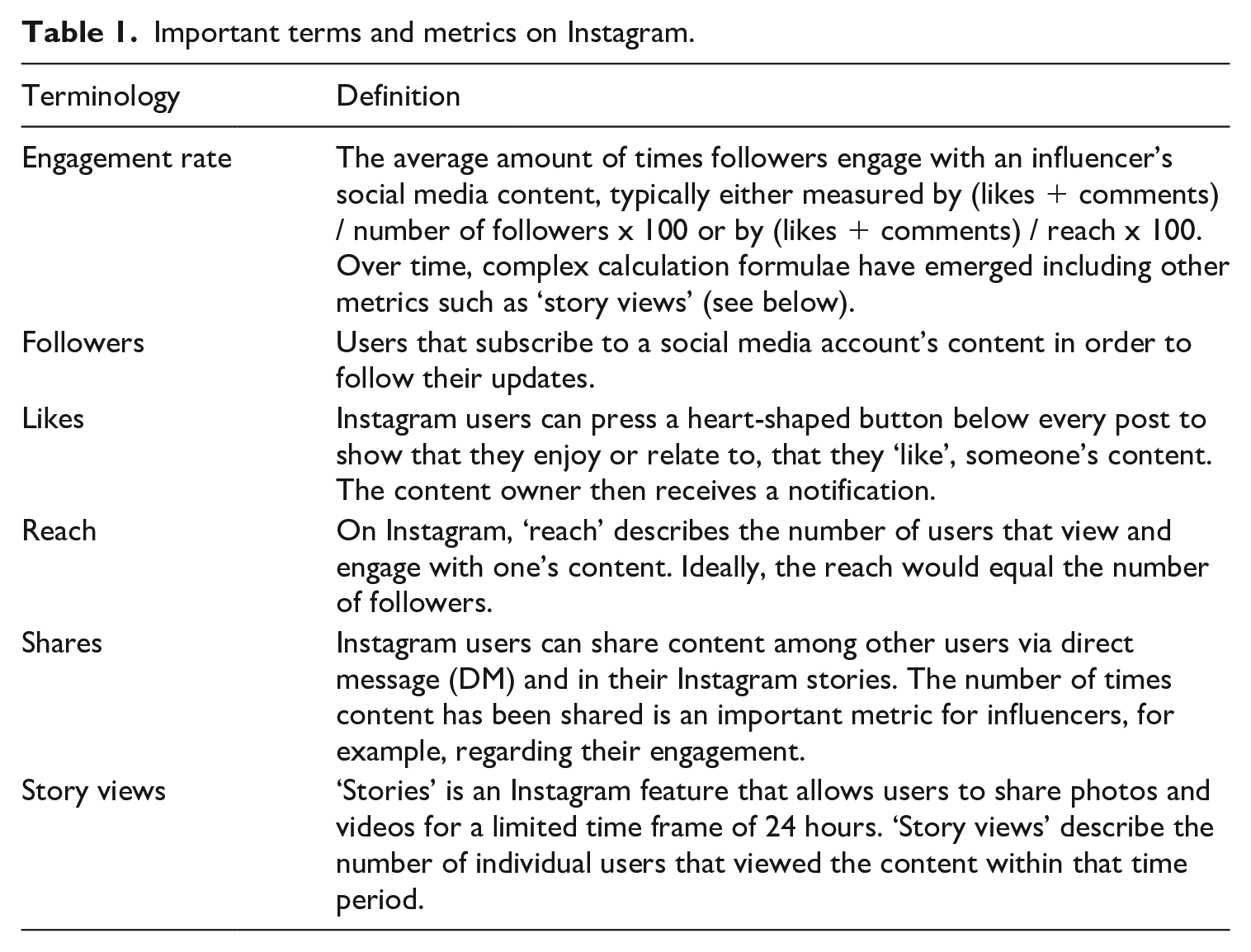
At its peak of popularity in the summer and autumn of 2020, the IPG community published some 200 anonymised posts per month. This was at a time when influencer marketing was rapidly gathering pace owing to the movement of even more marketing activities online as a consequence of the COVID-19 pandemic (Geyser, 2021). Most of the posts submitted by influencers to the IPG community followed a set format, including the following information about each poster: their core demographic details (age, gender, race); their social media metrics (e.g. their engagement rate and follower count; see Table 1 for metrics related to Instagram); their ‘theme’ (e.g. beauty, vegan food, travel, etc.); and an account of any commercial work they had been asked to perform, including the level of pay offered (see Figure 1). ‘Commercial work’ in this context refers to several possible activities including promoting products and/or services through sponsored influencer posts, creating branded content for company posts, conducting sponsored competitions and ‘give-aways’ in return for ‘follows’ and ‘likes’, and product and service reviews. Influencers perform such work in various ways, including by creating social media posts (i.e. images with captions), ‘carousel’ posts (i.e. multiple images and captions), videos, as well as ‘story’ content that disappears after 24 hours (Geyser, 2023). Many influencers also operate affiliate programmes with companies, in return for which they receive a commission if their followers click a link to purchase a product or service publicised by the influencer.
Important terms and metrics on Instagram.
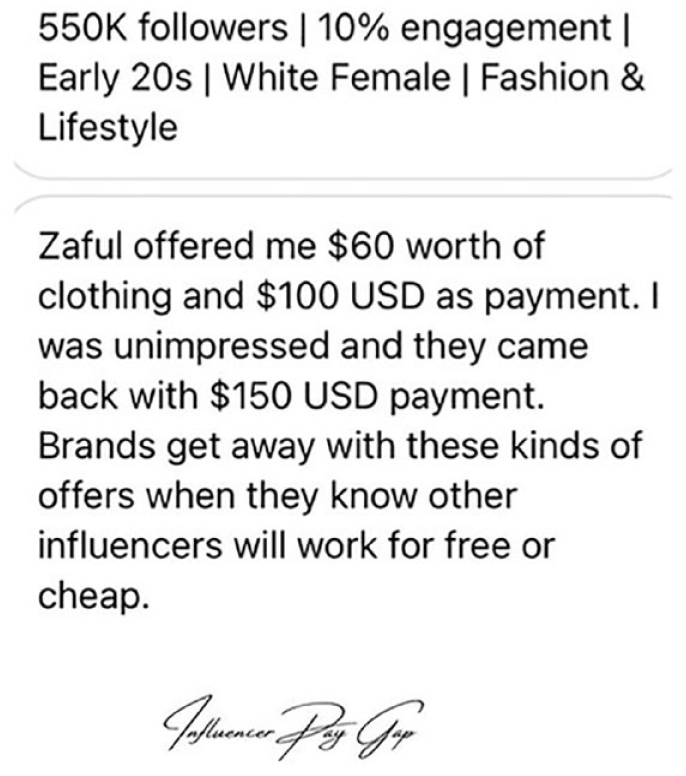
Anonymous IPG community post (18 November 2020).
Posts submitted to the IPG profile could receive anywhere from a handful to hundreds of comments and ‘likes’, with community members often engaging in extensive discussions about work and rates of pay. Social media companies were also actively present in the IPG community, reflecting the growing extent that businesses rely on influencers to drive purchases (Hearn and Schoenhoff, 2015). Importantly, since most influencers are independent contractors hired on a short-term basis (Geyser, 2023) and do not receive standardised pay and other benefits, influencers and companies alike both grapple with how to set rates of remuneration. In this context, pay is typically determined through the complex interplay of social media metrics (with work deemed to be more commercially worthy the higher the number of an influencer’s followers and engagement rate) and the sense of ‘fit’ between the focus of the influencer and the company (Bishop, 2021). For companies, influencers need to provide the best return on investment, while for influencers their pay needs to match the perceived market worth of their work and to be personally financially viable. Drawn from posts and comments submitted to the IPG community and interviews with influencers and companies, our data provide evidence of how influencers engaged with these dynamics to commercialise meaningful work.
Data collection
Online data
Adopting a non-participatory approach (Kozinets, 2015), both authors observed interactions in the IPG community on a daily basis between June and November 2020, engaging without actively contributing content but separately taking brief fieldnotes and regularly comparing and discussing these notes. In the subsequent period from November 2020 to March 2021, the authors visited the community less frequently (usually once a week) as the number of posts fell from 200 to approximately 50 per month. Our live observation of the IPG community ended when the IPG account ceased to publish any new posts in March 2021. We then used an external Instagram application to harvest all posts and comments available from June 2020 to March 2021, creating a spreadsheet for each post that included the initial post, all comments and metadata (i.e. the name of the person commenting, a datestamp and the number of ‘likes’), culminating in a dataset of 1087 posts (as images) and 24,000 comments. While we made our presence known to the founder of the IPG community from the outset and we understand it is a public online community, we pseudonymise the names of all commentators (and interviewees) in this article and remove identifying information to protect anonymity (Whiting and Pritchard, 2017).
Interviews
To gain deeper insights into the lived experiences of the participants in the IPG community, we conducted 25 interviews in two rounds (see Table 2). In the first round, we used snowball sampling to recruit 19 influencers as interviewees (Strauss and Corbin, 1998), initially approaching influencers engaged with the IPG community and later asking them to recommend others in their networks who had participated in or observed the IPG community. Selecting only influencers who described themselves according to Instagram’s pre-defined categories as ‘digital/content creator’ or ‘entrepreneur’, we aimed for a diverse sample in terms of location, identifying characteristics and content themes.
Sample of interviewees.
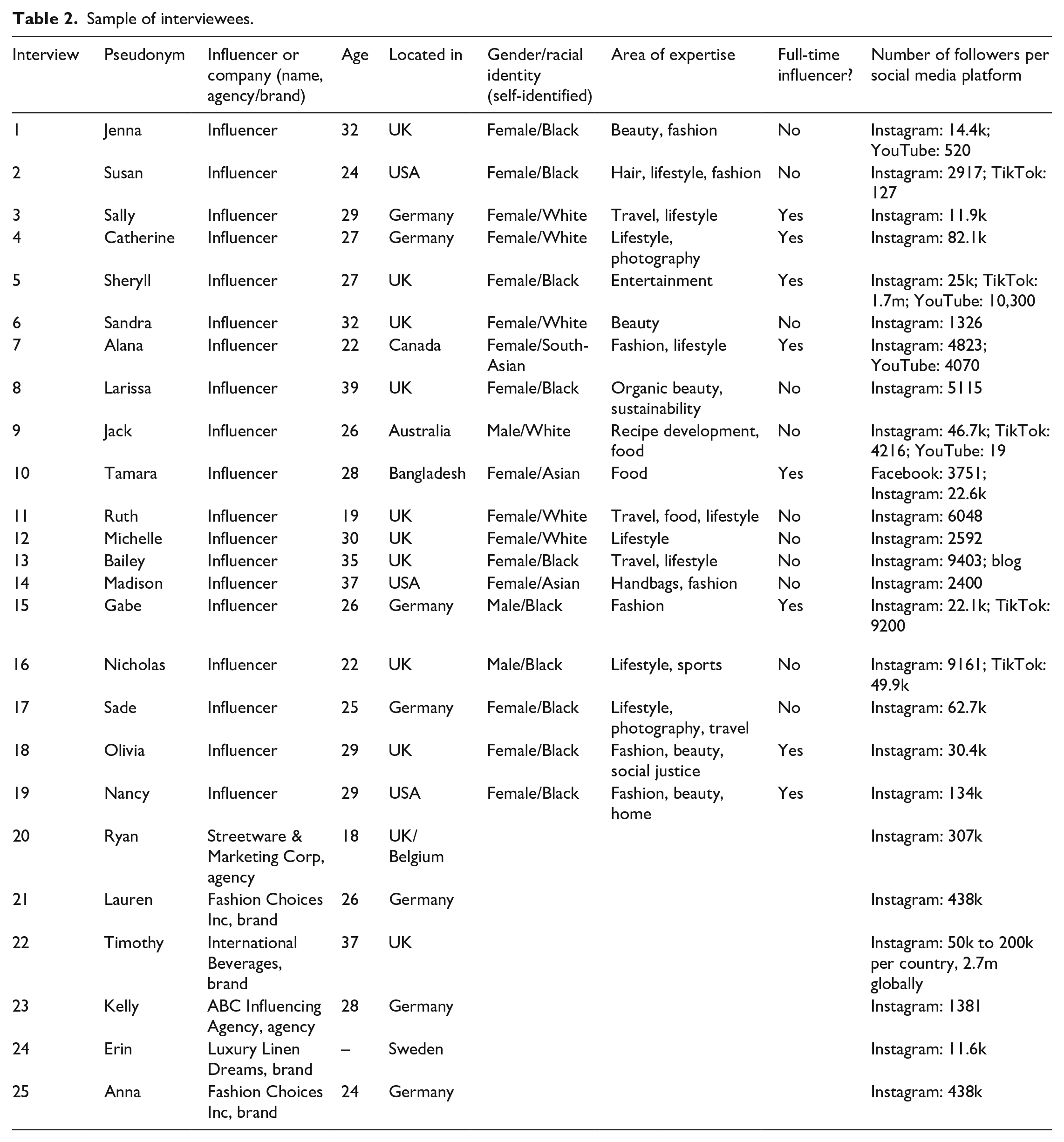
The majority of our final sample of influencer interviewees were part-time influencers. To ensure breadth and variety in terms of influencers’ scope for commercialisation, and based on the widely accepted if controversial premise that a higher follower rate equates to higher market worth, we included influencers from three levels of Instagram’s influencer scale: ‘mid-tier’ (between 50,000 and 500,000 followers), ‘micro’ (between 10,000 and 50,000 followers) and ‘nano’ (fewer than 10,000 followers) (see O’Meara, 2019). Owing to the IPG community’s origins in the UK and our snowball sampling approach, the influencers in our final sample were concentrated in western geographical regions, though it includes diversity in terms of influencers’ self-identifying characteristics (see Table 2). For our second round of interviews, we used the networks established in round one to undertake purposive sampling of social media companies (Strauss and Corbin, 1998), resulting in our recruitment of six interviewees from companies actively working with influencers.
All interviews were conducted between May and November 2021 either by phone or using video-conferencing tools. The interviews began with open questions to elicit interpretations of meaningful work and commerciality. Ranging from 26 minutes to 72 minutes in duration, all interviews were recorded and fully transcribed. Most interviews took place in English, with a minority conducted in German and later translated verbatim. To uphold high standards of research ethics, we gained informed consent prior to each interview.
Data analysis
In keeping with interpretive studies of meaningful work (e.g. Symon and Whiting, 2019; Weller et al., 2023) and sociological accounts of valuation (e.g. Thurnell-Read, 2019), we adopted a narrative analysis strategy. This approach proceeds from the premise that individuals make sense of their experiences both of life (Chase, 2005) and work (Bindl, 2019) through the construction of narratives that do not simply reflect reality but actively construct social realities and individuals’ experiences, emotions, thoughts and actions (Gergen, 1999). We thus treat narrative as a meaning-making device that aids us in understanding influencers’ experiences of meaningfulness vis-a-vis commerciality and complements our reflective and abductive approach to theorising (Chase, 2005; Sætre and Van de Ven, 2021; Tavory and Timmermans, 2014).
Using thematic narrative analysis, we identified common themes across our dataset (Maitlis, 2012). Accordingly, the narratives we identify in this article were not articulated by any single actor, but composites derived from fragments of many actors’ accounts across our data sources (see Haack et al., 2012; Vaara et al., 2016), that is, from our interviews and naturalistic online observations (Sonenshein, 2010). Although composed by ourselves in line with our understanding of worth and its valuation as a socially constructed process (Boltanski and Esquerre, 2020), our focus throughout this process and in our presentation of these narratives in this article is very much on elucidating the lived experiences of influencers.
We find the narrative form to be an extremely useful device for fusing our theoretical interests with our analysis (see Czarniawska, 1998; Symon and Whiting, 2019). We base this claim on two key observations on narrative analysis made by Maitlis (2012: 492), who states that all narratives require (1) a ‘valued endpoint’ and (2) a ‘set of characters that make the endpoint more or less probable, accessible or vivid’. In our context, the narratives of influencers have a clear ‘endpoint’, that is, to secure payment for work they find meaningful. To achieve this end, influencers effortfully construct the commerciality of their work, engaging with three main enrichment narratives (Boltanski and Esquerre, 2020) to construct and enhance its value and demonstrate its market worth. These efforts are all the more necessary since the market worth of work is neither stable nor objective, but socially constructed through a recursive process of valuation with malleable and shifting endpoints.
The socially constructed nature of value can be related to Maitlis’ (2012) second observation that narratives involve a ‘set of characters’ in that commercial worth is relational and negotiated by a number of social actors (see Knight and Cuganesan, 2020; Kornberger, 2017; Orlikowski and Scott, 2014; Plante, 2022). In the case of influencing, these actors include influencers themselves, social media companies, platform algorithms, followers and fellow-influencers. Together, these actors can be understood as the ‘set of characters’ in our ‘story’ of how influencers commercialise their work (Czarniawska, 1998).
Applying an abductive approach, we continuously iterated between our empirical data and theory (Strauss and Corbin, 1998) to generate a ‘thick description’ of the lived experiences of the influencers we observed (Geertz, 1973). More specifically, our data analysis mirrored the process outlined by Maitlis (2012) and Symon and Whiting (2019), proceeding in an emergent and multi-staged process (see Weller et al., 2023). As a first step, the second author read the transcripts of each individual influencer several times over, visited the respective social media platforms of these influencers and created a short (400–700 word) summary of influencers’ experiences of meaningful work and how they constructed the commerciality of this work (see Online Appendix 1). Comprised of quotations from the transcripts interwoven with the researchers’ own prose, these summary narratives stayed true to the influencers’ accounts, conveying three themes: the influencer’s background story and motivations, their content theme and aspirations (for a similar approach, see Bindl, 2019).
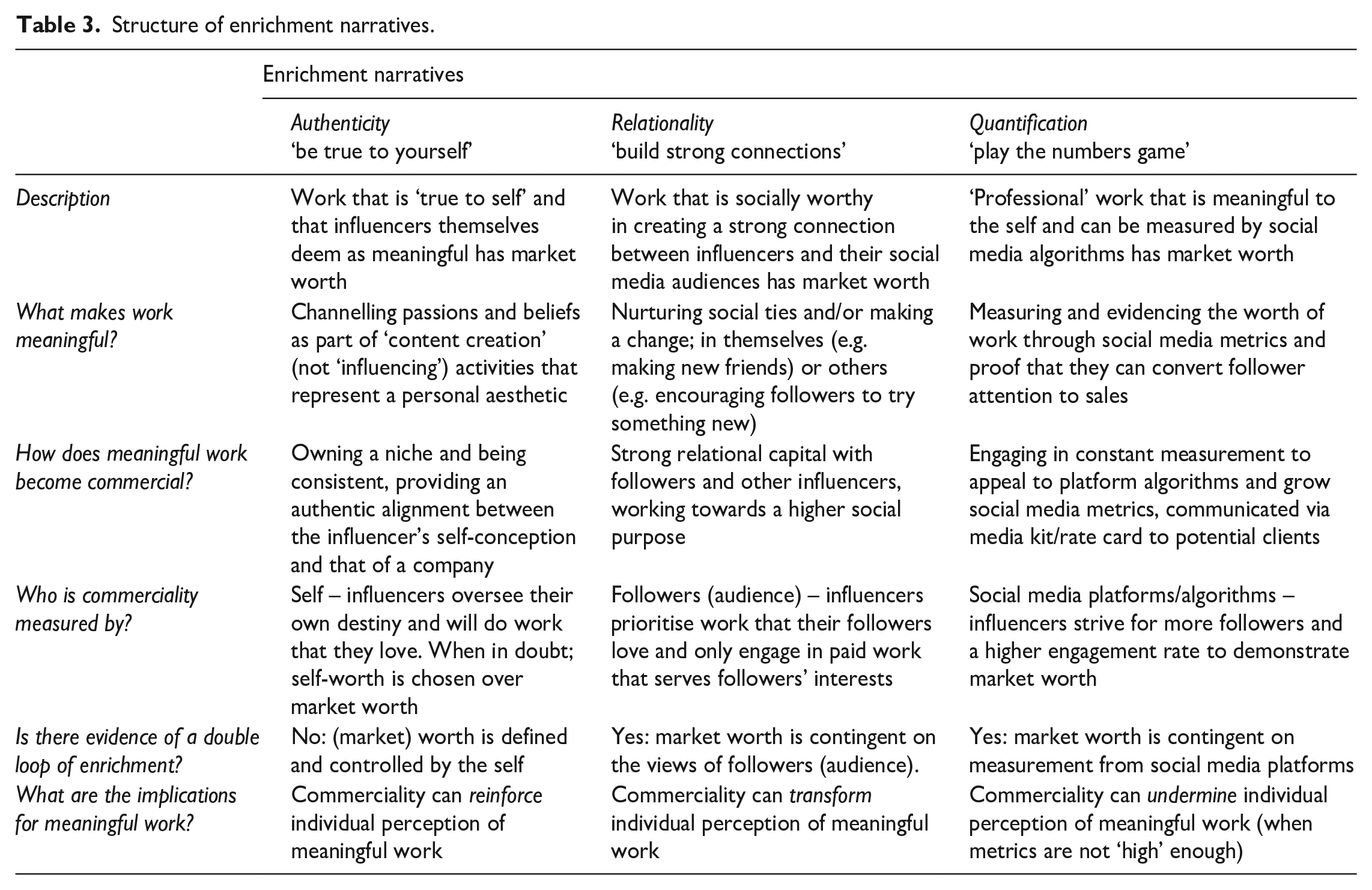
Although our data from interviews with influencers alone would have supported the development of individual narratives, we transformed these data into composite narratives to offer more situated accounts in tune with our relational understanding of worth (Michaelson and Tosti-Kharas, 2024). To do so, we interweaved comments – or ‘fragments’ of data (Vaara et al., 2016) – from our observational fieldnotes on the IPG community and from our interviews with influencers and companies. In this process, the first author reviewed the summary narratives and then complemented these with social media posts (including imagery and textual data; see Heizmann and Liu, 2022), relevant fieldnotes taken during the period of observing the IPG community, and selected quotes from the company interviews. Throughout this process, both authors discussed key observations related to the market worth of work as our ‘sensitising construct’ (Kreiner, 2016). The three narratives we identified and developed through this iterative process, labelled using extracts from raw data, thus provide rich interpretations of how the influencers in our case commercialised their meaningful work. In line with Czarniawska’s (1998) recommendations, each narrative is organised around four core questions (see Table 3). Further examples of data are provided in Online Appendix 2.
Structure of enrichment narratives.
Our triangulation across multiple ‘offline’ and ‘online’ sources (see McCarthy and Glozer, 2022), together with our detailed record-keeping and continuous co-author discussions (Mitra and Buzzanell, 2017), ensured the credibility, transferability, dependability and confirmability of our analysis. To ensure the integrity of our analysis, we struck up a rapport with an industry expert and regularly sense-checked our emerging interpretations with this expert during our analysis. This not only helped us check whether our claims reflected the rapidly evolving influencer industry context but also aided our reflexivity and our abductive design by enabling us to interrogate our own interpretations and biases as situated researchers (Sætre and Van de Ven, 2021; Tavory and Timmermans, 2014).
Findings: Three enrichment narratives
In this section, we elucidate and evidence three narratives of authenticating, relating and quantifying that influencers draw on to commercialise their meaningful work in the hope of circumventing expectations of performing work for free. These three narratives (see Table 3) are not mutually exclusive but combined by influencers in their ongoing efforts to make sense of, and make a living in, a context of continuously shifting valuations of their work by followers, companies and the algorithms of social media platforms. While enabling influencers to demonstrate their market worth and reinforcing and transforming their subjective perceptions of the meaningfulness of their work, these narratives can also induce perceptions of not (yet) being worthy (enough) to deserve pay for their work, thereby constituting what we term a ‘double loop of enrichment’.
Enrichment narrative 1: ‘Be true to yourself’ (authenticity)
We found the emerging profession of influencing to be strongly characterised by a widespread commitment to creating ‘authentic’ high-quality content. The influencers we observed and interviewed were proud of the ‘substance’ (Olivia) of their work and invested considerable time and energy and other resources into creating content that brought them ‘joy’ (Nancy) and ‘happiness’ (Jack). Rather than setting out to make money, most influencers had first begun engaging in content creation as a hobby or ‘side-hustle’ alongside other pursuits such as completing a university degree (Catherine), working (Jenna) and/or raising children (Bailey). For many, the COVID-19 pandemic had proven a catalyst for their increasingly professional engagement in this line of work, not only by providing them with extra time for experimenting with content creation (Madison) but also – and importantly for our research focus – by increasing their reliance on online income (Nicholas).
Influencing provided personal fulfilment for our interviewees, ‘enriching’ their personal lives (Sally) and in some cases for ‘protecting’ their mental health (Olivia). Many were surprised and excited when first approached by companies to perform paid work. For example, Sheryll recalled how she had started her comedic TikTok profile as a ‘fun little project’ and had ‘no idea [of] the money attached’ to influencing or of the market worth of her content, while Catherine recalled her pleasure on receiving her first gifted collaboration (promoting free cushions from a high street retailer): ‘I thought “It CAN’T BE that they sent me something for FREE!”, like “Oh my God!”’
An authentic love of work as opposed to primarily commercial motivation was widely held to be the basis for ‘deserving’ to be paid among participants of the IPG community. It was partly for this reason that most insisted on describing themselves as ‘content creators’ rather than influencers. For instance, Jack laughed when we asked him if he was an influencer, admitting ‘I’m just a regular person who likes to cook.’ Indeed, the very term ‘influencing’ has negative connotations for many in this industry, denoting superficiality and explicit commerciality, key elements of what the influencers term to be an industry ‘stigma’. To describe one’s work as ‘influencing’ was thus perceived as contrary to authenticity, and many influencers emphasised they had never set out to ‘sway opinions’ (Sheryll).
Influencers regularly talked of finding, knowing and ‘owning’ their ‘niche’. Whether it was vegan food and fitness (Nicholas), book reviews (Sandra), fashion inspiration (Gabe) or romantic getaways (Bailey), influencers had a clear sense of what made them distinct from others and actively leveraged this knowledge to enrich their work. For instance, while Olivia’s primary focus was on creating fashion and beauty content, she also used her platform to talk about ‘powerful’ social justice issues, including racism and feminism. She further ‘added weight to her arguments’ by conducting research and citing historical events: ‘I’m not just taking pretty pictures. [I’m] always gonna have something interesting and new to say.’ Those who had accumulated more experience regularly encouraged influencers to develop an individual ‘aesthetic’, to be ‘true to themselves’ and to ‘know what they’re about’ before they entered into commercial relationships through the IPG community: ‘My recommendations: do it because you love it and are passionate, not for products and collabs. You do you, work on your content, your niche etc. and brands will come to you  ’ (IPG Comment, 17 July 2020). Since being authentic was widely understood to be about revealing one’s ‘real’ self, it had to be ‘done’ consistently (Larissa). For example, many influencers spoke of how they could not ‘separate’ themselves from work: ‘I’m ME, so I’m marketing myself and my life there’ (Catherine). Nicholas shared his dreams of running a business where he would not be ‘the main character’, finding the overlap between his personal identity and work a challenge.
For companies engaging with influencers, authenticity in the sense of a close connection between who influencers are and the content they produce is also highly valued. For example, company representative Ryan (Streetware & Marketing Corp, brand agency) described how he always experienced a ‘conflict’ when influencers’ passions did not match their niche. Describing a case in point, Ryan recounted how he had responded in an interaction with a football player who wanted to create content about fishing: ‘But nobody knows you for fishing. We know you for playing football so we want to see you play football.’ This high value placed by companies on consistent authenticity was affirmed by Kelly (ABC Influencing Agency, brand agency), who explained her company’s goal as being ‘to find the right influencers that make a campaign authentic’.
While fewer than half of the influencers we interviewed conducted influencing full-time, all aspired to increase the market worth of their work. Indeed, this unanimous aspiration was reflected also in the very raison d’etre of the IPG community, since a key reason why influencers visited this profile was to learn how to get paid (fairly) for their work. Given the competing importance attached to authenticity, however, influencers exercised care in choosing which companies to work for, prioritising those with a clear alignment or ‘fit’ with their own work and ‘brand’. For example, Bailey refused offers of gifted collaborations (i.e. work in exchange for free products) unless these came from luxury brands or fancy locations that ‘fitted’ her brand, while fashion and travel influencer Ruth described going to some length to ensure authentic brand fit: First, I follow them on Instagram. Then I see if they’re aligned with my message and my values and what I believe in. For example, if it was a tobacco company it wouldn’t make sense for me because I don’t smoke and I don’t support smoking. So, I wouldn’t do a collaboration with them even if they were offering a lot of money. But if it was something that’s aligned with what I believe in and my lifestyle, I’d partner with them.
Influencers regularly commented that influencing provided them with freedom and flexibility, commonly depicting themselves as autonomous ‘businesspeople’ or ‘entrepreneurs’ in control of their own destiny and accountable only to themselves. As lifestyle influencer Michelle commented, ‘the only competition that I have is the person that I was yesterday . . . like the only person that I compete with is literally myself’. Since influencing was seen as an avenue for personal growth, the narrative of authenticity also served as a buffer against the risk and constant fear of rejection; for even if their work might not (yet) be deemed of market worth by potential clients and others, they could at least comfort themselves that it was authentic. This function of the authenticity narrative particularly helped influencers who had experienced unfair treatment in the industry, as evident in the following response from fashion influencer Madison, who had experienced being overlooked by companies and discriminated against on the grounds of her ethnicity: We know we’re beautiful. We’re amazing, and the colour of our skin is authentic. So if someone doesn’t see it as worthy, that’s their problem and not ours . . . I’d love to earn loads of money off Instagram. Hell yes! Absolutely 100%! But I’m not gonna lose my soul or my authenticity just for ‘likes’.
Paradoxically, the authenticity narrative was used to enrich meaningful work with market worth, while also being used to cope with the experience of failure in getting paid for work.
Enrichment narrative 2: ‘Build strong connections’ (relationality)
In the second enrichment narrative employed by influencers to commercialise their work, the need to build relationships with other actors – above all with their followers and wider ‘audiences’ – was depicted as key to constructing and enriching the market worth of their work. Indeed, the very essence of influencing is relational given that influencers are positioned between their audience (followers) and companies in a role that Larissa aptly described as ‘hybrid salespeople’. Unlike the narrative of authenticity in which worth is primarily depicted as self-defined, the emphasis placed on relationship-building in this second narrative reflected influencers’ acute awareness of needing to provide utility to audiences in order for their content to be commercially viable. By implicitly recognising the extent to which commercialisation relies on the accounts of others (audiences), the employment of this narrative of ‘building strong relationships’ demonstrates the operation of what we term the double loop of enrichment.
Consistent with this narrative, influencers sought to build relationships with their followers by helping them make decisions. For instance, skincare influencer Sandra was proud to relate that her content encouraged people to ‘change’ their skincare practices and helped them in deciding to ‘buy or not buy’ a product. So as not to jeopardise the ‘trust’ her community placed in her, Sandra would only create content about products she had tried and liked herself. Many influencers felt a similar sense of responsibility towards their followers, not wanting to disappoint them with content that did not engage or enthuse them or that undermined their creative credibility. Comments in the IPG community regularly warned influencers against letting their content become overly commercial, for example: ‘Don’t do it only for the money. You subscribers will def get bored’ (IPG comment, 3 November 2020).
On the one hand, influencers also drew on this relational narrative to equate work that brought social benefits with its market worth. Here, ‘engagement rates’ were understood by influencers as an important visible manifestation of the social capital they had managed to accrue (see Table 1). In sharing her engagement rate with us, Nancy commented that ‘My engagement is super high . . . I always like to do something new. I like to shock my, my audience.’ This rate was also a core metric invariably disclosed in anonymous IPG posts and subsequent discussions (see Figure 1). For companies too, of course, engagement rates constitute a core criterion in their selection of influencers. According to Timothy (International Beverages, company), the most commercially worthy influencers were often those who combined a high reach with a high level of engagement (see Table 1). This was why many influencers were so careful to respond to ‘every comment’ and to post regularly despite the time commitment this entailed (Jack/Madison). Attention to strategic relationship-building not only served the social media algorithms, however, but also mitigated the constant anxiety that influencers evinced about losing followers: ‘Like if I go a week or so without posting, I’m like “Oh no, are people gonna unfollow me?”’ (Susan).
On the other hand, this narrative was closely connected to the personal significance that influencers experienced in their work and to a higher sense of purpose beyond commerciality. For example, one of fitness fanatic Jack’s core motivations for developing and sharing his recipes using protein powder was to ‘meet more like-minded people’. Similarly motivated, Madison was gratified that her influencing work had enabled her to nurture ‘genuine friendships’ with followers from all over the world, commenting ‘these people know me better than some of the people I know in person’. Influencers also enjoyed seeing the impact of their work. For example, one influencer tackling topics of body image and self-confidence talked of how she ‘uplifted’ her young female followers, while another aimed to change her followers’ lifestyles and thereby ‘change the world’ with her focus on vegan cooking. As Sally declared: ‘the best thing for me is to see that MY worth is worthy to others as well . . . That’s success for me.’ This aspect of the relationship-building narrative was encapsulated in the following comment by Olivia: What’s really important to me is making an impact on people. When I die, nobody’s going to care about how many followers I have. The only thing they’re going to care about is how I made people feel and the impact I made on people’s lives.
The narrative of relationality was widely circulated among influencers both publicly and privately. Another reason why influencers participated in the IPG community was to explore and exchange knowledge about how to build relationships with followers and the market worth of such relationship-building. Typical comments posted on this profile included queries such as ‘Has anyone else’s story engagement randomly shot up a ton the past few weeks?’ (IPG comment, 22 November 2020), often also affirming the worth of influencer work with congratulatory remarks such as ‘Well done you! If nothing else, I love that this page coming about is helping people see their worth’ (IPG comment, 12 June 2020). Nancy emphasised these benefits of the IPG community in saying ‘we want all of us to win, like we need to win – collectively’. Accordingly, many influencers praised the IPG community for levelling the playing field between influencers and companies, creating more transparency around the market worth of work. As Sandra commented, ‘I don’t think brands sometimes realise quite how much people talk behind closed doors [about rates and brand offers].’
The IPG community was not the only form of collective action attempting to leverage market worth. Most of the influencers we spoke to had what Tamara described as ‘backstage’ networks of fellow-influencers with whom they discussed company offers before entering negotiations with companies. Madison took this a step further by collaborating with fellow-influencers in her book community within what she called an ‘engagement circle’, that is, a group of individuals promoting each other’s Instagram posts to increase engagement rates. Olivia framed her own relational efforts vis-a-vis the influencer community in more altruistic terms, describing how she had developed a ‘growth e-book’ in which she shared ‘the basics of growing an audience on Instagram’ to support budding influencers and share her commercial ‘superpower’ with others. Accepting the premise that the more they gave to their audiences and peers the stronger their relational ties would be, influencers frequently drew on the narrative of relationality to infuse their work with social capital and thus, market worth.
Enrichment narrative 3: ‘Play the numbers game’ (quantification)
Reflecting a widespread recognition that influencing ‘was a numbers game’ and that commercial work was ‘measured’ work (Jenna), influencers consistently – even obsessively – drew on the enrichment narrative of quantification. Through the narrative of ‘play the numbers game’, influencers used their ‘personality to drive sales’ (Olivia), that is, to induce a certain percentage of followers to complete a desired (trans)action. Many worked with affiliate programmes or as company ambassadors, receiving specific codes or links that could be tracked in terms of their usage. This preoccupation with quantification unsurprisingly matched the priorities of companies. For example, Erin (Luxury Linen Dreams, brand) explained how her company offered a particularly lucrative affiliate programme to an influencer whom they were ‘extremely confident’ could ‘convert her audience into sales’.
Unlike the relationality narrative, which was focused on how influencers prove and improve the quality of their relationships with their audiences, influencers drew on the quantification narrative in their craving to enrich their work through higher visibility. Here, their social media ‘follower count’, ‘reach’ and ‘engagement rate’ (see Table 1) provided the strongest proxies for demonstrating the market worth of their work in numbers. This narrative was widely circulated in the IPG community, with community members frequently encouraging influencers to ‘get behind their figures’. In response to IPG posts that saw influencers debate if pay or free products were adequate compensation (i.e. Figure 1, which received 16 comments), influencers were advised on how to calculate their worth, for example, ‘if you have 550k [follower count] with 10% engagement, you should know better than to consider anything less than $3–5k for a static post . . . smh [shaking my head]’. In this particular comment, ‘smh’ conveyed a widely held belief that many influencers did not know the market worth of their work relative to their figures. Indeed, this was a common theme across our data, with interviewees from the IPG community often saying how they ‘felt sorry for those who don’t know their [quantified] worth’ (Sally).
In their efforts to demonstrate the market worth of their work to companies, influencers engaged in near-constant measurement of social media metrics facilitated by platform algorithms. As was the case when influencers drew on the relationality narrative, influencers employing the quantification narrative relied on a double loop of enrichment, understanding commercial worth as defined by, and enriched through, social media platform algorithms and associated social media metrics. A notable manifestation of this was the frequent use of a device known as a ‘media kit’ or ‘rate card’, an aesthetically designed flyer that included influencer statistics (i.e. reach and engagement rate) and a description of the influencer’s ‘brand’. The kit was described by one IPG (6 June, 2020) as ‘the most important thing . . . for brands to take you seriously . . . because you’re taking yourself seriously’. Catherine confirmed this view in the following description of how she used her kit: So, when I work with brands or when they approach me for collaborations, I send my media kit. That’s where it’s all listed . . . what reach I have, how many people follow me, what my engagement rate is, my prices, etc. That’s a form of ‘defining myself on this platform’ . . . I cannot argue against that. It’s a form of language – a form of communication, or a currency.
While media kits were often provided to companies at the point of negotiating rates of pay, Jack’s kit was easily accessible via a link in his Instagram biography. Others, including Sheryll, worked with management agencies to develop and disseminate her rates. Unsurprisingly, media kits were also used extensively by the companies we interviewed. For example, Ryan (Streetware & Marketing Corp, brand agency) spoke of how his company ‘chuck[ed]’ rate card figures through an algorithm that ‘shot out a number in the end, which would basically be like, “Are they [influencers] worth working with or are they not?”’
One figure that featured prominently in multiple influencer narratives of quantification was the all-important 10,000-follower count, seen as a core marker of commerciality. At 10,000 followers, influencers can utilise the ‘swipe up’ feature on Instagram that enables them to add links directly to their stories. While providing a personal growth goal to many, this figure can also often undermine personal perceptions of meaning, thereby legitimising unpaid work. With 4823 followers, for example, Alana felt she had limited capacity to demand payment, revealing her acquiescence in algorithmic metrics by stating, ‘my follower count isn’t as high as I want it to be . . . I kind of understand why some people wouldn’t wanna pay’. In the IPG community, influencers without the quantifiable metrics considered necessary to get paid for their work were regularly encouraged by peers to work in exchange for gifted collaborations instead, or even for free in return for the promise of future exposure (known as ‘waiting deals’). Readily buying into this narrative, Tamara rationalised her free work as ‘building her portfolio’, while Nancy unquestioningly described how she had only begun requesting payment once she had accrued ‘an engagement rate that was monetisable’. Susan often felt envious of others whom she saw ‘blowing up’ and ‘getting bigger’: ‘I told myself that I was gonna reach a certain following and that after I’d done a certain amount of free partnerships then I was gonna start to ask to be paid.’
The extent of influencers’ acquiescence to quantification narratives, nonetheless, had limits. Although many in the IPG community encouraged influencers to ‘#knowyourworth’, others spoke of their concerns that such discussions created a (false) ‘sense of entitlement’ (Jack); large followings did not always translate to justifiably higher rates of pay. For example, Larissa reminded us there was no ‘universal metric’ of market worth, while Sheryll told us ‘Everyone’s content is different . . . it’s [not] so black and white.’ As a general rule, however, influencers accepted they needed to lower their commercial aspirations until they could prove their market worth through metrics. Willingly or not, most would concede the truth of the statement in one IPG (17 June, 2020) that: ‘No one’s making millions of dollars off of someone with 5k followers . . . you’re going to sink your career before its even started by thinking your entitled to more than youre worth.’ Consequently, many influencers were careful not to overplay their metrics so as to avoid being seen as ‘spoilt, bratty, asking for too much’ (Alana) or to work for free to avoid ‘feeling bad’ about asking for money (Madison).
Accepting the prevailing narrative, influencers thus strove to develop their commercial acumen and knowledge of social media in order to master what to measure. Michelle admitted to ‘measure and track literally like everything’, while Olivia ‘studied’ to understand ‘how many followers guaranteed you a certain amount of money’ and find the ‘right’ balance between asking for too much and asking for too little. Sally spoke of the benefit of the IPG community in aiding her to ‘scale’ her market worth, gradually increasing the amount of money she asked from companies as her figures grew, in line with experiences of others in the community. Yet, she guarded her secret ‘ingredients’ of professional acumen from other influencers, asking ‘why should I make everything I learn for free . . . so EVERYTHING is free of charge . . .?’, indicating the inherently competitive nature of the industry. In sum, enrichment through quantification based on metrics provided influencers with justifiable and tangible evidence of market worth.
Discussion: Commercialising meaningful work
This study has explored how social media influencers commercialise work that holds personal meaning in order to avoid expectations of working for free. Our narrative analysis of influencing – an emerging profession that lacks standardised norms of payment – reveals how the commercialisation of influencers’ meaningful work transpires through a process of valuation grounded in three narratives of ‘enrichment’ (Boltanski and Esquerre, 2020). We label these narratives as authenticity (‘true to self’), relationality (‘builds strong connections’) and quantification (‘play the numbers game’) (see Table 3). Since market worth is socially constructed, the commercialisation of work involves a dynamic and relational interplay between human and non-human actors (Michaelson and Tosti-Kharas, 2024). To explain this process, we introduce the concept of a ‘double loop of enrichment’ whereby influencers combine their own personal valuation of the worth of their work with the valuations of other actors, namely their followers and social media platforms/algorithms. These views may reinforce and transform influencer perceptions of the meaningfulness of their work, as well as undermine the meaningfulness of work, given the perception that work is not (yet) worthy enough to deserve pay until certain metrics of success are realised.
Theoretical implications
The primary theoretical contribution of our study consists in our illumination of the dynamic interconnection between commerciality and meaningful work. This close association has remained largely overlooked in the meaningful work literature to date, with studies mostly proceeding from the assumption that pay and meaningful work are distinct or even antithetical. On the one hand, scholars have argued that low pay has detrimental impacts on individual perceptions of meaningfulness at work (Bailey and Madden, 2016), with recent studies finding that workers are more likely to prioritise pay or commerciality over meaning (Ward, 2023). On the other hand, scholars have found grounds for claiming that higher pay does not in fact equate to greater meaning at work (Bunderson and Thompson, 2009; Gill, 1999) and that some workers will even forgo financial rewards if this means sacrificing meaningful work (e.g. Hu and Hirsh, 2017). Studies of creative workers in particular have found that pay is often not seen as the most desirable goal of work (Alacovska, 2022). A common shortcoming within studies in this debate is that pay tends to be somewhat treated as a rough proxy for how markets value work (Michaelson and Tosti-Kharas, 2024).
Our study diverges from prior scholarship by focusing on the theoretical and practical puzzle of how workers can ascertain the market worth of their work. Such knowledge is crucial for workers as it enables them to circumvent expectations of performing work for free and avoid a trade-off between pay and meaning. Instead, work is rendered worthy both to the self (meaningful work) and the market. Our findings not only reveal how meaningful work is commercialised through enrichment narratives, thereby extending insight into the social construction of worth (Bailey and Madden, 2019; Bailey et al., 2019a, 2019b; Lepisto and Pratt, 2017), but also elucidates three key implications of commercialisation for individual perceptions of meaningful work.
First, we show that the enrichment narrative of authenticity can reinforce experiences of meaningful work by enabling workers to infuse and thus align their work with commerciality, thereby making it possible for them to experience ‘being paid to do what [they] love’ (Duffy, 2017). Second, we show how drawing on the narrative of relationality transformed or converted the personal significance of influencers’ work into worth for other actors involved in its valuation (in our case the audiences towards whom influencers felt a sense of responsibility). Meaningful work and commerciality were again aligned here insofar as influencers’ engagement rates represented the market worth of their relationality. Third, we highlight how commerciality also has a negative implication, showing how the narrative of quantification can often undermine individuals’ perceptions of the meaningfulness of their work, in our case locking influencers into a continuous cycle of free work in the hope of gaining sufficient followers to render their work ‘deserving’ of pay in the future.
Although we have presented the three enrichment narratives as distinct, we by no means intend to imply that they are mutually exclusive. To the contrary, these narratives were frequently used alongside each other by our interviewees and the influencers we observed in the IPG community. Here, the authenticity narrative was particularly pervasive, with one reason being that a high number of followers does not necessarily guarantee success for individual influencers. This is because most companies strive for the ‘holy grail’ of securing an authentic influencer–brand ‘fit’ (Bishop, 2021), meaning they often assign work to influencers with smaller followings if these influencers are perceived as being more adept at nurturing closer connections on the basis of niche market knowledge (Hall, 2023). This insight was confirmed by our industry expert, who told us that companies would usually first assess how ‘authentic’ an influencer was before examining their metrics.
These findings have theoretical as well as practical relevance in demonstrating that pay for meaningful work need not necessarily – and for many workers does not – entail a trade-off between meaning and pay. Instead, we show that worth to self and market worth – that is, personally meaningful work and pay – are intertwined through enrichment narratives, especially in non-traditional work settings where multiple human and non-human actors (i.e. algorithms) are involved in assessing what constitutes commercially ‘worthy work’ (Begkos and Antonopoulou, 2020). With this insight, we answer recent calls in the meaningful work literature for more research into the future of work, including into how the shifting technological, social and economic dimensions of contemporary work may shape the future of meaningful work (Lysova et al., 2023). In this respect, our study is especially pertinent since influencers represent not only an emerging profession within the rapidly evolving context of platform work (e.g. Alacovska et al., 2022) but also a case of work in non-traditional work settings marked by high levels of flexibility, opacity and uncertainty regarding remuneration and other benefits (Ashford et al., 2018).
Our study further contributes to the sociological theory of valuation (e.g. Knight and Cuganesan, 2020; Kornberger, 2017; Orlikowski and Scott, 2014). In particular, we build on scholarship focused on the role of ‘narratives of enrichment’ in valuation (Boltanski and Esquerre, 2015, 2020) by applying this perspective to evidence and elucidate the means by which meaningful work is commercialised. Whereas this approach has hitherto been applied to explore the enrichment of commodities, including the use of enrichment narratives to market craft beer or real estate and so on (e.g. Plante, 2022; Thurnell-Read, 2019), we apply an enrichment lens to study the worth of workers and their work. And whereas the narrative enrichment of commodities relies on the exploitation of abstract ideas relating to culture, heritage and identity, we show how enrichment narratives of meaningful work intertwined with perceptions of market worth involve references to valuation by social actors. In our case context, influencers’ construction of their work as having market worth for companies requires valuation from both various actors (i.e. followers and social media algorithms).
We do not claim to be the very first to explore the connection between valuation theory and meaningful work. Prior research by Beer et al. (2022) in the relatively formal and fairly stable context of traditional work has already shown that valuation is not a one-off event but an ongoing process, with employees’ perceptions of meaningful work shaped by repeated employer performance measurement practices. However, we explore this connection in the non-traditional work setting of social media influencing. While valuation in this context is also a continuous process, for influencers embedded in such flexible and often opaque settings, this process unfolds as a double loop of valuation demanding the near-constant construction of enrichment narratives. In evidencing and highlighting the extent to which narratives of enrichment are thus built on a double loop, our study extends Boltanski and Esquerre’s (2020) theory of enrichment to the value of work.
With our concept of a double loop of enrichment we also make important contributions to research on creative labour and platform work (e.g. Duffy, 2015, 2016; Nemkova et al., 2019), helping to advance the evolution of this literature. In this scholarship, it has long been argued that creative workers mainly work for non-commercial rewards and deferred compensation in the form of promises of future exposure while enjoying certain benefits such as autonomy, flexibility, visibility and creativity itself (Butler and Stoyanova Russell, 2018; Cinque et al., 2020; Duffy et al., 2021; Kuehn and Corrigan, 2013). We add to this debate by outlining how the commercialisation of work can constitute an additional source of meaning at work. This is because enrichment narratives provide discursive resources that not only enable influencers to demonstrate their commerciality to businesses but also help affirm the significance of their own work to influencers themselves. Our findings thus evidence how enrichment narratives can help workers stabilise a sense of meaning in their work in a context wherein the commercial worth of work is in constant flux, dependent upon the shifting evaluations of other actors. As such, our study provides insights into the inherent precarity of creative and platform work and the intricate coping strategies employed by those keen to sustain such livelihoods (Duffy et al., 2021).
There are nonetheless limits to the extent that meaningful work is enhanced through commercialisation. Many of the influencers we interviewed and observed in the IPG community grappled with the near-constant measurement and evaluation of the commerciality of their work by different audiences, predominantly via algorithmically facilitated social media metrics such as ‘likes’, ‘shares’ and ‘followers’ (Begkos and Antonopoulou, 2020; Christin and Lewis, 2021; Duffy et al., 2021). While useful in measuring the commerciality of work, the opaque ways whereby algorithms configure an influencer’s visibility and the placement and delivery of content remain a core source of ambiguity that endangers the potential of influencing to become commercially successful and meaningful work (e.g. Bishop, 2021; Caplan and Gillespie, 2020; Duffy et al., 2021). This ambiguity, as O’Meara (2019: 8) has argued, means platform workers ‘cannot know when, for whom, and under what circumstances their content has not been shown, and so cannot know when they have done enough’. Workers’ knowledge of the commercial worth of their work is thus only ever incomplete in platform contexts, further exacerbating the technologically induced frustration – or ‘techno-invasion/stress’ – that surrounds perceptions of meaningful work in digitalised contexts (Aleksić et al., 2022).
Against this backdrop of criticality, our findings also contrast with, and add nuance to, studies that have identified resistance among workers to the online quantification of creative platform work. According to Christin and Lewis (2021: 1), for example, influencers tend to try to distance themselves from the constant pressure to base their ‘online worth and status . . . almost exclusively on metrics’. For while this dynamic is clearly visible in our data, and especially in the narratives of authenticity and relationality through which influencers narrativise the worth of their work beyond purely quantifiable terms, we also find abundant evidence of influencers’ acquiescence in the power of platform algorithms, above all through their internalisation of the narrative of (algorithmic) quantification.
In drawing on the narrative of quantification, influencers accept that their work may not be ‘worthy’ enough for remuneration until they reach industry markers of success (e.g. a 10,000-follower count), deferring remuneration until their metrics indicate that their work is worthy of payment (Mackenzie and McKinlay, 2021). In this context, social media metrics become ‘status signals’ (Christin and Lewis, 2021: 3) as influencers internalise ‘a neoliberal ethos of self-commodification’ (Duffy et al., 2021: 1–2), engaging in undercompensated work in the present to increase their future work opportunities (Deuze, 2006). In doing so, influencers will often perform free labour in order to protect their future market worth even at the expense of their current personal perceptions of meaning at work. Such compromising arrangements have been termed ‘aspirational labour’ (Duffy, 2016) or ‘hope labour’ (Alacovska, 2018), underscoring the ‘temporality of meaningful work’ (Bailey and Madden, 2017; Kuehn and Corrigan, 2013; Lips-Wiersma et al., 2020). In our own terminology, such deferment of remuneration reflects the operation of a double loop of enrichment that goes beyond a current trade-off between meaning and pay, that is, between worth for self and market worth (e.g. Bunderson and Thompson, 2009; Hu and Hirsh, 2017; Ward, 2023), to consider scenarios for meaningful work in other emerging professions. While ‘hope’ emerges from this loop as a means by which to cope with current uncertainty, such hope can lead to the exploitation of influencers and trap them in a perpetual cycle of free work in the present.
Limitations, practical implications and future research
Our insights as well as the boundary conditions of our study indicate several avenues for future research. One limitation of our study, for example, relates to the social actors involved in the processes of commercialisation and enrichment. Thus, in addressing our core research question of how influencers commercialise meaningful work we have prioritised capturing the lived experiences of influencers through the use of composite narratives (Sonenshein, 2010). While our focus is on the worth of work and its valuation as a socially constructed process (Boltanski and Esquerre, 2020), there is clearly more scope for research to investigate the role of other industry actors in greater depth, including followers (audiences), commercial remunerators and social media platforms themselves. Studies with such a focus would further help to evidence and elucidate the dynamics of enrichment and commercialisation.
We further advocate a broader examination of influencers participating in collectives similar to the IPG community to explore how these relate to networked processes of enrichment. (For an example of one such collective, in this case of emerging trade union representation in the industry, see @thecreatorunionuk on Instagram.) We see value in further unpacking such relationships not only in influencer work but also in broader forms of platform work to identify the contextual and structural dynamics shaping commercialisation. We also see significant benefit ensuing from exploring how such forums provide spaces for deliberation and the crucial exchange of industry knowledge. By themselves, self-organised forums are far from sufficient to address the power asymmetries and multifarious inequalities that characterise the rapidly evolving platform economy, but taken together with policymaking (Abidin et al., 2020) and greater industry transparency around the remuneration of creative work (Milmo et al., 2022), there may be cause for optimism.
Many of our interviewees indicated that the opacity of how companies and algorithms assess the commercial worth of their work negatively impacted their personal perceptions of conducting meaningful work (most visibly in the ‘quantification’ narrative). Here, however, it is important not to overlook the fact that some influencers actually benefit from the opacity inherent in such valuation. Brand payments often take place ‘behind closed doors’ (see Sandra’s comment in the Findings section), and some influencers even seek to protect their market worth by refusing to share insights with other influencers (e.g. Sally). Nevertheless, not all influencers have the resources required to understand market worth, including the social status and self-confidence required to negotiate prices with companies. Indeed, these resources may be considered a privilege, with concomitant exclusionary effects. Recent research has confirmed such inequalities among influencers, exposing racial discrimination and broader levels of structural inequality in this industry, further showing how the IPG community worked to counter this issue (Christin and Lu, 2023). Our own study found evidence of discrimination in Madison’s defiant insistence that her skin and her work were ‘authentic’ regardless of whether companies saw herself and her work as commercially worthy. Examining a range of less privileged contexts would demonstrate how hope interacts with commerciality and the structures of privilege and power that surround the ‘cruel optimism’ (Berlant, 2011) of platform work (see Alacovska et al., 2022).
Finally, there is further room to extend Boltanski and Esquerre’s (2020) work on enrichment narratives and our own concept of a double loop through a temporal lens. How might market worth be shaped over time and in relation to fluctuations in social interest? Longitudinal studies could offer insights into the specific ‘value trials’ of influencers and how these are temporally navigated through narratives of the past, present and future (Boltanski and Esquerre, 2020). Such a focus on temporality is especially important given the aspirational nature of influencer work (Duffy, 2015). Investigating the operation of the double loop of enrichment over time could also help ascertain what happens when various conceptions of worth collide, that is, when worth self, market and society-at-large are (temporarily) misaligned (Boltanski and Thévenot, 2006).
Conclusion
For many contemporary workers, including freelance creative workers such as influencers, a core ambition is to conduct work that is meaningful both to themselves and to others (Bailey et al., 2019a; Beer et al., 2022; Florian et al., 2019). At the same time, many understandably evince a strong interest in how to commercialise their work – at the very least to ensure they are paid enough to make a living. In this study we have explored how meaningful work was commercialised by influencers participating in the InfluencerPayGap community. Our findings reveal that influencers circumvented expectations of performing free labour by commercialising their work through three enrichment narratives that rely on a ‘double loop’ involving social accounts from other actors. While this double loop reinforced and transformed a personal sense of the meaningfulness of work among influencers in our study, we also found it could undermine meaningfulness at work, especially through the narrative of quantification and the internalisation of valuations derived from algorithms.
In capturing the challenges of commercialising meaningful work, we nuance some of the headier claims that glamorise influencing (Duffy, 2015) and freelance creative work (see Butler and Stoyanova Russell, 2018). We also note, however, that the worth of work is set to become further obfuscated in many careers over the years ahead as multiple types of work transition to online delivery and less traditional forms of evaluation and remuneration. We hope and believe that our findings may inform those engaged in platform labour today, and tomorrow, that meaningful work and pay need not be oppositional, but more complementary.
Supplemental Material
sj-docx-1-hum-10.1177_00187267231220260 – Supplemental material for #Knowyourworth: How influencers commercialise meaningful work
Supplemental material, sj-docx-1-hum-10.1177_00187267231220260 for #Knowyourworth: How influencers commercialise meaningful work by Hannah Trittin-Ulbrich and Sarah Glozer in Human Relations
Supplemental Material
sj-docx-2-hum-10.1177_00187267231220260 – Supplemental material for #Knowyourworth: How influencers commercialise meaningful work
Supplemental material, sj-docx-2-hum-10.1177_00187267231220260 for #Knowyourworth: How influencers commercialise meaningful work by Hannah Trittin-Ulbrich and Sarah Glozer in Human Relations
Footnotes
Acknowledgements
This project has been a labour of love. We want to extend our heartfelt appreciation to everyone who played a part in bringing this project to fruition. We are grateful for the guidance and comments provided by the handling editor Karan Sonpar and the three anonymous reviewers. Our deepest gratitude goes out to the IPG community and our interviewees for sharing their stories with us. To Ana Alacovska, Andrew Brown, Itziar Castelló-Molina, Andrew Crane, Luke Fletcher, Jean-Pascal Gond, Christopher W Michaelson, Dennis Schoeneborn, Elke Schüßler, the ETHOS research centre, Sub-theme 02 on New Actors, Responsibilities and Forms of Organizing in the Age of Digital Transformations at the 37th EGOS Colloquium (Amsterdam 2021) and the LOST group: your support, expertise and feedback have been invaluable. Thank you! We also wish to express our profound thanks to Leuphana University of Lüneburg and the University of Bath that generously provided the resources and facilities essential to this study. Finally, we thank Nicolas Markert, Mira Linzenmeier, Lena Kostuj and Oyinkansola Ige for their support in the data collection process and Matt Jones for language editing. We dedicate this publication to Arie Glozer in loving memory.
Funding
The authors received no financial support for the research, authorship and/or publication of this article.

Supplemental material
Supplemental material for this article is available online.
References
Supplementary Material
Please find the following supplemental material available below.
For Open Access articles published under a Creative Commons License, all supplemental material carries the same license as the article it is associated with.
For non-Open Access articles published, all supplemental material carries a non-exclusive license, and permission requests for re-use of supplemental material or any part of supplemental material shall be sent directly to the copyright owner as specified in the copyright notice associated with the article.
