



Abstract
Why do individuals find their work meaningful and what is the role of worthwhile contributions in this experience? We undertake an analysis of accounts related by individuals working as nurses, creative artists and lawyers in which they explain why they find their work meaningful. Drawing on the traditions of critical discourse and narrative analysis, and informed by French pragmatic sociology, we move beyond a focus on what is said to consider how accounts are structured in explanations of meaningfulness. We find meaningfulness to be discursively constituted in the judgement that work makes a worthwhile contribution to others or wider society. We add theoretically to the literature on meaningful work, first, by revealing worthwhile contributions to be a complex, three-fold evaluation comprising the value attached by the individual to their contribution, validation from others that aligns with the individual’s own evaluation concerning the worth of the contribution and the individual’s self-efficacy belief that they are able to make the contribution. Second, we build bridges between hitherto disconnected branches of the meaningful work literature grounded in positive psychology on the one hand and moral worth on the other by showing how judgements of worth are fundamental to the experience of meaningfulness.
Introduction
Research over recent years has highlighted the benefits of meaningful work for both individuals and organisations, including higher levels of job and life satisfaction, well-being, engagement and performance (Allan et al., 2019; Bailey et al., 2019). Broadly speaking, meaningful work can be defined as work that is ‘personally significant, worthwhile, and valued’ (Lysova, 2023: 1227). Thus, scholars have argued that a sense that one’s work makes a worthwhile contribution is foundational to the experience of meaningfulness (Beer et al., 2022; Hackman and Oldham, 1976; Lips-Wiersma et al., 2020; Robertson et al., 2020; Steger, 2019). Allan et al. (2019: 502) define contribution as ‘the global judgement that one’s work accomplishes significant, valuable and worthwhile goals that are congruent with one’s existential values’. In fact, it has been argued that individuals have such a strong need to believe their actions are worthy and that they can make an important and valuable contribution, that a failure to justify the worth of one’s work is the central problem behind a deficit of meaningfulness (Baumeister, 1991; Lepisto and Pratt, 2017).
Despite its importance, however, what is meant by a ‘worthwhile contribution’ remains elusive and ‘undertheorised’ in the context of meaningful work (Bryant et al., 2023; Martela, 2023), particularly since almost any job could be argued to make some kind of a contribution (Michaelson, 2021). From an empirical perspective, studies have revealed a wide range of factors at the interpersonal, organisational and societal level that may affect evaluations of worth (Florian et al., 2019; Jiang, 2021; Laaser and Karlsson, 2022; Long et al., 2016; Vu, 2022). In light of the complex array of interactions among these and over time, it has been found that discerning one has made a worthwhile contribution is a challenging undertaking (Lepisto and Pratt, 2017). However, research has not as yet pinpointed precisely how individuals evaluate the worth of their contribution, although doing so is necessary if we are to advance our understanding of the important link between judgements of worth and meaningful work.
To address this issue, we draw on French pragmatic sociology (Boltanski and Thévenot, 2006; Reinecke et al., 2017), which proposes that there are six distinct ‘orders of worth’ within which specific higher common principles are encoded that may serve as foundations for claims to worth (Jagd, 2011). This perspective, which is starting to gain traction within the meaningful work literature (Trittin-Ulbrich and Glozer, 2024), may help explain why individuals struggle to secure a sense that they are making a worthwhile contribution (Iatridis et al., 2021; Lepisto and Pratt, 2017) as evaluations of worth coalesce around the relative legitimacy of different moral foundations of worth (Reinecke et al., 2017).
Within this context, worthy contributions can be regarded as the ‘property of a dynamic dialogical process in which relations between moral schemes are constantly (re)negotiated’ (Reinecke et al., 2017: 33). Thus, notions of what may or may not be viewed as worthy emerge discursively within actors’ ‘legitimating accounts’ (Suchman, 1995; Suddaby and Greenwood, 2005), or private ruminations (Orbuch, 1997), during which they seek to explain why their work is meaningful. Inspired by research based within discourse and narrative genres (e.g. Dick, 2004; Maclean et al., 2012; Whittle and Müller, 2012), we argue that a focus on processual issues, such as the dialogical form and structure of the accounts related by social actors, enables insight into the complex interactions between self, other, organisation and society that underpin accounts of meaningful work and how individuals form judgements concerning the worth of their contribution.
Our research is based on data from a qualitative study involving 40 informants from three occupational groups who work in the kind of pluralist context most likely to give rise to a diversity of interpretations of worth (Reinecke et al., 2017): nurses, creative artists and lawyers. We extend prior narrative research on meaningful work that has largely been focused within single occupations (e.g. Iatridis et al., 2021; Mitra and Buzzanell, 2017; Trittin-Ulbrich and Glozer, 2024) by shifting attention from what people include in their accounts to how accounts are structured and formulated across different occupational settings, thus uncovering in a comparative context the discursive strategies and resources deployed by social actors in constructing, maintaining and defending the worth of their work.
To analyse and interpret the accounts, we mobilise a discursive approach (Dick, 2004; Suchman, 1995) sensitive to both ideological ‘grand discourse’ at the societal level and ‘micro-discourse’ that takes place at the inter-personal level (Alvesson and Kärreman, 2000) combined with a narrative approach that draws out the overarching form and purpose of accounts (Souto-Manning, 2014). We therefore set out to answer the following research question: What do the discursive processes underpinning justificatory accounts of worth reveal about meaningful work?
We make two principal contributions to the literature on meaningful work. First, we find worthwhile contributions emerge as three-faceted: individuals’ judgement that their work makes a contribution in ways that they find personally worthwhile, their judgement that others and wider society also regard that contribution as worthwhile in ways congruent with their personal interpretation of worth and individuals’ belief they are able to achieve that contribution. These insights extend prior theorisation on worthwhile contributions (Bryant et al., 2023; Martela, 2023; Mortimer, 2023) and enable us to build bridges between diverse and hitherto incommensurable perspectives on meaningful work (Lepisto and Pratt, 2017) by revealing how the individual’s judgement that their work is worthwhile is discursively bound up with their experience of work as meaningful. The article proceeds as follows. First, we review the intersecting literatures on worthy work, meaningful work and account-making. We then explain the methods used in our study to gather and analyse our data. In reporting on the findings of our research, we examine the accounts provided by each occupational group in turn and, finally, we draw together the underlying themes and outline the contributions of the research. We explain the limitations of our study and conclude with recommendations for future research in the field.
Literature review
Worthwhile contributions within the context of meaningful work
The meaningful work literature has recently branched in two divergent directions (Lepisto and Pratt, 2017). Broadly, the dominant, positive psychological perspective (Bailey et al., 2019) positions meaningful work as a subjective experience that arises in the context of psychological need fulfilment. Notably, it has been argued that meaningfulness is associated with the subjective assessment that one is able to fulfil the self-determined needs of competence, relatedness and autonomy (Deci and Ryan, 2000), thereby leading to self-actualisation and the experience of work as meaningful (Hackman and Oldham, 1976; Lepisto and Pratt, 2017). The belief that one has made an important contribution to others has been positioned as a core mechanism via which these needs can be met (Bryant et al., 2023; Lysova et al., 2023; Rosso et al., 2010). For example, across three experimental studies, Allan et al. (2018) found a causal link between working to benefit others, or task significance, and increased levels of intrinsic motivation and work meaningfulness. In this context, it has been argued that contact with beneficiaries is an important mechanism that increases the sense of having made a prosocial impact via positive feedback and affirmation, thereby enhancing the individual’s sense of meaningfulness (Grant, 2007; Lysova et al., 2023; Robertson et al., 2020).
Conversely, the emergent sociological/ethical perspective regards meaningfulness as an evaluation that one’s work is worthy and consequently makes a valuable contribution to other people or society at large (Beer et al., 2022; Florian et al., 2019; Trittin-Ulbrich and Glozer, 2024), the so-called justification perspective (Lepisto and Pratt, 2017). This perspective positions worthy contributions as central to meaningful work (Martela, 2023). Some scholars working within this paradigm from an objectivist standpoint argue that work can be considered meaningful only if it conforms to certain independent, normative standards of worth (Bowie, 2019; Ciulla, 2012; Michaelson, 2009). For instance, Ciulla (2012: 127) defines objectively worthy work as: ‘jobs in which people help others, alleviate suffering, eliminate difficult, dangerous or tedious toil, make someone healthier, happier, aesthetically or intellectually enrich people, or improve the environment in which we live’.
Nevertheless, it has been argued that a pure objectivist viewpoint remains incomplete insofar as it fails to take into consideration the individual’s own evaluation of whether or not their work is worthy (Lips-Wiersma et al., 2020; Michaelson, 2021; Yeoman, 2014). Consequently, scholars working within this perspective from a more subjectivist or mixed standpoint have argued that worthy work constitutes a distinct form of meaningful work grounded in the individual’s judgement that their work makes a worthwhile contribution (Boova et al., 2019; Lepisto and Pratt, 2017; Trittin-Ulbrich and Glozer, 2024). For example, Beer et al. (2022: 1925) propose that meaningful work arises when the individual judges their work as ‘contributing to personally or socially valued goals . . . which we refer to as “worthy work”’.
However, researchers have found that discerning and judging whether or not one’s work makes a valuable contribution is a problematic (Lepisto and Pratt, 2017; Mitra and Buzzanell, 2017). Martela (2023: 814) notes that contributions can vary significantly; for example, from ‘making a customer smile to serving humanity through one’s art or research’. In any given context, social actors may hold divergent conceptualisations of what may be considered worthy (Michaelson, 2021; Robertson et al., 2020) and so rather than affirming the worth of a contribution, cues from others, such as beneficiaries, may be ambiguous or even serve to undermine a sense that one’s work is worthwhile (Michaelson, 2021; Nielsen and Colbert, 2022). From this vantage point, it has been argued that when work takes place in pluralist contexts, such as in cases of interdependent working in which the individual comes into contact with multiple and diverse others, securing a sense of worth may be especially challenging because the individual is likely to be exposed to many competing interpretations of worth and value (Bechky, 2003; Buch and Andersen, 2013; Martikainen et al., 2022; Mitra and Buzzanell, 2017; Reinecke et al., 2017; Vu, 2022).
Moreover, it is not just at the interpersonal level that notions of what constitutes a worthwhile contribution are subject to challenge; worth is also constituted at the socio-cultural, organisational and occupational levels within complex and shifting landscapes (Cinque et al., 2021; Laaser and Karlsson, 2022; Long et al., 2016; Vu, 2022). Florian et al.’s (2019) research, for instance, shows how changing societal attitudes towards refugees caused volunteers to re-evaluate the worth of their work in dysfunctional ways. Thus, it has been argued that ‘worth is not inherent in the nature of the tasks one performs’ (Lepisto and Pratt, 2017: 108), nor does it adhere to specific jobs or occupations, but rather it is subject to ongoing negotiation and contestation (Beer et al., 2022).
A further consideration is that, as some scholars have argued, for individuals to judge their work to be worthwhile, they must be able to discern not just the contribution itself but also their ability to be the one making that contribution (Martela, 2023; Robertson et al., 2020). This is associated with self-efficacy beliefs and the need for positive outcomes to be linked to one’s own efforts (Baumeister, 1991; Robertson et al., 2020). However, research has not yet explored how self-efficacy might be bound up with judgements of moral worth, or the fundamental value attached to a contribution by the individual, other social actors and wider society, and pragmatic worth, or the degree to which, and the ways in which, work benefits others (Alexiou and Wiggins, 2019).
Prior research has therefore proposed diverse interpretations of what ‘contribution’ entails in the context of meaningful work and has identified a number of potentially significant facets. Although some progress has been made towards a unified theory, fundamental uncertainties remain concerning how it is judged, evaluated and experienced (Bryant et al., 2023; Martela, 2023). Recently, it has been proposed that French pragmatic sociology may help advance the debate (Trittin-Ulbrich and Glozer, 2024) by highlighting six ‘orders of worth’ that social actors may draw upon to justify their work as worthy: inspired worth (creativity); domestic worth (kinship); fame worth (reputation); civic worth (the common good); market worth (reciprocal profit); industrial worth (efficiency) (Boltanski and Thévenot, 2006). Each of these is grounded in a different higher-order principle according to which claims to worth may be judged (Jagd, 2011; Reinecke et al., 2017). While developed originally to explain clashes of legitimacy between larger entities, the framework is also relevant in helping explain justifications at the individual level, and we therefore draw on this in our investigation into how meaningfulness is linked to worthwhile contributions.
Accounting for worthy work
It has been suggested the most fruitful means to advance theorisation on worthy work is through focusing on language and discourse since ‘meaningful work fundamentally involves accounts that justify the worthiness of work’ (Lepisto and Pratt, 2017: 106). Such accounts constitute ‘a dynamic and evolving communicative process’ (Reinecke et al., 2017: 44) that enables individuals to articulate an answer to the question: ‘why is my work worth doing?’ (Lips-Wiersma and Morris, 2009).
While accounts constitute a form of narrative, they are distinct from other communicative events, such as stories, which are worked-out depictions adhering to certain narrative conventions and often developed with rhetorical intent (Whittle and Müller, 2012). Accounts, in contrast, comprise private, informal and inchoate reflections (Goffman, 1959), akin to a stream of consciousness. Within their accounts, individuals draw on contextual ‘raw materials’ (Lepisto and Pratt, 2017: 109) and discursive resources (Clarke et al., 2009) to undertake ‘legitimacy work’ (Suddaby and Greenwood, 2005) aimed at laying claim to morally virtuous attributes and distancing themselves from moral taints. They do so via discursive processes such as questioning, inter-personal comparisons and the trialling of alternative subject positions in an effort to develop explanations that serve to elevate the worth of their work and emphasise the value of their contribution (Orbuch, 1997). Thus, individuals craft attributions within their accounts that apportion ‘causality, responsibility and blame, and trait ascriptions both to other and to self’ (Orbuch, 1997: 464).
In adopting a discursive approach, following Alvesson and Kärreman (2000), we distinguish between ‘big D’ and ‘little d’ discourses. ‘Big D’ discourse, or ‘grand discourse’ is inspired by the work of Foucault (1977) and is based on the premise that discourse ‘shapes and constitutes our understanding of the real on the experiential level: it informs us as to what is normal, natural and true’ (Alvesson and Kärreman, 2011: 1130). Such discourses may be regarded as ideological in origin, encompassing taken-for-granted assumptions and moral orientations (Maclean et al., 2012; Souto-Manning, 2014), with hegemonic struggles likely to arise as ‘different ideologies compete for dominance’ within a social field (Dick, 2004: 205). Hence, when developing their accounts, individuals formulate a justification of the worth of their work in the face of competing and sometimes more powerful perspectives (Bechky, 2003; Boltanski and Thévenot, 2006; Dick and Cassell, 2004; Iatridis et al., 2021; Thumala et al., 2011).
‘Little d’ discourse, or ‘micro-discourse’, on the other hand, is based on the assumption ‘that the social world is created bottom-up: people create and construct the social world through linguistic interaction’ (Alvesson and Kärreman, 2011: 1126). Micro-discourse is therefore ‘concerned with what people do with their talk and writing (discourse practices) and also with the sorts of resources that people draw on in the course of those practices’ (Potter and Wetherell, 1995: 81; emphases in original). Through a sensitivity to both levels, we are able to use critical discourse analysis (CDA) to consider how the experience of worth is dialogically constituted at the individual level through the interplay between ‘grand discourse’ on the one hand, and the micro-linguistic tools and resources embedded within individuals’ accounts on the other.
However, Alvesson and Kärreman (2011) urge caution in relying exclusively on discourse in explaining organisational phenomena, and recommend drawing ‘counter-balancing concepts’ (2011: 1142) into the analytical process, given ‘there are more things at play than just discourse’ (2011: 1136). We therefore situate our CDA within the broader context of narrative in a ‘mutually beneficial partnership’ as a means of unpacking ‘how people make sense of their experiences in society through language’ (Souto-Manning, 2014: 161–162). A narrative approach emphasises the form of accounts and how the parts fit together (Earthy and Cronin, 2008; Maclean et al., 2012), as well as identifying the ‘story types’ and plots that underpin accounts (Gabriel and Griffiths, 2004). While extant research has shed light on some of the overarching narratives individuals develop in an effort to justify the worth of their work (Mitra and Buzzanell, 2017; Trittin-Ulbrich and Glozer, 2024), what remains unclear is how individuals draw on discursive building-blocks, discursive resources and story arcs to formulate and structure accounts of worth that are personally credible and persuasive, and equipped to fend off alternative interpretations.
Methodology
To investigate these issues, in line with Dick and Cassell (2004: 57), the methodology we adopted ‘was informed by a social constructionist epistemology’ that regards discourses as the medium for the construction of identities through power relations (Dick, 2004). We developed a methodological approach that was inspired by both narrative and CDA strategies (Chouliaraki and Fairclough, 2010; Mohr and Frederiksen, 2020; Souto-Manning, 2014; Whittle and Müller, 2012). CDA may be performed in a variety of different ways and there are no universally agreed guidelines for the researcher to follow (Dick, 2004). While some approaches at the level of micro-discourse advocate a highly elaborate and detailed investigation of language use focusing on a small number of texts (Potter and Wetherell, 1995), Alvesson and Kärreman (2011: 1128) argue that moving beyond this to consider how broader phenomena appear and are resolved in accounts ‘is much more fruitful and enlightening to study’. Our focus was on understanding how social actors construct accounts of worth through the use of micro-linguistic tools and other discursive resources at the local level, and how ideologies or ‘grand discourses’ inform their subject positioning (Alvesson and Kärreman, 2011; Potter and Wetherell, 1995; Pratt et al., 2006). The narrative element of our analysis then enabled us to consider how informants use devices such as emplotment and character type to extract meaning (Maclean et al., 2012; Whittle and Müller, 2012).
Research context
We selected three occupations that are all ‘inherently relational’ (Nielsen and Colbert, 2022), bringing job holders into contact with a wide and diverse range of stakeholders – nursing, creative work and law. While these three occupations differ markedly in terms of factors such as occupational structures, institutional arrangements, job content and career pathways, they nevertheless represent potentially rich sites for an exploration of the struggles between ‘different moral and social orders’ (Dick, 2005: 1365). Two of these groups, nurses and lawyers, are generally considered to be examples of professional occupations that are characterised by an esoteric knowledge base, as well as high levels of autonomy and privilege, bounded by social closure to entry (Muzio et al., 2013; Pratt et al., 2006). However, recent analyses have drawn attention to the shifting institutional context of professional work, with growing levels of ambiguity and complexity bolstering the ongoing erosion of what Ashley and Empson (2016) describe as the ‘traditional’ values associated with professionalism, thereby leading to ‘intense and ongoing identity construction and development’ among role incumbents (Buch and Andersen, 2013: 160). In the context of lawyers working within professional service firms, research has found that there is an evolution towards the hybridisation of occupational logics and increasing emphasis on market rather than professional values. Such shifts mean that lawyers may be confronted with conflicting demands and status threats (Buch and Andersen, 2013).
While nursing is one of the caring professions associated with the restoration of health and well-being, research has shown it to be an occupation in which sustaining a sense of meaningfulness is challenging within a context of healthcare reforms, a growing managerialist orientation and increasingly intense workloads (McCabe and Sambrook, 2019; Pavlish and Hunt, 2012; Pavlish et al., 2019). As a prototypical female domain, studies have found that nursing is often perceived as being of lower status than some other medical professions, such as doctors, who may be positioned to vie more successfully for power and control over the medical discourse (Bechky, 2003).
Creative artists work within the creative industries that supply ‘goods and services that we broadly associate with cultural, artistic or simply entertainment value’ (Caves, 2000: 1). For the majority, work within this sector is typically viewed as individualistic, precarious, uncertain and poorly paid (Alacovska et al., 2021). As a consequence, Cinque et al. (2021) found in their research into theatre actors in Italy that even though many creative artists regard their work as a ‘political project’ aimed at transforming society, they often feel marginalised and rejected. Such an occupational setting potentially renders claims to the worth and value of creative work highly unstable.
Data collection
Informants were drawn from a qualitative research project focusing on meaningful work across a range of occupational groups based in the south of England conducted during 2013–2014. Demographic information is given in Table 1.
Demographic data.
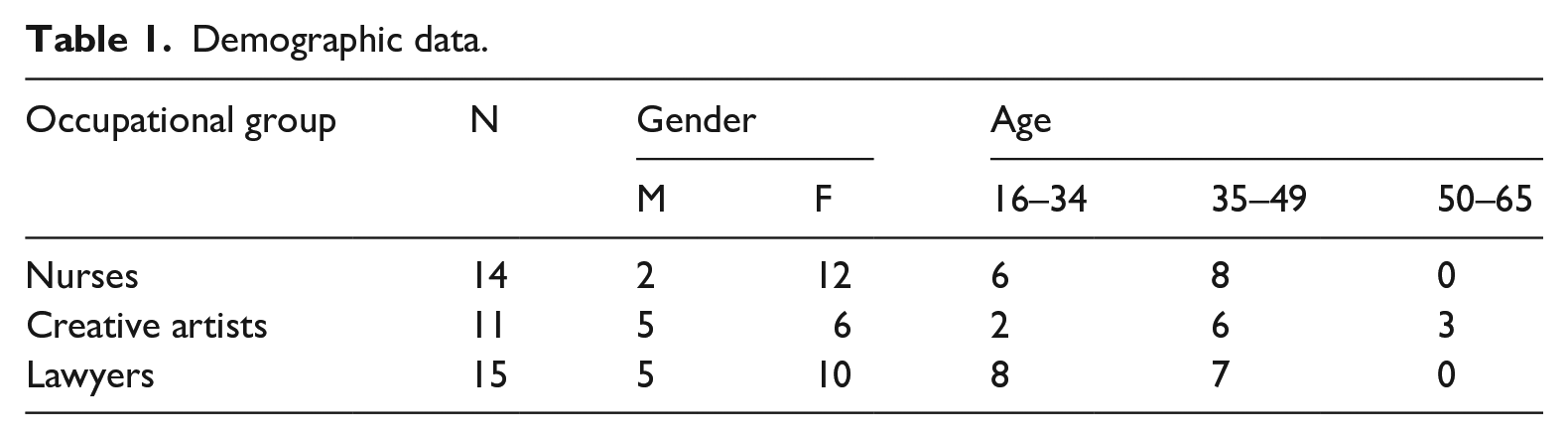
The lawyers (n = 15) all worked for a large employer within a professional call-centre setting that specialised in claimant work. While recognising that this particular setting may not be typical of an average partnered law firm (Regan and Rohrer, 2021), it offers an interesting opportunity to examine how the potentially competing logics of the profession and the market feature in accounts of worth. The nurses (n = 14) all worked for a hospital trust. The majority were staff nurses including those working in acute wards and outpatient settings. The creative artists (n = 11) were all self-employed as musicians, actors or writers. Individual, face-to-face semi-structured interviews were held with each informant, and were audio-recorded and transcribed verbatim. Informants were asked about their career history and facets of their present working lives. In particular, they were asked to reflect in detail on times when they found their work meaningful or meaningless, explaining what was happening, who was involved and their personal interpretation of these events.
At the time of data collection, the intention had not been to gather accounts, but close reading of the transcripts over time revealed the presence of accounts during which informants discussed their experience of meaningful work that focused on the struggle to secure and stabilise a sense that they had made a worthwhile contribution. As such, the accounts arose ‘in their natural state’ (Gabriel and Griffiths, 2004: 116) as informants reflected on the meaningfulness of their work. It is these accounts that form the basis of our analysis. Interviews represent a ‘specific social context’ with potential implications for power dynamics (Dick and Cassell, 2004: 59), but nevertheless constitute an acceptable source of text for a CDA (Dick, 2004). While there is an element of interaction and questioning that underpins the development of the accounts in an interview setting, the interview provides an opportunity for informants to ‘relate their experiences freely and in peace without having to struggle for space’ with the interviewer taking the role of ‘empathic listener’ (Ylijoki, 2005: 562).
Data analysis
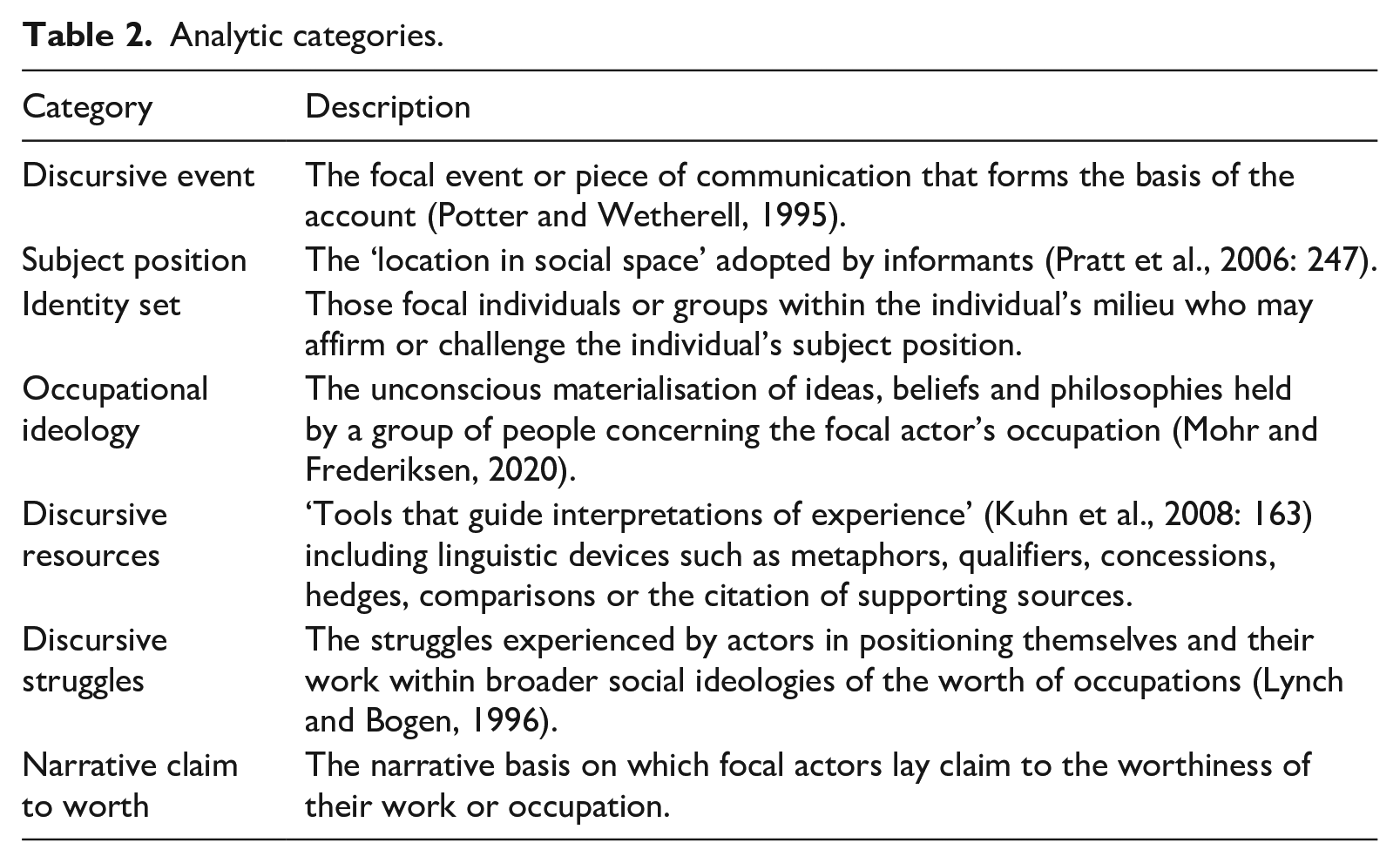
Data analysis proceeded in four stages. Table 2 summarises the analytic categories we used. First, we focused on data familiarisation, during which members of the research team separately undertook a close reading of all the transcripts, marking instances where informants appeared to be providing an account relating to the meaningfulness of their work, and wrote detailed memos. The team agreed that the accounts did not equate to coherent, well thought-through stories with rhetorical intent, but rather comprised a series of micro-narratives (Martikainen et al., 2022). Hence, we felt confident in classifying these as ‘accounts’ rather than as ‘stories’ (Orbuch, 1997).
Analytic categories.
Our reading of the transcripts revealed that these accounts were not provided simply in response to one specific question, but rather were often returned to throughout the interviews, emerging as informants engaged in deep reflection on their experiences (Ibarra and Barbulescu, 2010). In order to make the analytic procedure manageable, in the second stage we followed Dick and Cassell (2004: 60) by adopting a ‘data sampling’ approach, whereby we ‘selected those parts of the conversations that were specifically concerned with the issues we wished to understand’. This necessitated a further close reading of each transcript and the careful creation of an abridged version of each one. We cross-verified that the accounts were complete, including relevant contextual information. The third stage entailed determining and applying the discourse analytic procedure, breaking the accounts down into their constituent parts. We iterated between the literature (e.g. Alvesson and Kärreman, 2011; Dick, 2004; Dick and Cassell, 2004; Phillips et al., 2008; Potter and Wetherell, 1995; Souto-Manning, 2014) and our dataset.
At the heart of CDA are the discursive events – pieces of communication or focal happenings that produce meanings (Potter and Wetherell, 1995). We found that the accounts were organised around such events; for instance, in the case of the nurses, accounts centred around caregiving situations, and we created memos concerning the focal discursive events we found. We also sought to identify the ‘grand discourses’ (Alvesson and Kärreman, 2011) or ideologies within the accounts. We were able to determine the unconscious application of such ideologies within statements such as: ‘As far as society is concerned . . .’ (Pat, creative artist).
Social actors engage with subject positions or ‘locations in social space’ (Pratt et al., 2006: 247) in the context of ideologies, which ‘frame the possibilities for being and acting’ (Phillips et al., 2008: 781). By doing so, social actors may consent to, or resist, prevailing ideologies (Dick and Cassell, 2004). Such subject positions are generally adopted in relation to an actor’s ‘identity set’ (Pratt et al., 2006) or focal individuals/groups within the account, with some subject positions ‘warranting a louder voice than others’ (Phillips et al., 2008: 773). We therefore looked within the accounts for evidence of the subject positions adopted by informants and noted how these were accomplished. For example, analysis of Paul’s (lawyer) account shows how he adopted the subject position of powerful ‘helper’ thanks to his legal expertise in relation to those ‘going through a really difficult time’, categorising vulnerable ‘clients’ as focal, and dependent, actors within his identity set.
These building-blocks then enabled us to identify the ‘discursive resources’ (Kuhn et al., 2008) or micro-linguistic devices drawn upon by informants that link together the elements of their accounts and reveal how they are structured and what they aim to achieve (Dick, 2004). These included, for example, hedges, qualifiers, metaphors, concessions, categorisations, comparisons or the citing of supporting sources (Jahedi et al., 2014; Kuhn et al., 2008; Whittle and Müller, 2012). For instance, we found Mary (nurse) used the discursive resource of comparison to underscore how much more meaningful her work is as a nurse dealing with ‘life and death situations’ rather than a job simply ‘providing food and drink for people’.
Discursive struggles (Dick and Cassell, 2004) are experienced by social actors as they seek to position themselves in relation to grand discourses concerning the worth of their occupation (Martikainen et al., 2022; Whittle and Müller, 2012). For instance, Mike’s account (actor) exemplifies the discursive struggles he faced in securing a sense of worth in a profession that ‘will always let you down’ because ‘someone is always doing better than you, you always get rejected’. We worked separately, and then together on the CDA element of the analysis to reach agreement among the research team.
At the fourth stage, we built the accounts back up again to consider all the elements together with the aim of identifying the overarching narratives that underpinned the claims to worth made by each occupational group. Narrative analysis aims to examine how the emplotment of the accounts ‘work(s) to construct the morality of the characters involved’ (Whittle and Müller, 2012: 112). Here, we discovered that incumbents of each occupational group reverted to one particular narrative archetype in laying claim to the worth of their work.
Findings
We discuss each occupational group in turn, and provide further illustrative quotations in Table 3 (see online supplemental materials).
Nurses
The nurses’ claim to worth was vested in the role of patient advocate, being present for the patient, standing up for their ‘real’ needs and fighting for their interests in the face of opposition from other, more powerful, social actors (Pavlish et al., 2019). The discursive events drawn on by the nurses in accounting for the contribution made by their occupation related to acts of daily caregiving, rather than grand claims concerning the societal value of nursing. These events centred around personal care aimed at making patients ‘comfortable’ (Anne) from their subject position as ‘the real guardians of the patients’. Doctors and hospital leaders emerged as important antagonistic actors within the nurses’ identity set, occupational groups with what the nurses regarded as a different, and inferior, understanding of the patient based on divergent logics (e.g. the ‘efficiency’ order of worth, Boltanski and Thévenot, 2006) that failed to centre patient needs (the ‘domestic’ order of worth):
So you have to be gatekeepers for the patients because the consultants [senior doctors] . . . some of them really want to keep going with the chemo, and they perhaps don’t see as we see, the day-to-day lives of the patients and what they are struggling with. (Anne)
Anne drew on her intimate knowledge of the lived reality experienced by patients, in contrast with the doctors whose primary focus was on the treatment regime rather than the person. She also questioned the care she could provide for patients in the face of hospital managers who ‘would say: “your focus is to get the patients through, we need these beds, you need to make sure you’ve got their care and treatment sorted so that they can be discharged and moved out”’. The patient was thereby positioned as the focal character in the nurses’ accounts; the person to whom their caregiving actions were directed and whose interests were most salient as they laid claim to the worth of their contribution.
The nurses drew on a range of discursive resources, notably empathy and proximity, based on the ‘quite intimate relationships’ (Mary) they were able to establish with the patient. Edwards (1997) argues that empathy is a device frequently used to lend weight to claims of worth since it is more challenging to ‘cast someone into the role of villain if they display themselves as caring and compassionate persons’ (Whittle and Müller, 2012: 127). Empathy thereby serves to bolster the nurses’ claim to moral virtue in the face of competing and generally more powerful discourses. Conversely, the nurses drew on the discursive resource of depersonalisation (Walsh et al., 2023) in referring to those ‘upstairs’ or ‘the management’ when talking about hospital leaders, to distance themselves from what they perceived as the unworthy, morally tainted priorities espoused by more powerful actors. Through ‘firewalling’ (Jagd, 2011), the nurses absolved themselves of the obligation to focus on efficiency by assigning this responsibility to hospital managers and other medical professionals.
Downward comparison with hypothetical alternative occupations was another discursive resource on which the nurses drew; for instance, Sian said: ‘I could have worked in a retail shop for 20 years and it wouldn’t have given me that sense of achievement that I got from doing nursing for three years.’ Positive affirmation from patients also served to enhance their sense of worth, helping them to: ‘think, oh, you made a difference there’ (Livia), but we notably found that the patient voice was absent from many accounts. Instead, the nurses generally relied on their own evaluation of what the patient really needed in formulating claims to worth, even in the face of patients who ‘hate you from the moment they see you’ (Emily) because ‘you are a nurse’.
At an ideological level, the nurses’ accounts revealed their belief that their occupation was one that was generally viewed as morally virtuous in society: ‘if you say to someone . . . I’m a nurse . . . it’s a job that people really do sort of respect and admire’ (Emily), leading them to feel ‘proud to say that I’m a nurse’ (Mary). However, the discursive struggles experienced by the nurses reveal their accounts to be emblematic of an ambivalent quest to establish and maintain their jurisdictional claim to worth (Bechky, 2003) in a system replete with competing and more successful logics grounded in efficiency. Their accounts of the struggle to assert their authority on behalf of the patient often referenced direct confrontation with representatives of these other regimes vested in a sense of the legitimacy based on their specialist expertise and patient-centredness (Pavlish et al., 2019). Jane described having to go over the head of a senior consultant to secure what she believed to be appropriate care for one patient by calling another doctor who was in the middle of surgery:
. . . and they put the phone to his face [while he was performing surgery] and I had to have the courage to say, ‘this patient really is very unwell and it’s not being recognised, please can you order the scan’. So, yeah, it was that kind of grappling, that kind of battle while this patient is dying.
The nurses made frequent use of a battle or fight metaphor when describing their efforts to perform their role as a ‘good nurse’, drawing on socially validated attributes such as ‘courage’ to bolster their claim to the morally ‘virtuous’ stance. In doing so, they emphasised the importance of the ‘little things’ they did when providing patient care that were generally overlooked within these competing spheres, acts that exemplified their prioritisation of patient dignity and safety (Pavlish and Hunt, 2012):
. . . like taking the extra time . . . I always like to wash people’s feet, I know that’s a bit weird but people’s feet get missed and if you clean someone’s feet and get someone all cosy and they’re just like ‘oh, thank you’ and that’s just a really nice thing to do. (Anne)
According to MacLeod (1994: 361), this ‘little things’ discourse is used by nurses to point towards the seemingly ordinary, ‘moment-by-moment’ complexity of their role, which serves an important visibilising effect in a role context where worth is contested, by emphasising the quotidian, private aspects of their role and the skills required to perform well. Thus, at an ideological level, the (mainly female) nurses in our sample felt that their role often lacked social validation owing to its underpinning link to reproductive rather than productive labour; in ‘“women’s work”, the real work involved is not appreciated . . . One way to draw attention to that work is to show how it is constructed, what effort it involves’ (Daniels, 1987: 405):
I think we all [nurses] care and want to do the right thing. It’s frustrating when you see things on the news that nurses don’t care or they don’t want to spend any time [with patients] because there are some really lovely small things that happen but that doesn’t make the news because it’s not big. (Jane)
Creative artists
The accounts provided by the creative artists laid claim to worth based on grandiose notions of inspiration, resting on the artist’s ability to make a valuable contribution by transforming the emotional and spiritual landscape of individuals and wider society through their artistic endeavours. The discursive events that provided the foundation for these claims were the artistic productions themselves, times when the artist was exposed to public view and evaluation. Such events balanced personal talent, sacrifice and effort against momentary or transient affirmation; for example, Simon (actor) described seeing his ‘name in lights’ outside a famous theatre while Steve (musician) talked of the ‘rapturous response’ from the audience at one of his concerts.
The artists adopted the particular subject position of outsider (Cinque et al., 2021); Pat (artist) explained that ‘being on the outside’ meant working as a ‘paid professional stranger’ whose role is to question and challenge taken-for-granted norms, adding, ‘you’re not in a fixed position like a teacher, being on the outside is part of being an artist maybe as well . . . That’s the kind of usefulness of artists to a certain degree’. Equally, the artists saw themselves as uniquely placed to bring audiences to a higher emotional or spiritual plane, citing many examples of specific times when they connected directly with audiences or even individuals. Ron (opera singer) commented: ‘I really hope that my performance opens people’s horizons, consoles people, helps their emotional state. I hope that people would be moved, transcended.’
In locating themselves within their accounts, the artists drew on a large and varied identity set comprising ‘the arts’ in the broader sense, funding bodies and organisations on whom they were dependent for income, audience members who provided affirmation of their work and other artists. Simon explained how working with people of ‘calibre and experience’ helped him to grow and develop, thus bolstering perceived worth, while conversely Euan distanced himself from other people in music – downplayed as morally tainted and described disparagingly as depersonalised ‘unknowns’ – who had found unwarranted success through happenstance or personal connections rather than through the more challenging and morally virtuous routes he had pursued.
Many accounts revealed that while artists considered themselves to be set apart from wider society and audiences, they nevertheless felt a strong sense of belonging to a like-minded community of fellow artists, which afforded a sense of worth through shared values (Lips-Wiersma and Morris, 2009): ‘you all believe in the power of arts, you all talk the same stuff’ (Nuala). The artists’ subject positioning also reflected the importance of seeking personal fulfilment via their creative work. Mike (actor) used the discursive resource of an imagined alternative self (Obodaru, 2012) – or person who he could have been – to draw out why pursuing an artistic career mattered to him: ‘If I had been a lawyer or something like that for 40 years, I might never have had to question what’s going on, and I think questioning what’s going on is really important, you know.’
Artists often made reference to their work in terms of privilege (Cinque et al., 2021); Simon described the opportunities afforded to him by his acting career as ‘a great privilege. I mean it shouldn’t be a privilege, I wish everyone was able to have that’. They also frequently referred to themselves as ‘lucky’ – the discursive resource of ‘luck’ (Broncano-Berrocal, 2015) is a way of acknowledging that artistic success is hard to achieve in a competitive landscape, while also avoiding hubris or arrogance.
At the ideological level, the artists frequently drew on discursive comparisons when seeking to explain the perceived worth of art at a societal level, contrasting their work with that of other occupations that produced more material or immediately visible outputs:
When I think about it, realistically think about it, I actually think what artists do is probably just as important [as nurses’ work] because, you know, that’s your . . . whatever you want to call it, your soul, that you are looking after. (Chris)
Chris’s account is hedged with qualifiers, indicating the fragility of his claim to worth. Euan was similarly uncertain in his account, but drew on the discursive resource of citing a credible authority to support his claim to the worth of the arts; in this case, the famous actor Tom Cruise, who made a speech citing how the arts could add value to society during challenging times. Their claim that the arts ‘matter’ to society nevertheless featured considerable uncertainty concerning whether or not the arts were merely ‘a luxury’ (Simon):
Quite often in the arts you do see the positive impact. Yes, there’s lots of negative criticism and publicity and all sorts of stuff and, you know, people who don’t believe in the value of the arts . . . but the value it brings to their [clients’] well-being and experience, that kind of richness . . . (Nuala)
The concession contained in Nuala’s account enabled her to set up a depersonalised morally questionable other – that is, ‘people’ whose views she could then (reasonably) reject, but the formulation of her reprise signals her ongoing uncertainty. This ambivalence was exacerbated by perceived government bias against the arts (Cinque et al., 2021) and the perception that, to be awarded funding you simply had to be able to say: ‘oh yes, I know so-and-so from the [funding body] and they’ve been to see our work and you know she quite likes it’ (Chris).
Among the three groups, the artists’ accounts featured the most complex discursive struggles over their worth centring around concerns with value – the value of the self as an artist and the value of the arts more broadly to society. First, there was a sense that, as an artist, there is always the fundamental fear of failure since those in creative roles ‘feel exposed through these acts to the critical gaze of others’ (Yardley, 2005: 118) not just in terms of their artistic production but also of the self. This was closely bound up with the high levels of precarity and uncertainty over income characteristic of the creative sector (Alacovska et al., 2021):
I mean, the thing that I do feel proud about is that I’ve actually earned my own living for 34 years only through writing . . . On the other hand, I’ve never become sort of the best seller or hugely famous or anything like that . . . I’ve always thought – where’s my next job coming from? (Gail)
The second source of discursive struggle was over the fear of being fake, or ‘selling out’ for financial gain (Cinque et al., 2021; Umney, 2016), echoing struggles within the cultural hierarchy of the arts within which ‘high culture’ is usually associated with classical arts (e.g. opera) and popular culture is, in institutional terms, deemed to be more ‘vulgar’ and thus morally tainted (Williams, 1974). Euan said: ‘I think I value what I do too much just to churn out generic crap after generic crap just to get it on something.’ However, the pursuit of integrity was fraught with the risk of failure and financial hardship:
Well, I think if anything the integrity makes it worse because, like, I did a piece at Christmas that makes me cry and it makes me cry because I am so proud of this piece . . . and I just thought, this has been heard by, like, 12 people . . . and I didn’t know how to get anyone to hear it, it was really upsetting. (Euan)
Appeals to cultural distinction were used to legitimise erratic employment, isolation and low pay (Cinque et al., 2021). At the same time, the precarious nature of creative employment meant that the artists were continually ‘chasing’ funding or work opportunities and ‘justifying your existence’ (Pat) to those who did not necessarily appreciate or understand their work. This was linked to struggles with other creatives who had divergent views on the creative output, or those in powerful positions who failed to acknowledge them. Gail talked of being ‘shovelled into some dark corner’ as a writer on magazines, while Chris described the frustrating struggle of working with funding bodies with competing priorities: ‘definitely, all of us [artists] feel that people like [funders] are nothing to do with us’.
These intra- and inter-personal struggles were part of wider uncertainty over whether their involvement in the arts more broadly could be considered a worthy endeavour, as exemplified in Euan’s use of rhetorical questioning as he ruminated over whether and why his work mattered:
That’s a good question isn’t it? I don’t know, I don’t know. I mean I suppose . . . I ask myself that lots of times thinking – what is the point of any of this, why do I bother kind of thing, and am I contributing anything to society? (Euan)
Similarly, the creatives’ accounts featured discursive struggles over whether they should have chosen an alternative, more socially worthwhile occupation, thus underlining the fragility of their sense of worth: ‘I guess part of me would, you know, sort of always think, you should go and help people somewhere or do something constructively social, or have a goat farm or something’ (Pat).
Lawyers
The lawyers’ narrative claim to worth was based on positioning themselves as purveyors of justice battling against unfairness and immorality via their professional expertise that enabled them to ensure ‘vulnerable people’ (Paul) win through ‘against the odds’ (Dan).
The discursive events within the lawyers’ accounts related to the cases they handled on behalf of their clients, such as employment appeals and probate work. This caseload included lengthy communication and correspondence with claimants as well as other legal representatives and appeals to tribunals. Handling these well constituted a site where their contribution became visible:
If you’ve got an unfair dismissal case, it has damaging effects on the individual and the family, on the financial aspects. So you know that you’ve helped that family . . . That’s why this work is so important to me, claimant work. (Dan)
Within their accounts, the lawyers adopted the subject position of ‘crusader’ for legal rights (Dan) or champion of the ‘ordinary people’ and their ‘real issues’ (Carol) in the face of misfortune or unscrupulous employers, freeing them from a burden at a time of great personal difficulty (Frances) thus positioning themselves as morally virtuous. In building their accounts, the lawyers drew on an identity set comprising the law as a whole, other lawyers and legal firms, and clients. Clients were central to these accounts as the beneficiaries of their work:
We don’t look to make people happier because that’s not anything to do with law. Sometimes people are very unhappy with their encounters with the law and there’s a difference between making you happy and getting you what you are entitled to. (Louis)
Notably, the lawyers appealed to professional logic (Muzio et al., 2013) and the objective application of the ‘right’ legal procedures to ensure ‘things should be done properly and no short-cuts taken’ (Pete), rather than to the ‘happiness’ of their clients, who emerged as rather unreliable arbiters of what the lawyers regarded as the real worth of legal work.
The discursive resources the lawyers drew on when laying claim to making a worthwhile contribution centred around professional expertise and the moral virtue of hard work. It was through these that the lawyers perceived they were able to achieve positive client outcomes and thereby bolster a sense of their worth: ‘because without me they wouldn’t know what to do’ (Mura). Comparing their legal work favourably with alternative occupations they might hypothetically have pursued also served to strengthen a sense that law was worthy owing to its associations with socially approved values, such as benevolence or justice: ‘if I had gone into accountancy, I might not have got that sense of fairness and justice’ (Clare). At the same time, the lawyers emphasised that getting to the position where they could help clients was not an easy process; they talked of excessive working hours and the ‘personal sacrifices’ (Paul) they made to acquire the necessary training and credentials, along with a willingness to accept low pay compared with other professionals. These discursive resources and appeals to socially acceptable virtues (Michaelson, 2021) served to strengthen claims to the esoteric and worthwhile nature of their professional enterprise (Carlson, 2016).
Lawyers drew on a perceived ideology that law was an institutionally important profession, necessary for the fair and just operation of society. Being a member of this occupational group became a source of pride: ‘since I qualified, I’m saying to people, “I am a solicitor and I will be dealing with your case”, it kind of makes me feel, like, wow, that’s me, I’m a solicitor!’ (Frances). As such, their perception was that the law was often seen in wider society as ‘glamorous’, well-paid and prestigious. Conversely, there was a countervailing perception that lawyers were regarded with ‘general cynicism’ (Tara) and as unnecessary, morally tainted and overpaid, hence leading to some ambivalence about laying claim to worth as a lawyer: ‘it’s a bit of an embarrassing thing to be [a lawyer] isn’t it, because they [the public] think we’re all big fat cats earning huge salaries and charging £350 an hour’ (Carol).
In their discursive struggles, which coalesced around the theme of status, the lawyers justified their work by identifying with a specific branch of law that they regarded as morally superior, while at the same time distancing themselves from other, less socially desirable types of law: ‘I don’t see myself as a lawyer doing respondent work for whoever approaches me first, I see myself as a claimant lawyer . . . I know it’s not professional but I find it distasteful to help an employer sack someone’ (Dan). However, assuming this identity set up further tensions between personal, ethical and professional values (Mitra and Buzzanell, 2017) as they were played out in the context of their firm: ‘My values are based on the Law Society [professional] values rather than [firm] values, which isn’t to say I object to their values, it’s just they are not my priority’ (Louis).
While Carol disparagingly referred to the company’s values as ‘a bit Disney’, Louis went on to describe the ‘perverse’ devaluing of professional expertise in the firm, which meant that unqualified staff were often promoted over solicitors: ‘you have spent an awful lot of work and an awful lot of money training to become something, and the view here is that it doesn’t actually count for very much’. These accounts signal the tensions experienced by lawyers in the face of the erosion of traditional legitimating resources within the professions such as credentialism, public service and professional ethics (Carlson, 2016; Walsh et al., 2023), which are progressively being replaced by the logics of efficiency and commerce (Muzio et al., 2013). They are, moreover, also indicative of an internal struggle within the law itself over intra-occupational jurisdiction (Bechky, 2003) and the relative worth of different facets of law. A core element of the struggles experienced by the lawyers was, however, over the inherent value of legal work itself (Martela, 2023), signalling the underlying fragility of their claim to be making a worthwhile contribution: ‘I think that I am doing all of this paperwork on someone’s estate, you know, they could do it themselves and, you know, sometimes . . . I suppose in a way I am questioning the meaningfulness of what I do’ (Stephanie).
Some compared their job negatively with occupations perceived as being more ‘frontline’ such as ‘doctors and firemen’ (Mura) or with manual jobs producing tangible outputs:
It’s difficult to be proud of something when you don’t produce, isn’t it? I’d love to be a carpenter because I’d love to finish the day and think, ah, ‘I’ve made that’ . . . there isn’t anything you can do other than think, ‘I led somebody well through a process’. (Carol)
Tara’s account was emblematic of the difficulties the lawyers experienced in ‘pulling’ (Boova et al., 2019) wider cultural ideologies into their justifications, as evidenced in the range of hedges and qualifiers she used: ‘Well, we have an awful lot of customers so we must be needed. I know we’re needed. I think we do contribute greatly to people, we’re providing a service people need.’ At the extreme, the discursive struggle with what being a lawyer contributes to society meant that for Carol:
I never, ever admit to being a lawyer. I think it is meaningful to me if I’ve done a good job and improved the situation of somebody and then I feel like I can hold my head up, despite being a lawyer. I just don’t think it’s meaningful to larger society at all.
In their accounts, the lawyers ultimately rejected grand societal acclaim and youthful ideals of ‘changing the world’ (Louis) and instead sought worth in the ‘smaller things which still need to be done on a day-to-day basis’ in their client work that helped ‘make the world go round’ (Tara).
Discussion and conclusions
Discussion
Through a CDA-based study of informants working in three diverse occupations, we reveal the discursive content, form and structure of accounts of meaningful work formulated by social actors in their quest to secure and uphold a sense that their work makes a worthwhile contribution. Informants all centred their accounts of meaningful work around discursive events or ‘test’ situations (Boltanski and Thévenot, 2006) where the worth of their contribution came under close inspection: the nurses talked of moments of patient-centred caregiving, the creative artists focused on the moment a creative artefact or production was brought to life and the lawyers discussed the conduct and resolution of legal cases. Our study therefore lends weight to prior research that has positioned contribution as the cornerstone of meaningful work (Allan et al., 2018; Bryant et al., 2023; Lips-Wiersma et al., 2020; Lysova et al., 2023; Martela, 2023; Steger et al., 2012). However, by attending not just to what contribution social actors talked about but also to how they talked about it, we are able to advance theory concerning the role of worthwhile contributions in two important ways.
First, we found that meaningful work is associated with a three-dimensional discursive construction of one’s contribution as being worthwhile. This builds on and extends prior literature on the role played by contribution, which has emerged piecemeal within divergent streams of meaningful work research (Bryant et al., 2023; Lepisto and Pratt, 2017; Lysova et al., 2023; Martela, 2023; Mortimer, 2023).
The first dimension is the perception that work contributes positively to others and wider society via pathways that align with the order of worth regarded by the individual as legitimate. Thus, it is not sufficient simply for individuals to perceive their work makes almost any kind of positive contribution (Rosso et al., 2010), but rather we argue, in line with Bryant et al. (2023), that it is important the individual evaluates their own contribution as worthwhile; in other words, the question people ask themselves is: does my work make a contribution that I judge to be worthwhile?
Thus, from a narrative perspective, the nurses positioned their contribution within the framework of the domestic order of worth (Boltanski and Thévenot, 2006) as providing patient-centred advocacy and personal care (Pavlish et al., 2019). The creative artists drew on the inspired order of worth to argue their contribution lay in moving, challenging and inspiring individuals and society via the authenticity and spiritual integrity of their artistic productions (Cinque et al., 2021). The lawyers viewed their contribution within the industrial order, positioning themselves as the purveyors of justice whose technical expertise and hard work meant that social fairness would win out, so long as the correct procedures, of which they were the guardians, prevailed. Where individuals were unable to discern a contribution that aligned with their own espoused order, then this undermined their experience of meaningfulness, as evident in the uncertainties, hedges and qualifiers they used.
The second dimension is the individual’s perception that evaluations of the worth and value attached to their contribution by other social actors and wider society align with their own sense of where the value of their contribution lies. Hence, the question is: is the worth of my contribution judged and acknowledged by what I consider to be appropriate standards by other social actors, and/or within societal discourses? This is evident in the manner in which informants engaged in ‘justification work’ (Jagd, 2011: 348) to defend against competing value judgements and cast doubt on the validity of other social actors who drew on alternative orders of worth, positioning them as unreliable arbiters (Ashforth and Kreiner, 1999). For example, the nurses rejected claims from others that the contribution of nursing care should be judged in terms of efficiency, which is based on the industrial order of worth (Boltanski and Thévenot, 2006) utilising discursive resources such as firewalling and claims to morally virtuous attributes. The creative artists knew they could hypothetically participate in other, more popular forms of art that would enjoy greater market worth, but instead drew on strategies such as downward comparisons in an effort to discredit beneficiaries and others within their identity set who judged them simply in terms of popularity. The lawyers dismissed the notion that their contribution could be evaluated in terms of the ‘happiness’ of clients by asserting the superior moral worth of legal professional values (Buch and Andersen, 2013) grounded in the industrial order.
Although beneficiary feedback was important for our informants, it mattered not only that the feedback was positive but also that it was the right kind of feedback. Thus, contact with beneficiaries emerged as something of a double-edged sword. To some extent, though, casting beneficiaries as unreliable appeared to be more easily accomplished than the dismissal of coworkers’ judgements. Beneficiaries could be positioned as lacking the requisite knowledge and understanding to make a sound judgement. Handling competing claims to worth on the part of coworkers or significant others within social actors’ identity set, such as doctors in the case of nurses, funders in the case of the creative artists or other legal professionals in the case of the lawyers, appeared more problematic. Prior research has highlighted the challenging battles for dominance and epistemic authority that can take place among occupations through processes of boundary marking and maintenance (Bechky, 2003; Carlson, 2016). Experiencing devaluation from coworkers from within the same occupational realm evinced a particularly strong sense of lost meaning among our informants, prompting intense discursive struggles to reassert their own preferred claim to worth.
Similarly, informants exhibited sensitivity to cues emanating from wider ‘grand’ societal discourses concerning the worth of their work (Alvesson and Kärreman, 2011). However, while previous research has indicated that social actors can shift perspective in light of changing socio-cultural cues (Florian et al., 2019; Jiang, 2021), by looking into the detail of how accounts are constructed, we found that individuals struggle significantly to change their view and evaluate the worth of their work through an alternative lens when confronted with cues suggesting that the contribution made by their work is not valued in wider society. Although Clarke et al. (2009) argue that accounts can contain ‘unresolved antagonisms’ that enable individuals to flexibly reauthor themselves as morally virtuous even in the face of changing circumstances, we instead found that individuals were strongly attached to the moral order within which they grounded their contribution. It seems that it is not just in the context of ‘legitimacy crises’ (Reinecke et al., 2017: 46) that individuals are prompted to undertake effortful justification work (Jagd, 2011) but also in daily working life, since ‘a “state of peace” is always only a temporary truce’ (Reinecke et al., 2017: 45). This reflects the fundamental tensions and antagonisms that persist between conflicting orders of worth (Boltanski and Thévenot, 2006; Jagd, 2011) and the effort required to restore a lost sense of meaningful work (Florian et al., 2019).
The third dimension is the degree to which individuals perceive they are able to deliver a contribution they value and that is appropriately valued by others within the prevailing working context, or a self-efficacy belief (Baumeister, 1991; Clarke et al., 2009; Martela, 2023; Mortimer, 2023; Rosso et al., 2010). Thus, the core question is: am I able to make what I consider to be a worthwhile contribution? Through their accounts, informants sought to position themselves within an almost ‘heroic’ narrative genre (Gabriel and Griffiths, 2004) – their accounts included tales of personal hardship and suffering as they engaged in a moral quest to do what they regarded as good for society via an epic journey that frequently entailed ‘defying the odds’ (Maclean et al., 2012: 19) in the face of significant rejection, criticism or opposition. Such heroic narratives are a common trope that transforms the narrator into a virtuous moral agent (Wright et al., 2012) whose claims to worth are then hard to disavow (Ibarra and Barbulescu, 2010; Michaelson, 2021). The hero subject position is also a means of ascribing agency to oneself even in the face of seemingly impossible odds and thereby strengthening both the individual’s perceived self-efficacy and the worth of the contribution one makes. Paradoxically, positioning oneself as a self-sacrificial hero also signals the difficulties faced by the individual in determining the basis upon which legitimacy may be judged in the face of competing authorities ‘vying for power’ (Dick and Cassell, 2004). Groups with the power to determine what constitutes a worthwhile contribution do not have to fight to legitimise it. Thus, the narrative composition of accounts reveals how struggles for self-efficacy may serve to undermine individuals’ sense of being able to contribute in worthwhile ways, calling meaningfulness of their work into question.
Taken together, these three dimensions suggest why it is that securing a sense that our work makes a worthy contribution and, hence, is meaningful, becomes challenging. While prior research has pointed to the difficulties faced by individuals working in volatile environments (Florian et al., 2019; Long et al., 2016), or by those seeking to establish themselves in ‘new’ professions (Iatridis et al., 2021; Trittin-Ulbrich and Glozer, 2024) in judging their work to be worthy, our findings demonstrate that people in more ‘regular’ types of jobs are equally vulnerable to feelings of unworthiness (Buch and Andersen, 2013). The notion of a ‘worthy contribution’ emerges from our study as a complex, multifaceted evaluation drawing on moral and pragmatic forms of worth (Alexiou and Wiggins, 2019) along with self-efficacy beliefs (Baumeister, 1991), grounded within the enduring primacy of the individual’s attachment to the value of their own criteria of worth.
Contact with a wide range of beneficiaries, proximal and distal others within the individual’s identity set, coupled with exposure to ‘grand discourses’ (Alvesson and Kärreman, 2000) and inter-occupational power struggles, mean that social actors are constantly exposed to threats that undermine their ability to discern the value of their contribution. We therefore found individuals are required to look deeply into their daily working practices to achieve a sense of worth. Thus, we found that worth resides in the minutiae of everyday working life rather than in grand claims to legitimacy at the occupational level. Accordingly, individuals engaged in ‘justification work’ (Jagd, 2011: 348) at the micro-level of their particular niche within their occupation, focusing on the quotidian ‘little things’ (MacLeod, 1994: 361) where efforts at justification were more readily visible. This often entailed drawing on discursive resources that enabled them to align with the perceived moral virtues attributed to their occupation as a whole, while simultaneously distancing themselves from the moral taints perceived to be attached to their occupation by wider society: nurses as uncaring, ‘dirty workers’, the creative artists as an unimportant waste of money and lawyers as unnecessary ‘fat-cats’. This was accomplished via discursive strategies geared towards moral boundary-marking within the occupation (Bechky, 2003) and by ‘condemning the condemners’ (Ashforth et al., 2007: 163): thus, the nurses rejected doctors’ counter-claims to be arbiters of what constituted good patient care, the artists dismissed other, more popular artists as fakes and sell-outs and the lawyers spurned other lawyers who acted on behalf of ‘immoral’ clients. Informants thus relied on their direct experience of proximal ‘micro-contributions’ made through the working day when justifying the worth of their work.
‘Justification work’ (Jagd, 2011: 348) emerges as an uncomfortable and effortful undertaking for social actors, although one that is necessary in the struggle to maintain a sense of meaningfulness. This appeared especially acute in the case of the creative artists, given the intangibility of their contribution and diverse interpretations of the value of the arts (Alacovska et al., 2021). Moreover, given that the production of a creative artefact, whether through music, writing or acting is highly personal, the very self of the creative artist was at stake when worth was challenged (Cinque et al., 2021). However, even though the solicitors could draw on discursive resources such as professional values (Buch and Andersen, 2013) and the nurses could align themselves with grand societal discourses concerning the value of caregiving (Martela, 2023), an underlying fundamental insecurity regarding the ‘true’ worth of their contribution persisted owing to ongoing contestation between orders of worth (Boltanski and Thévenot, 2006). Rather than resolving differences to reach a compromise or stability across competing orders of worth (Reinecke et al., 2017) or holding unresolved tensions that might provide ‘wiggle room’ to author alternative versions of themselves (Clarke et al., 2009), we instead found that social actors adopt entrenched antagonistic positions in an effort to strengthen the case for their preferred order of worth. Paradoxically, this then serves to weaken their experience of meaningful work because, by rejecting others’ interpretations of worth, individuals then undermine a sense of belonging (Schnell et al., 2019) that might otherwise serve to bolster meaningfulness (Lips-Wiersma and Morris, 2009).
Our conceptualisation of worthy contributions adds to our understanding of the association between the contribution of work and work meaningfulness and helps build bridges between divergent perspectives on meaningful work. Worthwhile contributions are central to the ‘meaningful-work-as-worthy-work paradigm’ (Beer et al., 2022; Boova et al., 2019; Trittin-Ulbrich and Glozer, 2024), otherwise referred to as the ‘justification’ perspective (Lepisto and Pratt, 2017). According to this viewpoint, meaningfulness arises via individuals’ evaluation that their work makes a worthwhile contribution to others and wider society, but views differ as to whether work should adhere to certain, normative standards to be adjudged worthwhile or whether subjective evaluation is sufficient (Beer et al., 2022; Martela, 2023; Michaelson, 2021). By positioning worthy contributions as a discursively constituted socio-cognitive evaluation (Alexiou and Wiggins, 2019) within the orders of worth framework (Boltanski and Thévenot, 2006) we are able to reconcile these perspectives. The framework provides an overarching set of normative criteria by which moral claims to serve the common good may be judged, without seeking to assert the primacy of any particular one (Reinecke et al., 2017). Following Boltanski and Thévenot (2006), we found that rather than there being a clear consensus over normative valuations of worth, or multiple subjective evaluations that are not grounded in a general agreement, there are instead a number of higher common principles of value that are constructed, challenged or upheld in determining worthwhile contributions.
Second, we propose that our framing of worthwhile contributions serves to bridge the gap between psychological theories of meaningful work on the one hand (the so-called ‘realisation’ perspective), and the ethical/sociological, or ‘justification’ perspective on the other (Bryant et al., 2023; Lepisto and Pratt, 2017; Martela, 2023). Psychological theories position contribution as one of the core foundations of meaningful work (Lysova et al., 2023; Steger et al., 2012). However, the emphasis within this paradigm is on task significance and the individual’s perception that their work has a pro-social impact within the context of psychological need fulfilment and self-actualisation (Allan et al., 2018; Grant, 2007; Hackman and Oldham, 1976; Steger et al., 2012). We found that individuals cannot experience their work as meaningful and thereby achieve a sense of self-realisation (Lepisto and Pratt, 2017) if they do not judge that what their work accomplishes is of worth and value to them, to others and to wider society in ways that matter to them.
Limitations and directions for future research
While our study has shed light on the discursive processes underpinning accounts of worth, there are nevertheless some limitations. First, we focused our research on three occupations in the service sector who engage with multiple others as they go about their work, and did not consider other types of workers; for example, those in manual jobs, those who largely work alone or those whose work produces more tangible outputs. Workers in such occupations may well experience different kinds of discursive struggles in securing a sense of worth (Laaser and Bolton, 2022), and future research could, for example, explore how individuals in such jobs integrate the perspectives of others within their identity set into their evaluation of the worth of their work.
Second, the three focal occupations are very different structurally and institutionally, which complicates comparison between them in terms of understanding how their worth is constituted. However, given that our emphasis has been on uncovering the discursive processes by which a sense of worth is developed, crystallised and challenged, we nevertheless feel that such a comparison is valuable and informative. Future research might consider account-making at the inter-personal or inter-occupational level; for example, by comparing accounts by social actors in occupations in adjacent and inter-dependent fields, such as doctors, nurses and administrators working together in a healthcare setting.
Third, we examined account-making within the context of research interviews. However impartial and non-directive, the interviewer inevitably becomes drawn into the account-making process through dialogue with the interviewee (Dick, 2004). There is therefore scope to explore the ideas examined in this article using alternative methods, such as ethnographies or diary studies, that draw out more spontaneous and immediate accounts during the working day.
Fourth, our study is moreover one of a limited number that has focused on accounts and the account-making process (Trittin-Ulbrich and Glozer, 2024) as distinct from other forms of narrative, such as stories or life histories (Maclean et al., 2012; Whittle and Müller, 2012). Given that accounts have been described as crucial arenas for meaning and identity negotiation (Orbuch, 1997) especially in light of changing socio-cultural structures and values, further research that develops the theory and methodology of accounts in other contexts would be welcome.
Our focus on worthwhile contributions raises further questions for those seeking to build bridges between ‘realisation’ and ‘justification’ approaches to meaningful work (Lepisto and Pratt, 2017; Martela, 2023). For example, although we have emphasised the importance of contribution, future empirical studies could explore more deeply the connections between contributions and self-oriented dimensions of meaningful work, such as self-actualisation. Finally, our study lays the foundation for a research agenda that expands our understanding of the discursive construction of meaningful work. Future research could consider how social actors draw on other discursive devices in accounts of worth or consider whether there may be additional orders of worth that are relevant in the context of meaningfulness.
Conclusions
Most jobs do not require us to ‘run toward danger’ (Michaelson, 2009: 42) and hence discerning whether and how our work makes a worthy contribution to society can be challenging. Yet, at a human level, it matters to us that what we do during the working day is, at least to some degree, significant and worthwhile. We all want to be the hero of our own story but, in seeking out this subject position, we ultimately expose our vulnerabilities and uncertainties, as consistently sustaining the heroic ideal remains elusive. Our research has revealed the complex discursive processes by which individuals seek to discern and maintain a sense that their work makes a worthwhile contribution. In the face of contested ideologies and contrasting orders of worth that are played out on a daily basis, the struggle for worth emerges as a discursive battle that starts afresh at the beginning of every working day.
Supplemental Material
sj-pdf-1-hum-10.1177_00187267241255581 – Supplemental material for Experiencing meaningful work through worthwhile contributions: A critical discourse analysis
Supplemental material, sj-pdf-1-hum-10.1177_00187267241255581 for Experiencing meaningful work through worthwhile contributions: A critical discourse analysis by Catherine Bailey, Adrian Madden and Marjolein Lips-Wiersma in Human Relations
Footnotes
Acknowledgements
We would like to thank Dr Evgenia Lysova, Dr Carrie Oelberger, Dr Peter McGhee and Dr Anna Zueva for commenting on an earlier draft of this article. We would also like to thank the Editor, Professor Mina Beigi, and the three anonymous reviewers for their constructive and helpful feedback through the review process.
Funding
The authors received no financial support for the research, authorship and/or publication of this article.

Supplemental material
Supplemental material for this article is available online.
References
Supplementary Material
Please find the following supplemental material available below.
For Open Access articles published under a Creative Commons License, all supplemental material carries the same license as the article it is associated with.
For non-Open Access articles published, all supplemental material carries a non-exclusive license, and permission requests for re-use of supplemental material or any part of supplemental material shall be sent directly to the copyright owner as specified in the copyright notice associated with the article.
