



Abstract
Are organizational projects for refugee and migrant inclusion always trapped with the logic of exclusion and inequality that they seek to dismantle? Existing literature on critical diversity and inclusion studies has demonstrated how the “doing” of inclusion in organizations tends to come with paradoxical effects: well-intended efforts to include migrants and refugees construct them as vulnerable, non-autonomous subjects who need help, within a hierarchical order that is taken for granted. Based on ethnographic fieldwork, this article explores how three civil society organizations (CSOs) navigate these paradoxical effects and the unduly constraining power relations involved through practices that we theorize as counter-conduct against the pastoral government of a national refugee and migrant integration regime. The analysis identifies three practices of counter-conduct through which organizations “do inclusion differently”: contesting constraining categorizations, problematizing hierarchical power relations, and questioning the assimilationist goals and principles of the integration regime. We argue that through continuous critique and renegotiation of the ways in which boundaries of inclusion/exclusion are drawn within the integration regime, organizations work toward conditions in which power relations remain fluid and allow for strategies to alter them.
Introduction
Migration and forced displacement have become vehemently debated social and economic issues. Research shows that refugee and migrant workers still tend to be discriminated against in the labor market and thus struggle to secure employment or remain underemployed, often working in precarious or exploitative conditions (Colic-Peisker and Tilbury, 2007; Ozturk and Berber, 2020; Romani et al., 2018; Van Laer and Janssens, 2011). In addressing this problem, scholars and practitioners alike have highlighted the importance of global commitment to promote “inclusive societies” (e.g., United Nations Sustainable Development Goal #16) and the need to combat institutionalized discourses and practices that block inclusion in organizations (Berry, 1997; Phillimore and Goodson, 2006; Robila, 2018). Inclusive organizations, in this context, typically refer to those in which “individuals of all backgrounds—not just members of historically powerful identity groups—are fairly treated, valued for who they are, and included in core decision making” (Nishii, 2013: 1754).
Though a broad consensus seems to exist on the importance of promoting inclusion in organizations, critical diversity and inclusion scholars have recently called attention to the ambivalent or paradoxical effects of diversity and inclusion programs, arguing that many well-intended efforts that aim at equality and inclusion in organizations simply fail or end up perpetuating exclusion and inequality in the workplace (Dobusch et al., 2021; Ortlieb et al., 2021; Ponzoni et al., 2017). Specifically, initiatives that aim to promote the inclusion of refugees and migrants seem to risk being complicit in what Romani et al. (2018: 371) called benevolent discrimination: well-intended efforts to address discrimination that constructs migrants and refugees as inferior, dependent, and non-autonomous, and in need of help within a hierarchical order that is taken for granted. In much of the literature on refugee and migrant inclusion, these unintended paradoxical effects of diversity and inclusion initiatives have been explained as outcomes of deep-rooted societal power asymmetries and the underlying “societal discourses of otherness” (Ghorashi and Sabelis, 2013: 78) unreflexively reproduced in organizations (Ghorashi and Ponzoni, 2014; Holck and Muhr, 2017; Ponzoni et al., 2017; Zanoni and Janssens, 2015). Scholars have conceptualized these discourses as normalizing “structures of dominance” that operate as tacit sources of refugee exclusion. Hence, to combat these unintended discursive effects, scholars have called for “critical reflection on the ways that the power of dominant discourses works in the practice of everyday life” (Ghorashi and Ponzoni, 2014: 161).
In this article, we respond to this call. Though much of the existing research has critically examined and sought to tackle the exclusionary effects of institutionalized discourses of refugees, migrants, and migration on the lived experience of individual refugees and groups of refugees, in this article, we shift analytical attention to the “regimes of practices” (Foucault, 1991) and “micromechanics of power” (Foucault, 2003: 27–32) through which this experience gets shaped. More specifically, we build a Foucauldian perspective of inclusion as counter-conduct and resistance to the pastoral government of individualization (Foucault, 1981, 1982, 2007) to explore how the “doing” of inclusion can promote the emergence of new forms of ethico-political subjectivity that have the capacity to resist and transform the normalizing society and its unduly constraining forms of power. This is important because inclusion can be understood as the “technology of governance: not only as a way of bringing those who have been recognized as strangers into the nation but also of making strangers into subjects, those who in being included are also willing to consent to the terms of inclusion,” as Ahmed (2012: 1965) notes. We argue that despite the increasing scholarly disquiet about the power asymmetries that migrant and refugee-related inclusion programs and efforts seem to be plagued with, we still know relatively little about how power and resistance operate in these contexts. Hence, in this article, our aim is to advance knowledge of the practices and micro-mechanisms through which power relations within the “asymmetrical includer-included relationships” (Dobusch et al., 2021: 313) are produced, problematized, and altered. More specifically, our aim is to better understand how individuals and organizations try to do things differently and struggle with the mechanisms of pastoral power through which the unintended and paradoxical outcomes of organizational inclusion efforts, such as benevolent discrimination, are brought about. Hence, the research question that we set out to address is as follows. How can organizations engage in counter-conduct and practice inclusion differently to challenge and destabilize unduly constraining power relations in the context of refugee and migrant inclusion?
We address this question by means of an ethnographic study of three civil society organizations (CSOs) working on refugee and migrant inclusion in Germany. Since the so-called “refugee crisis” of 2015, the German state has intensified its policy efforts to promote the social and economic integration of recently arrived refugees and migrants, launching programs that have been criticized for reproducing existing power hierarchies through their principle of “mandatory integration” (Hertner, 2022; Hinger, 2020). With its rigid boundaries, conditions, and hierarchies of inclusion (Etzel, 2021), the German integration regime can be understood as a “project of inclusion” and a “national project [. . .] a way others as would-be citizens are asked to submit to and agree with the task of reproducing that nation” (Ahmed, 2012: 163). We explore how CSOs, operating themselves within the integration regime, enact their ethico-political commitment to inclusion in their micro-processes of organizing through counter-conduct against the pastoral government of the integration regime.
Based on our analysis, we identify three practices of counter-conduct through which CSOs seek to “do” inclusion differently to problematize and counteract the rationalities, techniques of power, and forms of subjectivity through which the German integration regime operates: contesting constraining categorizations, problematizing hierarchical power relations, and questioning the assimilationist goals and principles of the integration regime. Our study shows how these counter-conduct practices allow CSOs to engage in a continuous critique and renegotiation of the ways in which the boundaries of inclusion/exclusion are drawn within the integration regime. In doing so, we argue that the CSOs can work toward conditions of inclusion/exclusion in which power relations remain fluid and can be altered, and in which space is created for new forms of collective and individual ethico-political subjectivities to emerge.
Overall, our study contributes to critical diversity and inclusion studies by proposing a theoretical perspective on “doing inclusion” as counter-conduct and resistance against the pastoral government of individualization. It complements existing theories on the dynamics of power and resistance in organizational practices of inclusion, particularly in the context of refugee and migrant inclusion (Ghorashi and Ponzoni, 2014; Tomlinson and Egan, 2002). This perspective broadens the scope of analytical attention from the exclusionary effects of institutionalized discourses to the regimes of practices and the subtle, complex ways resistance operates as the everyday struggle through which organizations and individuals seek to subvert pastoral power by exploring ways of being and conducting themselves differently. This perspective, thus, allows us to shed light on the ambivalent and mutually constitutive relationship between practices of inclusion and the exclusionary practices they oppose. It draws attention to: (1) the workings of pastoral power in shaping the ways boundaries and conditions of inclusion/exclusion are drawn, and (2) the dynamics of co-optation/resistance through which organizing for refugee and migrant inclusion emerges as inevitably entwined with the national project of inclusion and its pastoral government.
Theoretical perspective
In building our theoretical perspective, we position our article within the emerging literature on critical diversity and inclusion studies (Adamson et al., 2021; Dobusch et al., 2021; Ghorashi and Sabelis, 2013), engaging particularly with the emerging research on power asymmetries in refugee and migrant inclusion that examines the unintended, paradoxical, and ambiguous outcomes of inclusion programs as discursive effects of normalizing power (Ghorashi and Ponzoni, 2014; Ortlieb et al., 2021; Ponzoni et al., 2017). Our aim is to advance knowledge within this literature by proposing a theoretical perspective on “doing inclusion” as counter-conduct (Foucault, 2007: 193) and resistance against the pastoral government of individualization that is practiced within the “asymmetrical includer-included relationships” (Dobusch et al., 2021: 313) that refugee and migrant inclusion involves. In the following sections, we elaborate on this perspective.
“Doing inclusion”
The starting point for developing our theoretical framework is the recent “inclusion turn” in organization studies and the more critical stream of this literature in particular (Adamson et al., 2021; Brewis, 2019; Priola et al., 2018; Tyler, 2019). In this literature, the concept of inclusion has been discussed as an ethico-political commitment and as a response to the question of what we should do about diversity or how we should “organize difference” (Brewis, 2019: 94) in organizations and societies more broadly (Mor Barak, 2018; Ozkazanc-Pan, 2019). Understanding the broad objectives of inclusion—to promote access, participation, equality, belonging, and recognition for all (Ferdman, 2017; Nkomo, 2014; Vasta, 2009)—seems unequivocal, while subject to nuanced differences in the definitions of inclusion in particular contexts (see Shore et al., 2011: 1265 for a definition of work group inclusion).
Recently, critical scholars have begun to draw attention to how inclusion is “done” in organizations (Adamson et al., 2021; Janssens and Steyaert, 2020). The “doing” perspective on inclusion departs from the individualist understanding of inclusion rooted in individuals’ perception and experience, and, instead, turns attention to inclusion as a socially instituted practice that manifests a particular logic or reason of its own (Foucault, 1991). Practices of inclusion are viewed as necessarily embedded in particular relations of power, guided by institutionalized discourses and collective conventions about what is normal or appropriate, and this normative understanding regulates the conduct of organizational actors and shapes their subjectivities (Gherardi, 2009). The practice perspective thus shifts attention to the dynamics of power in refugee and migrant inclusion and thereby highlights that it is not only practices of exclusion but also practices of inclusion that need to be subjected to critical interrogation (Dobusch, 2014). Evidence is mounting that the doing of inclusion is “a process fraught with ambivalence and ambiguity and one that goes hand in hand with exclusionary dynamics” (Adamson et al., 2021: 218).
These exclusionary dynamics can be further unpacked by drawing attention to how the “doing” of inclusion may reproduce the hierarchies and conditions through which individuals and groups were excluded in the first place. For instance, though prevailing notions of inclusion are premised upon an appreciative recognition of difference (Mor-Barak and Cherin, 1998; Nishii, 2013), critical scholars have highlighted that inclusion programs and efforts tend to implicitly draw on hierarchical constructions of “difference” and thus presuppose and implicitly support understandings of the cultural inferiority of refugees and migrants (Kalonaityte, 2010; Ortlieb et al., 2021). Consequently, inclusion may denote the rectification of problematic migrant and refugee subjectivities through expectations of assimilation into dominant norms (Essed, 2002; McPherson, 2010). However, the “difference” attached to refugee and migrant subjectivities is not only hierarchically constructed but also essentialized, which means that, though refugees and migrants may be expected to assimilate to dominant norms (both in societies and organizations), this is simultaneously made impossible because dichotomous and essentializing identity constructions fix them in the position of “the Other” (Ponzoni et al., 2017).
Romani et al. (2018: 371) have discussed these paradoxical and unintended outcomes of practicing inclusion as benevolent discrimination. In the empirical context of a corporate inclusion initiative, their study shows how inequality is reproduced through a social relationship between human resource managers and migrant employees that places the former in the position of authoritative experts who know what is best for migrant employees and who can determine the terms of inclusion. Their study thus shows that the exclusionary effects of inclusion efforts can be overlooked precisely because of the benevolent intentions behind the efforts to include refugees and migrants (see also Ortlieb et al., 2021).
In this article, we argue that many paradoxical effects of inclusion programs and efforts, such as benevolent discrimination, can be attributed to the workings of pastoral power. Pastoral forms of power are concerned with “the provision for human needs” and “the provision of what is necessary for the health, welfare, and protection of a living being” (Dean, 2010: 90). Scholars have argued that the modern welfare state and its increasing intervention in the lives of individuals, in the name of well-being and care, is based on the techniques and rationalities of pastoral government (Dean, 2010; Foucault, 1988, 2000a; Oksala, 2013). Therefore, we argue that pastoral power, as a technology of government, provides a useful analytical lens for examining the dynamics of power and resistance that underpin inclusion in the context of refugee and migrant integration.
Pastoral power as “conduct of conduct”
In this article, we argue that in many contemporary contexts, programs and efforts for refugee inclusion operate through a technology of power that Foucault discussed as pastoral power (Foucault, 2007), using the metaphor of the pastor as a shepherd who watches over and leads his flock. Pastoral power is a form of power that is both individualizing and totalizing (Foucault, 1982). To ensure the health and well-being of his flock, the shepherd must care for and guide the flock in its entirety, but also each member of the flock individually, and each member of the flock “owes a personal obedience to the shepherd” (McCall, 2014: 177). Above all else, however, pastoral power is the power of care. As Foucault (2007: 127 emphasis original) wrote, “pastoral power is [. . .] entirely defined by its beneficence; its only raison d’être is doing good, and in order to do good.” For individuals to benefit from this care, however, they need to subject themselves to and obey the pastor who knows the truth—knows better how to lead them to “salvation,” not only “in the next world,” but also “in this world,” in the sense of health, well-being, satisfactory wealth and standard of living, and personal security, among other worldly things (Foucault, 1982: 783–784). The relationship that pastoral power establishes between pastors and individuals under their guidance is, thus, one of dependence and is based on the obedience and subordination of the guided individuals.
Foucault (2007) theorized the pastorate as a technology of government: “art by which some people were taught the government of others, and others were taught to let themselves be governed by certain people” (Foucault, 2007: 151). Government, in his thinking, refers not only to political rule or governance but also more generally to “the conduct of conduct . . . a form of activity aiming to shape, guide, or affect the conduct of some person or persons” (Gordon, 1991: 2). It refers to practices through which some actors seek to conduct—lead, guide, and direct—the actions of others and to practices through which people conduct themselves as individuals (Foucault, 2007: 193).
In the context of refugee inclusion, pastoral power is exercised within various institutionalized “regimes of practices,” such as national refugee integration regimes (Papadopoulos, 2011) that seek to regulate and shape the world of refugee integration and the politics of integration (Distinto, 2020). Refugee and migrant inclusion programs and efforts may be viewed as constitutive elements of these regimes (Lippert and Pyykkonen, 2012). According to Foucault (1991: 75), regimes of practice are “places where what is said and what is done, rules imposed and reasons given, the planned and the taken for granted meet and interconnect.” Within these regimes, power operates through particular “programs of conduct”: programmatic attempts to organize particular spaces and the conduct of human actors that inhabit these spaces in specific ways (Dean, 1998: 185; Foucault, 1991: 80). These programs give rise to and depend on particular forms of knowledge and expertise and operate through particular mechanisms—techniques and procedures—that are geared toward realizing particular goals (Dean, 2010: 31), and they “have both prescriptive effects regarding what is to be done . . . and codifying effects regarding what is to be known” (Foucault, 1991: 75).
Within these programs of conduct, pastoral technologies of government operate particularly through “the government of individualization”: by producing particular normalized forms of subjectivity through which power can operate (Foucault, 1982: 781; Rabinow, 1984: 8–11). On the one hand, pastoral power constitutes human beings as subjects through various individualizing techniques of subjection, which Foucault referred to as dividing practices: “processes of social objectification and categorization through which human beings are given both a social and a personal identity” (Rabinow, 1984: 8). Dividing practices are basically “modes of manipulation,” such as classification, control, and containment, that “combine the mediation of a science (or pseudo-science) and the practice of exclusion—usually in a spatial sense, but always in a social one” (Rabinow, 1984: 8). These techniques are typically used for marginal, criminal, or delinquent people, such as prisoners and mental health patients. As such, dividing practices seek to control what individuals think, say, do, or are to produce a passive or docile subject. On the other hand, pastoral power also operates through processes that Foucault discussed as subjectification: “techniques through which the person initiates an active self-formation” (Rabinow, 1984: 11). Subjectification thus concerns the ways in which a “human being turns himself or herself into a subject” (Foucault, 1982: 778). Gutting (2005: 101) argued that in discussing these modes of subjection and subjectification, Foucault played with the double meaning of the term subject; whereas subjectification refers to the government of individualization “whereby an ethical code enters individuals’ lives and constitutes their identity,” subjection involves techniques of government through which “individuals are made subject to the ethical code.” Rabinow (1984: 11) noted, however, that distinctions between these modes of objectification of the subject are primarily analytical; in practice, they can be effectively combined in programs of conduct.
Counter-conduct
To explore and critically examine how organizations can resist the normalizing forms of pastoral power that characterize the modern western state as “a modern matrix of individualization” (Foucault, 1982: 783) and its refugee-related inclusion programs, we turn to Foucault’s notion of “counter-conduct” (Foucault, 2007): resistance to “power as conducting” or conduct of conduct (Foucault, 2007) and the struggle against the practices through which people are governed and govern themselves as individuals and collective actors. From this perspective, effective resistance to relations and forces of power that block inclusion calls for counter-conduct that targets the government of individualization in society; it requires an ethico-political struggle against unduly constraining and normalizing procedures and techniques through which individuals are transformed and transform themselves into subjects. On the one hand, such a struggle targets the modes of inquiry and “dividing practices” that classify individuals into categories of normal and abnormal (Foucault, 1982: 781). Counter-conduct takes issue with forms of normalizing judgment and practices of exclusion, both social and spatial, through which individuals are isolated, morally condemned, and positioned as passive and deviant members of society (Rabinow, 1984: 8). On the other hand, counter-conduct is also concerned with how individuals conduct themselves. It calls for people, both individuals and collectives, to “refuse” what they are and invent new ways of being (Foucault, 1982: 785). The notion of counter-conduct thus adds an explicitly ethical element to practices of resistance; it shifts attention to the practices of active self-transformation of individuals and constellations of individuals through which “one transforms one’s relation to oneself and to others in the domain of the ethical” (Davidson, 2011: 32). This type of resistance engages both individual and collective actors in creating, developing, and promoting new forms of subjectivity that can be effective sources of resistance to excessive or abusive governing. As Foucault (1982: 781) argued, it involves ethico-political struggles that: . . . question the status of the individual: on the one hand, they assert the right to be different, and they underline everything which makes individuals truly individual. On the other hand, they attack everything which separates the individual, breaks his links with others, splits up community life, forces the individual back on himself, and ties him to his own identity in a constraining way.
Such counter-conduct, according to Foucault (1997), is animated by a critical ethos or “critique”: a particular critical moral and political attitude that seeks to confront and challenge certain truths, rules, and practices, as well as unjustified claims of authority through which people are conducted in abusive or unduly constraining ways. For him, this ethos is not about “how not to be governed.” Rather, he highlighted the nature of the critique that underpins effective counter-conduct as “the art of not being governed quite so much” (Foucault, 1997: 45) or “the will not to be governed thusly, like that, by these people, at this price” (Foucault, 1997: 75). Counter-conduct, thus, points toward a multitude of ways of “being differently” that are not easily explained through a dichotomous view of self-government as either succumbing to the normalizing process of self-making or refusing every aspect of such a process.
Methodology
Research context: Politics of integration in Germany
The so-called “refugee crisis” and its aftermath intensified political debates about migration and integration in many European countries, including Germany, which received more refugees than any other member state of the European Union (EU). At first, German politics was marked by Angela Merkel’s famous assertion “wir schaffen das” (we can do this) in August 2015, while news images of German crowds welcoming refugees at railway stations were circulating around the world. A movement coined “welcome culture” (Hamann and Karakayali, 2016) saw a record number of people volunteering, and numerous new CSOs—including the three CSOs that are the focus of our study—supporting the newly arrived refugees. Before long, however, the political climate in Germany started to shift (Vollmer and Karakayali, 2018), and the following year, 2016, Germany introduced a new integration law for refugees that “required migrants and refugees to integrate into society in return for being allowed to live and work in the country” (The Guardian, 2016). The new “Integration Act” gave asylum seekers with good prospects for remaining in Germany a fast track to governmental integration courses but also made these courses mandatory for people deemed “in need of integration.” The new law required refugees to actively “work on their own integration” (CEDEFOP, 2017), and imposed sanctions, such as curtailed support and social benefits, on those refugees who did not attend integration courses (Die Bundesregierund, 2016). Critical scholars have argued that the new law was introduced with the goal of attracting fewer asylum seekers (Hertner, 2022), explicitly framing the increasing numbers of refugees in Germany and their supposed lack of integration as a socio-political problem (Hinger, 2020).
The Integration Act, and the politics of “mandatory integration” that it promotes, need to be understood within the broader context of debates about German multicultural society and its alleged failure that had existed long before the 2015 situation (Holzberg et al., 2018). In the 2000s, “the failure of multiculturalism” became the dominant discourse (Schönwälder, 2010), as it was argued that multiculturalism was conducive to the emergence of parallel societies and posed a threat to western civilization and culture in the form of terrorism, radicalization, Islamization, and, more generally, the Muslim “Others” (Kymlicka, 2010). These debates paved the way for the post-2015 political climate, in which it was increasingly highlighted that Muslim refugees must accommodate the German “Leitkultur” (Vollmer and Karakayali, 2018)—a concept some argue serves only to create a boundary between natives and migrants by conveying a flawed image of a static, unified national culture (Heinemann, 2018). The integration courses, which include language and orientation courses that aim to teach refugees and migrants the assumed German-dominant social norms and values (BAMF, 2021), thus became framed as the solution through which the problematic refugee and migrant subjectivities could be rectified (McPherson, 2010).
Case organizations
Our empirical analysis is based on ethnographic fieldwork carried out in three CSOs working on refugee and migrant inclusion in Berlin, Germany. Do IT (all names are pseudonyms) focuses on basic and advanced digital training and provides employment services. CESG offers entrepreneurship training (including mentorship programs), organizes social events, and runs a language cafe (during the fieldwork, only the entrepreneurship training was ongoing). Co-Kitchen organizes social events (mainly about cooking), provides mentoring and “buddy” programs, and manages language cafes (see Table 1).
Case organizations.
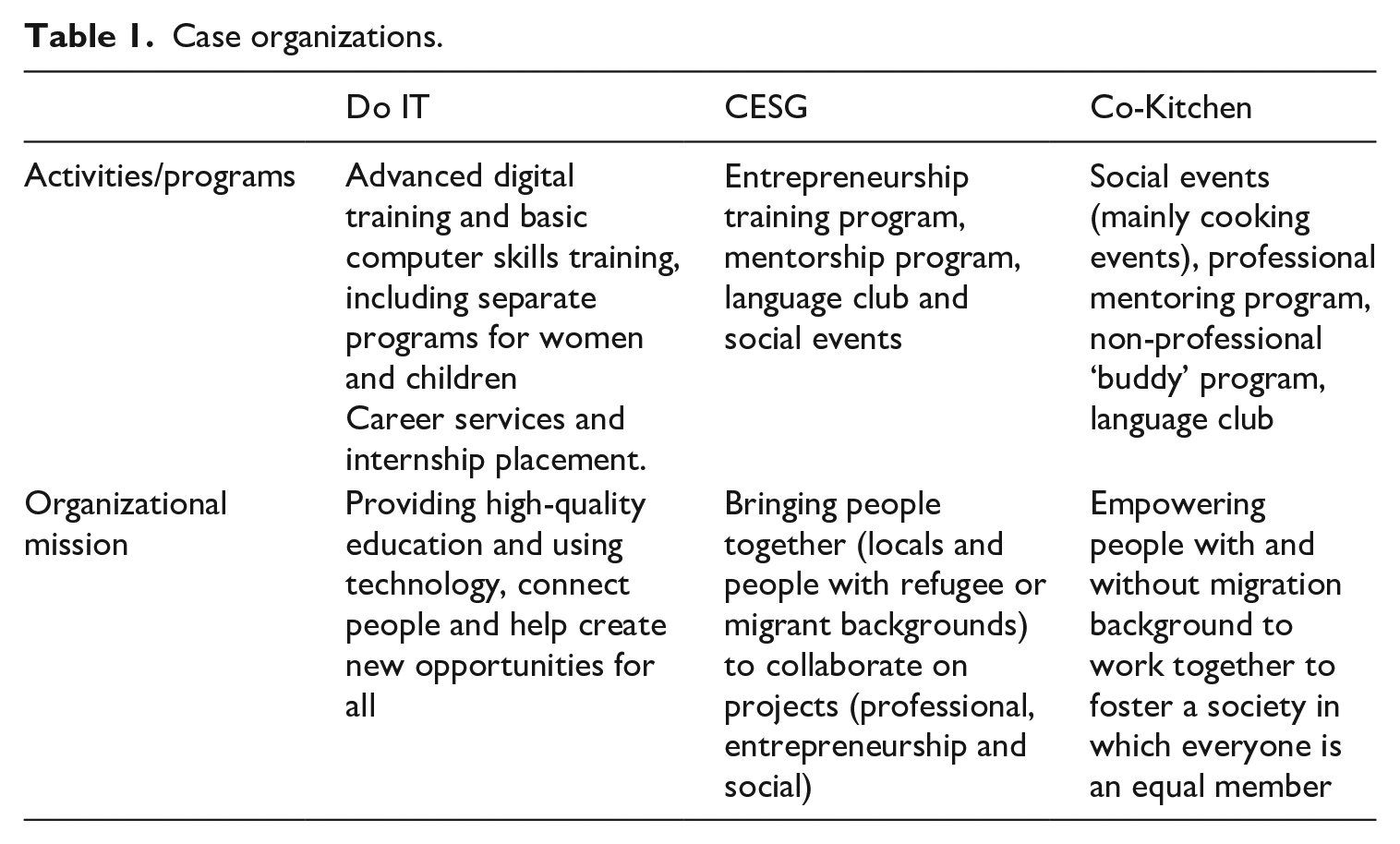
Do IT and CESG began their activities rooted in the solidarity movement in 2015/2016. Co-Kitchen was established earlier, but later became tightly part of the solidarity movement. Since then, the organizations have transformed from volunteer-led projects to fully fledged CSOs (legal forms of social enterprises and associations) with small teams (of 10–20 mainly part-time employees) supported by larger communities of volunteers. The CSOs had different sources of funding, but all had some form of public funding and had, for example, been nominated for the government’s national integration prizes through which the state rewards civil society initiatives for their efforts toward refugee and migrant integration. Thus, they operated as an integral part of the national integration regime.
Collection of empirical material
Empirical materials for the study consist of participant observation fieldnotes, transcripts of interviews, and documentary material on the case organizations. The research involved ethnography conducted over a period of seven months, during which the first author joined the three organizations as a volunteer, disclosing her concurrent role as a researcher. The nature of her involvement depended on the organization but was similar to the commitment of an “average” volunteer (all the organizations had volunteers with a high variance of involvement). At Do IT, this meant assuming the role of a supporting teacher or a principal teacher for basic digital skills classes for women that took place once a week. This involved teaching but also planning the curriculum and content for classes together with other volunteers. Additionally, she observed a variety of other training sessions, ranging from coding to basic digital training, which served as an opportunity to not only observe the sessions but also get to know the community and talk with numerous volunteers and participants during the breaks and before and after the class. At CESG, she joined the entrepreneurship training sessions either as an observer or in an expert role (depending on the topic and the preferences of the organizers). Volunteers’ typical engagement at CESG involved becoming a mentor for one participant, giving a workshop on a topic of expertise, joining workshops as an expert, assisting the workshop leaders, and giving feedback to participants during different exercises. Finally, at Co-Kitchen, the first author was part of a volunteer group that met once a month to plan social activities for the following month. Usually, there were four to five social events taking place in a month (cooking events were always in the program, but other events depended on the interests of volunteers), and they were planned in small groups. The first author joined the organizing group for several social events and took part in others as a participant. For all the organizations, the first author also took part in various information events for new volunteers and networking and other social events targeted to volunteers, participants, and people interested in getting involved.
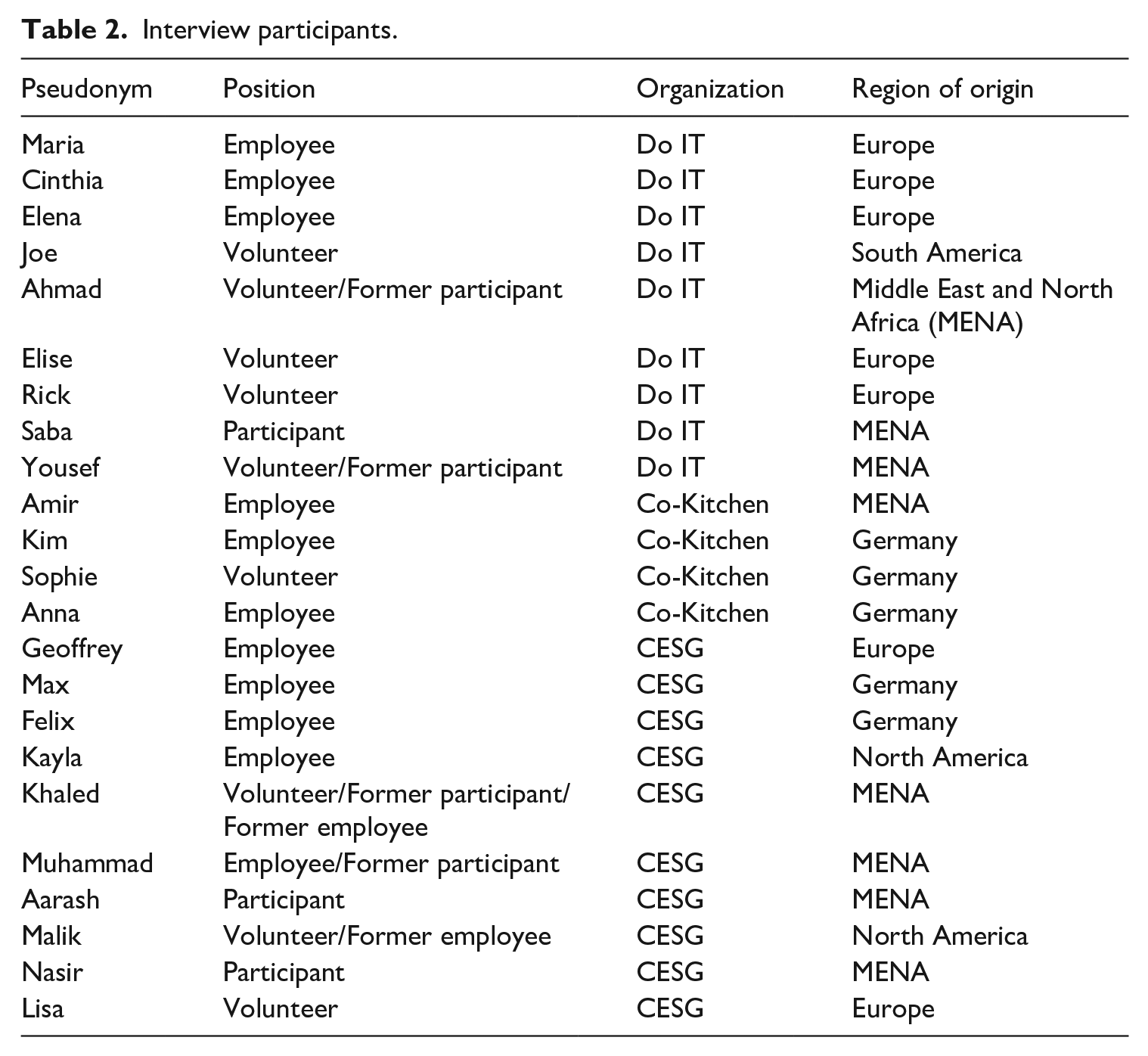
At the site, the first author took field notes when possible and wrote up detailed accounts afterward. The ethnographic participant observation was complemented by 23 semi-structured, in-depth interviews conducted with employees, volunteers, and participants. In addition, several informal interviews were carried out with organizations’ employees, volunteers, participants in events and programs, and other stakeholders. These were recorded in field journals. The interviews lasted 45–90 minutes, and the respondents (see Table 2) were identified through personal contacts made in the field and snowball sampling techniques. The volunteers and participants interviewed were all particularly active in the community, having engaged in the work for at least 6 months. The volunteers themselves and others regarded them as key members of the community. Their educational and professional backgrounds were diverse, and a large majority were between the ages of 20 and 35. Their regions of origin are listed in the table to capture the cultural diversity of interview respondents (whether they were employees, volunteers, or program participants), and in some cases, their cultural identities were also more complex than reflected in the table (e.g., dual citizenship and backgrounds of second-generation migration). To ensure the anonymity of the interview participants, countries of origin are not listed, except for the case of Germany.
Interview participants.
Analysis
Our data analysis was based on an abductive approach, going back and forth between theory and empirical material (Van Maanen et al., 2007). The analysis of the empirical material began with a close reading of the entire data set and a line-by-line reading of the field notes, interview transcripts, and texts before generating a list of first-level descriptive codes (Lindlof and Taylor, 2011). The first round of analysis identified recurring themes that were conducive to promoting an inclusive social order—as currently discussed in the inclusion literature that highlights, in particular, promoting recognition of individuals’ uniqueness and belongingness (Shore et al., 2011). These themes included, for example, “not using the refugee label,” “becoming a member of a community,” “no obligation to learn or use the local language,” “people with refugee and migration backgrounds participating as employees and volunteers,” “not referring to helping,” “highlighting cultural diversity,” and “becoming friends.” At this stage, it became evident that organizations approached inclusion as both a problematizing and an affirmative project, which led us to focus on the complex dynamics of what was being resisted, on the one hand, and what was created, on the other hand. To critically examine the logic of these practices further, we consulted the critical inclusion literature and turned to Foucault’s notion of pastoral power and counter-conduct. Continuously moving back and forth between data and literature, with several rounds of coding, we aggregated the recurring themes into three categories that we theorized, in line with our theoretical approach (Foucault, 1991), as practices of counter-conduct: contesting constraining categorizations, problematizing hierarchical power relations, and questioning assimilationist goals and principles.
Findings
Based on our empirical analysis, we identified three practices of counter-conduct that were geared toward problematizing and counteracting the pastoral government of refugees and migrants within the German integration regime: contesting constraining categorizations, problematizing hierarchical power relations, and questioning the assimilationist goals and principles of the integration regime. Through these practices, the CSOs that we studied sought to create space for continuous critique and resistance, engaging in ongoing everyday struggles with power. For the CSOs, in our case, these practices represented deliberate attempts to subvert power: intentional strategies for exploring possibilities for new forms of subjectivity, fields of relationships, and modes of thinking instigated to effect changes in the field of power within which refugees were conducted through the German refugee integration regime.
Contesting constraining categorizations
Vignette 1: I was attending CESG entrepreneurship training, which was open to international people interested in starting businesses in Germany. The topic was the German business environment. We started with a round of introductions during which everyone was asked to say their name and briefly explain their business idea. Everyone mentioned their country of origin, too, and the group included participants from Europe, the Middle East, Africa, and Asia. [. . .] A Syrian entrepreneur, Hassan, and his German mentor Jasper were invited to share their experience participating in the previous cohort. They recalled the story of when they first met. “At first, I was surprised that he was a refugee but he had business cards and everything,” Jasper said, amused. Everyone laughed. “Oh, you were surprised he wasn’t a cliché,” another participant asked in a snide way. “Now I don’t even want to use the word refugee,” Jasper added. “Yeah, we say newcomer,” Muhammad, the Syrian program manager, pointed out.
The fieldwork rapidly revealed that all the CSOs we studied resisted and sought to problematize and counteract the dividing practices (Foucault, 1982) through which individuals were given a distinct character and identity as “the other” by naming and categorizing them as refugees. Dividing practices are enacted not only through various arrangements through which certain individuals are spatially separated from others (e.g., in asylum and reception centers) but also—and importantly—through discourses and practices of social exclusion (Rabinow, 1984). In the German refugee integration regime, these practices would seem to operate, for example, by making refugees and migrants knowable in terms of what scholars have discussed as the dichotomy of victims/villains (Vollmer and Karakayali, 2018), for instance, constructing refugee women as victims “at risk” and refugee men “as risk,” according to the “gendered logic of feminine vulnerability and masculine threat” (Ghorashi, 2021: 48).
To resist such unduly constraining subjectification of individuals as refugees and as the Other, the CSOs that we studied avoided using the term refugee in their everyday activities and external communications. “When someone is labeled a refugee, they are reduced to this image of a helpless victim, with no ideas of their own,” Amir, an employee of Co-Kitchen, explained. “You should only speak about refugees if you speak strictly in a legal context. If you work with inclusion, the language you use should reflect your goals,” Kayla, an employee of CESG, argued.
Hence, in the events and meetings that we observed, participants used the word refugee mainly ironically to criticize or ridicule (Mumby, 2006) the societal discourse on refugees, which may depict refugees as terrorists or criminals, for example. Khaled from CESG asked jokingly during an interview, “I say refugee, and you start thinking of ISIS, right?”. Similarly, in Vignette 1, Jasper, the German mentor, laughs with others about being oblivious to the fact that a refugee could actually have a business card.
Moreover, as another way of problematizing and counteracting the dividing practices of the German refugee integration regime, all the CSOs had decided not to convene in refugee shelters or other spaces typical of refugee work that physically separate refugees from other people. “The venue cannot be migration-related; that’s important,” Felix, an employee of CESG, emphasized. To illustrate, whereas Co-Kitchen’s space was a beautifully decorated venue with a close resemblance to a trendy cafe, CESG and Do IT held part of their activities in an upscale co-working space located in a modern tall office building of a business district. Instead of placing the participants within the context of migration, the cafe-like space of Co-Kitchen thus represented leisure time, and the office building of CESG and Do IT represented a professional environment. “What is so special about Do IT is how the participants come to these modern office buildings; there is free coffee and all that,” Joe, a volunteer from Do IT, described. “We provide a space where people can come and not be whatever they are expected to be,” Amir (employee, Co-Kitchen) argued. Yousef, a former refugee participant and now a volunteer at Do IT, underlined, “If [the activity] is only for refugees, I’d have this feeling that I’m here just because I’m a refugee. No—I’m here because I’m capable of learning something.” Through these socio-material arrangements, we argue that the CSOs thus sought to create a space for the refugee participants to resist what they were expected to be and, instead, see and conduct themselves as autonomous individuals, distanced from the material and discursive conditions of their refugee identity. Instead of using the term refugee, the CSOs referred to their refugee participants as newcomers. “I like the term newcomer because it is a more forward-looking term. We don’t think about war or boats sinking in the Mediterranean. It emphasizes your arrival, not your departure,” Kayla explained. Importantly, the category of newcomers included all people new to Germany, incorporating different migrant groups, all without distinction. Malik from CESG explained: Newcomer used to be a euphemism for a refugee, but as a euphemism, it defeats the purpose. So, it was a conscious choice to start using it to refer to others as well. The point was to convey the message that there is nothing fundamentally different about a Syrian or a Korean newcomer.
The CSOs’ activities were, thus, open to everyone who identified as newcomers, and the self-identified newcomers who participated in the activities included many culturally diverse and legally stratified migrant groups, such as refugees, asylum seekers, non-western/western migrants, international students, and citizens of the member states of the EU. By naming and categorizing their refugee and migrant participants as newcomers, the CSOs thus strategically rejected the official classification systems of the German state and problematized the political division between wanted and unwanted migrants through which these systems operate. What is more, the category of newcomers, as it was reappropriated by the CSOs and their participants, conflated two central categories of settlers—refugees and expatriates—which represent the two extremes on a continuum from stigmatized to privileged migrants with high social status (Szkudlarek et al., 2021). For example, on social media, CESG used hashtags such as #BerlinExpats, #Newcomers, and #SyriansinBerlin in parallel to make the point.
From the Foucauldian perspective that we take in this article, this reappropriation of the category of newcomers can be viewed as an affirmative project for creating space for processes of subjectification that situate refugee and migrant individuals in power relations that are not fixed but variable, reversible, and strategic in the sense that they allow for strategies to alter them. In this project, the category of newcomers is used as a counteracting mode of objectification to help refugee participants free themselves from the subjugating and normalizing effects of the dividing practices through which they had been governed by the German refugee integration regime. Whereas the pastoral techniques of government that characterize the regime constitute the refugee subject as an obedient object in need of care and guidance, the mobilization of the category of newcomer—as it was reappropriated and effectuated in the specific context of our study—created conditions under which the exploration and development of new alternative and more flexible forms of subjectivity became possible for all participants—refugees and non-refugees alike.
By problematizing and counteracting the dividing practices of the German refugee integration regime that objectified some people in unduly constraining ways as “victimized refugees,” the CSOs sought to resist the individualizing and totalizing techniques of pastoral power that subjectified individuals as objects of care—passive members of the “flock,” guided by their “shepherd.” To this end, the CSOs did not underline topics such as participants’ potential experiences of trauma, structural discrimination, racism, xenophobia, or material or educational deprivation. This was not completely unproblematic, however, as it led the organizations to disregard structural sources of exclusion in a manner resembling the problems connected with color-blind practices of inclusion (Ghorashi and Sabelis, 2013: 79). During the fieldwork, it transpired, for instance, that some of the employees and volunteers at Do IT were shocked to suddenly learn that some of the female newcomers lacked basic education and literacy skills (field note). Overlooking the situation of the most disadvantaged newcomers, thus, risks making the activities less suitable for them.
Such instances led to CSOs reutilizing techniques of pastoral power as they sought to attend to these individual “stray sheep” and to know them better as the “problematic subjects” in order to support and guide them. To illustrate, Cinthia, an employee, concluded that volunteers would need to be better educated about the specific situation of individual refugees. “I thought it was important to have someone from that background come to tell the volunteers about the situation in Afghanistan or Syria, rather than generalizing. But we need to understand their situation better,” she explained.
Similarly, Rick, a volunteer at Do IT, recounted an incident in which another volunteer had stopped volunteering because there were not enough participants with African or Arab backgrounds: [The volunteer] felt that, because [the participants with African or Arab backgrounds] are the ones most discriminated against in the labor market, they should get this kind of support the most. [. . .] There were lots of discussions about this in our group and finally, a compromise that [. . .] ideally, in our [digital training] group, there should be at least 50% refugees [. . .] Or to put a bit more discreetly, those who are vulnerable and those who are not vulnerable.
Both Cinthia and Rick tried to acknowledge the structural sources of exclusion while struggling not to impose a dividing practice that objectifies refugees. In these instantiations of utilizing pastoral power, the CSOs thus came to realize the importance of taking care of participants individually, not only collectively, as singular newcomer subjects.
Problematizing hierarchical power relations
Vignette 2: I was attending a movie night organized by Co-Kitchen, which had been promoted on Facebook, with no further details on the purpose of the event, other than spending a nice evening together. The Facebook post was written in German and Arabic, which was the only indication of the nature of Co-Kitchen’s work. Arriving at the movie night felt like coming to a distant friend’s birthday party. There were no introductory rounds or presentations made about Co-Kitchen. [. . .] We started preparing the snack buffet together. I chatted with a young woman who said she was from Syria. I asked her about her participation, and she said she enjoys coming to these events because the people are nice. There was no way anyone could tell whether she was a refugee or if she wanted to help refugees, neither, or both. [. . .] After the movie, everyone started cleaning the dishes. Mustafa, a Syrian community manager who was the only representative of the team, answered questions about where to put what, but he did not tell people what to do. I had not yet been to many events, but it felt natural to assume the role of a host—in fact, everyone seemed to be a host; no one was a guest at this event.
The CSOs that we studied continuously problematized the hierarchical relationships that currently characterize the pastoral government of migrants and refugees: the positioning of some (the government, employees, and volunteers) as benevolent authorities or “shepherds” and others (the migrants and refugees) as passive, obedient recipients of aid—the “flock.” In an active attempt to reconfigure this relationship, the CSOs continuously questioned and re-worked their understanding of who they were (their goals, roles, responsibilities, and relationships) in the organization, struggling to invent and create practices, relationships, and ways of being that allowed everyone to experiment with problematizing and rethinking the premises of unequal relations on both structural and interpersonal levels. This involved countering the pastoral idea of helping that brings about the asymmetric power relation—between “helpless refugees” and their “helpers” (Harrell-Bond, 2002). As Khaled from CESG explained, “This idea of helping is the problem. We, therefore, tell the volunteers they are here to share, not help.”
In practice, as Vignette 2 demonstrates, the CSO sought to continuously disrupt and defy these types of hierarchical power relations by trying to keep the events, and the interactions during the events that the CSOs organized, as informal and open—as free from pre-defined role expectations and rules of social interaction—as possible. People were not asked to and did not identify, reveal, or explain their personal motivations for participating in the events; there was no need for anybody to confess that they were refugees or wanted to help refugees. In the coaching and training events and activities, where it was necessary to define clear teacher–student relationships, the organizers systematically highlighted that everybody should consider volunteering as a teacher for one course and participating as a student in another (field note). At the CSOs, the participants were thus encouraged to perform multiple, changing roles and tasks. As Khaled (CESG) explained, “I am actually one of the founders, a participant, a former employee, and now a contributor.”
In this way, we argue that the CSOs sought to create space for cultivating fluid and flexible roles and non-normalizing relationships based on non-hierarchical views of difference. One concrete way of doing so in the CSOs that we studied was to model the social relationships within the organization around the idea of “friendships across difference”: friendships that cut across boundaries of race, ethnicity, nationality, religion, class, and gender, for example (McLaren, 2006: 200). As Lisa, a volunteer at CESG, explained, “It is primarily about friendship. CESG is very good at matching people. Of course, I want to support [my mentees’] business ideas, as I would support any friend’s business idea.” The concept of friendship, in our interpretation, allowed her to think differently about her relationship with her mentees, beyond the typically fixed and hierarchical power relations that characterize refugee integration regimes, and even rationalize the act of helping by not premising it on an asymmetric power relationship. Friendship relations, in our case, thus served to challenge the CSOs to push beyond the limits of the pastoral logic of the German refugee integration regime and to invent modes of being and forms of oppositional community that could serve as sites of resistance to normalizing power. Through these types of ethical practices of the self, the employees also attempted to find new ways of defining the organizations’ collective subjectivity. “We are not a refugee charity. . . Or I mean legally we are a charity, but we don’t want to be seen that way” (Max, CESG). Refusing the identity of a charity, all three CSOs described themselves as communities—groups of people—participants, volunteers, and employees—who share a common purpose. To illustrate, Maria, an employee of Do IT, explained, “People keep telling us they come here because of the community feeling; that it feels like a family. The teachers hang out with the students; sometimes they invite me too.” Maria uses the word people to refer to both volunteers and participants, placing them on equal footing with equivalent motivation to take part in the activities. Constructing the organizational identity of the CSO around the ideals of the community allowed the employees and volunteers some space to renegotiate the asymmetrical power relations within the organization, and in relation to the refugee participants, in particular, actively engage in ethical self-formation and cultivating particular new forms of ethical comportment to resist the taken-for-granted position of the “shepherd” in the refugee integration regime.
For the CSOs that we studied, however, resistance to the pastoral government of migrants and refugees was an “everyday struggle” (Nealon, 2008). Though all members of the CSOs seemed to share a strong commitment to challenging and disrupting hierarchical power relations in the community, many of them explicitly acknowledged the difficulties and unresolved contradictions that their efforts involved, accepting the fact that inequality will always permeate their social interactions. For example, Lisa explained her motivation to volunteer as a business mentor and help her mentees originate from their friendship, but she also expressed her disappointment with the fact that some participants in the entrepreneurship program represented the more privileged migrant groups. As she put it, “The participants don’t need to be refugees. But I was disappointed to see those French guys there.” Her pastoral motivation to help—or to care for and provide guidance for—the more disadvantaged newcomer groups thus remained, as she sought to redefine her relationship with her mentees as one of friendship.
In our case, ethical self-work entailed a constant struggle of critical and creative engagement with the existing limits imposed by structural sources of exclusion and the asymmetrical power relations between volunteers and participants that may ensue. To illustrate, the employees of Co-Kitchen, who seemed to be particularly reflective about the power hierarchies involved, even organized a workshop for their volunteers in which the volunteers could reflect on whether meeting as equals, which was the guiding principle of their work, was ever possible: We think it was important for the volunteers to have this conversation, as it gives context to our work. [. . .] But eventually, we are trapped by the power dynamic. We say we create these spaces to meet as equals, but it is artificial and temporary. (Amir, employee, Co-Kitchen)
Amir pondered the provisional nature of their activities that escaped “concrete answers and firm closures” (Rossdale and Stierl, 2016: 169).
Kayla explained how CESG had originally wanted to call its mentoring program peer mentoring. “Imagine a German and a Syrian engineer—surely the German has just as much to learn from the Syrian [. . .] But getting people to see it that way was not so easy, getting funding was not easy” (Kayla). This focus on not helping and opening up activities to groups other than refugees, as discussed in the previous section, shaped the nature and content of the activities of the CSOs that we studied. Malik from CESG explained: If it was just a refugee program, you’d probably find people who want to support a refugee sitting down and doing a business plan for a cafe, for example. But now that it’s not only about refugees, we keep people engaged because of the focus on innovation and community.
The activities focused on topics that were generally regarded as interesting, especially by young adults, and, for instance, entrepreneurial training employed different methods that were described as innovative. “It’s a non-charity approach. We create an atmosphere where it’s just fun. You’re excited to be there—not because you’re volunteering but because it’s cool,” Kayla from CESG argued.
The newcomer subject that was promoted through these practices was evidently more accessible to individuals who had the resources to contribute their time and energy (being both participants and volunteers), and who enjoyed the social aspects of being part of the international community, but also to individuals who were relatively more privileged in terms of socioeconomic background. “From the beginning, we’re reaching quite a homogeneous profile of participants—typically young students from Syria who have high economic backgrounds and who have attended university. We know that there are many more people who need this program,” Maria explained.
In their attempt to reach more disadvantaged groups, Do IT started providing basic digital literacy courses, as mentioned in the previous section. The forms of relationships appearing in these courses sometimes differed drastically from the more horizontal friendship-style relationships described above. For example, participants called the teacher Mrs Teacher instead of using her first name, whereas the employees would reproach participants for being late, highlighting how the volunteers sacrificed their time to be there (field notes). Thus, the ethical practices of reimagining new forms of relations were also conditioned by levels of structural inequality between participants and volunteers.
Questioning assimilationist goals and principles
Vignette 3: Do IT’s UX/UI design class was attended by a group of approximately ten participants from Russia, South America, and Arab countries. Three teachers rotated in terms of who was speaking. Instead of lecturing, the teachers assigned exercises; the participants worked on their laptops, and the teachers went around the room, instructing them. One of the teachers spoke in English, one in German (she sat next to one participant and spoke German with her), and the third switched between English and Arabic. The slides that were shown contained all the text in these three languages. [. . .] Toward the end of the class, one participant showed the website she had created for the whole class. She said she was from Turkey and had created a website for the Turkish market in Berlin. [. . .] After the class, I talked with the Arabic-speaking teacher, Yousef, saying it was impressive how the course was held in three languages. “It wasn’t the original idea—we thought we would just teach in English. But we saw the need and thought, why not? Whatever helps—I mean, the most important thing is that the course is accessible,” he explained.
Though the CSOs that we studied arguably operated within and as constitutive elements of the German refugee integration regime, they all openly problematized and criticized many of the principles and objectives of the regime. The focus of this critique was particularly on the nationalist assumptions of one-way cultural assimilation and the contentious notion of “Leitkultur” (Cattien, 2021) that allegedly characterized the integration programs of the German state. As Khaled from CESG explained, “Integration means that people should forget their own language and their own culture.” To problematize these assumptions and counteract the normalizing effects involved, the CSO celebrated cultural diversity and sought to distance the CSOs’ activities from those of the local culture.
As Maria from Do IT explained, “I think it is important that [the newcomer participants] come here and meet other international people. [. . .] They learn a skill that is not related to Germany—it is something international.” The logic and politics of one-way integration were questioned on several accounts. Kim, an employee of Co-Kitchen, emphasized: This idea of integration imposes us and them—like, they are the wrong ones, and we have to change them so that they can fit into our society. I think it’s better to open the institutions and the organizations. [. . .] It should be more in terms of changing the structure than changing people. There is nothing wrong with people.
Yousef, a former participant and now a volunteer at Do IT, rejected the whole concept of integration. “The point was never integration. I hate this idea of integration. The point was to live your life and have fun,” he answered when asked whether Do IT helped him integrate. In this way, the principles and goals of integration, as practiced by the German state, were subjected to critique and basic distrust without necessarily specifying and justifying a set of alternative normative guidelines by which refugees should be treated in the receiving countries. Rather, the focus of this critique lies on revealing the limits that the discourse of otherness—as the regime of truth that underpinned the integration programs—imposed on refugees.
To challenge the nationalist and assimilationist goals and principles of the German refugee integration regime, the CSOs opted to celebrate cultural diversity and highlight newcomers’ rights to proclaim their cultural identities in various ways. In Do IT’s digital classes, for example, students created presentations or websites related to their countries of origin and culture, as described in Vignette 3. Co-Kitchen’s main social activities involved cooking and food because this allowed participants to share their culture. “This is what food represents for us; you bring your mom’s recipe, your identity, and you show who you are. It’s an intimate thing,” Amir (employee, Co-Kitchen) explained. As a result, individuals’ countries of origin and cultures were common topics discussed at different events (field note).
Though these practices might well be characterized by a “feel-good celebration of ethno-cultural diversity” (Kymlicka, 2010: 98), our analysis suggests that the CSOs engaged in these oppositional activities to “work against the grain” (Amoore, 2008) of the assimilationist refugee integration regime of the German state to effect changes in the field of power within which migrants and refugees were governed. Abdullah, a refugee participant of CESG, explained: It’s very good to have different cultures and nationalities because you don’t feel like a stranger. We’re all strangers. [. . .] In this community, I feel like I don’t have to transform myself to be more German and others don’t have to transform themselves; it’s about accepting each other as we are.
Hence, differences were affirmatively recognized as a source of connection instead of division (Johansson and Wickström, 2022). Together with the practice of constraining categorizations, questioning the assimilationist goals and principles operated to create space that “includes difference and excludes reified categorizations” (Ghorashi and Sabelis, 2013: 83).
Moreover, as part of this critique, the CSOs problematized the “truth” promulgated by governmental integration programs that learning German is the most important pillar of activities supporting inclusion. To defy this policy, the CSOs had a flexible approach to language use, as demonstrated in the vignette, and activities were characterized by multilingualism and partial domination of English. Though the CSOs did not reject the assumption that learning German promotes the social inclusion of refugees and migrants (CESG used to have and Co-Kitchen still had activities such as language clubs that supported learning German), they resisted the pastoral governance that demands that refugees learn the native language. Consequently, and in line with the practices of informality described in the previous section, there were no strict rules about which languages to use, as the organizations tried to ensure that the involvement of any participant or volunteer was not prevented because of a lack of language skills. This also contributed to resisting the hierarchical relations that are formed between native speakers and those learning the language. The practice of using English was linked to the practice of blurring the distinctions between unwanted refugees and wanted migrants (such as ex-pats), as discussed in the first section, and operated, in particular, to connect newcomers to the IT industry and start-up entrepreneurship scenes that are English-dominated in the local context of Berlin. Importantly, the practice also countered the logic of governmental integration programs that create hierarchies by obliging refugees and some migrants—deemed not compatible with the prevailing system of norms—to attend integration and language courses, whereas others, such as EU citizens or migrants from the “Global North,” were not obliged (Hertner, 2022). Overall, the CSOs thus problematized the obligatory language courses as sites in which refugees and migrants were incited to recognize their moral obligation to assimilate. However, questions about which languages to use were not uncontroversial. Co-Kitchen, for example, adapted from the prevalence of using multiple languages to sometimes prioritizing German. “At first, we had English, Farsi, Arabic, and German, but the problem is—why these languages and not others? And we thought many people still come here to learn German,” Kim explained. At Do IT, as shown in the vignette, training could be held in many languages, and basic digital training used translators. However, Cinthia underlined the importance of using German. “We can translate, or someone can explain in a participant’s mother tongue, but we need to teach in German. [. . .] If they always have someone speak their mother tongue, they will not practice their German at all,” she explained, referring to the case of basic courses for women. In making this judgment, she seems to have taken the pastoral role of the shepherd, who knows what is actually beneficial for the refugee participants. In particular, for individuals from lower socioeconomic classes, learning German was deemed more important than for those of higher socioeconomic status, as they were evidently less likely to be employed by the English-speaking IT industry, for example. Challenging the normalizing effects of integration programs as programs of conduct, the organizations also normalized diversity in specific ways that did not extend to socioeconomic class status.
Discussion and conclusions
In this article, our aim was to better understand how individuals and organizations struggle with the mechanisms of power through which the unintended and paradoxical outcomes of organizational inclusion efforts are brought about in the context of refugee and migrant inclusion. Theorizing the doing of inclusion as Foucauldian counter-conduct and resistance to the pastoral government of refugees and migrants as individuals and a cohort of the population, we analyzed how three CSOs engaged in counter-conduct practices to navigate and resist these outcomes operating within the German integration regime. Based on our analysis, we identified three practices of counter-conduct through which CSOs “do inclusion differently”: contesting constraining categorizations, problematizing hierarchical power relations, and questioning assimilationist goals and principles. We argue that through these practices, organizations engage in continuous critique and renegotiation of the ways in which boundaries of inclusion/exclusion are drawn within the integration regime. Though necessarily contested and ambiguous, the counter-conductive practices allowed the CSOs to simultaneously “work with and be intransigent” (Foucault, 2000b: 456) within the refugee and migrant integration regime to create possibilities for overturning the unduly constraining power relations of the regime.
Our study contributes to critical diversity and inclusion studies by proposing a theoretical perspective on “doing inclusion” as counter-conduct and resistance against the pastoral government of individualization. This perspective shifts the analytical focus from the exclusionary effects of institutionalized discourses on the lived experience of individuals and groups to the “regimes of practices” (Foucault, 1991) and “micromechanics of power” (Foucault, 2003: 27–32) through which this experience gets shaped. We propose this perspective to complement existing theory on the dynamics of power and resistance in organizational practices of inclusion, particularly in the context of refugee and migrant inclusion (Ghorashi and Ponzoni, 2014; Ponzoni et al., 2017; Romani et al., 2018; Tomlinson and Egan, 2002). Theorizing the doing of inclusion as counter-conduct draws attention to the non-discursive, micro-physical, and practical dimensions of normalizing power in the “asymmetrical includer-included relationships” (Dobusch et al., 2021: 313) that refugee and migrant inclusion arguably involves. Prior research has largely attributed the paradoxical outcomes of contemporary western refugee inclusion programs to the normalizing effects of discursive power that operates through culturalist and assimilationist discourses on refugees and migration as “structures of dominance” (Ghorashi and Ponzoni, 2014: 161) that constitute hierarchical power relations between refugees and the host population. In doing so, they locate “the power of dominance within the discourse itself and not the hands of a dominant group” (Ghorashi and Sabelis, 2013: 81). Hence, as a way of tackling the exclusionary effects of institutionalized discourses, scholars have highlighted the importance of building reflexive capacity by creating emancipatory, discursive spaces in which participants can share their experiences and “untold stories” as the Other (Ghorashi, 2007) and critically reflect on their taken-for-granted perspectives, interests, and subject positions (Mahadevan and Kilian-Yasin, 2016). In this line of thinking, resistance is about improving one’s “discursive consciousness” (Ghorashi and Ponzoni, 2014: 164) to destabilize structures of dominance. The theoretical perspective that we propose in this article broadens this perspective on normalizing power by focusing attention on the mundane practices through which some actors seek to conduct—lead, guide, and direct—the actions of others and conduct themselves as individuals (Foucault, 2007: 193) within broader programs of conduct, such as integration regimes. This perspective makes visible some of the more subtle and ambivalent forms of resistance to normalizing power that are distinct from political revolts or expressly political dissent against the state and the market (Amoore, 2008; Death, 2016; Odysseos et al., 2016). As our study shows, the counter-conduct approach that we build allows us to explore and examine the everyday struggles through which organizations and individuals seek to subvert pastoral power by exploring ways of being conducted and conducting themselves differently: by exploring possibilities for new forms of subjectivity, social relationships, and ways of thinking about the goals of refugee and migrant inclusion. In this line of thinking, resistance to normalizing power is not so much about opposing “hegemonic structures of power” (Death, 2016: 201), but rather a struggle to be governed differently, structured around three key ethico-political questions: “By whom do we consent to be directed or conducted? How do we want to be conducted? Towards what do we want to be led?” (Foucault, 2007: 197). Resistance as counter-conduct, thus, does not entail the total rejection of government but relies upon the strategies, techniques, and power relationships that it opposes (Death, 2016; see also Munro 2014; Siltaoja et al., 2015); it calls for the “government of the self by oneself” through practices of ethical self-creation (Oksala, 2014: 435). Consequently, a counter-conduct lens allows critical diversity and inclusion scholars to disaggregate a range of nuanced ways of understanding resistance and re-evaluate practices that “do not participate in an expressly political register” and may thus appear to be insufficiently transformative, as Death (2016: 217) has argued.
By theorizing power as both “enabling and constraining limits” (Simons, 2013: 307), the perspective that we propose also sheds light on the ambivalent and mutually constitutive relationship between inclusion practices and the exclusionary practices they oppose (Adamson et al., 2021; Bendl et al., 2022; Dobusch et al., 2021). We complement the line of research that highlights how exclusion (Van Eck et al., forthcoming) and exclusionary hierarchies and conditions (Ortlieb et al., 2021; Ponzoni et al., 2017) are co-constituted in the practices of inclusion, resulting in specific inclusion/exclusion configurations. Responding to the calls for diversity and inclusion scholars to scrutinize how and which boundaries of inclusion/exclusion are drawn (Dobusch et al., 2021), the perspective we propose draws attention to how this boundary-making is shaped by the workings of pastoral power. Through the scrutiny of power/resistance dynamics, we are able to show how boundaries and conditions of inclusion/exclusion are drawn, but also continuously problematized and renegotiated, left more open and fluid, with the potential to overturn oppressive power relations. Thus, our perspective allows us to turn our focus to resistance as not escaping the exclusionary effects but as altering the “‘rules of the game’ while playing the game” (Lemke, 2011: 35–36).
Our empirical study shows how, for the CSOs operating within the pastoral government of the German integration regime, re-working the boundaries of inclusion/exclusion was about creating space within which individuals and groups were not positioned as “included,” “not yet included,” or “to be included” (Ahmed, 2012: 185); instead, the boundaries between excluded and included were left open and fluid. As the analysis demonstrates, though this renegotiation allowed for strategies to alter the relations of power (instead of reproducing exclusionary hierarchies and conditions), it also risked overlooking existing structural sources of exclusion. The existing literature has widely acknowledged and discussed the dilemma of how to recognize differences (and their connections to structural exclusion) without essentializing them (Ghorashi and Sabelis, 2013; Prasad and Mills, 1997). For instance, an approach to intentional strategic essentialism, as proposed by Ghorashi and Sabelis (2013), was notably absent in the manner in which CSOs engaged with categories of difference. Thus, arguably, by “becom[ing] too diffuse” (Ghorashi and Sabelis, 2013: 83), the CSOs foreclosed certain kinds of interventions to tackle structural exclusion. Moreover, our findings reveal the dangers of counter-conduct contributing to new boundaries of exclusion, as some of the practices privileged newcomers with higher socioeconomic backgrounds as intelligible subjects of inclusion (see also Dobusch, 2021). For instance, mobilizing cosmopolitanism to create new imaginaries of inclusion beyond the “national project” (Ahmed, 2012: 163) still risks turning to “cosmopolitanism from above,” in which its norms are defined from a position of privilege (Uhde, 2021). Thus, though the counter-conduct represented an intentional, deliberate effort to instigate resistance, it was performed within existing power relations and offered no easy or conclusive solutions for emancipation.
Yet, our empirical study also shows that the continuous critique led to an ongoing destabilization of inclusion/exclusion configurations, suspending any closure of a new boundary of inclusion/exclusion or the establishment of a “new normal” (Nkomo, 2014: 585). Such critique is not about finding a coherent and progressive counter-hegemonic challenge to the status quo that can be evaluated in terms of success and failure (Rossdale and Stierl, 2016). Instead, the three practices of counter-conduct were fraught with contradictions, allowing the CSOs to experiment with alternatives to the pastoral government of helping refugees, but neither fully refusing pastoral rationality nor fixing any alternative forms of doing inclusion under the integration regime. The ongoing pursuit to do things “differently” served to foreground the ways in which these attempts also sometimes fail—for instance, categories of difference that should not matter, such as the refugee category, still came to matter. In this way, we argue that the counter-conductive practices did not merely bypass structural sources of exclusion but continuously brought to the fore the struggle of how to address these sources of exclusion without reproducing them. We argue that the ways in which the CSOs acknowledged the “difficulty and unresolved contradiction” that remained (Amoore, 2008: 274), without succumbing to the debilitating political pressure to find quick alternatives or once-and-for-all solutions (Death, 2016), were conducive to promoting new forms of collective and individual ethico-political subjectivities.
To conclude, we argue that grappling with the unintended and unwanted effects of diversity and inclusion programs calls for counter-conduct that problematizes and rethinks the taken-for-granted forms of individual and collective identity through which refugee inclusion/integration regimes operate as pastoral programs of conduct. Moreover, resistance to the normalizing power that results in the paradoxical and ambivalent effects of refugee inclusion programs calls for constant vigilance and the critique of ways in which we are governed as “free” active subjects (Moisander et al., 2018)—specifically, the struggle against forms of individual and collective identity (Eräranta and Moisander, 2011; Soini and Eräranta, forthcoming) through which the normalizing techniques and practices of pastoral power operate within refugee inclusion programs and the broader integration regimes involved. In this struggle, however, the integration regimes that are to be subjected to this critique constitute the conditions of possibility for refugee and migrant inclusion in organizations. As Davidson (2011: 27) has argued, counter-conduct is not absolutely external to conduct; rather, conduct and counter-conduct “share a series of elements that can be utilized and (re)utilized, reimplanted, reinserted, taken up in the direction of reinforcing a certain mode of conduct or of creating and re-creating a type of counter-conduct.” Organizing for refugee and migrant inclusion is thus inevitably entwined (through the dynamics of co-optation/resistance) with the national project of inclusion (Ahmed, 2012) and the pastoral government, which seeks to guide problematic refugee subjects toward “salvation.”
Finally, we would like to note that, in our study, we do not focus on the concrete effects of the practices of refugees and migrants’ experiences of inclusion. Prior studies alert us that civil society efforts that foreground reflexiveness about the embedded power dynamics may still have mixed outcomes in terms of the short- and long-term social inclusion of refugees and migrants (Carlsen et al., 2022; Younes et al., 2021). Thus, though we demonstrate how counter-conductive practices of inclusion can create the conditions for ethico-political potential to emerge, further studies are needed to examine how such potential can be leveraged for social transformation toward more inclusive organizations and societies.
Footnotes
Acknowledgements
We are grateful to Associate Editor Timothy Kuhn for his valuable guidance throughout the review process and to the anonymous reviewers for their constructive and insightful comments on our manuscript. We also thank the colleagues who have offered valuable comments when we presented earlier versions of this article at conferences and seminars.
Funding
The authors received no financial support for the research, authorship, and/or publication of this article.
