




Abstract
Scholarly interest in refugee employment often centers on the barriers faced by this group of jobseekers. This study shifts focus to employers, exploring how their practices address recruitment challenges. Our qualitative investigation of 39 Australia-based employers identifies two sets of barriers—proximal and distal—and the corresponding practices employers adopt to overcome them. We find that these barriers differ in the assumed scale, locus of influence, and the nature of impact. Through a practice theory lens, we demonstrate how employers’ responses to these barriers have the capacity to reproduce or alter the socio-structural conditions in which refugee employment takes place. While most employers focus on adaptive practices targeting proximal barriers, transformative practices aimed at tackling the distal barriers play a key role in rectifying structural disparities in the recruitment of disadvantaged groups. Our study advances refugee employment literature by demonstrating how employers’ assumptions around the barriers can deter employer engagement and limit impact. We highlight the managerial implications by demonstrating how employers can drive meaningful change in areas traditionally considered the domain of other actors, effectively addressing challenges in the employment landscape.
Keywords
Introduction
Refugee integration is one of the most pressing issues of our time (Jiang, 2021; Salehyan, 2019), with their numbers reaching an estimated 43.7 million at the end of 2024 (United Nations High Commission for Refugees, Geneva, [UNHCR], 2024). Although integration into the workforce constitutes a core component of refugees’ resettlement (Ager and Strang, 2008), employment rates for this group remain low worldwide (Kreisberg et al., 2024). The rapid escalation of humanitarian crises (UNHCR, 2024) and the increasing polarization of attitudes around forced migration call for urgent responses from a wide range of stakeholders (Banulescu-Bogdan, 2022). In this context, businesses and organizational researchers have been urged to address both the challenges and opportunities of refugee workforce integration (Guo et al., 2020; Hajro et al., 2021), and employers are encouraged to take a more proactive stance in recruiting from this group of potential employees (Hajro et al., 2023a; Hirst et al., 2023; Szkudlarek et al., 2024a). We define refugees broadly as “individuals, regardless of their legal status, who have fled their home country to seek protection and security in another country and cannot safely return due to a well-founded fear of the prevailing circumstances in their country of origin” (Lee et al., 2020: 195).
Recruitment, as one of the core human resource management (HRM) functions, includes organizational practices around the identification and attraction of talent (Barber, 1998). Initial studies indicate that inclusive recruitment targeting disadvantaged jobseekers, such as refugees, can be more complex than hiring from the mainstream labor pool and is fraught with challenges (Lee et al., 2020; Loon and Vitale, 2021). Existing literature categorizes barriers to refugee employment into three levels—individual, organizational, and institutional—implying clear-cut boundaries between the spheres of influence exerted by various actors within the complex matrix of refugee employment, with hiring organizations seen as one of the key stakeholders (Knappert et al., 2020; Lee et al., 2021; Richardson et al., 2020). Yet, businesses have limited understanding of, and even misconceptions about this inclusive recruitment process (Due et al., 2025; Szkudlarek et al., 2021). While extant literature documents the experiences and challenges faced by refugees in trying to enter local labor markets (Campion, 2018; Nardon et al., 2021; Verwiebe et al., 2019), few studies provide empirical insights into the barriers faced by employers in recruiting from this group and how these barriers can be overcome (see Boese, 2015; Lundborg and Skedinger, 2016, and Wehrle et al., 2024 for exceptions). This empirical void is accompanied by a theoretical gap in considering the embeddedness of refugee workforce integration within the wider socio-political system and the institutional and structural conditions of the labor market (Guo et al., 2020).
To address this, and unlike previous research that predominantly focuses on the barriers faced by refugees in their quest for employment, our study responds to scholarly calls to analyze employers’ perceptions and their practices for inclusive recruitment to address the barriers (Knappert et al., 2023; Newman et al., 2018; Szkudlarek et al., 2024). In this effort, we apply a phenomenon-driven research approach to advance theory (Ployhart and Bartunek, 2019) and adopt a practice lens, long advocated for analyzing HRM issues situated within complex socio-political contexts (Vickers and Fox, 2010). A practice lens can help to conceptualize organizational activities, such as inclusive recruitment, as collective social undertakings deeply intertwined with broader socio-political processes, stressing the “co-emergence between human affairs and the context in which they occur” (Janssens and Steyaert, 2019). It is especially well-suited to tackling organizational responses to phenomena that are complex, enduring, and large-scale (Gray et al., 2022). While this theoretical lens has primarily been applied to investigate how employers’ practices (re)produce or (de)stabilize structures and (in)equalities within organizations (Janssens and Steyaert, 2019; Nicolini, 2012; Watson, 2017), our study shifts the focus to critically analyzing the barriers employers face, and their practices for inclusive recruitment developed in response, with the attention given to the structural arrangements both within and outside the organizational boundaries.
By grounding our analysis in practice theory, we aim to advance theoretical understanding of how employers view and address challenges in fostering refugee workforce integration through inclusive recruitment. More specifically, the following research questions direct our investigation: What are the barriers employers face in the pursuit of refugee recruitment, and how do employers navigate those barriers? How do employers’ practices affect the intra-organizational outcomes and the socio-structural conditions of refugee workforce integration?
To answer these questions, we opted for a qualitative investigation. Our data consists of 52 semi-structured interviews from 39 employing organizations in Australia. Australia presents a unique and insightful context, given its long history of refugee resettlement, highly regulated labor market, and politically charged asylum policies, which are reflected in polarized public attitudes toward refugees (Australian Bureau of Statistics, 2022; Gravelle, 2019; Russell, 2019). These characteristics create distinct institutional and structural challenges for employers in hiring refugees. Our analysis of employer’s accounts reveals an implicit separation of recruitment challenges shaped by their perceptions of agency and influence. They separated these challenges into those that are primarily internal and actionable (proximal barriers) and those seen as predominantly external and insurmountable (distal barriers). The implicit classification and the choices that follow have direct consequences for the potential impact of organizational practices not only on recruitment outcomes but also on the socio-structural factors that impact refugee workforce integration more broadly. Recognizing that these categories are socially constructed rather than naturally occurring is key to fostering employer reflexivity and encouraging a shift from reactive adaptations to proactive transformation in refugee workforce integration.
Our study offers several contributions to theory. First, we further the refugee workforce integration literature by critiquing the classification of barriers based on the levels of analysis, arguing that this division perpetuates artificial divides and absolves organizations of responsibility for systemic challenges labeled as institutional. This stratification not only fosters inaction but also legitimizes employer disengagement from addressing barriers perceived as beyond their direct influence. We challenge this static classification by illustrating how employers’ practices interact with the implicit categorization of barriers, shaped by their perceptions of the realm of influence. By examining both employers’ interpretations of barriers and the inclusive recruitment practices they adopt in response, we propose a more integrated approach to bridge these divides and encourage active employer involvement. This perspective highlights how organizational practices can reshape and redefine perceived constraints, fostering greater accountability and engagement from employers in refugee workforce integration.
This leads to our second theoretical contribution, where we marry practice theory with refugee recruitment literature to dismantle the divide between organizational and institutional barriers, emphasizing how practices bridge these levels. By shifting the focus from static barriers to employer actions, we show how organizations play an active role in addressing systemic challenges. This approach shifts the focus from how employers’ practices (re)produce or (de)stabilize structures within organizations to how these practices traverse multiple levels of structural barriers and inequalities that exist beyond organizational boundaries. This approach advances both refugee workforce integration and broader debates among practice theorists on how organizational practices can either reinforce or dismantle systemic barriers of large phenomena (Everts, 2016; Schatzki, 2016), like the refugee crisis.
Lastly, we advance practice theory by distinguishing between adaptive and transformative practices to examine how employer responses shape and redefine perceived barriers to refugee recruitment. Adaptive practices address those barriers that are seen as immediate and proximal in regard to organizational functioning, while transformative practices target the barriers that are seen as distal and detached from the organizations’ sphere of influence. This distinction offers a new pathway for applying practice theory to complex societal challenges, such as those linked to forced migration, demonstrating how organizational practices can either reinforce or dismantle structural divides.
Literature review
Refugee workforce integration
To advance knowledge of refugee workforce integration, researchers need to understand the particularities of this group and the challenges its members face in their quest for employment (Disney et al., 2021; Knappert et al., 2020; Ortlieb et al., 2021). Researchers have predominantly focused on the refugee perspective, outlining factors hindering workforce integration, such as their experience of workplace discrimination (Bullinger et al., 2023), the lack of social and cultural capital (Baranik et al., 2018; Cheung et al., 2022; Knappert et al., 2017), limited local language proficiency (Wehrle et al., 2018), and challenges associated with translating foreign qualifications to local accreditations (Eggenhofer-Rehart et al., 2018; Krahn et al., 2000). Many of these refugee-centered obstacles were summarized under the umbrella of the Canvas Ceiling, which describes a complex, multifaceted layer of barriers hindering refugees’ workforce integration (Lee et al., 2020).
However, recruitment involves at least two parties and, increasingly, researchers have noted the importance of the employers’ perspectives on refugee workforce integration (Lee and Szkudlarek, 2021; Lundborg and Skedinger, 2016). Much of this discussion, however, centers around post-employment concerns, such as the role of employers in supporting refugee resettlement and integration (Boese, 2015), the need for a supportive environment (Ortlieb and Ressi, 2022), the potential impact of organizational inclusion practices on refugees’ identities (Ortlieb et al., 2021), and the categorization of refugee workers as inferior (Romani et al., 2019). Little of this literature explores the initial engagement and recruitment stage, and even fewer studies focus on what challenges employers face in hiring refugees and how they make sense of those barriers and attempt to overcome them. This is important, as recent studies suggest that employers’ initial experience forms the basis for their future (dis)engagement in hiring refugees (Lundborg and Skedinger, 2016).
Since, in many countries, refugee employment is a highly contentious and polarized social phenomenon (Banulescu-Bogdan, 2022), employers’ recruitment of refugees is inevitably more complex than recruitment of most other workers. With extant literature suggesting clear-cut boundaries between various levels of barriers to refugee employment, limited attention has been given to the interplay between the internal processes and the externalities that may further complicate practices for inclusive recruitment. The dehumanizing media portrayal of refugees (Bleiker et al., 2013; Bose, 2018; Mulvey, 2010), or the role of governmental policy-making (Boese and Phillips, 2017; Loon and Vitale, 2021), for example, are often thought to be outside of the organizational realm of influence, but can have a significant impact on organizations’ practices, including inclusive recruitment of refugees. Crucially, what remains underexplored is how employers interpret these barriers, how they navigate the complexities, and what actions they take to dismantle them. Addressing this gap is vital, as it moves the discussion from abstract calls for employer engagement in inclusive recruitment to a deeper understanding of how organizations can play an active role in challenging systemic barriers to refugee workforce integration.
Practice theory lens and refugee recruitment
The literature on refugee workforce integration has identified and categorized a wide set of barriers that hinders refugees’ integration into local labor markets, mostly based on the different levels of analysis (Lee et al., 2020). While prior studies have been instrumental in identifying various challenges and the stakeholders involved in addressing them, this hierarchically structured, barrier-specific focus often presents a fragmented understanding, isolating barriers from the broader systems and practices that sustain or mitigate them. This risks overlooking the dynamic interplay between organizational actions and the socio-institutional structures in which they occur, limiting understanding of how (internal and external) barriers are actively (re)produced or (de)stabilized through organizational practices.
We address these limitations by adopting practice theory as our research lens in the investigation of employers’ approach to refugee recruitment. Although “a unified theory of practice does not exist” (Nicolini, 2012: 1), with practice theory constituting a broad family of theoretical approaches connected by historical and conceptual similarities, the value of such a lens is that it focuses on what happens, drawing our attention to phenomena, considering the meanings, power, social institutions, and transformations that occur at the site of practice (Buch and Schatzki, 2018). More critical social science analysis of HRM (Watson, 2004) has led to increased interest in the practice perspective in HRM (Poon and Law, 2022; Vickers and Fox, 2010). Applying this lens to the phenomenon of the inclusive recruitment of refugees allows for a holistic understanding of how practices traverse and bridge the traditional divide between organizational and institutional levels. By examining how actors actively perceive, categorize, and engage with the perceived barriers through their practices, we can uncover how employers’ practices interact with broader socio-institutional contexts to either perpetuate or dismantle systemic barriers, providing new pathways for transformative organizational action and systemic change.
Things that happen in practice, as opposed to what is meant to happen according to a strategy or policy, are at the core of practice theorizing. Practices are considered meaning-making, identity-forming, and order-producing activities, and to analyze them requires patient, evidence-based, bottom-up efforts that untangle relationships and bring together seemingly opposing constructs (Chia and Holt, 2008; Nicolini, 2009). In this sense, practice theory opens the door to an investigation of organizational phenomena heavily intertwined in a wider socio-political environment (Everts, 2016; Schatzki, 2016), allowing us to reconsider what “is ‘taken for granted,’ and thereby to furnish new alternatives for social action” (Gergen, 1978: 1346).
In the context of refugee workforce integration, practice theory offers multiple fruitful avenues for exploring, conceptualizing, and theorizing the role of employers and their practices for inclusive recruitment. Practice theory posits that human actions and the contexts in which they occur are intimately connected and co-created (Schatzki, 2005). Alpenberg and Scarbrough (2021: 417) highlight that practice theory “has, in effect, no context because it contains within it all elements that traditional research treats as context.” This perspective is particularly pertinent to understanding how practices can be integrative (Alpenberg and Scarbrough, 2021), connecting intra- and inter-organizational factors, and dismantling the divide between traditionally conceptualized organizational- and institutional-level constituents. The co-creation between human activity and its context, central in practice theorizing (Schatzki, 2005), underscores the need to see employers as not only reactive to context, but also as proactive actors whose practices can challenge and modify the assumed externalities. Practice theorizing facilitates the integration of organizational activity and the socio-political environment, illustrating their unique co-creation. Practices do not occur in isolation but are interconnected with other practices (Nicolini and Monteiro, 2017). Recognizing these connections enables the adoption of more holistic and systemic approaches to understanding complex phenomena, such as refugee recruitment, which embrace a myriad of actors, activities, and meanings (Everts, 2016; Schatzki, 2016).
Nicolini (2012) argues that practices create a particular social order and are inherently non-neutral. In the highly polarized milieu surrounding refugee employment (Rea et al., 2019), practice theory offers a unique opportunity to explore how employers navigate a highly contested phenomenon. The call by practice theorists for more studies on how practice theorizing can advance our understanding of social phenomena that reflect existing inequalities (e.g., Janssens and Steyaert, 2019; Watson, 2017) is, therefore, especially relevant in the context of this study.
Methodology
Research site and sample
As little is known about the employers’ perspective on refugee recruitment and the employers’ perspective has been largely absent in extant literature, we opted for an in-depth exploratory study (Marschan-Piekkari and Welch, 2004). Our research was conducted in Australia, a country known for its multicultural makeup (Australian Bureau of Statistics, 2022). Since World War II, Australia has settled over 950,000 refugees and other humanitarian entrants and continues to do so (Department of Home Affairs, 2024). The migrant cohorts in Australia make up a diverse group coming from more than 35 different countries, from different professional backgrounds and with different educational credentials, where 20% of refugees had post-secondary education prior to coming to Australia (Smart et al., 2017).
Australia is among the top ten countries for net migration, and with its smaller population, the proportional net migration rate is almost three times that of the United States of America or the United Kingdom (Gravelle, 2019). This has resulted in asylum and immigration policy being highly contentious and extensively politicized. Receiving asylum seekers and refugees arriving on Australian shores by boats, and the use of off-shore detention centers, has been part of a long-standing political debate around refugee policies in Australia (Russell, 2019). Extensive surveys conducted in 2015 and 2016 measuring attitudes toward refugees and asylum seekers revealed that four in ten Australians believe that boats carrying asylum seekers should be turned back, with three in ten disagreeing (Blair and Alam, 2017). Scholars continue to observe similar levels of polarized opinions among the Australian population, evidenced in media and policy discourse (Haw, 2023). Australia’s asylum system has been described as the most restrictive regime globally (Global Detention Project, 2019; Kaldor Centre, 2019). Despite some of the system’s worst practices being removed, refugee policy continues to generate strong debates (Failla, 2024). This background makes Australia an insightful choice for an exploratory study, as its socio-political and institutional context provides an opportunity to challenge the universalistic, context-neutral outlook often assumed in HRM research (Festing, 2012).
To understand and map the breadth of barriers to refugee recruitment, and the wide range of organizational practices employed, we approached employers who are or had been engaged in refugee recruitment. Given the lack of any established database, we used a “snowballing” technique to find and recruit our research participants, using the second author’s extensive corporate network and then through link tracing from initial interviewees to subsequent ones (Atkinson and Flint, 2004). We approached a wide range of employers operating in various industries to represent a broad scope of perspectives and organizational contexts, guided by the principle of maximum-variation sampling (Patton, 2005). Our sample includes employers of various sizes, from small and medium enterprises to multinational corporations. In total, we include 52 interviewees from 39 employing organizations, including 23 employers who were hiring refugees at the time of data collection, 2 employers who used to recruit refugees but, for various reasons, stopped doing so, and 14 employers who were in the planning stage of refugee recruitment or have attempted to hire refugees but were not still successful at the time of data collection. Respondents’ roles ranged from CEO or Directors to diversity and inclusion staff, human resources personnel, and line managers. Individuals and organizations are anonymized, and an overview of our sample is presented in Table 1.
Overview of empirical data sources.

HRM: human resource management.
Data collection and analysis
While there is no uniform methodology for studying practices, ethnomethodology is often chosen to include observation and in-depth interviews, as an approach that allows researchers to dig deep into actual work practices and what people say and do (Nicolini, 2009). Considering the sensitive nature of our research context and the highly polarized environment around refugee employment, participant observations of hiring organizations were not possible. The sensitivity of our research context can be illustrated by one of our cases where an organizational member was operating an “undercover” approach to refugee recruitment, where neither the leadership team nor the line managers knew about the initiative. Therefore, while aware of the limitations of relying exclusively on in-depth interviews, we follow the approach previously used by scholars in other sensitive contexts when direct observations were not possible (e.g., Roberts and Beamish, 2017; Van den Brink and Benschop, 2014) and consider in-depth interviews as strongly aligned with practice theorizing (cf., Arsel and Bean, 2013; Magaudda, 2011; Reckwitz, 2002). This approach also allowed us to capture a more nuanced perspective on the reception of refugees within the hiring organizations, as we believe our interviewees felt safe to disclose the biases and prejudices within their organization, knowing that the identities of interviewees and organizations would be protected.
Our semi-structured interview scripts included a set of open questions structured around the barriers employers face in refugee recruitment and the practices involved in addressing them. The scripts were tested in five pre-study interviews to ensure all questions were understood. We continued to update the interview protocols to address emerging ideas (Spradley, 1979), particularly taking note of any barriers and organizational responses we had not anticipated. We continued to interview new employers until data saturation was reached (Francis et al., 2010), and no new relevant information was gained in consecutive interviews. The list of topics covered throughout the interviews is summarized in Appendix A. All interviews were recorded and transcribed verbatim, except for two where we relied on extensive notetaking. All coding was performed using NVivo software. The emerging conceptualizations of codes were agreed upon by consensus by at least two coders (Pratt et al., 2020).
The first stage of data analysis assumed both deduction, through investigation of existing literature on refugee recruitment, and inductive analysis of data-driven emerging themes with a specific focus on barriers (or potential barriers) faced by employers (Van Maanen et al., 2007). Evidently, while some themes, such as recognition of professional accreditations, were inspired by the refugee recruitment literature (Krahn et al., 2000; Lee et al., 2020), others, such as access to refugee talent pools and peer industry supports, emerged organically from our data (Murphy et al., 2017; Van Maanen, 1979). As our interviews proceeded, our analysis moved away from an artificial categorization of barriers based on the institutional, organizational, and/or individual levels, and focused more on the employers’ accounts, understanding, and perception of those barriers.
Following best practice, we began by zooming in on the interview data (Nicolini, 2012) to capture the emerging themes and aggregated dimensions of barriers to refugee recruitment experienced by employers and their attempts to address such barriers. This analytical step started with a close reading of the interview transcripts and resulted in summative tables where the findings were organized (Miles and Huberman, 1994). That is, the mapping of practices applied a largely inductive approach and led to coding specific passages of text to capture practices performed by employers in response to the barriers identified.
Zooming in on specific barriers and practices formed a precursor to the second analytical step of zooming out (Nicolini, 2012). Zooming out repositioned the focus of analysis from individual instances to their interconnected nature and the effects produced by the resultant arrangements. Throughout this process, we found that employers perceived some barriers as closer (proximal) to their organizational context and sphere of influence and were able to formulate responses to those barriers by adapting and modifying extant recruitment processes to the circumstances of the refugee jobseekers. The effects of their actions were focused on specific intra-organizational challenges and outcomes. At the same time, our analysis uncovered another set of barriers that were perceived as existing predominantly outside of organizational boundaries and sphere of influence (distal). Several of our employers had ceased their recruitment activities in the face of these barriers. Those who engaged expanded the intended outreach of their practices outside the organizational realm. This analytical step made us refocus our exploration from practices to their potential effects (Nicolini, 2012), concentrating on the enduring consequences that could be produced by practices that aim to tackle barriers perceived as either proximal or distal and their intertwined nature. Our analytical focus moved from individual instances of practice to the production and (de)stabilization of the “natural” order (Janssens and Steyaert, 2019) of refugee labor market inclusion. Our analytical steps are presented in Tables B1 and B2 in Appendix B, which flow from the passages of text (exemplary quotes) to the conceptualization of emerging and aggregated themes and are further summarized in the Gioia-inspired (Magnani and Gioia, 2023) data structure presented in Figure 1.
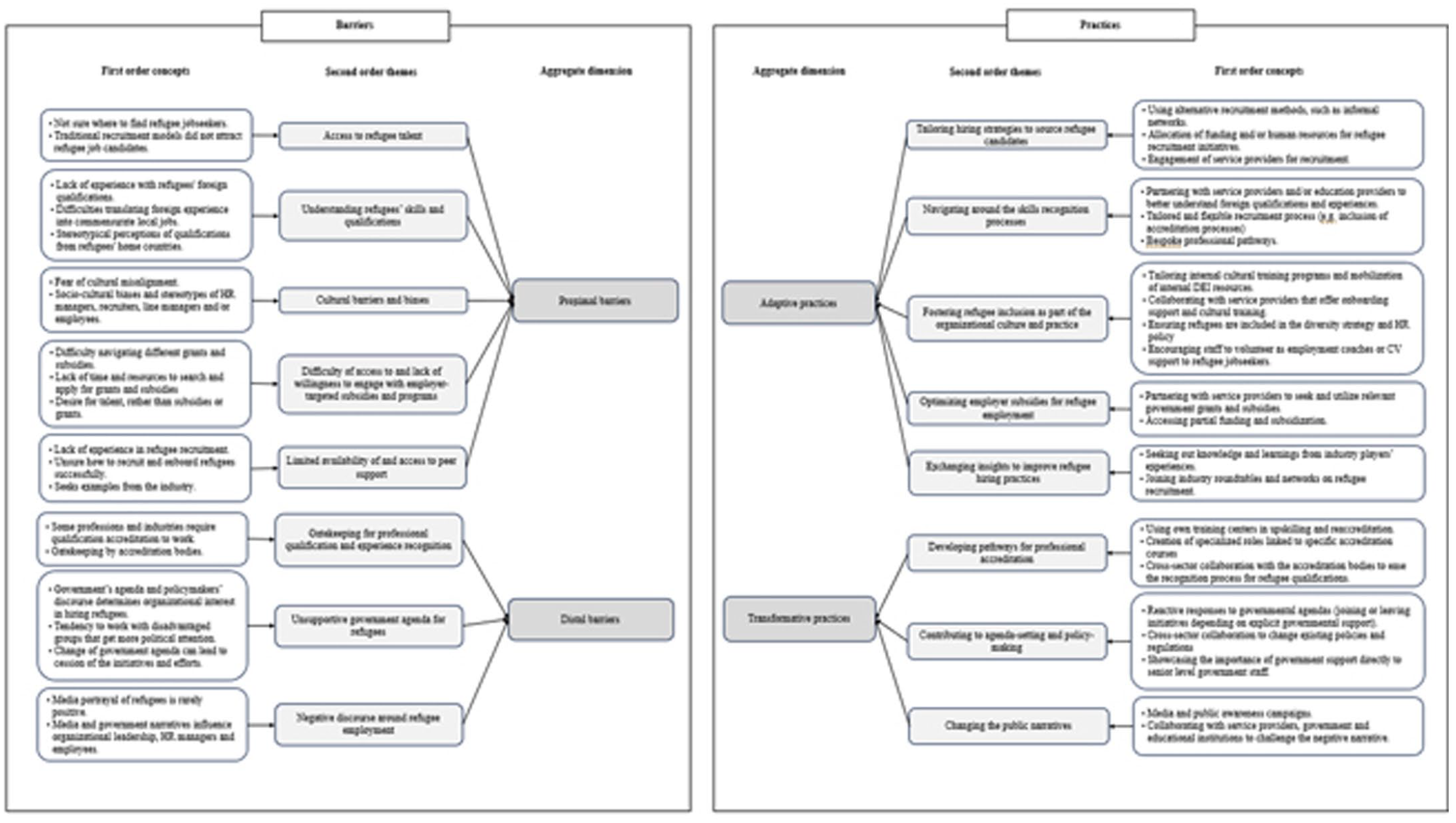
Combined data structure.
Findings
Our study uncovered that employers identify two sets of barriers impacting their efforts in refugee recruitment. Some barriers were perceived as directly impacting employers and their recruitment efforts, and as being within employers’ sphere of influence. We labeled these barriers as proximal in the sense that they affected employers in the specific intra-organizational context of refugee recruitment. Barriers that were seemingly detached from employers and their realm of influence yet had a material impact on employers’ recruitment engagement, we called distal. We present an analysis of the proximal and distal barriers below, vis a vis employers’ practices in response to these barriers.
Proximal barriers and organizational practices to overcome them
Our respondents identified numerous operational barriers pertaining directly to their efforts to recruit refugees. While these prevented some employers from taking any action, others were able to overcome the barriers and the organizations successfully hired refugee jobseekers.
Access to refugee talent
One of the key barriers to recruitment was access to the specific refugee talent pool. Interviewees reflected on the challenges of identifying avenues to reach out to and attract refugee jobseekers, because “I don’t think we would know where to go to find refugee talent” (E34). In response to this barrier, many employers chose to engage with service providers, such as non-governmental organizations, social enterprises, and employment agencies specializing in refugee employment. The key to success in these collaborative approaches was the business orientation of the service provider and their ability to source candidates that matched employer needs, including tailored support throughout the recruitment process: [H]aving that skill matching process and that personalized ability from [the service provider] to do such in-depth screening, and then coaching for that candidate to be job ready is probably key to the success of the outcome. (E07a)
If information about such service providers was not easily available, or if the initial collaboration was unsuccessful, employers would disengage (and often redirect their focus toward other disadvantaged groups, such as the indigenous communities). In fact, one employer noted the lack of service providers’ engagement as a major reason for the discontinuation of refugee recruitment: “We are not considering hiring refugees because there are no organizations approaching us.” (E15)
Internally, many employers have assigned a specific person to recruit and onboard refugees and other disadvantaged jobseekers. Having a person in charge of inclusion of refugees positively influenced the organizations’ ongoing commitment and the smooth integration of refugee workers. Yet, the continuation of refugee recruitment efforts often relied on the motivation, time, and energy of the person in charge: [T]hat’s part of what I’m trying to do [employ refugees] . . . but I need to muster a bit of energy before I could tackle that again. (E26)
In addition to assigning a specific role to recruitment and onboarding of refugees (and other disadvantaged jobseekers), other employers have also allocated funding resources specifically directed toward refugee recruitment initiatives.
Understanding refugees’ skills and qualifications
Many interviewees struggled to assess and translate foreign experience and credentials into the local job context. One employer suggested that this is not only because of the difficulties in understanding foreign qualifications, but also due to stereotypes. Employers emphasized flexibility and openness in adapting to refugee circumstances to overcome this barrier. Internal skills assessment tools that focus on practical abilities and potential rather than formal qualifications alone allowed refugees to demonstrate their capabilities through work trials or project-based assessments, instead of formal job interviews. For example, some employers had a separately structured recruitment process just for refugees who don’t actually get through the [regular] process because they don’t have the local qualifications or . . . there’s maybe some unconscious bias there going on . . . whereas, if we have a specific process for them, or, like. . . because what we find is that once they get to the interview, they’re amazing, but they just don’t get to the interview. (E01)
Some employers chose to develop internal internship and apprenticeship programs aimed at refugees to support their skills and enable on-the-job learning, making it easier to assess and integrate them into the workplace. In cases where employment at a level matching the previous experience was not immediately possible, one employer designed an internal progression program where employment was linked directly with the acquisition of additional expertise that would allow a quick internal progression: [I]f we employed a [professional title] that didn’t have a degree recognized in Australia, we wouldn’t put that person into a senior role . . . then, [if] we wanted to promote them to a senior role, we would go and have them get some micro-credentialing to get the degree recognized. (E04)
Furthermore, some employers who have hired refugees worked with educational institutions to help them understand and recognize refugees’ qualifications and skills more accurately or to create bespoke training programs, such as bridging programs and equivalency courses, to facilitate easy transition into the organization: I have to get [refugee jobseekers] through the [educational institution]. It’s just a little test for us to see if they’ll be able to get through that. And then, after that day, if we think they are appropriate, we ask them in for a two- or three-hour trial. (E02a)
Cultural barriers and biases
Cultural considerations, the fears of cultural misalignment, especially in terms of “the cultural elements of language, where things can be misinterpreted” (E30), as well as internal opposition to hiring refugees, were voiced by several employers as barriers to refugee recruitment.
For example, the way [refugees] write a CV is very different. And I know they’re cultural, but they trigger me, and I know they can easily impact the decision I make at the end of reading the resume, because they’ve triggered biases initially. And I’ve been in recruitment for a long time, so I’m aware of this, but ultimately there’s always a part of your biases that you can’t control. (E38)
Mobilizing internal diversity, equity, and inclusion (DEI) resources was one of the key initiatives employed by interviewees, as employers observed common negative assumptions about refugees’ ability to contribute to the organization. For example, one employer noted that these biases include employees believing that refugees “don’t speak English,” “don’t understand the culture,” and “require so much extra support” that hiring them seems unfeasible (E17). To this end, leadership commitment to advancing DEI in the context of refugee recruitment was a key determinant in whether resources were allocated internally to such initiatives. Diversity training developed for general cultural awareness was tailored to address the specific circumstances of refugee integration programs. One of the employers explained: It’s always a really tailored approach, and it’s always very obviously sensitively delivered. . . . So rather than running a once-a-year cultural awareness training that’s one-size-fits-all, it’s more: this is this person, this is their background, this is what they’re experiencing, this is what they’ll need from you. And, actually tailoring it to that work situation. (E23)
In addition to internal cultural training programs, some employers we spoke to partnered with service providers to offer cultural training and onboarding support specific to refugee employees.
Difficulty of access to and lack of willingness to engage with employer-targeted subsidies and programs
Several employers identified the need for additional funding through employer-targeted subsidies or grant programs as a precondition to refugee recruitment: [G]rants would be wonderful for small businesses. It’s difficult with a small business to make that step of hiring somebody if you have to wait until you have the cash available to do it. Whereas, if there were grants and incentives for doing it, it makes it just that much easier to say, “Yes, I can take the risk. I can do it.” (E36)
While those grants and incentives were available in our research context, many employers either did not know about their existence or struggled with the administration involved in accessing the funding. Employers pointed to a lack of time and resources to investigate and apply for the subsidies: It was just a load of reading that I just don’t have that liberty of time. I know that’s not a great excuse, but it wasn’t something that was easily accessible for us. (E21)
In fact, wage subsidies, often seen by policymakers as a strong positive incentive to hire vulnerable jobseekers, were perceived to be less relevant to the majority of our respondents, who stressed the importance of finding the right candidate as key to the successful recruitment of refugees. Some employers reached out to service providers for support to understand the myriads of available incentives and how to navigate those. This funding was then used to collaborate with the service provider on a specific refugee recruitment initiative.
Limited availability of and access to peer support
One of the key obstacles to refugee recruitment was the question of “how,” with employers finding it “difficult to know where to start” (E36). In response to this challenge, several employers decided to join industry networks bringing together organizations with experience or interest in refugee employment. One respondent shared their experience of role modeling within the industry based on their own experience of being influenced by industry peers: I’ve been involved in all sorts of events, bringing out [refugee] participants or past participants and they share their story, and that’s pretty compelling. That’s the thing that grabs people and tugs at the heart. And basically, that’s how we got involved in the [refugee employment] program in the first place. (E05a)
This step of accessing peer knowledge and experience was often a prerequisite to consequent employment, as it allowed employers to envision the feasibility of future engagement in refugee recruitment. Corporate peer influence was an emerging force in refugee recruitment, especially in addressing the barriers related to how to hire and smoothly integrate this particular group of jobseekers into the workforce.
[The service provider] set me up to join a couple of other round tables and things where I can continue that learning journey as well. (E22)
Distal barriers and organizational practices to overcome them
A set of barriers identified by our interviewees appeared outside of their control or sphere of influence. Most employers ceased their refugee recruitment efforts in the face of these barriers. Only a handful of our interviewees saw an avenue to overcome apparently insurmountable obstacles.
Gatekeeping for professional qualification and experience recognition
While some employers struggled to translate foreign qualifications and skills into a local work context, others realized that professional accreditation institutions required refugee job candidates to acquire formal qualifications before they could be considered for inclusion into the local workforce. Domains such as health care, engineering, and accounting were among many where the barriers to professional roles were maintained by accreditation bodies: A number of people that I’ve worked with, particularly from the health background, end up working only in aged care, which tends to be lower paid, and probably well under what their qualification is. So, unfortunately, not all, depending on where you’re from, but a vast majority of medical professionals from other countries aren’t recognized in Australia. (E03)
Most employers in our sample who were affected by this barrier considered it insurmountable. However, two study participants utilized their existing training centers to support refugees in gaining the qualifications they needed: People can do a four-year degree at [our accredited training center] and then they might work for two years in industry. And we might have a few graduate roles. (E28)
While few organizations have access to their own training centers, there were other avenues employers could explore to address professional gatekeeping. For example, one employer (E11) was involved in supporting the streamlining of the recognition process for foreign qualifications and was advocating for more flexible accreditation mechanisms for refugees. During the research project, one of Australia’s major professional bodies acknowledged its part in preventing recruitment from this group of jobseekers, and decided to launch an initiative to address its own gatekeeping role. The program was launched as a cross-sector partnership between employers (including E11), service providers, and the accrediting institution, and was in its pilot stage at the time of our data collection, expanding toward other disadvantaged groups such as migrants and indigenous communities.
Unsupportive government agenda for refugees
Governmental priorities permeated the organizational recruitment outcomes across multiple domains, from immigration policies to setting and supporting specific incentives and programs to stimulate employers’ engagement. For example, employers are required to screen applicants for visa status, which disadvantaged asylum seekers on temporary visas. Employers also identified ways in which changes in governmental agendas, and the introduction of initiatives such as procurement targets, changed the employment landscape for the disadvantaged groups of jobseekers: We know with many of the indigenous communities, it’s big on the agenda. So, people think about it because it’s the approach of the government, of everyone, to do that. There is that openness and willingness to engage because everyone talks about doing it. (E26)
The government’s agenda-setting role was often clearly reflected in interviewees’ commitment to certain practices, such as the allocation of funding and initiation of new recruitment projects. One employer reflected on the importance of the agenda-setting activity in their decision to engage in refugee recruitment: Essentially, ministers launching something means that the program is going to probably be viable while that government is in power . . . then once the ministers picked it up and launched it, and it was on the news, that meant that we had some sort of buy-in to support the program. (E03)
This meant that a change in the government agenda could lead to the cessation of the refugee employment programs. Only three employers (E04, E05, E16) in our sample engaged in actively tackling this barrier by attempting to influence the existing employment-related resettlement policies: We engage in dialogue with policymakers and government officials, either directly or through industry associations . . . We want to create more favorable policies, for example, regarding refugee working rights and resettlement, such as advocating for the simplification of work permit processes or the adjustment of rural resettlement rules to facilitate employment. (E16)
One of these employers (E05) even advocated for revised visa regulations and joined a policy taskforce, using the success of their refugee recruitment program as an empirical showcase of success.
Negative discourse around refugee employment
The socio-political ambience around refugee employment, created through media discourse and the governmental narrative around refugee resettlement, was one of the most palpable barriers. Many employers based their understanding of refugees’ employability on the media messaging, which provided them with implicit understandings of the cohort being “uneducated” (E21), “lazy” (E13), “traumatized” (E38), or “unreliable” (E17). Negative rhetoric explicitly and/or implicitly influenced employers’ openness to consider refugee jobseekers as potential employees and affected their recruitment engagement practices. It could also lead to a pause in existing initiatives. One employer, who no longer recruits refugees, recalled a hate message from a member of the local community: I did get [a complaint]. It was not a job applicant at all, and [the person] was just very upset that I was providing an opportunity [to refugees and] not for locals of non-refugee status. (E10)
In the face of these challenges, one employer took what could be described as an “undercover” (E17) approach to refugee recruitment: I think that the level of scrutiny [of refugees] in the media meant that our senior leaders thought that we might be compromising the organization by getting involved in something that was so political, but also that it had such a negative external face that maybe it would reflect badly on the organization . . . [The negative media] had an impact on what I did, and how I approached developing that sort of employment program for refugees . . .if our senior leaders sensed that there was a level of negativity, and that maybe this wasn’t the right program, although the business case was sound . . . I thought it was better to do it quietly. (E17)
While the practice led to a small-scale success and recruitment of two candidates from a refugee background, it should be seen more as a way to circumvent rather than tackle distal barriers. While many interviewees capitulated to the perceived strength of the negative discourse around refugees, three employers in our sample (E4, E5, and E16) took active steps to tackle misconceptions around refugees through media and public awareness campaigns, as well as engagement with the government, and with educational institutions, to actively commit to counteracting negative stereotypes: “We do a lot of media. We do a lot of good news stories” (E04c).
The potential for impact
The proximal barriers identified by our respondents are perceived as more immediate and pertain to the engagement between employers and potential employees in inclusive recruitment. They are more localized and predominantly influence the day-to-day operational aspects of the process. They are within the organization’s more proximate sphere of influence and can be addressed through internal policies and practices, as well as collaborations that are focused on internal organizational outcomes, such as the direct recruitment objectives of a specific employing organization. To this end, responses to proximal barriers do not aim to extend their impact outside of organizational boundaries.
Employers in our study responded with a wide range of practices to successfully address barriers they perceived as proximal. First, they capitalized on existing internal resources and structures and re-purposed them toward refugee recruitment. The presence of internal policies and practices addressing recruitment barriers faced by other disadvantaged groups facilitated faster responses. Some respondents indicated that the potential impact of these practices was confined to intra-organizational outcomes: We refreshed our diversity, equity, and inclusion policy and have included refugees in the wording of that. That’s a small step forward, but it’s really around framing intentions at this point in time, rather than concrete action. (E36) We actually just started doing unconscious bias training programs. We’ve just had two sessions done for everyone who’s in management positions. And that’s starting to lay the foundations for this, because there will be all sorts of biases triggered when we talk about this topic. So, getting those things already happening is part of it, but it’s really baby steps for now. (E38)
At times, these efforts had only a very temporary dimension, linked to the determination of specific organizational change champions. One of the interviewees reflected: “It’s just so hard to maintain that momentum when a key enthusiastic person leaves.” (E24).
Second, several interviewees engaged in small-scale collaborations, taking advantage of the availability of service providers focused on supporting employers in their refugee employment efforts. Those collaborations, while external to the employing organization, were exclusively focused on internal recruitment objectives. In cases where external providers could not facilitate finding easy solutions or where refugee recruitment did not fit in the business-as-usual approach, many employers disengaged with the idea of refugee recruitment altogether. While addressing proximal barriers often led to successful recruitment, it rarely had an impact beyond satisfying a given employer’s more immediate recruitment needs. We call these adaptive practices as they aimed to adjust or modify local recruitment practices to accommodate the specific circumstances of refugees and/or the particular organization in concern. To this end, addressing proximal barriers led to predominantly localized and often temporary outcomes.
In contrast to proximal barriers, which were perceived as addressable through internally focused practices, distal barriers were characterized by their assumed broad, systemic scale, influenced by external socio-political and institutional conditions. Many interviewees perceived them as existing outside the organizational sphere of influence. The impact of distal barriers was described as affecting the general environment within which refugee employment takes place, rather than any specific organization. Most employers did not challenge the existence of the distal barriers, and treated them as a fixed context that confined the boundaries of their actions. To this end, the distal barriers disproportionately affected employers’ ability and willingness to engage in refugee employment, creating a perception that this set of barriers is insurmountable. The handful of employers who did attempt to overcome distal barriers focused on practices that were unlikely to have an effect on their immediate recruitment efforts. Instead, those employers engaged in practices, such as lobbying policymakers, modifying industry-level accreditations and media outreach.
We also work with [a Professional Association] to present the business case for our program and the benefits, to inspire and engage other companies, but also these insights get presented to relevant government officials through their extensive influence into government and different portfolios. We advocate broadly across the media to drive positive stories about our program and the value of refugees. This content, we know, is read by policymakers who have credited [us] publicly with commendation on these actions based on media articles they have referenced. (E16)
Addressing distal barriers takes time, and the impact might not be evident instantly, but the potential for wide-reaching positive consequences motivated the employers to continue their efforts: Minister [name] confirmed his positive response with the focus and direction of our sub-committee work and has now tasked the department to work through the recommendations in more detail to see how they may work [to improve refugee employment]. (E05)
Practices taken to address distal barriers are more transformative and disruptive in nature, aiming to bring a larger-scale encompassing impact on socio-structural conditions. These practices have the potential to create enduring changes to the inclusive “identity” of the overall recruitment environment and ease or remove the proximal barriers altogether. For example, less restrictive and more inclusive professional qualification recognition systems will remove the challenges faced by employers in trying to understand the transferability of skills and qualifications of individual jobseekers. To this end, we label these practices as transformational, as their intended effects aim to reshape the socio-political structures within which refugee employment occurs. By dismantling the divide between different spheres of impact and the disjointed groups of actors responsible for addressing refugee employment barriers, transformational practices have the potential to drive structural change, bridging the artificial divide between internal and external organizational levels of impact.
Discussion and conclusions
Challenging the multitude of barriers to refugee recruitment is key to employers expanding their talent pools and enjoying the associated benefits. It is also critical for disadvantaged jobseekers to enable them to gain access to meaningful employment (Hajro et al., 2023b). Moreover, in the long term, it can impact the increasingly fragile social fabric (Edelman, 2023). Our findings chart a path toward furthering these goals.
We advance refugee recruitment literature by broadening its primarily refugee-centric perspective. Our paper extends the call for employer engagement in advancing refugee recruitment (Hajro et al., 2023a; Hirst et al., 2023) by explicating a multiplicity of barriers that organizations can face in their quest to support refugee workforce integration, and potential ways to address those challenges. In doing so, we demonstrate how the perception of barriers and strategically focused practices could positively contribute not only to specific recruitment outcomes of the employing organizations but also to altering the socio-structural condition in which refugee recruitment takes place. We highlight the critical role of employers in addressing refugees’ under- and unemployment concerns, redistributing the responsibility for supporting refugee employment often assigned to individuals (Obschonka et al., 2018; Pajic et al., 2018) and policymakers (Gravelle, 2019; Guo et al., 2020). More specifically, our study extends the refugee employment theory by arguing against the artificial delineation of barriers and the groups of actors traditionally associated with addressing them. Previous literature has frequently categorized barriers into distinct levels—individual, organizational, and institutional—each with separate actors and responsibilities (Boss et al., 2022; Garkisch et al., 2017; van Riemsdijk, 2024). This hierarchical framework often isolates barriers from one another, assigning specific groups, such as refugees, employers, and policymakers, the sole responsibility for addressing particular challenges within their respective domains. By arguing against this rigid categorization, our study emphasizes the interconnectedness of barriers and calls for a more integrated approach—one that acknowledges shared responsibilities across actors, promotes practices that bridge the divide between barriers and address them effectively, and considers the varying levels of impact.
The proximal and distal barriers differ in assumed scale, locus of influence, and the nature of impact. They also have a different temporal outlook, with proximal barriers being dealt with through short-term tactical responses. It is important to clarify that our distinction between proximal and distal barriers does not represent an objective or fixed categorization but rather reflects the ways in which employers perceive and make sense of the challenges they encounter. These classifications emerge from employer narratives and influence how they frame their agency in addressing refugee employment barriers. By interpreting certain barriers as distal—beyond their immediate sphere of influence—some organizations inadvertently reinforce assumptions that limit engagement in transformative practices. However, as our findings suggest, employers who actively challenge these assumptions can redefine what is actionable and participate in reshaping systemic conditions rather than merely adjusting internal processes. Recognizing that these categories are socially constructed rather than naturally occurring is key to fostering employer engagement and encouraging a shift from reactive adaptations to proactive transformation in inclusive recruitment.
Second, we contribute to advancing theoretical understanding of refugee workforce integration by demonstrating how practice theory can help dismantle the artificial divide between organizational and institutional barriers. Previous research within practice theorizing has largely focused on examining how employers’ practices (re)produce or (de)stabilize inequalities within organizations (Janssens and Steyaert, 2019; Nicolini, 2012; Watson, 2017). However, this focus has often overlooked how these practices traverse beyond organizational boundaries to influence broader socio-political structures.
By applying practice theory to the realm of refugee workforce integration, we reveal how the impact of organizational practices—those related to inclusive recruitment in particular—can transcend organizational boundaries and reshape socio-political structures, addressing inequalities existing within the larger community. Our application of practice theory has allowed us to conceptualize practices as a bridge between organizational and institutional boundaries, challenging the notion that the barriers are static or external to employers’ inclusive recruitment practices. Instead, we show that barriers are dynamically shaped by employer actions, and that organizations play an active role in either reinforcing or dismantling systemic constraints. This perspective encourages a shift in focus from viewing barriers as fixed obstacles or separate entities to recognizing them as malleable through organizational agency. By applying practice theory in this way, we extend its scope to demonstrate how employer actions influence institutional structures and systemic inequalities, fostering greater organizational accountability in implementing inclusive recruitment practices, particularly to address refugee workforce integration. Ultimately, our analysis advances theory and debates on the role of organizations in driving societal change through inclusive recruitment (Everts, 2016; Schatzki, 2016).
Lastly, by distinguishing between adaptive and transformative practices, our study contributes to practice theory by elucidating the mechanisms through which organizations enact change. Practice theory emphasizes the relational and emergent nature of practices (Nicolini, 2012; Schatzki, 2005), and our findings extend this understanding by demonstrating how employers’ inclusive recruitment practices in responses to refugee workforce integration can traverse different levels of engagement with varying degrees of impact both within and outside of organizational boundaries. We detail the difference between adaptive and transformative practices for inclusive recruitment in Table 2.
Adaptive and transformative practices.
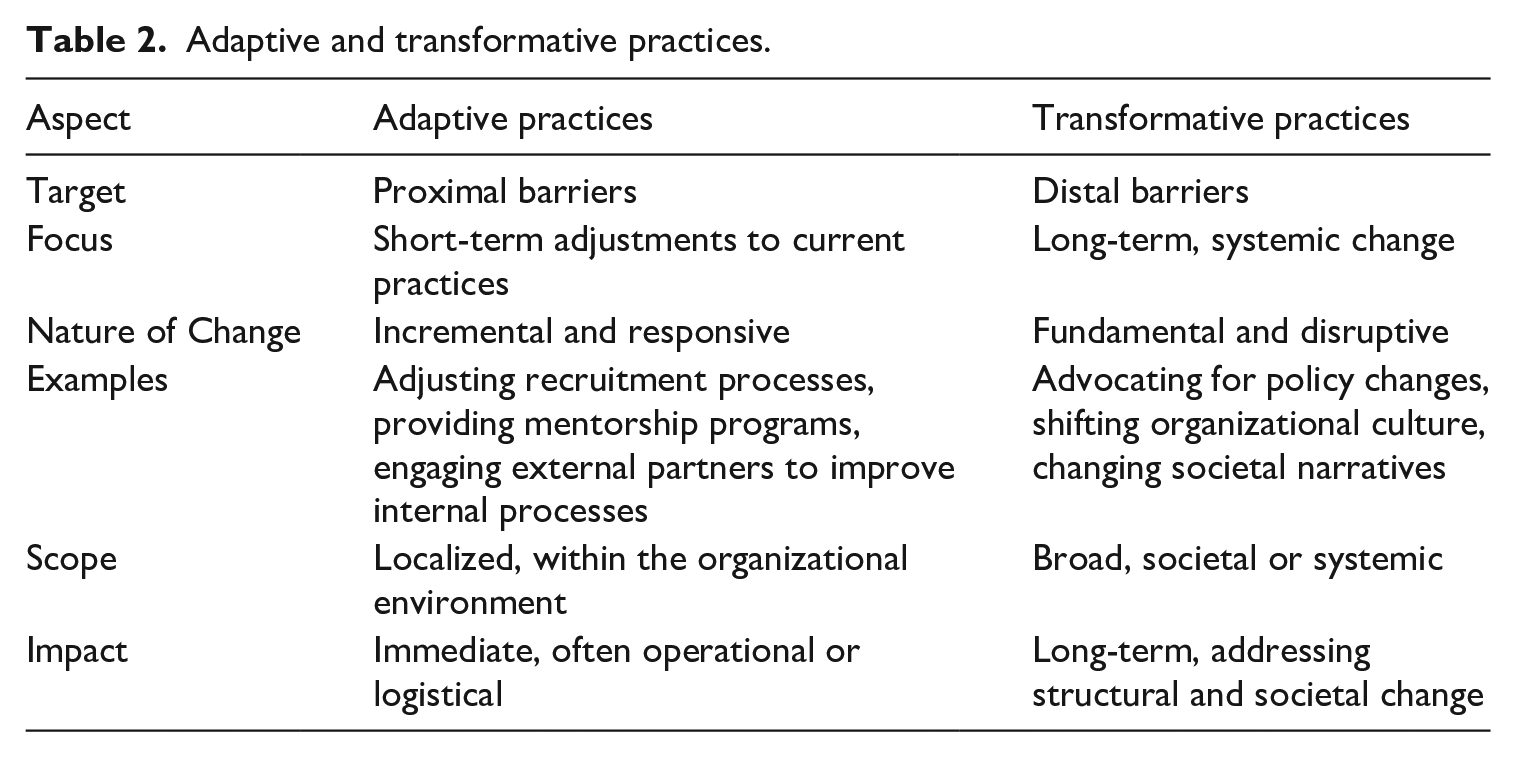
Adaptive practices focused in isolation on proximal barriers to inclusive recruitment can lead to sustainable recruitment outcomes but have limited impact on contesting the challenging socio-structural environment where recruitment of disadvantaged communities occurs. For instance, re-allocations of internal resources may provide desirable solutions for the imminent recruitment needs of the hiring organization but have little or no influence on long-term access to the refugee talent pool and their equitable access to the labor market. Over-emphasis on proximally focused, adaptive practices can contribute to upholding internal challenges (such as the persistence of internal opposition to refugee employment driven by wider socio-political debates), creating additional costs and hurdles for employers in the long run. This is because the existence and persistence of many barriers are rooted in broader power dynamics and reflect the marginalization of groups, such as refugees, within society (Ortlieb et al., 2021). To this end, barriers and their cascading effect on employing organizations may reflect systemic inequities and biases that hinder inclusive recruitment and exclude the marginalized jobseekers like refugees from the corporate talent pool. Employers’ responses can either challenge or perpetuate these dynamics. Instead of taking the social order for granted, tackling the assumed distal barriers allows the restructuring of the “natural” order of things (Janssens and Steyaert, 2019: 533). Practices can, therefore, create a particular social order that employers either reinforce or challenge and serve the interests of some at the expense of others (Nicolini, 2012). The practice lens enabled us to uncover how current organizational practices in refugee recruitment could contribute to or challenge the enduring inequalities observed in the labor integration of refugees more broadly.
Our findings also highlight the power of what we have termed transformative practices in inclusive recruitment. While recruitment literature traditionally focuses on the internal mobilization of resources (Falck and Heblich, 2007), highlighting internally focused, adaptive organizational practices, systems, policies, and impact (Janssens and Steyaert, 2009), we show how these are insufficient to move the dial on inclusive recruitment of disadvantaged jobseekers. Specifically, our evidence demonstrates how, through engagement in transformative practices, employers can actively challenge and reshape systemic inequalities, generating ripple effects that extend beyond the workplace. By shifting the focus from isolated, organization-centric practices to their systemic implications, our study underscores the importance of practices as vehicles for change, capable of addressing structural inequalities and fostering inclusive labor markets. This theoretical integration not only broadens the scope of refugee workforce integration literature but also offers a framework for sensemaking in the inclusive recruitment of disadvantaged jobseekers more broadly.
Businesses face complex challenges in generating and applying solutions to the refugee crisis; “however, the existence of such challenges does not give businesses a pass from responding to them” (Van Buren et al., 2024: 5). Solutions to new problems, such as the employment-related grand challenges of global migration, require thinking, connections, and actions that might not be located in the immediate surroundings of the organization, directing employers to challenge what is considered “normal” in the way they operate (Risberg and Romani, 2022). For example, while diversity literature stresses the importance of shared-meaning creation to shift attitudes and foster a collective intra-organizational commitment to inclusivity (Roberson et al., 2017), this lens is limited in achieving impact within the context of refugee inclusion. To achieve long-term sustainability and efficiency in their diversity endeavors, employers need to target systemic barriers to employment of disadvantaged groups. Our findings encourage organizations to reflexively consider how their practices could contribute to or mitigate these systemic barriers. This reflexivity is central to the practice lens, emphasizing the importance of ongoing critical reflection on the part of practitioners regarding the social conditions and consequences of their actions to make practice theory truly practical (Feldman and Worline, 2016).
Limitations and future research directions
The limitations of our study represent an important starting point for future research into addressing the grand challenges of contemporary society. First, the transferability of our study’s findings, located in a single-country context, should be treated with caution. Disentangling how factors at national and international levels influence inclusive recruitment could become an exciting avenue for future research into the grand challenges, and the identification of effective strategies in addressing them. As such, cross-country comparative studies and multiple case studies would be useful in opening avenues toward evidence-based approaches toward effective recruitment of refugees and contribute to both organizational and societal benefits.
Second, our study relies on insights from only one group of stakeholders, albeit a previously understudied one. There is scope for more exhaustive research on the inter-relationship of the activities of all actors (including the media, government, and service providers) that are often deemed distal and peripheral to organizational practices. Further research could investigate the tensions within the roles and practices of these actors, and the opportunities for complementary collective action in implementing inclusive recruitment.
Third, our study does not draw a clear link from each practice to the particularities of the barriers, but showcases distinct, external dynamics in which employers may opt for certain practices. Thus, a processual, longitudinal perspective on refugee recruitment could add fine-grained detail to our understanding of the dynamics involved in addressing proximal and distal barriers to refugee employment. Such a longitudinal approach will allow researchers to unveil which practices address which barrier(s) and how. Future research that follows a group of organizations throughout their recruitment process could add invaluable insights into ways in which employers’ practices most effectively challenge and alter the inequalities embedded within the societal structures of the labor market. This investigation could look into identifying the most suitable strategies and best practices within and across industries. Management scholarship has an important role in identifying a range of business practices that address socio-structural challenges in the wider society.
Footnotes
Appendix A. Interview topics used in data collection
Appendix B. Data structure
Data structure for distal barriers and transformative practices to overcome them.
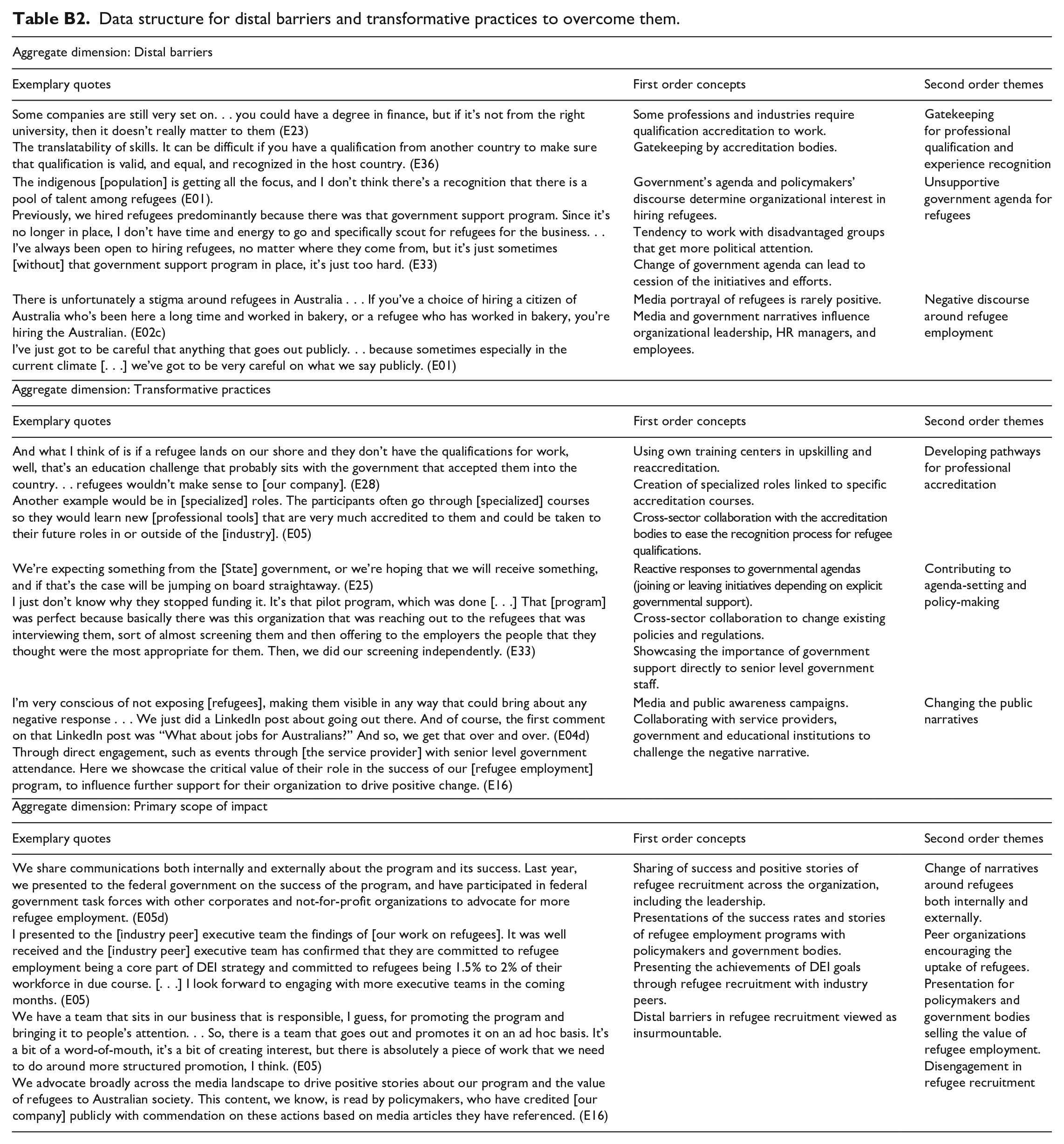
| Aggregate dimension: Distal barriers | ||
|---|---|---|
| Exemplary quotes | First order concepts | Second order themes |
| Some companies are still very set on. . . you could have a degree in finance, but if it’s not from the right university, then it doesn’t really matter to them (E23) The translatability of skills. It can be difficult if you have a qualification from another country to make sure that qualification is valid, and equal, and recognized in the host country. (E36) |
Some professions and industries require qualification accreditation to work. Gatekeeping by accreditation bodies. |
Gatekeeping for professional qualification and experience recognition |
| The indigenous [population] is getting all the focus, and I don’t think there’s a recognition that there is a pool of talent among refugees (E01). Previously, we hired refugees predominantly because there was that government support program. Since it’s no longer in place, I don’t have time and energy to go and specifically scout for refugees for the business. . . I’ve always been open to hiring refugees, no matter where they come from, but it’s just sometimes [without] that government support program in place, it’s just too hard. (E33) |
Government’s agenda and policymakers’ discourse determine organizational interest in hiring refugees. Tendency to work with disadvantaged groups that get more political attention. Change of government agenda can lead to cession of the initiatives and efforts. |
Unsupportive government agenda for refugees |
| There is unfortunately a stigma around refugees in Australia . . . If you’ve a choice of hiring a citizen of Australia who’s been here a long time and worked in bakery, or a refugee who has worked in bakery, you’re hiring the Australian. (E02c) I’ve just got to be careful that anything that goes out publicly. . . because sometimes especially in the current climate [. . .] we’ve got to be very careful on what we say publicly. (E01) |
Media portrayal of refugees is rarely positive. Media and government narratives influence organizational leadership, HR managers, and employees. |
Negative discourse around refugee employment |
| Aggregate dimension: Transformative practices | ||
| Exemplary quotes | First order concepts | Second order themes |
| And what I think of is if a refugee lands on our shore and they don’t have the qualifications for work, well, that’s an education challenge that probably sits with the government that accepted them into the country. . . refugees wouldn’t make sense to [our company]. (E28) Another example would be in [specialized] roles. The participants often go through [specialized] courses so they would learn new [professional tools] that are very much accredited to them and could be taken to their future roles in or outside of the [industry]. (E05) |
Using own training centers in upskilling and reaccreditation. Creation of specialized roles linked to specific accreditation courses. Cross-sector collaboration with the accreditation bodies to ease the recognition process for refugee qualifications. |
Developing pathways for professional accreditation |
| We’re expecting something from the [State] government, or we’re hoping that we will receive something, and if that’s the case will be jumping on board straightaway. (E25) I just don’t know why they stopped funding it. It’s that pilot program, which was done [. . .] That [program] was perfect because basically there was this organization that was reaching out to the refugees that was interviewing them, sort of almost screening them and then offering to the employers the people that they thought were the most appropriate for them. Then, we did our screening independently. (E33) |
Reactive responses to governmental agendas (joining or leaving initiatives depending on explicit governmental support). Cross-sector collaboration to change existing policies and regulations. Showcasing the importance of government support directly to senior level government staff. |
Contributing to agenda-setting and policy-making |
| I’m very conscious of not exposing [refugees], making them visible in any way that could bring about any negative response . . . We just did a LinkedIn post about going out there. And of course, the first comment on that LinkedIn post was “What about jobs for Australians?” And so, we get that over and over. (E04d) Through direct engagement, such as events through [the service provider] with senior level government attendance. Here we showcase the critical value of their role in the success of our [refugee employment] program, to influence further support for their organization to drive positive change. (E16) |
Media and public awareness campaigns. Collaborating with service providers, government and educational institutions to challenge the negative narrative. |
Changing the public narratives |
| Aggregate dimension: Primary scope of impact | ||
| Exemplary quotes | First order concepts | Second order themes |
| We share communications both internally and externally about the program and its success. Last year, we presented to the federal government on the success of the program, and have participated in federal government task forces with other corporates and not-for-profit organizations to advocate for more refugee employment. (E05d) I presented to the [industry peer] executive team the findings of [our work on refugees]. It was well received and the [industry peer] executive team has confirmed that they are committed to refugee employment being a core part of DEI strategy and committed to refugees being 1.5% to 2% of their workforce in due course. [. . .] I look forward to engaging with more executive teams in the coming months. (E05) We have a team that sits in our business that is responsible, I guess, for promoting the program and bringing it to people’s attention. . . So, there is a team that goes out and promotes it on an ad hoc basis. It’s a bit of a word-of-mouth, it’s a bit of creating interest, but there is absolutely a piece of work that we need to do around more structured promotion, I think. (E05) We advocate broadly across the media landscape to drive positive stories about our program and the value of refugees to Australian society. This content, we know, is read by policymakers, who have credited [our company] publicly with commendation on these actions based on media articles they have referenced. (E16) |
Sharing of success and positive stories of refugee recruitment across the organization, including the leadership. Presentations of the success rates and stories of refugee employment programs with policymakers and government bodies. Presenting the achievements of DEI goals through refugee recruitment with industry peers. Distal barriers in refugee recruitment viewed as insurmountable. |
Change of narratives around refugees both internally and externally. Peer organizations encouraging the uptake of refugees. Presentation for policymakers and government bodies selling the value of refugee employment. Disengagement in refugee recruitment |
Acknowledgements
We are deeply grateful to all employers and professionals, who shared their experiences with us, despite the sensitive nature of the topic. We would also like to thank all support workers, and decision-makers who are so committed to the successful workplace integration of refugees. In addition, we are indebted to the three anonymous reviewers and the editor, Prof. Jean-Pascal Gond, for their insightful feedback and careful guidance throughout the review process.
Funding
The author(s) disclosed receipt of the following financial support for the research, authorship, and/or publication of this article: This study was supported by funding from the Australian Government through the Department of Jobs and Small Business.
