




Abstract
Previous studies have overlooked critical differences between different aspects of employees’ knowledge-hiding behaviors. Using Social Information Processing theory as an anchor, we fill this void by investigating the impact of servant leadership on three distinct aspects of employees’ knowledge-hiding behaviors: evasive hiding, playing dumb, and rationalized hiding. Specifically, we propose that servant leadership is negatively related to evasive hiding and playing dumb, and yet, paradoxically, positively related to rationalized hiding. We further propose employee perspective taking as a crucial underlying mechanism and employee justice orientation as a relevant boundary condition of the hypothesized relationships between servant leadership and employees’ knowledge-hiding behaviors. Our time-lagged and two-source data provide support for our hypotheses. The theoretical and practical implications of our findings are discussed.
Keywords
In a highly competitive era, knowledge sharing, and high-quality, trust-based interpersonal relations, are considered indispensable for gaining sustainable competitive advantage (Usman et al., 2019). One of the potential threats that can impair interpersonal relationships and effective transfer of knowledge in organizations is knowledge hiding – concealing knowledge from, or providing twisted information to others, such as peers who requested it (Connelly et al., 2012). Existing research suggests that knowledge hiding harms employees’ quality of relationships (Černe et al., 2014) and jeopardizes organizations’ efforts aimed at enhancing organizational learning and creativity (Connelly and Zweig, 2015). Past research has been impressive and insightful in bringing to the forefront the various factors (e.g., leadership, psychological safety, relational social capital, and mastery climate) that can help managers deter employee knowledge-hiding behaviors (see Abdullah et al., 2019; Anser et al. 2021; Men et al., 2020).
Despite valuable insights from the above studies, this stream of research has tended to treat knowledge hiding as a unitary construct, ignoring the multidimensionality of knowledge-hiding behavior. However, we are aware that the construct of knowledge hiding has three dimensions. These include playing dumb (i.e., withholding knowledge by pretending not to have the requested knowledge), evasive hiding (i.e., providing incomplete information, concealing core knowledge while pretending to provide the requested information), and rationalized hiding (i.e., withholding knowledge to preserve confidential knowledge) (see Connelly et al., 2012). The treatment of knowledge hiding as a unitary concept is problematic. For example, previous research assumes that knowledge-hiding behaviors are all deceptive and unethical. This assumption, we argue, contradicts Connelly et al.’s (2012) seminal conceptualization of knowledge-hiding behaviors. According to Connelly and Zweig (2015: 481), “only evasive hiding and playing dumb involve deception; rationalized hiding does not”. Thus, the assumption that knowledge hiding is a unitary construct poses a potential risk of glossing over the unique aspects and characteristics of employees’ knowledge-hiding behaviors. This, in turn, offers inadequate information to managers and may eventually trigger ineffective managerial interventions to minimize this multifaceted issue of knowledge hiding.
To address the above concerns, we examine three distinct aspects of employees’ knowledge-hiding behaviors and draw on Social Information Processing (SIP) theory (Salancik and Pfeffer, 1978) to propose that servant leadership – a leadership style that places the needs of followers before leaders’ needs and centers efforts on helping followers “reach their maximum potential and achieve optimal organizational and career success” (Liden et al., 2015: 163) – can provide deeper insights into how knowledge hiding unfolds in the workplace. We employ SIP theory (Salancik and Pfeffer, 1978) as an anchor for our research because it posits that people are adaptive organisms who, mainly based on signals from the social context, change their beliefs and behaviors to the social context. As such, people’s behaviors can best be apprehended by analyzing the “informational and social environment within which that behavior occurs and to which it adapts” (Salancik and Pfeffer, 1978: 226). In the present study, we contend that SIP theory is useful in theorizing how and when servant leadership might influence employee knowledge-hiding behaviors. In this respect, the present work proposes that servant leadership has the promise to influence followers’ knowledge-hiding behaviors through its other-centered focus, concern for followers’ growth/moral development, and emphasis on the development of society at large (Hoch et al., 2018).
We consider servant leadership because there is evidence that leaders constitute a primary source of social information in organizations, and different social and informational cues emanating from leaders’ behaviors and actions shape employee outcomes at work (Griffin, 1983; Wang et al., 2018). Specifically, servant leadership predicts employee outcomes at work above and beyond other leadership styles, such as ethical leadership, transformational leadership, and authentic leadership (see Hoch et al., 2018). Importantly, we argue that servant leadership is theoretically relevant to discourage playing dumb and evasive hiding that are essentially deceptive but encourage rationalized knowledge hiding. This is because servant leaders bring their other-centered focus, as well as moral and social selves, to work to address the social and moral needs of their employees and society (Eva et al., 2019; Hoch et al., 2018). Thus, we understand that servant leadership may be more effective in dealing with the multifaceted issue of knowledge hiding by offering cues to its employees to consider ethics and their responsibility toward the organization while dealing with peers’ knowledge-hiding requests.
Furthermore, we contend that servant leadership might shape followers’ perspective taking. This is primarily because employees of servant leaders learn and imitate their leaders’ perspectives and behaviors (e.g., other-centered approach perspectives and moral behaviors) when dealing with peers’ knowledge-hiding requests. Perspective taking, which refers to the “extent to which individuals are willing to take others’ perspectives” (Fasbender et al., 2020: 410), allows both leaders and employees to understand others’ viewpoints and limitations while making decisions (Kamdar et al., 2006) and creates a balance between the interests of various stakeholders (Kamdar et al., 2006). As such, we argue that perspective taking is a possible underlying mechanism through which servant leadership might impact employee knowledge-hiding behaviors.
Finally, SIP theory postulates that the influence of social environment on individual outcomes is not homogenous across individuals; rather, it is contingent on various individual-related and contextual factors (Salancik and Pfeffer, 1978). As such, drawing on SIP theory, we integrate employee justice orientation – “the extent to which individuals internalize justice as a moral virtue and are attentive to fairness issues around them” (Sasaki and Hayashi, 2014: 252) – as a moderator to explain when servant leadership may impact employees’ knowledge-hiding behaviors. Studies (e.g., Ali et al., 2020; Rupp et al., 2003) suggest individuals with high justice orientation act in ways that are less consistent with their self-interest; rather, they exhibit a sense of self-transcendence to benefit others and sacrifice their self-interests to ensure that others are treated with justice. Thus, we reason that compared with others, employees high on justice orientation are more likely to engage in perspective taking and deal with knowledge-hiding requests more fairly. Altogether, we theorize that servant leadership will impact employee perspective taking, which, in turn, will impact different aspects of employee knowledge-hiding behaviors, while employee justice orientation is expected to reinforce the association between perspective taking and knowledge-hiding behaviors.
We contribute to the literature in several ways. First, in contrast to existing studies (Anser et al., 2021; Men et al., 2020) that have treated knowledge hiding as a unitary construct, we revived the seminal essence of knowledge-hiding behaviors by providing empirical evidence of the unique nature of different aspects of employees’ knowledge-hiding behaviors. In doing so, we foreground the potential of servant leadership in dealing with distinct aspects of employees’ knowledge-hiding behaviors. Second, existing research has mainly focused on different employee-, climate- or leader-centered mechanisms to explicate how servant leadership affects employee outcomes (see Hoch et al., 2018). Our integration of perspective taking is an important contribution to this body of research as a coworker-focused mechanism through which servant leadership may impact different aspects of knowledge-hiding behaviors. Finally, we contribute to the scarce studies on justice orientation (Ali et al., 2020; Sekiguchi and Hayashi, 2014) and highlight its important yet largely overlooked role in moderating the relationship between employee perspective taking and knowledge hiding. Altogether, the integration of justice orientation extends the literature on the boundary conditions of the links between servant leadership and employee behaviors (e.g., Eva et al., 2019). Our proposed model is presented in Figure 1.
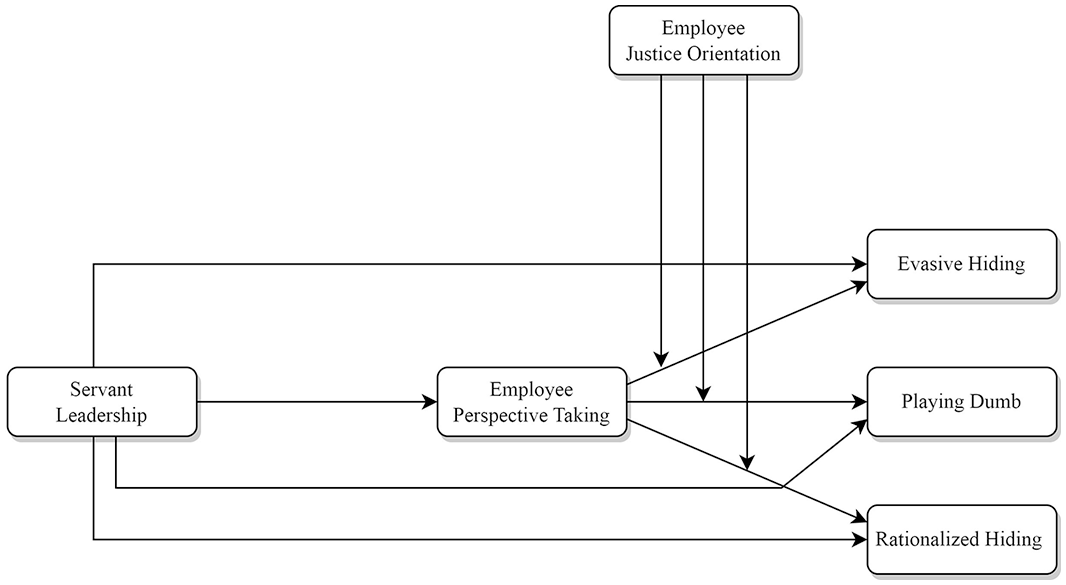
The proposed model.
Theory and hypotheses development
Knowledge hiding
One of the key drivers of employee knowledge-hiding behaviors is the increasingly competitive and politized nature of organizations. In such an environment, employees withhold certain knowledge to maintain their power and ability to manoeuvre in the turmoil of relational politics (Cui et al., 2016). For instance, employees are likely to hide the individualized work deals from their coworkers to sustain this unique resource and benefit from similar deals in the future (Marescaux et al., 2021; Rofcanin et al., 2019). Given the rising prevalence of i-deals in organizations and the relational dynamics that create political uncertainty (e.g., Malik et al., 2019), knowledge hiding may be regarded as a crucial counterproductive knowledge-hiding behavior that hampers employees’ outcomes and organizations’ productivity. However, it is important to note that knowledge hiding is different from a lack of knowledge sharing, counterproductive behaviors, workplace aggression, and knowledge hoarding (for details, see Connelly et al., 2012).
Knowledge hiding is comprised of three dimensions: playing dumb, evasive hiding, and rationalized hiding. Evasive hiding and playing dumb are both intentional and deceptive (Connelly et al. 2012; Venz and Shoshan, 2022). On the contrary, in rationalized knowledge, the hider withholds knowledge to preserve confidential information. As such, in rationalized knowledge, the hider is legally and ethically guided and acts to protect the knowledge following organizational norms and rules (Connelly and Zweig, 2015).
Hiding confidential information is one of employees’ leading moral and legal obligations (Hannah and Robertson, 2015). Unprotected confidential information is harmful to an organization’s competitive advantage (Dyer and Nobeoka, 2000) because leaked confidential information to others (e.g., peers not entitled to the information) may not only benefit the competitors but also can attract lawsuits (Romanosky et al., 2014). In sum, studies show that the protection of confidential knowledge is a critical challenge for organizations (Hannah and Robertson, 2015) and that formal rules and regulations are often deficient in addressing this challenge (Dyer and Nobeoka, 2000).
Influence of servant leadership on evasive hiding and playing dumb
We draw on SIP theory (Salancik and Pfeffer, 1978) to explain the influence of servant leadership on employees’ knowledge-hiding behaviors. SIP theory posits that people learn from social cues. They actively process cues from the social settings and demonstrate behaviors that are congruent with the social norms (Salancik and Pfeffer, 1978). Servant leaders exhibit genuine concern and care for their subordinates and transcend their self-interests to serve their subordinates’ best interests (e.g., improving followers’ knowledge and skills and focusing on their moral development). Servant leaders inculcate other-serving orientations among followers and inspire them to positively contribute to others’ lives by acting as pro-social catalysts and rejuvenating the broken structures of the social fabric of the workplace (Eva et al., 2019; Neubert et al., 2022). As such, employees of leaders who have other-serving focus (i.e., servant leaders) are more likely to help their coworkers by providing them with requested knowledge instead of hiding knowledge.
Further, servant leadership entails a holistic approach to followers’ development and growth that focuses on their personal and professional development and thus engages them in diverse dimensions (e.g., emotional, ethical, and relational) (Blake et al., 2022; Liden et al., 2015; Wang et al., 2018). According to Greenleaf (1979), servant leadership’s first and foremost emphasis is on developing followers’ ethical and altruistic orientations. In this respect, servant leaders provide social cues related to the leaders’ sense of self-transcendence, genuine concern for others, ethical values, and altruism. Consistent with SIP theory (Salancik and Pfeffer, 1978), subordinates of these leaders are expected to learn and exhibit altruism, care, concern for their peers’ knowledge needs, and a sense of self-transcendence when dealing with their peers’ knowledge requests. Thus, we expect employees of servant leaders to transcend their self-interest, demonstrate care for their peers, and show positive intent to satisfy their peers’ knowledge needs rather than concealing knowledge from them or providing them distorted knowledge. Likewise, employees who imbibe the ethical values of servant leaders, such as honesty and integrity (Liden et al., 2015) are less likely to engage in lying, deception, and sabotage. As such, we expect servant leadership to inhibit employees’ engagement in knowledge-hiding behaviors that are unethical in nature and involve lying and deception. Based on the above arguments, we propose:
Hypothesis 1: Servant leadership is negatively associated with (a) evasive hiding and (b) playing dumb.
Servant leadership and employee rationalized hiding
Building on SIP theory, we argue that servant leaders can play an important role in helping organizations to protect confidential knowledge, and in doing so, address its negative repercussions. Eva et al. (2019) suggest that servant leaders’ emphasis on serving others (e.g., subordinates) is sustained by their concerns for the organization and its long-term success. In this respect, and through other-oriented focus and a strong moral character, servant leaders offer cues to followers that their decisions and behaviors related to serving others (e.g., providing the requested knowledge to peers) should not disregard ethics and their responsibility toward the organization. Similarly, servant leaders’ focus on followers’ development is sustained within their concerns toward a wider range of organizations’ stakeholders, including the society at large. Servant leaders not only focus on followers’ development but also acknowledge their moral responsibility toward the organization’s success (Blake et al., 2022). Servant leaders act as stewards of the organization and therefore endeavor to enhance organizational resources entrusted to them (Van Dierendonck et al., 2014). Based on SIP theory, we understand that such acts of stewardship toward the organization provide followers with important signals about their leaders’ expectations in terms of their moral responsibility toward the organization. As such, we contend that subordinates of servant leaders are likely to hide confidential information, given its destructive influences on the organization’s success and competitive advantage.
Additionally, focusing on ethical behaviors is one of the important aspects of servant leadership (Neubert et al., 2022; Wang et al., 2018). As Frick and Spears (1996: 26) put it, a servant leader “wants to do what is morally or ethically right, wants to deliver on obligations, and wants to act with competence”. Indeed, a servant leader’s decisions and behaviors are based on moral and ethical considerations, driven by core values, such as fairness and integrity (Liden et al., 2015; Wang et al., 2018). Servant leaders also demonstrate fairness and honesty through their behaviors and every organizational practice and interaction with followers (Frick and Spears, 1996). Such incorporation of ethical values in the service of others, according to SIP theory, conveys important signals to employees about what is wrong and what is right based on these ethical values. In this regard, followers of servant leaders should adopt their leaders’ moral values and fulfill their legal and ethical responsibilities by refraining from disclosing confidential information to others. Therefore, we anticipate that servant leadership encourages rationalized hiding:
Hypothesis 2: Servant leadership is positively related to rationalized hiding.
Employee perspective taking as a mediator
Servant leaders’ decisions, actions, and behaviors are not self-centered (Liden et al., 2015). Instead, their decisions and actions are aimed at safeguarding others’ interests, including employees and the organization (Hunter et al., 2013). The concern for others’ interests or other-focused approach reflected in servant leadership behaviors is further evidenced by servant leaders’ emphasis on employee personal and professional development (Hoch et al., 2018). Servant leaders’ visible manifestations of care for others’ interests (Hunter et al., 2013) serve as powerful cues for employees to understand their leaders’ other-oriented approach (Van Dierendonck et al., 2014). Based on SIP theory, we understand that by processing these cues, employees are likely to follow their leaders’ others-centered focus and consider the perspectives of others around them.
Furthermore, servant leaders interact and engage with their followers to listen to their concerns, offer feedback on their performance, and value their contributions to the organization (Hoch et al., 2018). In doing so, servant leaders help their followers understand and internalize the importance of moral values and valuing others in the workplace (Hunter et al., 2013). Thus, servant leaders, through listening to their followers and valuing their contributions, provide social information about the importance of listening to others and valuing their opinions and contributions. Observing such leaders’ way of dealing with others should, therefore, enable followers to appreciate others’ (e.g., peers’ supervisors’, and the organization’s) perspectives and the context shaping those perspectives. Previous research has also shown that individuals’ interactions with other-oriented figures around them can enable them to gain more information about others’ views and understand why others, such as peers and managers have those views (e.g., Fasbender et al., 2020; Parker and Axtell, 2001). Accordingly, and from the SIP perspective (Salancik and Pfeffer, 1978), we argue that employees working with servant leaders process cues emerging from these leaders’ behaviors to understand others’ perspectives, as well as embody the leader’s values while interacting with their peers. In essence, servant leadership should enhance employee perspective taking.
Furthermore, we propose that perspective taking discourages employees to engage in knowledge-hiding behaviors that involve deception and lying (i.e., evasive hiding and playing dumb). Perspective taking encourages an individual to listen to others to enable him/her to understand others’ views and the context shaping their point of view. As such, perspective taking may allow an employee to have an improved understanding of the issues that others are facing and provide them the necessary support. For instance, a deeper understanding of peers’ work-related issues can encourage employees to help their peers in the effective performance of their roles. Employees do this by providing their peers with guidance, knowledge, and other instrumental resources. In this regard, previous research suggests that perspective taking can enhance employees’ willingness to cooperate with others, improve the level of trust, and encourage cooperative behavior in the workplace (e.g., Axtell et al., 2007; Fasbender et al., 2020; Parker and Axtell, 2001; Wang et al., 2017). Therefore, it is likely that employees who have increased ability at perspective taking (e.g., of their peers’ point of view) are likely to understand their peers’ knowledge needs and provide them the requested knowledge instead of engaging in deception or providing them distorted information. Also, given that knowledge hiding impedes organizations’ learning and growth (Anser et al., 2021), employees who take the perspective of the organization’s success are less likely to engage in knowledge-hiding behaviors that are deceptive and impede the organization’s success. Taken together, we expect servant leadership to facilitate employees’ perspective taking, which in turn discourages them to engage in knowledge-hiding behaviors that entail deception – evasive hiding and playing dump:
Hypothesis 3: Employee perspective taking mediates (a) the negative relationship between servant leadership and evasive hiding and (b) the negative relationship between servant leadership and playing dumb.
Unlike evasive hiding and playing dumb, rationalized hiding does not involve lying and deception (Connelly and Zweig, 2015). As we discussed earlier, in rationalized hiding, the hider may be fulfilling his/her responsibility by hiding knowledge to preserve confidential knowledge because the hider is legally and morally bound to protect the knowledge as per the norms and rules of the organization (Connelly et al., 2012); thus, helping to safeguard the interest of the organization (Zhao et al., 2019).
Relying on SIP theory, we further argue that perspective taking positively mediates the relationship between servant leadership and rationalized hiding. We have previously argued that servant leaders consider themselves stewards of the organization and demonstrate their concern for the organization’s success through their decisions and communication with followers to propagate the importance of the organization’s success for the welfare of employees and the larger community (Eva et al., 2019; Liden et al., 2015). In Hypothesis 3, we argued that servant leadership enhances employee perspective taking. Here, we suggest that the enhanced perspective taking abilities (developed from observing servant leaders) will encourage rationalized knowledge hiding. This is because rationalized hiding entails hiding confidential knowledge, and employees who take others’ perspectives may refuse peers’ requests concerning confidential knowledge thinking from their leaders’ perspective about the organization’s success. Importantly, ethicality is one of the core aspects of servant leadership (Wang et al., 2018). In this respect, employees’ thinking is likely to be influenced by the servant leader’s perspective and thus may enhance employees’ likelihood to hide confidential information. Together, we propose the following hypothesis:
Hypothesis 4: Employee perspective taking mediates the positive relationship between servant leadership and rationalized hiding.
Justice orientation as a moderator
Reflecting on SIP theory, we argue that justice orientation act as a second-stage moderator of the relationship between servant leadership and employees’ knowledge-hiding behaviors (via perspective taking). Justice orientation is a motivational attribute that guides individuals to take care of justice as an important moral value (Ali et al., 2020; Sasaki and Hayashi, 2014). Prior studies suggest that justice orientation inspires individuals to regulate their behaviors in ways that ensure fairness and justice toward coworkers and the organization (e.g., Ali et al., 2020; Sasaki and Hayashi, 2014). Importantly, justice orientation shapes and develops individuals’ moral motives and propels them to sacrifice their personal interests to ensure just practices (Ali et al., 2020; Rupp et al., 2003). This suggests that employees high on justice orientation will be more likely to follow an other-centered approach. Accordingly, we argue that compared with their counterparts, employees high on justice orientation have a higher tendency to take others’ perspectives (e.g., peers, supervisors, and the organization) and exhibit less evasive hiding and playing dumb, and more rational hiding. In other words, justice orientation would reinforce the negative influence of perspective taking on evasive hiding and playing dumb.
Further, SIP theory posits that although social cues shape employees’ attitudes and behaviors, individual dispositions (e.g., justice orientation) influence the effectiveness of social cues. SIP theory also suggests that individuals interpret social information in ways that are consistent with their self-concept. Since individuals with justice orientation internalize justice as moral virtue as a part of their self-concept (Sasaki and Hayashi, 2014). Thus, based on SIP theory, we argue that employees high on justice orientation will be more inclined to take others’ (e.g., peers, supervisors, and the organization) perspectives and thus engage less in evasive hiding and playing dumb, and more in rationalized hiding. On the contrary, employees low on justice orientation are less other-centered and have less tendency to connect with and understand others’ perspectives and therefore will be more likely to engage in evasive hiding and playing dumb and less in rationalized hiding. Together, we propose the following hypotheses:
Hypothesis 5: Employee justice orientation moderates (a) the negative relationship between employee perspective taking and evasive hiding and (b) the negative relationship between employee perspective taking and playing dumb, such that the relationships are stronger when employee justice orientation is high (vs. low).
Hypothesis 6: Employee justice orientation moderates the positive relationship between employee perspective taking and rationalized hiding, such that the relationship is stronger when employee justice orientation is high (vs. low).
Indirect servant leadership-knowledge hiding links: Justice orientation as a moderator
As posited earlier (H3), servant leadership discourages employees’ engagement in evasive hiding and playing dumb indirectly, via employee perspective taking. Likewise, we also proposed (H4) that servant leadership positively influences rationalized hiding indirectly, via employee perspective taking. Additionally, as posited above (H5 and H6), a high degree of justice orientation accentuates the effect of employee perspective taking on employees’ knowledge-hiding behaviors. Together, we infer that employee justice orientation serves as a boundary condition of the indirect effects of servant leadership on employees’ knowledge-hiding behaviors – evasive hiding, playing dumb, and rationalized hiding. SIP theory suggests that individuals interpret and integrate social information and cues in ways that are consistent with their self-concept. They align their inner selves with the norms and expectations of the situation. Thus, we can reasonably expect that individuals who are high on justice orientation will reap more benefits from servant leadership and engage more in perspective taking and therefore engage less in evasive hiding and playing dumb but more in rationalized hiding. We predict the impact of servant leadership on evasive hiding and playing dumb will be more significant for individuals who are driven by justice values (e.g., high on justice orientation). This is mainly because evasive hiding and playing dumb involve unethical conduct of information hiding and deceiving others (Connelly and Zweig, 2015). In contrast, we expect the positive indirect effect of servant leadership on rationalized hiding (via perspective taking) to be stronger for employees high on justice orientation. Viewed from the perspective of self-concept, these individuals are likely to see the sharing of confidential information as harmful to organizational effectiveness. Thus, the following hypotheses are developed:
Hypothesis 7: Employee justice orientation moderates the indirect negative relationships (via employee perspective taking) between (a) servant leadership and evasive hiding and (b) the indirect negative relationship between servant leadership and playing dumb, such that the relationships are stronger when employee justice orientation is high (vs. low).
Hypothesis 8: Employee justice orientation moderates the indirect positive relationship (via employee perspective taking) between servant leadership and rationalized hiding, such that the relationship is stronger when employee justice orientation is high (vs. low).
Method
Minimum sample size
We employed G*Power software to determine the minimum sample size. Together with control variables and three interaction terms, there were a total of 19 predictors. Since we intended to test the influence of these 19 predictors on knowledge-hiding behaviors, linear multiple regression was specified: fixed model, R2 deviation from zero as the statistical test employing F tests. Then .15 as the effect size, .05 as an α error probability of, and .95 as a power (1- β error probability) in G*Power were chosen that yielded a minimum sample size of 217.
Procedures
We collected time-lagged (three rounds, two months apart) and two-source survey data from 429 employees (focal participants) and their 429 peers in different 104 manufacturing and service sector organizations. Data were collected with the support of 104 alumni of a large public sector university in the Indian subcontinent. The alumni members helped us gain access to those 104 organizations and get the lists of employees in their respective organizations. Initially, we randomly chose 800 employees from the provided lists and facilitated them with a covering letter that contained the confidentiality promise, the general purpose of our research, and a chance to win a smartphone out of five smartphones. In total, 592 employees agreed to participate in the survey.
Data about servant leadership, employee justice orientation, and control variables including demographics, ethical leadership, and baseline controls, such as baseline perspective taking, baseline evasive hiding, baseline playing dumb, and baseline rationalized hiding were collected from employees in the first wave. In the second wave, we collected data about employee perspective taking. A total of 521 and 502 responses were received in these two waves, respectively. Responses were matched using codes. After screening the data for negligence and missing values, 491 responses from focal participants were retained.
Finally, following the recommendations of Zhao et al. (2019), we collected peer-reported data on knowledge hiding. To do this, we asked focal participants to provide the name of all their peers. We randomly selected one peer to obtain the rating on the knowledge-hiding behaviors of each of the focal participants. Thus, in total, we randomly chose 491 peers and received 438 peer responses about focal participants’ knowledge-hiding behaviors. In the present study, we answered Zhao et al.’s (2019) call to use peer ratings for the robustness of findings. After matching and examining the data for negligence and missing values, 429 matched responses were retained and used to test the raised relationships.
Our final sample consisted of 47.1% female employees and 52.9% male employees. The average experience and age of the respondents were 7.25 and 36.25 years, respectively. The data on the education of the sample showed that 21.7% had 10 years of schooling, 18.5% had 12 years of education, 27.3% had 13 years of education), 22.5% had completed an undergraduate degree and 10% held a master’s degree or above. Structural equation modeling (SEM) in Mplus (version 8.6) was employed for data analysis.
Common method variance
We used a time-lagged design (using a lag of two months between two consecutive rounds) and two-source data to address the common method problem. Previous studies suggest that a two-month lag is appropriate, as it is neither too long to permit contaminating factors to confound results nor too short to allow respondents to recall their previous responses and has been used in numerous studies (e.g., Peng, 2013; Usman et al., 2021). We matched data using the unique codes.
We also conducted confirmatory factor analysis (CFA) using the marker variable technique for more insight into the common method issue. A marker variable is theoretically uncorrelated with the main variables of the study, but it is measured with the understudy constructs using the same approach (Williams et al., 2010). The present study used attitude toward blue color as a marker variable because it was theoretically uncorrelated with our main understudy variables. Following Simmering et al. (2015), we measured attitudes toward blue color using a three-item scale: “I like the color blue”, “I prefer blue to other colors”, and “I like blue clothes” (α = .84). To conduct CFA using marker variable, we specified all the items on the marker variables and ran the model for three different specifications: an unconstrained model, a fully constrained model at zero (which ensures that there is no substantial shared variance for marker variable), and an equally constrained model. We noted χ2 and df for the unconstrainted model and a fully constrained model at zero to perform the χ2 difference test. The χ2 difference test (Δχ2 = 33.99, d.f. = 32, p = .37) showed an insignificant shared variance owing to response bias and thus did not affect our model. Further, we perform an equally constrained model to assess the amount of shared variance. The result revealed that less than 1% variance was shared between the understudy constructs and the marker variable.
Measures
All the items were assessed on a five-point scale, from 1 (strongly disagree) to 5 (strongly agree).
Servant leadership was assessed by using a seven-item scale (α = .92) by Liden et al. (2015). Sample item: “My leader puts my best interests ahead of his/her own”.
Employee justice orientation was measured using a 16-item scale (α = .94) developed by Rupp et al. (2003). Sample item: “I am prone to notice people being treated unfairly in organization”. Justice orientation has two facets: attentiveness and internalization, but both dimensions were highly correlated. Moreover, justice orientation as a unitary construct also showed a good fit with the data. Consistent with previous research and for the sake of parsimony, we used justice orientation as a unitary scale (see Ali et al., 2020).
Employee perspective taking was assessed by adapting four items (α = .90) from Axtell et al. (2007). We changed the word “customers” to others (e.g., peers, supervisors, and the organization). Sample item: “At work, I imagine how things look from others’ (e.g., peers, supervisor, and the organization) perspective”.
Knowledge-hiding behaviors were measured by adapting Connelly et al.’s (2012) scales. Participants read the following scenario and responded to the items of three scales that measured three aspects of knowledge-hiding: Please think of a recent occurrence in which you requested knowledge from a specific co-worker. But she/he refused to provide you the requested knowledge by pretending that he/she does not have this information, did not provide all of the needed information, or said that this is confidential information that he/she is not entitled to share.
Evasive hiding (α = .78) was assessed by adapting a four-item scale from Connelly et al. (2012). Sample item: “He/she agreed to help but never really helped”. Playing dumb (α = .82) was assessed by adapting a four-item scale developed by Connelly et al. (2012). Sample item: “He/she pretended that he/she did not know the requested information”. Rationalized hiding (α = .90) was assessed by adapting a four-item scale developed by Connelly et al. (2012). Sample item: “He/she told me that his/her boss would not let him/her share this knowledge”.
Control variables
Gender, age, education, tenure, and industry type may influence knowledge-hiding behaviors (Abdullah et al., 2019; Men et al. 2020) and therefore we controlled for these demographics. Moreover, prior research has highlighted that servant leadership conceptually overlaps more with ethical leadership than the other leadership styles because they both focus on ethics (Dinh et al., 2014). Additionally, ethical leadership has been more extensively studied in relationship with knowledge hiding (Abdullah et al., 2019; Anser et al., 2021; Men et al., 2020). Thus, we controlled for ethical leadership. We measured ethical leadership by using a 10-item scale (α = .89) by Brown et al. (2005). Sample item: “My leader listens to what employees have to say”. We also controlled for the baseline level of our mediator (perspective taking) and outcome variables – playing dumb, evasive hiding, and rationalized hiding to draw robust conclusions.
Analysis level
While our data were nested in 104 organizations, the hypotheses were tested at the individual level. The following two strategies were used to decide the analysis level. First, data were tested for non-independence and therefore ICC (1) values for knowledge-hiding behaviors perspective taking were calculated. These values were .003 (NS) and .002 (NS), .003 (NS), and .01 (NS) for evasive hiding, playing dumb, rationalized hiding, and perspective taking, respectively. Thus, based on Bliese’s (2000) recommendation, it was concluded that data non-independence was not a problem.
Second, within-level and between-level variances were calculated. Variance decomposition analysis revealed significant within-level variance for servant leadership (σ2within = 1.42, p < .01), perspective taking (σ2within = 1.60, p < .01), evasive hiding (σ2within = 1.20), playing dumb (σ2within = 1.37, p < .01), rationalized hiding (σ2within = 1.65, p < .01) and justice orientation (σ2within = 1.35, p < .01). However, we found insignificant between-level variance for all the variables – servant leadership (σ2between = .01, p > .05), perspective taking (σ2between = .03, p > .05), evasive hiding (σ2between = .01, p > .05), playing dumb (σ2between = .01, p > .05), rationalized hiding (σ2between = .01, p > .05) and justice orientation (σ2between = .01, p > .05). Thus, we treated all the variables at the individual level.
Results
Means and correlation
Table 1 depicts means and correlations. The correlations among the main variables of the study are significant and in the expected direction.
Means and correlations.
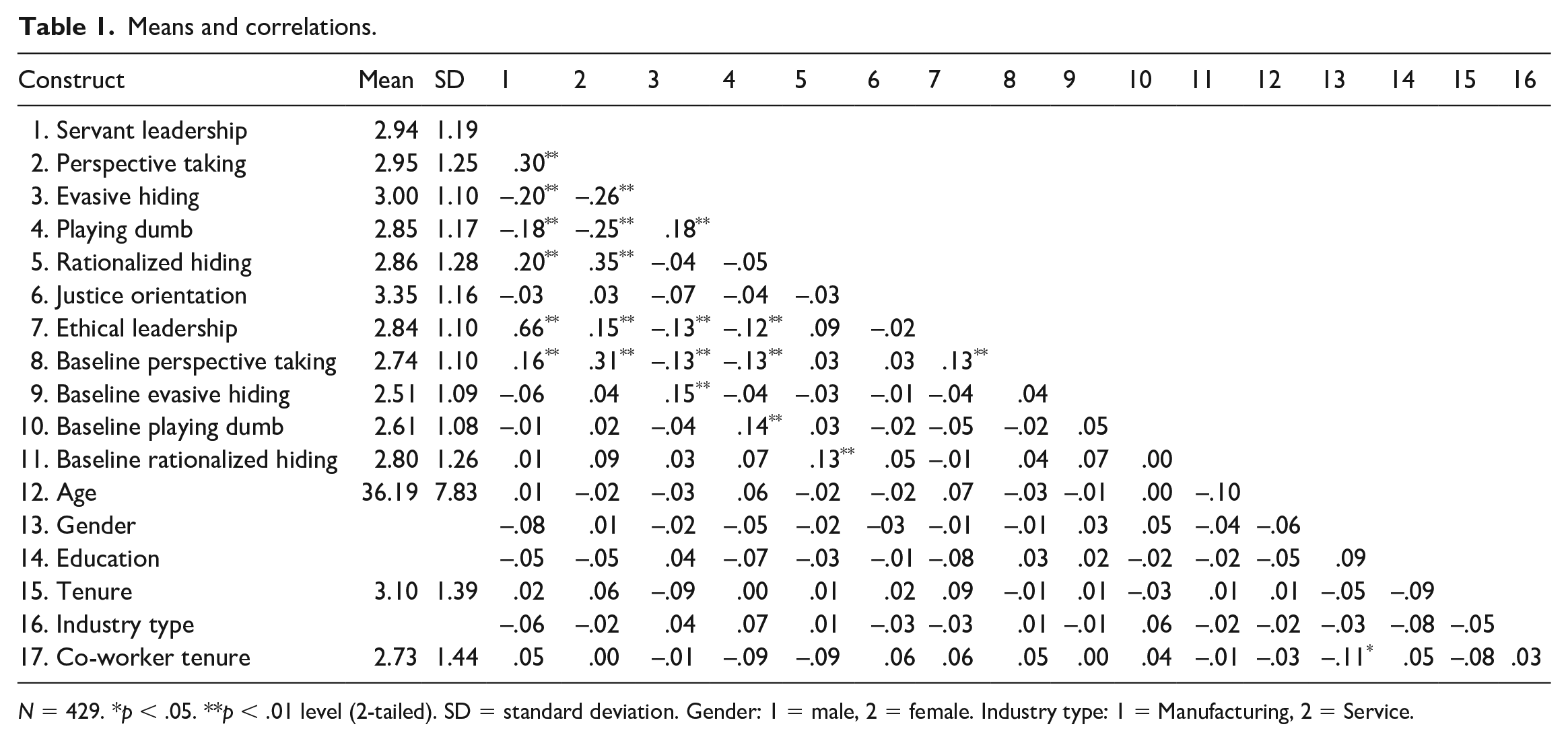
N = 429. *p < .05. **p < .01 level (2-tailed). SD = standard deviation. Gender: 1 = male, 2 = female. Industry type: 1 = Manufacturing, 2 = Service.
Measurement model
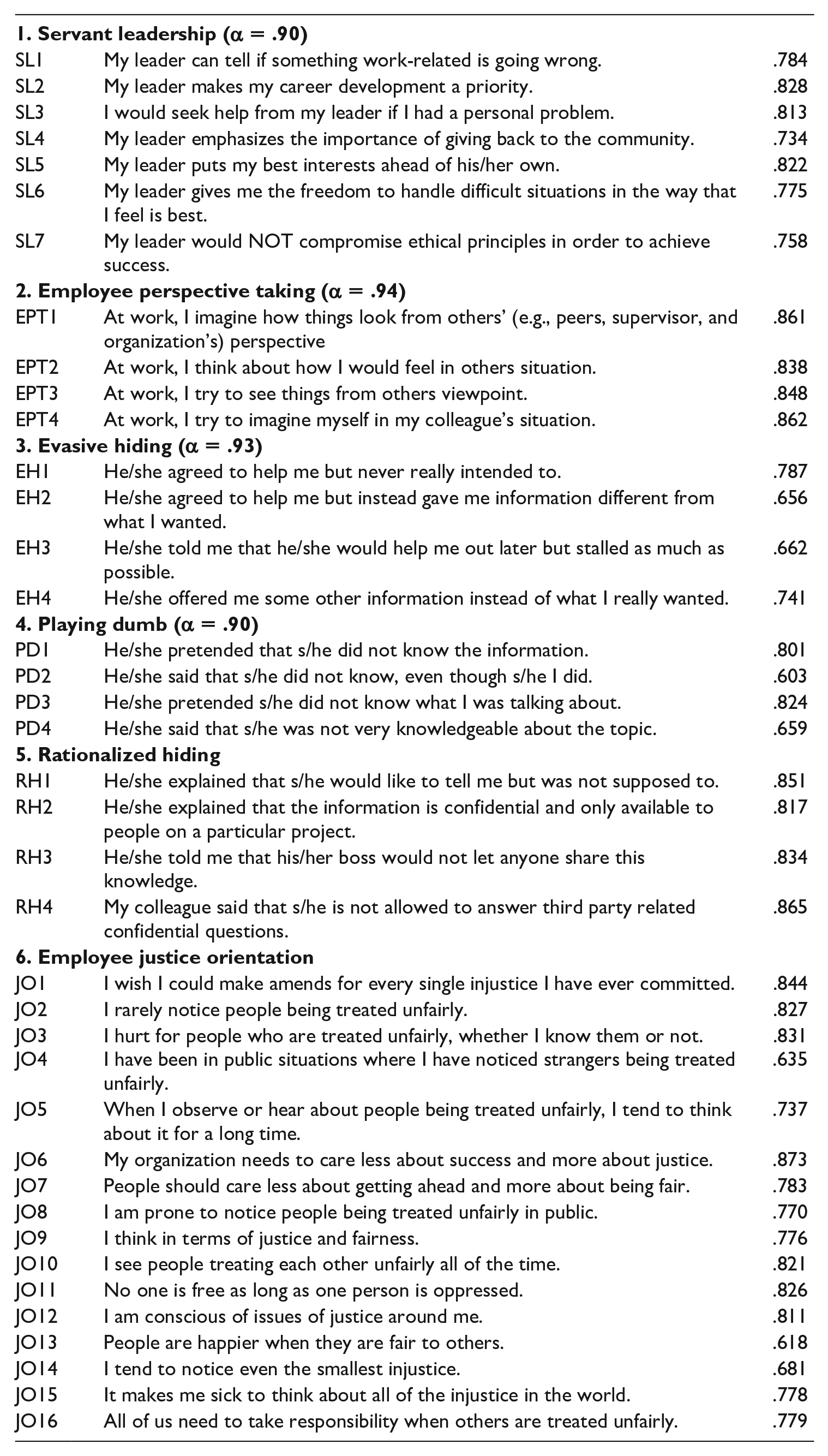
We executed CFA using Mplus (version 8.6) to assess the model fitness. The results show that our proposed model consisted of servant leadership, perspective taking, evasive hiding, playing dumb, rationalized hiding, and justice orientation had a good fit with the data – χ2(687) = 1493.65, χ2/d.f. = 2.17, Root Mean Square Error of Approximation (RMSEA) = .05, Standardized Root Mean Square Residual (SRMR) = .04, Comparative Fit Index (CFI) = .93, Tucker Lewis Index (TLI) = .92. All the unrestricted factor loadings were above .60 and statistically significant. The factor loadings of all the items are presented in Appendix A. To assess the convergent and divergent validities, we calculated average value extracted (AVE), average shared value (ASV), and maximum shared value (MSV). The results (Table 2) show that for all the variables, AVE > .50 (the threshold value), AVE > MSV > ASV, and the square root of AVE > inter-construct correlations. Thus, the convergent and discriminant validities were satisfactory.
Discriminant validity, convergent validity, and internal consistency.
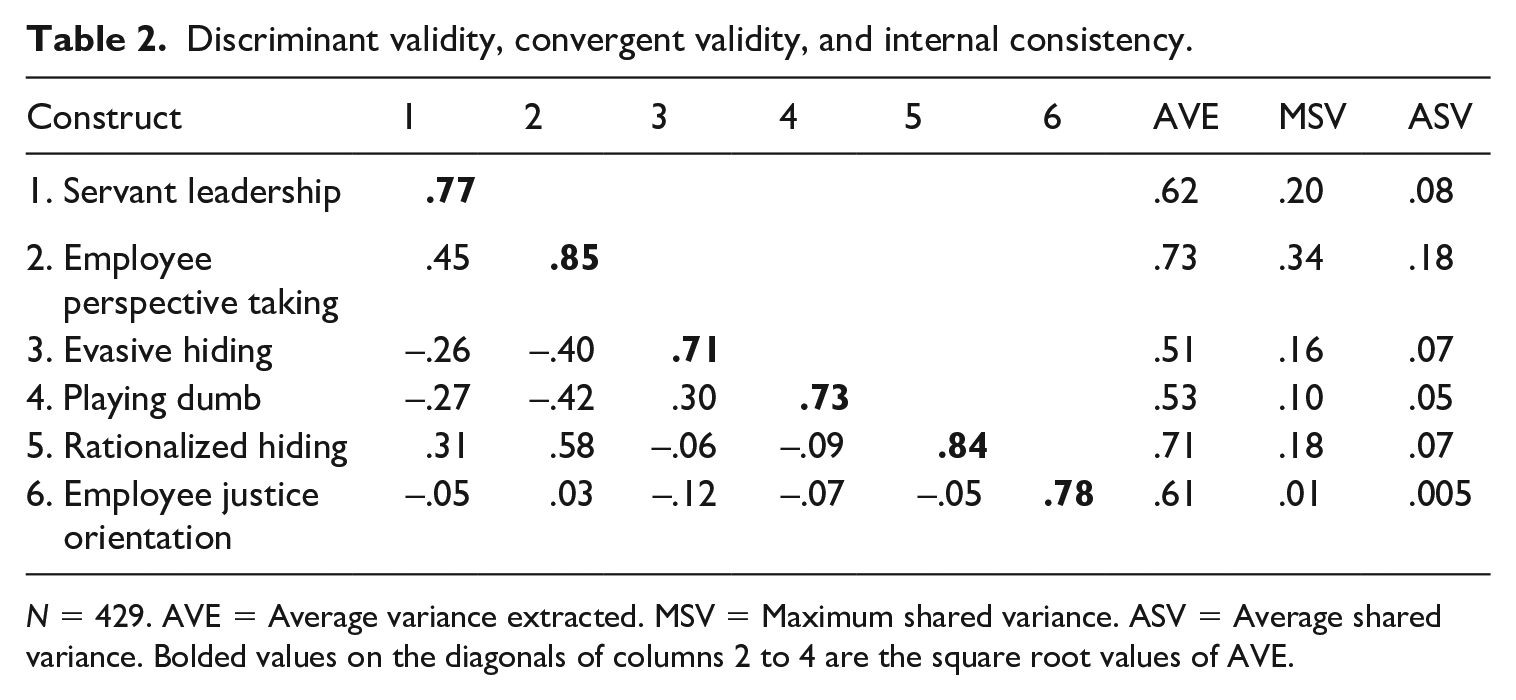
N = 429. AVE = Average variance extracted. MSV = Maximum shared variance. ASV = Average shared variance. Bolded values on the diagonals of columns 2 to 4 are the square root values of AVE.
Hypotheses testing
To evaluate all the hypothesized relationships, we employed SEM in Mplus (8.6). The results were significant despite the presence of control variables (Table 3). The results (Table 3) show significant negative relationships of servant leadership with evasive hiding (B = -.16, SE = .07, p < .05) and playing dumb (B = -.18, SE = .07, p < .05). Moreover, we found a significant positive relationship between servant leadership and rationalized hiding (B = .29, SE = .08, p < .01). Thus, Hypotheses 1a, 1b and 2 were supported. Proceeding further, the results revealed insignificant negative indirect relationships of servant leadership with evasive hiding (B = -.08, SE = .02, p < .01) and playing dumb (B = -.09, SE = .02, p < .01) via employee perspective taking and a significant positive indirect association of servant leadership with rationalized hiding via employee perspective taking (B = .14, SE = .03, p < .01). Thus, Hypotheses 3a, 3b and 4 were supported.
Hypotheses testing (with controls).
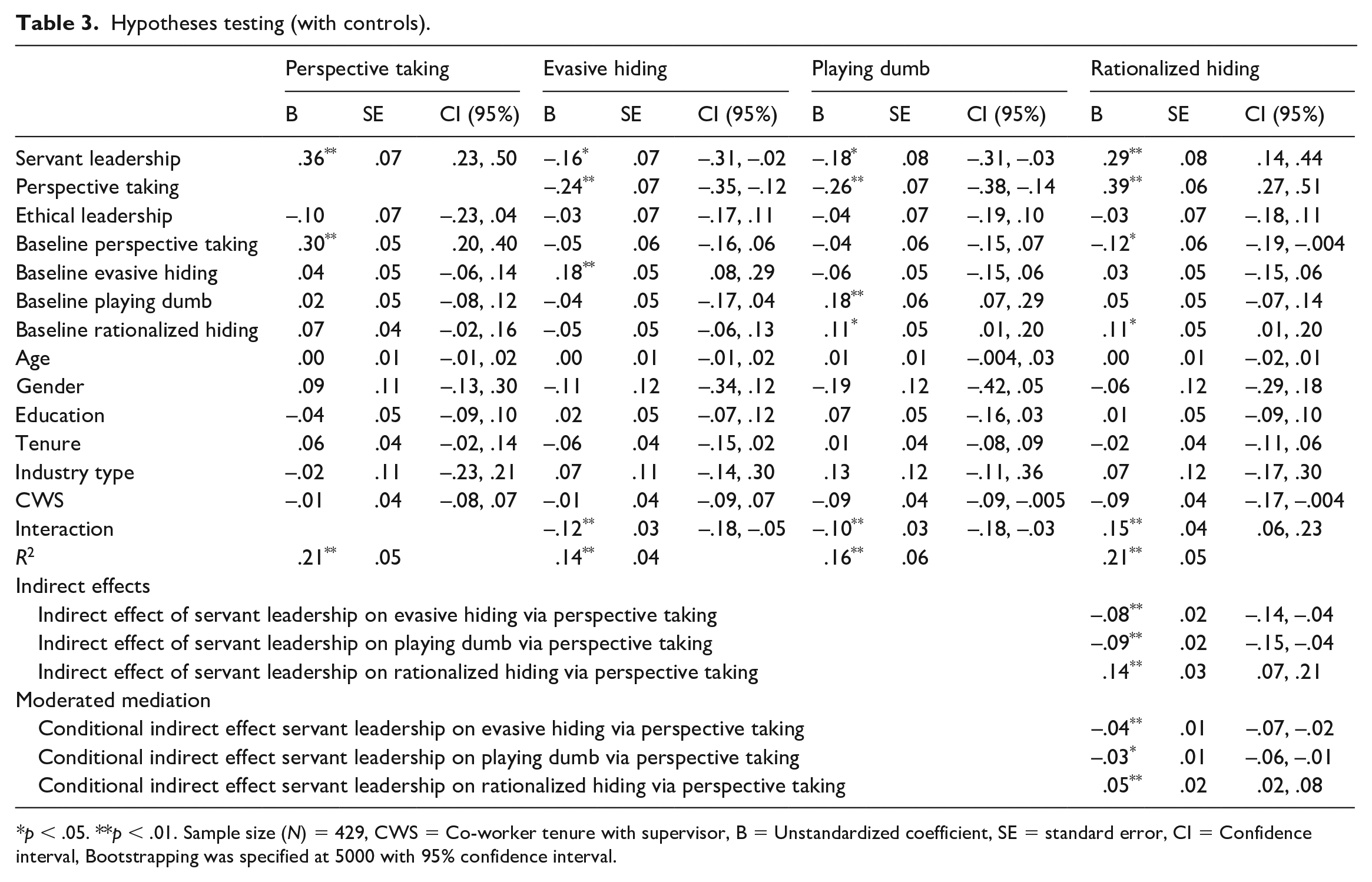
*p < .05. **p < .01. Sample size (N) = 429, CWS = Co-worker tenure with supervisor, B = Unstandardized coefficient, SE = standard error, CI = Confidence interval, Bootstrapping was specified at 5000 with 95% confidence interval.
The moderation analysis showed that the interaction between employee perspective taking and employee justice orientation was negatively associated with evasive hiding (B = -.12, SE = .03, p < .01) and playing dumb (B = -.10, SE = .03, p < .01) and positively associated with rationalized hiding (B = .15, SE = .04, p < .01).The interactions were mapped at +1/-1 SD from the mean of employee justice orientation are shown in Figures 2, 3, and 4. The simple slope tests showed that the negative relationships of servant leadership with evasive hiding (B = -.32, SE = .06, p < .01) and playing dumb (B = -.31, SE = .06, p < .01) were significant when justice orientation was high, while the relationships was insignificant (B = -.04, NS and B = -.07, NS, respectively) when justice orientation was low. Furthermore, the positive relationship between servant leadership and rationalized hiding was significant (B = .48, SE = .06, p < .01) when justice orientation was high, while the relationship was insignificant (B = .14, NS) when justice orientation was low. Thus, Hypotheses 5a, 5b, and 6 were supported.
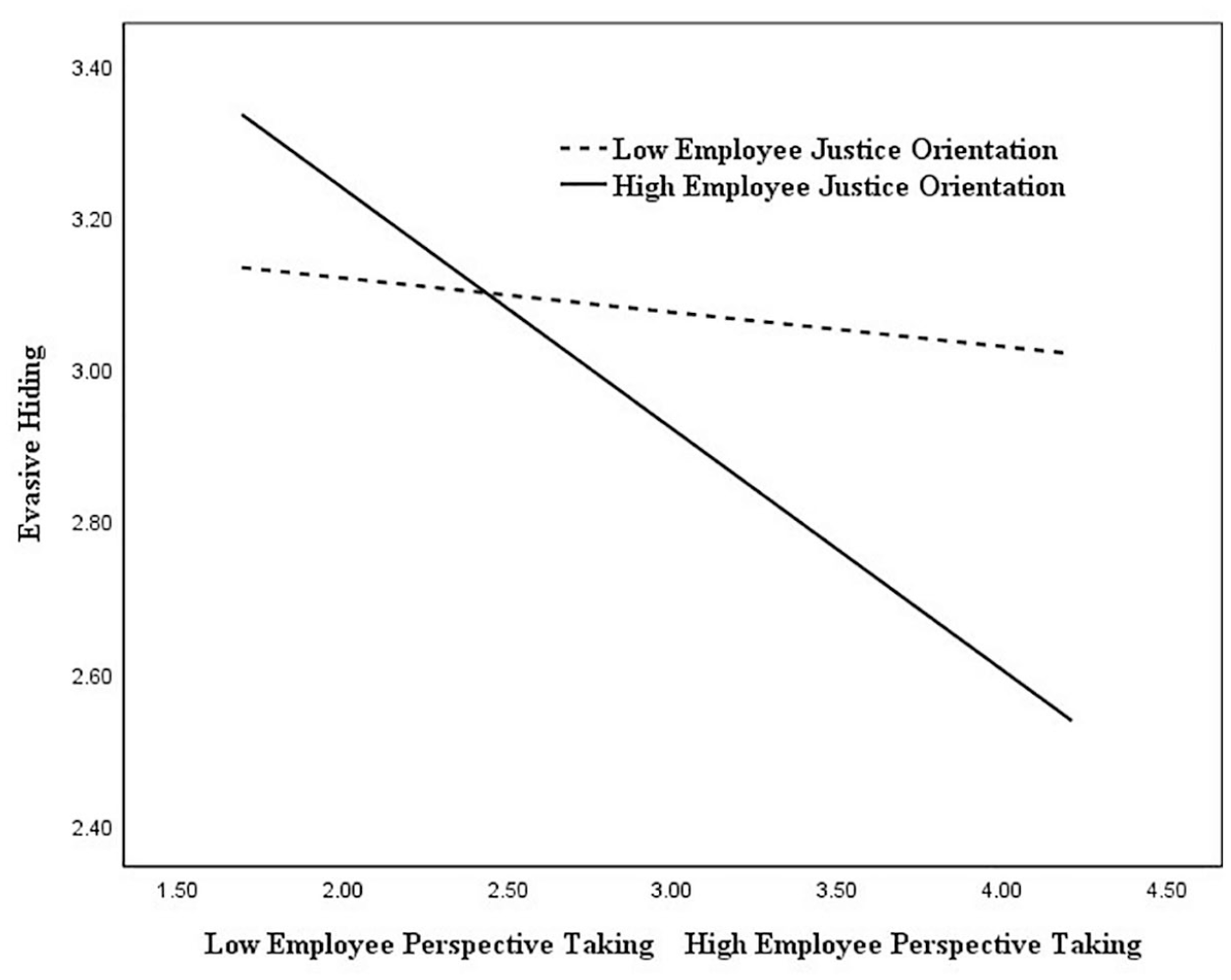
Justice orientation as a moderator of the perspective taking-evasive hiding link.
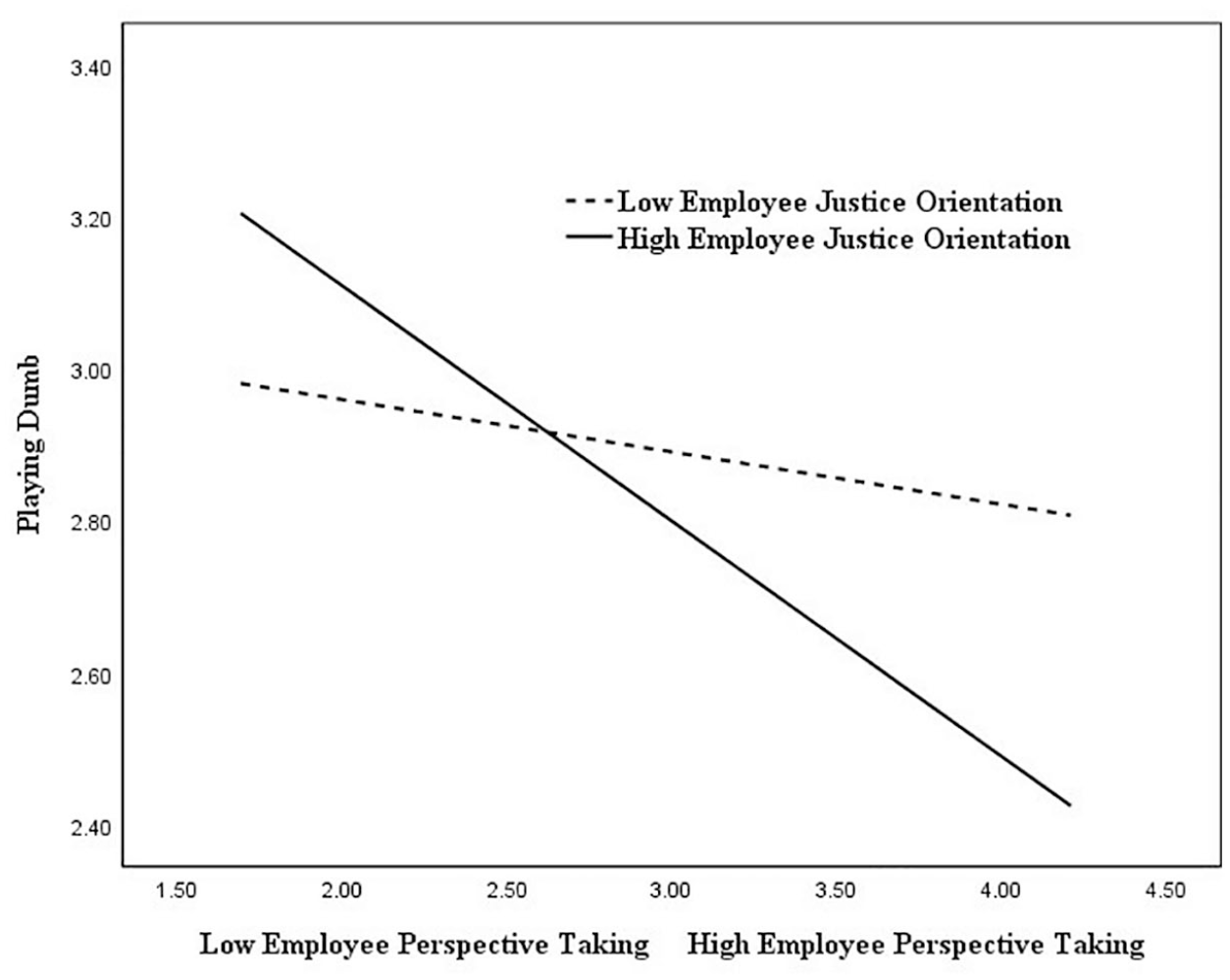
Justice orientation as a moderator of the perspective taking-playing dumb link.
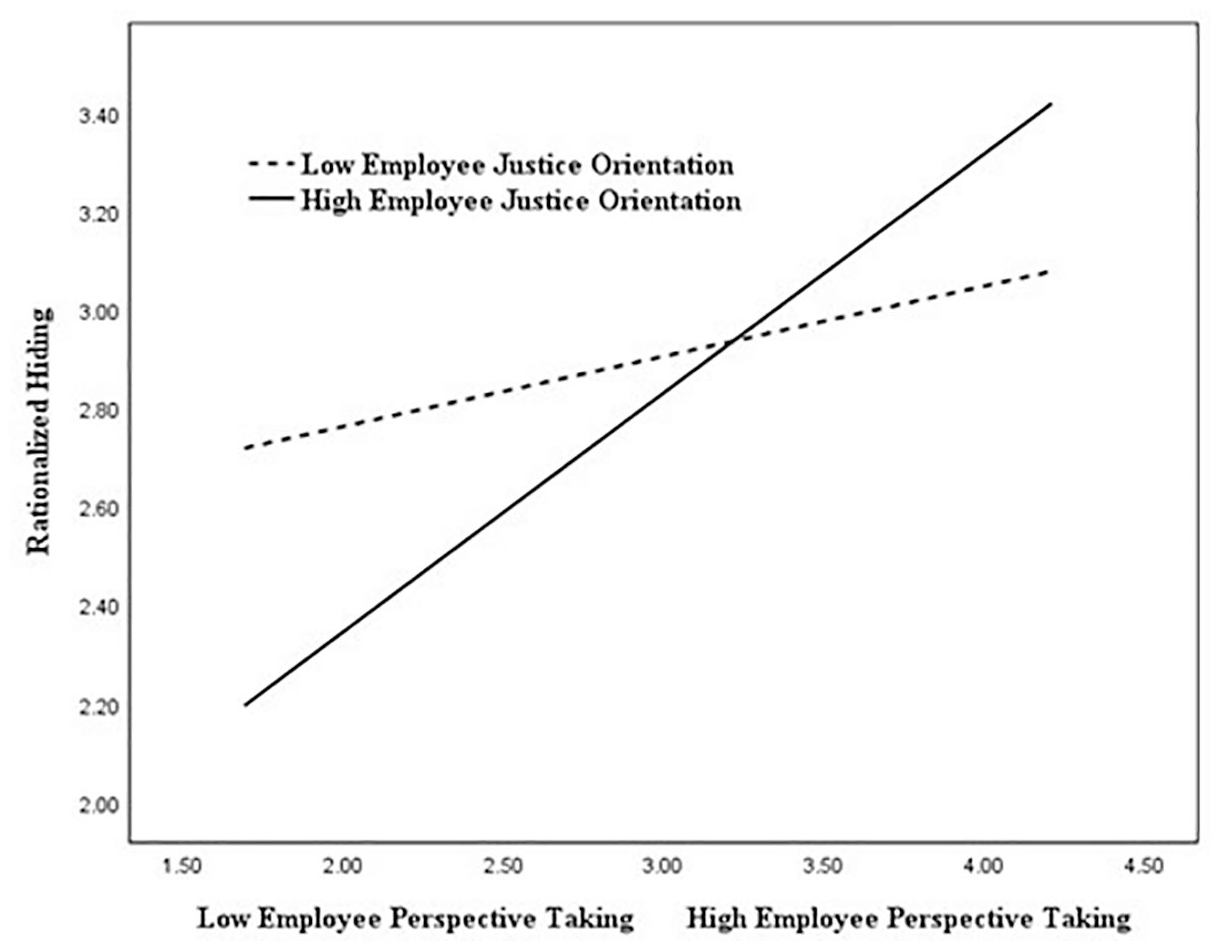
Justice orientation as a moderator of the perspective taking-rationalized hiding link.
Finally, the mediated moderation indices were significant for the hypothesized indirect relationships of servant leadership with evasive hiding (index = -.04, SE = .01, CI = [-.07, -.02]), playing dumb (index = -.03, SE = .01, CI = [-.06, -.01]) and rationalized hiding (index = .05, SE = .02, CI = [.02, .08]) via employee perspective taking. The conditional indirect effect of servant leadership to evasive hiding (B = -.10, SE = .02, p < .01), playing dumb (B = -.10, SE = .02, p < .01), and rationalized hiding (B = .15., SE = .03, p < .01) via employee justice orientation were significant when justice orientation was high. However, these relationships were insignificant when justice orientation was low (B = -.01, NS, B = -.02, NS, and B = .04, NS, respectively). Thus, Hypotheses 7a, 7b, and 8 were supported.
Discussion
Theoretical contributions
In the present study, we found that servant leadership was negatively related to evasive hiding and playing dumb, and yet, paradoxically positively related to rationalized hiding. We also established employee perspective taking as a crucial underlying mechanism of the relationships of servant leadership with employee knowledge-hiding behaviors – evasive hiding, playing dumb, and rationalized hiding. Finally, the present revealed that employee justice orientation moderated the direct relationships of perspective taking with employee knowledge-hiding behaviors, as well as the indirect associations of servant leadership with employee knowledge-hiding behaviors. The results were significant despite the presence of various control variables, such as demographic controls (e.g., age, gender, and education), ethical leadership, and baseline controls.
An important way through which our findings improve our understanding of employee knowledge-hiding behaviors is to show the double-edged nature of servant leadership and how it impacts various components of knowledge hiding. In a context where servant leadership is touted to generate desirable outcomes for employees (e.g., Eva et al., 2019), our findings show servant leadership discourages employees’ engagement in knowledge-hiding behaviors that are deceptive and negative. On the contrary, servant leadership encourages employees to hide confidential knowledge. These crucial findings underline the ethical concerns related to employee knowledge-hiding behaviors and enrich the current understanding of the leadership-knowledge hiding links (Anser et al., 2021; Men et al., 2020) by considering the multiplicity of knowledge-hiding behaviors. We also provide empirical evidence for the distinctiveness of the seminal conceptualization of knowledge-hiding behaviors proposed by Connelly and colleagues (see Connelly et al., 2012).
The second contribution of our findings relates to the role of perspective taking as a mediating mechanism between servant leadership and knowledge-hiding behaviors. Several constructs such as employee-job centered (e.g., proactivity, self-efficacy), team-centered (e.g., team efficacy), leader-centered (e.g., LMX, trust in leaders), and climate-centered (e.g., supportive work environment) have been examined as mediators to explain how servant leadership unfolds (Eva et al., 2019; Hoch et al., 2018; Liden et al., 2015; Neubert et al., 2022). The present study departs from the above to examine perspective taking, an other-centered construct as a mediating mechanism to explain the impact of servant leadership on knowledge hiding. Perspective taking aligns with the other-concerned nature of servant leadership and enables us to explore a theoretical assumption of this type of leadership by shifting the focus to the need to understand coworkers’ needs and preferences (Axtell et al., 2007; Fasbender et al., 2020). Our study is timely and relevant especially given the destructive influences of knowledge-hiding behaviors on employees and organizations.
The third contribution of our study is our integration of justice orientation, which is not only an extension of existing research on the boundary conditions of servant leadership (e.g., Eva et al., 2019; Liden et al., 2015; Neubert et al., 2022) but also highlights the role of justice orientation as an individual difference in keeping the ethical and moral conduct within workplaces (Ali et al., 2020; Sasaki and Hayashi, 2014). Prior research showed that justice orientation instigates individuals to sacrifice self-interests to ensure justice practices (Ali et al., 2020; Sasaki and Hayashi, 2014). Yet, this body of research has largely ignored its role in affecting employees’ engagement in knowledge-hiding behaviors. Previous work (e.g., Sekiguchi and Hayashi, 2014) has mainly focused on the direct associations between employee justice orientation and employee outcomes. Importantly, in the current research, we offer insights into the role of employee justice orientation as a boundary condition for an untapped yet crucial net of relationships that include servant leadership, perspective taking, and knowledge hiding. By showing that employee justice orientation serves as a boundary condition for the indirect links between servant leadership and knowledge hiding, we bring to the fore the intricacies involved in these relationships, as well as highlight the consequential value of employee justice orientation for the influence of servant leadership on knowledge hiding.
Practical implications
We suggest that supervisors need to understand the importance of their role as role models and demonstrating other-focused servant leadership behaviors in discouraging employees’ engagement in unethical and deceptive knowledge-hiding behaviors and encouraging them to hide confidential knowledge. To facilitate learning through observation and role-modeling, we suggest behavioral modeling techniques that might include identifying a suitable role model such as a supervisor who exhibits servant leadership behaviors, understanding the ways that facilitate learning such as consistent interactions and negotiations between the supervisor and employees, highlighting the positive impacts of these behaviors, and practicing these behaviors, for instance, using various role plays. Further, human resource departments need to focus on shaping a climate that encourage social bonding and social bonding behaviors such as caring for others’ interests and providing support to others.
Additionally, managers should initiate training programs for their employees on the types of knowledge-hiding behaviors and the impact of such behaviors on employees’ productivity, performance, and wellbeing, as well as organizations’ productivity and success. More importantly, we know that psychological safety (Tan et al., 2022) and trust (Usman et al., 2019) enhance knowledge sharing. Managers who want to promote knowledge sharing as opposed to knowledge hiding (e.g., evasive hiding, playing dumb) should promote activities that can facilitate psychological safety and trust among coworkers. Supervisors as servant leaders can instill the other-centered approach and moral values in their followers that would inspire them to think from the point of view of other stakeholders including peers and the organization and thus make fair decisions while dealing with the decision to provide or hide knowledge. Therefore, and in line with the policies of HR departments, continuous training and development programs can be held for supervisors to clearly communicate the importance of the other-focused approach and moral values and importantly demonstrate such approach and values through their behaviors and actions at work. To render task and development i-deals effective for everyone, we recommend that organizations should prioritize the recruitment of employees that may show some features of servant leadership and perspective taking. We also suggest that organizations should develop training programs that foster others’ orientation and moral values and instill in employees the care for a wider range of stakeholders, including society at large. The managers should make i-deal types a part of their human resource programs to enable employees to address their individualized needs at work.
Finally, since justice orientation plays important role in reinforcing the effect of servant leadership on employee knowledge-hiding behaviors, supervisors should focus on understanding and differentiating employees with high justice orientation from those with low justice orientation. Recruitment, selection, and talent management programs in organizations can focus on ensuring justice orientation of employees is measured and reflected upon periodically to evade unethical and counterproductive work behaviors such as knowledge hiding (e.g., Venz and Shoshan, 2022). Additionally, managers should make use of psychometric tests such as personality profiles to identify the level of employee justice orientation of the existing and potential new hires. This could help managers develop appropriate interventions for employees with high, as well as low justice orientation to ultimately inspire them to exhibit fairness while dealing with peers’ knowledge-hiding requests.
Limitations and future research
Despite its strength, this study has limitations that should be noted. First, we contextualized the theoretical interrelations between supervisory servant leadership, justice orientation, perspective taking, and knowledge hiding in a collectivist country. Future studies are suggested to explore the proposed associations with samples drawn from a non-collectivist country. Second, in addition to our focus on servant leadership, other value-based leadership styles, such as ethical leadership (Ali et al., 2022a; Kalyar et al., 2020; Shafique et al., 2020) and spiritual leadership (Ali et al., 2022b; Usman et al., 2021) can deter unethical and deceptive knowledge-hiding behaviors and encourage employees to hide confidential knowledge. Although we controlled for ethical leadership, future research should investigate the relationship between these value-based leadership styles concurrently to determine which is more impactful on knowledge-hiding behaviors in organizations.
Third, future studies could integrate other mechanisms to delineate the associations between servant leadership and knowledge-hiding behaviors. One potential area of inquiry will be to focus on the role of helping behaviors (as a reflection of perspective taking) and emotions (the positive and negative emotional reactions shown against servant leadership) as potential bridging mechanisms in future studies. Fourth, other contextual variables such as the personality of servant leaders or followers, family-supportive climate, and perceived informal leadership support could be integrated as boundary conditions to explore when the impact of servant leadership unfolds in the most effective ways. Finally, from a knowledge-hiding perspective, the loss of authority, power, and job insecurity are among the factors that affect employees’ knowledge-hiding behaviors (Connelly et al., 2012). Future studies could examine the effect of job insecurity and other such factors on knowledge-hiding behaviors. In essence, future studies should focus on enhancing the nomological networks of the antecedents and outcomes of knowledge hiding, given its destructive influences on employees and organizations and its intricate nature.
Footnotes
Appendix A. Measures and item loadings
|
|
||
| SL1 | My leader can tell if something work-related is going wrong. | .784 |
| SL2 | My leader makes my career development a priority. | .828 |
| SL3 | I would seek help from my leader if I had a personal problem. | .813 |
| SL4 | My leader emphasizes the importance of giving back to the community. | .734 |
| SL5 | My leader puts my best interests ahead of his/her own. | .822 |
| SL6 | My leader gives me the freedom to handle difficult situations in the way that I feel is best. | .775 |
| SL7 | My leader would NOT compromise ethical principles in order to achieve success. | .758 |
|
|
||
| EPT1 | At work, I imagine how things look from others’ (e.g., peers, supervisor, and organization’s) perspective | .861 |
| EPT2 | At work, I think about how I would feel in others situation. | .838 |
| EPT3 | At work, I try to see things from others viewpoint. | .848 |
| EPT4 | At work, I try to imagine myself in my colleague’s situation. | .862 |
|
|
||
| EH1 | He/she agreed to help me but never really intended to. | .787 |
| EH2 | He/she agreed to help me but instead gave me information different from what I wanted. | .656 |
| EH3 | He/she told me that he/she would help me out later but stalled as much as possible. | .662 |
| EH4 | He/she offered me some other information instead of what I really wanted. | .741 |
|
|
||
| PD1 | He/she pretended that s/he did not know the information. | .801 |
| PD2 | He/she said that s/he did not know, even though s/he I did. | .603 |
| PD3 | He/she pretended s/he did not know what I was talking about. | .824 |
| PD4 | He/she said that s/he was not very knowledgeable about the topic. | .659 |
|
|
||
| RH1 | He/she explained that s/he would like to tell me but was not supposed to. | .851 |
| RH2 | He/she explained that the information is confidential and only available to people on a particular project. | .817 |
| RH3 | He/she told me that his/her boss would not let anyone share this knowledge. | .834 |
| RH4 | My colleague said that s/he is not allowed to answer third party related confidential questions. | .865 |
|
|
||
| JO1 | I wish I could make amends for every single injustice I have ever committed. | .844 |
| JO2 | I rarely notice people being treated unfairly. | .827 |
| JO3 | I hurt for people who are treated unfairly, whether I know them or not. | .831 |
| JO4 | I have been in public situations where I have noticed strangers being treated unfairly. | .635 |
| JO5 | When I observe or hear about people being treated unfairly, I tend to think about it for a long time. | .737 |
| JO6 | My organization needs to care less about success and more about justice. | .873 |
| JO7 | People should care less about getting ahead and more about being fair. | .783 |
| JO8 | I am prone to notice people being treated unfairly in public. | .770 |
| JO9 | I think in terms of justice and fairness. | .776 |
| JO10 | I see people treating each other unfairly all of the time. | .821 |
| JO11 | No one is free as long as one person is oppressed. | .826 |
| JO12 | I am conscious of issues of justice around me. | .811 |
| JO13 | People are happier when they are fair to others. | .618 |
| JO14 | I tend to notice even the smallest injustice. | .681 |
| JO15 | It makes me sick to think about all of the injustice in the world. | .778 |
| JO16 | All of us need to take responsibility when others are treated unfairly. | .779 |
Funding
The author(s) received no financial support for the research, authorship, and/or publication of this article.
