




Abstract
This study draws on three well-established streams of leadership research: transformational leadership, servant leadership, and five-factor personality theory and applies them to the labor union context. The study tested the relationship between these theories and both leader and union effectiveness. The sample consisted of 240 respondents who rated the leadership of 60 participants in the 2018 and 2019 Harvard Trade Union Program. Results indicated that the best predictors of both leader effectiveness and union effectiveness were the transformational and servant leadership styles. In contrast with other research, the five-factor personality variables (extraversion, conscientiousness, emotional stability, openness, and agreeableness) had no significant relationship with leadership effectiveness after controlling for the leadership style models. Only two of the five personality variables, extraversion and emotional stability, were related to union effectiveness after controlling for the effects of transformational and servant leadership. Discussion includes implication for labor educators.
Keywords
Leadership is important to every organization. Effective leadership sets a successful strategic direction that accounts for current environment constraints, inspires the commitment of followers to implement it, and ensures that organizational structures support those actions. Ultimately, the end result of the leader's actions is to reach the organization's goals. For labor unions, those goals typically include things such as winning good contracts for existing members, organizing new members, and engaging in political action to promote the interests of working people. But these goals are not achieved by the leaders alone. Rather, they must inspire their followers to work toward these goals. Many members would also prefer leaders who are ethical, and treat their followers fairly and with respect. Leadership of a labor union—or any organization—is a challenging task that juggles competing interests from different stakeholders and must counter a general pattern of resistance to change. Given these constraints, what type of leadership is most likely to be successful in labor unions?
There is a vast literature on leadership in the business environment and a considerable amount in the leadership of educational institutions. But there is substantially less about leadership in labor unions. Do the unique characteristics of labor unions as organizations mean that a different style of leadership is effective in unions, as compared to businesses?
Applying existing organizational behavior theories to labor unions is complex. Clark (2009, 11–12) suggests that it is reasonable to use existing social science theory as a starting point. But he also points to the special characteristics of labor unions that are different from for-profit organizations, for example, the democratic structure and the election of top leaders, which may mean that some theories work better in labor unions than others. Without testing the theories in a union environment, we cannot assume that they apply—or that they do not apply.
This study uses the existing body of leadership research to begin to address the following question: What is the most effective leadership approach to use within a labor union? Using the organizational psychology literature as a foundation, this study looks at three of the dominant streams of leadership research with the goal of assessing their relationship to union effectiveness. These include one stream that is based on leader traits—five-factor (“Big Five”) personality theory—and two streams that are based on leadership style (or leadership behavior)—transformational leadership (Full Range Model) and servant leadership.
The first of these streams, trait theory, studies whether people with certain traits are more likely to be effective leaders. Personality is the primary trait used in leadership research today. The dominant personality theory is the five-factor model or the “Big Five:” extraversion, conscientiousness, emotional stability, openness, and agreeableness (Goldberg 1990; McCrae and John 1992; McCrae and Costa 1997). A meta-analysis by Judge et al. (2002) finds that these five factors account for about a quarter of the variance in leader emergence (i.e., who is seen as a leader by others) and about 15 percent of the variance in leader effectiveness. Of these five variables, extraversion consistently has the strongest relationship with leadership, and agreeableness has the weakest.
The Big Five personality variables are not widely used in union research. This may be due, in part, to a strong belief in the labor movement that all members are equal, and things like personality traits are unrelated to union goals of fairness, dignity, and respect. But while we may value all members equally, they do not all have the same skills. A carpenter, nurse, and pilot are all highly skilled, but we do not expect the nurse to fly a plane or the carpenter to provide health care. Equally, members do not all have the same personality. Further, having the “right” personality may have been seen as coded language for being more aligned with management than with the union. But the link between personality traits and leadership is well-established in other settings. Because these traits are so dominant in organizational studies, because they account for considerable variance in leadership effectiveness, and because the results have been replicated in a variety of organizational settings, it is important to assess the role of the Big Five personality traits as part of this study.
There are strong reasons why the Big Five traits might be expected to be related to union leadership effectiveness. For example, those high in extraversion find it easy to meet and talk to new people, have large social networks, and enjoy being in and interacting with large groups. This can be seen as an advantage in organizing and in running for union office. For example, Rooks and Penney (2015) quote one organizer who said, “If you want to be a union organizer,… you have to be able to talk to people. You have to be able to get along with all kinds of people.” Another organizer said she is “very outspoken. I’m very much of an extrovert… There was never an issue [about whether] I could succeed in knocking on a stranger's door and talking to them” (p. 198). For these reasons, I predict the following: H1: Extraversion is positively associated with both leader and union effectiveness.
The next trait, conscientiousness, involves paying attention to detail, following up on tasks and commitments made to others, and staying organized. These could be important characteristics for those involved in collective bargaining and contract administration. It is also helpful for those who manage the internal affairs of the union, such as managing staff and finances. Therefore, I propose that H2: Conscientiousness is positively associated with both leader and union effectiveness.
While extraversion and conscientiousness are commonly found to be related to leadership in a variety of settings, two of the other traits have a more inconsistent relationship to leadership. One, emotional stability, is the tendency to remain calm in challenging situations and to be less affected by stress. In the workplace, many employees prefer to have a supervisor who remains calm than one who is easily irritated. However, there is a perception among some union members—perhaps an outdated perception—that emotional outbursts and fist-pounding are helpful at the bargaining table. But more experienced bargainers would dispute this, maintaining that staying calm is important to thinking clearly and strategically. Thus, emotional stability would likely be a positive trait for a union leader. H3: Emotional stability is positively associated with both leader and union effectiveness.
Openness to new experiences is a somewhat complex trait, as measured. At a basic level, it is often taken to mean a willingness to try new things—such as a willingness to try unfamiliar foods or having an interest in a wide range of art. But as measured here, it also includes an interest in abstract ideas and an ability to imagine things that do not currently exist. Thus, one could see openness as being an advantage to any leader involved in strategic decision-making for the union. Being high in openness might help a union leader to imagine a better workplace, to strategize about organizing priorities, or to navigate a highly polarized political environment in a way that promotes changes that help working people. For these reasons, I predict that H4: Openness is positively associated with both leader and union effectiveness.
The fifth trait, agreeableness, generally has little or no relationship with leadership effectiveness. Those who are high in agreeableness place a priority on getting along with others and are willing to compromise in order to do so. Thus, while they are well-liked, they are often seen as being unable to make difficult decisions and unlikely to stand up under pressure. Since union leadership necessarily involves taking steps to counter management actions, high agreeableness does not seem like a good trait for a union leader. Yet if someone is too low in agreeableness, they can be seen as self-centered and unconcerned about others. Thus, they may be unlikely to be elected or appointed to a leadership position. Perhaps because of these competing aspects, agreeableness tends to be unrelated to leadership, and no prediction is made for it here.
The next two theoretical approaches are about leadership style or behavior. This contrasts with the Big Five, which is considered a trait theory—meaning that the characteristics are relative stable and long lasting. But it is important to note that the traits are measured by asking about behaviors. As a result, the line between trait theories and “behavioral” theories of leadership (or leadership style) is blurry.
The second stream in leadership research used here is based on the idea of transformational leadership. Early theorists such as Burns (1978) and Bass (1985) describe a transformational leader as someone who is charismatic and who effectively communicates a vision that is challenging and inspiring. As currently researched, there are four factors in transformational leadership: idealized influence, inspirational motivation, intellectual stimulation, and individualized consideration. Rooks and Penney (2015, 199) describe how this type of leadership transforms union members. They report, “Organizers can help workers change from uninformed, fearful followers to knowledgeable, confident workplace leaders… Organizers facilitate personal transformation … by pushing workers outside of their comfort zones.”
There is additional evidence that transformational leadership is effective in labor unions. Cregan, Bartram and Stanton (2009) reported that transformational leadership is related to members’ loyalty and willingness to work for the union. A case study by O’Connor and Mortimer (2013) described transformational leadership that had benefits for both the union and its members. Twigg, Fuller and Hester (2008) found that transformational leadership is related to union organizational citizenship behaviors.
1
They described behaviors such as attending union meetings and other events as organizational citizenship behaviors. And Catano, Pond and Kelloway (2001) reported that transformational leadership is positively associated with member involvement in and commitment to the union. Thus, I predict the following: H5: Transformational leadership is positively related to both leader and union effectiveness.
Transformational leadership is typically studied as part of the Full Range Model of leadership, which also includes transactional and laissez-faire leadership. Transactional leadership focuses on an exchange: the leader offers a reward if the follower accomplishes a goal. The inspirational and affective aspects of transformational leadership are not part of transactional leadership. An example of transactional leadership might be for a regional director to offer a staff representative a better assignment if they succeed on an existing assignment, such as winning an arbitration case or reaching a good contract agreement. In the Full Range Model of leadership (Bass and Avolio 1994), transformational leadership is seen as the most effective, and transactional leadership is a middle ground. Therefore, I predict that H6: Transactional leadership is positively related to both leader and union effectiveness.
The third style in the Full Range Model is laissez-faire leadership, which was initially studied in contrast to both democratic and authoritarian styles of leadership. Lewin, Lippitt and White (1939) described laissez-faire leadership as “complete freedom for group or individual decisions” and “complete nonparticipation by the leader.” Over time, this style came to be seen as an absence of leadership. The leader may have a title, but does little to enact the role in that they are unavailable, tend to delay decision-making, do not provide feedback, and generally avoid responsibility. Most studies of laissez-faire leadership have found that it has a negative relationship with leader effectiveness (Judge and Piccolo 2004). An opposing view of laissez-faire leadership is that it can be a good approach in some contexts (Yang 2015), particularly with highly skilled and motivated subordinates who do not need or appreciate much oversight. However, the measure of laissez-faire leadership used in this research focuses on the traditional view of a leader who is unavailable when needed and who provides no overall direction. Therefore, I predict H7: Laissez-faire leadership is negatively related to both leader and union effectiveness.
The third major stream of research included here is servant leadership. Servant leadership was first proposed by Greenleaf (1970) but was not widely researched until decades later. Its current popularity comes from a dissatisfaction with unethical or “pseudo-transformational” leadership. It is one of several newer approaches to leadership that specifically highlight moral and ethical behavior and that are considered alternatives to transformational leadership. In servant leadership, the leader serves the needs of the follower first. The leader helps the followers develop their skills and reach their goals. The servant leader puts the followers’ needs before their own personal gain. Based on this definition, servant leadership seems like an especially appropriate model of leadership for the labor movement, because its goal is to achieve social justice for its members. Indeed, the influential labor leader Walter Reuther's epitaph captures the essence of servant leadership: there is no greater calling than to serve your fellow men… There is no greater satisfaction than to have done it well.
Servant leadership contrasts with transformational leadership in some key ways. Specifically, a transformational leader sets goals and inspires followers to work toward those goals. Under servant leadership, this order is reversed: Followers have goals, and the servant leader helps them achieve those goals. The question of whether the followers (i.e., members) are better off as a result of the leader's efforts is at the very core of servant leadership. Whereas under transformational leader, followers might or might not benefit. Another contrast between these two styles is that transformational leaders are comfortable in the spotlight; indeed, many of them seem to relish being the center of attention. Servant leaders are willing to speak publicly when needed, but they do not seek to be the focus of attention on a regular basis.
Other models related to servant leadership are authentic leadership and ethical leadership. However, the present study focuses on servant leadership as the central theory in this research stream, both for the sake of parsimony and because it is better established in the research literature. For example, Liden et al. (2014) find that servant leadership is related to organizational effectiveness. However, there are some concerns that transformational leadership and servant leadership overlap. As Hoch et al. (2018) point out in their meta-analysis, while the two constructs are theoretically distinct, with transformational leadership focusing on organizational goals and servant leadership focusing on follower's needs, they are highly correlated empirically. One possible reason for this is a halo effect in which respondents rate leaders they like high on all dimensions. A second reason might be that the concepts are redundant in practice, if not theory. A third might be that the items used to measure these concepts are too convergent. Also, Hoch et al. (2018) find that servant leadership is more robust than authentic and ethical leadership in explaining additional variance above and beyond that of transformational leadership. For these reasons, and because servant leadership seems especially appropriate for a social justice organization, this study looks at whether servant leadership is related to union effectiveness. H8: Servant leadership is positively related to both leader and union effectiveness.
The history of leadership research tends to involve each stream proceeding along with a separate path, with relatively little empirical comparison of their usefulness. To counter this, DeRue et al. (2011) call for an integrated theory of leadership that incorporates both traits and behavioral or style theories. The primary goals of the present study are first, to test whether each of these three major streams of leadership research apply to labor unions, and second, to test whether their effects are additive or whether some lose their predictive power when combined with the others.
This study includes two outcome measures: leader effectiveness and union effectiveness. Both are measured by supervisors, subordinates, and colleagues of the leader. Leader effectiveness focuses more on the extent to which followers trust the leader and are inspired by them, while union effectiveness assesses how well the union is performing as an organization. The predicted relationships are the same for both. However, leader effectiveness may be more influenced by an emotional liking or bias in favor of the leader. In contrast, union effectiveness is more reflective of the leader's performance in reaching their goals for the union. Moreso than other types of organizations, unions require both the commitment and the actions of their members (e.g., organizational citizenship behaviors) in order to succeed. Of these two outcome measures, leader effectiveness can be seen as an indicator of the extent to which leaders generate commitment to the union. On the other hand, union effectiveness is influenced by a range of factors—including external economic conditions and the leader's strategic decisions, as well as member commitment and activism.
Methods
Sample
The sample was drawn from two cohorts (2018 and 2019) of the Harvard Trade Union Program. The program is a six-week, residential program for union leaders. Participants are generally mid- and high-level union leaders. Just over a third are Regional Directors, Executive Directors, Directors, or Associate Directors. About 20 percent are elected officials (president, vice president, secretary, treasurer, or similar). About 30 percent are staff representatives. They are supported by their union for participation in the program. Both the cost of the program and the leader's residence at Harvard (and therefore absence from the union) for six consecutive weeks means that the union has invested a considerable amount in these leaders.
The HTUP core curriculum focuses on strategic choice, negotiations and labor relations, leadership, history, capital strategies for labor, and strategic public sector labor relations. The current research was incorporated into the program in 2018 and 2019. I collected the data prior to the program, with the endorsement of HTUP, and presented the results during the program.
Sixty out of 78 program participants completed online surveys, for a response rate of 77 percent. Of these, 85 percent were from the U.S., and the remaining 15 percent were from Australia, Canada, and New Zealand. Participants were also asked to invite about five colleagues to complete a parallel survey about them. While it would have been preferable to have an unbiased and independent process to select coworkers to complete the survey, that was not possible in this context. A total of 269 surveys were received from colleagues (32 percent supervisors, 45 percent peers, 11 percent subordinates, 11 percent other), and these ratings by others are the basis of the analysis presented here. Missing data reduced the sample size to 240.
The leaders rated in the sample are 60 percent male and 40 percent female; and 70 percent identify as white only and 30 percent identify as a racial minority. About a third of them are in elected positions and two-thirds in appointed positions. They work in the following industries: building trades, 33 percent; education, 7 percent; health care, 7 percent; manufacturing, 10 percent; general public sector, 20 percent; police and fire, 13 percent; utilities, 3 percent; and other, 7 percent. They have been in their current position for about four years on average, and their mean age is 45 years.
Of those who rated the leaders, 38 percent were in elected positions, and 6 percent were appointed to positions for which they would have to run for office in the future. Many of them, but not all, have supervisory roles: 40 percent do not directly supervise others, 15 percent supervise 1–5 employees, 24 percent supervise 6–10 employees, and 21 percent directly supervise more than 10 employees. This group was 66 percent male and 34 percent female; 83 percent of them identified as white only, and 26 percent identified as a minority.
Measures
This study primarily used well-established measures of personality and leadership. Some of these concepts have multiple measures available, all with appropriate psychometric properties. I used two criteria for choosing between alternate measures of the same concept. First, I only used research measures that were available at no cost so that unions who wish to replicate this research may easily do so. Second, I selected measures that were as short as possible (i.e., had the fewest number of items per scale). This limits “survey fatigue” and increases the likelihood that the survey will be complete. The survey software used here predicted that average completion time would be 12 minutes. Based on these criteria, I used the measures identified below for personality and leadership. However, I developed a new measure of union effectiveness because existing measures had a different focus than required for this study.
Personality
I used the Mini-IPIP scales (Donnellan et al. 2006) to measure the Five-Factor Model of personality. The Five Factors are extraversion, agreeableness, conscientiousness, neuroticism (or its reverse, emotional stability), and openness, and are a version of the Big Five factors of personality. The correlations between the shorter 20-item Mini-IPIP used here, and the 50-item IPIP-FFM range from .85 to .95 for the five personality traits (Donnellan et al. 2006).
Leadership
I used the Carless, Wearing and Mann (2000) measure of transformational leadership. A key advantage of this measure is that it has only seven items. However, a disadvantage is that it does not capture the four subscales (idealized influence, individualized consideration, inspirational motivation, and intellectual stimulation). Sample items in this measure include this leader “communicates a clear and positive vision of the future” and “encourages thinking about problems in new ways and questions assumptions.”
Regarding transactional leadership, I used a limited measure of the contingent rewards aspect of transactional leadership from Podsakoff et al. (1990). A sample item is this leader “personally compliments staff and members when they do outstanding work.”
To complete the full-range model, I used a measure of laissez-faire leadership by Xirasagar, Samuels and Stoskopf (2005). Sample items include this leader “avoid[s] responsibility in handling important issues” and is “unavailable when needed.”
I used the Liden et al. (2015) short-form measure of servant leadership. Sample items are this leader “can tell if something work-related is going wrong” and “I would seek help from this leader if I had a personal problem.”
Leader Effectiveness
This scale has five items, including “I have a high degree of trust in this leader's competence,” “This leader reduces my desire to work hard for the union,” (reverse scored), and “All things considered, this leader does a good job for the union.” This is a shortened form of the manager effectiveness measure used in Tjosvold, Andrews and Struthers (1991).
Union Effectiveness
I was unable to find a suitable measure of union effectiveness that matched the roles of the leaders in this sample. There are good measures of some aspects of union effectiveness. However, they measure effectiveness in a narrower domain than needed for this study. For example, Hammer and Wazeter's (1993) measure focuses explicitly on local union effectiveness and may not be suitable for participants who work at the national level. Fiorito, Jarley and Delaney (1995) focus on organizing effectiveness only, and only at the national level. But this sample includes participants at the local, regional, and national levels, making it difficult to create detailed items that work for all participants. Instead, I use a more general approach, based on Clark's (2009, 5–9) view that union effectiveness must be multifaceted. He argues that union effectiveness, at a minimum, includes the union's ability to organize new members, attain positive collective bargaining outcomes, and have a positive impact on society overall (including political action). He suggests that internal union democracy is a key factor as well. Thus, I used a measure based on these six items:
This union has been effective in serving its current members (e.g., in bargaining and administering contracts). This union has been effective in mobilizing current members to take action. This union has been effective in organizing new members. This union has been an effective voice for working people in electoral politics and public policy. This union promotes member voice and democracy within the union. All things considered, this union is effective in achieving its goals.
Respondents were asked to focus on that part of the union that the leader has the most responsibility for, and to answer on a five-point scale, from “Disagree strongly” to “Agree strongly.” A factor analysis on this measure resulted in one factor (Eigenvalue = 3.45, 57 percent of variance accounted for).
Comparison of Union and Leader Effectiveness
As discussed above, there is reason to suspect that a given leader’s score on leader effectiveness may be higher than union effectiveness. Among the reasons are possible bias in responding to a survey about a colleague. But it may also be the case that the environment faced by some union leaders is more challenging than others, and that success in bargaining or organizing, for example, is more difficult because of economic and market conditions in the industry. Here, the mean for leader effectiveness is 4.47 and for union effectiveness is 4.23. A t-test indicates that this difference is statistically significant (t = 5.72, df = 226, p < .001). However, one can arguably claim that the best measure of a leader's success is the extent to which they achieve organizational goals. If that is the case, then the measure of union effectiveness is more important than the measure of leader effectiveness.
Results
Means, standard deviations, and correlations are shown in Table 1. All of the items are measured on a five-point scale. There is a moderate to moderately high level of correlation on many of the variables. However, high correlations exist within the full range model and between it and servant leadership. As discussed above, this is not uncommon in the leadership literature, but it is somewhat problematic because they are intended to be theoretically distinct constructs. Indeed, Judge and Piccolo (2004) report a .80 relationship between transformational leadership and contingent rewards (a key aspect of transactional leadership), almost identical to the result in this sample. Perhaps most surprising is that extraversion, long considered one of the most important personality variables in relation to leadership (Judge et al. 2002), has relatively few significant correlations with the various leadership measures in this sample.
Means, Standard Deviations, and Correlations for All Variables.
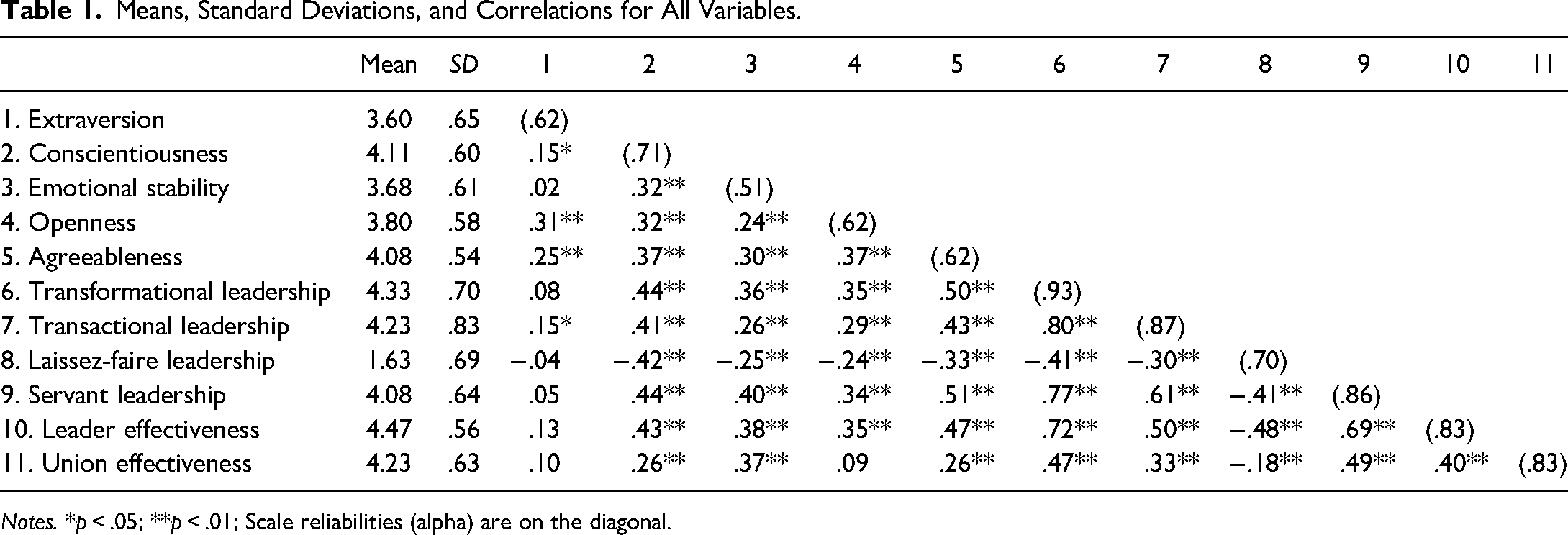
Notes. *p < .05; **p < .01; Scale reliabilities (alpha) are on the diagonal.
Because of the high correlations, two approaches were used to assess potential problems with multicollinearity. First, the variance inflation factor (VIF) was used. The VIF was highest for transformational leadership, at 4.05 in the regression for union effectiveness and 4.60 for leader effectiveness. There are differing rules of thumb for a cutoff level for the VIF, but a range from 3 to 5 is generally considered a moderate level of multicollinearity, and over 10 is considered high. Thus, the transformational leadership measure appears to have a moderate level of multicollinearity. The other variables of interest all have VIFs below 3.0.
The second approach is based on work by Kalnins (2018), who suggests that even with modest VIFs, multicollinearity can also occur among two independent variables with moderate or high bivariate correlations (here, transformational and servant leadership) if two additional criteria are met. First, the variable's beta in the regression must be of the opposite sign than its bivariate correlation with the independent variable. This is not the case here. Transformational leadership has a positive bivariate relationship with both leader effectiveness and union effectiveness, and its beta is likewise positive in both regressions. The same is true of servant leadership. Second, if the strength of the relationship changes dramatically from the bivariate relationship to the beta, for example, becoming nonsignificant in the regression, this is also a concern. But here, transformational leadership is significantly correlated with leader effectiveness (.72, p < .01) and union effectiveness (.47, p < .01). And in the regressions, it retains a statistically significant positive result. This pattern of results is the same for servant leadership. From these results, I conclude that while there is a question of moderate multicollinearity for transformational leadership, it is not significantly distorting the regression results.
Analysis Design
Analyses of leader effectiveness and union effectiveness were conducted in stages. First, in order to determine if an OLS regression could be used, or if the nested structure of the dataset (i.e., multiple ratings of the same leader) required a different approach, the intraclass correlation (ICC) was calculated. The ICC is defined as the portion of the total variance that is accounted for by the group-level variance—that is, the variance related to the individual union leader. The ICC was .12 for leader effectiveness and .23 for union effectiveness. Following Lane, Nimon and Roberts (2013), an ICC over .10 calls for the use of Hierarchical Linear Modeling (HLM), rather than OLS regression. To prepare the data for HLM, all variables (except the bivariate demographic variables) were centered around the mean (Garson 2013).
Next, a series of five models were tested using HLM. Results are shown in Table 2 for leader effectiveness and Table 3 for union effectiveness. For each dependent variable, Model 1 includes only control variables (gender, race, and industry). In Models 2, 3, and 4, a single theoretical approach (personality, full range model, or servant leadership) is added to the demographic variables. Finally, Model 5 includes all three conceptual approaches.
HLM Results for Leader Effectiveness.
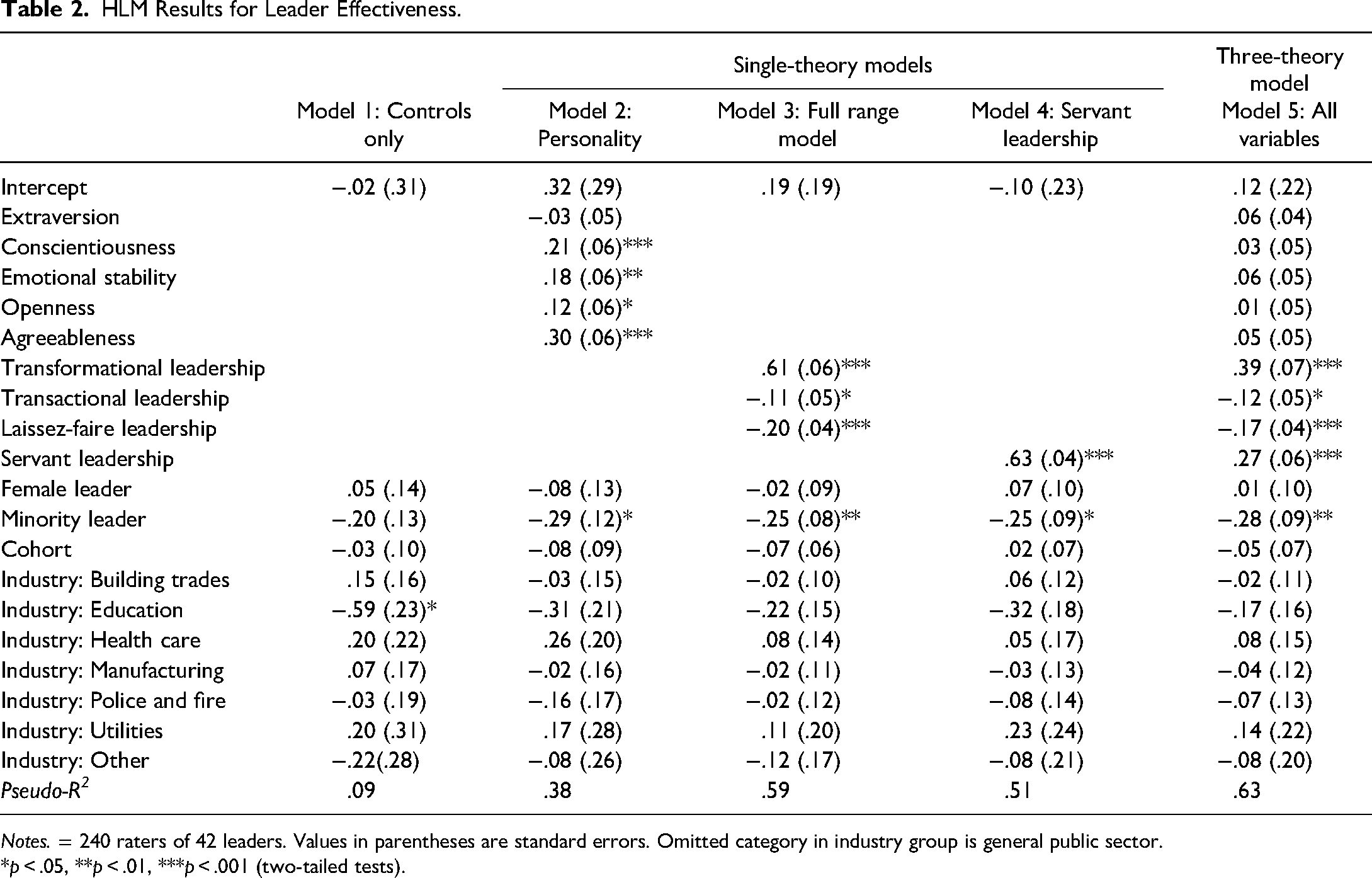
Notes. = 240 raters of 42 leaders. Values in parentheses are standard errors. Omitted category in industry group is general public sector. *p < .05, **p < .01, ***p < .001 (two-tailed tests).
HLM Results for Union Effectiveness.
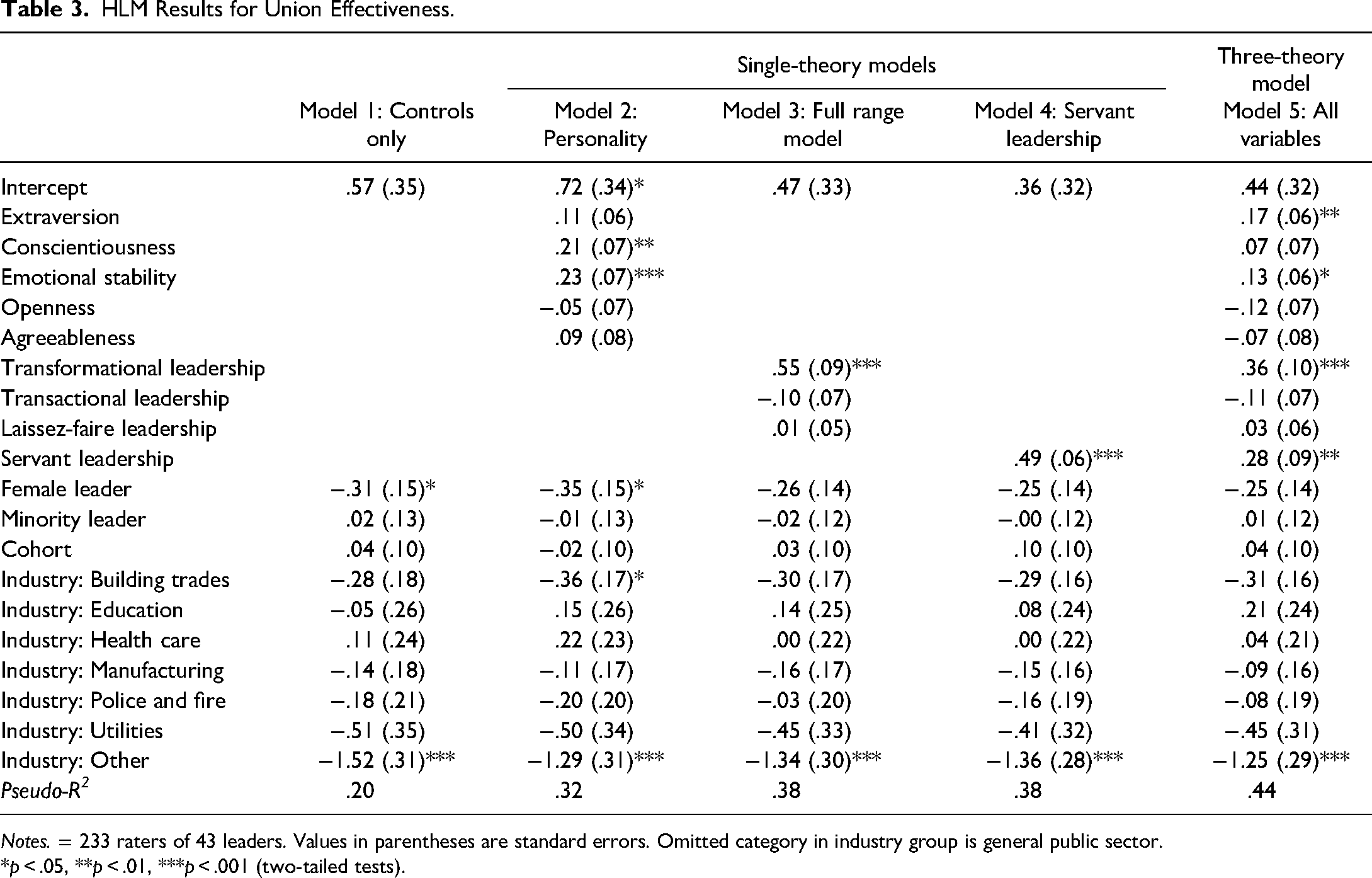
Notes. = 233 raters of 43 leaders. Values in parentheses are standard errors. Omitted category in industry group is general public sector. *p < .05, **p < .01, ***p < .001 (two-tailed tests).
Leader Effectiveness
Results are shown in Table 2. All three of the single-theory models were an improvement over the model containing demographic variables only. In the personality model (M2), extraversion was not significant, yet this is considered the Big 5 personality variable with the most consistent relationship with leadership. The other four personality measures (conscientiousness, emotional stability, openness, and agreeableness) were all positively and significantly related to leader effectiveness. Thus, H1 was not supported, but H2, H3, and H4 were supported.
In the Full Range Model (M3), transformational leadership was positively and significantly related to leader effectiveness, supporting H5. In contrast, transactional leadership and laissez-faire leadership were negatively and significantly related to leader effectiveness. This contradicts H6 and supports H7. In Model 4, servant leadership was positively related to leader effectiveness, supporting H8.
When all three models were combined (M5), none of the personality variables were significantly related to leader effectiveness. However, the full range model and servant leadership continued to have a significant effect on leader effectiveness.
Union Effectiveness
The results for union effectiveness were similar, although not identical, to the results for leader effectiveness (see Table 3). Again, in the personality model (M1), extraversion and openness were not significant, indicating that H1 and H4 were not supported. Conscientiousness and emotional stability were significant, supporting H2 and H3. In the three-theory model (M5), a different combination of personality variables—extraversion and emotional stability—were significant.
In Model 3, transformational leadership was significantly related to union effectiveness, supporting H5. But transactional and laissez-faire leadership were not related to union effectiveness, and thus H6 and H7 were not supported. Servant leadership was significantly related to union effectiveness in Model 4, supporting H8. In Model 5, which combines all variables, extraversion, emotional stability, transformational leadership, and servant leadership were all significantly and positively related to union effectiveness.
Discussion
Methodological Limitations and Contribution
The most significant limitation of the study is that the leaders chose the people to rate them. It would be preferable to have a more structured way to select the raters—for example, the leaders’ supervisor, all direct reports, and a few peers—that was under the direct control of the researcher. But that would require the approval of the 23 unions included in the study, and unfortunately, it was not possible for this study.
A second methodological limitation is the restricted range of the sample. Leaders have to be considered successful, or have significant potential for success, to be sponsored by the unions and sent to the HTUP. Thus, it is unlikely that any of the leaders are poor performers, and in that sense, the range of the effectiveness outcome measures is likely restricted. Another concern about the sample is that because of the high cost, unions with more limited financial resources are unlikely to be able to send participants to the program. Conducting this research with a broader range of leaders would be desirable. While recognizing these limitations, it is still unusual to be able to conduct quantitative analysis of this sort—with union leaders who have significant responsibilities, and who come from a range of both private and public sector unions. Thus, the study is valuable as a starting point, although it is not generalizable to the entire labor movement.
A secondary goal of this study was to create a short survey that could be used to assess union leadership, both for research purposes and as a developmental tool for union leaders. This is especially important because currently, quantitative research on union effectiveness and union leader effectiveness is relatively limited, compared to similar research in other types of organizations. The survey developed here could be easily used by other researchers and by labor educators as part of a leadership development program. 2
Theoretical Implications
The results presented here in some ways support and in other ways contradict other studies of leadership. First, the personality variables were relatively insignificant in predicting leader or union effectiveness when leadership style was taken into account. As discussed above, the Big Five personality variables, especially extraversion, have been widely researched and found to be strongly related to leadership in many settings. In Model 5, which incorporated all the variables, the personality traits were not significant for leader effectiveness. And only two of them—extraversion and emotional stability—were significant in Model 5 for union effectiveness. Since extraversion would seem to be especially important in organizing and in running for office, additional research might address whether the impact of extraversion on effectiveness varies with the different leadership roles within the union.
A second surprising finding relates to transactional leadership. Other research has found that both transformational and transactional leadership are positively related to organizational effectiveness, and some suggest that transformational leadership expands and builds on transactional leadership (Bass 1999). Here, transformational leadership is positively and significantly related to leader effectiveness, as expected. However, transactional leadership is negatively related to effectiveness in the regressions. Unfortunately, this result for transactional leadership appears to meet the criteria proposed by Kalnins (2018) for a Type I error due to multicollinearity. 3 Thus, this study cannot provide reliable evidence about whether transactional leadership is effective in labor unions.
Finally, the results for servant leadership are noteworthy. Servant leadership has not been studied much in labor unions, even though its values-based approach fits well with the goals of the labor movement. Servant leadership focuses on prioritizing the needs of the followers and building a community. It was significantly related to both leader effectiveness and union effectiveness in Models 4 and 5.
But since both servant and transformational leadership are idealized styles, and since their measures are highly correlated, it can sometimes be difficult to distinguish between the two. Both styles place an emphasis on developing the skills of the followers. And they both currently emphasize ethical leadership—although this was not the case in the early development of the concept of transformational leadership. One view is that the core difference between these two concepts is this: Whose goals are being followed? In transformational leadership, the leader sets the goals. In servant leadership, it is the followers’ goals that are paramount.
In the union setting, both leader-set goals and member goals are important. If member goals are not met, support for unions will decline. Traditionally, we think of these goals as dignity and respect on the job; and favorable wages, hours, and terms and conditions of employment. We may also think of member goals as having a sense of inclusion and belonging. And indeed, these goals may overlap substantially with union leaders’ goals. But union leaders are also responsible for strategizing about the future of the union, and so must include a focus on organizing and engagement in the political process. There are also larger social justice goals for which the leaders may set a goal and ask the members to follow. There can be tension as a smaller group of union members work to promote activism on controversial issues such as climate change or diversity, equity, and inclusion. A servant leader in this situation might face a conundrum: they cannot support all their followers if the followers are on opposite sides of these issues. At best, they can prepare the followers to make their case as effectively as possible. In contrast, a transformational leader may independently adopt controversial or progressive goals and use their charisma and communication skills to generate support for them among a majority of the membership. It can be exciting to follow a charismatic, transformational leader. Yet, servant leadership remains attractive to many followers. The appeal of having a leader who puts your goals first is compelling. So, while there can be tension between these two approaches, unions can benefit from both—although one approach may be better at certain times or in certain locations within the labor movement.
Demographic Implications
While demographic measures were included here only as controls and no predictions were made for them, the results for the race and gender of the leader merit further discussion. In some of the models, race and gender were significantly associated with union and leader effectiveness, respectively. The pattern of results, however, is inconsistent. Results of a post hoc analysis indicated that there were no significant differences based on gender or race in either leader effectiveness or union effectiveness when no other variables were included. This pattern held when an interaction term was used to measure intersectionality.
However, from here the results diverge. Notably, they vary by outcome measure. Gender has a significant effect in Models 1 and 2 of union effectiveness, but not in any models of leader effectiveness. One interpretation of this might be that the raters like the female leaders as much as they like male leaders (contributing to equal scores on leader effectiveness), but are not willing to give them a high score for performance (i.e., union effectiveness). This could be because of rater bias. It could also indicate a “glass cliff” effect (Ryan and Haslam 2005), in which women are only able to attain top leadership positions when organizations are already facing a crisis or are in a period of poor performance.
In one way, the results for race are a mirror image of the results for gender. There are no significant results for race on union effectiveness (i.e., performance), but leaders who identify as a minority were rated lower on leader effectiveness in Models 2, 3, 4, and 5. Again, this could be a result of rater bias.
Further post hoc analysis suggested that the gender differences first appear when the industry controls are added. Figure 1 shows the mean ratings for union effectiveness by the gender of the leader and the gender of the rater. There is virtually no difference in the ratings. But when industry controls are added, female leaders are rated lower by both male and female raters, as seen in Figure 2. Normally, if bias was concentrated in a specific industry, controlling for industry would reduce the statistical effect of gender, rather than increase it. Gender differences were found in Models 1 and 2, but gender was not significant in Models 3, 4, and 5.
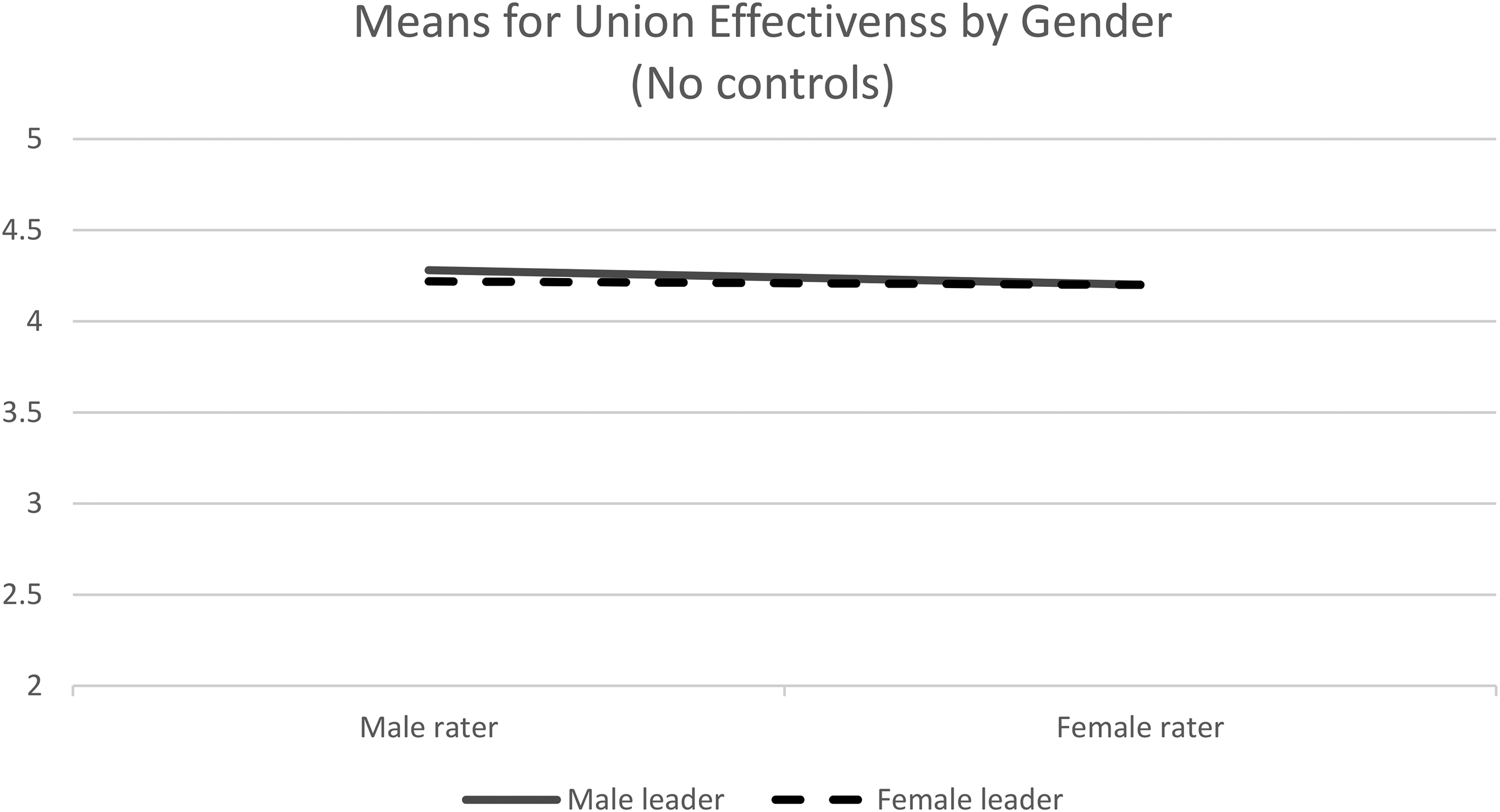
Gender and union effectiveness.
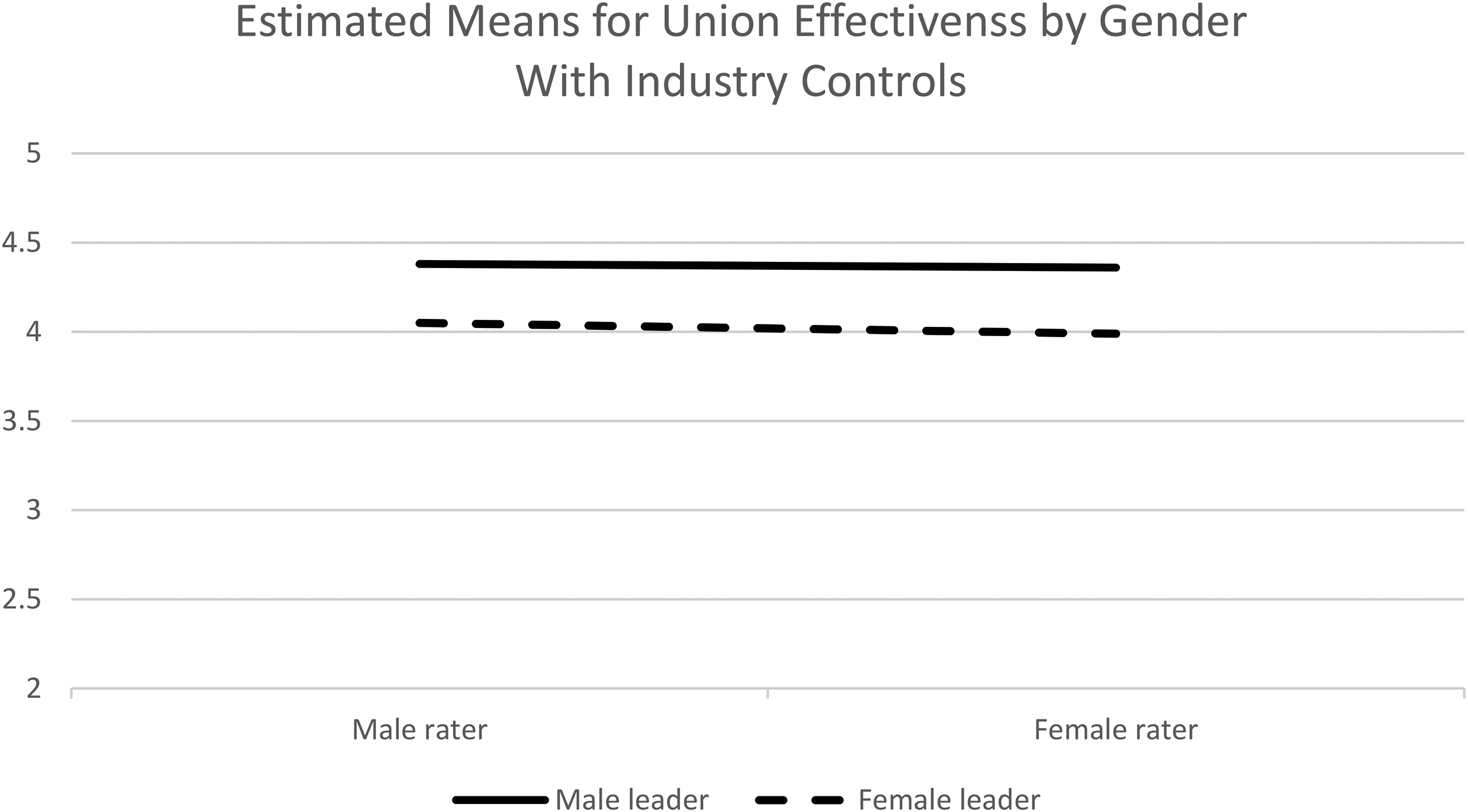
Gender and union effectiveness with industry controls.
The ratings for leader effectiveness by race are shown in Figure 3 (without controls) and Figure 4 (with controls). Minority status was not significant in Model 1, but was in Models 2, 3, 4, and 5. Figure 4 shows controls based on Model 2. In this case, the overall pattern is very similar in both charts, but the effect is slightly more pronounced when industry controls and personality variables were added.
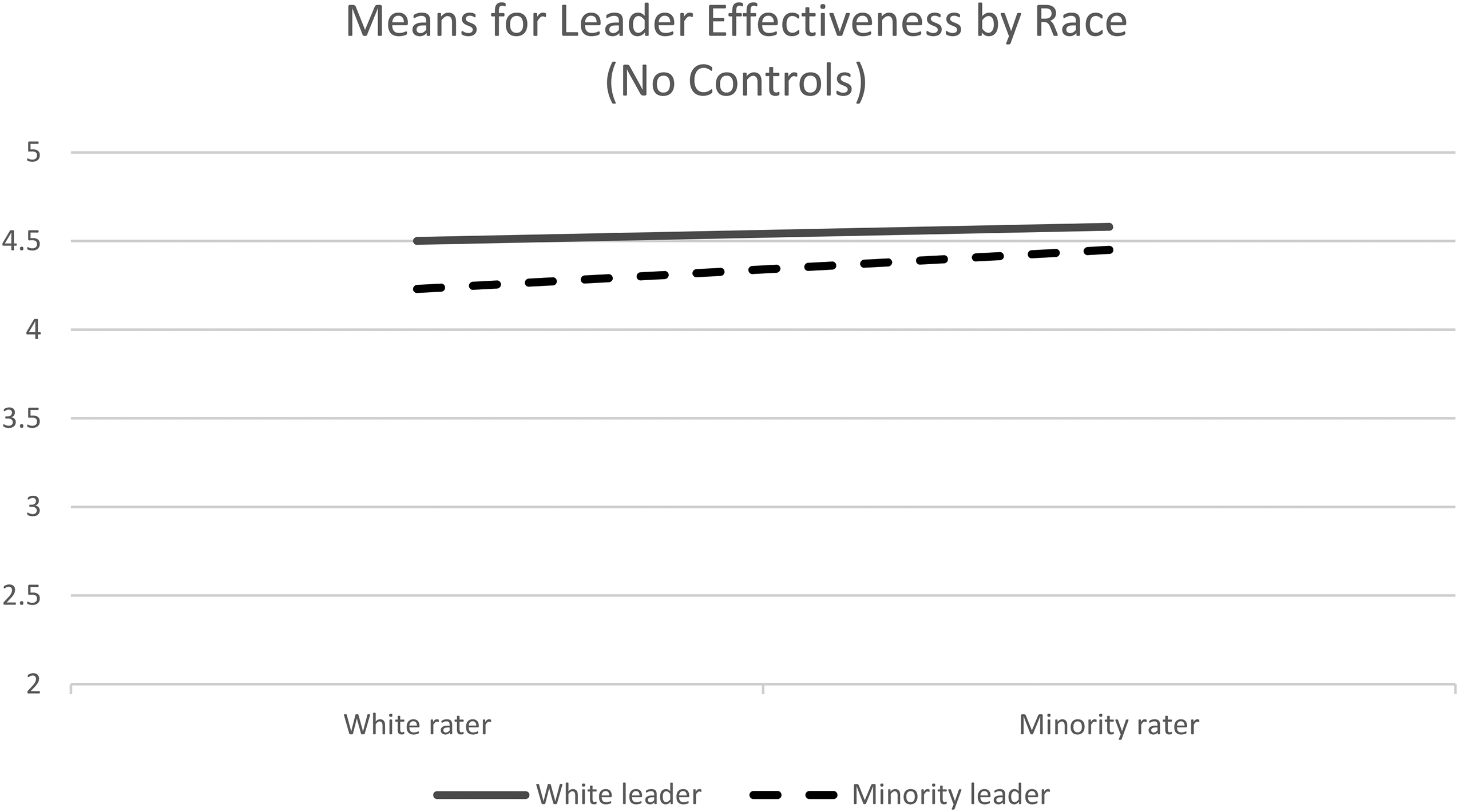
Race and leader effectiveness.
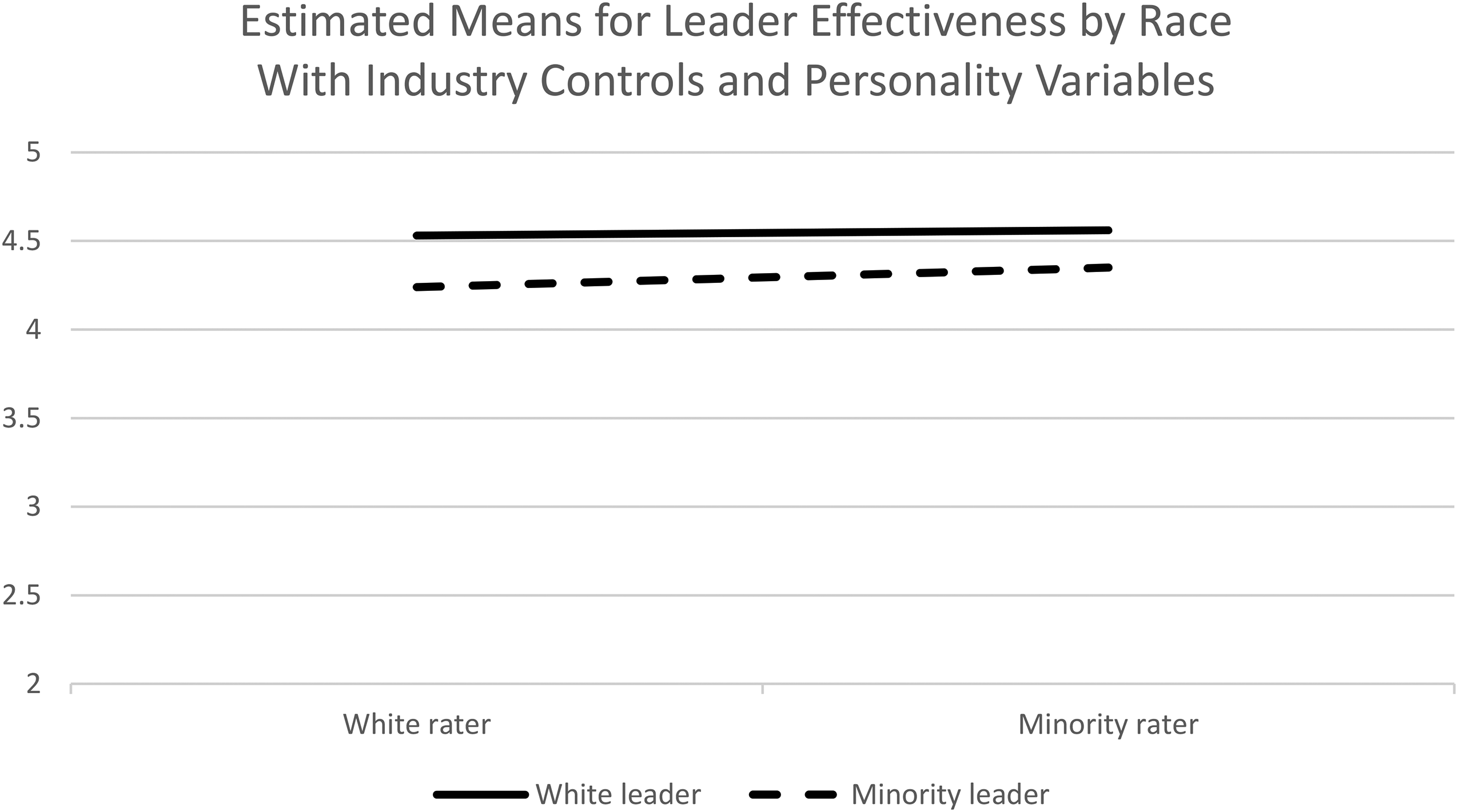
Race and leader effectiveness with industry controls and personality variables.
There are several possible explanations for these results for race and gender. One is that there is still considerable bias, even within the labor movement, against women and people of color as leaders. Another explanation is that there is a statistical suppressor operating—although it would not appear to be the same variable in both cases because the differences by gender and race mostly appear in different models. More accurate modeling would help clarify this issue. A third explanation, suggested by the fact that there are no significant correlations between race or gender and the effectiveness measures, is that it is something about the grouping variables that causes the statistical significance to appear.
Implications for Labor Educators and Unions
This study applies three of the main theories about leadership effectiveness from the organizational psychology literature to labor union leadership. The results suggest that two styles of leadership—transformational and servant leadership—are important predictors of effectiveness and could be the foundation of a leadership development program. New labor leaders can be trained in the skills of transformational leadership to develop and communicate a vision for the union that is embraced by the membership. The best transformational leaders offer visions that are compelling, challenging, and attainable. They communicate these visions very effectively. They also serve as role models, and followers want to be like them. Labor educators could work with labor leaders to develop and communicate a positive vision of what a union can accomplish today.
Leadership development programs could also focus on servant leadership. Spears (2002) identifies ten characteristics of a servant leader: listening, empathy, healing, awareness (including self-awareness), persuasion, conceptualization, foresight, stewardship, commitment to the growth of people, and building community. Each of these could be incorporated into a curriculum on union leadership development.
Both transformational leadership and servant leadership are romanticized ideals of what we would like our leaders to be like. But leaders are human, and few can live up to these standards. Leaders cannot always be transformational; they cannot always be perfect servants. Furthermore, followers are human as well and may have goals and interests that do not match the goals of the leaders or other members. And union members may or may not be willing to be followers. As Plato said, “The real challenge of leadership is working successfully with people who do not always like each other, do not always like the leader, and do not necessarily want to live together” (quoted in Ciulla 2004, 322). As labor educators, we can provide leadership development that acknowledges these challenges and still prepares leaders to make unions stronger and more effective.
Footnotes
Acknowledgments
The author would like to thank Sharon Block, Alida Castillo, Chenwei Liao, and the participants in the Harvard Trade Union Program for their help with this study.
Declaration of Conflicting Interests
The author declared no potential conflicts of interest with respect to the research, authorship, and/or publication of this article.
Funding
The author received no financial support for the research, authorship, and/or publication of this article.