



Abstract
Research has provided limited knowledge of how people in organizations experience growth of agency during circumstances that seem hopeless and stuck, and how such growth emerges. Drawing from the study of the turnaround processes at a nursing home and the Pragmatism of Dewey and Mead, we contribute with a theory of how agency is produced in social inquiry. We suggest that the puzzling accounts of lightness in the experiences of people at this nursing home help explain how a field of social inquiry may be charged with creative and agentic force. We show how agency emerged through a series of action sequences related to inviting people into inquiry through the opening of a troublesome situation, the resulting voicing of needs and ideas for improvement, as well as the subsequent experimenting and surfacing of tales of meaningful progress from such actions. Furthermore, our empirical observations suggest that the emergence of collective desire to meet the needs of the Generalized Other is a central, yet understated, part of agency produced through social inquiry. Lightness of agency may be accentuated, paradoxically, by the weight of a more generalized situation – in this case that of institutionalized care for elderly – that the local inquiry exemplifies and in which it resonates.
The one thing I’m afraid of is losing this lightness, the lightness and madness in all of this that we are doing. When you are old, heavy, with an aching body, and lay there, in the sea, and it just floats. We needed to hold them a little, and the two of them lay there and the seagulls were screaming, and it was fantastic, shining weather. They did not want to get up. There were burning jellyfish, and they just snorted at Ann and me for being afraid of getting burned. They were full of bliss. You see that, well, then I get so moved because you just feel the joy and that lightness, that freedom that they have and are experiencing (. . .) And Elsy in particular, who had not believed this would ever be possible again. It was such a feeling of victory too. So, we got up and sat down with a cup of coffee and ate buns, and then the 94-year-old, not Elsy, the other one, said, “Can we bathe one more time?” Sure, we can bathe one more time!
Seahill nursing home was once an organization with struggling people. According to employees, a combination of demanding work, lack of resources and little collaboration, limited regard in the local community, and slim prospects for improvement weighed rather heavily on people – so heavily that almost one-quarter of the workforce was on sick leave. Then, with a change of leadership, a pervasive and positive transformation apparently began almost immediately. During interviews, nurses told stories of how they felt invited and empowered to make improvements in their workplace. Residents were asked what they wanted the most and their answers brought fresh perspectives on the needs for care. Boat trips, sightseeing bus tours, beer brewing, mini-concerts, trim sessions, bazaars, Christmas tree lighting, sea bathing and hug-selling followed. Employee absence decreased to below 2%. As voiced by people in the local community, the nursing home transformed into a vibrant centre of the community, celebrated for its warm, inviting atmosphere and engaging social activities. The local grocery store owner proclaimed that the nursing home had become ‘an idea volcano’ that inspired the whole town. Moreover, leaders as well as employees and volunteers talked of the change experience as one of surprising ease and fun, using terms such as ‘madness’, ‘magic’ and ‘lightness’. Variations of the opening story about the bathing ladies at Seahill, both over 90 years old, have been told to many audiences, often with an emphasis on the necessity of maintaining lightness. What could an experience of lightness in such a process of organizational turnaround mean?
To understand the significance of the turnaround process at Seahill, including the puzzling emphasis of lightness when emerging from a hardship, we turn to pragmatism and theories of agency. As a process philosophy dealing with action and meaning (Alexander, 2013; Dewey, 1922, 1929; Evans, 2000; James, 1890 [1950]; Joas, 1996), pragmatism is uniquely suited to understand growth of agency as a relational, emergent and generative phenomenon where people unlock problematic situations and discover new possibilities through action (Farjoun, Ansell, & Boin, 2015; Simpson & den Hond, 2022). Prior research has provided only partial knowledge of how people in organizations experience growth of agency when they overcome troublesome situations. Struggles over agency, or the paradox of attaining agency in the face of being embedded in structural determination, are acknowledged by many (Garud, Hardy, & Maguire, 2007; Seo & Creed, 2002). The process of breaking free from determination has also received attention, especially by research emphasizing political contestation and the temporal reorientation of actors (Dalpiaz, Rindova, & Ravasi, 2016; Lawrence, Suddaby, & Leca, 2011). Yet, such accounts tend to privilege temporality and cognition, following from the influential work of Emirbayer and Mische (1998). Much less has been said about how agency is produced in embodied and emotive interactions (Burkitt, 2016) or how actors distance themselves from a constraining past and build shared intentionality and meaning (Robichaud, 2006).
Pragmatism allows us to transcend the dualism between agency and structure by considering them to be interlinked and partly overlapping processes (Farjoun et al., 2015). It is a tradition of theorizing that is particularly fitting for problematic situations ‘when established habits and old ways of thinking and acting are no longer efficacious’ (Simpson & den Hond, 2022, p. 132). We approach pragmatism by focusing primarily on Dewey’s notion of social inquiry (Dewey, 1922, 1929, 1938 [1991]; Dewey & Bentley, 1949 [1991]) in connection with Mead’s work on significant social gestures (Mead, 1910, 1934). We further communicate with streams of research that explicitly apply a relational ontology to agency, whether in organizational research inspired by pragmatism (Lorino, 2018; Martela, 2015; Shotter, 2017; Simpson, 2009, 2016), relational sociology (Burkitt, 2016; Dépelteau, 2018) or the tradition known as the communicative constitution of organizations (CCO ) (Brummans, 2018; Cooren, 2018, 2020; Robichaud, 2006; Schoeneborn, Kuhn, & Kärreman, 2019).
Empirically, we draw from accounts of the positive transformation of the Seahill nursing home. The notion of lightness was initially derived from our fieldwork. We use it as a sensitizing device that we suggest captures central qualities of how people in our case organization experienced and co-produced growth in agency in their interactions at work. We dwell on the puzzling accounts from people in the field who describe experiencing the transformation of their workplace as surprisingly easy and swift. We interpret these accounts as telling of an initial unlocking of agentic resources through reorientation of internal actors, with a sense of temporal release from the past and sudden strengthening of felt togetherness, followed by expanding the reach and emotional charge of inquiry through involving residents and other stakeholders in inquiry. We explicate lightness as the clue to what gives social inquiry its creative force, in short, explaining the way people grow their capacity and desire to act with and for others as well as from a burdening past and towards continued progress and hope for their organization and its beneficiaries. The primary contribution of the paper is an empirically based theorizing of how social inquiry can grow agency, including how situations are opened and the seeding of desires for human betterment.
Theorizing Agency from a Pragmatist Lens of Social Inquiry
By theorizing agency as a form of social inquiry, we seek to understand the relational and temporal processes in the transformation processes at Seahill. What could explain the seeming swiftness of the collective reorientation and the emergence of a capacity for meaningful action in this organization? Building on the pragmatism of Mead and Dewey, Emirbayer and Mische (1998) defined agency as a temporal-relational form of social engagement that is situated within the threefold present, allowing for the interplay of habit (through iterations from the past), judgement (contextualization within the contingencies of the present) and imagination (as a capacity to imagine alternative future possibilities) in interactive responses to problems. This treatment of habit was heavily inspired by the work of Dewey (1922, pp. 24–42), who had recast the understanding of habit from the mere repetition of routinized responses to broader dispositions for action that have an active and projective function. For some situations, agency may involve the flexible and intelligent extension of established habits (Alexander, 1993; Cohen, 2007; Dewey, 1922, pp. 40–44). For other situations, agency entails a more prolonged effort of social inquiry (Dewey, 1922, pp. 56–57, 75–78; 1938 [1991]; Evans, 2000).
Inquiry as a conceptual complement to habit is one of the key tenets of Pragmatism. This was first entertained by Peirce, who understood inquiry as arising in situations marked by the irritation of doubt and the subsequent struggle to attain belief that can engender the next steps of action – ultimately settling into new habits (Peirce, 1877 [1966], pp. 97–101). For Dewey, the need for social inquiry was a recurrent topic that emerges in many of his writings, simultaneously marking his critique of the ‘quest for certainty’ in religion and science, his battle against biological or cultural determinism, and his denouncement of the separation of theory from practice (Dewey, 1929, 1938 [1991]; McDermott, 1977, pp. 356, 575–576; Toulmin, 1984). These were certainties and dualisms that Dewey saw as obstructing a more active coping with conditions and creating possibilities for human growth (Alexander, 2013; Dewey, 1922, 1929). Based on Dewey’s admiration for the methods of physical science, social inquiry emerged as a form of experimental empiricism that could be broadly used to handle social challenges (Festenstein, 2019): Through systematic and iterative coupling of reflection and concrete experience, the uncertainty of a troublesome situation can be reduced and tentative next steps taken (Evans, 2000).
In other words, a turn to social inquiry is a turn to agency. Through social inquiry, ‘The “business” of will [or agency] is to be resolute; that is, to resolve under the guidance of thought, the indeterminateness of uncertain situations’ (Dewey, 1929, p. 238, emphasis in original). In what follows, we qualify an analytical framework to orient our interpretation of the transformation of Seahill based on two sets of questions related to the site of inquiry and the processes and meaning of inquiry.
The site of inquiry: Situation, habit and doubt
One of the more intriguing patterns of the turnaround process at Seahill nursing home was the symbolic significance that people in the organization granted to the first staff meeting after the two new leaders had arrived. ‘It all started there’ was the chant we heard. What could be fruitful ways of starting inquiry?
Problematizing the situation is the first step of inquiry, and inquiry may act simultaneously on the environing conditions of the situation and habit (Lorino, 2018, p. 102). Dewey insisted upon the uniqueness of doubt concerning what is ‘uncertain, unsettled, disturbed’ (Dewey, 1938 [1991], p. 109) as setting up the situation, and furthermore, it is the situation that has these traits. It is not merely subjective. Joas (1996, p. 160) voiced a similar argument in suggesting that human action is both contingent upon and constituted by the situation. What we may ask then is how people within such a conditioning – for example, people grappling with limited resources in the institutional care for elderly in a particular organization at a particular time – somehow construct the situation as needing of inquiry and what kind of constructing it is that prepares the ground for the emergence of agency. Dewey’s answer in his Logic (1938 [1991]) is partly about the questioning going on, because ‘we inquire when we question’ (p. 109), and partly about ‘how the situation is taken, adjudged to be problematic’, including how ‘environing conditions are examined with reference to their potentialities’ (Dewey, 1938 [1991], p. 111).
Dewey (1938 [1991]) goes on to specify patterns of inquiry that also involve a form of investigation of the situation through acts of observation, reasoning, ideation and experimental action. Yet, he provides little further detail on the initial problematizing of situations in inquiry in relational terms. Cooren (2020) has recently pointed to what might be involved. Having stakeholders voice concerns in a situation may function to confront multiple viewpoints and increase the number of elements under consideration. By ‘multiplying its authors’ (Cooren, 2020, p. 183), one can allow the situation to be co-defined and to reveal itself in surprising ways. In other words, constructing a situation as a polyphonic dialogical scene to engage people in inquiry involves not just rendering it sufficiently open and with generative potentials, but also positioning people as co-creators when moving forward.
A further complication in understanding the site of inquiry concerns how doubt uniquely addresses habit in the situation. Does the situation appear to be taken as a matter of extending existing habits or creating entirely new ones? Dewey (1922, pp. 40–44) saw intelligent habit as encompassing will, or agency. Habits are agentic insofar as they are made flexible resources for improvising (Cohen, 2007) and inhibit capacities to readjust activity and meet new conditions (Tsoukas & Chia, 2002). Dewey also held that changing unreflective or ‘dead’ habits has little to do with iterating from the past but may necessitate initiating and reflecting on entirely new courses of action (Dewey, 1922, pp. 37, 56–57). Thus, the potential for agency in inquiry may also be seen as growing from the tension between unreflected habitual action and creative action (Joas, 1996, p. 129). When failed habits are deeply ingrained in the social field, questions of more fundamental agentic re-orientations emerge (Emirbayer & Mische, 1998, pp. 1009–1011). How does the need for a liberation and reorientation become problematized at the site of inquiry and what leverage for agency could that create?
The process and meaning of inquiry: Trans-action, gesture and the Generalized Other
Several employees at Seahill highlighted the reshaping of interactions as key to the transformation process. To locate growth of agency in inquiry as a recursive process of meaning making, it is necessary to come to grips with assumptions of relationality. The work of Emirbayer and Mische (1998) may be criticized for disregarding non-human interactants (Cooren, 2018) and privileging cognition and the reflexivity of individual actors, thereby downplaying the ‘embodied, emotional, interdependent forms of relating in which reflexivity develops and is enmeshed’ (Burkitt, 2016, p. 330). The works of both Dewey and Mead offer fruitful conceptions for arriving at such a fuller account of relationality. A key notion here is that of trans-action 1 from Dewey and Bentley (1949 [1991], pp. 101–102), which encompasses an ontology of action that that moves beyond limited focus on self-action, where agency may be attributed to individuals, or inter-action where agency is held to be co-created between two or more unchanging entities. By contrast, an ontology of trans-action offers a way of understanding agency where ‘causality is undone by the mutual emergence of all the constituting elements’ (Simpson, 2016, p. 166). This involves an analytical focus on the larger system or field, derived from a metaphor of electromagnetic fields (Dewey & Bentley, 1949 [1991], pp. 107–112; Lorino, 2018, p. 139). The notion of field is foreshadowed in much of the writing of Dewey (1925 [1958], pp. 8, 262; 1938 [1991], pp. 72, 152–153) as a way of understanding human experience as inseparable from its environing conditions. In such a field, agency cannot be attributed to preformed subjectivities or singular entities but emerges, or not, through a chain of trans-actions (Dépelteau, 2018), a totality of combined influences from the evolving whole of persons, things, symbols, institutions and events of interaction, including the invocations of past and present voices outside the organization (Cooren, 2020).
Following the electromagnetism metaphor, we may further ask how a particular field of action is charged with meaning and engagement more so than others. On this note, we turn to the work of Mead. Mead can be seen as placing his work precisely in the intersection between trans-action and temporality (Lorino, 2018; Simpson, 2009) and the associated construction of collective forms of meaning in the emergent event (Mead, 1932, 1934). Like Dewey and Bentley, Mead gave primacy to the field of social action, underlining that it ‘must be taken as a dynamic whole – as something going on, no part of which can be considered or understood by itself – a complex organic process implied by each individual stimulus and response involved in it’ (Mead, 1934, p. 7). Of particular interest here is Mead’s notion of significant gesture, whether vocal, textual and embodied, as a producer of meaning. Gestures become significant when they trigger action sequences in the social field, when they are ‘acts that call out responses which lead to readjustments of acts which have been commenced, and these readjustments lead to still other beginnings and responses which again call out still other readjustments’ (Mead, 1910, p. 398).
In such a sequence of actions, taking the role of the other is fundamental to formation of meaning because significant gestures become internalized to have the same meaning for all individual members of a group and enable people to adjust their subsequent behaviours (Mead, 1934, pp. 46–47). Mead here famously introduced the notion of the Generalized Other (Mead, 1934, pp. 89–90, 154–156) as denoting socially agreed-upon meanings that reflect the generalized attitudes and perspectives assumed to be relatively uniform across a given social group. The meaning making that goes on does not transcend specific gestures, specific others and specific situations until they are reflexively considered in retrospect of the temporal event and further internalized in experience. Thus, meaning making in trans-action requires the reflexive accumulation of significant symbols related to Generalized Others that people in a field of social action tentatively appropriate and that may have bearing upon their future actions. In the words of Mead (1934, p. 254), ‘This taking of the role of the other . . . is not something that just happens as an incidental result of the gesture, but it is of importance in the development of cooperative activity.’
We adopt this language of significant gestures and the Generalized Others from Mead because the turnaround of the Seahill nursing home from the beginning appeared a case thick on relational re-orientation, both in internal collaboration and in the care for residents. Moreover, as underlined well by Robichaud (2006), agency resides in action but should not be limited to it. There is a need to conceptualize the accumulation of shared intentions and connections in their narrative context to avoid reducing agency to ‘a series of actions and reactions displaced in time and space’ (Robichaud, 2006, p. 133).
In summary, limited research has been done on the experience and production of positive shifts of agency during circumstances that seems hopeless and stuck. We have turned to pragmatism and to theories of social inquiry to orient our empirical inquiry and sensitize us to variations of a larger research question: What are the specific features of social inquiry that may grow agency in troublesome situations? How do we understand the experience of lightness by people in our case organization from such a theoretical lens?
Research Setting and Method
Our interest in the Seahill case emerged from learning about the change process in the organization from a series of presentations by the two new department leaders at practitioner conferences and executive educational courses where we both taught. We were struck by a combination of what seemed to be a profound transformation process, and the jargon-free storytelling, and moved by tales of novel actions to provide better care for elderly residents. It seemed a most unusual turnaround. The department leaders told their stories from a gloomy institutional setting often associated with public concerns about poor living conditions for residents and seemingly little space for agency. We chose a process-oriented study (Langley & Tsoukas, 2010) with a narrative approach to understand how people accounted for and experienced the events of the turnaround. We have sought to elicit rich stories that could help us build theory (Kohler Riessman, 2008) and allow readers to make comparisons with their personal experiences (Stake, 1995).
Introducing the case
Seahill (all names are aliases) is a nursing home in a small Scandinavian council with 35 employees sharing the hours equivalent to 21 full-time positions. It serves 14 residents in the home’s building, 20 people in care apartments and about 70 people living in their homes. Seahill was established as a nursing home in 2008, with employees who previously had worked in home care in the same area. The period from the opening until February 2011 was characterized by our interviewees as one of confusion and conflict, with unstable and changing leadership. Many employees went on sick leave or quit their jobs. Seahill was considered unable to provide proper care to residents with serious health issues. At the beginning of 2011, absence due to illness was at 21.7%, and the employees reported their working environment to the authorities. At this point, the council decided to give the leadership responsibility to Jane, who was a trained nurse without any leadership experience. She was seen as a talent in creating positive energy and constructive relations at work. Jane recruited Sally, also a trained nurse, to be her assistant manager. In the first meeting with the employees, Jane and Sally were seen as inviting people to a journey of building pride in the workplace and making Seahill the heart of the local community. That first meeting became the start of a three-year period of energetic activity and positive change at Seahill.
Data collection
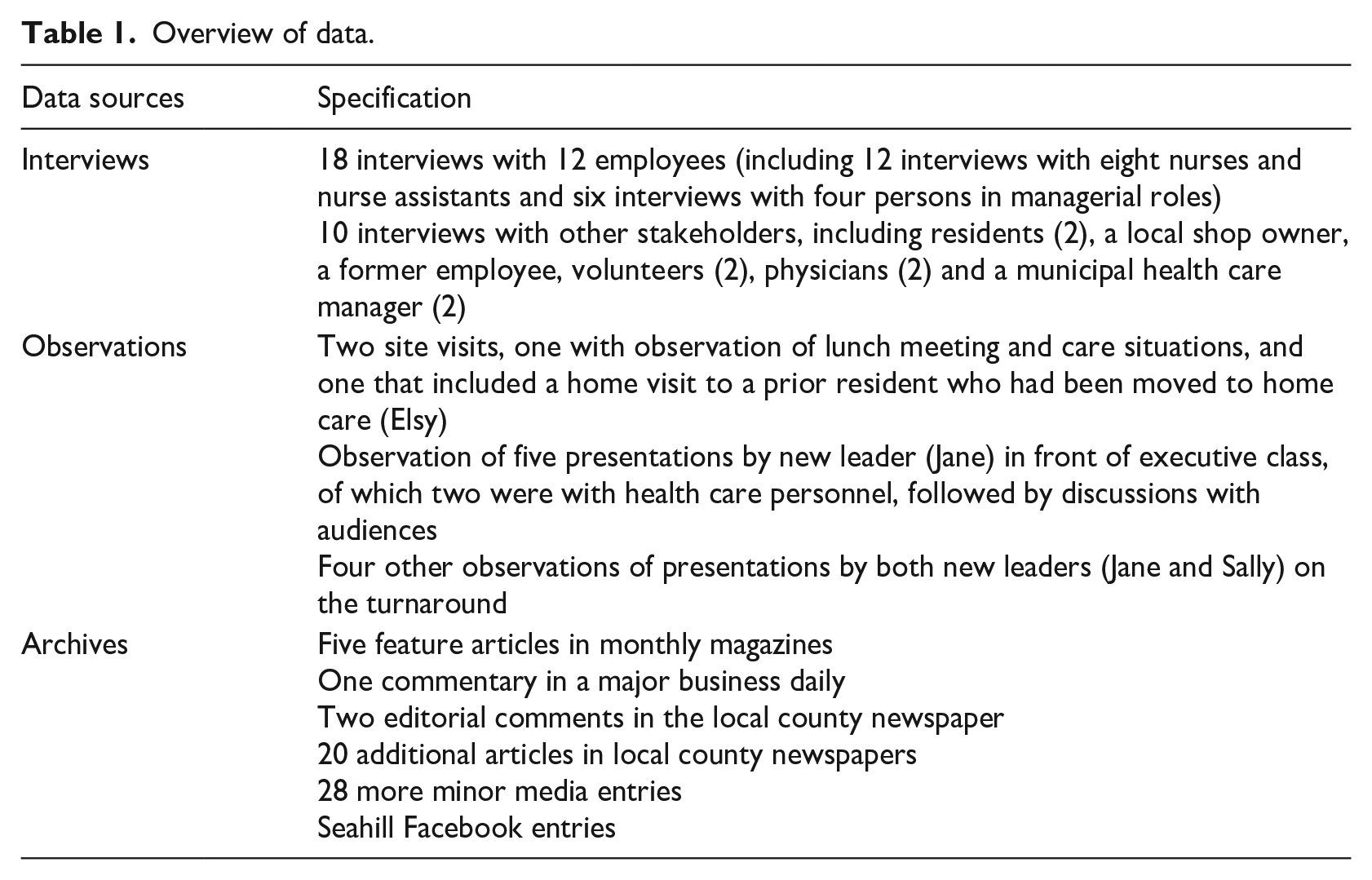
We combined semi-structured interviews with observations and archives from media articles. See Table 1 for an overview.
Overview of data.
Interviews
Twenty-eight interviews were conducted for this study, lasting from 20 to 85 minutes, of which 18 were taped and transcribed verbatim. This was done in three rounds. First, 10 of the interviews, all taped and transcribed, were conducted by students working on their master’s thesis under the supervision of the first author in 2014. We did an additional 10 interviews ourselves during a site visit after having gone through the results of the first round, also involving a few residents, volunteers and people in the local community. A last round of eight additional interviews was conducted after Jane and Sally had left the organization in 2015, with the last interview in early 2019. We did not tape interviews with residents or elderly volunteers in response to concerns expressed by staff that doing so could appear intimidating. We tried to compensate for that by one of us taking studious notes that we updated afterwards. All interviews but six were conducted on site and followed a semi-structured and open-ended format where we emphasized a narrative approach of eliciting stories of the change experience while also giving room to a multiplicity of voices (Kohler Riessman, 2008). We would typically begin by asking for a brief account of a person’s working history or otherwise relation to Seahill, followed by open questions about how he or she experienced the prior three years at Seahill and more directed questions about specific aspects of these experiences.
Observations
Our interest in the Seahill case began with five sets of observations of regional seminar presentations given by the two new leaders. They had been invited to speak to other health care workers and nursing home leaders and staff at various locations in the country. We observed five additional presentations after we began interviewing, four of them in an executive educational programme where we both taught. These events allowed us to see how the two leaders responded to questions posed by a variety of audiences. This also involved more informal conversations before and after presentations with selected audiences: How did they interpret what they heard? Would similar initiatives and resource mobilization make sense or be possible in their organizations? This dialogical sensemaking (Cunliffe & Scaratti, 2017) produced contrasting interpretations that helped us see the uniqueness of the case while being aware of the fragilities involved. Other observations took place during two site visits where we were able to see the premises, follow a lunch meeting, observe some of the nurses in interactions with residents and learn about their development work. Included also was a two-hour visit to one of the sea-bathing ladies, who was in extended home care at the time of study.
Archives
The change process at Seahill has evoked a fair share of attention in both local and domestic media. During the first site visit, we noted that articles from local and domestic newspapers were displayed as framed totems on the wall. We realized that journalists played significant roles in the social inquiry at Seahill and did a media search, identifying 28 articles directly related to the change process. The more useful of these articles told multi-voiced stories based on interviews with managers, employees and residents, thus complementing data from interviews and observations.
Data analysis
The interpretive journey for this paper took place as a repeated shuttling between empirical data and theory while invoking a methodological bricolage (Pratt, Sonenshein, & Feldman, 2022) drawn mainly from process studies and narrative approaches. Four steps of interpretation were central. We began with an open round of assigning meaning to our data, trying to stay true to the reality of the research participants and allowing interviewees to speak in their voices (Van Maanen, 1979). We subsequently noted the peculiar emphasis on ‘lightness’ as an experiential quality of the transformation process and decided to use it in a second step as a sensitizing device for a more thematically focused round of making sense of the data. We wrote a series of empirical vignettes that somehow seemed thick on agency and spoke of lightness. These vignettes were small composite narratives of care situations and events in the turnaround process, such as a first staff meeting with the two new leaders. They functioned as a form of ‘live coding’ (Locke, Feldman, & Golden-Biddle, 2015) in our interpretive process where we shared the vignettes with others, deepened our engagement with the data and built understanding of key events that was more coherent. A third step took inspiration from re-engaging with literature and finding ‘shifting agentic orientations’ (Emirbayer & Mische, 1998, pp. 1008–1011) as a phenomenon of particular interest. After returning to the data, the salience of social inquiry in producing agentic shifts became evident. In a fourth step, we went more fully into this theoretical perspective from pragmatism and returned to the data with the analytical lens that we have just detailed, focusing on the site and process of inquiry.
We have throughout this analysis tried to assume a dual reflexive stance of remaining open to the teaching of the people in the field (Rhodes & Carlsen, 2018) while also adopting a position of suspicion (Josselson, 2004): Were voices suppressed and insights hidden in the sometimes celebratory tales of the turnaround? This suspicion was spurred by critical comments from one of the leaders who later took up Jane’s position at Seahill. In a third round of interviewing, we thus began looking for and systemizing alternatives to the tales we had heard. A nurse who worked for the previous regime and one of the leaders who followed after Jane and Sally had left, suggested that the many new activities might have come at the expense of maintaining proper medication and nutrition for the weakest of the residents, though municipal health care leaders that we contacted had not seen any such complaints. There were also scattered critical voices from the other health care audiences learning of the transformation process at Seahill. While the dominant reactions spoke of being moved and inspired, a few voices expressed concern that the actions initiated at Seahill would not have been available to them as leaders, either for ‘lacking the charm of Jane’ or ‘not having backing from above’.
Internal voices acknowledged that the increased repertoire of activities for residents came with new risks, such as beer brewing resulting in exploding bottles or a resident who returned triumphantly from his trip down to the harbour on a three-wheeler scooter with bleeding scratches on his face. People could still cry after a hard day at work. However, we could not find counter-stories to growth of agency by the people directly involved, either in the nursing home or in the local community. We interpret this to mean that a growth of agency may involve a simultaneous expansion of risk and possibility but also that we needed to better understand the sources of surprisingly strong and homogeneous meaning making in inquiry. In the final analysis we thus redirected our interpretive effort there.
Findings: Agency Emerging in Social Inquiry
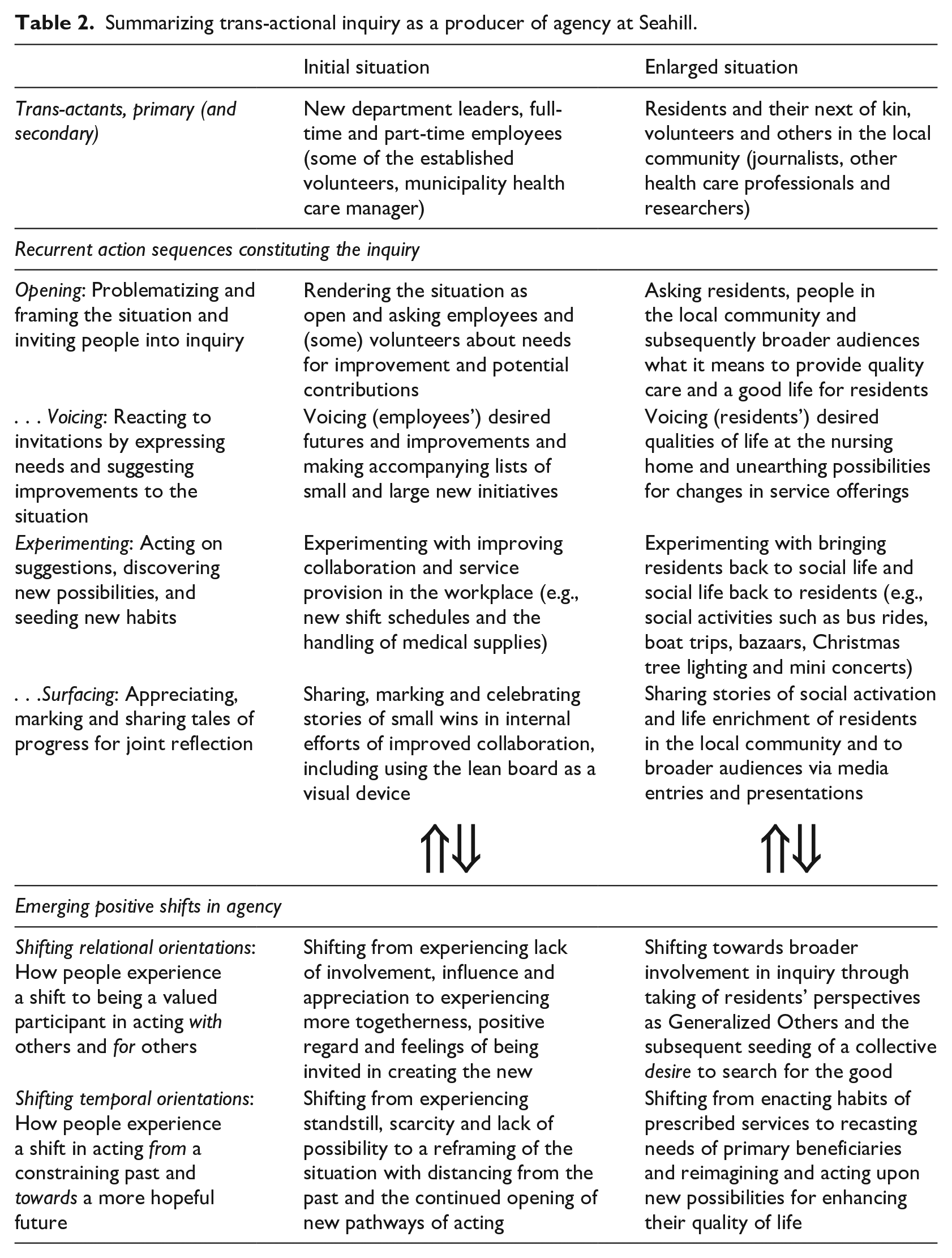
Using the pragmatist framework of social inquiry that we have just constructed, our empirical analysis of the transformation process at Seahill nursing home suggests that agency emerges from parallel processes of social inquiry in two interlinked situations. We will show that the inquiry began by addressing an initial situation where the two new department leaders and the employees attended to problems of interactions at their workplace. The inquiry then proceeded towards an enlarged situation where questions about the residents’ quality of life were at the centre and a broader set of stakeholders were involved. We make an analytical distinction between the inquiry in these situations due to markedly different ways of addressing past habits and the correspondent forward-looking meaning making. In each of these two situations, inquiry takes a shared pattern of two action sequences of significant gestures and their responses that we term opening-voicing and experimenting-surfacing. It is a dynamic whereby people assign certain types of gestures a symbolic significance that leads to responses that in turn are taken as new significant gestures and trigger yet new responses. These action sequences are recursive patterns of meaning making that constitute the emergence of agency in the organization. As summarized in Table 2, we start by unpacking the action sequences in the initial situation before turning to the same type of sequence in the enlarged situation. We make brief theoretical connections throughout, before stepping back for additional theorizing in the discussion section.
Summarizing trans-actional inquiry as a producer of agency at Seahill.
Opening-voicing in the initial situation
The first staff meeting after the appointment of the two new department leaders at Seahill took place three days after their arrival. It marked a key event in opening the inquiry in the organization, one set up by perceptions of failed habits of interaction. There is not a single interview or media article about the turnaround processes at Seahill nursing home that does not emphasize the importance of a perceived change in interactions. Many nurses spoke of a past in which their workplace had a bad atmosphere, a lack of task coordination and a feeling that employees were not seen or heard. Some also mentioned an internal tendency of ‘endless complaints without pointing to any solutions’.
Jane, the new leader, had prepared for the first staff meeting by walking around and talking to people to obtain a feel of things and learn about people’s concerns. When the meeting began, she had already heard of experiences of not being listened to and had gathered a long list of wishes for improvement. According to Sigrun, a nurse,
We really fell for this lady. She had a completely different leadership style to what we were used to. She included us. She said that she didn’t know all that much about Seahill. ‘You know, the basics of what goes on here. What can we do to make it work well?’ (. . .) We felt it was fine to be seen and heard. We agreed that we wanted to have fun at work and that we should meet each other with a smile (. . .) The surprise was that things changed so rapidly, maybe in one or two weeks.
Other nurses also spoke of a remarkable shift in interactions. According to one of them, Kristie, the personnel meetings used to be very top down with people being ‘told how to do things’. By contrast, people now ‘got to say what we meant and what we wished for, and things got moving there and then’. Each of the interviewees who were present at this first meeting described it as a turning point, one where staff members had the experience of being seen, listened to and invited to participate in improving their workplace.
Employees also spoke of a newfound belief. During conversations with nurses prior to signing on for the job, Jane had learned that the one practical thing that employees wanted the most was lockable medicine trolleys that they could easily bring with them to residents’ rooms. Jane managed to negotiate obtaining two such trolleys as a precondition for taking the job and brought them along to the meeting. Her accompanying message, as also retold by others, was, ‘The past is over and done with. There is nothing we can do about it now. The future is open, and it is up to us. We are home alone, and we shall do this together.’
Apparently, Jane’s twofold strategy of inviting participation and demonstrating possibility had a strong effect. The term ‘home alone’, which we take to signal that staff were no longer under the watchful eyes of authorities and could act freely and be more self-determining, stuck and later showed up in interviews and media articles as a label for a newfound freedom. The trolley was taken as material proof that it made sense to voice ideas for improvement and attempt to realize them:
She came here and said, ‘I can do this, and I can help you that way. What can we do together? How can you contribute?’ And then it just poured on. We made a comprehensive list of things that had irritated people for a long time, things that had not been purchased, things that had not been done right, lots of small issues. We fixed it over the table that evening. (Per, health care consultant)
We interpret these tales from the field as speaking to the way inquiry begins through a series of significant gestures (inviting, questioning, bringing the trolleys, appreciating) and responses (voicing needs and suggestions, showing enthusiasm) regarding how the initial situation for the organization is opened and people are invited to contribute with how they see the situation and potential solutions. The terms ‘home alone’ and ‘we shall do this together’ mark a metaphorical reframing of the situation, a ‘restatement of the past as conditioning the future’ (Mead, 1932, p. 15). As such, the liberation from confining habits of interaction is a temporal-relational move where employees are repositioned as authors in recreating the workplace.
Experimenting-surfacing in the initial situation
The first meeting was followed up with a rush of small steps of improvement. In the months that followed, Jane and her assistant leaders spent much time taking part in everyday work and making themselves available to deal with issues there and then through meeting people and reading situations. Demonstrating an ability for spontaneous action and immediate follow-up became key. The nurses saw the leaders as having descended from the second floor:
The previous leaders lived on the second floor. These ones lived downstairs with us and were available to us. Previously, management came down for the morning report and told us what to do and then disappeared. It’s not like that any longer. We have got to know them, not just at work. We have a whole deal of social activities outside of work that they participate in. They behave like colleagues. They are near us. (Kristie, nurse)
As Kristie pointed out, ‘descending from the second floor’ became both a practical strengthening of relations and a symbolic marker of release from constraints of hierarchy and distance. Other actions took on a more systematic form of inquiry. Sally initiated a weekly arrangement called ‘ethical reflection practice’ on difficult patient cases, mentioned by many as a watershed for internalizing good habits of development work. Several practices of lean philosophy 2 of engaging people in continuous improvement were also adopted, with a lean board showing ongoing development activities and ideas placed centrally by the lunch table. The department leaders and their team acquired a habit of marking and celebrating progress. Achievements were noticed on the lean board and linked to symbolic awards and social events. The new development practices functioned to institutionalize participation in development work. As voiced by one nurse, ‘Previously, we basically were trained and told what to do and then we did just that. Now it is completely changed, an entirely new way of thinking, where we ourselves see new things.’
We interpret these activities, both the informal everyday follow-ups and the systematic development work, as a continuation of inquiry at Seahill. The opening of the situation is followed by a stream of experimental actions of a creative nature (Golden-Biddle, 2020), a series of ‘what nexts’ (Dewey, 1922, p. 36) where people discover new ways of working together from within the particulars of their situation (Burkitt, 2016) and where leaders situate themselves as participants within the inquiry in terms of being relationally responsive (Shotter, 2006). The growth of agency through such processes of joint discovery is here further nurtured by the marking of progress and experiential surfacing (Nilsson, 2015), when results of experimental actions are somehow brought to shared attention and reflected upon.
Opening-voicing in the enlarged situation
By enlarged situation we refer to the situation for residents at the nursing home in terms of persistent questioning about their quality of life beyond mere medical treatment. This situation was opened more gradually. It started from doubts as to whether existing habits of service provision were sufficient and whether staff had really listened to residents. The resulting questioning expanded from employees to residents and people in the local community, involving an open-ended inquiry about the residents’ needs and the basic purposes of nursing homes. In a presentation to executives, Jane said,
We started by asking our users a very fundamental set of questions: What is important to you here? What do you dream of? What is a good Christmas for you? What is a good summer? What is a good breakfast?
The staff found that residents did not want 20 or so types of toppings with their breakfast bread: Two was enough. ‘That’s a significant saving just there,’ said Jane. The most important thing that residents wanted was much more fundamental: residents wanted to have more contact with life – with the buzz of social activities, laughter, children, smells and tastes that reminded them of their previous lives – and less feeling of being separated from others and shoved away. Most of the activities that were initiated in the following weeks and years took this basic insight as a premise. The practice of asking residents became a standard feature, with nurses walking around with simple surveys biweekly, sometimes needing to ‘dig into memories’ of residents to understand their wants. To some of the nurses, this practice was the key to everything, seeding a desire that is ethical-political in nature:
I believe very few take the time to ask the elderly residents what they want. We believe we know, but we don’t. It is really a most peculiar thing, this, not asking them. Would we act in such a way for any other group of users? Who listens if they complain about the food or any other service? It is a form of discrimination, at worst on a par with racism – it is elderism. (Sigrun, nurse)
The enlarged inquiry expanded to the local community. Seahill arranged ethical cafés addressing the dignity of growing old and quality of life in nursing homes. Other outreach activities followed. An early example came from Jane’s visit to the local florist with the only available money she could find in the budget. She told him that she would prefer to use her money on ‘ice cream and beer for the elderly’ and ended up ‘leaving with a car full of flowers and money still in pocket’. Another initiative resulted in a much-appreciated activity that became known as the biweekly milky route; 2- to 4-hour sightseeing tours in a minibus sponsored by the local owner of a grocery store. Said the merchant,
Sally came and asked what we could do to get the residents out more, offer them trips. We found a solution where we extended an existing delivery service. The car and driver were already in place (. . .) Everyone feels important and involved, and that job is really valuable and fun, too.
Both these stories became symbolic markers of the ways engaging the local community could harness support. As the questioning of residents and others brought a flurry of new activities for the residents, local media joined in and typically front-staged the social activation of residents as surprisingly novel and meaningful. More fundamental questions were also asked. As voiced in one local newspaper (October, 2012), ‘What is a dignified way of growing old? A room alone where the clock ticks, away from your home and children, the ones you loved. And the week is open, no-one depends on you any longer.’
We interpret these tales from the field to mean that the enlarged inquiry gained its force from tying the particular situation and the needs of particular others to asking questions and voicing suggestions for the residents at the Seahill nursing home as a Generalized Other. At its most impactful, the local inquiry exemplifies and resonates in a situation most of us will face, whether for ourselves or our loved ones, thus engaging people broadly in an inquiry into the needs and situation of residents in any nursing home, a Generalized Other who is more distant and near at the same time.
Experimenting-surfacing in the enlarged situation
The inquiry in the enlarged situation grew along with a series of experimental actions to improve the life quality of residents. Tales of progress from such activities were subsequently surfaced (Nilsson, 2015) and shared with staff, next of kin, the local community and broader audiences. The story of the sea bathing included in the opening quote of this paper is one example. It is part of this story that the family of one of the bathing ladies had been skeptical of many of the activities at the nursing home but had turned around completely after the event. According to Jane, the daughter had never imagined that her mother had such a strong desire for bathing or that she would ever manage to do it again.
Another example, one that became a particularly symbolically charged event, was moving the lighting of the town’s Christmas tree from a roundabout to the backyard of the nursing home. The idea was that like few other things, people associated Christmas with loved ones and children and togetherness. It took Jane three phone calls to bring it about, obtaining the tree, its foot and the transportation all free of charge.
A special event [in the turnaround process]? Then I think about the lighting of the Christmas tree (. . .) We wanted the nursing home to be the centre of the community. We invited people, we have the tree, and I was thinking, ‘Will anyone come?’ Then 500 people were pouring in. That was grand; that made us all teary. (Ann, assistant department leader)
The ceremony of the Christmas tree lighting became an important marker in the change process, one that still brought tears to our interviewees when they recalled it. It had a dual function of expanding the sense of possibility and establishing Seahill as a meeting place in the community. As such, it served a prolonged invitational function. The event was followed up by similar activities of bringing residents back to social life. The local National Day children’s parade was redirected to pass by the nursing home. Seahill soon received regular visits from kindergartens and Boy Scouts. Other activities included readings of short stories by a retired schoolteacher, mini-concerts by local musicians, boat trips, visits to the local cinema, bazaars and lotteries and ‘trim and thriving’ led by a physical therapist; a 2-hour weekly arrangement with easy moving and stretching around a table followed by light refreshments and small talk. The social activation seemed to work. Statements from media articles corroborated the voices of the residents we interviewed. The many new activities meant that the more active of the residents now had a schedule with activities every day. The cafeteria began to offer menus for inexpensive meals and activities that attracted broader audiences. Seahill had become a place to stop by and meet people.
In 2013, Jane won a national workplace award for Enthusiast of the Year. The award was shared with the whole team in how she accepted it (the nurses were all present at the event), talked about it (as a collective achievement) and spent the prize money (on residents and staff). The award garnered further media interest in Seahill, and the event became a vehicle for repeated exposure and enlistment of yet others in the inquiry.
Stepping back from these stories, we can observe that the inquiry into the enlarged situation of the residents had intertwined with and strengthened the inquiry into the initial situation. In the enlarged situation, the trans-actants included not just the staff and residents at Seahill, or the local community, but also other health care professionals, journalists and their articles, and researchers attending to and writing about the organization, and by that contributing to both the experiential surfacing (Nilsson, 2015) and resulting questioning of the situation. Agency thus emerged in a social field fuelled by many sources and iterative meaning making connected to understanding, being affected by and responding to the needs and concerns of the human other. Conceived as such, the emergence of agency from the inquiry has at its heart a form of desire that gains its force from being directed to ethical ends-in-view (Martela, 2015) of a prosocial nature.
Discussion: Lightness of Power and Desire in Inquiry
We began with the empirical puzzle of why people in an organization caught in circumstances that seemed hopeless and stuck spoke of their experiences of positive transformation of the situation as one of lightness. We turned to theoretical resources in pragmatism to analyse the way social inquiry can grow agency in organizations. Our analysis, as summarized in Table 2, shows how agency emerged in a field of social action that becomes charged through inquiry. To borrow and extend language from Cooren (2018), our analysis illustrates the way people through social inquiry may grow their capacity and desire to act with and for others as well as from a burdening past and towards continued progress and hope for their organization and its beneficiaries. The resulting notion of agency is collaborative (Raelin, 2016; Simpson, 2016) and emergent as people manage to put themselves ‘into relation with whole groups in the community whose attitudes have not entered into the lives of others in the community’ (Mead, 1934, p. 256).
The primary contribution of the paper is to theorize how people can grow agency and transform troublesome situations through social inquiry. This theorizing has used the transformation of the Seahill nursing home as empirical inspiration and provided a new synthesis of elements from the scholarship of Dewey and Mead to understand the site and process of social inquiry as a cradle of agency. Further highlighting what we believe to be the uniqueness of our contribution, our analysis points to two features of social inquiry that are surprisingly salient in our case and understated in previous work. Both features speak to the charging of the field of inquiry with a creative force that takes on notions of lightness: lightness of charging situations with coactive power and lightness of growing desires to respond to the needs of the human other. We now revisit the front-end theorizing to clarify these contributions and their implications for further research.
The lightness of opening situations and growing coactive power
Deweyan inquiry took the unique doubtfulness as a primary conditioning of the situation under inquiry (Dewey, 1938 [1991], pp. 109–111). There is partial support for that perspective on social inquiry in our case. The initiating conditions of despair and the prevalence of failed habits of interactions are structural features of the situation at Seahill that are resources for agency (Farjoun et al., 2015) in the sense of being made a contrasting past that calls for action and opens for emergence (Mead, 1932). The past is actively negated through words (‘the past is over and done with’) and new ways of interacting that stand in relation to failed habits. The opening is constituted by invitation to act (‘the future is open, and it is up to us’), a questioning of what people want and may contribute, and the imagination of new possibilities for action.
Inherent in this last observation, but much less theorized in Deweyan inquiry, is the notion of problematizing the situation to bring about a relational shift in power. Research has suggested that agency may grow from interactions that invite altered loci of control (Bridwell-Mitchell, 2016) where everyday occurrences are symbolically constructed as liminal phenomena (Howard-Grenville, Golden-Biddle, Irwin, & Mao, 2011). In the empirical setting of our paper, the significance attributed to vocal gesture of being ‘home alone and all together’, as well as the material gesture of ‘descending from the first floor’, suggests a shift from coercive power based on hierarchy to coactive power based on invitation and collaboration. Here we are using the conceptions of Dewey’s contemporary, Mary Parker Follett, who spoke of coactive power as a relational and situated capacity, a power with (Follett, 1924 [1951], 1940). To Follett, quite like in Deweyan inquiry, progress in problem-solving needs to follow the ‘law of the situation’ (Follett, 1940, pp. 58–64, 106) so that facts are attended to and differences between people’s viewpoints are recognized and unified. Charging a situation with coactive power means opening the field to a performative power with as a generative force created through collaboration (Morlacchi, 2021).
These observations invite further research on how people are brought in and encouraged to speak in social inquiry, the status granted to them in relation to opening, defining and contributing to the issues at hand (Cooren, 2018), as well as the ongoing processes of interacting on issues that are contested. Future research could also seek to unpack how the confluent flows of agency and power-with performativity (Simpson, Harding, Fleming, Sergi, & Hussenot, 2021) in social inquiry emerges along with changing identities. Consistent with the notion of trans-actional inquiry, the emergence of agency is also a becoming of actors and their practices (Carlsen, 2006), whether we speak of leaders, employees or beneficiaries.
We should note here that our study has limitations in relation to understanding how coactive power is produced in inquiry. Through interviews and archival data, we have been able to capture tales of how the reconstructing of agentic orientations involves a narrative repositioning that places people as protagonists in a more open-ended narrative. Lack of thick observational data means that we have been much less able to capture forms of relational responding that may elude reflexive awareness, what Shotter (2006, 2017) has attended to as ‘action guiding feelings’ within inquiry. Such feelings may pertain to disquiets about a situation or embodied gestures of others that cannot be fully articulated (Shotter, 2017) and that may arise feelings of being involved, appreciated, listened to, or invited – all of which shape how people form tentative intentionality of how to deal with what is next (Cunliffe & Locke, 2020).
The lightness of desire in contributing to the other
What is an inquiry that produces lightness in agency an inquiry of? We have given tentative answers by pointing to the centrality of relational responding and a prosocial agenda in tales from the field. In more general terms, Dewey (1929, p. 255) once remarked, ‘The most profound lack is not the will to act upon goods already known but the will to know what they are.’ This statement suggests that inquiry that grows agency may be about both particular goods for particular others (‘How do you want to contribute? What is a good breakfast for you?’) and broader, more open-ended questions about human betterment for the Generalized Other (‘What is a good workplace? What is a good life for residents at nursing homes?’), also beyond the residents at this nursing home. Both forms of inquiry serve to negotiate and renew ethical responsibilities with agency (or will) not as stable states, but as an ongoing responsiveness emerging from people’s activities of inquiring, a desiring inquiry (Painter-Morland, 2011; Välikangas & Carlsen, 2020) growing in power by a multiplicity of selves in-the-making (Fouweather & Bosma, 2021). As noted by Lorino (2018), the process is recursive. The will (or agency) to ask about the good can seed habits of inquiry that in turn produce will.
The prosocial theme of inquiry at Seahill is significant. The charging of the field of inquiry is to no small degree accomplished through the surfacing of stories of perspective taking from residents at Seahill and the subsequent improvement of their quality of life, whether such surfacing is done by staff or journalists. It is the very element in the overall story of Seahill that seems to evoke the most emotion in presentations for other health care workers. Research has shown that when people recognize that their actions benefit others, their prosocial motives are strengthened (Bolino & Grant, 2016, p. 647). Yet, there is limited knowledge of how the relationship between such internalization and growth of agency evolves over time (Espedal & Carlsen, 2021). This is amiss because prosocial desires may be perceived as the primary driver of agency. Indeed, to Ricoeur (1992), people are first and foremost shaped by how they respond to the calls of the human other, and these responses coevolve with their agentic capacity. Dewey is less specific in tying will (or agency) to a prosocial agenda, but holds that desire is the unifying ordering mechanism of will (Dewey, 1922, pp. 248–250). Belief may be needed to see the next step of inquiry, but in this case, as in Deweyan inquiry taken more broadly (Alexander, 1993, 2013), the shared intentionality of going forward (Robichaud, 2006) is primarily driven by the desire to contribute to human betterment and growth. From that perspective, the desiring lightness of agency may, paradoxically, be accentuated by the weight of a more generalized situation – in this case that of institutionalized care for elderly people – that the local inquiry exemplifies and in which it resonates.
Conclusion
The literary testament of the Italian author Italo Calvino (1985 [1993]) begins with existential questions of how lightness and weight characterize the human condition. Calvino saw lightness not only as contrary to the serious and weighty, but its necessary companion. Weight represents human constriction and plight, a world turned into solid mass or stone, whereas lightness involves the ephemeral and transient liberations in creating and playing, swift trains of thought and action ‘in reaction to the weight of living’ (Calvino, 1985 [1993], p. 26). We can use this view from Calvino when thinking of the larger lesson for how people in organizations can seek to deal with troublesome situations to grow agency in social inquiry. The lightness from opening the situation towards emergence of agency stands against the weight of a past with limited participation and possibility. The lightness from meaning making marks a desire for contributing to the human other that coexists with the weight of inevitable death. Lightness and weight, like agency and structure, demarcate qualities of experiencing that presuppose and somehow need one another, each unbearable without the other.
Footnotes
Acknowledgements
We would like to extend our gratitude to the people involved at the Seahill nursing home who shared their experiences with us in an unusual open and thoughtful manner. We thank Senior Editor Barbara Simpson and three anonymous reviewers for their deep engagement with our paper and very helpful comments. For their support in discussions and/or close readings of previous drafts we are also grateful to Siv Heidi Breivik, Doug Creed, Jane Dutton, Paul Hibbert, Jon Erland Lervik, Sally Maitlis, Bjørn Erik Mørk, Davide Nicolini, Lance Sandelands and Jo Sundet.
Funding
The author(s) received no financial support for the research, authorship, and/or publication of this article.
