



Abstract
Team member proactivity refers to self-starting, future-directed behavior to change a team’s situation or the way a team works. While previous studies have shown that individuals generally benefit from their proactivity, few studies have explored how others in a team experience it. This is important as the way peers perceive team member proactivity could be critical for the initiative to be effective. We conducted a five-month in-depth study to uncover how peers from three self-managing agile teams react to instances of team member proactivity. Our findings suggest a process model of team member proactivity, in which we show that peers react at two distinct moments during proactive episodes. Depending on its perceived success and whether peers directed their reaction to the proactive employee or at their initiative, peer reactions unfolded in four different pathways: by (1) belittling the proactive team member, (2) criticizing the proactivity initiative, (3) supporting the proactive initiative, or (4) admiring the proactive team member. We explain how and why these reactions are formed by showcasing their cognitive, affective, and behavioral evaluations. Our findings contribute to the proactivity literature, provide a process perspective for understanding how peers perceive proactivity, and present implications for sustaining proactivity in teams.
Keywords
Introduction
Burgeoning organizational needs for continuous change, decentralization, and teamwork have amplified the need for individuals to identify opportunities for improvement, seek feedback, and prevent future problems (Grant and Ashford, 2008; Griffin et al., 2007; Parker et al., 2006). Since work is increasingly interdependent through operating in teams (Ilgen et al., 2005), organizations rely on team member proactivity, which refers to situations in which ‘an individual engages in self-starting, future-directed behavior to change a team’s situation or the way the team works’ (Griffin et al., 2007: 332). By behaving proactively, team members can recognize early on potential problems or opportunities in their changing work environment and initiate change to implement a better future work situation for their team (Gan and Cheung, 2010; Parker and Collins, 2010). Although proactivity is generally conceptualized and viewed as desirable individual work behavior (Grant and Ashford, 2008), yet potentially taxing (Fay and Hüttges, 2017), research also suggests that the consequences of proactive behaviors beyond oneself cannot be ignored any longer (Parker et al., 2019; Sun et al., 2020; Zhang et al., 2021). In a team context, the way peers evaluate and respond to the proactivity of a fellow team member could impact whether or not the initiative succeeds. Consequently, understanding how peers perceive and react to team member proactivity gains importance as there is limited knowledge about how they reflect on, feel about, and deal with proactive team members who act on behalf of the team (Bindl, 2019; Parker et al., 2019).
Investigating how peers make sense of and react to team member proactivity builds on several core assumptions. Primarily, while proactive employees tend to bring about positive changes (Parker and Collins, 2010), make improvements to inefficient work methods (Parker et al., 2006), and are rewarded by supervisors (Fuller et al., 2015; Grant et al., 2009), it is also assumed that their proactive behavior affects peers. Especially, when it comes to team member proactivity, which is not targeted at oneself but at improving the team’s functioning (Griffin et al., 2007), peers might feel a greater need to intervene in the proactivity process as the initiative is likely to also affect their work for the team. Even though it seems logical that team member proactivity is a social phenomenon that may or may not be welcomed by peers (Bateman and Crant, 1993), Parker et al. (2019: 240) warn that there are still limited empirical insights into ‘peers’ responses to proactivity’. This is partly because previous research has primarily relied upon self-ratings by proactive persons and outcomes rated by, for instance, their manager (Burris, 2012; Grant et al., 2009; Sun and Van Emmerik, 2015), in which the latter is more likely to provide an overall assessment of the proactive employee. Consequently, there are two strands to the research that we are presenting. First, research is yet to investigate how peers, as observers and companions, affectively respond to team member proactivity and its goals. Second, in contrast to previous research that retrospectively examined proactive behavior, we observe how peers respond to this behavior in the moment.
Following this reasoning, our study draws on another key assumption that the process of team member proactivity depends on the active input from peers to realize the intended change to the team’s way of working. In contrast to individual proactivity targeted at achieving personal goals, team member proactivity goes beyond oneself and leaves more room for peers to intervene in whether and, if so, how the initiative should be carried out. Peer evaluations and reactions thus likely shape the team member proactivity process as well as impact its goal realization. In this study, we show that the involvement of peers makes the team member proactivity process much more complex than for individual proactivity as it becomes a dynamic negotiation between team members. Thus, the lack of insights as to how the team member proactivity process unfolds in a team leaves us with a lingering question: how do peers evaluate and respond to instances of team member proactivity in the moment, and in what way are peer responses shaped throughout the team member proactivity process?
To answer this question, we provide an in-depth investigation of how peers affectively respond throughout the proactive process based on a five-month observational case study of three self-managing agile teams. Although affect, that is how employees feel (Barsade, 2002), has been part of previous proactivity research (e.g. the role of affect as a driver of individual proactivity: Den Hartog and Belschak, 2007; at different phases of the proactivity process: Bindl et al., 2012; and throughout the process of engaging in proactivity: Bindl, 2019), we demonstrate that favorable peer responses and evaluations of its implementation are crucial in the process of achieving proactive goals aimed at benefiting the team. We focus on how team member proactivity may instigate emotional episodes (Frijda, 1993) that shape peers’ cognition, affect, and behavior towards handling the proactivity of others in the team as well as their own intentions to be proactive for the team. In particular, by elaborating that peers generally directed their response towards belittling or admiring the proactive team member, or responded by criticizing or supporting the proactive initiative, our study contributes new knowledge. Thus, we expand the literature on the implications of proactivity for others by exploring which factors trigger them to formulate and reevaluate their reactions.
Moreover, we showcase that team member proactivity does not occur as a one-time-only behavior but gives rise to an episode in which the team member proactivity is enacted, experienced, and evaluated by peers. This process view on team member proactivity extends previous research that has shown that individual proactivity can be represented as a goal-driven process (e.g. Bindl, 2019; Grant and Ashford, 2008; Parker et al., 2010), or routine (Vough et al., 2017), and enables us to elucidate how and why peers respond to the initiatives and when proactivity is sustained in a team or withers.
Theoretical background
Team member proactivity
Proactivity is a specific form of motivated work behavior that is self-starting and future-directed (Bateman and Crant, 1993). According to Crant (2000: 436), proactive behavior can be defined as ‘taking initiative in improving current circumstances or creating new ones; it involves challenging the status quo rather than passively adapting to present conditions’. Broadly speaking, proactive work behaviors are either directed at the self, such as through job crafting (Tims and Parker, 2020) and feedback-seeking (Ashford et al., 2003), or at others (Parker and Collins, 2010), such as personal initiative (Frese and Fay, 2001) and taking charge (Morrison and Phelps, 1999). While proactivity is considered to be a process of a relatively autonomous set of individual actions (e.g. Bindl and Parker, 2010), organizations increasingly rely on proactive employees operating in teams, whose members depend on each other to do their work (Ilgen et al., 2005). As a result, proactivity targeted at the team instead of themselves becomes more crucial (Belschak and Den Hartog, 2010).
Griffin et al. (2007) argue that employees can focus their team member proactivity at improving the team’s functioning by, for example, initiating changes to standard team work methods (e.g. Van Dyne and LePine, 1998), introducing new routines, such as team meetings (e.g. Morrison and Phelps, 1999), or implementing innovative communication methods to enhance cooperation within the team (e.g. Wang and Jiang, 2015). Team member proactivity is thought to be risky behavior for the proactive employee, with potentially high social costs as it implies questioning the status quo (Crant, 2000; Strauss et al., 2009). However, research so far has been dedicated to predicting the engagement in this type of prosocial behavior and in which forms, while, surprisingly, current studies have not yet explored how peers impact, or are impacted by, the team member proactivity process. We argue that the role of peers, and especially their perceptions and reactions, could be crucial in shaping how beneficial or harmful the team member proactivity process is for both proactive employees and the team.
In line with this reasoning, a relatively new stream of proactivity literature highlights the importance of incorporating how others, including peers and supervisors, view and respond to individual proactivity (e.g. Tims and Parker, 2020). For instance, the ‘wise proactivity’ framework theorizes that individual proactivity is most likely to be effective when it serves themselves, the tasks, and others (Parker et al., 2019). Transferring the insights from this framework towards engaging in team member proactivity effectively implies that the need to be self-serving moves to the background and that space should be made for emphasizing the role of others – especially the support from peers. Even though others are thought to be crucial in determining the effectiveness of individual proactivity, examining peer reactions is especially crucial for instances of team member proactivity because the behavior and its goals are targeted at benefiting the team. As proactive team members know that their initiative impacts the work of peers, they are more likely to share their initiative and its intended goals with them. Also, proactive team members likely need their peers to help them implement the initiative to realize the improvements to the team’s way of working. Providing peers agree with the change and feel that the initiative could be helpful towards striving for these team goals, they would be more likely to positively evaluate the effort and lend their support in achieving the improvements. Thereby, the way peers perceive and respond to the initiative could largely impact how effective the change is to the status quo.
Peer reactions in the process of team member proactivity
A growing stream of research examines the impact that proactivity has on others in the workplace (e.g. Chan, 2006; Morrison and Phelps, 1999; Parker et al., 2010). On the one hand, when proactive efforts seem to bring about change to problematic situations and are aimed at prosocially benefiting the status quo, peers will be more likely to see that the solution works in their favor (Grant et al., 2009). For example, peers might welcome novel ideas that they consider valuable for solving emerging problems or changing work demands that make the team more effective (e.g. Fuller et al., 2012). This could result in peers supporting the initiative and possibly rewarding or giving credit to the proactive team member for improving the team’s functioning (Fuller et al., 2015; Grant et al., 2009).
On the other hand, however, studies suggest that highly proactive employees could trigger negative reactions from others because they disrupt or threaten their self-evaluation or status, which in turn could result in envious reactions, lower performance ratings, withdrawal of support, and feelings of self-deflation (e.g. Burris, 2012; Fuller et al., 2015; Grant et al., 2009; Sun and Van Emmerik, 2015; Zhang et al., 2021). In response to this perceived threat to their status, peers can socially undermine the actions or goal achievement of the proactive effort by, for example, expressing their anger or dislike, disapproving the initiative, and disparaging the proactive individual (Duffy et al., 2002).
Although existing research acknowledges that proactive behavior could impact others and that individual proactivity could instigate both positive and negative reactions from peers, there remains a limited understanding of how team members respond to each other’s initiatives and why these reactions are shaped in a certain way. The focus has primarily been on stressing the impact that individual proactivity could have on peers (e.g. Bindl and Parker, 2010; Grant and Ashford, 2008; Strauss et al., 2017), whereas limited empirical research has explored how peers actually react to the potential benefits or costs of team member proactivity (for exceptions see Sun et al., 2020; Zhang et al., 2021), to which we turn now.
Explaining peer reactions in the process of team member proactivity
As team member proactivity is aimed at changing the status quo of the team (Griffin et al., 2007), peers, as change recipients, ought to react by sharing their openness and readiness towards these initiatives. To capture peer responses comprehensively, we draw on emotional episodes (Frijda, 1993) triggered by change events, such as instances of team member proactivity. Emotional episodes can be described as ‘the sequence of affective processes which integrate the emotion, cognition, and behavior that arise in response to the triggering event’ (Frijda, 1993: 382). More specifically, emotional episodes are situations in which changes trigger a cognitive appraisal, affective feeling, and behavioral action tendency from an employee. While cognitive, affective, and behavioral responses are related and interdependent, Lazarus (1999) proposes that their roles can be separately identified for clarity purposes, which we draw on in an effort to understand how peers react in the process.
First, before framing their response, employees make a cognitive judgment of their impressions. Based on how they perceive the initiative, peers are likely to evaluate whether or not they are willing to invest their time and energy. Hearing about a proactive effort and being asked to implement the initiative could disrupt peers’ regular work routines and consume their resources. To them, these actions are either perceived as enhancing their time and resources or as having no reason to be done. Therefore, it may be that peers cognitively evaluate both their resource gains and losses when formulating a reaction to the proactivity of a team member (Hobfoll, 1989). Although protecting the team’s resources from being threatened could also be perceived as essential, peers generally frame their reaction in such a way that they first account for protecting their own resources (Hobfoll et al., 2018). Thus, team member proactivity could be negatively experienced by peers if they perceive it as an extra demand beyond their role and therefore resource depletion, or as positive, if they feel motivated to generate resources through creating a better work environment for the team.
Second, besides cognitively evaluating, peers are thought to shape their response to the proactive team member based on their affective evaluation of the proactivity. We refer to affect as an umbrella term for affective states or traits, and emotions (Barsade, 2002). Affect is most strongly influenced at work through interactions with peers (Miller et al., 2007), during which they are exposed to each other’s affect through nonverbal signals, such as body language, tone, and facial expressions (e.g. Van Kleef, 2014), but also through emotional expressions. Emotions are intense, relatively short-term affective reactions to a specific environmental stimulus and differ from moods or emotional states; the latter are weaker reactions to general stimuli that are relatively stable in the short term (Ortony et al., 1988).
Emotional expressions convey information to the self and to those who observe them in the social environment (Keltner and Haidt, 1999). The idea of emotional contagion, which refers to mimicking a similar emotion as others in the interaction (Hatfield et al., 1994), assumes that people can (un)consciously interpret and use other’s emotions as an indication of how they should feel and subsequently act (Barsade, 2002). Thus, emotional contagion may result in similar affective experiences when socially interacting with each other about a proactive effort (Niven et al., 2012), referred to as team emotions (Knight and Eisenkraft, 2015). Westman et al. (2013) found that especially crossovers of positive affect related to gaining resources had a powerful impact on a team, compared with negative resource loss crossovers. The sharing of positive affect, for instance, has been shown to lead to more cooperation, less conflict, and higher perceived task performance (Barsade, 2002). Accordingly, peers may use the information distilled from others’ emotional expressions as additional input to shape their affective response to the team member proactivity.
Thirdly, peers are thought to behaviorally respond to the team member proactivity, since affect serves as a positive or negative reinforcer of someone else’s behavior (e.g. Van Kleef, 2014). Affect may activate action tendencies, where one is preparing for an action that might be required to deal with the current situation (e.g. Ortony et al., 1988). On the one hand, when peers respond with positive emotions, such as enthusiasm and excitement, they are more likely to prosocially behave towards implementing the intended changes (Sonnentag and Starzyk, 2015). On the other hand, when peers respond by expressing their negative emotions, such as stress or disagreements, proactive employees are more likely to trigger anti-social behavior from peers or even decrease their peers’ action tendencies to participate in the proactive effort (Johnson and Connelly, 2014).
Besides the cognitive, affective, and behavioral evaluations that employees make when forming their reaction, previous research also highlights that responses to proactivity may vary from employee to employee because they have different beliefs about how to best approach their tasks to be effective (Sun et al., 2020). The concept of flexible role orientation describes the extent to which employees perceive various goals, problems, and tasks as part of their job role (Parker, 2007; Parker et al., 1997). Team members with a more flexible role orientation define their jobs broadly and feel responsible for (team) goals and problems beyond their primary tasks (Parker et al., 2006). They are more tolerant to perceiving changing and differing job demands as part of ‘their job’ (Parker et al., 1997). Contrarily, reflecting a ‘that is not my job’ mentality, employees with a less flexible role orientation define their roles more narrowly and view completing their most prominent role requirement as accomplishing what they are told (Parker, 2000). Together with self-efficacy, flexible role orientation is often portrayed as a distal antecedent to employee proactivity (e.g. Beltrán-Martín et al., 2017). For example, employees with a more flexible role orientation had a more proactive approach to implementing ideas and solving problems (Parker et al., 2006).
Beyond a cognitive state that motivates employees to be proactive, a flexible role orientation could also play a vital role in how peers react to the proactivity of others in the team. Depending on how a team member executes his/her job role, flexible role orientation may affect how sensitive an employee is to the proactive initiatives of fellow team members (Parker, 2007). A more flexible role orientation might stimulate peers to take more ownership and focus their effort towards integrating the proactive initiatives of others into their way of working. Hence, it could arouse their aspirations to take control of the situation and their willingness to accept responsibility for the consequences of the proactivity. Team members who feel capable of carrying out activities related to the proactive initiative, such as its implementation, are more likely to believe in its success and cope with the changes to their work situation (i.e. role breadth self-efficacy; Parker, 1998). From this perspective, peers could be particularly helpful in shaping the effectiveness of the proactivity for the team and preventing the proactive employee from feeling that the behavior could come at a cost.
Alternatively, peers with a less flexible role orientation could perceive team member proactivity as threatening as their proactive behavior may impact how they enact their job role. Employees with a narrow and passive role orientation are less receptive to change as they do not see the actions needed as relevant to their role or have different beliefs about the portrayed effectiveness of the task. In essence, they could experience the proactivity as hindrances impairing their job performance, have a tougher time adjusting to the changes, be less motivated to implement it or drop the initiative sooner. As a result, their lack of motivation to support the team member proactivity could hinder the proactive employee and the team from successfully integrating the changes into their way of working.
Building on the notion of emotional episodes (Frijda, 1993), our study contributes by exploring actual episodes of team member proactivity through the lenses of peers – as active participants. Uncovering the process from the perspective of peers is novel since most studies have focused on the rewards from supervisors (e.g. Fuller et al., 2015), or the risky consequences for proactive employees when changing the status quo, such as depleting one’s own resources (e.g. Bolino et al., 2010). Accordingly, we aim to shed light on how peers cognitively, affectively, and behaviorally respond to instances of team member proactivity and whether their response shapes the effectiveness of the initiative throughout this process.
Methods
Research context
The inductive case study took place at the IT department of a large energy network company based in the Netherlands, where three agile teams were shadowed during their day-to-day work. More organizations are implementing agile work methods, as the work design stimulates team members to proactively improve the team’s functioning and deal with customer changes without the interference of a manager (Dybå and Dingsøyr, 2008; Hoda et al., 2011). We identified agile teams as a relevant context for this case study as they are perceived to be successful when their members actively display, initiate, and self-start goals in relation to the team goals and their customers instead of merely adjusting to their changing work environment (Griffin et al., 2007). Agile teams are self-managing and cross-functional, implying that they manage their own workload, participate in team decision-making, and shift work among themselves to iteratively and incrementally fulfill changing customer requirements along the way (Dybå and Dingsøyr, 2008). Even though the team works autonomously, their tasks are highly interdependent, meaning that they rely on the successful completion of each other’s work to progress with their own work (Campion et al., 1993). Taken together, these contextual factors make agile teams an interesting setting to study the process of team member proactivity as it presupposes that team members are bound to communicate their proactivity with each other. Moreover, proactive team members rely on their peers rather than their managers for implementing the improvement.
The three agile teams were selected per the purposeful sampling premise of choosing typical cases (Corbin and Strauss, 2008). Resembling the bulk of the agile teams’ level of experience worldwide (Digital.ai, 2021), the selected teams have developed a certain level of proficiency using agile practices over the last one to three years but are still maturing their competencies. Furthermore, the number of members per selected team is between seven and nine individuals (total N = 25), precisely in line with the agile requirements (Schwaber and Beedle, 2002). Also, demographically the team members are representative of the European IT industry (Eurostat, 2020), in that the members of the selected teams are on average between 30 and 40 years old, have college or university degrees, and 80–90% of them are male. These demographic characteristics also hold for the three managers of these teams; however, in this case, all managers are males. Lastly, the three teams work in different IT domains (Customer Service Management, Web Communication, New Business Research & Development), and therefore work for different internal customers. All three teams used Scrum (Schwaber and Beedle, 2002), the most used agile method worldwide (Digital.ai, 2021). Scrum teams work in increments (i.e. ‘sprints’) of, in the case of this company, two weeks. Each sprint starts with a planning meeting, followed by daily coordination meetings, and ends with two reflection meetings; one with the team and one with the customer.
Data collection
Between February and June 2017, the three agile teams were shadowed by the first author for five months during all meetings (i.e. a period of 10 two-week sprints; please see Appendix A in the online supplemental for a detailed overview of the data sources). During these meetings, it was possible to write detailed field notes of the observations, including verbatim quotes, on a laptop since the team members also used their laptops to take notes or demonstrate work. Furthermore, team members were shadowed while working in the office together for one whole day each sprint. Overall, each team was shadowed for approximately 120 hours, resulting in 360 hours of fieldwork. Throughout the observation period, the teams were informed that a study was being conducted on the team dynamics of various agile teams in the company. According to the team members and the managers, the observations did not change the team dynamics. The data collection ended when the managers of the management team announced that they were going to make enduring changes to the team compositions.
While shadowing the team members in the office, we also conducted informal conversational interviews with most of them, which served as additional primary data. The purpose of these interviews was to have a natural interaction that typically occurred as part of the ongoing observation, whereby interactions with the team members guided the flexible interview process (Gall et al., 2003). These interviews allowed for a better understanding or clarification of what was witnessed during the shadowing of either a team meeting or when they were working, for example, concerning peers’ feelings when a proactive initiative was communicated. Typically, the informal interviews lasted 10 minutes and were noted afterwards. Furthermore, six semi-structured formal interviews were held face-to-face (i.e. two members per team, average duration of 70 minutes) throughout the study period, which were audio-recorded and fully transcribed. This was a sufficient number of interviews to complement the richness of the primary data without being repetitive. The interview questions concerned how they experienced their day-to-day (team)work, team meetings, and proactively dealing with both customer changes as well as their team’s functioning. The semi-structured interviews mainly served to unravel how team members explained the team processes and their own behavior in relation to how proactive instances evolved in the team.
To further strengthen the validity, and as a source of secondary data, we also observed 20 weekly management team meetings (as a non-participant). The purpose of this management team was to facilitate the transition towards agile working and contribute to creating an agile mindset among its employees. The management meetings were attended by the three team managers of the three agile teams that we observed, four other team managers, and two external consultants. These meetings also resulted in detailed field notes that include verbatim quotes, which provided valuable insights into the managers’ views about proactivity in agile teams. Conversational interviews with the managers after each meeting also enabled us to cross-check our observations of how ongoing initiatives were evolving in the teams.
Lastly, the ‘Jira’ webpages of each agile team were used as a secondary digital data source. These online team pages contain, among other things, the progress, the work the teams have committed themselves to for each sprint, changes needed to the product, every team members’ technical abilities, and team notes of their meetings. This digital source allowed us to keep track of the tasks and the progress of all teams during the observational period, including the actions and tasks that the teams set out to implement proactive efforts.
Data analysis
To understand how peers react to the efforts of team members' proactivity and why their reactions are shaped in this way, we adopted a process approach. Used for inductively constructing theory, a process lens makes it possible to explain how peer reactions follow from a sequence of actions over time (Langley, 1999). The first step in our data analysis was to analyze the observational field notes, and later the interview transcripts, to identify specific instances of employees engaging in team member proactivity. Atlas.ti, a software package for coding and analyzing qualitative data, was used to code the data. For local integration, the data were organized chronologically per team to track their engagement in team member proactivity over the two-week sprints, and we regularly compared data across the teams for a more inclusive integration (Weiss, 1994). During the coding process, for each instance of team member proactivity, we asked ourselves whether these individual actions were self-initiated, future-focused, and aimed at changing either the team’s situation or their work processes, in line with the definition of Griffin et al. (2007). Matching these criteria, the coding uncovered 69 distinct episodes of team member proactivity in the teams. We refer to them as episodes because each instance of team member proactivity appeared to be part of a more comprehensive process going through different phases. For each episode, we coded who, when, and why a team member engaged in team member proactivity.
The second analytical step was to delve deeper into the proactive episodes and code the types of team member proactivity occurring in each of them using existing definitions of proactive work behavior (Grant and Ashford, 2008; Parker and Collins, 2010). As discerned by Parker and Collins (2010), we found three types of team member proactivity, namely 16 instances of problem prevention, 39 instances of taking charge, and 14 instances of team innovation, all intended to bring about change within the team. In Table 1, we specify the definitions of these types of team member proactivity and provide a representative example.
Types of team member proactivity induced from coding the data sources.
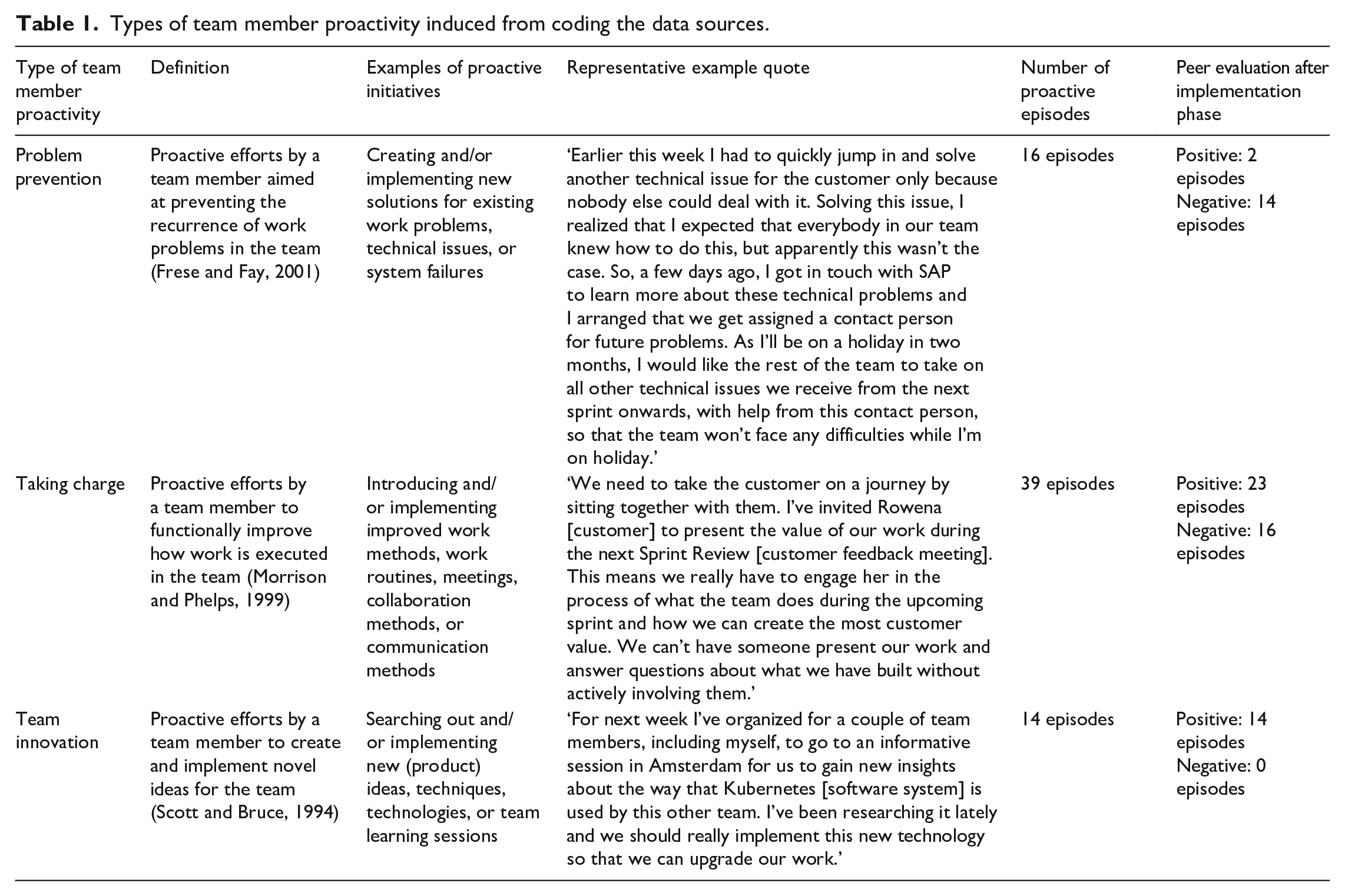
The third analytical step was to code the event-level data of the 69 episodes to understand how peers responded. This meant, for instance, that we read all the transcripts from the (meeting) observations of a particular proactivity episode, and coded sections of dialogues or sentences in which peers said something about the team member’s proactivity. Thus, we kept track of what was said, by whom, and when during the sprint this took place.
However, the coding also indicated that peers did not only react directly when hearing the proactivity but also later on. Therefore, the fourth analytical step was concerned with uncovering how the proactivity process evolved over time by analyzing the temporal dynamics of the team member proactivity episodes. This is in line with the existing theory on proactive motivation that proactivity, when viewed through a process lens (Langley, 1999), is a sequence of goal-driven actions over time. The coding of this second follow-up reaction was conducted in the same systematic way as the immediate peer reactions, although we also coded whether at this point in time peers perceived the team member proactivity to be successful or unsuccessful as a result of its implementation efforts.
After establishing that peers react at two different moments in time, we sought to distinguish what triggered the way peers reacted towards the proactivity in each specific episode. We first analyzed the predominantly encouraging and discouraging immediate reactions separately and then identified similarities and differences in the patterns that appeared from them during these proactive episodes. At this stage of the data analysis, substantial individual and contextual differences emerged as to why peers stuck to their initial reaction or whether they decided to change their response after reevaluating the initiative’s impact. In a later stage of the coding, we distinguished between immediate reactions and subsequent references of peers expressing that they feel responsible and perceive (proactive) goals, problems, and tasks to be part of their job role (i.e. flexible role orientation) and references to not feeling any responsibility beyond their primary tasks (i.e. restrictive role orientation; Parker, 2007; Parker et al., 1997). Also, for the follow-up peer reaction, we coded when peers referred to being proactive as part of their job (i.e. proactive role orientation) and expressions of undermining actions following proactive initiatives (i.e. restrictive role orientation). Finally, we inductively discerned four overall pathways of peer reactions that showcased how peers typically perceived the proactivity during the process.
Findings
First, we introduce the four main phases of the team member proactivity process, as indicated at the top of Table 2, to facilitate the understanding of the narratives underlying the four overall peer reaction pathways to team member proactivity that follow afterwards.
Process model of team member proactivity episodes for four types of peer reaction pathways.
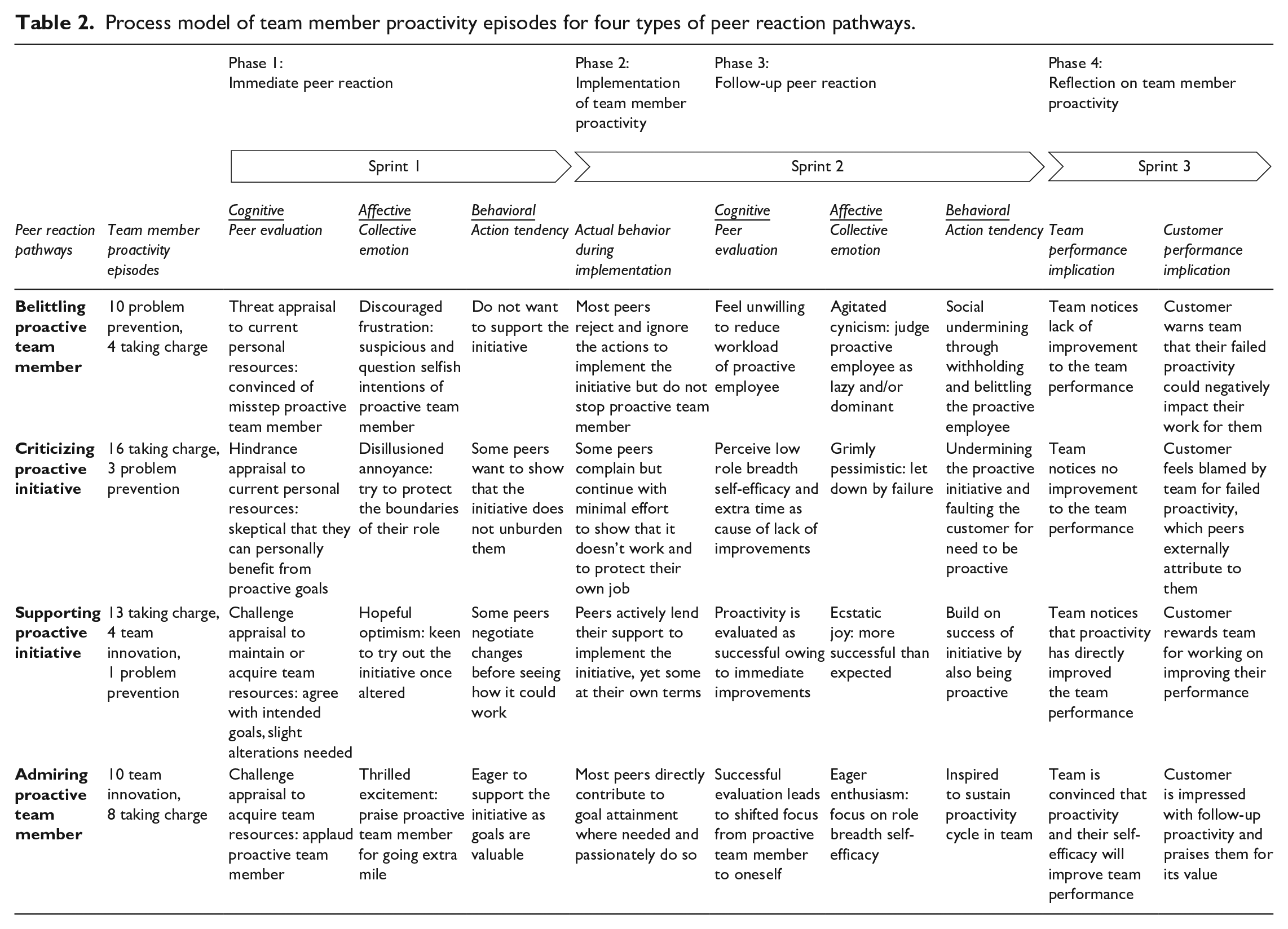



Proactive team members used the team reflection meeting that occurred every two weeks at the end of a sprint to share their proactive effort with the others in the team. This was perceived to be necessary since contributions from team members were needed to yield support for and to realize the change. Directly after hearing about their team member’s proactive initiative, in the first phase, peers cognitively appraised the intended change and its goals as a threat, hindrance, or an interesting challenge to either themselves and/or the team, which they used to affectively respond and indicate their action tendency. While peers that felt most threatened by the initiative were most likely to respond, peers tended to agree with each other’s reactions as not everybody was able to speak up at that moment.
In the second phase, peers showcased how they perceived the team member proactivity by (refraining from) taking actions towards implementing and bringing about the initiated improvement as suggested by their proactive team member. During this implementation phase, we observed how peers actually contributed towards realizing the proactive goals and whether this behavior was in line with their immediate action tendency. The way they perceived the implementation phase allowed peers to cognitively (re)evaluate what the impact of the initiative was for themselves and the team. We found that this assessment of the proactivity’s success and its effectiveness was part of a follow-up peer reaction in the proactivity process, which we refer to as the third phase, whereby peers again affectively reacted to the proactive effort. Interestingly, we found that during 35 episodes, which were positively evaluated after its implementation, peers responded with a proactive follow-up reaction. Peers’ follow-up reaction towards negatively evaluated episodes was passive and undermined either the proactive employee or the proactive initiative.
Lastly, in line with Bindl’s (2019) individual proactive process, the final phase followed after the (proactive) follow-up reaction, in which peers reflected on the team member proactivity. Instead of directly reacting to the proactive team members or at their initiatives, peers used this moment to share their overall reactions to the process by reflecting on its implications for the team and the customer. This fourth phase formed a vital final discussion about the effectiveness of the proactivity as well as its impact on the team and their performance. The customers also shared their thoughts about the team’s proactivity.
Peer reactions to team member proactivity
Peer reaction type 1: Belittling the proactive team member
In the first type of peer reaction, peers decried the proactive team member because they did not feel that their colleague genuinely tried to improve the team’s functioning. This reaction mainly followed when team members engaged in problem prevention (10 episodes) and to a lesser extent when taking charge (two episodes) to improve and functionally change how the team works. The negative feelings started when the proactive employee blamed the team for their lack of commitment to prevent workplace problems or improve work processes. For example, in an initiative to help the team take collective responsibility for checking whether there were any problems on the dashboard, Josh harshly accused his peers of never monitoring it themselves: Guys, it bothers me that you don’t all look at the monitor. Tests are turning red on the dashboard and nobody asked me how we’re solving it! I feel as if I’m the only one who really cares. We need to do this together. Every day during the Daily Sprint, I’m going to assign somebody to check the customer monitor. This will make it a reminder for everybody to keep checking it. Later [that day], if the monitor hasn’t been checked yet, I’ll send a reminder to that person.
By negatively attributing the cause of the problem to his team members’ lack of dedication to regularly check the dashboard, Josh’s peers felt personally attacked by him. In these cases, peers felt that the goal of the proactivity was not to solve the proposed team problem but a deliberate attempt by their team members to decrease their own demands. The consequence of the proactivity would be that work was delegated and divided among the team members, without leaving peers any control about how to distribute this task. The proactive employees justified this by arguing that the problem is a collective responsibility needing to be taken on by more members than just oneself. They felt that the rest of the team was not taking full accountability to solve these (longstanding) problems.
As a result of the selfish underlying intentions that the peers sensed, this triggered more negative affect and avoidant responses from them, which they directed at the proactive employee (see Figure 1 – bottom left quadrant). The immediate response of the peers was to promptly mistrust the initiative as they felt that there was no need to proactively intervene since there was not even an actual team problem that needed solving. During the interviews and conversations, they shared their suspicion and doubt that there must be ulterior motives for the proactive endeavor, claiming once again that their team member had made a personal misstep by reducing one’s own workload in such a way. Peers also expressed during these conversations that they cognitively perceived the delegating of work to them as a threat to their resources (e.g. energy, time, effort), particularly because they believed that these extra responsibilities were not part of their role. Therefore, peers affectively reacted with discouragement and frustration to the proactivity as they felt that, in this case, Josh should have continued doing it himself instead of suddenly delegating extra responsibilities to them:
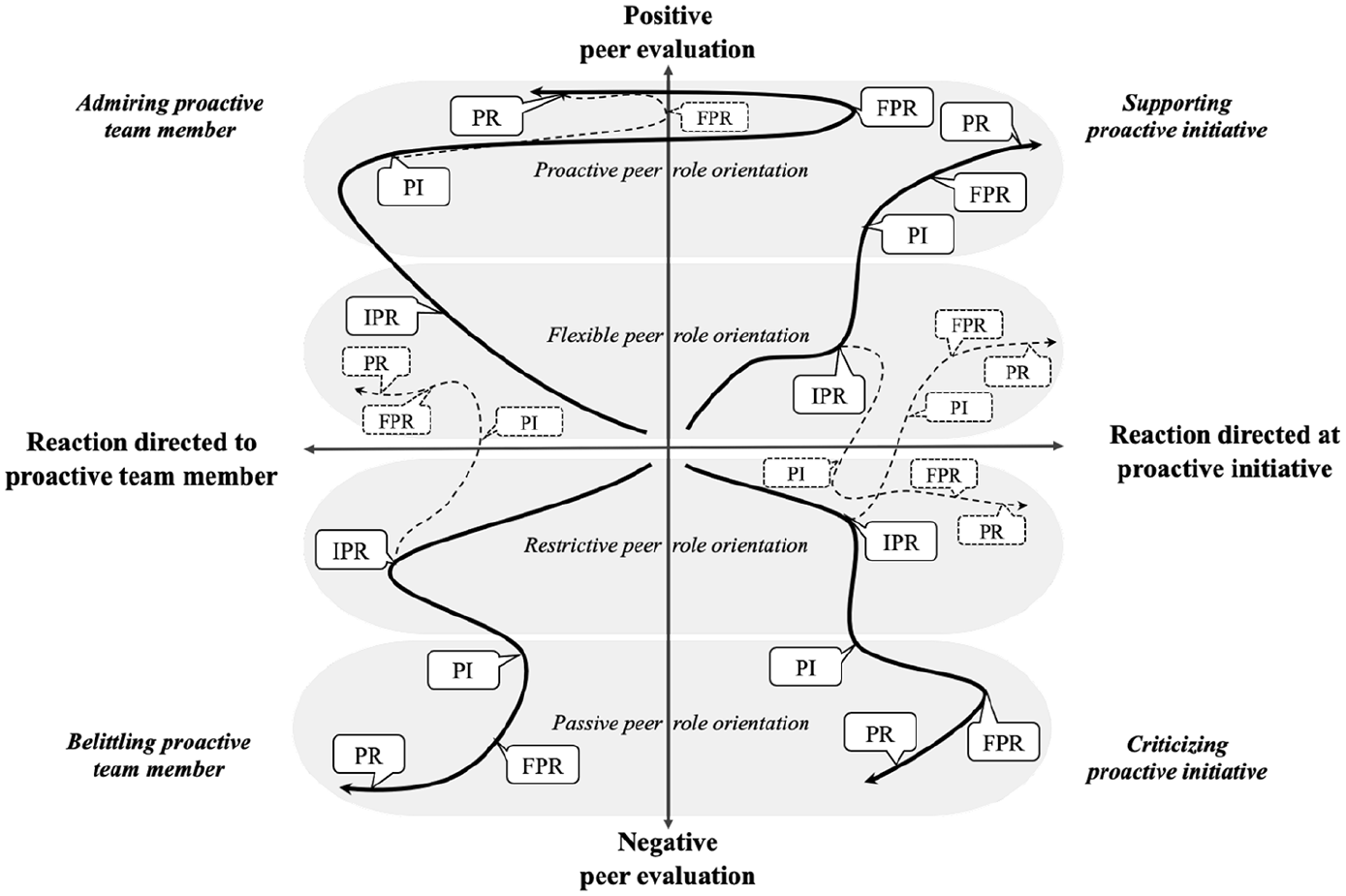
Pathways of peer reactions during team member proactivity episodes.
Why is that a problem? Can’t you do it yourself? I’ve never done that before. Do you really think that we want them [reminder emails]? It would feel like a childish reminder from you to check whether we’ve already brushed our teeth or not.
Other peers also questioned the intentions of the proactive employee for suddenly raising this issue, as they felt that this was an attempt to protect one’s own resources. Such personal accusations of proactive team members occurred more commonly throughout this peer reaction pathway. Thus, peers expressed a lack of trust in the proactive team member for sharing such an initiative, which they defensively reacted to, as exemplified by Josh: You are always the one who speaks up and takes charge of having to do less . . . In response to the peer: Do you really think I would come up with this if I knew you were all going to raise your eyebrows at me?
Thereafter, both during reflection meetings and in conversations with us, peers said that they were undermining the efforts because they would rather have their team members continue doing these tasks with which they were already familiar. Peers did not want to broaden their role with these tasks, especially not if this was to decrease their team members’ workload (see Figure 1 bottom left quadrant – shown by the turn in the pathway after the immediate peer reaction that moves away from the proactive team member). To explain their resistance, peers, for example, referred to Josh as being ‘dominant and sometimes a drama queen’ and someone selfish as he ‘always thinks he can easily get away with it’.
During daily meetings throughout the sprint that was used to implement the initiative, we observed that peers stood by their initial action tendency and refused to take on the tasks. For instance, peers said that they deliberately ignored Josh’s reminder emails, to which he reacted defensively that they should not be blocking his extra effort. Generally, the lack of involvement in implementing the initiatives following their initial reactions of distrust highlighted that peers were still convinced that the initiatives were unsuccessful.
Two weeks later, peers again emotionally expressed in a cynical and agitated way that they still did not understand why this problem needed addressing and why it promptly needed prioritizing. The peers kept on mentally distancing themselves from the tasks. More than previously, peers felt that the team member had a hidden agenda, whereby introducing this initiative and blaming the others for their lack of commitment was used to eliminate having to do these tasks oneself. Again, addressed directly to the proactive employee, however this time more furiously, the peers' collective negative affective response was further reinforced by them attributing the proactivity to him being too lazy again to take on the tasks himself: Have you actually been doing any work for the team this sprint? We miss transparency about what you have exactly been doing [to the monitor], you don’t properly communicate this with us. It feels like you are just too lazy to do it yourself.
Later on, reflecting on the proactivity during the reflection meetings and in discussions with us afterward, peers expressed their reduced commitment. They highlighted that they wanted to completely withdraw all their efforts related to the initiatives because they were ‘fed up’ with having to take on additional responsibilities when commanded to do so. Thus, the initial restrictive peer role orientation used to justify their reaction to the team member’s proactivity shifted towards a passive peer role orientation. Jointly, peers completely undermined implementing the effort or withdrew themselves from both the initiative and the proactive employee as they did not believe in its goals or its success: ‘I also assume that people only ask me to help with preventing problems when they have too much to do themselves, not to clear up their mess.’
After the negative reflection in Josh’s episode, peers left him to check the dashboard himself and ignored both him and the topic. The tension did not get less as during the customer feedback meeting the customer also said that he felt ‘that the communication is not good in this team’ because the team members ‘do not seem to understand each other’. He warned the team that they should work on improving the atmosphere in the team because he was worried about it negatively impacting their work for the customer. In some episodes, the customer explicitly referred to the failed proactive initiative and the impact it had on them.
To summarize, peers generally belittled their proactive team members when they did not perceive that the genuine intention was to solve a recurring problem or make a positive change but rather unnecessary attempts to reduce one’s own workload. Interestingly, out of the 12 proactive episodes that were initially perceived as a personal misstep, two were found to be more successful during its implementation after initially belittling the proactive employee (see Figure 1 shown by the dashed line moving away from the bottom left to the top left quadrant). Peers tried to retain a friendly team atmosphere when they realized that they were rightfully blamed and felt guilty for not putting in the minimal effort requested from the proactive employee to prevent the work problem; consequently, they started to praise them for pushing through the initiative without their approval. Moreover, the personal attack did not withhold the proactive employees from trying this proactive strategy again or belittling other peers in similar episodes. In two episodes, the proactive team member was admired for taking charge of a team-serving work method change after previously being belittled for an initiative that was considered self-serving. In contrast, being belittled after receiving admiring reactions from peers only followed in a single episode.
Peer reaction type 2: Criticizing the proactive initiative
The second type of reaction occurred when peers criticized the content of the proactivity or how the effort was executed, without faulting the proactive employee. The 17 proactive episodes (i.e. 14 episodes of taking charge and three episodes of problem prevention) that followed this unsuccessful pathway were motivated by the proactive team members as solutions to existing concerns or lingering problems that restrained the team from working effectively together. Similarly, these episodes started with proactive employees condemning all or a couple of team members for their lack of collective responsibility resulting from their restrictive role orientations. For instance, John explained that he proactively arranged for the team to work on product improvements together. As per the following quote by John, proactive team members felt annoyed that their peers were only occupied with finishing their own tasks whereas they prefer everybody to gain insight into how these single contributions come together: We should be more responsible for our work as a team. Some of us tend to only take ownership of tasks that have explicitly been assigned to them . . . From the next sprint onwards, I’ve made an overview and planned in everybody’s agenda that we’ll be taking on the first user story together, collectively. If we take these tasks on together, we’ll finish it in no time and the quality of the work will be really good!
Although proactive team members stressed that the initiative was intended to protect the team’s current resources, for instance with John’s idea of delivering better work without having members waiting around until they can contribute, peers reacted negatively as they perceived it as a threat to their resources. Peers appraised the input needed from them to implement the proactivity as hindering demands that go beyond their formal role requirements (i.e. restrictive peer role orientation). Preventing themselves from having to stretch the boundaries of their role, for an initiative that they already perceived to be unsuccessful, they stressed their incompetence to take on these additional responsibilities and decided to put in minimal effort. Hence, peers responded in disillusionment and annoyance: ‘Yes, well, doing that [working on user stories together] won’t make a difference, John. And I can’t do that because it doesn’t include my type of work.’
Thinking from their own perspective instead of that of the team, they felt that the proactive employees wrongly expected them to spend time learning a different technical specialism as these tasks were not part of their job. By doing so, peers were also trying to protect their job control. So, despite being blamed by the proactive employees for having a restrictive role orientation, peers were found to use precisely this reasoning as a defense mechanism to justify their criticism of the initiatives. Despite them complaining about having to do tasks beyond their formal role requirements, peers ended the discussion deciding that they would try the intended change, including John’s initiative, in the next sprint. Yet, peers stressed that they are doing so on their own terms as it places a burden on them.
During the daily meetings and while working, we observed that peers kept on complaining about the inconveniences they experienced when implementing the initiative. For instance, in an effort to justify their inefficacy of learning and understanding new skills when collaborating with others, they deliberately tried to slow down the process by pretending that they did not understand the technicalities or the programming language, and kept on referring to how long it had taken them to learn the complex procedures. In multiple episodes, peers confirmed that they did not fully commit themselves to regular duties of team members with a different specialism to maintain the cross-functional status quo.
As a result of their negative experiences with the implementation, which confirmed their initial impression, their follow-up reaction during the next reflection meeting remained pessimistic and reluctant. Peers conclusively and gloomily expressed that the initiative did not lead to any noteworthy improvements, such as John’s proposed collaboration: It really doesn’t make any sense to try to keep on doing all these tasks together, it won’t work. I understand the need to feel responsible for the totality but I still don’t like testing at all. I’m hired as an SAP-ISU specialist, so I can only do that.
So, peers again expressed their sensitivity towards having to take on additional tasks, such as those that cross the boundaries of their job description. Especially peers who defined their role narrowly reacted to the proactive initiatives with resistance and unwillingness. They felt threatened by the proactive employees who tried to influence how they should execute their job role more actively. Besides conveying their resistance to change their way of working, peers also pointed out that they felt they were too incompetent: ‘Don’t you understand that I can’t simply learn to do these new tasks? It’s too hard.’ ‘No way, I’m a Java developer and I can’t learn that other work as fast.’
This illustration indicates how peers allude to their restrictive role orientation to stress their unwillingness to learn new tasks that are beyond their formal role requirements, thereby refusing to continue further implementing the proactivity. Moreover, in some episodes, we saw in the Jira team pages that teams performed worse as collectively working on the first user story resulted in them not finishing their other work for the sprint on time.
Lastly, reinforced by their negative affect and not having achieved their team deadlines, peers blamed the proactive initiatives for the lack of accountability that they felt. In this case, this followed because they felt that John’s effort could not lead to everybody being able to fully understand each other’s technical tasks. Throughout episodes following this pathway, proactive team members reacted with shock and surprise that peers perceived their initiative as a threat and tried to downplay its impact and their intentions.
Similarly, in the customer feedback meetings, peers bitterly condemned the customer for not fully understanding why John’s initiative led them to not having achieved all sprint goals. For instance, when they discuss the ‘failed’ organization of working on tasks together: ‘If you have to do work and you don’t understand the reason why that’s when you get this mentality of lacking ownership like this. And working together on these tasks definitely won’t help us finish the work faster.’
Thus, even though peers criticized fruitless initiatives, they also felt that the need to introduce the changes was initially triggered by issues related to their work for the customer.
In sum, episodes of criticizing the proactive initiative did not successfully change the status quo because peers faulted the proactivity from the start and kept on doing so over time. These reactions were shaped by their unwillingness to invest time and effort in going beyond their prescribed role requirements to do tasks or prevent problems they perceived themselves to be unable to do or learn. As the proactive employees were not personally attacked during these pathways, they were not afraid to engage in team member proactivity again. Yet, we also observed two episodes of taking charge, whereby peers first criticized the initiatives, while later appeared willing to learn new tasks or skills during the implementation. They felt that they could perceive their role more flexibly to keep on learning, and evaluated the proactivity more positively than previously anticipated (see Figure 1 bottom right quadrant indicated by the dashed line moving away from the criticizing pathway).
Peer reaction type 3: Supporting the proactive initiative
This type of peer reaction is characterized by peers immediately expressing their support for the content of the proactive initiative but requesting slight adjustments to the way it is implemented. This successful pathway was found in 13 episodes of taking charge and four episodes of team innovation. Alexis, for example, took charge of organizing certain days to work together on shared tasks in the same office space instead of constantly calling each other when collaborating on those tasks. Proactive team members shared their initiative with a visionary tone, presenting the proactivity as a prosocial means to conserve the team’s resources, as exemplified by Alexis: Important aspects for us, I think, are that we keep on communicating together, take collective ownership of our work, and help each other with shared tasks. For us to keep doing that effectively as a team it is better if we can physically work together more often. Therefore, I have made a schedule on Jira showing where we’ll be working as a team each day of the week. I will keep on updating this schedule every Friday.
Once peers heard about the proactivity, they did not perceive any threat to their resources, generally only some slight exceptions, such as having a longer commute on some days. Therefore, they acknowledged that participating in the initiatives could directly benefit the team. More optimistic than the proactive employees, they said to us that the initiatives could have the potential to acquire additional resources for the team. However, in these conversations after the reflection meeting, peers also expressed that they were still slightly hesitant of its success because they first wanted to see how the initiatives would turn out. Hence, peers affectively reacted to the proactivity with hopeful optimism; they saw the value of trying the improved work methods. But seeing is believing, as was also the case for Alexis: ‘I agree that this could be improved. Even working together while working on different tasks could enable us to brainstorm together when it’s necessary. We could try this out next sprint and see whether this works for us.’
Without too much discussion, peers were happy to go along with the initiatives presented to see whether and how they could work out for the team. However, in this episode, peers collectively decided to try this new work method for only four working days a week instead of the proposed five days. Whereas this immediate peer reaction shows hesitation, we also observed proactive episodes that did not showcase this slight doubt at the start. In these cases, the eagerness was mostly for initiatives that the team had discussed earlier as a good option but did not act upon or initiatives that required input from the customer. Yet, peers remained unafraid to negotiate slight adjustments to let the implementation process better match their personal needs and schedule. Proactive team members mostly gave peers this freedom to further tweak their initiative for them to also feel motivated to make the changes.
During the two weeks of implementation whereby the team worked together in the office according to Alexis’ new schedule, which we tracked in the daily meetings and the Jira pages, peers came to evaluate the initiative positively. Commonly, peers realized that the change saved them valuable time and effort. In this particular episode, peers mentioned phone-calling each other less than before and referred to socializing with each other during their shared car rides to the office. As a result, their follow-up reactions in the reflection meeting were more encouraging than initially was the case. Overall, peers felt that the changes were much more fruitful than expected, which slightly relieved and reassured Alexis: I really enjoy working on more tasks together, we should keep doing this. In response to the peer: Yes, even though you’ve only helped me out for five minutes, as you did last week, it [physically working together] really saved me a lot of time.
Hence, we observed that peers reacted joyfully and were keen to pursue the changes in the next sprint to see how they could fine-tune the improvements as proactively initiated by their fellow team members. Positive evaluations of proactive efforts encouraged other team members to build on the success of the previous initiative by also engaging in team member proactivity. This shift is portrayed by the sharp incline of the pathway towards peer implementation in the top right-hand quadrant of Figure 1. The proactive peer role orientation showed from the evidence that peers perceived their role ever more flexibly as they felt stimulated to go beyond lending their support towards proactively making improvements to the team themselves in response to their fellow team members’ initiative. Generally speaking, peers attempted to uphold the success by instigating ideas that were either closely related to the previous proactivity. So, the proactive follow-up reactions highlighted peers’ willingness to invest more resources in initiatives that appeared to be encouraged by the team, which also received positive feedback from the customer. For example, Maxim told us during the meeting’s coffee break that he was initiating further improvements to the colocation days that Alexis organized, by planning for junior and senior members to do tasks in pairs: We need to keep the knowledge in our team. I’m going to arrange that on these [colocation] days of the week we can also do some programming work in duos next sprint so that we can learn from each other.
After the peers reacted and acted upon the team member proactivity, they highlighted during the daily review and the reflection meeting that the proactivity and the further development of it by other team members had directly improved their internal work processes. For instance, Aaron expressed during the daily meeting that working in pairs enabled them to ‘detect issues earlier than by ourselves’. These improvements also did not go unnoticed by the customers as shared with the team during their feedback meetings: Customer: What the team has built for us is really valuable. If you hadn’t worked on these tasks together then the work would have probably not been finished before June. In response to the customer: Yes, since we’re more actively sharing knowledge, we can now do everything together and help each other with tasks where necessary. We’ve now developed a shorter time-to-market for you.
Similarly, in most other episodes, peers felt praised by customers when proactive changes to the team’s way of working were picked up by them, especially when the customers were not aware of the follow-up initiative. Thus, in a nutshell, episodes of supporting the proactive initiative occurred when peers immediately shared that they saw the potential of the initiative, negotiated slight adjustments, and shortly after trying out the improvements realized how successful it was. In turn, this stimulated peers to further improve the team functioning by also being proactive themselves, which was often applauded by customers. These encouraging reactions were mainly triggered by peers’ flexible and proactive role orientation, thereby giving the team a sense of reward. Only in one proactive episode (as indicated by the dashed line moving from the top right to the bottom right quadrant of Figure 1), peers negatively evaluated the effort of taking charge. This happened when they noticed that the proactive employee kept controlling how the initiative needed to be implemented in the team. In response to this, peers held back from perceiving the need to take on these additional tasks as they could not successfully evaluate the initiative anymore; thus moving away from a flexible to a more restrictive role orientation in that situation.
Peer reaction type 4: Admiring the proactive team member
We found that in all 18 episodes (i.e. 10 episodes of team innovation and eight episodes of taking charge) whereby the proactivity process started with praising the proactive employee, peers evaluated the initiative as fruitful after acting upon it. In most cases, the proactive team member communicated that the initiative's goal was to improve the team’s (future) performance, thereby acquiring team resources over time. A striking example of a proactive effort of team innovation occurred during a reflection meeting, whereby Charlie stated that he wanted the team to be ahead of the customer’s needs and wishes. He communicated his proactive efforts towards asking the customer for feedback concerning research he conducted into their future needs and which new high-tech solutions would be attractive. He told the team that he wanted to follow up on that feedback by using the following week to present to the customer how they would like to realize their future needs with these new technologies.
As was the case for Charlie’s initiative, peers generally felt that their personal resource investment was limited. As soon as the proactive team members communicated the effort with them, peers acknowledged that the proactivity would first require resources from them, but they realized that this could take the team’s performance to the next level later on. Thrilled by the initiative, peers expressed their admiration for the proactive team member and the potential impact of the idea, as illustrated by Tom’s reaction to Charlie: Wow, isn’t that great that you’ve created a much better insight into what we need to do for them in the future! I’m really impressed! I totally agree that we should engage the customer in which technological solutions we’ve found and what they mean for them!
In conversations after this particular reflection meeting, team members expressed that they were astonished by Charlie’s proactivity because he is known for being quite shy and preferring to stay in the background. In multiple episodes, including this narrative, peers were a bit perplexed because they assumed that the proactive team members were secretly working on the initiatives for some days besides their regular taskwork without them noticing anything. However, in other episodes, peers mentioned that they praised the proactive employees for being thoughtful, and that going the extra mile was natural to these people.
Throughout the next sprint, team members directly contributed to advance the novel ideas, using daily team meetings to coordinate the tasks. In this case, and in comparable episodes, Charlie had not specified who needed to be involved in preparing the presentation and how this process was shaped, which resulted in a couple of peers with a flexible role orientation offering their assistance. Positive evaluations of the proactivity directly followed when the customer was stunned by the plans they presented to them. Straight afterwards, and during team reflection meetings, the team again said how happy they were with the idea. Peers were noticeably cheerful when they realized that the innovative ideas were attainable.
The peers’ follow-up responses to the team member proactivity had moved towards upfront eagerness and enthusiasm to actively generate new ways to improve the team’s functioning. So, in contrast to their initial reaction (i.e. directed at admiring Charlie), peers were already less occupied by what their team members had previously initiated (as indicated by the sharp turn in the pathway from the top left to the top right quadrant of Figure 1). Instead, we observed during their work, as confirmed in conversations with us, that they were occupied with proactively looking ahead at other product ideas or work methods that they could explore. Since the value of the previous effort was already visible to peers and appeared to be successfully evaluated by the team, peers felt keen and confident to also be proactive and thereby sustain the team’s proactivity cycle. Peers that already had a large sense of responsibility, felt inspired by the success of the proactivity to also actively seek to gain more resources for the team, thereby taking on a more proactive role orientation. Their flexible attitude and commitment to contribute to these initiatives fostered their willingness to also invest time and effort in proactively making a difference. In most of these episodes, the proactivity that followed was intended to inspire either the customer or fellow team members with novel and advanced techniques, technologies, or knowledge with which they were not yet familiar. Rick’s account illustrates this point. In response to Charlie’s initiative and the feedback they received from the customer, Rick used the team reflection meeting to proactively present his new ideas concerning the team’s most valuable customer solutions: As we need more insight into how we can help the customer create more value in the future, I’ve made an overview whereby I’ve calculated how much our work over the last period has contributed to this value creation and based on that have come up with a new proposal. I’d love to show my newest product ideas to you and the customer coming Friday after lunch so that we can prioritize our future work accordingly.
This follow-up response by Rick illustrates the tendency that peers do not rephrase their admiration for their team members’ proactivity by addressing them personally but instead willingly voice their own inclination to go the extra mile to further improve the team’s performance. Proactive team members commonly responded to their peer’s follow-up reactions with sincere pride and a high willingness to contribute to this initiative, even if this required tasks to be done outside of regular work hours. Solely in a couple of episodes, peers briefly referred to valuing the proactive employee besides stressing their own initiatives.
In most cases, the team reflected on the proactive efforts by praising the proactive employee again as they initially did. Moreover, team members applauded and complimented the whole team for their effective implementation. They felt that slowly but surely the initiatives would help the team perform better over time. Interestingly, while reflecting on what the initiatives had accomplished, stressing how effectively they were incorporated into the team, peers frequently referred to their self-efficacy as the main reason behind its success.
In sum, admiring the proactive team member was a reaction to initiatives whereby peers directly praised the proactive employee for engaging in a valuable effort. Peers were so excited after seeing its success that they shifted their attention away from their team members towards seeking how they could also make proactive improvements. In only four episodes, peers maintained expressing their admiration for the proactive team member as shown by the dashed line diverging from the admiring pathway in Figure 1. In reflecting on the proactivity, peers did come back to offering them praise for being proactive, thereby stressing the importance of the team’s mindset to proactively go beyond necessary customer requirements.
Discussion
Starting with the premise that exploring proactivity in teams is central to understanding how teams deal with working in a constantly changing work environment, this study attempts to advance theories about how and why peers react to team member proactivity. Most proactivity research has assumed that individuals benefit from proactive work behaviors (e.g. Grant et al., 2009; Van Dyne and LePine, 1998), while little is known about the potential impact of proactive efforts on others, especially in a team context, and crucially how this impact translates into their reactions to the proactive team member or proactive initiative. In seeking to fill this gap, this qualitative study revealed that cognitive, affective, and behavioral evaluations explained which of four peer reaction pathways were formed throughout the process and how peers reflected on the proactivity and its impact on the team. To provide an overarching understanding, the process model takes into account that peer reactions are based on how the change is experienced, enacted, and evaluated over time.
Theoretical implications
Peer reactions depend on how the team member proactivity is perceived
Our research contributes by further clarifying the role of peers in the process of team member proactivity. Although research has recognized managerial reactions towards proactivity (e.g. Bolino et al., 2010; Burris, 2012; Chan, 2006; Fuller et al., 2015), the role of peers has received less consideration (see Parker et al., 2019). This study uncovers the perspective of individuals directly observing and involved in the proactivity, thereby providing insight into how team member proactivity is responded to by peers. Naturally, our first finding was that peers react to the team member proactivity either directly to the proactive employee or at their proactive initiative. On the one hand, peer responses centered around the proactive team member when the peers perceived that the intentions behind the proactivity were not fully sincere or when the peers were directly convinced of the success of their initiative and motivated to sustain proactive behavior in the team. On the other hand, peer responses focused on the initiative when they perceived the proactivity to either be valuable for the team or a waste of time.
We further uncovered that these immediate peer reactions were triggered in two ways by how the proactive team member communicated the initiative to them. First, when proactive team members made any negative attributions about them, peers were more likely to negatively react to the proactivity and question their egoistic or ungenuine intentions. In contrast, peers better evaluated a more visionary or promising tone because this uplifted the team and they associated the initiative as being meant to genuinely improve the team. In all episodes, peers directed their response at the proactive team member when they sensed that the intentions were not genuine. Second, peers understood from the way proactive team members communicated the initiative whether they received or could negotiate any control over the way the initiative needed to be implemented. Only when peers felt that they could control the implementation, or personally felt that adjustments were needed to unburden themselves, they directed their response at the proactive initiative to negotiate changes.
With these findings, our study extends the proactivity literature by showing that especially in an interdependent setting where employees manage themselves towards achieving team goals, it is important that peers respond constructively towards each other’s proactivity. Positive responses are vital as they depend on proactivity to stay on top of their team’s functioning and changing demands (Hoda et al., 2011; Junker et al., 2021). They encourage peers to also behave proactively to improve the team’s functioning. While most studies focus on the managerial support that employees receive to behave proactively (e.g. Fuller et al., 2015), our study emphasizes the need for receiving peer support. Such support sends important social cues to team members that they are capable, can exert control in obtaining desirable outcomes, and that their contributions are appreciated (Grover, 2013).
Moreover, this study also moves beyond exploring the generally positive outcomes that individuals experience from being proactive, towards gaining insights into the perceived desirability of proactivity in a team context. By doing so, we respond to a call from Bolino et al. (2010) requesting more research on when proactivity is well-received by peers and when it is considered by them to be unfavorable. The two reactions of ‘belittling’ or ‘criticizing’ proactivity especially showed that proactive team members could indeed be penalized for their misappropriate timing or challenging of the status quo (see Chan, 2006). Specifically, reactions of ‘belittling the proactive team member’ resulted when peers perceived the proactivity as an attempt of job crafting to decrease one’s job hindering demands (Tims and Bakker, 2010). Also, similar to Einola and Alvesson (2019), peers personally rejected the proactive team member because they felt that (s)he was trying to dominate by blaming other team members while communicating their initiative. Attributions of self-serving intentions had adverse reputational effects, since peers also decried the proactive employee in their follow-up reaction, by harshly blaming and rejecting him/her. In these instances, peers also made inferences about personal characteristics of the proactive employee driving them towards sharing selfish initiatives, such as by referring to their laziness, incompetence, or dominance, as well as accusing them of trying to decrease their own workload more often.
In general, peers tended to avoid belittling their proactive team members in an effort to keep the atmosphere pleasant, as they highly depended on this harmonious team climate to collectively achieve their interdependent work (see Gan and Cheung, 2010). Nevertheless, peers struggled with keeping up this facade when they felt that their proactive team member presented a self-serving initiative. Hence, peers belittled proactive team members, as a direct form of social undermining (Duffy et al., 2002). This finding is in line with previous research that suggests that proactivity is received more positively when it has prosocial motives and more negatively when it is perceived as self-serving (e.g. Grant et al., 2009). Surprisingly, the belittling and social undermining did not withhold proactive employees from engaging in team member proactivity again, for which in some episodes they were admired.
Interpreting peer reactions to team member proactivity
A second theoretical contribution is that our research highlights the affective reactions from peers throughout the process of team member proactivity. While previous research has principally focused on the role of affect and mood in relation to employees engaging in proactivity (e.g. Bindl, 2019; Den Hartog and Belschak, 2007), highlighting that positive affect is crucial for employees to be more proactive (e.g. Bindl et al., 2012), our findings emphasize that positive affective peer reactions, indicating that they are willing to go along with the initiative, may give employees strong beliefs and feelings of self-efficacy that they can bring about change to the status quo (i.e. ‘can do’ proactive motivation; Parker et al., 2010). In line with Choi et al. (2011), we found that team innovation received positive affective peer responses, which led to higher levels of collectively using the innovation in the team. More than half of the ‘admiring’ cases appeared to be instances of team innovation, and all of these episodes were perceived to be successful. As a result of these eager responses, and similar to Urbach et al. (2016), peers also demonstrated a higher action tendency towards implementing the prosocial team innovation.
Positive feelings of excitement, happiness, and pride during the implementation phase are needed for proactive employees to feel motivated to engage in proactivity in the future (Bindl, 2019). We extend this finding by showing that, in a team context, positive affective reactions towards proactivity, or at least a positive follow-up reaction, are also necessary for peers’ sustained motivation to engage in team member proactivity in the future. Impressed by the exceptionally original proactive ideas, peers also believed that they could mirror their team member's successful endeavors (see Barsade, 2002), even team members who were previously belittled for embarking on a self-serving initiative. This flow-on effect highlights that when peers proactively react in response to their team member’s successful initiative, they can sustain the proactivity in the team and strengthen their team’s proactive norms (Junker et al., 2021). While this mimicking was not the intention of the proactive team members, they appeared to be highly supportive of these initiatives and made tremendous efforts to also make them highly effective for the team. In contrast, affective reactions that remained negative throughout the process discouraged peers from engaging in proactivity themselves. The absence of sustaining a initiative could result in proactive employees not feeling respected enough by their peers to make a difference (Grover, 2013). This might not invigorate them to become proactive again (i.e. ‘energized to’ proactive motivation; Parker et al., 2010). Especially since peers have distanced themselves from the proactivity by blaming them, putting in minimal effort or ignoring them during the implementation, or even totally undermining their initiative. These pessimistic responses emphasize the urgent need for convincing peers to accept and participate in making proactive changes now and in the future.
Peer reactions are dynamically shaped by the flexibility of their role orientation
The third contribution of this study is that we reveal why peers feel and express these different emotions and behavioral action tendencies in response to team member proactivity. Peers can appraise the initiative as a challenging opportunity, hindrance, or threat to their resources immediately after hearing about it. We found that peers need to perceive that they have the means to contribute to the implementation of the proactivity before they react positively to the initiative. Perceptions of resource availability are essential because proactive employees are more likely to face difficulties selling proactive ideas when their peers perceive they have limited resources to implement the workplace change (Guzman and Espejo, 2019).
Having access to sufficient resources, rather than the actual resources needed to implement the proactivity, allows peers to weigh whether they feel like formulating an encouraging reaction. Yet, our findings also suggest that peers want to influence their resource investment by negotiating how the initiative should be implemented (Hobfoll et al., 2018); for example, by fine-tuning their contribution so that it better fits their skills or workload. Especially for the episodes whereby they expressed their support, which indicates that peers see the added value of the initiative, they still want to feel in charge of their own resources. Hence, cognitively evaluating their resources could play a critical role in the process of peers deciding whether they are willing to invest their time in its implementation.
The present findings add to research on role orientations (e.g. Parker, 2007) by explaining that peers actively shape and reshape their own role orientation to fit their current evaluation of the proactivity. Specifically, we found that the same peers adapted their role orientation in the moment depending on their perception of the initiative's success. When peers saw the value and flexibly took on the additional tasks, they were more likely afterward to shift their role enactment to sustain the team member proactivity. Interestingly, these proactive follow-up reactions were not limited to single team members. Thus, besides the importance of proactive employees defining their roles broadly and flexibly to be proactive, we found that peers also need to do so. Feeling responsible is crucial for them to respond encouragingly towards the initiative and to be proactive themselves in the process.
Alternatively, when peers evaluated the additional demands as a burden, they reacted from perceiving their role more restrictively. After hearing about a fruitless initiative, they felt reluctant to take on the actions beyond their formal role requirements and tried to criticize the initiative or blamed the proactive employee to protect the boundaries of their own role. Later on, these peers shifted towards enacting their role regarding the proactive initiative more passively (by undermining the tasks and the team member) because they did not believe in its potential. It is especially problematic that peers who feel most threatened by the proactivity are those who speak up on behalf of the others that the initiative does not fit within the responsibilities of their role, thereby negatively shaping the process’s progress. Based on their first impressions, wanting to refrain from spending resources on realizing proactive goals, peers could actively withhold proactive employees from being effective.
Process of team member proactivity from the perspective of peers
A final contribution of this study is that we shed light on how peers impact the way that the proactivity process unfolds in the team. Parker et al. (2010) describe proactivity as a goal-driven process involving envisioning a proactive goal (i.e. proactive goal generation) and striving to achieve that proactive goal (i.e. proactive goal-striving). We highlight that peers also envision whether the team members’ initiative could address the problem or opportunity before they strive to achieve their team member’s proactive goal. Individual proactive behavior is described as a process consisting of four phases: envisioning, planning, enacting, and reflecting (e.g. Ashford, 2008; Bindl et al., 2012; Grant and Parker et al., 2010). In this study, we found that the process is more complex for team member proactivity as proactive employees heavily rely on their peers’ impressions, evaluations, and reactions towards their proactivity when striving to impact the team. Instead of striving for personal goals, the proactive goals aimed at benefiting the team need to be supported and understood by peers in order for them to invest their resources in implementing the desired change. Our model contributes to capturing how peers perceive the entire proactivity process, as we show that peer reactions to team member proactivity are not limited to a single occasion. This process approach was recommended by Parker et al. (2010) since judging how proactivity is experienced based on a one-off observation, such as a meeting, could be inaccurate.
In essence, the process started with peers immediately evaluating the initiative directly after hearing about it from their proactive team member, who seeks their assistance to implement the change. In formulating their initial reaction, peers were triggered to cognitively perceive whether, for instance, the introduction of a new work method could benefit the team, whether the intentions were genuine, and how they would appraise their control. Regardless of whether the immediate reaction was positive or negative, each initiative was acted upon in the next sprint and ended with a follow-up reaction in the following team reflection meeting. Indeed, even though peers might initially express their admiration for the proactive team member, we show that peers can decide to alter the way they feel about the proactivity during the process, as peers in the ‘admiring’ episodes directed their follow-up reaction to the proactive initiative and their own proactive contributions. Especially peers that evaluated the proactivity very positively felt the need to go the extra mile themselves by also being proactive for the team. However, when peers immediately responded negatively to the proactivity, they did not alter their first impressions but instead used the follow-up reaction to reaffirm that their initial opinion could not change.
The episodes where peers were motivated to be proactive themselves also positively impacted the fourth and last phase of the process, namely the reflecting on the team member proactivity. In line with previous studies on the individual proactivity process (e.g. Bindl, 2019; Bindl et al., 2012; Parker et al., 2010), we found reflection as a phase of proactive goal striving. Team members tried to understand the implications of the proactivity on the team by discussing its success or failure. Peers actively used this occasion to share their last personal thoughts, as they hardly ever referred back to specific proactive instances after this moment.
Practical implications, limitations, and future research
Our study shows that proactive employees rely on active support from their peers to successfully enact their initiatives. In turn, peers need to become aware of the impact that their reactions have on the proactive employee, the team’s functioning, and their resources. Therefore, we advise managers or teams to design interventions targeted at developing self-awareness and intrapersonal skills. These interventions could train team members to give constructive feedback to a proactive initiative. Furthermore, they can create awareness of communicating the proactive effort timely and with the right tone. One such skill that team members could benefit from developing is political skill, which is ‘the ability to understand others at work, and to use such knowledge to influence others to act in ways that enhance one’s personal and/or organizational objectives’ (Ferris et al., 2005: 127). Developing this ability would benefit the team since politically skilled employees are better at delivering their proactive suggestions in a more sincere, thoughtful, and effective manner (Sun and Van Emmerik, 2015). This could stimulate more positive peer responses to taking charge of the team’s functioning, as peers often criticized these proactive efforts as being a hindrance to their job and resources. In doing so, they can also better account for peers’ needs and projected resource investment and address them in socially constructive and adaptive ways.
Moreover, our findings highlight that peers need to be open to first explore and act upon the initiative before they negatively react to the proactivity or blame the proactive employee. By developing more trust among team members, peers could feel more responsible for tasks or problems beyond their formal role requirements and for proactively making improvements to the team (Parker et al., 2006). This could allow peers to better cope with the implications of team member proactivity without feeling threatened by its required actions, as was found for problem prevention. Developing political skills could also help peers to formulate more constructive and positive reactions, which largely impacts whether other team members feel motivated to sustain the proactivity. Similarly, peers need to be aware of situations in which team members use proactive behavior to craft one’s job and use this to reduce their workload. This awareness could enable peers to detect the true proactive motivation and help them by offering extra support and other relevant job resources.
Lastly, and line with Vough et al. (2017), team meetings represented crucial moments to communicate, react to, and reflect upon team member proactivity. While the actions to implement the proactivity were enacted throughout the sprint, the teams mostly used the reflection meetings to share their proactive efforts, allowing peers time to react and respond to them. Therefore, organizations aiming to promote proactivity among their teams should facilitate such moments of reflection, not only with team members but also with customers. Practically, teams or their managers could plan fixed reflection meetings, preferably every two or three weeks, to create an opportunity for members to communicate and discuss their initiatives. Finally, managers could stimulate teams to proactively engage in team innovation, since peers are more likely to appreciate these initiatives and successfully realize change.
This study has several limitations that may serve as fruitful avenues for future research. First, we acknowledge that studying a specific type of team (i.e. agile teams) could have influenced the reactions that we found. Several characteristics of agile working, such as being self-managing, working in iterations, and a fixed set of meetings, are expected to be projected in the results. For example, members of agile teams might be more aware of the potential impact of their proactivity on (the work of) their peers. In more constrained team contexts that rely less on task interdependence and proactively dealing with changing demands, such as short-term teams or autonomy-restricted teams with managers, peers might be more hesitant towards efforts of team innovation or taking charge. Alternatively, peers from other team contexts might perceive their role more restrictively and may therefore be less likely to sustain the proactivity in their team. Thus, owing to the distinct nature of agile teams, it is advised that future research explores peer reactions in other contexts and team types, thereby also exploring the impact of different types of team member proactivity. Such research could also contribute insights into how the proactivity process is shaped in teams that are, for example, more gender-diverse or do not have fixed team meetings.
Second, we encourage future researchers to empirically study the process outlined in this research. Specifically, it would be interesting to examine whether different dynamics could be uncovered beyond the four peer reaction types that we found since we imagine that this does not fully represent all possible pathways. There might also be other dynamics when teams work with sprints or projects that last a longer or shorter time as this could impact the duration of each phase of the process. Moreover, future research is encouraged to study whether and which personal characteristics of the proactive team member can explain how peers react to their initiatives, especially since we found that peers reject proactive employees for characteristics of laziness, dominance, and blame. Lastly, we encourage researchers to explore whether and how peers compare proactive episodes, particularly when teams are going through multiple proactive processes (individual- or team-oriented) simultaneously. Ultimately, we hope our insights into peer reactions to team member proactivity may motivate future researchers to take a broader perspective when examining proactive behaviors so that initiatives in a team can be valuable for all its members.
Supplemental Material
sj-pdf-1-hum-10.1177_00187267221094023 – Supplemental material for A process model of peer reactions to team member proactivity
Supplemental material, sj-pdf-1-hum-10.1177_00187267221094023 for A process model of peer reactions to team member proactivity by Melissa Twemlow, Maria Tims and Svetlana N Khapova in Human Relations
Footnotes
Funding
The author(s) received no financial support for the research, authorship, and/or publication of this article.

Supplemental material
Supplemental material for this article is available online.
References
Supplementary Material
Please find the following supplemental material available below.
For Open Access articles published under a Creative Commons License, all supplemental material carries the same license as the article it is associated with.
For non-Open Access articles published, all supplemental material carries a non-exclusive license, and permission requests for re-use of supplemental material or any part of supplemental material shall be sent directly to the copyright owner as specified in the copyright notice associated with the article.
