



Abstract
Several large organizations underwent agile transformation processes over the past few years, despite limited theory and empirical research on agile working. The present study draws from the taskwork–teamwork distinction and the proactivity literature to develop a new multilevel model of agile working. We tested this model in a sample of 114 teams (N = 476 individuals) undergoing an agile transformation at a large German transport and logistics organization. Teams at the end of the agile transformation scored significantly higher on agile work practices, proactivity norms, and team performance than teams at the beginning of the transformation. Results of multigroup structural equation modeling indicated that agile taskwork related indirectly to team performance through a positive relationship with proactivity norms. The positive relationship of agile teamwork with team performance was not mediated by proactivity norms, unlike hypothesized. Finally, we found that agile taskwork increased the likelihood that individual employees benefited from engaging in proactive behavior (specifically, employee intrapreneurship) in terms of in-role performance (i.e., cross-level interaction). This was presumably because of the favorable proactivity norms of teams practicing agile taskwork (i.e., mediated moderation). We discuss the implications of our findings for the literature on proactive behavior in teams.
Several large organizations such as the Finnish consumer electronics company Nokia (Laanti et al., 2011) and the US-based online retailer Zappos (Bernstein et al., 2016) have spent considerable financial resources in undergoing agile transformation processes. The central aim of an agile transformation is to adopt agile ways of working (Rigby et al., 2020), which entails that employees work in teams rather than hierarchically supervised departments (Tripp et al., 2016). Agile working further entails employees performing their tasks in a self-starting and future-oriented way (Grass et al., 2020), which is also known as proactivity (Parker et al., 2019).
Despite the popularity in organizations, we currently lack a theoretical framework on agile working that integrates this emerging concept with the literature on work teams (Mathieu et al., 2019) and employee proactivity (Parker et al., 2019). Until now, studies that have linked agile working to theories on management and organizational behavior primarily made use of qualitative (Grass et al., 2020) and single-level designs (Tripp et al., 2016). Yet, agile working is inherently multilevel because it entails phenomena at the team level (e.g., agile practices) and at the individual level (e.g., proactive behavior). Therefore, the present study aims to develop and test an integrative multilevel model (see Figure 1) to provide insights regarding how agile working shapes the behaviors and performance of teams and individuals.
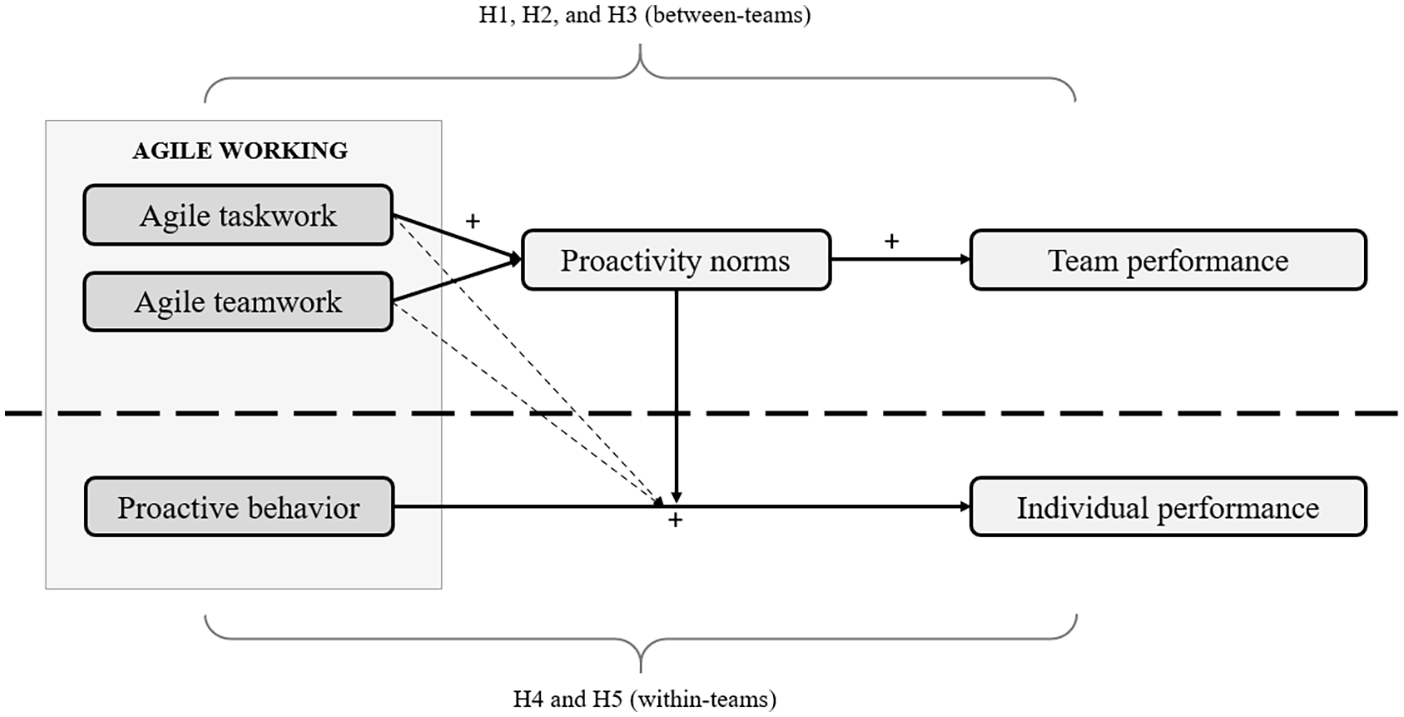
Multilevel model of agile working.
Before developing our model, we introduce the concept of agile work practices, which we predicate on the team literature (Fisher, 2014; Marks et al., 2001). Agile work practices are proposed to be a set of activities that can be used by almost any type of team to structure taskwork and teamwork in an agile way. This concept is introduced to account for recent developments in organizations, where agile practices are no longer only applied in software development teams, but also in HR, marketing, and other types of teams (Cappelli and Tavis, 2018). Moreover, the agile work practices concept is not tied to a specific agile method such as Scrum (Schwaber and Sutherland, 2017), Kanban (Anderson, 2010), or Design Thinking (Plattner et al., 2012). In other words, we propose that agile work practices can also be implicitly used by various teams, without adhering to the guidelines or “rules” of a specific agile method.
We aim to make three contributions to the broader literature on teams and employee proactivity. Firstly, we introduce the concept of agile work practices to empirically study agile working across different team contexts. Secondly, we develop and test a multilevel model of proactivity and performance in agile teams. This model delineates how agile work practices generate proactivity norms in teams, which facilitate the effectiveness of employees’ proactive behaviors. Finally, we explore the role of different proactive behaviors—job crafting and intrapreneurship—that employees may use to enhance their own job performance when working in agile teams. Our findings have implications for organizations aiming to become agile.
Theory and hypotheses
Agile work practices and the taskwork–teamwork distinction
The present study focuses on the most frequently used agile practices as reported in large-scale industry surveys among agile practitioners (VersionOne, 2018). These surveys include respondents from a wide range of organizations that have adopted agile ways of working and are annually conducted by VersionOne, a large US-based software development organization. Tripp and Armstrong (2018) analyzed the 2011 wave of this survey based on a sample of 2304 agile practitioners consisting mostly of project managers, trainers, and consultants. Together with three expert raters, Tripp and Armstrong categorized the reported agile practices into (a) software-development practices and (b) project- or team-focused practices. Here, we focus on the latter and refer to them as agile work practices because they can presumably be used by almost any type of team, beyond the software development context.
As noted by Niederman et al. (2018), the agile literature is often criticized for lacking a solid theoretical basis. Given that agile work practices are typically implemented in teams, we propose a conceptualization of these practices that builds on the established taskwork–teamwork distinction from the literature on work teams (Fisher, 2014; Marks et al., 2001). Accordingly, we define agile work practices as a bundle of instructions that enable teams to organize (a) taskwork activities and (b) teamwork activities in ways that align with the values of the agile manifesto (i.e., personal interactions over fixed processes, output over documentation, collaboration over contracts, flexibility over following plans; see Beck et al., 2001). Next, we further define the two sub-dimensions of agile work practices and introduce specific practices as reflective indicators of each dimension.
Agile taskwork
Agile taskwork addresses the goal- and task-specific performance requirements in the team (see Marks et al., 2001), and is reflected in practices such as iterative development and sprints. Iterative development is an approach to delivering work outputs in repeated cycles (i.e., iterations) and smaller portions (i.e., increments). Instead of specifying the details of the final work output upfront, agile teams experiment with different ideas and often start with developing prototypes (Nguyen-Duc et al., 2017). These prototypes are rapidly refined throughout each iteration, so that by the end of an iteration the team can deliver a potentially working increment of a product (e.g., a new feature of an app). Iterative development is closely linked to the logic of effectuation (Sarasvathy, 2001) because it entails that products/services arise organically through experimentation and adaptation, rather than through following pre-specified long-term plans. Agile teams typically specify the tasks that are performed within an iteration in time intervals of less than 1 month, which is often referred to as a “sprint” (Schwaber and Sutherland, 2017). By planning the work in sprints, the team reduces the risk of unnecessary resource allocation, and remains flexible in case requirements change (So, 2010). Sprints may work on the principles of goal-setting theory (Locke and Latham, 2019), as this practice implies that tasks are approached by following short-term and attainable goals.
Agile teamwork
Agile teamwork addresses the interaction and role requirements in the team (see Marks et al., 2001), and is reflected in practices such as stand-up meetings and retrospective meetings. Stand-up meetings are short daily meetings, during which team members usually stand together in a circle to inform each other of the progress of their work and their goals for the day (Stray et al., 2020). According to agile practitioners, the duration of this meeting should be limited to 15 minutes, in order to keep the meeting focused on the main developments in the team (So, 2010). Stand-up meetings can be seen as a form of team monitoring (Rapp et al., 2014) that happens in a formal setting on a daily basis. At the end of an iteration, agile teams usually hold a more elaborate meeting—the so-called “retrospective meeting” (Andriyani et al., 2017). The purpose of this meeting is to discuss ways for improving team performance and to address team dynamics (e.g., conflicts, role ambiguity, etc.). Hence, retrospective meetings can be seen as a structured way to enable team reflexivity, which refers to a “team’s joint and overt exploration of work-related issues” (Schippers et al., 2007: 191).
Agile work practices and team self-management
Qualitative studies have characterized agile teams as self-managing (Moe et al., 2010), which means that their members tend to have more control over their work methods and take responsibility for a broader variety of tasks than members of hierarchically supervised teams (Manz, 1992). What makes agile teams different from other teams is the extent to which they make use of agile work practices for coordinating team members’ activities. Hence, team agility is best viewed as a continuous variable, as any team might use agile work practices to a certain extent—independent of whether this happens explicitly (e.g., owing to the team’s use of the Scrum method; Schwaber and Sutherland, 2017) or implicitly (e.g., owing to the way the team has organized itself organically). Moreover, it is possible that certain agile work practices can also be implemented in hierarchically supervised teams. For instance, leaders—rather than team members—may formulate the specific goals for a sprint (i.e., agile taskwork), and use stand-up meetings (i.e., agile teamwork) to assign work tasks. Thus, whether an agile team is self-managing or hierarchically supervised may depend on how agile work practices are enacted in the given context (see Daniels, 2006).
A model of proactivity and performance in agile teams
One of the main aims of agile work practices is to enable team members to engage in self-starting and future-oriented behaviors (Grass et al., 2020; Rigby et al., 2020). With the model presented in Figure 1, we want to explain how agile work practices could help to establish a context that is conducive to these positive work behaviors, which subsequently influences performance at the team level and the individual level (Griffin et al., 2007). Our central proposition is that agile taskwork and agile teamwork contribute to the emergence of shared proactivity norms in teams. Favorable proactivity norms, in turn, relate positively to team performance (i.e., mediation) and enhance the effectiveness of individual team members’ proactive behaviors (i.e., cross-level mediated moderation). Proactivity norms indicate the extent to which the team encourages self-starting and future-oriented behaviors, similar to the concept of team climate for proactivity (Cai et al., 2019). In the following, we integrate the proactive motivation model (Parker et al., 2010) with a social influence perspective (Barker, 1993; Ehrhart and Naumann, 2004; Salancik and Pfeffer, 1978) to explain how agile work practices contribute to the emergence of proactivity norms in teams.
Agile work practices and proactivity
The proactive motivation model (Parker et al., 2010) states that contextual variables, such as agile work practices, shape proactive behaviors via three motivational states, namely (a) can-do motivation (e.g., self-efficacy), (b) reason-to motivation (e.g., felt responsibility for change), and (c) energized-to motivation (e.g., positive affect). Although this model has primarily been used in individual-level research, a recent review by Cai et al. (2019) suggests that the three motivational states may also exist as shared team-level phenomena.
A team with high levels of can-do motivation feels a shared sense of confidence to engage in a broader variety of different tasks, and regards proactive behavior as a feasible way to approach goals. Can-do motivation may primarily come from agile taskwork, as agility implies that the team is working on tasks that allow for using different skills, such as planning work activities for the next sprint (Liu et al., 2019) and interacting directly with customers to obtain feedback on prototypes (Nguyen-Duc et al., 2017). Moreover, agile taskwork grants team members the autonomy needed to initiate changes in tasks and procedures (Tripp et al., 2016), which has been linked to proactivity via can-do motivators (Parker et al., 2010).
A team with high levels of reason-to motivation collectively feels responsible for the work and values proactive behavior. Reason-to motivation may primarily come from agile teamwork in the sense that stand-up and retrospective meetings increase team members’ feelings of responsibility by holding them accountable for their work outputs (Andriyani et al., 2017; Stray et al., 2020). In addition, agile teamwork provides regular opportunities for obtaining feedback on one’s task performance (Tripp et al., 2016) and thereby may give a reason to engage in proactive behaviors (see Wang et al., 2018).
Finally, a team with high levels of energized-to motivation experiences positive affect and collectively feels enthusiastic about work. Perceptions of agile work practices have been shown to correlate positively with job satisfaction (Tripp et al., 2016) and work engagement (Huck-Fries et al., 2019). These earlier findings suggest that energized-to motivation may emerge from both agile taskwork and agile teamwork. This idea also aligns with theories of group affect (e.g., Costa et al., 2014; Kelly and Barsade, 2001), proposing that a team’s level of energy and positive affect is a function of taskwork (e.g., job characteristics) and teamwork (e.g., communication) antecedents.
In sum, our theoretical analysis from a perspective of the proactive motivation model (Cai et al., 2019; Parker et al., 2010) suggests that agile work practices have a motivating potential that may encourage team members to be proactive. Now, we integrate a social influence perspective with the proactive motivation model to further explain the emergence of shared proactivity norms in agile teams. Seen from the perspective of social information processing theory (Salancik and Pfeffer, 1978), agile taskwork and agile teamwork may provide motivational cues (e.g., “can-do” and “reason-to”), from which team members derive that proactive behavior is encouraged by the team (see Bommer et al., 2003). In this way, agile work practices may contribute to the emergence of “injunctive proactivity norms”, which indicate the extent to which the team approves of proactivity and regards it as appropriate work behavior (see Ehrhart and Naumann, 2004). Once injunctive proactivity norms are established, the team may exert “concertive control” (Barker, 1993)—a subtle form of peer pressure that ensures that all team members engage in proactive behaviors that contribute towards team goals.
We notice that this introduces a paradox, as proactive behavior is defined as a volitional and self-initiated form of behavior (Parker et al., 2019). Yet, this does not exempt proactivity from the very basic social psychological mechanisms that give rise to human behavior. Indeed, it has been shown that colleagues model each other’s proactive behaviors (Bakker et al., 2016; Peeters et al., 2016) and that team proactivity crosses over to individual proactivity (Tims et al., 2013). These behavioral modeling processes may give rise to “descriptive proactivity norms”, which indicate the average levels of proactive behavior displayed by team members (see Ehrhart and Naumann, 2004).
Taken together, we hypothesize that agile work practices promote the emergence of shared proactivity norms because these practices signal proactive motivational cues (i.e., injunctive norms) and thereby contribute to the behavioral modeling of proactive behaviors (i.e., descriptive norms). In this way, agile taskwork and teamwork may help to establish a work context where being proactive is the norm. Thus, we expect:
Hypothesis 1a: Agile taskwork relates positively to team proactivity norms.
Hypothesis 1b: Agile teamwork relates positively to team proactivity norms.
Proactivity and performance in agile teams
Organizations typically implement agile work practices because they want to enable their teams to be more responsive to changing performance requirements, such as new customer demands, rapid industry changes, or resource constraints (Rigby et al., 2020; VersionOne, 2018). According to the performance taxonomy of Griffin et al. (2007), these volatile demands require proactivity for optimal performance. Why is proactivity needed for performance, especially in agile teams? Role theory proposes (Katz and Kahn, 1978) that in contexts where uncertainty is high, work behaviors must emerge dynamically because not all contingencies can be anticipated and managed by external agents such as team leaders. The economic environments in which agile teams typically operate (e.g., IT or new product development) make it difficult to formalize team members’ behaviors, and therefore demand a high level of proactivity from each member (Grass et al., 2020). Among the various types of work behaviors individuals may display in agile teams, we propose that proactive behaviors are especially required for job performance in these teams. In the following, we outline why proactivity may account for the effects of agile work practices on performance at the team and individual levels.
Team performance
At the team level, our model shown in Figure 1 posits that proactivity is manifested in the form of shared proactivity norms. Similar constructs have been linked to team performance in various empirical studies. For instance, the study of Kirkman and Rosen (1999) indicated that team proactivity is related to better customer service and higher productivity, and Williams et al. (2010) showed that favorable interpersonal norms relate positively to teams’ proactive performance rated by supervisors. Moreover, proactivity norms may be seen as a team-level manifestation and building block of an organizational “climate for initiative”, which has been linked to firm performance (Baer and Frese, 2003) and customer service satisfaction (Raub and Liao, 2012). Teams that encourage and exhibit proactive behaviors may feel more responsible to initiate changes, and persist in realizing ideas that may ultimately lead to better team performance (Mathieu et al., 2019). Thus, we hypothesize:
Hypothesis 2: Team proactivity norms relate positively to team performance.
Previously, we proposed that agile taskwork and agile teamwork contribute to the emergence of shared proactivity norms by providing cues that motivate self-starting and future-oriented behaviors. In combination, Hypotheses 1 and 2 predict that agile work practices affect team performance through their relationship with proactivity norms. Based on this, we formulate the following mediation hypotheses (see Zhao et al., 2010):
Hypothesis 3a: Agile taskwork relates positively to team performance via team proactivity norms.
Hypothesis 3b: Agile teamwork relates positively to team performance via team proactivity norms.
Individual performance
We draw from role theory (Katz and Kahn, 1978) and the work of Griffin et al. (2007) to argue that proactive behavior benefits individuals’ job performance, particularly in teams that make use of agile work practices. In order to test this idea, we investigate cross-level moderators of the within-team relationship between proactive behavior and individual performance. Specifically, we operationalize individual performance as the extent to which a team member adequately completes tasks and assigned duties, which is also known as “in-role performance” (Williams and Anderson, 1991). Cross-level moderation exists when the strength and direction of a relationship between two lower-order variables depend on a higher-order moderator (Aguinis et al., 2013). Agile work practices and proactivity norms may function as cross-level moderators of the within-team relationship between proactivity and in-role performance, for the following two reasons.
Firstly, agile work practices and proactivity norms indicate the extent to which proactive behaviors are actually needed for in-role performance. In teams characterized by high levels of agile taskwork, agile teamwork, or proactivity norms, those team members who engage in proactive behavior to a greater extent will be more capable of dealing with the volatile task demands that these teams tend to face (Grass et al., 2020). In reverse, in teams that lack these characteristics, members may not need to be proactive in accomplishing their tasks because work procedures are highly formalized and managed by external agents (e.g., leaders or software), rather than team members themselves (Griffin et al., 2007).
Secondly, we propose that agile work practices indicate—via proactivity norms—that proactive behavior is socially approved and valued by the team. In teams that lack these characteristics, members may receive more negative reactions to their proactive behaviors because proactivity is interpersonally risky (Tims and Parker, 2020), and will be valued to a lesser extent when it does not match with the situation (Fuller et al., 2015). This reasoning concurs with the “wise proactivity” hypothesis (Parker et al., 2019), which states that proactivity will be more consistently related to individual performance when it matches (a) the task context and (b) the social context of the work environment. Thus, we expect:
Hypothesis 4: Proactive behavior relates more strongly to a team member’s in-role performance in teams with (a) high (vs low) levels of agile taskwork, (b) high (vs low) levels of agile teamwork, or (c) strong (vs weak) proactivity norms.
Finally, we propose that proactivity norms will have the strongest cross-level moderating effect on this relationship and account for the moderating effects of agile work practices. We expect this because proactivity norms, compared to agile work practices, indicate more explicitly whether proactive behavior fits (a) the task context and (b) the social context, which determine whether proactivity benefits individual performance (Parker et al., 2019). Earlier, we specified Hypothesis 1, according to which proactivity norms emerge from agile taskwork and agile teamwork. The combination of Hypotheses 1 and 4 results in a special case of mediated moderation (e.g., as in Grant and Berry, 2011). Thus, we propose that agile work practices facilitate the effectiveness of individual team members’ proactive behaviors because these practices contribute positively to the emergence of proactivity norms. Proactivity norms strongly indicate the extent to which proactive behavior fits with the work context and thereby determine whether such behavior benefits in-role performance:
Hypothesis 5: Proactivity norms mediate the cross-level moderating effect of (a) agile taskwork and (b) agile teamwork on the within-team relationship between proactive behavior and in-role performance.
Method
Organizational context: An agile transformation
We tested the proposed model in a unique organizational setting, as the participating teams were undergoing an agile transformation at the time of the study. The organization is the IT division of a large European transport and logistics company, with about 4000 employees mainly located in Germany. Before the start of the agile transformation, employees worked in departments that were managed hierarchically in a matrix structure. In 2017, the division introduced a new organizational design that successively replaced the old departmental structure with self-managing (agile) teams that work together in a network structure. This happened in all departments of the organization, including HR, finance, sales, and IT service teams. All employees primarily belong to only one team in this company. The teams undergo their agile transformation in four phases, of varying durations. The pace with which the teams progress through the phases of the transformation is up to the team and not pre-determined by the organization. At the end of each phase, the teams must pass a “quality gate” before progressing to the next phase. The quality gate is an internal evaluation process that includes senior managers and members of the company’s work council. After Phase 1 of the agile transformation, the teams must have demonstrated their commitment to the change process and show that they started implementing agile ways of working. After Phase 2, the teams must have clarified their roles and their main work activities. After Phase 3, the teams should be integrated within a network of other teams in the company and must have clarified their professional development needs. Finally, in Phase 4, the team’s customers (internal or external) must have confirmed the team’s effectiveness.
Procedure and participants
We sent an invitation for the study to the shared email accounts of 159 teams (N < 1300). In total, 499 participants completed the survey between May and July 2019 (overall response rate of approximately 38%). At least two members per team had to answer the survey to be included in the final sample, as has been done in similar previous studies on proactivity in teams (e.g., Tims et al., 2013). We excluded participants who were the only respondent of their team, resulting in a sample size of 476 participants spread over 114 teams (response rate of 72% at the team level). The final sample included 19 teams that were in Phase 1 of the agile transformation (N = 63), 47 teams in Phase 2 of the agile transformation (N = 196), 34 teams in Phase 3 of the agile transformation (N = 146), and 14 teams in Phase 4 of the agile transformation (N = 71). The company classified most of the teams as “delivery teams” (76%) and the remaining as “support teams” (24%). Delivery teams produce direct value for customers (internal or external) in the form of IT services, IT maintenance, and IT consulting. Support teams include functions such as HR, finance, or customer relations. The median team size of the contacted teams was nine (M = 9.51, SD = 2.41, min = 8, max = 16), and on average 4.18 (SD = 1.78, min = 2, max = 9) members per team answered the survey (median within-team response rate of 40%, min = 15%, max = 100%). Almost all participants (92%) had been a member of their team for more than 6 months and had worked in the organization for more than 1 year (96%). Most of the participants were men (78%) and between 35 to 55 years old (55%). Participants were highly educated, as 64% reported having obtained a bachelor’s degree or higher.
Measures
The organization’s HR system provided information on the phase of the agile transformation of the teams, team size, and whether the team was classified as a support or as a delivery team. Self-report measures were collected in an online survey with trackable links for each team. All measures were administered in German and, when necessary, translated from English using the forward–back-translation method. Means, standard deviations, inter-correlations, alpha reliabilities, and within-team agreement statistics of these measures are shown in Table 1.
Descriptive statistics, (intraclass)-correlations, within-team agreement, and alpha reliabilities.
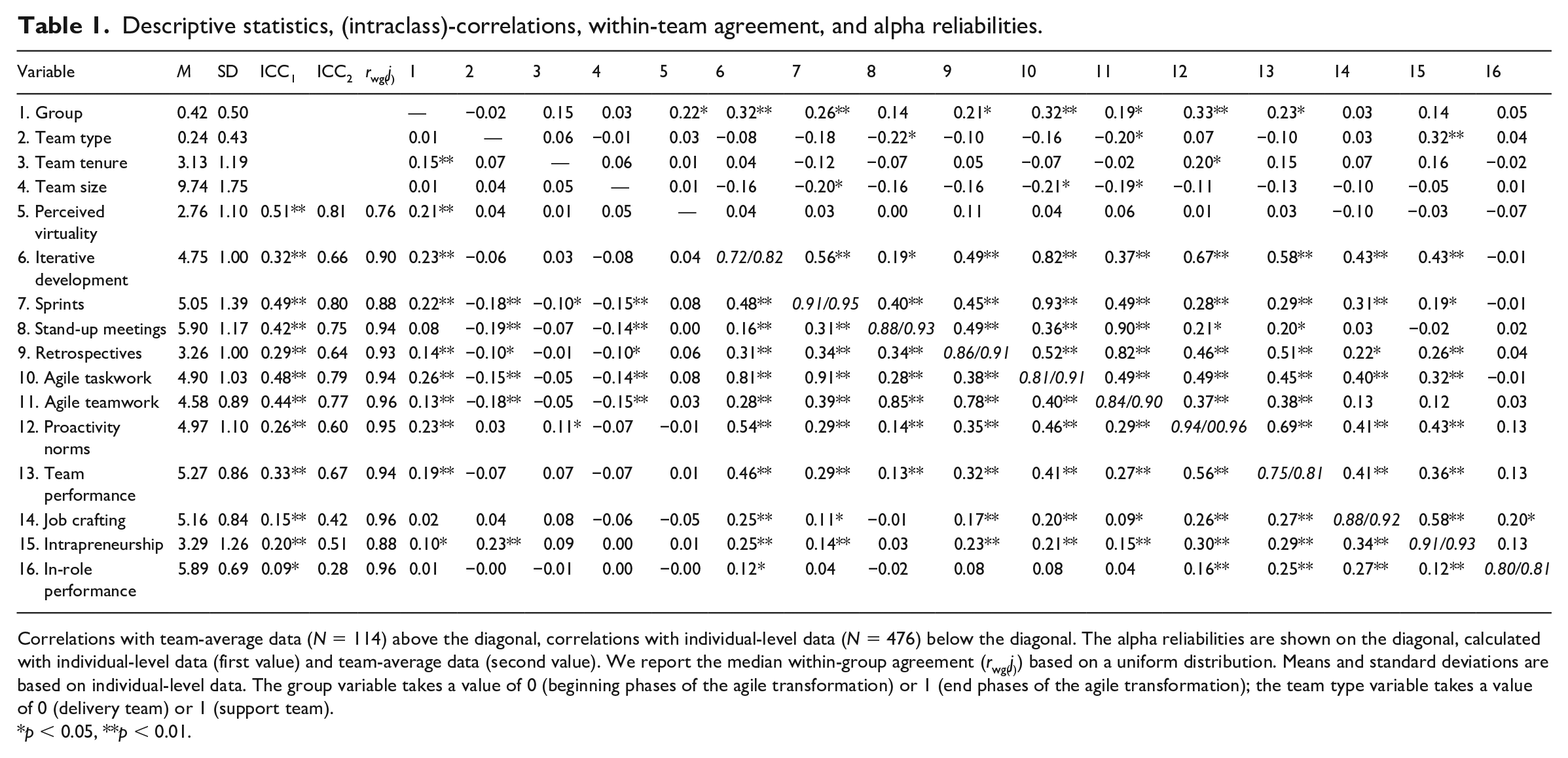
Correlations with team-average data (N = 114) above the diagonal, correlations with individual-level data (N = 476) below the diagonal. The alpha reliabilities are shown on the diagonal, calculated with individual-level data (first value) and team-average data (second value). We report the median within-group agreement (rwg(j)) based on a uniform distribution. Means and standard deviations are based on individual-level data. The group variable takes a value of 0 (beginning phases of the agile transformation) or 1 (end phases of the agile transformation); the team type variable takes a value of 0 (delivery team) or 1 (support team).
p < 0.05, **p < 0.01.
Team-level measures
Agile work practices
We used a newly developed Agile Work Practices Instrument (AWPI), which builds on existing scales that have measured agile practices in software development teams (So, 2010; Tripp et al., 2016). The AWPI captures agile taskwork with a four-item iterative development subscale (e.g., “We experiment with different ideas before settling on an approach”) and a four-item sprints subscale (e.g., “We plan our work in short cycles”). The agile taskwork items are rated on a Likert scale (1 = fully disagree, 7 = fully agree). The AWPI captures agile teamwork with a four-item retrospective meetings subscale (e.g., “We take our time to discuss about our work processes”) and a four-item stand-up meetings subscale (e.g., “We have a short meeting to monitor the progress of our work”). The agile teamwork items are rated on a frequency scale (1 = almost never, 7 = daily). The items and information on the multilevel factor structure of the AWPI are provided in the Appendix.
Proactivity norms
We used a six-item scale to measure proactivity norms based on the personal initiative (PI) scale (Fay and Frese, 2001). Each item started with the stem, “Team members encourage each other . . .,” and continued with an activity statement such as “to take initiative” or “to actively attack problems”, as provided by the PI scale (1 = fully disagree, 7 = fully agree). Hence, this measure mainly captures injunctive proactivity norms because the items suggest that proactive behavior is socially approved and valued by the team (see Ehrhart and Naumann, 2004).
Team performance
We measured team performance with the three positively worded items of the scale of Edmondson (1999). Team members rated the extent to which they agreed with statements such as “This team does superb work” (1 = fully disagree, 7 = fully agree).
Psychometrics of team-level measures
Cronbach’s alphas for all scales were appropriate both when calculated at the individual level (α ⩾ 0.72) and at the team level (α ⩾ 0.81). Considerable variance in the scale scores existed between teams (ICC1 ⩾ 0.26, all p < 0.001). Moreover, group mean stability (ICC2 ⩾ 0.60) and within-group agreement statistics (median rwgj ⩾ 0.88, uniform distribution) justified the aggregation of the measures to the team level (see Van Mierlo et al., 2009). The values for each scale are displayed in Table 1.
Individual-level measures
Proactive behaviors
Most typologies of proactive behaviors distinguish them based on whether they focus on initiating change for oneself or the organization (Belschak and Den Hartog, 2010; Parker et al., 2010). Therefore, we selected one self-focused and one organization-focused proactive behavior for an empirical test of our model. As a self-focused proactive behavior, we selected job crafting towards strengths and interests (Kooij et al., 2017) because we expect that in agile teams, individuals have the opportunity to actively choose tasks that fit their personal capabilities because of a favorable work design (Tripp et al., 2016). As an organization-focused proactive behavior, we selected employee intrapreneurship (Gawke et al., 2019), which refers to activities through which individuals anticipate changes and adapt organizational procedures to events in the broader economic environment. We opted for measuring intrapreneurship because members of agile teams are typically expected to innovate (Grass et al., 2020), and intrapreneurship is a behavior that can give rise to innovation (Blanka, 2019). Job crafting was measured with the eight highest-loading items reported in the study of Kooij et al., 2017 (e.g., “I actively look for tasks that match my own interests”), and employee intrapreneurship was measured with the eight-item scale of Gawke et al., 2019 (e.g., “I undertake activities to realize change in my organization”). Participants rated how frequently they engaged in these activities at work (1 = almost never, 7 = always).
In-role performance
We measured in-role performance with four items based on the frequently used scale of Williams and Anderson (1991). An example item of this measure is “I adequately complete assigned duties” (1 = fully disagree, 7 = fully agree).
Psychometrics of individual-level measures
Cronbach’s alphas for all three scales were acceptable at the individual level (α ⩾ 0.80). Although the items of the scales do not refer to the team, there still existed considerable variance at the team level (ICC1 ⩾ 0.09, all p < 0.05) and relatively high within-group agreement (median rwgj ⩾ 0.88, uniform distribution). Yet, the relatively low group mean stability of these measures (particularly for in-role performance: ICC2 = 0.28) may speak against their aggregation to the team level (see Van Mierlo et al., 2009). The values for each scale are displayed in Table 1.
Control variables
We controlled for five variables that may theoretically affect the development of proactivity norms in teams (for a review, see Ehrhart and Naumann, 2004). Firstly, as group norms develop over time, we controlled for team tenure and the phase of the agile transformation of the teams. Team tenure was measured in terms of collective tenure (i.e., time since the most recent member joined the team; see also Gonzalez-Mulé et al., 2020). Secondly, as the enforcement of social norms may be more difficult in larger teams and teams that do not work in the same location, we controlled for team size and perceived team virtuality. We measured perceived team virtuality with a single item, asking team members whether they mostly worked together in the same place or virtually across different locations (1 = mostly at the same place, 5 = mostly virtually). Previous research indicated that perceived virtuality converges meaningfully with other virtuality indicators such as spatial–temporal separation and team diversity (Siebdrat et al., 2014).
Analysis strategy
Owing to the unique organizational contexts with individuals nested in different teams, which in turn were nested in different phases of an ongoing agile transformation process, we performed the analyses in three parts. Firstly, we tested whether there exist significant differences between teams from different phases of the agile transformation. Given that there were only 19 teams in the first phase and only 14 teams in the final phase of the transformation, we merged the first two phases and the last two phases to form two groups of teams (instead of four). The first group consisted of 66 teams (N = 259) in the beginning phases of the transformation (i.e., Phase 1 and Phase 2), and the second group consisted of 48 teams (N = 217) in the final phases of the transformation (i.e., Phase 3 and Phase 4). Secondly, using the aggregated team data, we tested the between-team hypotheses (upper half of Figure 1) in a multigroup structural equation model (SEM) and examined whether the hypothesized relationships hold among the teams at the beginning, as well as among the teams at the end of the transformation. Finally, we tested the cross-level moderation hypotheses (lower half of Figure 1) using random coefficient modeling. The main analyses were performed in R using the “lavaan” package (Rosseel, 2012) and the “multilevel” package (Bliese, 2013).
Results
Measurement model tests
Prior to comparing observed score differences between teams, we examined the cross-contextual measurement invariance of our survey measures. The results indicated that we can examine score differences in responses from teams at the beginning (i.e., Phase 1 and Phase 2) versus the end (i.e., Phase 3 and Phase 4) of the agile transformation, as the confirmatory fit index (CFI) of a model with equality constraints on loadings and intercepts (i.e., the “scalar” model; CFI = 0.924) was similar to the CFI of a model without these equality constraints (i.e., the “configural” model, CFI = 0.930). According to the simulations of Cheung and Rensvold (2002), CFI differences smaller than or equal to 0.01 indicate that the null hypothesis of invariance should not be rejected. Thus, it seems that participants from different phases of the transformation interpreted our measures in a similar way, which allows for a valid comparison of their scores. Additional paired-construct tests indicated that merging the indicators of any pair of latent variables in our model together on the same factor resulted in a significant deterioration in model fit (Δχ2 ⩾ 35.86, Δd.f. = 6, p < 0.001). These findings support the measurement invariance and discriminant validity of the scales used in the present study.
Between-team differences arising from the agile transformation
Before comparing the scores from teams at the beginning (i.e., Phase 1 and Phase 2) and teams at the end (i.e., Phase 3 and Phase 4) of the agile transformation, we verified whether it was appropriate to merge the phases to two groups of teams (instead of four). According to multivariate analyses of variance (MANOVA), there were no significant differences among the teams within Group 1 (F(4, 61) = 1.64, p = 0.178), as well as within Group 2 (F(4, 43) = 2.53, p = 0.054) on the four team-level measures. Thus, it seemed justified to split the teams into two groups instead of four without losing information. Though the scores within the groups of teams did not differ, there were significant differences between the two groups (F(4, 109) = 4.87, p = 0.002). As shown in Table 2, the teams in the final phases of the transformation scored significantly higher on all four team-level variables of our model compared to the teams in the beginning phases of the transformation. This supports the construct validity of our measures based on a known-groups comparison (Cronbach and Meehl, 1955). As agile transformation processes aim to improve performance by implementing agile work practices (Rigby et al., 2020), agile taskwork and agile teamwork can be expected to mediate the effects of this organizational change process on team outcomes. In line with this reasoning, when agile taskwork and agile teamwork were included as covariates in the MANOVA, the between-team differences in proactivity norms and team performance arising from the agile transformation were no longer significant (F(2, 109) = 2.49, p = 0.088). This preliminary finding aligns with our model (Figure 1), which posits agile work practices as predictors of proactivity and performance.
Score differences between teams at the beginning (N = 66) versus end (N = 48) of the agile transformation.
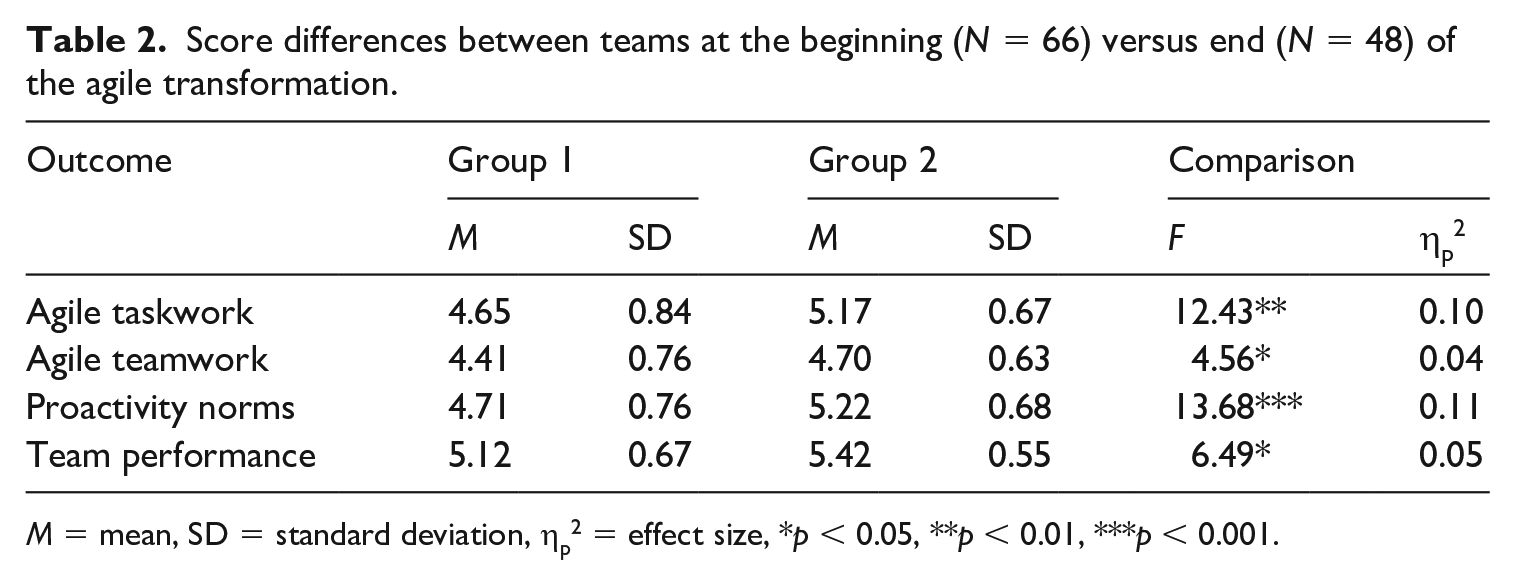
M = mean, SD = standard deviation, ηp2 = effect size, *p < 0.05, **p < 0.01, ***p < 0.001.
Analyses with team performance as outcome
We tested the between-team hypotheses in a multigroup structural equation model on the aggregated team data (N = 114) using robust maximum likelihood estimation (MLR). Agile taskwork and agile teamwork were modeled as latent variables with their subscale scores as observed indicators. Thus, agile taskwork was modeled as the shared variance of iterative development and sprints, whereas agile teamwork was modeled as the shared variance of stand-up meetings and retrospective meetings. The error variances of team proactivity norms and team performance were fixed with the formula “(1-reliability)*variance” (see Antonakis et al., 2010). Prior measurement invariance tests indicated that it was justified to force loadings and intercepts to equivalence for the two groups. We fitted models that included team type (i.e., support vs delivery team), team tenure, team size, and perceived team virtuality as control variables. Moreover, we included the direct paths from agile taskwork and agile teamwork to team performance to test the mediation hypotheses.
A model that allowed regression coefficients to vary between teams that were at the beginning (N = 66) and teams that were at the end (N = 48) of the agile transformation gave an acceptable fit according to a non-significant chi-squared statistic (χ2 = 68.48, d.f. = 52, p = 0.062, scaling correction factor = 1.17, RMSEA = 0.081, CFI = 0.921, TLI = 0.882). We then constrained all regression coefficients and factor covariances to equivalence between the two groups (χ2 = 88.75, d.f. = 66, p = 0.032, scaling correction factor = 1.07, RMSEA = 0.080, CFI = 0.900, TLI = 0.882), which fitted the data equally well as the previous “unconstrained model” (Satorra-Bentler Δχ2 = 21.23, Δd.f. = 14, p = 0.096). We base our conclusions on the “constrained model”, as this model provides a more parsimonious representation of the hypothesized relationships. The standardized regression coefficients of the “constrained model” are displayed in Table 3. Unstandardized regression coefficients are reported in the text. For completeness we also report coefficients of the “unconstrained model”, when paths seemed to differ.
Standardized multigroup path coefficients of the “constrained mode”.
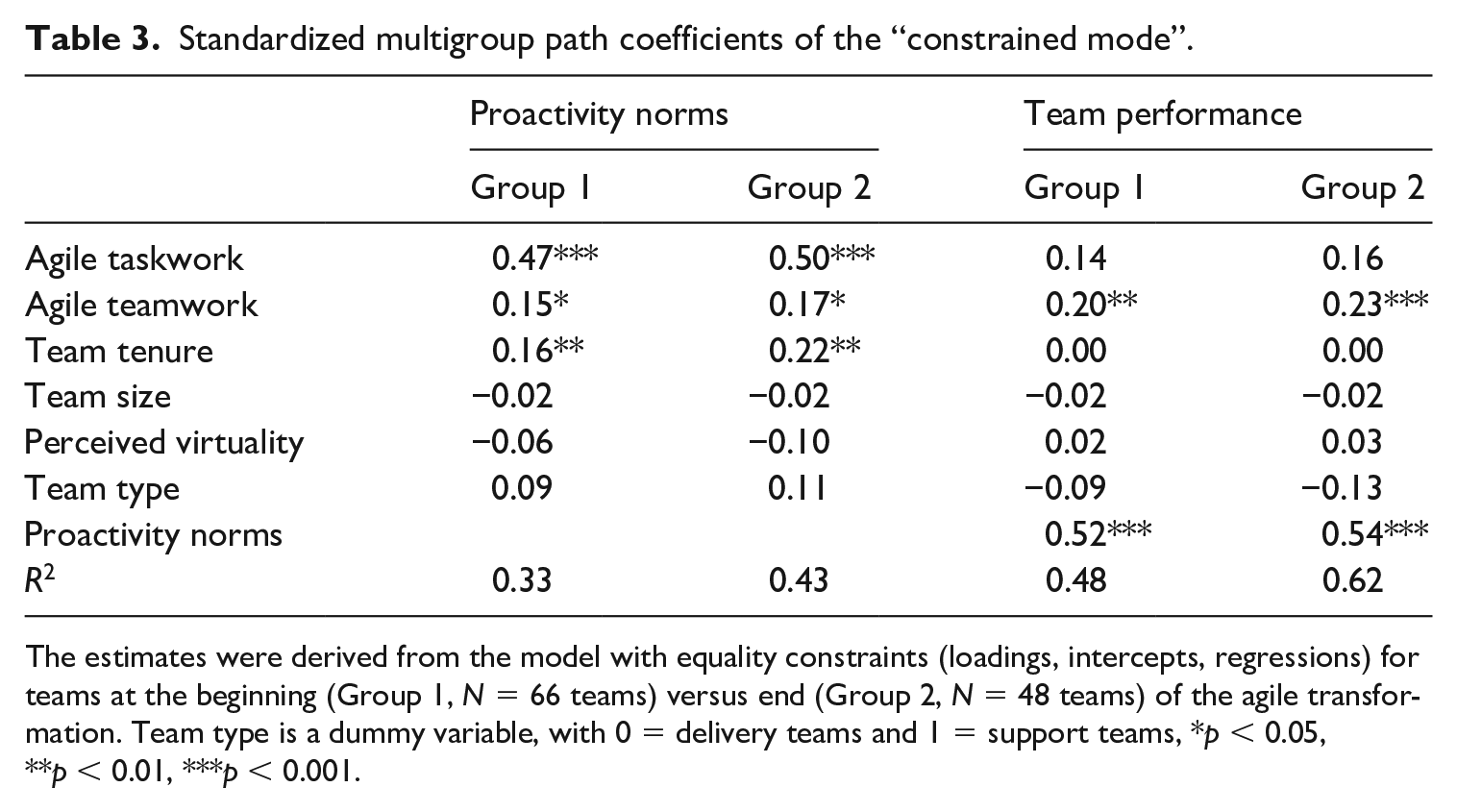
The estimates were derived from the model with equality constraints (loadings, intercepts, regressions) for teams at the beginning (Group 1, N = 66 teams) versus end (Group 2, N = 48 teams) of the agile transformation. Team type is a dummy variable, with 0 = delivery teams and 1 = support teams, *p < 0.05, **p < 0.01, ***p < 0.001.
Hypotheses 1a and 1b stated that proactivity norms are predicted by agile taskwork and agile teamwork, respectively. These hypotheses received support, as we found positive relationships of agile taskwork (B = 0.57, SE = 0.14, p < 0.001) and agile teamwork (B = 0.18, SE = 0.08, p = 0.034) with proactivity norms. In the “unconstrained model,” the path from agile taskwork to proactivity norms was significant for teams at the beginning (B = 0.62, SE = 0.14, p < 0.001) and teams at the end of the transformation (B = 0.48, SE = 0.19, p = 0.011). The path from agile teamwork to proactivity norms was primarily significant for teams at the beginning (B = 0.25, SE = 0.09, p = 0.007) but not for teams at the end of the transformation (B = 0.13, SE = 0.13, p = 0.327) according to the “unconstrained model” (but significant for both groups according to the “constrained model”; see Table 3). Hypothesis 2 stated that proactivity norms relate positively to team performance, which was supported (B = 0.59, SE = 0.10, p < 0.001). Moreover, according to the “unconstrained model”, the path from proactivity norms to team performance was significant for both teams at the beginning (B = 0.84, SE = 0.18, p < 0.001) and teams at the end (B = 0.55, SE = 0.13, p < 0.001) of the transformation.
Hypothesis 3 combined the previous hypotheses and stated that the relationships of (a) agile taskwork and (b) agile teamwork with team performance are mediated by proactivity norms. The direct path from agile taskwork to team performance was no longer significant when controlling for proactivity norms (B = 0.19, SE = 0.11, p = 0.087). Moreover, the indirect path from agile taskwork to team performance via proactivity norms was positive and significant (B = 0.34, SE = 0.09, p = 0.001). Thus, Hypothesis 3a was fully supported, as mediation was complete (see Zhao et al., 2010). The paths from agile teamwork to team performance were still significant when controlling for team performance (B = 0.27, SE = 0.09, p = 0.004). In addition, the indirect path from agile teamwork to team performance via proactivity norms did not reach conventional levels of significance (B = 0.11, SE = 0.06, p = 0.055). Hence, Hypothesis 3b had to be rejected.
Analyses with individual performance as outcome
We tested the cross-level interactions (Hypotheses 4 and 5) following the recommendations of Aguinis et al. (2013). Hence, we centered the within-team predictors job crafting towards strengths/interests and employee intrapreneurship to the team mean, whereas the cross-level moderators agile taskwork, agile teamwork, and proactivity norms were centered to the grand mean. Prior to modeling the cross-level interactions, we tested whether there exists sufficient slope variance that can be explained by the moderators. A likelihood ratio test supported this assumption, as a model with random slopes fitted the data significantly better than a model with fixed slopes (Δ–2 log likelihood = 11.26, Δd.f. = 5, p = 0.046). The random-slopes coefficients are shown in Model 1 of Table 4. On average across teams, the relationship between individual members’ job crafting and their own in-role performance was positive and significant (B = 0.23, SE = 0.05, p < 0.001), whereas the relationship between intrapreneurship and in-role performance was not significant when averaged across teams (B = 0.03, SE = 0.03, p = 0.310).
Multilevel regressions on in-role performance.
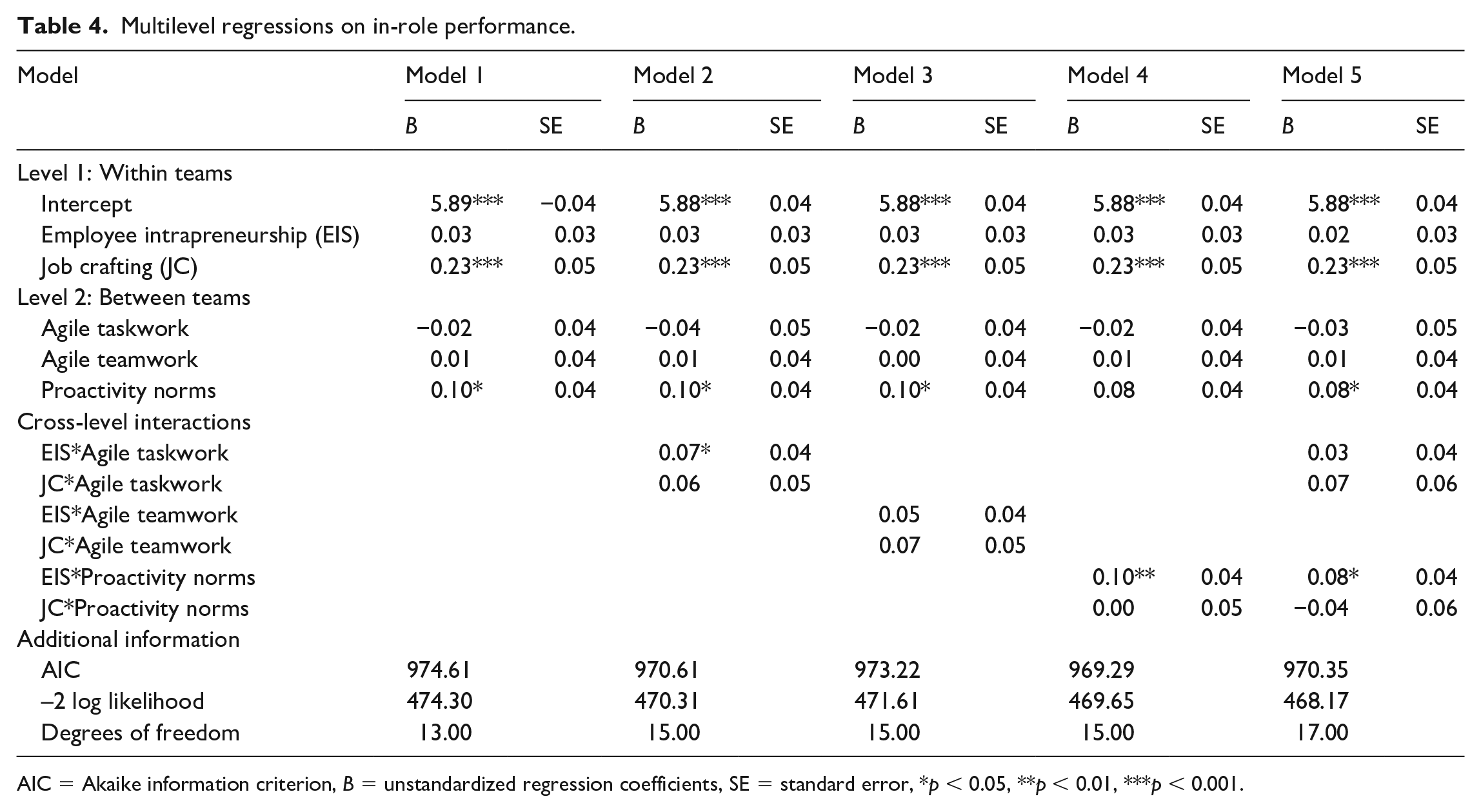
AIC = Akaike information criterion, B = unstandardized regression coefficients, SE = standard error, *p < 0.05, **p < 0.01, ***p < 0.001.
We proceeded with testing Hypothesis 4, which stated that the relationship between proactive behaviors (i.e., job crafting and intrapreneurship) and in-role performance will be stronger in teams with (a) high (vs low) levels of agile taskwork, (b) high (vs low) levels of agile teamwork, or (c) strong (vs weak) proactivity norms. The results for these hypotheses are shown in Models 2–4 of Table 4. Agile taskwork (B = 0.07, SE = 0.04, p = 0.039) and proactivity norms (B = 0.10, SE = 0.04, p = 0.004) had significant cross-level moderating effects on the within-team relationship between intrapreneurship and in-role performance, but this was not the case for agile teamwork (B = 0.05, SE = 0.04, p = 0.181). None of the cross-level interactions involving job crafting were significant (all p > 0.10), which means that the slope variance of the job crafting–performance relationship was left unexplained in our models.
We then plotted the relationships between intrapreneurship and in-role performance for teams high (vs low) on agile taskwork or proactivity norms, which revealed a similar pattern (see Figure 2). According to simple-slopes tests, the relationship between intrapreneurship and in-role performance was positive and significant in teams high (i.e., +1 SD) on agile taskwork (B = 0.10, z = 2.09, p = 0.037) or in teams high (i.e., +1 SD) on proactivity norms (B = 0.13, z = 2.65, p = 0.008). In contrast, this relationship was non-significant or even slightly negative in teams low (i.e., −1 SD) on agile taskwork (B = −0.05, z = −0.96, p = 0.336) or in teams low (i.e., −1 SD) on proactivity norms (B = −0.07, z = −1.60, p = 0.110). These findings supported Hypotheses 4a and 4c, and the lack of cross-level interactions with agile teamwork implies that Hypothesis 4b must be rejected.
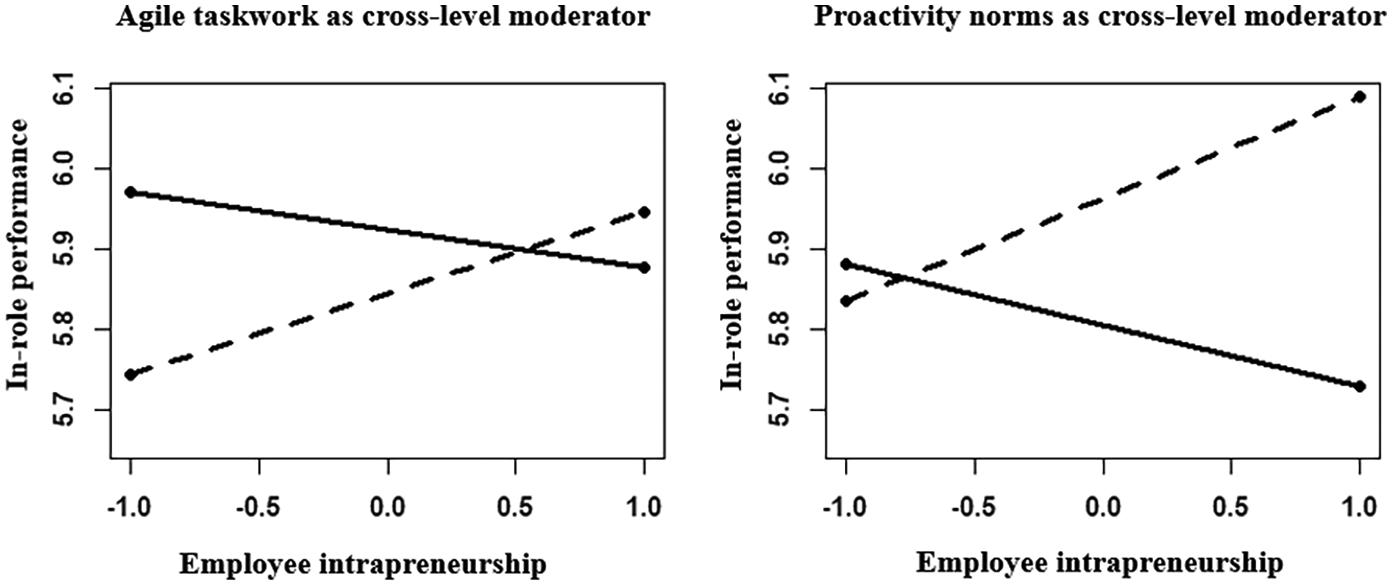
Relationships between intrapreneurship and in-role performance in teams high (vs low) on agile taskwork (left) and proactivity norms (right).
Finally, Hypothesis 5 stated that proactivity norms account for the cross-level moderating effect of (a) agile taskwork and (b) agile teamwork on the within-team relationship between proactive behavior and in-role performance. Owing to the previous results (i.e., Model 3 in Table 4), Hypothesis 5b had to be rejected because agile teamwork did not have a significant cross-level moderating effect. The results shown in Model 5 of Table 4 align with Hypothesis 5a, as the cross-level moderating effect of agile taskwork became non-significant (B = 0.03, SE = 0.05, p = 0.413) after accounting for the cross-level moderating effect of proactivity norms (B = 0.08, SE = 0.04, p = 0.040). To provide a full test of Hypothesis 5a, we calculated the indirect effect of agile taskwork in moderating the within-team relationship between intrapreneurship and in-role performance via proactivity norms, as the product term of the path from agile taskwork to proactivity norms (see previous SEM results: B = 0.57, SE = 0.14) and the cross-level moderating effect of proactivity norms (B = 0.08, SE = 0.04) using a Monte Carlo simulation with 20,000 repetitions (Preacher and Selig, 2012). This approach is similar to how mediated moderation has been tested by Grant and Berry (2011). The 95% confidence interval (CI) of the product-term estimate did not include zero (95% CI [0.0001 to 0.1034]). Thus, through a positive relationship with proactivity norms, agile taskwork seems to increase the likelihood that team members benefit from intrapreneurship in terms of in-role performance. This finding aligns with Hypothesis 5a.
Addressing endogeneity concerns
Our data only allow for making statements about potential (causal) relationships, if agile taskwork and agile teamwork are truly exogenous (i.e., vary randomly and are uncorrelated with omitted causes; Antonakis et al., 2010). Therefore, we feel the need to reflect on the steps we took to address potential sources of endogeneity (i.e., when predictors correlate with the error term of the model). The multigroup SEM analysis may have helped to reduce concerns regarding common-cause bias resulting from the agile transformation, as the hypothesized relationships were significant in both groups of teams. Thus, it seems unlikely that the observed relationships were merely owing to some other changes that went along with the agile transformation (e.g., the new formation of teams). To rule out the reverse possibility that the pace with which the teams went through the phases of transformation is caused by the variables in our model (i.e., Berkson’s paradox), we fitted the model without controlling for the agile transformation (i.e., regular SEM). Results remained unchanged, as agile taskwork related positively to proactivity norms (B = 0.61, SE = 0.11, p < 0.001) and indirectly to team performance (B = 0.38, SE = 0.10, p < 0.001). Agile teamwork again related positively to proactivity norms (B = 0.20, SE = 0.08, p = 0.011), and this time also had a significant indirect path with team performance (B = 0.12, SE = 0.06, p = 0.032). Thus, the observed relationships are unlikely to be owing to collider bias or Berkson’s paradox introduced by “over-controlling” for the differences arising from the agile transformation (see Elwert and Winship, 2014). Finally, our known-groups comparisons showed that teams in a more advanced phase of the agile transformation had higher scores on agile work practices, proactivity norms, and team performance (see Table 2). The MANOVA results further implied that agile work practices mediate the relationships between the agile transformation dummy variable and the outcomes, in line with our model. This suggests that our main findings are robust to potential threats to the exogeneity assumption (e.g., common method bias; Podsakoff et al., 2012).
Additional analyses with descriptive proactivity norms
Our measure of proactivity norms mainly captured injunctive norms as the items referred to the degree to which proactive behavior was actively encouraged by the team (see Ehrhart and Naumann, 2004). When aggregated to the team level, our measures of job crafting and intrapreneurship may be seen as indicators of descriptive proactivity norms (i.e., typical behavior in the team), and may be used to further test the robustness of our findings. A similar approach to measuring norms has been used in the study of Bommer et al. (2003), which investigated group-OCB norms using individual-level measures of organizational citizenship behavior. We used Model 4 in PROCESS (Hayes, 2017) to re-test the between-team hypotheses (aggregated data) with descriptive proactivity norms as the mediator. When controlling for agile teamwork, agile taskwork related indirectly to team performance via aggregated job crafting (95% bootstrap-CI [0.0399 to 0.1714]), and in a separate model agile taskwork also related indirectly to team performance via aggregated intrapreneurship (95% bootstrap-CI [0.0172 to 0.1377]). When controlling for agile taskwork, none of the indirect paths from agile teamwork to team performance was significant, either in models with job crafting (95% bootstrap-CI [−0.0788 to 0.0379]) or in models with intrapreneurship as mediators (95% bootstrap-CI [−0.0689 to 0.0348]). Thus, Hypotheses 1a, 2, and 3a were replicated when using measures of descriptive proactivity norms, whereas Hypotheses 1b and 3b were not supported in analyses with these measures. We also tested whether descriptive proactivity norms had a similar cross-level moderating effect on the within-team relationship between employee intrapreneurship and in-role performance. Similar interactions as shown in Figure 2 were found when aggregated job crafting (B = 0.10, SE = 0.03, p = 0.005) or aggregated intrapreneurship (B = 0.08, SE = 0.04, p = 0.028) were used as cross-level moderators. Taken together, these supplementary analyses further supported the robustness of our findings.
Discussion
The present study set out to introduce the concept of agile work practices and to test a model that integrates this new concept with the literature on work teams and employee proactivity. We conceptualized agile work practices according to the established taskwork–teamwork distinction from the team literature (e.g., Fisher, 2014; Marks et al., 2001), and examined the relationships between these practices and performance both at the team level and at the individual level through the lens of the emerging proactivity literature (Cai et al., 2019; Parker et al., 2019). Thereby, our study addresses the calls of Niederman et al. (2018) to provide a theoretical foundation for research on agile teams across levels of analyses. In addition to developing and testing a model of proactivity and performance in agile teams, the novelty of our study lies in the unique multilevel research setting with individuals nested in teams, and teams nested in different phases of an agile transformation process. The research setting enabled known-groups comparisons (Cronbach and Meehl, 1955), showing that teams in the more advanced phases of the agile transformation scored significantly higher on agile taskwork, agile teamwork, proactivity norms, and team performance than teams that were in the beginning phases of this change process. Agile transformation explained differences in the mean levels of the variables in our model; the relationships between agile work practices and outcomes were similar in the two groups of teams. In other words, it seems unlikely that the observed relationships were merely owing to other changes that went along with the transformation, such as the new formation teams. In the following, we discuss the implications of our findings for the literature on teams and proactive behavior.
Theoretical implications
Agile taskwork entails that products are built in an iterative development process (So, 2010) and that tasks are planned in short work cycles or sprints (Liu et al., 2019). In the present study, agile taskwork related positively to team performance via proactivity norms—both in teams that were at the beginning and in teams that were at the end of the agile transformation. Agile taskwork also appeared to increase the likelihood that team members benefited from proactive behavior (i.e., employee intrapreneurship; Gawke et al., 2019) in terms of in-role performance, via the positive relationship with proactivity norms. It appears that in teams practicing agile taskwork, team members benefited more from engaging in risky proactive behaviors—such as intrapreneurship—because these teams have social norms in place, which signal that proactivity fits with the demands of the work environment (see Parker et al., 2019). As shown in the additional analyses, the indirect relationships between agile taskwork and performance via proactivity norms were present irrespective of whether we used measures of injunctive norms (e.g., “Team members encourage each other to take initiative”) or measures of descriptive norms (i.e., aggregated individual proactive behavior; see Bommer et al., 2003). Thus, the iterative- and goal-driven nature of agile taskwork seems to motivate team members to (a) encourage each other to be proactive, and (b) engage in a broad variety of different proactive behaviors (i.e., job crafting and intrapreneurship).
Agile teamwork primarily happens in the context of daily stand-up (Stray et al., 2020) and monthly retrospective meetings (Andriyani et al., 2017). In the present study, agile teamwork related positively to injunctive proactivity norms (but not to descriptive proactivity norms; see supplementary analyses), and the relationships of agile teamwork with performance were not mediated by proactivity norms. This points to an incomplete theoretical framework (see Zhao et al., 2010), and may imply that there are additional mechanisms through which agile teamwork affects performance. Alternatively, this may have something to do with the specific organizational context and the agile transformation. As indicated by the results of the “unconstrained” multigroup model, agile teamwork may have primarily helped teams at the beginning of the transformation to establish proactivity norms. This explanation would align with Tuckman’s well-known model of team development (Tuckman, 1965). Accordingly, stand-up and retrospective meetings may help teams that are in the “forming” phases of team development to explicate norms that guide proactive behaviors. In more mature teams, the effects of agile teamwork on performance may be better explained with team processes such as information sharing (Mesmer-Magnus and DeChurch, 2009) or goal monitoring (Rapp et al., 2014). Perhaps such team processes, rather than proactivity norms as we hypothesized, account for the direct path from agile teamwork to team performance, which was mainly present among the teams in the advanced phases of the transformation.
With our theoretical model and the empirical findings, the present study also contributes more broadly to research on proactivity in teams which, as noted by Cai et al. (2019), is much less developed compared to individual-level proactivity research. Conceptually, we formulated a theory on the emergence of proactivity in teams by combining elements of the proactive motivation model (Parker et al., 2010) with social influence perspectives (Ehrhart and Naumann, 2004; Salancik and Pfeffer, 1978). Empirically, we found that contextual variables such as agile work practices not only relate positively to injunctive proactivity norms, but also to the average proactive behavior or descriptive proactivity norms in teams. Future research may further delineate the exact motivational mechanisms behind these relationships by including measures of specific “can-do”, “reason-to”, and “energized-to” motivators, as proposed by the proactive motivation model. Additionally, ethnographic research may further describe the social influence mechanisms that determine proactivity in (agile) teams, such as behavioral modeling (e.g., Bakker et al., 2016) and concertive control (e.g., Barker, 1993).
To our knowledge, we are among the first to examine cross-level moderators of the within-team relationship between proactivity and in-role performance (for a recent similar analysis, see Wang et al., 2020). Thereby, we demonstrated a way to empirically test the “wise proactivity” hypothesis introduced by Parker et al. (2019). We found that, whereas job crafting towards strengths/interests related positively to in-role performance across teams, the relationship between employee intrapreneurship and in-role performance was highly contingent on the team context. As can be seen in Figure 2, an individual employee’s intrapreneurship behavior is particularly beneficial for in-role performance in teams that frequently use agile taskwork (i.e., teams that work iteratively and plan tasks in sprints) and in teams that expect members to be proactive (i.e., teams with strong proactivity norms). In such teams, the proactive behaviors of intrapreneurial team members (e.g., changing procedures, services, or products) are in sync with the taskwork activities of the team and with the prevailing norm regarding personal initiative. In contrast, in teams that rarely use agile taskwork and in which the norm is to be less proactive, intrapreneurship may be seen as a deviant and perhaps risky behavior that may not be fully appreciated by the rest of the team. Moreover, in such teams, individual employees who exhibit intrapreneurship behavior may receive only limited support for their new initiatives and may be hindered in their drive to innovate.
Extrapolating from the cross-level interactions may offer important practical implications for (proactivity) interventions in agile organizations. Accordingly, the job crafting interventions introduced by Kooij et al. (2017) may be beneficial for team members’ in-role performance in any kind of team. In teams that are strongly practicing agile taskwork, interventions may additionally emphasize intrapreneurship behaviors (e.g., boundary spanning, venture creation, and so forth; see Gawke et al., 2019) to enhance team members’ in-role performance. Furthermore, our findings suggest that organizations benefit most from proactivity when favorable team norms have been established and when proactivity is enacted in a manner that fits with the work context. Therefore, we recommend agile organizations to communicate that proactive behaviors are supported and necessary to make “agile” work.
Limitations and future research
Despite the promising empirical findings, our study does not come without limitations. Although we tried our best to address potential endogeneity threats such as common-cause bias, collider bias, and common method bias, the possibility of these threats to validity cannot be fully ruled out with our cross-sectional data. Therefore, further longitudinal and experimental studies are necessary to reach firm conclusions regarding causality. Similarly, as we relied on employee ratings of team and individual performances, we were not able to fully rule out possible ratee effects that could have affected the relationships with these outcome variables. Although there are also known limitations to observer ratings (see Conway and Lance, 2010), future research may complement self-reports with ratings provided by team leaders to enable a full view on job performance in agile teams. In addition, future research may provide a conceptual replication of our model with more general measures of proactive behavior (e.g., measures of Griffin et al., 2007) or proactive behaviors that are specific to the teamwork context (e.g., speaking up; Edmondson, 1999). Perhaps the proposed cross-level moderation effect of agile teamwork can be demonstrated only with teamwork-specific proactive behaviors.
Lastly, it is not clear whether our findings generalize to other populations of employees and teams. The context of our study given by the agile transformation of a large German transport and logistics company was rather unique. Most of the participants were IT professionals, male, and highly educated. We cannot ascertain that our findings apply equally to other occupational groups and teams with fewer task interdependencies. Future research may try to replicate our findings among teams from different organizations and examine in which contexts agile work practices are more likely to produce positive outcomes for teams and individuals. More research is also needed to examine whether the relationships between agile work practices and performance hold among virtual teams, given the recent developments around the COVID-19 pandemic (Kniffin et al., 2021). The data for this study were collected before the pandemic, and less than 10% of the participants indicated that their team worked “mostly virtually”, which provided limited statistical power to test whether virtuality moderated the relationships between agile work practices and team outcomes.
Conclusion
With the present study, we aimed to provide a theoretical basis for agile working, by drawing from the taskwork–teamwork distinction (Fisher, 2014), and by investigating relationships with proactivity and performance at the team level and the individual level (Cai et al., 2019; Parker et al., 2019). Our multilevel model of agile working delineates how agile work practices generate proactivity norms in teams, which positively influence team performance and facilitate the effectiveness of individual employees’ proactive behaviors. Consistent empirical support was found for the paths from agile taskwork to performance via proactivity, but evidence for these paths with agile teamwork was mixed.
Footnotes
Appendix
Multilevel psychometric properties of the AWPI, including primary and secondary within- and between-team factor loadings.
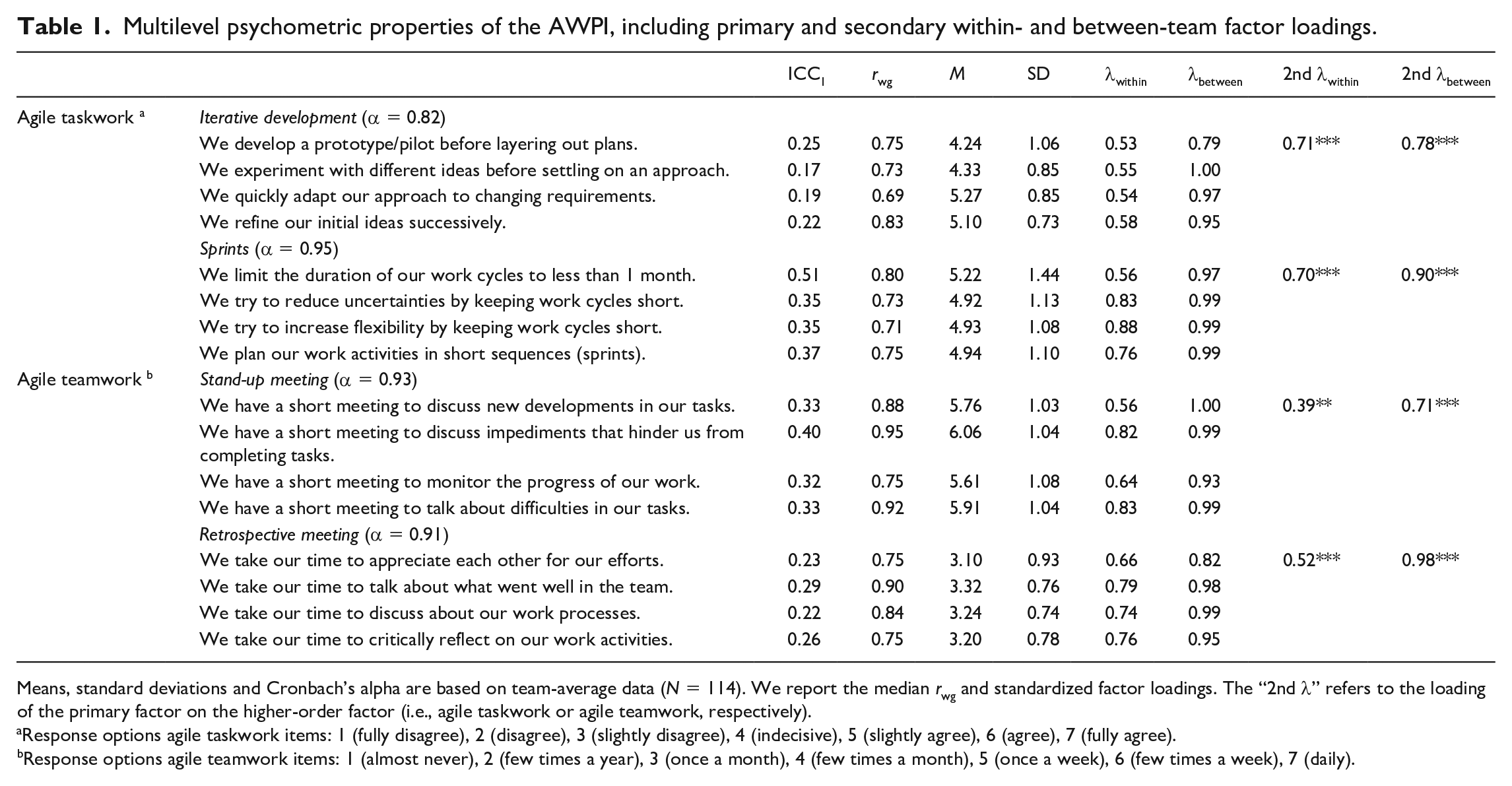
| ICC1 | r wg | M | SD | λwithin | λbetween | 2nd λwithin | 2nd λbetween | ||
|---|---|---|---|---|---|---|---|---|---|
| Agile taskwork a | Iterative development (α = 0.82) | ||||||||
| We develop a prototype/pilot before layering out plans. | 0.25 | 0.75 | 4.24 | 1.06 | 0.53 | 0.79 | 0.71*** | 0.78*** | |
| We experiment with different ideas before settling on an approach. | 0.17 | 0.73 | 4.33 | 0.85 | 0.55 | 1.00 | |||
| We quickly adapt our approach to changing requirements. | 0.19 | 0.69 | 5.27 | 0.85 | 0.54 | 0.97 | |||
| We refine our initial ideas successively. | 0.22 | 0.83 | 5.10 | 0.73 | 0.58 | 0.95 | |||
| Sprints (α = 0.95) | |||||||||
| We limit the duration of our work cycles to less than 1 month. | 0.51 | 0.80 | 5.22 | 1.44 | 0.56 | 0.97 | 0.70*** | 0.90*** | |
| We try to reduce uncertainties by keeping work cycles short. | 0.35 | 0.73 | 4.92 | 1.13 | 0.83 | 0.99 | |||
| We try to increase flexibility by keeping work cycles short. | 0.35 | 0.71 | 4.93 | 1.08 | 0.88 | 0.99 | |||
| We plan our work activities in short sequences (sprints). | 0.37 | 0.75 | 4.94 | 1.10 | 0.76 | 0.99 | |||
| Agile teamwork b | Stand-up meeting (α = 0.93) | ||||||||
| We have a short meeting to discuss new developments in our tasks. | 0.33 | 0.88 | 5.76 | 1.03 | 0.56 | 1.00 | 0.39** | 0.71*** | |
| We have a short meeting to discuss impediments that hinder us from completing tasks. | 0.40 | 0.95 | 6.06 | 1.04 | 0.82 | 0.99 | |||
| We have a short meeting to monitor the progress of our work. | 0.32 | 0.75 | 5.61 | 1.08 | 0.64 | 0.93 | |||
| We have a short meeting to talk about difficulties in our tasks. | 0.33 | 0.92 | 5.91 | 1.04 | 0.83 | 0.99 | |||
| Retrospective meeting (α = 0.91) | |||||||||
| We take our time to appreciate each other for our efforts. | 0.23 | 0.75 | 3.10 | 0.93 | 0.66 | 0.82 | 0.52*** | 0.98*** | |
| We take our time to talk about what went well in the team. | 0.29 | 0.90 | 3.32 | 0.76 | 0.79 | 0.98 | |||
| We take our time to discuss about our work processes. | 0.22 | 0.84 | 3.24 | 0.74 | 0.74 | 0.99 | |||
| We take our time to critically reflect on our work activities. | 0.26 | 0.75 | 3.20 | 0.78 | 0.76 | 0.95 |
Means, standard deviations and Cronbach’s alpha are based on team-average data (N = 114). We report the median rwg and standardized factor loadings. The “2nd λ” refers to the loading of the primary factor on the higher-order factor (i.e., agile taskwork or agile teamwork, respectively).
Response options agile taskwork items: 1 (fully disagree), 2 (disagree), 3 (slightly disagree), 4 (indecisive), 5 (slightly agree), 6 (agree), 7 (fully agree).
Response options agile teamwork items: 1 (almost never), 2 (few times a year), 3 (once a month), 4 (few times a month), 5 (once a week), 6 (few times a week), 7 (daily).
Acknowledgements
We thank the Associate Editor Yasin Rofcanin and three anonymous reviewers for their constructive feedback and suggestions.
Funding
The authors received no financial support for the research, authorship, and/or publication of this article.
 . [Email: