



Abstract
Despite anecdotal evidence showing that some CEOs possess narcissistic personality traits, research on this individual characteristic is still lagging behind. Though the literature has established that narcissistic CEO traits may affect firm performance, it is not clear whether they act as constructive or destructing forces in family firms. This is particularly important given family firms’ attention towards the preservation of socioemotional wealth. A question thus arises: Can family firms benefit from narcissistic CEOs or should they avoid appointing individuals with this personality trait? Our analysis of unique data from Italian CEOs – collected through a survey and a psychometric test – reveals that CEO narcissism is lower in family firms, and among family CEOs. Nevertheless, in family firms, more narcissistic CEOs tend to exploit greater innovation opportunities by fostering higher top management teams strategic decision comprehensiveness. Our findings advance our understanding of narcissism in leadership positions, highlighting its importance for family firms’ innovation and providing meaningful contributions for research on CEO personality, family business and innovation, as well as for practitioners.
Introduction
Narcissism consists of “the degree to which an individual has an inflated sense of self and is preoccupied with having that self-view continually reinforced” (Chatterjee and Hambrick, 2011: 204). This personality trait entails “an exaggerated sense of self-importance, fantasies of unlimited success or power, need for admiration, entitlement, lack of empathy, and exploitation of others” (Blair et al., 2008: 255). The increasing prevalence of narcissistic individuals in top management positions has made this personality trait a relevant and timely topic in both academic and practitioner literatures (Campbell and Campbell, 2009; Chatterjee and Pollock, 2017; Maccoby, 2012; Rovelli and Curnis, 2021; Tang et al., 2018). Anecdotal evidence suggests that, generally, CEOs tend to display a high level of narcissism (Chatterjee and Hambrick, 2007, 2011; Vogel, 2006). In fact, narcissism may be considered a desirable characteristic favoring those who wish to reach the apex of most firms (Kets de Vries, 2004; Rovelli and Curnis, 2021). But are there situations where narcissism becomes an impediment rather than an asset for individuals trying to reach the top of the managerial ladder? This question is still unanswered (Braun, 2017), and we address it by analyzing how the firm’s ownership structure influences the role and consequences of narcissism. Specifically, we propose that conflicting forces may be at play in family firms. On the one hand, these organizations would tend to repudiate an overly narcissistic CEO as the behaviors associated with this personality trait might clash with the family’s desire to preserve socioemotional wealth (SEW), which is an important utility of family owners (Gomez-Mejia et al., 2007, 2011, 2018, 2021a). On the other hand, recent literature suggests that greater CEO narcissism might be associated with the choice of more innovative strategies (Kashmiri et al., 2017; Zhang et al., 2017). This means that, in an attempt to avoid SEW losses, the selection of CEOs who are low on narcissism translates into family firms potentially giving up opportunities for innovation, thereby lagging behind their nonfamily counterparts. Using primary survey data, we confirm that narcissism is seen as a negative personality trait among family firms and thus one is less likely to find narcissistic CEOs in these organizations. Furthermore, among family firms, CEOs with family ties are less narcissistic than those without such ties. Nevertheless, our analysis within family firms reveals an interesting, contrasting pattern, namely that CEO narcissism tends to offer some benefits to family firms in terms of innovation, thanks to the more comprehensive strategic decision-making process that these individuals set in their top management teams (TMTs).
Our study offers a number of contributions. Consistent with prior literature, we find that narcissism is a key personality trait that determines strategic choices made by CEOs, with narcissistic CEOs showing a tendency to make riskier strategic choices and to downplay the hazards associated with those choices (Chatterjee and Hambrick, 2011). Yet, from a corporate governance perspective, little is known about the extent to which CEO narcissism is more or less prevalent across different ownership forms and the consequence this has for organizations. The present study addresses this question by focusing on family firms, defined as “organizations in which families exercise substantial influence on the firm’s affairs” (Gomez-Mejia et al., 2011: 660). This ownership form represents the majority of the organizational landscape (Chua et al., 2015). Though estimates are sensitive to the definition used, there are very few countries where family firms represent less than 80% of all firms (La Porta et al., 1999; Sacristán-Navarro et al., 2011). Amit and Villalonga (2014: 159) conclude that “92% of all US businesses can be considered family businesses . . . [and] 37% of Fortune 500 firms have founders or their families as key officers, directors or owners.” Given that families constitute society’s most intimate social group, with long histories and often strong identities and bonds, family owners tend to impart a distinctive flavor to organizations. Indeed, in family businesses the boundaries between family and firm often become quite blurred. Practically all published research on CEO narcissism has been conducted among the largest publicly traded firms with dispersed atomistic ownership, and thus an important question remains to be addressed: How does family ownership determine the narcissistic profile of those chosen for the top executive job? To our best knowledge, we are the first ones to directly address this important issue. Lastly, whereas most research using nonfamily firm samples tends to focus on the negative implications of CEO narcissism (such as hubris and recklessness; Blair et al., 2008), we highlight the positive value of CEO narcissism for the special case of family firms. We report that CEO narcissism, though less prevalent in family firms, actually helps these organizations become more innovative and allows them to enjoy a more comprehensive TMT strategic decision-making process. Thus, contrary to most prior research focused on the negative consequences of CEO narcissism among publicly traded nonfamily firms, we demonstrate that CEO narcissism as a personality trait offers the family firm some important business advantages.
Theory and hypotheses
CEO narcissism
Originating in Greek mythology, the concept of narcissism was introduced for the first time to the literature by Freud (1914/2014). This personality trait is very stable over time (e.g., Campbell et al., 2011; Chatterjee and Hambrick, 2007; Del Rosario and White, 2005; Tracy et al., 2009)– that is, it is an enduring and unchanging trait (Campbell et al., 2002; Cramer, 1998) that develops during the infancy of an individual and then never disappears or changes in adulthood (e.g., Chatterjee and Hambrick, 2011). Individuals with this personality trait experience a condition of self-love and self-admiration that leads them to see others as an extension of themselves (Ellis, 1898). Narcissistic individuals typically express a grandiose conception of the self, fantasies of power and success, superficial emotional bonds, envy of others, manipulative behaviors, and a charming appearance that often masks maliciousness and little empathy (American Psychiatric Association, 1994; Campbell and Foster, 2007; Kernberg, 1967; Kohut, 1966). In the literature, two sides of narcissism have been highlighted. The bright and positive side pertains to traits such as self-confidence and self-esteem, as well as the ability to maintain commitment to their own values and inspire other individuals (e.g., Kets de Vries and Miller, 1985; Lubit, 2002; Maccoby, 2000); the dark and negative side entails instead a demand for constant recognition, amorality, lack of empathy, anger, arrogance, superiority, and irrationality (e.g., Glad, 2002; Morf and Rhodewalt, 2001). Considering both positives and negatives, an important question is when narcissistic individuals are more likely to be placed in leadership positions and the conditions under which they are good or bad for the firms they lead (Braun, 2017).
Indeed, narcissism is among the most recurrent personality traits recognized in CEOs (Chatterjee and Hambrick, 2007, 2011; Vogel, 2006), to the point that CEO narcissism has become a regular discussion topic in both academic and practitioner literatures (Chatterjee and Pollock, 2017; Maccoby, 2012). Research has investigated CEO narcissism from two alternative perspectives. On the one hand, some literature has recently started to adopt an ex-ante approach to understand the career advancement of narcissistic individuals towards the top, showing that individuals who score higher on this personality trait become CEOs for the first time in their career more quickly (Rovelli and Curnis, 2021).
On the other hand, the majority of the literature has instead adopted an ex-post approach by investigating the consequences – both at the individual and firm level – of having a narcissistic CEO at the top of the firm (Braun, 2017). At the individual level, compensation research suggests that narcissism is valued and rewarded: firms typically provide better remuneration to narcissistic CEOs, entailing a greater pay gap between them and other executives working for the firm (O’Reilly et al., 2014). At the firm level, the scholarly debate has highlighted that narcissistic CEOs typically lead higher-valued firms (Olsen et al., 2013) and firms experiencing extreme, as well as fluctuating, performance (Chatterjee and Hambrick, 2007; Wales et al., 2013), being also willing to commit crimes in order to show off and make their firm’s performance look better (Olsen and Stekelberg, 2015; Rijsenbilt, 2011). Moreover, narcissistic CEOs make their firms undergo frequent strategic changes (Chatterjee and Hambrick, 2007), they more frequently undertake mergers and acquisitions with higher bids for target firms (Aktas et al., 2016), and they tend to pursue growth through internationalization and high-risk foreign sales (Oesterle et al., 2016), while they seem to diversify less (e.g., Hautz et al., 2020). Finally, some studies have started investigating the role of narcissistic CEOs in innovation even if they focused on a few specific aspects, namely the proportion of radical innovation and new product introduction (Kashmiri et al., 2017), or studied narcissism only in combination with other personality traits (Zhang et al., 2017).
Family firms’ SEW
SEW is one of the defining characteristics of family firms, capturing the essence of these firms and distinguishing them from their nonfamily counterparts (e.g., Alessandri et al., 2018; Gomez-Mejia et al., 2011; Rovelli et al., 2021; Vandekerkhof et al., 2015). It consists of “the non-financial aspects of the firm that meet the family’s affective needs, such as identity, the ability to exercise family influence, and the perpetuation of family dynasty” (Gomez-Mejia et al., 2007: 106). In other words, it refers to the endowment of non-financial wealth embedded in the firm (current SEW) and the intentional pursuit of noneconomic goals (prospective SEW) (Gomez-Mejia et al., 2018). Along this line, Berrone et al. (2012) argue that family owners strive to build and preserve SEW by exerting influence over the firm in ways to (a) maintain control over the firm, (b) enhance family image, (c) reinforce owner identification with the firm, (d) create strong social bonds inside and outside the firm, (e) derive positive emotions from the family’s attachment to the business, and (f) build a positive family legacy into the future. A large and growing literature indicates that the constant attention towards SEW preservation extensively affects the management of family firms. Indeed, SEW purportedly influences a wide range of firm decisions, behaviors and strategic outcomes, which end up differentiating family from nonfamily firms at a fundamental level (see Berrone et al., 2012; Chrisman et al., 2010; Gomez-Mejia et al., 2011). For instance, the SEW construct has been used to explain differences between family and nonfamily firms on board composition (e.g., Jones et al., 2008), corporate governance processes (e.g., Minichilli et al., 2016), TMT dynamics (e.g., Cruz et al., 2010), executive compensation (e.g., Gomez-Mejia et al., 2019), corporate social responsibility (e.g., Block and Wagner, 2014), environmental policies (e.g., Berrone et al., 2010), diversification (e.g., Schmid et al., 2015), internationalization (e.g., Liang et al., 2014), mergers and acquisitions (e.g., King et al., 2022), human resource practices (e.g., Christensen-Salem et al., 2021), and research and development (R&D) investments (e.g., Gomez-Mejia et al., 2014), among others.
SEW and the presence of narcissistic CEOs in family firms
For a variety of reasons, we expect that the desire for SEW preservation among family owners likely impedes the appointment of narcissistic individuals to their firms’ leadership positions. First, narcissistic CEOs may show self-serving and self-aggrandizement behaviors that diminish the stature of other family members and thus hurt their ego. This is likely to provoke hard feelings among family members who feel relegated to a subservient position and who are overshadowed by the CEO. Thus, family image as reflected in the firm and the family’s close identification with the firm are likely to suffer. Second, by exercising strong protagonism within the firm, a narcissistic CEO is less likely to foster family unity and magnify any family cleavages that may already be present (for instance, among jealous siblings). Hence, binding social ties within the firm – another pivotal SEW dimension according to Berrone et al. (2012) – are prone to suffer. Third, a narcissistic CEO is likely to grab control from the family, taking away another key SEW utility – the enjoyment of influence and authority. The preservation of SEW demands keeping control in the hands of the family and a collective rather than a personalistic perspective. This guides the development of those with management potential within family firms, in turn mitigating the probability that an ego-centered personality reaches the top, who might concentrate power into her/his own hands and rob discretion from the family as a group. 1 Fourth, narcissistic CEOs tend to be strongly associated with the firm in the public eye given their need for constant attention in the media, industry circles, and the community (Chatterjee and Hambrick, 2007, 2011). In addition, CEOs with a narcissistic personality see themselves as core to the definition of the firm for which they work, with the result of perceiving the family firm’s character as being secondary and subsumed within their ego (i.e., narcissistic organizational identification; Galvin et al., 2015). This is likely to infringe upon the family owners’ close emotional attachment to the firm, who may see the narcissistic CEO as usurping the family’s primary affective claims to the firm, and its public persona. Lastly, and more broadly, the effects of having a narcissistic CEO are compounded by the personalism that characterizes family firms (Carney, 2005). In these organizations, managerial authority is typically concentrated at the top (e.g., De Massis et al., 2020). Therefore, firm strategy, decisions, functioning, and outcomes largely depend on the CEO’s choices. Because narcissistic CEOs tend to undertake extreme behaviors and to overcentralize the organization (Kets de Vries and Carlock, 2010), CEO decisions may have severe consequences for the dynastic future of family owners. The duality of power concentration with CEO narcissism tends to be particularly hazardous to family firms whose owners face a high downside risk both financially (as most of their wealth is tied to one organization) and in terms of SEW (as all SEW is lost if the firm fails and hence the dynasty cannot be preserved).
Thus, we posit that, compared with those in nonfamily firms, family firms’ CEOs tend to have, on average, a less narcissistic personality.
Hypothesis 1: Family firms’ CEOs are less narcissistic than nonfamily firms’ CEOs.
Though we hypothesize that overall family firms’ CEOs are less narcissistic than those in nonfamily firms, family and nonfamily CEOs within family firms may present different degrees of narcissistic personality. To preserve the family’s SEW, family owners may select and appoint as CEO individuals with a low degree of narcissistic personality – because, as explained above, the characteristics and behaviors associated with this personality trait might be detrimental to the preservation of SEW. Moreover, according to the SEW perspective, family firms’ priority is to keep control within the family (Gomez-Mejia et al., 2007), which would lead family owners to give priority to qualified family members, if present, when it comes to appointing a new CEO (Gomez-Mejia et al., 2001, 2003). Assuming that more than one qualified individual for the CEO position is available within the family ranks, family owners may select a viable candidate who happens to be the least narcissistic one. This tendency is reinforced by the fact that the pressure towards keeping control within the family is likely to be felt and shared by family members: a narcissistic family member is likely to engender conflict and jealousy within the family and thus may be stigmatized by family peers as untrustworthy and a hazard to the family’s binding social ties; a self-effacing offspring is instead more likely to be seen as a consensus builder and capable of energizing the collective efforts of the family. In this setting, preference may thus be given to the less narcissistic family candidate who is perceived to be less prone to stir negative family emotions (Morgan and Gomez-Mejia, 2014). When, instead, qualified family candidates do not exist, family owners are forced to look at external candidates. However, in this case, individuals who typically succeed in getting noticed by firms when it comes to CEO appointment are those with a narcissistic personality (Rovelli and Curnis, 2021). Following the same reasoning, even when there is (only) one qualified CEO family candidate, this individual would be preferred to an external one, who is likely to be more narcissistic. Accordingly, we posit:
Hypothesis 2: In family firms, family CEOs are less narcissistic than nonfamily CEOs.
Narcissistic CEOs in family firms and the exploitation of innovation opportunities
Family firms are typically conservative and resistant to engaging in innovation (Gomez-Mejia et al., 2014); for this reason, Chrisman and Patel (2012) refer to them as “myopic” organizations. As the degree of CEO narcissism increases, this may help family firms reverse some of this tendency. Narcissistic individuals are more inclined to adopt risk-seeking behaviors (e.g., Chatterjee and Hambrick, 2007; Harrison et al., 2019), which may induce them to search for and take advantage of new opportunities. Indeed, we already know from prior literature that narcissism “is a spur to risk taking and innovation” (Gerstner et al., 2013: 281) and that narcissistic individuals act with supreme confidence and crave for applause (Gerstner et al., 2013). Also, they may be the best choice when dealing with renewing or saving an organization as they are prone to bold and unconventional actions (Gerstner et al., 2013). Moreover, in their theoretical article, Navis and Ozbek (2016) propose that “in familiar venture contexts, higher levels of narcissism will provide a behavioral enabler that facilitates first-order learning and, in turn, increases the likelihood of successful opportunity realization” (Navis and Ozbek, 2016: 120). By “swinging for the fences,” narcissistic CEOs are more likely than others to “rock the boat” in order to garner personal attention (Kets de Vries and Miller, 1985). They prefer dramatic choices that bring attention to their self-image and ego (Buss and Chiodo, 1991), even if they might face greater performance volatility. This view is supported by Kashmiri et al. (2017), who found that narcissistic CEOs were associated with higher rates of radical innovation and new product introduction; moreover, when CEOs complement narcissism with humility, they seem to be more likely to cultivate an entrepreneurial culture and deliver innovative performance (Zhang et al., 2017). Accordingly, narcissistic CEOs are expected to favor innovation (e.g., Smith and Webster, 2018; Wales et al., 2013), and thus greater CEO narcissism may assist family firms to engage in exploitation of new business opportunities.
Hypothesis 3: In family firms, more narcissistic CEOs tend to pursue greater exploitation of innovation opportunities.
CEO narcissism is likely to affect innovation endeavors by influencing the strategic decision-making process of the TMT, specifically its strategic decision comprehensiveness defined as “the extent to which an organization’s executives systematically gather and process information from the external environment in making strategic decisions” (Souitaris and Maestro, 2010: 658). There are several reasons for this prediction, as explained below.
First, we expect that higher CEO narcissism is associated with greater TMT strategic decision comprehensiveness. Research on prospect theory (Kahneman and Tversky, 1979) and behavioral agency theory or Behavioral Agency Model (BAM) (Gomez-Mejia et al., 2000, 2021b; Wiseman and Gomez-Mejia, 1998) indicates that agents are loss averse rather than risk averse (Larraza-Kintana et al., 2007; Wiseman and Gomez-Mejia, 1998). This may specifically hold for more narcissistic CEOs, who may be prone to making strategic decisions – such as those concerning the exploitation of innovation opportunities – that entail a certain degree of risk, while at the same time aiming (and trying) to reduce the potential losses that might be associated with strategic decisions. Indeed, narcissists are typically just anxious individuals (e.g., Brown, 1997; Mannor et al., 2016) and not, per se, destructive or evil (Raskin, 1980). As self-interested individuals, they are likely to be less concerned with maximizing future personal wealth than minimizing losses to present wealth. According to the BAM, risk bearing, which consists in the “perceived risk to agent wealth that can result from employment risk or other threats to agent wealth” (Wiseman and Gomez-Mejia, 1998: 136), may affect the propensity of narcissistic CEOs to take these risks. The risks associated with strategic decisions, such as innovation ones, may translate into greater risk bearing in terms of their personal wealth. Indeed, we know from prior research that prospects of future firm performance impact the perceived wealth of executives (Wiseman and Gomez-Mejia, 1998) or what Martin et al. (2013) refer to as “prospective wealth.” In this specific case, the CEO may fear a loss of reputation, as well as lower compensation and higher employment risk, when contemplating possible negative outcomes resulting from the strategic decisions that are made. To prevent this, and hence reduce risk bearing, narcissistic individuals may foster more systematic and collective assessments by TMT members of the pros and cons of a given strategic decision, or what is generally known as “strategic decision comprehensiveness” (Sniezek, 1992). In so doing, the TMT increases the amount of information at CEO disposal, based on which s/he can decide.
Second, we argue that a greater TMT strategic decision comprehensiveness is positively associated with opportunity exploitation. The collection and analysis of a larger amount of information and their careful study (i.e., TMT strategic decision comprehensiveness) favors the judicious evaluation and selection of strategic alternatives (e.g., Foss et al., 2013; Meissner and Wulf, 2014; Miller and Friesen, 1982). This is in line with previous findings by Souitaris and Maestro (2010), who demonstrated a positive relation between strategic decision comprehensiveness and financial performance. Following the BAM (Gomez-Mejia et al., 2021b; Wiseman and Gomez-Mejia, 1998), improvement of the TMT strategic decision comprehensiveness reduces the CEO’s risk bearing, including the perceived risks to personal reputation, which is particularly important for narcissistic individuals. The reduction of risk bearing and thus of prospective losses will likely lead more narcissistic CEOs to exploit a greater amount of innovation opportunities, thus mediating the positive relation between CEO narcissism, which affects the problem framing, and risk taking. In sum, more narcissistic CEOs should promote higher TMT strategic decision comprehensiveness, which in turn positively relates to the exploitation of innovation opportunities. Formally stated:
Hypothesis 4: In family firms, TMT strategic decision comprehensiveness mediates the positive relation between CEO narcissism and exploitation of innovation opportunities.
Figure 1 provides a synthesis of the hypothesized relations.
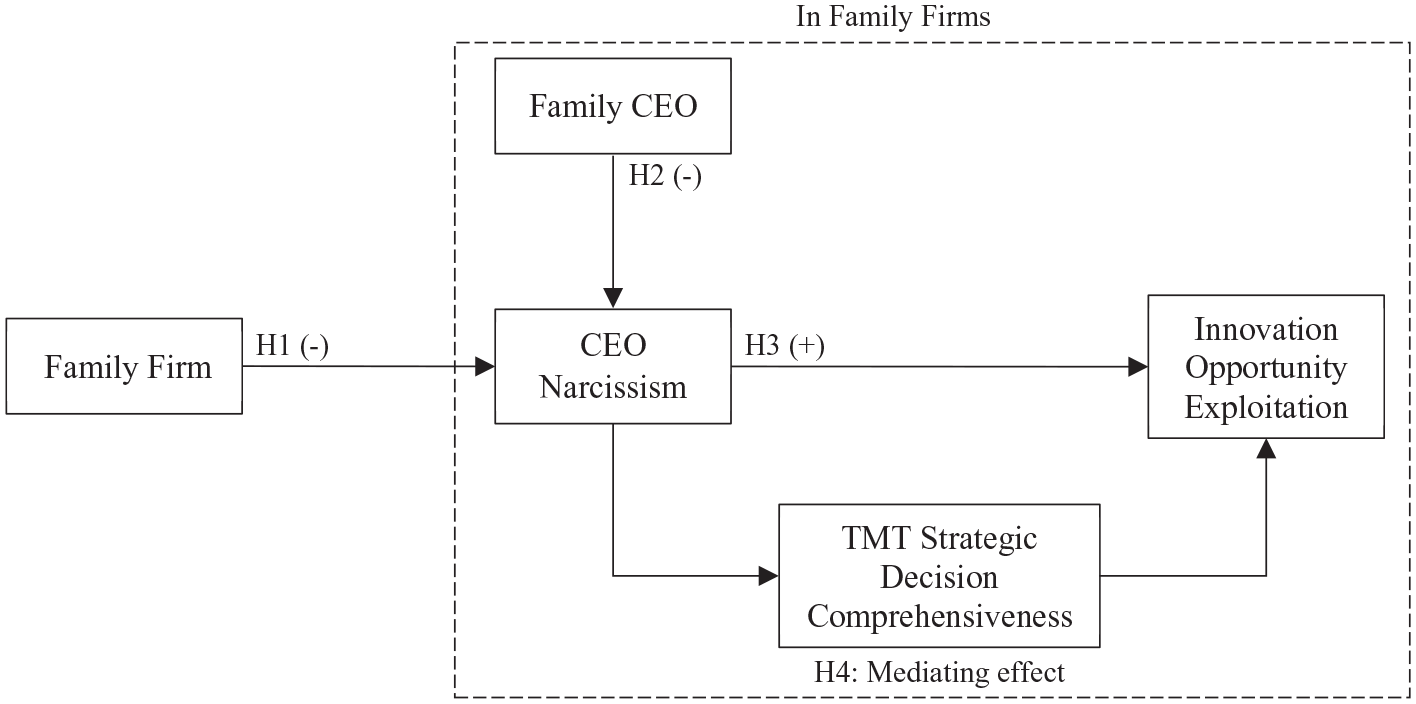
Synthesis of the hypotheses.
Methods
Data collection and sample
To investigate the differences in CEO narcissism between family and nonfamily firms and among family firms, together with the implications for family firms’ innovation opportunity exploitation, we developed a unique database with information on Italian firms and their CEOs. As information on the characteristics of the decision-making process, the exploitation of opportunities, and the narcissistic personality of individuals are not publicly available from secondary sources, we constructed this primary database by means of a survey and the administration of a psychometric questionnaire, that is the Narcissistic Personality Inventory (NPI) (Raskin and Terry, 1988). Secondary sources were then used to gather data to control for possible confounding factors. The data collection procedure was as follows.
First, a structured questionnaire was administered to Italian CEOs. Though the general purpose of this questionnaire was to study the organization of Italian firms’ TMTs, in our case we took advantage of the questions specifically designed for collecting information on the amount of innovation opportunities exploited by the firm and the TMT decision-making process. We created the questionnaire based on constructs that have been validated in previous research. According to established practices, we first translated these questions into Italian and then we back-translated them to English. This allowed us to guarantee the preservation of their original meaning (Dillman, 2000; Kriauciunas et al., 2011). After a pilot test with six CEOs and a pre-test involving 31 CEOs (see Andrews et al., 2003; Collins, 2003; Kriauciunas et al., 2011), we administered the final version of the questionnaire by email to a sample of 3899 CEOs of Italian firms, which was derived from the target population of 50,341 Italian firms (please refer to Appendix A in the online supplemental document for detailed information on the sampling procedure). Three hundred and sixty-three CEOs replied to our questionnaire, corresponding to a 9.31% response rate. This response rate is consistent with that of other survey data collections conducted in similar studies (e.g., Cruz et al., 2010; De Massis et al., 2020; Garcés-Galdeano et al., 2017; Graham et al., 2013; Poterba and Summers, 1995; Simsek, 2007; van Doorn et al., 2017). Nevertheless, only in 241 cases did we retrieve complete information on the exploitation of innovation opportunities. A series of tests assured the representativeness and absence of non-response biases in the sample, as well as the reliability of CEOs’ answers (please refer to Appendix B in the online supplemental document for details about these tests).
An important element of our study is the measuring of CEO narcissism. To this end, we relied on the most commonly used instrument to measure narcissism through a psychometric questionnaire (Andreassen et al., 2012), the NPI (Raskin and Terry, 1988). We thus administered the NPI to the 241 CEOs in the survey sample who shared information on the exploitation of innovation opportunities. The English version of the NPI is reported in Appendix C in the online supplemental document. However, in line with our target sample, we administered its Italian version, whose validation and translation from English was carried out by clinical psychologists (Fossati et al., 2008). To prevent biases, CEOs were not explicitly informed about the topic of the test. A total of 202 complete NPIs were returned, corresponding to an 83.81% response rate. Such a high response rate guarantees by nature a good representativeness against the full sample, which was confirmed by chi-squared tests and t-tests. The sample is also devoid of non-response bias.
Finally, general firm characteristics were collected from balance sheets obtained from the Aida database managed by Bureau van Dijk. Depending on missing data, the usable sample for this study consisted of 198 firms. As noted later, 102 (51.52%) are family firms and 96 are nonfamily firms (48.48%); these two groups are used to test our comparative family/nonfamily hypothesis dealing with CEO narcissism (H1). The 102 family firms are used to test those hypotheses pertaining to heterogeneity within the population of family firms (Hypotheses 2–4).
Measures
Main variables
The main variables used in this study are those concerning: (i) the extent to which the CEO has a narcissistic personality, (ii) the family nature of the firm and the CEO’s family membership, (iii) the firm’s exploitation of innovation opportunities, and (iv) the comprehensiveness of the TMT decision-making process.
We measured CEO narcissism by means of the NPI psychometric questionnaire (Raskin and Terry, 1988), which is the most popular instrument to measure this personality trait (Andreassen et al., 2012). Data collected through the NPI go beyond the unobtrusive indicators of personality used so far by management scholars (e.g., Chatterjee and Hambrick, 2007; Ham et al., 2018) and offer a unique opportunity to test our hypotheses. Specifically, the validity of this instrument, which is typically used to measure narcissistic traits in non-clinical samples (Andreassen et al., 2012; Bianchi, 2014; O’Reilly et al., 2014; Petrenko et al., 2015), is supported by a number of studies (see, for instance: Campbell and Miller, 2001; Kubarych et al., 2004; Raskin and Hall, 1981; Raskin and Terry, 1988; Watson et al., 1984). Also, this instrument allows us to overcome the limits of the unobtrusive measures that are more frequently used in the management literature. The most notable example of such alternative measures is the one developed by Chatterjee and Hambrick (2007), who brought forward six unobtrusive indicators: the prominence of the CEO’s photograph in the company’s annual report; the CEO’s prominence in the company’s press releases; the length of the CEO’s Who’s Who entry; the CEO’s use of first person singular pronouns in interviews; the CEO’s cash compensation divided by that of the second-highest paid executive in the firm; and the CEO’s non-cash compensation divided by that of the second-highest paid executive in the firm. Though these measures have yielded robust results in their study, the most notable limitation to their work, as they claim, is that these convenience indicators are far from being fully validated and are somewhat arbitrary (Chatterjee and Hambrick, 2007). Therefore, the NPI remains the most reliable instrument to measure narcissism. In detail, the NPI measures narcissism over a scale from zero to 40. The questionnaire indeed consists of 40 paired statements that CEOs had to evaluate. To compute CEO narcissism, for each pair of statements we coded as one the narcissistic self-view and as zero the non-narcissistic self-view, and then we summed all 40 items selected by the respondent.
We identified family-controlled firms (or family firms for short) through a dummy variable, which equals one in the case of this type of firm. Specifically, we first resorted to the self-identification criterion (e.g., Cruz et al., 2010; Harveston et al., 1997; Mahto et al., 2010), directly inquiring CEOs about their firm’s nature. Then, we checked these answers by means of ownership data retrieved from Aida. In so doing, we considered as family firms those where the same family controls more than 50% of the shares (Minichilli et al., 2010). Using the two alternative approaches (i.e., the self-identification criterion and the ownership analysis), we identified the same sample of family firms. In line with previous literature (e.g., Harveston et al., 1997; Ling and Kellermanns, 2010; Mahto et al., 2010; Miller et al., 2013), we thus singled out the family firms in our sample through both the involvement and essence criteria (Chrisman et al., 2012). More specifically, both the self-identification as a family firm and the participation of the family in a major ownership position assure the presence of an influential force (i.e., the family) that pushes the firm to lean towards SEW preservation instead of pursuing merely financial goals. By only considering the family firms in our sample, we also created the variable family CEO, which is equal to 1 in the case where the family firm is led by a member of the family.
To measure a firm’s exploitation of innovation opportunities, we used data gathered through the survey. Following Foss et al. (2013, 2015), we asked CEOs to assess the number of opportunities exploited by their firm and that favored the improvement of financial performance. In so doing, CEOs used a seven-point Likert-type scale ranging from “no opportunities” (1) to “many opportunities” (7). Moreover, we provided seven types of opportunities: (i) new products and services (with the exception of marginal changes); (ii) new production technologies; (iii) entry into new markets; (iv) changes in the organization; (v) new ways to manage the human resources; (vi) new ways to manage the R&D; and (vii) new ways to manage the accounting and finance. Taking inspiration from Foss et al. (2013), we selected the four items that precisely point to innovation as intended in terms of product innovation (instead of changes in the organization of processes, structures and functions, which the remaining items represent): new products and services, new technologies, new markets, and new ways of managing R&D. This focus on a more “traditional” type of innovation considers opportunities that are visible from outside the firm and for which the family firm, and thus the CEO, might receive feedback. Therefore, these are the types of opportunities a narcissistic CEO might be interested in, so as to get recognition when being successful. A higher average of the four selected items indicates a higher number of opportunities exploited. A Confirmatory Factor Analysis validated this classification, and we used the corresponding factor as a measure of innovation opportunity exploitation. 2
Finally, we used survey data also to measure the TMT strategic decision comprehensiveness. Following prior studies by Miller et al. (1998) and Souitaris and Maestro (2010), in the questionnaire CEOs were asked to think about situations in which they faced an immediate, important, non-routine threat or opportunity, and evaluate via a seven-point Likert-type scale how frequently TMT members: (i) develop many alternative responses; (ii) consider many different criteria and issues when deciding the course of action to take; (iii) thoroughly examine multiple explanations for the problem or opportunity; (iv) conduct multiple examinations for the suggested course of action; and (v) search extensively for possible responses. One single factor emerged applying a Principal Component Analysis to these five items (alpha = 0.907), which we used as a measure of TMT strategic decision comprehensiveness.
Control variables
We considered several control variables when testing our hypotheses. First, we took into account firm-level aspects that might affect the presence of narcissistic individuals leading the firm as well as the exploitation of innovation opportunities. Specifically, we considered firm size, which is the logarithm of firm’s employees, and firm hierarchical levels, which is the number of levels between the CEO and the last level with budget or expenses responsibility. Then, we also controlled for the logarithm of firm age and for the number of executives in the TMT (TMT size). We further considered the industry in which the firm operates (industry dummy equal to 1 in the case where it is in the manufacturing rather than the services industry) and its geographical location (geographical dummy equal to 1 where the firm is located in the north of Italy). Finally, we controlled for the characteristics of the market in which the firm operates, measuring market competition and market evolution. In this respect, in the questionnaire we asked CEOs to evaluate, using a five-point Likert-type scale, whether in the market there are few (1) or many (5) competitors; the competitive intensity within the industry is very low (1) or very high (5); the market size is rapidly shrinking (1) or rapidly growing (5); and the technological change is very slow (1) or very rapid (5). A Principal Component Analysis applied to these items revealed two factors: market competition including the first two, and market evolution including the last two.
Second, in the models aimed at investigating the exploitation of innovation opportunities, we added some individual-level control variables that might play a role in this regard. Specifically, we considered a dummy equal to 1 where there is a female CEO, and another dummy variable equal to 1 if the CEO possesses a bachelor or master degree (CEO degree). We also controlled for when the CEO is the founder of the firm (founder CEO is a dummy variable equal to 1 in this case), CEO tenure, measured as the number of years since the individual was appointed CEO in the current firm, log-transformed given its skewness, and for the extent to which the CEO delegates authority over strategic decisions to the managers forming the team (CEO delegation). Adapting the measure of Colombo and Delmastro (2008), we computed CEO delegation as the average level of delegation of 21 strategic decisions that CEOs assessed in the questionnaire. Specifically, we asked CEOs to provide the lowest hierarchical level responsible for making each strategic decision: 1 indicates the CEO’s corporate superior (e.g., the board of directors); 2 is the CEO; 3 is the first line managers, but with the formal authorization of the CEO; 4 is the first line managers, who decide autonomously; and 5 is the middle managers. To compute CEO delegation, we excluded decisions made directly by the CEO’s corporate superior (i.e., decisions associated with a value of 1 in the scale above), computing the average level of delegation considering only those made either by the CEO, the TMT or the middle managers (i.e., decisions associated with values from 2 to 5 in the scale above).
Methods of analysis
We tested our hypotheses by means of a series of ordinary least squares (OLS) models. First, to study CEO narcissistic personality in relation to the firm nature (i.e., family vs nonfamily firms) and the status of family firms’ CEOs, we ran three models. Model 1 is the baseline with only control variables. Model 2 adds the family firm nature to the baseline. Model 3 considers only family firms and includes the measure of whether the CEO is a family member. These models served thus to test Hypotheses 1 and 2.
To study instead the relation between family firms’ CEO narcissism and their exploitation of innovation opportunities, and the alleged mediating effect of the TMT strategic decision comprehensiveness, we resorted to both the four-steps approach of Baron and Kenny (1986) and the bootstrapping approach (Bollen and Stine, 1990; Shrout and Bolger, 2002). The former consists in testing four models. After a model with only controls (Model 4), in the first model (Model 5) we regressed the innovation opportunity exploitation against CEO narcissism (i.e., the treatment). In Model 6 we instead estimated the mediator (TMT strategic decision comprehensiveness) given the treatment. In Model 7, we regressed the outcome (innovation opportunity exploitation) against the mediator, whereas in Model 8 we regressed the outcome against both the mediator and the treatment. As said, we also used the more modern approaches to test the robustness of the findings. In so doing, we computed the Average Causal Mediate Effect (Hicks and Tingley, 2011), we did the Sobel (1982) test, and we used the bootstrapping method (Bollen and Stine, 1990; Shrout and Bolger, 2002); to so do, we used the Stata commands medeff, sgmediation, and bootstrap, respectively. Taken together, with these models we tested Hypotheses 3 and 4.
Please note that the possibility of common method variance is not a problem for Hypotheses 1 and 2 (as family ownership, CEO being a member of the family, and the founder being present are all objective data), whereas for Hypotheses 3 and 4 we ran tests to rule out common method variance for the self-reported survey data on the exploitation of innovation opportunities and the TMT strategic decision comprehensiveness (see below for more details).
Results
Table 1 reports descriptive statistics and correlations. One hundred and two of the 198 firms in the sample (51.52 %) are family firms. Thirty-eight of these family firms are led by a nonfamily CEO, whereas 64 are led by a family CEO. The average size of firms is 681.08 employees when considering all firms and 568.37 employees when focusing on family firms. The majority of the firms operate in the manufacturing sector (46.46% overall, 58.82% family firms) and are located in northern Italy (67.68% overall, 70.59% family firms). The average level of narcissism of the CEOs in the sample is 15.515 (over a scale that ranges from zero to 40, see above for further details). As expected, however, in nonfamily firms, CEOs are more narcissistic than those working in family firms (16.656 vs 14.441), and the difference is statistically significant at p < 0.01. Indeed, CEO narcissism is negatively and significantly correlated with family firm (corr. = −0.185, p = 0.009). Considering family firms, CEO narcissism is negatively and significantly correlated with family CEO (corr. = −0.170, p = 0.087). Also, CEO narcissism positively correlates to innovation opportunity exploitation (all firms: corr. = 0.127, p = 0.075; family firms: corr. = 0.148, p = 0.137) and with TMT strategic decision comprehensiveness (all firms: corr. = 0.177, p = 0.013; family firms: corr. = 0.195, p = 0.050). Finally, innovation opportunity exploitation and TMT strategic decision comprehensiveness are positively and significantly correlated (all firms: corr. = 0.219, p = 0.002; family firms: corr. = 0.289, p = 0.004).
Descriptive statistics and correlations.
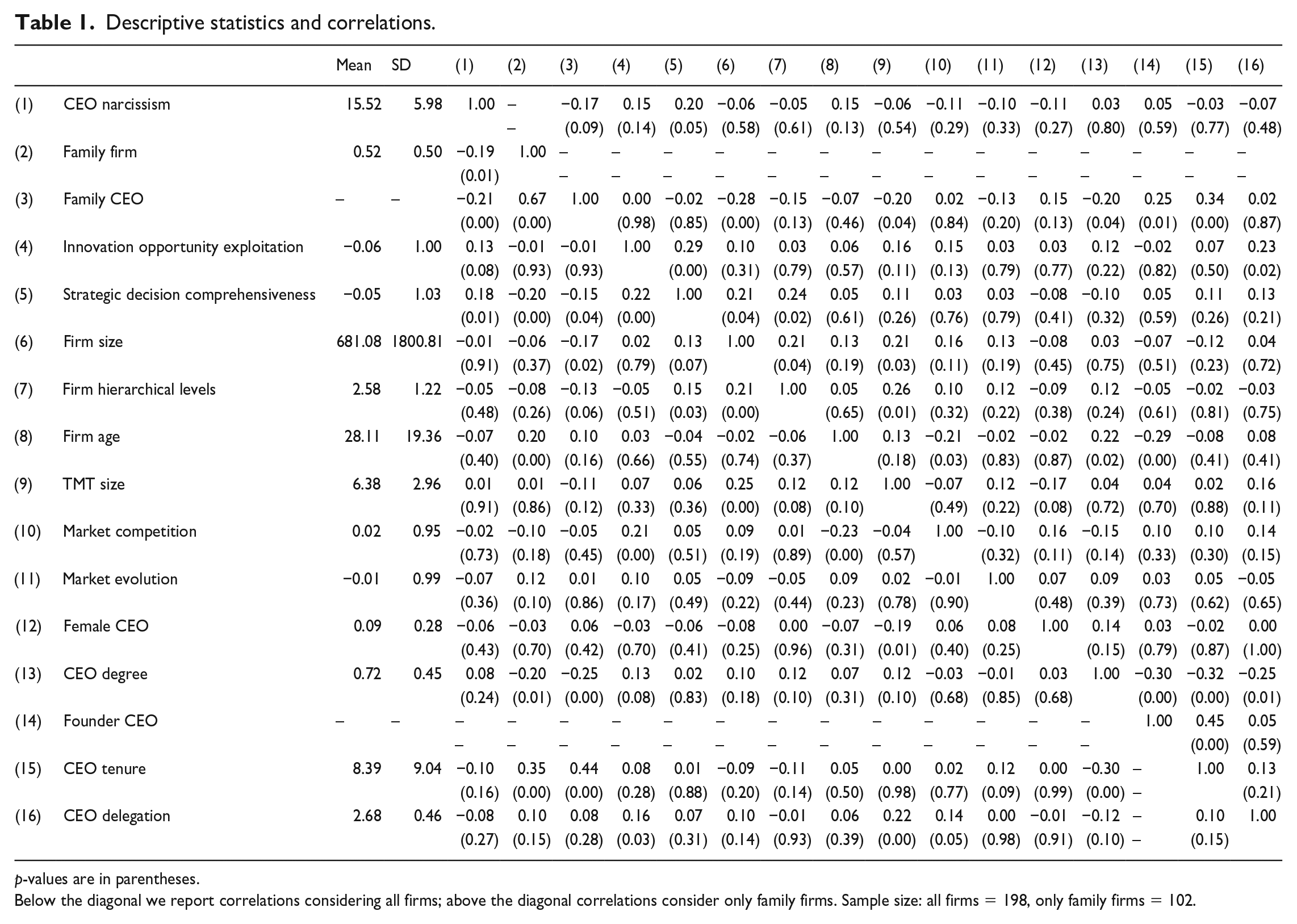
p-values are in parentheses.
Below the diagonal we report correlations considering all firms; above the diagonal correlations consider only family firms. Sample size: all firms = 198, only family firms = 102.
Tests of variance inflation factors and condition indexes confirmed the absence of multicollinearity; indeed, such values were both lower than the thresholds that are typically related to multicollinearity problems (Belsley et al., 1980). During the data collection, we first implemented some remedies to minimize the possible problems of common method variance (although this is not a concern in the comparative Hypothesis 1 given that the family/nonfamily distinction was confirmed with archival ownership data collected independently from the survey). Following Podsakoff et al. (2012), we worked to vary scale properties among questions (e.g., adopting different scale types and number of scale points or including reverse-worded items), and to alternate perceptive and non-perceptive questions. Once the survey concluded, we did additional formal tests to control whether results are affected by common method variance (Podsakoff et al., 2003, 2012). The Harman (1967) single-factor test resulted in six factors with eigenvalues greater than one, accounting for the 63.14% of the total variance. As the first factor explains only 22.28% of the variance, this analysis excluded the presence of common method bias (Podsakoff and Organ, 1986). To confirm this result, we also took advantage of a structural equation model with common latent factor (CLF), as suggested by Podsakoff et al. (2003). In this model, we considered all the items included in the main constructs of this study and we controlled for the effect of an unmeasured common latent factor; this CLF should capture the items’ common variance. We thus ran a Confirmatory Factor Analysis including the CLF and relating all items to this factor. In so doing, the paths were constrained to be equal and the common variance of the CLF to 1. We computed the common variance as the square of the common factor of each path before standardization. The structural equation model unveiled that the items share a common variance of 12%, which means that common method bias is not a significant problem.
Table 2 reports the OLS models testing Hypotheses 1 and 2. Interestingly, from the baseline Model 1 it appears that the level of narcissism does not significantly depend on general firm characteristics. Differently, a negative and significant relation between being a family firm and CEO narcissism emerged (Model 2: γ = −2.073, SE = 0.917, p = 0.025). In detail, moving from a nonfamily to a family firm there is a 12.624% decrease of CEO narcissism (from 16.426 to 14.352). 3 This result is in line with Hypothesis 1, which argues that family firm CEOs are less narcissistic than those working in their nonfamily counterparts. Results also reveal that, within family firms, the CEO’s family membership matters. In Model 3, which considers only family firms, family CEO negatively and significantly relates to CEO narcissism (γ = −2.463, SE = 1.289, p = 0.059), such as moving from a family firm with a nonfamily CEO to one with a family CEO, CEO narcissism decreases by 14.472% (from 17.025 to 14.561). This moderately supports Hypothesis 2 (because the relationship is significant at p < 0.10), claiming that, in family firms, family CEOs are less narcissistic than nonfamily ones.
Models on the relationship of family firm nature and the CEO’s family membership with CEO narcissism.
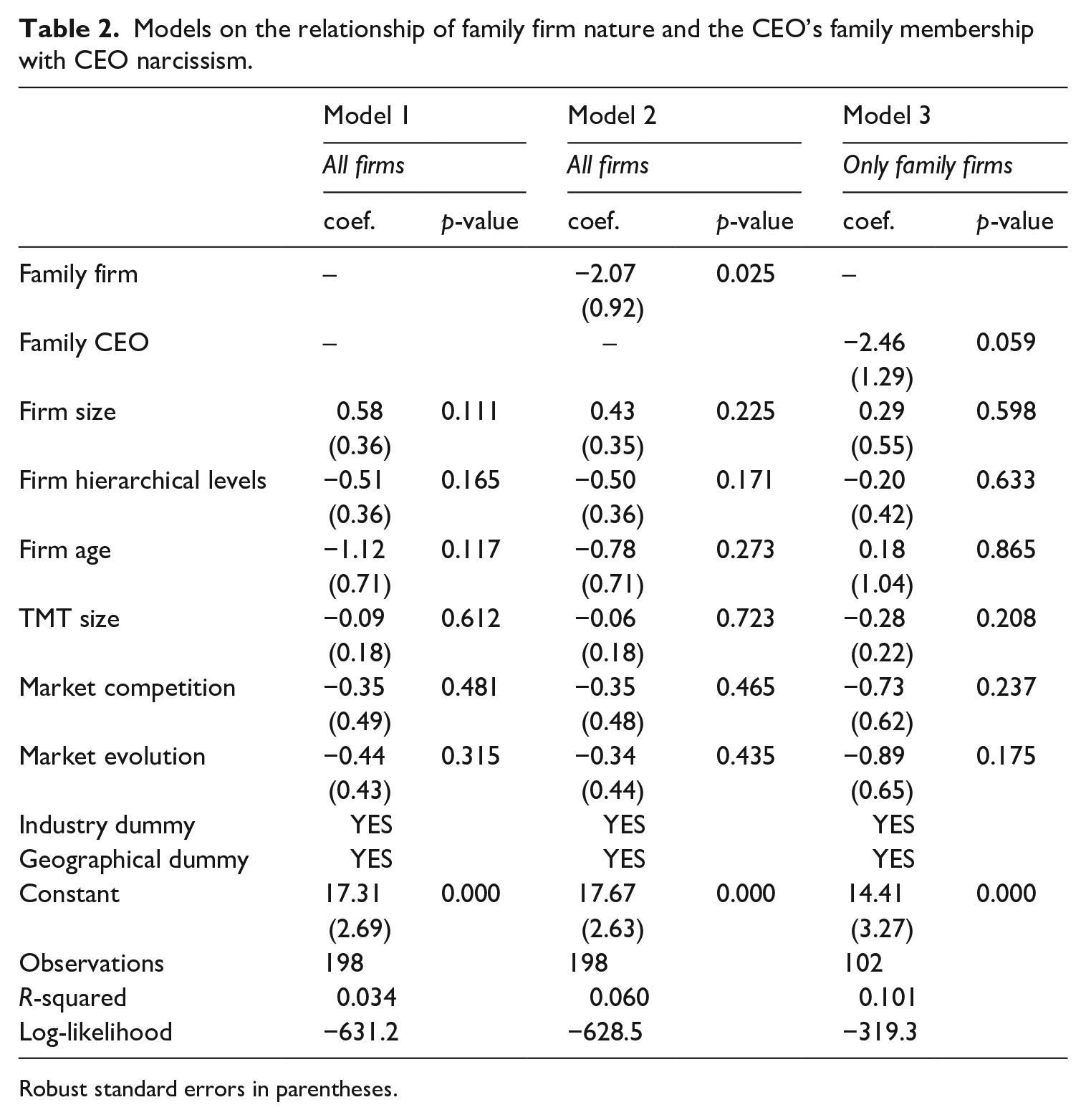
Robust standard errors in parentheses.
The models used to test Hypotheses 3 and 4 are presented in Table 3; these consist of the four steps suggested by Baron and Kenny (1986) to test whether TMT strategic decision comprehensiveness mediates the direct relation between CEO narcissism and innovation opportunity exploitation. Looking at the baseline model (Model 4), we see that the exploitation of innovation opportunities increases where the CEO possesses a degree (γ = 0.484, SE =0.263, p = 0.069) and with the increase of CEO delegation (γ = 0.529, SE = 0.258, p = 0.043). Confirming Hypothesis 3, Model 5 shows that CEO narcissism positively relates to innovation opportunity exploitation (γ = 0.040, SE = 0.018, p = 0.033). Specifically, one standard deviation increase of CEO narcissism is associated with a 54.935% increase in innovation opportunity exploitation (from 0.422 to 0.654). CEO narcissism also positively and (marginally) significantly relates to TMT strategic decision comprehensiveness (Model 6, γ = 0.046, SE = 0.024, p = 0.056), thus confirming the notion that narcissistic CEOs tend to favor a greater comprehensiveness of the assessment carried out by TMT members. In this case, one standard deviation increase of CEO narcissism leads to a 97.513% increase in TMT strategic decision comprehensiveness (from –0.277 to –0.007). Model 7 confirms the positive effect of TMT strategic decision comprehensiveness on innovation opportunity exploitation (γ = 0.289, SE = 0.086, p = 0.001). Specifically, one standard deviation increase of TMT strategic decision comprehensiveness is associated to a 64.548% increase in the extent of exploitation of innovation opportunities (from 0.483 to 0.795). Finally, Model 8 tests whether TMT strategic decision comprehensiveness mediates the direct positive relation between CEO narcissism and innovation opportunity exploitation. Though the coefficient of TMT strategic decision comprehensiveness is still positive and highly significant (γ = 0.258, SE = 0.091, p = 0.006), CEO narcissism loses its significance (γ = 0.028, SE = 0.018, p = 0.119). This result supports Hypothesis 4 and the presence of a full mediation. The result is confirmed by a positive and significant Average Causal Mediation Effect (coef. = 0.012). Also, the indirect effect (p = 0.087) and the total effect (p = 0.041) are statistically significant, whereas the direct effect of CEO narcissism is not significant (p = 0.150). The percentage of total effect mediated by TMT strategic decision comprehensiveness is 0.199. Also, Sobel’s and Goodman’s tests confirm the mediation (p = 0.087 and 0.074, respectively), and the bootstrapping approach leads to coherent results (Bollen and Stine, 1990; Shrout and Bolger, 2002); in this case, the indirect effect is positive and significant (p = 0.080) and the direct one is positive but not significant (p = 0.134). Hypothesis 4 is thus confirmed by the results.
Models on the relationship between CEO narcissism and innovation opportunity exploitation in family firms, and the mediating effect of TMT strategic decision comprehensiveness (sample: only family firms).
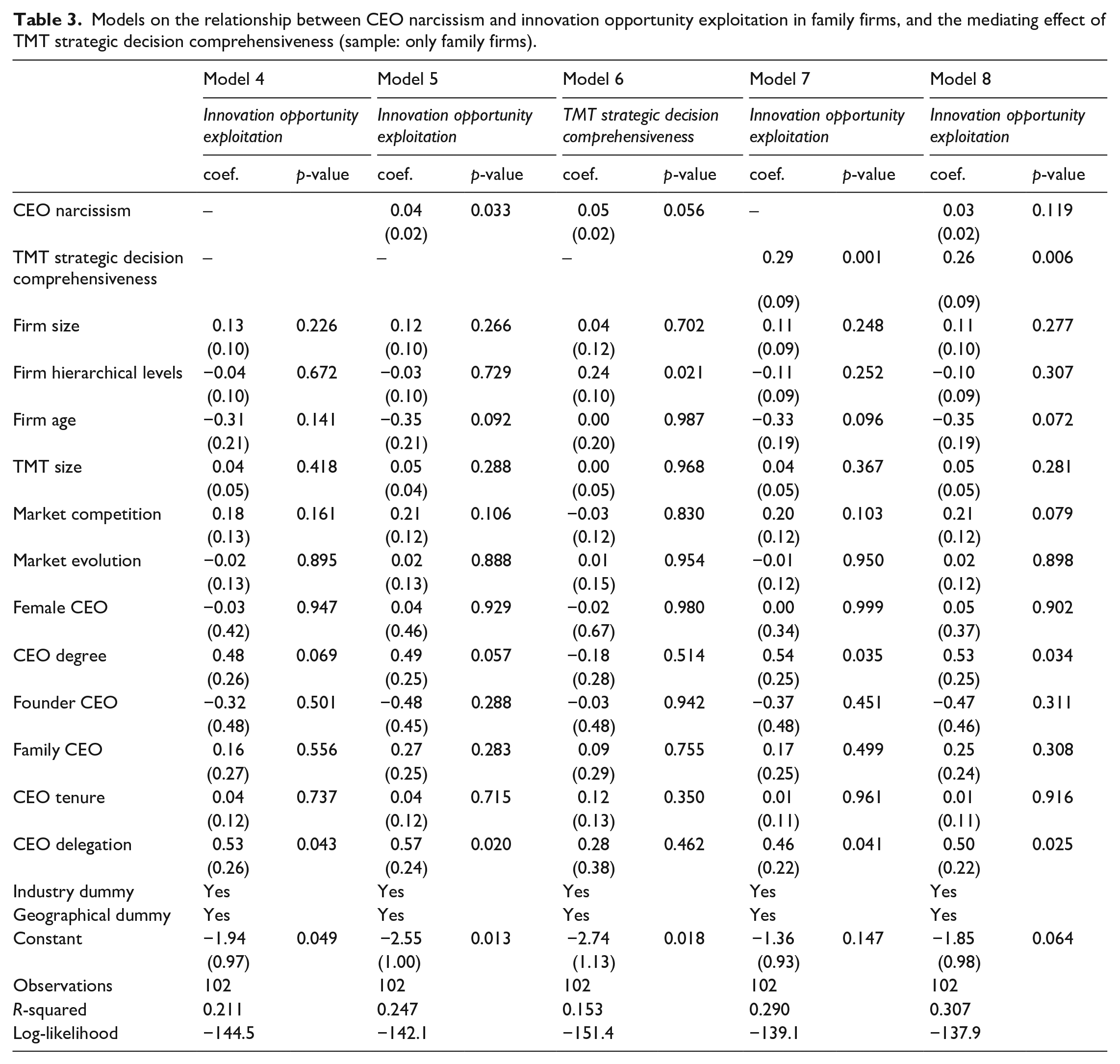
Robust standard errors in parentheses.
Robustness check
We ran further analyses to check whether our results were robust; the results are reported in Appendix D in the online supplemental document. First, we tested Hypothesis 1 by substituting the dummy variable family firm with a continuous variable measuring the percentage of shares owned by the family, when present. Estimates confirm the main results.
Second, we used an alternative measure of innovation opportunity exploitation, which was computed as the average of the related items, instead of considering the standardized factor obtained through the Confirmatory Factor Analysis. Results are totally in line with those presented above. This means that the TMT strategic decision comprehensiveness still fully mediates the positive and significant relation between CEO narcissism and the exploitation of innovation opportunities.
Third, we considered a wider measure of innovation opportunity exploitation by including the opportunities that we excluded in the previous analyses (i.e., changes in the organization, and new ways to manage human resources and accounting and finance). We thus created a new variable (opportunity exploitation) by computing the average over all types of opportunities, and then we ran estimates again using this in place of innovation opportunity exploitation. In this case also, results fully confirm the main estimations.
Lastly, we tested our mediation hypothesis extending the analysis to the whole sample instead of considering only family firms. Results are again confirmed.
Discussion and conclusion
CEO narcissism has generated much interest among practitioners, as well as in the academic literature (e.g., Campbell and Campbell, 2009; Chatterjee and Hambrick, 2007, 2011; Chatterjee and Pollock, 2017; Maccoby, 2012; Rovelli and Curnis, 2021; Tang et al., 2018; Vogel, 2006). Yet research on why some organizations are attracted to this CEO personality trait whereas others are repelled by it largely remains as an empty set. In this article, we have advanced knowledge on CEO narcissism by investigating this personality trait as being reflective of ownership structure. Our results reveal a controversial behavior of family firms. Indeed, on one side, family firms tend to limit the presence of narcissistic individuals at their apex, as it is revealed by our results showing that CEOs leading family firms have a less pronounced narcissistic personality compared to those leading nonfamily firms; these firms are also less likely to hire external CEOs who are high on narcissism. Though family firms are led by less narcissistic CEOs, heterogeneity exists among these firms. Specifically, in family firms, family CEOs are less narcissistic than nonfamily CEOs.
On the other side, consistent with some prior evidence from recent literature (Kashmiri et al., 2017; Zhang et al., 2017), our results also demonstrate that family firms managed by a more narcissistic CEO get benefits in terms of innovation opportunities: the greater the CEO narcissism, the greater the amount of innovation opportunities exploited by the family firm. This is made possible as more narcissistic CEOs shape the TMT strategic decision-making process in a way that it becomes more comprehensive. This allows taking the risk of innovating while reducing the potential losses that might be associated with the exploitation of the selected innovation opportunities. Thus, we inform family firms that, though avoiding the appointment of a narcissistic CEO potentially protects them from SEW losses, this choice could lead them to suffer in their competition with nonfamily firms (who are more likely to appoint narcissistic CEOs) concerning innovation. CEO narcissism indeed turns out to be beneficial if family firms aim to exploit innovation opportunities. In that case, a more narcissistic CEO frames the TMT strategic decision making in a way that is more comprehensive, so s/he has at her/his disposal all the information needed to allow taking the risk of exploiting innovation opportunities but at the same time reducing the potential losses (i.e., negative implications on her/his wealth and reputation) that might be associated with the innovation opportunities. This means that having this kind of personality might be positive for family firms. For instance, self-confidence, risk-taking behavior, and locus of control or ambition that are typically associated with narcissism (Buss and Chiodo, 1991; Chatterjee and Hambrick, 2007; Kets de Vries, 1994; Lubit, 2002) may foster innovation in family firms that are typically reluctant to do so (Chrisman and Patel, 2012). Hence, though they may potentially damage SEW, narcissistic CEOs might also be beneficial for family firms. Our study therefore brings light to the debate in the family business literature as to when the pursuit of SEW and financial wealth might be mutually reinforcing or counterbalance each other (Gomez-Mejia et al., 2021a; Kotlar et al., 2018; Martin and Gomez-Mejia, 2016).
Our article adds to the literature also in other ways. First, we contribute to the literature on CEO personality in general, and CEO narcissism in particular, as well as to the stream of literature that investigates narcissism in leadership (e.g., Higgs, 2009; Judge et al., 2002; Kets de Vries and Miller, 1985). Adding to the literature interested in the characteristics leading to the emergence and appointment of leaders (e.g., Cappelli and Hamori, 2005; Rovelli and Curnis, 2021; Tedlow et al., 2003), we enhance our understanding of why and how narcissistic individuals are more likely to be present in leadership positions of some firms than others. In so doing, we rely on the NPI as a direct measure of narcissism, departing from unobtrusive measures that exploit secondary sources of information (e.g., Butticè and Rovelli, 2020; Chatterjee and Hambrick, 2011; Engelen et al., 2016; Raskin and Shaw, 1988). Second, by investigating the presence and consequences of narcissistic CEOs, we add to the family business literature. On the one hand, we answer the call for more research on the psychological foundations of management in this organizational setting (e.g., Humphrey et al., 2021; Picone et al., 2021). In so doing, we contribute to the stream of research on CEO personality in the specific context of family firms (e.g., Kelleci et al., 2018).
To the best of our knowledge, this is the first study that investigates CEO narcissism with a specific look at family firms. Even though this personality trait might be particularly worrisome in this type of firm because of the need to preserve SEW, we find that it has a salutary impact on their innovation activities. We thus offer a theoretical perspective to understand and explain why, in family firms, narcissistic CEOs exploit more innovation opportunities – which we argue is because they pursue a greater TMT strategic decision comprehensiveness to reduce risk bearing and the perceived risks to their reputation. In so doing, we throw light also on the debate concerning the extent to which family firms refrain from innovation (e.g., Calabrò et al., 2019; Chrisman et al., 2015; Kellermanns and Eddleston, 2006; McKelvie et al., 2014) by revealing the influential role of narcissistic CEOs in the exploitation of recognized innovation opportunities, a topic that has been largely neglected in both the family business and general management literature. CEO narcissism thus offers a piece of the puzzle to understand why family firms are heterogeneous in the exploitation of innovation opportunities. Moreover, we extend the mainstream literature on CEO narcissism by uncovering new antecedents – that is, family nature and CEO status – and adding to the debate on the consequences of being managed by CEOs with this type of personality – that is, favoring innovation opportunity exploitation by means of a better TMT strategic decision comprehensiveness.
Apart from its contributions, our study has limitations that provide opportunities for future research. First, our sample includes only firms located in one country and it is possible that different institutional and cultural environments may influence the effect of CEO narcissism in family firms (Berrone et al., 2021). Therefore, the generalizability of results may be questioned, and we welcome further tests conducted in different empirical settings. Likewise, it might be worth testing whether our results are robust to alternative definitions of family firms (e.g., considering voting rights); indeed, though we adopted both involvement and essence criteria to identify family firms in our sample, the definition of family firm is still a debated topic. Moreover, future investigations could further corroborate the robustness of our results testing Hypotheses 1 and 2, whose corresponding models have a relatively weak absolute R2.
Second, we drew on a unique cross-sectional database that we created using a psychometric instrument. Though the narcissistic personality trait is developed in infancy and then remains stable across life (Freud, 1914/2014), it would be interesting to have longitudinal data on firms’ CEO, organization and innovation opportunity exploitation to understand whether changes may happen in the relation between CEO narcissism and innovation opportunity exploitation and, if this is the case, what factors intervene triggering these changes over time. Similarly, complementing our study with a qualitative approach might help to fully grasp the motivation of family firms’ owners to having a narcissistic individual leading their firm and the way in which narcissistic CEOs frame their TMT activities and search of information to make their innovation decisions.
Third, though we argue that family firms might decide not to have a narcissistic CEO owing to the potential consequences of this personality on the preservation of SEW, our data did not allow us to directly explore this aspect. This is a common aspect in the SEW literature, where scholars have inferred the presence of SEW in firms with family involvement without directly measuring it (for related discussion see Gomez-Mejia and Herrero, 2021). Future research might thus make efforts to directly measure SEW preservation so as to test empirically the underlying mechanism in the theorized relationship between CEO narcissism and SEW preservation.
Fourth, though investigating the exploitation of innovation opportunities and the mediating effect of TMT strategic decision-making comprehensiveness adds new knowledge to understand the consequences of CEO narcissism in the context of family firms, other aspects might be affected by this CEO personality trait and be worthy of investigation. For instance, future research might assess whether the level of CEO narcissism affects the firm’s goals, organizational structure, and performance, as well as the family’s involvement in the firm. Also, not only the personality of the CEO may matter in innovation opportunity exploitation, but also that of other family members involved in the firm or of other top executives. We thus invite scholars to investigate the interaction between CEOs’ and other family members’ or top executives’ narcissistic personality, which might determine the extent to which the family firm exploits innovation opportunities. Finally, given the positive relation that we show between CEO narcissism and the exploitation of innovation opportunities, it would be interesting to investigate how family firms could minimize the threats in terms of SEW preservation when appointing a narcissistic individual as CEO (e.g., HRM practices, investments in socializing outsider narcissistic CEOs, career and succession planning practices).
Despite limitations, our work informs practitioners dealing with family firms. From an individual perspective, narcissistic individuals should be aware that it might be more difficult to be hired as CEO in a family firm compared to a nonfamily firm. Therefore, they should be ready to either revise their career goals or make the family firms’ owners aware of the contribution they can bring in terms of innovation. From a family firm perspective, these organizations should be aware of the controversial result emerging from our study – that is, though they might be tempted not to have narcissistic individuals as CEOs, for instance to preserve SEW, this could further condemn them not to keep up with their nonfamily counterparts when it comes to innovation. Preferring less narcissistic individuals for their leadership roles, and specifically to cover the CEO position, is in fact not per se the best strategy. Indeed, although the characteristics typically associated with this personality trait may lead family firms to believe that a narcissistic CEO might be a threat to the preservation of the family’s SEW, a narcissistic leader – either family or nonfamily member – can instead be an opportunity in terms of innovation. Family firms’ owners interested in increased innovation by which plan to hire a narcissistic CEO, who will likely lead the firm to exploit a greater number of innovation opportunities, while also trying to keep the risks associated with this action limited. Narcissistic CEOs can indeed be a spur to a family firm’s innovation. Nevertheless, family firms could put some actions into play to limit the potential negative effects that these individuals might have in terms of SEW preservation. Finally, our work also has implications in terms of HRM practices. Specifically, family firms’ owners and HR managers might be stimulated to develop HRM practices aimed at taking advantage of the benefits that narcissistic CEOs can bring to the family firm. These might include the development of selection procedures to measure narcissistic traits, setting up career and succession planning practices to potentially consider a narcissistic successor, or some socialization strategies for outsider narcissistic CEOs to allow them to interiorize the importance of SEW and its preservation.
Supplemental Material
sj-pdf-1-hum-10.1177_00187267221076834 – Supplemental material for Are narcissistic CEOs good or bad for family firm innovation?
Supplemental material, sj-pdf-1-hum-10.1177_00187267221076834 for Are narcissistic CEOs good or bad for family firm innovation? by Paola Rovelli, Alfredo De Massis and Luis R Gomez-Mejia in Human Relations
Footnotes
Funding
The authors received no financial support for the research, authorship, and/or publication of this article.

Supplemental material
Supplemental material for this article is available online.
Notes
References
Supplementary Material
Please find the following supplemental material available below.
For Open Access articles published under a Creative Commons License, all supplemental material carries the same license as the article it is associated with.
For non-Open Access articles published, all supplemental material carries a non-exclusive license, and permission requests for re-use of supplemental material or any part of supplemental material shall be sent directly to the copyright owner as specified in the copyright notice associated with the article.
