



Abstract
Irving Janis’s concept of ‘groupthink’, the idea that a collective desire for consensus overrides the realistic appraisals of alternatives and leads to poor group decision making, is a staple of social science textbooks. Despite gaining little support in empirical studies, Janis’s eight symptoms of groupthink remains a popular framework. What has been forgotten, however, is that nearly 20 years before Janis’s supposed invention, groupthink was coined by social critic William H Whyte, author of one of the 1950s, most influential books on management. Adding to the growing interest in a historical turn in Management and Organization Studies, we investigate how and why Whyte’s groupthink was over-written by a history that found Janis’s ideas more useful, and outline how recovering Whyte can add value to our thinking now.
Keywords
[G]roups are bad . . . they produce what Fortune magazine has immortalized as ‘groupthink’.
Groupthink has been the leading explanation for crucial group decision failure ever since Irving Janis first proposed it in the early 1970s.
Groupthink is a well-known concept introduced to students in management and psychology courses. It refers to the tendency for people in groups to suppress contrary opinions because of the belief that high performing groups must reach a consensus. This suppression can prevent a group from considering alternative options and lead to sub-optimal decisions, which may have disastrous consequences. In textbooks, groupthink is attributed to Irving Janis, regarded as one of the most eminent psychologists of the last century (Haggbloom et al., 2002).
Janis (1971) developed his groupthink concept, a term inspired by George Orwell’s (1949) dystopian novel 1984, by studying US foreign policy fiascos such as the Bay of Pigs invasion, the failure to anticipate the attack on Pearl Harbor and the escalation of the Vietnam War. Janis created a diagnostic framework in the form of eight symptoms of groupthink. These are: an illusion of invulnerability that encourages excessive risk taking; collective rationalization of evidence; a belief in the inherent morality of the group; stereotyping of outsiders; direct pressure on dissenters; self-censorship; a shared illusion of unanimity; and self-appointed ‘mindguards’ who maintain the apparent consensus. Janis then prescribed remedies for treating the symptoms, including seeking external views, appointing a ‘devil’s advocate’ within the group and having independent groups working on the same issue.
While textbooks attribute groupthink to Janis, he was not the originator of the term. It can be seen from the quotations at the head of this article that while Janis is credited for first proposing the term in the early 1970s, Dorwin Cartwright and Ronald Lippitt, instrumental figures in the development of group dynamics, wrote about groupthink years earlier. Their piece appeared in the first edition of Readings in Managerial Psychology (1964), a collection of seminal articles compiled by Harold Leavitt and Louis Pondy. This raises the question, who is the person that ‘immortalized’ groupthink in the pages of Fortune magazine way back in 1952?
It was William H Whyte, author of best-seller The Organization Man (1956). Groupthink was Whyte’s diagnosis of the malaise affecting both the study and practice of management (and, by association, America) in the 1950s. His target was the fledgling field of Human Relations – the body of knowledge that this journal played a key role in nurturing. Whyte was dismayed that employees had subjugated themselves to the tyranny of groups, which crushed individuality and were instinctively hostile to anything or anyone that challenged the collective view.
Whyte’s stinging criticism attracted the attention of the field’s most influential figures. Keith Davis, described by management historians Wren and Bedeian (2009: 44) as ‘Mr. Human Relations’, devoted a section on groupthink in Human Relations in Business (Davis, 1957: 283–284), one of the earliest management textbooks. Davis acknowledges Whyte as the person who ‘termed . . . and critically described’ groupthink. Davis’s textbook is significant because it is the longest-running textbook in its field: published for more than 50 years through 14 editions, first by Davis himself, then together with John Newstrom; and then by Newstrom on his own following Davis’s death in 2002. As we will show later, throughout these editions there has been a gradual erasing of Whyte and establishment of Janis as the founder of groupthink. This is curious because Janis was a social psychologist and did not envision the field of management studies as his audience. In the preface to his 1972 book Victims of Groupthink, Janis notes: ‘This book is at the intersection of three disciplines – social psychology, political science, and history. I hope . . . [to] add something to the thinking of scholars in each of these disciplines’ (1972: vi). So, why do management textbooks prefer Janis – who was not writing about management – to Whyte, who was?
In exploring this question, we build on, and seek to contribute to, historical approaches within Management and Organization Studies. We begin with a brief review of this literature and an overview of our methodological approach. We then present a counter-history to the conventional textbook narrative regarding the evolution of groupthink and look back before the established origin point of groupthink (Janis in 1971) to understand Whyte’s concept of groupthink and its evolution. We analyse how and why Management forgot Whyte and elevated Janis and conclude with a discussion of the value of recovering Whyte and of our critical, historical approach.
The uses (and abuses) of history in Management
Those naive historians call ‘Objectivity’ the process of measuring past opinions and deeds by the universal public opinion of the moment. Here they find the canon of all truths. Their work is to adapt the past to contemporary triviality. (Nietzsche, 1874: VI)
1
The idea that history is not a factual, objective account of what happened in the past, but rather a malleable strategic resource, has received increasing attention in Management and Organization Studies (Kieser, 1994; Zald, 2002). This is not a new idea. In The Use and Abuse of History for Life (1874), Friedrich Nietzsche made a case against ‘universal history’: the notion that history is a matter of collecting and presenting the objective and immutable facts of the past. He argued that this view was naive – there is no such objectivity: historians always select some aspects they see in the past, and do not see or ignore others, creating causal chains that appeal to them while steering people away from alternative interpretations.
One hundred and fifty years after the publication of Nietzsche’s essay, our field (or at least parts of it) has embarked on an ‘historic turn’ in this spirit (Clark and Rowlinson, 2004; Coraiola et al., 2021; Mills et al., 2014; Rowlinson et al., 2014; Spector, 2016). This ‘turn’ is in line with similar developments in a widening range of fields, from psychology to international relations, which have sought to investigate how history is subjectively deployed and a key element in power/knowledge dynamics (Klein, 2017).
Within Management and Organization Studies, the historic turn has led researchers down different paths. One involves examining how organizational actors produce and use history in the present. This ‘uses of the past’ approach has focused on understanding the use of history by organizations (Cappelen and Pedersen, 2021; Lubinski, 2018; Paludi et al., 2021; Sasaki et al., 2020; Suddaby et al., 2010); actors within organizations (Cailluet et al., 2018; Wadhwani et al., 2018); and organizations in combination with nation-states and industries (Hatch and Schultz, 2017; Lubinski and Wadhwani, 2020). A second research path shifts the gaze upon our subject: to understand how management as a field uses the past too. Research has examined the crafting of a sanitized, ideologically conservative narrative of the field’s past that has forgotten the centrality of slavery (Cooke, 2003), politically left-wing ideas (Cooke, 1999) and the role played by women (O’Connor, 2000; Williams and Mills, 2017). In recent years, this approach has attracted the label ‘new histories of management’ following a book by Cummings et al. (2017) of the same name. Research has challenged conventional histories of management theories and institutions and examined how these histories have been utilized to support particular narratives and repress others (e.g. Bridgman et al., 2016, 2019; Hassard, 2012; O’Connor, 1999; Prieto and Phipps, 2019; Rowlinson and Hassard, 1993; Spector, 2014). ‘New histories’ research has not been welcomed by all within the management history community (Bowden, 2018; Muldoon, 2019), igniting philosophical and methodological debates that have further contributed to a growing interest in history (Durepos, 2020; McLaren, 2019; Mills and Novicevic, 2019; Mollan, 2018).
Despite Nietzsche being seen as a talisman by both of these emergent historical approaches to Management and Organization Studies research, the potential of his writing for them remains unrealized. ‘Uses of the past’ claims Nietzsche as one of its intellectual founders, someone who ‘paved the road’ for the study of how people use history in the present (Wadhwani et al., 2018: 1665). ‘New histories’ scholars Bridgman and Cummings (2021) concur with Parker (2002) that Management should engage more deeply with Nietzsche and other continental philosophers to explore power, justice and quality. However, beyond these brief mentions, neither approach appears to have grasped the potential of Nietzsche’s ideas in this regard, a deficit we seek to address in this article.
Nietzsche saw that history could be a burden on our ability to live life and innovate. The challenge, he said, was to find a balance – to use the past to better understand the present and inspire living better in the future. To achieve this balance, Nietzsche outlined three relationships with history – looking for inspirational role-models (monumental history); preserving what we had but might have lost (antiquarian history); and using it to emancipate us from conventional assumptions that we may have thought to be objective and thus immutable (critical history).
Nietzsche did not see the three relationships as discrete, but to be used in concert to support one another. Monumental history views the past as a chain of accomplishments by special individuals, reassuring us that humans have agency and that just as there have been great people in the past, so there can be today. The problem, however, is that focusing on individuals undervalues the importance of context. To address this, an antiquarian attitude looks beyond individuals to trace genealogically how phenomena in the present originated. Antiquarianism also has a limitation, in that when it becomes settled it can repress other ‘ways of dealing with the past’ (Nietzsche, 1874: III). So, in order to innovate and create a better life ‘a person must have the power from time to time to use it to break a past and to dissolve it’ (1874: III). This requires adopting a critical attitude to understand how and why certain elements of, and pathways from, the past have been marginalized in order to support ‘contemporary public opinion’ (1874: VI).
Methodology
In the remainder of the article, we utilize Nietzsche’s three relationships to history to investigate the representation of the origins of groupthink in Management. We explore the contributions of two ‘monuments’, Whyte, and Janis; and present an antiquarian history that analyses the context of their emergence in very different periods in Management’s past. We engage in critical history to explain why Whyte’s contribution disappeared from view, and we go beyond calling for Whyte to be remembered as the originator of ‘groupthink’ to argue why recovering his insights can be useful for inspiring new research and teaching trajectories.
In exploring groupthink’s origins, we studied books, edited collections of classic papers, research articles on groupthink and histories of management, in addition to biographical material on Whyte and Janis. We also gave emphasis to the concept’s representation in management and organizational behaviour textbooks (which, for simplicity, we hereafter refer to as ‘management textbooks’). More than mere repositories of knowledge, textbooks are influential elements in the discourse of any subject (Kuhn, 1970; McLaren and Helms Mills, 2010; Spector 2016; Stambaugh and Trank, 2010). They create and maintain disciplinary boundaries – what is inside the boundary and how the field is positioned relative to others (Fineman and Gabriel, 1994; Grant and Mills, 2006; Harding, 2003; Jacques and Durepos, 2015; Mir, 2003). These boundaries are the result of decisions made about what to include and exclude, as well as the way the included content is categorized, organized and presented (Cramblett Alvarez et al., 2020; Giraud, 2018; Vicedo, 2012).
Textbooks mirror and shape organizational practices. The theories included in them reflect the practical concerns of both scholars and organizational participants (Calas and Smircich, 1989). By constructing an understanding of what management is, textbooks socialize students into how they can expect to be managed as employees and what is expected of them as future managers (Cameron et al., 2003). There is growing interest in using textbooks as data, particularly in ‘new histories of management’ research (e.g. Cummings et al., 2016; Williams and Mills, 2019). Within this approach, which we adopt in this article, textbooks are time-capsules that enable us to track changes in the conventional view of Management over time.
The impetus for the research was the discovery of Whyte’s 1952 groupthink article (Whyte, 1952a). We all have been taught that Janis was the first to develop the concept, so this surprise led us to investigate further. We first examined 13 recent editions of management and organization textbooks (Bateman et al., 2017; Bratton, 2021; Buchanan and Huczynski, 2019; Clegg et al., 2019; Griffin, 2022; King and Lawley, 2019; Knights and Willmott, 2017; Kreitner, 2009; McShane et al., 2019; Robbins et al., 2018; Samson et al., 2021; Schermerhorn et al., 2020; Williams et al., 2020). These textbooks represent a cross-section of mainstream and critical perspectives. All credit Janis as the founder of groupthink, apart from Bateman et al. (2017), which does not associate the concept with anyone.
When we looked back before Janis published his first piece on groupthink in 1971, we saw a different history. Prior to 1970, textbooks were not the clearly defined and formulaic genre they are today, but many books used in classrooms had Whyte as groupthink’s ‘monument’ (e.g. Dalton, 1959; Davis, 1957; Golembiewski, 1965; Gross, 1964a, 1964b; Koontz and O’Donnell, 1968; Leavitt, 1958; Longenecker, 1969; Thompson, 1961; Vance, 1959). Consequently, we wanted to understand how and why Whyte was forgotten as the founder of groupthink. A longitudinal approach was appropriate, because it is well suited to research seeking to map changes over time (Pettigrew, 1990). Longitudinal studies are uncommon in management research because of the time and cost associated with questionnaire and interview methods of data collection that are typically employed (Bryman and Bell, 2011). However, using textbooks as data helped overcome these impediments. We selected the Davis/Newstrom textbook to analyse the transition in depth, since it is unique in spanning the 1950s to today, incorporating the period when Whyte formulates groupthink, through the 1970s when Janis reinvents it, and from the 1980s onwards when modern textbooks incorporate it.
In the following section, we apply our methodological approach to construct a monumental, antiquarian and critical counter-history of groupthink.
A counter-history of the conventional origins of groupthink
An alternative ‘monumental’ figure for groupthink and a genealogy of his thinking
William H Whyte would not have described himself as a radical. He was ‘straight Establishment and a card-carrying, socially conservative member of the American gentleman class’ (Hodgson, 1999: 20). Born in 1917 in West Chester, Pennsylvania, Whyte attended boarding school during the Great Depression and witnessed the profound impact of its aftermath. In an uncertain world, job security was top of mind, driving people into the arms of corporations as a matter of necessity rather than adoration (Polman, 1987). Whyte graduated from Princeton in 1939, took a sales job at Vick Chemical Company and then became an intelligence officer in the Marines. At the end of the war, he began writing for the popular business magazine Fortune, which developed an interest in exploring connections between corporations and social change. Whyte was to play a leading role (Kaufman, 1999; Nocera, 2002).
In 1952, Fortune published Whyte’s ‘Groupthink’ article as part of the magazine’s series on Communication. He wrote about how the individual no longer had meaning in corporate America, except as member of a group. He labelled his concept ‘groupthink’ (1952a: 2), ‘a rationalized conformity – an open, articulate philosophy which holds that group values are not only expedient but right and good as well’ (1952a: 2).
Whyte’s metaphorical imagery was that of a pleasant treadmill. Young workers were content but felt impotent as individuals; they were trapped by organizations but also believed they needed the group for their emotional well-being. Whyte pointed to popular culture and literature to illustrate his point, referencing a Fortune analysis of magazine fiction plots in 1935–1936 compared with 1950–1951, and finding that the protagonists of the latter years were markedly more submissive. This trend, he argued, reflected a wider tendency in American society away from independence towards submission to the whole.
Whyte saw group working as an ideology being pushed by a trained elite of social engineers, aided by a ‘blind faith in scientism’ (1952a: 10). The overall effect was to encourage obedience to a status quo based on group values, and ultimately ‘freedom from moral choice’ (1952a: 10). Whyte did not provide a definitive solution to his concerns. He claimed that a return to ‘rugged individualism’ (1952a: 14) was not his intention – he was not opposed to groups. But he did call for a renewed respect for the individual in the hope of retaining ethical fortitude and autonomy. Some specific suggestions were offered, including a proposal that corporations consciously encourage and accommodate dissent, and that universities revive the humanities. However, his conclusion was that ‘possible approaches to a problem so fundamental cannot easily be spelled out’ (1952a: 14).
Later in 1952, Whyte published the book Is Anybody Listening? (Whyte, 1952b). A pre-publication advertisement in the Wall Street Journal highlighted his desire to hold American industry to account, accusing large organizations of selling out the ‘American Way of Life’, particularly through the ‘religion of Conformity and Group-think, fostered in corporation employees’. The advert promised to make ‘some of American Industry’s Big Brass – and little brass – quite angry’ (Wall Street Journal, 1952: 8). ‘Groupthink’ is the book’s final chapter. It deals with similar issues to those explored in the Fortune article, with Whyte concerned about the repurposing of old concepts of individualism to justify and promote the opposite – submission to groups.
Whyte’s writing in Fortune on groupthink and conformity laid the foundation for his magnum opus: The Organization Man (1956). This extended his concept of groupthink and gave it a new name – the ‘social ethic’. Whyte attributed three features to the social ethic: a belief in the group as a source of creativity; a belief in belongingness as the ultimate need of the individual; and a belief in the application of science to achieve this belongingness. This relaunch of Whyte’s groupthink concept was a success: The Organization Man sold more than two million copies.
Whyte’s views resonated with other critiques of the supposed Golden Age of post-war America, including David Riesman’s The Lonely Crowd (1950), a sociological analysis of American culture, C Wright Mills’s (1951, 1956) analysis of America’s middle class and power elite and John Kenneth Galbraith’s (1958) calling out of the affluent society. It also chimed with scholars challenging the structure and dynamics of bureaucracy (Blau, 1956; Gouldner, 1954; Merton, 1957). Whyte was dismayed that the ‘organization man’ had accepted his situation willingly in return for a stable career and a comfortable family life in the suburbs. And he detested the new obsession with work groups and their ‘essential urge’ to coddle and unify (1956: 52). Consensus should not be the overriding goal, he believed, since progress tended to come from challenging the dominant, taken-for-granted view.
A prime target for Whyte was the burgeoning field of Human Relations, which developed at Harvard Business School under Elton Mayo during the interwar period. By the 1950s Human Relations had become influential in industry, its central tenets sold by a rapidly growing cadre of organizational psychologists (O’Connor, 1999). Whyte commended Mayo for bringing the human dimension to the fore at a time when a mechanistic worldview of management was dominant. However, he believed Mayo’s pushing of belongingness as the key ingredient in workplace relations had come at the expense of the innovative individual. Whyte was troubled that group dynamics was being reinforced by supposed scientific proof that the group was superior to the individual. He did not believe the science. If you analysed a problem only through the lens of group dynamics, he said, you would diagnose it as disharmony within the group, which could be completely missing the real cause. For Whyte, Human Relations had become a moral crusade presented as a scientific endeavour.
Whyte was not a lone voice of concern. Peter Drucker launched a similarly excoriating critique of Human Relations in The Practice of Management (1954). While it had initially been ‘one of the great liberating forces, knocking off blinkers that management had been wearing for a century’ (1954: 278), it was now making ‘primarily a negative contribution’ (1954: 278). Like Whyte, Drucker thought that the focus on groups was excessive and had failed to acknowledge questions of power and a clash of interests, which could not be wished away by empty slogans such as ‘the happy worker is a productive worker’. Drucker believed Human Relations had developed ‘an almost panicky fear of the labor union’ (1954: 279) and a ‘strongly manipulative tendency’ (1954: 279) to diagnose any rational opposition to management as the result of maladaptive individuals.
These themes were further developed by Baritz in The Servants of Power (1960), highlighting the managerialist and anti-union stance of Mayo, for whom ‘industrial cooperation meant that labor should do as management said’ (1960: 113). Baritz (1960: 173) observed that as Human Relations’ popularity grew, it had become almost impossible for managers to resist: ‘One either authorized human-relations research or was made to feel like an anachronism left over from the Neolithic period.’ The obsession with groups, argued Baritz, was a divide and conquer strategy by management, with employees hoodwinked into believing that they had been involved in decision making. Baritz saved his strongest criticism for industrial psychologists, whom he felt had abandoned their wider obligations to society as intellectuals and sold their knowledge and their soul to the corporation.
While the critics lined up to attack Human Relations, there were also a number who defended it. Both of Whyte’s 1950s books were perceived by some as anti-business, and among authors citing groupthink, moderation was often urged (Tannenbaum, 1959). Baumgartel (1969: 50) refuted Whyte’s accusations, arguing that Human Relations was based on scientific truth, not what ‘the authorities deem to be true’. Exploitation and manipulation were unlikely, Baumgartel (1969: 53) said, since ‘as more people share in decisions, and as decisions get made on a more empirical basis, the “operator” has less of a chance . . .’. Golembiewski (1965) claimed that groupthink was a valid fear, but in extremis only.
If the journal Human Relations was all that you were reading at this time, you would have almost certainly been blissfully ignorant of the concerns raised by Whyte and others. The closest the journal came to engaging with the critics was Kenniston’s (1953) combined review of Riesman’s The Lonely Crowd (1950), Faces in the Crowd (1952) and Mills’s White Collar (1951). Kenniston acknowledged that the books were unscientific and expounded extreme views based on selective value judgements. But, in a challenge to the Human Relations establishment, he concluded that by ‘ranging over a wide field and daring to venture “outrageous hypotheses”, [they] may make a greater contribution to the understanding of society than a hundred technicians rigidly pursuing “scientific method”’ (1953: 291).
The first mention of groupthink in Human Relations did not come until 1970, in an article by Clark who noted that in some groups ‘members avoid each other around tasks they could do better together, usually maintaining that “group-think” or “management by committees” stifle “individuality”’ (1970: 269). No citation was given, but this was a year before Janis’s article in Psychology Today, suggesting Whyte’s concept was well known even if it was not being investigated by researchers in Human Relations.
Whyte’s groupthink made little impact in other management journals. Neither Administrative Science Quarterly (ASQ) (first published in 1956) nor Academy of Management Journal (AMJ) (1958) contained any mention of groupthink until the 1970s, and all the articles that did between 1972 and 1980 (six in ASQ, one in AMJ) cite Janis as the source. In the decades that followed, the number of articles that addressed groupthink increased across all three journals (Human Relations, ASQ and AMJ): with 35 articles in total in the 1980s and a peak of 45 articles in the 1990s. None of these articles cite Whyte and all bar one cite Janis. The number of articles addressing groupthink has declined (37 in the 2000s; 30 in the 2010s) but the pattern of citing Janis rather than Whyte continues.
While Whyte’s social critique was not seen as relevant by management researchers, it did, initially at least, have an impact on how the subject was taught. In the 1950s, groupthink was picked up by a newly emergent textbook genre. Leavitt’s first edition of Managerial Psychology (1958: 190) notes a ‘growing vanguard of “group-thinkers”’ who, Leavitt argued, have an ‘almost mystical faith’ in committees. Vance’s (1959) Industrial Administration stressed the importance of groupthink and questioned the prevailing belief that groups should perform most decision making. Gradually, however, Whyte’s role as groupthink founder would be forgotten, as we explore in the following section.
How and why groupthink’s founder was forgotten
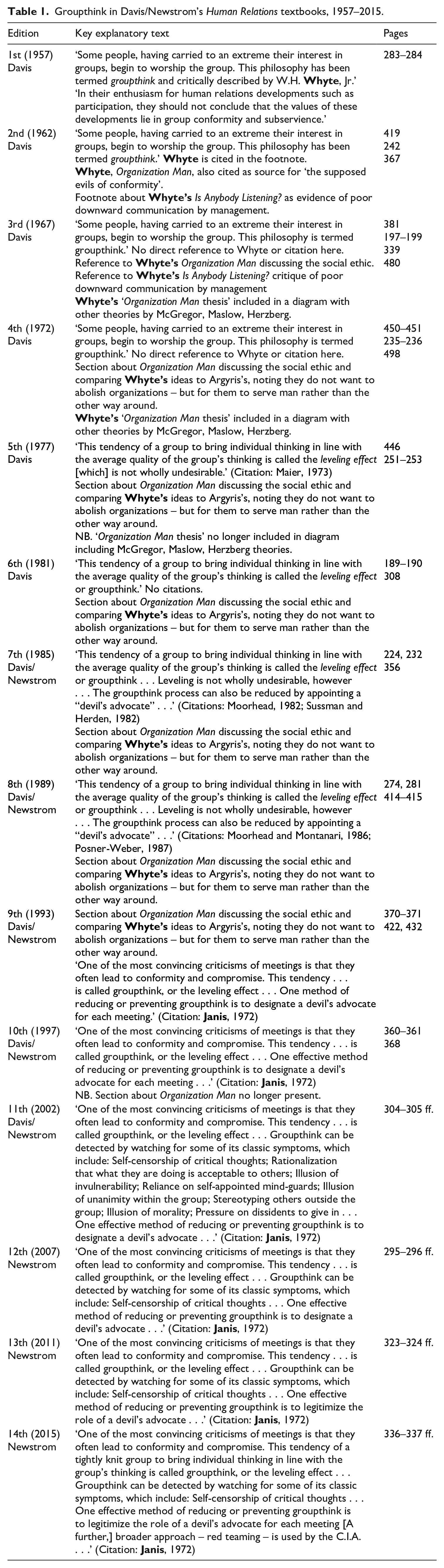
Keith Davis was active in the Academy of Management in the late 1950s, eventually becoming its President in 1964. His textbook Human Relations in Business was published on the cusp of a boom in management education, as the number of business schools and students grew exponentially. Table 1 shows the shifting treatment of groupthink through 14 editions of Human Relations in Business, recording the gradual obscuring of Whyte’s role as the creator of groupthink as Janis takes on that mantle. Figure 1 provides a simplified overview of key moments in the evolution of the groupthink concept that can be read alongside Table 1.
Groupthink in Davis/Newstrom’s Human Relations textbooks, 1957–2015.
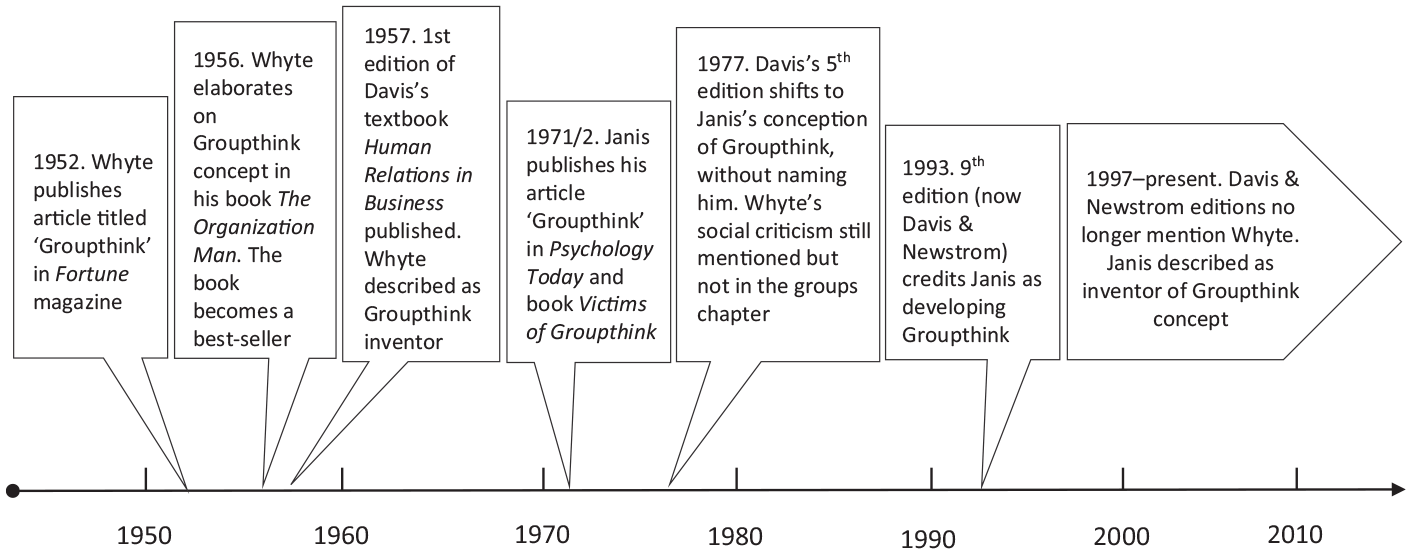
Key moments in the evolution of the groupthink concept as seen in multiple editions of Davis and Newstrom’s textbook.
In the first edition (1957), Davis credits Whyte as the originator of groupthink. It is also clear that Davis agrees with Whyte’s critique of both the practice of management and the development of Human Relations as a subject. Like Whyte, Davis laments the worship of groups in business. Committees were being used for no good reason and committee members were ‘spending all their time trying to fit into the group instead of thoughtfully considering the problem at hand, which they should be doing’ (1957: 284). Davis, like Whyte, regrets the reduced emphasis on the individual as the key unit of organization: ‘[Individuals] are the creators of the group – it is not their creator. And they share responsibility for it.’ Davis (1957: 284) concludes with a warning for those in business: ‘in their enthusiasm for human relations developments such as participation, they should not conclude that the values of these developments lie in group conformity and subservience’.
The second edition (1962) incorporates more of Whyte’s social criticism. Davis (1962: 242) cites The Organization Man in a footnote about ‘the supposed evils of conformity as it has developed within formal organizations’ and in another footnote he cites Whyte’s critique in Is Anybody Listening? of expensive and ineffective ‘downward’ communication from managers to workers. Whyte is still cited as the inventor of groupthink but is now relegated to the footnotes. Davis remains critical of the excessive use of groups in business and the undervaluing of individuality but gone is the warning about Human Relations and its enthusiasm for conformity. Also noteworthy is that ‘businessmen’ (1957: 284) is replaced with ‘managers’ and ‘business’ becomes ‘management’ (1962: 419); signs of the boundaries of management as a subject becoming clearer.
In the third edition (1967), Whyte’s social criticism is given greater prominence. Coverage of The Organization Man, including Whyte’s notion of the ‘social ethic’ is integrated into the main text, as is the previously footnoted reference to Is Anybody Listening? There is also a new section comparing Whyte’s ideas in The Organization Man with those of Chris Argyris’s Personality and Organization (1957). Both, says Davis (1967: 199), ‘simply want the organization to serve man, rather than the other way around’. Whyte also features in a graph comparing key features of various management theorists, including McGregor, Maslow and Herzberg. The section on groupthink remains unchanged.
The year 1972 saw the publication of Janis’s Victims of Groupthink, as well as the fourth edition of Davis’s textbook. The reference to Is Anybody Listening? is dropped, though all material from The Organization Man is retained. The groupthink section is almost entirely unchanged, with one notable difference: Whyte is not cited in either the main text or footnotes.
The fifth edition (1977) gives considerably less attention to Whyte. The ‘social ethic’ and the comparison to Argyris remains, but Whyte is no longer included in the graph of theorists alongside McGregor, Maslow and Herzberg. A major shift is the removal of the groupthink terminology. Davis (1977: 446) opts instead for the ‘leveling effect’, defined as ‘the tendency of a group to bring individual thinking in line with the average quality of the group’s thinking’ and credited to Maier (1973). This had appeared alongside groupthink in earlier editions but now takes sole billing. Davis (1977: 446) retains his concern about a potential loss of individuality in groups, but he is much less forthright, noting that ‘leveling is not wholly undesirable. It serves to temper unreasonable ideas and to curb the autocrat.’
The discussion of the levelling effect is truncated in the sixth edition (1981). The definition remains the same, but groupthink is added as a synonym. This is significant, because the levelling effect is far closer to Janis’s conception of groupthink than Whyte’s, although Davis does not credit Janis for it. Alongside is a new figure outlining ‘Guidelines for effective groups’, an indication of a shift towards a managerial perspective that sees the reader envisaged as a future manager.
For the seventh edition (1985), Davis is joined by Newstrom. The groupthink material includes a statement that ‘the groupthink process can also be reduced by appointing a “devil’s advocate” for each meeting’ (1985: 224). This is a term that Janis uses, but he is not acknowledged as the source. Citations to three publications are added, including Moorhead (1982). This is another indirect engagement with Janis, as Moorhead’s article ‘reviews the major tenets of the groupthink hypothesis of Irving Janis’ (1982: 429).
The eighth edition (1989) repeats the material of the seventh but updates the references to include Moorhead and Montanari (1986) and Posner-Weber (1987), both of which are based on Janis’s groupthink. This reluctance to credit Janis directly in the seventh and eighth editions is puzzling – perhaps Davis is wary because he knows Whyte had coined it.
In the ninth edition (1993), Davis and Newstrom do cite Janis directly in a new section ‘Groupthink’. It is a phenomenon that ‘can be detected by watching for some of its symptoms’ (1993: 422) and can be resolved by applying remedies. In another part of the book there is a discussion of Whyte’s ‘social ethic’ but it is not mentioned that this is Whyte’s synonym for groupthink. This bifurcation continues today in textbooks that incorporate critical management perspectives, such as Clegg et al. (2019) and King and Lawley (2019). Both note Whyte’s concerns about organizations stifling creativity and attribute this to The Organization Man, with groupthink mentioned separately in chapters on ‘Managing groups and teams’ and attributed to Janis.
Whyte disappears completely from the 10th edition (1997), which retains the same section on groupthink from the ninth. The only change in the 11th edition (2002) is a list, in bullet-point form, of all eight of Janis’s symptoms. The 12th edition (2007) is the first sole authored by Newstrom. This and the 13th edition (2011) repeat the same material from the 11th. The only change for the 14th edition (2015) is a discussion of how the CIA combat groupthink.
The Davis/Newstrom textbook is unique in Management for spanning the entire period from Whyte’s coining of groupthink in the 1950s to the present. It was not the only case we found, however, of Whyte’s contribution being forgotten and replaced by Janis’s. The same pattern is followed in Leavitt’s textbook Managerial Psychology, published in five editions published over a 30-year period from 1958. Leavitt and Pondy’s Readings in Managerial Psychology (1964) also makes the transition. We began our article with a quote from Cartwright and Lippitt in the book’s first edition (1964), which credited Whyte for immortalizing groupthink. In the third edition (Leavitt et al., 1980), Cartwright and Lippitt’s chapter is gone. In its place is a reprint of Janis’s 1971 article from Psychology Today.
We have shown, then, how groupthink’s ‘immortalizer’, and his criticism about American society and business’s obsession with group dynamics, was forgotten in management textbooks, replaced in our historical consciousness by Irving Janis. But why did it happen? Below, we outline four possible reasons.
Whyte’s career trajectory
The stir caused by The Organization Man added to the foment growing against America’s corporatization when it was published in 1956, but a restless Whyte was ready to move on to other topics. He started writing about city planning and business while at Fortune and commissioned Jane Jacobs to write articles that were a precursor to her classic book, The Death and Life of Great American Cities (1961). In 1959, disappointed not to have been appointed Fortune’s managing editor, Whyte left to focus on urban planning issues, especially as they related to conservation (Birch, 1986; Nocera, 2002). He spent the next 40 years until his death in 1999 observing and improving America’s landscape and cities. While Janis’s groupthink was catching alight in 1972 Whyte was in New York, sitting in plazas and watching pedestrians, pining for big trees and accessible water features (Whyte, 1972). Despite the career shift, his dislike for organizations that sought predictability and consensus remained. Whyte observed that people in plazas preferred to be able to move their chairs, making their own decisions on where to sit (Popper and Popper, 2006). His transformative redesign of the formerly run-down and crime-ridden park, Bryant Park in New York included this free-seating arrangement (Wiley-Schwartz, 2006).
Not much is known about whether Whyte cared about Janis getting the credit for coining groupthink, since he did not keep personal diaries and remained mostly silent on his earlier writing. In a rare statement on his 1950s work, Whyte (1986) accepted that employees were now less inclined to be loyal to one organization but believed allegiance to the system and conformity to the group remained as strong as ever. When he died in 1999 obituaries mentioned The Organization Man, but none mentioned groupthink.
A managerialist perspective of Human Relations prevails
As Whyte’s interest in groupthink waned, Human Relations evolved in a way that obscured Whyte’s work. Koontz (1961) compared management theory to a jungle and argued that the field was in desperate need of clearer definition. Since management was a practical activity, Koontz (1961: 186) proposed that it be ‘defined in the light of the able and discerning practitioners’ frame of reference’. By the 1970s, the debate that had energized the nascent field in the 1950s had been won by advocates of this technical, managerialist vision.
This shift from a contested field of study to one characterized by an apparent consensus can be seen in successive editions of Wren’s The Evolution of Management Thought, Management’s seminal history text. In the first edition (1972), Wren devotes an entire chapter to criticisms of Mayo’s experiments at Hawthorne, dealing extensively with Knowles’s (1958) claims against the ‘Mayoists’, which mirrored those of Whyte, Drucker and Baritz discussed earlier. Wren discusses McMurray’s (1958) article in Harvard Business Review on how innovation is stifled by group pressures. He details McNair’s (1957) ‘indictment of the human relations approach’ (Wren, 1972: 378) for treating people like children, suppressing individual responsibility and creating conformity to the group. Wren (1972: 378) notes that ‘William H. Whyte has also decried the exaltation of the group to the detriment of the individual’ and outlines his conception of the social ethic from The Organization Man. Wren (1972: 381) concludes that ‘today, the apogee of the movement has passed as the very research it stimulated is bringing fresh insights into human behavior’.
Wren’s second edition (1979) contains the same material as the first edition, but there is a significant shift in the third edition (1987). The title of the chapter changes from ‘Social man and the critics’ to ‘Human relations in concept and practice’. Knowles’s (1958) and McNair’s (1957) critique are given less coverage, as the emphasis shifts to ‘extending and applying human relations’ (Wren, 1987: 313). Absent from this edition and all subsequent ones are McMurray’s and Whyte’s concerns about the dangers of conformity in groups.
Janis’s seeding of an ongoing research programme
Janis’s groupthink arrived at a time when the recommendations of two important studies on the future of management research and education, prompted by mass expansion in US business education and the perceived threat to academic standards, were still fresh. A report from the Carnegie Foundation argued that to be taken seriously business schools needed to develop a systematic body of knowledge (Pierson, 1959). Likewise, a report from The Ford Foundation identified the need for high quality scientific research (Gordon and Howell, 1959).
Janis (1972: 202) regarded his eight symptoms of groupthink as hypotheses to be tested: ‘The evidence needed . . . must ultimately come from field experiments and other systematic investigations specifically designed to pin down causal sequences, rather than from historical case studies.’ Janis’s groupthink was timely, providing Management a testable scientific concept at a time when there were few to be found. In contrast, Whyte’s view was more acerbic. It offered knowledge, but no useful scientific research agenda, at least for those saw groups as desirable.
Nearly 40 years on, we are still waiting for scientific validation of Janis’s concept. There is not a single credible, influential study showing a positive relationship with all of Janis’s symptoms, despite numerous attempts. Overall, studies have provided limited support (Aldag and Fuller, 1993; Park, 1990; Turner et al., 1992) and Janis’s influence on group research is waning (Whyte, 2015). While some textbooks register unease about groupthink’s validity (Bowditch et al., 2008; Brooks, 1999; Johns, 1996; Moorhead and Griffin, 1992), or provide a less specific acknowledgement of ‘some controversy’ (Knights and Willmott, 2017: 394), most are happy to look past the lack of empirical support for Janis’s concept.
Janis is a better fit with the modern management textbook
Many of the best-known textbooks of today were first published in the late 1970s and early 1980s (e.g. Baron, 1983; Robbins, 1979; Wheelen and Hunger, 1983). By this time, the managerialist perspective that Koontz had promoted had become dominant. James Stoner, author of the world’s best-selling management textbook at the start of the 1980s, wanted not just to write about management, but to write for management: ‘In this text I have chosen to address the reader as a potential manager . . . I want to encourage the reader to start thinking like a manager as soon as possible’ (Stoner, 1982: xv).
Textbooks were divided into sub-topics such as motivation, group dynamics, leadership and culture. Having adopted this managerial perspective, authors sought content that could be applied by students ‘stepping into the shoes’ of managers to solve problems in organizations. While Janis, like Whyte, warns against conformity and encourages valuing the individual, his framework of eight symptoms provides a practical means of identifying and managing groupthink. The examples used to illustrate the dangers of groupthink have changed over time, 2 but the lesson remains the same. While groupthink is something for managers to watch out for, the overriding message is that groups and teams are vital for decision making, and that it is the role of the manager to correct their course using the kind of remedial tools Janis prescribes.
Why recovering Whyte as a founder of groupthink matters
Inspired by The Use and Abuse of History for Life by Friedrich Nietzsche, our counter-history of groupthink has promoted a forgotten monumental figure: William H Whyte. It has sought to convey a greater antiquarian understanding of the context in which Whyte wrote, a time where mainstream management writing was engaged in thinking critically about management and corporations’ role within, and impact on, wider social and psychological developments. And it has enabled us to think critically about why Whyte was ignored by researchers and forgotten by educators and how Irving Janis came to be established as the founder of groupthink.
Nietzsche (1874) wrote that recognizing the futility and detrimental effects of the belief in objective history, like the understanding of groupthink that we have sought to counter, came with benefits. He outlined how we could live better knowing that history was a malleable tool that we could use to build and develop identity, rather than meekly accept other authorities’ imposed historical narratives. In the words of a philosopher who sought to continue Nietzsche’s work in this regard, Michel Foucault (1985: 9), the purpose of a counter-history was not just to look again at how the past has been interpreted, but ‘to free thought from what it silently thinks [in the present] and enable it to think differently [for the future]’. In this section, we outline what the consequences for research and teaching of management could, and should, be for recovering William H Whyte as the founder of groupthink.
An alternative research platform for developing concepts about groups
Whyte’s contribution to Management faded because Whyte moved on from writing about groupthink, because Janis’s conception was a better fit with a managerial perspective that took a positive view of the potential of groups and because it provided a research platform for mainstream researchers. But if we were to remember Whyte’s groupthink, what alternative research platform might his thinking provide?
As we have seen, Janis provided significant impetus for group research, which peaked in the 1990s. This is not easy research to conduct in a modern academic context: groups are more difficult units of analysis to study than individuals (about whom primary data may be collected through surveys), or firms (about which there are many sources of secondary data that can be analysed). Both of these units lend themselves well to quantitative and comparative research of the kind that can often be turned into publications more efficiently than research into groups.
One of the few (perhaps the only) current business or psychology scholars who was working when Whyte was writing about groupthink is Edgar Schein. As Schein noted when we interviewed him, while academics now seem to be stepping away from group research, large corporations are increasingly willing to provide the investment required. An example is Google’s re:Work platform and their Project Aristotle’s focus on understanding effective group dynamics (Schein, 2019, personal communication). 3 A key shift is that Google can do their research by monitoring and measuring their own employees in ways that are difficult for university researchers to replicate (logistically and ethically). Google start with the assumption that groups are good and seek to discover what managers can do to help them achieve their potential. Their bias is indicated in the name, Project Aristotle: ‘a tribute to Aristotle’s quote, “the whole is greater than the sum of its parts”’. 4
Whyte’s monument and his context’s antiquarian legacy could be to inspire us to look at aspects that Janis’s research platform, and the likes of Google’s research in the present, is not concerned with. Whyte provides another conceptual foundation for exploring the ‘dark side’ of groups, supplementing the Weberian iron cage of concertive control in self-managing teams (Barker, 1993) and labour process and poststructuralist theorizations of team discipline through surveillance and power/knowledge processes (Sewell, 1998; Sinclair, 1992). New communication technologies that are enabling organizations to manage through the COVID-19 pandemic, such as Microsoft Teams, have extended managerial control beyond traditional temporal and spatial boundaries of organizations. This ‘extensification’ of managerial work (Hassard and Morris, 2021) is ripe for further research from the perspective of Whyte’s groupthink.
In addition to inspiring new research, recovering an understanding of Whyte’s context can also encourage us to pitch our research in different ways. Like others at the time, Whyte wrote for a mass audience – Fortune magazine – not for a niche audience of scholars in prestigious journals obscured behind publisher paywalls. There is scope, we believe, for scholars from multiple disciplines to learn from his ability to write on issues of broad cultural and social concern in ways that are relatable to a mass audience.
Thinking differently about what we teach about groups
Research associated with the ‘historic turn’ is growing, but there is also greater recognition of the value of historical thinking in teaching (Madansky, 2017; Tennent et al., 2020). Nietzsche’s challenge to the conventional view of history as an objective account of what happened in the past creates the possibility of a more critical and creative management education. Such an approach is consistent with the traditional aim of universities to cultivate intellectual freedom: to expose learners to a wide range of perspectives that can help generate different ways of understanding the world, and to think critically about the strengths and limitations of all perspectives.
For management researchers, there are nowadays a plethora of journals open to both mainstream and critical perspectives. This journal, for example, is far more representative of the diversity of perspectives than it was 70 years ago. But can the same be said for management textbooks? While it would be reassuring to believe that as academic fields mature, textbooks get better at this, the case of groupthink suggests the opposite. The early editions of Davis’s Human Relations in Business provide an insight into the contest of ideas about groups and the development of Human Relations. They incorporate commentary about the role of management and business in society that later editions do not. These later editions adopt a managerial lens, with concepts presented as ‘tools’ that managers can utilize to solve problems and improve organizational performance. We have argued that this, in part, explains why Janis replaced Whyte as the founder of groupthink.
If management textbooks were to attribute groupthink to Whyte, what difference would it make? Starting with Whyte rather than Janis would enable students to reflect critically on the desirability of group working. Groups may offer the potential for employees to satisfy social needs and to pool expertise; but they can also foster conformity and discourage individuality and critical thinking. Dealing with topics such as groups in an open way, rather than with ideological blinkers on, would provide a better management education for students. Additionally, taking a critical, historical perspective like we have deployed in this article, incorporating both Whyte and Janis and showing how Whyte came to be forgotten and eventually remembered, would provide a valuable insight into how management as a field of study has developed. It might also create spaces for alternative ways of thinking and teaching about management, and ultimately, about practising management, to take hold.
Conclusion
Our contribution has been to extend the literature on ‘uses of the past’ and ‘new histories of management’ through a case study of how the subject of management uses (and abuses) history. Specifically, we have applied an approach often alluded to but never employed in either of these areas – Nietzsche’s three relationships to history and his critique of objectivist history as outlined in his essay The Use and Abuse of History for Life. We have placed an alternative founder of the concept of groupthink, William H Whyte, in his broader historical context, thought critically about why his ‘monument’ declined and outlined how recovering an understanding of Whyte’s conception of groupthink can inspire us. Recognizing Whyte as the founder of groupthink is timely, since the risks of group working for diversity, innovation and creativity are as relevant for organizations today as they were in the 1950s. Our inquiry has been limited to the field of management. Groupthink is researched and taught in other disciplines, particularly psychology, and there is potential for future research into how it is represented there.
Beyond re-investigating and thinking differently about the past and future of groupthink, we hope the research presented here encourages two further developments. The first relates to our effort to show how two nascent approaches that have contributed to the historical turn in the social sciences have a shared history that leads back to Nietzsche, and that his approach can be effectively employed by both. This could be a useful step towards more communication between ‘uses of the past’ and ‘new history’ scholars: the former comprising historians looking to add to our understanding of management and organization; the latter management scholars applying a historical lens to think critically about their field.
Second, we hope our research encourages others to look further into the reasons behind Management’s narrow, often homogenous, and status quo-affirming history. The forgetting of Whyte’s groupthink is just one example of how ideas can be obscured by histories that are unthinkingly accepted by scholars in management. For example, even though many of the early techniques that were gathered into what came to be known as Scientific Management were clearly developed on American slave plantations, we see little trace of this in management history and no trace in management textbooks (Cooke, 2003; Rosenthal, 2018). Why has the pioneering work of Mary Parker Follett been misplaced (Bednarek et al., 2020)? Why have the deep flaws in Elton Mayo’s work never unsettled his position as a Management pioneer (Hassard, 2012)? And why are there so few African American or Latino faces in histories of management (Prieto and Phipps, 2019; Wanderley et al., 2021)? Whyte is the tip of an iceberg. There is much more work to be done uncovering the uses and abuses of history in Management and how they limit future horizons.
Footnotes
Funding
The authors received no financial support for the research, authorship and/or publication of this article.
Notes
 . [Email: