



Abstract
Through a dynamic analysis of the interplay between structure and agency, this article explores the factors shaping an inclusive approach to labour market activation for clients who experience multiple barriers to work. While previous studies argue that ‘street-level bureaucrats’ (SLBs), such as advisers and job coaches, have minimal agency to shape the services they deliver, the pilot programme that is the focus of this article allowed SLBs greater discretion to support clients and to use their entrepreneurial skills to build relationships with local employers. However, the unresolved tension between personalisation and swift labour market insertion meant that SLBs often reverted to engrained employability interventions that simply prepare clients to compete for low-wage entry-level jobs. We argue that the ‘policy closure’ around a work-first model of activation in the UK constrains social innovation among SLBs, and limits the freedoms of citizens to navigate their own transitions into paid work.
Keywords
Introduction
Active labour market programmes, as distinct from passive welfare payments, aim to incentivise job search activity among claimants while also improving their employability through basic training and soft skills interventions. There is a well-established body of literature charting the ‘activation turn’ in macroeconomic policy since the 1990s and the increasingly punitive nature of welfare to work across Europe (e.g. Scholz and Ingold, 2021; Seikel and Spannagel, 2018; Wright et al., 2020), but recent research has also drawn our attention to the micro-level implementation of activation and the tensions and ambiguities faced by front-line professionals (e.g. Rice, 2013; Schulte et al., 2018; Zacka, 2017). This literature highlights the critical role of street-level bureaucrats (SLBs) operating at the interface between government policy, changing social structures and the realities of the labour market (Fuertes and Lindsay, 2016; Scholz and Ingold, 2021).
While SLBs are sometimes seen as powerful actors that apply their own personal values and standards to casework, they are also potentially constrained by a range of operational and bureaucratic pressures that channel them into particular ways of acting and thinking (Brodkin, 2011; Lipsky, 1980). A number of studies also suggest that the pressure to contain costs and hit performance targets under New Public Management (NPM) modes of governance leads to low-cost and standardised services, and reduces the opportunities for SLBs to exercise discretion in their interactions with clients (Fuertes and Lindsay, 2016; Greer et al., 2018). Within coercive workfare regimes, such as the UK, SLBs act on behalf of the state to discipline clients by imposing sanctions that remove their choice to refuse bad jobs (Koch, 2021; Rafferty and Wiggan, 2011; Wright et al., 2020).
This calls for a closer analysis of the situated agency of activation SLBs – namely, how the changing organisational and systemic context of activation shapes their individual interactions with clients and employers (Fuertes and Lindsay, 2016; Rice, 2013). In order to explore these issues, we undertook a qualitative analysis of a newly established, and largely non-mandatory, approach to activation in a post-industrial region of England. The analysis draws on 40 interviews conducted over a 30-month period with SLBs (key workers and employer partnership coordinators (EPCs)), as well as programme managers and local employers.
Applying a multi-level institutional framework to our data that spans the individual, organisational and systemic levels of activation, this article makes three substantive contributions. The first is to build on a growing international literature that explores the localised personalisation of client support within activation programmes, and the increasing focus on demand stimulation as a way to improve outcomes for the most marginalised groups (Fletcher, 2004; Ingold and Stuart, 2015; Lindsay and Dutton, 2013; Schulte et al., 2018). By exploring a localised effort to move away from the low-cost and undifferentiated interventions associated with coercive activation at national level, our original case study analysis captures the impact of changing policy priorities on front-line SLBs, while also recognising barriers to the operationalisation of a more socially inclusive approach.
The second contribution is to extend the taxonomy, and understanding, of front-line professional roles within activation programmes (e.g. Ingold, 2018; Jordan, 2018; Koch, 2021; Wright et al., 2020). By exploring the work routines of key workers and EPCs, we are able to identify the multiple, and often conflicting, roles that SLBs are expected to fulfil. Our findings show that while individual SLBs draw on familiar employability interventions as a way to reduce ambiguity and give meaning to their new roles, there remain a number of unresolved tensions between the needs of clients for personalised support, the needs of SLBs (and their managers) to hit performance targets and the ongoing needs of employers for high volumes of suitable candidates for low-wage jobs.
The third related contribution is to further elaborate the dynamic interplay between structure and agency in the implementation of public policy (Brodkin, 2013; Crouch and Farrell, 2004; Rice, 2013; Zacka, 2017). Our case study shows that the interactions between SLBs and clients are influenced not only by individual dispositions and organisational contingencies (Greer et al., 2018; Kaufman, 2020), but also by systemic factors such as the quality of entry-level jobs, the generosity of welfare and wider labour market policies that either decommodify or recommodify work (Rubery et al., 2018). Drawing on the public policy concept of bounded innovation (Weir, 1992), we argue that the engrained work-first approach of UK activation can be understood as a product of the singular problematisation of unemployment as an individual supply-side deficit, combined with a legacy of failed experiments with decentralisation, personalisation and demand stimulation (Fletcher, 2004; Ingold, 2020). This ‘policy closure’ (Fuertes and Lindsay, 2016: 538) significantly hinders the meaningful consideration – at all levels – of more socially inclusive alternatives such as subsidised job rotation schemes, localised investment in lifelong learning and enhanced social protection.
The next section reviews street-level perspectives on professional work, introducing the multi-level institutional framework that situates the individual interactions between activation SLBs and clients within a wider organisational, systemic and historical context. The research design and methods are then described, as well as the specifics of the local pilot programme that forms the empirical basis of this article, followed by a presentation and discussion of the findings.
Professional work at street level
The concept of street-level bureaucracy has been applied to various studies of the everyday interactions between citizens and SLBs such as police officers, housing and welfare advisers, and social workers. SLBs are defined as those that ‘interact directly with citizens in the course of their jobs, and who have substantial discretion in the execution of their work’ (Lipsky, 1980: 3). Operating at the front-line, SLBs mediate between institutions and citizens, translating policy into practice. Moreover, by exercising their discretion, they are effectively policy makers in an environment that they do not control (e.g. Brodkin, 2011; Lipsky, 1980; Van Berkel, 2020). Discretion is generally seen to manifest itself in the way in which SLBs interpret and apply formal rules, and decide which clients to help and how. Within the street-level literature, discretion was initially viewed as a mechanism by which SLBs coped with bureaucratic and resource demands – what Brodkin (2011) refers to as routinized discretion. For example, Lipsky (1980) observed how SLBs covertly built slack time into their work routines in order to create capacity to deal with unexpected or unpredictable situations. SLBs may also control the information that clients receive in order to reduce demand, while simultaneously cherry picking easier clients from waiting lists and passing on those with more complex needs to colleagues or other agencies (Brodkin, 2013).
Beyond a simple coping mechanism, such work routines are increasingly seen to shape how SLBs understand and legitimise their roles and behaviours, and how they interpret and understand the motivations of their clients; what Kaufman (2020) refers to as street level dispositions. These dispositions can have a significant bearing on the degree of personalisation and inclusivity of public services that citizens receive. A number of studies have analysed how SLBs selectively invoke discretion in line with professional values and personal judgements. For example, SLBs may go the extra mile for clients judged to be deserving of help, while de-prioritising those with complex needs or a perceived lack of motivation (Jordan, 2018). In this way, SLBs can act as moral agents who selectively use their discretion to support and shield clients from adverse outcomes (Zacka, 2017), or as gatekeepers who actively control citizens’ access to scarce state resources and impose sanctions for non-compliance (Koch, 2021; Rafferty and Wiggan, 2011; Wright et al., 2020).
Given the significant expansion of the global workfare project (Brodkin, 2011), increasing attention has also been paid to the way systemic factors may limit discretion and create new role tensions for SLBs within activation programmes. In contrast with front-line emergency service occupations that are tightly delineated by formal qualifications and systems of professional accreditation, activation programmes are often home to a heterogeneous mix of SLBs such as social workers, case workers, welfare advisers, job coaches and employer engagement officers (Ingold, 2018). These front-line workers span the organisational boundaries of job centres, Public Employment Services (PES), local authorities and an increasingly fragmented patchwork of private, not-for-profit and charitable organisations (e.g. Greer et al., 2017). The literature suggests that a lack of professional and institutional power means that activation SLBs are typically only able to exercise weak or routinised discretion such as deciding the order in which clients are seen and choosing from a limited suite of employability interventions (Brodkin, 2013).
Activation SLBs are exposed to multiple role tensions resulting from ambiguous and sometimes contradictory policy goals. In a workfare context such as the US and UK where social protection is closely linked with labour market participation, SLBs such as personal advisers and job coaches are expected to support clients while also imposing sanctions for non-compliance (Rafferty and Wiggan, 2011). The upwards referral of sanctions to an unseen ‘decision maker’ partly distances SLBs from unfavourable outcomes, but does little to foster trust and cooperation in their ongoing relationships with clients (Wright et al., 2020). Where there is a gap between the goals and values of individual SLBs, and those of higher-level policy makers a process of policy alienation may ensue, resulting in feelings of powerlessness and meaninglessness among SLBs, which in turn can provoke both individual and collective resistance (Tucker et al., 2021). Thus, the street-level interactions between SLBs and clients are not simply the product of idiosyncratic dispositions and cognitive schema, but rather they are shaped by a wide range of often competing goals and contextual forces.
The organisational and systemic context of activation
We now explore the complex and dynamic relationship between structure and agency by applying a micro-institutionalist framework to front-line activation work (Figure 1). This framework helps not only to make sense of the ambiguities and role tensions faced by SLBs in terms of balancing support and sanctions, but also to reveal how organisational and systemic factors legitimise certain actions while prohibiting others (Fuertes and Lindsay, 2016; Rice, 2013). We apply this multi-level institutional framework to UK activation, and explore the effect this has on the work routines and role orientations of SLBs.
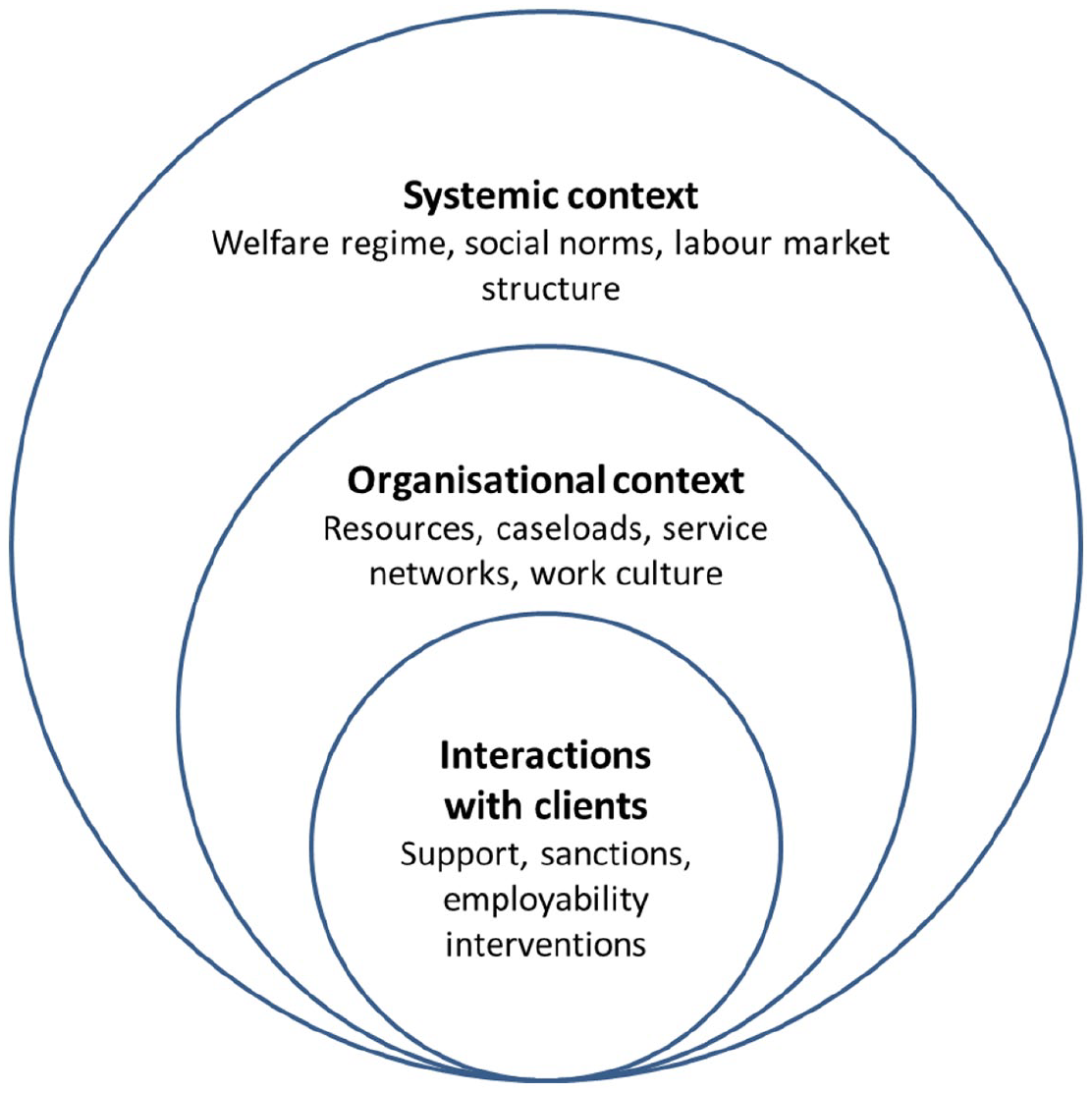
The multi-level context of activation casework undertaken by SLBs.
The organisational context – in particular the availability of resources and service networks – has a strong influence on the everyday interactions between SLBs and clients. For example, per capita expenditure on activation programmes is relatively low in the USA and UK when compared with many European countries, which constrains the range and quality of interventions offered to clients, as well as the time available to build inclusive and supportive relationships (Daguerre, 2004). In this context, there is the practical problem of how SLBs with high caseloads can act as social or moral agents (Zacka, 2017) when dealing with a ‘constant stream of problem-bearing, demoralised customers’ (Jordan, 2018: 71). Even where individual SLBs may be positively predisposed towards understanding and supporting clients, without the concomitant resources to act, SLBs may seek to delegitimise client needs by reframing deep social issues as a simple lack of motivation (Brodkin, 2011; Jordan, 2018).
An increasing feature of the organisational context of activation across Organisation for Economic Co-operation and Development (OECD) countries is the use of private contractors to deliver supply-side interventions typically under a payment by results (PBR) framework. PBR theoretically incentivises providers to focus on achieving job outcomes rather than prescribing in detail what interventions should be delivered, sometimes known as a black box approach (Jordan, 2018). However, PBR can also lead to ‘creaming and parking’, which means fast-tracking job ready candidates into employment and placing those with more complex needs into a holding pattern of attending low-cost basic skills courses (Carter and Whitworth, 2015; Greer et al., 2018). From this perspective, SLB discretion largely reflects a calculative logic about which clients will generate the quickest financial return as a result of being moved into work (Brodkin, 2011). A standard menu of interventions and the strict scheduling of appointments (often using centralised IT systems) limits the individual interactions between SLBs and clients, and exerts significant control over the labour process of caseworkers (Fuertes and Lindsay, 2016).
The systemic context of activation normally reflects top–down policy goals and the wider economic and labour market structure within a particular country. Within the UK’s liberal welfare regime, citizens are defined primarily by their contribution to the labour market, and activation programmes tend to focus on supply-side deficiencies and the pathology of workless individuals rather than structural inequalities in labour markets (Jordan, 2018). The UK’s work-first approach, that originated in the USA, assumes job seekers gain valuable skills and experience in the workplace and quickly become more financially self-reliant (Daguerre, 2004). However, there is a tension between this work-first approach and the rhetorical commitment to personalisation as it reduces the time that clients are engaged with activation programmes and incentivises contractors to select low-cost standardised interventions such as CV writing workshops and interview preparation aimed at improving soft skills and employability (Fuertes and Lindsay, 2016; Greer et al., 2018).
Nevertheless, employer engagement is an increasingly important dimension to activation programmes, and even within coercive workfare regimes SLBs provide an important brokerage role by matching pre-screened clients to local job opportunities (Ingold, 2018). SLBs can appeal to employers as ‘clients’ by providing a full-service labour market intermediary role, or as ‘co-producers’ in the development of inclusive and sustainable pathways into work for vulnerable clients (Van Der Aa and Van Berkel, 2014). While the former requires SLBs to use their entrepreneurial skills to generate leads into local businesses – what Schulte et al. (2018: 334) call ‘prospecting’ – the latter requires SLBs to work more closely with employers to make their recruitment processes more inclusive (Ingold and Stuart, 2015; Salognon, 2007).
Overcoming policy closure?
The multi-level framework set out in Figure 1 provides much needed nuance to the understanding of the dynamic relationship between structure and agency by recognising ‘that although institutions do influence action, they do not fully determine it’ (Rice, 2013: 1042). We seek to connect this micro-institutionalist approach to Lipsky’s (1980) grounded analysis of street-level work routines by exploring how SLBs navigate an increasingly fluid and ambiguous organisational and systemic context. While some argue that standardised practice among SLBs is driven ‘almost entirely from the top down’ (Fuertes and Lindsay, 2016: 540), recent studies have called for a closer analysis of how changes in public policy, performance frameworks and the labour market can create (albeit limited) spaces for bottom–up innovation and experimentation (Brodkin, 2013; Kaufman, 2020).
For example, the separation of the delivery of employability support from the administration of welfare sanctions can create opportunities for SLBs to build stronger interpersonal relationships with clients (Salognon, 2007; Schulte et al., 2018). In addition, demand stimulation strategies can achieve sustainable employment for out of work clients over and above a simple work-first approach enforced through welfare conditionality. This may include job subsidies that reduce the cost burden for employers of hiring or providing work experience to those that cannot immediately work full-time or at full capacity (Etherington and Jones, 2004; Fletcher, 2004; Ingold, 2020; Schulte et al., 2018). There is also evidence that more personalised and inclusive support can be achieved where local authorities, trade unions and employers are closely involved in the design and management of public and private service networks, and where qualified social workers are hired rather than generic caseworkers (Etherington and Ingold, 2012; Ingold, 2020; Rice, 2017; Schulte et al., 2018).
While there are important lessons from these more inclusive localised approaches, it is not clear that policies developed in countries that seek to achieve ‘welfare through work’ rather than ‘welfare to work’, can be easily transposed into liberal market contexts (Etherington and Ingold, 2012; Etherington and Jones, 2004). Furthermore, it cannot be assumed that SLBs will automatically welcome greater professional discretion and autonomy or whether they will revert to ‘familiar patterns of service provision’ that reflect the anchor drag of their own past experiences and expectations (Ellis, 2007: 418). National policy paradigms are also typically highly path dependent, which means the further embedded they become in public debate, the more they shape organisational practices and everyday work routines, and the harder they are to subsequently dislodge (Brodkin, 2013; Chung and Thewissen, 2011; Crouch and Farrell, 2004). Weir (1992) uses the concept of bounded innovation to show how the sunk investments in specific policy approaches can narrow the parameters of future policy innovation, making it increasingly difficult for actors to both imagine and implement alternatives approaches. Weir argues that the rejection of the full employment bill in 1946 set strict parameters around US labour market policy at federal, state and local level for the next 50 years. This process of ‘policy closure’ (Fuertes and Lindsay, 2016: 538) effectively fixes the political and public perception of unemployment as an individual moral failure, which in turn legitimises only those policy interventions that reduce welfare spending and increase incentives for individuals to move into paid work.
As mentioned earlier, the UK has historically been strongly influenced by US labour market policy and has adopted a similar work-first approach to activation. At the same time, recent policy reforms offer an opportunity to explore how these institutional regime legacies and processes of policy closure shape street-level innovation (Fuertes and Lindsay, 2016). In 2017, the UK Work Programme (the government’s flagship activation policy) was rebranded the Work and Health Programme, with a rhetorically stronger focus on employer engagement, and locally designed and personalised support for the long-term unemployed and those with disabilities. However, previous policy experiments with personalised support and decentralised programme design in the UK produced mixed results. The ‘New Deal’ programme (adopted by the Labour government of 1998–2010) gave clients greater support and choice, and the City Strategy Pathfinder was an attempt to stimulate demand among local employers (Ingold, 2020). However, the government’s reluctance to move away from centralised performance management, coupled with employers’ preferences for job ready candidates (over internal training and development) curtailed the development of flexible and client-oriented service provision through community networks (Fletcher, 2004; Ingold, 2020). The efforts to create holistic ‘caseworker’ roles also created new ambiguities as SLBs found themselves pulled between competing professional obligations and organisational priorities (Ingold, 2018). The change of activation policy towards a more inclusive model with greater regard for both supply and demand side factors may also be counteracted by the integration of in and out of work benefits under Universal Credit (UC). Under this system, payments are tapered in line with earnings but workers are expected to take on multiple part-time jobs to achieve the equivalent of full-time hours (Koch, 2021). This means employers are under no obligation to create full-time work knowing that low paying part-time roles will either be supplemented by workers’ other jobs or by the state (Rubery et al., 2018).
Through a contextualised analysis of the work routines of front-line activation professionals, this article seeks to marry Lipsky’s (1980) grounded analysis of how SLBs cope with everyday ambiguity and conflicting role demands, with the institutionalist perspectives of Fuertes and Lindsay (2016) and Rice (2013) that emphasise the powerful influence of the organisational and systemic context. Fundamentally, it asks whether localised programmes, and the SLBs that deliver them, can successfully break out of a closed workfare policy paradigm in the UK and implement a more socially inclusive approach to activation.
Research design and methods
In order to study the changing work routines of front-line activation SLBs, we adopted an in-depth embedded qualitative case study design (Yin, 2017). Our case study was selected for its novelty, and to our knowledge is the first in-depth analysis of one of the two regions in the UK selected by government to pilot a non-mandatory approach to activation (described below). The region where the fieldwork was conducted was identified by central government as a priority area for devolved funding for activation owing to: above average levels of economic inactivity owing to sickness and disability; a high rate of unemployment (particularly for men); and a below average level of qualifications. The pilot programme ran in two phases for a total of five years (2014 to 2019) and was based on a more gradual approach to building trusting relationships between SLBs and vulnerable clients without the immediate pressure of job search activity, or the lever of welfare conditionality to incentivise labour market participation (Wright et al., 2020). Furthermore, by providing a wide range of support interventions to socially excluded clients that had been poorly served by previous coercive and undifferentiated workfare, the pilot was designed to try and overcome the recognised problem of creaming and parking (e.g. Carter and Whitworth, 2015; Greer et al., 2018).
As Edwards (2005) argues, in order to explain forms of social action, it is necessary to uncover the enabling or constraining role of social context. By exploring the work routines of SLBs such as key workers and EPCs in context, we were able to explore their changing role orientations as a result of the localised move towards a personalised and non-mandatory approach, and explore how SLBs selectively applied professional discretion. The findings from a single case study such as this, while not generalisable, are potentially paradigmatic in that their novelty reveals more general characteristics of the wider context (Flyvbjerg, 2006). The embedded case study findings are also potentially useful for other contexts where policy and practice are in flux, and actors are attempting to make sense of their changing environment (Tracy, 2019).
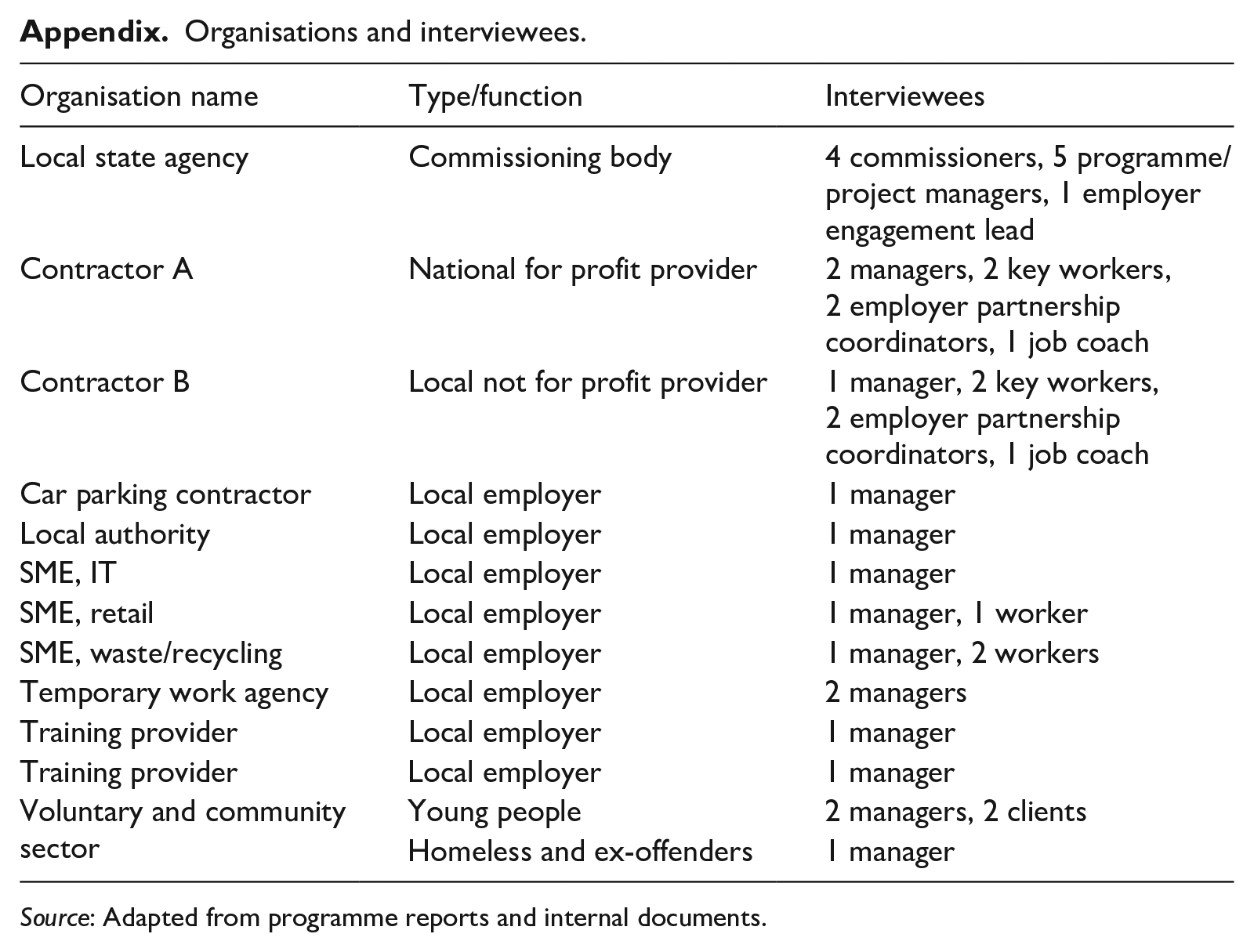
To secure research participants, we first contacted the commissioning managers of the pilot activation programme at the local level. By building trust and rapport with these managers over a number of meetings they granted approval for a qualitative analysis of the programme’s policies and practices (as opposed to a quantitative analysis of its outcomes). The aim was to focus on the distinctive design and approach of the programme and to explore how SLBs operated within the newly defined roles of key workers and EPCs. We also sought to explore employer experiences of receiving activated clients from within the programme. Over the 30 months of the research (March 2017 to September 2019) interviews were conducted with 40 key actors (see Appendix) including commissioners, managers and various SLBs (including key workers, EPCs and a small number of job coaches) working within the programme, and eight employers who had accepted activated clients from the programme. Only three client workers at these firms were interviewed owing to the potentially sensitive nature of their participation, and while the data from these interviews provided useful background information, they are not analysed below. Finally, five people were interviewed from the voluntary and community sector in order to contrast alternative approaches to activation within the local context. Although our research was not formally longitudinal, the extended period of the fieldwork and the opportunities to compare the perspectives of different actors allowed us to explore a range of intended and unintended consequences of changing policy and practice as they unfolded in-context (Gioia et al., 2013).
All interviews were semi-structured and questions differed according to type of interviewee (e.g. employer, key worker, manager). After establishing the participant’s job role and prior experience of activation programmes, interviews progressed to a more detailed discussion around the challenges arising within the programme, and more generally in respect of placing socially excluded clients into the labour market. Interviews lasted between 30 and 90 minutes, were audio recorded and transcribed. The transcripts were analysed manually across two stages. The first stage involved two researchers independently extracting basic information about how the programme operated in terms of service provision and new roles and responsibilities, and the extent to which the pilot had delivered on its aims. Discussions between the whole research team helped clarify details and establish the broad points of departure from previous programmes, as well as the emerging limitations. These interview data were supplemented by secondary data from performance reports produced by the local commissioning body, as well as participant observation in a number of key meetings and public events (some of which were high profile events aiming to attract employers to the project). This information helped to deepen and contextualise the understanding of the social phenomena and processes drawn from the thick descriptions established through interviews with knowledgeable agents (Gioia et al., 2013). During the second stage of analysis, all four researchers read and re-read the transcripts to identify common themes regarding more subjective matters around the perceived successes and shortcomings of the programme and the main challenges faced by SLBs in sustaining a socially oriented approach. We approached the thematic analysis inductively at first (Tracy, 2019) but as common patterns emerged in respect of contextual constraints on SLBs, the data were then systematically mapped onto the institutional framework in Figure 1. Further discussions helped resolve discrepancies and ensured a consistent approach, and the iterative approach helped refine and strengthen the analysis.
Research context and overview of programme
The local pilot programme differed from previous (nationally designed and commissioned) welfare to work programmes in two key ways. The first was that the programme was non-mandatory for the majority of clients. 1 At a local level, commissioners and programme managers recognised that standardised activation programmes underpinned by coercion and crude numerical targets for job search had failed to find work for those furthest from the labour market, and therefore a new more holistic approach was required that brought together a range of support services and made stronger links with employers. Although clients could be referred through the same channels that linked with mandatory activation programmes such as Job Centre Plus, there was no obligation for individual clients to join or complete the pilot. The second related difference was that by focusing on those groups that were furthest from the labour market the incentives for contractors to cream and park were theoretically reduced.
The programme was commissioned locally using a combination of central government funding and European Structural Funds (ESF) and delivered in two phases. The first phase of the programme (2014–2016) aimed to support 5000 clients; mainly those claiming legacy benefits such as Employment Support Allowance (ESA) who were out of work for two years owing to ill health, or those receiving Job Seeker’s Allowance (JSA) who had already completed the mainstream Work Programme but not found sustained work. The second phase (2016–2019) – the focus of our fieldwork – aimed to attach at least 10,000 clients including lone parents and those moving onto Universal Credit (an integrated welfare benefit for those out of work and those who are in work but on low incomes). The total spend for the second phase was just over £20m of which £15m was on client fees under a PBR framework (discussed below), which despite the focus on the most marginalised groups, on a per-client basis was similar to previous programmes. Contractors were expected to achieve job starts for 20% of ‘attachments’ and for 75% of job starts to be sustained for at least 12 months (an average of 16 hours per week for 50 out of 54 weeks). 2
After a competitive tender process, two contractors were selected to deliver the programme across all the individual local boroughs within the region; Contractor A covered 70% of boroughs and Contractor B covered 30%. Contractor A is a multinational company that specialises in training delivery and health support (often through large public sector contracts). Contractor B is a local, not-for-profit, organisation that has previously provided apprenticeships, training and development for young people and disadvantaged groups.
The two main types of SLBs working for the contractors that we focus on were key workers and EPCs. The role of key worker was specifically created for the pilot programme, though some of their tasks were comparable to those of client advisers operating in mainstream welfare to work programmes. Key workers were tasked with building rapport with clients and removing their multiple barriers to work, but were not recruited according to specific professional qualifications but rather for their previous experience on local social programmes and soft skills such as empathy and client support. Compared with key workers, the role of EPCs was more entrepreneurial than social, and focused on selling ‘job ready’ candidates to local employers. EPCs were recruited primarily for their sales and networking skills gained from mandatory activation programmes and also from the commercial recruitment industry.
Under the PBR framework, each client on the pilot programme could be worth up to £3000 to contractors, which is broadly similar to previous UK mainstream workfare programmes, £1500 of which was paid upfront as an attachment fee. The reinstatement of significant attachment fees was designed to incentivise contractors to clear the backlog of clients who had been ‘parked’ by the mainstream Work Programme (Carter and Whitworth, 2015). In addition, attachment fees were augmented by separately funded mental health provision for those with the most severe needs, which protected the income stream for contractors and encouraged SLBs to focus on the quality of interactions with clients. Fee weightings were also adjusted during the programme in order to incentivise contractors to focus on specific priorities. For example, at the start of the programme, contractors earned £1500 for a successful client attachment to the programme, £600 for a job start and £900 if a client sustained paid work for at least 12 months; a weighting of 50%–20%–30%. The weighting of fees was subsequently recalibrated to 30%–30%–40% to incentivise job starts and sustained job outcomes.
During the second phase of the programme (2016–2019), there were nearly 20,000 referrals, of which more than 12,000 were attached as clients and 3000 experienced job starts (25%), of which around 1100 (37%) sustained work for more than 12 months. Thus, while the job starts target was achieved, sustained job outcomes were well below the 75% target (the reasons for which are discussed below). Nevertheless, the programme delivered improved outcomes for the most socially excluded group of ESA clients (those with disabilities) of which 10% achieved a job start, compared with fewer than 5% of ESA clients on previous workfare programmes.
Findings
This section presents the qualitative data gathered from interviews with SLBs, managers and employers aligned with the three levels of analysis in Figure 1. First, we explore the changing work routines and role orientations of SLBs (key workers and EPCs), and consider how the new pilot programme shaped their interactions with clients, other professionals and employers. Second, we analyse the changing organisational context in terms of the main points of departure from previous coercive workfare programmes, and the limits to inclusive activation. Finally, we situate the programme within a wider systemic context by triangulating the views of programme commissioners and SLBs with the views of local employers about activated clients and the shift to a more socially inclusive approach.
The individual interactions between SLBs and clients: New roles and new tensions
Analysing the individual work routines of SLBs within the programme revealed a number of positive individual experiences of the new approach, while also identifying a number of role tensions and ambiguities that SLBs faced when dealing with deeply embedded social problems. The logic of creating the new professional roles (key workers and EPCs) was to signal a change from the traditional gatekeeper role associated with activation programmes where case workers were responsible for both supporting and sanctioning clients based on individual judgements of motivation and commitment. Furthermore, creating discrete roles with responsibility for personalised client support (key workers) and matching clients to jobs (EPCs) was intended to overcome the role tension faced by caseworkers in dealing with clients’ complex needs while also moving them quickly into work.
In terms of creating supportive relationships between key workers and clients, the fact that caseloads for key workers were typically much smaller than on previous programmes allowed for more regular and meaningful engagement. Moreover, the fact that clients could not be sanctioned by key workers was crucial to build trust and empathy, which in turn allowed key workers to design personalised support pathways (rather than standardised low-cost interventions). However, reflecting the past experience of welfare sanctions, it took time to convince clients that their participation was both voluntary and in their best interests: ‘A lot of customers feel that they have to come here, just because of the Job Centre. So sometimes that can take three or four weeks just to break that barrier down’ (Contractor B, Key Worker).
Key workers appeared to relish the opportunity to experiment with more personalised approaches to case work such as engaging in short informal meetings with clients for coffee to build rapport, and accompanying clients on bus journeys to help build confidence in social situations. At the same time, the role of key worker remained somewhat ambiguous both in terms of professional status and expertise, and in terms of the nature and duration of interactions with clients. Key workers recognised the limits of the professional support and advice they could provide to clients with multiple needs and referred them on to specific services where appropriate. However, as a way to reduce ambiguity and give legitimacy to their own role they reframed often deep-seated mental health problems and client experience of social exclusion as individual ‘barriers to work’ such as low confidence, poor social skills and a lack of recent work experience. Reverting to a more traditional caseworker role allowed key workers to respond to complex client needs with a relatively narrow range of employability interventions, and to uphold labour market insertion as the ultimate goal: We don’t make any bones about it; the programme is to help you towards work . . . you might not be ready for that today . . . but this is about the steps that you’d take to move towards that [goal]. (Contractor A, Key Worker)
At the same time, key workers were expected to provide personal support and advocacy for clients before, during and after their transition into work; referred to as creating a ‘soft landing’. Key workers actively sought to maintain relationships with working clients in order to find out if issues such as poor timekeeping were symptoms of deeper problems: ‘It’s your [the key worker’s] job to pick up that phone and speak to the client, see what’s actually going on – “Has something happened at home?” Because I think most of them forget that we’re still their key workers’ (Contractor A, Key Worker).
EPCs had a more distinct entrepreneurial role where they were primarily responsible for a two-way sales process that contributed to achieving financial performance targets. EPCs were expected to ‘sell’ suitable vacancies to the clients within the programme (based on factors such as location, working hours and the role demands) while also ‘selling’ specific clients, and the programme ethos more generally, to local businesses. Building up a network of local employers required an initial cold-calling approach (known as prospecting; see Schulte et al., 2018) whereby EPCs quickly established personal links with hiring managers (who often were not human resources (HR) specialists). For those from a commercial recruitment background this was an enjoyable part of the role: I don’t mind door knocking at all, I enjoy it; and that’s at least once a week I go for a little walk round the town centre . . . or I’ll go to the industrial estate and have a look round to see who is there, and get quite a bit that way. (Contractor A, EPC)
Through their entrepreneurial activity, EPCs established a sales network of local employers, ranging from large multinationals and public sector employers to small and medium enterprises (SMEs). However, as discussed below, employer engagement largely relied on informal relationships and the personal reputation of EPCs as opposed to formal contracts and partnerships that might provide a platform for more meaningful entrepreneurial behaviour such as collaborating with groups of employers and trade unions to develop flexible and inclusive models of recruitment and in-work support. Nevertheless, the need to achieve sustained job outcomes meant that EPCs sometimes took on an advocacy role by using client feedback and local labour market knowledge to pre-emptively filter out unscrupulous employers who would expect too much of vulnerable clients: ‘There’s no point at all working with an employer that you know is either going to slave drive them or just . . . take advantage of them’ (Contractor B, EPC).
At the same time, job starts remained important and key workers and EPCs saw their role as being to manage client expectations rather than providing value judgements about ‘good’ or ‘bad’ jobs. In some cases, this meant encouraging clients to use their transferrable skills to apply for jobs or sectors they had never considered before. For others, it meant challenging ‘unrealistic’ expectations about the kind of work on offer in the local labour market where even basic elements of working-time flexibility might not be the norm: ‘Some of the customers, they want to work in retail but they only want school hours. Well, that isn’t realistic’ (Contractor B, Manager). Again, key workers sought to reconcile the competing objectives of personalised support and labour market insertion by breaking down long-term career goals into manageable steps: . . . it’s our job to make it realistic, but to make the client aware that it’s not going to be an easy journey . . . [a client] came in [and said] ‘I want a 40 grand job in IT’ but he’s got no qualifications. Now it’s not my job . . . to say ‘No you can’t do that’ . . . but to get there we still need to go through certain steps and it is going to take time. (Contractor A, Key Worker)
Once clients had settled on ‘realistic’ job goals, EPCs would then use their brokerage skills to match clients with job opportunities, and their sales skills to encourage employers to take a chance on activated clients. In order to build and sustain sales networks, EPCs closely assessed clients for ‘job readiness’ that reflected a combination of each client’s skills and experience, as well as their perceived motivation and attitude: . . . from my perspective, [job readiness] would be whether they have recent experience [or] recently fell out of work . . . [and] whether they are saying . . . ‘I want to work’. I think this is the sign for us to say he is job ready or she is job ready because they are stating ‘I want to get back to work’. (Contractor B, EPC)
One EPC argued that a particular problem among younger clients was the difficulty that some experienced in maintaining eye contact in meetings, which both SLBs and employers tended to interpret as a sign of disinterest and poor social skills. However, this fails to recognise that neurodiversity and social exclusion might fundamentally influence how clients present themselves in a pressurised interview situation, and could give a (false) impression of disengagement or lack of enthusiasm (Scholz and Ingold, 2021). Furthermore, the lack of transparent criteria for job readiness meant that the judgements of key workers and EPCs did not always tally, which meant referring clients back for further interventions. This was not ‘parking’ in the traditional sense as passing clients back to key workers meant more support, but it similarly resulted from the instrumental organisational goal of protecting the often fragile personal relationships between EPCs and employers.
Despite the efforts of the programme to achieve sustained job outcomes (namely, 16 hours per week for 50 of 54 weeks), where clients were not deemed ready for regular employment, key workers might suggest volunteering or temporary work as a way for clients to gain experience. However, placing clients in work via temporary employment agencies introduced additional complexity as the reputation of both the EPCs and the agency managers among local employers again depended on the job readiness of clients: You’re only as good as the last person you place, always. So it’s got to be the right person. They’ve just got to be job ready . . . and I do say ‘Look, I’m being honest with you, you don’t look to me like you want a job. Prove me wrong.’ (Temporary Work Agency, Manager)
Thus, despite the apparent policy shift away from coercion, standardised interventions and the efforts to tackle creaming and parking, SLBs (and key workers in particular) found it hard to break away from the entrenched work-first philosophy of activation, and as a result continued to measure client progress against the normative benchmark of job readiness.
The organisational context: Managing (low) expectations
Analysing the organisational context allows us to triangulate the views of SLBs with those of managers, and to reveal a number of more fundamental tensions in the implementation of a socially inclusive approach to activation. In the same way that the creation of new discrete street-level roles was expected to liberate front-line professionals from the constraints of enforcing welfare conditionality and to create a space for personalised client support, managers expected that the move away from mandatory activation would transform the organisational context and culture. The commissioners responsible for overseeing the programme were confident that delivering personalised support for the most disadvantaged groups over a period of time without the threat of welfare sanctions was a progressive move, and the ambitious targets for job outcomes led to significant additional investment from national government to support the pilot programme: . . . nationally I think at the time it was something like 3.9% of [disabled clients] were moving into employment . . . so the proposition that was put to government at the time was that ultimately [we] can do better than that . . . the agreement through these conversations was that [government] would release in the region of about £11m to support the pilot. (Programme Commissioner)
Focusing on the most challenging clients was intended to reduce the incentives for contractors to cream and park, but this also had the effect of filtering out any potential ‘quick wins’ of inserting clients into work that were already close to the labour market. Many of those referred into the programme had already unsuccessfully participated in the mandatory Work Programme, and were generally much further from the labour market than either commissioners or contractors initially anticipated. In the short term, this validated the decision to offer high attachment fees and to recruit key workers who gradually developed client skills and confidence without the immediate pressure of job search activity. Similarly, the reduction in the individual caseloads of key workers by managers was designed to create a space for personalised interactions. However, despite the lack of formal professional qualifications for the role of key worker, the programme initially struggled to recruit because few candidates had the requisite experience of working with challenging clients, and who would also be willing to work for a salary at least 20% below the market rate for a professional social worker. From a management perspective, creating a generic case worker role also helped maintain the focus on employability interventions: ‘when you’re working with clients who have complex needs and complex barriers . . . the key workers can slip into that, [an] almost social work way of working that they can empathise with the client’ (Contractor A, Manager).
Nevertheless, commissioners and managers sought to move away from the low-cost undifferentiated interventions historically associated with marketised activation. In contrast with previous programmes where contractors tended to remain somewhat isolated from other support agencies and job centres, in the pilot programme key workers, job coaches and EPCs were co-located with other support services in local ‘hubs’ across the region. Each hub was supported by a dedicated ‘eco-system’ of services for clients to be assessed, triaged and referred into when needed. The services ranged from foundational care and support for those furthest from the labour market through to more ‘light touch’ support for those moving into and seeking to sustain work (Figure 2).
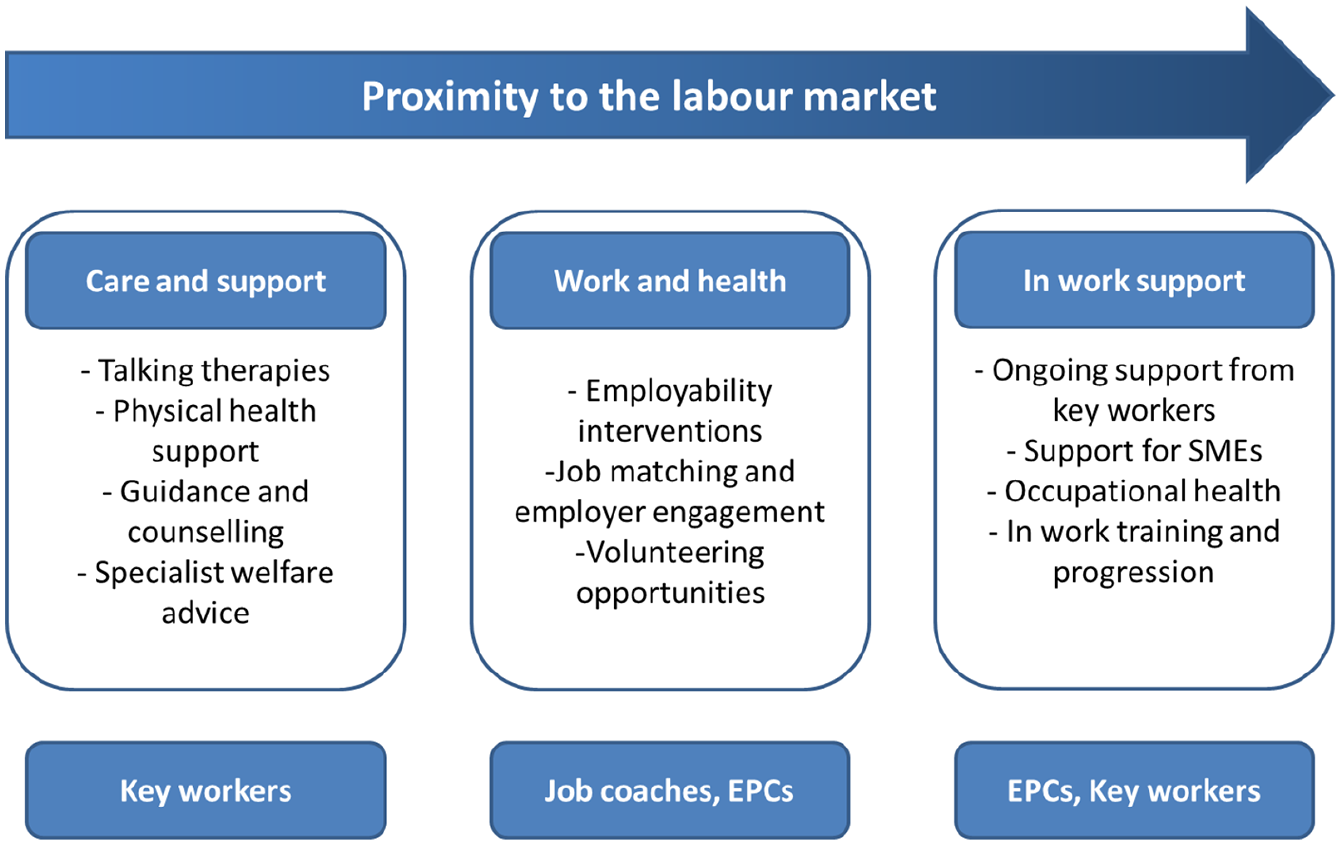
The programme ecosystem.
A manager with personal experience of earlier work-first programmes was sensitive to this significant practical and cultural change within support service networks: I was really shocked . . . [at] my first ever integration board meeting . . . about 25, 30 people came into the room . . . There was Job Centre Plus, and the Drug and Alcohol Team, the Homeless Team . . . Substance Misuse Workers . . . And they just sat down and looked at me, and went, ‘So how do you want us to help your clients?’ . . . I thought, ‘Oh my God, it’s really real.’ (Contractor A, Manager)
In order to incentivise contractors to refer clients to specialist support for mental health (at no direct cost to them), dedicated access to talking therapies was funded across the region by the local commissioning body rather than being subcontracted locally by Contractor A and B. Similarly, an accredited training provider was procured (at no cost to contractors) to improve basic and vocational skills among clients who had few or no qualifications. However, only around 10% of the total £20m spent between 2016 and 2019 was on health interventions, and only 10% of clients achieved a formal, accredited qualification while on the programme. This partly reflects the low skill demands of entry-level work in the UK, but also a degree of scepticism among SLBs about the value of sending clients on training courses as an alternative to finding work. Thus, despite the management emphasis on tackling multiple social and health problems, the majority of interventions were employment-related such as non-accredited skills courses, confidence building exercises and CV writing, all of which were designed to make clients job ready as quickly as possible.
In terms of moving clients into the labour market, the pilot programme achieved somewhat modest outcomes. As discussed earlier, overall job starts were above target (25% against a target of 20%), and job starts for ESA claimants were twice the target (10% versus 5%). However, this still means that just one in four clients, and just one in 10 clients with a disability, moved into work after attending the pilot programme. Sustained job outcomes were also below target (37% against a target of 75%). Nevertheless, commissioners calculated that each successful job outcome generated returns of £1.30 for both central and local government for every £1 invested in the programme (owing to increased income tax revenue, reduced welfare payments and less demand for specialised public services). Commissioners also estimated that most clients would be at least £45 per week better off in full-time work than on welfare. The modest financial gains associated with full-time work reflect the fact that only around a quarter of clients placed into work through the programme were paid at or above the true UK living wage compared with four-fifths of all workers in the local labour market. Thus, despite the ambitious objectives of the pilot programme, its success was hampered by the complexity of client needs, a conventional PBR system and the poor quality of jobs on offer in the local labour market.
The systemic limits to inclusive activation: Policy legacies and labour market realities
The final systemic level of analysis revealed more intractable challenges for the pilot programme. Our findings underline the limited choice that clients have over entry-level jobs in a context of flexible labour markets, and also the challenges SLBs face in engaging with employers as both ‘clients’ and as ‘co-producers’. As discussed earlier, EPCs leveraged their entrepreneurial skills to build local sales networks, but employers first had to be convinced of the added-value of hiring from a pool of workers with non-linear work histories and potentially challenging and complex personal circumstances. This was particularly important in our case study area where temporary work agencies are a significant feature in the labour market, along with other return to work schemes that had proliferated in recent years. Engaging with employers as co-producers involved breaking down negative preconceptions about activated clients, and working closely with individual employers to make hiring practices more inclusive. Despite the non-mandatory and socially inclusive approach of the programme, managers often encountered highly engrained negative stereotypes of activated clients when talking with local businesses: ‘when I describe my job, people will say, oh they’re all just people that are playing the system . . . [that] absolutely drives me insane’ (Contractor A, Manager).
To overcome these negative stereotypes, managers and SLBs actively promoted the distinct ethos and approach of the programme within the local area, while also championing the wider social benefits of hiring marginalised clients. This was achieved partly on the back of the sales networks developed by EPCs, and partly through high profile engagement and networking events. Managers and commissioners emphasised the high levels of motivation and diversity among their clients who had been supported, rather than coerced, into work and often invited individual clients to speak at events to share their ‘journey’.
On a practical level, EPCs sought to encourage employers to adjust their recruitment procedures to accommodate clients with limited work experience and few formal qualifications. This included offering employers face-to-face meetings with a client early in the recruitment process to avoid employers simply sifting through paper CVs (where vulnerable clients would often be filtered out). In some cases, EPCs attended interviews along with their client and filled in gaps by discussing the client’s strengths and weaknesses. In other instances, EPCs challenged employers about whether eligibility criteria for particular jobs were essential, or simply a means of narrowing the applicant pool. A particular challenge in engaging employers as ‘co-producers’ was the lack of internal HR capacity within many firms to formally adopt inclusive hiring policies, which meant that the decisions of hiring managers often came down to a simple cost–benefit analysis. Some SMEs recognised that there might be an up-front cost to hiring clients who had been through the programme, but expected the investment to pay off in the long run: In the early stages, those staff are not making us money. It’s only once they’re fully into the work, does that turn around [happen]. So, our commitment, in the early stages . . . costs us money. But our firm belief was, that over the years, we’ll get paid more . . . back by loyal members of staff. (Owner/Manager SME, Waste/Recycling)
However, some employers made it clear to EPCs that they could not afford to take on staff that would not soon be working at full capacity, which typically excluded those with complex support needs. There was also a risk for some employers that as clients gained work experience and confidence they might leave in pursuit of better opportunities: ‘Some of the supermarkets were paying more . . . And where would you rather go? Sit in a shop on a till and stack some shelves or come and get abuse for issuing [parking] tickets?’ (Car Parking Enforcement Company, Manager).
Some employers seemed to accept high levels of staff turnover as a natural consequence of flexible labour markets, and from this viewpoint welfare to work schemes were simply another source of cheap and relatively disposable labour. The fact that the current programme was largely non-mandatory did little to change negative views that activated clients were motivated solely by the possibility of welfare sanctions: When they [clients] are coming through work solutions and skills solutions, whatever name you want to put . . . on the box, they just do that because they need to . . . A lot of it is the big stick of you might lose your benefit if you don’t do the scheme. And that’s the only reason they’re doing it. (Owner/Manager, SME Retail)
Creating a distinct identity for the programme was made more difficult because there were several other ‘access to work’ schemes operating in the local area managed by local authorities and voluntary sector organisations. But rather than focusing on the welfare benefit received by clients (such as ESA, JSA or UC), these programmes targeted specific social groups such as those from deprived neighbourhoods, young people, those with disabilities or prison leavers. Professionals within the pilot programme recognised the complementarities of such tailored interventions, but one employer who had engaged with different programmes expressed exasperation at their multiplicity: I’ve had four or five organisations, all come to me saying, “We’ve got people, can you take ours?” And they seem to be almost overlapping in what they’re doing – they’re almost competing to get people into us. (Director, SME Recycling Business)
To help consolidate the position of the pilot programme, EPCs had effectively taken over the recruitment process of some larger employers, which created some scope to modify recruitment and to support clients as they transitioned into the workplace. Conversely, other employers recruited exclusively through temporary work agencies and in this context the programme, somewhat reluctantly, became a second layer in the intermediary process. EPCs and managers were keen to emphasise to employers that, while they offered some of the services of a recruitment agency, they did not have the same supply of job ready candidates, and could not offer on-site services to respond to short-term peaks in demand.
With so many competing sources of labour supply, it is perhaps unsurprising that employers were reluctant to deviate from short-term recruitment strategies that allowed them to fill large numbers of vacancies. In turn, the limited number of entry-level vacancies, and competition from agencies and other access to work programmes meant that SLBs and managers in the programme were forced to accept the standard employer hiring practices that partly excluded their clients from the labour market in the first place.
Discussion and conclusion
The core aim of this article was to understand how SLBs navigated more socially inclusive approaches towards activation in the long shadow of coercive UK workfare. The article draws on an in-depth case study of an innovative pilot project in order to analyse how the individual interactions between SLBs and their clients are both enabled and constrained by the organisational and systemic context. Our data were analysed against a multi-level theoretical framework that drew together the grounded street-level perspectives on professional ambiguity and role tensions first developed by Lipsky (1980), and the micro-institutionalist approach of Fuertes and Lindsay (2016) and Rice (2013). This allows us to make three substantive contributions.
First, our longitudinal case study findings build on a growing international literature that explores the localised individualisation of client support within activation programmes, and the increasing focus on demand stimulation as a way to improve outcomes for the most marginalised groups (Fletcher, 2004; Ingold and Stuart, 2015; Lindsay and Dutton, 2013; Schulte et al., 2018). The pilot programme in this study exhibited a number of key differences from the low-cost undifferentiated interventions often associated with coercive activation. Programme commissioners and managers appeared committed to a more personalised and non-mandatory approach, facilitated by reduced client caseloads and integrated networks of support, underpinned by stronger performance management of contractors. The programme specifically focused on those clients that had been ‘parked’ by marketised, work-first activation programmes (Carter and Whitworth, 2015; Greer et al., 2018), and allowed clients to gain confidence and basic skills without the immediate pressure of job search activity; a policy feature not commonly associated with workfare regimes in the UK where clients are typically expected to apply indiscriminately for all available jobs in order to avoid sanctions (e.g. Ingold, 2020; Wright et al., 2020). Nevertheless, the fact that a large share of spending was still on attachment fees and employability interventions (rather than formal qualifications or health support) underlines the difficulty of displacing low-cost black-box approaches associated with quasi-marketised activation models (Greer et al., 2018; Jordan, 2018). Furthermore, by focusing purely on improving clients’ job readiness defined according to engrained employer demands for motivated and flexible workers who learn quickly ‘on the job’, the discriminatory recruitment practices that keep marginalised clients out of the labour market in the first place remain largely unchanged.
Second, the grounded analysis of the work routines of key workers and EPCs extends the taxonomy, and understanding, of changing front-line roles within activation programmes (e.g. Ingold, 2018; Jordan, 2018; Koch, 2021; Wright et al., 2020). This approach provides a more nuanced understanding of how SLBs use, and eschew, discretion in their individual interactions with multiple stakeholders including clients, managers, other agencies and employers (Brodkin, 2011). The interview data suggest that, when freed from the policy straitjacket of simply enforcing strict welfare conditionality, key workers in particular are better able to uphold the principles of personalisation in their individual interactions with clients; a historically elusive policy outcome in the UK owing to central government preferences for cost control, accountability and standardisation (Fuertes and Lindsay, 2016).
However, the findings also reveal a number of unresolved role tensions within street-level activation work shaped by contradictory professional, operational and policy goals. There are clear tensions between the nascent role of individual SLBs as a social or moral agent (offering personalised support and preserving client choice), their traditional role as an activation caseworker (responsible for setting realistic job goals and moving clients closer to work) and as an entrepreneur (identifying sales opportunities, and establishing the programme as a preferred supplier of labour to local businesses). Key worker SLBs seek to reconcile these seemingly incompatible objectives by reframing deeply rooted social and personal needs as barriers to work that can be tackled by drawing on ‘tailored’, but very narrowly defined, packages of employability interventions such as CV workshops, confidence building, and interview preparation. For key workers the continued focus on swift insertion into the labour market reduces the role tensions and ambiguity associated with more socially inclusive approaches to activation, but also legitimises the limited interventions that are carefully calibrated to meet the relatively low demands of entry-level jobs.
The separation of personalised support (key workers) from the process of prospecting and job matching (EPCs) was intended to avoid tensions and conflict within individual SLB roles, but the continued pressure to meet targets for job outcomes meant that ‘entrepreneurialism’ largely meant a transactional sales role of bringing in local job vacancies and preparing clients for interviews. There are also emerging tensions between the efforts to engage with employers as co-producers or clients, particularly when sales networks (such as they are) often hinge on the strength of personal relationships between individual SLBs and hiring managers (who are more focused on short-term operational needs rather than long-term human resources strategies). As isolated institutional actors in the UK, activation programmes struggle to engage deeply with employers to make hiring practices more flexible and socially inclusive, and face significant challenges in destigmatising SLBs within activation programmes as a ‘provider of last resort’ (Ingold, 2020; Van Der Aa and Van Berkel, 2014). Pre-screening clients meant than EPCs could maintain their personal reputation by reducing the number of unfiltered applications sent to employers, but the competition for repeat sales with other labour market intermediaries meant that the distinct non-mandatory approach of the pilot programme was often lost on employers. This underlines the difficulties of attempting to modify employer hiring practices from the outside (Fletcher, 2004).
Third, by situating the grounded analysis of SLB work routines and role orientations (Lipsky, 1980) in a wider organisational, systemic and historical context we contribute to debates about the dynamic interplay between structure and agency in the implementation of public policy (Brodkin, 2011; Fuertes and Lindsay, 2016; Rice, 2013). Our findings demonstrate clearly the agency of SLBs to exercise discretion in their everyday work routines, to use their professional judgement to advocate on behalf clients and to work collaboratively with colleagues and other agencies. However, there are signs of policy alienation among SLBs as the limitations of routinised interventions and embedded ways of working come to the surface (Tucker et al., 2021). Our case study shows that while the targeting of activation programmes at those with complex needs reduces the incentives to cream and park, the limited resources for sustained support still lead to SLBs prioritising and de-prioritising clients according to the highly embedded and normative standard of job readiness. The more significant challenge that arises from such sorting and filtering is that those clients that are furthest from the labour market often do not receive the intensive and sustained support that allows them to catch up, nor do clients retain any significant choice over the types of job they accept or refuse. Activation SLBs, even within non-mandatory programmes, pragmatically recognise that there is little point in making significant upfront investments in skills training when entry-level jobs typically do not require more than school-level qualifications, and the longer clients remain attached to the programme the less marketable they potentially are to employers. Thus, there appears to be a growing sense among individual SLBs, and their clients, that in some cases activation may in fact do more harm than good (Kaufman, 2020).
These engrained low expectations at street level suggest a pattern of ‘bounded innovation’ whereby the work routines and roles that SLBs perform are consciously and unconsciously shaped by their own prior experiences and expectations (along with those of clients and employers), underpinned by powerfully embedded institutional and normative legacies (Weir, 1992). The singular focus on supply-side factors within UK activation is not just a product of the situational incentives created by marketised models of welfare to work (Greer et al., 2018; Kaufman, 2020), but is the legacy of a specific coercive model of welfare imported from the USA more than three decades ago that defines responsible citizens primarily in terms of their contribution to the labour market, and views unemployment as an individual rather than a societal failure (Daguerre, 2004). Through a long-term process of policy closure (Fuertes and Lindsay, 2016), labour market interventions in the UK have progressively focused on reducing overall welfare spending and removing the freedoms to refuse poor quality work. Policy makers believe this can be done by instilling a stronger individual work ethic through a mixture of conditionality and employability interventions that prepare clients to compete in a low paying and highly flexible labour market (Rafferty and Wiggan, 2011). This process of closure narrows the range of policy interventions that SLBs and managers are willing, and able, to experiment with, and effectively precludes the meaningful consideration of alternatives to work-first activation at the systemic, organisational and individual levels.
Although our data are drawn from a single contextualised case study, the findings have practical relevance for the design and delivery of labour market interventions that seek to move people from unemployment or inactivity into paid work. The results of this research suggest that street-level experimentation within a context of policy closure is only likely to produce marginal changes. A more transformative, socially inclusive approach would require closer examination of localised models developed in Denmark, France and (to a lesser extent) Germany, where PES co-invest in vocational training and skills development with local employers, trade unions and adult education institutions (Etherington and Ingold, 2012). Rather than selling the clients of individual activation programmes, these alternative approaches suggest the need for activation SLBs to sell the broader benefits of inclusive hiring, job rotation and in-work training to networks of employers (Etherington and Jones, 2004). Clearly, the difficulties in deviating from path dependent policy regimes go far beyond the micro-level interactions between SLBs and clients, and require the systemic coordination of multiple parallel activities and sustained collaborations between social actors (Crouch and Farrell, 2004). A reorientation towards ‘human capital’ models of labour market insertion (Schulte et al., 2018), combined with welfare and labour market reforms that strengthen worker rights and decommodify, rather than recommodify, labour (Rubery et al., 2018) may be needed to turn the tide of poor labour market outcomes for those socially excluded citizens that successive UK governments have repeatedly tried, but failed, to activate over a 30-year period.
Footnotes
Appendix
Organisations and interviewees.
| Organisation name | Type/function | Interviewees |
|---|---|---|
| Local state agency | Commissioning body | 4 commissioners, 5 programme/project managers, 1 employer engagement lead |
| Contractor A | National for profit provider | 2 managers, 2 key workers, 2 employer partnership coordinators, 1 job coach |
| Contractor B | Local not for profit provider | 1 manager, 2 key workers, 2 employer partnership coordinators, 1 job coach |
| Car parking contractor | Local employer | 1 manager |
| Local authority | Local employer | 1 manager |
| SME, IT | Local employer | 1 manager |
| SME, retail | Local employer | 1 manager, 1 worker |
| SME, waste/recycling | Local employer | 1 manager, 2 workers |
| Temporary work agency | Local employer | 2 managers |
| Training provider | Local employer | 1 manager |
| Training provider | Local employer | 1 manager |
| Voluntary and community sector | Young people | 2 managers, 2 clients |
| Homeless and ex-offenders | 1 manager |
Source: Adapted from programme reports and internal documents.
Acknowledgements
The authors would like to thank the participants in this research who volunteered their time and valuable insights. We would also like to thank the editor and three anonymous reviewers for their helpful comments in developing the article throughout the review process.
Funding
The authors disclosed receipt of the following financial support for the research, authorship and/or publication of this article: Lord Alliance Strategic Investment Fund, Alliance Manchester Business School.
