




Abstract
Are your workdays created equal? Common wisdom suggests that employees experience Mondays differently from Fridays. However, few studies distinguish among workdays, inherently assuming that the employee experience is uniform across the workweek. In the current study, we examined the trajectories of employees’ experiences of job satisfaction and job stressors across the workweek. We proposed two competing theoretical perspectives that result in opposite predictions as to whether job dissatisfaction and perceived job stressors will be higher (“Monday blues”) or lower (“rested and recharged”) at the beginning of the workweek rather than later in the week. Employing a daily diary design with 139 employees (681 matched daily observations) working the traditional workweek, we found that employees reported experiencing lower levels of job satisfaction and perceived more job stressors (i.e., incivility and organizational constraints) at the beginning of the workweek as opposed to later in the week. Additionally, the relationship between perceived incivility and job satisfaction was stronger at the beginning of the workweek. Our findings were consistent with the “Monday blues” perspective and suggest that workdays are not created equal.
Most of the research on temporal work cycles differentiates workdays (weekdays for traditional work schedules) from nonwork days (weekends) but does not distinguish among the workdays themselves. In doing so, an assumption is made that employees’ experiences of workdays are uniform. However, there is reason to presume that workdays are not all created equal. Indeed, common wisdom tells us that employees approach and react to the beginning (i.e., Mondays), middle (i.e., Wednesdays), and end (i.e., Fridays) of workweeks differently. Therefore, we argue that much of current research may represent an overly simplified view of the employee workweek experience. The current study aims to take a closer look into employees’ experiences across different workdays with a focus on the trajectories or directions of change of job satisfaction, two job stressors (experienced incivility and constraints), and their relationships throughout the workweek.
Job satisfaction is a central variable in the study of organizational behavior that reflects the individual’s work adjustment and work well-being. It is essential to many theories of organizational phenomena such as the job characteristics model (Hackman, 1980) and leader-member exchange (e.g., Dulebohn et al., 2011) to name just two. For many years, job satisfaction research has taken a static view, considering job satisfaction as relatively fixed and even dispositional (e.g., Staw et al., 1986), at least within the same job. With the advent of daily diary studies, it has become apparent that employees’ job satisfaction level can vary from day-to-day within individuals (e.g., Hülsheger et al., 2013; Pindek et al., 2019a). Some of this daily variability can be explained by daily work experiences, most notably job stressors (e.g., Eatough et al., 2016). Traditionally, the daily fluctuation of job stressors such as workplace incivility have been examined as a predictor of daily fluctuations in employee attitudinal and behavioral outcomes (e.g., Beattie and Griffin, 2014).
What is unclear in previous research, however, is the pattern of variations in the experience of job satisfaction and job stressors across the different workdays within a workweek. We focus on workweeks because they have a typical cyclic rhythm, in that the weekly rhythm repeats itself most weeks of the year. This rhythm provides an ideal opportunity to examine how employees’ experiences vary across days that repeat in the workweek cycle (Beal and Ghandour, 2011).
Using a diary design, the current study examines the trajectories of employees’ perceptions of job satisfaction, job stressors, and their relationships across the workweek, as suggested by other researchers (Sonnentag et al., 2014). We discuss two plausible yet contradictory processes. According to the first perspective, employees arrive to work on Mondays “rested and recharged” having recouped their resources (defined here as things that are perceived by the employee as helpful in attaining goals and meeting demands; Halbesleben et al., 2014) over the weekend. As a result, employees experience fewer stressors and feel more satisfied with their jobs earlier in the week as opposed to later in the week (i.e., a negative trajectory for satisfaction, and positive trajectories for perceived job stressors). Given that job satisfaction fluctuation has been linked to perceptions of job stressors, which are considered affective events (Fuller et al., 2003), we would expect job satisfaction to be predicted by perceptions of job stressors across the week. Therefore, as employees are “rested and recharged” on Monday, but perceive comparatively more job stressors as the weekend draws nearer, they will also experience an increased sensitivity to those job stressors, resulting in a greater decrease in job satisfaction.
The alternative viewpoint, consistent with the “Monday blues” perspective (Areni, 2008), is that employees are dismayed at the idea of returning to work after the weekend respite and start the week with a negative mood. Because mood explains a substantial portion of the within-individual variability in job satisfaction (Ilies and Judge, 2002), they would also start the week with lower satisfaction levels and events that occur earlier in the week would be perceived as more stressful than later in the week (i.e., a positive trajectory for satisfaction and negative trajectories for perceived stressors). Under this perspective, sensitivity to these job stressors is also greater at the start of the week with perception of job stressors having a stronger effect on job satisfaction.
While both of these perspectives have broad theoretical and some empirical support (e.g., Areni and Burger, 2008; Fritz et al., 2010), they have been largely disconnected, and prior studies have, for the most part, focused on mood and recovery variables separately under each perspective. Our study integrates the two perspectives in examining a fundamental work-related well-being indicator, namely job satisfaction. Specifically, we pit against one another these two competing time-based theoretical perspectives to examine which of the above two perspectives will better describe the experiences of job satisfaction, job stressors (i.e., workplace incivility and organizational constraints), and the stressor-satisfaction relationship over the course of the traditional workweek.
Theoretical foundations and hypotheses development
Weekly rhythms of job satisfaction, incivility, and constraints
Despite calls for theoretical developments that explicitly consider nuanced time-based approaches, such as rhythms and cycles (George and Jones, 2000), as well as the broader relevance of temporal issues to the understanding of organizational phenomena in general (Shipp and Fried, 2014), there has been little research on the weekly rhythm of employee experiences. Each of the two theoretical perspectives we present can be used to explain why job satisfaction, as well as perceived job stressors, vary as a function of the workday. Both perspectives indicate that weekends offer a respite from work, providing opportunities for resource recovery (Meijman and Mulder, 1998). Individuals are thought to be generally happier on the weekend because they are free to choose their activities to a greater extent than during workdays (Areni, 2008) and can, therefore, spend more time recouping resources rather than spending them. However, the two perspectives provide opposing viewpoints regarding whether job satisfaction, as well as perceived job stressors, would increase or decrease as the workweek progresses.
Furthermore, both perspectives build on Affective Events Theory (AET; Weiss and Cropanzano, 1996), for the potential fluctuation of job satisfaction as a function of time and stressor experiences. Specifically, the central tenet of AET suggests that employees’ attitudes (i.e., job satisfaction) can be affected by adverse work events through negative affective reactions, and that the fluctuation of affect levels over time can potentially lead to the fluctuation of job satisfaction over time – in this case, throughout the workweek.
Rested and recharged
This perspective posits that employees arrive to work on Mondays rested and recharged, ready to engage the workweek. According to the effort-recovery model (Meijman and Mulder, 1998), exerting effort to meet work demands results in an overload experience for the individual. Sufficient recovery (i.e., the restoration of resources and the reduction of strain reactions; Fritz et al., 2010) is needed between successive demands in order to avoid adverse outcomes such as job dissatisfaction. Therefore, the weekend provides an opportunity to recover emotional, mental, and physical energy that is consumed by the job, and begin the week rested and recharged. As a result, employees begin the workweek with the satisfying experience of having more resources. However, as the workweek progresses, employees have less recovery time, because they only have a few hours after the workday as opposed to the full two-day weekend. As a result of having fewer opportunities for recovery, employees’ resources are depleted as the workweek progresses. As resources gradually get depleted, the satisfaction levels are expected to decrease.
Furthermore, when employees arrive to work at the beginning of the workweek having recouped resources over the previous weekend, they are more resilient and better able to handle job tasks and the resulting stressors. This point is supported by the transactional stress theory approach (Lazarus and Folkman, 1984). That is, employees’ energy level and fatigue can affect both the primary appraisals of a work situation (i.e., viewing a situation as a threat) and their secondary appraisals of that situation (i.e., evaluating their own resources and coping ability). For example, when an employee is well rested and has adequate resources on Monday morning, he or she is less likely to perceive a constraint on performance as a threat, and will have confidence that he or she has sufficient resources with which to cope. He or she likely considers time as a resource, so on Monday the employee has an entire week to accomplish the week’s work, whereas on Friday, there is only a matter of hours. Thus, employees would view something that interferes with accomplishing tasks (e.g., an organizational constraint) as more threatening when it occurs later in the workweek because there is decreasing work time to accomplish the weekly tasks. This is akin to the fade-out effects of vacation that show the well-being benefits from vacation fade out after returning to work (Fritz and Sonnentag, 2006; Kühnel and Sonnentag, 2011).
Finally, according to AET (Weiss and Cropanzano, 1996), experiencing a job stressor likely elicits subsequent negative affective reactions that influence short-term job attitudes such as employees’ job satisfaction. As previously described, employees arrive to work on Mondays rested and recharged, having recouped resources during the weekend respite. As a result, they are likely to perceive job stressors as less threatening, thereby eliciting a milder response, because employees feel they have adequate resources to cope with the encountered stressors. Hence, perceived job stressors would likely have a weaker effect on job satisfaction levels earlier in the workweek. However, as the workweek progresses, employees have fewer available resources, and will therefore have an increased sensitivity to stressors experiences, resulting in an increasingly stronger impact of those stressors on employees’ job satisfaction levels.
Supporting this perspective, researchers have found that following the weekend, employees experience decreased emotional exhaustion (Drach-Zahavy and Marzuq, 2013) as well as increased well-being and performance (Binnewies et al., 2010; Fritz et al., 2010). These effects are attributed to sufficient recovery during the weekend (Fritz and Sonnentag, 2005). For example, recovery experiences during the weekend (defined as nonwork pursuits that promote unwinding from work) positively predicted the following week’s positive affective states and negatively predicted the following week’s negative affective states (Fritz et al., 2010). Taken together, these studies suggest that the weekend provides employees with the opportunity to replenish their resources and recover from the effects of the previous workweek. It then follows that employees perceive higher job satisfaction levels, lower job stressor levels, and a weaker stressor-satisfaction relationship at the start of the week. As the week progresses and resources dwindle, employees will have lower levels of job satisfaction, would perceive more job stressors, and the relationships between job stressors and job satisfaction would become stronger.
Monday blues
The alternative perspective, “Monday blues,” refers to the general idea that people are happier on nonwork days (e.g., weekends) because they are free to choose their activities (Areni, 2008). However, they do not have this choice during the workweek and this has a negative effect on their affective state at the start of the workweek because of a contrast effect (Marco and Suls, 1993). Specifically, employees generally look forward to the weekend (i.e., weekend anticipation), and that anticipation is associated with higher levels of positive mood on Friday afternoon (Sonnentag et al., 2008). As such, employees might dread Mondays because as the first day of the workweek, it is also the farthest day from the next weekend, and employees tend to have higher negative mood than later in the workweek. According to AET (Weiss and Cropanzano, 1996), this pattern of affect levels can influence job attitudes such as job satisfaction, resulting in lower levels of employees’ job satisfaction on Mondays. However, as the workdays pass, the positive mood associated with the expected weekend relief can lead to an increase in employees’ job satisfaction levels. Therefore, a positive trajectory for job satisfaction is expected whereby early in the week job satisfaction is relatively low, because mood is contrasted with the weekend, but gradually increases across the workweek as the next weekend draws nearer.
Regarding job stressors, the Monday blues perspective can be explained using the resource control and management argument (Spector, 2017) that is based on the idea that people allocate their own resources in a strategic way (Grawitch et al., 2010). Simply put, employees pace themselves during the workweek, allocating resources each day at a pace that allows them to get through the workweek without becoming overly depleted. If resources are depleted faster than planned, employees may perceive a loss of control over resources, which can elicit concerns regarding the sufficiency of resources for the remaining days of the workweek. According to this view, encountering job stressors early in the week, which depletes more resources than were allocated for that day, signals a loss of control over resources, which has a potentially bigger impact on employees. Thus, the bigger threat to resources earlier in the workweek would result in perceiving work demands as more stressful (higher perceived stressors).
According to the transactional stress theory (Lazarus and Folkman, 1984), the bigger threat would also lead to a greater sensitivity or stronger reaction to those perceived job stressors; thus, job satisfaction as a reaction to stressor experiences (Weiss and Cropanzano, 1996) might have a stronger relationship with perceived job stressors. However, later in the workweek, the threat is reduced because the upcoming weekend provides an opportunity for employees to replenish their resources, meaning that there is less of a need to continue reserving resources over the remaining workdays, leading gradually to weaker reactions to them in terms of job satisfaction.
There is some empirical support for this perspective. For instance, Rook and Zijlstra (2006) found that while the weekend respite provides recovery effects, these effects wane on Sunday evening in anticipation of the upcoming workweek. This suggests that employees, familiar with previous experiences of the workweek, already anticipate the expected depletion of their resources and may feel a greater threat to their control over those resources. There is some preliminary evidence that employees experience higher levels of perceived incivility at the beginning of the workweek with these rates declining as the week progressed (Nicholson and Griffin, 2017), in line with the Monday blues perspective.
Current study and competing hypotheses
The testing of alternative theoretical explanations is critical for the understanding of social science phenomena (Imai and Tingley, 2012). When two sound theoretical perspectives support opposite predictions, their relative validity for making such predictions can be compared and evaluated using a strong inference epistemological approach (Aguinis and Adams, 1998; Platt, 1964). Specifically, researchers can first devise alternative/competing hypotheses, and then design and conduct appropriate empirical studies that optimally provide support for one hypothesis over the other. These tests can be done using meta-analyses (e.g., Shockley et al., 2017), experimental designs (e.g., Aguinis and Adams, 1998), or non-experimental field studies (e.g., Aguinis et al., 2010; Thau and Mitchell, 2010) such as the one employed in the current study.
Following this approach, we apply the two competing time-based perspectives, “rested and recharged” and “Monday blues,” to develop parallel but opposing hypotheses regarding the experience of job satisfaction, perception of job stressors, and relationships between job stressors and job satisfaction. This allows us to determine whether these variables and relationships among them follow a “rested and recharged” or a “Monday blues” pattern. The former would be indicated if early in the workweek, on Monday for example, there is a higher level of satisfaction, a lower level of perceived job stressors, and a weaker association between job stressors and job satisfaction, compared to later in the workweek. However, the latter would be indicated if, on Monday, employees have lower levels of job satisfaction, higher levels of perceived job stressors, and a stronger relationship between job stressors and job satisfaction.
To test these perspectives, we examine two impactful workplace stressors: perceived incivility and perceived organizational constraints. Perceived incivility is an interpersonal stressor that refers to a mild form of mistreatment, with ambiguous intent to harm, that can psychologically harm another employee (Andersson and Pearson, 1999). Employees’ job dissatisfaction has been linked to both incivility (for a review, see Schilpzand et al., 2016) and meta-analytically to the broader experience of mistreatment (Bowling and Beehr, 2006) at the between-person level. There is also evidence for similar relationships at the within-person level (Dimotakis et al., 2011; Meier et al., 2014). The second job stressor, perceived organizational constraints, is more task-oriented and refers to work conditions that inhibit employees’ ability to perform job tasks (Peters and O’Connor, 1980). This stressor has also been linked to job dissatisfaction at the between-person level (Pindek and Spector, 2016b). Although direct evidence for the within-person constraints-satisfaction relationship is scarce, evidence suggests that constraints are linked to affective state at the end of the work day (Sonnentag et al., 2012). Both stressors are expected to have a negative within-person effect on job satisfaction because employees view these events as threatening to their productivity and well-being (Cavanaugh et al., 2000; Podsakoff et al., 2007).
We chose these two specific job stressors for several reasons. First, the incorporation of these job stressors allows us to examine both the socially-oriented side of workplace stress (i.e., perceived incivility) as well as the more task-oriented side of stress (i.e., perceived organizational constraints). Second, these job stressors lend themselves nicely to the current framework, given the substantial appraisal component in the perceived severity level of each stressor. The appraisal component is important, because employees’ appraisal of their own resources shapes the appraisals of their stressor experiences, and in that sense, changes the employees’ reactions to these job stressors (Grawitch et al., 2008). To illustrate this point, if an employee greets a coworker but the coworker does not respond, the focal employee could perceive the non-response as uncivil and threatening. However, the focal employee could also simply assume the coworker was distracted and therefore not perceive the event to be an act of incivility. Indeed, research indicates that the appraisal of the event determines the threat level (Dewe, 1992; Lazarus and Folkman, 1984; Marchiondo et al., 2018), and it is this appraisal, more than the actual event, that leads to consequences for the employee (Pindek and Spector, 2016a). This is an important point because the focus of the study is on perceived stressors, and how those perceptions may change as a result of the workweek rhythm.
Second, despite the established links between these two job stressors and job satisfaction, extant research has rarely examined whether the experience of these job stressors, job satisfaction, and the stressor-satisfaction relationship vary across the workweek (for an exception on workday fluctuations of perceived workplace incivility, see Nicholson and Griffin, 2017). Rather, existing research on weekly rhythms has focused on different workplace experiences, most notably employees’ recovery (“rested and recharged”) and mood (“Monday blues”) following the weekend. However, far less is known about how the workweek rhythm affects employees’ perceived job stressors. Therefore, to examine this phenomenon, we offer two sets of competing hypotheses stemming from the “rested and recharged” and the “Monday blues” perspectives. Based on the former perspective, employees will arrive to work on Monday morning feeling rested and recharged from the weekend respite. As a result of having sufficient resources, they will have a higher level of job satisfaction and perceive lower levels of job stressors (i.e., incivility and constraints) at the beginning of the week than at the end of the workweek. Furthermore, their sufficient resources allow them to cope better with the encountered job stressors, and to experience a milder decrease in satisfaction as a response to those stressors. Therefore, the job stressor-job dissatisfaction relationship is weaker early in the week and stronger later in the week. This argument leads to our first set of hypotheses that we label “Set A”: H1a: Employees’ satisfaction follows a negative trajectory across the workweek such that employees’ job satisfaction is higher earlier in the week and lower at the end of the week. H2a: Employees’ perceived incivility follows a positive trajectory across the workweek such that employees perceive lower levels of incivility earlier in the week and higher levels later in the week. H3a: Employees’ perceived constraints follows a positive trajectory across the workweek such that employees perceive lower levels of constraints earlier in the week and higher levels later in the week. H4a: Time moderates the incivility-satisfaction relationship such that the perceived incivility-job satisfaction relationship is weaker earlier in the week than later in the week (the sensitivity to the stressor increases across the week). H5a: Time moderates the constraints-satisfaction relationship such that the perceived constraints-job satisfaction relationship is weaker earlier in the week than later in the week (the sensitivity to the stressor increases across the week). H1b: Employees’ satisfaction follows a positive trajectory across the workweek such that employees’ job satisfaction is lower earlier in the week and higher at the end of the week. H2b: Employees’ perceived incivility follows a negative trajectory across the workweek such that employees perceive higher levels early in the week and lower levels later in the week. H3b: Employees’ perceived constraints follows a negative trajectory across the workweek such that employees perceive higher levels earlier in the week and lower levels later in the week. H4b: Time moderates the incivility-satisfaction relationship such that the perceived incivility-job satisfaction relationship is stronger earlier in the week than later in the week (the sensitivity to the stressor decreases across the week). H5b: Time moderates the constraints-satisfaction relationship such that the perceived constraints-job satisfaction relationship is stronger earlier in the week than later in the week (the sensitivity to the stressor decreases across the week).
Method
Participants and procedure
The sample consisted of 139 full-time staff employees (non-teaching positions) working in a large university in the US. We chose a sample of employees who work a traditional workweek, that is, employees who work a set Monday–Friday schedule between the hours of 8–5 (including a one-hour lunch break) with no sanctioned overtime or weekend work. These are state civil service employees and are not permitted by law to work outside of their scheduled working hours. This makes them a suitable sample for the current study.
Participants were contacted via email and invited to participate in the study, in exchange for a $50 gift-card. Participant’s identifying information was kept separate from their answers and the data were later matched with automatically generated identification codes. This study is part of a larger project, and the variables currently used were collected at two time points during each day. The job stressors survey was sent at 5pm, which constituted the conclusion of the workday, and the job satisfaction measure was sent at 9pm so that participants could complete it before going to bed. The predictor and criterion measures were intentionally separated in an attempt to reduce the likelihood of common method variance and more specifically, the effects of transitory factors (Podsakoff et al., 2003). Daily surveys were sent for nine consecutive workdays (the study terminated and participants were debriefed before leaving work on the second Friday 1 ), with participants completing both surveys according to their instruction on 4.9 days on average (for a rate of 54% usable observations). Data that were provided outside the allotted time frame (no more than two hours after 5pm, and no more than six hours after 9 pm) were discarded. There were 805 daily observations for the 5pm measures, 981 for the 9pm measures, and 681 daily observations with matched data.
Measures
Perceived organizational constraints was measured using the four most prevalent items discussed in Pindek et al. (2019b). Participants indicated the extent to which the following things made it difficult to do their job on that day: “Interruption or inadequate cooperation and help from coworkers,” “Organizational rules and procedures,” “The supervisor or management,” and “Poor equipment or lack of money.” Response options range from 1 (not at all) to 5 (extremely). The within-level alpha was .57 and the between-level alpha was .86. It is important to note that the constraints scale is formative, meaning items are not interchangeable and internal consistency is not necessarily relevant (Spector and Jex, 1998).
Perceived incivility was measured using the five-item incivility scale (Leiter and Day, 2013). Participants indicated how many times someone at work did the following things to them that day: behaved without consideration, ignored, excluded, spoke rudely or behaved rudely. Response options were 0, 1, 2, and more than 2. The within-level alpha was .70 and the between-level alpha was .89.
Job satisfaction was measured using a modified version of the 3-item job satisfaction subscale from the Michigan Organizational Assessment Questionnaire (Cammann et al., 1983). We adapted the scale, originally designed to measure overall job satisfaction, for use in a daily diary study by adding a time referent to the items. For example, the item “I am satisfied with my job” became “At present, I am satisfied with my job.” To make the rating task easier for respondents, we reversed the negatively worded item “I do not like my job” to “I like my job.” Response options range from 1 (Strongly Disagree) to 5 (Strongly Agree). The within-level alpha was .75 and the between-level alpha was .99.
Days since the weekend (the operationalization of day of the workweek) was calculated using the surveys’ automatic time stamps. On Monday, the day count from the weekend is 1, and every subsequent day the count increases by 1, with Friday having the value 5.
Analytic approach
All study variables were measured daily, meaning that these measures are nested within individuals. Thus, we used growth models within a multilevel modeling framework to examine our research questions with Mplus 7.02 (Muthén and Muthén, 1998–2012). First, separate growth models were tested for each variable (job satisfaction, perceived workplace incivility, perceived organizational constraints). For each variable, we report the null model followed by model 1, whereby days since the weekend was entered as a predictor. 2 Then, for satisfaction, we added additional models whereby one of the stressors was entered (model 2), and finally, the interaction between that stressor and days since the weekend was added (model 3). We did these final two steps (model 2 and 3) separately for each stressor because they are correlated and entering both would result in decreased power (though including both stressors at step 2 did not change the pattern of results). In all regressions, our predictors were group-mean centered (days since the weekend was centered around the middle of the week) because it provides the most accurate estimate of within-person relationship (Enders and Tofighi, 2007). This also means that between-person variables (i.e., demographics or personality) were controlled. All effects are estimated using random slopes and intercepts, while allowing the slopes and intercepts to covary. We use two-tailed significance tests, accounting for the bidirectionality of our two sets of hypotheses. Equations for our statistical analyses are shown in the Appendix.
Results
Descriptive statistics and intercorrelations are presented in Table 1. We conducted multilevel regression analyses to test the growth models indicated in our hypotheses. Tables 2–4 contain the results of the multilevel regression analyses used to test hypotheses 1–3. The test for H1 is shown in Table 4. There was a positive trajectory for job satisfaction (γ = .03, p < .05, 95% confidence interval (CI) = [.002, .049], 8.50% within-person variance explained), supporting H1b. Furthermore, H2b, and H3b were supported, as days since the weekend was negatively associated with both perceived incivility (γ = −.02, p < .01, 95% CI = [−.032, −.006], 1.61% within-person variance explained) and perceived constraints (γ = −.03, p < .05, 95% CI = [−.046, −.004], 1.16% within-person variance explained), indicating a negative trajectory for stressors (see Tables 2–3). A similar pattern of results can be seen in the within-level correlations in Table 1. These results support the “Monday blues” perspective for hypotheses 1–3 (Set B).
Descriptive statistics and correlations among study variables.
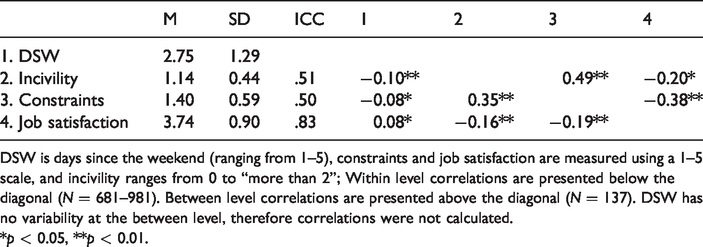
DSW is days since the weekend (ranging from 1–5), constraints and job satisfaction are measured using a 1–5 scale, and incivility ranges from 0 to “more than 2”; Within level correlations are presented below the diagonal (N = 681–981). Between level correlations are presented above the diagonal (N = 137). DSW has no variability at the between level, therefore correlations were not calculated.
*p < 0.05, **p < 0.01.
Main effects of days since the weekend on perceived incivility.
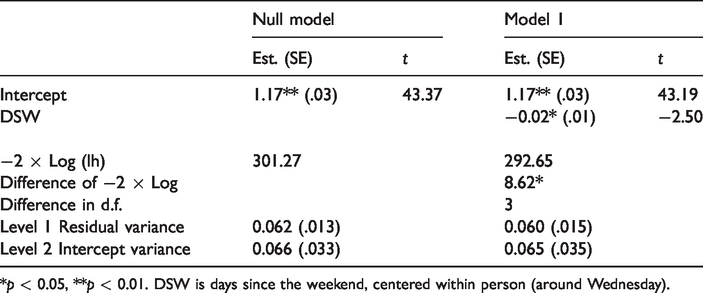
*p < 0.05, **p < 0.01. DSW is days since the weekend, centered within person (around Wednesday).
Main effects of days since the weekend on perceived constraints.
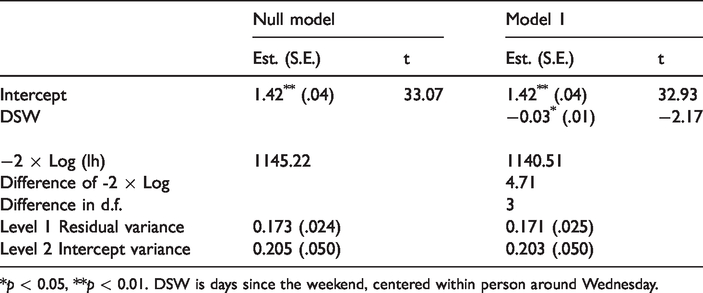
*p < 0.05, **p < 0.01. DSW is days since the weekend, centered within person around Wednesday.
Effects of days since the weekend, stressors (incivility and constraints) and their interactions on job satisfaction.
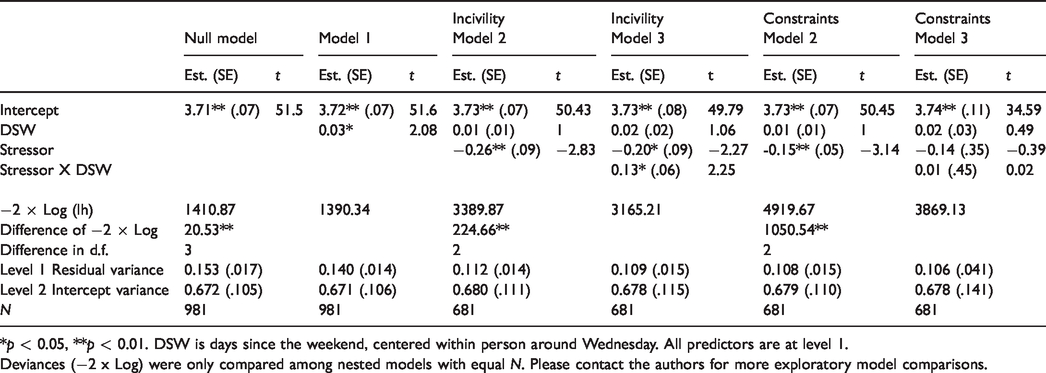
*p < 0.05, **p < 0.01. DSW is days since the weekend, centered within person around Wednesday. All predictors are at level 1.
Deviances (−2 x Log) were only compared among nested models with equal N. Please contact the authors for more exploratory model comparisons.
Table 4 also contains the models used to test hypotheses 4 and 5. Days since the weekend moderated the relationship between perceived incivility and job satisfaction (γ =.13, p < .05, 95% CI = [.018, .249]) 3 such that perceived incivility had a negative effect on job satisfaction only earlier in the workweek (for Monday, γ = −.47, p < .05, 95% CI = [−.831, −.099]) and not later in the workweek (for Friday, γ = .07, p = .46, 95% CI = [−.112, .247]). The multilevel regression model explained 28.76% of the within-person variance of job satisfaction. The interaction is displayed in Figure 1; the plot shows the slopes on the lowest and highest values of days since the weekend, that is on Monday and on Friday. The slopes decrease from Monday to Friday (γ = −.47, −.33, −.20, −.07, .07 across the days of the week, and only on Thursday and Friday the slope is no longer significantly different from zero with p = .34 and .46, respectively), suggesting the pattern of change across the week is not the result of a uniquely large slope on Monday or a uniquely small slope for Friday. This pattern of moderation provides support for the “Monday blues” perspective for Hypothesis H4b (Set B), as the sensitivity to incivility decreases across the workweek. Days since the weekend did not moderate the constraints-satisfaction relationship, failing to support either perspective for Hypothesis H5 (γ =.07, p = .45, 95% CI = [−.111, .251]).
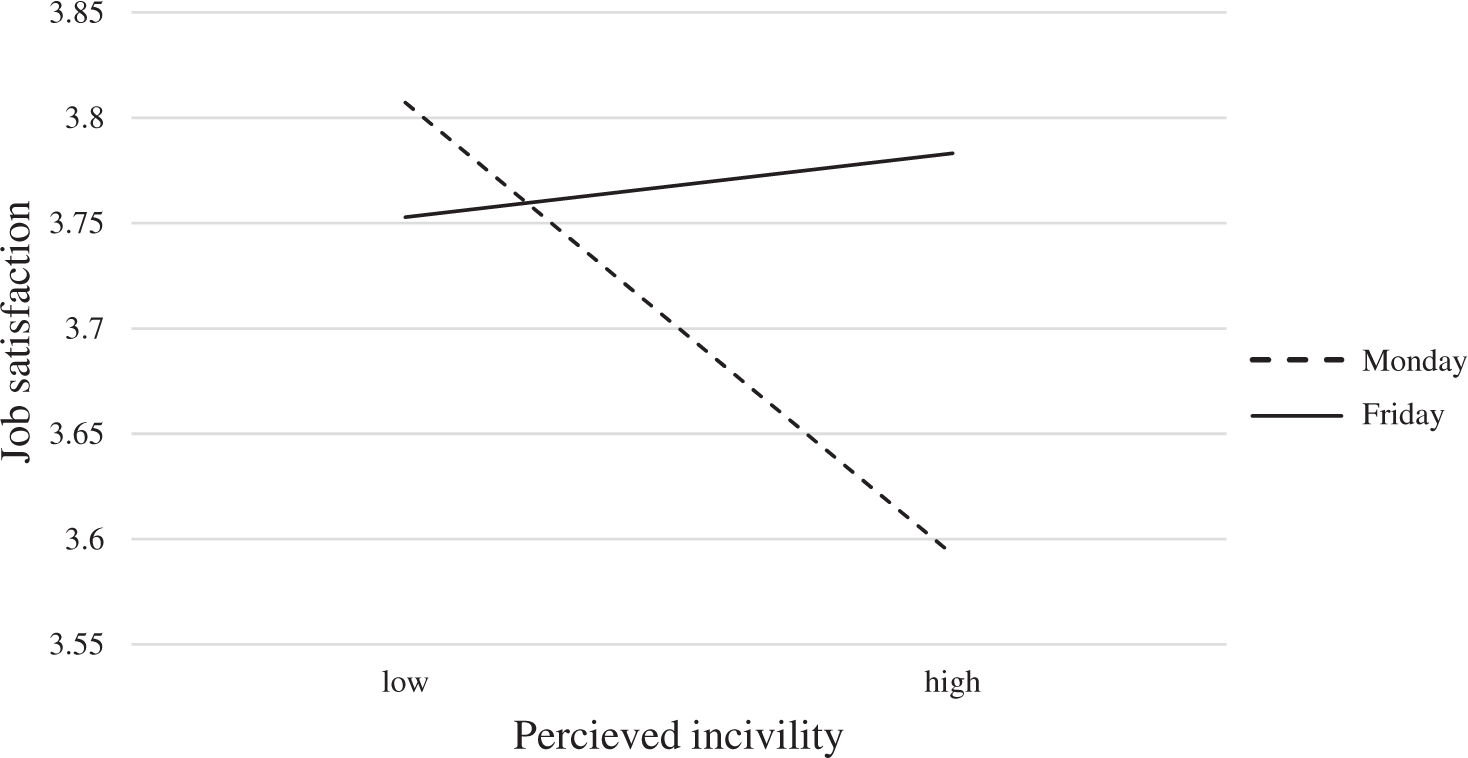
The within-person interaction between days since the weekend and incivility in predicting job satisfaction. The slope is significant on Monday, when the day count since the weekend is low (γ = −0.47, p < 0.05) but not on Friday, when the day count is high (γ = 0.07, p = 0.46).
Discussion
The current study examined the employee experience of the typical workweek, pitting against one another two competing theoretical perspectives on how the experiences of job satisfaction, perception of job stressors, and their relationships unfold over the workweek. Our results indicated support for the “Monday blues” perspective since employees reported experiencing lower levels of job satisfaction and higher levels of incivility and constraints at the beginning of the workweek compared to the end of the workweek. Further, the perceived incivility-job satisfaction relationship was stronger at the beginning of the workweek than at the end of the workweek, indicating higher sensitivity to incivility earlier in the workweek. None of our findings were consistent with the “rested and recharged” perspective for the experiences of job satisfaction or stressors. Therefore, stressors are perceived as more severe and also have a greater impact on job satisfaction earlier in the week rather than later in the week. This is in line with one study that found that employees experienced higher levels of incivility early in the week (Nicholson and Griffin, 2017). Our study expands upon this finding to include more than one stressor as well as job satisfaction, and the stressor-satisfaction relationship, which was found to be stronger at the beginning of the week for perceived incivility.
Reconciling the previous findings that support both opposing perspectives, it is important to take into account the substantial difference between recovery and mood. In line with prior research that supports the rested and recharged perspective, it is likely that the weekend indeed recharges employees’ resources, as reflected in benefits to many health and well-being indicators as well as performance measures in the coming week (Binnewies et al., 2010; Drach-Zahavy and Marzuq, 2013; Fritz et al., 2010; Fritz and Sonnentag, 2005). However, feeling more rested does not necessarily mean that employees are more satisfied or better able to manage workplace stressors. A reason for this is rooted in the resource allocation argument. Despite having more resources on Monday, the impact of anything that drains those resources is greater because people have to wait longer until the next time they can replenish their resources over the following weekend. Therefore, there is a negative trajectory for workplace stressors across the week.
Within-person variability in job satisfaction is associated with mood (Ilies and Judge, 2002), and as mood improves over the course of the workweek, so does job satisfaction. In addition, job satisfaction has a judgment-evaluative aspect to it (Motowidlo, 1996). It is therefore possible that at the beginning of the workweek, goals for the week have been set but have not yet been accomplished. As the week unfolds, tasks are completed leading to a sense of accomplishment and satisfaction with a job well done, indicating a positive trajectory for job satisfaction across the workweek.
Furthermore, our findings suggest that although previous studies found that employees are better rested on Monday morning (e.g., Binnewies et al., 2010), it does not necessarily indicate that they would appraise job-related experiences such as incivility and constraints as less threating. It is possible that when employees encounter a stressor on Friday, knowing they are about to get a recovery break over the weekend, the loss of resources is less of a problem, and they are therefore better able to handle or even ignore the stressor (e.g., ignore uncivil behavior), knowing their exposure to the stressor is about to end for the week. On Monday, on the other hand, the stressors that they encounter have the potential to linger over the following days, and employees may perceive their own ability to cope with those stressors (without having a chance to fully recover) as lower, and consequently appraise the stressors as more severe and experience less job satisfaction in response. In line with this explanation, Hülsheger et al. (2014) found that psychological detachment from work as well as sleep quality increase over the workweek. All of this fits with the conceptualization of a psychological time perspective that impacts how employees recoup resources over the weekend, and allocate their resources in the face of stressful situations at work: when the next opportunity for replenishing resources seems far in the future (i.e., on Monday, the farthest day from the upcoming weekend), employees may be more concerned about losing control over their resources, thus perceiving stressors as a bigger threat, as experiencing them as more severe. The threat of losing control over resources, and the increase in perceived stressors are then reflected in lower satisfaction levels.
The interaction between day of the workweek and perceived incivility in predicting job satisfaction indicates that day of the workweek not only impacts job satisfaction directly, but also renders employees more vulnerable to the experience of job stressors such as incivility. That is, if an employee perceives incivility at the beginning of the week, the effect on that person’s job satisfaction is stronger than if the perceived incivility occurs later in the week. In contrast, day of the workweek did not moderate the perceived constraints-job satisfaction relationship. Specifically, our results indicate this relationship is constant throughout the week. It is possible that while both constraints and incivility are perceived to be higher at the beginning of the workweek than later in the week, there are differences in the response to those stressors. Though not tested in the current study, one possible explanation for this difference is that when perceived incivility occurs later in the week, the employees know their respite is near, they will not need to be in contact with the perpetrator of the perceived incivility for a few days, and the effects of the uncivil encounter may fade. This would help them cope better with the stressor, and therefore experience a milder decrease in job satisfaction as a response. However, with perceived organizational constraints, if events interfere with accomplishing work tasks, the negative effects on task completion and the added load carry over to the next workday, regardless of whether there are weekend days in between. In this regard, although social stressors are sometimes deemed more harmful to employee well-being compared to task stressors (Dormann and Zapf, 2002), in the context of weekly patterns there is an added layer of complexity, where a mild social stressor can be removed over the weekend while the negative effects of task stressors may carry over to the next week. This again points to the complexity of employees’ perceptions of their work environment based on how they perceive their place in the circular rhythm of the workweek, which warrants further investigation.
Another relevant issue is that our measures of stressors were separated by a few hours from our measure of job satisfaction (as a means of reducing common method variance), and this separation allowed for some recovery (or other events) to have occurred (Mitchell and James, 2001). This means that transient effects of the workday may have partially faded, and only effects that spilled over to the home domain were detectable, rendering our tests more conservative. It is possible that under these conditions, the interaction between day of the workweek and perceived incivility was strong enough to be detected, but the interaction between day of the workweek and perceived constraints was not.
Finally, the calculated deviance statistics indicate the model fit did not get worse by the addition of the predictor days since the weekend, or by the addition of the interaction term (difference between the null model and model 1, and between models 2–3 in Tables 2–4). However, the fit did get significantly worse when adding a stressor predictor in addition to days since the weekend. One potential reason is that the number of daily observations was reduced from 981 in model 1 to 681 in model 2 because there were days during which participants only completed evening surveys (measuring job satisfaction) but not afternoon surveys (measuring incivility and constraints). The smaller number of observations in model 2 might contribute to the worse model fit. The number of observations remained the same between models 2 and 3, making the comparison more meaningful. In addition, it has been suggested that “model fit sequential comparisons of models typically offer few insights above and beyond what are provided by final models” (Nezlek, 2011: 68). Thus, we believe the worse model fit indices from model 1 to model 2 in Table 4 should not affect the interpretation of our results. 4
Practical implications
Results from the current study suggest that employees are less satisfied and more susceptible to work stress experiences at the beginning of the workweek. One way that organizational leaders, particularly those in charge of employee wellness programs, can apply this knowledge is by scheduling employee wellness and recovery activities earlier in the week as opposed to later in the week. Following a similar rationale, stress inducing changes such as major organizational changes might be better placed closer to the weekend. For example, it might be better to announce a new policy that would require considerably more efforts to complete work tasks (i.e., an additional constraint) later in the workweek. This way the perceived severity of this constraint would likely be lower than it would be at the beginning of the week. This is in line with vacation fade-out research (Kühnel and Sonnentag, 2011) that indicated that reducing job demands after a vacation can prolong the benefits from vacations. Furthermore, this study points to the need for organizations to provide greater autonomy for employees. While the link between autonomy and satisfaction is not a new idea (e.g., Spector, 1986), incorporating a temporal perspective into our understanding of employees’ experiences at work helps illustrate the benefits of autonomy that allows for different levels of recovery opportunities as the need for them increases and decreases with the rhythm of the workweek.
Limitations and future directions
One limitation of the current study is generalizability to populations that follow different weekly work patterns. Study results are based upon employees who work a typical eight-hour day shift in an organization that only operates during the traditional five-day workweek and is closed during the weekend. However, there are other jobs that follow different weekly rhythms, such as hospital employees who work in shifts to manage patient care on all days of the week. Other occupations may experience different stress-related cycles as a result of deadlines, such as the yearly “tax season” for tax accountants. Furthermore, in some countries, the last day of the workweek is objectively less busy because it is customary to work a half-day. All of these elements, as well as our use of a single organization, a relatively small sample, sampling only nine workdays and having some missing data, limit the generalizability of the results. In order to obtain a better understanding of how temporal patterns affect employees’ experiences of stressors and their impact on satisfaction, more diverse populations need to be studied, and changes to the design may need to be made accordingly.
Second, our study only examined the effect of days since the weekend as linear, thus confounding the negative effects of anticipating Monday stress with any possible benefits from anticipating the weekend respite on Friday afternoon (Stone et al., 2012). However, different stressors could exhibit different weekly patterns, or altogether different relationships with well-being indicators. For example, some stressors might have a positive association with job satisfaction (e.g., challenge stressors; Podsakoff et al., 2007), and display different patterns over the progression of the week. That is, if a challenge stressor has a positive association with satisfaction, then at least two things are possible. First, if the challenge stressor is higher at the start of the week, increasing satisfaction levels, this would make the overall trajectory of satisfaction over the week more moderate as some stressor effects offset one another. Alternatively, it could be that the challenge stressor is highest at a different time in the week, indicating a completely different stressor pattern. Workload, for example, might be highest later in the workweek, as the end of the week is drawing near and much work still needs to be done. One potential difficulty in such future investigations that aim to test the offsetting effects of several stressors, which was also present in the current study, is that testing the sensitivity effects of multiple stressors simultaneously entailed including multiple interaction terms that can have a high level of multicollinearity between them. Another consideration is that testing multiple interaction effects simultaneously is the same as testing each interaction while controlling for the others, which changes the interpretation of the results (Becker et al., 2016). When the controls remove meaningful variance, it can render the effects that were actually tested nonsensical from a theoretical standpoint (Beal, 2015).
Furthermore, in our study we did not account for the objective levels of stressors, but rather focused on their perceived level, as that is what impacts employees’ well-being the most. However, if there are differences in the objective levels of stressors that would suggest that other interventions (ones that aim to adjust the levels of objective stressors) could also be beneficial to employees. It is important to note that while there may be differences in the objective stressor levels throughout the workweek, those are unlikely to explain the moderator effect we found for workday on the stressor-satisfaction relationship. This is because the objective level of stressors, or even the perceived level of stressors, likely has little to do with the stressor-satisfaction relationship. Rather, this relationship is likely the result of the level of sensitivity to those stressors. For instance, it seems as though employees are more sensitive to incivility on Mondays, and as a result, when they perceive others behaving uncivilly towards them, they are more dissatisfied with their jobs. On Fridays, they are less sensitive, and when they encounter perceived incivility, they are less likely to become dissatisfied. Whether there are objectively more stressors on Monday or Friday does not affect this directly because the mechanism has to do with individuals’ sensitivity to stressors and not the stressor’s level. To address these issues of linearity, limited number of stressors, and separation of objective from perceived levels of stressors, future studies should examine the weekend effect using a finer lens, by examining the potential beneficial effect of distance from prior and the next weekends, the roles of other stressors such as workload or time pressure, and by attempting to tease apart objective from perceived stressor levels (for example, by using multiple sources for the measurement of stressors).
Along the same lines, our study conceptualizes the two perceived stressors in terms of their cognitive appraisals, and the employees’ ability to cope with them. However, these cognitive processes were not directly assessed. Future research can uncover the specific cognitive mechanisms by which the weekend affects perceptions of stressor levels.
In addition, our focus on two workplace stressors as predictors of job satisfaction limits our ability to generalize to other stressors, particularly seeing as there were differences in the pattern of moderation between the two stressors. The lower reliability level of the stressor measures, particularly the perceived constraints measure, is also a limitation that might have attenuated the observed relationships. Nevertheless, the observed relationships are consistent with the literature (Pindek et al., 2019a). Similarly, job satisfaction had a high ICC level of .83, indicating that only 17% of the variance in job satisfaction is within individuals. However, this is comparable to other studies using within-person measures of satisfaction (Eatough et al., 2016), and did not seem to prevent us from finding within-person job satisfaction effects.
Furthermore, because the focus is on job stressors and job satisfaction, we are precluded from drawing definitive conclusions regarding weekend recovery. Rather, we base our arguments on prior research that has shown recovery occurs over the weekend (e.g., Fritz and Sonnentag, 2005). We examined only the effects of the workday on the experiences of employees, finding a greater sensitivity to stressors and lower job satisfaction early in the workweek. Future research could more directly assess the level of recovery that happened over the weekend and link it to the weekly rhythm of stressors and satisfaction.
Finally, we did not examine individual differences as potential moderators of the within-person relationships, and future studies would benefit from considering them. For example, anticipating the coming week’s stress appears a likely explanation for our results, and personality variables such as negative affectivity (Watson and Clark, 1984) are likely predictors of these negative thoughts, and as such could moderate our observed weekly patterns. Alternatively, the general perceived enjoyability of one’s work, often conceptualized as part of an occupational callings, may also moderate the results, as there would be likely less negative feelings associated with work, but also lower detachment levels (Clinton et al., 2017). Similarly, the weekend might not have the same level of recovery benefits for everyone, as the recovery of resources depends on the specific activities undertaken during the weekend (e.g., Fritz and Sonnentag, 2005; Fritz et al., 2010). Such individual differences are avenues for future investigations.
Conclusion
In conclusion, the current study examines temporal rhythms, or trajectories, within the typical workweek. It provided a comparative test of two theoretical perspectives, “rested and recharged” versus “Monday blues,” concerning the daily stress process during the workweek. The results were consistent with hypotheses derived from the “Monday blues” perspective, which suggests that employees will experience lower levels of job satisfaction and perceive higher levels of workplace stressors at the beginning of the week than at the end of the week. Moreover, there is a stronger link between workplace incivility and job satisfaction earlier in the workweek than later in the workweek. The current research does not discount the important role that the weekend serves in allowing employees to recharge and replenish their resources, both physically and psychologically. Furthermore, it is likely that if employees did not have weekends off, they would eventually wear out from the continual experience of stressors. In other words, weekend and other respites might allow employees to maintain a reasonable level of physical and psychological well-being, even though some aspects of well-being might be lower on Monday than on Friday. Overall, our results suggest that the temporal patterns in job satisfaction and job stress are complex, and that further research is needed to better understand the rhythms that underlie the work experiences of employees.
Footnotes
Appendix
Yij = b0j + b1j * Time + rij
b0j = γ00 + u0j
b1j = γ10 + u1j
Yij: Job satisfaction or Stressor Perception for person j in day i
Yij= b0j + b1j * Time + b2j * Stressor+ rij
b0j = γ00 + u0j
b1j = γ10 + u1j
b2j = γ20 + u1j
Yij: Job satisfaction for person j in day i
Yij = b0j + b1j * Time + b2j * Stressor + b3j * Time * Stressor + rij
b0j = γ00 + u0j
b1j = γ10 + u1j
b2j = γ20 + u1j
b3j = γ30 + u1j
Yij: Job satisfaction for person j in day i
Declaration of conflicting interests
The author(s) declared no potential conflicts of interest with respect to the research, authorship, and/or publication of this article.
Funding
The author(s) disclosed receipt of the following financial support for the research, authorship, and/or publication of this article: This work was supported by the National Institute for Occupational Safety and Health [grant number T42-OH008438].
