




Abstract
Research on knowledge hiding, the intentional attempt to withhold knowledge that others have requested, strikingly shows its detrimental consequences. But, if it has only negative effects, why do employees hide knowledge in their everyday work at all? With this diary study, we address this question, shedding light on the instrumentality of knowledge hiding. Specifically, placing it within the transactional stress model, we argue that deceptive knowledge hiding (playing dumb and evasive hiding) may function as coping, relating negatively to psychological strain responses to experienced interpersonal conflict. Accordingly, we tested evasive hiding and playing dumb as mediators of the day-specific relationship between conflict and end-of-work exhaustion and negative affect. Based on data of 101 employees who reported on 615 workdays, results of multilevel path analyses showed relationship conflict positively related to evasive hiding and playing dumb. Playing dumb was negatively related to end-of-work psychological strain responses, resulting in inconsistent mediation. Evasive hiding was unrelated to psychological strain. Showing the potential intrapersonal benefits of playing dumb, this article helps to better understand the occurrence of enacted ‘negative’ interpersonal work behaviors, yielding important implications for research and practice.
Keywords
In today’s highly complex and ambiguous world of work, coworkers’ mutual sharing of information and knowledge is crucial for organizations to survive. Accordingly, knowledge hiding, an interpersonal work behavior defined as an intentional attempt to withhold knowledge that others have requested (Connelly et al., 2012), is likely to harm organizational functioning. Indeed, knowledge hiding comes along with negative consequences for both organizations (e.g., low creativity; Bogilović et al., 2017; Černe et al., 2014) and employees (e.g., targets’ distrust and reciprocated knowledge hiding; Černe et al., 2014). As such, knowledge hiding can be considered a counterproductive work behavior (Serenko and Bontis, 2016). Importantly, employees seem well aware of the personal cost knowledge hiding may have: actors expect their engagement in knowledge hiding to harm their relationship with the knowledge seeker and anticipate targets to retaliate (Connelly and Zweig, 2015). Still, employees do hide knowledge in their everyday work (Connelly et al., 2012; Peng, 2013). With this quantitative diary study, we address this seeming contradiction by examining the potential instrumentality of knowledge hiding. In so doing, we shed new light on why employees might hide knowledge on some days but not on others. Gaining this knowledge is important, because without knowing the whys and wherefores of knowledge hiding, its enactment cannot completely be understood and thus cannot be counteracted.
To help promote understanding of the potential instrumentality of employees’ knowledge hiding, we apply ideas brought up in the literature on counterproductive work behaviors (CWBs). Specifically, we follow Neuman and Baron’s (2005) suggestion that employees might show CWBs as a reaction to a negative event or as a (possibly unconscious) mean to a desired end, such as to obtain or protect resources (Penney et al., 2011). Hence, we examine both situational antecedents and intrapersonal beneficial consequences of knowledge hiding. Toward this end, theoretically, we place knowledge hiding, more precisely its two deceptive forms, namely playing dumb and evasive hiding (e.g., Burmeister et al., 2019), within the transactional model of stress and coping (Lazarus and Folkman, 1984, 1987). The transactional stress model allows to adopt a functional lens on presumably negative behaviors, such as knowledge hiding, viewing them not only as unintended self-control failure (e.g., Rosen et al., 2016), but as potentially functional (e.g., Shoss et al., 2016), volitional or automatic, responses to experienced stressors. By taking into account that knowledge hiding possibly involves benefits for the hider, our study is an important complement to extant research on the intrapersonal effects of knowledge hiding, which focused on its detrimental consequences thereby overseeing that ‘negative’ behaviors often have value for the actor.
In sum, adopting a transactional perspective on knowledge hiding, we suggest that stressors, precisely interpersonal coworker conflict as a prevalent and notably disturbing stressor (Bruk-Lee and Spector, 2006), antecede knowledge hiding and that knowledge hiding, in taking the function of coping, in turn, counteracts psychological strain responses, precisely exhaustion and negative affect, to this stressor. Figure 1 shows our research model.
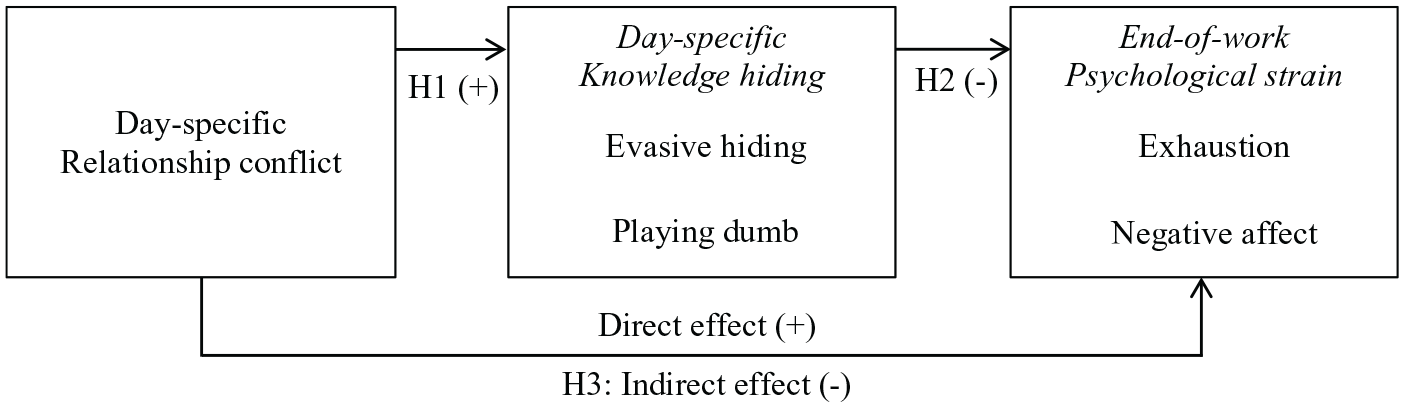
Conceptual model: Within-person (i.e., day-level) indirect effect between relationship conflict and psychological strain responses via deceptive knowledge hiding behaviors.H = Hypothesis.
To test our research model, we employed a quantitative daily measurement design. Studies suggest meaningful day-to-day variation in ‘negative’ interpersonal behaviors (e.g., Rosen et al., 2016; Vahle-Hinz et al., 2019). However, extant research on knowledge hiding focused on between-person differences (i.e., general knowledge hiding). Yet, ‘between-person research may not be appropriately capturing the within-person dynamics’ (Gabriel et al., 2019: 992) of knowledge hiding. Specifically, whereas it makes sense that outcomes like reduced creativity and damaged coworker relationships more likely result from repeated (i.e., general) knowledge hiding than from a single knowledge hiding episode, studies focusing on between-person differences fall short to examine the immediate effects knowledge hiding might have. As we argue in this article, other than the long-term consequences, the short-term effects of knowledge hiding for the hider might actually be positive. By ‘improving temporal precision’ (McCormick et al., 2020: 324), our diary approach allows to examine this possibility and, thus, helps ‘to challenge existing theory and build new theory’ (Gabriel et al., 2019: 972), that is, to reveal unique and novel insights on knowledge hiding at work (Connelly et al., 2019). Importantly, examining within-person processes in relation to knowledge hiding is not only a methodological gimmick, but offers a crucial theoretical contribution. Our approach allows for appropriately delineating the dynamics associated with knowledge hiding, thus facilitating ‘new understanding relative to that which can be gained through between-person research’ (McCormick et al., 2020: 323).
Summing up, we aim to promote a better understanding of employees’ knowledge hiding in everyday work. Thereby, our study makes important contributions: we broaden research and theory on often negatively connoted interpersonal work behaviors, in particular knowledge hiding. Specifically, addressing calls to adopt experience sampling designs in research on knowledge hiding (Connelly et al., 2019), our study expands knowledge about the immediate intrapersonal antecedents and consequences of knowledge hiding, taking also the potential psychological benefits into account. In doing so, we enrich research on the functional aspects of primarily negative work behaviors (Kelloway et al., 2010; Krischer et al., 2010; Reynolds et al., 2015). Further, in reference to the social interactionist framework (Andersson and Pearson, 1999), we introduce interpersonal conflict with coworkers as a day-level predictor of coworker-directed knowledge hiding. Doing so adds to research on employees’ immediate reactions to interpersonal conflict (e.g., Ilies et al., 2011; Martinez-Corts et al. 2015; Meier et al., 2013), taking behavioral responses into account. Overall, examining situational antecedents and intrapersonal beneficial consequences of knowledge hiding, our study brings up important implications for organizations that wish to reduce knowledge hiding among their employees.
A transactional perspective on knowledge hiding, interpersonal conflict, and strain
The transactional model (Lazarus and Folkman, 1984, 1987), which is one of the most prominent and influential theories of stress (Bliese et al., 2017), describes the stress process as a transaction between the situation and the person. Precisely, it posits that situational work stressors trigger a chain of individual cognitive and behavioral processes that mediate the stressors’ effects on psychological strain responses as the final outcome of the stress process. Psychological strain responses describe inner states that ‘are aversive to the’ employee (Jex and Beehr, 1991: 313). Occupational stress scholars typically distinguish between high-arousal (e.g., negative affect) and low-arousal (e.g., exhaustion) psychological strains (e.g., Bakker and Oerlemans, 2012), which, indeed, are the two most-frequently examined indicators of short-term psychological strain in job stress research (e.g., Klumb et al., 2017). To match with this research, we considered state negative affect, which describes a person’s momentary level of negative activated mood states such as anger, tension, and irritation (Watson et al., 1988), as well as state exhaustion, which comprises feelings of depletion, tiredness, and fatigue (Shirom and Melamed, 2006), as indicators of psychological strain as the ultimate outcome in our study.
Before psychological strains such as negative affect and exhaustion emerge in response to a stressor, the employee might perform a number of cognitive and behavioral actions that are also prompted by the stressor and that mediate the stressor-strain relationship (see Boyd et al., 2009; Folkman and Lazarus, 1988). In the transactional stress model, these mediating actions are termed ‘coping’, which is defined as ‘constantly changing cognitive and behavioral efforts to manage specific external and/or internal demands that are appraised as taxing or exceeding the resources of the person’ (Lazarus and Folkman, 1984: 141). Traditionally, coping is divided into problem-focused coping, which addresses the stressor, and emotion-focused coping, which addresses one’s psychological strain response to the stressor (Lazarus and Folkman, 1987). In principle, coping comprises both primarily positive behaviors, such as problem-solving efforts (e.g., Dijkstra et al., 2011), and usually negatively evaluated, counterproductive behaviors, such as aggression and reduced effort (Fox et al., 2001; see also Penney and Spector, 2005). Hence, despite carrying a negative connotation, CWBs might prove functional in some situations insofar as they entail the potential to reduce psychological strain responses to a stressor (Reynolds et al., 2015; Shoss et al., 2016). Put differently, at least in some situations CWBs may serve as emotion-focused coping (Krischer et al., 2010), thus potentially being instrumental (Kelloway et al., 2010; Neuman and Baron, 2005) to oppose short-term psychological strain responses.
CWBs cover a wide array of intentional work behaviors that have the potential to harm the organization or its members (Fox et al., 2001). Knowledge hiding, defined ‘as an intentional attempt by an individual to withhold or conceal knowledge that has been requested by another person’ (Connelly et al., 2012: 85) shows some overlap with CWBs. In particular, although knowledge hiding is not necessarily performed with bad intensions (Connelly and Zweig, 2015), it has the potential to harm. Accordingly, knowledge hiding has been termed a ‘counterproductive knowledge behavior’ (Serenko and Bontis, 2016: 1199).
Knowledge hiding comprises three separate behaviors, namely rationalized hiding, evasive hiding, and playing dumb (Connelly et al., 2012). When engaging in rationalized hiding, the hider offers a justification for not providing requested knowledge (e.g., because it is confidential). When enacting evasive hiding, the hider gives incorrect or incomplete information or promises to provide the requested knowledge in the future without actually intending to do so. When playing dumb, the hider pretends not to have the requested knowledge. Evasive hiding and playing dumb involve deception, while rationalized hiding rather does not (e.g., Offergelt et al., 2019; Zhao et al., 2016). Hence, one can conclude that rationalized hiding shows less overlap with CWBs and is, thus, less likely to play a role in negative social interactions at work. Indeed, Connelly and Zweig (2015) found evasive hiding and playing dumb, but not rationalized hiding, to be related to retaliation expectations and intentions. Likewise, Zhao et al. (2016) found ostracism to predict evasive hiding and playing dumb, but not rationalized hiding. Therefore, and in line with Connelly et al.’s (2019) notion that single knowledge hiding facets may be examined individually, in the present study we focused on the deceptive knowledge hiding behaviors of evasive hiding and playing dumb as being triggered by interpersonal conflict with coworkers. Because previous research suggests that evasive hiding and playing dumb might relate differently to intrapersonal outcomes (e.g., Burmeister et al., 2019), but results are inconclusive (e.g., Connelly and Zweig, 2015), we distinguish between these two knowledge hiding facets.
Altogether, adopting a transactional perspective (Lazarus and Folkman, 1984, 1987), we argue that interpersonal conflict with coworkers prompts coworker-directed evasive hiding and playing dumb, which take the function of emotion-focused coping to oppose psychological strain responses. In the following, we elaborate on these assumptions and derive our hypotheses.
Hypotheses development
Interpersonal conflict with coworkers as an antecedent of coworker-directed knowledge hiding
Interpersonal conflict, which emerges when employees perceive their goals, values, or beliefs being frustrated by others (De Dreu and Beersma, 2005), is one of the most prevalent and at the same time most upsetting workplace stressors (Bruk-Lee and Spector, 2006). It is a typical hindrance stressor (i.e., a stressor that likely interferes with or thwarts personal resources; Brady and Cunningham, 2019). As such, according to the transactional stress model (Lazarus and Folkman, 1984), interpersonal conflict unequivocally induces psychological strain responses. Specifically, because being involved in conflict poses a threat to basic needs (Frone, 2000), what increases arousal, tension, and other negative affective states (Jehn and Bendersky, 2003), interpersonal conflict tends to result in psychological strains (e.g., Dijkstra et al., 2011; Giebels and Janssen, 2005). In addition, conflict requires effort to deal with it (Martinez-Corts et al., 2015; Sonnentag et al., 2013), what ultimately might result in feeling fatigued, exhausted, and depleted. Indeed, De Dreu et al. (2002; Study 3) showed interpersonal conflict to be positively related to tension as well as fatigue. Also, meta-analytical evidence (Mazzola and Disselhorst, 2019; Spector and Jex, 1998) and literature reviews (e.g., De Dreu et al., 2004) clearly highlight the role of interpersonal conflict for employee psychological strain responses. More recent studies succeeded in replicating and extending these findings at the day level: Within persons, interpersonal conflict, in particular relationship conflict (as opposed to task conflict; Meier et al., 2013), is positively related to activated negative affective states (e.g., Ilies et al., 2011; Rispens and Demerouti, 2016) and to emotional exhaustion (Liu et al., 2015).
In addition to psychological strain responses, stressors elicit behavioral responses, which according to the transactional stress model precede the emergence of the psychological strain responses (Lazarus and Folkman, 1984, 1987). In this regard, empirical results suggest that interpersonal conflict is one of the work stressors most consistently and strongly related with negative behavioral responses in the form of CWBs (e.g., Bruk-Lee and Spector, 2006; De Wit et al., 2012), precisely with interpersonal CWBs (as opposed to organization-focused CWBs; Shoss et al., 2016; see also Chiaburu and Harrison, 2008), of which knowledge hiding is an example (Serenko and Bontis, 2016). Accordingly, Meier et al. (2013: 146) argued that ‘conflicts may start an incivility spiral’, with interpersonal conflict with coworkers (as opposed to with supervisors) being crucial in this regard (Bruk-Lee and Spector, 2006).
That employees are at all likely to react to negative treatment by coworkers with enacting negative interpersonal behaviors themselves can be explained along the premises of social exchange models (see Cropanzano et al., 2017), for example the social interactionist model (Andersson and Pearson, 1999). Social exchange theories posit that an initiating action of negative hedonic value, such as conflict, will be reciprocated by the target with a negative response (Cropanzano et al., 2017). Accordingly, the social interactionist model (Andersson and Pearson, 1999) suggests that targets might respond to experienced interpersonal conflict by enacting negative interpersonal behaviors themselves. Yet, moving beyond the assumption of direct reciprocity, the social interactionist model suggests that, in an attempt to establish justice or to defend their self-worth, targets might pay back negative acts of others not only by behaving negatively toward the offender but also by redirecting their negative reaction toward others (i.e., displaced retaliation; e.g., Rosen et al., 2016; Vahle-Hinz et al., 2019). Indeed, experiencing negative treatment, conflicts, or interactional injustice (Ambrose et al., 2002) elicits global negative interpersonal responses including low general willingness to help coworkers (e.g., Chiaburu and Harrison, 2008) or to exchange knowledge (Chen, 2011), and high overall, generalized knowledge hiding (Jahanzeb et al., 2019; Khalid et al., 2018).
In sum, because negative interpersonal interactions, as they occur in interpersonal conflict, disrupt the social equilibrium at work (Andersson and Pearson, 1999), employees who face interpersonal conflict with coworkers may feel entitled to generally deny meeting coworkers’ requests for information, that is, to hide their knowledge (Webster et al., 2008). At the same time, because usually one will have to work with the same coworkers in the future, reacting actively uncivil to a coworker’s knowledge request by, for instance, overtly refusing help might be risky. Knowledge hiding, though, is a way to more covertly deny help and knowledge exchange (Connelly and Zweig, 2015) that may be seen as a ‘less risky’ (Jahanzeb et al., 2019: 812) way of establishing justice or protecting one’s sense of self-worth after having experienced conflict–without overtly refusing to provide requested knowledge, thus not risking negative reactions in turn.
Indeed, interpersonal dynamics have been theoretically proposed and empirically shown to predict general knowledge hiding (i.e., at the between-person level; e.g., Černe et al., 2014; Connelly et al., 2012; Khalid et al., 2018; Serenko and Bontis, 2016; Zhao et al., 2016). Further, empirical evidence shows that especially coworker conflict predicts a range of interpersonal CWBs at the between-person level (e.g., Bowling and Eschleman, 2010; Bruk-Lee and Spector, 2006; Fox et al., 2001; Penney and Spector, 2005). Regarding knowledge hiding in particular, Semerci (2019) reported evidence for interpersonal conflict to predict general knowledge hiding. Yet, because research that examines knowledge hiding with an experience sampling approach is missing (Connelly et al., 2019), the question of whether interpersonal conflict plays a similar role in predicting knowledge hiding on a daily basis is open. It is, however, valuable to know whether already single conflict experiences enhance the chance that employees hide knowledge (i.e., even if they generally do not hide knowledge) or whether knowledge hiding occurs in high-conflict workplaces only–what might then be an expression of a general ‘bad’ workplace rather than of social dynamics. Based on the social interactionist model of social exchange (Andersson and Pearson, 1999) and backed by diary studies that found day-specific social stressors to predict interpersonal CWBs (e.g., Rosen et al., 2016; Vahle-Hinz et al., 2019), we hypothesize:
Hypothesis 1: Day-specific interpersonal conflict is positively related to (a) day-specific evasive hiding and (b) day-specific playing dumb.
Low psychological strain as a consequence of knowledge hiding
Extant between-person research reported a number of negative consequences of knowledge hiding. For instance, knowledge hiding has been related to reduced creativity (Bogilović et al., 2017) and innovation (Černe et al., 2017), low team performance (Wang et al., 2019), targets’ distrust (Černe et al., 2014), and, regarding playing dumb, hiders’ guilt (Burmeister et al., 2019). Yet, the immediate, within-person consequences of knowledge hiding for the hider have not been addressed in past research.
We argue that hiding knowledge on a specific day may come along with psychological benefits for the hider. As described earlier, according to the transactional stress model (Lazarus and Folkman, 1984, 1987), individuals’ behavioral responses and psychological strain reactions to stressors are related to each other in that the behavioral responses determine the psychological ones: Employees’ coping behavior shapes their psychological strain responses, with effective coping being negatively related to psychological strains (e.g., Leiter, 1991; Zhang et al., 2019). Accordingly, given that CWBs may take the function of coping (e.g., Krischer et al., 2010), we suggest that evasive hiding and playing dumb negatively predict exhaustion and negative affect. This assumption follows the notion that CWBs might be instrumental in their own right, reflecting automatic or even deliberate behaviors to obtain or protect resources, thus reducing psychological strain (Penney et al., 2011). Indeed, research shows that there are personal costs to daily helping (e.g., Koopman et al., 2016). In contrast, knowledge hiding might save the hider time, energy, and cognitive resources that would be expended if knowledge was shared (Connelly et al., 2014; Škerlavaj et al., 2018; see also Yao et al., 2020). Hence, we propose:
Hypothesis 2: Day-specific (a) evasive hiding and (b) playing dumb is negatively related to end-of-work psychological strain (i.e., exhaustion and negative affect).
Knowledge hiding as a mediating emotion-focused coping mechanism
Summing up, we propose that interpersonal conflict experienced on a specific day prompts both behavioral reactions and psychological strain responses, with the behavioral (i.e., knowledge hiding) responses negatively relating to the psychological strain responses. Combining these propositions, we suggest that the effect of knowledge hiding opposes the positive direct effect of interpersonal conflict on psychological strain responses. In other words, we hypothesize negative indirect effects of conflict on exhaustion and negative affect via evasive hiding and playing dumb that are in opposition to the direct positive effects of conflict. This form of mediation we propose equals an inconsistent mediation 1 (MacKinnon et al., 2007), in which direct and indirect effects have opposing signs.
The assumption that knowledge hiding inconsistently mediates the within-person relationship between interpersonal conflict and psychological strain responses mirrors a core notion of the transactional stress model, which, as a ‘mediational model of stress’ (Boyd et al., 2009: 197), poses ‘coping as a mediator’ (Lazarus and Folkman, 1987: 147) of the effects of stressors on psychological strain responses (e.g., Zhang et al., 2019). Consistent with the transactional stress model, some researchers (e.g., Krischer et al., 2010) have argued that, when enacted in response to a stressor, CWBs may take the function of emotion-focused coping, thus having the potential to lower stressor-induced exhaustion and negative affect (Reynolds et al., 2015). In general, coping is a behavioral response to situations when resources are threatened (Lazarus and Folkman, 1984). Likewise, ‘models of CWB position these behaviors as reactions to workplace situations in which resources are threatened or lost’ (Reynolds et al., 2015: 84), for instance when facing interactional injustice or interpersonal mistreatment, which threaten basic needs and motives (e.g., Ambrose et al., 2002) as well as require resource expenditure to deal with them (e.g., Sonnentag et al., 2013). Effective coping helps to protect threatened or to restore lost resources. Accordingly, CWBs may benefit the employee by preserving resources (Penney et al., 2011; Reynolds et al., 2015). Knowledge hiding might constitute such a way to conserve resources (Yao et al., 2020) and thus to protect employee well-being in response to experienced interpersonal conflict in particular. Specifically, concealing knowledge in the aftermath of interpersonal conflict might be relieving in that it might help to restore feelings of control or justice (Ambrose et al., 2002; Kelloway et al., 2010), which in turn might ease psychological strain responses (e.g., Van den Broeck et al., 2016), resulting in inconsistent mediation. The idea that knowledge hiding inconsistently mediates the effects of interpersonal conflict is further supported by conflict management research that has ‘established that the specific consequences of workplace conflict largely depend on the behavioral reaction to the conflict’ (Dijkstra et al., 2014: 431). In sum, in line with theorizing that CWBs potentially take the function of coping (Shoss et al., 2016) and based on the transactional model (Lazarus and Folkman, 1987), we hypothesize:
Hypothesis 3: The relationships between day-specific interpersonal conflict and end-of-work psychological strain responses (i.e., exhaustion and negative affect) are mediated by day-specific (a) evasive hiding and (b) playing dumb. Interpersonal conflict has a negative indirect relationship with end-of-work psychological strains through deceptive knowledge hiding behaviors.
Method
Participants and procedure
In the context of an empirical project on social relationships at work, psychology students recruited German-speaking employees for this study. Within their personal networks and by posting on several social media websites students distributed study information material, which contained the web link to a study registration website. This sampling strategy has the advantage of obtaining a heterogeneous sample, enhancing the generalizability of the findings (Demerouti and Rispens, 2014). We informed interested persons that, to be eligible to participate, they have to work at least 20 hours per week and have to have regular, ideally daily, contact to their coworkers. As an incentive for participation, employees who filled in at least 50% of all surveys had the chance to win one of 15 shopping vouchers, worth €10 each. To ensure data quality, the first author of this study was responsible to interact with participants (e.g., sending study emails) and monitored study registration and participation.
Registered participants were asked to complete a general one-time online survey and two daily online surveys, one at the beginning and one at the end of each workday, over the course of two workweeks (i.e., 10 workdays). For the general survey, we sent an email link in the week before the daily surveys. For the daily surveys, we sent separate email links to each survey at the time when the survey was put online. The morning survey was put online at 5 am and was accessible until 11 am. The end-of-work survey was accessible between 3 pm and midnight. In total, of 159 employees who registered for study participation, 139 persons completed the general survey. Of these, 133 persons provided entries on a total of 832 morning surveys, and 132 persons provided entries on a total of 742 end-of-work surveys, which matched to 646 complete daily data sets (i.e., morning and end-of-work survey from the same day) from 114 persons. To ensure that interpersonal conflict with coworkers and coworker-directed knowledge hiding could have occurred, in our analyses we included only days on which participants reported they had coworker contact. Further, to render within-person variation possible, we retained data only from those participants who provided valid data for at least two days. Following this logic, we excluded 31 days and 13 participants.
The resulting final sample consisted of 101 employees (65.3 % female) who provided valid day-level data (i.e., both surveys on a given day) on a total of 615 days (i.e., on average 6.1 days per participant). Mean age in this final sample was 38.6 years (SD = 12.6), mean job experience was 12.6 years (SD = 10.8), and mean weekly working time was 38.5 hours (SD = 8.7). Participants had on average 6.3 coworkers (SD = 3.8). Participants held a variety of job titles (e.g., accountant, clerk, engineer, physician, teacher) and worked in a broad range of industries, including educational (12%) and other services (19%), health care (13%), construction (9%), finance and insurance (8%), and public administration (7%). On the 615 analyzed days, participants reported to have engaged in face-to-face communication with one other coworker on average 2.9 times a day (SD = 1.9) plus in face-to-face communication with a group of coworkers 2.2 times a day (SD = 1.9). In addition, participants reported to have engaged in email communication with coworkers on average 2.9 times a day (SD = 2.4) and in phone and video calls with coworkers on average 1.9 times a day (SD = 2.1).
Measures
Study participants answered a one-time general survey and a series of daily surveys, one before and one at the end of each workday. We assessed interpersonal conflict, knowledge hiding, and psychological strain indicators daily in the end-of-work survey, in which we also measured workload as a control variable. In the morning survey, we assessed state negative affect as a control variable. All surveys were completed in German. The response format ranged from 1 (not true at all) to 5 (very true), if not indicated differently. Following scholarly recommendations on how to conduct experience sampling studies, which place a high burden on participants, we used shortened scales to measure the constructs of interests (Gabriel et al., 2019). Table 1 gives an overview of the variables’ descriptive statistics.
Descriptive statistics and intercorrelations of study variables.
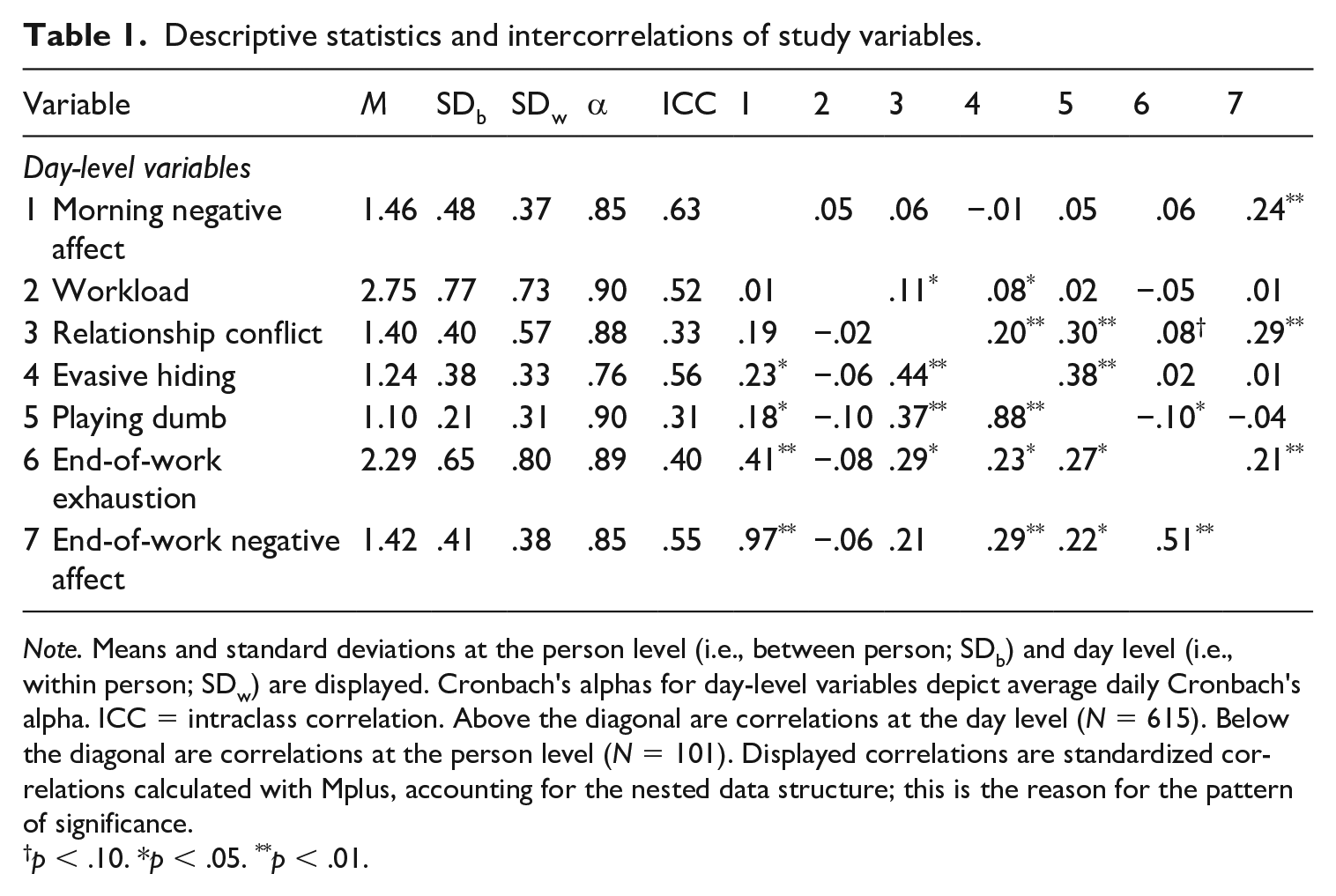
Note. Means and standard deviations at the person level (i.e., between person; SDb) and day level (i.e., within person; SDw) are displayed. Cronbach’s alphas for day-level variables depict average daily Cronbach’s alpha. ICC = intraclass correlation. Above the diagonal are correlations at the day level (N = 615). Below the diagonal are correlations at the person level (N = 101). Displayed correlations are standardized correlations calculated with Mplus, accounting for the nested data structure; this is the reason for the pattern of significance.
p < .10. *p < .05. **p < .01.
Day-specific interpersonal coworker conflict
We measured day-specific interpersonal coworker conflict in the form of experienced relationship conflict with coworkers. Occupational stress research largely suggests that, at the day level, relationship conflict is more relevant than task conflict in triggering psychological strain responses (e.g., Meier et al., 2013; Rispens and Demerouti, 2016), potentially because it is unequivocally detrimental and threatens individual self-worth and identity more than task conflict (Bechtoldt et al., 2013). We measured relationship conflict with three items derived from a measure proposed by Giebels and Janssen (2005), adapted to the day level. A sample item is ‘Today, there were personal clashes between me and my coworkers’. Average daily Cronbach’s alpha was .88. Intraclass correlation (ICC) was .33.
Day-specific deceptive knowledge hiding: evasive hiding and playing dumb
We based our measure of day-specific knowledge hiding on the scale developed by Connelly et al. (2012). Using a back-translation procedure (Brislin, 1970), we translated the items into German, and then adapted them to the day level. We used the three items with the highest factor loadings (Connelly et al., 2012) each to measure day-specific evasive hiding (e.g., ‘Today, I offered a coworker some other information instead of what he/she really wanted.’) and day-specific playing dumb (e.g., ‘Today, when one of my coworkers asked me something, I pretended that I did not know the information.’). Average daily Cronbach’s alpha was .76 for evasive hiding and .90 for playing dumb. ICCs were .56 for evasive hiding and .31 for playing dumb.
Day-specific psychological strain responses: exhaustion and negative affect
We measured end-of-work exhaustion using three items borrowed from the physical fatigue subscale of the Shirom-Melamed Burnout Measure (Shirom and Melamed, 2006), adapted to the day level. Participants had to indicate how they felt ‘today, during the last two hours at work’. A sample item is ‘I felt tired’. Average daily Cronbach’s alpha was .89; ICC was .40. We measured negative affect at the end of the workday with six items (e.g., ‘irritable’, ‘nervous’) from the Positive and Negative Affect Schedule (PANAS; Watson et al., 1988). We asked participants to report how they ‘feel at the moment’. The response format ranged from 1 (not at all) to 5 (very much). Average daily Cronbach’s alpha was .85; ICC was .55.
Control variables: workload and morning negative affect 2
To rule out the alternative explanation that employees hide knowledge on specific days because they are ‘too busy’ to share (Connelly et al., 2014), we controlled for day-specific workload, which has also been shown to be a predictor of day-specific psychological strain (e.g., Ilies et al., 2010). We measured day-specific workload with three items from the Quantitative Workload Inventory (Spector and Jex, 1998), adapted to the day level. A sample item is ‘Today, there was a great deal to be done’. Average daily Cronbach’s alpha was .90; ICC was .52. In addition, because negative affect may enhance the likelihood to engage in interpersonal CWBs (Dalal et al., 2009), we controlled for negative affect assessed in the morning survey (‘How do you feel at the moment?’) when predicting knowledge hiding. To measure morning negative affect, we used the same six items from the PANAS (Watson et al., 1988) that we used to measure end-of-work negative affect. Average daily Cronbach’s alpha was .85; ICC was .63.
Construct validity
To test discriminant validity of the constructs that we measured concurrently in the end-of-work survey, we conducted a series of multilevel confirmatory factor analyses (MCFA), using Mplus, Version 7.11. A six-factor model (workload, relationship conflict, evasive hiding, playing dumb, end-of-work exhaustion, and end-of-work negative affect) at the day level (i.e., within person) with all items loading on their intended factor had an acceptable fit, χ2 (174) = 457.555, p < .001, Scaling Correction Factor (SCF) = 1.5070, Root Mean Square Error of Approximation (RMSEA) = .051, Comparative Fit Index (CFI) = .927, Akaike Information Criterion (AIC) = 22075.752, and fit the data better than any alternative five-, four-, three-, and two-factor models as well as the one-factor model (e.g., a five-factor model with items to measure playing dumb and evasive hiding loading on one common factor, χ2 (179) = 611.307, p < .001, SCF = 1.5343, RMSEA = .063, CFI = .889, AIC = 22314.171, Satorra-Bentler Δχ2 (5) = 99.983, p < .01). These results suggest that the day-level measures represent distinct constructs.
Data analysis
To account for the hierarchical structure of our data with days nested in persons, we tested our hypotheses with a multilevel path modeling approach (Preacher et al., 2010) using Mplus 7.11. Employing the syntax provided by Preacher et al. (2010), we specified a random-intercept-fixed-slope model, in which we concurrently modeled all paths at the day level (i.e., within person). This means that we tested all hypotheses simultaneously with playing dumb and evasive hiding as parallel mediators and exhaustion and negative affect as parallel outcomes. To be able to test for the proposed 1-1-1 mediations, we also specified all hypothesized paths at the person level (i.e., between person). This procedure partitions each day-level variable that is also modeled at the person level into its latent within and between components (Preacher et al., 2010). In addition to the hypothesized paths, we modeled direct paths between relationship conflict and exhaustion and negative affect at both levels.
Results
Table 2 shows the single, unstandardized path estimates for a two-level path model in which we specified all relationships simultaneously 3 at both levels of analysis. This model yielded acceptable fit to the data, χ2 (10) = 32.36, p < .001, SCF = 1.9205, RMSEA = .060, CFI = .943, Standardized Root Mean Square Residual (SRMR)within = .058, SRMRbetween = .073. Day-level specific R2 (Bryk and Raudenbush, 1992; LaHuis et al., 2014) were .03 for evasive hiding, .04 for playing dumb, .03 for exhaustion, and .10 for negative affect.
Results of multilevel path modeling.
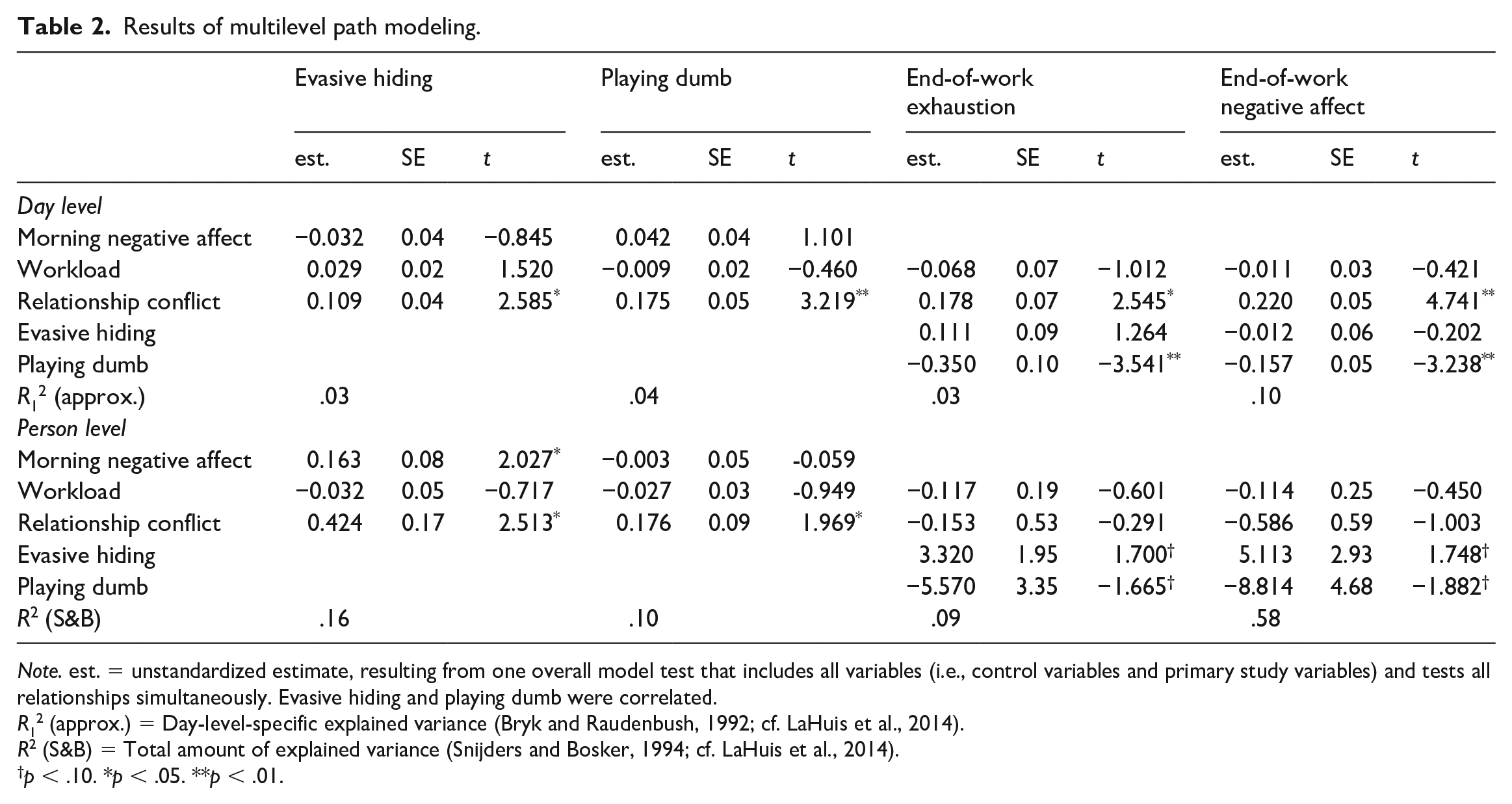
Note. est. = unstandardized estimate, resulting from one overall model test that includes all variables (i.e., control variables and primary study variables) and tests all relationships simultaneously. Evasive hiding and playing dumb were correlated.
R12 (approx.) = Day-level-specific explained variance (Bryk and Raudenbush, 1992; cf. LaHuis et al., 2014).
R2 (S&B) = Total amount of explained variance (Snijders and Bosker, 1994; cf. LaHuis et al., 2014).
p < .10. *p < .05. **p < .01.
Hypothesis tests
In Hypothesis 1, we proposed day-specific interpersonal conflict to positively relate to (a) evasive hiding and (b) playing dumb. At the day level, relationship conflict was positively related to playing dumb (γ = .18, p < .01) and to evasive hiding (γ = .11, p < .05). These results provide support for Hypothesis 1. Regarding Hypothesis 2, which relates day-specific (a) evasive hiding and (b) playing dumb to end-of-work exhaustion and negative affect, at the day level, evasive hiding was neither significantly related to end-of-work exhaustion (γ = .11, p = .21) nor to end-of-work negative affect (γ = -.01, p = .84). In contrast, playing dumb was negatively related to both exhaustion (γ = -.35, p < .01) and negative affect (γ = -.16, p < .01). Hence, we found support for Hypothesis 2b, but no support for Hypothesis 2a.
In Hypothesis 3, we proposed the day-level relationships between interpersonal conflict and psychological strains to be mediated by day-specific (a) evasive hiding and (b) playing dumb with interpersonal conflict having a negative indirect relationship with psychological strain responses via knowledge hiding behaviors. We computed the indirect effect from interpersonal conflict to psychological strains via knowledge hiding using the product of coefficient method (MacKinnon et al., 2007; Preacher et al., 2010). We used the online tool by Selig and Preacher (2008) to obtain confidence intervals of the indirect effects based on the Monte Carlo method with 20.000 simulations. When the 95% confidence interval does not include zero, this means that the indirect effect is significant at p < .05. In line with the above reported significant day-level relationships between relationship conflict and playing dumb on the one hand and between playing dumb and end-of-work exhaustion and end-of-work negative affect on the other hand, we found two significant within-person indirect effects from relationship conflict to exhaustion (indirect effect = -.06, 95% CI [-.13, -.02]) and to negative affect (indirect effect = -.03, 95% CI [-.05, -.01]) via playing dumb.
As proposed, the signs of the two significant indirect effects were negative, but the signs of the direct effects of relationship conflict (for exhaustion: γ = .18, p < .05; for negative affect: γ = .22, p < .01; see Table 2) were positive, indicating inconsistent mediation (MacKinnon et al., 2007). To take a closer look at this inconsistent mediation, we computed a model in which we excluded mediator variables (i.e., a model in which relationship conflict only directly related to end-of-work exhaustion and negative affect, what equals step 1 for testing mediation as proposed by Baron and Kenny, 1986). In this model, at the day level, relationship conflict was unrelated to end-of-work exhaustion (but showed a positive trend: γ = .13, p = .06) and positively related to end-of-work negative affect (γ = .19, p < .01). The size of this direct effect was, in both cases, smaller than the size of the direct effect under simultaneous consideration of the indirect effects (see Table 2). This supports the hypothesis of inconsistent mediation. In sum, Hypothesis 3b was supported. We did not obtain any significant indirect effect for evasive hiding. Hence, Hypothesis 3a was not supported.
Results at the person level
The data analysis procedure needed to test for 1-1-1 mediation (Preacher et al., 2010) requires modeling the within-level relationships also at the between level. Therefore, although our hypotheses refer to the day level, our data analysis procedure allows to gain insights into the study variables’ relationships also at the person level (e.g., whether a participant who, overall, experienced more conflict than the others engaged in more knowledge hiding). Because day-level relationships do not necessarily accord with those at the person level, scholars advise to explicitly test and report between-person relationships with within-person data and to contrast them with the respective within-person relationships (i.e., homology across levels; Gabriel et al., 2019; McCormick et al., 2020). We deem this particularly promising in our study, because, to the best of our knowledge, it is the first to relate knowledge hiding to hider’s negative affect and exhaustion. Hence, we also summarize the person-level results (see Table 2): At the person level, relationship conflict was positively related to both evasive hiding (γ = .42, p < .05) and playing dumb (γ = .18, p < .05). Yet, evasive hiding and playing dumb were not significantly related to neither exhaustion (evasive hiding: γ = 3.32, p = .09; playing dumb: γ = -5.57, p = .10) nor negative affect (evasive hiding: γ = 5.11, p = .08; playing dumb: γ = -8.81, p = .06). Thus, we did not obtain any significant indirect effect at the person level.
Supplementary analyses
To check for the robustness of our findings and to enhance validity of our results, we conducted additional analyses in which we considered that conflict and knowledge hiding behaviors were measured in a cross-sectional manner all relating to the same time period (i.e., the whole workday). First, we tested an alternative path model in which we reversed relationship conflict and knowledge hiding behaviors, testing conflict as the outcome of playing dumb and evasive hiding. This model did not yield acceptable fit, χ2 (14) = 196.667, p < .001, RMSEA = .148, CFI = .538, SRMRwithin = .049, SRMRbetween = .209. While playing dumb significantly predicted relationship conflict at the day level (γ = .48, p < .01), evasive hiding did not (γ = .16, p = .10). At the person level, neither playing dumb (γ = -.28, p = .74) nor evasive hiding (γ = .62, p = .23) predicted relationship conflict. Hence, while conflict predicted both evasive hiding and playing dumb at both analytical levels, only playing dumb predicted conflict only at the day level; This speaks against a generally reversed relationship with knowledge hiding triggering conflict, supporting our theoretical notion that situational stressors more likely elicit behavioral responses than vice versa.
Second, we considered lagged relationships from one workday to the next (see Gabriel et al., 2019); These analyses are based on data from 85 employees on 366 subsequent days both with coworker contact. We specified a within-person path model in which we predicted playing dumb and evasive hiding at day t by relationship conflict at day t-1, relationship conflict at day t, morning negative affect at day t, and workload at day t. Further, to approach causality (Gabriel et al., 2019), we took autocorrelations into account, regressing evasive hiding at day t on evasive hiding at day t-1 and playing dumb at day t on playing dumb at day t-1. This model fit well, χ2 (2) = 2.601, p = .272, RMSEA = .029, CFI = .995, SRMRwithin = .019. Previous day’s conflict was not significantly related to playing dumb (γ = -.06, p = .07) and evasive hiding (γ = -.06, p = .12), while same-day conflict positively predicted playing dumb (γ = .20, p = .01) and evasive hiding (γ = .16, p = .01) beyond previous day’s playing dumb (γ = .22, p = .04) and evasive hiding (γ = .47, p < .001), respectively. These results support our idea that knowledge hiding is an immediate reaction to relationship conflict.
Discussion
Results of our quantitative diary study demonstrated that, at the day level, relationship conflict was positively related to deceptive knowledge hiding in the form of playing dumb and evasive hiding. Further, playing dumb was negatively related to end-of-work exhaustion and negative affect, resulting in an indirect within-person negative effect of relationship conflict on end-of-work psychological strain responses via playing dumb. Altogether, the day-level direct positive effect of relationship conflict on psychological strain responses was contrasted by the indirect negative effect of relationship conflict on psychological strain responses via playing dumb (i.e., inconsistent mediation; MacKinnon et al., 2007). Evasive hiding, however, was not related to end-of-work psychological strain responses.
Theoretical and empirical implications
Theoretically embedded within the transactional stress model (Lazarus and Folkman, 1984), our research shows that the rather negatively connoted knowledge hiding behavior of playing dumb (e.g., Burmeister et al., 2019) might actually, at least in the short term, represent a functional coping strategy to deal with day-specific relationship conflict. As such, our study complements current research on ‘the dark and the bright side’ of interpersonal work behaviors (e.g., Koopman et al., 2016). While this stream of research has mainly focused on positive behaviors such as helping, our study broadens this focus by including the functional side of ‘negative’ interpersonal work behaviors, specifically playing dumb. Hence, our study contributes to literature that addresses the instrumentality of CWBs (Krischer et al., 2010; Reynolds et al., 2015; Shoss et al., 2016) and complements research that focused on the negative intrapersonal consequences of knowledge hiding (e.g., Burmeister et al., 2019; Offergelt et al., 2019). In sum, shedding light on the potential whys and wherefores of knowledge hiding in everyday work, our results support Neuman and Baron’s (2005) idea that two central, possibly unconscious, motives underlie interpersonal deviance, namely, to react to social stressors, such as interpersonal conflict, and to obtain positive intrapersonal outcomes, such as to prevent or oppose resource depletion or to feel better.
Regarding the intrapersonal outcomes of knowledge hiding, while evasive hiding was unrelated to end-of-work psychological strain responses, playing dumb was negatively related to them. This finding supports other evidence that indicated meaningful differences between evasive hiding and playing dumb (e.g., Burmeister et al., 2019), pointing to the usefulness of examining the knowledge hiding facets as separate constructs (Connelly et al., 2019). Specifically, our results suggest that playing dumb is a rather quick, complete and utter way to hide knowledge that instantly unfolds its coping function, thus relating to immediate low psychological strain. When enacting evasive hiding, in contrast, hiders more likely need to spend time and effort (e.g., by sharing different information than what was asked for), which could not only be exhausting, but could also elicit a more pronounced interruption experience or lead to time pressure, which in turn might prompt negative affect (e.g., Sonnentag et al., 2018). Thus, the positive and the negative intrapersonal effects of evasive hiding possibly cancel each other out. Besides, in reaction to evasive hiding (e.g., promising to give the information later) the supplicant might actually come back and try again to get the requested knowledge, thus not lowering tension until end of work. Possibly, the alleviative effect of evasive hiding crops up only after work when employees can be sure that the target of their evasive hiding will not come back. Future research on the intrapersonal outcomes of different knowledge hiding behaviors will thus benefit from including further daily measurement points, including time after work.
Our study also has implications for research on the predictors of knowledge hiding (e.g., Connelly et al., 2012; Škerlavaj et al., 2018), for research on within-person processes related to interpersonal conflict at work (e.g., Rispens and Demerouti, 2016), and for research on spirals of negative interpersonal work behaviors (e.g., Rosen et al., 2016; Vahle-Hinz et al., 2019). More precisely, taking behavioral (i.e., knowledge hiding) responses into account, we contribute to research on employees’ immediate reactions to interpersonal conflict in general (e.g., Ilies et al., 2011) and to the literature on day-specific consequences of relationship conflict in particular (e.g., Martinez-Corts et al., 2015). Specifically, we found that relationship conflict is not only relevant for psychological strain responses, but also for behavioral responses in the form of playing dumb and evasive hiding.
Last but not least, we want to emphasize that our day-level results did not completely generalize to the person level, supporting the notion that day-level relationships do not simply mirror person-level relationships (see Gabriel et al., 2019; McCormick et al., 2020) and pointing to the usefulness of employing a diary approach to study knowledge hiding, its antecedents, and consequences. Specifically, while relationship conflict was positively related to playing dumb and evasive hiding also at the person level–replicating earlier findings (Semerci, 2019) on the predictive role of interpersonal conflict for knowledge hiding–playing dumb and evasive hiding were not significantly related to psychological strain responses at the between-person level. Yet, for evasive hiding the relationships even showed a positive trend. Overall, our findings suggest that it is not employees high on knowledge hiding who generally experience low psychological strain, but that it is on days when employees hide knowledge, more precisely play dumb, they feel better. As such, our results imply that the coping function of playing dumb is a short-lived, immediate function. At the same time, considering the person-level results, evasive hiding might be straining in the long run; potentially because of the effort involved in it as discussed before. Future longitudinal studies are needed that examine hiders’ long-term psychological strain responses as outcomes of knowledge hiding.
Limitations and directions for research
Despite its advantages, that enabled us to examine immediate intrapersonal antecedents and consequences of daily deceptive knowledge hiding, our research has some limitations, which might be considered and ideally overcome in future studies. First, we employed only self-report measures, raising concerns about potential common method bias (Podsakoff et al., 2012). Yet, Fuller et al.’s (2016) data simulation found that common method bias does not represent a serious threat to the validity of study findings when based on sufficiently reliable measures. Still, though, the measurement of CWBs might suffer from social desirability or non-response bias (Greco et al., 2015). Hence, employees might underreport their knowledge hiding (Černe et al., 2014), which is a low base-rate phenomenon anyway (Connelly et al., 2012). The potentially resulting range restriction and small within-person variance might attenuate relationships (Greco et al., 2015). However, because knowledge hiding is a covert behavior hardly observable by others, self-ratings are the most viable measurement option (see Berry et al., 2012; Connelly et al., 2019). To alleviate concerns related to self-ratings, we utilized morning negative affect as a control variable for knowledge hiding. Moreover, the diary design and related multilevel analyses rule out that the within-person findings are due to between-person differences like, for instance, a person’s general tendency to respond in a socially desirable way (Gabriel et al., 2019). Future studies might benefit from using non-self-report measures to assess conflict (e.g., coworker-ratings; Bruk-Lee and Spector, 2006) and from including physiological strain responses (e.g., Klumb et al., 2017).
Second, although measured on a daily basis, we assessed interpersonal conflict and knowledge hiding in a cross-sectional manner at the end of the workday both relating to the whole day at work. Hence, we cannot actually conclude that interpersonal conflict causes knowledge hiding. However, knowledge hiding is a covert behavior hardly observed by coworkers and is, therefore, less likely to cause immediate conflict than vice versa. Moreover, because knowledge hiding is more inactive than conflict and because ‘it is somewhat uncommon for an inactive initiating action to generate an active response’ (Cropanzano et al., 2017: 27), in particular at the day level it is more likely that interpersonal conflict triggers knowledge hiding than vice versa. Accordingly, results of an additional analysis suggest that a reversed relationship is less likely. Also, day-specific conflict predicted evasive hiding and playing dumb beyond previous day’s knowledge hiding, enabling ‘stronger causal inferences’ (Gabriel et al., 2019: 994). Nevertheless, in order to further strengthen causal inferences, event sampling and longitudinal studies or, even better, experiments (e.g., Černe et al., 2014, Study 2; Connelly et al., 2012; Škerlavaj et al., 2018, Study 2) are needed.
Third, knowledge hiding has been originally introduced as a dyadic phenomenon (Connelly et al., 2012). In our study, though, we captured interpersonal conflict with one or more coworkers as well as knowledge hiding behaviors toward one or more coworkers. While recent studies on the social predictors of knowledge hiding used the same approach (e.g., Jahanzeb et al., 2019; Semerci, 2019), this way of how we measured conflict and knowledge hiding does not guarantee that conflict partners and knowledge hiding targets were the same persons. However, the social interactionist framework (Andersson and Pearson, 1999) and empirical findings indicate that employees do not only engage in direct retaliation toward conflict partners, but that experienced conflict might incite them to engage in a rather broad set of negative interpersonal behaviors toward a range of targets (e.g., Penney and Spector, 2005; Liu et al., 2015). Yet, with our study we cannot answer the question of how daily dyadic social exchange patterns relate to dyadic knowledge hiding. Here, an event-based approach (e.g., Connelly et al., 2012, Study 1), which is especially suited to study incidents with a low occurrence rate (Reis and Gable, 2000), might allow for more accurate insights into the social dynamics of daily knowledge hiding.
Lastly, while our quantitative within-person approach facilitates a more thorough understanding of knowledge hiding by addressing the dynamics inherent to interpersonal interactions at work and, thus, enabling ‘an immediate sense’ (Gabriel et al., 2019: 972) of knowledge hiding, it can only offer part of the answer to the question of why employees hide knowledge. Specifically, while our design allowed to examine how change in the status of knowledge hiding relates to change in the status of conflict, negative affect, and exhaustion within a workday without having to ask for an employee’s conscious reasons to hide knowledge (e.g., without the employee having to be aware that knowledge hiding relates to experienced exhaustion), it only covered a small number of potential correlates of knowledge hiding. We consider qualitative approaches to be a useful addition to learn more about why employees hide knowledge from their coworkers.
Besides some methodological implications, our research opens up interesting questions that future studies might want to address. For instance, by including moderator variables, future studies could look at the chronic situational (e.g., leader behavior, Offergelt et al., 2019; task interdependence, Hernaus et al., 2019) or personal (e.g., personality, Bowling and Eschleman, 2010; reciprocity beliefs, Jahanzeb et al., 2019) circumstances that shape an individual employee’s probability to react to interpersonal conflict with knowledge hiding. Similarly, future diary studies could examine for whom or under which circumstances knowledge hiding is not negatively, or even positively, related to psychological strain responses. Such studies could further benefit from including rationalized hiding as well as from considering other intraindividual consequences of knowledge hiding, such as moral emotions (see Burmeister et al., 2019) or job performance. Also, in expanding their daily data collection efforts to include coworker dyads, researchers might examine the short-term consequences that knowledge hiding has for the targets. In addition, research is needed that addresses the long-term outcomes of knowledge hiding for hiders and targets. In this regard, the well-being and performance consequences for both parties as well as the costs knowledge hiding has for the dyadic exchange relationship (see Connelly et al., 2012) are of interest. Ideally, future studies examined the short- and long-term consequences together, testing the possibility that knowledge hiding, for instance, increases individual short-term performance, but decreases team long-term performance (e.g., Wang et al., 2019).
Another promising avenue for future research is to examine the mechanisms that underly the intrapersonal effects of knowledge hiding. In this regard, we have offered several theoretical ideas for why day-specific knowledge hiding might relate negatively to exhaustion and negative affect. These assumptions need empirical examination. For example, we have argued that knowledge hiding might save the hider’s time, energy, and cognitive resources (e.g., Connelly et al., 2014; Škerlavaj et al., 2018) as well as that knowledge hiding in the aftermath of conflict might help restore feelings of self-worth, control, or justice (e.g., Ambrose et al., 2002; Kelloway et al., 2010) that have been threatened by the conflict. Accordingly, variables such as time pressure, cognitive vigor, or justice perceptions might be tested as mediators of the knowledge hiding-psychological strain relationship.
Practical implications
Even though our findings suggest potential positive short-term intrapersonal consequences of knowledge hiding, its interpersonal and organizational consequences are likely to be adverse (e.g., Černe et al., 2014; Connelly and Zweig, 2015). These detrimental effects of knowledge hiding must be kept in mind when deriving practical implications from our research. Hence, even though we found short-term benefits, knowledge hiding should be discouraged. Several organizational means have been suggested in this regard, such as stressing the importance of intraorganizational knowledge exchange and establishing a knowledge-sharing climate (Connelly et al., 2012; Connelly and Zweig, 2015; Serenko and Bontis, 2016).
In addition to these means, our finding of a positive association between relationship conflict and deceptive knowledge hiding suggests that preventing or at least efficiently solving coworker conflicts will help to reduce the incidence of knowledge hiding and, what is more, will limit the negative consequences relationship conflict may have for employee well-being. To avoid relationship conflict, Meier et al. (2013) suggested to create trust climates–what will likely also prevent knowledge hiding (e.g., Černe et al., 2014). To improve conflict management, the creation of collaborative conflict cultures (Gelfand et al., 2012) and the implementation of conflict management interventions (e.g., Leon-Perez et al., 2016) seem worthy. In general, problem-focused conflict management strategies, such as active problem solving, are more functional than emotion-focused strategies (e.g., Dijkstra et al., 2011). Hence, while knowledge hiding might facilitate a short-term relief from psychological strain, it is very likely not the most effective conflict management strategy. Thus, interventions to teach employees effective ways to manage conflict at work should focus on pro-active, collaborative problem-solving behaviors (Dijkstra et al., 2011; Leon-Perez et al., 2016). In addition, the negative relationship between playing dumb and immediate psychological strains indicates a need to provide employees with the resources necessary to share knowledge, thus discouraging playing dumb.
Conclusion
In conclusion, our study contributes to research on ‘negative’ interpersonal work behaviors, in particular deceptive knowledge hiding. In showing that playing dumb in reaction to day-specific coworker conflict might benefit daily well-being, our study enriches research on the instrumental functions of primarily negative work behaviors, broadens the literature on the within-person benefits and harms of interpersonal work behaviors, and adds to studies on employees’ short-term reactions to interpersonal conflict.
Footnotes
Acknowledgements
We thank Marvin Ganz, Marina Kamburova, Andrea Laura Macavei, and Tabea Anna Schiele for their invaluable help in collecting the data, and Sabine Sonnentag for providing extremely useful feedback on an earlier version of this article.
Funding
The author(s) received no financial support for the research, authorship, and/or publication of this article.
