



Abstract
Background:
Despite anatomically correct models (ACMs) being recommended internationally for their ability to serve as real-life, age-appropriate, and practical models in comprehensive sexuality education (CSE) for learners with visual impairment, there is still limited research exploring South African teachers’ views regarding their use.
Objectives:
The aim of this study was to explore how South African teachers of learners with visual impairment view the use of ACMs during their CSE lessons.
Method:
This study used a qualitative approach and an exploratory, multiple case study research design. A total of 36 teachers from five schools for the blind were convenience sampled and data were generated via focus group discussions. The theory of planned behaviour underpinned this study, while data were analysed thematically.
Results:
Most teachers reacted with fear and resistance towards the use of ACMs in their teaching. Their responses were based on embarrassment, shame, and discomfort in handling the models. Part of the reason for this was that most teachers had not received prior teacher education about the use of the models. Some teachers falsely believed that ACMs were pleasure-enhancing devices. Others recommended their use only for blind learners, while yet others stated that they would use ACMs because of their practical value.
Conclusion:
Findings suggest that future research is needed on how best to engage the teachers of learners with visual impairment in self-awareness and desensitisation teacher training. Recommendations for a critical teaching framework, revisions to the CSE curriculum, as well as guidelines for teacher education are provided to facilitate teachers’ use of learners with visual impairment ACMs in their CSE lessons.
Keywords
Introduction
Learners with visual impairment, that is, those with partial to complete loss of vision, face various obstacles in accessing visual or written forms of comprehensive sexuality education (CSE) (Kelly and Kapperman, 2021; Rohleder et al., 2009, 2020; Wild et al., 2014). CSE is a rights-based curriculum that promotes accurate understandings, beliefs, values and attitudes about safe sexual practices; gender and sexuality diversity; desire, power, consent, pleasure and communication for individuals and for people in relationships (United Nations Educational, Scientific and Cultural Organization, 2018). For learners with visual impairment, even with audio-translated resources like CSE-themed seminars, podcasts, and television programmes, talk alone may be insufficient to transfer a real-world understanding of the complexity of human sexual anatomy and expression (Kamehama, 2019; Kelly and Kapperman, 2012; Krupa and Esmail, 2010). For example, during their early years, many learners with visual impairment would like to know what the differences are between boys and girls, as well as children who do not ‘fit’ within either binary based on their voice, dress, personality, facial appearance and bodily features (White, 2003). During adolescence, learners with visual impairment also experience puberty in a similar way to their sighted peers but encounter challenges associated with specific aspects of psychosexual development, such as where the vagina is located, where the vaginal opening is, or how to put on a male or female condom (see the important work by Hicks, 1980 for more detail on these issues). Their teachers moreover may lack appropriate training and the resources to demonstrate the referred aspects in a practical manner. Teaching and learning for learners with visual impairment is therefore still replete with uncertainty, especially in relation to human anatomy as part of CSE (Kamehama, 2019; Kelly and Kapperman, 2012; Krupa and Esmail, 2010).
Background
There is a need for specialised teacher education training, especially when working with students with disabilities. To meet this need, the literature suggests the use of alternative strategies that provide tactile and holistic information regarding human sexual anatomy and expression (Kamehama, 2019; Kelly and Kapperman, 2012; Krupa and Esmail, 2010). One recommendation suggested by international and local research is for learners with visual impairment and their educators to integrating the use of anatomically correct models (ACMs) and other supporting technologies into their CSE lessons (Kapperman and Kelly, 2014; Krupa and Esmail, 2010; Ubisi, 2023). ACMs refer to any externally used, three-dimensional (3D), educational models of the human sexual genitalia (see Holmes, 1974; Scholl, 1974; Torbett, 1974; for more detail). ACMs do not include dildos, vibrators and other aids that are not primarily used for educational purposes but instead are recommended to enhance sexual pleasure.
Through its national professional teaching standards, The South African Council for Educators (SACE, 2010) seeks to ensure that teachers have the skills and experience necessary to teach a wide range of children and young people in schools. The South African Government’s Department of Basic Education, in a report by Asmal (2001), has highlighted the importance of providing CSE to children living with disabilities, but makes no specific reference to those who are learners with visual impairment, implying that their needs are learners with visual impairment less important. Depending on the knowledge, skills, and resources available to a teacher or another educator, scholars suggest that ACMs should be introduced to a class or child in a manner appropriate to their age, the severity of disability, as well as their stage of psychosexual development (Kapperman and Kelly, 2013; Reynolds, 2019; Ubisi, 2023). Importantly, parental consent with respect to the learner(s) should be kept in mind when ACMs are to be introduced within a specific context.
Controversies surrounding CSE and ACMs
In multi-cultural and religious landscapes such as those present in South Africa, where some religious and cultural groups find talking about sex, gender and sexual diversity to be taboo (Bhana et al., 2019; Ngabaza and Shefer, 2019; Ubisi, 2023), the intersection between of disability and sexuality may be hard to grapple with (Chappell et al., 2018; Davies et al., 2024; Hanass-Hancock et al., 2018a, 2018b; Rohleder et al., 2009). Conversation about the sexuality of children with disabilities may be uncomfortable and/or seen as unnecessary by teachers or parents who share conservative moral, cultural, and religious attitudes (Chirawu et al., 2014; de Reus et al., 2015; Rohleder et al., 2009). In South Africa, scholars such as Bhana et al. (2019), Mayeza and Vincent (2019) and Ngabaza and Shefer (2019) have written about the ‘pedagogy of discomfort’ that makes some teachers uncomfortable when teaching CSE themes like abortion, same sex relationships, or anal sex.
Some teachers find it useful to use props such as bananas and oranges to teach learners about male and female sex organs respectively. One example of this can be found in Msutwana and De Lange’s (2017) article entitled, ‘Squeezed oranges?’ in which Xhosa women secondary school teachers recall their own learning about sexuality as part of a process of reimagining their teaching sexuality education. They recalled how the use of such items was limited when it came to demonstrating the complexity of the internal and external female sexual organs, including the vulva, inner and outer labia, the clitoris, and the vaginal opening (Msutwana and De Lange, 2017). For this reason, teachers of learners with visual impairment have been encouraged to use ACMs as real-life, age-appropriate, and practical models (Kelly and Kapperman, 2021; Ubisi, 2023; Wild et al., 2014). However, as it stands, limited research exists in South Africa which explores teachers’ learners with visual impairment views regarding the introduction of these models into their CSE lessons (Ubisi, 2023).
Theoretical orientation
Ajzen’s (1991) theory of planned behaviour (TPB) was used to analyse teachers of learners with visual impairment views towards the use of these models. According to Ajzen and Klobas (2013), three factors influence human intentions and ensuing behaviours: behavioural attitudes, subjective norms, and perceived behavioural control. In terms of attitudes, Ajzen (1991) was interested in how individuals perceive and evaluate the range of possible outcomes of participating in a particular behaviour. For example, if a teacher believes that they will make a difference by introducing ACMs into their CSE lessons, then this will likely increase the likelihood of their incorporating these models into his or her lessons. In contrast, if a teacher sees this behaviour as incongruent with any interest or benefit to them, then a change in behaviour will not likely take place. Regarding subjective norms, if a teacher feels that their colleagues might praise them for introducing the models into their lessons, then this will greatly increase the possibility of the teacher using these models to elicit positive regard from others. As for perceived behavioural control, or what Bandura (1994) called self-efficacy, if a teacher believes they can lead a lesson using ACMs in the classroom, then the behaviour will more likely take place. Ajzen and Klobas (2013) suggested that all three of these factors are what determines our intentions towards new behaviour. The relationship between these predictors and intentions as well as new behaviour is shown in Figure 1.
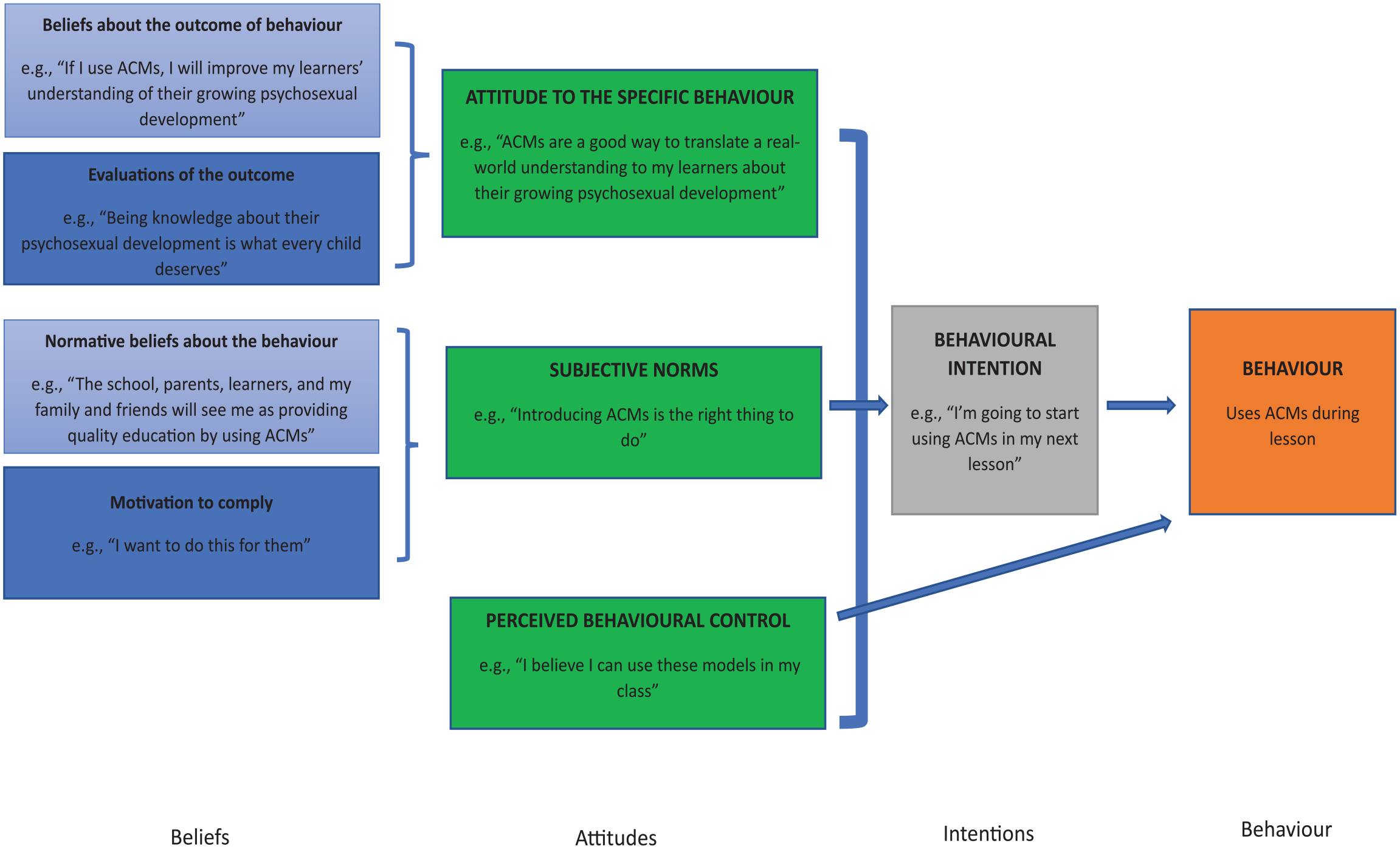
Factors that may influence teachers of learners with visual impairment views and intentions in introducing anatomically correct models to comprehensive sexuality education lessons according to the theory of planned behaviour.
Method
Project description
This study forms part of a larger funded project to develop a CSE curriculum for learners with visual impairment in South Africa. This qualitative study explores teachers’ views regarding the introduction of ACMs into their CSE lessons. In this small-scale investigation, the researchers used a qualitative and exploratory case study design to describe the limited information we have about the lived (and shared) views of teachers about using ACMs to teach CSE lessons (Nieuwenhuis, 2007).
Sampling
Participants were identified from five schools for the blind in three provinces: Gauteng, Kwa-Zulu Natal, and Western Cape Province. Teachers were convenience sampled based on their years of teaching and interest in the CSE curriculum. Teachers who were interested in participating in the study expressed their interest by responding to an invitation e-mail forwarded to them by the school principal. Overall, 36 teachers (33 female and 3 male teachers) agreed to participate in focus group discussions. They taught at the foundation, intermediate and senior phases of education (Table 1). One female teacher was herself visually impaired.
Participants’ characteristics.
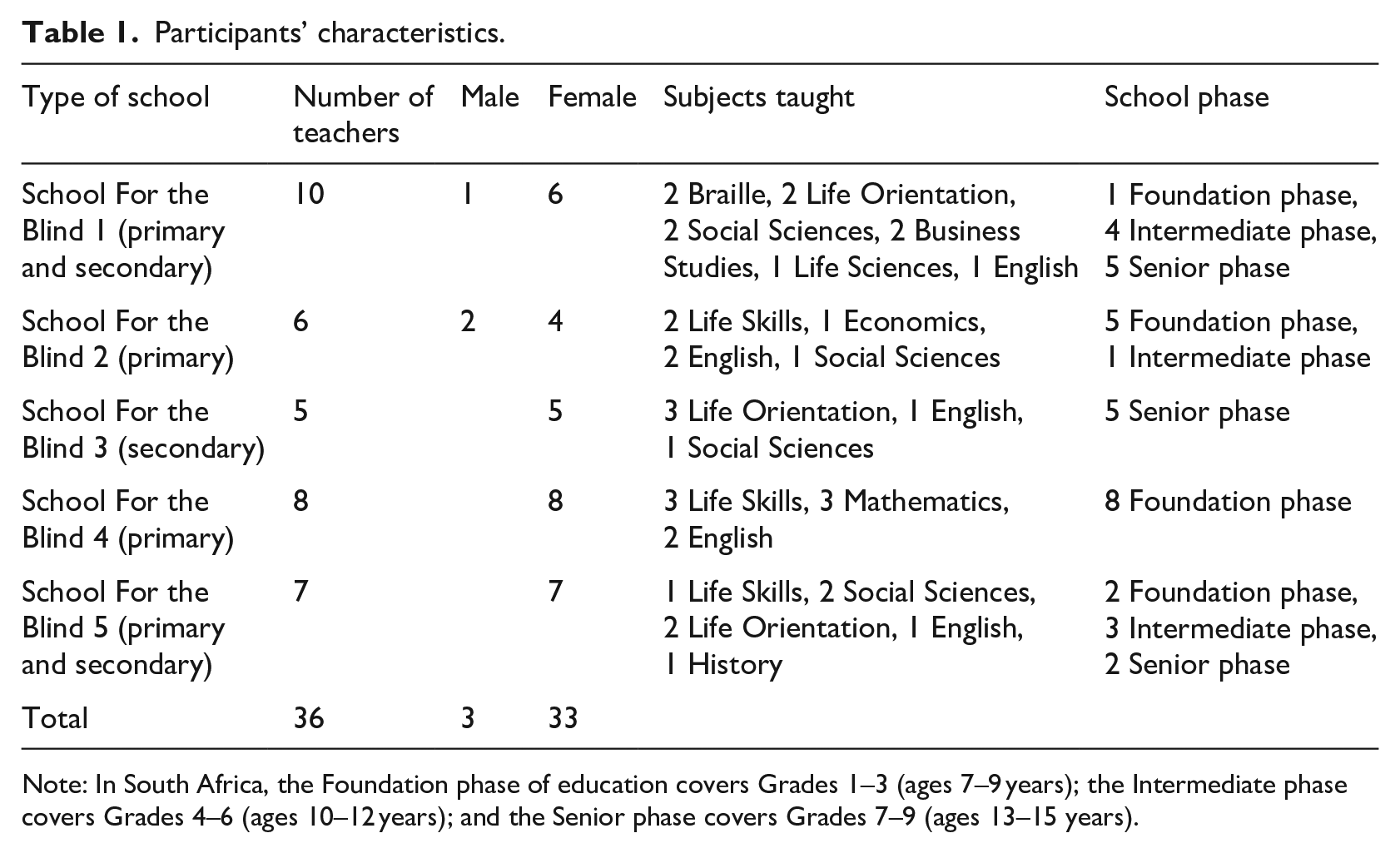
Note: In South Africa, the Foundation phase of education covers Grades 1–3 (ages 7–9 years); the Intermediate phase covers Grades 4–6 (ages 10–12 years); and the Senior phase covers Grades 7–9 (ages 13–15 years).
Data collection methods
Focus group discussions with teachers lasted 1 to 3 hours, with coffee and lunch breaks. The discussions were conducted on the school premises after school hours. Schools were about to close for the term, which led to teachers ending their working hours at 13:00 hrs. This enabled the discussions to be conducted without disturbing teachers’ regular work schedule. A semi-structured interview guide was used which had been developed from the international literature as well as discussions with school principals during familiarisation visits. Samples questions included the following: have you been previously trained to use ACMs; do you know what an ACM is; and what do you think about ACMs?
In line with the University of South Africa’s Research and Ethics Committee’s policy on data management, the audio-recordings and written transcripts will be stored in a Google Drive file, only to be accessed by the project team and destroyed after 5 years.
Data analysis
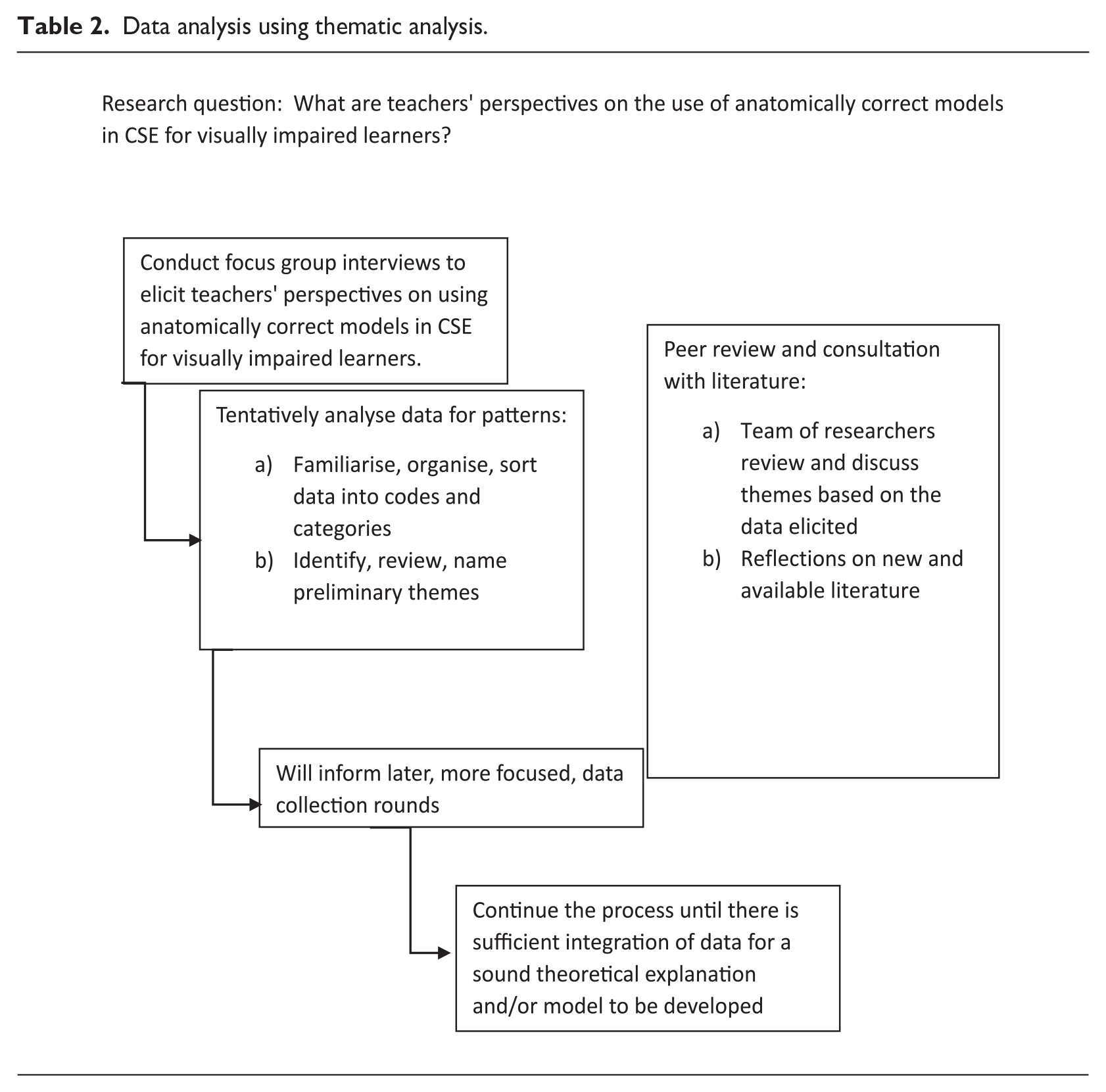
Data were analysed using Braun and Clarke’s (2006) six step thematic analysis (Table 2): (1) immersion in the data, (2) creation of initial codes, (3) search for possible themes, (4) review of initial themes, (5) organising and naming themes in relation to the research questions, the available literature and the selected theoretical framework, and (6) write up of the findings.
Data analysis using thematic analysis.
Ethical considerations
Ethical clearance (Protocol Number: 022/04/13/90352025/02/AM) was received from the University of South Africa’s Research and Ethics Review Committee. Data were collected with informed consent. Teachers participated voluntarily in the study and could decline to do so with no negative sanctions. Participants were assured of confidentiality with respect to information shared. Permission to conduct the research in schools was also obtained from the relevant heads of provincial education departments, namely the Gauteng Department of Education, the Western Cape Department of Education, and the KwaZulu Department of Education.
Findings
All the teachers in the study indicated that they had not been trained in the use of ACMs as part of their teacher education. The following themes were developed from the analysis of the data: (1) teachers’ embarrassment and discomfort, (2) teachers’ preference for the use of sexually neutral supports, as well as (3) teachers’ desire to provide only essential information and proceed caution.
Embarrassment and discomfort
An immediate reaction from most of the teachers was embarrassment about handling the ACMs in class. SFB1A, a female intermediate phase teacher, for example, pointed out that use of the models would not only embarrass her but learners as well, because she has never touched one before and learners have been told from an early age that their genitals were private:
A sexual device, imagine, oh my word, imagine! Me, myself certainly have never handled one. So, you can imagine that I must go and explain to the children about that!? It would be totally uncomfortable for me. . . . If I do that in class (use an ACM), in front of a class where children can see, immediately, they will all be embarrassed and very uncomfortable. Because it’s something that you teach a child from a very early age, that it [the genitalia] is a private thing.
SFB3A, a female, intermediate phase teacher, was worried about showing the ACMs to young children:
I for one, I don’t feel comfortable. Like it was last year that they said they were going to introduce sex education to Grade 3 learners. I was like, telling a Grade 3 learner how a baby comes, all that stuff–Oh I won’t [do that]. I don’t think it’s appropriate for them to know that [sort of thing].
SFB1B, a female, foundation phase teacher, maintained that demonstrating using a vagina model would for her be like symbolically exposing her own sexual organs. This made her feel embarrassed.
I think I’m uncomfortable because I don’t know how to say it. Maybe I’m giving them a part of myself. If I’m putting a mould of a vagina there, and I’m letting them come around there to see what it’s like. . . . I feel I’m kind of exposing myself in a way. I feel like, as I said, it just feels like it’s bordering on pornography for me in a way.
The above responses suggest that teachers brought their own values to their teaching practice. Their personal values and beliefs regarding sexuality set limits on how they could teach topics related to sexuality and reproduction.
Preference for sexually neutral objects
Some teachers stated that they would prefer using sexually neutral objects like a banana for demonstrations of how to put on a male condom on a penis. SFB1C, a female, intermediate phase teacher, for instance alluded to the fact that the banana would likely create a neutral atmosphere in which the focus would strictly be on the lesson and not the body part itself:
When I start my class, I would start by saying, ‘I’m gonna hand each of you a banana and a condom’. [That way] already you create an environment that’s neutral. So, were I seriously tell them I’m gonna give you a plastic penis or a sexual device. . . . I would rather say you put [it on] the banana now, and this is why we are going to do this exercise. . . . The discipline needs to be strict and neutral like I said.
For this teacher, using a banana would avoid the need to get into detailed discussion because it already resembles a penis. SFB2A, a male, intermediate phase teacher suggested that bringing these models into class and allowing learners to feel and touch them would increase learners’ interest in exploring real human sexual genitalia:
I’m now thinking of teenagers. Now you are bringing a vagina in class, and I know with boys, when you are teenagers, there’s that curiosity as to how does it really look like. It is not the one that you see on TV and so forth. Now someone is bringing it to you in class. . . you get to feel it’s made of silicon and what. So, the next thing, it is now taking you out of the classroom.
Besides the risk of triggering a negative reaction from parents, another concern brought up by SFB1E was the risk of the models disappearing if they were stored in the classroom:
. . . the type of learners that we are having, we will be doing these things for them, and that we are helping them, but what if they steal those things?
What stood out most in the above discussions was how teachers conflated ACMs with sex toys such as dildos and vibrators. Even when the manufacture and uses of ACMs were explained, it became clear that teachers still considered the models to be as pleasure-enhancing devices.
Provide only essential information and proceed with caution
Most of the teachers spoken to in this study preferred to ‘sanitise’ discussion of sex and sexuality using a disease and abstinence focused curriculum. For example, SBF1A, was in favour of a conversation and text-based curriculum instead of a practical lesson incorporating ACMs:
I don’t think it’s necessary for a blind learner to have extra. . .what do you call it. . .extra stuff, like models and what not. . . . I feel conversation is more than enough and text. . . [That way] they can explore [these things] by themselves like we all did when you were young. . . The important stuff for me is like I said, diseases and [the] consequences of things, not that (sex) itself.
SFB3A acknowledged that despite her own discomfort with ACMs, she felt ACMs would help if introduced to Grade 11 and 12 learners (aged 16 and above):
You know, I also wouldn’t be comfortable having these models. But in terms of progressing, it’s very uncomfortable, but if it’s going to. . .you know a lot of these kids end up getting HIV and Aids. . . . So, if it means . . . decreas[ing] teenage pregnancy, then in terms of Grade 11 and 12, I’m sure we could do it.
SBF5A, a female, senior phase teacher, pointed out that ACMs would provide more tactile and meaningful information equivalent to the pictures used for their sighted peers:
For a blind child, uncomfortable as it may be, I am saying we do need something like that (ACMs). The print learner has pictures. . .but now this blind child must imagine all those things.
SBF1E, a female, senior phase teacher who is also a registered educational psychologist, indicated the need to de-sexualise ACMs following an incident in which a boy had brought one of his parent’s vibrators to class:
At one stage, they called me in because they had a Grade 1 boy (aged 7) with a vibrator in class. So, this was a huge thing at the school. . . . He thought this was a fabulous thing because you put it on the table and there it goes (both laughing). There was nothing sexual about that for him, but for the grown-ups, it was a huge thing. . . . Obviously, there were a lot of very upset parents because the children now know something about that. So, I had to talk to the parents and school and say, ‘You must remember, this thing is only a toy for these boys. Don’t sexualise it, it’s private. Tell him, you cannot take mom’s things to school – that is not okay. You’re not even supposed to look in her drawer’. . . . They played with it; do you understand? They didn’t know what to do with it. They had it on the table and it was spinning all over the place and they thought it was fabulous.
It is clear from the above, that to use ACMs many teachers will need to be strengthened in self-awareness through desensitisation training and in other ways. This is particularly the case for those with conservative religious and cultural attitudes towards explicit discussion of sex and sexuality.
Discussion
The aim of this study was to explore how South African teachers of learners with visual impairment viewed the possible use of ACMs during their CSE lessons. While most teachers responded with fear and discomfort towards the use of these models in class, it became apparent that this discomfort arose from their own attitudes and subjective norms, as well as their perceived behavioural control. Given this, in what follows a possible way forward is identified informed by the findings from this initial work.
Personal discomfort during pedagogy
None of the teachers in this study had prior experience in the use of ACMs. As a result, they experienced fear, shame and embarrassment when imagining themselves using these teaching aids. Part of the reason for their embarrassment was that some teachers felt that ACMs were too explicit and revealing. As one female teacher in this study indicated, allowing learners with visual impairment to feel a 3D vagina model, would be synonymous to her exposing her own genitalia. In a South African context, where the values of most teachers are deeply rooted in the norms, traditions and religious values of the communities they grew up in (Bhana et al., 2019; Chappell et al., 2018; Ngabaza and Shefer, 2019), it is not normal to teach or talk about sex and sexuality to learners, let alone introduce CSE programmes which will require them to use a 3D penis or vagina in class. One reason for this is that most teachers had never received training to use ACMs as part of their teacher education (Ubisi, 2023). However, it is only human to feel uncomfortable when something new or unfamiliar is first encountered. Teachers in this study were no exception – the use of ACMs as part of teaching and learning was new to them. This suggests the need for further training to see these models as valuable teaching aids and not as pornographic or pleasure-enhancing devices.
The implications of using sexually neutral objects in CSE
Teachers’ preferences for sexually neutral props reveals the impact of conservative normative beliefs on their everyday practices and their tendency to see discussion of sex and sexuality as potentially corrupting the innocence of children (Chappell et al., 2018; Hanass-Hancock et al., 2018a). While the use of a banana may have some value in demonstrating the use of condoms, it is not a suitable guide to understanding male anatomy. Likewise, the use of an orange is seriously limiting when it comes to understanding women’s anatomy. Ultimately, the use of bananas and oranges (or similar objects) as representational objects only provides an inaccurate representation of the complexity of the male and female sex organs (Kamehama, 2019). Particularly for blind learners, these impressions may false ideas not only about what certain male and female genitalia should look like but where they are located. For these reasons, Kelly and Kapperman (2012, 2021) stress the importance of using well-designed ACMs to enable learners with visual impairment to acquire accurate information about the nature and diversity of human anatomical structures.
The future of ACMs in CSE lessons for learners with visual impairment
Based on the findings of this study, the future of ACMs in CSE for learners with visual impairment seems fraught with challenges if we are to overcome the resistance and discomfort that derives from teachers’ concerns. This occurs despite the commitment of the South African Council for Educators (2010) and other bodies to promoting a strong professional teaching culture through high-quality teacher education and continuing professional development. Importantly, and in line with Ajzen’s (1985, 1991, 2002) TPB, teachers’ resistance may not only stem from feeling less qualified to teach using suitable models, but as this study shows because they may never have been exposed to these models in the first place. Ultimately, both teachers and parents need to be educated about what, when, how and why ACMs should be incorporated within the CSE curriculum (Kelly and Kapperman, 2021; Ubisi, 2023; Wild et al., 2014). Building on Ajzen’s (1985, 1991, 2002) work, there is a further need to develop positive attitudes towards these models as useful educational tools. Providing training to pre- and in-service teachers in line with this framework will likely to enable teachers to better understand the place of ACMs as part of CSE.
Limitations
A significant limitation of this study was the fact that only a very few of the recruited teachers taught Life Skills and Life Orientation, the part of the school curriculum in which CSE curriculum is mostly taught. In addition, more women teachers were recruited than men. The views of a wider range of teachers need to be elicited, and possible sex differences between women and men concerning the use of ACMs need to be explored as part of an effort to capacitate teachers who might be interested in teaching within this area.
Conclusion
This study confirms the need to train the teachers of learners with visual impairment on how to teach CSE programmes effectively using appropriate forms of support. Currently, there is very limited research on the use of ACMs in the South African context. Study findings revealed that teachers’ behavioural attitudes, subjective norms and perceived behavioural control strongly affected their intention to use these models. Teachers were not prepared to do so because of safety concerns, possible negative parental and public responses, as well as personal discomfort. A dominant reason for teachers’ reluctance was the fact that that they had not been previously exposed to the use of, these models as part of their initial teacher education. In-service and continuing education is needed to desensitise teachers to the issue and provide them with greater self-awareness and understanding of the use of ACMs as a way of delivering good-quality, meaningful, and accessible CSE to tactile learners such as learners with visual impairment.
Footnotes
Acknowledgements
The authors thank all the teachers who willingly participate in this study.
Funding
The author(s) disclosed receipt of the following financial support for the research, authorship, and/or publication of this article: this paper derives from research supported by the National Research Foundation of South Africa (Grant No.: 129858).
Disclaimer
The views expressed in this research article are those of the researchers Lindokuhle Ubisi and Wandile Tsabedze at the time of the research and are not those necessarily those of the university involved in the study or its funders.

Data availability
Anonymised data to support the findings of this study are available upon reasonable request to the corresponding author.