




Abstract
Background:
Comprehensive Sexuality Education (CSE) is increasingly gaining traction within the international community. CSE is regarded as an important means of informing young people about their rights and sexual health, improving public health outcomes and contributing to sustainable development.
Context and objective:
Considerable variation exists in understandings regarding what makes sexuality education ‘comprehensive’. To gain greater clarity on what CSE is seen to be and entails, and how this form of sexuality education compares with other approaches, a review of existing programmatic and scholarly literatures was conducted.
Design:
This literature review analyses a range of CSE guidelines and academic sources engaging with the subject of CSE, and sexuality education more broadly.
Method:
Analysis of stated goals and means of CSE to identify core components of this form of education.
Results:
Four sets of core CSE components are identified, yet the analysis shows that the intended breadth of this type of sexuality education leaves considerable space for interpretation, with key concepts often remaining abstract. Furthermore, addressing the core elements of CSE and achieving its ‘emancipatory’ goals can work to exclude particular perspectives and subjectivities.
Conclusion:
The review draws attention to the politics of knowledge production at play in decisions concerning what is deemed ‘comprehensive’, for whom, when and where. It concludes that the notion of ‘comprehensive’ is a matter of degree, and that reaching consensus on a set of universal standards regarding what can be deemed as ‘comprehensive’ may neither be possible nor desirable. The analysis will be useful for those interested in more careful engagement with CSE and, specifically, in examining features that, in practice, may run counter to the original goals.
Introduction
In recent years, the notion of (school-based) Comprehensive Sexuality Education (CSE) has gained increasing traction within the international community. CSE is regarded as an important means to inform young people about their rights and sexual health, as well as improve public health outcomes and contribute to sustainable development (International Planned Parenthood Federation [IPPF], 2012; Kanem, 2017; United Nations Educational, Scientific and Cultural Organization (UNESCO), 2018). Considerable variation exists in understandings as to what makes a programme or policy ‘comprehensive,’ however. For example, the 2009 UNESCO’s technical guidance on CSE – developed in collaboration with other UN partners – defines CSE as: [An] Age-appropriate, culturally relevant approach to teaching about sexuality and relationships by providing scientifically accurate, realistic, non-judgmental information. (UNESCO, 2009: 2, 2015: 12)
Offering a different definition, the United Nations Population Fund (UNFPA, 2014: 6) states that CSE is ‘a rights-based and gender-focused approach to sexuality education’ for young people. These two definitions vary in the aspects of CSE that are highlighted – one making reference to sexuality, relationships and cultural relevance, the other emphasising rights and gender.
Not only do conceptions vary across different sets of actors, time and ‘lessons learned’ (UNESCO, 2018: 13) also bring about changes. In its most recent technical guidance – published in 2018 – UNESCO offers the following definition: [CSE is a] curriculum-based process [that] aims to equip children and young people with knowledge, skills, attitudes and values that will empower them to: realise their health, well-being and dignity; develop respectful social and sexual relationships; consider how their choices affect their own well-being and that of others; and, understand and ensure the protection of their rights throughout their lives. (UNESCO, 2018: 16)
This extract further illustrates variation in conceptualisations of CSE, in this case by UNESCO – the initial framing relating to a particular (culturally relevant) approach, the subsequent framing to a series of expected learning outcomes. As Cornwall and Eade (2010) argue, depending on who deploys them, and when and where, health and development buzzwords – of which CSE is one – can convey a number of different things. In some contexts, terms may lose their critical edge, or cease to have any real meaning at all (p. iix). Freeing buzzwords of their conceptual wooliness is therefore important; not because of lofty ideals regarding ‘proper’ linguistic practice, but to support those using these terms to be vigilant about how ‘accepted’ terminology – which may seek to convey a universality – can mask power dynamics, implicitly setting boundaries, and excluding certain individuals and communities .
Gacoin (2017) correctly observes that sexuality education – what and how it is taught – is always a political project. Yankah and Aggleton’s (2017) description of the development of UNESCO’s first CSE technical guidance and the political manoeuvring required to bring about this shared guidance vividly illustrates Gacoin’s observation. By unpacking the notion of ‘comprehensive’ and its constitutive elements, we seek to illustrate the politics of knowledge production on CSE and make more explicit whose political claims are being advanced and whose may be side-lined in these processes. In so doing, we seek to offer what McCormack (2014) describes as an ‘ethical engagement with epistemologies’, calling attention to whose knowledge and experiences may be underrepresented (p. 11; see also Miedema and Oduro, 2016). Finally, greater clarity is essential to better understand how and why (elements of) a global policy framework like CSE may be resisted or reformulated by others (see Corrêa et al., 2008; Le Mat et al., 2019a; Voss, 2018).
To add greater conceptual clarity, this paper presents a review of a range of publications on CSE, including guidance documents, academic sources, policy briefs and programme reports. The review specifically focuses on the notion of ‘comprehensive’, examining how this idea has been conceptualised in the existing literature and identifying some of the themes typically mentioned in relation to CSE. In addition, we seek to identify how this form of sexuality education is thought to differ from other approaches, such as ‘abstinence-plus’ sexuality education.
In reviewing a range of literatures on CSE, we note that, in addition to ambiguity around specific definitions of CSE, there has been little critical analysis of the approach itself. While many (UN and other programmatic) reports refer to the purported efficacy of CSE programmes, there exists limited analysis of the theoretical and normative underpinnings of CSE, and how these might impact the comprehensiveness of sexuality education delivered within different contexts. To address this gap, we examine possible areas of tension within or between the components of CSE and, crucially, which issues tend to receive less attention or are excluded. That is, by more carefully reflecting on the varied conceptions and core themes identified during the review, we engage not only with the question of who defines what is comprehensive, but also with questions of for whom CSE may be considered ‘comprehensive’, and for whom it may be less so. It is important to note that in so doing, we neither discount the importance of ‘working definitions’ and ‘living documents’, nor claim that it is either desirable or possible to articulate a single universally applicable definition of CSE.
Methodology
The aim of the review was to identify and understand core components and definitions of CSE. A first step in the analysis consisted of consulting frequently cited guidelines and standards, such as those developed by UNESCO, UNFPA, IPPF and the Sexuality Information and Education Council of the United States (SIECUS). Analysis of these guidelines involved mapping and clustering stated definitions, elements and goals. For instance, UNESCO (2018) offers a breakdown of key concepts to support the provision of CSE to learners aged 5–18+ years (divided into four age groups). These key concepts are compared with the definitions and components put forward in other guidelines, allowing us to identify areas of agreement between different sets of standards. Across the literature on the topic, numerous themes recur in relation to CSE – the most frequently mentioned are those of health, behaviour, agency, gender and rights. By mapping and grouping the different themes together, we arrived at four core components of CSE, which are presented here.
The second step in the analysis involved comparing the core components of CSE identified during the initial review with other forms of sexuality education closely associated with CSE across the literature, specifically abstinence-plus education and holistic sexuality education (HSE). This step was carried out in order to create an additional layer of analysis of the concepts underpinning CSE, and to illustrate the way in which the combination of components which makes up CSE sets it apart as a form of sexuality education in its own right. A third step in the analysis consisted of an engagement with scholarly work on (a) CSE guidelines and initiatives and (b) CSE-related themes that emerged from our initial review, such as health, diversity, and rights. Engaging with this additional body of literature supported the analysis of the core components articulated in the global guidance documents, and more careful reflection on areas of possible tension within and between these components.
The clustering of key themes and comparison with other forms of sexuality education also enabled us to identify the ways in which different actors and authors prioritise some themes over others as part of their approach to CSE. While the review illustrated the multiplicity of CSE-related definitions and priorities in the existing literature, the four components that we present here are an attempt to synthesise critical defining elements of CSE. As will become clear, some of the themes – such as sexuality, relationships and behaviours, or gender, rights and agency – overlap, but this overlap can be attributed to the intentionally ‘connected together’ nature of CSE. Finally, it must be said that there is now a vast body of literature on the theme of CSE and sexuality education in general. The literature engaged with here was chosen to support clarification of the concept of CSE in itself but is not exhaustive.
Identifying core components of CSE
As noted, the concept of CSE is one that appears to have no one agreed upon definition. Relatedly, the theoretical and normative elements that underpin CSE remain vague and at times disputed (see, for example, Le Mat et al., 2019b). Despite apparent lack of agreement on a specific definition, many authors allude to similar components in their analyses of this form of sexuality education. The iterative three-step approach described above yielded the following four broad and interlinked themes that are given particular emphasis: (a) rights, participation and agency; (b) sexual and reproductive health and behaviours; (c) gender equality and power and (d) positive sexualities and respectful relations (see also Figure 1 below). In what follows, these common themes are examined in more detail. The presentation of these core themes or components also includes a reflection on challenges in providing education on specific issues and topics.
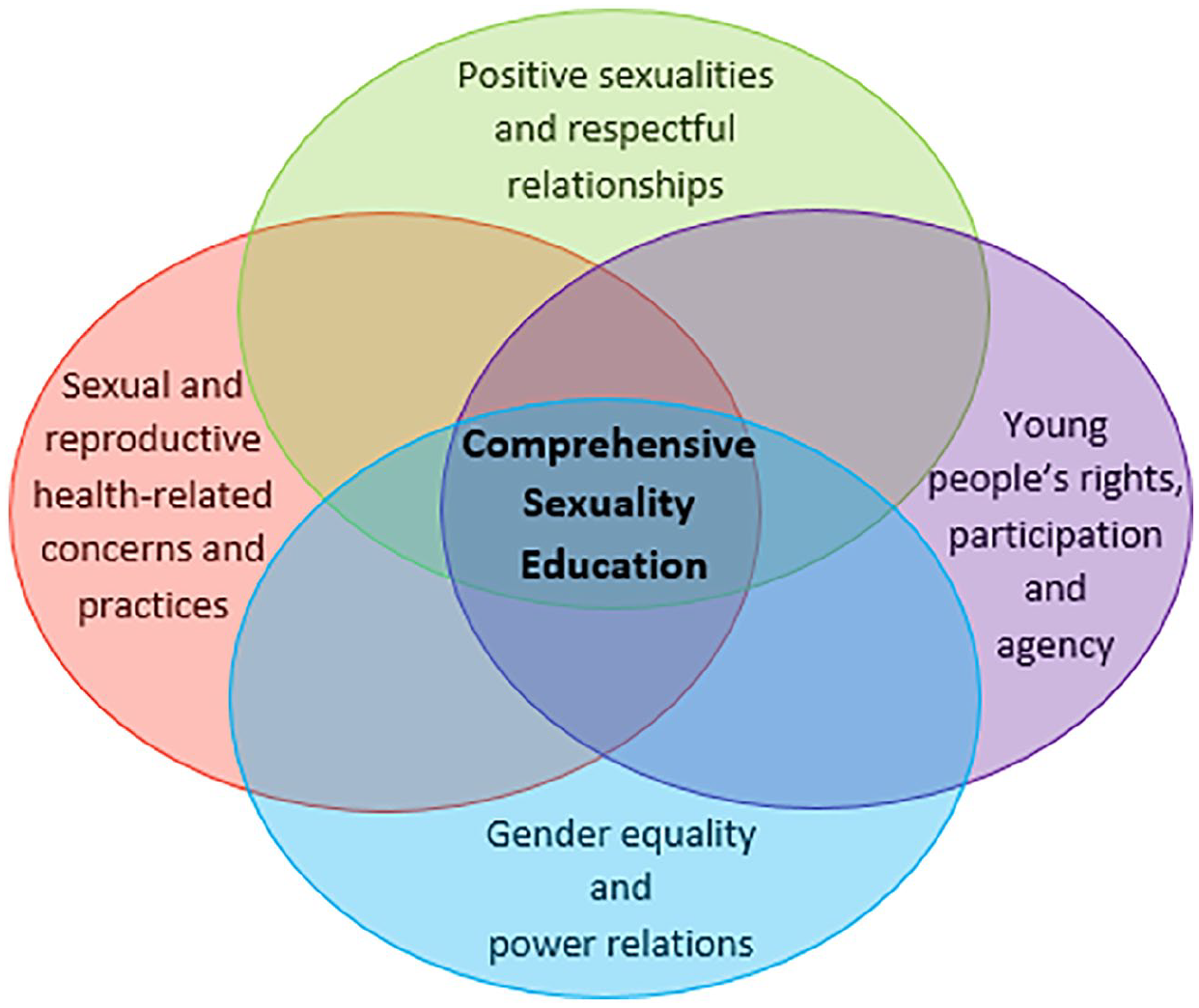
Components of comprehensive sexuality education.
Young people’s rights, participation and agency
Rights constitute a fundamental focus across literature on CSE, and there exists common agreement that CSE seeks to develop young people’s knowledge, attitudes and life skills to help them to secure their sexual and reproductive health and rights (SRHR) (Berglas et al., 2014; Haberland and Rogow, 2015). The centrality of a rights-informed approach to CSE is evident in most of the standards and guidelines reviewed, UNESCO (2018), for instance, asserting that its guidance document ‘affirms the position of sexuality education within a framework of human rights and gender equality’ (p. 4). Regardless of specific focus or content, CSE centres on choice and speaks to the notion of self-determination. That is, CSE recognises that all young people have the right to be informed about their sexuality and sexual and reproductive health, are entitled to make their own choices, and should develop an understanding of their responsibility to respect other people’s rights (Berglas et al., 2014; United Nations Youth, 2011; Vanwesenbeeck et al., 2016).
Notions of rights, choice and agency are not only central to the goals of CSE, but also to conceptions of the educational process and pedagogy. That is, the success of CSE, particularly in relation to young people’s abilities to voice SRHR-related needs and decisions, as well as their role in challenging exclusionary norms and practices, is often related to young people’s active participation in a CSE initiative in and of itself (International Women’s Health Coalition [IWHC], 2015; UNESCO, 2015; UNFPA, 2015). The grounding of CSE in notions of rights is thus seen to entail a ‘youth-centred pedagogy’ (Berglas et al., 2014). The difficulties of creating space for ‘meaningful’ participation of young people in sexuality education – and the abstract nature of rights more broadly – is increasingly the subject of debate (Miedema et al., 2014; Rizzini and Thapliyal, 2007; Twum-Danso, 2009). In a recent publication, Evelo and Miedema (2018), for example, highlight the distinctly gendered nature of young people’s (limited) participation in sexuality education, arguing this is reflective of existing gender hierarchies. Such research adds further weight to Middlestadt et al’.s (2007) assertion that gender constitutes a ‘gateway factor’ to SRHR-related outcomes.
It is important to note that while the notion of rights is central to many CSE frameworks and programmes, rights-based rationales have proven controversial in settings where rights are associated with unwanted foreign influence and the supposed imposition of ‘Western’ (gender) ideologies (see, for example, Le Mat, 2019c). At the same time, research by Campbell (2016) suggests that where there is opposition to the notion of young people’s rights, sexuality education can be counter-productive, entrenching and reinforcing gender stereotypes and discriminatory norms. As the discussion of other core components will also illustrate, political and socio-cultural factors thus largely shape which components of CSE are considered acceptable within particular contexts, and as such degrees of comprehensiveness (Awusabo-Asare et al., 2017; Monzón et al., 2017).
Sexual and reproductive health-related concerns and practices
As with many types of sexuality education, there exists widespread consensus that CSE must provide information about sexual and reproductive health (SRH) and tackle specific SRH-related concerns such as HIV and AIDS, teenage pregnancy and female genital cutting or mutilation (FGC/M) (IPPF, 2010; UNESCO, 2018; Woog and Kågesten, 2017). Providing young people with such information is regarded as a crucial means to achieving the Sustainable Development Goals (SDGs) (see, for example, UNESCO, 2018). In addition to these predominantly biomedical indicators of health, emphasis is placed on young people’s development in a broader sense. For example, UNFPA (2014) defines CSE as ‘enabling young people to protect their health, wellbeing and dignity’ (p. 5), a position that is echoed by Goldfarb and Constantine (2011) who contend that CSE ‘employs a health promotion and human development approach’ (p. 3). Within CSE, the concept of ‘health’ is thus not only conceived in a biomedical sense, but also in emotional, psychological and social terms (Braeken and Cardinal, 2008; Helmich, 2009; McCave, 2007; UNFPA, 2015).
The holistic definition of health offered within the CSE literature is in line with global health promotion statements (e.g. WHO, 1986), and moves beyond the reductionist framings of health underpinning some other forms of sexuality education (for examples, see, Miedema et al., 2011). However, it is important to note that sexual health mostly continues to be subsumed under the notion of STIs and reproductive health (Corrêa et al., 2008; Iyer and Aggleton, 2015). Illustrative of this tendency is more recent UNESCO (2018) guidance, which, in keeping with the WHO definition of health, states that SRH: (a) ‘encompasses dimensions of physical, emotional, mental and social well-being in relation to sexuality’ and (b) ‘is not merely the absence of disease, dysfunction or infirmity’ (p. 22). While the document goes on to highlight positive dimensions of ‘sexuality and sexual behaviour’ (key concept 7), the guidance on SRH itself (key concept 8) focuses solely on prevention of disease and pregnancy. The document thus seems to separate sexuality from sexual health, and to move to and fro between broad and narrow conceptions of sexual health (see also IPPF, 2010, 2012; UNFPA, 2015). Thus, despite the ‘S’ in SRH within CSE, sexual health often appears to be considered in terms of reproductive and sexually transmitted infection (STI)-related concerns. Sexual health is thereby implicitly framed in relation to negative outcomes in the form of (unplanned) pregnancy and disease.
Gender equality and power relations
The intended impact of CSE on gender equality and women’s empowerment is a prevalent theme throughout the literature. Haberland and Rogow (2015) compare programmes that emphasise gender and power relations with those which neglect these topics, describing the latter as ‘conventional’ CSE. This reference to conventional CSE reinforces the expectation that a core goal of (good quality) CSE policies and programmes involves addressing gender and power. Indeed, the majority of literature, policy briefs and programme reports on the topic of CSE at least reference the intended impact on gender relations and tackling the social norms that negatively impact women and girls across a range of contexts (Browes, 2015; Campbell, 2016; IPPF, 2016; IWHC, 2015; UNESCO, 2018; UNFPA, 2015). More broadly, CSE is posited as enabling young people to treat others with ‘respect, acceptance, tolerance and empathy’ regardless of, among other issues, race, ethnicity, socio-economic status, sexual orientation, ability as well as gender (UNESCO, 2018: 17). Departing from this broader conception of equality, UNESCO (2018) draws attention to the relationship between power and sexuality, showing how power affects people’s control over their own body and their decision-making possibilities in sexual relations.
Promoting gender equality in and through schools is a complex endeavour in itself, which would require teachers receiving careful guidance on identifying how gender is learned and enacted through the curriculum and in day-to-day interactions in schools, and learning how best to address gender norms and power dynamics. However, Haberland (2015) notes that CSE programmes have largely failed to integrate gender due to ‘a lack of clarity about what a gender or power perspective means’ (p. 32). The recent UNESCO (2018) guidance merits attention in this regard. The key concept ‘understanding gender’ is discussed in relation to three topics: ‘the social construction of gender and gender norms’, ‘gender equality, stereotypes and bias’, and ‘gender-based violence’, and each topic is then broken down into ‘key ideas and knowledge, attitudinal, and skills-based learning objectives’ (p. 35). For example, ‘attitudinal’ objectives related to the topic of social construction of gender norms for 12-15 year olds include ‘recogni[tion] that beliefs about gender norms are created by societies’, and ‘acknowledge[ment] that gender roles and expectations can be changed’ (p. 50).
The UNESCO guidance also offers a fairly detailed breakdown of critical questions regarding gender, violence and power, and thus may contribute to shifting deep-seated social norms around these areas. It will thus be important to assess the different ways in which this guidance is (or is not) taken up by curriculum designers and educators. In particular, research is warranted on whether the guidance provides the necessary scaffolding for the kind of engagement Haberland (2015) identifies as a characteristic of good quality sexuality education; that is, education that (a) stimulates young people to critically reflect on gender and power in society, and how these concepts affect their own lives and relationships, and (b) supports young people in understanding their own possibilities to contribute to change.
Positive sexualities and respectful relationships
The final core aspect of CSE is closely linked to the other components and relates to supporting young people in developing an understanding of (their) sexuality and building ‘healthy’ relationships. The notion of ‘positive sexualities’ referred to above includes the idea of sexual pleasure, while that of ‘respectful relationships’ seeks to capture the attention paid in CSE guidelines to enabling young people to build ‘healthy’ relationships with (intimate) others, and respecting others regardless of sexual orientation, gender identity, race or ability.
SIECUS (2004), for example, conceptualises CSE as a lifelong process focused on ‘acquiring information and forming attitudes and beliefs about topics such as identity, relationships and intimacy’ (p. 13). UNFPA (2014) in turn, speaks of CSE as enabling young people ‘to develop a positive view of their sexuality’ (p. 6). UNESCO (2018) echoes these positive sentiments and objectives, asserting that a central aim of CSE is to develop young people’s ‘knowledge, skills and attitudes for positive sexuality’ (p. 12). The 2018 guidance makes frequent reference to notions of ‘healthy’ relationships and positive values such as respect, equality, and reciprocity (UNESCO, 2018).
Some actors take issue with the acceptance of young people as sexual beings, and the apparent ‘sex-positive’ approach within CSE guidelines. Family Watch International (FWI), for example, asserts that CSE ‘can be disguised as human rights education’ but effectively teaches young people ‘radical sexual ideologies’, including an ‘obsessive focus on and promotion of sexual pleasure for children [. . .]’ (FWI, 2014: 2–3). Yankah and Aggleton (2017) drily observe that conservative actors ‘question anything that [hints] of any form of sexual freedom’ and regard all education that goes beyond a focus on abstinence as ‘morally suspect’ (p. 55). However, contrary to what might be expected given the concerns expressed by actors such as FWI, little remains of the sex-positive stance when SRH-related issues are addressed. As noted earlier, such issues still tend to be framed in negative terms, with an emphasis on unplanned pregnancy and STIs.
It is worth briefly reflecting on the complexities of advocating for education that is sex-positive and seeks to foster acceptance of diversity, including with respect to gender identity and sexual orientation. With regard to the former, Michelle Fine’s (1988) seminal work on the ‘missing discourse of desire’ is frequently referenced by authors critiquing the absence of discussion about pleasure and desire within school-based sexuality education initiatives (e.g. Allen, 2005; Ingham, 2005). Fine argued that this absence compromises the ability of young women in particular to engage, negotiate or resist sexual relationships (see also Fine and McClelland, 2006). From this perspective, the increasingly prominent place accorded to pleasure and desire over the past few decades, and the more positive stance on sexuality more broadly, is to be welcomed. Further research is required to examine how this positive stance is combined with CSE’s central aim to tackle public health concerns and whether learning goals such as ‘reflect[ing] on how gender norms and stereotypes influence people’s expectations and experience of sexual pleasure’ (UNESCO, 2018: 72) provide educators with sufficient scaffolding to address these deeply ingrained norms.
Regarding approaches to diversity within CSE, criticism has also been growing in relation to regarding the ways in which heterosexuality is normalised and enforced through sexuality education (Advocates for Youth, Answer, GLSEN, the Human Rights Campaign [HRC] Foundation, Planned Parenthood Federation of America [PPFA], and the Sexuality Information and Education Council of the United States [SIECUS], 2015; Allen, 2013; García, 2009; Pascoe, 2007; Rasmussen, 2012). As García (2009) has compellingly argued, far more attention needs to be paid to the ways in which heteronormativity, sexism and racism interact in school-based sexuality education, and how these reinforce and perpetuate existing inequalities. Compared to the 2009 iteration, the current UNESCO (2018) guidance pays more attention to ‘aspects of’ vulnerability, including race, disability, sexual orientation and gender identity (p. 18). For instance, the document refers to the need to develop more relevant content for LGBTI + youth, and makes frequent mention of the importance of respecting diversity (see also IPPF, 2010, 2012). However, the guidance offered does not move beyond these rather abstract statements to provide concrete advice or tools on how educators might, for example, stimulate students to critically reflect on hegemonic norms underpinning homophobic and transphobic discrimination, let alone how these might interact with questions of race (García, 2009; Holden et al., 2015; Parkes et al., 2016; Warwick and Aggleton, 2014).
Beyond concerns as to whether existing guidance documents offer sufficient footholds for educators to meaningfully address issues of pleasure and diversity in CSE initiatives, and relate questions of pleasure to SRH-concerns, authors such as Rasmussen (2012) raise important questions regarding the potentially normalising effects of an emphasis on pleasure, desire and sexual diversity in CSE. Drawing attention to the secular logics and the attendant narrative of progress on which CSE is framed, Rasmussen (2012) interrogates the notion that sexual emancipation is ‘the fruit of secularism’ (p. 470; Scott, 2009). She points out that this secular framework tends to marginalise and reject religious subjectivities and perspectives – religiosity being assumed to involve false consciousness, repression and backwardness (see also Roodsaz, 2018; Scott, 2009). While a sex-positive approach in CSE and its emphasis on respecting diversity are valuable developments, we concur with Rasmussen that it is important to be aware of the ways in which sexual ‘emancipation’ can work to exclude, in this case religious ‘Others’.
Tackling discriminatory practices in schools – and how these are constituted by, and constitutive of, gendered, racialised and sexualised norms and identities – thus continues to be challenging, and important questions remain regarding for whom CSE can be considered comprehensive. Similarly, affirming sexual pleasure and diversity in increasingly heterogeneous settings is a complex undertaking. Drawing on the notion of agonism (Mouffe, 2013), we argue that rather than strive to achieve consensus regarding the articulation of sexual, gender as well as racial and classed hierarchies within CSE and providing educators a particular normative framework on, for instance, pleasure, it would be more productive to offer educators tools to generate debate between learners on these areas of tension. The primary aim would then not be to undo potential disagreement but rather to foster recognition of the inevitability of difference, and to learn to respect one another’s right to exist differently. It goes without saying that an objective such as this could only be pursued in settings where there is space for deliberation, and where it is safe for educators to explore the possibility of difference with learners.
Abstinence-plus, holistic or comprehensive sexuality education
The somewhat elastic use of the term CSE has been alluded to earlier in this paper. Not only do different actors and authors place varying emphasis on differing sets of issues, some refer to CSE interchangeably with other forms of sexuality education that, while geared towards similar goals in enhancing young people’s SRHR, represent different approaches to teaching about sexuality. We now focus on two types of sexuality education that are frequently discussed in relation to, or synonymously with, CSE: abstinence-plus education, and HSE.
Abstinence-plus
Across the literature, CSE is often linked with abstinence-plus education, with some authors presenting the two terms as being synonymous with one another. Underhill et al. (2007), for example, identify abstinence-plus as a comprehensive intervention, noting that it promotes abstinence but also encourages use of condoms and safe-sex practices (see also Advocates for Youth, 2001; Alford et al., 2005; García, 2009; Jeffries et al., 2010). Abstinence-plus often appears to be seen as ‘comprehensive’ due to its considerations of circumstances in which abstinence may not be possible, in addition to addressing the linkage between relationships, sexuality and sexual activity. CSE and Abstinence-plus thus share a broader and more complex approach to young people’s sexuality than abstinence-only education.
While Abstinence-plus – also known as the ABC Approach (which stands for ‘Abstinence, Be Faithful, Use a Condom’) – may offer a more comprehensive form of sexuality education than abstinence-only approaches, it differs from CSE in its lack of attention to the realities of gender and power relations. Murphy et al. (2006) make reference to the fact that in many settings where the ABC-approach is implemented, women and girls often do not have control over their sexual and reproductive decisions, and may not have the option to abstain from sex or negotiate condom use. In theory, these kinds of barriers to achieving gender equality and redressing power imbalances should form a key focus within CSE initiatives. As Fine and McClelland (2006) note, contrary to the field of abstinence education, advocates for CSE ‘place the genesis of social problems not in the act of teen sex but in the uneven social contexts in which teens develop and sex occurs’ (p. 25).
In recent years, there have been further developments to abstinence-plus education, bringing it closer in line with the rights-based focus of CSE programmes. The Dutch development organisation, Educaids, refers to CSE initiatives as at least encompassing ABC, but preferably also paying attention to ‘DEF + – Delay sexual intercourse, Equal consent, Fewer partners and testing’ (Educaids, no date). This onus on consensual relationships recognises the need for choice and agency, and also promotes safer sexual behaviours through testing, linking with notions of rights, and gender and power which are present within CSE. Abstinence-plus, ABC and ABC-DEF + approaches do appear to resemble CSE, yet emphasis is still placed on abstinence, which CSE addresses but is not limited to. In theory, both ABC and CSE initiatives are thus open to young people using contraception where needed, but differ in that abstinence-plus sees this as a last resort while in CSE there may be more openness to young people being sexually active, and having access to a range of contraceptive products and services (Berglas et al., 2014; Beshers, 2007; SIECUS, 2004; United Nations Youth, 2011).
Holistic Sexuality Education (HSE)
Within the existing scholarly literature on CSE, reference is also made to the idea of a ‘holistic’ approach to sexuality (Ketting et al., 2016; Ponzetti, 2015). HSE is characterised by what is referred to as a positive approach to sexuality, that is, one that ‘consider[s] sexuality as a potential source of joy and happiness and not predominantly as a health risk’ (Ketting et al., 2016: 69; Ollis, 2014; Ponzetti, 2015). HSE appears to align with CSE in a number of ways, including consideration of sexuality and relationships, gender dynamics and the rights of young people. In contrast to CSE, HSE further develops the notion of sexuality by supporting a critical approach to dominant discourses and challenging the negative connotations associated with youth and sexual relations. In addition, HSE pays specific attention to the need for support for children and youth who experience sexual health problems, such as sexual abuse, unintended pregnancy or conflicted feelings about sexuality. While these are issues are addressed within some literature on CSE (see, for example, Kohler et al., 2008), they do not appear to constitute dominant themes.
Authors such as Ponzetti (2015) point out that while the guidelines developed by organisations such as IPPF, UNFPA and UNESCO may draw on the notion of ‘holism’, HSE differs from CSE in that while the latter tends to focus on changing behaviours, the former sets a broader range of goals to include personal and sexual development and growth (see also WHO Regional Office for Europe and BZgA, 2010). Ponzetti (2015), furthermore, observes that HSE is mainly found in what are considered more ‘liberal’ European countries, such as Sweden, the Netherlands and Belgium. There tends to exist greater acceptance of young people’s sexuality in these settings than in many countries in the Global South, which may help explain the stronger focus on ‘personal and sexual growth’ present in HSE, as opposed to the seemingly more instrumental emphasis on public health outcomes within CSE and ultimately, broader developmental goals, including the SDGs. It is salient that development agencies advocate for CSE in the Global South, while more sex-positive holistic approaches may be promoted in a range of (donor) countries in Western Europe (Ponzetti, 2015). The differential focus suggests diverging priorities across these settings, and thus the kinds of sexual futures that are imagined for differently located young people (on these topics, also see Miedema and Oduro, 2016; Roodsaz, 2018).
Figure 2 above represents how HSE and Abstinence-Plus education engages with the core CSE components identified during this review.
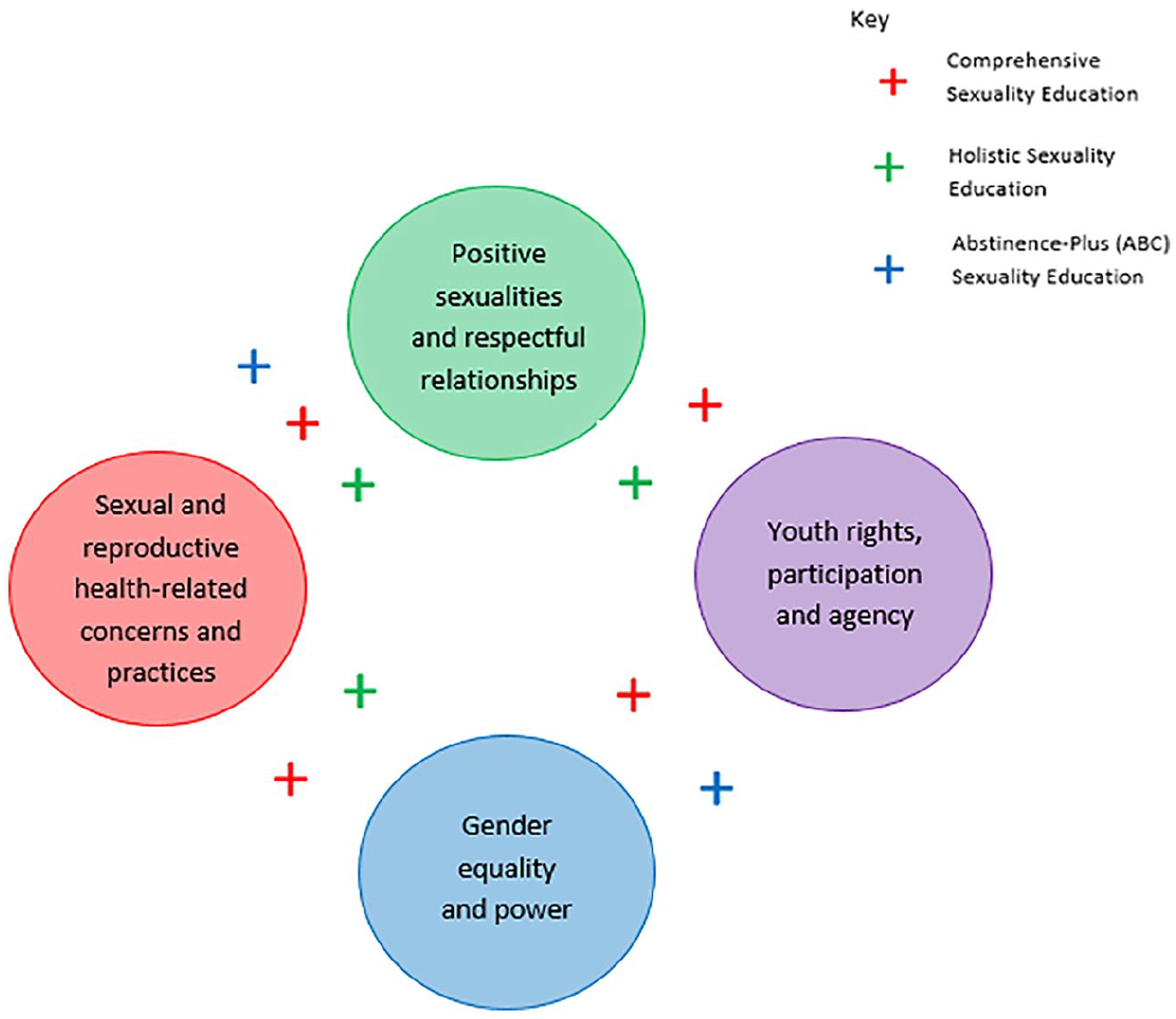
Comparison of approaches to sexuality education to the core CSE components.
Within Figure 2 above, the ‘+’ signs indicate which of the core CSE components are addressed in HSE and Abstinence-Plus education. CSE is depicted as encompassing all four interconnected components. The other variations of sexuality education may tackle some of the same issues but not necessarily in the same manner. For example, Abstinence-Plus also addresses all four components but approaches each of them in a different way, and while connecting the themes of SRH and behaviour with sexuality and relationships, Abstinence-Plus education does not appear to link these to themes of gender and power, and agency and rights.
Noting differences between approaches sheds further light on what CSE is thought to be and how it differs from other forms of sexuality education. However, as Lesko (2010) has shown, identifying where and how different approaches overlap is equally revealing. Examining the feelings towards which different forms of sexuality education are directed, the author offers a convincing analysis of the critical similarities between two seemingly opposing forms of sexuality education: abstinence-only education and CSE. While the former invokes an imagery of ‘wholesome, nuclear families’ (p. 291), CSE speaks to the idea of ‘empowered individuals managing risks and creating caring relationships’ (p. 290). Lesko argues that both forms of sexuality education appeal to an image of a child ‘who is ultimately protected from real chaos or impropriety’ (p. 290). As such, both approaches can be understood as grounded in what Lesko refers to as a ‘pan-optimism’ regarding the potential of knowledge and values in attaining particular states ( ‘e.g. ‘caring’ relationships) and resolving social problems (e.g. teenage pregnancies). At a more fundamental level, differences between approaches may be less stark than they initially appear to be.
Discussion and conclusion
In a recent assessment of CSE programmes, the Guttmacher Institute deployed UNFPA’s (2014) definition of CSE, given its perceived adaptability to what could ‘reasonably be expected in [a] target country, given cultural contexts’ (Awusabo-Asare et al., 2017; Monzón et al., 2017: 11). The authors identified sexuality education initiatives that met minimum standards, were ‘adequately’ comprehensive, and reached a high level of comprehensiveness. This three-point assessment and reference to ‘what can reasonably be expected’ highlights again that there is no one universal set of CSE standards, and that there instead may be levels of comprehensiveness. In an effort to create greater clarity as to what CSE is and is expected to entail, we reviewed existing CSE guidance documents and scholarly literature engaging with CSE.
Our review identified four broad and closely interconnected sets of issues that jointly appear to constitute core themes within CSE. Our presentation of these core components is not designed to serve as a prescriptive framework, but rather as an entry point to create greater clarity on what ‘comprehensive’ sexuality education means, to whom, when and where. It should be noted that ‘age’ as a variable was not factored into this analysis even though certain documents do seek to structure CSE provision along age lines (see e.g. UNESCO, 2018). In addition, while some publications included in the review address the design, implementation and impact of CSE programmes, this paper has not sought to assess the efficacy of CSE across different contexts. Further analysis may be warranted as to what ‘comprehensive’ is thought to mean for different age groups (see e.g. Goldman, 2015), and how the impact of international standards can best be assessed.
The four overarching themes identified during the review are (a) rights, participation and agency; (b) SRH-related concerns; (c) gender equality and power and (d) positive sexualities and respectful relationships. Apparent consensus across the literature on which core aspects make up CSE obscures the varying levels of attention afforded to each component by different actors. Some agencies place strong emphasis on – at least in theory – notions of gender equality and empowerment (e.g. IPPF, 2016), while others first and foremost appear geared to achieving public health outcomes (e.g. Guttmacher Institute, 2019; Kirby et al., 2007). Opponents of CSE, such as FWI, often focus on CSE’s engagement with sexuality and sexual relations, critiquing the perceived negative impact of such education on young people’s morality and social cohesion more broadly (Levesque, 2003; Roudsari et al., 2013).
The review also drew attention to the conflation of CSE with HSE, and Abstinence-plus (or ABC) education in some of the literature, highlighting the varying priorities of these different forms of education. In the case of CSE vis-a-vis HSE, we drew attention to their differing geographies: HSE primarily promoted in the Global North, CSE and ABC approaches in the Global South. Here too questions arise as to who is in a position to determine which issues are prioritised – and funded – for which groups of young people: sex positive approaches, pleasure and personal wellbeing emphasised for young people in certain countries in Western Europe, while CSE initiatives for young people in the Global South tend to be driven by concerns regarding the relationship between SRH-issues and attaining broader development goals.
CSE is, in theory, more sex positive than ABC approaches. CSE acknowledges that (many) young people are sexually active, while ABC approaches tend, first and foremost, to advocate abstinence as a means of protection against negative health outcomes. However, while CSE may address questions concerning young people’s sexuality, and issues such as pleasure and desire, as authors such as Rasmussen (2012) have argued, it is crucial to recognise that the secular logics of CSE involve their own form of moralising, and one that might be dismissive of religious perspectives. Lesko (2010) too has identified areas of similarity between CSE and its apparent opposite, that is, abstinence-only education. Crucially, Lesko’s work alerts us to how the different pathways to ‘caring’ relationships advocated by these two forms of sexuality education are grounded in similarly optimistic conceptions of knowledge – that is, as having the potential to lead to certainty and security, and away from the messiness of sexuality, and sexual and intimate relationships.
This review has sought to clarify how the notion of ‘comprehensive’ sexuality education is understood, highlighting the varying emphases placed on key CSE components by different actors, and reflecting on the implications of these decisions for who is included, on whose terms, and to what end. In addition, we highlight several problematic assumptions underpinning CSE policies and guidelines. Crucially, the implicit framing of CSE-related goals as reflective of universal neutral ideals and its underlying progressive secular promise suggests an ‘othering’ of opposition to CSE may be at work (Rasmussen, 2012; Roodsaz, 2018). Adaptation of CSE to ‘what can reasonably be expected’ in particular socio-cultural contexts and ‘sensitivities’ (Monzón et al., 2017: 11) may thereby be depicted as instances of backwardness and barriers to rational progress. In so doing, the review illustrates the politics of knowledge production at play in CSE standard setting, signalling that there is no position on sexuality and education on this subject that is ‘somehow outside [of] politics’ (Rasmussen, 2012: 469).
Rather than assume the possibility of formulating universally valid ideals and, by the same means, dismiss objections to CSE as regressive, we call for greater recognition of the historical and cultural particularity and normativity of all definitions of comprehensiveness. Given many international CSE guidelines have been developed in the Global North, and given the similarities noted between what on the face of things, appear to be diametrically opposing approaches to sexuality education, we argue that greater epistemic modesty is required on the part of international development actors, and greater willingness to explore the shortcomings of secular, liberal conceptions of sexual rights, consensus and emancipation. Crucially, there is a need for broader recognition that all sexuality education involve moralising, that all forms of moralising work to ‘Other’ and exclude, and thus that conflict and difference are inevitable (Mouffe, 2013). Such acknowledgement is crucial for what Roodsaz (2018: 118) refers to as a ‘true conversation’ between relevant actors, including young people, about the goals, core components and means of comprehensive sexuality education.
Footnotes
Acknowledgements
The author(s) thank the anonymous reviewers for their valuable feedback on earlier iterations of this paper.
Funding
The author(s) disclosed receipt of the following financial support for the research, authorship, and/or publication of this article: the author would like to thank Share-Net International for the financial support provided to conduct the research described in this article.
