




Abstract
Background:
The pathologisation of people with disability1 has long affected the educational quality of the sexuality education they receive. Whilst concern for people with disability has been growing in some comprehensive sexuality education settings, the quality of education in these spaces is variable and typically accommodations for people with disability are not made. The lack of accessibility fosters few opportunities to learn about and practise skills related to establishing and maintaining social relationships, including platonic, romantic and sexual relationships, thereby limiting informed decision-making. Moreover, the lack of good quality sexuality education significantly increases the risk of sexual abuse, assault, and family and domestic violence – impacting people with disability’s self-determination, autonomy and ultimately, ability to work, live independently, and maintain their mental and physical health.
Objective:
Few reviews of comprehensive sexuality education programmes for people with disability have been reported. Therefore, four current comprehensive sexuality education programmes for people with disability were reviewed, including their content and the topics included; the feasibility of implementation including costs; different accessibility considerations for varied learners and disabilities; and methods of delivery. This allowed an assessment of their strengths and opportunities for people with disability.
Results:
The review highlighted strong positive changes occurring within the field, as well as challenges due to funding limitations, and the extensive number of topics under comprehensive sexuality education that need to be addressed in teaching and delivering quality comprehensive sexuality education to people with disability.
Conclusion:
Informed by the evidence in this review, we advocate for the inclusion of a more comprehensive range of topics, including gender and sexuality diversity within accessible comprehensive sexuality education for people with disability, and the establishment of appropriate forms of teacher education and training to increase confidence and comfort when delivering comprehensive sexuality education to people with disability.
Introduction
Good quality comprehensive sexuality education (CSE) aligns with the United Nations Sustainable Development Goals, including goals 3 (good health and well-being), 4 (quality education), 5 (gender equality) and 16 (peace, justice and strong institutions; United Nations, n.d.). Within Australia, it is acknowledged that vague curriculum guidelines have created problems for the delivery of CSE (Ezer et al., 2019). Furthermore, a general lack of teacher preparedness for providing and promoting CSE (Burns and Hendriks, 2018; Collier-Harris and Goldman, 2017; Duffy et al., 2013; Goldman and Coleman, 2013) compounds the quality delivery of CSE, putting students at risk.
When delivered appropriately, CSE can enhance learning, decrease unsafe sexual behaviours (Burns et al., 2019; Burns and Hendriks, 2018) and reduce experiences of sexual abuse (McCabe et al., 2000) for all students. Good quality CSE is also associated with positive student behavioural change and greater success in HIV-related interventions (O’Brien et al., 2021). Goldfarb and Lieberman (2021) reviewed school-based CSE programmes across the USA and beyond, and documented the increased inclusion of sexual diversity, healthy relationships, and social and emotional learning. They also noted a reduction in family and domestic violence (FDV) and child sexual abuse when students had access to CSE across a broad range of topics and all grade levels (Goldfarb and Lieberman, 2021). These findings highlight the potential for good quality CSE to deliver increased self-determination, independence, mental and physical health, and well-being for students regardless of disability status.
However, key barriers to CSE delivery to people with disability exist. These tend to be attitudinal and grounded in stigma, including the belief that people with disability are assumed to be asexual and thus should be excluded from CSE (Sladden et al., 2021). In contradiction, the behaviours of people with disability may also be seen as hypersexual and pathological, thereby creating shame and stigma (McCann et al., 2019; Sala et al., 2019). According to Goldman (2016), the exclusion of people with disability from sexuality education defies logic and reduces the education and knowledge available to students. Knowledge of, about, and for the body should be available to all individuals regardless of age, ability or location (Goldman, 2016). Research highlights the ability of CSE to help individuals develop happy and successful sexual health and relationships (McCann et al., 2019), including understanding how to keep themselves safe when dating, and noticing red flags in relationships (Graff et al., 2018).
The importance of CSE for people with disability cannot be understated due to the high rates of FDV and sexual abuse experienced by people with disability (Lund, 2011; McCann et al., 2019; Ward et al., 2010). Lack of CSE has been identified as a key contributing factor placing people with disability at increased likelihood of experiencing sexual violence (Johnson et al., 2014; Lund, 2011; McCann et al., 2019). However, well-documented case studies of sexuality education for people with disability are few and far between. In this paper, therefore, we seek to review the literature on best practices in this field, particularly regarding accessibility for people with disability, including understanding the different accessibility needs of people with disability, and reviewing four accessible CSE programmes developed for people with disability. Recommendations for the future forms of accessible CSE are also provided.
CSE and best practice
To be effective, CSE should be scientifically accurate, incremental, age-appropriate, curriculum-based, comprehensive, based on human rights and gender equality, culturally relevant, transformative and able to support healthy decision-making (UNESCO, 2018). Good quality CSE recognises the importance of sexual health and well-being, which, according to Sladden et al. (2021), comprises the innately interlinked elements of sexual health, sexual rights and sexual pleasure (also sometimes referred to as sexual well-being). CSE, therefore, should engage with a broad range of topics, including sexual diversity, healthy relationships, and gender roles (Pound et al., 2017). These topics, when adequately addressed, ensure that CSE moves away from a disease-focused curriculum to an inclusive approach to sexual and reproductive health (Sladden et al., 2021).
CSE has been associated with positive and protective outcomes that include the delayed onset of sexual debut, a reduction in frequency of unprotected sexual activity (Burns et al., 2019; Burns and Hendriks, 2018), lower rates of sexually transmitted infections (STIs), decreased susceptibility to sexual abuse (Johnson et al., 2014), positive student behaviour change and enhanced protection against HIV (O’Brien et al., 2021). However, many studies acknowledge that teacher education and training in relation to CSE is inadequate (Almanssori, 2022; Burns and Hendriks, 2018; Collier-Harris and Goldman, 2017; Ezer et al., 2022; Goldman and Coleman, 2013; Miesera and Gebhardt, 2018; O’Brien et al., 2021; Ollis, 2016; Shannon and Smith, 2015; Xiong et al., 2020) and when CSE is delivered in school it is compromised by limited curriculum time, low teacher confidence, perceived parental objections, limited priority and minimal suitable resources (Duffy et al., 2013; Johnson et al., 2014).
For students with disability, access to sexuality education is often made difficult by exclusion from teaching in mainstream classrooms (Gougeon, 2009), or the myths and stigma that surround sexuality and disability (Stapleton et al., 2022). Research has shown that people with disability are less likely than non-disabled students to receive any form of CSE at school, including on healthy and unhealthy relationships (Sala et al., 2019; Ward et al., 2013). The parents of children with disability often fear CSE may increase the likelihood of sexual activities occurring, despite the evidence to the contrary, and thus need to be educated themselves to ensure that ‘crisis intervention’ following harm or adversity is not the first instance of sexuality education for people with disability (Pownall et al., 2012).
Frawley and Wilson (2016), when speaking to people with intellectual disability about their sexuality education, found that, particularly for young people with intellectual disability, sexuality education adopted a rules-based and biological focus rather than the holistic approach CSE requires. This led to a variety of negative consequences, including people with intellectual disability not understanding the ‘how to’ of relationships and sexual activity, as well as being unsure of who or where to go for answers to sexuality-based questions. Similar findings were evident in a literature review conducted by Medina-Rico et al. (2018), who advocated for a multidimensional approach to sexuality for people with intellectual disability, which includes family members, carers, educators and health professionals (Berman et al., 1999). In their study of child burn survivors’ sexuality education, Parrott and Esmail (2010) further highlight the need to approach sexual education with the consideration of exposure, content, timing, method of delivery and characteristics of the educator. Therefore, while a debate continues over the best location to deliver CSE to people with disability, we suggest that this should be tabled – focusing instead on how to deliver accessible education to support people with disability to receive CSE regardless of venue.
Unmet accessibility needs and challenges for people with disability in CSE
A human rights–based approach to sexual health acknowledges the right to sexual and reproductive health for all people to ensure equitable access to the highest attainable level of health (UNFPA, 2009). Equity can only be reached through the availability, accessibility and quality of resources and the teaching of sexuality education (UNFPA, 2009). For people with disability, a rights-based approach to sexual health is often lacking, leaving them without appropriate support, education or knowledge. This egregious breach of sexual rights has far-reaching consequences for their mental, emotional and physical health.
In recent decades, there have been major changes in the lives of many people with disability, including deinstitutionalisation, particularly for people with intellectual disability, to semi-independent or supported living (McCann et al., 2019). While this has created greater community inclusion (McCann et al., 2019), substantive gaps remain in the delivery of CSE among people with disability (Sala et al., 2019), limiting the capacity for people with disability to make informed decisions related to sexuality and relationships (McCann et al., 2019). Pownall et al. (2012) note that the majority of sexuality education received by people without disability is gained through informal social interactions, reaffirming the need for sexuality education that is accessible and comprehensive.
There are major differences between people with disability, including their abilities, complexities and accessibility needs. For example, people with intellectual disability may require learning resources in Easy Read, and Autistic people may require the provision of more literal information without euphemisms. People with visual impairment and blindness may require video or audio versions of information, and someone in a wheelchair, as a minimum, may require a ramp and a door frame wide enough to physically access the teaching space.
With respect to unmet needs, when asked what they wanted out of sexuality education, people with intellectual disability specifically stated their desire to learn about sexual relationships, same-sex relationships, intimacy, making friends and starting social conversations (Chrastina and Večeřová, 2020). Other research indicates that the topics of greatest interest to people with disability include gender, sexuality norms and assumptions, sexual anatomy and hygiene, and safe dating and dating behaviours (Graff et al., 2018; McCann et al., 2019); these preferences provide compelling support for a CSE curriculum.
Further considerations relating to the delivery of CSE lie issues of intersectionality, including the relationship between race, class, gender and sexuality, and the combined impact of these factors on individual experiences (Costanza-Chock, 2018). This impact may call for the need for cultural sensitivity, as well as the inclusion of reference to gender and sexual minorities (among others) throughout the sexuality education curriculum.
Sala et al. (2019) have also noted potential problems arising from the delivery of CSE through computer-assisted programmes, which may limit those with mobility restrictions and people living in remote and rural areas. Sala et al. (2019) found that particularly for Autistic students and people with intellectual disability there was strong value in educational role plays, additional time to practise role modelling behaviours and skills; social reinforcement; written and spoken questions; images, videos and visual models of anatomy; and clear scheduling of the sessions – affirming that the mode of delivery of the CSE forms a part of the accessibility.
CSE programme review and methodology
Few CSE programmes for people with disability exist. Because of this, we sought to identify and review programmes that had a broader focus than this alone. The programmes focused upon here came from the USA and Australia. Two reviewers assessed four programmes, including the content and topics addressed; the implementation process and problems arising; accessibility for different disabilities; and how the programmes were delivered or accessed. Any disputes between the reviewers were clarified with the organisations who created or delivered the programmes.
Accessible CSE resources/programmes in the USA
Family Life and Sexual Health curriculum
The Family Life and Sexual Health (FLASH) curriculum is a school-based sexuality education curriculum developed by Seattle and King County Public Health (King County WA, 2023) with downloadable lesson plans for elementary school students (aged 5–10) and ‘special education’ and middle schools (aged 11–13) and high schools (aged 14–18) accessible for a fee.
FLASH was designed to reinforce sex-positive attitudes and beliefs and encourages family involvement through homework exercises to reinforce learning (King County WA, 2023). Research in mainstream settings has shown that the programme positively impacts refusal and condom use self-efficacy, attitudes towards birth control and condoms, and perceived norms (Coyle et al., 2021). Kesler et al. (2023) have also found that the curriculum is able to reduce homophobic and transphobic beliefs among heterosexual, cisgender students, reaffirming the value of CSE in reducing bullying and violence and promoting inclusivity. FLASH also includes a ‘special education’ curriculum with a variety of lesson plans, suggested methods for teaching and suggestions on how to alter the teaching to suit different learners and communication styles.
The lesson plans appear well laid out and include a focus on assertiveness, saying no, hearing no, non-speaking communication and decision-making. These topics serve to reinforce self-determination and promote autonomy and self-advocacy, which are often underdeveloped in people with disability due to social barriers and community-imposed limitations. The inclusion of a focus on consent communication, including rejection and non-speaking consent, are extremely valuable components of CSE for people with disability. However, as Winges-Yanez (2014) found, while FLASH is more comprehensive than many ‘special education’ sexuality curricula, it ignores topics such as gender identity, sexual orientation and healthy relationships. This exclusion reinforces the myth that people with disability are cisgender and heterosexual and do not require knowledge of gender and sexuality diversity.
Accessible CSE resources/programmes in Australia
The SECCA App
The SECCA App was developed by Sexuality Education Counselling and Consultancy Agency in Western Australia. It was launched in 2018 and evolved from a large hard-copy resource consisting of a board and picture tiles, together with a handbook first developed in 2008.
Intended to provide CSE to students from kindergarten (age 4) to grade 12 (age 18), the App is a resource containing over 2,500 functionally and anatomically correct images associated with 200 digitally accessible lessons. Topics such as emotions, communication, sex and sexuality, puberty, healthy and unhealthy relationships, consent, the law and sexuality, sexual and physical health, parenting, and public and private behaviours are addressed. Due to the nature of the resource, new topics can be developed by educators who can create their own lessons and import individual images to create new picture tiles relevant to the lived experience of people with disability.
It had been determined that the original resource was large, cumbersome and expensive, and the images potentially ambiguous and confusing, being aimed at young learners only. The move to create digital tiles that could be used online began the move towards the SECCA App that exists today, with functionally and anatomically correct images depicted clearly and labelled using the correct terminology and representing diverse genders, relationships, bodies and sexualities. However, because cost was an ongoing issue, together with limited access to the resource by people with disability, funding was sought to build a web-based application that could be accessed free of charge. The initial development process behind the App involved contributions from teachers, education assistants and therapists.
A recent round of improvements to the SECCA App has been made following input from several people with disability who provided feedback on the App, and what worked or did not work for them. The 2023 SECCA App upgrades, beyond functionality improvements, included a variety of language updates and new lessons. They also aimed to scaffold learning to reinforce topics of particular interest to teachers, including protective behaviours, going to work, health checks, consent and puberty. The upgrades also included the introduction of a range of diverse tiles representing people of different ages, skin tones, genders, family types and sexual orientations. The App is not designed as a standalone resource and requires supported learning due to its inclusion of anatomically and functionally correct images and the need for contextual explanations to the learners.
The App has three main sections, all available in English and Kimberley Kriol (an Aboriginal and Torres Strait Islander language common in the Kimberley region of Western Australia). The first section is titled Foundation Games, which are pre-programmed, interactive games designed to familiarise learners on how to use the App, build confidence and self-esteem, and allow educators to assess and support people’s core concept knowledge levels. The Foundation Games section aims to reinforce existing topic knowledge, introduce new concepts and assess understanding.
The second section of the App comprises a series of lessons, sub-divided by concepts, topics and subtopics. These lessons can be manipulated to suit the learner including the ability to add custom personalised picture tiles. The lesson board provides students with the opportunity to sort or match concepts, complete receptive labelling, follow or create picture sentences or social stories, sequence events or activities, learn consequences and discuss the flipside of specific situations. The App also allows for re-sizing the picture tiles (on touch screen devices only) and to play the tile name audio and journeys to scaffold learning.
Following the 2023 SECCA App upgrades, five online training events have been conducted across Australia, with five regional trainings in Western Australia by members of the SECCA Education team. When participants were asked to provide details about what they found positive about the SECCA App, the comments stressed its comprehensive nature, its lesson plan, ease of use, and the inclusivity and diversity represented in the App (see Figure 1).
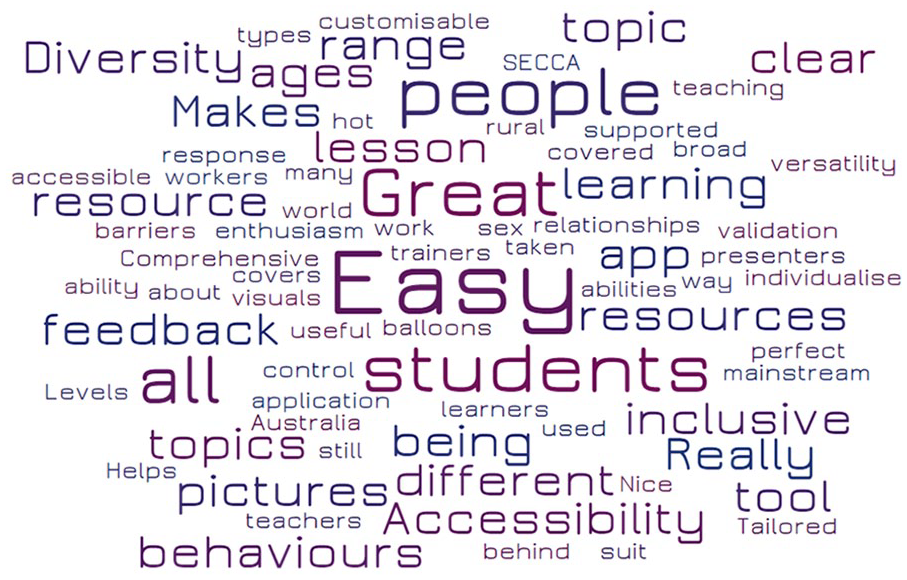
Word cloud of post-training positive comments about the SECCA App.
The SECCA App is an ongoing development, noting that despite the extensive number of picture tiles, there are topics (e.g. transgender and gender-diverse puberty experiences) that do not have sufficient picture tiles. Other limitations include the fact that the App is unable to be used outside of Australia, and the need for a reliable Internet connection limit use in rural and remote areas. Anecdotal evidence also highlights how educators feel more confident using the App following training and do not feel comfortable using all its features, limiting its usefulness in the classroom.
Every body needs to know/‘all school’ special education
Every Body Needs To Know is a school-based relationship and sexuality programme developed and delivered by True Relationships & Reproductive Health (True, n.d.) in Queensland, Australia. The programme seeks to promote the involvement of school leadership, professional development for school staff and the provision of parent/carer information. It does this through the provision of programme information and content for 4 one-hour education sessions for students with disability at each of four developmental levels aged from Preparatory to Year 12 (ages 5–17). In line with best practice, the programme adopts a whole-school approach. The developmental levels focused upon are as follow:
Junior Primary (with content relating to Personal Safety, Public and Private, and Learning about Feelings) (ages 5–8);
Senior Primary (with content relating to Personal Safety, Public and Private, Puberty and Body Changes, and Healthy Relationships) (ages 9–11);
Junior Secondary (with content relating to Personal Safety, Public and Private, Puberty [refresher], Keeping Sexually Healthy, Healthy Relationships) (ages 12–14);
Senior Secondary (with content relating to Personal Safety, Public and Private, Keeping Sexually Healthy, and Healthy Relationships) (ages 15–18).
The student sessions are modelled on the Australian National Curriculum with modifications for individual learning needs and offered in the usual class groups with classroom teacher and support staff present. Key topics such as public and private can be re-visited to reinforce learning and develop in sophistication as children learn and age.
This programme has been hailed for its scaffolded layout, its inclusion of topics such as the law, social media and sexting, and for its use of a whole-of-school approach. Beyond this, it is extremely affordable. Subsidised government funding charges schools $605 per developmental programme stage and supports True educators to travel to remote schools in Queensland. Throughout its content and the teaching and learning approaches adopted, the programme aims to recognise diversity in relationships/families and promote freedom of discrimination.
The in-person nature of the programme can be seen as both a strength and a challenge. This delivery format encourages the development of relationships between experts and educators and responds quickly to issues that may arise. However, the staffing requirements may be unattainable in some schools due to high staff turnover. The programme is run beyond capacity every year with a waitlist of schools.
Planet Puberty
Planet Puberty is a website developed by Family Planning New South Wales (FPNSW, n.d.). It aims to help the parents of children with intellectual disability and autism navigate puberty (so is typically suitable for ages 8–16). The website hosts extensive information about puberty, recommended resources, introductory concept games, worksheets, interview videos with parents, and educational instructional videos involving people with disability. It also provides details of upcoming training opportunities.
The website is divided in two different ways allowing for use in different learning contexts: first, with a focus on the body, feeling good, relationships, identity, keeping safe and second with an introduction to puberty for girls, an introduction to puberty for boys, taking care of your body, relationships and an introduction to masturbation. All the topics are labelled as ‘beginner’, ‘intermediate’ or ‘advanced’ depending on the concepts they engage with. Each includes a topic overview, conversation starters, strategies, resources, and related content in both plain English on the website and easy English as a downloadable document.
This website has extensive accessibility features (enabling users to adapt the text size/space, increase the contrast, the remove image) and has clear game instructions. A very wide array of topics is covered, from introductory puberty topics through to responding to disclosure, ending relationships, and supporting gender and sexuality identities. Specific issues focused on include sensory considerations, practical strategies to support concept understanding and recommended next topics (or plans to encourage scaffolded learning).
Opportunities for improvement include adopting a more consistent image style in the Easy English resources (currently, some [but not all] of them are animated, and some [but not all] include photos, and all are of varying styles), the less strongly gendered provision of information on specific topics, and additional information about intersex variations and puberty.
Discussion
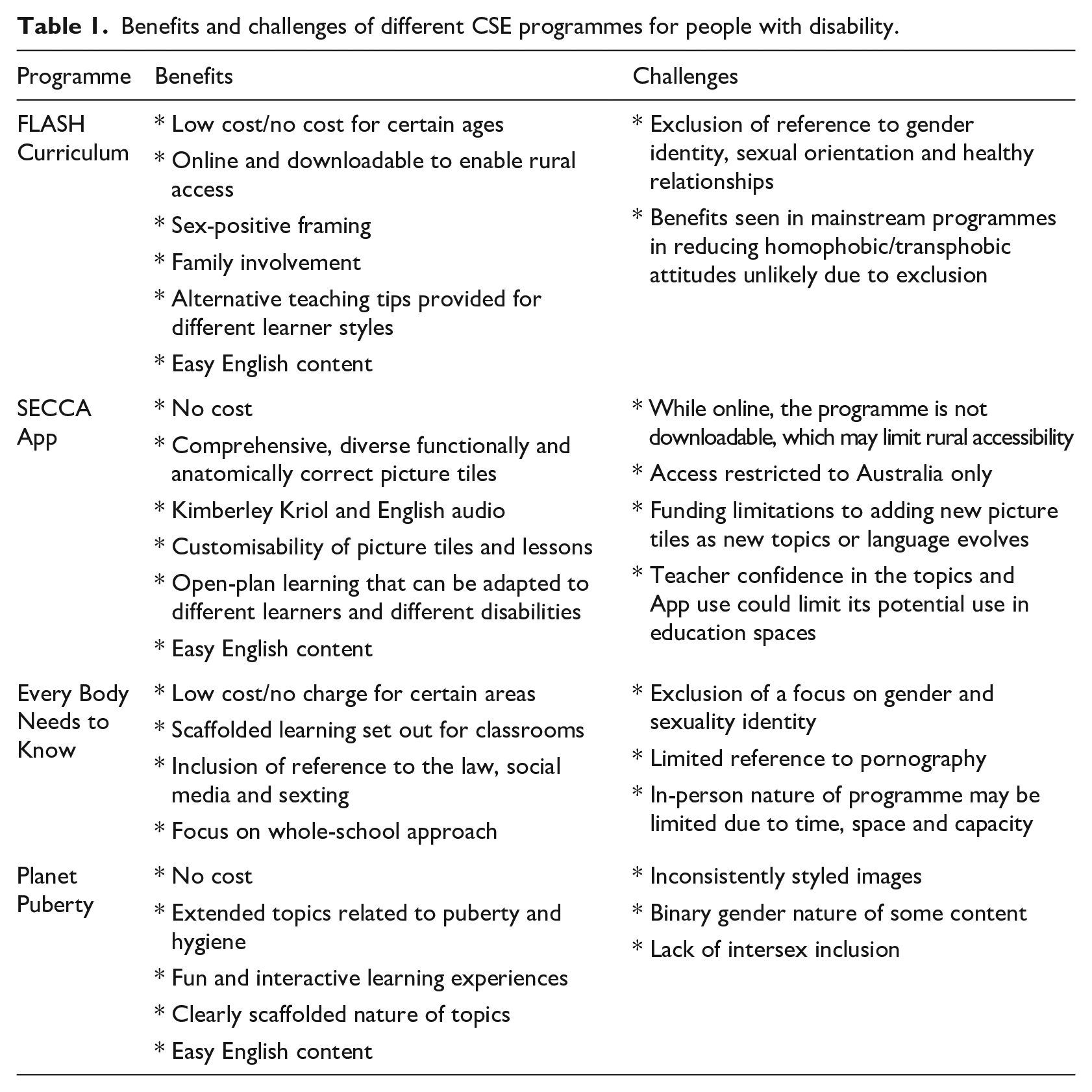
While no resource can cater for all types of disability or can respond to all intersectional variations among possible users, the four programmes discussed in this paper signal the improvements in the inclusion of people with disability from the past. In particular, they encourage teachers and other educational professionals to consider new and more effective different ways of delivering CSE to people with disability. Table 1 highlights the benefits and challenges associated with the four different programmes and shows some of the positive changes that have taken place in recent years with respect to the delivery of good quality CSE to people with disability. Alternative formats and accommodations for different learners could be found across the four programmes, but each programme requires ongoing development to address the challenges encountered.
Benefits and challenges of different CSE programmes for people with disability.
Further research is needed on the pedagogical approaches best suited to different disabilities and learners as a first step towards ensuring that current and future programmes cater to a wider array of disabilities. However, continued low rates of teacher training in relationships and sexuality education (O’Brien et al., 2021) will likely limit their implementation and success. Such programmes should therefore be given higher priority by pre-service teacher training organisations, universities and colleges.
Conclusion
As society has moved from an institutionalised model of care to a human rights model of disability, the education available to people with disability around relationships and sexuality has grown. In principle, this should lead to a situation in which all people, with and without disability, can access the good quality education to promote mental, emotional, physical and sexual health. Current resources offer inspiration for the ongoing provision of accessible and inclusive good quality CSE. However, further work is needed to determine the wants and needs of people with different forms of disability, develop improved curricula and resources, and ensure teachers and other educators are well prepared to undertake the work that needs to be done.
Footnotes
Acknowledgements
We express our gratitude to all the trailblazers who continue to pursue a path that is often neglected – namely, the intersections between sexuality and disability. Without their work, resources such as those described in this paper could not exist. The authors of this paper identify as (1) neurodivergent, chronically ill and disabled; (2) neurodivergent; and (3) the sibling of someone with a disability. We acknowledge the tireless motivation and emotional labour undertaken by members of the disabled community whose experience and support guided us throughout this research journey. The authors are passionate advocates for inclusive and rights-based comprehensive sexuality education on Whadjuk Noongar Country. We acknowledge and respect the immense knowledge and wisdom of Indigenous people and cultures and their 65,000-year history of teaching and education.
Declaration of conflicting interests
The author(s) declared the following potential conflicts of interest with respect to the research, authorship and/or publication of this article: At the time of writing this article, all the authors were employed by SECCA and contributed to the design, content and images used within the SECCA App.
Funding
The author(s) disclosed receipt of the following financial support for the research, authorship and/or publication of this article: the Department of Social Services Australia initially funded the development of the SECCA App described in this paper. Upgrade funding for the App has been received from the Department of Communities, Australia.
