




Abstract
Background:
Participatory architecture can promote dialogue across cultures while working together to create physical outputs. A team of academics with a background in architecture, psychology and health sciences evaluated a participatory architecture workshop in Southern Italy as part of the Crossing Cultures project. The goal was to explore participants’ experiences and perceived benefits. In the context of situated learning, the workshop brought together architecture students, local citizens and asylum seekers, who by working together and learning from each other formed a community of practice (CoP).
Objective:
The aim of this study was to explore the experiences of members of the CoP, their beliefs about the benefits of the project and ways to improve it.
Setting:
Data collection took place in 2019 during a participatory architecture workshop in Belmonte, Italy.
Method:
Twenty-five asylum seekers, locals and students took part in in-depth interviews, which were later subjected to thematic analysis.
Results:
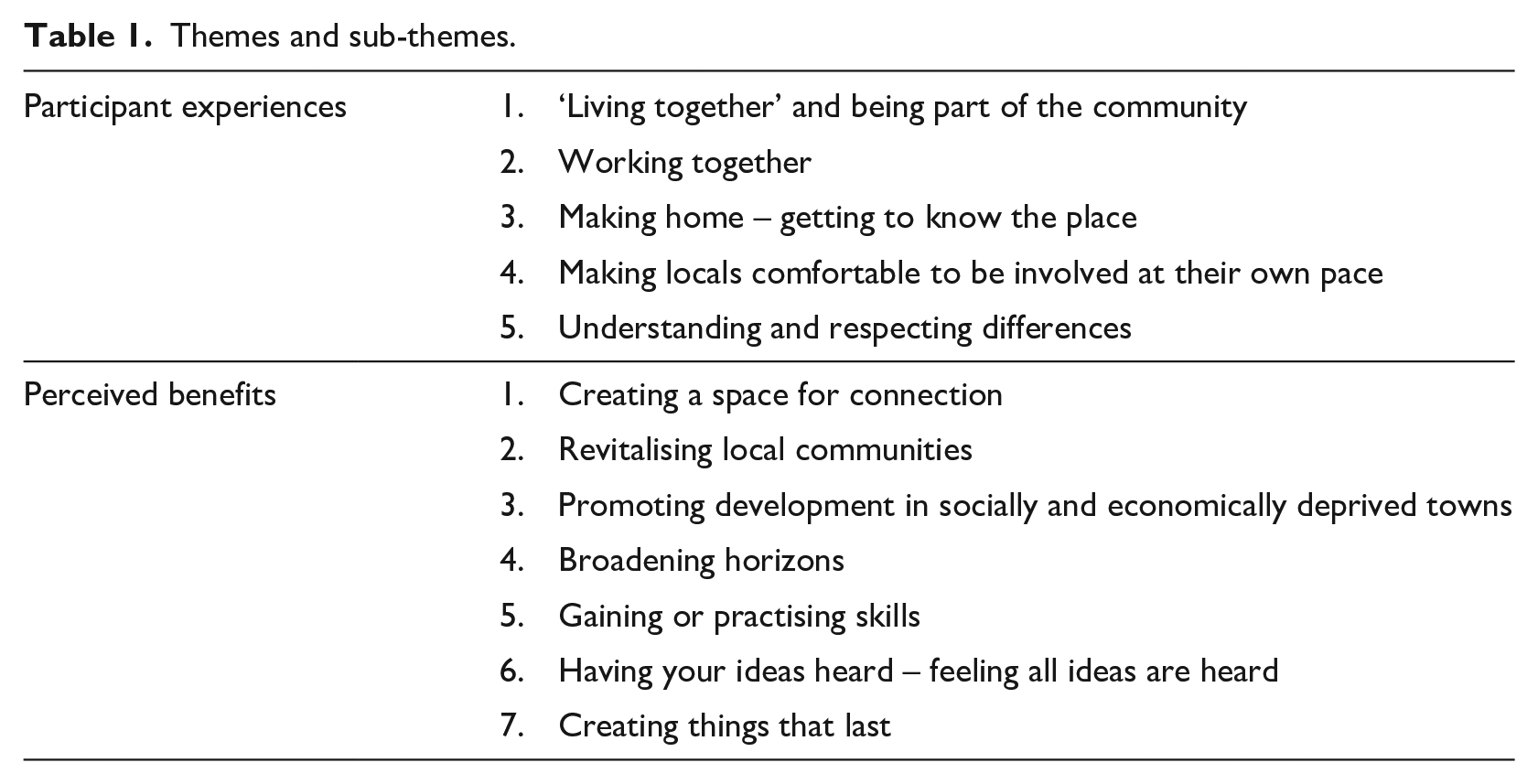
Participants reported experiences relating to ‘living together’, ‘working together’, ‘making home’, ‘making locals comfortable to be involved’ and ‘understanding and respecting differences’. Perceived benefits were ‘creating a space for connection’, ‘revitalising local communities’, ‘promoting development of towns’, ‘broadening horizons’, ‘gaining or practising skills’, ‘having your ideas heard’ and ‘creating lasting things’.
Conclusion:
Findings suggest that creating a CoP not only fulfils individual goals but also addresses common concerns. Participatory architecture workshops in an area with high immigration can create connections between asylum seekers and local people, and promote intercultural dialogue while helping to reactivate an economically and socially deprived area.
Introduction
Over the last few decades, the number of asylum seekers moving into Europe has increased substantially. Asylum seekers face lack of integration and inclusion in their host country, and this can impact their mental health (OECD, 2006). Participating in community initiatives and activities, which bring together native-born individuals and asylum seekers, can contribute to the social integration of migrants (OECD, 2018).
According to the United Nations High Commission on Refugees (UNHCR), asylum seekers are individuals seeking international protection after escaping conflict or political persecution in their home country. Research has identified that asylum seekers have a higher risk of certain mental health disorders (Priebe et al., 2016). Refugees likely encounter a number of risk factors for their mental health during integration into the host country. These include social isolation, discrimination, unemployment and acculturation issues. This is especially the case if, after resettlement, they fail to integrate into the host communities (Bhui et al., 2012; Priebe and Giacco, 2018). On the other hand, the risk of experiencing mental health disorders has been found to be lower if a sense of belonging to the host country is developed by asylum seekers (Cooper et al., 1992; Grieco, 1998).
Integration is a multidimensional process. Developing a positive relationship between host communities and asylum seekers is believed to be crucial. If asylum seekers can join a social network and participate in social and employment activities in the host country, this will likely benefit their mental health (Priebe and Giacco, 2018). The integration of asylum seekers also benefits the host country itself, as they become productive citizens who effectively contribute to the country’s development making use of their knowledge and skills (OECD, 2006).
Nevertheless, integration is a long-term process in which time and space have an essential role to play. Over time, asylum seekers understand and learn more about their new community, its language and how its labour market works, and become able to contribute to it. Space in a broader sense often acts as a tool that allows host communities to connect with newcomers. In the project described in this paper, we arranged for interaction to take place between newcomers and local citizens within the context of participatory architecture workshops. The workshops adopted an approach called Public Interest Design (PID) (Feldman et al., 2011) and formed part of a larger strategy, which brings groups of London-based students to a depopulated village in Calabria to help rejuvenate this marginalised area of Italy (Denicke-Polcher and Donnellan, 2022).
The pedagogical model underpinning the activity is situated learning (Lave and Wenger, 1991). Taking architecture students out of the classroom is key to students’ learning within communities, in which what is ‘practiced is learnt and vice versa’ (Handley et al., 2006: 1). Partnership work between local people, asylum seekers and students is intended to establish a community of practice or ‘common ground’ and a ‘safe working and learning environment’ (Denicke-Polcher and Donnellan, 2022: 4). The literature has highlighted the opportunities this model offers to students’ learning beyond the individual learner and beyond architecture as it works to create a ‘culture of global citizenship’. The Crossing Cultures project described here sought to provide ‘cultural encounters of difference which created an inclusive educational environment and a platform for international collaboration where all participants are involved in negotiating the shared terms’ (Denicke-Polcher and Donnellan, 2022).
The pedagogy associated with this social practice and its effects on feeling at home for asylum seekers as well as for students is described elsewhere (Denicke-Polcher and Donnellan, 2022). However, targeted research is needed to explore more fully the development of social identity within communities of practice. According to Handley et al. (2006), ‘learning is not simply about developing one’s knowledge and practice, but also involves a process of understanding who we are and in which communities of practice we belong and are accepted’ (p. 644). Communities of practice are closely linked to the construction of identity, sense of belonging and commitment. Here, our study focussed on understanding the perceived benefits of the common interest and learning from and with each other, that formed part of the participatory workshop activities undertaken.
Informing this question was evidence that the segregation of asylum seekers in deprived and poor areas of cities can contribute to their social marginalisation and discrimination (OECD, 2018). To avoid this, countries such as Italy facilitate the settlement of asylum seekers in less populated rural areas, such as small villages. The opportunity to be involved in socially relevant projects, which put creative abilities to use for a common aim, is key to the integration of asylum seekers. Local initiatives can offer opportunities for newcomers to socialise with other asylum seekers and local people, create trust and links within the community, and learn and understand more about other cultures. For instance, Camini Jungi Mundu (Unite the World), a small Italian association near the city of Riace, 1 has welcomed and integrated asylum seekers to repopulate the village of Camini. This has not only increased social integration through joint activities and events (Marcher et al., 2017) but has also brought Camini socially and economically back to life building social capital in this part of Calabria.
Engaging migrant communities with local communities promotes a cross-cultural experience, achieved when people with culturally diverse backgrounds work together on the same project. Mohandas (2018) has shown how small-scale architectural interventions helped asylum seekers in Greece create a connection with a place and define it as ‘home’. Working together also promotes acceptance of diversity, integration and inclusion (OECD, 2018). The creation of a sense of community can reduce the feelings of rejection and alienation that asylum seekers face as a result of the discriminatory behaviours by others (McMillan and Chavis, 1986), that can harm their mental and physical health (Nauck, 2001; Sellers et al., 2003). More specifically, by increasing asylum seekers’ social interaction and integration with the host community, their isolation, as well as their perceived rejection, decreases, increasing their feelings of belonging (Cochrane and Stopes-Roe, 1977; Pickett and Wilkinson, 2008). Social integration can improve healthy behaviours and appropriate help-seeking for vulnerable populations of asylum seekers and marginalised migrants (Priebe et al., 2016). Hence, interventions to increase social integration are of value to health educators and professionals providing care to vulnerable groups (Priebe and Giacco, 2018).
Within the field of situated learning, participation and engagement are seen as crucial for the development of identity, and arts-based activities are recognised as tools to encourage dialogue and communication between cultures. Art has been described as a tool that helps to approach the unfamiliar and broadens individuals’ comfort zones (Mohandas, 2018). It offers a neutral contact zone that connects cultures. It also creates intercultural experiences, which are essential for the integration of asylum seekers. In this study, we were interested in understanding how creating a sense of community can be achieved by physically building and making things together. Indeed, by taking part in activities and practices with a community, newcomers gain the opportunity to develop awareness about the larger group, learn their language, meet and encounter their characters, and engage with and use their tools. It is through the physical act of participating and engaging with communities that individuals can adapt and reconstruct their identities. Importantly, public interest design practices seek not only to address a community’s immediate needs but also to build the assets and capacities of that community (Feldman et al., 2011). The degree to which architecture in form of participatory design can facilitate dialogues across different cultures and promote integration (Mohandas, 2018) has not yet been investigated.
The study
Building on the aforementioned concerns, the aim of this study was to evaluate the experiences that asylum seekers, local citizens and architecture students had while participating in a 1-week collaborative architecture workshop in the depopulated village of Belmonte Calabro in Calabria in the South of Italy, during July 2019. The outputs of this participatory work had previously included small-scale, mobile constructions, for example benches, chairs, shelving towers (used for exhibitions and events) and canopies (covering large tables for community dinners). In 2019, the workshop activities became more permanent and longer lasting for instance by focussing on the renovation of the Casa, a former nunnery in the centre of the medieval village. The Casa has since developed into a community hub where villagers, newcomers and visitors alike can come together for workshops, celebrations and events. The result of all these engagements is an overall body of work which offers a new vision for a positive future for Belmonte and its inhabitants. The participatory architecture workshops have initiated a process of regeneration.
Within this context, we felt it was important to identify how students and local people, as well as participating asylum seekers, navigated cultural differences beyond the subject of architecture and helped foster dialogue and intercultural exchange. Here, we aimed to understand the experience and benefits of the workshops for asylum seekers, local people and students and identify perceived benefits and limitations of this initiative to understand whether larger scale implementation is warranted and, if so, how it should be evaluated.
Method
Nature of workshop and location
Since 2016, the work of Crossing Cultures has taken London-based architecture students beyond the design studio to focus on regenerating depopulated areas in southern Italy. Several times a year, student groups work and live in Belmonte Calabro for 1 week. The local workshop focussed on here took place in July 2019. It was the fourth summer workshop organised in this area and brought together architecture students from London Metropolitan University, asylum seekers residing in Longobardi and Amantea, two towns in the vicinity of Belmonte Calabro, and local people. The 2019 workshop was the last one to be held before the COVID-19 pandemic started and had the largest number of participants so far, approximately 50 in total. Of these participants, 15 were refugees, 6 were local residents, and 9 were London-based students. A further 20 participants were international students and professionals who joined the workshop through its wider network. The activities undertaken during this particular workshop focussed on small-scale constructions as part of the renovation of the Casa in the village centre. The activities aimed to create a community hub in the village for local people and newcomers.
Participants
For the purposes of this study, we recruited a purposive sample with a roughly similar number of participants from each of three groups (students, asylum seekers and local people). All participants provided informed consent. One interview with an asylum seeker was conducted in French with the help of an interpreter.
The study was approved by the Ethics Committee of the Department of Psychology at City, University of London.
Data collection
Data were collected by means of interviews which explored participants’ experiences of participating in the workshop. A topic guide was used. Participants were asked about what they liked the most and the least about the workshops; what were the potential benefits at a personal level and for the town’s development; and, finally, if they had suggestions on how to improve the workshops. Two trained interviewers conducted the interviews in English and in Italian.
Procedure
Each participant was approached in person by an interviewer and provided with a Participant Information Sheet. In addition, researchers explained to participants what was expected of them, how long the interview would last (30–60 minutes), and that they had the right to refuse participation at any stage of the research. All participants’ questions were answered before the interviews commenced and written consent was provided to record the interview. Following the interviews, a bilingual (Italian and English) study researcher (F.C.) transcribed the interviews, which were then checked for accuracy by two independent analysts (C.H., D.G.).
Thematic analysis
Thematic analysis (Braun and Clarke, 2006) was used to identify and analyse patterns across participant interviews focussing on participants’ experiences and meanings. The six-phase framework developed by Braun and Clarke (2006) was applied. The analysis started with familiarisation with the data: the audio recordings were transcribed, allowing the researcher to get familiar with the interviews. After carefully reading the transcriptions, first notes were made. Then, initial codes were generated, indicating potential patterns across the interviews. Following the identification of the recurring patterns indicated by codes, the search for themes to capture important aspect within the data started. Themes were then reviewed, analysing which ones needed to be retained or discarded, for instance, due to overlap with another theme. Then, themes were defined and named to clarify which aspect of the interviews each specific theme captured. Finally, the final themes were illustrated by quotes from participants’ interviews; pseudonyms were used to protect confidentiality.
Findings
A total of 25 participants (14 men, 11 women) from three groups (students, asylum seekers and locals) were interviewed. 10 were students, 6 were asylum seekers and 9 were local residents. Participants were all adults and ranged in age from 18 to 51 (SD = 14.67) years; however, 19 participants were reluctant to provide their age. Thematic analysis (Braun and Clarke, 2006) led to the development of two main themes and several subthemes within each of them, as shown in Table 1.
Themes and sub-themes.
Participants’ experiences of the workshop
‘Living together’ and being part of the community
Both students and local people who participated in the collaborative architectural workshop reported that collaborating closely in the workshop made them feel as part of the same community. The workshop provided them with the opportunity to spend time together during the evenings and connect, creating an experience of ‘living together’.
We [. . .] made friends with the locals at the bar, we used to get to the bars in the evenings and play cards with the local men, which is a good way to connect with them. (Mark, student) They all created a big family. They stay all together without differences: they seem like a big community when they are together. (Luca, student)
Working together
The experience of collaborating and working jointly was positively identified especially by asylum seekers, who saw the workshop as an opportunity to get to know other people across gender and ethnicity differences. Working together also provided asylum seekers with the chance to share their stories and experiences with locals.
It is a big thing for me. It is a big experience, because when I meet you, I want to know you and be close with each other. I don’t want you to be afraid of me. Here we are all curious about each other. If I meet you, I can share a lot with you. It is a big experience for me. (John, asylum seeker) It is really great that there are no colour differences, and everyone is working together. And even the girls working on the constructions and guys working together [are doing that, and] that is not very common in Pakistan. (Oliver, asylum seeker)
Making a home – getting to know the place
Both students and asylum seekers expressed the desire to create a home while participating in the workshop. Asylum seekers described how they would be happy to make a home when they found a community that accepted them and, most importantly, a place that had potential and offered possibilities for them.
This concept of the refugees coming here now [. . .], and they are willing to create a home here, and if we are providing them with the possibilities. (Mark, student) ‘Belmonte [. . .] is very peaceful and it calms me. So, living in Italy, especially seeing the locals and everyone as well, they accept me, so I feel that there is potential. (Oliver, asylum seeker)
Making locals comfortable to be involved at their own pace
Some students who took part in the interviews felt the workshop allowed local people to get comfortable and be involved at their own pace. The workshop was characterised by open dialogue and conversation, which helped local people get used to the presence of students and asylum seekers and become involved in the workshop without any kind of pressure.
It is beautiful being involved and getting to know new people from different cultures and ethnicities. (Emma, local) It was good and did help to create an atmosphere and a conversation, which is the most important thing: to create and to carry this forward. But I think we need time to build [on] this so we can have a bigger conversation in the future eventually. (Mark, student) I see local people kind of getting used to you and recognising you and [that’s] is a really nice feeling. (Oliver, student)
Understanding and respecting difference
Both students and asylum seekers felt that the workshop provided an opportunity to learn how to understand and respect differences. The fact that people from different countries speaking different languages met in Belmonte and worked together was seen as a way of connecting and learning new things from others, accepting, and respecting cultural, social and background differences.
It is beautiful that all these young people from different cultures and languages come here. (Charlotte, student) All different cultures can connect and do things together; this makes things better because we can all learn something new from the others. (Elijah, asylum seeker)
Perceived benefits of the workshop
Creating a space for connection
Students perceived that the workshop created a space for people to visit regularly throughout the year, and therefore a space for connection. Students also shared that collaborating in the workshop allowed them to create strong friendships with asylum seekers.
I think the project, the workshop helps to develop that relationship as we are building and renovating a house now and I think that is where is the space for people to continuously come throughout the year [so that] then it will continue to grow as a place. (Mark, student) I made friends also with the immigrants. They are my friends. We made a relationship, we stayed in contact during the year, we talked by phone, by message: we created a link. (Amelia, student)
Revitalising the local community
The workshop was seen as an opportunity to revitalise the local community and the village: local people became more aware of the potential of the place they lived in and having more people in the village increased the activity and profits of local businesses.
The workshops provide Belmonte with the opportunity of experiencing different activities and of showing the innate potentialities that human beings have. In addition, the village started to be populated and there was both a commercial and cultural exchange. (Martha, local) The community is growing. And it is amazing to see just this whole process growing, developing and just creating a positive change that is the whole point of it at the end. (Mark, student)
Promoting development of deprived towns
Local people who participated in the workshop identified the re-development of depopulated towns such as Belmonte Calabro, as an important benefit and result of this participatory architecture intervention. The workshop also helped Belmonte being more alive and dynamic.
Belmonte needs more visibility, and we need to publicise it more as it is a really beautiful place. (Ben, local) [Belmonte] is alive now, there is more movement. (Ben, local)
Broadening horizons
Local people and asylum seekers felt that the workshop helped broadening horizons: participants from different backgrounds gained new perspectives and shared their thoughts, offering each other the opportunity of learning new things.
The workshops were really innovative. Participants provided new perspectives, different from the ones that we are used to seeing and living with. (Sophie, local) I like the fact that I am learning [new] languages. I like that when people speak, I learn different things. (Theo, asylum seeker)
Learning skills
Some local people who participated in the workshop shared that they were learning skills: they felt the desire to learn things from others and enrich their knowledge.
They all have different ideas, but they all share the desire to learn and do new things. (Sophie, local) I am enriching myself while learning new methodologies, and I am sure that people from Belmonte will learn new things as well. (Sophie, local)
Feeling all ideas are heard
Many students spoke about how everyone was free to share their own ideas and that these were always heard by the local community, as well as by the other participants.
They bring their own ideas, and they get the bits and pieces from the community. and everyone is around the table and can bring themselves. It is part of the place, but they are creating something new. (Henry, student) [The workshops] can open the minds [of the community], their visions with more possibilities. [. . .] It can be very beneficial. (Henry, student)
Creating things that last
Several participants’ responses revealed that, during the workshop, they felt they were creating something that was going to last. They explained that taking care of something created a sense of belonging. Because of these feelings, people felt that there would always be space for them to go back to, allowing Belmonte Calabro to keep on growing.
[We are] creating the sense of appropriation: when people feel to belong to something, they take care of it, and it lasts. (Henry, student) There is space for people to continuously come throughout the year, then it will continue to grow as a place. (Mark, student)
Discussion
Main findings
This study explored the experiences and benefits perceived by asylum seekers, local people and students following a collaborative architectural workshop using a pedagogical model of situated learning. Overall, participants confirmed that the common interest and shared learning created a sense of belonging and identity.
Generally, the workshop was described by all participants as a positive experience. It was perceived as an opportunity to live together and to feel part of the same community. Participants described the workshop as an experience that enabled them to work together and become closer with others while creating a home for all of them. Participants felt that the workshop represented an opportunity to understand and respect cultural and social differences, promoting the integration of different cultures.
Asylum seekers, students and local people described several benefits arising from the collaborative workshop. As participants were involved in renovating a building for community use, they felt they were creating a space for connection and for people to visit on a regular basis, and strong friendships were created between them. The local community was also revitalised by the cultural exchange that came with the workshop. The development of Belmonte Calabro was perceived as an extremely beneficial consequence of the workshop: local people felt that the town became more dynamic, active and revitalised while the workshop was taking place. In addition, the presence of individuals from different cultural, social and economic backgrounds broadened their horizons and enabled them to share different perspectives, ideas and skills. This cross-cultural and open environment created the feeling among participants that everyone’s ideas were heard and, most importantly, that they were creating something together that was going to last. Participants developed a sense of belonging to Belmonte Calabro and the feeling that they could always go back there. This sense of belonging to a community was reflected in the naming of Belmonte as ‘Belmondo’, translated as ‘beautiful world’. Consequently, the emerging community there has been described as ‘an open and inclusive imagining, (in which) anyone can become a local’ (Ricci, 2020).
Comparison with the wider literature
All the participants in this study described having a strong connection with the village and a higher understanding and respect of cultural differences. These findings were in line with those reported in previous work by Mohandas (2018), who investigated whether small-scale architectural interventions could help asylum seekers in Greece create a connection with a place and define it as ‘home’. Mohandas’ (2018) findings demonstrated that architectural interventions could achieve this goal for asylum seekers and create feelings of deep connection to a hitherto foreign land. The architectural interventions in Greece provided spaces where people could share their cultures while learning and respecting differences. As Mohandas (2018) argues, ‘we must engage and interact with difference to create more tolerant and democratic societies’ (p. 48).
Sennett (2008) has argued that ‘the act of making is a method of integrating people with difference through a collective act’ (p. 29). Through the collective act of making within the community of practice established in Italy, individual students, local people and asylum seekers, have created their shared identity and effected the integration of asylum seekers. Given the diversity of backgrounds and skills different participants bring to the project, this community of practice might be described as something of a ‘radical collaboration’. Howell and Wilson (2018) use this term to describe ‘an approach, often led by community-oriented non-governmental organizations, that seeks to transform the ways disadvantaged groups access the city’. With reference to the work of Roberta Feldman et al. (2011), the close alignment between the project and public interest design is evident, since the ambition of the project lies ‘at a scale that is bigger than the individual project’ and seeks to address ‘long-term societal problems’ with has far-reaching consequences.
Findings from this study show that collaboration between students, asylum seekers and local people is a practice that can initiate and promote the regeneration of socially and economically deprived villages and cities while also positively impacting the local economy. The Refugees as City-Makers project conducted in Lebanon in 2018 (Fawaz et al., 2018), also identified similar positive effects resulting from efforts to ensure refugees became active agents in the construction of their lives in a new country. Both studies demonstrate the role that refugees can play in the revitalisation of both urban and rural places.
Our study therefore adds to the available literature by showing how a sense of community can be fostered by initiatives such as architecture-based workshops and communities of practice. Past research has shown the benefits of participatory architecture workshops in reducing the negative effects of perceived discrimination (García-Cid et al., 2020), a finding which is confirmed by our study. Our study findings also show how participatory architecture workshops may be a good way of promoting a sense of community. Participants reported that our workshops did increase a sense of community in several ways: (a) through membership and an associated sense of belonging; (b) by means of influence and generating the feeling that one can make a difference to the community; (c) through the fulfilment of disparate needs; and (d) by means of shared emotional connection (McMillan and Chavis, 1986).
Our findings also need to be considered in the context of the large body of literature produced by national and international schools of architecture on the art of making (Gropius, 1965). Much of this literature to date has focussed on pedagogical benefits rather than on the positive impact that architecture-informed workshops can have on students or other participants, including their mental health. However, contemporary perspectives (Gaber, 2014) have emphasised that the act of physical making, especially involving groups of people, is linked to increased well-being. As outlined by Mitchell (1996), making at a scale of 1:1 in education fosters communication and the sharing of skills among participants. Moreover, the act of making at large scale ‘involve[s]all participants in a joint endeavour’, further highlighting the benefits of architecture workshops as a tool to foster ‘group cohesion’ (Mitchell, 1996: 173). In summary, emerging evidence shows that architecture workshops of the kind developed here can generate positive experiences for participants and deliver tangible benefits for the towns and communities that host them.
Implications and further research
Findings from this study contribute to emerging evidence (Gaber, 2014; Mohandas, 2018) that architecture workshops and the pedagogical model of situated learning that underpins them can be beneficial with respect to the integration of asylum seekers and regeneration of rural and urban areas. Benefits for students are also of importance, as participatory architecture provides opportunities for students to engage in socially relevant activities in an economically deprived area.
While previous research has identified the potential of art-based workshops to reduce discriminatory attitudes, our study shows how participatory architecture workshops by creating things that last over time, may also foster a sense of community between people from different backgrounds. Politicians and local authorities should consider the wider implementation of these initiatives given the different benefits experienced by the different groups of participants.
Finally, future research studies evaluating the larger scale roll-out of such workshops should focus on assessing not only experiences but also outcomes, such as personal connections made, changes in attitude towards asylum seekers/locals/students, changes in a sense of community and individual and collective mental health benefits. To extend the knowledge base, these studies should assess responses to these initiatives in a more diverse mix of rural, semi-rural and urban sites.
Strengths and limitations
This study has a number of strengths and limitations. Having bilingual researchers helped maximise the participation of asylum seekers and local people in the interviews. One-to-one interviews looked at the individual experiences of the participants, giving them the opportunity to share feedback which might have been more difficult to talk about in groups. Interviews were also conducted directly at the time of the workshop, not afterwards, minimising recall bias. Finally, the interviewers did not participate themselves in the workshop so as to be clearly separate from the team organising workshops.
Limitations of the study included a relatively small sample of participants and that fact that work took place in one location. While the themes identified cannot as such be generalised to other contexts; they may recur or be useful in informing future similar experiences of participatory architecture workshops in rural villages. Finally, despite the safeguards we took, it is possible that desirability bias may have influenced our results with participants focussing on identifying the positive aspects of a novel initiative, rather than providing more critical feedback.
Conclusion
Asylum seekers’ integration into host countries can be extremely challenging, and for asylum seekers establishing trust and dialogue with native-born communities can be difficult, leading to difficulties and negative consequences on asylum seekers’ mental health. Architecture-based workshops have the potential to enhance social integration with important effects on healthy behaviour and appropriate help-seeking.
This study has highlighted the importance that participatory architecture workshops can play in promoting dialogues across cultures. Through participatory architecture workshops, local people and asylum seekers can positively and successfully collaborate, connect and communicate and a sense of community can be created. Through the meaningful activities associated with the workshop, relationships and shared identities came to be created. Such interventions show promise in fostering the integration of newcomers and reactivating depopulated villages and towns.
By promoting social integration, interventions may also have an important impact on help-seeking and healthy behaviours. Health professionals working with vulnerable and migrant populations should explore the potential of these initiatives and ideally advocate for them if their benefits are to be confirmed in further research.
Footnotes
Acknowledgements
Special thanks go to the local Associazione Culturale ‘Le Seppie’ whose network and insight made this research possible. The views expressed are those of the author(s) alone and are not necessarily those of the NIHR or the Department of Health and Social Care. SD-P is a member of the Centre for Urban and Built Ecologies (CUBE) at London Metropolitan University, which offers support to the Crossing Cultures project.
Funding
The author(s) disclosed receipt of the following financial support for the research, authorship and/or publication of this article: DG is partly supported by the Applied Research Centre West Midlands of the National Institute for Health Research (NIHR).
