




Abstract
Objective:
This study investigated the efficacy of a two-component professional development approach to improving school wellness in Pennsylvania secondary schools.
Design:
Circle of Wellness (CoW), a year-long, two-phase programme, involved providing Whole School, Whole Community, Whole Child (WSCC) workshops to Pennsylvania school staff and administrators, followed by personalised technical assistance to facilitate the implementation of wellness initiatives.
Setting:
The workshops were provided in-person, with follow-up technical assistance (e.g. phone calls, zoom meetings, real-time editing sessions via Google Drive) delivered remotely.
Method:
Workshops featured expert presentations, activity stations, and physical resources to meet all 10 components of the WSCC model. After workshop completion, research staff provided support to promote school staff adoption of a wellness action plan grounded in WSCC components. Participants then completed post-programme evaluations rating satisfaction and success with the implementation of their action plans.
Results:
In a final programme evaluation, 70% of the respondents reported bringing about healthy changes as a result of participating in the CoW programme (n = 28). In addition, 100% of the school representatives reported that attending the workshop and participating in the programme were a worthwhile experience (n = 40).
Conclusion:
Professional development opportunities such as the CoW, which includes follow-up guidance and resources, were well received by school staff, and the understanding gained through participation in such programmes contributed to the sustainability of wellness initiatives.
Background
Because children and adolescents spend much of their time in school, schools are often considered a strategic environment on which to focus public health efforts. The overall health of children and adolescents is essential to support academic performance and future success. Simultaneously, schools require community input, resources and collaboration to best provide support to students (Centers for Disease Control and Prevention [CDC], 2014). Alignment, integration and collaboration between school and community sectors are needed to improve each child’s learning and health.
Developed in 2014 by the Association for Supervision and Curriculum Development (ASCD) and the CDC in collaboration with key leaders from the fields of health, public health and education, the Whole School, Whole Community, Whole Child (WSCC) model combines and builds on elements of the traditional coordinated school health approach and the whole child framework (CDC, 2014). The model calls for greater alignment, integration and collaboration between health and education systems to address whole child wellness (i.e. physical, cognitive, social and emotional development), and subsequently academic achievement. While there continues to be a push towards ‘holistic wellness’ at the school level, too often implementation efforts fail to translate into measurable school improvements (Purnell et al., 2020).
One way to promote the adoption of holistic models such as WSCC is through the provision of professional development opportunities. Professional development is a systematic process that aims to strengthen how professionals obtain and retain knowledge, skills and attitudes (CDC, 2019). The overall goal of effective professional development is the employment of skills and strategies that enhance the knowledge of participants and simultaneously promote the transfer of learning and resources. Unfortunately, to date, teacher and administrator training and workshops often fall short when it comes to creating health initiatives in participating schools, often due to the lack of resources or buy-in from administrators.
The Penn State PRO Wellness team has long-standing expertise in professional development with schools (Francis et al., 2019; Hivner et al., 2018, 2019). To promote the adoption and utilisation of whole child wellness activities, the team has sought to utilise CDC Professional Development Practices (CDC, 2019). This model, which is based on research and best practice, involves the delivery of professional development through training workshops and other activities in a group, followed by one-on-one technical assistance to support implementation. Guided by the CDC’s Professional Development Best Practices, the two-phase Circle of Wellness (CoW) programme, focuses on developing sustainable programmatic change in schools to bolster the health and wellness of school communities.
In this study, our goal was to create an easy-to-implement professional development opportunity that would lead to the implementation of sustainable wellness initiatives grounded in the WSCC model.
Methods
Programme development
CoW was a 1-year-long, two-phase programme focusing on the provision of technical assistance to schools after staff participation in an in-person workshop.
Phase 1
At the start of the 2019–2020 school year, teachers, nurses and administrators from Pennsylvania secondary schools were invited to participate in the CoW programme. A save the date invitation was sent via an internal Listserv to school professionals. Two staff and/or administrators per school were invited to participate in a full-day workshop to increase knowledge about the WSCC model and challenge participants to implement a wellness initiative in their school community.
Speakers and content experts were selected from PRO Wellness’ extensive community contacts and expertise within this space. Content experts led session and activity stations, which aligned with at least one of the 10 WSCC components and with a particular focus on mental health (Table 1).
CoW workshop, by Whole School, Whole Community and Whole Child (WSCC) model component.
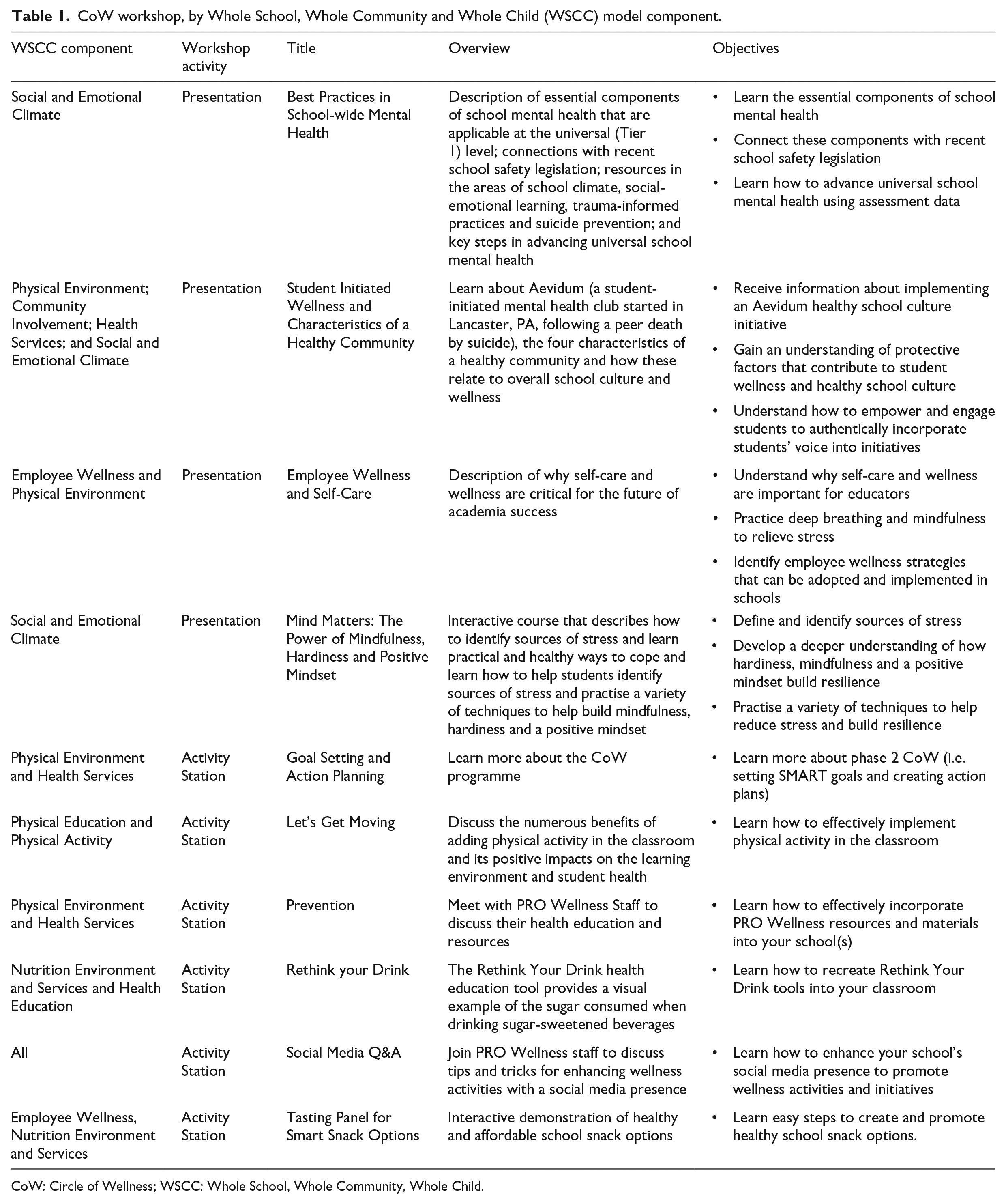
CoW: Circle of Wellness; WSCC: Whole School, Whole Community, Whole Child.
To meet the needs of the audience, the same workshop was offered on two separate occasions (25 and 26 October 2019). Each guest contributor introduced participants to a realistic, achievable wellness initiative that could be implemented within their school community. To assist in the development and implementation of a wellness initiative, participants were challenged to (1) take what they learned during the workshop and disseminate the information across their school/district (e.g. through Parent Teacher Organisations [PTO] and Wellness Councils), and (2) involve the local community in selecting and realising of an actionable item. The ultimate goal of the workshop was to promote awareness and understanding of the WSCC model to help in the selection and implementation of an actionable wellness initiative involving the school community.
Phase 2
Following the completion of the workshop, participants were challenged to apply one of the wellness activities and/or programmes presented during the workshop in their own school community. PRO Wellness facilitated and supported the chosen activities through technical assistance, resources and stipend support to participating schools (e.g. phone calls, Zoom meetings, real-time editing sessions via Google Drive) to aid in shaping their wellness goals and objectives.
Goals and objectives formulated during phase 1 provide a foundation to select an action item, establish the overall direction and focus of a programme, and define the scope of what the programme or initiative should achieve. Without well-written goals and objectives, it is difficult to measure progress in implementing a plan as well as its impact on students, staff and the community. PRO Wellness staff supported the creation of straightforward and concise goals defining (1) who would be affected, and (2) what would change as a result of the wellness initiative.
Following the development of goals and objectives, school participants were guided through the process of creating an action plan. This plan was used as a guide for the implementation of activities in support of the goals and objectives. Action planning also involved creating a budget. All participating schools were allotted a stipend of US$300 to support their wellness initiatives.
As a final step of the action planning process, schools were encouraged to establish metrics to assess programme success. Evaluation metrics allow for both future improvement and enhance administrative support for programme sustainability. Goals/objectives, the action plan and evaluation metrics were developed using Google Drive to allow real-time editing and to provide feedback to participants. This process ensured both PRO Wellness staff and the school participant(s) were working from the same document(s). Personalised Google Drive forms were created for each school. PRO Wellness staff tracked participation and the completion of all documents for schools throughout the school year and followed up with school representatives if documentation was incomplete.
Personalised follow-up was largely dependent on the individual school’s needs, but included the sharing of relevant resources (e.g. PDFs, PowerPoints, webinars) and one-on-one assistance via telephone and video to help participating schools effectively navigate their action planning. In particular, phone and video calls were useful in facilitating the development of action plans with schools since they provided schools with an engaging environment in which to work through their ideas.
COVID-19 restrictions, however, created challenges for some schools, but the PRO Wellness team was able to assist with amending plans, where possible, and creating timelines for delayed activities. Technical assistance was key to helping schools successfully implement their plans. PRO Wellness built strong relationships with the engaged schools and provided tailored technical assistance, based on their needs. Having a sounding board and resources provided schools with the means to be successful in their wellness initiatives.
Data collection and analysis
At the end of the 2019–2020 school year, participants were invited to complete a post-programme evaluation regarding programme outcomes and knowledge gained from participation. The final evaluation, distributed to all participants via their Google Drive accounts, captured (1) the perceived usefulness of the initial CoW workshop, (2) a rating for the technical assistance and resources provided by the PRO Wellness staff, (3) the perceived effectiveness of the action planning process, and (4) the self-reported effectiveness of the CoW programme (i.e. the creation of wellness initiatives through action plan development).
The perceived usefulness of the kickoff CoW workshop was based on an average rating of satisfaction by event attendees and the ability of participants to disseminate workshop information and materials to school staff. Responses were rated using yes/no, open-ended and multiple-choice questions. The rating of technical assistance provided by PRO Wellness was measured using a 5-point Likert-type scale question from (1) not at all useful to (5) very useful and open-ended responses. Participants who completed action planning activities were asked additional yes/no questions and 5-point Likert-type scale questions from (1) strongly disagree to (5) strongly agree to rate the effectiveness of the action planning process. In addition, participants who were unable to compete the action planning process were asked via multiple-choice response to identify the main barrier(s) they had encountered. Finally, the self-reported effectiveness of the overall CoW programme was measured by the number of action plans completed, as well as by the intent to implement similar events in the future through the support of community partnerships. Respondents were also asked, ‘As a result of participating in the Circle of Wellness programme, did your school institute any new changes?’ This included wellness initiatives implemented with or without the creation of an action plan. Data were analysed and presented descriptively using frequencies and associated percentages.
Results
Participation
Through the internal listserv, 183 administrators and school staff were sent a save the date. Seventy-two members of school staff representing 42 schools and 13 counties in Pennsylvania registered to participate. The final project enrolment included 67 school staff and administrators representing 37 schools and 11 counties who attended the initial CoW workshop. Overall, school administrators were the largest group of attendees (25%), with school health/physical education teachers and counsellors/social workers being the next two largest groups of school professionals (21% and 20%, respectively).
Final evaluation
Representatives from thirty-two participating schools completed the final evaluation, resulting in a total of 40 completed evaluations (Table 2), since in six schools more than one representative completed the final evaluation. All 40 respondents found the initial workshop to be useful and worthwhile, with all but one of our respondents reporting the dissemination of workshop information and resources with their school teams. The average rating for PRO Wellness technical assistance was a 4.3/5. Overall, participants found the action planning process effective, with 36 respondents (90%) reporting the action planning process easy to follow. Specifically, 36 respondents (90%) reported it easy to use the action planning documents, and the same number of respondents (n = 36) reported the use of these documents to implement their wellness initiatives. Schools also prioritised creating sustainable initiatives, as 33 respondents (84%) anticipated holding similar events in the future.
Circle of Wellness (CoW) programme – final evaluation (n = 40) a .
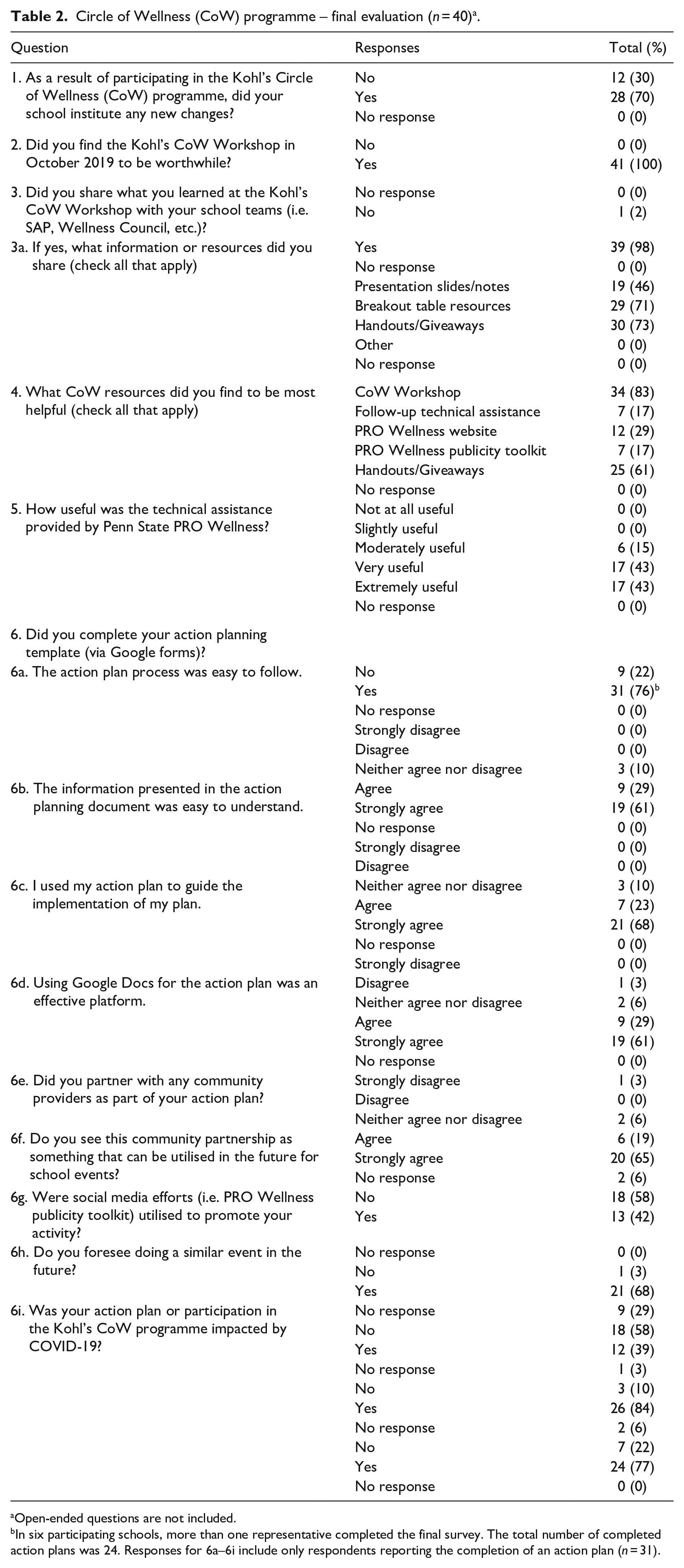
Open-ended questions are not included.
In six participating schools, more than one representative completed the final survey. The total number of completed action plans was 24. Responses for 6a–6i include only respondents reporting the completion of an action plan (n = 31).
In total, 24 schools (65%) successfully completed an action plan and evaluation template. However, 18 schools were ultimately not able to implement their action plan during the 2019–2020 school year due to the COVID-19 pandemic. The action plans submitted covered all 10 WSCC components. The WSCC components Social and Emotional Climate and Employee Wellness were the most highly frequently represented component in completed action plans, appearing in 46% (n = 11) and 42% (n = 10), respectively. Notable action plan initiatives include renovating faculty spaces to improve employee wellness and including meditation and mindfulness in physical education classes. To facilitate programme success, 47.8% (n = 13) of the total respondents (n = 40) reported engaging with their communities and partnered with local vendors Furthermore, 69.6% (n = 21) of respondents reported that they thought a community partnership could be leveraged in future events.
Overall, 28 (70%) of the 40 respondents reported instituting additional healthy changes because of participating in the CoW programme (n = 28). Examples include the completion of wellness surveys regarding teacher burnout and mental wellness; the formation of a committee to review current health and physical education curriculum; the creation of a vaping education programme for students and staff; the introduction of mental health curriculum; and partnerships with community groups to encourage increased physical activity among the school community.
Discussion
This study assessed the use of a two-part professional development approach to improve school wellness in 37 secondary schools in Pennsylvania. Overall, school respondents rated the two-phase professional development opportunity positively. In addition, based on final evaluation results, CoW was perceived as effectively educating schools about WSCC components, providing participants with the tools to create action plans to meet school wellness needs, while focusing on sustainability and community engagement.
As indicated earlier, the study was designed in line with the CDC’s Professional Development Practices, which focus on sustaining an infrastructure, technical assistance, promotion to audience, conducive learning environments, providing follow-up support and evaluation throughout the process (CDC, 2019). The CoW programme sought to utilise all of these foci throughout the year-long time frame. A review of 35 methodologically rigorous studies focusing on teacher professional development found that effective approaches are content-focused, incorporate active learning, support collaboration, use models and the modelling of effective practice, provide coaching and support, offer opportunities for feedback and are of sustained duration (Darling-Hammond et al., 2017). Each of these seven qualities was present in the CoW programme. In particular, PRO Wellness was strategic in encouraging initial workshop registrants to bring a school peer to increase the number of stakeholders at each participating school and to support collaboration. This use of this strategy was informed by research showing that professional development opportunities are more beneficial when participants work with peers rather than participate alone (Ward and van der Mars, 2020). Overall, participants expressed ease with the process and demonstrated knowledge gained through the dissemination of resources.
All 24 action plans developed as part of the CoW programme included an element of community engagement to support implementation and sustainability. From our perspective, this element was crucial to ongoing success as research has shown working with the community is an essential feature of the WSCC model (Olson et al., 2021; Pittman et al., 2020). Despite activities being disrupted by the COVID-19 pandemic, PRO Wellness was able to work with school representatives to adapt programmes and initiatives to engage with the new learning environment (via in-person, remote and hybrid forms of teaching and learning). It is hoped that the community engagement developed through the programme will continue to support schools as they transition through these new learning environments and pandemic challenges.
Limitations
While the CoW programme proved to be a successful and positive experience, there is always room for improvement. Attendance at the workshop and retention with action planning were lower than anticipated. One barrier to this could have been timing, as the workshop was only offered twice, and that too during the same week period. The geographic location of the workshop could also have posed a barrier to school representatives who did not want to travel far to participate in a professional development opportunity.
Conclusion
In conclusion, given schools’ and participants’ positive responses, similar professional development models may offer an effective way of delivering wellness content and promoting whole school wellness. Next steps should include a focus on implementing similar models in varied education environments as schools continue to transition from in-person to remote and hybrid models of learning in response to the COVID-19 pandemic.
Footnotes
Acknowledgements
We thank the content experts who participated in the Circle of Wellness workshop as well as the school representatives who participated in the year-long programme. Thanks to Kohl’s Cares for their support of Penn State PRO Wellness in the development and delivery of professional development opportunities for school-based personnel.
Funding
The author(s) received no financial support for the research, authorship and/or publication of this article.
