




Abstract
While it is now argued that intellectual giftedness is not causally associated with well-being, the individual and environmental determinants associated remain empirically underexplored. Trying to fill this gap, this study investigated potential risk and protective factors on the well-being and mental health of 219 Canadian intellectually gifted adults. Exploratory transversal analyses were conducted between 11 determinants frequently evoked in the literature on intellectually gifted individuals and hedonic well-being (positive/negative affect; ∝ = .85–.87; satisfaction with life; ∝ = .88), eudemonic well-being (existential crisis/meaning in life; ∝ = .76–.87; interpersonal connection; ∝ = 92) and psychopathologies. Results show that twice-exceptionality and lower socioeconomic status are risk factors for the development of psychopathologies, while being married/in civil union and having a higher perceived level of potential achievement are protective factors for hedonic and eudemonic well-being. Results are discussed in light of previous knowledge about gifted individuals.
Keywords
Despite the growing popular interest in giftedness and its broad scientific coverage, little consensus is accessible about the gifted persons’ evolution into their adult lives (Brown et al., 2020; Brown & Peterson, 2022; Rinn & Bishop, 2015). While gaining a better understanding of gifted adults is necessary to validate the ways we tend to the development of gifted individuals, most empirical studies seem to focus mainly on comparing their social and emotional experience to the general population, obtaining varying conclusions according to the paradigms and operationalization of giftedness and well-being used (e.g., Jones, 2013; Rinn, 2024). If experts have recommended to clarify explicit and implicit conceptualisations used to move this field forward, they have also highlighted that the relationship between giftedness and well-being could overcome causality and be better explained by multiple individual and environmental determinants (Rinn, 2024). This calls for a shift in this knowledge field, suggesting, among other things, that more research be devoted to gaining a better understanding of potential risk and protective factors of well-being and mental health in the gifted population (e.g., Jones, 2013; Neihart & Yeo, 2018; Rinn, 2024). In trying to fill this research gap, we have attempted to take a first step by exploring potential individual and environmental determinants of well-being within a population of Canadian intellectually gifted adults. Hedonic well-being (positive and negative affect, life satisfaction), eudemonic well-being (meaning in life and crisis of meaning, quality of interpersonal connections), and the self-reported presence or absence of mental disorder(s) have all been examined to gain a broader perspective of this complex question.
Theoretical Background
Defining Intellectual Giftedness
Although giftedness has been the object of several theoretical conceptions, including a wide range of definitional components (e.g., engagement and/or creativity; Renzulli & Reis, 2018; Tannenbaum, 2003), there is no consensus regarding its definition (Guay et al., 2020; Marleau, 2021; Rinn, 2024). This lack of a consensual definition evokes ontological tensions and practical challenges, particularly in terms of identifying and assessing giftedness, great heterogeneity of practice being observed (Guay et al., 2020; Marleau, 2021; Rinn, 2024).
To ensure greater clinical and research rigor (e.g., interpretation of the data, accuracy between the sample and the construct under study), many experts have called for the clarification of the paradigm of giftedness used (e.g., Carman, 2013; Marleau, 2021; Rinn, 2024). In Quebec, Canada, where the research took place, experts have suggested the adoption of intellectual giftedness as research and clinical paradigm (also known as the high IQ paradigm or the giftedness as potential paradigm; Carman, 2013; Pollet & Schnell, 2017). Indeed, displaying exceptional intellectual abilities has frequently been one of the central criteria to define giftedness. For instance, in unidimensional psychometric models of giftedness, the latter has generally been defined as having intellectual abilities above the 98th percentile (IQ > 130) on an intelligence scale, typically the Weschler Adult Intelligence Scale (WAIS; e.g., Carman, 2013; Sternberg & Kaufman, 2018). Alternative and more inclusive multidimensional models of giftedness, for example, Renzulli’s Three-Ring Conception of Giftedness (e.g., Renzulli & Reis, 2018) and Gagné’s Integrated Model of Talent Development (DMGT/IMTD; e.g., Gagné, 2023), which are two of the most cited theoretical models on giftedness, still tend to include intellectual potential in their proposed conceptualization. For this reason, in Quebec, giftedness is now majorly defined as an atypical neurocognitive profile characterized by an exceptional intellectual potential (e.g., Gauvrit, 2021; Marleau, 2021). This definition of intellectual giftedness cannot be generalized to other higher abilities such as sport or music and is to be distinguished with a definition of giftedness centered on achievement, talent, or success (talent development paradigm; Guay et al., 2020). Moreover, even if this perspective presents some theoretical and operational limits (e.g., Guay et al., 2020; Marleau, 2021), local experts also recommended that intellectually gifted individuals be assessed by cognitive measures or tests realized by psychologists/neuropsychologists who possess the necessary expertise to assess IQ and combine or distinguish giftedness from other psychological or neurodevelopmental disorders (e.g., Labouret, 2021). These assessments of intellectual giftedness are often realized by experts in private organizations or within a clinical context (e.g., hospitalization, school psychologist).
Well-Being Among Intellectually Gifted Individuals
Because of this cultural view of intellectual giftedness as primarily characterized by a superior intellectual potential, there have been numerous debates on the role of IQ and intellectual abilities in the development, functioning, and well-being of intellectually gifted individuals. Essentially, two conflicting perspectives are expressed. On one hand, because of a philosophical tradition where intelligence is associated with a lucidity that can instill madness, as well as fundamental maladjustment with peers, intellectual giftedness has been associated with an increased vulnerability and potential well-being alterations from childhood to adulthood (e.g., see Jones, 2013 for a review). This view is frequently known as the divergence hypothesis or the disharmony hypothesis (e.g., Bergold et al., 2018). On the other hand, because of the abilities that can emerge from a superior intellectual potential, intellectual giftedness has been associated with eminence, success, and well-being (e.g., Holahan et al., 1995; Terman, 1925), and has long been perceived as an essentially favorable condition for the individual (e.g., Jones, 2013; Subotnik et al., 2011).This view is frequently known as the harmony hypothesis (e.g., Bergold et al., 2018).
While both views received empirical evidence to support their position, the harmony hypothesis initially gained a larger scientific support in research on intellectually gifted children and adults. Indeed, ever since the pioneering longitudinal Genetic Studies of Genius realized by Lewis Terman and his colleagues (1947) on gifted individuals (IQ > 140 on the Standford-Binet Intelligence Scale), it has been claimed that intellectually gifted children are as adapted as neurotypical children and grow to become adults who show very high levels of professional success, psychosocial adjustment, and report lower mental health disorder prevalence than the general population (see also Holahan et al., 1995; Oden, 1968; Terman & Oden, 1959). This finding has been supported by longitudinal studies, including the 35-year longitudinal study of Mathematically Precocious Youth (SMPY; Bernstein et al., 2021; Lubinski & Benbow, 2006; Lubinski et al., 2014), which concluded that participants’ levels of subjective well-being (according to Diener et al.’s [1985] Life Satisfaction Scale and Diener et al.’s [2010] Positive and Negative Affect Scales) were above the mean values of these scales from childhood to adulthood. Transversal studies and meta-analyses on intellectually gifted children, students, and adults have also supported the harmony perspective (e.g., Boazman & Sayler, 2011; Gonzalez-Mulé et al., 2017; Harrison et al., 2015). Based on numerous studies, including those cited above, the conclusion that giftedness is associated with positive longitudinal outcomes has thus been largely widespread to support the harmony hypothesis in intellectually gifted individuals (e.g., Rinn & Bishop, 2015).
Despite the growing consensus surrounding the various positive outcomes of intellectual giftedness (e.g., academic and socio-economic success; Rinn, 2021; Rinn & Bishop, 2015), some researchers have called for caution when it comes to well-being and mental health, as few nuanced results were found. In comparative studies, Wirthwein and Rost (2011), Bergold et al. (2020), and Dijkstra et al. (2012) observed an absence of differences regarding the subjective well-being (positive and negative affect and satisfaction with life) of their intellectually gifted and non-gifted students and adult samples, while Casino-García et al. (2021) found lower subjective well-being rates in their gifted students sample. Another team of researchers (Pollet & Schnell, 2017; Vötter, 2019; Vötter & Schnell, 2019a, 2019b) also found more contrasting results. Indeed, their longitudinal research project showed that intellectually gifted adults seemed to show enduring lower levels of subjective well-being (as measured by the WHO-5; Brähler et al., 2007) and meaning in life (according the Meaning in Life and Meaning Crisis scales; Schnell, 2009) compared to a control group drawn from the general population. Similarly, the cross-sectional study by Stålnacke and Smedler (2011) pointed out that intellectually gifted adults showed a significantly lower eudemonic well-being level than the normative mean score on the Sense of Coherence Scale (Antonovsky, 1993).
In parallel, a few recent studies on mental health disorders in intellectually gifted individuals also supported a more nuanced approach to this question, revealing that intellectually gifted adults could present higher prevalences of self-reported mental disorders, particularly anxiety, depression, and bipolar disorder than control groups (Lancon et al., 2015; D. J. Smith et al., 2015) or the general population prevalence (e.g., Karpinski et al., 2018). However, robust systematic literature review and epidemiological studies on mental health have suggested otherwise and ensured continued support to the harmony hypothesis. Indeed, research shows that gifted children seem to present lower mental health disorders that neurotypical children (Francis et al., 2016). Other findings also suggest that this could remain over time. For example, the recent study conducted by Williams et al. (2023) using the UK biobank, states that as they age, intellectually gifted individuals show lower levels of general anxiety, childhood or adulthood stressors, and abuse- and trauma-related disorders, and show no differences in other mental health disorders when compared to the non-gifted general population. Their high intellectual group (general IQ > 98th percentile) was also less neurotic and felt less socially isolated. These conclusions have also been observed in epidemiological studies by Brown et al. (2021) and Wraw et al. (2016).
Interpretative Reviews
Even if these latest studies add validity as well as conceptual richness to the research on well-being in intellectually gifted children, students, and adults, they remain scarce and conclusions on this issue remain preliminary. Indeed, methodological and paradigmatic gaps between the studies seem to make the drawing of reliable and valid conclusions almost impossible (e.g., Rinn, 2021, 2024; Wirthwein & Rost, 2011). As researchers have noted (e.g., Labouret, 2021; Rinn, 2024; Williams et al., 2023), these studies also involve common sampling confusions (e.g., Mensa and academics samples), making it difficult to draw generalizable conclusions. Moreover, Pollet and Schnell (2017) emphasized that, apart from their work, most studies on the well-being of intellectually gifted adults tend to rely solely upon hedonic well-being indicators such as subjective well-being measures (satisfaction with life and positive and negative affect) or mental health disorders inventories. As they highlighted that well-being transcends the pleasant life and its subjective experience (also known as happiness, e.g., Huta, 2013, 2017; Huta & Ryan, 2010) or the absence of it, they argued that the inclusion of eudemonic indicators is also important to the study of well-being in gifted adults. Defining eudemonic well-being as centered on the “good life,” a form of life that allows individuals to reach their full potential and align with their personal value system (e.g., Ryff, 1989), the addition of eudemonic well-being indicators focused on life meaning, personal growth, environmental mastery, or positive relationships with others was recommended. By adding this nuance, Pollet and Schnell (2017) encouraged that future research on intellectually gifted be inclusive of both the hedonic and eudemonic well-being theoretical perspectives.
Furthermore, a growing number of giftedness experts now suggest that contradictory results that persist in the scientific literature may not solely be attributable to the theoretical and methodological gaps identified. Given these persistent discrepancies, they now advocate that the association between well-being and giftedness in adults may go beyond causality. Indeed, they increasingly advance that it is implausible for high intellectual potential to be the sole cause of well-being or mental health alterations (e.g., Pollet & Schnell, 2017; Rinn, 2021, 2024). As stated by Neihart and Yeo (2018), “giftedness seems to add complexity to an individual that can either enhance or interfere with healthy adjustment, depending on several factors” (p. 497). This conclusion has been echoed by Rinn (2024) in her more recent critique of the current state of research on social and emotional experiences of gifted individuals, in which she stated that “it is probably fair to say having a very high IQ could likely relate to some unique social and emotional experiences, but one cannot say that a very high IQ causes unique social, emotional, or psychological experiences” (p. 38). According to her, “any mental health issues that arise during childhood could be due to a plethora of environmental and individual factors” (p. 38), thus calling for a deepening of current research on the potential determinants of well-being among gifted individuals (e.g., Harder et al., 2014; Rinn, 2021, 2024; Webb, 2014).
Determinants of Well-Being in Intellectually Gifted Individuals
In addition to chance (also referred to as luck), several authors have suggested that the effect of intellectual giftedness on well-being may vary according to the presence or absence of multiple determinants (or moderators), which could modulate the individual’s ability to be in harmony with oneself or one’s surroundings, and thus to achieve one’s intellectual potential (Cross & Cross, 2015; Duplenne et al., 2024; Neihart & Yeo, 2018; Pereira-Fradin, 2004; Webb, 2014). The following section aims to summarize the main hypotheses and findings in the development of intellectually gifted individuals.
Individual Determinants
Most of the research on the determinants of well-being in intellectually gifted individuals seem to have focused on individual internal factors, such as personality factors, perfectionism, and emotional intelligence. First, in gifted children and students, research shows that gifted samples seem to show higher extraversion and conscientiousness, as well as lower scores of neuroticism when compared to non-gifted samples (e.g., Dijkstra et al., 2012; Mammadov & Ward, 2023; Matta et al., 2019; Porath, 2013). These effects also seem to remain over time, as suggested by recent studies on intellectually gifted adults samples (e.g., Mammadov & Ward, 2023; Stanek & Ones, 2023). As the latest findings of the Five-Factor Personality Model (McCrae & Costa, 1996) suggest that extraversion and conscientiousness could enhance well-being in the general population (e.g., Anglim et al., 2020), these personality traits may thus represent a protective factor among gifted individuals, given their higher prevalences in this population.
Concerning perfectionism as a global construct, a recent meta-analysis suggested an absence of difference on well-being between the gifted and the non-gifted (Ogurlu, 2020). Adaptative perfectionistic striving, on the other hand, could sometimes be associated with positive outcomes, such as subjective well-being (Grugan et al., 2021). The latter could maintain in adulthood, where intellectually gifted adults who showed greater levels of adaptative perfectionism (strivers) seemed to show higher level of emotional regulation and subjective well-being (Perrone-McGovern et al., 2015).
Finally, regarding emotional intelligence, recent meta-analyses illustrate that gifted children, students, and adults, particularly girls and women, could present higher levels of emotional intelligence (Abdulla Alabbasi et al., 2021; Ogurlu, 2020), which could also enhance the healthy adjustment and subjective well-being of the gifted population (e.g., Casino-García et al., 2021).
While these findings seem more robust and identify important protective factors of the well-being of intellectually gifted students and adults, other individual determinants seem less studied. Among them, gender identity and subtype groups of intellectually gifted individuals (highly gifted and twice exceptional gifted individuals) have also been suggested as promising determinants of the well-being of the gifted children, students and adults (e.g., Neihart, 1999; Webb, 2014).
Regarding gender identity, popular and clinical literature suggest that intellectually gifted girls and women would be more at risk of encountering well-being alterations such as social isolation, poorer recognition of their intellectual giftedness, or fewer professional opportunities (e.g., Bell, 1990; Bianco et al., 2011; de Kermadec, 2019; Holahan, 2021; Lovecky, 1993; Reis & Hébert, 2008). From an empirical perspective, research on gifted children and students show contrasting results, as some studies suggest that gifted girls could present higher well-being than gifted boys (e.g., Chen et al., 2018), while others suggest the contrary (e.g., Bergold et al., 2015). However, the effect of gender in older intellectually gifted individuals seems less studied. Indeed, only Holahan (1984, 2021), Wirthwein and Rost (2011), and Perrone-McGovern et al. (2012) seem to have explicitly tested the role of gender identity on subjective well-being in intellectually gifted adults, obtaining non-significant statistical differences. In parallel, more recent studies have also highlighted that minority-gender individuals could be more at risk of developing mental health disorders (e.g., Lipson et al., 2019; Stacey & Wislar, 2023), which has also been advanced in the gifted population (e.g., Wikoff et al., 2021). Experts notably suggest that minority-gender identity may “exacerbate the burden of being twice different” (Lo et al., 2022, p. 2), which may contribute to well-being alterations. Further research on the effect of gender on the well-being of gifted individuals thus seems necessary to examine these links and clarify the differences, if any.
When it comes to subtypes of giftedness, it has been regularly argued that the rareness and the consequent discrepancy it creates may predispose highly gifted (Francis et al., 2016; Hollingworth, 1942) or twice-exceptional (Foley-Nicpon & Assouline, 2015; Hébert, 2022; Kutner, 1999; Neihart, 1999) individuals to a higher risk of altered well-being and socio-emotional problems (e.g., anxiety, depression, loneliness, existential dread). Indeed, research shows that twice-exceptional children and students exhibit lower levels of happiness, more self-esteem difficulties, and more anxiety, depression, and oppositional symptoms than their peers without ADHD (e.g., Antshel et al., 2008; Foley-Nicpon & Assouline, 2020; Foley-Nicpon & Kim, 2018; Neihart & Yeo, 2018; Reis et al., 2014; Terriot, 2021). However, when gifted students become adults, there seems to be very little empirical support of this clinical claim, apart from a study by Antshel et al. (2009) that suggests that twice-exceptional gifted and attention-deficit/hyperactivity disorder (ADHD) adults present greater functional difficulties (e.g., impaired work and family functioning) and mental health disorders than the high IQ group without ADHD. Because well-being alterations are also most prevalent in the general population who presents neurodevelopmental disorders or learning disabilities (e.g., Beaton et al., 2022; Brod et al., 2012; Fuller-Thomson et al., 2022; Wilmshurst et al., 2011), this hypothesis needs to be examined thoroughly before further conclusions can be drawn.
Environmental Determinants
Regarding environmental well-being determinants, particular interest seems to have arisen in those that could reduce or enhance social discrepancies and talent development in intellectually gifted individuals (e.g., Rinn, 2024; Webb, 2014). Indeed, the issues surrounding the equity of intellectually gifted children and students are being increasingly identified in the scientific literature and the role of determinants such as socioeconomic status, minority ethnocultural affiliation, and support from family or close ones are being highlighted (e.g., Worrell & Dixson, 2022). In intellectually gifted students, there is also a large scientific corpus about gifted education that highlights that appropriate educational programs such as acceleration or specific programs can be an important protective factor on mental health and well-being (e.g., Bernstein et al., 2021; Cash & Lin, 2022).
As gifted children grow into their adult lives, fewer studies appear accessible. Among the available knowledge, the ability of loved ones and relatives to support the gifted person is widely considered as a central factor in the trajectory of their well-being (Brown & Peterson, 2020; Sifuentes-Becerril et al., 2018; Webb, 2014). For example, empirical findings illustrate the significant protective effect of being in a marital relationship on well-being, particularly life satisfaction (e.g., Perrone-McGovern et al., 2011, 2012). For their part, Pollet and Schnell (2017) have identified the protective effect of parenthood on meaning in life.
Beyond the direct role of the couple and family of intellectually gifted adults on their well-being, several authors also studied the impact of growing up in a family of origin where one or more members have also been identified as gifted. For instance, Dijkstra et al. (2012) identified that their sample of intellectually gifted adults placed greater importance on finding a partner like themselves and of high intelligence than the control group drawn from the general population. Perrone-McGovern et al. (2012) also found that gifted participants who were in a marital relationship with a gifted spouse reported higher levels of life satisfaction than those in a relationship with a non-gifted individual. However, this effect was not detected five years later, which has been attributed to the fact that the benefits of the partner’s giftedness could become less important over time, while other relational positive outcomes (i.e., intimacy, shared interests, family goals) became more prevalent.
Regarding other environmental determinants, studies remain disparate. Although many studies show that gifted individuals generally achieve high education levels and socioeconomic status, two outcomes associated with well-being (e.g., Rinn & Bishop, 2015), there remains a considerable lack of understanding about the well-being of intellectually gifted individuals who do not attain high educational levels or socioeconomic status. Moreover, if several studies have highlighted the risks for gifted students in minority cultural or gender groups (e.g., Barnes, 2022; Garces-Bacsal & Elhoweris, 2022; Long, 2022; Warne, 2022), none seems to have empirically investigated the effects of this reality on well-being. Nevertheless, this knowledge gap appears significant, as several studies have highlighted the importance of achieving intellectual potential and accessing opportunities as predominant for the well-being of gifted students and adults (e.g., Perrone et al., 2007; Perrone-McGovern et al., 2011; Persson, 2009; Pollet & Schnell, 2017; Wirthwein & Rost, 2011).
Overall, while certain determinants appear promising for a better understanding of the well-being of intellectually gifted individuals, there seems to remain very little knowledge about the effects of these determinants in older gifted samples, very few studies appearing accessible on intellectually gifted adults. The scarcity of empirical research and the preliminary findings associated with it thus call for further research to clarify the respective associations of these determinants with various well-being dimensions. This is particularly important as numerous experts claim the importance of tending to the development of all gifted individuals, regardless of their origins, gender, giftedness type, or the environmental support they received (e.g., Brown & Peterson, 2022; Worrell & Dixson, 2022).
Current Study
Trying to fill the theoretical, empirical, and conceptual gaps discussed above, we attempted to answer the following question: what are the risk and protective factors of intellectually gifted adults’ well-being? To do so, our study explored the associations between well-being and 11 individual and environmental potential determinants of well-being frequently evoked but underexplored in the literature on the developmental trajectory of gifted individuals: gender, subtypes of giftedness, personal annual income, education level, being part of a minority cultural group, presence of one or more gifted family member(s), marital status, parenting status, perceived level of professional and family support and perceived level of achievement of their intellectual potential. Because this study is designed to propose a broader perspective on the complex experience of well-being among intellectually gifted adults by looking into its multiple dimensions, the effects on each determinant were verified on three hedonic well-being indicators (positive affect, negative affect, and satisfaction with life), three eudemonic well-being indicators (meaning in life, crisis of meaning, and quality of interpersonal connections) and one index of self-reported mental health disorder(s). No a priori hypotheses were formulated given the limited nature of the empirical studies previously published.
Method
Procedure
This explorative study adopted a quantitative cross-sectional and correlational design. A sample of intellectually gifted French-Canadian adults (18 years and older) was recruited in 2022. To assure an accurate representation of intellectual giftedness while staying coherent with the gifted as potential paradigm (or high IQ paradigm), participants were only included in this study if they reported having been cognitively tested and identified as intellectually gifted by a psychologist/neuropsychologist qualified to assess intellectual giftedness. These intellectually gifted participants were recruited from the researchers’ network, as well as from mailing lists of non-profit organizations dedicated to giftedness that agreed to collaborate in the recruitment. An advertisement for the study was also shared on social media platforms about research projects and on social networks that cater to gifted individuals and their networks. Intellectually gifted adults interested in participating in the study were invited to complete the battery of questionnaires via the SimpleSurvey web platform, for an estimated duration of 30 minutes. To do so, they were invited to click on the link attached to the advertisements, which allowed them to access the information, consent form, and questionnaires.
Participants
Altogether, 219 French-Canadian identified as intellectually gifted adults aged 19 to 70 (M = 38.31; Mdn = 38) participated in this study (see Table 1). Almost all participants were Caucasian, and the majority identified as women. Most participants were married, and half had one or more children. Finally, half of the participants had completed a master’s degree or more, and more than half of the sample reported a personal annual income of CAN $60,000 or more, which is comparable to the Canadian median income (Statistics Canada, n.d.).
Participants’ Demographic and Giftedness Information.
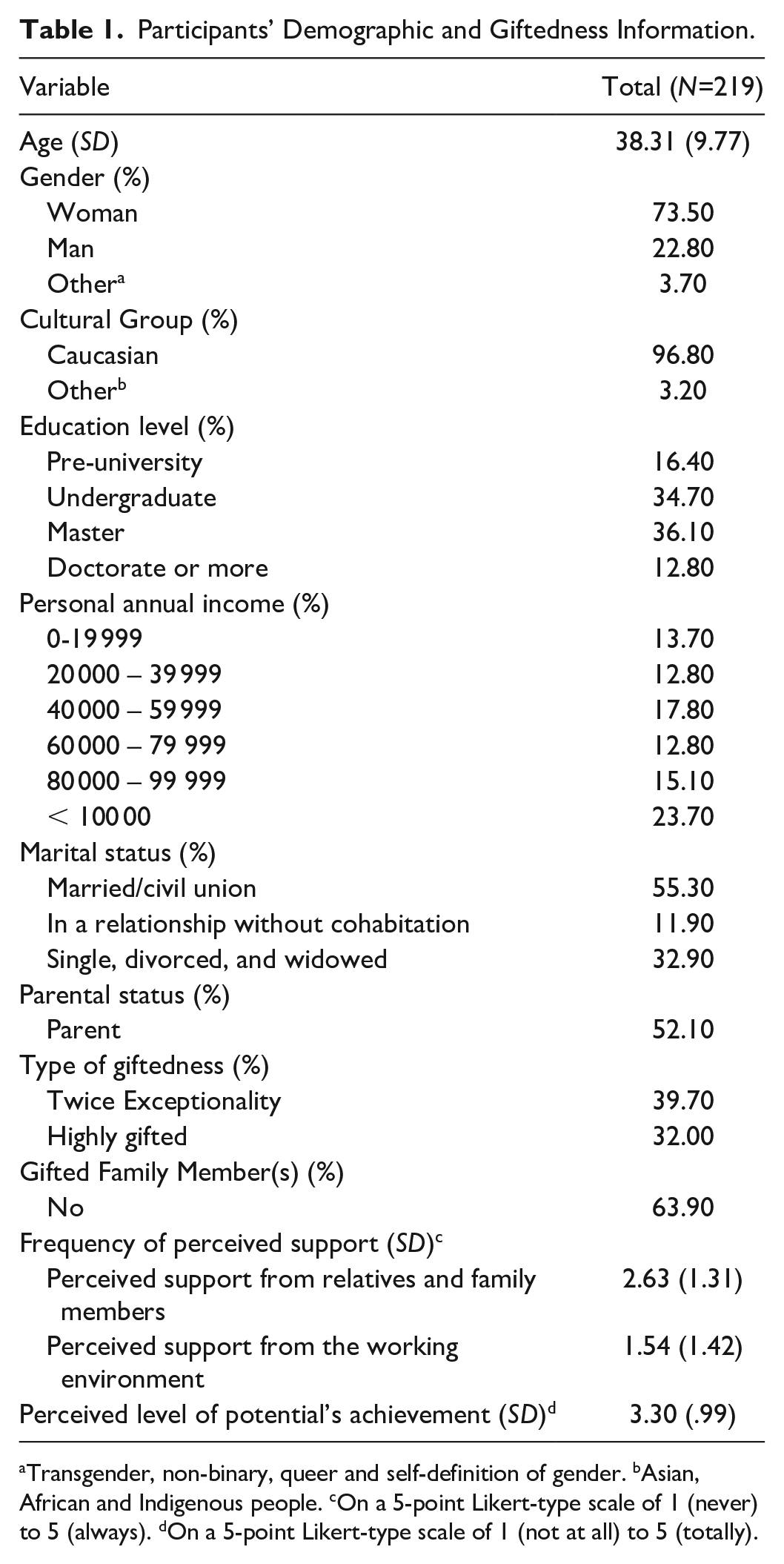
Transgender, non-binary, queer and self-definition of gender. bAsian, African and Indigenous people. cOn a 5-point Likert-type scale of 1 (never) to 5 (always). dOn a 5-point Likert-type scale of 1 (not at all) to 5 (totally).
In addition, participants were asked about their giftedness. They had to specify whether they had been cognitively tested and identified as twice exceptional (defined to them as the concomitance of intellectual giftedness and one or more neurodevelopmental or learning disorder(s) such as dyslexia or ADHD; Labouret & Francois, 2021; Reis et al., 2014) and/or highly gifted (defined by an IQ > 99th percentile; Gross, 2018; Silverman, 2009). A third claimed having been diagnosed as highly gifted, and nearly 40% as twice exceptional. Although these categories were non-exclusive, as participants could present more than one condition, 75 participants declared having been diagnosed with ADHD, 15 with a specific learning disorder (e.g., dyslexia), eight with autism, six with a motor disorder (e.g., Gilles de la Tourette Syndrome), and four with a language disorder. Almost half of the participants noted the presence of one or more gifted family member(s) in their life (e.g., parent, sibling, spouse, children). Participants were also asked to rate the frequency of perceived support from their family, friends, and their professional environment on a five-point Likert-type scale ranging from 1 (never) to 5 (always). On average, participants reported a low frequency of support from their relatives and a very low frequency of support from their professional environment. Finally, participants were asked to indicate, on a five-point Likert-type scale ranging from 1 (not at all) to 5 (totally), the extent to which they subjectively felt they led a life that enabled them to actualize their intellectual potential. Globally, participants reported an average perceived level of actualization.
Measures
In addition to the socio-demographic and giftedness measures, four distinct well-being measures were included, rather than a multidimensional general well-being measure, to capture the overall and holistic phenomena of well-being in gifted adults. Measures were chosen for their validity in gifted adult samples, their good psychometric properties and the fact that they are relatively brief and available in French.
Hedonic Well-Being
To assess the hedonic facets of well-being, the French version of the Positive and Negative Affect Schedule (PANAS; Watson et al., 1988; translated from Bouffard & Lapierre, 1997) was administered. The PANAS consists of 20 items (10 positive affect and 10 negative affect), in which participants are asked to rate the extent to which they have experienced each affect in the last six months on a Likert-type scale from 1 (not at all) to 5 (extremely). The French version supports the two-factor structure of the PANAS and shows a satisfactory internal consistency (∝ = 0.79–0.90; Bouffard & Lapierre, 1997). Cognitive facets of hedonic well-being were assessed by the French-Canadian version of the Satisfaction with Life Scale (Diener et al., 1985; translated by Blais et al., 1989), a five-item questionnaire designed to quantify individuals’ overall satisfaction with their lives. Participants respond to statements (e.g., “I am satisfied with my life”) on a seven-point Likert-type scale ranging from 1 (strongly disagree) to 7 (strongly agree). Internal consistency was considered satisfactory (∝ = .79–.84) within the original sample (Blais et al., 1989).
Eudemonic Well-Being Measure
In-house translations of Meaning in Life and Crisis of Meaning scales of the Source of Meaning and Meaning in Life Questionnaire (SoMe; Schnell, 2009, 2021) were administered to capture two dimensions of meaning in life: meaningfulness (5 items, e.g., “I have a fulfilled life”) and crisis of meaning (3 items, e.g., “I am missing meaning in my life”). Items are rated on a six-point Likert-type scale ranging from 0 (no agreement) to 5 (complete agreement). The original version of the SoMe has been validated and shows satisfactory internal consistency (∝ = .78–.90; Schnell, 2009). The scales also show satisfactory to excellent internal consistency within our sample (∝= .76–.95, see Table 2), as well as good construct validity, when compared to the other well-being measures used (see Table 3).
Descriptive Analysis, Cronbach’s Alpha Coefficients and Pearson Correlations of Well-Being Indicators.
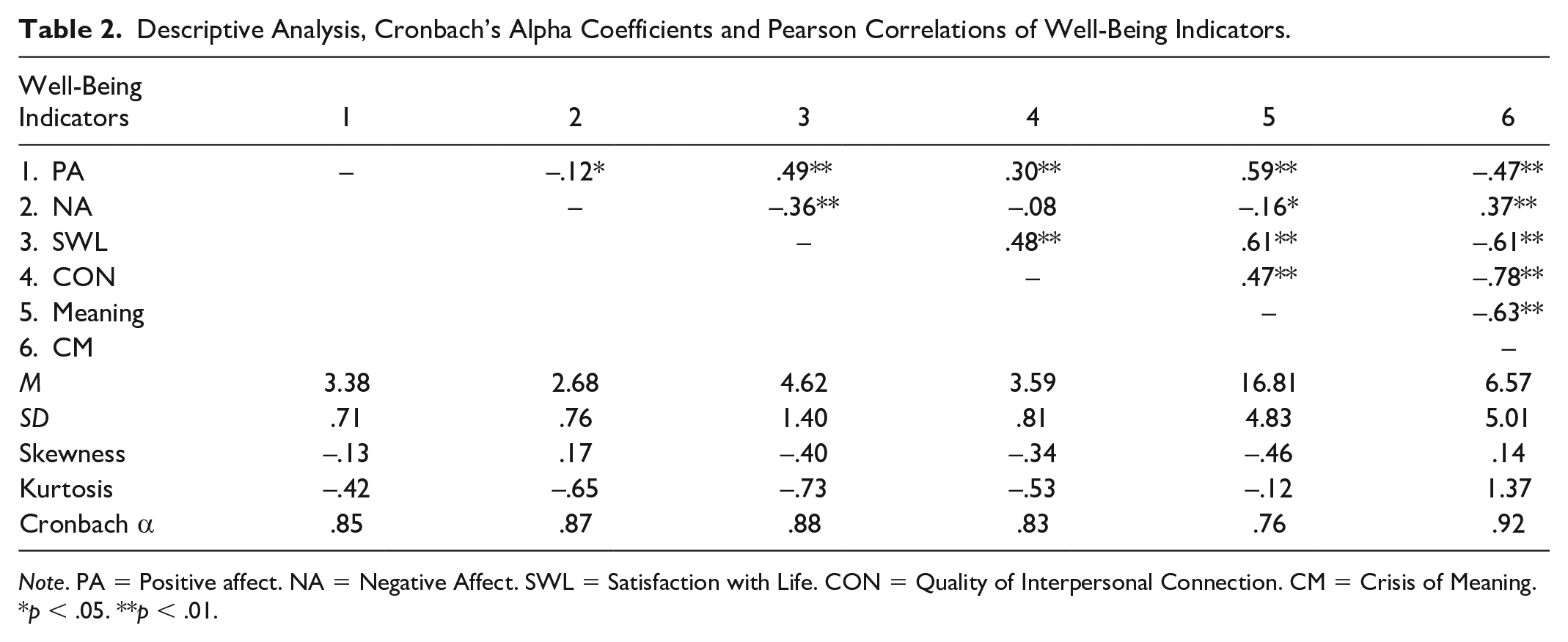
Note. PA = Positive affect. NA = Negative Affect. SWL = Satisfaction with Life. CON = Quality of Interpersonal Connection. CM = Crisis of Meaning.
p < .05. **p < .01.
Well-Being Indicators Means (SD) and Wilks-Lambda F Ratios for each Exploratory Determinant.
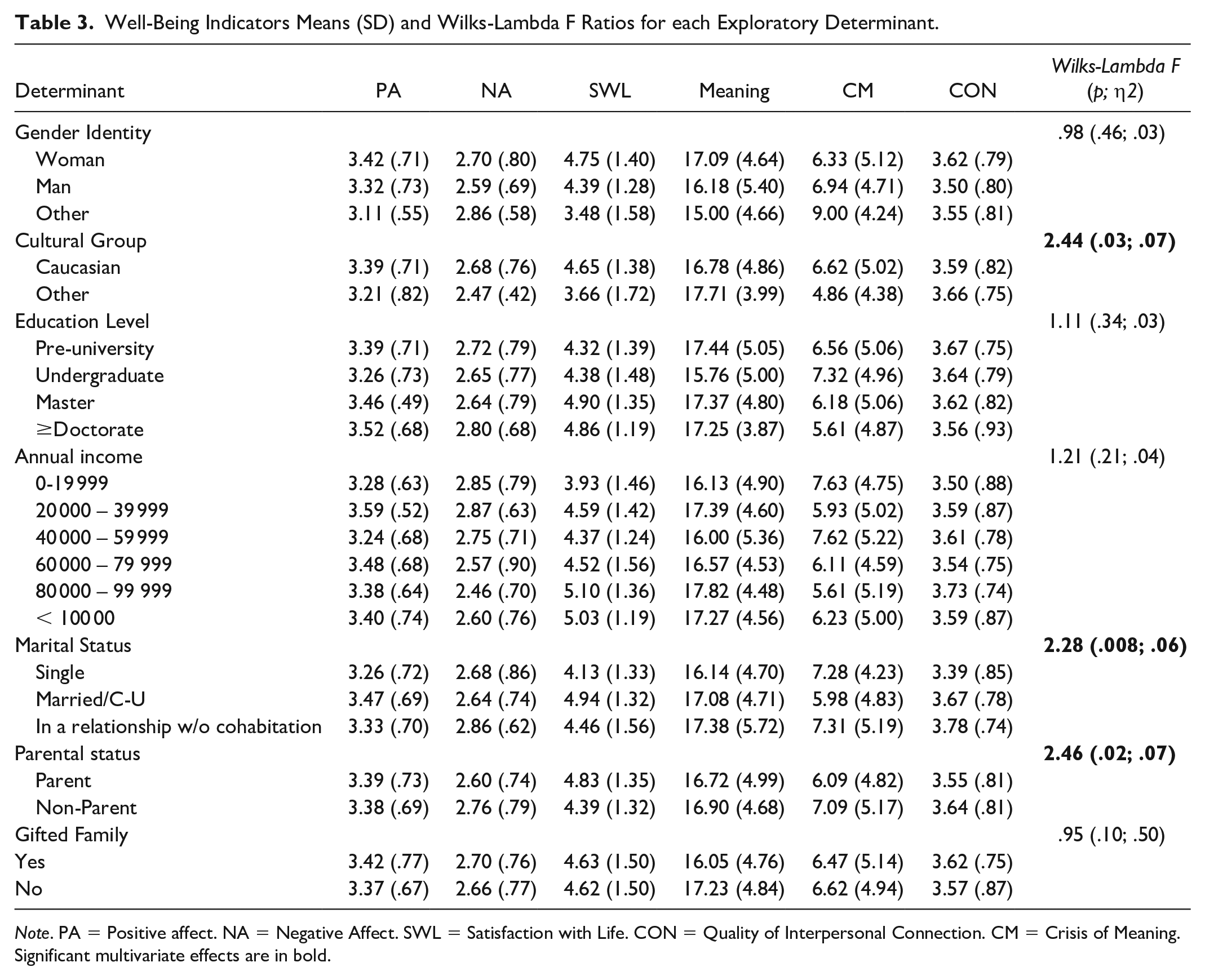
Note. PA = Positive affect. NA = Negative Affect. SWL = Satisfaction with Life. CON = Quality of Interpersonal Connection. CM = Crisis of Meaning. Significant multivariate effects are in bold.
The Connection scale of the General Well-Being Inventory (GWBI-65; Longo et al., 2017; French translation from Beliveau, 2021) was administered to capture the relational facet of eudemonia. This scale measures the ability to create and maintain positive and meaningful connections with people. Participants respond to five statements (e.g., “I feel close and connected to the people around me”) on a five-point Likert-type scale ranging from 0 (not at all true) to 5 (completely true). The original version shows good reliability (ωh = .86; Longo et al., 2017), as well as the translated version (∝ = .89).
Mental Health Disorders Index
Drawing on the measure presented by Karpinski et al. (2018) in their study on gifted adults, a self-reported mental health disorders index was designed for this study to identify participants’ mental health disorder(s). Participants were asked to indicate if they had been diagnosed with one or more mental health disorder(s) by a professional practitioner (i.e., psychiatrist, psychologist, MD). If they answered yes, they were invited to select which diagnoses on a pull-down menu of all the mental health disorders listed in the fifth edition of the Diagnostic and Statistical Manual of Mental Disorders (DSM-5; American Psychiatric Association, 2013). For the purposes of this study, all self-reported mental health disorder(s) were combined into a single dichotomous variable indicating the presence (1) or absence (0) of one or more self-reported diagnosed mental health disorder(s), excluding learning disorders and neurodevelopmental disorders which are reported as twice-exceptionality.
Results
Preliminary Analysis
No missing values were found on the main variables. Descriptive statistics, Cronbach’s alpha coefficients, and Pearson’s correlations on all well-being variables are presented in Table 2. Overall, the sample showed moderate to high scores for positive affect, negative affect, and life satisfaction. Participants reported moderate levels of quality of interpersonal connection and meaning in life subscales, as well as a low score on the crisis of meaning subscale. Finally, 57.50% of the participants reported having a diagnosis of one or more mental health disorder(s). Descriptive analyses also revealed that most variables presented skewness and kurtosis indices that did not depart from a normal distribution, ranging between -1 and 1 (Tabachnick & Fidell, 2013). Only Crisis of Meaning presented a slightly positive kurtosis, which still appears acceptable. Cronbach’s alpha coefficients also seemed to support the measures’ reliability among this sample.
Most well-being scales were significantly correlated in the expected direction (i.e., the higher the participants’ positive affect, life satisfaction, quality of interpersonal connection and meaning in life, the lower their negative affect and crisis of meaning scores). These preliminary links support the relevance of combining all the well-being scales in a multivariate well-being model when carrying out the main analyses.
Main Analyses
The study’s objectives were assessed with exploratory statistical analyses conducted in SPSS 28.0.0. First, seven multivariate analysis of variance (MANOVA) were conducted on the combined six well-being subscales (i.e., positive affect, negative affect, life satisfaction, connection, meaning in life, meaningfulness) to compare participants based on categorical determinants: gender identity, education level, personal annual income, minority cultural group (1 = Caucasian; 2 = non-Caucasian), presence of one or more intellectually gifted family member(s), marital status, and parenting status. An additional factorial MANOVA was conducted for type of giftedness, including two dichotomous variables: being identified as twice exceptional (yes/no) and/or as highly gifted (yes/no). Assumptions of normality, as well as the homogeneity of the variances and the covariances (Box’s ps > .05), were all met. The data also presented an absence of multicollinearity (rs < .70, see Table 2).
As shown in Table 3, results revealed that three out of seven variables were associated with well-being as an overall construct: cultural groups, marital status, and parental status. Moreover, results from the factorial MANOVA for subtypes of giftedness revealed no interaction effect, Wilks-Lambda F(3,215) = 1.46, p = .20, but principal multivariate effects of twice-exceptionality, Wilks-Lambda F(3,215) = 2.44, p = .03, η2 = .06, and highly gifted, Wilks-Lambda F(3,215) = 2.49, p = .02, η2 = .07. It should nevertheless be noted that when the significance level was adjusted according to the Bonferroni correction (i.e., the specified alpha level of .05 is divided by the number of analyses [8]) to prevent type 1 error, only the multivariate effect of marital status remained significant. For this reason, one post hoc analysis was conducted on marital status to determine the nature of the group differences identified.
Because of its robustness in the context of multivariate analyses, the post hoc analysis selected was the descriptive discriminant analyses (DDA; see K. N. Smith et al., 2020). In addition to the postulates associated with MANOVA, all of which have been met, the multivariate normality was verified by examining the plot of Mahalanobis distances and paired chi-square values of the model residuals. Because no important deviation was noted, the postulate was estimated as met. Results revealed two discriminant functions, although only the first discriminant function was considered significantly associated with the well-being effects observed between marital status groups (p = .008; Rc = .21; Rc2 = .04). Because function 2 was not statistically associated with well-being outcomes (p = .31), only the first function was interpreted to understand the nature and weight of the variables involved in the outcomes (see Table 4). When results were analyzed in greater detail, the combined standardized weight and structure coefficients suggest that the effects observed on well-being seem mostly attributable to satisfaction with life (standardized coefficient = 1.15), as it is responsible for 75% of the observed variance. However, positive affect (20% of the observed variance) and quality of interpersonal connection (19% of the observed variance) also appear to be lightly involved in the well-being differences observed. As for meaning and negative affect, their combined small standard weight coefficients and medium to high standardized discriminant coefficients suggest that they might exercise a suppression effect on the linear equation, which means that they could contribute to enhance the group differences in one or more determinants (K. N. Smith et al., 2020), which corresponds to life satisfaction and positive affect, after statistical verification. Results also reveal that crisis of meaning is not associated with the well-being differences observed in marital status, weighting very little to the equation (less than 1% of explained variance). Concerning the interpretation of differences, results show that married/civil union show significantly better outcomes than their single counterpart on the multivariate effects of satisfaction with life, positive affect and quality of interpersonal connection, with a moderate effect size (p < .001; Cohen’s d = .69, 95% CI [.40, .99]). The group of participants that were in a relationship without cohabiting, for their part, did not differ significantly from the single group (p = .23, 95% CI [-.18, .73] nor from married/civil union group (p = .06, 95% CI [- .84, .09]).
Standardized Discriminant Function Coefficients, Structure Coefficients, and Group Centroids for Marital Status Function 1.
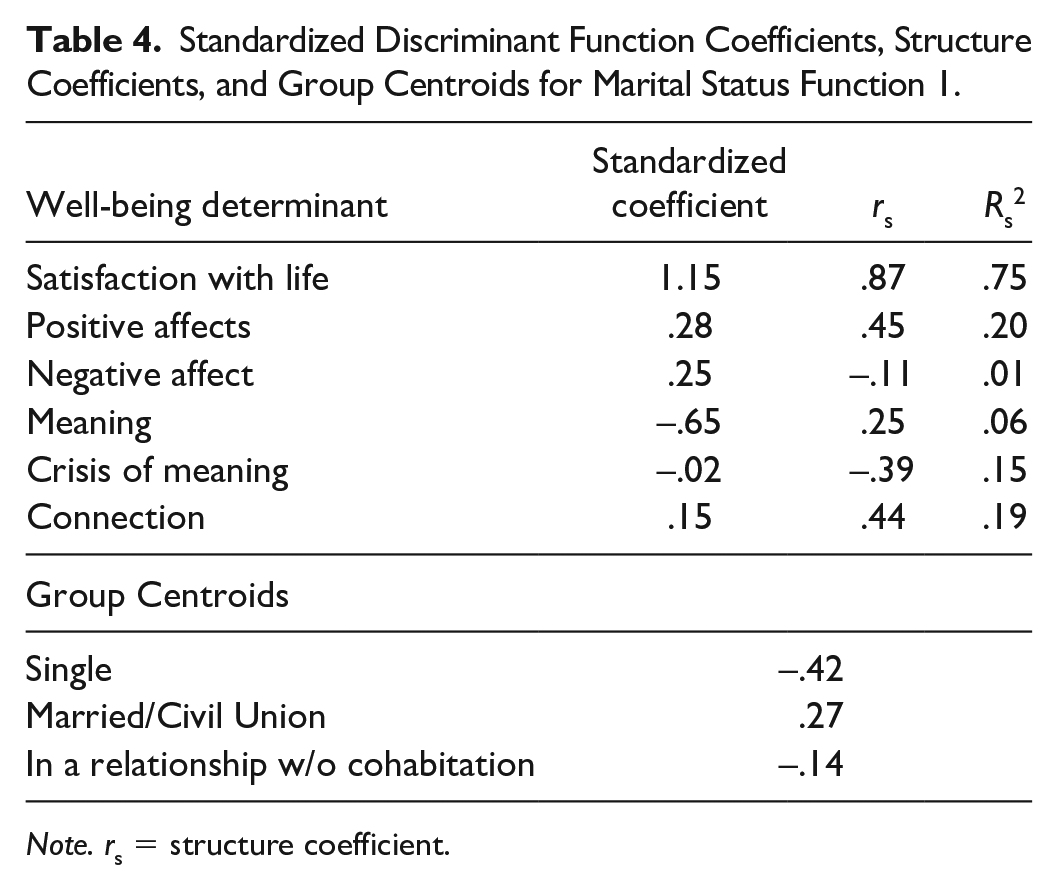
Note. rs = structure coefficient.
Second, to explore the associations between the well-being subscales and three continuous determinants (i.e., perceived levels of family support, work support and intellectual potential achievement), bivariate Pearson correlations were conducted. Significant results revealed that family support was positively associated with life satisfaction (r = .27, p < .001), quality of interpersonal connections (r = .41, p < .001), and meaning in life (r = .15, p = .003). Workplace support was weakly positively associated with quality of interpersonal connections (r = .16, p = .03) and meaning in life (r = .15, p = .02). Achievement of potential was strongly positively associated with positive affect (r = .47, p < .001), life satisfaction (r = .61, p < .001), quality of interpersonal connections (r = .36, p < .001), and meaning in life (r = .54, p < .001). It was also moderately to strongly negatively associated with negative affect (r = –.23, p < .001) and crisis of meaning (r = –.55, p < .001). When the Bonferroni correction was applied, only achievement of potential maintained its associations with all the well-being subscales mentioned above. Family support also remained associated with life satisfaction, the quality of interpersonal connections and meaning in life.
Finally, because mental health disorder(s) was a dichotomized categorical outcome variable (0 = absence; 1 = presence), a logistic regression was carried out for each of the determinants explored. Assumptions of homoscedasticity and linearity of the logit were verified, along with the absence of multivariate outliers (Cook’s distance < 1). Overall, as shown in Table 5, most of the potential determinants were not associated with the presence of mental health disorders, as the regression models were not significant for gender identity, education level, cultural group, parenting status, presence of one or more gifted family member(s), perceived levels of family support, perceived level of work support and intellectual potential achievement (ps > .05). Nevertheless, the regression models were significant for two potential determinants. First, the regression model assessing the contribution of a low income (1 = low annual personal income) on mental health disorders was significant, χ2(1, N = 219) = 3.97, p = .004, as this determinant explained between 1.90% (Cox & Snell’s R2) and 2.50% (NagelKerke’s R2) of the variance in mental health disorders. More precisely, gifted people with a personal annual income ranging from $20,000 to $39,999 presented a 1.8 times higher risk of presenting mental health disorder(s) than gifted people with a $40,000 or more personal annual income. Second, the regression model assessing the contribution of types of giftedness (with twice exceptional and highly gifted subtypes of giftedness entered simultaneously) was significantly associated with mental health disorder(s), χ2(1, N = 219) = 4.93, p = .004, as subtypes of giftedness explained between 2.30% (Cox & Snell’s R2) and 3.00 % (NagelKerke’s R2) of the variance. Indeed, twice-exceptional participants were 1.9 times more likely to present concomitant mental health disorder(s) than non-twice exceptional participants. The effects remained significant (p < .005) when the Bonferroni correction was applied.
Results of Logistic Regression for Mental Health Disorder(s).
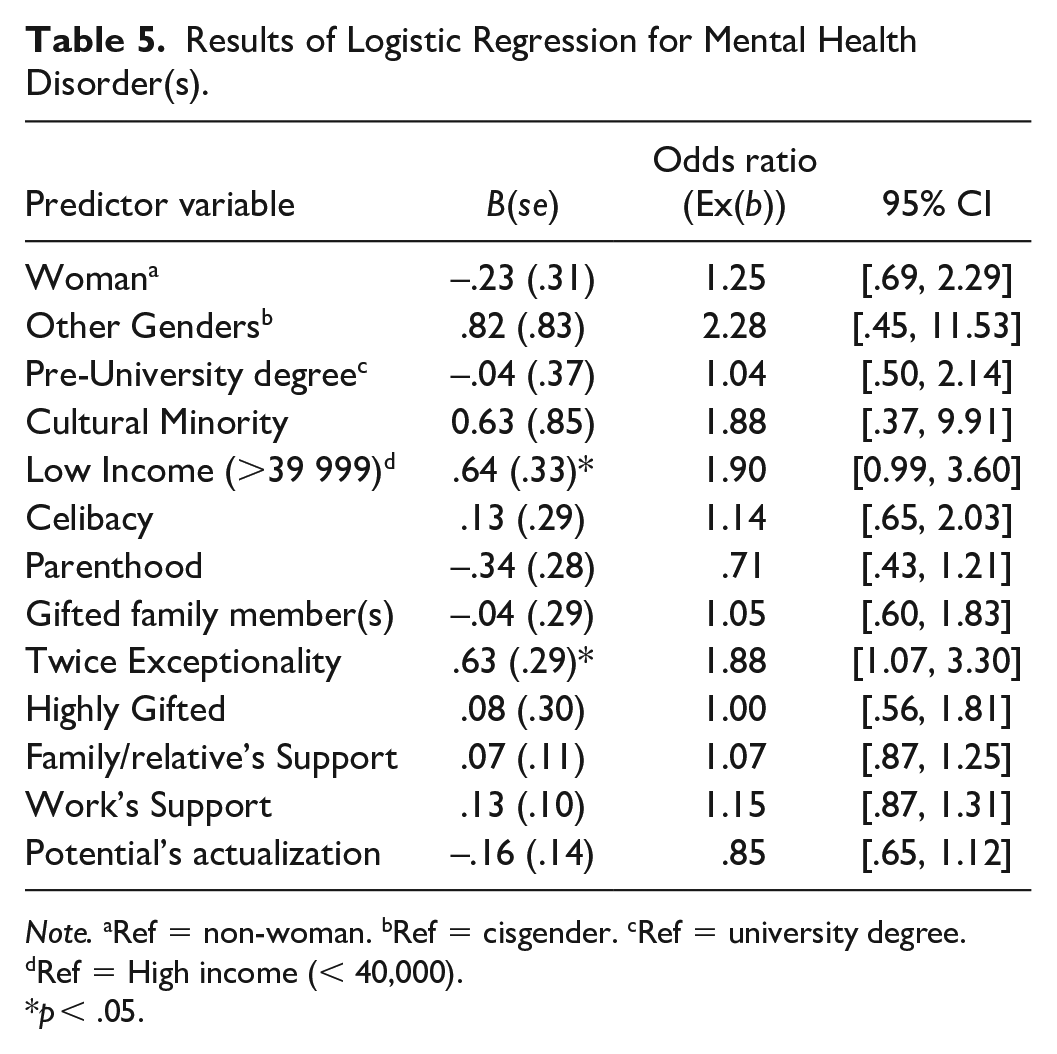
Note. aRef = non-woman. bRef = cisgender. cRef = university degree. dRef = High income (< 40,000).
p < .05.
General Discussion
Given the recommended avenues of research on the social and emotional experience of intellectually gifted individuals, the present study aimed to gain a more precise and thorough understanding of the well-being risk and protective factors of intellectually gifted adults by exploring the associations between well-being and individuals and environmental factors frequently evoked but underexplored in the literature on intellectually gifted individuals. Exploratory statistical analyses on potential individual determinants suggested that twice exceptionality plays a role in the well-being of intellectually gifted adults. Regarding environmental potential determinants, analyses identified the significant role of marital status, family support, annual personal income, and perceived levels of achievement of their intellectual potential.
Individual Determinants of Well-Being
Results showed that twice exceptionality was significantly associated with mental health disorder(s). Twice-exceptional participants reported almost twice the risk of presenting a mental health disorder diagnosis than gifted-only participants. This result appears consistent with the hypothesis formulated by clinicians (e.g., Kutner, 1999; Terriot, 2021) and researchers (Neihart & Yeo, 2018; Rinn & Bishop, 2015), as well as with the comparison study on gifted adults conducted by Antshel et al. (2009), which showed that ADHD-intellectually gifted adults presented greater well-being alterations and mental health disorders than gifted adults without ADHD. While this finding could be attributed to the fact that all individuals with neurodevelopmental or learning disorders generally exhibit greater impairments in terms of well-being (Beaton et al., 2022; Brod et al., 2012; Fuller-Thomson et al., 2022; Wilmshurst et al., 2011), these impairments could further be explained by the specific challenges faced by twice-exceptional individuals. As Kutner (1999) and Terriot (2021) discussed, this finding could be expounded by the paradoxical fact that even if twice-exceptional individuals have exceptional intellectual potential, their neurodevelopmental limitations complexify its actualization. This paradox is occasionally associated with a phenomenon known as internal dyssynchrony, which has been linked with greater mental health alterations in gifted children and adults (e.g., Terrassier, 1979, 2009). Greater well-being difficulties observed in our twice-exceptional participants could also be explained by the risk of delayed diagnoses or interventions encountered in this population, which has recently been pointed out by Milioni et al. (2017), Mullet and Rinn (2015), and Bishop and Rinn (2020). Indeed, their research showed that ADHD-gifted children, students, and adults are at risk of having their giftedness or their ADHD masked by their concomitant neuroatypicality, hence potentially leading to delayed identification or misdiagnosis of twice-exceptionality and lack of appropriate services. Either way, as previously noted (e.g., Neihart, 2008; Neihart & Yeo, 2018; Rinn & Bishop, 2015), this result suggests that twice-exceptionality is a risk factor among the gifted population and that, from childhood, twice exceptional gifted individuals should be monitored for the development of mental health disorders. Special attention should be paid to the understanding of their special needs and those of their parents, which may differ from the special needs of gifted children without a twice-exceptionality so that we can assure targeted interventions to prevent the potential socioemotional difficulties they could encounter during their life (Brault-Labbé et al., 2024).
Interestingly, our results showed no significant differences in mental health disorder(s), nor subjective (positive/negative affect and satisfaction with life) and eudemonic (meaning in life, crisis of meaning and connection) well-being between highly gifted adults and typically gifted participants. While these results appear to contradict the hypothesis about highly gifted individuals originally formulated by Hollingworth (1942) and Francis et al. (2016), they are consistent with the absence of empirical evidence of highly gifted children being more vulnerable to social and emotional problems (Neihart, 1999, 2008), in addition to allowing this knowledge to be extended to adults.
When it comes to gender identity, our exploratory results suggest no difference between gifted women, gifted men, and gifted people who identify as transgender, non-binary, or who self-define their gender. While this result is consistent with the absence of difference between male and female gifted adults observed in empirical studies by Holahan (1984), Wirthwein and Rost (2011), and Perrone-McGovern et al. (2012), it does not confirm that gender minorities could be a risk factor in the gifted population (Lo et al., 2022; Wikoff et al., 2021). The latter conclusion must however be interpreted with a lot of nuances, given the very small sample size associated with gender minorities (n = 8).
Environmental Determinants of Well-Being
Regarding environmental determinants, our results first showed that being married or in a civil union may be a protective factor for well-being, particularly in terms of life satisfaction, positive affects, and quality of interpersonal connection. These results are not surprising, as some studies have already illustrated that marital relationships and marital satisfaction could enhance hedonic or subjective well-being (e.g., life satisfaction and positive affect) in gifted adults (Perrone et al., 2006; Perrone-McGovern et al., 2012; Sears, 1977). In addition, the fact that it contributes positively to the quality of interpersonal connection suggests that marital status may also be important for eudemonic well-being, as married/civil union intellectually gifted adults seem to benefit from the personal connection in a way that may add more purpose and direction to their life. However, contrary to Perrone-McGovern et al. (2012), we did not detect a protective effect of having gifted spouses or relatives on hedonic, eudemonic, or negative well-being. This result could suggest that the well-being of intellectually gifted adults is more closely tied to the quality of their relationships than to the giftedness of their loved ones. Indeed, whether their loved one is gifted or not, what may most promote well-being is being in a relationship where they can subjectively feel that their needs for understanding, mutual respect, and affiliation are being met, as gifted adults themselves stated in the qualitative study of Perrone-McGovern et al. (2011). This hypothesis would also lend support to our findings showing that the level at which they perceived to be supported by their family was weakly positively associated with meaning in life and moderately positively associated with positive affect, life satisfaction and quality of interpersonal connections. From childhood to adulthood, our conclusions thus continue to support the importance of taking concrete actions to foster and maintain supportive relationships to improve the well-being of intellectually gifted individuals.
In terms of personal annual income, our study showed that low levels of income represent a significant risk factor for the development of mental health disorder(s). Indeed, individuals reporting the lowest level of personal annual income (CAN $0- 39,999) were almost twice as likely to present concomitant mental health diagnoses than their richer counterparts. This finding is consistent with the meta-analysis of Pinquart and Sörensen (2000) and the more recent systematic review of Thomson et al. (2022), revealing that, in the general population, high income is a protective factor against the development of mental health disorders, particularly when it enables an individual to lift themselves out of poverty and attain a standard of living deemed comfortable. However, in the intellectually gifted individuals, the effect of very low income on mental health could also be attributed to their specific reality, as low-income intellectually gifted adults could have suffered from tardive identification of their giftedness or insufficient adapted support for their needs. They may also have lacked opportunities to achieve their intellectual potential, which could explain both why they did not attain a high level of socioeconomic status, but also the subsequent development of personal difficulties such as mental health disorders (Ballam, 2009; Hamilton et al., 2018; Hodges et al., 2022). This underscores the critical importance of promptly identifying giftedness in childhood and providing individualized support to gifted children and students, especially those from economically disadvantaged backgrounds, to enable them to access opportunities for self-actualization and the realization of one’s intellectual potential into their adult lives.
Turning to the achievement of intellectual potential, our findings revealed that the perceived level of potential achievement may be the strongest protective hedonic and eudemonic well-being factor of our study. Indeed, results showed that it was strongly positively associated with life satisfaction, which is in line with the findings of Siekańska and Sękowski (2006, 2008), who found that life satisfaction was significantly higher among gifted adults who felt that their jobs were congruent with their interests and enabled them to make the most of their high abilities. Achievement of intellectual potential was also strongly positively associated with positive affect, quality of interpersonal connections and meaning in life, as well as moderately to strongly negatively associated with negative affect and crisis of meaning. Since educational level and annual income were not significantly associated with positive well-being indicators, these results appear particularly innovative. Indeed, they may indicate that intellectually gifted adults experience greater hedonic and eudemonic well-being when they subjectively feel that they are achieving their intellectual potential rather than when they objectively achieve it through academia or high-income employment. This hypothesis would be consistent with the qualitative study by Perrone-McGovern et al. (2011), in which gifted adults recommended choosing a career based on intellectual abilities and interests rather than on salary or social expectations. In this vein, the development of gifted individuals would benefit from being directed in a way that allows them, starting from school age, to discover what best allows them to fulfill their potential in a personally meaningful way.
Strengths and Limitations
To our knowledge, the present study seems to be one of the first to have simultaneously empirically explored the roles of multiple individual and environmental determinants on the well-being of intellectually gifted individuals, which can be considered a noteworthy milestone to gain a better understanding of risk and protective factors of well-being inside the gifted population. Moreover, this study was conducted in a relatively large sample of intellectually gifted adults, which contributed to the development of knowledge on this under-researched population (Brown & Peterson, 2022; Brown et al., 2020). As methodological shortcomings, particularly sample biases (i.e., Mensa group biases or academia biases, see Rinn, 2024 and Williams et al., 2023), are frequently evoked in previous studies on intellectually gifted adults (e.g., Williams et al., 2023; Wirthwein & Rost, 2011), our sampling method can be considered as a strength, since participants were asked that their giftedness be identified by professionals who possess the expertise to assess intellectual giftedness, which enhance the reliability of the construct of intellectual giftedness used. Our sampling method may also have allowed the recruitment of a group that was not uniquely impaired or, conversely, uniformly highly functional, since psychological assessment of giftedness can be performed in clinical settings, without being limited to them. Given the challenge of recruiting this highly rare subgroup of the population, the sample size has significantly exceeded the initial aimed sample size to obtain 80% statistical power (Tabachnick & Fidell, 2013). Finally, as suggested by Pollet and Schnell (2017), we included simultaneous hedonic and eudemonic measures of well-being, which represents a strength by helping capture the most nuanced and precise role of the studied determinants.
Several limitations can however be noted. First, this study has limitations regarding its transferability, as the data collected concerns only individuals considered intellectually gifted according to the high IQ paradigm and therefore does not apply to individuals considered gifted according to other paradigm or models (e.g., Three-Ring Conception of Giftedness, see Renzulli & Reis, 2018; Star Model, see Tannenbaum, 2003). Beyond the general limitations of cross-sectional and correlational designs, this study could also be limited by a potential self-selection bias, as only a subset of particularly informed, involved or impacted intellectually gifted may have been exposed to social media or organizations about giftedness. This explorative study is also based solely on a self-reported confirmation of intellectual giftedness and self-reported questionnaires, which could be associated with notable biases. First, because the researchers do not know which specific IQ tests were used to identify intellectual giftedness, they cannot ensure that the results from the different assessments are directly comparable or consistent across the sample. Moreover, although carefully examined, self-reported measures could also have led to common method biases or social desirability. Finally, the way we collected the data could have led to a lack of understanding and/or adherence to the eligibility criteria in some participants, which may have resulted in invalid participation in the study and higher risk of invalid responses to questions (i.e., self-classification of diagnosed mental health disorders, twice-exceptionality or highly giftedness). Moreover, despite numerous efforts to recruit a broad and diverse selection of intellectually gifted adults, the sample’s homogeneity in terms of gender identity, cultural groups, educational level, and personal annual income may limit the generalization of the findings, particularly to minority groups or marginalized gifted adults. To promote inclusive research and ensure more valid results, it might have been relevant to target more gifted adults from economically disadvantaged backgrounds or from minority groups, particularly those who identify as other genders or who are not Caucasian. Nonetheless, the combined rareness of each group represents a significant feasibility challenge that must be emphasized. Concerning the sample’s homogeneity, it is also possible to note that twice exceptional and highly gifted individuals are over-represented in our sample. While this can be potentially cause by mistakes in self-classification of these conditions, it could also be explained by the fact that participants were required to have an evaluation by a neuropsychologist or psychologist qualified to assess intellectual potential. This may have led to a selection bias where the people who sought professional assessment were the ones with the most distinctive features in their cognitive functioning, i.e., twice exceptional and highly gifted individuals. This could be more likely considering that resources and contexts for formally identifying giftedness remain underdeveloped in the region of Canada where the study was conducted. 1 Another study conducted in the same area found a similar prevalence (47.9%) of self-reported twice-exceptionality among its sample of 259 parents of gifted children (Brault-Labbé et al., 2024). Thus, this represents a cultural limitation to the generalizability of the study that needs to be considered when results are interpreted.
On another note, the analyses lead to findings based on small effect sizes, which suggests that the results could have a limited practical relevance and should be interpreted carefully, despite our robust statistical controls and high statistical power. The robustness of our analytical controls may also have contributed to reducing the identification of potentially interesting exploratory results, given that the Bonferroni correction has been associated with the risk of type II error (Warne, 2014).
Finally, our study did not include a control group, which appears as a notable limitation. Even if our results clarify what are the risk and protective factors within the intellectually gifted population and give us clearer avenues to understand which gifted individuals might be in specific need of targeted interventions, this prevents us from comparing the role of potential determinants of well-being in gifted adults with the general population. Thus, it is still impossible to determine whether some factors are salient to gifted adults and if so, to what extent. Given the fact that we are trying to gain a better understanding of intellectually gifted adults to foster their unique development, this appears especially important to rectify in the future.
Implications for Further Research
Because this study seems to be the first to explore underlying well-being determinants between different groups of intellectually gifted adults, replication studies with other samples of intellectually gifted are encouraged. To promote a developmental understanding of these underlying determinants, it would notably be interesting to pursue similar objectives in studies with gifted children and adolescent samples, within longitudinal research designs extending into adulthood, to better capture the evolution of well-being in intellectually gifted individuals through time.
Even if our explorative study contributes to a better understanding of individual and environmental determinants involved in promoting the well-being of intellectually gifted, it is fundamental to pursue research by conducting further studies that will enable multiple comparisons, such as comparisons between an intellectually gifted sample and a general population group. For example, multiple comparison studies appear particularly relevant to clarify the innovative finding that twice exceptionality seems to represent a risk factor for mental health disorder(s) in intellectually gifted adults. Indeed, it would be interesting to deepen our comprehension by comparing mental health disorder(s) between twice-exceptional individuals and typically developing neuroatypical and neurotypical individuals. Since neurodevelopmental disorders have been associated with mental health difficulties in the general population (Beaton et al., 2022; Brod et al., 2012; Fuller-Thomson et al., 2022; Wilmshurst et al., 2011), it would be important to further understand how intellectually gifted individuals adapt when compared to them. We may be surprised to discover that intellectual giftedness becomes a protective factor when gifted twice-exceptional individuals are compared to the general population who live with neurodevelopmental disorders or learning disabilities. Studies examining more specifically the links between giftedness and/or twice-exceptionality and different categories of mental health disorder(s) would also be relevant to examine whether certain types of clinical vulnerabilities stand out when subgroups of gifted individuals are compared with each other or with neurotypical and neuroatypical non-gifted individuals. Concerning twice exceptionality, further studies could also be conducted to explore if some exceptionalities are more likely to increase the risk of well-being alterations than others, as our study did not permit to isolate these conditions.
In parallel, because twice exceptionality and low-income minority groups both appear as risk factors for mental health disorder(s) in gifted adults, further research could be initiated on the role of intersectionality in the well-being of intellectually gifted students and adults, as our study suggests that this could be an important avenue of explanation of well-being alterations in our population. It would also be important to further understand the potential links with cultural and gender minorities, as our other gender and culture groups may have been too small to draw robust statistical conclusions.
Finally, to clarify what intellectually gifted individuals do to foster their well-being, it would be interesting to ask them directly by using qualitative study designs. Qualitative studies could clarify the role of subjectively important well-being determinants found in our study (e.g., perceived level of relatives’ support, perceived level of intellectual potential achievement), as well as help the emergence of new well-being determinants that researchers would not otherwise have considered. Notably, this avenue is coherent with the results of a survey presented by Brown et al. (2020), in which international experts in giftedness have highlighted the importance of gifted individuals’ input and conducting research that fosters a better understanding of their lived experiences. In doing so, we may be amazed by the diversity, complexity and richness in the paths found by intellectually gifted adults to live with the “gift” of their giftedness.
Footnotes
Declaration of Conflicting Interests
The authors declared no potential conflicts of interest with respect to the research, authorship, and/or publication of this article.
Funding
The authors disclosed receipt of the following financial support for the research, authorship, and/or publication of this article: This work was supported by scholarships from the Social Sciences and Humanities and Research Council and from the Fonds de recherche du Québec (FRQ) to the first author.
Open Science Disclosure Statement
The data analyzed in this study are not available for purposes of reproducing the results. The code or protocol used to generate the findings reported in the article are not available for purposes of reproducing the results or replicating the study. The following newly created, unique materials used to conduct the research are available upon request for purposes of replicating the procedure: Every home-translated measure can be shared in its translated version. The psychopathology index that has been created for the purpose of the study can also be shared.
Ethics Approval Statement
Ethical approval for this study was obtained from Université de Sherbrooke’s Institutional Research Ethics Committee (approval no. 2021-3280) on January 24, 2022.
