




Abstract
Psychosocial skills are variables related to human behavior, beliefs, and attitudes and shape social interactions, learning processes, academic achievements, and general goal-directed behavior. Psychosocial skills seem particularly important during the adolescent period when large changes in goal setting, learning attitudes, and ability development take place. However, it remains unclear to what degree the growth of musical abilities is influenced by psychosocial skills in musically gifted children and children who are not musically gifted. Hence, the aim of this study is to determine the impact of psychosocial skills on music listening abilities beyond demographics, musical training, and cognitive factors. At four secondary schools in Latvia (two general schools and two schools for musically gifted individuals), we tested 191 adolescents (aged 11–18 years) with an online test battery assessing musical listening abilities, cognitive ability, socio-demographics, musical training activities, and a range of psychosocial skills. Data were analyzed through a series of hierarchical regression models determining the effect of different groups of independent variables. Results indicate that, in general, psychosocial variables make a substantial contribution to musical listening abilities beyond demographics, musical training, and cognitive capacity. When students from general secondary schools and schools for the musically gifted were analyzed separately, the contribution of psychosocial skills differed noticeably, with a greater relative importance for musically gifted children. Thus, the results suggest an important role of psychosocial variables in musical giftedness education. However, the specific role of individual psychosocial variables such as grit still needs to be clarified in future studies.
The successful development of musical abilities and musical talent has been linked to many factors, including musical training, general cognitive abilities, and physical dispositions for playing a specific instrument. Recently, psychosocial skills and competencies have also been nominated as a group of variables that might have a significant impact on musical ability development (Lipnevich et al., 2016) as well as talent development (Jarvin & Subotnik, 2010). Psychosocial skills are discussed as drivers of general talent development also in the talent development megamodel (Subotnik et al., 2011) and the talent development model in achievement domains (TAD; Preckel et al., 2020), and more specifically in the adaptation of the TAD model for musical talent development (Müllensiefen, Kozbelt, et al., 2022). A priori, it seems very plausible that psychosocial variables should play a role for the continued engagement and goal-directed training that is necessary for developing high levels of musical skills. Yet, there is little quantitative evidence on the impact that psychosocial skills have in music and, in particular, in the education of musically gifted individuals. Therefore, in this study, we aim to close this gap and assess the degree to which psychosocial skills are associated with musical development with a specific focus on children in musical gifted education.
The data reported in this study were gathered in Latvia, which has a strong tradition of distinctive musical gifted education with a specific music curriculum. Hence, the data afford a comparison of the role that psychosocial skills play in musical ability development among highly gifted children and a control group of matched children attending secondary schools with a standard curriculum.
Psychosocial Skills
According to the World Health Organization (WHO, 1994), psychosocial competence is a “person’s ability to deal effectively with the demands and challenges of everyday life” (p. 1). Relatedly, the American Psychological Association (n.d.) defines psychosocial factors as “social, cultural, and environmental phenomena and influences that affect mental health and behavior” (Definition 1). In addition, Dixson et al. (2016) point out that psychosocial factors are concerned with motivational constructs that are influenced by both psychological and social contexts. In other words, psychosocial factors are a tool for the holistic development of an individual (Basak, 2022) in a social environment. However, as the previous definitions show and, for example, Kyllonen et al. (2014) noted, there are inconsistencies with regard to terminology in the literature. Several alternative terms, such as noncognitive factors, soft skills, nonacademic skills, socio-affective skills, personal qualities, character traits, and nonintellectual strengths are present in the literature and are often used synonymously. For example, Subotnik et al. (2011) use psychosocial factors, skills, abilities, and variables interchangeably and Dixson et al. (2016) use psychosocial factors and variables synonymously while others refer to psychosocial competence (Basak, 2022; WHO, 1994) or psychosocial capacity (Basak, 2022). Most authors emphasize the trait-like components of the construct that are often observable through repeating behavior patterns, such as the ability to adapt, social and coping skills, self-beliefs, commitment, or perseverance (MacNamara et al., 2008). Although there is a plethora of terms being used in the literature, a key characteristic of psychosocial skills and factors is their distinction from cognitive skills and abilities. It is worth noting that some of the recent literature (e.g., González-Rodríguez et al., 2024) links psychosocial variables to contextual factors or social conditions. This leads to a distinction between internal psychosocial skills and environmental or contextual psychosocial factors. In this study we only use the term psychosocial skills, and we focus on the trait-like and noncognitive psychological skills of an individual.
Most authors highlight important characteristics of psychosocial skills, emphasizing that their development is a lifelong process and that they are malleable and transformative (Basak, 2022; Burrus & Brenneman, 2016; Dixson et al., 2016; Kyllonen et al., 2014; Olszewski-Kubilius & Thomson, 2015; Subotnik et al., 2011). Consequently, there are calls in the literature that psychosocial skills should be taught and deliberately cultivated by teachers, mentors, coaches, and parents (Dixson et al., 2016; Subotnik et al., 2011; WHO, 1994). This is in line with empirical evidence showing that psychosocial skills, rather than specific task competence and intelligence, can be an important distinction between individuals who have similar abilities or training in a domain (Dixson et al., 2016). Teaching and cultivating psychosocial skills might reap benefits beyond short- or mid-term performance increases in a specific domain with evidence showing the impact of psychosocial skills gained during the school years continuing to influence individuals into adulthood and employment (Kyllonen et al., 2014).
Several psychosocial skills, such as self-discipline, motivation, growth mindset, hope, and grit, have been shown to play an important role in academic education (Dixson, 2017; Kyllonen et al., 2014; Patton et al., 2016) and in general, the significant positive impact of psychosocial skills on academic achievement has been widely documented in the empirical literature (Basak, 2022; Burrus & Brenneman, 2016; Duckworth & Seligman, 2005; Yeager & Walton, 2011). For example, in a longitudinal study of 140 eighth-grade pupils, Duckworth and Seligman (2005) showed that highly self-disciplined adolescents outperformed their more impulsive classmates in all academic-performance variables. This finding is in line with results that demonstrate that grit, as a psychosocial skill, is an important predictor of academic achievement and could even be as essential as IQ (Duckworth et al., 2007). However, Dixson et al. (2016) showed that for students’ perceived ability or academic achievement, grit was not a significant predictor, but self-efficacy and hope contributed more to these outcomes. Thus, the ambiguous results in the literature with regard to individual psychosocial constructs indicate that there is still a need for research on the types of psychosocial skills which may have the greatest effect on performance outcomes.
In the context of music education, several studies have demonstrated the relations psychosocial skills can have with important music-related outcomes. For example, in the context of research on music practice and performance in musicians, psychosocial skills, such as intrinsic motivation (Oliveira et al., 2021; Stoeber & Eismann, 2007), self-efficacy (McCormick & McPherson, 2007; McPherson & McCormick, 2006), and proneness to musical flow experiences (Butkovic et al., 2015; Marin & Bhattacharya, 2013; Passarotto et al., 2022) have been linked to enhanced practice and performance behavior. In the talent development megamodel, Subotnik et al. (2011, 2012) proposed that there is a distinction between those whose talent is related to the creative performance, such as athletes, musicians, dancers, and actors, and those who are creative producers, such as choreographers, scientists, writers, and composers. However, it is important to note that in the case of musicians, it is sometimes difficult to separate one category from another, especially when talking about giftedness where both cognitive and psychosocial variables play an essential role. In addition, the literature on gifted musicians also mentions a link between psychosocial skills and general well-being and mental health. This link seems to be particularly important with respect to performance-related components, such as performance anxiety and different coping strategies (Braden et al., 2015).
Another psychosocial skill that plays a role for sustained musical engagement and achievement is the growth mind-set (Dweck, 2000) of musical learners. This is the self-belief that one own’s musical abilities are malleable and can grow in response to training and continued engagement. Several studies (Holochwost et al., 2021; Tan et al., 2021) suggest that it is positively linked to musical achievements as well as other psychosocial skills relevant for musical development. This relationship does not only hold true for high achieving and practicing musicians but also for adolescents from the general population (Labonde & Müllensiefen, 2022; Müllensiefen et al., 2015). However, it is still unclear whether psychosocial skills play the same role for highly gifted and high achieving musicians as well as for the development of musical skills in the general population. Hence, in this study, we took the opportunity to compare the impact of psychosocial skills on the development of musical abilities in these two populations. Note that psychosocial skills are currently not taught in Latvian schools, but this study might serve as a first step toward an evidence basis regarding the usefulness of psychosocial skills teaching in gifted education in Latvia and potentially more widely.
Musical Gifted Education in Latvia
The Latvian music education system consists of music education institutions founded by the Latvian State, local government, and private educational organizations. One of the main aims is the education and preparation of professional artists, musicians, dancers, and teaching staff. The policy was formulated by the Latvian Ministry of Culture (KM) and its implementation is coordinated and managed by the Latvian National Centre for Culture. This mandate includes the supervision of schools that implement education programs in the field of music, dance, visual arts, and design. In 2022, there were 162 educational institutions that delivered accredited programs in music, art, design, and dance. In the 2022–2023 school year, 24,510 students participated in professionally oriented education programs in music, art, design, and dance. With the population of Latvia being merely 1.88 million (Official Statistics Portal, n.d.), this means that in 2023, one pupil for every 73 inhabitants of Latvia was involved in one of the art education programs. In addition, 10 state-funded secondary schools operate under the supervision of the KM, with about half of the students studying vocational arts education programs. Vocational school graduates of music, art, design, and dance can continue their education in three universities of music, art, and culture, including the Latvian Academy of Music (JVLMA).
Variety of Music Educational Programs in Latvia
Children and adolescents in Latvia can develop musical abilities by completing various types of educational programs, but the so-called school program 20V is the first step toward professional musical education. In this program, students around the age of 7 are admitted with or without prior knowledge of music and the duration of musical training is set to 8 or 9 years. Sensitivity to pitch and beat, as well as abilities to repeat simple melodic and rhythmic patterns are usually tested during the admission process. Children are offered programs in playing instruments, choral singing, contemporary music, and rock music. Lessons take place in the afternoons and in some schools, also on Saturdays, and students complete up to 2,870 hr in the music programs. Upon mastering the program 20V, around the age of 15, students who want to continue their professional education in music, while also obtaining high-quality secondary education, can apply for the program 30V, which comprises 1,260 hr of music education in 3 years of study. Students study music subjects in the afternoon. On completion of the program, students receive a certificate of vocationally oriented education and can continue their studies at a higher education institution. Currently, educational programs are being implemented in Latvia in 24 instrument specializations as well as singing and jazz.
An additional and highly selective program, 33, plays an important role in the development of musical talent and mastering professional growth of a musician or dancer. Program 33 combines intensive music education for musically gifted children with general education. It is delivered by schools with admission examinations after graduation from elementary school (from the age of 15). In 3 or 4 years, the student masters the requirements for aspiring to a profession as a musician or dancer upon graduation, most of the time, at the age of 18 or 19. Students receive individual lessons on their instrument as well as individual piano lessons. This is complemented by classes in ear training, ensemble playing, and music literature reading. The music classes paid for by the state in the 4-year program provide around 5,768 hr per program and a large number of hours are in individual lessons with teachers and accompanists. The number of one-to-one music lessons (including instrumental lessons, sight reading, choir conducting, etc.) can account for up to 60% of the total number of hours in the educational program. Essentially, students enrolled in this program have at least as many music-related lessons in their school day as common school subjects, such as mathematics and languages. Once admitted to Program 33, students receive a scholarship and some schools also offer a place in a dormitory.
At the end of Program 33, students receive a diploma and obtain a qualification in their chosen specialization (instrument or singing). Graduates can be employed in the field of music and dance, or continue their education at a higher educational institution, such as the JVLMA. In many cases, the educational specialization program at a given school may only have one student, which makes the process of learning an instrument very individualized. These music schools for musical talent development have a long tradition in Latvia and several music schools are marking 100 years since their founding.
The Current Study
The data reported in this study were gathered as part of the LongGold project (Müllensiefen, Elvers, & Frieler, 2022; Müllensiefen et al., 2015), a large longitudinal project on musical development that has been implemented in several European countries. As part of the project, children and adolescents are assessed on the same battery of tests and questionnaires at regular intervals. Musical abilities are measured through various listening performance tests. In addition, data on cognitive abilities as well as musical and other leisure activities, personality, and psychosocial variables are obtained from children. The longitudinal nature of the data will eventually allow for the modeling of causal relationships between musical activities and many important nonmusical factors, such as demographic, cognitive, emotional, and behavioral variables. The Latvian branch of the LongGold project was launched in 2023 with a special focus on the role of psychosocial skills on musical development. Within the scope of this study, psychosocial skills are considered trait-like entities that individuals might possess to varying degrees. The main research questions ask whether there is an association between these traits and musical abilities and whether the association is different for children in musical gifted education versus standard schools. More specifically, with the cross-sectional data from the first wave of data collection, this study intends to answer three questions on the role of psychosocial skills for the development of musical abilities:
We answered these three questions through a series of hierarchical regression models where we can quantify the impact of groups of variables through the changes in R2, that is, the amount of variance explained by each group of variables. In addition, hierarchical regression models also allowed a comparison of the contributions of individual variables by their standardized effect sizes.
Method
Design
In general, the Latvian implementation of the LongGold study has a longitudinal design where the same children are assessed on a battery of musical and cognitive tests, as well as psychosocial questionnaires, over three measurement waves, 6 months apart. The first measurement wave took place in spring 2023 and data collection on Wave 3 is still ongoing. The study does not involve any specific musical intervention but uses an observational approach (see Müllensiefen & Harrison, 2021) which is similar to approaches frequently employed in education research or economics research, when true experimental designs are not feasible. The LongGold study design does not interfere with the musical behavior or engagement of the study participants. Instead, all relevant musical behavior and kinds of musical engagement are recorded via self-report questionnaires on a regular basis. The resulting data reflect the type and intensity of musical activity of each individual and is employed in statistical models of musical development (for details see Müllensiefen, Elvers, & Frieler, 2022). Only data collected during Wave 1 are reported here and all analyses are therefore cross-sectional.
Participants
The sample included 191 participants (84 female, 99 male, eight other or undisclosed). Mean age was 13.9 years (SD = 1.75). Participation was voluntary and children were able to withdraw from the study at any time. Participation was fully anonymous and did not require children to enter their names or any other identifying information. The study was approved by the Rīga Stradiņš University Research Ethics Committee (approval document number: 2-PĒK-4/195/2023) and consent from parents was obtained in advance. Participants were recruited from four schools located in Riga. Two schools had a dedicated curriculum (Program 33) for fostering musical talent and giftedness: National School of Arts Emīls Dārziņš music school (N = 27) and Riga Cathedral Choir school (N = 67), in total 94 participants. Two additional schools were selected to match on general sociodemographic characteristics, but without any focus on music and teaching a standard curriculum: Riga English Grammar school (N = 25), and Riga Secondary school Nr 49 (N = 72), in total 97 participants. None of the participating schools provided any training in psychosocial skills. The main difference was in the amount of musical training the schools provide as part of their curriculum. Another difference was the admission criteria where only the two dedicated music schools required evidence of high musical achievement prior to enrolment via entrance exams.
Materials
Online tests and questionnaires were sourced from the LongGold project (https://longgold.org/). All tests and questionnaires were translated from English into Latvian following the ITC Guidelines for Translating and Adapting Tests (International Test Commission, 2017) as well as recommendations given in Tran et al. (2017). The iterative translation procedure included forward and back-translations using several Latvian native speakers as well as a professional Latvian-to-English translator. Disagreements and inconsistencies were identified and resolved after each step by a panel of three experts who were all native Latvian speakers, very fluent in English, and had backgrounds in music research. As a final step, pilot tests on small groups of Latvian pupils were carried out to identify any remaining language issues which were all resolved eventually.
A short description of each test or questionnaire is provided below. Detailed descriptions can be found in the references provided. Tests and questionnaires can be categorized as musical listening tests, cognitive performance tests, self-report on sociodemographic background and activities, and self-report on psychosocial variables. 1
Musical Listening Ability Tests
These tests aimed at assessing the performance abilities of several different musical listening tasks. A battery of musical listening tests as opposed to musical production or performance tests was chosen for measuring musical ability within the LongGold project because the selected listening tasks do not require any formal training in music and can be completed by all participants regardless of their musical background. In addition, administering a battery of listening tasks allows for simultaneous testing of groups of participants within their natural classroom environment where each individual can be tested with their own digital device and pair of headphones. Admittedly, music listening abilities are not the same as musical performance skills. However, there is evidence in the literature that the two are related, as exemplified by studies showing a clear advantage of active musicians versus participants who do not play an instrument on a wide range of musical listening tasks (e.g., Hansen et al., 2012; Kraus & Chandrasekaran, 2010; Liang et al., 2016; Schaal et al., 2014). A plausible mechanism for this strong correlation between musical listening and production skills is the fact that training on an instrument requires the tight coupling of auditory and motor skills to be effective. Hence, for the scope of this study, we use musical listening abilities as a proxy for musical skills in general. More specifically, the three listening tasks selected target very different musical listening abilities: beat alignment, mistuning perception, and melodic memory. These three abilities differ in the type of musical information that participants need to extract from the musical signal, the type of processing, and the putative perceptual mechanisms involved. Yet, all three abilities are highly important skills for a wide range of musical styles and aggregating the scores of the three tasks aims at measuring individual differences of general musical ability. All musical listening tests are based on item response theory (IRT) models and are adaptive, meaning that the difficulty level of each task dynamically adapts to the ability level of the individual participant, which is estimated after each trial taking into account all previous responses. All listening tests are scored according to the IRT model underlying each test. Scores fall on a metric from −4 to 4, where smaller values represent lower ability levels.
The Beat Alignment Test (BAT; Harrison & Müllensiefen, 2018) is a 2-alternative forced choice test, which assesses the ability to identify a musical beat within a short music excerpt and compare it to an overlaid beep track. On each trial, participants hear two versions of the same short track and must decide which version features the beep track that coincides with the musical beat. The musical tracks span a broad range of popular music styles and item difficulty is mainly determined by the amount of offset between beep track and musical beat.
The Melody Discrimination Test (MDT; Harrison et al., 2017) is a 3-alternative forced choice test, which assesses the ability to discriminate among highly similar melodies. It uses a so-called odd-one-out test paradigm where participants must identify one out of three melodies that differs in one note from the other two versions. Starting pitches of the melodies are transposed by one semitone each to ensure that participants rely on the interval structure and not the absolute pitches of the melodies. Melody items are in the style of Irish folksongs and item difficulty depends on differences in contour, tonality, and length.
The Mistuning Perception Test (MPT; Larrouy-Maestri et al., 2019) assesses the ability to recognize if a singing voice sounds in tune or slightly out of tune in relation to track of background music. Like the procedure of the BAT, participants have to decide which of two versions of a short music excerpt features the in-tune singing voice. Musical stimuli represent a broad range of popular music styles and task difficulty changes with the pitch shift distance between the voice track and the background tracks of a multitrack recording.
Cognitive Performance Test
Due to time constraints, only a visuo-spatial working memory (WM) test was included as one test of cognitive performance ability. However, this particular WM has been shown to correlate substantially with a range of other cognitive ability measures and has been used successfully as an individual difference measure in a population of musically as well as intellectually gifted children previously (Tsigeman et al., 2022). Hence, the WM can be considered a good proxy for general cognitive ability.
The Jack & Jill Working Memory Test (JAJ; Tsigeman et al., 2022) measures the capacity of visuo-spatial WM and is based on a dual-task paradigm where participants must perform a same/different judgment and, at the same time, also encode the visual-spatial orientation of one of the two figures on the screen. The sequence of orientations has to be recalled at the end of each trial. Item difficulty is related to the length of the sequence of visuo-spatial orientations. Similar to the musical ability tests, the JAJ is adaptive and based on an item response model. JAJ scores from a minimum of −4 to a maximum of 4.
Self-Report Questionnaire on Demographics
The Basic Demographics Questionnaire (DEG) is a collection of questions on basic demographic information from which we only report age and gender in this study. In addition, information on the school pupils attend is encoded in their anonymous ID.
Self-Report Questionnaire on Musical Training Activities
The Concurrent Musical Activities Questionnaire (CCM; Müllensiefen et al., 2015) is a short self-report questionnaire on which participants record the musical activities that they are currently engaged in. Participants also rate the frequency of current musical practice and overall musical activities. The resulting scores are on a numerical scale, centered around zero, and can range from a minimum of −3 to a maximum of 9.
The Goldsmiths Musical Sophistication Index (GMS; Müllensiefen et al., 2014) assesses the degree of musical training, expertise, and music-related behaviors on five subscales. The musical training subscale (GMS.musical_training) is most relevant in the context of this study as it has been frequently linked to musical listening abilities. A 7-point Likert-type scale is used for all items of the self-report inventory and scores are averaged across all items of a given subscale. Hence, scores can range from 1 to 7.
Self-Report Questionnaires on Psychosocial Skills
Several self-report questionnaires on different psychosocial constructs were employed in this study. All constructs can be considered internal trait-like constructs, are not cognitive abilities, and are not directly related to external environments or sociodemographic factors. All measures are brief and the corresponding constructs were deemed potentially relevant for musical development based on prior research (e.g., Dixson, 2017; Eisinger, 2021; Harpaz & Vaizman, 2023; Hille & Schupp, 2015; Müllensiefen et al., 2015; Ruth & Müllensiefen, 2021; Vialle et al., 2007). Our selection of psychosocial measures was also based on research on psychosocial skills in education (see Lipnevich et al., 2016) and their importance in gifted education (see Rinn, 2020). All questionnaires generate numerical scores as output.
The Children’s Grit Scale (GRT; Duckworth & Quinn, 2009) measures perseverance and passion for long-term goals. Participants respond to eight statements on a 5-point scale. The self-report questionnaire asks for attitudes of pupils concerning passion and perseverance toward their objectives, even in situations where they face difficulties and setbacks. Mean scores are computed across all items and Cronbach’s alpha values from .73 to. 83 (depending on sample) are reported by Duckworth and Quinn (2009).
The Children’s Hope Scale (HOP; Snyder et al., 1997) measures the perception of agency and the availability of pathways for achieving goals. Participants respond to six statements on a 6-point frequency rating scale. Participants are asked to think about themselves in relation to their capacity to initiate and sustain actions to achieve desired goals as well as identifying strategies on how to reach these goals. Mean scores are computed across all six items to yield a total HOP-score. Snyder et al. (1997) report Cronbach’s alpha values from .82 to. 95.
The Strengths and Difficulties Questionnaire (SDQ; Goodman et al., 1998) asks about mental and behavioral difficulties and strengths of children and adolescents and has five subscales. Four subscales (Behavioral Difficulties, Hyperactivity, Emotional Symptoms, Peer-Related Problems) target different psychological difficulties which can be aggregated into a single score (SDQ.difficulties) and one subscale assesses prosocial behavior (SDQ.prosocial). The widely established self-report questionnaire consists of 25 items with a 3-point rating scale and measures both positive and negative psychological attributes of children and adolescents. Goodman et al. (1998) report a Cronbach’s alpha of .82 for the behavioral difficulties subscale and a value of .65 for the prosocial behavior subscale.
The Theory of Intelligence Questionnaire (TOI; Dweck, 2000) records the self-beliefs and attitudes related to malleability of an individual’s cognitive ability which has also been termed growth mindset. The measure has two subscales. The first subscale (the Theory of Intelligence subscale; TOI.theory_of_intelligence) targets the belief about the degree to which one’s intelligence can grow incrementally. The second subscale (the Goal Choice subscale, TOI.goals_choice) assesses the degree to which an individual prioritizes learning goals over achievement goals. The two subscales commonly show a positive correlation. The questionnaire consists of seven items, six items require responses on a 6-point agreement rating scale and one item uses a simple checkbox as binary response option. Dweck et al. (1995) report a Cronbach’s alpha value of .85. While it is generally assumed that mindsets can be changed through education and experience (Dweck, 2017), they are usually fairly stable even over extended periods of time. Thus, within the scope of this study, they can be considered a psychosocial construct.
The Theory of Musicality Questionnaire (TOM; Eisinger, 2021), similar to the TOI, assesses self-beliefs about one ‘s own musicality or musical ability in general. It is modeled after the Conception of the Nature of Athletic Ability Questionnaire (CNAAQ-2) by Biddle et al. (2003) and has a hierarchical subscale structure. In this study, we make use of the “entity” (TOM.entity) and the “incremental” (TOM.incremental) subscales which are negatively correlated. The questionnaire consists of 12 items (six for each subscale) with a 5-point rating scale. Cronbach’s alpha values range from .66 to .79 (depending on sample) for the incremental subscale and from .63 to .68 for the entity subscale according to Eisinger (2021).
Procedure
Testing took place in four schools during normal school hours, usually taking two school lessons to complete (50–80 min). Pupils (aged 11–18) were tested in the school’s computer class where each participant completed the battery on a computer with headphones, in the presence of one or two researchers and supervisors who were supporting pupils with instructions, clarifications, or technical issues. At the start of each testing session, pupils entered their unique IDs into an online interface which allows for matching individuals longitudinally, but, at the same time, guarantees their anonymity throughout the study.
Data Analysis
Statistical analysis was conducted using the R software environment for statistical computing (R Core Team, 2021). After preprocessing and cleaning, the scores from the three music listening tests were averaged to yield an aggregate variable, Aggregate Musical Ability, which is used as dependent variable in all subsequent regression models. The aggregation of the three variables was justified by their high intercorrelations (.43 < r < .54). Subsequently, the data were analyzed through a series of hierarchical regressions to assess the influence of psychosocial variables on music perception abilities while also accounting for other factors known to be closely associated with musical abilities. For all hierarchical regression analyses, four models were constructed in an incremental way:
M0: intercept.
M1: intercept + demographic variables.
M2: intercept + demographics + musical training variables.
M3: intercept + demographics + musical training + working memory.
M4: intercept + demographics + musical training + working memory + psychosocial variables.
Results
Table 1 provides descriptive statistics for all measures included in this study. Mean values and standard deviations are given for students from both school types (Music Gifted Schools vs. Standard Schools) separately.
Descriptive Statistics for Variables in Study.
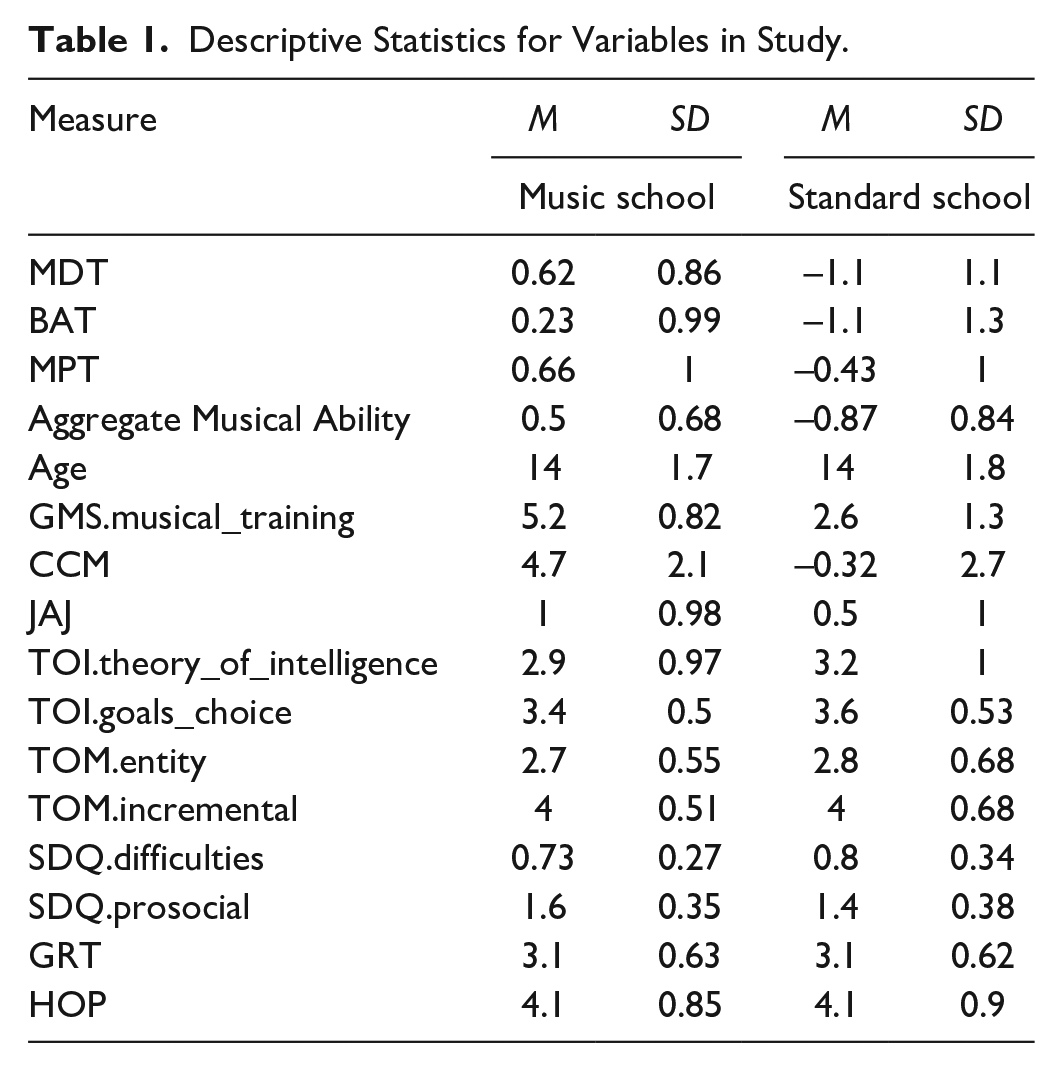
As expected, the descriptive statistics in Table 1 show clear differences in all music-related variables (MDT, BAT, MPT, Aggregate Musical Ability, GMS.musical_training, CCM.general) between students in musical giftedness education and students attending standard secondary schools. Also, a noticeable difference in WM capacity (JAJ) of about 0.5 standard deviations is found for the two groups. In contrast, the two groups are similar in demographic variables (Age). These results are in line with findings by, for example, Ruthsatz et al. (2014), suggesting that high WM capacity might be a defining feature of musical giftedness.
Table 2 shows the correlations among the psychosocial variables assessed in this study for the full sample of students in musical giftedness education and students at standard schools.
Mean Values, Standard Deviations, and Pair-Wise Correlations With Confidence Intervals for All Psychosocial Skills Across Both Groups of Participants.
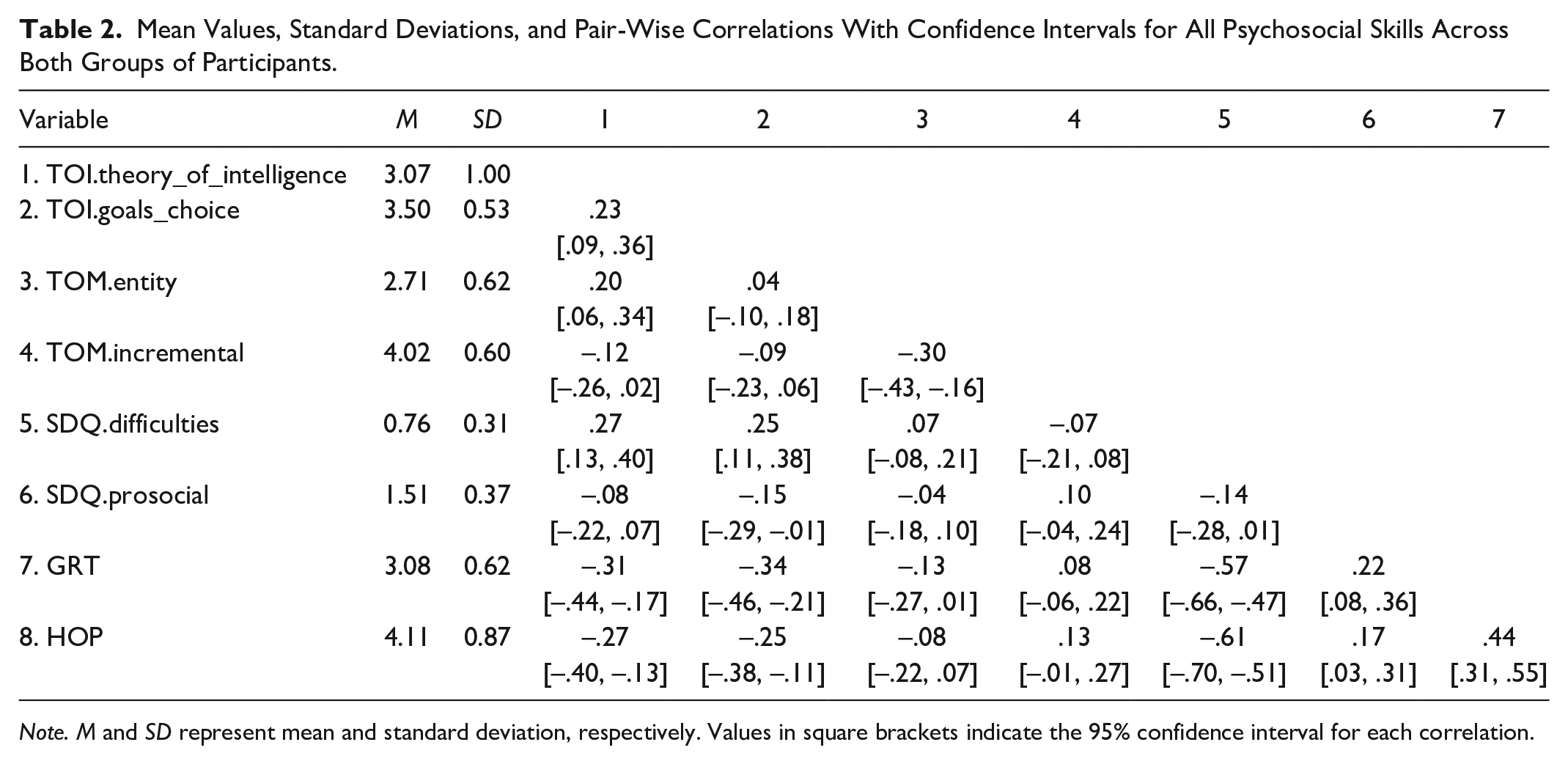
Note. M and SD represent mean and standard deviation, respectively. Values in square brackets indicate the 95% confidence interval for each correlation.
Table 2 shows many substantial correlations between psychosocial variables with expected relationships. For example, the difficulties subscales from the SDQ measure have strong negative relationships with the grit and hope measures, while the prosocial subscale from SDQ correlates positively with these measures. In contrast, the attitudes toward one’s musicality (subscales of TOM) have fairly weak correlations with most other psychosocial variables. However, both theory of intelligence subscales show moderate negative correlations with grit and hope. This may indicate a distinction between, on one hand, participants who focus on achievement instead of learning goals and possess higher degrees of task perseverance and, on the other hand, participants who prioritize learning goals, believe in the incremental nature of cognitive abilities, and have comparatively lower scores on the grit and hope scales.
Regression Analyses
Total Sample
An initial hierarchical regression assesses the impact that psychosocial variables have on music perception skills beyond demographics, training, and cognitive factors. The five models of the hierarchical regression are summarized in Table 3.
Hierarchical Regression Models Using Data From Both Participant Groups.
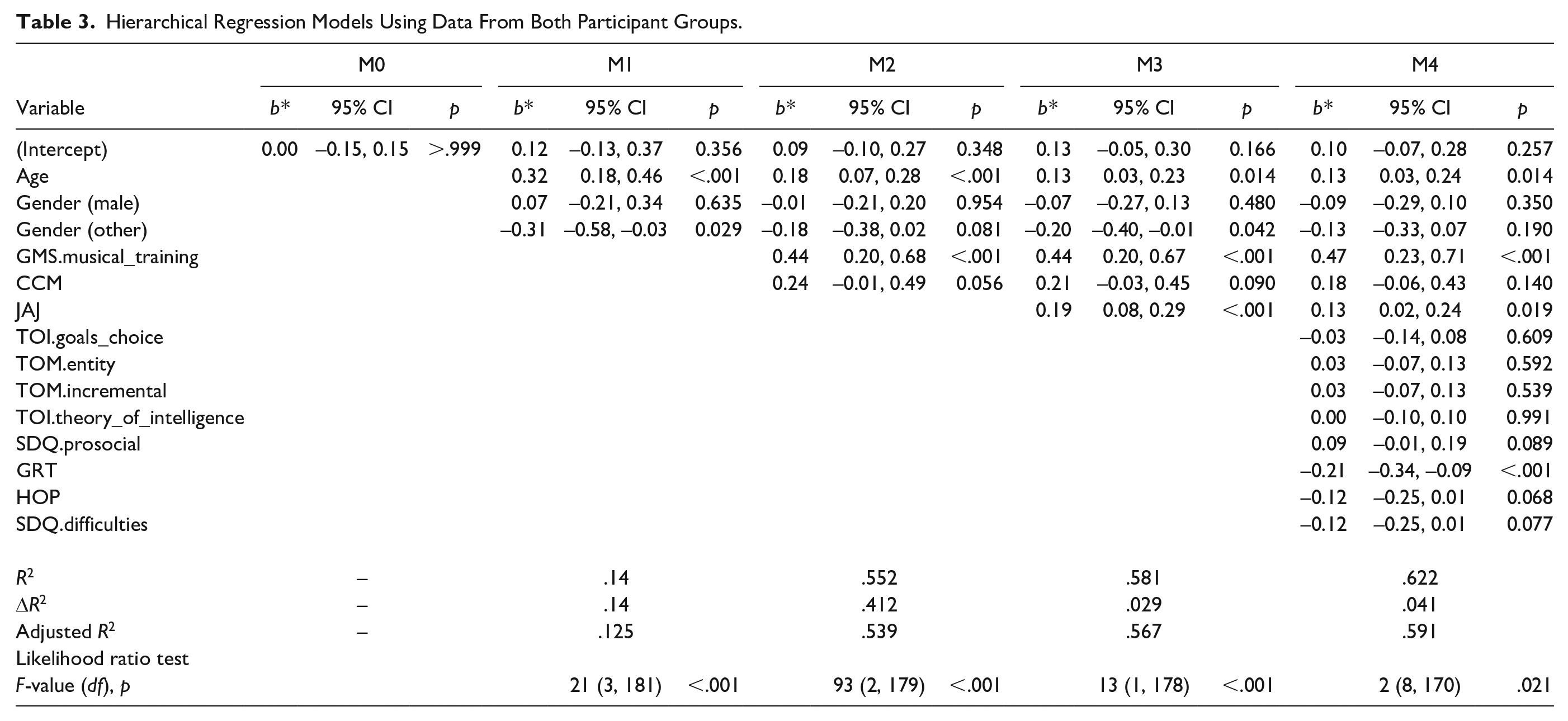
Models 1 to 4 each differ significantly from their simpler predecessor model as assessed by likelihood ratio tests (F-tests), suggesting the addition of each block of variables is justified and increases the model fit. Note that the F-tests take the different number of variables into account that each block of variables comprises. The increase in the R2 values for each block of variables can be interpreted as effect sizes and indicates the importance of each group of variables. The largest increase (∆R2 = .412) is generated by the addition of musical training in model M2 while the block of psychosocial variables leads to an increase in ∆R2 of .041 which is similar in magnitude as the addition of WM capacity (∆R2 = .029) as a proxy for general cognitive ability.
For zooming in on the effect of individual measures among the group of psychosocial variables, we compared their standardized regression coefficients. To produce a simple visualization, we aggregate all variables related to demographics, musical training, and WM into a single variable by generating predictions from model M3. The predictions are then entered together with all psychosocial variables into model m4_alt and the standardized coefficients are plotted in Figure 1.
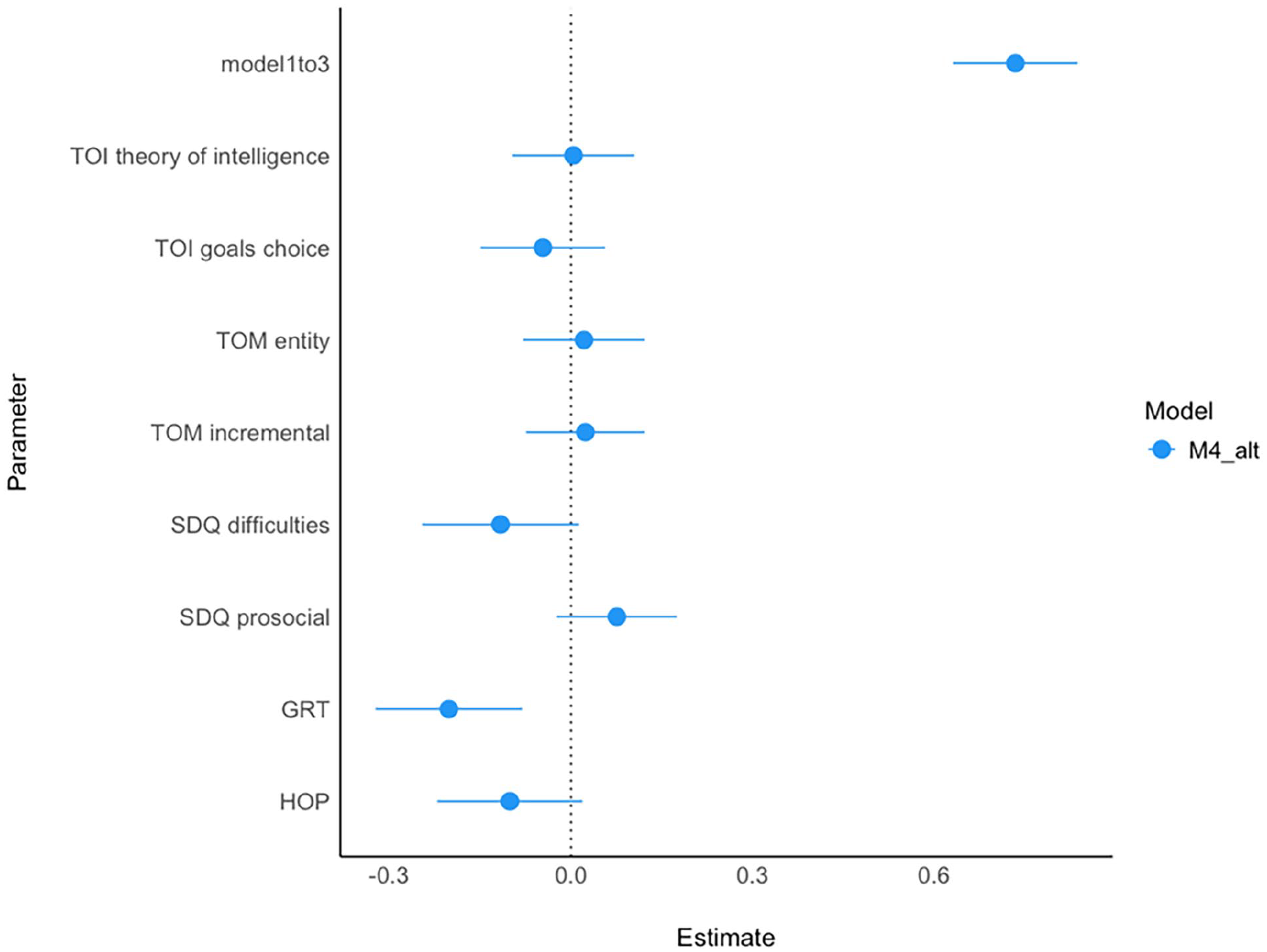
Visualization of Estimated Standardized Regression Coefficients of Psychosocial Variables Using Data from Both Groups of Participants
As expected, the predictions from models M1 to M3 have by far the largest regression coefficient. In addition, the coefficients for grit and SDQ.difficulties have the largest coefficients among the psychosocial variables as Figure 1. They are followed in size by the coefficients for SDQ.prosocial and hope.
Children From Special Gifted Education in Music
A second series of hierarchical regression models are computed, this time only using data from children in musical giftedness education. The models for the children in musical gifted education are summarized in Table 4.
Hierarchical Regression Models Using Data From Children in Special Gifted Education in Music.
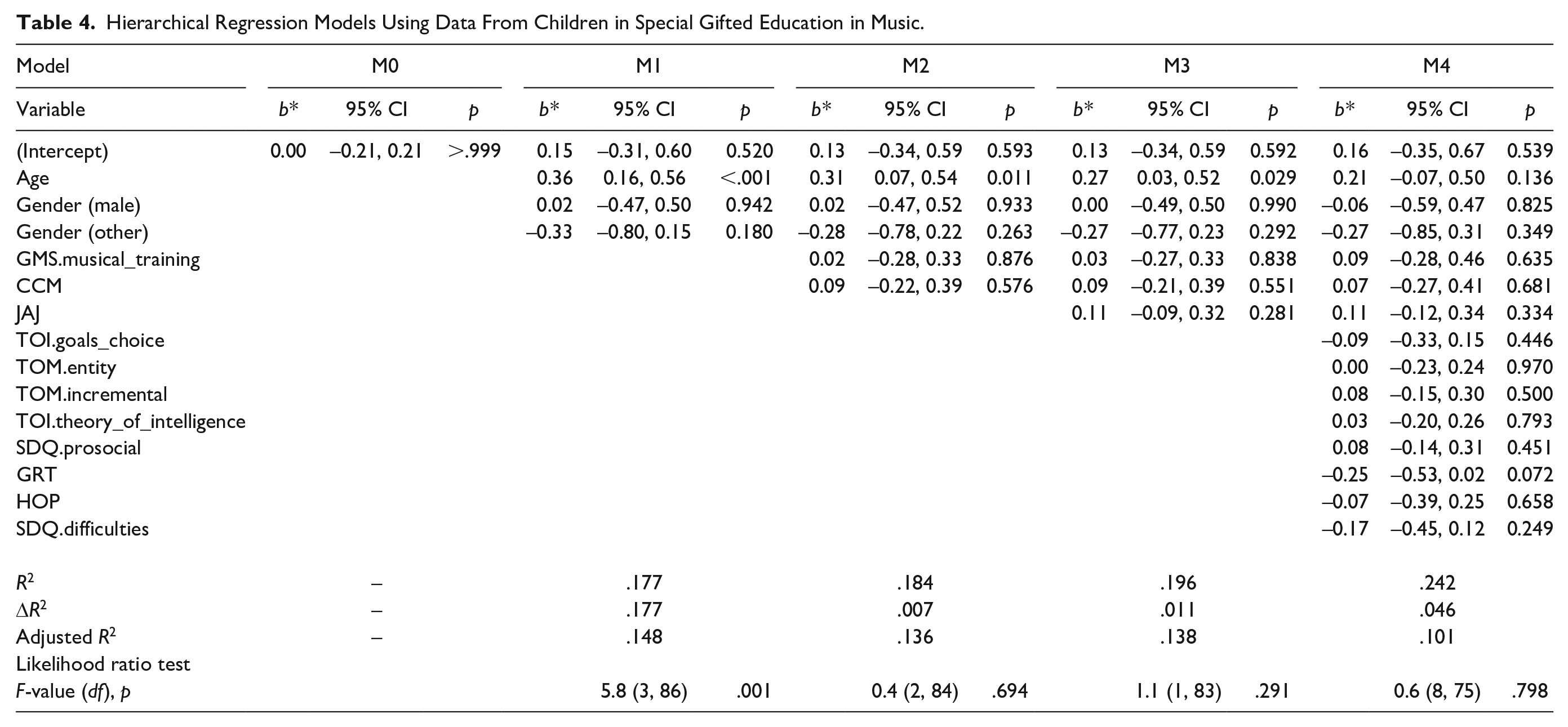
The hierarchical regression for the data from children in musical giftedness education shows a substantial increase in R2 value for the inclusion of the demographics into the model (∆R2 = .177) which is mainly due to the variable of age indicating that older pupils perform better on the listening tests. In contrast, the addition of musical training and WM capacity variables each explain around 1% of the variance in the data. However, adding psychosocial variables to the regression model explains another 4.6% of the variance. Although, one has to be careful when interpreting these increases in explained variance (∆R2) because they seem to be due to very small contributions of several variables. This is also confirmed by the series of adjusted R2 values that take into account the number of variables that are added in each block: Adjusted R2 values do not increase beyond model M1 which only includes sociodemographic variables. Similarly, this is also reflected by the nonsignificant results of the F-tests given in Table 4 and the small standardized regression coefficients of all psychosocial variables shown in Figure 2.
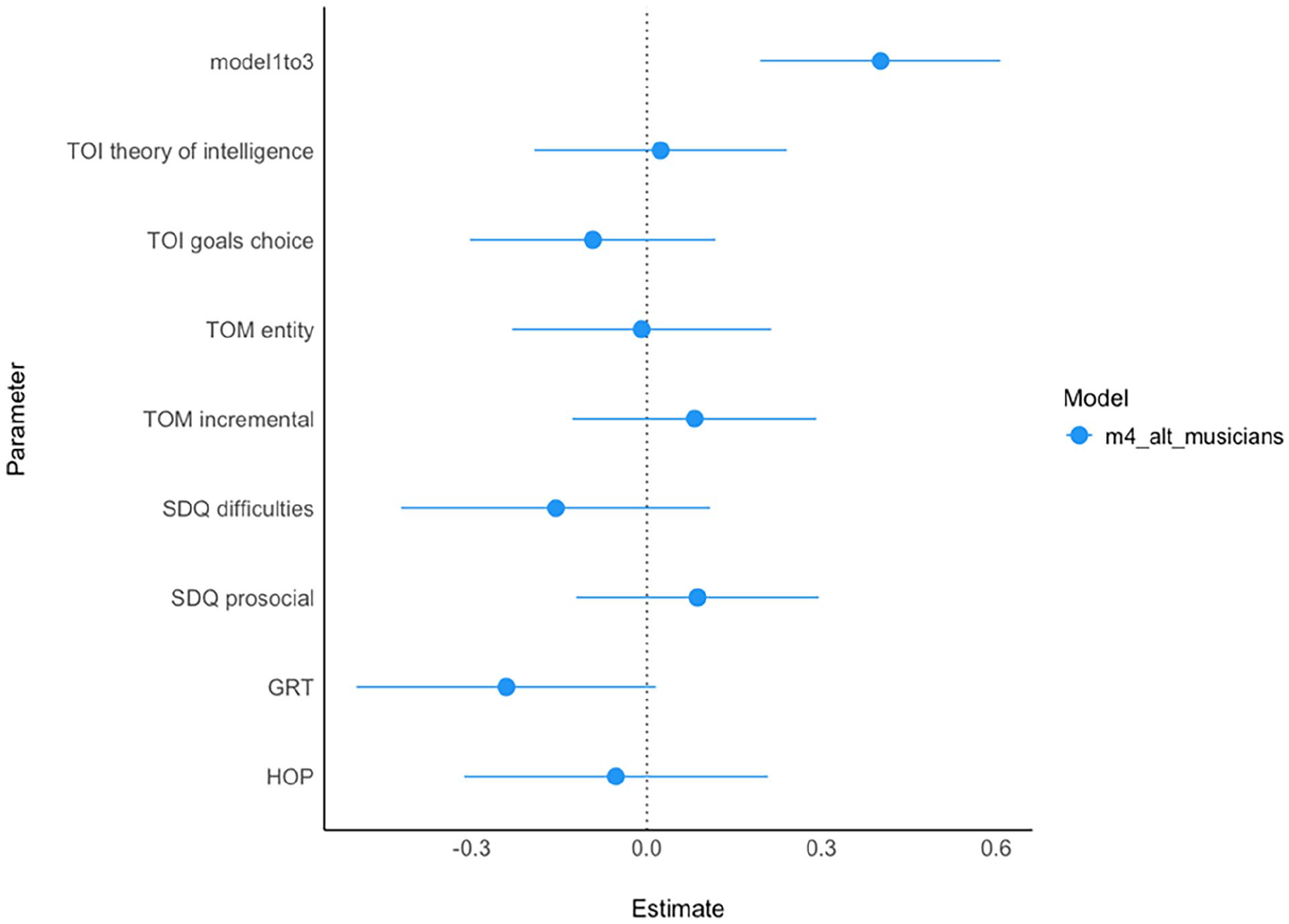
Visualization of Estimated Standardized Regression Coefficients of Psychosocial Variables Using Data From Children in Special Gifted Education in Music.
Again, grit shows a comparatively strong effect among the psychosocial variables. However, probably due to the smaller size of this subsample, the confidence intervals of all coefficients include zero, though for grit this is only marginally the case.
Children in Standard Education
The hierarchical regression model for the control group of children who attend standard schools without any specific music curriculum are summarized in Table 5 and point to different results.
Hierarchical Regression Models Using Data From Children in Standard Schools.
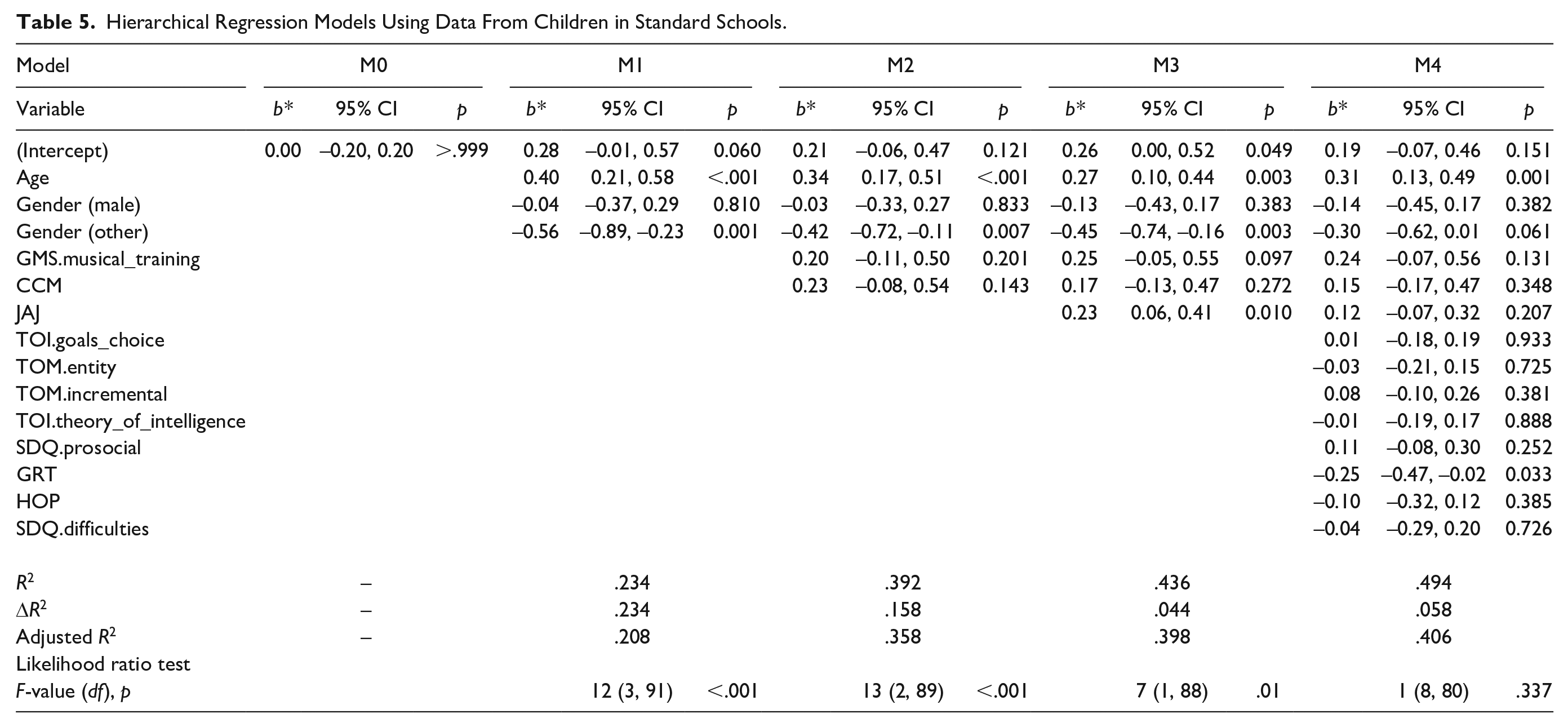
As Table 5 shows, age as a demographic variable is also a very important predictor for explaining the differences among pupils attending schools with a standard curriculum. In addition, the musical training variables explain a substantial amount of variance (ΔR2 = .158) with psychosocial variables explaining about a third of this amount of variance (ΔR2 = .058) and WM capacity still explaining a smaller amount (ΔR2 = .044).
Figure 3 shows that the magnitude of the standardized coefficients of grit and the prosocial subscale of the strengths and difficulties measure is noteworthy. Although, only the confidence interval of the grit subscale does not include zero which makes grit the most important psychosocial variables in the sample of children in standard education.
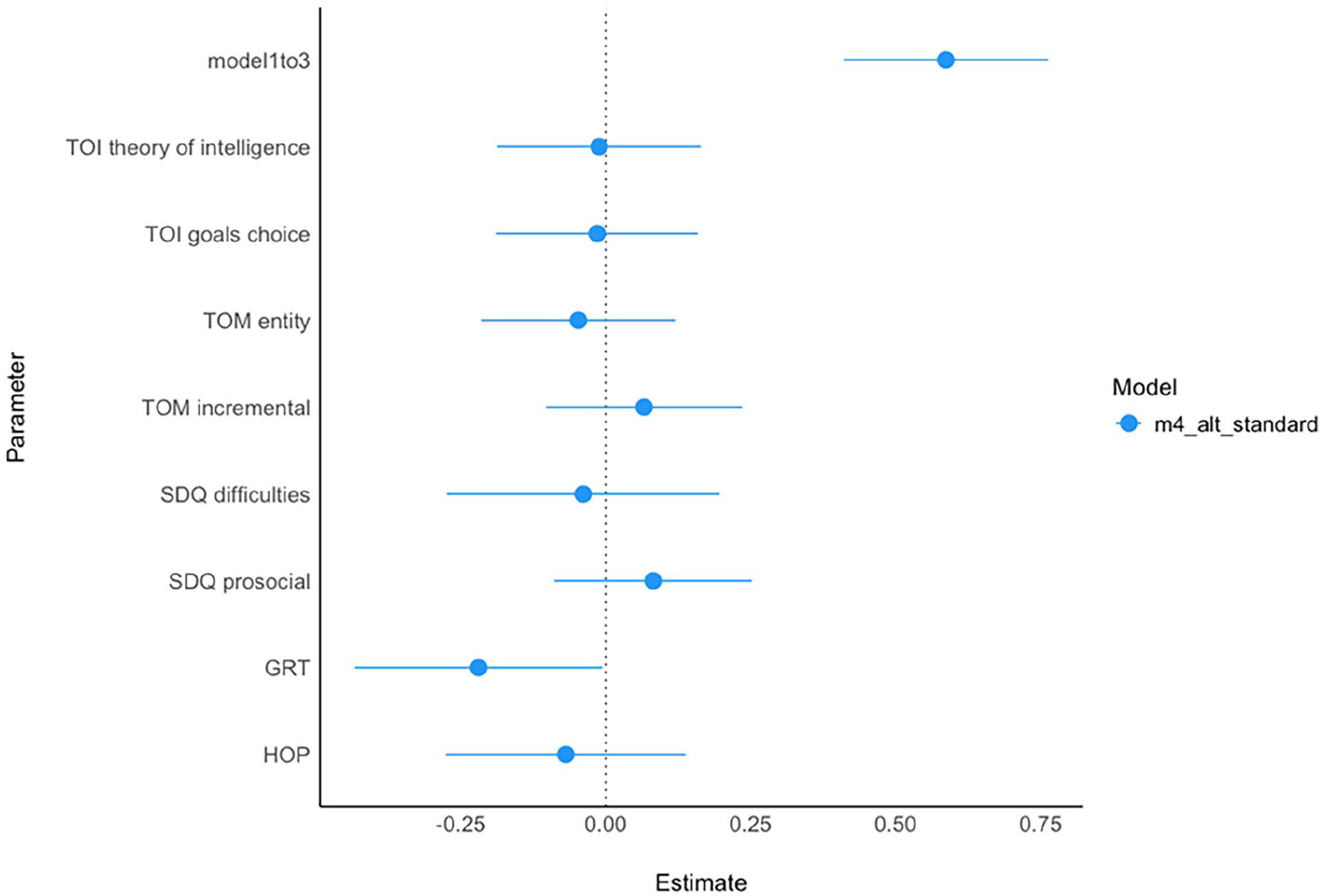
Visualization of Estimated Standardized Regression Coefficients of Psychosocial Variables Using Data From Children in Standard Education
Discussion
The present study was carried out with the aim of investigating the influence that psychosocial skills have on musical abilities beyond demographics, musical training, and cognitive factors. The results show that there are noteworthy associations among several psychosocial variables. This is in line with the literature explaining that behavioral, emotional, and cognitive components in adolescents are not isolated constructs but should be conceived as very much interrelated (Fredricks et al., 2004).
Overall, psychosocial variables explain a small (4.1%) but significant amount (p = .021 for including block of psychosocial variables into the model) of the differences in musical listening abilities when pupils from musical giftedness education and pupils in standard education are analyzed together. In this full sample, the largest differences are associated with musical training (41.2%). Musical training plays a similarly strong role when children from standard schools are analyzed as a separate group (15.8%) and psychosocial variables explain about 6.8% of the variance in the listening abilities of children in this group. However, when musically gifted children are analyzed as a separate group, musical training has a negligible association with musical listening skills (<1%) and, comparatively, psychosocial variables play a greater role, explaining about 4.6% of the variance.
Thus, in terms of Research Question 1, that is, whether psychosocial skills have an impact on musical abilities beyond the contributions of demographics, musical training, and cognitive capacity (i.e., WM), we can confirm that indeed psychosocial variables play a significant role for musical listening skills across a large sample of children in both standard education and musical giftedness education. In this joint sample, the contribution of psychosocial variables is larger than the contribution of cognitive capacity but substantially smaller than that of musical training. In other words, psychosocial variables play a substantial role for the development of musical skills if children in schools with and without musical giftedness education are considered jointly.
For Research Question 2, asking whether the impact of psychosocial skills is the same for children in schools with or without musical giftedness education, the empirical results indicate that psychosocial variables play a different role for children in musical giftedness education compared with children in standard schools when the relative contribution of different types of variables are considered. For musically gifted pupils, the effect of psychosocial variables is at least 4 times larger than the effect of musical training and cognitive capacity (as measured by delta R2 values). In contrast, for children in standard education the effect of musical training is about 3 times larger than the effect of psychosocial variables and almost 4 times larger than the effect of cognitive capacity. Thus, we can conclude that for musically gifted children, psychosocial factors seem to play a more important role for the development of musical listening skills when compared with other types of variables. For children in standard education, the role of psychosocial variables is comparatively smaller.
In addition to psychosocial variables, musical training and age play an important role for the development of musical listening abilities. These findings replicate results from many earlier investigations, demonstrating how performance on musical ability tests increases with age (e.g., Asztalos & Csapó, 2017; Lippolis et al., 2022). Similarly, this study replicates results regarding the impact that musical training and WM capacity (as a proxy for cognitive abilities) have shown in previous studies that report substantial associations between the amount of musical training, improvements in cognitive processes, and performance on musical tests (Habibi et al., 2018; Lippolis et al., 2022; Miendlarzewska & Trost, 2014; Rauscher & Hinton, 2011).
With regard to Research Question 3, asking which psychosocial skills are most important for the development of musical abilities, the empirical results show that one of the psychosocial variables, grit, has a consistent negative relationship with musical listening abilities in all three samples. The negative relationship between grit and musical perception ability was unexpected and is intriguing. As Table 1 shows, both subsamples (children in gifted education in music vs. children in standard schools) report the same amount of grit on average. Consequently, the negative impact of grit on music perception ability appears with comparable effect sizes in all three regression models (i.e., full sample model as well as both subsample models) and cannot be explained by a group effect. Checking the correlation of grit with aggregate music perception ability (r = -.17) in the data from Latvia (N = 185) against data from the LongGold branches in the United Kingdom and Germany (N = 1,294) confirmed the negative relationship (r = -.24) and therefore does not appear to be country-specific. Although, it is possible that negative aspects of the grit construct (e.g., discussed by Houston et al., 2020; Lam & Zhou, 2019), such as perfectionism, the difficulty to switch strategies during problem-solving, or lacking a positive view on new challenges may be a reason for why grit has a negative impact on musical ability. In particular, this might apply to the performance on the three music listening tasks used in this study. All three tests use an adaptive paradigm and present stimuli that become increasingly more challenging if participants provide correct answers on earlier trials. Hence, it is in the nature of these adaptive tests that they never provide the participant with a satisfying impression of final achievement. However, this potential explanation for the negative relationship between grit and music perception ability needs to remain a post hoc speculation for now and will need to be examined in more detail in future studies.
The difficulties subscale from the SDQ also has a consistent negative relationship with listening skills, meaning that students who have emotional or behavioral difficulties or mental health issues show lower musical listening skills. Hence, emotional and mental stability seem to be conducive to the development of high musical skill levels. In turn, the prosocial subscale from the SDQ measure, which is also related to emotional intelligence and empathy, is consistently positively associated with musical listening performance. This corroborates earlier results that have linked musicality and prosocial behavior (e.g., Kirschner & Tomasello, 2010; Miranda, 2019; Williams et al., 2015). However, the individual standardized effect sizes are very small, and it is worth noting again that this study primarily focused on the impact of psychosocial factors as a group of variables and did not suggest any specific hypotheses about the impact and directional influence of individual variables. Therefore, a more in-depth investigation of the interplay among different psychosocial variables and their joint effects on musical development will need to be relegated to future studies. A comparative analysis of the data from different components of The LongGold project in Latvia, the United Kingdom, Germany, and Italy will provide a good opportunity in this respect.
The current study has several limitations, concerning the sample size, the employed test battery, and the cross-sectional nature of the data. Although the size of the overall sample is sufficient to detect small effect sizes, the size of the two subsamples (musically gifted students and students in standard education) are not sufficiently large to detect significant differences between hierarchical regression models that include different groups of variables, let alone the significance of the coefficients of individual variables. Thus, replication of the results employing larger samples is necessary. For students in standard education, replications might be carried out using data from other branches of the LongGold project. But the replication of results for gifted children requires a new and sufficiently large sample. All results reported in this study were computed with musical listening ability as a dependent variable. Musical listening tests have the advantage that they can be easily administered to groups of participants tested in parallel and thus allow for the efficient collection of large samples of data. However, we note that musical listening ability is only one aspect of musicality and future studies will need to confirm findings using other measures of musicality, such as musical performance ability (e.g., instrumental playing or singing), and establish to what degree music perception and production abilities are related. Finally, the present study only made use of the data from the first wave of data collection in Latvia and could therefore only draw inference from cross-sectional data. Only the analysis of the longitudinal data gathered from the subsequent waves of testing will allow for answering highly interesting questions regarding the cause-and-effect relationships between psychosocial and musical variables. The existing literature seems to support causal influences in both directions, that is, either suggesting that musical activities increase psychosocial skills or indicating that psychosocial predispositions influence different trajectories of musical development. Careful analysis of longitudinal data collected on both musical and psychosocial variables might allow researchers to disentangle the causal relationships between the two types of constructs in the future. In addition, using longitudinal data from the same individuals at different points of their developmental trajectory would allow for investigating the question of whether the importance of psychosocial skills depends on the current developmental level of a musical learner and at which stage of music education the introduction of psychosocial skills into the curriculum might be most beneficial.
Conclusion
In summary, this study shows that psychosocial skills play a substantial role for the development of musical skills during adolescence. Compared with other groups of variables (e.g., musical training, WM) their importance is relatively higher for musically gifted children compared with children in standard education. This finding is noteworthy because, by their nature, psychosocial skills are much more akin to social and emotional learning rather than cognitive or perceptual performance and yet we see an empirical relationship between a group of psychosocial skills and performance on musical listening tests. This empirical result seems to have implications for music education with highly gifted children. Traditionally, psychosocial skills have not been taught or been given much consideration in advanced music curriculum in Latvia and other countries. Although, classes related to emotional well-being, performance anxiety, and other psychosocial topics are already part of the curriculum of conservatories and in professional music education in North America. Based on the current results it seems justified to introduce the concept of psychosocial skills at earlier stages in gifted education in music, for it seems that these so-called soft skills can make a difference in the development of musicality among young and gifted musicians.
Footnotes
Acknowledgements
We thank Margarita Mizujeva and Reinis Mauritis for their help with the Latvian translation of the test battery and their help with the data collection. We thank Klaus Frieler for setting up the online battery and marvellous technical support throughout the project. Finally, we would like to thank all participating schools, teachers, administrative staff, parents and, of course, children who have taken part in this study.
Declaration of Conflicting Interests
The author(s) declared no potential conflicts of interest with respect to the research, authorship, and/or publication of this article.
Funding
The author(s) received no financial support for the research, authorship, and/or publication of this article.
Open Science Disclosure Statement
The data analyzed in this study are available for purposes of reproducing the results upon request. The code used to generate the findings reported in the article is available for purposes of reproducing the results or replicating the study upon request. The following newly created, unique materials used to conduct the research are available for purposes of replicating the procedure: online tests and questionnaires, available at  .
.
Ethical Approval
The research was granted ethical consent by the Rīga Stradiņš University Research Ethics Committee (approval document number: 2-PĒK-4/195/2023).