




Abstract
The recent decision by the United States Supreme Court to limit affirmative action in college admissions could make it even more challenging for academically talented students of color to gain access to competitive schools. The importance of school counselors in guiding and supporting these students is now more crucial than ever. This qualitative study aimed to determine what school counselors need to know, do, and believe to help academically talented, Black students from low-income households gain admission into highly selective colleges and universities. Three broad themes and 10 subthemes emerged from the data analysis. The themes were (a) knowledge and awareness, (b) mindsets and beliefs, and (c) habits and practices. Implications for school counselor practice, training, and research are discussed.
As a senior in high school, NaKeshia was an honor student; she scored in the top 4% of test takers nationally on the SAT exam, held a job, participated in community service, and played an instrument. She always dreamt of pursuing an arts and humanities degree at one of the nation’s top 10 universities in these subject areas. However, when it came to applying to highly selective colleges, which often require lengthier and more complex applications, there were few people around to help her. Students from her predominantly low-income, Black high school rarely, if ever, applied to competitive colleges. The school counselors were overworked, under-resourced, difficult to access, and had limited training in college readiness counseling. And, on top of it all, neither of NaKeshia’s parents had prior experience with the application process. Actual high schoolers like this hypothetical student and the issues they face are very real. Nearly one out of every four high-achieving, low-income students apply to college entirely on their own (Giancola & Kahlenberg, 2016).
Limited access to college readiness counseling (e.g., strategies and interventions designed to support students’ ability to enter college and attain a degree) is one of the many reasons academically talented students like NaKeshia tend to shy away from applying to (or attending) selective colleges—a decision that has lasting consequences (Savitz-Romer, 2012). Several studies have found that high-achieving, low-income students of color who attend highly selective colleges are significantly more likely to: (a) graduate on time, (b) enroll in graduate school, (c) acquire less student loan debt, and (d) enjoy post-college labor market success than if they attended a non-selective 2 or 4-year college (Bowen et al., 2009; Carnevale & Strohl, 2013; Hoxby & Avery, 2012). Low-income, high-achieving students, like NaKeshia, make up just 3% of students enrolled at highly selective colleges compared to 72% of their wealthy, high-achieving, and often White peers (Giancola & Kahlenberg, 2016). This is where good college readiness counseling can make all the difference.
School Counselors as College-Related Social Capital
School counselors are crucial, especially for high-achieving students of color from low-income backgrounds. Their guidance and support can determine whether these students attend a college that matches their academic qualifications or if they miss out on this life-changing opportunity completely (Kang & Garciá Torres, 2021). For many academically talented, low-income students of color, a school counselor might be the only person they have access to who can support them through the college-going process (Bryan et al., 2011, 2017). Previous research has established that students of color and those from low-income families rely heavily on their school counselors for post-secondary counseling and support because of limited access to post-secondary knowledge and networks (Bell et al., 2009; Bryan et al., 2011; Cholewa et al., 2015; Choy, 2001; Farmer-Hinton, 2008; Plank & Jordan, 2001). College-related social capital refers to the information gathered through social networks and ties related to college admissions, financial aid, enrollment, etc. (Bryan et al., 2011, 2017). School counselors are an essential source of college-related social capital for students who are the first in their families to attend college or who come from historically oppressed groups, despite extensive emotional and motivational post-secondary support from caregivers and friends (Brookover et al., 2021; Cholewa et al., 2015; Farmer-Hinton, 2008; Poynton et al., 2021; Savitz-Romer, 2012).
Research indicates that speaking with a school counselor about college increases a student’s likelihood of: (a) taking the SAT or ACT exam, (b) applying to multiple colleges, (c) submitting the Free Application for Federal Student Aid (FAFSA), and (d) attending a bachelor’s degree program in the fall immediately following high school graduation (Bryan et al., 2011; Engberg & Gilbert, 2014; National Association for College Admission Counseling [NACAC], 2020; Poynton & Lapan, 2017). These findings suggest that school counselors are an essential source of college-related social capital for racially and economically marginalized students, reinforcing the need for highly qualified and trained school counselors.
Rationale for the Study
The recent decision by the United States Supreme Court to limit affirmative action in college admissions could make it even more challenging for academically talented students of color to gain access to competitive schools. The importance of school counselors in guiding and supporting these students is now more crucial than ever. Unfortunately, there is a considerable amount of evidence indicating that many school counselors are not adequately trained to provide efficient college readiness counseling to K-12 students, particularly those who come from marginalized communities (e.g., Gilfillan, 2017; Hines et al., 2011; Novakovic et al., 2021). While there are established standards for what K-12 students should know and be able to do before heading to college, professional associations have yet to define a set of competencies that school counselors should possess to effectively guide students toward college (e.g., American School Counselor Association [ASCA], 2021; NACAC, 2020).
Instead of relying solely on guidance from researchers and expert panels, we have chosen to prioritize the recommendations of the students who are directly affected by the issue of gaining admission to prestigious institutions. Their insights and perspectives are crucial in developing effective strategies for counselors to assist them in this process. However, the perspectives and voices of students within marginalized groups have been relatively absent in the college access and readiness literature (e.g., Brookover et al., 2021; Williams & Bryan, 2013; Williams & Portman, 2014). The ability to identify appropriate college readiness counseling competencies will be severely limited if student voices remain silent in conversations about the knowledge, awareness, and skills needed to help students with marginalized identities navigate post-secondary options effectively. Therefore, the primary purpose of this study was to identify students’ perceptions of what school counselors need to know, do, and believe to help academically talented, Black students from low-income households gain admission into highly selective colleges and universities.
We define highly selective colleges as those that typically admit fewer than 20% of their applicant pool of students with high academic readiness levels—as measured by SAT or ACT scores, GPAs, and class rank (Barron, 2018). High-achieving students are defined as students whose test scores (e.g., SAT or ACT) and GPAs place them in the top 25% of their peers nationwide (Wyner et al., 2007). The term Black describes people of African descent, including through United States slavery, or of Caribbean descent who were born in the United States or have immigrant parents. We identified low-income students as those whose family income is less than twice the federal poverty threshold—a low-income definition previously used by the National Center for Children in Poverty and the Working Poor Families Project using American Community Survey data (Jiang et al., 2015).
Methodology
A qualitative, phenomenological study was utilized to gain an in-depth understanding of students’ lived experiences and perceptions of how to support academically talented, low-income Black students during the college-going process (Creswell & Poth, 2018). Phenomenology seeks to understand social phenomena from the subjects’ perspectives and describe the world as experienced by them, yielding depth in the data rather than surface patterns (Patton, 2015). In this case, the phenomenon examined was being admitted to a highly selective college or university, despite the risk factors associated with living in poverty as a racialized student. The decision to select academically talented, low-income high school students who recently accepted admission to highly selective colleges or universities offered a more defined perspective, given their success in the college-going process, despite the adverse conditions associated with living in poverty as a racialized student. The following research question guided our inquiry: What do school counselors need to know, do, and believe to help academically talented, Black students from low-income households gain admission into highly selective colleges and universities?
Research Team
Our research team consisted of a faculty member, a doctoral student, and four masters-level students in counselor education programs from two large mid-Atlantic public universities. Three research team members identified as African American, one as Asian American, and two as European American, with a mean age of 28 years (SD = 2.9). There were two male and four female research team members. The first author, who identifies as a Black American, has sufficient research expertise and hands-on experience in counseling high-achieving students of color from low-income backgrounds. Similarly, the doctoral student had over seven years of practical experience as a high school counselor working with students of color who come from low-income households. The first author developed the methodology and provided qualitative research training to the team. The four masters-level students conducted and transcribed four to five interviews each, and the first author and doctoral student analyzed the data through independent and consensus coding.
Participants
Purposeful, criterion-based sampling (Patton, 2015) was used to identify 28 potential participants from a national sample of applicants pursuing a foundation-funded scholarship program called the Ron Brown Scholars (RBS) program. Of the 28, 18 individuals ultimately agreed to participate in the study. The RBS program is a national program benefiting academically talented, highly motivated Black high school seniors who have demonstrated financial need, social commitment, and leadership potential. The program also provides academic scholarships, service opportunities, and leadership experiences (Nagle, 2014).
Participants self-identified as Black (males, n = 10; females, n = 8). The average gross family income was below $33,000 per year for the sample population, as indicated by the IRS-reported adjusted gross income. Further, all participants were eligible to receive free or reduced lunch during high school. Participants lived and attended high schools in diverse geographic locales: urban (n = 9), suburban (n = 7), and rural areas (n = 2) at the time of the study. Students were drawn from 12 states across the four major U.S. regions. Participants were 18 (n = 16) or 17 (n = 2) years old. The average GPA for participants was 4.2 (on a 4.0 scale). The average American College Testing (ACT) scores were 32 out of 36, and the average Scholastic Aptitude Test (SAT) score was 1,440 out of 1,600 (730 verbal and 710 math). Half of the participants (n = 9) were first-generation students. All participants in the study were granted admission and acceptance to highly selective colleges or universities (i.e., Harvard, Columbia, Stanford, University of Southern California, Massachusetts Institute of Technology, Yale, Princeton, Notre Dame, etc.). They had not started attending at the time of the study.
Procedure and Data Collection
Upon gaining institutional review board (IRB) approval, access to the RBS applicant pool was granted to the first author for approved use and was governed by the RBS foundation’s executive director. The selection criteria for the RBS program included academic measures and income indicators. We invited 28 finalists from the RBS program to participate in the study, and 18 agreed to participate. This study draws upon two data sources: (a) the RBS application and (b) two semi-structured qualitative interviews with each participant.
Applications
When applying to the RBS program, students provided academic grades, test scores, essays, letters of recommendation, and demographic information (e.g., age, family status, race/ethnicity, gender, residency information, and income). These data provided the researchers with student profiles and ensured students met the study’s inclusion criteria.
Interviews
Candidates received mailed information, including a research study description, parental consent, and student assent forms. They were also informed that they would receive a $50 gift card as an incentive to participate. Participants received a phone call from a research team member to schedule the phone interview. A team of faculty experts from four research-intensive universities, possessing expertise in school counseling, college and career readiness, and working with racially marginalized K-12 students, collaborated to devise and assess an interview protocol. The interview protocol included eight open-ended questions, such as “What, if anything, do school counselors need to know to help high-achieving, low-income Black students gain admission into highly selective colleges and universities that match their academic credentials?” After each question, research team members asked probing questions (Patton, 2015), such as “How, if at all, do those things influence a student’s decision to apply for and ultimately enroll in a highly selective college?” The phone interviews lasted 45 to 71 minutes (M = 59), and each participant received a thank you statement and incentive in appreciation of their time.
During each interview, a digital audio recorder was used to record responses to ensure data collection accuracy (Patton, 2015). The research team members transcribed the digital files verbatim and later checked them against the recording to ensure accuracy. Each transcript was assigned a pseudonym, and participants’ names were deleted to maintain confidentiality. Six to ten weeks after the initial interviews, team members conducted follow-up interviews. The follow-up interview questions varied according to the participant’s responses to the first round of interview questions. The follow-up interviews lasted, on average, 25 to 30 minutes and included questions such as “Can you think of anything else that school counselors can do to help academically talented, low-income Black students gain admission to highly selective colleges?” or “Why is it important that school counselors are critically aware of the negative impact of racism and poverty on academically talented students’ post-secondary aspirations?”
Data Analysis
Thematic analysis was used to analyze the qualitative data acquired in this study. Thematic analysis is performed through coding in six phases (described below) to identify patterns across data sets that are important to describe a phenomenon and are associated with a specific research question (Braun & Clarke, 2006). Thematic analysis is not necessarily wed to any pre-existing theoretical framework and can be used with different frameworks, such as phenomenology (Braun & Clarke, 2006).
First, to familiarize ourselves with the data, the first author and doctoral student read all transcribed interviews before coding. While reading the transcripts, both researchers marked ideas (i.e., potential themes) for coding that were later revisited in subsequent phases. Second, both authors re-read transcripts to detect recurring words, phrases, or thoughts that may form repeated patterns (themes) across the data, which were then categorized using initial codes. The researchers also noted discrepancies in the participants’ responses (e.g., some students cited in-school adults such as teachers and school counselors as helpful throughout the college-going process, and others did not). Third, after a list of codes (and all the relevant coded data extracts) was identified across the data, they were sorted into potential themes. A thematic map analysis was used to visualize and sort the different codes into theme piles. Coding decisions that differed were openly discussed and modified slightly until a 100% consensus was reached. Specifically, researchers discussed the rationale behind and definition of the codes they assigned until consensus was reached about which codes best suited each theme. Next, the researchers considered the relationship between codes, themes, and different levels of themes (e.g., main overarching themes and subthemes within them). Five researchers reviewed and refined the potential themes identified in the previous phase. During this phase, the researchers read all the collated extracts for each theme and determined whether they formed a coherent pattern. Afterward, the researchers re-read the entire data set to ascertain whether the themes “work” in relation to the data set and to code any additional data within themes that had been missed in earlier coding stages. Following this, researchers revisited the collated data extracts for each and organized them into a coherent and internally consistent account with an accompanying narrative. Finally, the first author used the completed data analysis to write the results.
Trustworthiness
Several techniques were used to ensure the trustworthiness of the present study. First, peer debriefing involved enlisting two colleagues’ support with experience in conducting qualitative research to discuss evolving suppositions and findings from the study (Patton, 2015). Second, member checking involved asking participants to (a) review the interview questions for clarity; (b) review their transcripts to ensure adequate representation of their ideas; and (c) comment on the themes and emerging patterns that contributed to the results (Patton, 2015). The participants believed the findings accurately depicted their ideas.
Findings
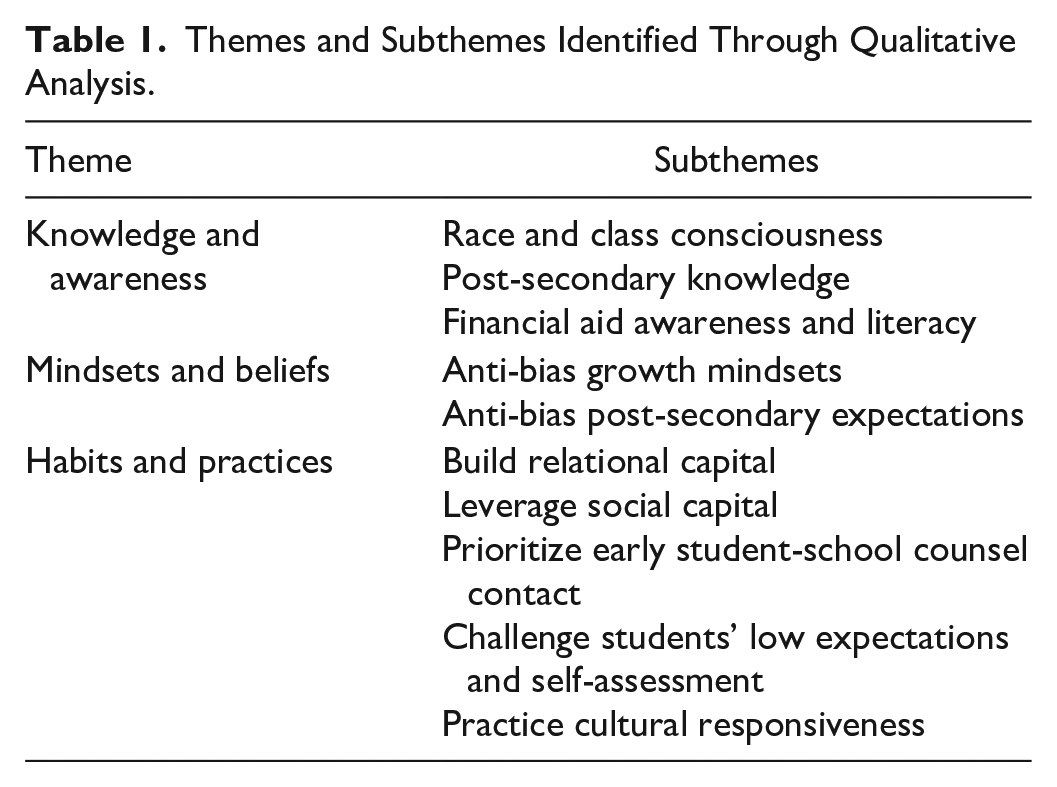
This qualitative research study examined high-achieving, low-income Black students’ perceptions of what school counselors need to know, do, and believe to help academically talented, Black students from low-income households gain admission into highly selective colleges and universities. Three broad themes and 10 subthemes emerged from the data analysis: (a) knowledge and awareness, (b) mindsets and beliefs, and (c) habits and practices. Each theme had corresponding subthemes (see Table 1). Participant pseudonyms are provided in these findings.
Themes and Subthemes Identified Through Qualitative Analysis.
Knowledge and Awareness
The first theme in the study related to what school counselors need to know to effectively assist high-achieving, low-income Black students in gaining admission into highly selective colleges and universities that match their academic credentials. Students describe the importance of gaining a critical consciousness regarding the negative impact of racism and poverty on academically talented students’ post-secondary aspirations, access, and choice. Students also emphasized the importance of understanding the college admission and financial aid processes at highly selective universities and colleges. Within this first theme, three subthemes emerged: (a) race and class consciousness, (b) post-secondary knowledge, and (c) financial aid awareness and literacy.
Race and Class Consciousness
Eighty-nine percent of students (n = 16) indicated that school counselors must possess a critical awareness of how poverty and systemic racism impact college aspirations, access, and choice for high-achieving, low-income Black students and shape their daily realities. For example, Asabi commented:
. . .being Black and poor puts us at a severe disadvantage regarding college readiness. I think [school counselors] need to be aware that Black students, especially those of us who attend poorly resourced schools, aren’t afforded the same opportunities to prepare academically for competitive colleges and complete the college entry process. In K-12 school districts, funding is being cut primarily at Black and Brown schools; there’s one counselor for every 300 or more students, so it’s not always feasible to access college access programs or find help navigating the college-going process.
Another participant, Ahmad, stated:
[school counselors] have to acknowledge and understand that Black students face systemic disadvantages in our education systems, which creates traumatic experiences for students; it may cause them to limit their goals or not be as ambitious as other students. Despite our academic track record, even the brightest Black students struggle with the idea that we are not good enough or not worthy of being at some of these top-tier institutions, so we enroll in less demanding colleges, or some of us don’t go to college at all. You can’t help us without seeing or understanding our plight.
Post-secondary Knowledge
Ninety-four percent of participants (n = 17, 94%) reported that school counselors must be knowledgeable about all phases of the college process, from researching, investigating, and suggesting colleges that align with students’ academic credentials to assisting students in the various stages of the applications processes. Tammara stated:
[school counselors] need a general understanding, foresight, and knowledge of the admission process. They need to know how to research different opportunities, provide advice, help us determine the right fit, and help us navigate the admissions process. Because me personally applying to XXX and all these other schools, I didn’t know what a CSB profile was. I didn’t know what the FAFSA was. I didn’t know what the SATs were. I didn’t know how to determine which colleges would be the right fit for me.
Another student, SaDohl, commented:
Another thing that I noticed; a lot of my counselors are not very up-to-date on what is currently happening in the college world. The information they give is based on their experience, which is still valid, but college has changed significantly in the past 10-15 years. Costs have gone up. So, they must stay current on the entire college admission process. Everything is just different . . . how you apply. My counselor initially told me I couldn’t apply to XXX through the common app because XXX is not on the common app, according to her. I checked, and it actually was, but the information she was going off of was 10-15 years old. She was never updated, I guess, on how things work.
Financial Aid Awareness and Literacy
All student participants (n = 18, 100%) reported that school counselors need a practical understanding of the financial aid and student loan process to help students and their families navigate the financial cost of attending a highly selective college or university. This includes helping students interpret financial aid award letters, secure scholarships, and grants, and make financially sustainable decisions. The comments below illustrate this subtheme.
A lot of really, really smart kids in my grade wanted to go to like Harvard and Yale but just chose not to apply because they were under the impression that they can’t afford it. I was one of the only ones to apply to an Ivy League. I discovered that those high-end schools will give you a lot of aid if you’re under a certain income. So I’m going to XXX and get good financial aid, but my family and I had to figure out the college sticker vs. net price ourselves. Counselors really didn’t inform us of that or other aspects of the financial aid process. I don’t think they knew that or how to help students forge a pathway to financing college (Dytisha).
Another student commented:
Financial aid was a big issue for my school, not the application process. Many of my friends got into the school they wanted but couldn’t afford, so they declined the offers and settled for in-state schools. School counselors weren’t good at helping kids figure out how to fund college; they didn’t know what they were talking about. It was a lot of self-learning, I think. We were all under the impression that you just have to get into school, and then you would just get your financial aid according to your need, but a lot of schools are not like that. Getting into college is hard, but not as hard as paying for college. We all got in; just not everyone could afford it (SaDohl).
Mindsets and Beliefs
The second theme in the study related to what school counselors should believe about low-income, Black students’ ability to get accepted, attend, and be successful at highly selective colleges and universities. These mindsets and beliefs were described as the invisible forces driving school counselors’ college readiness counseling-related behaviors and influencing students’ post-secondary decisions. Within this second theme, two subthemes emerged: (a) anti-bias growth mindsets and (b) anti-bias post-secondary expectations.
Anti-Bias Growth Mindset
Over three-quarters of the participants (n=14, 78%) reported that school counselors must confront their biases and preconceived notions about low-income Black students’ academic skills and potential to gain the knowledge and skills necessary to succeed at highly selective colleges and universities. These biases were said to negatively impact school counselors’ interactions with students and influence the types of college counseling-related services offered. Talking about this issue, Quiteya said:
. . .[school counselors] need to unlearn the stereotypes and personal biases they hold about Black students’ ability or aptitude to succeed at top-ranked colleges and universities. When we meet with our school counselors, we can tell if the counselor secretly believes that it’s a waste of their time to provide college counseling about top-ranked schools. Some think that because we come from under-educated families and under-resourced communities, we can’t develop the knowledge and skills through dedication and hard work [while in high school] to compete for admission at a top-ranked school.
Anti-Bias Post-Secondary Expectations
Relatedly, two-thirds of the participants (n = 12; 67%) believed that school counselors must challenge their racially biased expectations about low-income, Black students’ future performances, and behaviors at highly selective colleges and universities. These racially biased expectations were said to lead to self-fulfilling prophecies and negatively influence students’ college decision-making. Tammara stated:
Unfortunately, school counselors often have misconceptions of poor Black students. As a result, they develop and adopt low expectations of us and our chances of success at top-tier schools. These low expectations erode our self-confidence, motivation, and academic goals. At my high school, I was told that I probably wouldn’t get into a highly selective school. I was encouraged to apply just to state schools or community colleges. Which there’s nothing wrong with going to a state school or community college. But I almost lowered my standards and applied to a 2-year college to match my counselors. Counselors need to know that their expectations matter.
Another student, Malique, mentioned:
It helps if school counselors are aware of their preconceived notions about a student’s ability to apply, get accepted, and attend a competitive college based on their race or SES. If they approach college counseling with biased assumptions, they’re not going to be interested or ready to help us consider competitive schools. Instead, the counselor will cut corners on providing the student with the information, resources, and supports necessary to make attending a competitive college a reality. I know at my school we all get the same advice. I could have a meeting with a counselor, and my friend could have a meeting with that counselor; we’re completely different people, and she’ll tell us the same thing, “apply to XXX State. I think you’d fit in there.” XXX State is a non-competitive school—her assumptions speak volumes.
Habits and Practices
The third theme in the study related to what school counselors should regularly do to help high-achieving, low-income Black students gain admission into highly selective colleges and universities. Within this third theme, five subthemes emerged: (a) build relational capital, (b) leverage social capital, (c) prioritize early student-school counselor contact, (d) challenge students’ expectations and self-assessment, and (e) practice cultural responsiveness.
Building Relational Capital
More than three-quarters of those interviewed (n = 15, 83%) reported the importance of building a relationship with Black high school students grounded in a general acknowledgment of the unique challenges and strengths that characterize their lives, including their college potential. Thus, when it is time to push and challenge students to apply (and ultimately attend) highly selective colleges and universities, school counselors will have plenty of relationship capital to draw from. Talking about this issue, Candis said:
I know this may be unrealistic since there are huge high schools with thousands of students who only have maybe 5 or 6 counselors. But I think it’s important that counselors actually build relationships with their students. It’s a lot easier to help give someone college guidance if you know about their background, if you know their interests, if you know their strengths, and if you know their personality in general. Nowadays, counselors are disconnected from students because they stay in their office, and they never really get a chance to meet students and connect or see what’s happening in their life. A deeper connection with students will better equip them to know what types of services students from low-income backgrounds need to be college ready.
Similarly, Corey stated that:
It’s a relationship, not just a job. Without a relationship, the student will never trust, listen to, or respect you. So a counselor has to know how to build relationships with students and build empathy and give the benefit of the doubt . . . building relationships helps gain a student’s trust. So when you tell them the SATs are important and that they should study for and take it, they’ll be like, yeah, because she’s cool . . . this person cares about my future. Or when they challenge you to apply to a top-tier school, you’ll be like, yeah, they believe in me and what I can do, so I’m going to go for it.
Leverage Social Capital
Eighty-three percent (n = 15) of those interviewed indicated that school counselors must use their social networks, interpersonal connections, and resources to promote students’ college aspirations, interests, and college-going self-efficacy at highly selective colleges. For example, Tiffany said:
Be well connected. Learn to network and connect with other counselors in the area and go to different events to learn about new opportunities for students who do not have the resources to be connected or the skills to network for themselves. School counselors aren’t as valuable to us if they don’t have a good professional network of people they can use to provide us with support, feedback, insight, information, and resources.
While Leslie mentioned that:
[school counselors] have to be a jack of all trades. It’s really helpful when you can pawn kids off to other people in your professional circle and know that their needs will be taken care of, like help finding a scholarship, writing essays, gaining access to resources, tools, and relationships to help you get ready for colleges that match you and your needs. Um, and then if you don’t know something, don’t like fudge it, just send them to someone in your social network who knows what they are talking about.
Prioritize Early Student-School Counselor Contact
Over three-quarters of the participants (78%, n = 14) said that high-achieving, low-income students require special attention and early college planning in high school to ensure access to higher education and a reasonable chance for admissions at highly selective colleges and universities. Corey stated:
I feel like a counselor should be involved in the [college readiness] process early, not when senior year comes around, and they’re like “You need to do this, this, and this.” They should offer college services from the beginning and help students establish college-going goals when they first reach high school. During my freshmen year in high school, I had already identified what college I wanted to go to and what my target GPA was. And that changed, yes, but it kept me focused freshman year, which I think is the hardest year to stay focused. And then, from that, I was able to build off of it. I eventually surpassed my goals which was nice.
And Asabi commented:
So, for school counselors, I think they should, like, this is honestly not too realistic because it’s a very large school, but school counselors should have a discussion or some type of conference with freshmen as soon as they come in, one on one, to get a feel for what freshmen want to get out of high school and begin to plant the idea of going to college. And then, from that, they should have a list of programs for enrichment and other things that those students might need or want to access to benefit them. A lot of college readiness comes from school, extracurricular activities, and summer activities that you do throughout high school.
Challenge Students’ Low Expectations and Self-Assessment
Just over half of the participants (n = 10, 55%) noted the importance of school counselors’ ability to identify and explicitly challenge students’ low expectations and self-perceptions, making them hesitant to take appropriate academic risks, such as applying to highly selective colleges or universities. The comments below illustrate this subtheme.
It isn’t that the students in my school that aren’t going to highly-ranked colleges because they’re not smart enough to go. It’s that they’ve already allowed the lie that “I’m not good enough” to stop them. So getting rid of that lie would bring down a huge barrier. It would kind of just again help them understand that the lie that “I’m not good enough” isn’t true and that it is a lie. Then they’ll realize that people who attend these top schools aren’t all these super elite, super-rich people. They’re normal people like you and me; we are just as smart as everyone else (Malique). [school counselors must] understand that students who face poverty or maybe a minority deal with negative internalized messages and the idea that they are not good enough or worthy of being at some of these top-tier institutions. It is something that we learn living in this society. So counselors must recognize and challenge our self-stereotypes and encourage students to apply to some of these institutions with many students that are higher income and typically white (Patrice).
Practice Cultural Responsiveness
Most participants (n = 16, 88%) indicated that school counselors must proactively engage with and respond to students and their families in meaningful, respectful, and culturally responsive ways. For instance, Erica mentioned:
Um, they need to be sociable. Like, they need to develop the skill to meet people on their level and to really express an appreciation for cultural differences and what students and their families think and believe about going to college. Because the whole college process is often overwhelming to students and families, being able to talk to people on a comfortable level and in a caring and respectful way is very necessary. You have to speak to families on their level without coming off as condescending or as if families or students have nothing positive to offer the conversation or [college-going] process. So basically, being open-minded with families and being able to be a resource that someone feels comfortable coming to.
Notai commented:
I feel like counselors need to understand that when they speak to students, something as simple as their word choice can really offend- affect how well the students listen to them and try to do what they say. Suppose a counselor uses a whole bunch of code language that is offensive or jargon that students don’t understand. In that case, that can kind of deter them from trying because, again, it makes them feel inferior in a way like they’re not good enough for college. And counselors need to be able to speak in ways that students understand and ways that’ll leave students feeling like they want to listen to this person, instead of feeling like this person’s judging them or trying to tell them how to live their life.
Discussion
This study has confirmed and reinforced our existing knowledge about the crucial aspects necessary to enhance college access services for students who are economically and racially marginalized. It has also highlighted the significant role of school counselors as a social resource for marginalized students. Based on social capital theory, the participants identified three types of resources that students can obtain through their connections with school counselors to improve their chances of success in college admissions. These resources include information, norms, and support (Coleman, 1988). According to student participants, school counselors should gain a deeper understanding of the contextual and cultural stressors that affect students’ daily lives and their journey toward higher education. This would enable counselors to provide more effective support. This finding supports the hypothesis that adopting a critical lens to college readiness counseling would help college access professionals, such as school counselors, to (a) understand how intersecting systems of oppression constrain the college-going process for students of color and those from low-income backgrounds; (b) broaden interventions to include countering unjust conditions; and (c) incorporate advocacy and activism into their professional role (e.g., McWhirter & McWha-Hermann, 2021).
Students also noted that school counselors would benefit from improving their general understanding and knowledge of college admission and financial aid procedures, especially at top-tier universities. This would enable them to provide students with more effective information, guidance, and support throughout the process. This finding highlights the need for better training in college and career readiness counseling (e.g., Gilfillan, 2017; Novakovic et al., 2021). Numerous studies have indicated that a significant number of counselors do not receive adequate training in college counseling. Some counseling programs provide minimal coursework, while others do not offer any courses specifically focused on college and career counseling (e.g., Brown et al., 2016; Hines et al., 2011; Novakovic et al., 2021). Moreover, professional development in this area is rarely mandated or encouraged (Clinedinst, 2019; Savitz-Romer, 2012)
Second, students reported the need for school counselors to confront their racial prejudices and stereotypes about low-income Black students and their academic skills and potential to succeed at highly selective colleges and universities. This finding seems to be consistent with other research, which found that racial biases among school counselors and admissions counselors’ can lead to: (a) wrongly assuming Black and Latino students don’t want to go to college (Gutierrez-Ocampo, 2020; Thornhill, 2019); (b) steering Black and Latino students toward colleges significantly below their academic profile (Gutierrez-Ocampo, 2020); (c) withholding counseling readiness services (Roderick et al., 2011); (d) providing generic, misguided information due to assumptions that low-income Black and Latino students are low-performing (Roderick et al., 2011); and (e) wrongly assuming high-achieving, students of color don’t need as much support (Akos & Kretchmar, 2016; Roderick et al., 2011).
Finally, students outlined a set of norms and actions that school counselors should adopt to help high-achieving, low-income Black students gain admission into highly selective colleges and universities, such as (a) building relational capital, (b) leveraging social capital, (c) prioritizing early student-school counselor contact, (d) challenging students’ expectations and self-assessment, and (e) practicing cultural responsiveness. Such actions might serve as protective factors against the environmental barriers that too often deter students of color and those from low-income backgrounds from pursuing post-secondary education at highly selective institutions. This view is supported by several scholars who argue that these sorts of norms and behaviors can make the difference between low-income students of color being accepted to colleges that match their academic credentials, attending non-competitive colleges, or foregoing applying to college altogether (Brookover et al., 2021; Giancola & Kahlenberg, 2016; Gutierrez-Ocampo, 2020).
Implications
Given what these students shared within this study, several implications arise for school counselors and their practice, particularly in working with high-achieving, low-income Black students around their post-secondary options. Specifically, the students’ words suggest a twofold self-refection process involving internal and external components. Regarding the internal component, school counselors can ask themselves, “Am I making sure I am in the best position to help these students?” This includes reflecting on their knowledge base for helping students identify and apply to top-tier schools and their understanding of financial aid processes. It also includes their critical awareness of the significant impact of poverty and oppression on the lived experiences of low-income students of color. The latter reflection area aligns with behavior B-PF-6 in the ASCA School Counselor Professional Standards & Competencies, which states that school counselors “demonstrate understanding of the impact of cultural, social, and environmental influences on student success and opportunities” (ASCA, 2019). We suggest school counselors consider rating themselves in each area and identifying where they will pursue professional development. As Ahmad told us, “You can’t help us without seeing or understanding our plight.”
During the internal self-reflection process, it has been observed in numerous papers that school counselors need to consider their biases, stereotypes, and expectations when working with low-income students of color, who are often marginalized. This recommendation aligns with the American School Counseling Ethical Standards, which state that school counselors must “address their personal biases related to students’ postsecondary choices” (A.4.e; ASCA, 2022). As Malique told us, “assumptions speak volumes,” and Tammara shared, “low expectations erode [student’s] self-confidence, motivation, and academic goals.” Sometimes it is difficult to do this independently; thus, we suggest engaging in an external component to give you data to reflect on via a self-audit of your actions. For high school counselors, examine the data from the last two to three years of the low-income or students of color on your caseload to determine what percentage of those students pursued post-secondary education, specifically four-year and top-tier colleges. For those who did enroll in four-year colleges, compare their academic records to the colleges they attended. Is it a match?
To further guide the self-audit, the following questions align with the subthemes emerging from the students’ words related to the theme of “habits and practices.”
As you look over the students’ names and remember them, what expectations did you hold of them? Were they different than the expectations you had of their White peers?
What relationships did you have with those students? Could you speak to their background, interests, and strengths?
What conversations did you have with them that challenged any possible low expectations?
Moreover, practicing school counselors can review the broad themes and subthemes to identify areas of strength and improvement. Strengthening areas of weakness and building further upon areas of strength can make school counselors more effective in working with Black students from low-income households. Areas of improvement could include increasing critical consciousness about the impact of race and racism on the college-going process and ways to intervene. Or school counselors might seek professional development to learn ways to build and leverage social capital to promote students’ college aspirations, interests, and college-going self-efficacy at highly selective colleges.
We believe that most of the themes and subthemes that emerged from our study are observable and measurable and should be assessed regularly as part of the professional assessment of and development path for school counselors. For instance, school counselors can evaluate their knowledge of college life, the admission process, and financial aid processes by taking various assessments (e.g., Poynton et al., 2019). In addition, they can identify implicit racial biases (Greenwald et al., 1998), determine their level of critical consciousness (Shin et al., 2016), and assess their level and use of social capital (Grootaert, 2004; Sarason et al., 1983).
The findings presented in this study can also inform coursework and programming in counselor preparation programs. For example, counselor educators can use the present study’s themes and subthemes to guide the learning objectives and content within a specific college and career readiness course or those courses with integrated college and career components. Similarly, the findings can inform professional development opportunities offered to pre-service and practicing school counselors. Further, these findings can inform the development of supplemental materials, such as textbooks, videos, and other tools that can become a standard part of school counselor preparatory coursework (e.g., material that addresses undergraduate admission and financial aid processes).
Finally, professional associations can use the findings in the present study as a starting point to help develop a set of competencies to guide school counselors and other practitioners in effectively assisting marginalized students in gaining access to post-secondary education. Specifically, the American School Counselor Association (ASCA) and the Council for Accreditation of Counseling and Related Educational Programs (CACREP) can use the competencies suggested by students in this study to establish specific training standards requiring counselor education programs to conduct formative and summative assessments of the knowledge and awareness, mindsets and beliefs, and habits and practices that counselors in training need to develop during their preparation program to become effective in college readiness counseling.
Limitations and Future Research
There were several limitations to the present study. First, the sampling may be biased due to self-selection. The participants, who were applicants to a competitive foundation-funded scholarship program, may not necessarily represent the larger, high-achieving, low-income Black student population in the United States. These students might have more parental involvement, school support, and recognition than others, so examining other high-achieving, low-income, Black students to compare experiences is essential. Second, the study was vulnerable to examiner bias because the first author developed the questions, recruited participants, analyzed the data, and developed findings and recommendations. Finally, in qualitative research, finding meaning and understanding the subjective experiences of study participants can be challenging to ascertain. These limitations do not weaken the findings but rather serve as a starting point for future research by identifying potential college readiness counseling competencies needed to effectively help racially and economically marginalized students with college and career readiness.
To further enhance pre-service and in-service training, future research could focus on the needs and practices of school counselors who work with academically talented, low-income students of color. In addition, it is important to continue exploring the college aspirations, access, and choices of historically marginalized, academically gifted students and their families since their perspectives and voices have been underrepresented in the literature on college access and readiness. Further research is necessary to understand better the perceptions of academically talented Black students who either opt for attending a less selective college than their qualifications permit or choose not to pursue college at all. Moreover, it would be worthwhile to investigate how the racial demographics of school counselors influence students’ perceptions of their competencies and usefulness, if at all.
Conclusion
As school counselors and educators seek to expand post-secondary opportunities for K-12 students, the input of students themselves can be immensely valuable. This qualitative study delves into the perspectives of high-achieving, low-income, Black students, who offer valuable suggestions on how their peers can gain admission to top-tier colleges and universities. The study emphasizes the importance of counselors possessing knowledge of financial aid options and post-secondary paths, along with their ability to critically examine any biases they may have toward minoritized students. The students recommend counselors build genuine relationships, use their networks and resources, start meeting with students early on, challenge low expectations, and respond with cultural sensitivity. These insights can shape the competencies required for effective college readiness counseling, influence the curricula of counselor education programs, and inform the professional growth of counselors.
Footnotes
Declaration of Conflicting Interests
The author(s) declared no potential conflicts of interest with respect to the research, authorship, and/or publication of this article.
Funding
The author(s) received no financial support for the research, authorship, and/or publication of this article.
Open Science Disclosure Statement
The data analyzed in this study are not available for purposes of reproducing the results. The code or protocol used to generate the findings reported in the article is not available for purposes of reproducing the results or replicating the study. The newly created, unique materials used to conduct the research are not available for the purposes of reproducing the results or replicating the procedure.
