




Abstract
Through a qualitative case study approach, this study sought to understand how an independent school for gifted learners supports parents, teachers, and students in maximizing the potential of twice-exceptional learners. Findings indicated that the school’s success in working with twice-exceptional learners could be attributed to a triangular framework of supports created for all three stakeholder groups—twice-exceptional learners, their parents, and their teachers—that facilitated both academic achievement and social and emotional well-being. The framework of support arose from the school’s cultivation of a culture of acceptance of twice-exceptionality coupled with a belief in a team approach to problem-solving. A detailed discussion of the framework of supports is provided, and implications for working with twice-exceptional learners and avenues for future research are discussed.
Twice-exceptional students, defined as learners who demonstrate the potential for high achievement or creative productivity in one or more domains while simultaneously experiencing one or more disabilities (Reis et al., 2014), constitute over 360,000 students in schools (National Education Association, 2006). Although some have argued against the existence of twice-exceptionality (Lovett, 2011, 2013), the explosion of studies involving this population over the last decade, in concert with the creation of the National Joint Commission on Twice-Exceptionality (Reis et al., 2014) and a 2E Special Interest Group within the National Association of Gifted Children (National Association for Gifted Children [NAGC], 2022), suggests widespread dedication to understanding and serving this special population within the field of gifted education.
Despite such extensive interest in the field, an understanding of how best to support twice-exceptional learners is far from complete. One well-documented barrier to supporting these learners lies in the challenge of identifying them (for a thorough review, please see Maddocks, 2018). No standardized definition of giftedness is utilized by all states or researchers (Foley-Nicpon, 2015), and disabilities are difficult to identify due to overlapping characteristics and skill deficits (Yssel et al., 2021). For example, a specific learning disorder may interact with one or more general academic areas, and it may also affect only some or all the associated subskills in that domain (e.g., reading comprehension, spelling, and organization of written expression). Due to the countless permutations of associated skills and subskills, the exact diagnosis of some disabilities, including specific learning disabilities, attention-deficit hyperactivity disorder (ADHD), and autism spectrum disorder, requires a comprehensive evaluation including assessment of ability, achievement, and psychosocial profile (Assouline et al., 2010, 2012; Doobay et al., 2014). As Assouline & Whiteman (2011) wrote,
A comprehensive evaluation is essential in elucidating the student’s profile of abilities and challenge areas. This provides key information for determining, for example, whether a high ability student’s refusal to complete an academic assignment is the result of a learning issue, a behavioral issue, or both. If all the relevant aspects of a student’s intellectual, academic, and behavioral functioning are not evaluated, then there is considerable risk that an erroneous conclusion will be reached. (p. 399)
Some families may not pursue a full psychoeducational evaluation if they are not aware of the importance of it, the cost is prohibitive, or the time between referral and completion of the evaluation is too great.
Finally, the “masking effect” (Baum, 1994) acts as another barrier to identifying twice-exceptional learners wherein a student’s superior cognitive abilities may mask academic weaknesses, and their disabilities may mask their giftedness. As McCallum et al. (2013) noted, when schools utilize a response to intervention process to screen students, the masking effect is particularly problematic because twice-exceptional learners may appear as typical learners with their average performance on standardized tests not indicating the discrepancy between their ability and achievement.
In addition to the obstacles in the identification of twice-exceptional learners, understanding how to provide services for these learners is also challenging. Due to the diversity of their learning needs, resulting from the myriad of combinations of abilities and disabilities that may all fall under the umbrella of twice-exceptionality, these learners may require vastly different services and accommodations. Amran and Majid (2019) found that interventions fell into five diverse categories: academic/learning strategies, strength/talent-based, supports, technology, and art/music. They concluded that effective interventions need to be customized and include opportunities to nurture individual strengths, target areas in need of remediation, and support social and emotional needs.
Other researchers have also advocated for a comprehensive approach to addressing the needs of twice-exceptional learners that includes not only enrichment in areas of strength but also individualized supports for areas of struggle (Coleman & Gallagher, 2015; Foley-Nicpon et al., 2011; Reis et al., 2014). Atmaca and Baloglu (2022), however, cautioned that interventions and educational approaches designed specifically for giftedness or specifically for disabilities may not be ample for the unique learning profiles of twice-exceptional learners. As such, the researchers recommended a “novel conceptual framework that considers both giftedness and disability together to accurately identify and effectively intervene with these individuals” (p. 278).
Schools are also encouraged to consider the critical role of family and school partnerships in supporting twice-exceptional learners (Duquette, Fullerton, et al., 2011; Duquette, Orders, et al., 2011; Speirs Neumeister et al., 2013). Besnoy et al. (2015) noted that an effective collaborative relationship among school officials, parents, and students involves each stakeholder group feeling that “their expert voices are heard, valued, and appreciated” (p. 109); only after such a collaborative relationship is established can individualized programs for twice-exceptional learners be effectively implemented. Although the benefits of family and school partnerships are well supported by research (see Besnoy et al., 2015), the difficulty of establishing such a relationship is acknowledged as well (LaRocque et al., 2011; Wilder, 2013).
In response to Atmaca and Baloglu’s (2022) call for a novel framework to consider how giftedness and disabilities may be simultaneously supported, and considering Besnoy et al., (2015) emphasis on the importance of parent/school relationships, the purpose of the current study was to understand structures and supports a school may put in place not only for twice-exceptional learners but also for their teachers and parents. Specifically, the research question guiding this study was: “How does an independent school for gifted learners support parents, teachers, and students in meeting the cognitive needs and facilitating the social and emotional well-being of twice-exceptional learners?”
Method
Single Case Study Design
An embedded, single case study design was used to answer the research question guiding the study. Yin (2018) defined a case study as an empirical method that seeks to examine a contemporary phenomenon in depth and within its real-world context. As such, case study research is an appropriate method to use when the main research questions are “how” or “why” questions, there is minimal control over the events, and the focus of the study is contemporary. In addition, a single case is appropriate to use when the case represents an “unusual” or “revelatory” situation wherein the researcher has an opportunity to study a phenomenon not typically accessible. As all these conditions apply to the present study, case study was selected as an effective method to use.
In the present study, the “case” is an independent school with a mission to provide gifted students with an enriched and accelerated education, pre-school through eighth grade. Of the 410 students attending Silver Birch, 1 54% are Caucasian, 20% Asian, 12% Multiracial, 5% African American, 3% Middle Eastern, and 6% other. Admission to the school begins with a review of the applicant’s score on the Wechsler Intelligence Scale for Children-V (WISC-V). The average Full-Scale IQ score for current students is between 130 and 131. For applicants whose processing speed falls much lower than their other scores, the admissions team considers the General Ability Index and/or additional WISC-V scores as recommended by the National Association for Gifted Children (2018). In addition to intelligence testing, the admission team also considers a parent rating scale and narrative description of noted characteristics of giftedness and observational data gleaned from a classroom visit to assess age-appropriate social and emotional development and behavior conducive for classroom learning.
For students applying for admission in first grade or beyond, the results of achievement tests are also considered. However, since most of the students apply in their pre-kindergarten and kindergarten years (e.g., 79% of the current student body), the primary indicator of giftedness used for admission is intellectual reasoning ability rather than achievement. As such, most students at Silver Birch are admitted to the school in early childhood before many learning disabilities that affect achievement become apparent. Consequently, the masking effect that so commonly prevents twice-exceptional students from being identified as gifted (Baum, 1994) does not come into play as frequently at Silver Birch. In addition, the other element of the masking effect in which the disability goes unrecognized due to the child’s use of his or her advanced intellectual abilities to compensate also does not frequently apply at Silver Birch. Since the curriculum is differentiated to be appropriately challenging and accelerated for gifted students, potential learning disabilities soon become apparent as students are unable to use their intellectual abilities to compensate and “mask” their disability in such a rigorous learning environment. As a result, potential learning disabilities are identified earlier and more frequently at Silver Birch than may be typical in other school settings.
In addition to specific learning disabilities, Silver Birch also has students diagnosed with other disabilities as well. Table 1 includes a breakdown of the number and percentage of students in each disability category.
Percentage of Students Diagnosed in Each Category of Exceptionality.
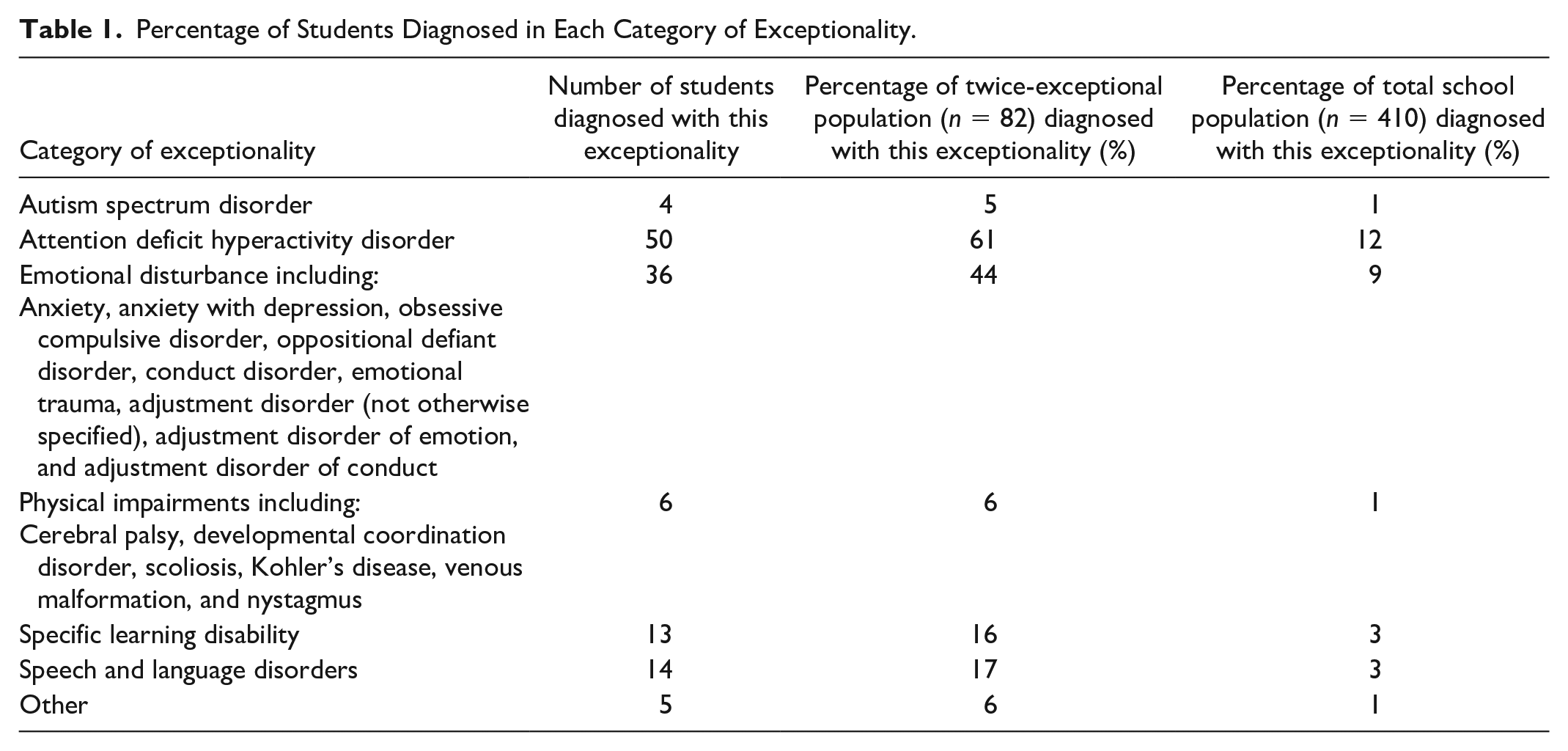
Collectively, 20% of Silver Birch’s population (n=82) has been identified with one or more exceptionalities beyond giftedness. Of these 82 students, 43% have two or more additional exceptionalities, and the majority (71%) are male. The ethnicity of the twice-exceptional students is reflective of the total student body except for the Caucasian students that have a higher percentage of twice-exceptional students (67% compared to 54% in the total school population) and the Asian students that have a lower percentage of twice-exceptional students (10% compared to 20% in the total school population). For the twice-exceptional students in which the date of diagnosis is known (n=57), 16% were diagnosed prior to first grade, 72% between first and fourth grade, and 12% in middle school.
Overall, twice-exceptional learners successfully graduate from Silver Birch having participated in the enriched, accelerated program through eighth grade. Historically, only eight twice-exceptional students have withdrawn before graduation, and in each of these cases, the families left by choice and were not counseled out. The school’s success in supporting its unusually high number of twice-exceptional learners identifies it as an ideal case study for understanding the framework of supports that maximizes the potential of twice-exceptional learners.
Data Collection
A total of 35 semi-structured interviews were conducted with 16 parents of twice-exceptional learners, 12 teachers, 3 administrators, the admissions assistant, the middle school coordinator, the school psychologist, and the learning resource specialist (LRS). Three faculty members interviewed were also parents of twice-exceptional learners; for these three individuals, the interviews were split into two, so participants would have the opportunity to respond to the questions for both the parent and the faculty interview protocols. Each interview, lasting between 45 and 75 min, was conducted over Zoom and recorded with permission from the participants. The interviews were transcribed verbatim through Zoom’s transcription process. The transcriptions were compared against the recordings to clarify and correct any errors before data analysis commenced. Sample interview questions are included in Online Appendix A.
In addition to the interview data, the LRS also provided access to additional data sources pertinent to the research questions including the following: (1) a copy of the program for developing executive functioning skills used by the school’s early childhood and lower school divisions; (2) the observation form used by the LRS to observe students either diagnosed with an additional exceptionality or referred to by teachers for a suspected diagnosis; (3) the template for documenting the learning support plan for twice-exceptional students; (4) the master spreadsheet of all twice-exceptional students including their areas of exceptionality, date of diagnosis, observation notes, list of accommodations, and additional notes; and (5) sample minutes from twice-exceptional parent group meetings and resources shared with parents.
Data Analysis
The researcher began the coding process by creating setting/context codes (Bodgan & Biklen, 2007). In this initial level of coding, basic descriptive information was categorized and charted, including the grade level of the child, gender, ethnicity, additional exceptionalities (and grade level of diagnosis), and years of attendance at Silver Birch. This initial level of coding provided the context for future analysis and interpretation. Next, the process of structural coding (Saldaña, 2021) was applied in which the data were categorized into large segments of text reflecting broad topics related to the research questions. This process of indexing the data is recommended for coding interview transcripts as it can provide the researcher with a framework for subsequent, in-depth analysis (Namey et al., 2008).
Data were next analyzed through procedures of inductive data analysis (Patton, 2015). The inductive data analysis began with the researcher coding the data with words and phrases that marked regularities and emerging patterns as well as topics covered in the data (Bodgan & Biklen, 2007). This method of coding reduced the data by allowing the researcher to organize, manage, and retrieve meaningful components (Coffey & Atkinson, 1996). However, it also functioned to open up the data, allowing the researchers to develop a schematic representation of the data through the process of raising questions and generating categories of similar codes (Saldaña, 2021). The researcher next examined the categories, merging them together into “meta” categories (Saldaña, 2021, p. 348) that reflected broader, more overarching themes. The researchers then completed a process of identifying the linkages and relationships among categories leading to the development of conceptual and theoretical coherence within the data (Coffey & Atkinson, 1996). A data display (Miles et al., 2020) was created to help clarify the relationships among the categories and is included in Figure 1.
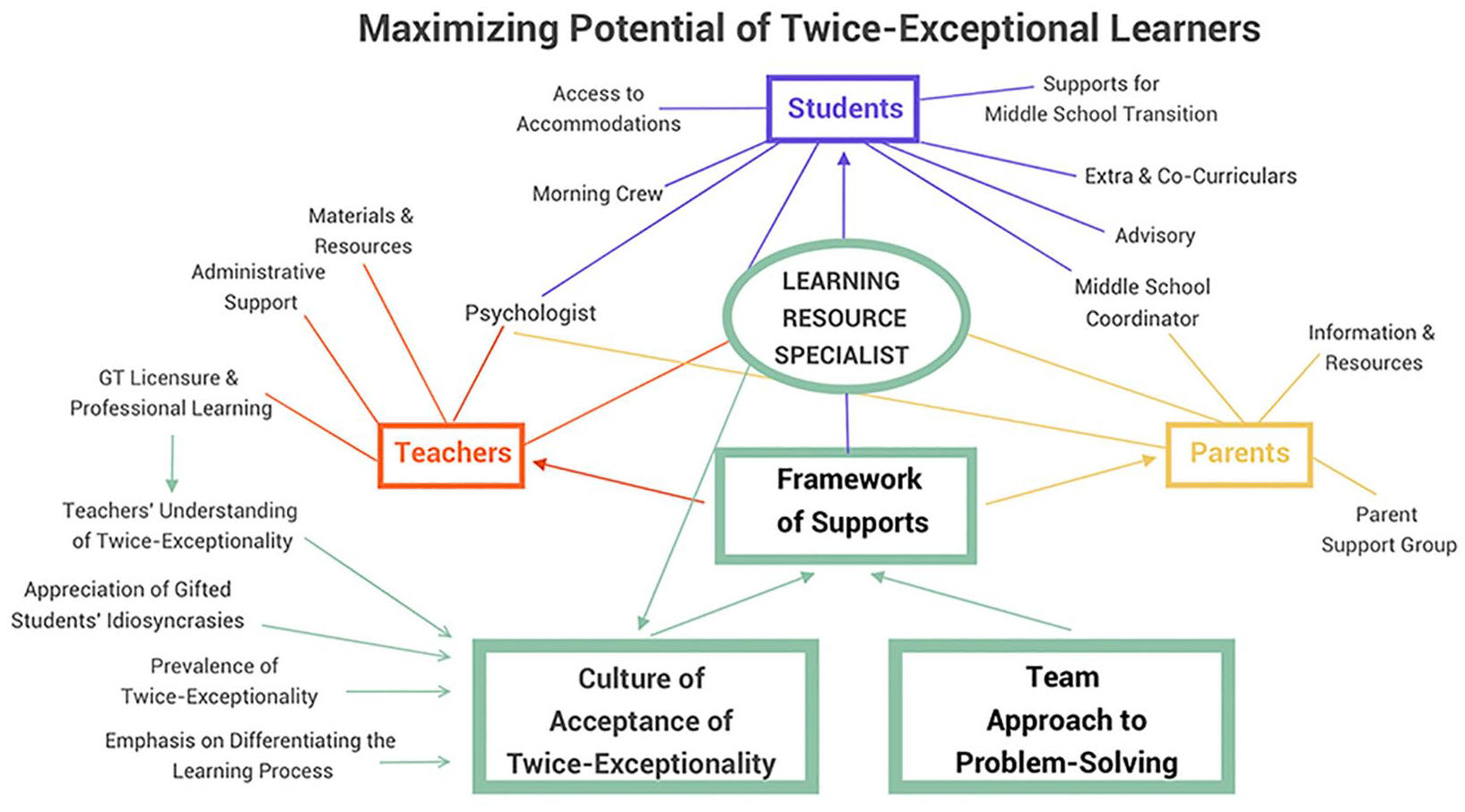
Data Display Depicting Relationships Among Categories of Findings.
Finally, to ensure analytical triangulation (Patton, 2015) and trustworthiness, a subset of the interview transcripts was coded by a second researcher and compared. Overall, the researchers’ coding processes were found to be consistent with only minor differences in how each constructed some of the initial categories. These differences were discussed to refine the analysis. For example, some differences were noted in the labeling of the categories and/or the breadth allowed for the category such as labeling “information and resources” as one category instead of splitting into two discrete categories or labeling a category as “appreciating gifted student’s idiosyncrasies” compared to “understanding characteristics of gifted students.” In these incidences, the researchers discussed the differences and agreed upon the labels and breadth for category inclusion for subsequent analysis. The two researchers’ coding was found to be consistent for the broader, “meta” categories that reflected overarching themes.
Findings
A culture of acceptance of twice-exceptionality, coupled with the mindset of a team approach to problem-solving, emerged as overarching themes that provided the impetus for allocating targeted resources to support each leg of the triad of stakeholders: school personnel, parents, and twice-exceptional students. Investing resources in all three stakeholder groups enabled Silver Birch to create a multifaceted framework to facilitate the academic, social, and emotional well-being of its twice-exceptional learners. These themes and the framework of supports are described in depth below.
Culture of Acceptance
One of the most prevalent themes to emerge in the data analysis was the shared perception among participants that at Silver Birch the concept of twice-exceptionality was embraced without hesitation. Faculty understood that being identified as gifted did not preclude students from having learning disabilities or other exceptionalities, and, inversely, that additional exceptionalities in no way invalidated a child’s giftedness. Faculty members who previously worked in other school environments recognized the rarity of this acceptance of twice-exceptionality. As the school psychologist noted:
I think about kids who fly under the radar in other settings either getting misidentified for special education or not getting identified as gifted, and I think Silver Birch is unique in the sense of identifying and supporting, so that’s powerful.
Twice-exceptional students are also accepted among the student population. A lower school teacher commented, “That’s one of the things I love most about Silver Birch: more than any other environment I’ve worked in, kids are really accepted by their peers here, regardless of any differences they might present outwardly.” A mother of a lower school student diagnosed with cluttering, a fluency speech disorder, shared the example that when her son would raise his hand to answer a question, he would “get stuck in parts of the answer, and when that happened, his classmates would just sit, be patient, and let him finish.” She shared the impact of his classmates’ patient support on her son’s psychological well-being: “He’s got great self-esteem now that he is at Silver Birch. That has a lot to do with the support and the acceptance.”
Faculty at the middle school level also commented on the unusual level of support among the student body for twice-exceptional learners even when the behaviors of these students are challenging. As one middle school faculty member explained:
So many of the students who do have some 2e elements can create some difficulty or maybe drama from time to time, and . . . what is lovely is how great the other kids are with the students dealing with that or helping them through it or not letting it fester and create further problems down the road.
Participants were asked their thoughts on how this seemingly atypical culture of acceptance evolved, and their responses indicated several main contributors. For faculty members, the presence and efforts of the LRS emerged as the most salient contributor to faculty understanding and acceptance of twice-exceptionality. In addition, the prevalence of twice-exceptionality in the student population, an appreciation for the idiosyncrasies of giftedness, and an emphasis on differentiation of the learning process contributed to the development of a school culture that readily embraced twice-exceptionality.
Learning Resource Specialist
Silver Birch hired its LRS nearly a decade ago in response to an increase in the number of students formally identified as twice-exceptional. She has a master’s degree in special education as well as a license in gifted and talented education. In addition, she is also the parent of children (now adults) who were identified as gifted and diagnosed with additional exceptionalities including autism spectrum disorder, ADHD, and anxiety.
The LRS’s initial task was to formalize the process for serving these students; since Silver Birch is an independent school, historically twice-exceptional learners did not have formal individual education plans, and only a few had 504 learning plans. The LRS created a system for working with all identified students that included creating digital folders with each student’s psychoeducational evaluation, medical report, and recommendations for accommodations. The digital folders are housed in a shared drive for faculty to easily access when needed.
Her weekly time allotted to specific responsibilities break down as follows. She currently spends approximately 25% of her time conducting observations of students in kindergarten through fifth grade. These observations are conducted when teachers or parents suspect a disability or problem in the classroom. Following each observation, she transcribes the notes and provides a written summary of the findings. She spends approximately 35% of her time with middle school students, following their progress, meeting with them individually and for supported study times, emailing reminders to students and parents, and communicating with teachers about student progress and needs. Paperwork and meetings with teachers and families to discuss accommodations comprise an additional 30% of her time. She oversees the distribution, collection, and delivery of teacher questionnaires that are frequently requested by physicians and psychologists, and she also completes the paperwork needed to apply for and submit materials for students needing accommodations on national or high school testing. A small amount of time (5%) is spent on the following: (1) reading or scribing for a student; (2) individualized test supervision; and (3) teaching technology use (using SnapType app, typing when writing is difficult, and Google Dictation). Finally, the remainder of her time during the week is spent working with parents. This can include meetings, presentations, email correspondence, and general support. In addition to these responsibilities, she also works with the school psychologist to provide professional development to teachers.
Participants felt that the presence of the LRS in the school validated the concept of twice-exceptionality and consequently shifted faculty attitudes toward accommodating these learners. The head of the lower school division explained:
I just can’t tell you the change that happened once we had [our LRS] on board. In the 21 years I’ve been here, I’ve seen a shift in teachers’ attitudes from teachers thinking, “well, we can’t have kids like that in the classroom,” to realizing you can’t be anywhere in the world without having students with all kinds of different learning issues.
The LRS also reflected on the changing attitudes of the faculty. When she initially started, she encountered some teachers who believed that students who needed extra time or had difficulty with organization and missing assignments did not belong in classes for gifted students. She shared the example of one teacher who was quite rigid about these beliefs, but after a few years of working with this teacher and helping support the students, the LRS noted that “he has changed his tune and isn’t necessarily singing that same song” anymore. The middle school coordinator echoed the tremendous influence of the LRS on the faculty’s attitudes toward twice-exceptional learners saying, “Her accessibility, her knowledge, and her willingness to help have been a big part of making people more aware of the realities and expectations, so that has been tremendous.”
Prevalence of Twice-Exceptionality
Another salient reason participants attributed Silver Birch as being so accepting of twice-exceptionality was the prevalence of these learners within the student population. With over 20% of the current student population diagnosed with some additional exceptionality, it is not viewed as unusual, and therefore, twice-exceptional students do not feel as though they stand out. A lower school teacher explained, “We have such a high percentage of students that are 2e that it’s almost the norm more than not around here, so that helps with the entire acceptance and tolerance level among students.”
Appreciation for the Idiosyncrasies of Gifted Children
Another factor participants indicated as contributing to the culture of acceptance surrounding twice-exceptionality was the blanket understanding that gifted kids in general have many idiosyncrasies. Since Silver Birch serves only gifted students, such idiosyncrasies are commonplace, and therefore, any additional unique characteristics or needs of twice-exceptional students blend into the background. A lower school teacher explained, “The good thing about [Silver Birch] is that the kids are incredibly tolerant of each other” and “they have known each other for so long that these kinds of idiosyncrasies are just a part of who they are, so they don’t stand out per se.” Similarly, parents credited the acknowledgment of gifted children’s unique characteristics as facilitating the acceptance of their twice-exceptional students. A parent of a middle school boy diagnosed with ADHD explained, “We’ve always said, if he was anywhere else, I’m not sure what kind of situation we would be in, but the kids in his class kind of understand, and some of them are similar in their own quirky little ways.” In addition, attending a school with all other gifted students allows twice-exceptional students the opportunity to connect with students who share their unique intellectual interests and need for challenge, and these shared interests facilitate acceptance and friendships. As one mother of a twice-exceptional learner said, “I mean [my son] is an odd bird, but most [gifted] kids are. He has peers that like the same things are and are challenged in the same way.” She explained that the boys’ shared interests are what enhance their friendship and concluded, “He’s just found his tribe is what [the school] likes to say, and I agree with that wholeheartedly.”
Understanding of the Need to Differentiate the Process of Learning
Finally, an additional theme contributing to the culture of acceptance of twice-exceptional learners centered around the teachers’ shared philosophy regarding the need to differentiate the process of learning. As the middle school coordinator explained:
It’s not just about the curriculum that we should be differentiating; it’s how we approach each child with their learning as well . . . it is the ways in which you help a student navigate their way through your class or middle school.
The emphasis on differentiating the process of learning translated into teachers readily offering different options for students such as typing their notes, taking tests with noise-canceling headphones, or working at stand-up desks to complete assignments. Whereas in other school settings, these options may be restricted to those formally identified as having a learning disability, they were not restricted at Silver Birch; they were considered tools to differentiate the learning process to meet the needs of individual students. The head of the middle school explained:
We are always differentiating for what students need . . . Other kids are used to seeing it, and it’s not made into a big issue, so I think that could be part of how we come to it as a culture [of accepting twice-exceptional students’ needs for accommodations] in our building.
This culture of normalizing different approaches to learning begins early with the teachers in lower school emphasizing the importance of customizing the process of learning to meet individual needs. Consequently, twice-exceptional students feel comfortable using their accommodations since they are not the only ones deviating from a standard procedure. As the head of the lower school explained:
I think one of the reasons there is acceptance [of twice-exceptional students needing accommodations] is because a lot of the accommodation types of things we have in the classrooms are for anybody to use if they need them . . . things like cushy seats to sit on and wiggle in, fidget toys, noise cancelling headphones, standing desks . . . because it’s available for everybody, kids that are twice-exceptional don’t feel like they’re sticking out, and that’s been really wonderful to see.
Teachers, cognizant of the need for twice-exceptional students to feel comfortable using their accommodations, also try to normalize it as much as possible. One second grade teacher explained, “Even if there is an accommodation that is really odd, I never just implement with one student. I always offer it to a few so that it’s not singling anybody out.”
Team Approach for Problem-Solving and Allocation of Resources
In addition to the culture of acceptance surrounding twice-exceptionality, a second key finding in the approach to maximizing the potential of twice-exceptional learners was the mindset of a team approach to problem-solving to determine effective ways of meeting the needs of specific twice-exceptional students. A middle school faculty member explained that time was always allotted during faculty meetings for teachers to ask for suggestions from other teachers on how to reach students that may be struggling. He explained that the faculty have a very “kid centered approach” that “allows us to pull together” and share ideas of what the student might need and strategies that have worked well for that student in other settings. The team-centered approach gives faculty confidence in working with twice-exceptional learners as explained by a middle school teacher who said, “I don’t ever feel ill equipped because I know that I could reach out at any point and get support from all these people . . . my administration, my colleagues, and our [LRS and psychologist].”
The team approach to problem-solving extended beyond just the faculty to include parents and students in the process. Participants believed that cultivating a strong collaborative partnership among the triangle of stakeholders was essential to maximizing the potential of twice-exceptional learners. A middle school teacher emphasized that twice-exceptional students’ academic success “has so much to do with the partnership with the family and then the child’s temperament and maturity. The number one thing is getting to know the parents and the kids first and then tailoring it from those ends.” With this realization, she tries to “to communicate quickly and often and let [families] know that I care and that we’re going to partner together to figure this out.”
A parent of a kindergarten student with cerebral palsy and visual-motor integration problems also commented on the willingness of teachers to listen to parents. She said, “The thing I loved about [his teacher] was her willingness to learn, to take what we were saying, and to [consider] ‘how can I adapt, how can I make, how can I get this worked out’” to help him learn. Other parents also echoed this sentiment and shared the recognition of how different this willingness to collaborate was from their experience with teachers in other school settings. A parent of a child with an auditory processing disordered reiterated, “I didn’t have to push excessively hard to get what I felt that he needed and that’s a big deal because I know that there are barriers in other schools, and we’ve run into them.”
Even at the lower school level, the need to include the student in designing interventions was recognized as key to the success of the plan as one teacher explained, “I like the student’s input. I ask ‘what do you think we could work toward,’ and ‘what strategies do you think we should put in place to help you meet those goal?’” She believed that including the child in the problem-solving process helps ensure that “they are on board as well, so they can become more and more self-aware and know how to help themselves.”
The head of the lower school division summarized the overall understanding of the need for a strong, collaborative triad, saying:
I think it’s important to keep everybody on the same page and to realize that the teachers, the parents, and the child are all involved. If we [neglect] one of those, things are going to start to suffer, no matter which part of the triangle.
One of the ways in which Silver Birch worked to strengthen the triangle was to provide each leg—school personnel, parents, and students—with targeted resources and supports to help twice-exceptional students maximize both their academic achievement and psychological well-being. Examples of these supports are described in detail below.
Supports for School Personnel
Silver Birch teachers participating in the study identified several significant supports they felt contributed to their ability to effectively meet the needs of their twice-exceptional students including administrator backing, access to materials and resources, professional learning opportunities, and assistance from the LRS and school psychologist.
Administrator Backing and Resources
Teachers perceived administration as backing teachers in their interactions with parents by serving as a bridge to facilitate effective communication with families. A lower school teacher explained, “I think administration has been a great advocate for us. [Our administrator] always has our backs. She doesn’t hesitate to come in and observe a student, and then she will advocate with parents.”
Teachers also perceived the administration as being supportive of their efforts to provide effective instruction to twice-exceptional learners by providing funding for resources requested to differentiation the process of learning and to determine effective strategies to help twice-exceptional learners. The school psychologist elaborated on the benefits of knowing financial resources are available to support twice-exceptional learners, saying, “If we need to buy extra supplies for [twice-exceptional students], we’re able to make that happen.” She felt that knowing financial support was available allowed faculty to “be creative about how to meet students’ needs.”
Gifted and Talented Licensure and Professional Learning
All teachers were provided the financial support to earn a license in gifted and talented education. The middle school coordinator shared the positive impact of this licensure on teacher understanding of twice-exceptionality when she said, “The education component of having our teachers get the gifted endorsement is wonderful because there’s that understanding they wouldn’t get elsewhere of twice exceptional students, kind of the quirks of how to work with them, so that’s exceptional.”
In addition to licensure in gifted and talented education, Silver Birch provided support for primary grade teachers to receive training in the Orton-Gillingham method, a multisensory, structured literacy approach frequently used to facilitate reading in students with reading disorders. The head of the early childhood program explained that teaching reading through this approach has been beneficial because it “helps teachers spot problems earlier but it’s also helping them do something about it, so they do not have to wait for this official diagnosis [before intervening].” She also continued to describe the benefit of the approach for all gifted students:
It’s still one of my favorite ways to approach phonics instruction to integrate that for multi-sensory not only the reading of it, but the writing and the systematic approach . . . gifted kids can connect with that because of how much they like systems of things and learning those rules. I think it triggers the intellectual part of them even if they’re not a 2e kiddo.
Another professional learning resource the LRS has shared is a systematic approach to teaching executive functioning skills that all lower school teachers use with their students. The program breaks down each of the skills and provides teachers with grade-level expectations for the development of each skill. As many twice-exceptional students struggle with executive functioning skills, the LRS felt that a proactive approach of focusing on the development of these skills in the early grades helps mitigate the struggle with executive functioning skills common among twice-exceptional learners in middle school.
Specialists
Teachers also credited the support that the LRS and school psychologist give them as another major contributor to their ability to meet the needs of twice-exceptional learners. One service that the LRS provides teachers is an electronic folder that houses each of the twice-exceptional learner’s files including doctor recommendations and their learning plans. In addition, she created a checklist for each grade level that shows a quick overview of the accommodations for every twice-exceptional learner. Teachers can pull up their grade level and have all the information ready. The LRS also helps teachers by conducting classroom observations of students, developing or securing helpful resources for students, or sharing professional learning materials. The school psychologist likewise is also available for teachers to reach out to for guidance and information. One teacher explained what a difference having access to the LRS and the school psychologist has had on her ability to effectively teach twice-exceptional learners saying:
I think sometimes 2e kids in other settings don’t get what they need because it’s just too much extra work for the teachers to do, and they are already working so much. I’ll call our [Learning Resource Specialist and Psychologist] and they will definitely step in, and they’re constantly asking “How can I help make this happen?” and that makes it easier for me as a teacher to implement everything.
Many teachers who had worked previously in other school systems recognized the rarity of the level of support provided. For example, a lower school teacher said, “I’m very grateful for the 2e students that need a place like this, first and foremost, but I’m also grateful to be working in a place that is incredibly supportive of me as a teacher trying to help these kids.”
Supports for the Students
Another theme to emerge from the data was the number of formal and informal supports put into place for the twice-exceptional learners themselves to help them be successful which are described below.
Specific Accommodations
Silver Birch does not provide direct services for students; with the exception of speech and language services, all other remediation services, such as psychological counseling, social skills training, occupational therapy, and tutoring are completed by families outside of the school day. Teachers and classroom assistants, however, do provide students with additional accommodations they need to support their learning and instruction. For example, these accommodations include scribing for a student who has a specific learning disability in reading or writing, communicating with the media specialist to make sure eBooks or audiobooks are available for students who need them, helping students set up and use a computer for longer responses; providing early check-ins for understanding, breaking assignments into smaller parts, repeated redirection, organization support, providing graphic organizers and rubrics, and providing guided opportunities to correct work before grading.
Advisory
The advisory program is designed so each faculty member has the same small group of students in their advisory group for all 4 years of middle school. This continuity allows for another adult in the building to get to know each student on a deeper level, monitor their development across middle school, and be attentive to any possible problems or concerns that may arise and affect the student’s well-being and academic success. The faculty and administration viewed this program as helpful for twice-exceptional learners because it fosters communication and provides another contact point for faculty to raise awareness of potential problems. The advisory program also provides twice-exceptional learners with another trusted adult for them to reach out to for support as noted by a middle school teacher who said, “It helps that you get really close with these kids, and then they’re likely to share if something stressful is going on.” She elaborated, “It’s nice that there’s another teacher point of contact for all of the kids if we need that.”
Morning Crew
Participants identified the “Morning Crew” as another beneficial support program for twice-exceptional learners at the middle school level. The LRS developed the Morning Crew as an optional opportunity for twice-exceptional learners to meet with her before the school day begins. During this time, she helps the students get ready for their day by going over the upcoming schedule, reviewing what they needed to turn in, and determining what they would need to work on that day. They also check the gradebook together to ensure there are no missing assignments. The LRS also takes this time to talk with students about skills needed for success and discusses strategies for how to develop them. Participants described the value of the Morning Crew for twice-exceptional learners. As one parent explained, it was great because her son “can get very overwhelmed by all the noise [in the school], and it allowed him a quiet place to make sure he was ready for the day.” The Morning Crew not only helps prepare students for their day but also helps them develop a relationship with the LRS. One parent reflected, “Over time he built a trust relationship with [the LRS] where he knew that she was his ally. So, there were times he would go to her, and then she would help facilitate discussions with teachers.”
Supports for Transition to Middle School
The faculty and administration at Silver Birch also recognized that a critical juncture for the success of twice-exceptional learners lies in a smooth transition to middle school. Monitoring seven different teachers’ expectations and assignments can be overwhelming for these learners. In anticipation of these potential problems, Silver Birch put two key transition supports in place. Beginning with the third trimester of fourth grade, teachers work with twice-exceptional students to establish routines for studying, completing assignments, and turning them in on time. They also communicate with parents about the need to transition the responsibility of these tasks to their children. The LRS followed up with the foundation that was established by the fourth grade team with a summer camp for the incoming fifth grade middle school students. The camp is for five-and-a-half days near the beginning of school. She takes the students through a variety of activities to work on executive functioning and leads them through a series of activities that help them become familiar with the middle school structure and building. They also participate in a series of games to help illustrate the importance of organization. For example, the LRS said:
We do races. One of my favorite games I do with them [involves] a messy locker and a really neat locker, and then I give them a list of things they have to find. They’re doing either the messy or the clean one, and, of course, the person looking in the messy one is like, ‘Oh my gosh I can’t even find it!’ Well, that gives you some kind of idea why you want to have a neat locker!
Extra and Co-Curricular Activities
One additional factor noted by faculty as contributing to the success of twice-exceptional learners was the variety of extra and co-curricular offerings available to students including athletics, creativity competition teams, robotics, drama, music, and academic teams and competitions in all core content areas. These outlets were viewed as psychosocial supports for twice-exceptional learners because they allow the students to participate in activities targeting their area of giftedness. Twice-exceptional students receive recognition for their outstanding performance in these activities and gain the respect of their peers which, in turn, leads to an increase in self-esteem. As one teacher explained:
There are so many [types of] teams, it allows kids to kind of unleash their superpower . . . maybe a student that struggles with autism and blurting [answers] out in one setting might not do very well, but in an academic setting like a history bee or a science bee, those are seen more as strengths.
School Psychologist
The faculty and administration also recognized that having a school psychologist on staff provided an additional layer of support for twice-exceptional learners, noting that the psychologist is available to “help kids even if it’s not they don’t have a formal plan. Any child who is struggling can have the opportunity to go talk to her.” Teachers also utilized the school psychologist to provide targeted supports for groups of students in need of the same interventions. For example, the head of the early childhood division explained:
Last year [our psychologist] had a group of kids who needed some help with [emotional] regulation, frustration, and tolerance. Once a week, she would pull them out [and work with them]. I look at all of those kids now this year, and all of them have improved.
Participants believed the network of supports available to twice-exceptional learners stemmed from an overall acceptance and dedication to meeting the needs of individual children. As the middle school coordinator explained, “People are truly interested in and want to help the students in any way we can . . . it’s almost like a family effort. And that focus on truly knowing and loving the students is a big part of that too.” In the words of one middle school teacher, the structures in place help create “an environment that is specifically set up to support 2e students and their unique needs . . . and those students experience success and a feeling of belonging” as a result.
Supports for Parents
Parents of twice-exceptional learners also commented on how much they appreciated the supports the school has put into place for them. For example, the middle school coordinator is available for parents to reach out to for questions or guidance regarding issues that arise with their twice-exceptional children. The coordinator helps facilitate communication between parents and teachers when necessary. She explained:
I want to make sure that parents recognize that I’m not just a concierge service here. I am an advocate for them, and they can use me in that capacity because my goal is to make their child’s life the best it possibly can be.
The school psychologist also provides another form of support for parents. She is available informally to answer questions, regularly shares resources about anxiety, stress, and depression, and offers a parent book club focusing on social and emotional development of gifted learners.
The most prominent support identified by parents was the twice-exceptional parent support group developed by the LRS and co-led by a parent. The meetings are held monthly and begin with the LRS sharing resources on topics or strategies pertinent to parenting twice-exceptional learners. Time is then provided for parents to talk with one another and share advice and experiences. All meeting minutes are kept in a shared electronic file with hotlinks to all resources discussed. Participants perceived the LRS’s facilitation of the support group as critical to its success. They felt her expertise and presence provided a structure and formality to the group that allowed it to be informative in addition to supportive. As one parent explained:
I cannot say enough good things about [Learning Resource Specialist’s] professionalism that’s what made it worth it, because we were moving forward without flopping around like fish out of water. We had an expert in the room . . . there are support groups and then there are support groups with an expert in the room, and I’ve learned those are two very different things.
Parents of newly identified twice-exceptional students also shared how much they benefited from the wisdom of seasoned parents of twice-exceptional learners. These shared experiences helped parents realize they were not alone. A lower school teacher observed, “I think it just opens up that that support system for [parents] because it’s hard enough being the parent of the gifted child, let alone parent to a twice-exceptional child.”
One recommendation faculty and administrators shared was the need for more targeted supports for parents to destigmatize twice-exceptionality. Despite all the attention to serving twice-exceptional learners, participants noted that a stigma still exists surrounding disabilities that prevent some parents from seeking out evaluations. The stigma appears to be more common in some cultural groups than others; whereas minority cultures comprise 45% of the student population, only 20% of twice-exceptional students are from a minority group. The administrators and faculty attributed fear of being asked to leave the school as a common reason some families resist having their students evaluated for a potential disability. As the head of the lower school explained:
[Parents] are afraid, and we try to reassure them every time. We try to say we’ve got over 20% of our students [who] deal with another exceptionality and [for] most students it works out well, and we can put accommodations in place, but parents could use some mentoring and support, especially that first year.
Discussion
The single case study design utilized in the present study provided a unique opportunity to discover how a school for gifted learners cultivated a culture of acceptance for twice-exceptionality within their community. This culture, coupled with the mindset of a team approach to problem-solving, enabled the school to develop a multipronged framework of supports for all stakeholders working with twice-exceptional learners. These findings are discussed within the context of the existing literature with implications for practice and future studies.
Culture of Acceptance
A “culture of acceptance” surrounding twice-exceptionality at Silver Birch contributed significantly to the school’s ability to support twice-exceptional learners, maximizing both their academic and social and emotional development. This culture of acceptance enabled twice-exceptional learners to feel understood and appreciated, and the significance of a psychologically safe environment for the growth of twice-exceptional learners has been well documented in other literature studies (e.g., Baum et al., 2014). With their giftedness unquestioned, students were given access to rigorously challenging and enriched learning experiences with supports in place to accommodate their additional exceptionality.
One of the reasons twice-exceptionality was so prevalent in this school for gifted learners is the fact that most of the students were identified as gifted primarily based on an individually administered intelligence test in pre-school or kindergarten before some specific learning disabilities started to noticeably impact achievement. In addition, for students with suspected difficulties in the areas of processing speed and working memory, the admissions team considered the General Abilities Index (GAI; rather than the Full-Scale IQ) for identifying twice-exceptional learners as recommended by the National Association for Gifted Children (2018). This approach reduced the likelihood of the masking effect that precludes so many students from being identified as twice-exceptional. Other schools may want to consider adopting a similar approach by screening students early with a pathway for gifted identification through a very superior GAI score alone without requiring correspondingly high achievement scores as these may be depressed for twice-exceptional learners relative to their advanced ability (Maddocks, 2018).
A second contributor to the culture of acceptance was the fact that the twice-exceptional learners were surrounded by other gifted students, each with their own quirks and idiosyncratic behaviors. In this environment, twice-exceptional learners did not stand out for their own unique needs. Instead, they were embraced by an accepting peer group which research has shown can be a strong influence on the academic self-concept of twice-exceptional learners (Wang & Neihart, 2015a, 2015b). This finding offers additional support for the benefits of grouping gifted students together for instruction.
Participants also attributed the culture of acceptance surrounding twice-exceptionality as being possible due to the teachers’ training in gifted education that enabled them to create a responsive environment necessary to address these needs (Amran & Majid, 2019; Baldwin et al., 2015). Educators wanting to increase supports for twice-exceptional learners should consider creating or providing access to foundational training in gifted education and twice-exceptionality for all their teachers to complete for a shared understanding and approach to working with these learners.
Silver Birch’s emphasis on differentiating the process of learning also enabled twice-exceptional learners to access their accommodations without feeling singled out or experiencing any social repercussions. Because of their advanced achievement and/or mastery of standards, an emphasis on differentiation for gifted learners frequently focuses on differentiation of content, pace, and complexity according to readiness level. Emphasizing differentiation of process, however, can normalize accommodations that twice-exceptional learners need to be successful, and, as with the findings of the present study, it may foster metacognitive awareness for all learners as they develop more of an understanding of how they learn best. In addition, this would open up the use of frequently restricted accommodations to all learners, not just those who have a formal diagnosis thereby increasing the likelihood that even stealth, unidentified twice-exceptional learners could be served.
Although the above factors were all important contributors to the acceptance of twice-exceptionality, participants in the present study overwhelmingly attributed the most significant influence on the development of a schoolwide culture that embraced twice-exceptionality to the LRS. In her role, the LRS provided professional learning, offered supports for all stakeholder groups, monitored all data and accommodations for each student, and served as a constant advocate for twice-exceptional learners. Her presence and work served as a validation of these learners’ needs and, as such, emerged as the greatest influence in changing the culture surrounding twice-exceptionality in the school. Although it will require a financial commitment, other school leaders who share a goal of maximizing the potential of their twice-exceptional learners may want to consider developing a similar LRS position as the findings of the present study suggest that the return on the investment may be significant. Due to the size of Silver Birch’s twice-exceptional population, their LRS position needed to be full time to effectively work with these students, teachers, and parents. Smaller programs for gifted and talented learners, however, may achieve similar results with a part-time LRS. The important piece is having a dedicated person in the role to raise awareness, advocate for twice-exceptional students, and serve as a central point of contact for all stakeholder groups to facilitate communication and the coordination of supports.
Facilitating a Team Approach to Problem-Solving
In addition to fostering a culture of acceptance for twice-exceptional learners, the other key theme contributing to the school’s successful approach to maximizing the potential of twice-exceptional learners was the mentality of a team approach to problem-solving. Teachers collaborated with each other and the LRS and psychologist to brainstorm strategies to meet the needs of specific students. In addition, teachers were not threatened by parents and instead were open to partnering with families to brainstorm effective solutions. The literature is replete with research findings citing the benefits of including parents as partners for academic achievement and social and emotional well-being (see Smith et al., 2020). As Besnoy et al., (2015) noted, however, such healthy, collaborative relationships are not always found and can be challenging to cultivate. As such, Silver Birch’s approach may serve as a model for other schools to consider. Other schools may consider offering and facilitating a parent support group for twice-exceptional learners. In addition, schools may benefit from creating some parent education materials that include a description of appropriate methods and processes for communication regarding the child’s needs and performance and how this communication structure might change from lower to middle school to prepare students to become their own advocates. Although the specifics of the roles and expectations may need to be individualized based on the unique needs of some twice-exceptional learners, having an established framework available from which to customize will likely eliminate many potential communication problems among stakeholders and strengthen the partnership between families and teachers that ultimately will facilitate the academic achievement and well-being of twice-exceptional learners.
Triangular Framework of Supports
With a foundation of a culture of acceptance of twice-exceptional learners in place, coupled with the belief in a team approach to working with these learners, Silver Birch was able to construct a multifaceted framework of supports to facilitate the academic and social and emotional well-being of twice-exceptional learners. The individual facets of this comprehensive approach include many recommendations highlighted in previous research. For example, one of the most common recommendations for facilitating the learning of twice-exceptional learners is to focus on both addressing the areas of challenge as well as providing opportunities to develop areas of strength (Assouline & Whiteman, 2011; Foley-Nicpon et al., 2013). Silver Birch ensured that students’ areas of challenge were addressed in several ways including the development of individualized learning plans and accommodations that were shared with each teacher through a digital folder and programs for small group and individualized supports led by the LRS and psychologist. As noted above, teachers routinely differentiated the process of learning providing all students, not just those formally identified, alternative paths for learning and demonstration of mastery. Finally, the school implemented pro-active strategies for addressing common areas of challenge for twice-exceptional learners such as a schoolwide program on the development of executive functioning, and the use of Orton-Gillingham, a multisensory approach for learning to read, at the primary level. Previous research findings also emphasized the importance of proactive, early interventions as they may lessen the need for long-term, intensive support and facilitate the positive development of twice-exceptional learners (Chamberlin et al., 2007; Pereles et al., 2009).
Similar to the array of options available to support the challenges twice-exceptional students face, Silver Birch also provided twice-exceptional learners with multiple opportunities to develop their strength areas as well. In addition to the enriched and accelerated academic programming in all subject areas, Silver Birch also offered competitive, extra and co-curricular programs in all core subjects as well as music, drama, creativity, robotics, and athletics. Successful participation in these competitive adventures afforded twice-exceptional students the opportunity to garner the respect of their peers. Wang and Neihart’s (2015b) study also found the benefits of providing programming geared toward twice-exceptional students’ interests and strength areas for peer support and influencing high academic self-efficacy. Given these results, other educators of twice-exceptional students may want to consider offering robust extra and co-curricular activities that allow these students more opportunities to collaborate with like-talented peers in areas of shared interests and strengths that provide opportunities for success.
In addition to the myriad of supports and opportunities offered to the students, Silver Birch’s multipronged approach to addressing the needs of twice-exceptional learners also extended to providing supports to their teachers and parents. As previously described, Silver Birch funded licensure in gifted education for all teachers to ensure a base understanding of all gifted students, including those who are twice-exceptional and strategies to create learning experiences responsive to their diverse characteristics and learning profiles. In addition to the professional development, Silver Birch also supported teachers by providing them instructional resources they needed to differentiate for their twice-exceptional learners and access to professionals (the LRS and school psychologist) to help provide interventions, share resources, and problem-solve. With this blanket of support surrounding them, teachers felt more equipped and confident working with twice-exceptional students and their families. Finally, Silver Birch’s approach also included offering supports to families in the form of individual consultations with the LRS and monthly support groups run by the LRS that included both an education and resource component as well as time to share and learn from other parents of twice-exceptional learners. The effectiveness of these supports underscores the findings of previous research illustrating the benefits of family and school partnerships of academic achievement and social and emotional well-being (Smith et al., 2020).
Silver Birch’s multifaceted approach to maximizing the potential of twice-exceptional learners has implications for coordinators of gifted and talented programs. Although the specifics of which supports to offer will vary necessarily depending on the different contexts of each program, the significant takeaway from the present study is the value of offering some type of supports for all stakeholder groups including parents, teachers, and students. The needs of these learners are complex, and for maximal development to occur, all parties working with them need access to education, strategies, and resources.
Future Studies
The present study had several limitations that future studies may want to address to further understand effective programming for students with twice-exceptionalities. First, due to restrictions the school had in place during the coronavirus pandemic while data collection was taking place, students were unable to participate directly in the data collection for the study. Although parents, teachers, and administrators shared student perceptions during the interviews, student voices were not captured specifically, a limitation Schultz (2012) noted in previous studies as well. As such, future studies examining programming for twice-exceptional students will want to include student voices to ensure their perspectives on what is needed for effective programming is captured.
Future studies will also want to explore the intersection of culture and identification and programming of twice-exceptional students. As noted, Asian students were underrepresented with only 10% identified as twice-exceptional compared to 20% of the study body. The reason for the discrepancy cannot be determined from the data collected in the present study. However, the LRS indicated that Asian families tended to be more resistant to the concept of twice-exceptionality with some families refusing to have students tested at the suggestion of the school and others not willing to share the results of the testing because they said they disagreed with the findings. Other scholars have also documented the underrepresentation of Asian students in special education and suggested that disabilities in Asian students may be overlooked as a result of the model minority stereotype (Cooc, 2019; Park et al., 2018). As Park and Foley-Nicpon (2022) explained, “When ‘what giftedness or disability should look like’ meets ‘what Asian American should be like,’ the multilayered stereotypes make it even harder to recognize, understand, and respond to the needs of Asian American 2E students” (p. 2). Moreover, when Chinese American students struggle in school, research findings indicate that it affects not only the child’s well-being but their parents’ as well (Qu et al., 2020). Since Chinese adolescents consider success in school as a way of fulfilling their responsibilities to their parents, they may become stressed when they are struggling in school. Moreover, Chinese parents’ self-worth is highly influenced by their children’s performance in school as they believe academic success is an indicator of optimal development (Qu et al., 2016). Consequently, they may be less willing to acknowledge a child’s disability.
In light of these findings, more research is needed to better understand how to effectively work with Asian American families of twice-exceptional learners. As Park and Foley-Nicpon (2022) emphasized, educators must keep within-group diversity in mind and carefully try to understand each family’s unique experience intersecting identities of culture, social class, and abilities and disabilities to create a responsive learning plan for the students. In addition, schools may want to provide all parents, including Asian American families, with resources that could educate them on twice-exceptionalities, so they would have a better understanding of this phenomenon as well as productive strategies to support their children. Such an understanding may mitigate the negative impact of academic struggle on the psychological well-being of Chinese American parents and children.
Finally, Silver Birch’s affiliation as an independent school provides another factor to consider regarding the interpretation of the findings. As an independent school, Silver Birch operated with a lot of flexibility and funding regarding services they could provide students, training they could offer for teachers, and programs they could offer for parents. Other schools may not have as much flexibility or funding for such comprehensive supports. However, the findings of the present study are valuable in that they provide a model of what an effective, comprehensive approach to maximizing the potential of twice-exceptional learners entails. When considering how to develop their own approach to meeting the needs of twice-exceptional learners, educators are encouraged to keep in mind the three key conceptual findings of the study—the importance of a schoolwide culture of acceptance for twice-exceptionality, the need for a team approach to problem-solving, and the importance of providing supports to all stakeholder groups working with twice-exceptional students. Educators are encouraged to build their own multifaceted approach to serving twice-exceptional learners that includes these key elements but with specific supports that are customized to fit within their own school’s contextual variables.
Conclusion
When a comprehensive, multifaceted approach is implemented that provides supports for the entire triangle of stakeholders, twice-exceptional learners can maximize their potential and thrive. Historically, other researchers have called for variations to this comprehensive approach. For example, Trail (2011) emphasized the importance of a wide-ranging team of professionals including counselors, psychologists, and teachers working together to effectively address the needs of twice-exceptional learners due to their complex social, emotional, and cognitive needs. Other researchers also emphasized a need for all-inclusive services that include interventions for areas of challenges as well as access to strength-based, enriched, and accelerated curriculum (e.g., Baum et al., 2014; Reis et al., 2014; Willard-Holt et al., 2013). Finally, other researchers have called for a broad system that includes support for and collaboration among all stakeholder groups including parents, administrators, teachers, and students (e.g., Besnoy et al., 2015; Speirs Neumeister et al., 2013). The present case study is significant in that it provides a concrete example of a school that developed a comprehensive model that includes all these facets—a team of professionals, comprehensive services, and support and collaboration among all stakeholder groups—for other schools to emulate and customize to maximizing the develop of their twice-exceptional learners.
Supplemental Material
sj-docx-1-gcq-10.1177_00169862231193699 – Supplemental material for Maximizing the Potential of Twice-Exceptional Learners: Creating a Framework of Stakeholder Supports
Supplemental material, sj-docx-1-gcq-10.1177_00169862231193699 for Maximizing the Potential of Twice-Exceptional Learners: Creating a Framework of Stakeholder Supports by Kristie L. Speirs Neumeister in Gifted Child Quarterly
Footnotes
Declaration of Conflicting Interests
The author(s) declared no potential conflicts of interest with respect to the research, authorship, and/or publication of this article.
Funding
The author(s) received no financial support for the research, authorship, and/or publication of this article.
Open Science Disclosure Statement
The data analyzed in this study are not available for purposes of reproducing the results. The code or protocol used to generate the findings reported in the article are not available for purposes of reproducing the results or replicating the study. The newly created, unique materials used to conduct the research are not available for purposes of reproducing the results or replicating the procedure.

Notes
Author Biography
References
Supplementary Material
Please find the following supplemental material available below.
For Open Access articles published under a Creative Commons License, all supplemental material carries the same license as the article it is associated with.
For non-Open Access articles published, all supplemental material carries a non-exclusive license, and permission requests for re-use of supplemental material or any part of supplemental material shall be sent directly to the copyright owner as specified in the copyright notice associated with the article.
