



Abstract
To understand divergent and remarkable lives lived, we examined the accomplishments, family dynamics, life orientation, psychological well-being, and definition of a meaningful life among two exceptional groups at age 50: Top Science, Technology, Engineering, & Mathematics (STEM) doctoral students (270 males, 255 females, originally surveyed in their mid-20s) and profoundly gifted adolescents (263 males, 71 females, top 0.01% in ability, first studied at age 12). The creativity and occupational stature of both cohorts were extraordinary and commensurate. Life priorities, time allocation, and breadth of interests created paths that differed for women and men, resulting in contrasting, but equally exceptional, life outcomes across career, life, and relationship satisfaction. Distinct constellations of personal attributes of intellectually and scientifically brilliant women, relative to such men, operated to form satisfying and productive lives that differed for the women and men as a whole. Findings cast light on the participation of women and men in STEM and conceptually demanding leadership positions.
Individuals compose a life by drawing on the opportunities and navigating the challenges and constraints that are presented by their environment. Humanism and free societies have a shared goal in wanting to ensure equal opportunity for each individual, regardless of race, ethnicity, gender, or background. Both view this goal not only as a moral imperative but also as an aspiration crucial to economic competitiveness, especially in today’s conceptual, idea-driven economy (Friedman, 2005; Hunt, 1995, 2010; Zakaria, 2011). Women are seen as not experiencing equal opportunity to the same degree as men (Gino et al., 2015; Gruber et al., 2021), particularly in STEM areas (Ceci et al., 2014, 2021; El-Hout et al., 2021; Stewart-Williams & Halsey, 2021a, 2021b) and especially at the top (Becker & Lindsay, 2004; National Science Board, 2022). As a consequence, they become underrepresented in certain STEM disciplines and in a variety of prestigious leadership positions throughout the occupational spectrum. While, undeniably, bias is at play, other factors may also be constraining the career aspirations of women. Here we address whether intellectually brilliant women and men tend to compose different lives that, although meaningful to them, contribute to this underrepresentation in some areas and overrepresentation in others. By studying the life course of two cohorts with world-class potential to excel in STEM, as well as other conceptually demanding disciplines and professions, we hope to cast light on how individual and gender differences develop not only in STEM fields but also at the very top echelons of the occupational spectrum more generally. To do so, we build on well-known psychological concepts and findings from a 50-year longitudinal study of exceptional intellectual talent, the Study of Mathematically Precocious Youth (SMPY; Lubinski & Benbow, 2006, 2021). 1
Background and Theoretical Orientation
Understanding how individual and group differences develop in high-impact careers requires two sets of considerations. One set involves findings based on models of educational and occupational development, the other involves how lives are lived beyond formal education.
Modeling Educational and Occupational Development
For decades, psychological theorists have assembled distinct classes of personal attributes to model educational and occupational outcomes (Corno et al., 2002; Dawis, 1992; Sackett et al., 2017). These models utilize constellations of cognitive abilities, educational/occupational interests, and personality to identify differential degrees of promise for contrasting learning and work environments (Corno et al., 2002; Cronbach, 1957). Labels denoting these constellations include trait clusters for conceptualizing intellectual development (Ackerman, 1996; Ackerman & Heggestad, 1997), trait complexes for conceptualizing educational readiness (Corno et al., 2002; Snow et al., 1996), and taxons for conceptualizing occupational potential (Dawis, 2005; Dawis & Lofquist, 1984).
Theory of Work Adjustment
The Theory of Work Adjustment (TWA; Dawis, 2005; Dawis & Lofquist, 1984; Tinsley, 1993) is a model especially germane for understanding how these concepts operate and influence educational and career decisions. TWA specifies ability/interest constellations that define promise for responding with competence and the motivation to persist when opportunities are provided in different disciplines and professions. According to TWA, two sets of personal attributes and environmental features are essential for understanding educational/occupational choice and performance after choice: (1) abilities and educational/occupational interests (personal attributes) and (2) response requirements and reward structures (environmental features). TWA places equal emphasis on assessing the individual and assessing the environment. The TWA dimensions of correspondence (satisfaction and satisfactoriness) identify environments that individuals are likely to enjoy “being in” as well as environments they are likely to thrive “performing in,” respectively. Satisfaction on the part of the individual is achieved when a person’s interests are met by the environment, and satisfactoriness on the part of the environment is achieved when the individual’s performance meets the expectations of their instructor or employer. One critical feature of TWA is that both the level and the pattern of abilities and interests are important considerations (Dawis, 1992, 2005; Dawis & Lofquist, 1984; Hanna et al., 2021; Katzell, 1994; Lofquist & Dawis, 1991; Lubinski & Benbow, 2000, 2006). Put simply, although many other things matter, what individuals enjoy the most and what they do best need to be factored in.
Ability/Interest Level and Pattern
Intellectually gifted populations, for example, typically display wide variation in their ability and interest profiles (Achter et al., 1996, 1999; Bernstein et al., 2019; Lubinski & Benbow, 2006, 2021); their ability/interest pattern is as diverse as that seen in typically-developing populations (Harmon et al., 1994; Nye & Rounds, 2019). However, individuals who excel in STEM tend to possess a distinct ability/interest pattern (Bernstein et al., 2019; Gohm et al., 1998; Kell, Lubinski, Benbow, & Steiger, 2013; Lubinski & Benbow, 2006, 2021; Wai et al., 2009). They possess exceptional mathematical and spatial reasoning abilities (Snow, 1999), and their mathematical/spatial abilities are typically greater than their verbal abilities. Moreover, they possess salient scientific and theoretical interests relative to other educational/occupational interests. This pattern has been observed for decades (Austin & Hanisch, 1990; Gohm et al., 1998; Gottfredson, 2003; Humphreys et al., 1993; Lubinski & Benbow, 2006, 2021; Roe, 1953, 1961; Super & Bachrach, 1957). Moreover, among cutting-edge performers in multiple disciplines, those who distinguish themselves from their peers not only typically possess greater ability (Arneson et al., 2011; Park et al., 2007, 2008), but they also display a more pronounced or “super typical” ability/interest profile (Bernstein et al., 2019; McCabe et al., 2020).
Exceptional achievement outside of STEM usually occurs when verbal reasoning prowess is appreciably more impressive intra-individually, relative to mathematical and spatial abilities. These individuals routinely invest their talents in conceptually demanding domains outside of STEM (Kell, Lubinski, & Benbow, 2013; Kell, Lubinski, Benbow, & Steiger, 2013; see Makel et al., 2016, Figures 2–4). This holds even among profoundly gifted mathematical reasoners (individuals whose mathematical acumen is well beyond the typical STEM doctorate [Kell, Lubinski, & Benbow, 2013; see Makel et al., 2016, Figure 1]). One reason for this is that many educational/occupational interests outside of STEM covary positively with verbal reasoning ability and negatively with mathematical and spatial ability, the latter in particular (Ackerman, 1996; Schmidt et al., 1998; Ackerman & Heggestad, 1997). Therefore, individuals whose intellectual profile is dominated by verbal ability relative to mathematical/spatial ability tend to be more interested in areas outside of STEM (Austin & Hanisch, 1990; Browne, 2023; Gohm et al., 1998; Gottfredson, 2003; Humphreys et al., 1993; Wai et al., 2009; Webb et al., 2002, 2007).
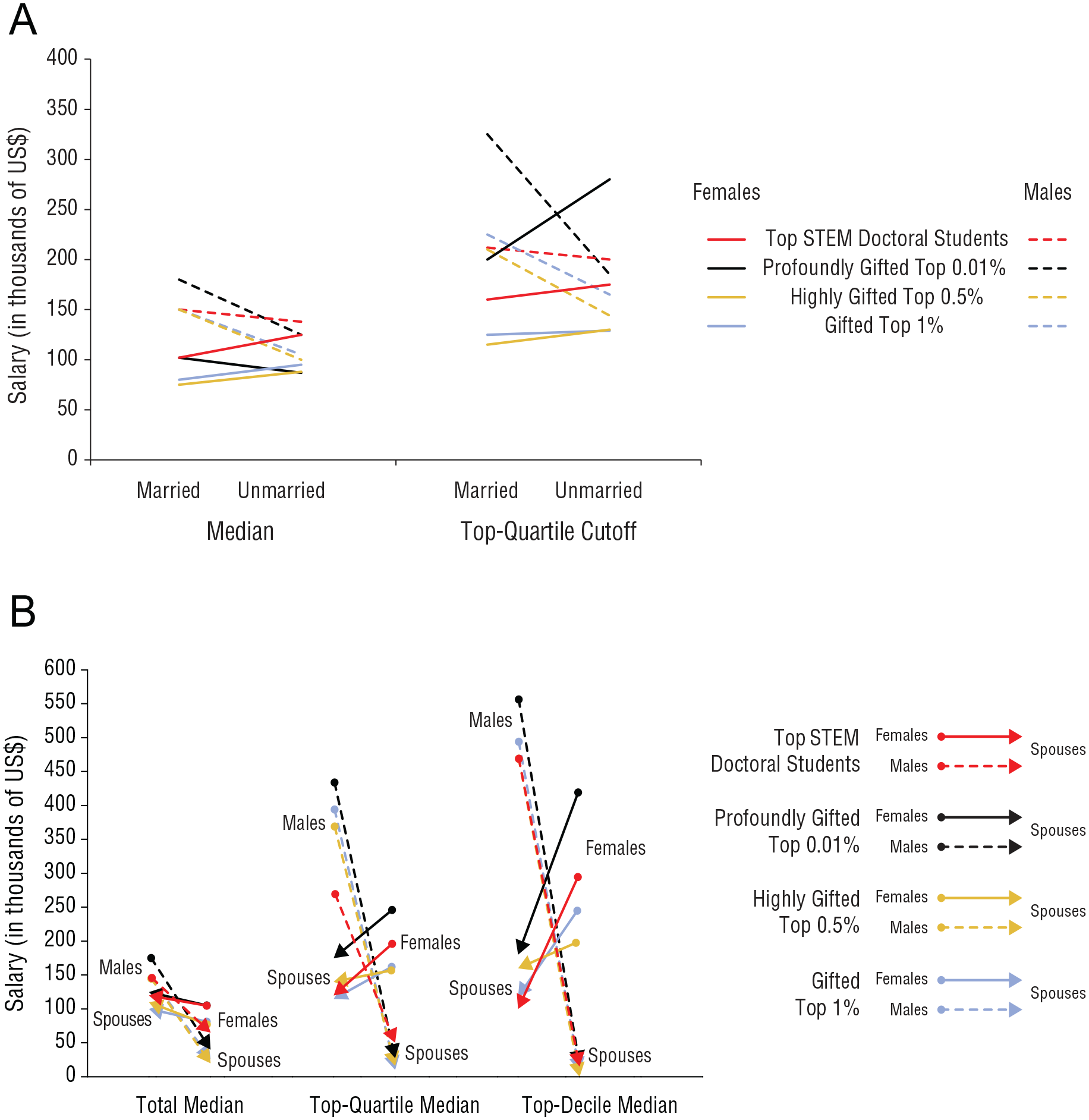
Gender differences in median incomes among all participants (A) and participants and their spouses (B).
There are well-documented differences in ability and interest patterns for men and women that are important given these trends. In educational/occupational interest profiles, decades of work have shown an average of one standard deviation gender difference for learning about and working with people versus things or in organic versus inorganic disciplines (Geary, 2021; Lippa, 1998, 2010; McIntyre & Graziano, 2016; Su et al., 2009). While their distributions overlap appreciably, women are much more likely than men to prefer to learn about and work with people and organic material, whereas men, relative to women, are more likely to prefer to learn about and work with things and inorganic material. In addition, there is also a salient average gender difference in ability strength. Although men and women do not differ in overall intellectual ability, they do differ in ability strength. On average, there is a pronounced difference in verbal versus mathematical/spatial abilities favoring females, while the inverse is true for males (Geary, 2021; Hedges & Nowell, 1995; Hunt, 2010; Johnson & Bouchard, 2007; Stewart-Williams & Halsey, 2021a; Voyer et al., 1995).
While abilities and interests are not the focus of this study, these considerations are a helpful first step in understanding differences in educational and occupational outcomes and need to be noted (Lubinski & Benbow, 2006, 2021; Stoet & Geary, 2015, 2018). They are part of the equation. However, they also help inform widespread national and international trends. For example, as educational opportunities have become more equitable for women (Stoet & Geary, 2018, 2020), cross-cultural trends show women are becoming overrepresented, relative to men, in securing tertiary educational degrees. In the United States, for example, more women than men have been awarded doctorates for more than 15 years. That overrepresentation, however, is not equally distributed across disciplines. Women are overrepresented in many organic disciplines while being underrepresented in inorganic fields. Women received more than 65% of the doctorates in education, more than 70% in health sciences, and more than 75% in public administration/services but only 25.1% in mathematics and computer science and 23.4% in engineering (Okahana & Zhou, 2018; Snyder et al., 2019). 2 The ability/interest taxons or trait complexes described earlier partly explain the trend. 3
Modeling Lives Lived Beyond Formal Education
Having exceptional abilities, passionate interests, and opportunities is one thing. Actualizing one’s full potential over one’s lifespan and after educational credentials are secured is another. Doing so involves many choices that go beyond trait complexes and supportive opportunities to learn and work (Lubinski & Benbow, 2001). Virtually all investigators studying high-impact careers have conceptualized these careers as a lifestyle (Ericsson et al., 2006; Gardner, 1993; Jackson & Rushton, 1985; Roe, 1953; Simonton, 1994; Wilson, 1998; Zuckerman, 1977). Certainly, potential and opportunity are needed. However, developing and sustaining conceptually demanding, high-impact careers, especially those wherein individuals are entrusted with vast amounts of economic and human resources, require considerations well beyond developing sophisticated professional expertise (Ullen et al., 2016). For the career and life outcomes in which we are interested in this study, career development needs to be conceptualized as a component of life because individuals differ on how much time they are willing to devote to it versus other activities (Hakim, 2017; Pinker, 2008; Rhoads, 2004; Rhoads & Rhoads, 2012), even under the best conditions (see Lubinski & Benbow, 2021, Figures 7 and 8). Trade-offs are made to pursue high-impact careers. It is a commitment to a way of life that is atypically dominated by one’s work. Economists, psychologists, and a variety of social science disciplines have studied this topic in the broader context of lives lived (Buss, 2019; Geary, 2021; Hakim, 2017; Holahan et al., 1995; Pinker, 2008; Rhoads & Rhoads, 2012) as has the popular press, with The New York Times stories such as “They conquered, they left” (Kuczynski, 2002) and “Women did everything right, then work got greedy” (Miller, 2019).
There are many ways to construct a meaningful and satisfying lifestyle (Buss, 2019; Geary, 2021; Hakim, 2017; Pinker, 2008; Rhoads, 2004). There is no one right lifestyle. Individuals prioritize contrasting life possibilities differently (Lubinski & Benbow, 2001) and derive satisfaction from different aspects that can constitute a life; they, therefore, differ with respect to what is worthy of investing their time (Browne, 2023; Geary, 2021; Gino et al., 2015; Hakim, 2017; Pinker, 2008; Stewart-Williams & Halsey, 2021a). To measure this domain for an age-50 follow-up of SMPY’s two oldest cohorts (identified in the 1970s), Lubinski and colleagues (2014) developed an extensive survey. They asked nearly 100 social scientists, representing various disciplines and perspectives, to generate theoretically compelling items that capture the personal attributes and life circumstances relevant to understanding the choice of lifestyle and consequential life outcomes following formal education. They were asked to consider determinants beyond their personal propensities for learning and work.
The resulting distillation of their responses informed the development of SMPY’s age-50 survey of its participants (available on the Open Science Framework: https://osf.io/tsby7/). The items from this process captured unique as well as common personal agendas and lifestyles germane to individual and gender differences in consequential life outcomes (Ozer & Benet-Martinez, 2006), both inside and outside of the world of work. They also reflected, when aggregated, several broad lifestyle themes, such as agency and communion or self-profitability and other-profitability (Abele & Wojciszke, 2007; Bakan, 1966; Wiggins, 1991) and economic decision-making (Hakim, 2017; Kahneman, 2011; Kahneman et al., 1982; Kahneman & Tversky, 2000) as well as working and loving (Freud, 1933), resource acquisition and mating (Buss, 2019), or occupational and mate selection (Geary, 2021; Roe, 1956).
When Lubinski et al. (2014) administered this survey to gifted and highly gifted women and men (SMPY Cohort 1, top 1% in ability, and Cohort 2, top 0.5% in ability), characteristic patterns of gender differences in their lifestyles and preferences mirrored those found in normative populations (Buss, 2019; Geary, 2021; Hakim, 2017; Pinker, 2008; Rhoads, 2004). As a group, women, relative to men, allocated their time differently across family and work. There were also gender differences in how time was allocated outside of work. Women, as a group, relative to men, had somewhat different preferences across work, family, community, and spirituality. Their paths also differed in how their close relationships were structured. Both women and men tended to marry spouses with impressive and commensurate educational credentials. Yet, at age 50 at least, women tended to be married to partners whose income was comparable to theirs; alternatively, men tended to be married to partners whose income was markedly less than theirs. However, there were no significant gender differences in life satisfaction, relationship satisfaction, or psychological well-being. Both women and men appeared satisfied with their lives although they had followed somewhat different paths.
While the individuals in the Lubinski et al. (2014) study led lives of high achievement, it was not clear whether the identified trends would apply to those who were exceptionally primed to produce noteworthy accomplishments. That is, do the findings also apply to those with even more potential for noteworthy achievement, but in very different and contrasting ways, and who also grew up when opportunities for women were greater? To answer this question, different samples are needed, which sets the stage for this study.
Current Study
Identifying appropriate samples to answer research questions involving noteworthy accomplishments, whether in music, arts, athletics, or science, is of crucial importance (Simonton, 1999b). Thus, to answer our question, we decided to compare the occupational outcomes and life course of two groups of 50-year-olds: top STEM doctoral students trained at the very best STEM programs in the United States and a profoundly gifted cohort with exceptional potential for high-power careers but more broadly defined. Both were exceptionally talented but based on different criteria.
Our profoundly gifted cohort was selected based solely on their exceptional cognitive abilities. At age 12, they were identified as in the top 0.01% in cognitive ability. Their interests and subsequent educational experiences and opportunities varied widely (Achter et al., 1996; Kell, Lubinski, & Benbow, 2013; Lubinski & Benbow, 2006; Lubinski et al., 2001b). All that was known about them initially, when identified, was that they had extraordinary intellectual potential.
In contrast, we knew much more about the STEM doctoral students when the sample was formed. They were selected because they were enrolled in the very top STEM graduate programs in the United States. Of course, the criteria to be admitted to such programs meant that we were selecting students who not only possessed the “super typical” ability/interest profile but who also had a long history of opportunities and high achievement in STEM. This is what it takes to get into the very top STEM graduate programs. Interestingly, the men and women who made it into these programs did not display the characteristic ability/interest gender differences reviewed earlier; both women and men were exceptionally talented mathematically. In addition, their mathematical ability was markedly more impressive than their verbal ability (see Lubinski et al., 2001b, Table 1), and their interest pattern was dominated by scientific and theoretical interests (see Lubinski et al., 2001b, Figure 1). In adolescence, math/science courses were their favorite academic topic, and they experienced many advanced learning opportunities in STEM (see Lubinski et al., 2001b; Tables 2 and 3). Furthermore, although opportunity has many meanings, they were able to pursue and secure impressive undergraduate degrees in STEM and subsequently obtain doctorates at some of the best STEM graduate training programs in the world. For this cohort, several well-known determinants to the development of world-class distinction in STEM were gender-equivalent in ways that, to our knowledge, have not been found previously in the psychological literature. Specifically, men and women in these top STEM doctoral programs were far more similar psychologically than men and women in the gifted cohorts. How women and men with this degree of educational and psychological exceptionality and uniformity live their lives and whether and how they achieve distinction should therefore be exceedingly informative.
Doctorates, Occupations, and Creative Accomplishments at Age 50.
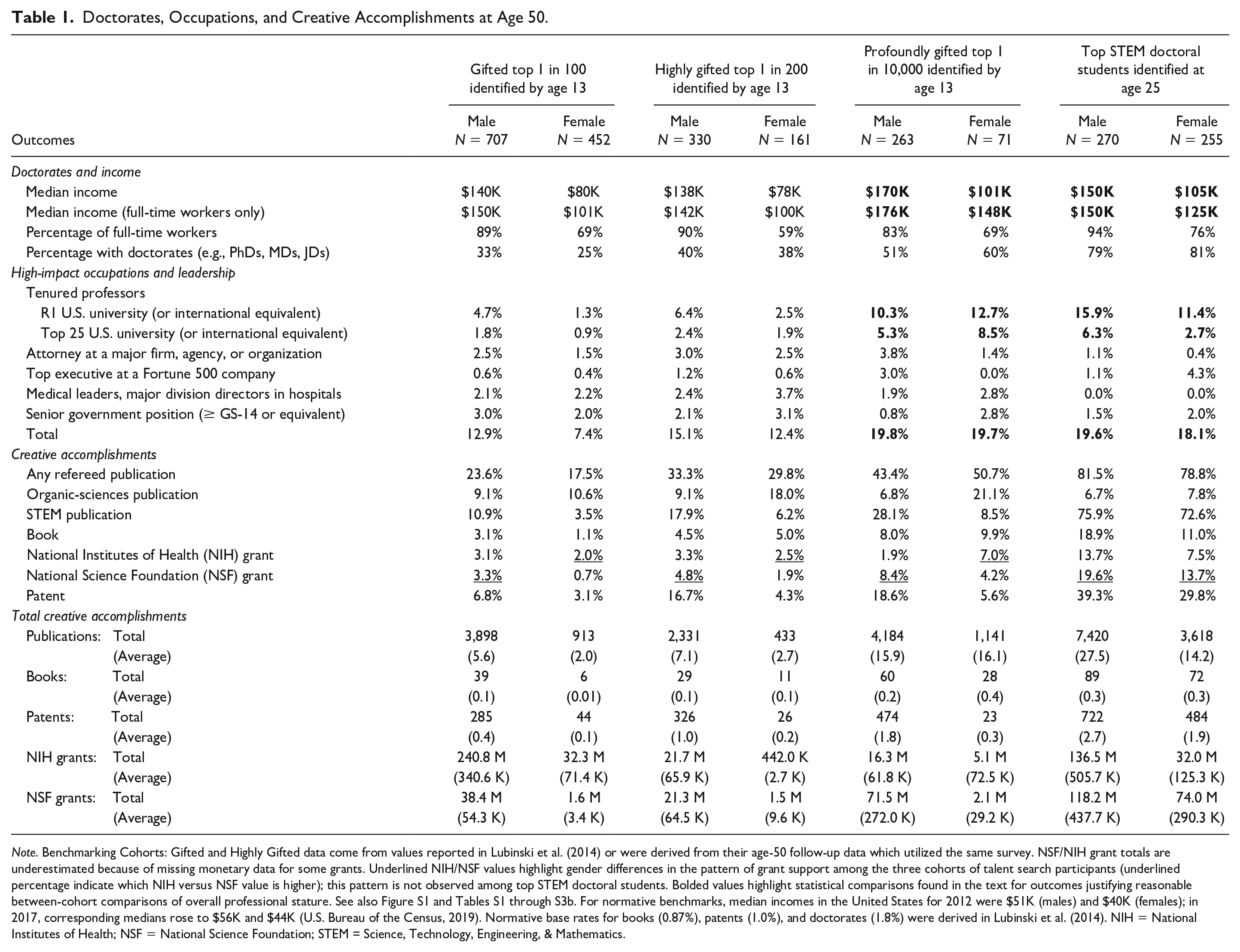
Note. Benchmarking Cohorts: Gifted and Highly Gifted data come from values reported in Lubinski et al. (2014) or were derived from their age-50 follow-up data which utilized the same survey. NSF/NIH grant totals are underestimated because of missing monetary data for some grants. Underlined NIH/NSF values highlight gender differences in the pattern of grant support among the three cohorts of talent search participants (underlined percentage indicate which NIH versus NSF value is higher); this pattern is not observed among top STEM doctoral students. Bolded values highlight statistical comparisons found in the text for outcomes justifying reasonable between-cohort comparisons of overall professional stature. See also Figure S1 and Tables S1 through S3b. For normative benchmarks, median incomes in the United States for 2012 were $51K (males) and $40K (females); in 2017, corresponding medians rose to $56K and $44K (U.S. Bureau of the Census, 2019). Normative base rates for books (0.87%), patents (1.0%), and doctorates (1.8%) were derived in Lubinski et al. (2014). NIH = National Institutes of Health; NSF = National Science Foundation; STEM = Science, Technology, Engineering, & Mathematics.
Importance of Work and Family Mentioned in Three Open-Ended Questions.
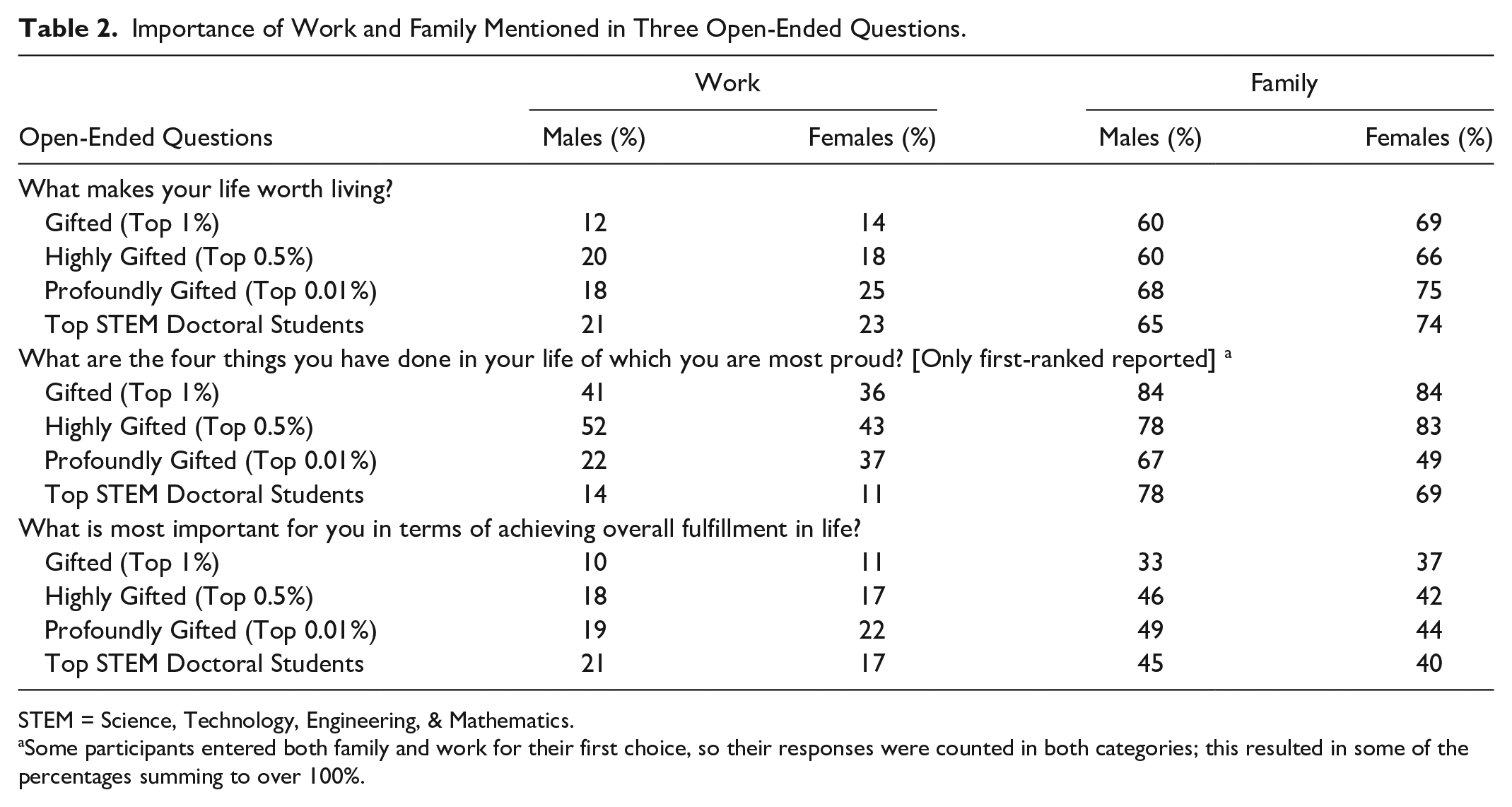
STEM = Science, Technology, Engineering, & Mathematics.
Some participants entered both family and work for their first choice, so their responses were counted in both categories; this resulted in some of the percentages summing to over 100%.
The distinct psychological profiles of the two cohorts in this study (top STEM doctoral students and the profoundly gifted) offer several attractive features for longitudinal research on factors predicting exceptional achievements and occupational stature. Moreover, these two cohorts meet Simonton’s (2014a) standard of what constitutes a significant sample: “[a] sample is significant when it represents the population of cases that have immense theoretical or empirical interest in their own right” (p. 11); these two cohorts definitely do.
To understand fully how remarkable careers develop requires assessing the unique strengths, relative weaknesses, and motivational proclivities of promising individuals and then studying their lives lived both in and outside of the world of work. Those with truly exceptional potential and afforded opportunities, we hypothesized, would have even more impressive career accomplishments at age 50 than SMPY’s gifted (top 1%) and highly gifted (top 0.5%) cohorts at age 50. Yet, we felt compelled to hypothesize that average gender differences in occupational outcomes, time allocation, life preferences and priorities, and structured family relationships would remain and would mirror the patterns seen normatively and in SMPY’s two older but less exceptional cohorts. We were unsure, however, what to anticipate in the magnitude of the gender differences for each group, given their different levels of achievement, potential, and more modern sociocultural context.
Method
Participants
This is the first major report on the age-50 survey of SMPY’s two most high-potential cohorts (Clynes, 2016; Lubinski & Benbow, 2006): top STEM doctoral students identified in their mid-20s and individuals identified at age 12 as being profoundly gifted (top 0.01% in ability). These two cohorts will be referred to as the focal cohorts to distinguish them from two additional cohorts that we used for comparison (Lubinski et al., 2014), termed benchmarking cohorts.
Focal Cohort: Top STEM Doctoral Students
In 1992, SMPY identified a cohort of STEM doctoral students around age 25 (270 males, 255 females). As first- or second-year doctoral students, they were attending top 15 STEM training programs in the United States (according to Gourman, 1989); within each department, women were oversampled to achieve commensurate representation (Lubinski et al., 2001a). This sample is exceptionally talented in quantitative reasoning ability as measured by the Graduate Record Exam (e.g., GRE-Q means for females and males are 734.4 and 749.0, respectively) and indicates promise for excelling in STEM careers. Scores on the GRE are used in the United States to select students into graduate programs for advanced study (Lubinski et al., 2001a); at the time, these means represented scores over two standard deviations beyond the typical graduate student in the United States. The women and men have commensurate ability and interest patterns, mathematical ability greater than verbal ability, and scientific interests and theoretical values as their regnant sentiments (while scoring lower on religiosity). For both men and women taking the Adjective Check List (ACL; Gough & Heilbrun, 1983), a broad spectrum 37-scale personality questionnaire designed by Berkeley’s Institute for Personality Assessment Research (IPAR) partly to identify the personality characteristics of creative individuals, “Creative Personality” was ranked first and “Succorance” ranked lowest. Moreover, either math or science was their favorite course in high school, and their extracurricular learning experiences prior to college were focused on STEM. There were insignificant gender differences found in their early graduate school assessments, and retrospective self-reports of their educational histories were STEM-concentrated and highly uniform (Lubinski et al., 2001a). The race/ethnicity makeup of the STEM doctoral students are as follows: 84.2% White, 8.4% Asian, Asian American, or Pacific Islander, 1.5% Mexican American or Hispanic, 1.1% Black or African American, 0.4% Puerto Rican, 4.2% Other or Multiracial, and 0.2% missing.
Focal Cohort: Profoundly Gifted Youth
In 1980–1983, SMPY identified a profoundly gifted cohort of 12-year-olds (263 males, 71 females) through talent searches wherein selected students were given the opportunity, through above-level testing, to take the SAT (Lubinski & Benbow, 2006; Lubinski et al., 2001b). They scored either SAT-Verbal ≥630 or SAT-Math ≥700 (which constitutes the top 0.01% in the ability for their age group). In contrast to the STEM doctoral students, the intellectually gifted women and men in this cohort displayed marked gender differences in their ability and interest patterns. The male ability/interest/values pattern—relative to the female pattern—was more similar to that of STEM doctoral students. Women were just as academically and intellectually impressive as their male counterparts, but their ability/interest/value pattern was different (Lubinski & Benbow, 2006; Lubinski et al., 2001a). In general, the intellectually precocious women in the cohort possessed a more balanced math/verbal ability profile, their interests were more intellectually diverse, and their choices of favorite courses and disciplines were more evenly distributed.
Finally, when we surveyed the top STEM doctoral students in 1992, we discovered that three of these students were already identified by SMPY in the early 1980s as profoundly gifted. Because they were identified by SMPY earlier, these three participants were removed from the top STEM doctoral student group but retained for analysis in the profoundly gifted cohort so that their data were not double-counted. The race/ethnicity makeup of the profoundly gifted cohort is as follows: 75.1% White, 18.9% Asian, Asian American, or Pacific Islander, 0.6% Black or African American, 0.3% Mexican American or Hispanic, 4.8% Other or Multiracial, and 0.3% missing.
Two Benchmarking Cohorts
We scaled outcomes against preexisting benchmarks. Because many of the items developed for SMPY’s age-50 survey are unique (Lubinski et al., 2014), a method for assessing robustness is required. Therefore, embedded in our graphic displays and tabular arrangements are the age-50 data from SMPY’s two oldest cohorts: one initially identified by age 13 in the early 1970s as gifted (1972–1974, top 1% in ability, N = 1,159); the other, identified in the late 1970s as highly gifted (1976–1979, top 0.5% in ability, N = 491). Data from these two cohorts were collected in 2012–2013 and published in Lubinski et al. (2014), using the same survey instrument employed here. Their age-50 data are presented alongside the new age-50 data collected during 2017–2018 on the top STEM doctoral students and the profoundly gifted cohort. These benchmarks served to address concerns about robustness and replication (Camerer et al., 2018; Open Science Collaboration, 2015), the latter being intensified when innovative survey design features are implemented and samples are rare. If consistent patterns of gender differences and similarities are found across the two focal cohorts, and they mirror patterns obtained on the earlier gifted and highly gifted benchmarking cohorts, then there is added confidence as to the robustness of our findings.
Procedure
The survey for the two focal cohorts was launched in February 2017 and closed in April 2018. Participants completed online surveys administered by SoundRocket (https://www.soundrocket.com/). The instrument used in our earlier study of gifted and highly gifted participants (Lubinski et al., 2014) was also administered by SoundRocket. A print version may be found on the Open Science Framework (https://osf.io/tsby7/). The print version of our survey “looks” longer than what participants saw (and to which they responded), because we implemented elaborate branching and skip logic. For instance, if participants were not in a romantic relationship or if they were not parents, they were not presented with (and thus “skipped” over) large blocks of corresponding items. The paper version has all the items possible, but participants were not presented items that were irrelevant to them. This age-50 survey was designed for years of longitudinal research. In addition to the standardized and open-ended measures utilized in this study, the survey also covered a variety of topics beyond career development, post formal education, family and life priorities, and personal preferences for what constitutes a meaningful life. It also contained several standardized measures of medical and physical health (Kell et al., 2022). In this first comprehensive age-50 follow-up study, we focus on the overall patterns of outcomes that align with our earlier first report of SMPY’s two oldest cohorts at age 50 (Lubinski et al., 2014).
We computed response rates in two ways. Specifically, response rates were calculated using two different denominators: (a) the initial sample size and (b) the number of participants who had valid e-mails for the follow-up survey. For the top STEM doctoral students, the response rates were 73.5% and 77.2%, respectively; for the profoundly gifted cohort, the response rates were 68.9% and 75.9%, respectively. 4
At the end of the survey, participants were given the option of receiving a $20 Amazon gift card or donating $20 to a scholarship fund for intellectually talented adolescents from economically challenged households to attend Vanderbilt University’s summer academic Programs for Talented Youth (PTY). Approximately 70% of each group chose to donate their incentive. 5
Standardized Measures
We used several standardized measures to assess psychological well-being and the alpha reliabilities for the two focal cohorts are presented with the description of each measure.
Satisfaction With Life Scale
The Satisfaction With Life Scale (SWLS; Diener et al., 1985) is a well-known measure of overall psychological well-being. Participants respond to 5 items (e.g., “In most ways my life is close to my ideal”), which are on a 7-point scale from Strongly disagree to Strongly agree (Doctoral Students, α = .88; Profoundly Gifted, α = .90).
Positive Feelings
We used the six positively valenced items (e.g., “Happy”) from the Scale of Positive and Negative Experience (Diener et al., 2010), which we labeled as Positive Feelings (PF). PF measures positive emotions experienced in the previous 4 weeks. Participants responded on a 5-point scale from Very rarely or never to Very often or always (Doctoral Students, α = .90; Profoundly Gifted, α = .90).
Flourishing Scale
The Flourishing Scale (FS; Diener et al., 2010) assesses whether participants believe that they are thriving and prospering in their lives. Participants answered eight items (e.g., “I lead a purposeful and meaningful life”) on a 7-point scale ranging from Strong disagree to Strongly agree (Doctoral Students, α = .83; Profoundly Gifted, α = .86).
Core Self-Evaluations
Core Self-Evaluations (CSE; Judge et al., 2003) measure how people evaluate their lives, including their ability and autonomy. Participants answered 12 items (e.g., “I am capable of coping with most of my problems”) on a 5-point scale, ranging from Strongly disagree to Strongly agree (Doctoral Students, α = .86; Profoundly Gifted, α = .89).
Open-Ended Items and Interrater Reliability
Three open-ended questions indexing what constitutes a meaningful life were coded for “work,” “family,” “both work and family,” or “other.” Two judges independently rated each item for all participants; discrepancies were decided by a majority vote by three of the authors (unaware of participants’ gender). Interrater agreement was calculated for the percentage of matching codes from valid responses from both focal cohorts. The questions and interrater reliability were as follows: (a) “What makes your life worth living?” (88.7% agreement), (b) “What are you most proud of?” (92.2% agreement), and (c) “What do you require to be fulfilled in life?” (85.0% agreement).
Analytic Frame
While we report significance levels in our analyses (utilizing both parametric and nonparametric tests, all two-tailed tests with an α = .05), our focus was on the overall pattern of findings rather than any one particular statistical comparison (Lubinski, 2016; Lubinski & Benbow, 2021; Makel et al., 2016; Meehl, 1978, 1990; Steen, 1988). Thus, we employed graphic and tabular displays of our age-50 data across the four cohorts to appraise and illuminate their profile concordances. These displays are arranged to reveal most clearly the individual and average gender differences in the accomplishments, lifestyle, and subjective reports of the top STEM doctoral students and the profoundly gifted. Simultaneously, the data of these two groups are benchmarked against the gifted and highly gifted cohorts as explained previously. To be clear, our comparisons focused on the top STEM doctoral students and the profoundly gifted. When empirical patterns are replicated across all four cohorts, we note that critical importance. Doing so enabled us to determine whether there are specificities associated with world-class STEM talent and training (and how they unfold developmentally) compared with more general forms of high-potential human capital. Given that these four cohorts were identified over a 20-year period (1972–1992), we were able to assess the consistency of gender differences among high-potential individuals over a period of immense sociocultural change.
One macro comparison, however, is worth detailing, for its capacity to detect cohort fluctuations in broad patterns of gender differences concurrently and over time. Across a heterogeneous collection of preferences and priorities, both inside and outside of the world of work, profile similarity was assessed across constituents of major life themes, scaled in effect size units, to determine the extent to which they converge and maintain their cross-cohort pattern. Profile concordance was evaluated parametrically and nonparametrically, using Pearson-rs and Spearman-ρs, respectively, as we did for the two gifted samples in the Lubinski et al. (2014) study. However, that earlier study examined the pattern of gender differences only concurrently. In the current study, we evaluate the gender differences among our two focal cohorts concurrently as well, but we also assess their robustness measured against findings obtained on the benchmarking cohorts assessed a decade ago (Lubinski et al., 2014). This approach aligns with extrinsic convergent validation procedures, designed to uncover the extent to which psychometric measurements, based on their pattern of correlates across diverse external criteria, are uniform.
Recently, Gonzalez and colleagues (2021) explicated the usefulness of extrinsic convergent validity for determining the conceptual equivalence and empirical interchangeability of two measures purporting to measure the same construct (Fiske, 1971, 1973). The idea is that two measures should not be considered conceptually equivalent or empirically interchangeable until they display corresponding patterns in their correlational profiles across a heterogeneous collection of external criteria. This approach has been found compelling across measures of cognitive abilities (see Lubinski, 2004, Table 1), educational/occupational interests and values (see Schmidt et al., 1998, pp. 445–446), and personality (see Lubinski et al., 1983, Table 1). When two measures consistently display a convergent and discriminant pattern in their external relationships across a heterogeneous collection of external criteria, they can be considered functionally equivalent and thus empirically interchangeable. This idea may be generalized to assessing the convergent/discriminant pattern similarity of gender differences arrayed in effect size displays. Namely, gender differences in broad life themes should not be considered robust until they display corresponding effect size patterns across a heterogeneous collection of constituent indicators. We apply this approach to assess the uniformity of cross-cohort gender differences both concurrently and over time.
Materials and supplemental analyses are available on OSF (https://osf.io/tsby7/). Data and code for this study are not available because we had concerns about identifying participants in our cohorts based on the variables used in this manuscript. However, we have provided descriptive data and intercorrelations among our non-standardized measures on OSF.
Results
Age-50 Accomplishments
Table 1 summarizes data on the educational, occupational, and creative outcomes for the top STEM doctoral students and the profoundly gifted participants. They are benchmarked against the outcomes for the gifted and the highly gifted cohorts. Because of the STEM focus of the doctoral students and the occupational heterogeneity of the profoundly gifted (see Appendix), we did not compute a composite index of their professional stature as a whole. Nonetheless, the various indices in bold in Table 1 suggest that their relative occupational and creative accomplishments are commensurate.
Income
The males’ median income in 2017/2018 was $150K and $170K for the top STEM doctoral students and the profoundly gifted, respectively; the females’ corresponding values were $105K and $101K. Across both cohorts, the male incomes do not differ significantly nor do the female incomes. However, gender differences within each cohort are significant: doctoral students (DS) z = 6.12, p < .001 and profoundly gifted (PG) z = 3.77, p < .001. Because there were significant gender differences in working full-time (DS z = 5.80, p < .001; PG z = 2.68, p < .01), the magnitude of these gender differences reduces considerably when medians are restricted to full-time workers. Male medians for the doctoral students and the profoundly gifted change little, $150K and $176K, respectively, whereas corresponding female medians rose to $125K and $148K. Gender differences, although still significant among the DS, are less so (z = 3.83, p < .001) and they become insignificant for the PG (z = 1.88, p = .06).
Academia and Tenure
Two other metrics of accomplishment are being a tenured faculty member at a top 25 institution and obtaining tenure at a research-intensive U.S. university (or international equivalents). Of course, not all participants entered academia. The DS and PG males were comparable in serving as faculty members at top 25 institutions, 6.3% and 5.3%, respectively. The DS females (2.7%) were significantly less likely to occupy such positions compared with the PG females (8.5%; z = 2.17, p < .05). The percentage of DS males achieving tenure at a research-intensive university (15.9%) is not statistically different from that of the PG males (10.3%; z = −1.93 p = .053); corresponding percentages for their female counterparts are less divergent, 12.7% and 11.4%, and statistically insignificant. These percentages for the STEM doctoral students are not surprising as they were identified while they were in programs that prepare individuals for careers in academia. Those comparable percentages were observed for a cohort identified at age 12 solely based on their profound cognitive abilities is noteworthy, however.
High-Impact Occupations and Leadership
We also computed an aggregate index of high-impact occupational and leadership positions based on professional leadership/prestige, which content experts deemed commensurate with tenured faculty at research-intensive universities (Bernstein et al., 2019; McCabe et al., 2020). These occupations included attorneys at major firms, Fortune 500 executives, leaders in medicine, and senior government positions. On this composite metric of occupational distinction, men and women in both focal cohorts were tightly clustered, with between 18.1% and 19.8% meeting this criterion (statistically equivalent).
NIH/NSF Grants
An interesting gender difference emerged across the percentages for the NIH/NSF grant recipients among the three gifted cohorts, which is not found among the top STEM doctoral students. In Table 1, we have underlined the percentages to indicate whether each group received more funding from NIH or NSF. For gifted women who secure scientific funding, they are more likely to do so from NIH rather than NSF, whereas the inverse is true for men. This aligns with female and male STEM doctoral students having essentially equivalent ability/interest profiles, whereas the gifted participants reveal characteristic profile differences in mathematical/verbal reasoning strength plus preferences for working with people versus things. These gender differences in grants awarded in relatively more organic (NIH) versus inorganic (NSF) sciences mirror patterns in the general population as well as the gifted and highly gifted benchmarking cohorts.
Summary
By any standard, across income, academic tenure at major institutions, and prestigious occupations of immense responsibility and trust, it is noteworthy that profoundly gifted participants identified before age 13 on a single, two-part test have comparable outcomes to top STEM doctoral students by age 50. Conversely, it is similarly impressive that the top STEM doctoral students achieved as much in aggregate insofar as their ability level is much more commensurate with our highly gifted cohort (namely, top 1 in 200; see Lubinski et al., 2001a, Table 1) than with that of the profoundly gifted cohort. This is important as it demonstrates the importance of individual differences beyond their intellectual capabilities. Those non-intellectual assets, in conjunction with their adolescence-to-young-adulthood learning experiences (see Lubinski et al., 2001a; Tables 2 and 3), earned them admission to some of the best STEM doctoral training programs in the world. While ability is important, ultimate achievement depends upon much more, both personally (human capital) and environmentally (learning opportunities).
Corresponding data from the two older benchmarking samples (i.e., the gifted and the highly gifted cohorts) support this broader point. When examining their high-impact and leadership position totals in Table 1, the successively more intellectually able cohorts held successively higher gradations of occupational impact and stature, culminating with the profoundly gifted occupying positions commensurate with top STEM doctoral students. Moreover, this is important given that the least exceptional group (the gifted cohort) was 3 to 5 years older than the other cohorts when surveyed. Ability matters, 6 however, many other things matter as well. There is more to career success than ability, and there is more to life than career success. Therefore, we turn to factors beyond ability and opportunity that also matter in constructing a meaningful and satisfying life.
Marital Status, Spousal Characteristics, Preferences, and Lifestyle
Marital Status and Spouses
Figure 1A presents income data as a function of marital status. For STEM doctoral students, male income is not significantly related to marital status. For women, it appears to be more so (i.e., unmarried women earning more than married women), but it falls short of statistical significance. For the overall sample of profoundly gifted men, the pattern is different. There is a significant trend for married men to earn more than unmarried men (z = 3.27, p < .001), which is mirrored in the two comparison samples. For profoundly gifted women, marital status does not covary appreciably with income, and this is also true for the two benchmarking samples. Both trends are found among participants with incomes in the top quartile of their gender with one exception. High-income, unmarried women in the profoundly gifted group earn appreciably more than their married counterparts. However, the small number of profoundly gifted, unmarried women in the top income quartile must be considered when interpreting this finding.
Figure 1B compares the participants’ median incomes to those of their spouses. Among all four samples, there is a marked discrepancy between male participants and their spouses. For men, both doctoral students and the profoundly gifted earn vastly more than their spouses (DS: z = 8.79, p < .001; PG: z = 9.71, p < .001), and this disparity intensifies at higher income levels. This pattern does not hold for women. In general, women earn statistically commensurate incomes to those of their spouses. Women do earn more than their spouses as their income increases; however, this income disparity is less marked for women across all four cohorts compared to men. For female participants overall, and for those with incomes in the top quartile and decile, their spouses earn incomes above $100K. Across these gradations for men, the median income for their spouses is less than $50K for the three gifted cohorts and $60K for the STEM doctoral students (see Tables S4 and S5). Importantly, there are no significant differences in the educational credentials of the spouses across all four cohorts. On a scale of educational credentials with 4-year degrees coded 2 and master’s degrees coded 3, the spouses of all four cohorts average between 1.9 and 2.2 (statistically insignificant, Tables S6 and S7). A replicated finding across all four cohorts is that the spouses of male participants are markedly under-employed relative to the spouses of female participants if income is the criterion. However, female and male participants had similar median annual household incomes (i.e., participant plus spouse). Among the STEM doctoral students, women and men had median family incomes of $214.5K and $215K, respectively; corresponding values for the profoundly gifted were $200K and $220K.
Time Allocation
Given that exceptional performers allocate an inordinate amount of time to developing expertise and their careers (Ceci et al., 2014; Eysenck, 1995; Simonton, 2014b), SMPY created a series of items to assess time allocation. Figure 2 shows items that assess time devoted to career/work (Figure 2A), family/household (Figure 2B), and the maximum amount of time participants would be willing to work if given the opportunity to do so in their ideal job (Figure 2C). In Figure 2A, participants estimated how much time they devoted to their career development during the past 15 years in 5-year segments. Participants also estimated how much time they plan on devoting to their career in the next 15 years, in 5-year segments. Retrospectively, the male doctoral students and profoundly gifted men reported devoting an average of 50.4 and 48.3 hr per week, respectively, to career development over the past 15 years; corresponding values for women averaged 44.2 and 43.6 hr, respectively. These gender differences are significantly different for both cohorts, DS: t(314.0) = 4.64, p < .001; PG: t(76.8) = 2.01, p < .05. Prospective appraisals suggest a lessoning of this trend, especially among the profoundly gifted. The latter pattern was replicated in the gifted and highly gifted benchmarking samples.
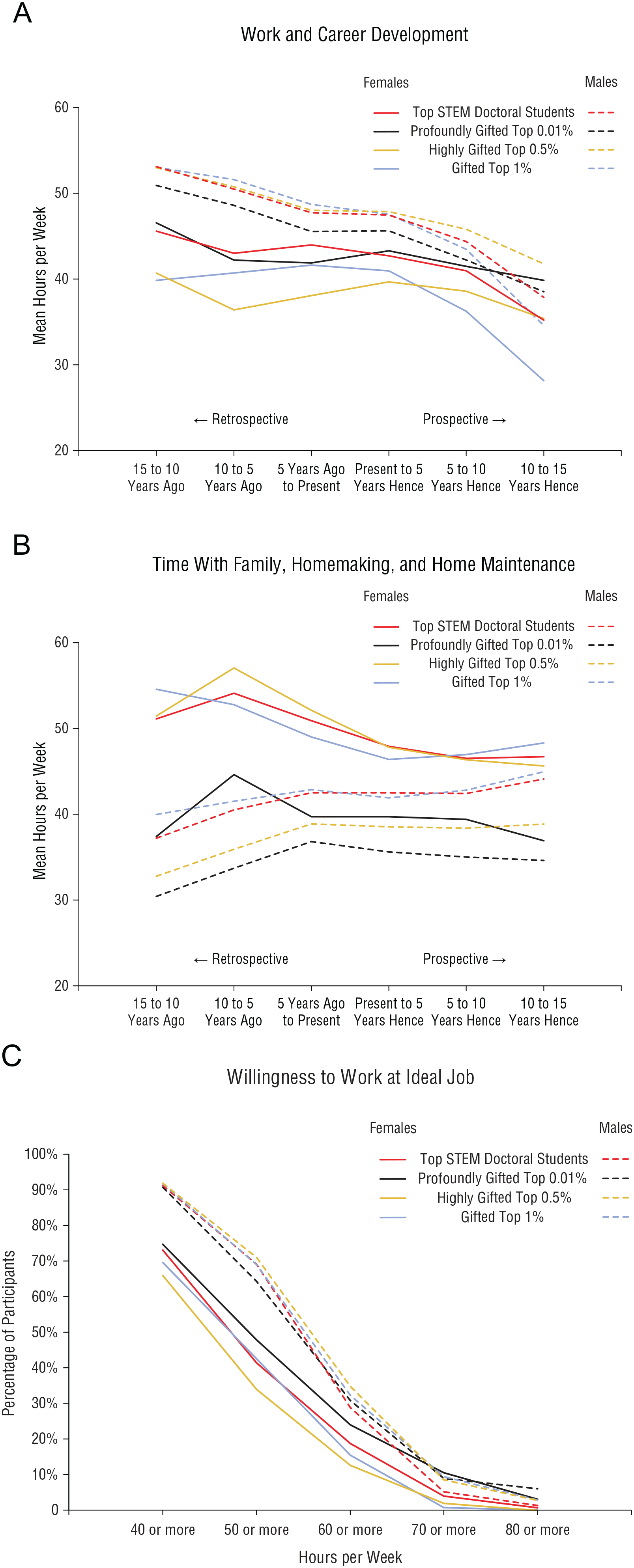
Gender Differences in Average Amount of Time Devoted to Work and Career Development (A), Family, Homemaking, and Home Maintenance (B), and Amount of Time Willing to Devote to Work in Ideal Job (C).
The time allocation patterns for men and women are inverted when participants were asked how many hours they devoted to family, relatives, homemaking, and maintenance over the past 15 years (Figure 2B). Relative to men, women devoted significantly more time to working in the home and being with family. Over the past 15 years, male doctoral students and profoundly gifted men reported devoting an average of 40.1 and 33.6 hr per week, respectively, to family and household; corresponding values for women averaged 52.0 and 40.6 hr, respectively. These gender differences are statistically significant, DS: t(387.8) = −4.61, p < .001; PG: t(74.55) = −2.02, p < .05. The profoundly gifted women were more similar to the profoundly gifted men than they were to their female counterparts from the doctoral student group. Nevertheless, within all four cohorts, the inverse pattern of time allocation of men versus women for career versus family/home is conspicuous. While constraints in occupational opportunity for women are being lessened, the disproportionate share of the responsibilities shouldered by them in other domains has remained. 7
Figure 2C shows how much participants would be willing to work, at most, if they held their ideal job. Consistent gender differences are observed under such circumstances; notably, men would be willing to work more than women, DS: t(499) = 4.73, p < .001; PG: t(307) = 2.03, p < .05. At age 50, 25% of women who were trained at the best STEM graduate universities in the world reported that they were unwilling to work 40 hr per week, and the same is true for profoundly gifted women. Less than 10% of men in both corresponding cohorts reported this preference. These values parallel those findings for the gifted and highly gifted cohorts who were initially identified in the 1970s.
These differences in time allocation have implications for commensurate representation in demanding positions that require inordinate time commitment and erratic schedules (see Tables S8, S12a, and S12b). Data points found along the upper regions of this graph speak to this issue further (i.e., working 50 or 60 hr per week). The higher values are more common for high-powered careers, such as a tenure-stream professorship at a research-intensive university or making partner at a prestigious law firm (see Ceci et al., 2014, Figure 15; Eysenck, 1995; Goldin, 2014; Hakim, 2017; Simonton, 2014b). 8
Work Values, Life Values, and Personal Views
Figure 3 displays three panels of effect sizes (i.e., in standard deviation units), rank-ordered by female-minus-male differences, for items assessing work preferences (Figure 3A), life values (Figure 3B), and personal views (Figure 3C). Both the STEM doctoral students and the profoundly gifted groups are displayed in clustered bar charts as focal cohorts, with their effect sizes rank-ordered as a function of the magnitude of the differences among the STEM doctoral students. For both cohorts, across all three panels, the gender differences have a similar pattern. Across all three effect-size displays, the Pearson r and the Spearman ρ correlations between the STEM doctoral students and the profoundly gifted groups are both .69 (ps < .001), indicating that gender differences have an appreciable degree of consistency. Moreover, this pattern of similarity does not constitute an isolated finding.
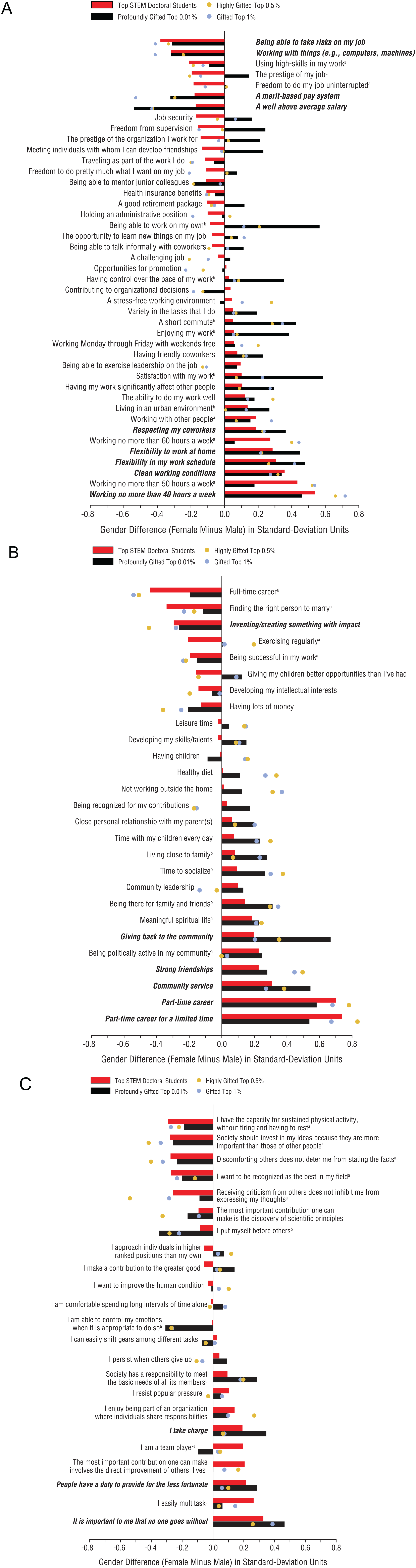
Gender Differences in Work Preferences (A), Life Values (B), and Personal Views (C) in Standard Deviations Units.
Solid circles along the clustered bar charts for the profoundly gifted participants represent data points for the SMPY gifted (
Men and women do not differ significantly on several items, including the importance of living in an urban environment, developing their intellectual interests, and wanting to improve the human condition. Yet there are many significant differences. With respect to their careers, men (as a group) rated having full-time work, making an impact, earning a high income, taking risks, and being successful at work as more important to them than women did. Women (as a group) rated having part-time work, spending time with the community and family, and having time for close relationships as more important than men did. The trade-off of achieving excellence at work over more evenly distributing priorities across work, family, community, and non-work-related personal development is a clear gender difference. Men (on average) are more concerned than women with being the best in their field and feel that society should invest in them because their ideas are better than most people’s. Women (on average) are more concerned than men that no one should go without and that they themselves maintain a greater work–life balance.
While requisite abilities, relevant interests, and developmentally appropriate opportunities are critical for understanding lifespan development in education, the world of work, and the kinds of outcomes found in Table 1 (among others), they are not the only determinants. Competing interests and other life priorities are also important. Willingness to invest in having an impact in the world of work (e.g., being creative or making money) versus choosing to invest in a balance between work and other aspects of life form another set of determinants (cf. Figure 3C). They are important to consider when modeling rare outcomes and careers that advance disciplines or manage substantial amounts of economic and human resources. Life consists of making trade-offs.
Constructing a Meaningful Life
Although we found and outlined numerous gender differences above, we did not find gender differences in what individuals required for a meaningful life. Table 2 reports percentages of the response to three open-ended questions: (a) “What makes your life worth living?,” (b) “What are you most proud of?,” and (c) “What do you require to be fulfilled in life?” Both men and women overwhelmingly stated that they considered their families more important to leading meaningful lives than their work and careers. When asked what made their lives worth living, the STEM doctoral students said family (65% of men and 74% of women) relative to work and career (21% of men and 23% of women). This pattern was the same for the profoundly gifted. When describing what they had done in their lives of which they were most proud, doctoral students mentioned elements of their family (78% of men and 69% of women) more often, relative to work and career (14% of men and 11% of women). This pattern also was the same for the profoundly gifted. Finally, doctoral students answered family (45% of men and 40% of women) relative to work and career (21% of men and 17% of women) when asked what was most important to them for achieving fulfillment in life; again, this pattern did not differ for the profoundly gifted. These findings are also highly consistent with the findings on SMPY’s gifted and highly gifted benchmarking samples assessed years earlier. As highlighted previously in Figures 2 and 3, men and women do appear to differ in the time and type of resources they devote to family. Given that men devote more hours to work and women devote more hours to family, it seems that women and men enact their commitment to family in different ways, but both place an equal premium on family for what is required for a meaningful life (see Tables S9 through S11).
Adjustment and Well-Being
We also collected data on subjective indicators of psychological adjustment and well-being that are used widely in cross-cultural research and industrial/organizational psychology (Diener et al., 1985; Diener et al., 2010; Judge et al., 2003). Moreover, we asked participants about their satisfaction in other domains, including their satisfaction with career success, satisfaction with career direction, and satisfaction with romantic relationships. Women and men were uniformly high and comparable across all these adjustment/satisfaction indicators, which is consistent with the two earlier SMPY benchmarking samples (see Figure 4). While there were marked gender differences in how participants allocate time and structure their lives, these differences did not covary with their personal views of their career accomplishments, close relationships, or future outlook toward life. Women and men across all groups scored in the top quartile of multiple measures of well-being and life satisfaction (relative to normative comparison samples); moreover, within all groups, the gender differences are insignificant (see Tables S13 and S14).
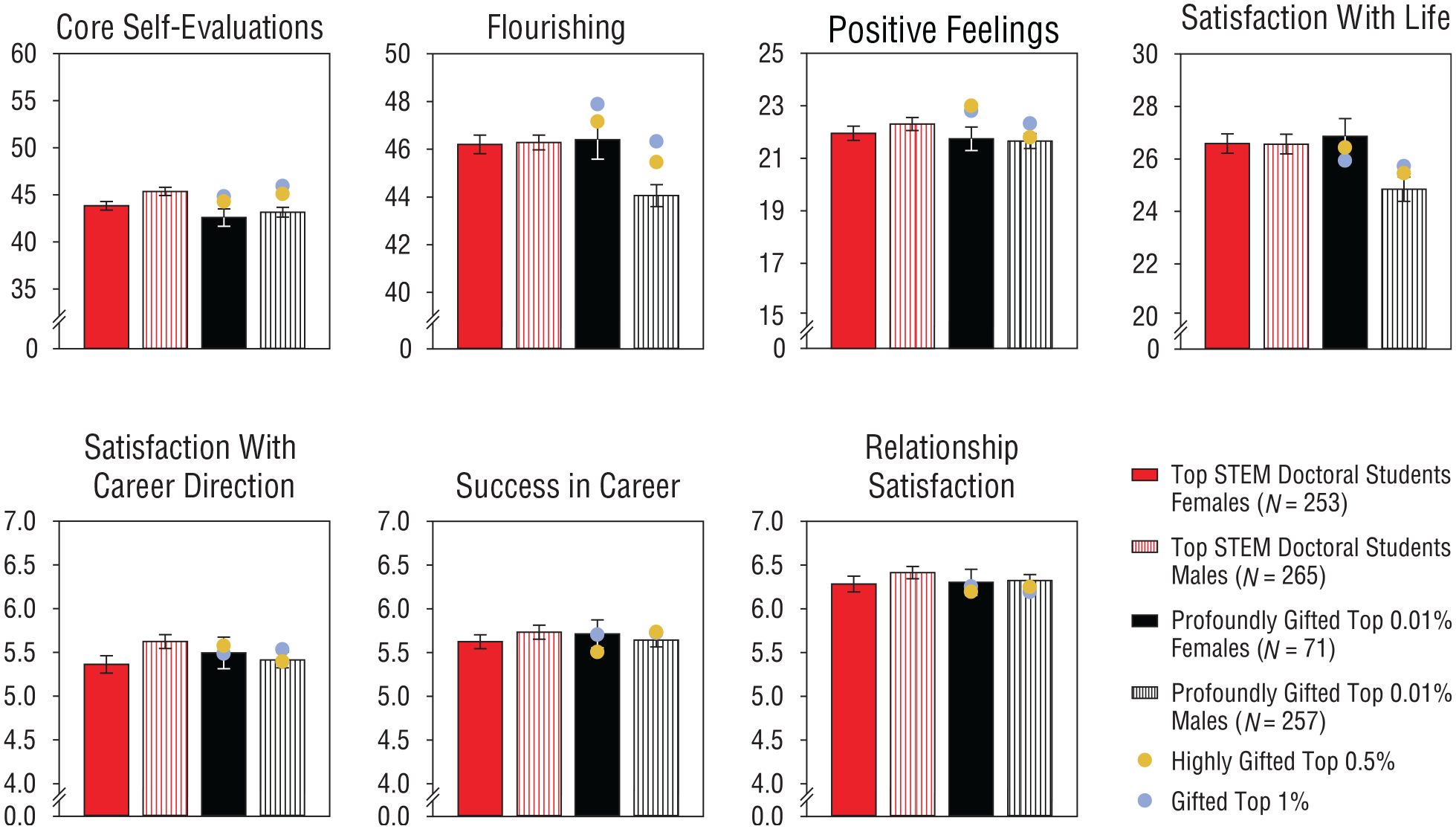
Mean scores for well-known measures of subjective well-being and life satisfaction (Top Row). The bottom row presents mean scores for items assessing participants’ satisfaction with the current direction of their professional career, feelings of success in their professional career, and relationship satisfaction (with “7” as the top possible score for each measure in question).
Discussion
Several decades of transformative change in society regarding gender roles have resulted in many more women entering the workforce and obtaining advanced educational credentials. In the U.S., women have earned more doctorates than men annually for years. Yet, we still see average gender differences in certain fields and at the highest levels of many professions. Women’s participation has risen, but not evenly, across disciplines or in their representation at the very top of many professions (National Science Board, 2022). Gender differences are especially marked in some STEM areas. In this study, we have examined some personal determinants that are oriented on lifespan development and life meaning. We focused on how lives are actually lived and the priorities underlying the choices made, after formal education has been completed, among women and men with profound intellectual gifts and world-class doctoral training in STEM.
At the conclusion of his leadership role working on the U.S. National Academies Report (2010), “Gender Differences at Critical Transitions in the Careers of Science, Engineering, and Mathematics Faculty,” co-chair Claude Canizares commented on the committee’s empirical findings: “While women can take some encouragement from the fact that there is no evidence of large-scale bias at these key transition points, the reasons for their continued underrepresentation need to be examined more closely” (Mervis, 2009, p. 1250). Canizares encouraged federal agencies and universities to gather longitudinal data on the career paths of women and concluded, “I’d suggest we start with our own graduate students” (Mervis, 2009, p. 1251), a position reinforced by more recent discourse and findings (Browne, 2023; Ceci et al., 2014, 2021; El-Hout et al., 2021; Gino et al., 2015; Stewart-Williams & Halsey, 2021a, 2021b; Williams & Ceci, 2015).
The current study does just that for the most academically and scientifically accomplished STEM doctoral students of their generation and for a group of individuals originally identified as profoundly gifted 12-year-olds, the most gifted of their generation. We collected prospective data on STEM doctoral students from programs ranked in 1992 as the very best in the world from the time they began graduate school to age 50 (Lubinski et al., 2001a). We then analyzed their accomplishments, life experiences, and personal views longitudinally. We did the same for profoundly gifted participants (who were roughly the same age as the STEM doctoral students); however, their tracking to age 50 started at age 12 (Lubinski et al., 2001b). Based on objective assessments and life records, the extraordinary potential of these cohorts is undeniable (Lubinski et al., 2001a, 2001b). As such, documenting how they invested their time and oriented their lives, and how they feel about those pursuits, provides powerful insight as to why women remain underrepresented at the top of many professions.
Our findings are particularly informative because groups of women with this much potential have never been extensively studied before (much less for multiple decades). Importantly, these individuals also came of age during a time of profound societal change. Until relatively recently, women were limited in their career choices; they could become nurses, teachers, and executive assistants, but not doctors, professors, or CEOs. That began to change slowly in the 1970s, just as SMPY’s oldest cohorts (gifted and highly gifted benchmarking samples) were adolescents (Lubinski et al., 2014). Thus, the women in SMPY come from the first generation of women to reach adulthood at a time of relatively greater opportunity for them, even if that opportunity was not fully equal or unaffected by everyday biases. As such, this is the first study to document how, over almost a 40-year time span, exceptionally talented women composed their lives, personally and professionally, and responded to changing societal norms as they became the exceptional individuals they were at age 50. One limitation of this sample is that it comprises mainly White and Asian subjects, yet there are no other samples like this to pursue these questions.
At outstanding levels of occupational distinction, the women in this study actualized their potential and did so comparably to the men. Essentially, 20% of women and of men in each focal cohort achieved truly outstanding high-impact careers and leadership positions by age 50 (see Table 1); there were no cohort or gender differences on a global metric of exceptional occupational prestige. 9 Both the women and the men were equally well-satisfied with the direction of their lives and had a strong sense of well-being and interpersonal connectedness. Yet, our analyses for the full samples also revealed persistent gender differences in some areas.
Opportunity requires the freedom to express one’s individuality (Dawis, 1992; Lubinski & Benbow, 2000, 2001; Tyler, 1992; Williamson, 1965). Women and men in our study appear to have done so with comparable levels of psychological well-being as well as personal and professional fulfillment. They expressed a conspicuous similarity in how much they believed family, relative to career and work, was central to creating a meaningful life. Nevertheless, they differed overall in how they realized that belief and commitment. Collectively, men prioritized their personal advancement, making money, and advancing society through knowledge creation, inventing material products, or leading impactful careers; women, while also finding those endeavors to be important, gave more precedence to keeping society healthy and vibrant. Women, overall, devoted less time to professional advancement and more to their families. Many preferred working part-time. Although the overall median family incomes of the women and men in both cohorts were comparable, ranging between $200K and $220K in 2017–2018, there was a trend for intellectually and scientifically brilliant women to have partners who earned incomes commensurate with theirs; conversely, there was a sizable difference between the larger incomes of the men and their spouses.
To be clear, there were many women in our study at the highest levels of their profession. The distributions of professional accomplishments were highly overlapping. Just as best practice in talent development has long maintained (Benbow & Stanley, 1996; Lubinski, 1996, 2000; Lubinski & Benbow, 2000, 2006), these findings underscore the importance of equal opportunity for all demographic groups (Worrell et al., 2019). Nonetheless, men in our study worked many more hours, and fewer worked part-time. Not surprisingly then, they averaged higher than the women on conventional indicators of professional accomplishment and success. 9 That this pattern was also evident for the STEM doctoral students was surprising as they not only possessed exceptional levels of the personal attributes needed to excel with distinction in STEM, but from adolescence and through their graduate study, women and men were intensely driven to develop STEM expertise and did so to the same degree (Lubinski et al., 2001a). Their drive and persistence in STEM propelled them to secure advanced degrees in STEM from some of the best universities in the world. That we found the same preference/priority pattern of gender differences in them and in the three cohorts of intellectually talented participants identified over a period of appreciable sociocultural change suggests that they could be robust and, therefore, have important implications.
To put the findings into a larger context, we see that these gender-differentiating tendencies mirror broad psychological themes, such as agency and communion (Bakan, 1966; Wiggins, 1991) or self-profitability and other-profitability (Abele & Wojciszke, 2007). Their relevance, moreover, goes beyond the economics of how family/work relationships are structured (Buss, 2019; Geary, 2021; Kahneman, 2011; Pinker, 2008; Rhoads, 2004). For example, we saw conspicuous and gender-differentiating strengths among the women in our sample that might be under-appreciated. The passions and values that many women in our study indicated as being important included a clear focus on and concern for community, health care, people in need, and the importance of inclusive public policies and human rights. Given the leadership potential of these scientifically-minded and intellectually brilliant women, ensuring that they have opportunities to express their talents and values could contribute to solving many of today’s most critical, complex local and global sociopolitical problems—for which solutions certainly would be noteworthy achievements. 10
Conclusion
The role of women in our society has undergone a major transformation in the last 50 years. Women in the U.S. now attend college at higher rates than men, and they earn doctorates in greater numbers. They constitute a substantial part of the workforce. Nonetheless, women remain underrepresented in some fields and top positions. Yet, at least in this sample of exceptional women and men, they are equally satisfied with the lives that they have constructed.
How can these outcomes be explained? Clearly, there are multiple ways to construct a meaningful, productive, and satisfying life. Although knowledge of a person’s abilities, educational/occupational interests, and opportunities is essential (Hoff et al., 2021, 2020; Lavrijsen et al., 2021; Lordan & Pischke, 2021), as centennial reviews of the psychological literature have well-documented (Dawis, 1992; Lubinski, 2016; Sackett et al., 2017), this knowledge alone is insufficient to understand subsequent development and what a person eventually becomes. Life priorities and personal commitments also must be considered. Doing so makes existing gender differences in professional accomplishments more understandable. Women and men with extraordinary potential and opportunity tend to embrace life’s various possibilities with different degrees of enthusiasm, which beckon them to follow contrasting yet equally satisfying paths. Thus, we find a lower representation of women at the very top of many professions, especially in STEM, partly because women engaged more heavily in family and community activities.
These findings lead to a conundrum: How do we strike the optimal balance between honoring each individual’s need—and right—to pursue a life that is most fulfilling against promoting a society built upon equal representation in highly varied occupational and societal roles by talented individuals from the diverse groups that compose it? Fully informing this question with the findings of psychological science requires going beyond the personal and environmental determinants of exceptional learning and work accomplishments. There are, after all, other significant influences and perspectives beyond educational and career development that give satisfaction and meaning to life.
Footnotes
Appendix
Acknowledgements
We thank Frank Miele, Gabriella Noreen, and Jessica Sommer for their comments on a prepublication version of the manuscript.
Declaration of Conflicting Interests
The author(s) declared no potential conflicts of interest with respect to the research, authorship, and/or publication of this article.
Funding
The author(s) disclosed receipt of the following financial support for the research, authorship, and/or publication of this article: Support for this investigation was provided by a research and training grant from the Templeton Foundation (61368), by the Eunice Kennedy Shriver National Institute of Child Health and Human Development under Award U54HD083211, by the National Science Foundation Graduate Research Fellowship Program, and by Schmidt Futures (ID 2023-2-2-5).
Open Science Disclosure Statement
The data analyzed in this study are not available for purposes of reproducing the results. The code or protocol used to generate the findings reported in the article are not available for purposes of reproducing the results or replicating the study. The newly created, unique materials used to conduct the research are not available for purposes of reproducing the results or replicating the procedure.
