



Abstract
Italy counts approximately 12 minority groups within its territory. Among these are the Ladins located in the Autonomous Provinces of Trento and Bolzano. This thesis is the first known sociolinguistic research on English loanword usage in Ladin publications and broadcasts, and individual perceptions of their use. Its findings were acquired from a survey of one Italian Ladin community’s perception of the use of Anglicisms. Combined, we find that many of the English loanwords being borrowed by Ladins are associated with technology, tourism, and business. Moreover, we find that while Ladins are critical of the use of loanwords, they do not perceive English as a threat to the preservation of the Ladin language. In addition, we find our sample is divided over whether new Ladin lexicon should be created to limit borrowing.
Introduction
The autonomous region of Trentino-Alto Adige (Trentino-South Tyrol), Italy, is multicultural and multilingual (Decarli, 2020; Riehl and Hajek, 2011). It is home to a majority Italian population, as well as minority German and Ladin communities (ISTAT, 2011). In 1972, after years of petition, the federal government of Italy officially recognised the German and Ladin languages within its territory (Darquennes, 2007; Voltmer, 2007). As a result, the Ladin achieved a “super protective status” in Italy (Decarli, 2020: 98).
Nonetheless, the Ladins of Marebbe, in Val Badia, Italy, are now facing another challenge to their language they are increasingly incorporating English loanwords into their mother tongue. For instance, a weekly Ladin publication by the Catholic parish of San Vigilio di Marebbe (Ploania Al Plan), printed on 14 March 2021, contained technology-specific English loanwords including “internet” “link”, and “download”. Furthermore, this bulletin also included the English term “drive-in”. Scholars refer to these English borrowed words as Anglicisms (Pulcini, 1999; Şimon et al., 2021). According to the literature, an Anglicism is a word or phrase that can be clearly attributed to the English language, whose “form (spelling, pronunciation, morphology, or at least one of the three)”, are borrowed by another language (Görlach, 1994: 224, in Pulcini, 1999: 360).
In response to the increasing appearance of English loanwords in Ladin, our research used a two-pronged approach to examine Anglicisms in Ladin and popular perceptions of their use. On the one hand, we identified English loanwords that appear in Ladin print or broadcast media available in Marebbe, Italy, to determine which Anglicisms are being used and in which resources and contexts they appear. The literature review lasted for one month and examined four types of publications. These sources were selected because they serve as the dominant print or broadcast media in the Ladin language in Marebbe, they are released on a regular basis, and they are important sources of news and information in the Ladin community. More specifically, we analysed the weekly Catholic parish bulletins Plata dla Ploania Al Plan and Plata dla Ploania La Pli; the spring issue of the Ladin quarterly magazine Le Saltà distributed in Marebbe; and the weekly newspaper La Usc di Ladins, distributed to all Ladin communities in Italy. Simultaneously, we monitored the Ladin daily television news broadcast Televisione Rai Ladinia (TRaiL) on Radiotelevisione Italiana (RAI) Südtirol for one month to identify Anglicisms used by its journalists.
During the second phase of our research, we measured Ladins’ attitudes in Marebbe. Using an online questionnaire to gauge respondent attitudes towards the use of English loanwords in the Ladin language, we sought to determine if our sample views English as a threat to Ladin. To our knowledge, this is the first study that examines loanword use in Ladin and the first that measures Ladin perception of lexical borrowing.
This article is organised as follows. First, it briefly details the history of the Ladin community and its language development. In this section, we contextualise some measures taken to protect the Ladin language prior to discussing the presence of English in Europe. Since English is a lingua franca, we note the increasing frequency with which English is studied by Europeans and how its lexicon is being borrowed internationally. Thereafter, we introduce our content analysis of the four written Ladin publications and the daily Ladin television news broadcasts. At this point, we identify which English loanwords appear in the publications analysed and in which context they are utilised. Afterward, attention turns to describing our survey of Ladins in Marebbe and analysing the data acquired. We close with a brief discussion, before noting several research limitations and offering recommendations for future research.
The Ladin Community and Language
Italy has an estimated 12 minority groups within its territory, each of which have their own unique language and culture (ISTAT, 2021). Among these minority groups are the Ladin populations located in the Autonomous Provinces of Trento and Bolzano (Dell’Aquila, 2010). In geographical terms, Ladins are largely concentrated in “five valleys in the Italian Dolomites: Val Badia, Gherdëina, Fascia, Fodom and Anpezo” (Darquennes, 2007: 124). According to 2011 statistics, there are more than 20,500 individuals in the Province of Bolzano that belong to the Ladin language group (ISTAT, 2011: 4). Combined, Ladins account for approximately 4% of the population in Bolzano province (ISTAT, 2011: 4). Our research focus, nevertheless, centres on one specific Ladin community in the Province of Bolzano, namely those living in Val Badia, in the municipality of Marebbe, where 92% of the inhabitants identify themselves as Ladin (ISTAT, 2011: 6).
The Ladin population dates back to 18,000 years ago when hunter-gatherers moved into the Dolomites (Dell’Aquila, 2010). Around 15 BC, these mountain dwellers began to interact with Roman soldiers, merchants and officials expanding into the area (Verra, 2016). The region, which the Romans called Ladinia, was eventually brought under Rome's control and divided into three administrative areas (Goebl, 2020). Under these circumstances, the Ladin language emerged as the Latin and Rhaetian (or ancient Celtic) languages were blended (Rubatscher et al., 2020). Under Rome's protection, Ladinia was generally insulated from population migrations until the Roman Empire's position declined around 476 BC (Goebl, 2020).
One consequence of the historical developments outlined was the creation of three primary Ladin speaking areas in contemporary Europe: the Dolomites and Friuli-Venezia-Giulia in Italy, and the Grison canton of Switzerland (Rubatscher et al., 2020; Verra, 2016). A similar consequence of their geographic division was the development of three variations of the Ladin language, which are considered unique language groups (Verra, 2016). Within this context, preservation of the Ladin language has been challenging. For most of its history, Ladin has largely been preserved orally (Rubatscher et al., 2020). While there are written documents dating back to 1532, Ladin was not officially codified until the second half of the 1800s (Rubatscher et al., 2020).
More recently, Ladin has faced increasing external pressure. Between 1943–1945, for example, South Tyrol was exposed to forced Italianisation that threatened both the German and Ladin communities residing in the province (Crepaz, 2018; Verra, 2016). Following the end of World War II, and increased political and social pressure to secure the rights of minorities in Europe, Italy's federal government eventually granted a Statute of Autonomy to Trentino-South Tyrol (Darquennes, 2007; Goebl, 2020; Verra, 2016). The 1948 statute offered a degree of protection to the Ladin community by granting certain rights, such as the right to establish independently managed Ladin schools (Darquennes, 2007; Riehl and Hajek, 2011).
However, the minority Ladin and German communities of South Tyrol found the 1948 arrangement insufficient for protecting their language and culture (Darquennes, 2007). Consequently, a 1972 statute was brokered with Rome. Among its concessions, the statute increased language protection of the German populations in Trentino-South Tyrol (Darquennes, 2007). Equally importantly, the decree made Ladin an official, protected language of Italy and permitted its use in the media (Riehl and Hajek, 2011; Uniun Ladins Val Badia, 2021). Building upon the statute, the German Worker's Association of Tyrol extended the same protection that South Tyrolian Germans had acquired to the Ladin minority in 1974 (Istitut Ladin Micurá de Rü, 2022a). As a consequence, the Ladin community was permitted to set the terms of their autonomy within South Tyrol, which among other protections, requested trilingual capacity be mandated among civil servants in Ladin regions and the establishment of the Istitut Ladin Micurá de Rü, an institution that promotes Ladin culture and language (Istitut Ladin Micurá de Rü, 2022a).
Another means of protecting Ladin language and culture addressed herein has been implemented by Ladins at the community level. There have been multiple attempts to preserve Ladin through language planning. These endeavours have largely focused on creating uniformity across Italy's varying Ladin versions (Rubatscher et al., 2020). Attempts to standardise the language date back more than a century (Darquennes, 2007). Uniun Ladins Val Badia (2021) notes that one attempt occurred in 1833, when a collective of linguists tried to organise and publish a book of Ladin grammar. Later, a commission attempting to standardise the language was established in March 1987 (Darquennes, 2007). However, the Ladin community of South Tyrol had expressed mixed support for standardisation. At that time, only 49% of respondents from Val Badia supported standardisation, and only slightly more than 50% considered the effort beneficial to the preservation of the language (Darquennes, 2007: 141).
Despite its marginal public support, language planning has experienced success. For instance, language experts developed a pan-Ladin, standardised language between 1994 and 1999, which is referred to as Ladin Dolomitan or Ladin Standard (Goebl, 2020: 54). While scholars believe its development will help preserve the language, some Ladins criticise it because they perceive that it clashes with their identity (Darquennes, 2007; Goebl, 2020). Nevertheless, La Usc di Ladins, a weekly newspaper produced by Uniun Generala di Ladins dles Dolomites [General Union of the Ladins of the Dolomites], is written in standardised Ladin and is distributed throughout the Dolomites’ communities. The paper started in 1949 and continues to offer its customers both printed and online content in Ladin Standard (Palfrader, 2019).
Due to the geographic and sociolinguistic conditions, most Ladins residing in Italy are bi- or tri-lingual, speaking Ladin (L1), German and Italian (L2 and L3). While Ladin families generally speak Ladin at home and within their community, being fluent in Italian and/or German is a necessity. On the one hand, Italian and German speaking populations, that have little or no passive knowledge of Ladin, geographically surround Ladin communities. Consequently, a journey beyond the borders of the municipality guarantees that Ladins will have to rely on their L2 or L3 to communicate. On the other hand, many of the Ladin valleys have local economies with a sizeable tourism infrastructure. Within this frame, German (50%) and Italian (30%) tourists account for the majority of visitors to South Tyrol (de Rachewiltz et al., 2020), so knowledge of Italian and German is essential. Within this context, Ladins regularly utilise multiple languages, nonetheless most identify themselves as Ladin.
Language Evolution and Purism
Languages naturally evolve (Trudgill, 2000; Wen-Chao Li, 2004) and this evolution usually occurs over longer periods of time (Chater and Christiansen, 2009). Changes in a language can occur because of internal or external factors, and these developments can impact a language by altering phonology, grammar, and even lexicon (Wen-Chao Li, 2004). Hickey (1999), for instance, highlights contemporary phonological changes occurring in Dublin, Ireland, including vowel shifts. He speaks of a “fashionable” Dublin English phonology where speakers consciously try to use and/or avoid certain vowel sounds (Hickey, 1999: 272). This is an example of an internally initiated change.
By comparison, an external influence can likewise lead to an evolution in a language. One way in which this may occur is through the process of word borrowing. In this capacity, English is a notable external influence on languages internationally (Meyerhoff, 2011; Pulcini, 2019), and its lexicon is one of the most borrowed (Kowner and Rosenhouse, 2008). Its influencing potential can be partially explained by the relative dominance of English as an international lingua franca (Jessner, 2008; Meyerhoff, 2011). Lingua franca, as utilised here, suggests that a language is popular for communicating across diverse language groups (Komori-Glatz, 2018; Meyerhoff, 2011). Nevertheless, public sentiment toward external influence on their language, such as through word borrowing, can range from general acceptance to outright rejection (Hansen et al., 2018; Kowner and Rosenhouse, 2008). Those that ascribe to the latter group may seek to preserve and protect their mother tongue by constructing barriers to limit change.
The literature refers to measures designed to protect a language from internal or external influence as linguistic purism or language planning (Ayres-Bennett, 2020; Hansen et al., 2018; Trudgill, 2000). Nonetheless, there are different theoretical models for conceptualising purism, with published definitions being broad and overlapping (Ayres-Bennett, 2020). To provide theoretical foundation, Thomas (1991) offers a concise definition of purism that is useful. He defines purism as: the manifestation of a desire on the part of a speech community (or some section of it) to preserve a language form, or rid it of, putative foreign elements or other elements held to be undesirable (including those originating in dialects, sociolects and styles of the same language). It may be directed at all linguistic levels but primarily the lexicon. Above all, purism is an aspect of the codification, cultivation and planning of standard languages. (Thomas 1991: 12)
Within this framework, language purists or protectionists take measures (language planning) to insulate their “pure” language from internal or external forces, the latter of which are considered “impure” or corruptive (Thomas, 1991: 36).
Broadly speaking, language planning can be implemented at various intensities and may be motivated by numerous political and/or social circumstances (Hansen et al., 2018; Trudgill, 2000). For instance, purism might be advocated as a result of in-group bias, nationalism, or cultural/social conservatism (Hansen et al., 2018; Kowner and Rosenhouse, 2008; Thomas 1991). However, when implemented in a fair and equitable manner, Trudgill (2000: 131) argues that language planning “can be both necessary and commendable”, for instance in multilingual regions where establishing a standardised or common national language might be mutually beneficial.
Numerous countries have engaged in, or continue to employ, purist policies. France, China (Wen-Chao Li, 2004: 105–107), and Poland (Hansen et al., 2018), to name a few, have used their governments and cultural agencies to language plan. In China, for instance, the government has promoted the standardisation of the Chinese language as a means of reinforcing language purity and building its resilience to external pressures (Wen-Chao Li, 2004). However, sometimes language planning can take on radical forms. Trudgill (2000: 48), for example, denotes the “lexical cleansing” measures carried out in the Serbian and Croatian languages in the 1990s. Determined to demonstrate their autonomy and language individuality, both ethnic groups eliminated words from their respective languages according to the perceived origins of the vocabulary.
Despite its purpose or reasoning, language planning is not without its complications or critics. Concerning the former, Wen-Chao Li (2004) reports one consequence of the practice may be the creation of internal competition between local and regional dialects. Dialects, as conceptualised here, refers to “differences between kinds of language which are differences of vocabulary and grammar as well as pronunciation” (Trudgill, 2000: 5). These competitions can manifest at multiple levels as planners manage a language. For instance, in China, language planning can create friction across dialects of Chinese (e.g., Mandarin, Min, Gan) and within a dialect (e.g., Shanghai Mandarin, Sichuan Mandarin, Beijing Mandarin) (Wen-Chao Li, 2004). Such friction can lead to discrimination of dialects or may result in language denigration and possible extinction (Trudgill, 2000).
McLelland (2021), a critic of language planning, argues that standardisation efforts presume monolingual citizens are the norm. In this instance, language is perceived to be static, and individuals are seemingly dissuaded from using multiple languages. Under these circumstances, borrowing foreign words or code switching would be rejected (McLelland, 2021). However, in a globalised and increasingly integrated world, insulating a language from external forces is challenging. It is especially difficult in Europe, where multilingualism is encouraged at the regional level.
English as a European Lingua Franca
Internationally, there is an increasing number of individuals that speak multiple languages, a capacity referred to as multilingualism (Cenoz, 2000; Jessner, 2008). In fact, numerous regions throughout Europe are bilingual or trilingual (Jessner, 2008; Trudgill, 2000). To further expand language knowledge among citizens across the region, the European Union is pursuing an initiative that promotes multilingualism among its citizens (European Commission, 2008; Jessner, 2008). According to the European Commission (2021), multilingualism benefits Europeans by increasing mobility within the union, promoting European unity and generating economic prosperity, among other advantages.
Within this context, an increasing number of individuals are learning a second and third language, with English being a popular option (Jessner, 2008; Trudgill, 2000). According to one study, approximately 28% of European citizens (post-Brexit) know the language well (Ginsburgh and Moreno-Ternero, 2017: 1775–1776). In multilingual South Tyrol, German and Italian speaking students learn English as a third language (L3) (Jessner, 2008), with German or Italian being L1 and L2. By comparison, the Ladin community of South Tyrol studies English as a fourth language (L4). Ladin children attend Ladin kindergartens, elementary and middle schools, where they learn Ladin (L1) as well as German and Italian (L2 and L3). English is introduced in Ladin elementary schools in the fourth grade. In this context, South Tyrol is at the forefront of the European initiative to promote multilingualism.
There are numerous reasons why English is commonly taught to European students of all ages. Without question, English has steadily increased in importance since the late 20th century (Kowner and Rosenhouse, 2008; O’Regan, 2014), resulting in it becoming a lingua franca in the union (James, 2000; Kartushina and Martin, 2019; Trudgill, 2000). Although its spread is sometimes negatively associated with globalisation and mass media (Kowner and Rosenhouse, 2008; Meyerhoff, 2011; O’Regan, 2014), English language learning continues to be both appealing and beneficial.
As a lingua franca, English is a common language for international leisure and business travel (Henry, 2013). Similarly, English is sometimes the shared language spoken between immigrants and inhabitants of their host country (Jessner, 2008). Nonetheless, there are additional factors that make learning English appealing. Pulcini (2006) argues that the public sometimes perceives English as sounding modern and intellectual. It is unsurprising, therefore, to find that students often prefer to learn English by comparison to other foreign languages (Jessner, 2008). Identifying these motives aids our understanding of why certain English words are borrowed, as examined in the next subsection.
Despite its benefits, negative sentiment towards English as a lingua franca can likewise be found in the literature. For instance, some scholars argue that a hierarchy of languages is created where English is viewed as superior or preferred to other languages (Canagarajah, 2006; Kowner and Rosenhouse, 2008; Trudgill, 2000). O’Regan (2014) similarly laments that power and dominance are often associated with English promotion and prominence. Finally, Flammia and Saunders (2007) suggest that in certain circumstances, English is imposed, such as on the internet, where nearly 30% use it to communicate. Nevertheless, many students continue to learn English, and English vocabulary is being steadily adopted into other languages, including Ladin.
Borrowing
In academic literature, the term borrowing refers to the adaptation of foreign lexicon, grammar or syntax into another language (Haspelmath, 2009; McLaughlin, 2013; Meyerhoff, 2011; Trudgill, 2000). Since our research is limited to lexical borrowing, we focus our attention on this single aspect. To understand the practice, Kowner and Rosenhouse suggest borrowing: occurs when speakers of a language begin to incorporate into their own lexicon, or metaphorically ‘borrow’ (without the need for permission) a foreign word (‘loan word’). The process of borrowing requires at least some contact between the two languages, rudimentary understanding of the meaning of a word and a minimal tendency to bilingualism. These nominal requirements may lead to occasional borrowing of a few words, but in many cases end with massive borrowing, amounting to thousands of words. (2008: 12)
From this quote, we observe that at least two languages are being utilised in close proximity, and one language group elects to borrow lexicon from the second. While borrowing is a common occurrence in languages (Meyerhoff, 2011; Trudgill, 2000; Zenner et al., 2019), attitudes toward it vary. Some of the public view the process as natural and enriching, while others view it as threatening and corruptive (Hansen et al., 2018).
The above quote also introduces the term loanword. Linguists broadly identify a “loanword” as a word that is borrowed from one language and utilised in another (Haspelmath, 2009; Peperkamp, 2004; Pulcini, 2019). Within this framework, the language that borrows a word can be referred to as the recipient language, while the language that provides the loanword is identified as the donor language (Haspelmath, 2009).
To be identified as a loanword, Haspelmath (2009: 43–44) argues they should “have a shape and meaning that is very similar to the shape and meaning of a word from another language from which it could have been taken”. However, loanwords can undergo adaptation in the recipient language, meaning that they may become “localized” or “nativized” in their form or function (Meyerhoff, 2011; Peperkamp, 2004; Trudgill, 2000). For example, the way in which a loanword is pronounced will likely follow the “sound structures” of the recipient language as opposed to that of the donor language (Peperkamp, 2004: 346–347). Equally important, Trudgill (2000) points out that some loanwords are actually manufactured analogies. Providing an example, Trudgill (2000: 164) references the German borrowing of “the non-existent English word ‘Pullunder’ for a sleeveless” shirt.
The literature offers numerous explanations for why words are borrowed from other languages. Among them, Kowner and Rosenhouse (2008: 12–13) suggest borrowing occurs to label new concepts, such as technological and cultural developments, or to “emulate a dominant group”. Others argue that groups have a tendency to create and utilise special lexicon, a practice that can be driven by its fashionable nature or the dominance of a language within a given context or community (Haspelmath, 2009; Pulcini and Milani, 2017; Şimon et al., 2021; Trudgill, 2000). In a nutshell, Zenner et al. (2019) deduce that words are borrowed to fill lexical gaps, to project social meaning, and to increase cohesion among a group. Nevertheless, Haspelmath (2009) cautions that providing an explanation for why borrowing occurs is not as straightforward as scholars might suggest, since new words can just as easily be created.
Research on Anglicisms in Ladin
There is a large body of research on English loanwords (Pulcini, 2019; Zenner et al., 2019). English is impacting most European languages, especially in fields such as technology and science (Pulcini and Milani, 2017; Trudgill, 2000). The spread of mass media, including international news networks, and expanding access to the internet has helped to increase borrowing (Kowner and Rosenhouse, 2008; Meyerhoff, 2011). In addition, increased English language learning in public and private schools around the world likewise proliferates language exposure and language mixing (Trudgill, 2000).
Haspelmath (2009) argues that borrowing likely occurs as a result of bilingual interaction and convenience if purist measures are not imposed. English loanwords are not only being adopted by major languages like Italian, but they are also being incorporated into minority languages such as Ladin. We can observe this phenomenon in Marebbe, Italy. Their increasing appearance in Ladin print and media broadcasting is, nevertheless, curious since many Ladins desire to protect their language. The remainder of this essay examines which English loanwords are appearing in Marebbe, Italy. It likewise gauges this community's perception on the topic.
Language is an important component of individual and collective identity (Meyerhoff, 2011; Trudgill, 2000). Data show that 92% of Val Badia's inhabitants declare themselves as Ladin (ISTAT, 2011: 6). According to a 1998 survey, around 90% of respondents from the area claimed to speak Ladin with their neighbours (Darquennes, 2007: 126–127). Similarly, more than 85% used Ladin with the youth, civil servants, and priest in their community (Darquennes, 2007: 129). 97% of those respondents claimed to use Ladin in local shops and when interacting with friends (Darquennes, 2007: 133). Finally, 73% of Ladins from Val Badia claimed to read books, magazines or other publications in Ladin, while 60% watched television programs in Ladin (Darquennes, 2007: 134). These statistics show that Ladins closely identify with their language and culture.
However, the Ladin language is facing a dilemma. It is witnessing a steady increase in English loanwords in publications and regional media broadcasts. This tendency was highlighted in the weekly Ploania Al Plan (14 March 2021) produced by the church parish of San Vigilio di Marebbe, where non-technology English loanwords were observed. Their appearance raises questions about why this vocabulary is being borrowed, in which context the lexicon is being utilised, and how the local community perceive them. We first examine the findings from our content analysis of Ladin media before outlining our survey results.
Identifying English Loanwords in Ladin Publication and Broadcast
There is dissention in the literature over which words should be classified as loanwords. Pulcini (2019: 124–125), for instance, considers the Italian use of “computer” and “tablet” as Anglicisms despite the fact that these words are Latin-based. By contrast, Haspelmath (2009) develops a more restrictive framework for identifying a loanword. Speaking to her peers, she demands that “[m]ost importantly, of course, we need to exclude the possibility of [a loanword's] descent from a common ancestor, which is a very common reason for word similarities across languages” (Haspelmath, 2009: 43–44). Under the more rigid framework, “computer” and “tablet” would be excluded as English loanwords in Italian because they have Latin origins. When identifying loanwords, we selected Pulcini's (2019) more inclusive approach. This decision was made because we believe that Pulcini’s (1999) methodology better reflects Görlach's (1994: 224, in Pulcini, 1999: 360) definition of Anglicism. Nevertheless, we crosschecked our lists with the Global Anglicism Database Network (GLAD) (2017) to confirm the words identified from our study qualify as Anglicisms.
From mid-April to mid-May 2021, the authors analysed the content of Ladin print media available in Marebbe to identify English loanwords. Combined, we analysed two weekly Catholic parish bulletins, the Ladin weekly newspaper, and the spring issue of a quarterly magazine distributed by the local government of Marebbe. Both researchers independently read each publication and documented the English loanwords found. Subsequent to identifying loanwords in each publication, the researchers compared their findings to create a single list of vocabulary identified by source. In conjunction with analysis of print media, the researchers monitored the Ladin daily TRaiL television news broadcast for one month to identify loanwords used by its journalists. Since written transcripts are unavailable for the daily, five-minute broadcasts, the researchers independently watched each broadcast and manually documented loanwords. These findings were likewise compared to create a single list of vocabulary identified according to the date of its broadcast.
For analytical clarity, the researchers created three categories of English loanwords: “technology”, “business names/titles”, and “other”. These categories were used for several reasons. First, many words associated with technology, such as “email” or “download”, are borrowed, most likely because of the prevalence of their use internationally and the importance of the English language in the field of technology (Pulcini and Milani, 2017: 175–176). Second, while the researchers wanted to identify loanwords, business names or titles (e.g., musicals/songs) were excluded because Ladin publications or broadcasters have a limited capacity to avoid using English loanwords when a business or body incorporates them into names or titles. For instance, “Green Pass”, the electronic system developed by European governments for verifying SARS-CoV-2 (COVID-19) vaccinations, was not considered because the media which referenced this system would have no alternative but to refer to the pass by name. Lastly, the authors created a third category for words that were not associated with technology. Our content analysis of each resource is outlined in the following subsections. We first provide a brief background of each of the resources prior to identifying loanwords and contextualising several of them.
Ploania Al Plan
Plata dla Ploania Al Plan is a weekly bulletin produced by the Catholic parish in San Vigilio di Marebbe/Sankt Vigil in Enneberg. It is released every Saturday and made available in print and online. It largely consists of prayers and scripture in Ladin, yet also publishes the weekly schedule of church services. Finally, it provides local public service announcements. The average word count of each of the five Ploania analysed is 1400 words.
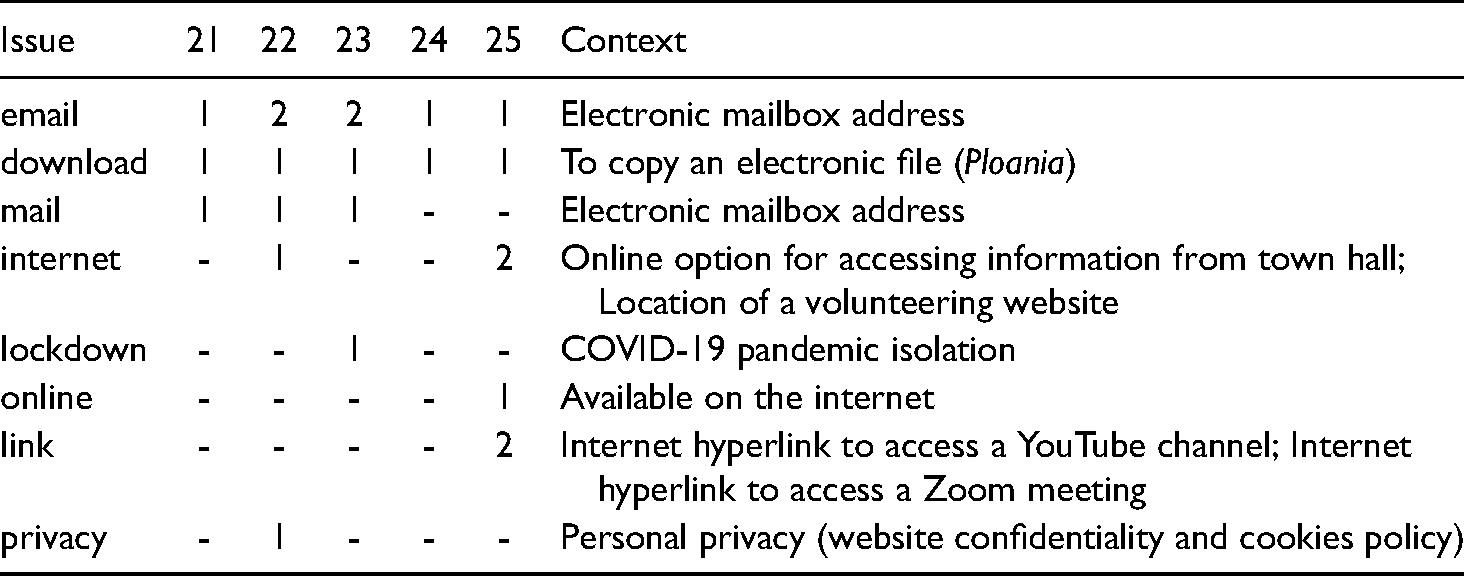
Our analysis shows that eight different Anglicisms appear in the four bulletins analysed. A clear majority (n = 6) is related to technology. The Ploania Al Plan's (2021, number 21; 2021, number 22; 2021, number 23; 2021, number 24; 2021, number 25) most frequently used loanwords are “download” and “email”. See Table 1 for the loanwords identified, the context in which they are used, and their frequency of appearance in each bulletin. Certain loanwords appear regularly because they are incorporated into the header or footer of the bulletin. Embedded within the header are the name of the priest [Ploan], the parish church's telephone number [Calogna Al Plan], the radio frequency [Radio de Ploania] on which church services are broadcast in Ladin, and:
Plata dla Ploania – Al Plan de Mareo.
“(The priest’s)
Combined, the header displays these details in list format.
Similarly, the footers provide the reader with additional data, including the street address of the church, as well as a website address:
“
In this manner, the reader is informed where they can access a digital copy of the weekly bulletin online.
Technology words beyond those identified in the header and footer of the Plata dla Ploania Al Plan were also identified in public service announcements. For example, bulletin number 22 (25 April 2021) informs parents that registration for the municipal soccer club is open:
… contaté l’uniun ala
“…contact the (soccer) club by (e)
In this example, we observe that Ladin uses “mail” and “email” interchangeably. “Mail” is regularly utilised in this manner as observed across multiple sources analysed in this study.
Only one loanword unrelated to technology appeared in the Ploania Al Plan bulletin number 23 (2 May 2021). Informing parishioners that the rosary would again be prayed at a local chapel, readers are informed:
Do che ara n’é l’ann passé nia garatada por le
After that it did year last not worked for the
“After not being able to (organise) the rosary because of last year’s
“Lockdown” refers to the stay-at-home orders issued by the Italian government during the COVID-19 pandemic. Its use in this context is expected as the term was widely adopted in Italy (Pareschi, 2021) and across Europe.
Overall, a clear majority of the loanwords identified in this publication are related to technology. The singular exception, “lockdown”, was broadly adopted in Italy and across Europe.
Ploania La Pli
Plata dla Ploania La Pli is a weekly publication produced by the Catholic parish in La Pli di Marebbe. It is released every Saturday and made accessible in print and electronic versions. The bulletin largely consists of prayers and scripture in Ladin, but also provides a weekly church schedule as well as public service announcements. The average word count of each of the five Ploania analysed is 1540 words.
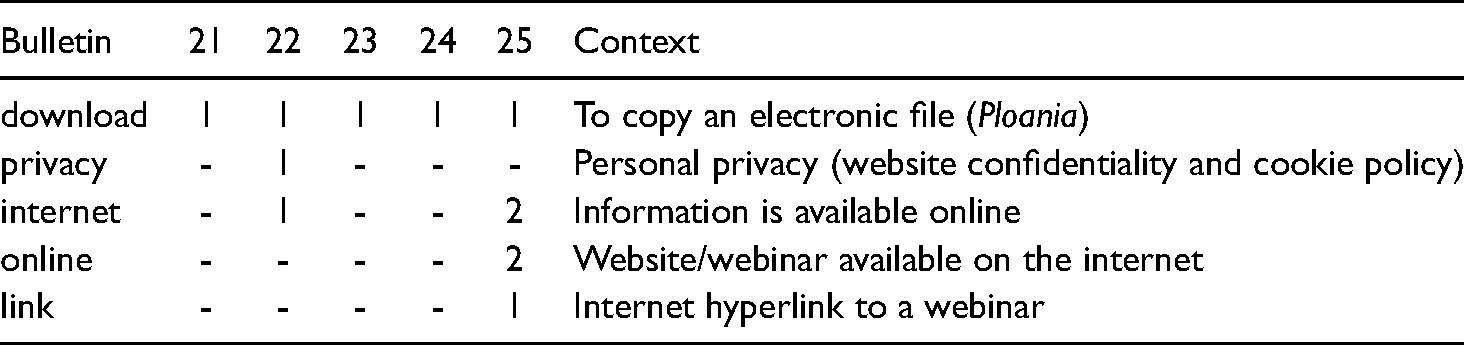
Only five English loanwords were observed in La Pli's Ploania during of our study. Every instance identified is related to technology (Ploania La Pli 2021, number 21; 2021, number 22; 2021, number 23; 2021, number 24; 2021, number 25). See Table 2 for a list of the loanwords identified, the context in which they were used, and their frequency of appearance in each bulletin. Download appears regularly (n = 5) because it is embedded in the footer where a web address is provided to download the Ploania from the internet. Other technology loanwords, including “internet” and “online”, are used to notify of information accessible on the internet.
Plata dla Ploania – La Pli de Mareo.
Another technology loanword that appears is “privacy”. La Pli's parishioners are notified of the possibility to register for a COVID-19 nasal swab through a provincial website. Issuing a precaution, the Ploania La Pli (25 April 2021) instructs:
Liéde ince l’enformativa sön la
Read also the information on the
“Also read the
“Privacy” is utilised in this context to refer to online privacy. The Ploania first provides the internet address where individuals can register for an appointment, before reminding the reader that they will be entering their personal data online. Consequently, the text author recommends that users read the website's “Privacy Policy”.
In another instance, the Ploania La Pli (16 May 2021) uses two loanwords while notifying parents of an educational webinar being conducted by a child psychologist. After identifying the webinar topic and host, the Ploania provides the hyperlink where parishioners can log on and attend:
“(The)
Combined, all of the loanwords identified in the Ploania La Pli are related to technology for which there is no alternative vocabulary available in Ladin. We believe that these English words were borrowed since English is an influential language in the technology sector (Flammia and Saunders, 2007) and many have been borrowed into Italian (Pareschi, 2021).
Le Saltà
Le Saltà is a quarterly magazine issued by the municipality of Marebbe that is written in standardised Ladin. Its contents include local budgetary matters, urban planning, and administration decisions. It likewise highlights upcoming events and initiatives of community interest. The publication is free of charge and automatically distributed by the municipality to households in Marebbe through the post.
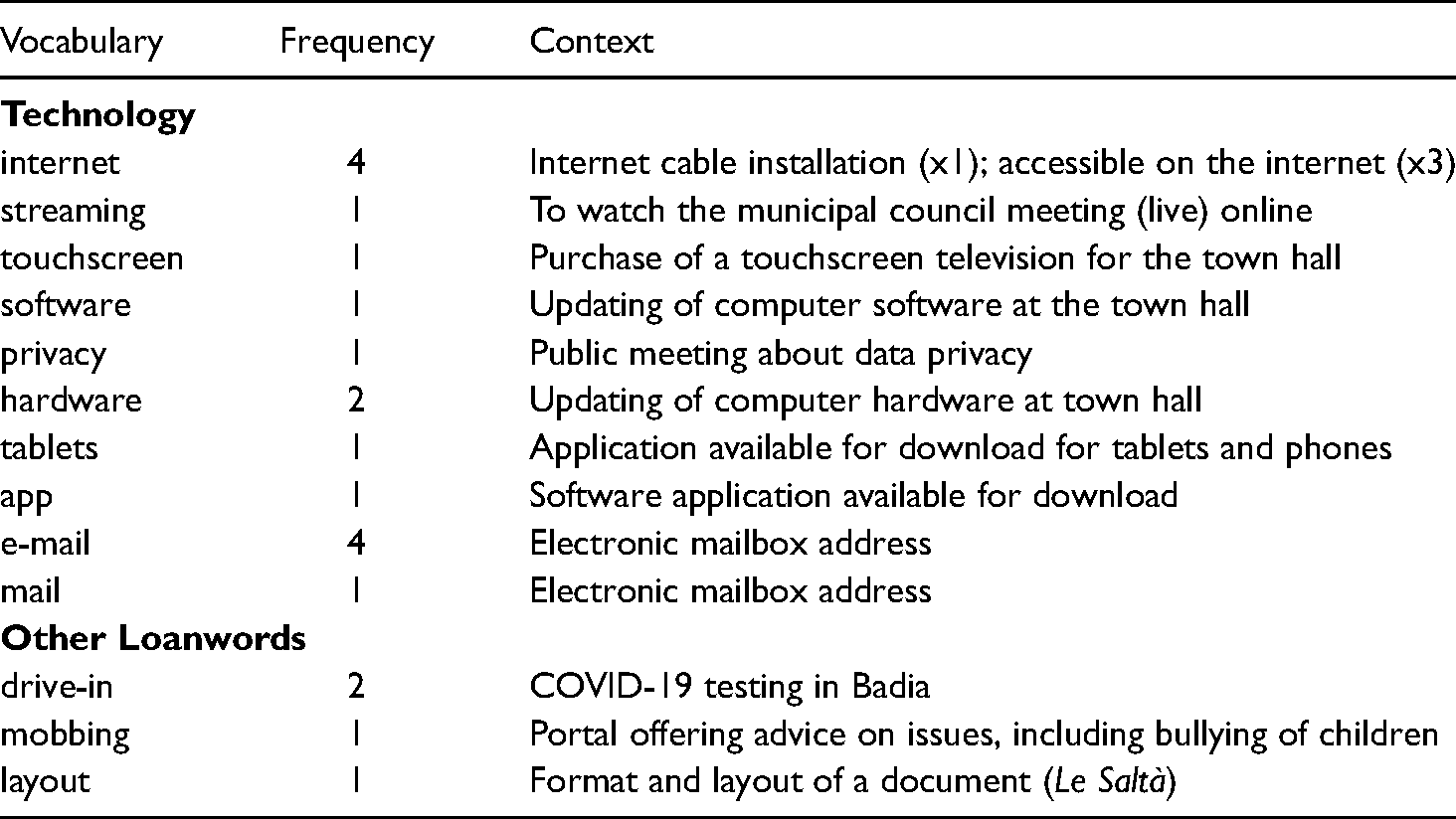
The spring edition of Le Saltà (2021) is 24 pages long and contains 13,678 words. Among those, we identified 13 individual loanwords in our analysis, with several of them repeating (e.g., “internet” (n = 4); “email” (n = 4)). See Table 3 for the English loanwords identified, the context in which they were used, and their frequency of appearance in the publication. Approximately three quarters are associated with technology (n = 10) and are presented in the context of describing technology or technological assistance acquired by the town hall using municipal budget. For instance, “touch-screen” is used to describe a television purchased for the town hall (Le Saltà, 2021: 4), and “software” and “hardware” describe the updating of town hall computers by an external service provider (Le Saltà, 2021: 7).
Le Saltà.
In addition to the technology-related loanwords, three unique English words were identified in the publication. The first analysed is “drive-in,” which appears twice in a short announcement of a COVID-19 testing area that screens patients in their automobiles (Le Saltà, 2021: 22). “Drive-in” appears once in a paragraph that informs the public that the “drive-in” COVID-19 testing site is operational. It reappears in a caption beneath an accompanying photograph of the testing area (Le Saltà, 2021: 22). The caption states:
Le “drive-in” por fá tesć antigenics, sön Badia.
The “
“The ‘
Since Ladin does not have a word to express a facility is accessible by automobile, as the term “drive-in” suggests, the term was borrowed to describe the COVID-19 testing site. It should be noted, however, that “drive-in” is likewise used in Italian to describe COVID-19 testing sites where citizens remain in their cars. Consequently, Ladin has most likely indirectly borrowed the term.
The second unique loanword identified in the Le Saltà is “mobbing”. This term is found in the context of a provincial internet portal that offers advice on issues ranging from marital problems to parenting issues (Le Saltà, 2021: 23). Illustrating questions that a parent might be seeking answers to on the platform, the Le Saltà proposes:
„Co pói pa sconé mio möt dal
“How can I protect my child from mobbing?”
In this instance, Ladin has a noun to express “mistreatment” [tichinada] and a verb that means to “pick on” or “torment” [tichiné]. However, we believe that the term “mobbing” has been indirectly borrowed from Italian law (Aimo, 2018), and it has become widely used in Italy.
The last loanword analysed from this quarterly is “layout” (Le Saltà, 2021: 23). The term appears when giving credit to the individual that formatted and designed the spring issue of Le Saltà:
Redaziun y
“Editing and
Since Ladin does not have a word to express the organisation and formatting of a document, the English term “layout” is borrowed. Once again, we believe that “layout” may have been borrowed from Italian, where it can be used to describe a keyboard layout [layout tastiera] and an electronic document's appearance and arrangement.
In total, most of the loanwords appearing in La Saltà are related to technology (70%). The remaining three unique loanwords identified are used in the context of publication formatting (“layout”), a COVID-19 testing facility that is accessible by vehicle (“drive-in”) (n = 2), and bullying children (“mobbing”). It is likely that the last two were indirectly acquired through Italian.
La Usc di Ladins
La Usc di Ladins is a weekly newspaper produced by the General Union of the Ladins of the Dolomites that is published in standardised Ladin. The paper began publishing in 1949 but was renamed in 1972 (Palfrader, 2019). It covers national and international news, but simultaneously devotes multiple pages to news from each of the five Ladin valleys. While La Usc di Ladins is sold in print, its website offers free online content.
The newspaper uses numerous English loanwords across the five newspapers analysed ( La Usc di Ladins, 2021, number 14 ; 2021, number 15; 2021, number 16; 2021, number 17; 2021, number 18). Due to the large size of the publication, we limited our focus to the sections that cover general news from the Ladin valleys of Italy and news from Val Badia. On average, 12 pages were analysed per issue and contained an estimated 6000 words total. From these sections, we identified 20 different technological terms, many of which repeat. “Online” (n = 11), “internet” (n = 7) and “email” (n = 3) were the most common loanwords found across publications. See Table 4 for a list of the technology loanwords identified, the context in which they were used, and their frequency of appearance.
La Usc di Ladins - Technology.
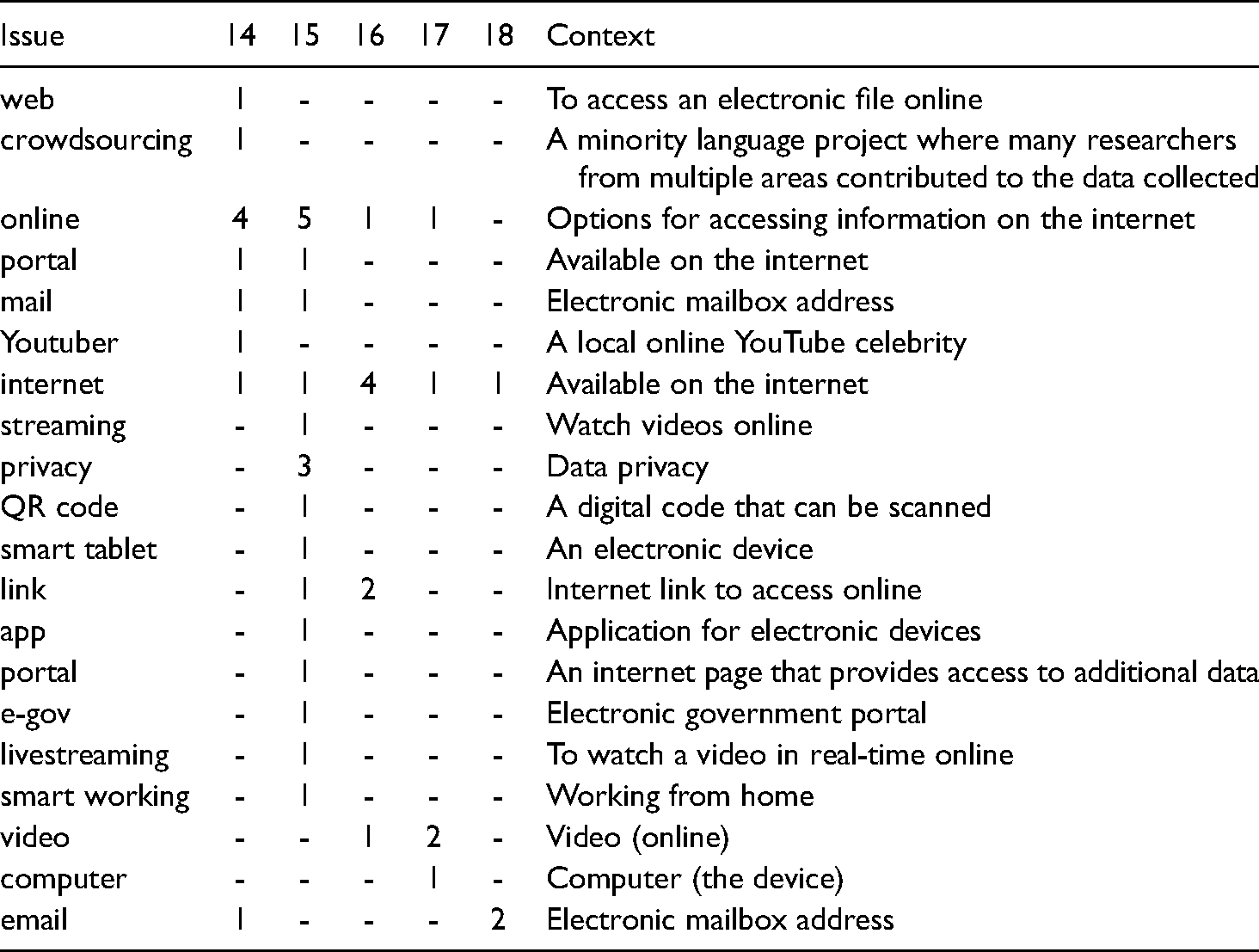
In addition to the technology loanwords identified in other sources, La Usc di Ladins (16 April 2021) contained several unique technology words, such as “Youtuber”, “portal”, and “crowdsourcing”. For instance, “crowdsourcing” appears in an article about a joint university project (16 April 2021) between Verona, Trento and Bolzano, where researchers uploaded data on minority languages onto a cloud database. The article states:
… regoer travers
… collect through
… through
Since Ladin lacks a single term to describe a collective working together (online) to achieve a common objective, selecting to borrow “crowdsourcing” seems logical. The alternative in Ladin would require the use of multiple verbs to express “to meet and work together online” [se incunté y lauré adöm online] and would have required the use of the loanword “online”. We hypothesise that the author has acquired “crowdsourcing” from a university press release, the project website or another news outlet (see, for example, Vinko (2022)), meaning that it was most likely borrowed indirectly.
Turning our attention to non-technology loanwords identified in La Usc di Ladins, we found 24 English loanwords in the five publications examined. See Table 5. Among these, “lockdown” (n = 8) and “newsletter” (n = 7) were the two most utilised loanwords. The former, as outlined above, is used in the context of the isolation period mandated throughout Italy during the COVID-19 pandemic. By comparison, “newsletter” appears frequently in a single issue (16 April 2021) either at the end of articles featuring a business that is seeking “newsletter” subscribers (n = 5) or to refer to the La Usc Ladins (n = 2).
La Usc di Ladins – other.
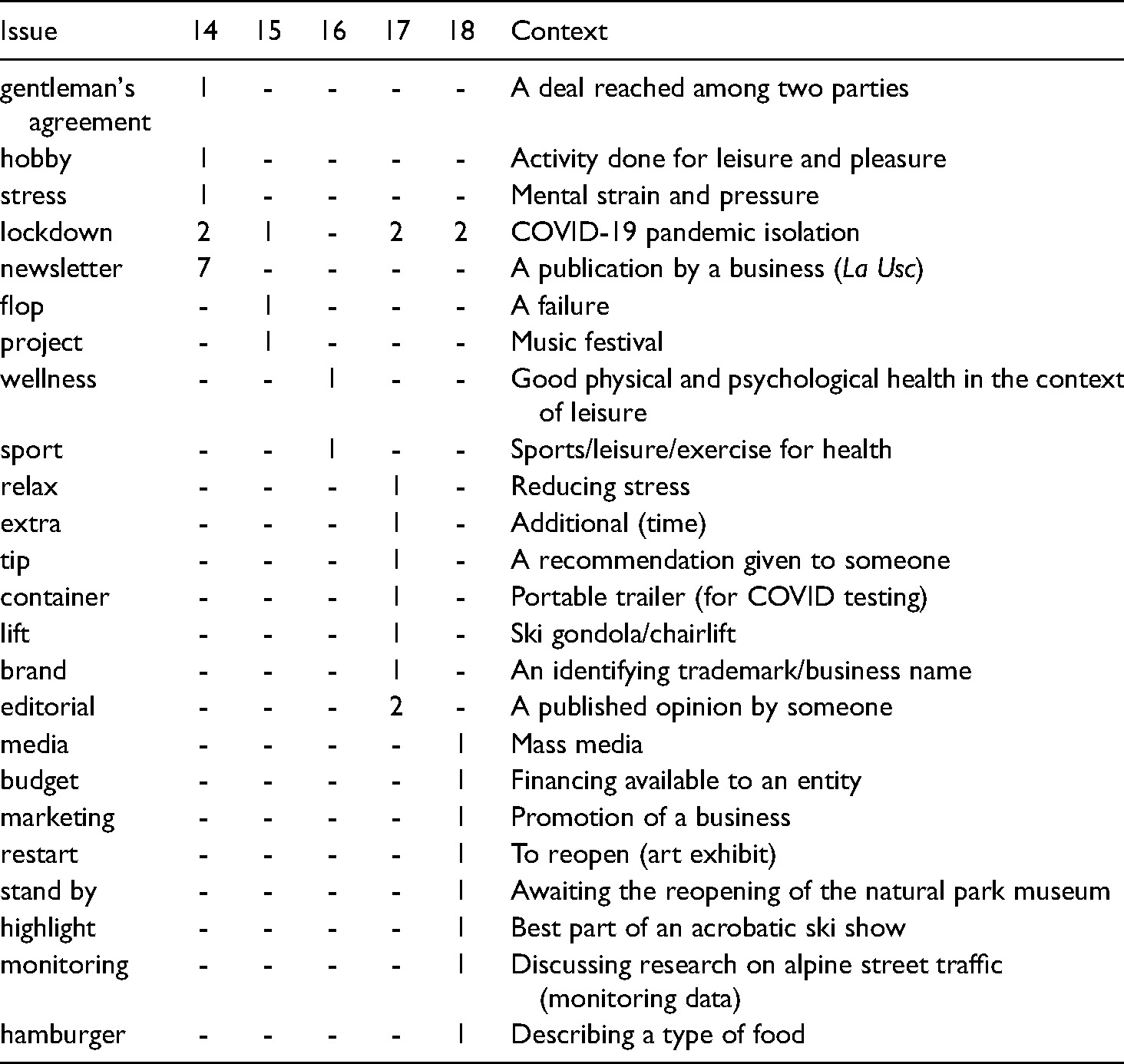
The next loanword analysed herein appears in an article about the Parks Department found in Issue 18 (14 May 2021). It describes two of the responsibilities of this body as:
…planificazium y
…planning and
The appearance of “monitoring” is curious as Ladin has nouns which would have functioned in this context. For instance, the journalist could have used “surveillance” [verda] or “control” [control] to express the same concept. Nevertheless, we surmise “monitoring” was borrowed from South Tyrol's Department of Nature [Amt für Natur], as two of its tasks, as expressed in German, are “Planung und Monitoring” (planning and monitoring). Therefore, “monitoring” most likely has been indirectly borrowed from the Department of Nature.
Of equal interest was a borrowed expression that appears in La Usc di Ladins. While discussing the nomination of the Istitut Ladin's council, the journalist notes that representatives of certain elected positions at the institute alternate between Val Gardena and Val Badia (16 April 2021). Embracing this arrangement, the journalist recommends:
N te’ “
Such a “
Such a “
The use of “gentlemen’s agreement” is informing. Ladin has an expression for an “understanding” or “deal” being reached [se gní], which the journalist has purposely not used. We believe the expression was borrowed since the English phrase indicates a mutual arrangement being reached between two respectable parties. The English expression, we believe, was selected because it underscores the author position that the presidency should alternate, and suggests that the arrangement would be the decent and reputable thing to do.
The final unique English loanword that we analyse from the newspaper is “flop” (23 April 2021). This term appears in the context of an ongoing debate over introducing COVID-19 nasal swab testing in schools. While summarising public scepticism of this practice, as well as his own, the journalist sarcastically opines:
Sön l’efiziënza di tesć bastel da recordé le
On the efficiency of the tests suffices to remember the
When considering the efficiency of the tests, it should suffice to recall the
The tone of the article strongly conveys hesitancy to having children regularly tested for COVID-19 in schools, and dubbing past failures as a “flop” accentuates its nonsensicalness. To underscore his position, the author purposefully avoids using a Ladin expression to say “that something went wrong” [ji en malora] or the term to say it is “unsuccessful” or a “failure” [insuzes]. While it is difficult to know precisely how “flop” was selected, we surmise that the word was borrowed from Italian, where “flop” is frequently utilised.
Trail Broadcasts
Television Rai Ladinia (TRaiL) is a Ladin news broadcast on RAI Südtirol that began in 1988 (Radiotelevisione Italiana, 2015). It is transmitted in Trentino-South Tyrol as a terrestrial broadcast. TRaiL news programs are usually Ladin-centric, but important international news may be presented. TRaiL attempts to balance its coverage across the Ladin regions throughout the week to ensure that their reporting is representative. Since, TRaiL does not offer transcripts of its broadcasts nor does it provide captioning during its live transmissions, the authors independently watched the evening news broadcast daily to identify borrowed words.
Excluding references to titles or business names, nearly 1:3 of the English loanwords used by TRaiL from 19 April 2021 to 19 May 2021 were related to technology. A total of 12 technology loanwords were identified. See Table 6 for a list of these loanwords. Among them, “online” (n = 10) was the most frequently, with “video” (n = 5) and “app” (n = 3) appearing multiple times. Similarly, “digital”, “internet”, “QR Code”, “smart working”, and “streaming” were equally utilised at least twice during this period.
TRaiL – technology.
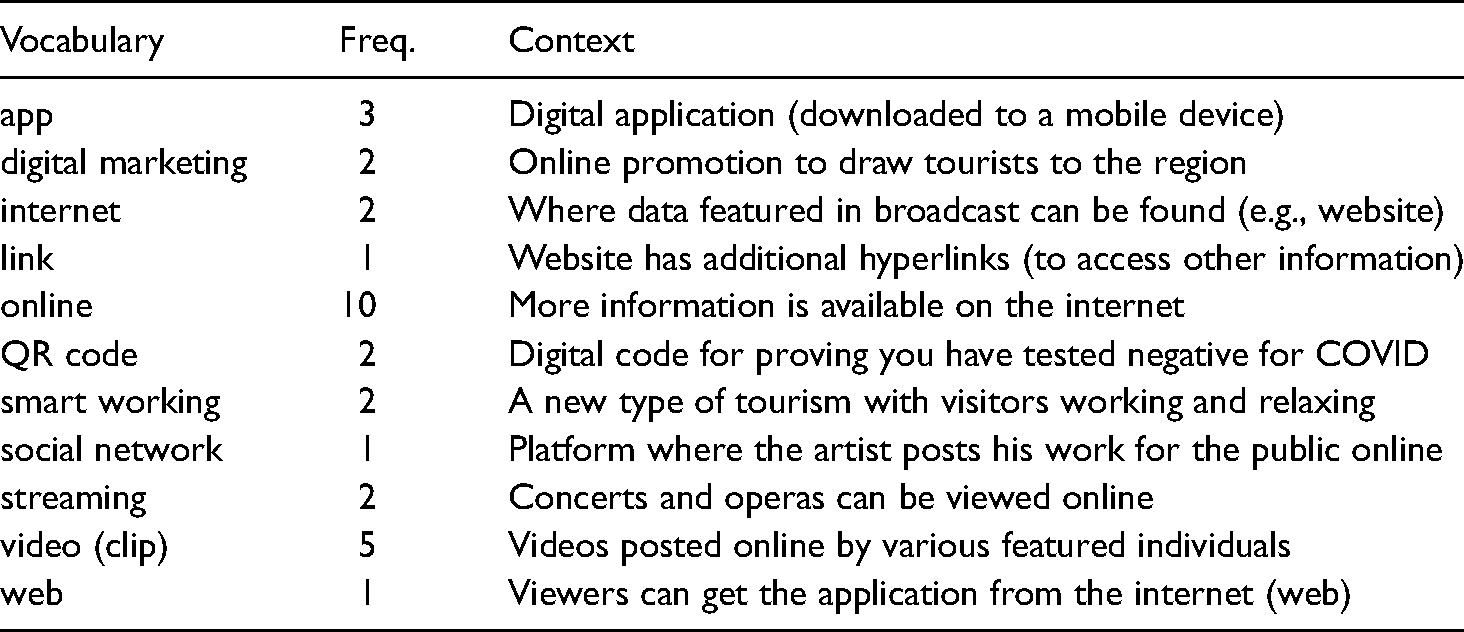
All of the technological vocabulary were used in the expected context. For instance, when South Tyrol was in COVID-19 lockdown, TRaiL made its viewers aware of cultural programs, such as concerts, that could be viewed online (24 April 2021):
…
…
“… (there are)
These loanwords are used in the appropriate manner and context. They have likewise been adopted into Italian (Pareschi, 2021; Pulcini and Milani, 2017), so may be indirectly borrowed into Ladin.
Similarly, a segment on employment during the lockdown (6 May 2021) discusses remote working:
Truepa aziendes y mprejes ti dà a si dependënc la ucajion de pudëi lauré da cësa, de fé
Many businesses and firms give their employees the occasion to can work from home, to do
“Many businesses and firms (are now) giving their employees the opportunity to engage in
“Smart working”, or to work from home via computer, is an adaptation of the more common “remote working” or “teleworking” as used in the United Kingdom and the United States (Pareschi, 2021). In this instance, we observe how this expression is an adapted, as denoted in section 2.3. Nevertheless, “smart working” has likely been borrowed by Ladin from the Italian, where it is commonly utilised (Pareschi, 2021).
TRaiL equally used English loanwords beyond the field of technology. In total, we identified 27 individual loanwords in this category, some of which were repeated multiple times during the broadcasts analysed. “Marketing” (n = 5), “film” (n = 4), and “tourism” (n = 4) were the most repeated loanwords in this category. Of the 24 remaining, one in five were associated with entertainment. These include terms like “disco”, “song”, and “event”. See Table 7 for a list of the loanwords identified in this category.
TRaiL – other.
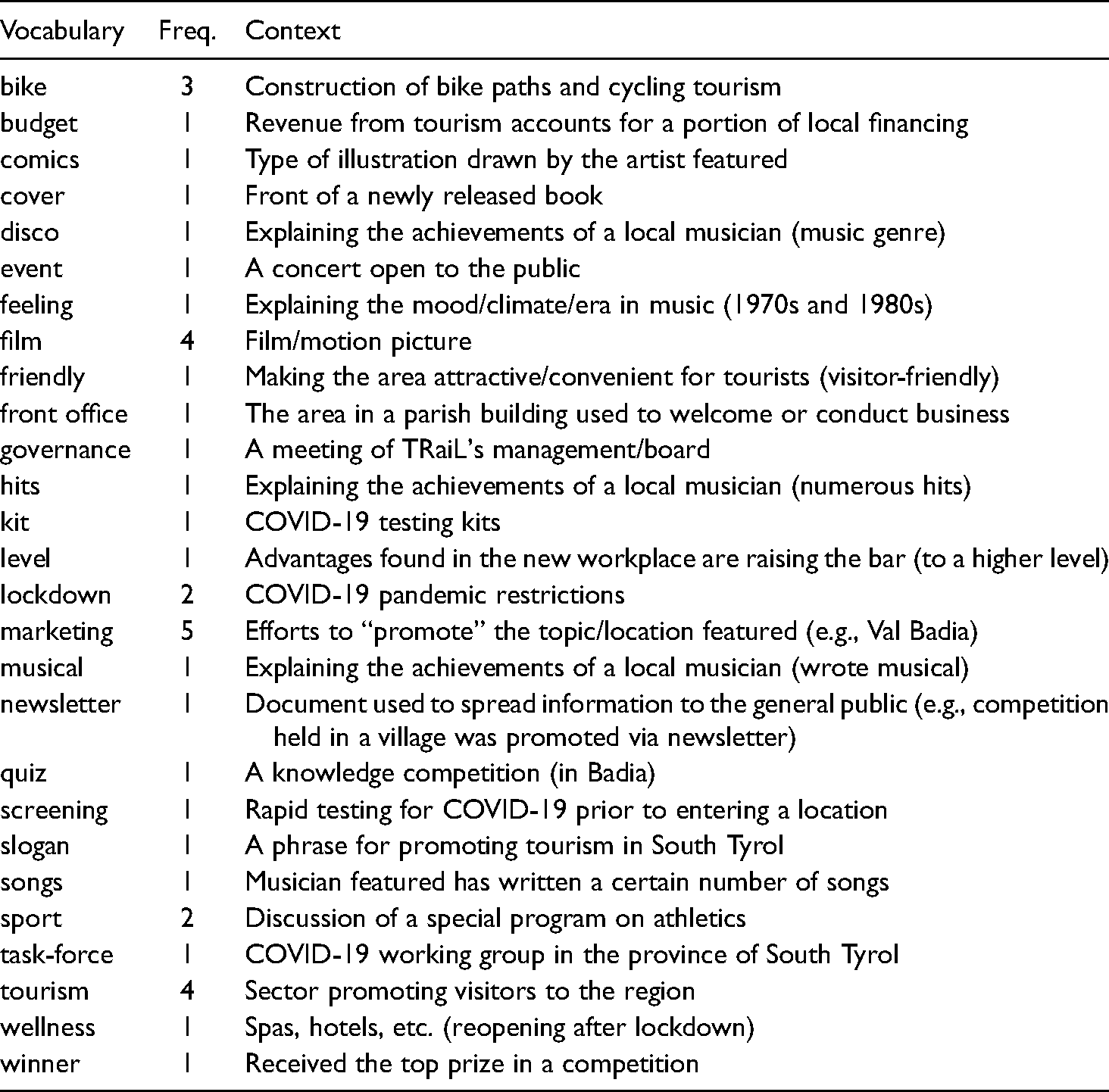
Several of the loanwords associated with the entertainment sector were mentioned in one TRaiL feature. In a segment on a famous Ladin songwriter and musician (23 April 2021), the journalist states:
Con sü
With his
“Through his
From the four loanwords identified in this sentence, “disco” as a music genre, and “film” as a motion picture, are expected. Similarly, the appearance of “hits” is unsurprising when discussing the success of songs or soundtracks, and Ladin viewers would most likely be familiar with the term in this context (e.g., “disco hits”). However, explaining why “feeling” was borrowed is challenging. We deduce that this “feeling” was borrowed as a tribute to Moroder's production of many famous songs and soundtracks in English.
Another notable loanword used by TRaiL journalists is “winner”. It appears in a segment announcing the victor of a regional architecture competition:
La ciasa le Fiun é
The house the Fiun is
“The
We use this instance to remind the reader that we did not analyse “Big”, “See” or “Award” because it was used to create the title of the architectural contest, and consequently, the Ladin journalist had no choice but to use these loanwords when reporting on the competition. Nevertheless, “winner” could have been substituted with the noun “win” [davagnadú], without altering the meaning. We conclude that the journalist borrowed “winner” to complement the pseudo-English name of the prize.
The final loanword examined from this resource is “cover”. It was selected for analysis because the journalist uses both the Ladin term and a loanword collectively. While discussing a recently published book, the TRaiL journalist reports:
Sön le coertl él na fotografia dal parëi de Sas dla Crusc tla löm cialda dal sorëdl co vá do jö: n
On the cover is a photograph of the faces of Sas dla Crusc in the light warm of the sun that goes behind down: a
The (book) cover has a photograph of the faces of the Sas dla Crusc in the warm light of a setting sun: a
During his first reference to the front cover, the journalist first uses the Ladin [coertl] and then selects to borrow “cover” in the second instance. The most reasonable explanation that we could find for this juxtaposition of Ladin and English is that the journalist wanted to compliment the beauty he perceived in the photography with a unique loanword. However, it may simply be that the journalist decided to borrow “cover” to prevent repetition in his description.
Overall, we identified 11 technology-related loanwords (30%) in TRaiL broadcasts and 27 (60%) that were unrelated to technology. This means that TRaiL uses more non-technology loanwords by comparison to the other Ladin sources analysed. As observable in Table 7, nearly half of the loanwords in the latter category are found in the context of entertainment (e.g., musical, hits, comic), conducting business (e.g., budget, front office, marketing), and tourism (e.g., bike, slogan, tourism). Similar to the field of technology, the vocabulary in these sectors is frequently influenced by English (Dewaele, 2002; Henry, 2013). As a consequence, their appearance might be classified as necessary rather than made by rational choice (Meyerhoff, 2011).
Qualifying Ladin Perceptions of Borrowing English in Marebbe
The second component of our research measures public attitude toward English loanwords among the community of Marebbe. Since a population has a fundamental role in language usage and preservation (Huws, 2018; Trudgill, 2000), we wanted to measure Ladin opinions and behaviour toward borrowing English. To this end, we collected Ladin opinions between April 27 and May 4 using a brief online survey. Responses were collected in snowball fashion, meaning the researchers first shared the survey link with their personal contacts, and those contacts were asked to share the link with their Ladin friends and neighbours in Marebbe. In this manner, the questionnaire was circulated and responses gathered. Simultaneously, the researchers also personally assisted six participants that had limited technological knowledge (n = 3) or no access to the electronic survey (n = 3) to ensure that individuals over the age of fifty-five had an opportunity to participate. When personally assisting respondents, the researchers met individually with the consenting participant, verbally read each question, and entered responses using an electronic device with an internet connection.
Survey Methodology
The survey consisted of 2 demographic questions (age and sex) and 10 statements that included both positively and negatively phrased text. The questionnaire's length was purposefully kept short to reduce the time necessary to complete it. The researchers estimated that most users would need no more than five minutes to participate. Of the 10 statements included, two measured the respondent's degree of identification with Ladin language and culture. The remaining eight measured participant's attitude toward the English language and the borrowing of loanwords in Ladin. A balanced, five-point Likert scale was used to allow participants a range of responses.
Since only two of the researchers are native Ladin speakers, the questionnaire was initially drafted in English and then translated into Ladin. To ensure clarity of the questions, two additional native Ladin speakers proofread the translation. Once complete, the survey was uploaded to a secure Google Drive account and a hyperlink was generated. The hyperlink was then shared electronically using email and social networking applications including Facebook and WhatsApp.
A statement was provided at the beginning of the online survey explaining the anonymity of participation and the purpose of the research. Privacy and anonymity were ensured in multiple manners. Foremost, respondents were not asked to provide identifying data (e.g., names or email addresses). In addition, Google Drive's tracking feature available for electronic form was deactivated so that computer IP addresses were not collected.
Respondent Sample
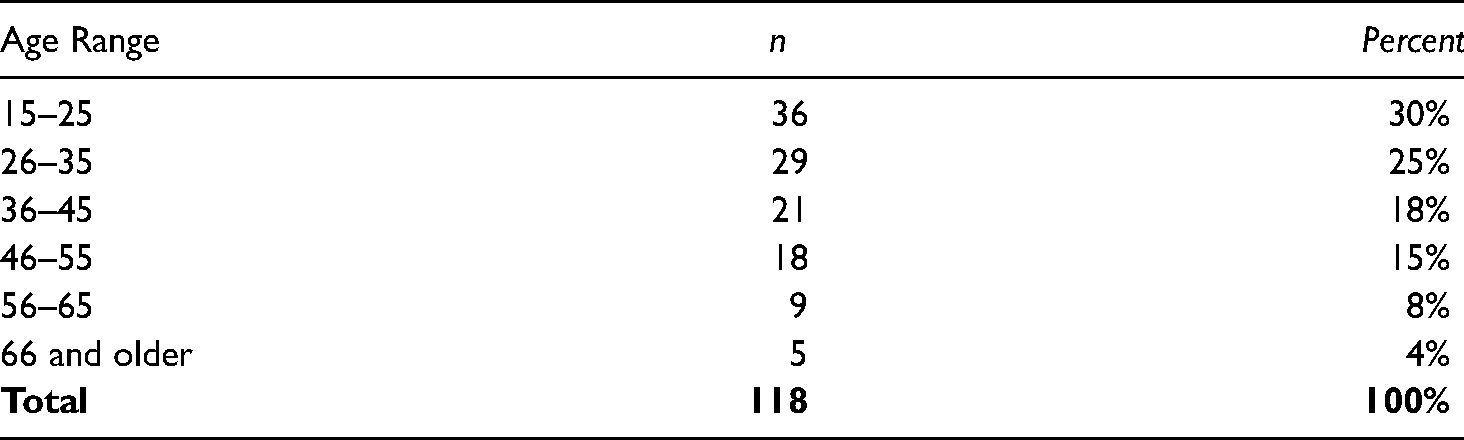
A total of 118 respondents from Marebbe completed the questionnaire. Most participants identified themselves as female (55%) and 45% identified as male. While the age distribution of participants was broad, a clear majority (55%) of our sample was between the ages of 15 and 35. See Table 8 for the age distribution of our sample.
Participant age distribution.
Findings
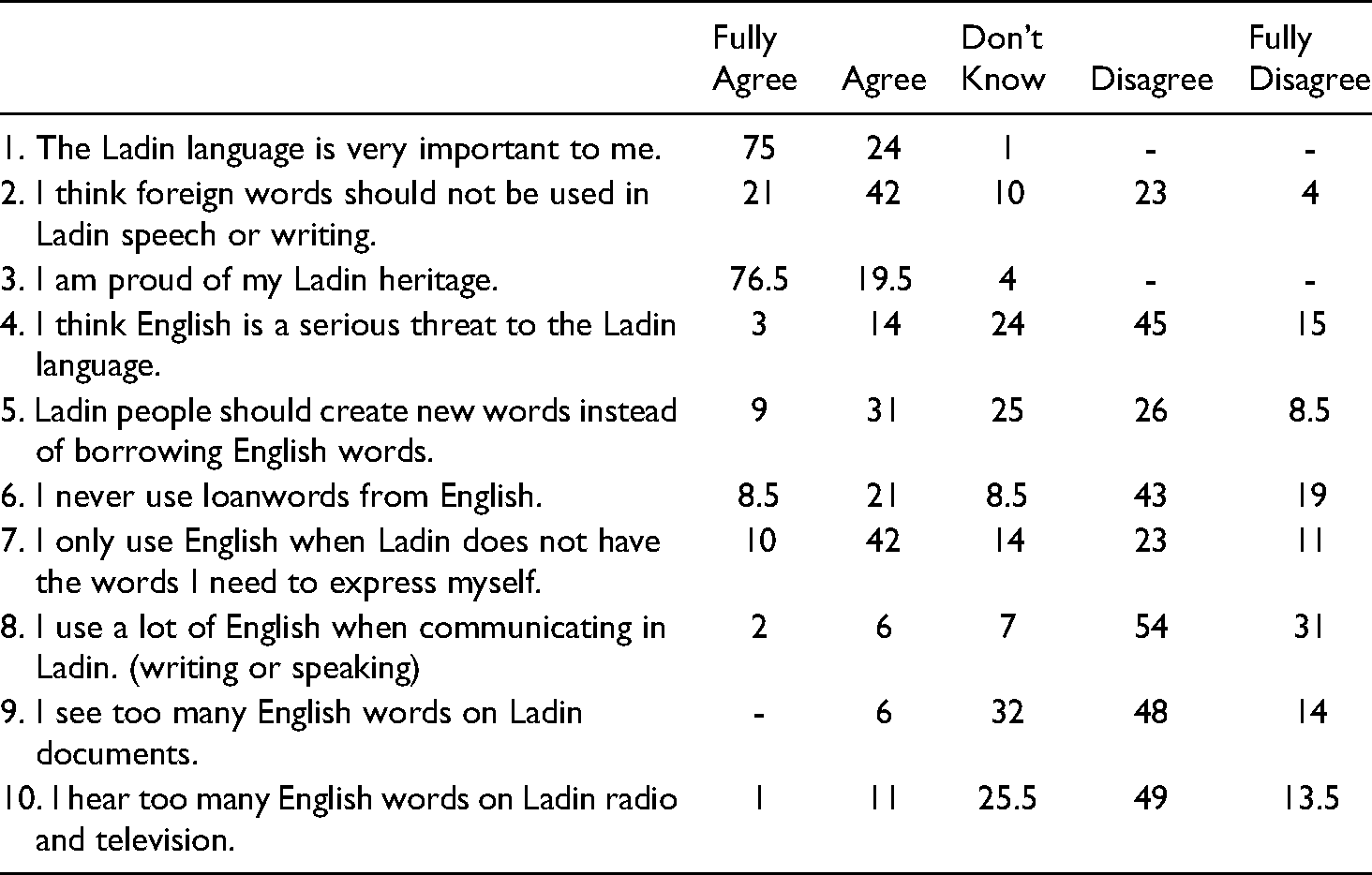
Perceptions of culture and language are important components of individual and collective identity (Meyerhoff, 2011; Trudgill, 2000). To measure how important Ladin language and heritage is to our sample, we included Statements 1 and 3 respectively. See Table 9 for a list of the ten statements included in the questionnaire and the acquired responses by percentage. From the data, we observe respondents strongly identify with Ladin. Only subtle variation in perceptions is observable by age on S3. See Appendix 1 to observe survey results for each statement by gender and age.
Statements and responses.
From the next statement analysed, we find that respondents generally agree that foreign words should not be used in Ladin (Statement 2). When analysed by age, we find that respondents over the age of fifty-six unanimously believed that foreign words should not be mixed with Ladin, while those under the age of fifty-five offered a broader range of opinions. See Figure 1 for the distribution of responses by age. This suggests that younger respondents are more divided on the issue of borrowing by comparison to older participants, which reject the practice. As a consequence, we may be observing a generational change in opinion (Meyerhoff, 2011; Trudgill, 2000).
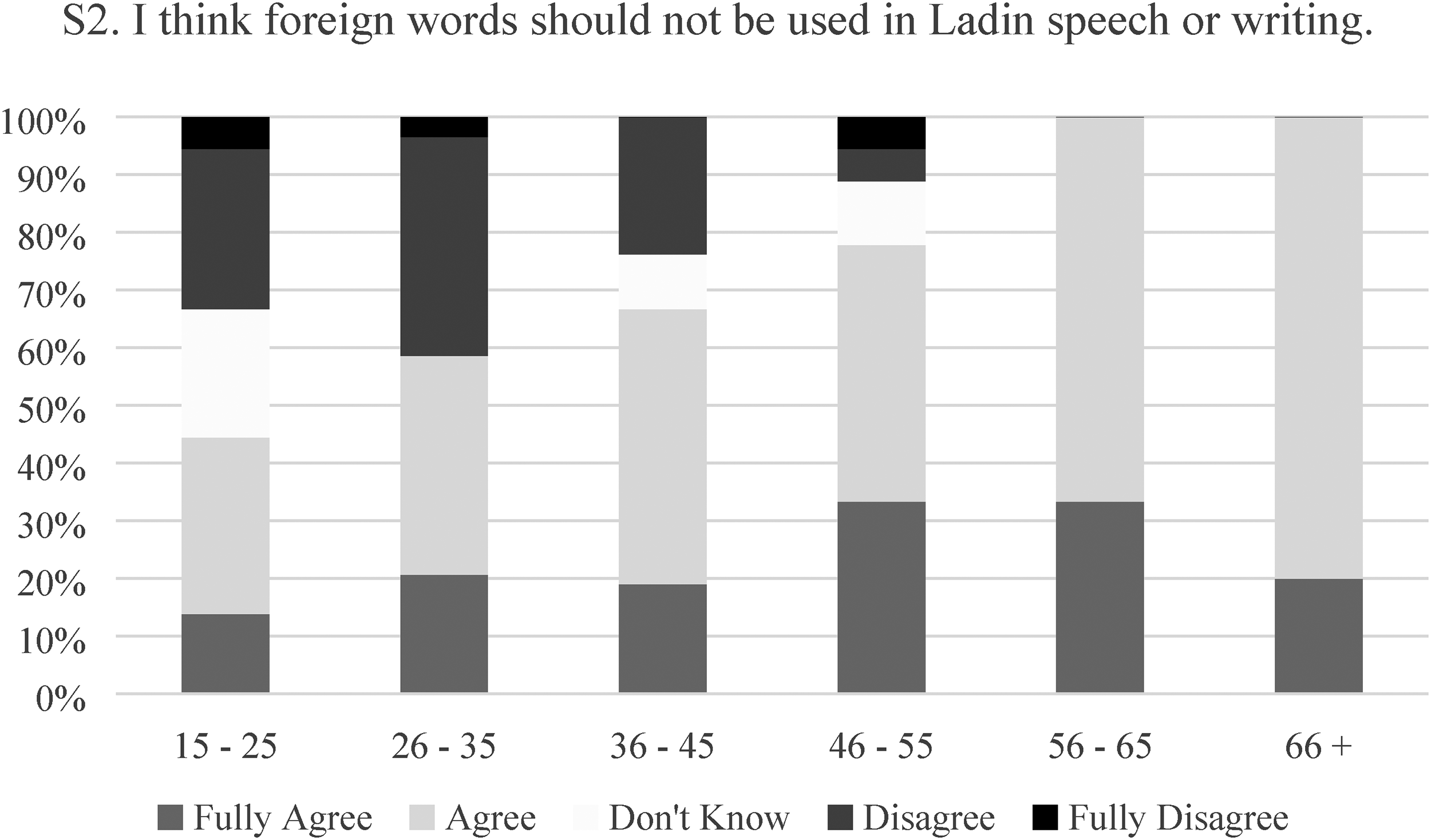
S2. Response by age.
From this point, we gauged whether respondents perceive certain measures should be implemented to protect the Ladin language from borrowed words. To measure this, we asked participants to respond to a statement that suggested Ladin should create new words to substitute loanwords (Statement 5). This statement was included in the survey because Micurá de Rü (2022b) has a working group responsible for coining new words, and it is in the process of creating an online databank where the general public can request new Ladin words be created or they can recommend new words. The process whereby new words are created is referred to as “word coining”, and this practice has been utilised as a method of language planning by indigenous communities in North America (Denzer-King, 2008). It has similarly been practiced to varying degrees in Indonesia (Alisjahbana, 2019), Sweden (Hannesdóttir, 2011), Iran (Sadeghi, 2001), Ireland (O’Connell and Walsh, 2006) and Israel (Shur, 1996). Nonetheless, in response to the idea of word coining, we observe only marginal support among our sample for creating new Ladin words as a means of reducing borrowing. Complicating our interpretation of responses, however, approximately one quarter (n = 29) of participants stated that they “don’t know”. We surmise that most participants have never given much thought to Ladin coining new words, and a sizeable number decided to indicate they were uncertain as opposed to spontaneously taking a position.
When responses to the statement of word coining were analysed by gender, we found that males were more likely to agree that new Ladin words should be coined by comparison to females. See Figure 2 for an illustration of responses by gender. Considering that males and females may view and use language differently (Meyerhoff, 2011; Trudgill, 2000), we believe that the data indicates that Ladin males may be more conservative with the language than females. After filtering the data by age, we likewise found older respondents are more uniform in their responses than younger participants. In this instance, those 66 years and older “agreed” or “fully agreed” new Ladin words should be created, whereas those 65 and younger were divided on the issue. See Appendix 1 for a detailed analysis of responses by age and gender.
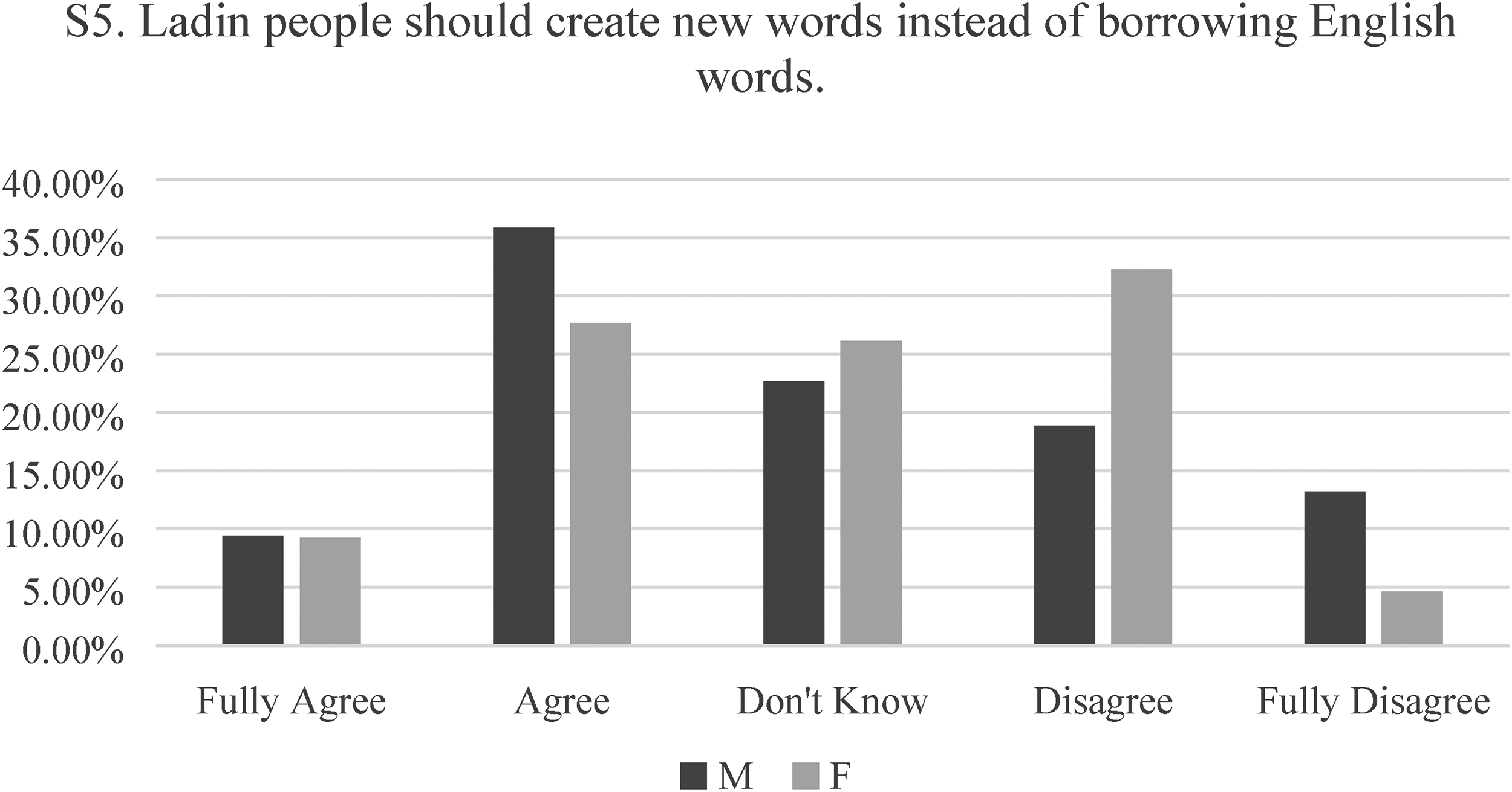
S5. Response by age.
We likewise asked respondents if they perceived English as a “serious threat to Ladin” (Statement 4). While a slight majority does not view English as threatening, nearly one quarter of our sample again expressed uncertainty. We conclude the large percentage of “don’t know” may be a result of respondents having never really considered whether English could be a threat. Controlling for gender, we find that males were slightly more likely to perceive English as a threat by comparison to females. This finding again suggests that Ladin males may be more conservative with the language than females.
When presented with the statement, “I see too many English words on Ladin documents” (Statement 9), a majority of our sample disagreed. Similarly, a majority disagreed with the statement “I hear too many English words on Ladin radio and television” (Statement 10). Combined, our sample does not perceive English as threatening to Ladin, and a majority does not perceive that they hear or see too much English in Ladin print or broadcast material.
The final statements included in our survey measured respondent's use of English. We found that only a small number of respondents stated they “never use English” when using Ladin (Statement 6). To determine whether loanwords were being used by participants because of necessity or rational choice (Meyerhoff, 2011), we asked respondents if they borrowed “English when Ladin does not have the words” the respondent needs (Statement 7). 42% of our sample “agree” they use English loanwords because Ladin does not have the vocabulary they require, and 10% “fully agree”. When these responses were analysed by gender, we find males were more likely to claim that they use English loanwords because Ladin lacks the vocabulary. See Figure 3. This data may suggest that females are using English by choice, and not just from necessity.
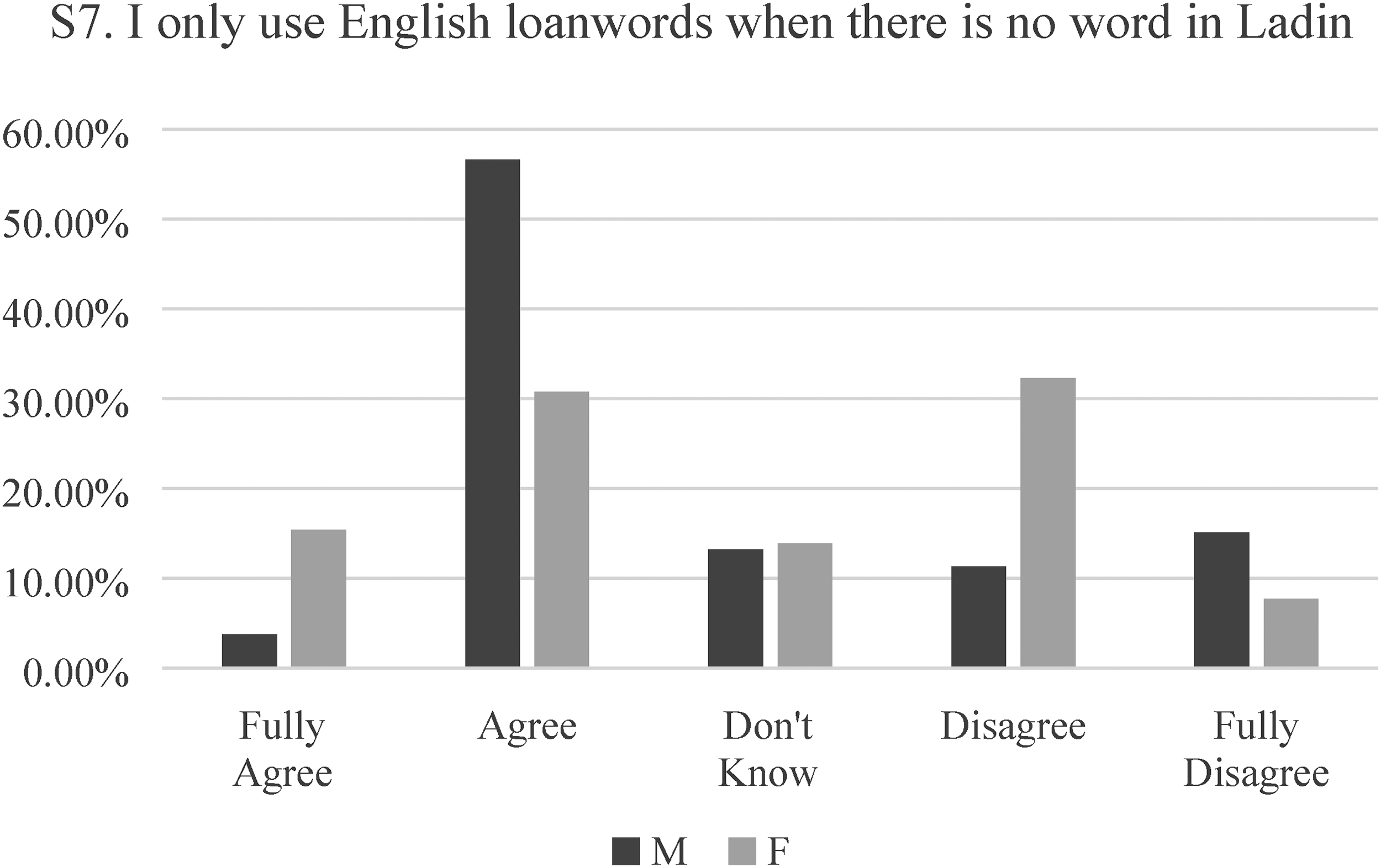
S7. Responses by gender.
Finally, only two percent “fully agree” and six percent “agree” that they “use a lot of English when communicating in Ladin” (Statement 8). When analysed by gender, we find female respondents were more likely to admit to using “a lot of English” (12%) by comparison to males (2%). See Figure 4. Once again, this discrepancy across genders leads credence to our hypothesis that females may be purposely selecting to borrow English as noted above. It similarly suggests that females might be less conservative with the language than males.
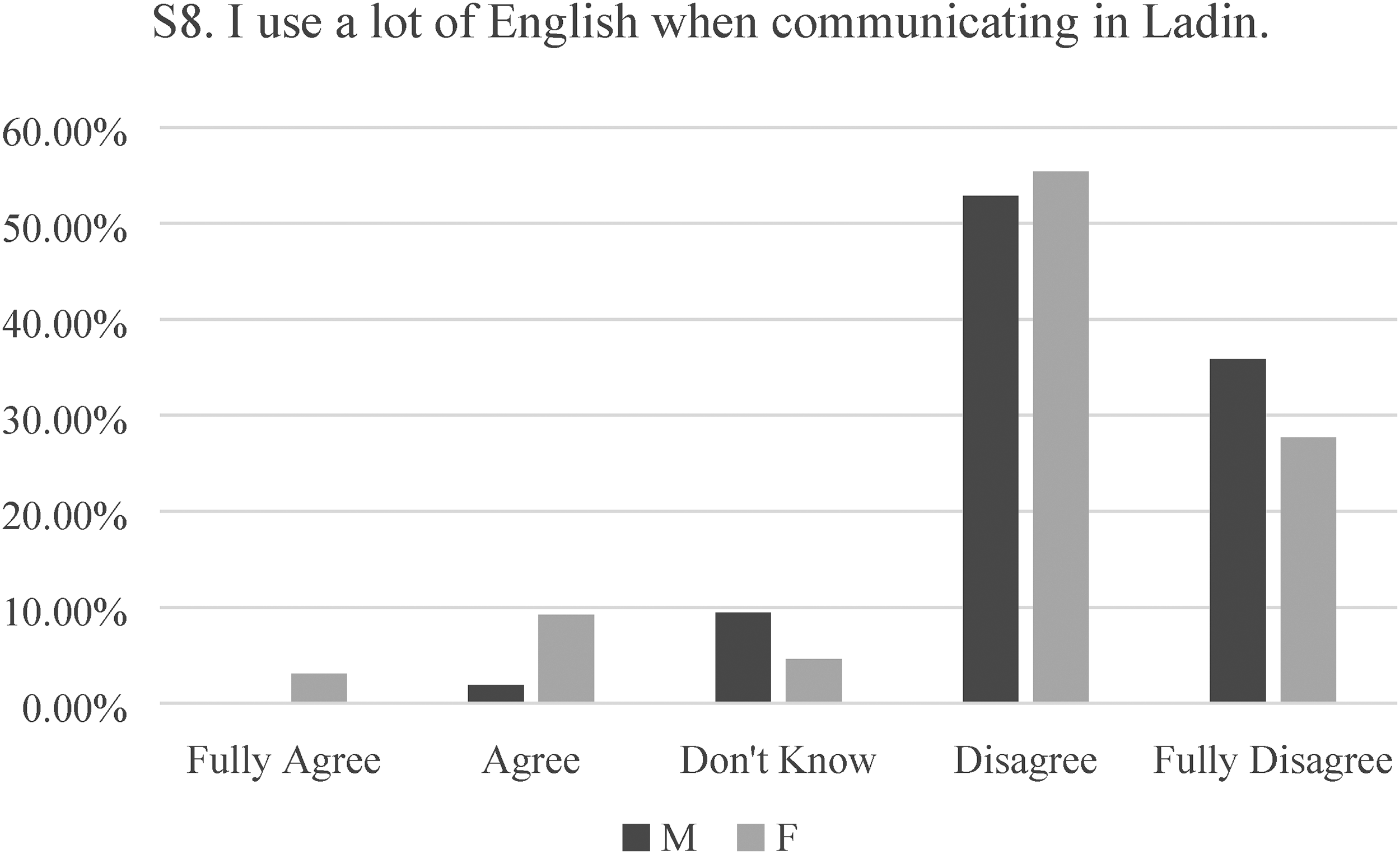
S8. Response by gender.
Discussion
Our dual methodological approach provides preliminary insight into word borrowing and opinions toward loanword use in Ladin. The premise of this first component of our research is based upon the fact that institutional supports (e.g., media broadcasts, bulletins) help to increase ethnolinguistic vitality, or the “demographic, social and institutional strength of the language and its speakers” (Meyerhoff, 2011: 108). In Marebbe, Ladin media is a cornerstone of language maintenance as there is a limited number of supports. However, these supports are increasingly mixing English into their content and thereby disseminating both Ladin and English loanwords.
From our content analysis, we find English loanwords appearing across a spectrum of Ladin resources and being presented in a variety of contexts. We likewise observe some discrepancy between the type of loanwords observed and their frequency of occurrence by source. The parish bulletins from La Pli and Al Plan, for example, contain few loanwords, and those that appear are predominantly related to technology. All of those identified have no Ladin equivalent. Nevertheless, the limited number of non-technology loanwords in these publications are easy to explain. First, the bulletins are single page documents by comparison to the longer printed media analysed. Second, the content of these bulletins is mainly gospels and prayers, which can be expressed in Ladin.
We equally found that a majority of the English loanwords identified in the Ladin quarterly, Le Saltà, was also related to technology. Many words associated with technology, such as “email” or “download”, are borrowed, most likely because of the prevalence of their use internationally and the importance of the English language in the field of technology (Pareschi, 2021; Pulcini and Milani, 2017). This finding is therefore unsurprising as the quarterly reports on governance issues in the municipality of Marebbe. Nevertheless, the document also contained three loanwords unrelated to technology. Usage of the latter can be attributed to the absence of a Ladin equivalent, and these terms have likely been indirectly borrowed from Italian.
By comparison, the formal Ladin news publications analysed likewise borrow English loanwords. La Usc di Ladins, for instance, uses 20 different technology loanwords, some of which repeat regularly (e.g., online), and 25 that are unrelated to technology. In some instance, those from the latter category were utilised because they are related to a specific sector (e.g., budget, tourism), and consequently may be borrowed by necessity. However, we equally demonstrated that certain loanwords were purposefully selected, such as “gentleman's agreement” and “flop”, which we hypothesise were used by journalists to accentuate their position on the topic being presented.
Lastly, analysis of TRaiL television broadcasts identified 40 different English loanwords in one month, with approximately 30% of those being associated with technology. Among the non-technology loanwords, nearly half were used in the context of entertainment and tourism. Since entertainment and business are likewise sectors that frequently borrow English vocabulary (Dewaele, 2002; Henry, 2013), their appearance may be from necessity.
Overall, our content analysis identifies the English loanwords being borrowed, and, we believe, demonstrates that many of those are being borrowed because Ladin lacks certain vocabulary. In these instances, English is functioning as a lexifier, meaning that it is providing the vocabulary that Ladin lacks (Meyerhoff, 2011). Since the English language is dominant in certain fields, its vocabulary is often borrowed (Flammia and Saunders, 2007; Luján-García and García-Sánchez, 2020; Trudgill, 2000). As a result, we can expect to witness a continued transformation of the Ladin language as vocabulary is continually added to fill a lexical need. However, we also noted that Ladin is not necessarily borrowing English directly, and may be indirectly accessing this vocabulary from Italian and/or German.
With the ongoing language transformation in mind, the second phase of our research consisted of a survey of one Ladin community in Italy. The data collected suggest there is strong ethnolinguistic vitality in the Ladin community of Marebbe. Ladin respondents express notable pride in their language and heritage despite their age or gender. Based upon this, we conclude that there is minimal social variation in perceptions (see Meyerhoff, 2011; Trudgill, 2000). Equally important, the strong identity expressed is promising for the Ladin community and its language, as social attitudes toward language are important for its preservation and continued use (Meyerhoff, 2011; Trudgill, 2000).
When analysed broadly, our data suggest a clear majority of our sample believes that foreign words should not be used in Ladin. In this instance, we observed that respondents over the age of fifty-six unanimously believed that foreign words should not be mixed with Ladin, while those under the age of fifty-five offered a broader range of opinions. See Figure 1 for the distribution of responses by age. The difference can be explained, on one hand, by the fact that those 56 and older would not have been taught English as a foreign language in school. On the other hand, these same individuals would have grown up under Italianisation, where Ladin was not taught in schools. Consequently, we deduce that older Ladin respondents might be torn between protection of the language and feelings that they should not be overtly proud of the culture and heritage as a result of their historical experience (see Trudgill, 2000).
Since a majority rejects the mixing of foreign loanwords, it was unsurprising that very few respondents admit to using “a lot of English”, and approximately half claim to only use English when Ladin lacks specific vocabulary. In this context, Ladins believe that borrowing should not occur. This identity factor may function to pull Ladins into limiting their use of English loanwords. Simultaneously, Ladin's lack of specialised vocabulary functions as a push factor, requiring foreign vocabulary be adopted to fill the void.
The push factor, consequently, may explain why a majority of our sample does not perceive English as a threat to Ladin. Reinforcing this idea, a majority of participants disagreed with the statements that they hear or see too much English. In short, respondents did not express any notable concern about the English loanwords they are personally using or those they are encountering in Ladin media. Ladins may recognise that they have no alternative but to mix languages.
Ladins have a general tolerance for language mixing. After all, they are accustomed to code switching and language switching depending on the situation or context. Personal experience demonstrates that Ladins often switch between Ladin, German and Italian. Within this context, our sample may be as equally tolerant of borrowing and mixing English. Simultaneously, it is likewise plausible that our respondents are unaware of the number of English words that are being borrowed, as many of them may be indirectly borrowed from German or Italian.
At the same time, we qualify differences in responses by gender on two interrelated issues. First, females were slightly more likely to say they use English “a lot” by comparison to males. Second, females are increasingly likely to state that they use loanwords not simply because they fill a void in Ladin. The literature notes that a user's gender can influence language usage (Meyerhoff, 2011; Trudgill, 2000; Wolfram and Schilling-Estes, 2003), and our data suggest that Ladin males are more conservative when it comes to borrowing words and using English than their female counterparts.
Finally, the most polarising statement included in our survey concerned the creation of new Ladin words to reduce borrowing. Although there was a high percentage of undecided, only a minority of our sample believes that new words should be created in Ladin to limit borrowing. This finding is somewhat surprising since a clear majority of participants rejects the use of foreign words in Ladin. While our research did not elicit additional information on this subject, we hypothesise that respondents may realise that it is necessary to fill the obvious gaps in Ladin vocabulary. In this context, Ladin will have to expand its vocabulary through borrowing, coining, or a combination thereof. Obtaining a better understanding of the general public's position on this matter is essential, as popular opinion runs counter to the ongoing work of Istitut Ladin Micurá de Rü (2022b) and its plans of coining new Ladin words.
Research Limitations
This research has several notable limitations. Foremost, our survey was limited to respondents from a single Ladin municipality. Its findings, therefore, should not be used to generalise about the opinions of the broader Ladin community. Moreover, due to the survey’s methodology (online, snowball sampling), many of our respondents were younger than 35. While efforts were made to include older individuals, their participation rate remained low.
Second, many of our respondents may not recognise the number and frequency of English loanwords found in Ladin. In fact, we believe that this lack of knowledge helps explain the high degree of “don’t know” responses we received on multiple questions. In conjunction with not having contemplated the issue of loanwords, we believe that respondents opted for a neutral stance rather than spontaneously taking a position. For this reason, Haspelmath (2009) discourages researchers from querying laypersons about loanwords as they are unlikely to be aware of their existence.
Next, our preliminary research was limited in size and scope. As a result, we did not collect some useful demographic information. This, regretfully, means that we were unable to analyse the data through markers commonly leveraged by sociolinguistic researchers, such as education level, occupation, or socio-economic status (Trudgill, 2000). The decision to limit demographic information to age and gender was, however, purposeful, since the researchers live in the municipality of Marebbe. Had we collected even one additional marker, respondent anonymity would have been forfeited, as it would have been relatively easy for us to match responses with respondents due to the small size of the community.
Lastly, our research does not specifically determine which English loanwords are being borrowed directly by Ladin speakers, and which are being indirectly introduced through German or Italian. We do draw attention to several instances where we believe the English loanword has been introduced via German or Italian. Nevertheless, indirect borrowing is more likely since the Ladin community of Italy regularly interacts with Italian or German, and have less direct contact with the English language.
Future Research
As English infiltrates the understudied minority Ladin language, more research should be conducted to trend the borrowing of loanwords and popular opinion of this phenomenon. As Ladins closely identify with their language and want to maintain it, monitoring the rate at which foreign words are being borrowed might be one method of qualifying the degree of change occurring over time. At the same time, larger and more detailed studies of Ladin opinion toward language planning and word borrowing would provide valuable insight into which, if any, planning measures Ladins support. Such findings might be valuable in identifying popular methods of maintaining Ladin.
Next, while our limited study suggests that females are slightly more open to mixing English by comparison to males, larger and more detailed research should closely examine the influence that gender and age have on Ladin opinions of word borrowing. Such studies might determine what is driving female openness to English and its use. Similarly, while we find that age exerts only modest influence on opinions, this finding should be tested using larger and more representative samples.
Lastly, La Usc di Ladins and TRaiL are formal institutions whose publications and broadcast reach all Ladin communities in Italy. For this reason, we recommend future researchers query Ladin journalists and editors to determine why non-technology English loanwords are being utilised in print and broadcast media. Since these media outlets are important for the maintenance of Ladin, such inquiries would provide further insight into the context and reasoning for word borrowing in Ladin.
Conclusion
This research was prompted by the increasing appearance of English loanwords in the media available in the community of Marebbe. We first provided a brief history of the Ladin language and language purism before noting the influence of English on other languages. There are many reasons why English is borrowed, including its presence in technology, entertainment, and being an internationally recognised language for travel and tourism. As a result, it is unsurprising that we see English being borrowed and utilised in Ladin.
After defining important theoretical concepts such as borrowing, we introduced our two-part research. The first part involved content analysis of Ladin media to determine which English loanwords appeared in one month. Our content analysis found that a majority of the loanwords identified in most resources examined were related to technology. Their appearance is relatively easy to explain as Ladin lacks this type of vocabulary. By comparison, the formal Ladin newspaper and news broadcasts contained numerous non-technology English loanwords. In some instances, these Anglicisms could have been substituted with existing Ladin terms or phrases.
Following our content analysis, the second part of our research measured the public’s attitude in Marebbe toward Anglicisms. Using an online survey, we found a clear majority of respondents believes that foreign words should not be used in Ladin, and many respondents claim they do not frequently mix English with Ladin. At the same time, respondents do not widely perceive English as threatening to Ladin and claim to borrow English because Ladin lacks specific vocabulary. More comprehensive research, however, should be conducted to determine which, if any, methods might be used to maintain the Ladin language, and possibly reduce the adoption of loanwords.
Supplemental Material
sj-docx-1-foi-10.1177_00145858221107342 - Supplemental material for Anglicisms in Ladin: Loanwords and Local Perceptions
Supplemental material, sj-docx-1-foi-10.1177_00145858221107342 for Anglicisms in Ladin: Loanwords and Local Perceptions by Silvia Erardi, Ronald L. Gardner and Sara Comploi in Forum Italicum
Supplemental Material
sj-xlsx-2-foi-10.1177_00145858221107342 - Supplemental material for Anglicisms in Ladin: Loanwords and Local Perceptions
Supplemental material, sj-xlsx-2-foi-10.1177_00145858221107342 for Anglicisms in Ladin: Loanwords and Local Perceptions by Silvia Erardi, Ronald L. Gardner and Sara Comploi in Forum Italicum
Footnotes
Funding
This research received no specific grant from any funding agency in the public, commercial, or not-for-profit sectors.
Declaration of Conflicting Interests
The Authors declare that there is no conflict of interest.
Supplemental Material
Supplemental material for this article is available online.
References
Supplementary Material
Please find the following supplemental material available below.
For Open Access articles published under a Creative Commons License, all supplemental material carries the same license as the article it is associated with.
For non-Open Access articles published, all supplemental material carries a non-exclusive license, and permission requests for re-use of supplemental material or any part of supplemental material shall be sent directly to the copyright owner as specified in the copyright notice associated with the article.
