



Abstract
Previous research in bilingual special education has called for the field to determine valid interventions, prepare bilingual special educators, and address issues of identification and disproportionality. We examined if these calls have been met through a systematic literature review of the research conducted within the past 24 years. Between May and June of 2024, we searched databases, references of literature reviews, and special issues to identify articles researching the intersections of bilingual and special education for students and their families in school settings. To be as comprehensive as possible, we included articles that address bilingual specialized academic instruction and related service provision such as speech therapy. A total of 203 articles were identified and analyzed to find patterns chronologically, in disciplines of journal publications, language use, context, and methods. Additionally, the research foci were coded and analyzed to examine the current focus within the field. Findings indicate that researchers have responded to calls to expand research in assessments and instruction of bilingual students with disabilities but have not continued to develop best practices in teacher preparation or family-school partnerships.
Keywords
Increasingly, educator preparation programs, state education agencies, and local school districts are starting to create courses, certification pathways, and programs that combine the domains and standards of bilingual education and special education. On the surface, there appears to be a great opportunity to address the needs of two populations of students who have historically been misunderstood, underserved, and marginalized in schools, all while solving the issue of a severe teacher shortage in both areas. This is not a new endeavor, however, and here we wonder what lessons have been learned over the past quarter century of bilingual special education initiatives and research within the United States context.
Research on bilingual special education often highlights how systemic inequities shape the educational experiences of culturally and linguistically diverse students. Artiles and Ortiz (2002) emphasize that bilingual students are disproportionately represented in special education, which reflects broader social and institutional practices that marginalize these populations. They argue that the assessment tools used to identify disabilities in bilingual students often fail to account for cultural and linguistic diversity, leading to misdiagnosis. This misalignment can perpetuate racial and linguistic biases in education, reinforcing educational inequities.
Through this review we develop a better understanding of the directions of bilingual special education in the United States. Bilingual special education is service provision at the intersection of bilingual (English and Native Language) and special education. Therefore, we consider bilingual special education as purposeful attention and focus to instruction or related service provision that considers bilingual students who are actively learning English while also considering supports for disability. This is an important endeavor because of the need to provide equitable special education services for bilingual and multilingual students. Beyond learning from the literature of the past quarter century to better understand the state of practice, we also set out to identify gaps in the research, areas that might need repair, and new practices that have been adopted at different rates across the related fields of study that make up bilingual special education research. One such practice is translanguaging. Embraced first by researchers in bilingual education, translanguaging describes the communicative process by which a “language user draws upon different linguistic, cognitive and semiotic resources to make meaning and make sense,” regardless of which named languages (e.g., Spanish, English, etc.) the resources are socially attributed to (Wei, 2018a, p. 2). Although similar to code-switching, a term that researchers in the fields of special education and speech pathology have historically favored due to its basis in empirical rule-governed behavior, translanguaging pedagogy and assessment resist placing stark grammatical and social constraints on users with the objective of facilitating greater communication, greater recognition of intimate and familiar languaging practices, and for promoting linguistic justice.
There have been purposeful attempts in the past to merge work across distinct disciplines addressing issue at the intersecton of bilingualism and disability. In The Bilingual Special Education Interface, Baca and Cervantes (2004) explore how culturally responsive pedagogy can address these disparities at this intersection. They assert that teachers who understand the cultural backgrounds and linguistic needs of their students can more effectively design instruction that supports academic and social success. Expanding on this assertion, Przymus and Alvarado (2019) explore the use of translanguaging strategies in content-based story retells as a means to differentiate language difference from disability among bilingual learners. Specifically writing about the need to advance knowledge in the field of bilingual special education through the merging of practice from bilingual speech pathology, bilingual education, and special education, they argue that traditional monolingual assessment practices often misidentify bilingual students as having disabilities due to a failure to account for the natural interplay of their linguistic repertoires. By incorporating translanguaging, students are encouraged to use all their linguistic resources during assessments, which provides a more accurate understanding of their abilities and learning needs. The authors demonstrate how this approach can improve the validity of evaluations and foster equitable educational opportunities for bilingual learners.
Without learning from the past to re-envision how equity in bilingual special education can improve, existing inequitable preparation becomes reified. Our current literature review builds on important work that has asked critical questions about identification, service, and preparation at the intersection of bilingualism and disability (Artiles & Ortiz, 2002; Baca & Cervantes, 2004; McCray & García, 2002). 1 Addressing these questions may give rise to a theoretical and practical framework that originates not from a singular background in either special education or bilingual education, but from the integration of both disciplines. Prior to describing our study, relating the results, and discussing the themes that arose from our systematic review, we briefly build the foundation for this work by pointing out important and related policy. In addition, we examine key systematic literature reviews and special journal issues that have shaped the ideology and practice of bilingual special education from the year 2000 to June of 2024. We organized our summary of systematic literature reviews and journal special issues by the distinct, yet related fields of study of the researchers and journals they were published in: speech language pathology, special education, and bilingual education.
Brief History of Policies
In Texas, a recent policy shift creating a pathway for a new Bilingual Special Education Teacher Certification has made us especially interested in the intersections of bilingual special education (State Board for Educator Certification, 2022; Texas H.B., 2256, 2021). However, the United States’ federal policies shaping bilingual education and special education are important for examining this work as well. The Bilingual Education Act of 1968 was a result of the significant work of the Civil Rights Movement and established a federal policy for bilingual education (Delavan et al., 2021; Language Proficiency Assessment Committee, n.d.). Several adjustments were made to this policy in the 1970s, 80 s, and 90 s; most notably, the 1994 update which called for improved research and evaluation at the state and local level (Language Proficiency Assessment Committee, n.d.).
In special education, the Education for All Handicapped Children Act, the policy providing services and rights to students with disabilities, was first enacted in 1975. It was then updated and renamed the Individuals with Disabilities Education Act (IDEA) in 1990 (U.S. Department of Education, 2024). Between 2000 and 2024, both the Bilingual Education Act and IDEA have undergone revisions and reauthorizations. Specifically, both policies were affected by the No Child Left Behind Act (NCLB) of 2001. IDEA was updated to align with this policy, which resulted in greater accountability for teachers and research of special education practices. NCLB also provided greater funding for addressing the needs of multilingual learners, while simultaneously and detrimentally removing language in support of bilingual education, towards more English-focused instruction for these students.
Regarding the questions about accurate identification for special education services, it should also be noted that a 2016 reauthorization of IDEA focused on data collection at the state level to determine where disproportionality of students identified for special education may be occurring (U.S. Department of Education, 2024). Additionally, Ko et al. (2025) recently published a critical review of equity-focused policies meant to reduce racial disparities in Special Education. Their systematic review of policies found that “equity-oriented special education policies, (un)wittingly, may (re)produce and reinforce the existing inequities through the diverging interpretations, negotiations, and appropriations of the policies by local policy actors” (p. 20). Still, there are no federal policies that speak directly to the integration of bilingual and special education. However, programs and certificates to prepare teachers for bilingual special education have existed since the 1980s and these certificates continue to expand in states across the U.S. today (State Board for Educator Certification, 2022; Texas H.B., 2256, 2021; Wang & Woolf, 2015).
Previous Literature Reviews and Special Issues
Concentrated and purposeful work at the intersection of bilingualism and special education has existed for close to half a century. An examination of the journals in which special issues dedicated to this effort are published, as well as the institutional departments housing the contributing researchers, reveals a fragmented and siloed approach to this intersectional work. In fact, our results below would support this supposition. However, the reality is more complex. Prior to describing our methodology and findings, we define terms used throughout this paper. Then, we provide a brief overview of some of the literature reviews and special issues published in the last 24 years. In this brief introduction of historical systematic literature reviews and journal special issues, it becomes clear that researchers have always thought intersectionally, albeit informed by specific fields.
Terminology Across the Disciplines
Bilingual special education uses a variety of terms to refer to instructional practices and students. Here, we include a few terms we believe are necessary for this work. As noted above, translanguaging is “an all-encompassing term for diverse multilingual and multimodal practices” (Wei, 2018b, p. 9). Translanguaging challenges the old ways of conceptualizing language acquisition, reframing learners as bilingual and multilingual language users, while also allowing a multilingual person to communicate with their multimodal, multi-semiotic, multisensory and multilingual resources (Tai, 2022; Wei & Ho, 2018). This advancement toward asset-based orientations of bilingualism has also influenced new terms and labels for bilingual students. García (2009) proposed the term “emergent bilinguals,” recognizing that many students already speak a language other than English and by default of attending school in the U.S. are emergent bilinguals. Others have built on this term to connect it with research in bilingual special education by using terms such as “emergent bilinguals labeled as disabled” (Cioè-Peña, 2021) and “emergent bilinguals with disabilities” (Martínez-Álvarez, 2019).
We take the time to define and justify the usage of certain terms (translanguaging, emergent bilinguals, emergent bilinguals labeled as disabled, etc.) because words matter and they influence thoughts about and practice for students at the intersection of bilingualism and disability. This will be taken up again in the discussion section that calls for more alignment of terminology in an integrated bilingual special education field of study; an alignment that is interdisciplinary and intersectional in nature, just like the identities of the students that we aim to serve.
Summary of Prior Reviews and Special Issues in Speech & Language
Researchers in the field of speech, language, and hearing sciences have looked at the intersection of bilingualism and disability for decades. This work and our results below support our observation that this has mostly been quantitative in nature, which coincides with the empiricism of the field needed to support decisions regarding speech and language services in schools. The literature within this field has found that language assessments should consider both bilingual students’ proficiency in their first and second languages to avoid misclassification (Bedore & Peña, 2008). Failure to do so can result in overidentification in special education or under-identification of students who truly need services. Much of the work in bilingual speech and language has led to the inclusion and important impact of using language sample analyses of narrative retells, via dynamic assessment and has pushed the field forward in advocating for the rights of bilingual students with disabilities to remain in bilingual education classrooms (Gorman et al., 2016; Miller et al., 2006; Miller et al., 2016; Peña & Bedore, 2017).
For example, an entire special issue of the Journal of Communication Disorders (2016a) “The road to bilingualism: Access, participation and supports for children with developmental disabilities across contexts” solidified the research around the appropriate participation and supports for these dually identified students in school. The authors within this special issue advocate for students who are bilingual and identified for special education services to stay in bilingual special education, arguing that these students are at no greater risk of decrease in English language development than monolinguals with the same disability (Kay-Raining Bird et al., 2016a; Kay-Raining Bird et al., 2016b; Marinova-Todd et al., 2016; Pesco et al., 2016; Scherba de Valenzuela et al., 2016).
Summary of Prior Reviews in Special Education
Within the special education field, several articles have reviewed literature focused on the multilingualism of students with disabilities. A literature review on the use of heritage language interventions for bilingual students with neurodevelopmental disorders found that the heritage language should be used with students with neurodevelopmental disorders. In fact, a small effect was found favoring the interventions in heritage language verses interventions solely offered in the majority language (Lim et al., 2019).
Multiple reviews have critiqued the lack of teacher preparation in supporting bilingual and/or multilingual students with disabilities. A review of the literature from the early 2000s found that teachers often lack the training needed to differentiate between a language learning need and a learning disability, which exacerbates the overrepresentation issue (McCray & García, 2002). A review focused on teacher preparation programs for bilingual special educators suggests that professional development must be implemented to improve teachers’ competencies in providing differentiated instruction that addresses both language development and special education needs (Wang & Woolf, 2015). These studies collectively argue for systemic reforms in teacher education, intervention and assessment practices, and culturally responsive instruction in bilingual special education (Lim et al., 2019; McCray & García, 2002; Wang & Woolf, 2015).
Summary of Prior Reviews and Special Issues in Bilingual Education
Research published in bilingual education journals that address the state of practice within bilingual special education, such as Ortiz et al. (2020), argue for integration of bilingual and special education, addressing the intersectionality of language and disability. In a historical overview of the difficulty of identification of disability within bilingual special education, Kangas (2021) critiques the educational systems that often conflate language differences with disabilities, framing this as an ableist and monolingual bias. These studies underscore the urgent need for systemic change to address the dual marginalization of emergent bilinguals with disabilities. They both advocate for transformative approaches that integrate cultural and linguistic responsiveness, ensure accurate assessments, and recognize the strengths and potential of bilingual learners with disabilities (Kangas, 2021; Ortiz et al., 2020).
Although empirical work at the intersection of bilingualism and disability has been produced from the field of bilingual education, such as the studies mentioned above, this research has differed in its theoretical and methodological approaches from special education and speech language pathology literature. Bilingual education has been influential in telling the stories of students, teachers, and families (Ortiz et al., 2020). This more qualitative, case study, testimonio, etc., approach has impacted the overall study of bilingual special education by introducing the concept of translanguaging and the importance of both accepting holistic language practices from students in the classroom and leveraging this for ecological and comprehensive assessments of students’ overall language abilities.
The above summaries of related work in distinct fields highlight the important work being conducted at this intersection and at the same time expose the need for this work to be more integrated across disciplines, researchers, and research traditions. With this study we set out to identify where and in what ways this interdisciplinary work could happen in the future.
Research Question
Through this systematic literature review, the authors seek to build on previous reviews of research at the intersection of bilingualism and special education that cover policy, instruction, theory, curriculum, assessment, identification, Individualized Education Programs, family engagement, and more (Artiles & Ortiz, 2002; Baca & Cervantes, 2004; Bedore & Peña, 2008; McCray & García, 2002; Wang & Woolf, 2015). This important past work has identified and called on the field to determine valid culturally and linguistically responsive special education interventions, ensure special educators are prepared to work with multicultural students, address issues of identification and disproportionality, and increase inclusion of culturally and linguistically diverse voices in the decision-making process (Artiles & Ortiz, 2002; Baca & Cervantes, 2004; McCray & García, 2002). We seek to assess if these calls have been met.
Through a systematic review of the last 24 years of bilingual special education literature we aim to provide an honest assessment of the state of bilingual special education and begin to answer questions on where the field has risen to meet challenges, has responded to new trends in both bilingual education and special education, and is lacking in its preparation to meet the call of new initiatives and programs in the United States. For example, have the fields of special education and speech language pathology kept up to date on new trends in bilingual paradigmatic shifts, such as the role of translanguaging? Has the field of bilingual education adopted new ways of thinking about students with disabilities, especially those whose identities are at the intersection of developing bilingualism? And in what ways have all of these distinct, but overlapping fields of study and research responded to each other? Although these are questions that focus specifically on the United States context, we believe the findings will be particularly helpful to service providers and educators within the U.S. and could influence ideologies and practice at the intersection of bilingualism and disabilities in other contexts such as Mexico (García-Cedillo et al., 2014).
With this literature review we focus our aim on better understanding the research directions and critical issues that the collaborative field of bilingual special education in the United States has been engaging with in this first part of the twenty-first century. Therefore, we approached this systematic literature review in the interest of responding to this research question: What has been the focus of empirical research on bilingual special education within schools in the United States in the last 24 and a half years? We recognize that this is a broad question to start with, but we want to be transparent about how we approached this work, from a broad perspective. In this way, we were led by “charting” the literature and what we could learn from the context, terms, research questions, and methodologies (Arksey & O'Malley, 2005).
Methods
The researchers designed this systematic literature review to identify empirical research conducted at the intersection of bilingual and special education with the purpose of supporting and impacting the children, teachers, service providers, and families within school-based settings. When referring to bilingual or multilingual education, this work refers to the teaching of additional world languages (Spanish, Vietnamese, Korean, etc.) and not the multilingualism that is sometimes offered as part of special education services (Augmentative and Alternative Communication, American Sign Language). Additionally, to cover the full range of educational services that support bilingual or multilingual students receiving special education services, the authors were interested in all aspects of the services provided to students including English as a second language, dual-language, and bilingual focused, Related Service Provision, teaching and teacher preparation, classroom interventions, and Response to Intervention and assessment procedures.
The purpose of this systematic review is to explore the range of research in the bilingual special education field to both map the research that has been conducted and uncover what research may be needed (Arksey & O'Malley, 2005). The review followed a five-step method of determining our research focus, finding the relevant literature, conducting a screening of these papers, coding the data, and summarizing the findings (Arksey & O'Malley, 2005; Cook & Taff, 2022).
Systematic Literature Search
To identify literature for this review, two members of the research team conducted database searches and hand-searched previous literature review references, and a third hand-searched three previously identified special issues on bilingual special education. We conducted database searches from 2000-June 2024 but recognize that our search terms and/or the reach of those databases may have eliminated articles of interest. Therefore, to be as comprehensive as possible, we hand-searched the references of literature reviews identified through the database searches and recent special issues identified by Author Three.
Database Searches
The authors searched scholarly databases ERIC, Academic Search Ultimate, Sage, Wiley Online and Education Source for empirical research published between 2000 and 2024 that focus on bilingual special education. We chose these indexes due to their direct link to the education field and the ability to read both title and abstract. An initial search for the term “bilingual special education” returned over 140,000 results and the team decided to include multiple levels of search terms in order to narrow the search. After reading a similar 2015 literature review on teacher preparation within bilingual special education, the team discussed and agreed upon the search strategy and search terms (Wang & Woolf, 2015).
These levels included a set of search terms focused on ‘bilingual and special education’ such as multilingual, bilingual, minority language, or English as a second language and disability, disabl*, special education or special needs. In an effort to narrow the research to education and school-based research, the next level included terms focused on schools including K-12 education, primary school, elementary school, secondary education, etc. The third level of search terms focused on finding intervention and instruction-focused research including terms such as intervention, pilot, pedagogy, teaching, assessment, professional development, etc. Finally, our fourth level of terms sought to narrow the searches to studies conducted within the United States and included terms such as United States, USA, and every state's name. The searches were restricted to literature published between 2000-present (searches completed in May and June of 2024) and to articles published in English. These database searches returned 2,400 articles and 249 met the criteria for a secondary eligibility screening after reading both the title and abstract. See Figure 1 for how these articles were reduced from 2,400 to 249.
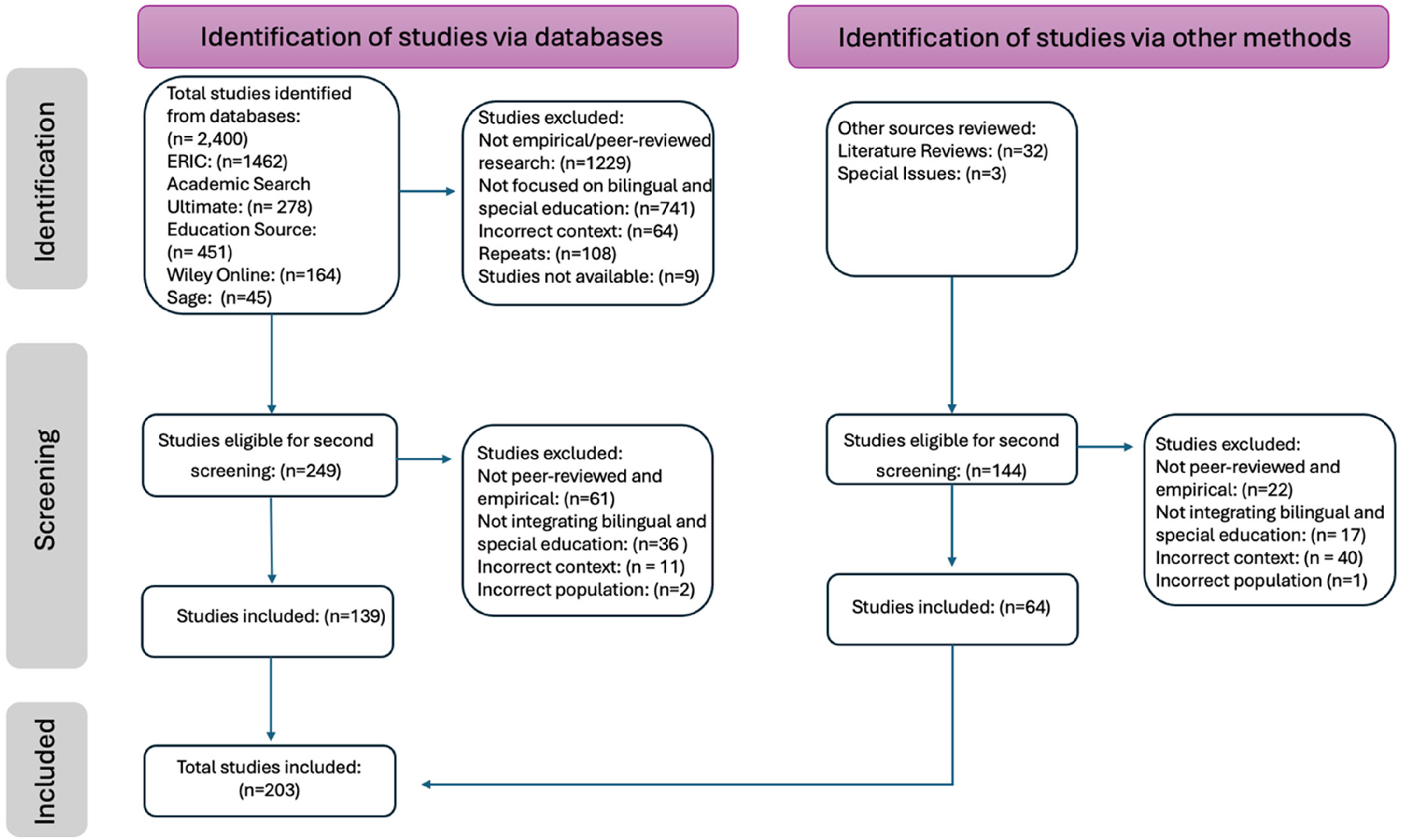
PRISMA Flow Diagram for Systematic Literature Review. Note. Diagram adapted from Page et al. (2020). Here ‘incorrect context’ refers to contexts that are not school-based or within the United States.
Literature Review Searches
As literature reviews were identified through the title-abstract screening of the database searches, the literature reviews that researched an aspect of bilingual special education were pulled so that their references could be hand-searched. The authors read these references for titles that matched the focus of this review. When literature reviews were found within these references, they were also reference searched. In addition, the Wang and Woolf (2015) review's references were hand-searched despite not being found through our database searches. We felt it necessary to include Wang and Woolf (2015) in the reference searches because it served as the foundation for our own Boolean searches and we wanted to be as comprehensive as possible. A total of 32 literature reviews’ references were searched and from this search 139 articles were added to our corpus for the second eligibility screening.
Special Issue Searches
The third author identified three special issues that had focused on bilingual special education within the last 8 years. These special issues were also hand-searched to ensure a comprehensive inclusion of the articles written on this topic. Of these three special issues, five articles met the criteria for a secondary eligibility screening.
Eligibility Criteria and Screening Process
In the first round of screening, two team members conducted a title and abstract reading to determine if articles should be included or excluded in this review. They noted repeat articles in these initial searches. After the initial search of databases, references, and special issues, the researchers conducted a secondary eligibility screening of all pulled articles. Two members of the research team read the methods sections and research questions of all articles to ensure they met the inclusion criteria. Each researcher would mark “yes” if they felt the article should be included in the review and “no” if they did not believe it met the eligbility criteria. For any articles where the two could not reach agreement, a third member was brought in to discuss the article and if it should be included. The team had an initial 79% agreement on inclusion and exclusion of the 393 articles reviewed in the secondary screening. Almost half (48%) requiring discussion were discussed to determine if they were at the intersection of disability and bilingualism. Ultiimately, we reached 100% agreement for all articles included.
Methodologically, three criteria were developed in order for articles to be included. Articles must detail empirical research, which includes qualitative, quantitative or mixed methods research (Gamoran & Dibner, 2022). We also developed criteria related to the articles’ context. The studies must be school-based or school-focused research with bilingual children currently receiving or being considered for special education services in the United States. Studies focused on multi-tiered systems of support for bilingual children were also included when they were purposeful in their consideration of supports for students with disabilities. The studies must be conducted within the United States because there is the need for a similar framework or set of policies that dictate how these programs are implemented. Articles must be school-based because of our interest in school-based interventions and research. This included articles addressing bilingual related service provision. 2 However, to ensure that experiences of all actors involved in schools are included, in the case that interviews about educational experiences were conducted in the home with caretakers, the research studies were also included.
The next, and most important criteria for inclusion, is that articles must focus on both bilingual and special education to be included in this review. The research team named this “the intersection or integration of bilingual and special education.” To determine if they met this criteria, we read the research questions and the purpose—were these purposefully considering bilingual students with disabilities? For example, articles focused on speech and language must be discussing language disorders and/or service delivery for bilingual students or they need to be explicitly about testing bilingual students for identification of a disability to be included in this study.
Several exclusion criteria were developed. Articles that are conceptual or offer program or intervention explanation without introducing new data were not included. Due to our interest in school-based practices and practitioner preparation, early-identification, home-based, or clinical research were not included. Articles were not included that compare special education and bilingual education or that focus on one of the two with brief mention of the other. Intervention research that happened to include both populations was not included. A total of 203 articles were identified for further analysis after the first and second screenings. The search terms and references for all 203 articles can be found at Open Science.
Coding and Analysis
Following the identification of literature for this review, the researchers examined articles and “charted” their data to better understand the scope of this literature. The analysis plan for this study was not pre-registered. However, to “chart” the data within these studies, the research team used an Excel spreadsheet to pull out important information from the research that can speak to the greater research question (Arksey & O'Malley, 2005). To understand the type of research being conducted, the coding researcher read each methods section and charted the type of study. If the authors identified the methodology (qualitative, quantitative or mixed methods), the researcher coded based on their designation. Researcher intuition (understanding of methodological practices) was used when the designiation was not included. The year and journal of publication was charted to be able to analyze how publications changed over time and the disciplines publishing these articles. The journals were grouped by disciplines: journals focused on bilingualism and language education, journals focused on special education and disability, journals focused on speech and language pathology, and “other” for journals that did not fit these three categories. Speech and language services are considered part of the special education services. However, due to its specific role in language development and its interests in bilingual special education practices, here we included speech and language as a separate category of discipline. In addition, to analyze the contexts of these studies, the languages included, school context, and United States region were pulled from each article.
The research team was also interested in the language shifts across this literature. First, the coder searched for the term used to identify bilingual or multilingual students and the term used to identify a student with a disability. In some cases, multiple terms were used and the researcher paid close attention to which terms were used within the research questions, purpose and methods section. Additionally, in the interest of examining the field over time, each article was searched for the use of “translanguaging” or “multilingual and multimodal practices” (Wei, 2018b, p. 9). For each category that was coded, descriptive statistics were calculated.
Finally, to better understand the focus of the research being conducted, the research questions (or study purpose when questions were not available) were pulled and coded for their focus. This was done through in vivo and descriptive coding. Codes included subject specific areas such as math and literacy and codes that focused on the people interviewed such as experiences of students or experiences of families. 3 Two focus codes were chosen for each article. To confirm this part of the coding, a second coder read each of the research questions and confirmed the research focus or foci. The focus codes were grouped by their themes and descriptive statistics were used to analyze the foci across this data corpus. The goal of this coding was to identify the field's research foci. In some cases, more than two codes might have been possible, but the two coding researchers chose to highlight the two main foci and agreed on the codes chosen. This was often determined by overall purpose and/or primary question within the research questions. Following the completion of the coding, these codes were grouped by themes. Fortunately, because codes were grouped by their themes, if an article covered phonemic awareness, vocabulary, and fluency, our choices in deciding which two foci to code does not change the results, as all of these codes were grouped under the theme of literacy.
Results
The authors examined 203 articles within this review to better understand the state of bilingual special education research since the year 2000. There is an abundance of information included within these articles but to provide a clear picture of the state of the research, we divided the findings into five sections. These include the discipline of the journals publishing this work, the chronology of publications, the terminology used to describe the populations receiving bilingual special education, the context and methodology of the scholarship, and the foci of the research.
Discipline of Journals
In an examination of the state of research of bilingual special education, it is important to understand the journals and more specifically, the disciplines of the journals that are interested in and actively publishing this work. Across the 203 articles within this review, 91 different journals are represented and 61 of those journals published one piece that is included within the review. The 14 journals with four or more articles are listed in Table 1. The two greatest publishers of this work are the Journal of Learning Disabilities and Language, Speech, and Hearing Services in Schools. It should be noted that in the journals with four or more articles each, 50% (7/14) are special education focused journals.
Top Publishers Used.
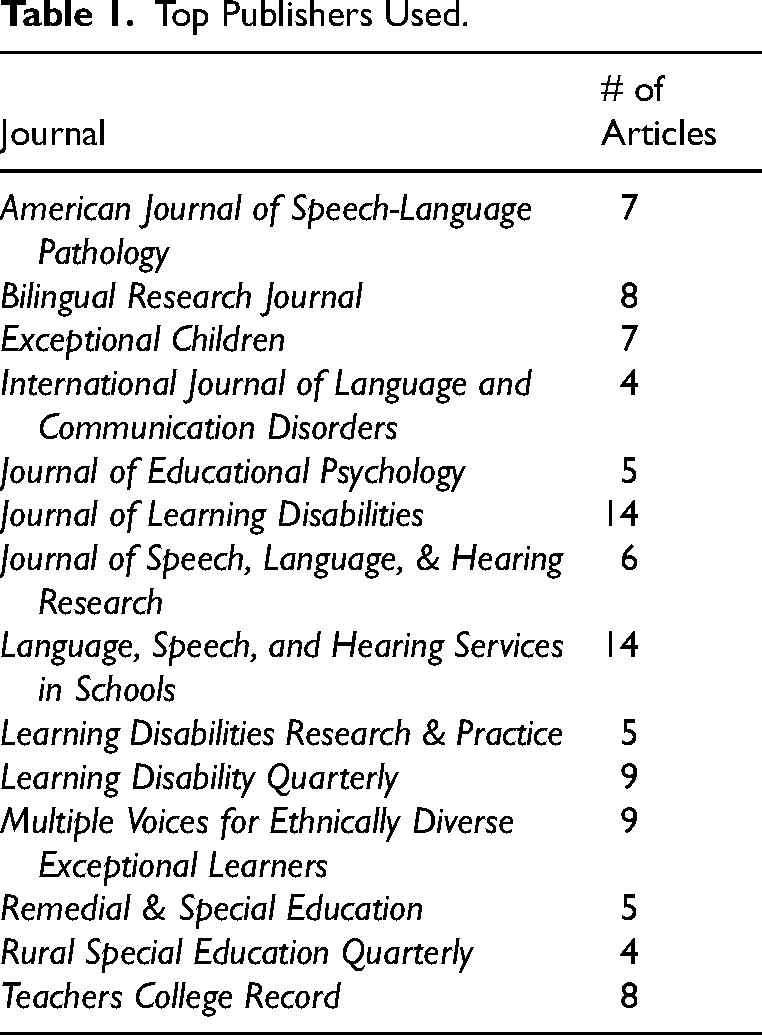
There are three disciplines of journals we paid special attention to within this review. These include journals focused on bilingualism and language education, journals focused on special education and disability, and journals focused on speech and language pathology. The largest contributor to these publications are special education journals. There are 29 journals focused on this discipline that published 83 (41%) of the articles included. A total of 14 speech and language journals published 47 (23%) of the articles included, while bilingual and language focused journals published 15 (7%) of the articles from 8 journals.
Chronology of Publications
The research included in this review spans from 2000 to the mid-point of 2024. Figure 2 presents the number of publications by year and two different spikes, or sharp increases in publications can be noted in 2006 and 2014. In 2006, the majority of the journals publishing this work were special education journals (n = 10, 67%) and five of those articles were from the same journal: Journal of Learning Disabilities. The Teachers College Record also published three articles within that year. In 2014, the same is true. Of the 20 articles published in 2014, 11(55%) were from special education focused journals and three journals published multiple pieces: Remedial and Special Education, Learning Disability Quarterly and Journal of Learning Disabilities. However, compared to 2006, the spike in 2014 does include journals that are speech and language focused. Following the 2014 spike, the average number of publications also increases from 6.3 articles per year prior to 2014 to 9.6 articles per year following 2014. In fact, over 50% (115) of the articles within the review were published in 2014 or later and 25% (51) were published within 2020–2024.
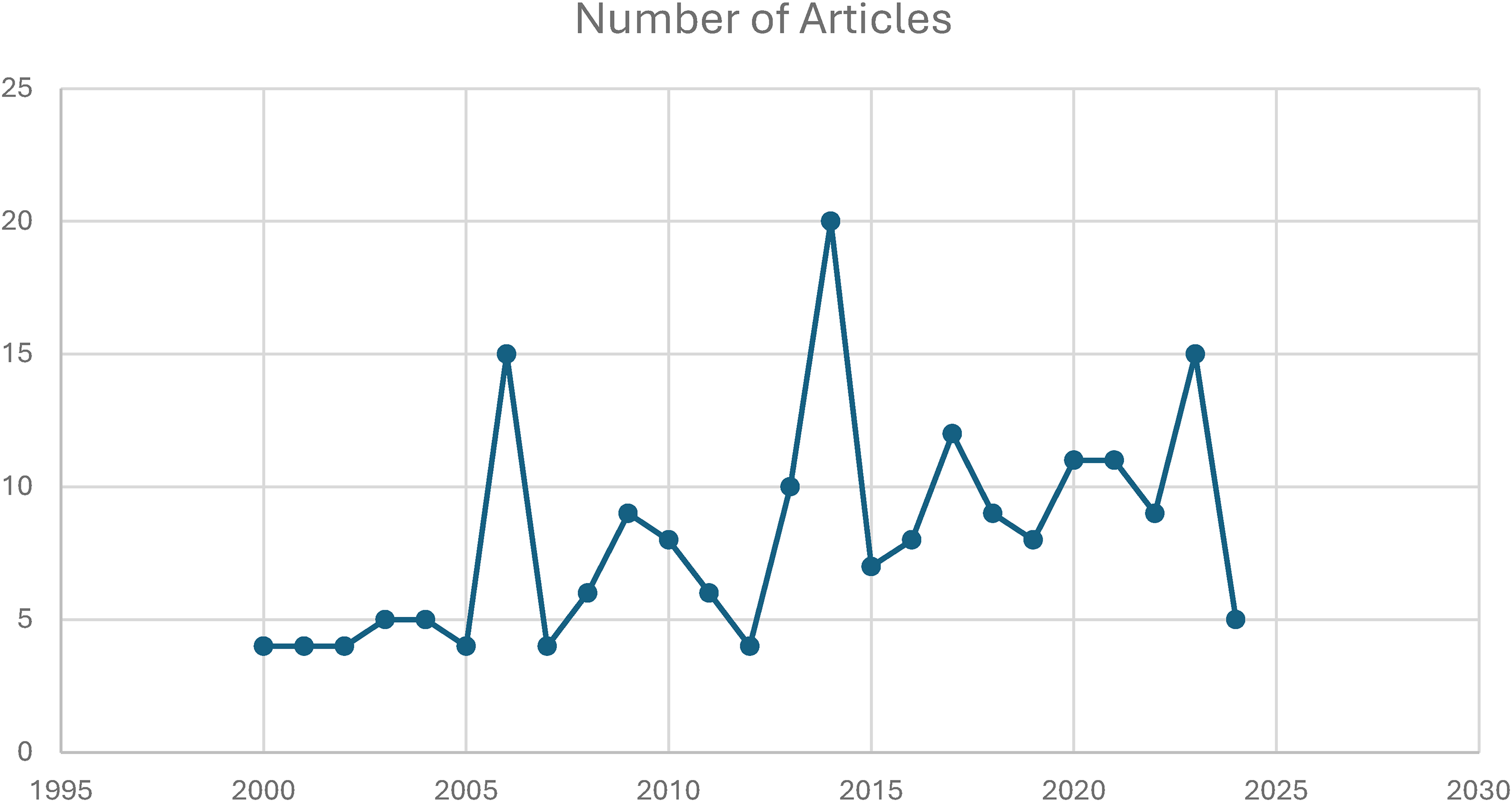
Publications Over Time.
Terminology Used
The way that researchers, publishers, and readers engage with and internalize the terminology used to describe the populations included within bilingual special education is of utmost significance. We specifically examined how researchers described the language development of students and disability. There are 28 different terms that were used to categorize students in relation to their language use and 12 (43%) of those terms were never repeated in other articles. The salient finding from this analysis is that 13 (46%) terms focus on students as English learners, meaning any term that focuses on their learning of English first (e.g English language learners, Latino English language learners, English learners, learners of English as a second language, etc.). Those 13 terms were used in 126 (62%) of the articles examined; over half of the articles view students in reference to their English learning. It should also be noted that these terms, such as “English language learners,” are used as early as 2000 and through 2024, so although new terms were introduced, there is not a clear shift in the terms within this work. In contrast, 10 (36%) of these terms focus on the students as bilingual, dual, or multilingual learners. This accounts for 67 (33%) of the articles examined. These terms are also used as early as 2000 and continue through articles published in 2024. However, new terms are introduced. For example, “emergent bilinguals” begins to be used in 2017.
In the description of disability, there is a large variability of terminology to identify disability. A total of 96 terms are used within these articles, and 69 (34%) of these articles used a term that was not replicated in another article. In some cases, terms are used to denote specific disabilities (e.g., math disability). However, even so, there were a multitude of terms for each of these (e.g., math disability, math learning disabilities, mathematical disabilities, mathematics learning disabilities). This demonstrates the lack of a clear descriptor for students with disabilities within this work. There are two terms used most often: Learning Disability(ies) (n = 27 articles, 13%) and students with disabilities (n = 16 articles, 8%).
As described within the literature review, there have been shifts in bilingual education since 2000. This includes the introduction of “translanguaging” as a strategy to support students in building on their Native language. Out of the 203 articles, only 11 (5%) of the articles used translanguaging somewhere within their writing. However, two of the 11 only include translanguaging within the citations. It should also be noted that all 11 articles are from 2017 or later and seven were published in 2020 or later. There are also repeating authors within this group of articles. One author wrote three of the articles and another was part of two of the articles. Only one of these articles is from a speech and language focused journal and one is from a special education focused journal, indicating that this term has been used in bilingual special education research, primarily within the field of bilingual education.
Context and Methods
The contexts and methods used to conduct these studies can tell us a great deal about the work that has been done and the work that needs to be done. Within the 203 articles examined, 122 (61%) studied students, families, and contexts where both Spanish and English are spoken. There are 49 (24%) articles that included students or families that speak multiple languages other than English. A few articles focused on specific languages other than Spanish. This includes Vietnamese (n = 2, 1%), Portuguese (n = 2, 1%), Korean (n = 2, 1%), Jamaican-Creole (n = 1, .5%), and Cantonese (n = 1, .5%). One difficulty is that 24 (12%) articles were not specific about the languages included.
The United States regions examined within these articles also provide a specific glimpse of the spaces that are prioritized in this work. The United States Census has organized the states into four regions, Midwest, Northeast, South, and West. Unfortunately, 37 (18%) articles were not able to be classified by region. Some articles did not include a state, city, or recognizable region. For example, a number of articles reported their research was conducted in the South Western states, but that is not a region as defined by the census, and we did not want to classify it without having a more specific idea of what the researchers meant. Within this research, the Midwest was the site of 20 (10%) articles, the Northeast the site of 29 (14%) articles, the South the site of 47 (23%) articles and the West was the site of 41 (20%) articles. There were also 20 (10%) articles that studied multiple regions and 9 (4%) articles that collected data from across the nation. There are two states that were frequent sites for this work. This includes Texas, which is 10% (n = 21) of the sample, and California, which accounts for 12% (n = 25) of the sample.
There is also much to be learned from the school levels that are included within this research. We classified studies by Preschool (3–5 years), Lower elementary grades K-2 (5–7 years), Upper elementary grades 3–5 (8–10 years), Middle School 6–8 (11–13 years), and High School grades 9–12 (14–18 years). Almost half, 46% (n = 94) of the studies were completed within elementary schools (lower and upper grades). In secondary schools (middle and/or high school), 22 (11%) of the studies were conducted, and 25 (12%) of the studies were completed within preschools. There was also research that crossed between preschool and elementary (n = 9, 4%), elementary and middle (n = 16, 8%) and elementary and secondary (n = 7, 4%). A small number, (n = 4, 2%), collected data across all school levels, preschool through high school.
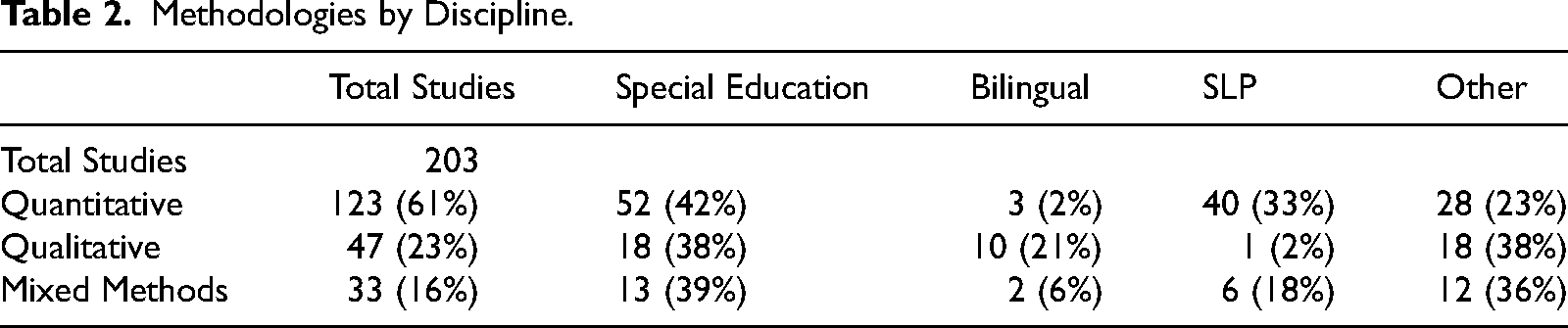
Finally, there were a wide variety of research methods utilized within these studies. Researchers conducted case studies, surveys, pilots, ethnographic studies, database reviews, policy studies, Delphi reviews, and interventions. Table 2 highlights the range of qualitative, quantitative,and mixed methods studies across each of the disciplines. It is important to note, within the quantitative research, 67 (33%) articles were intervention studies. This includes interventions focused on assessment, behavior, instruction, language development, literacy, math, and writing.
Methodologies by Discipline.
Research Question Foci
In the coding of research foci, the researchers used descriptive and in vivo codes for these foci and 33 unique codes were used in all. See Table 3 for a list of the focus codes.
Research Focus Code Frequencies.
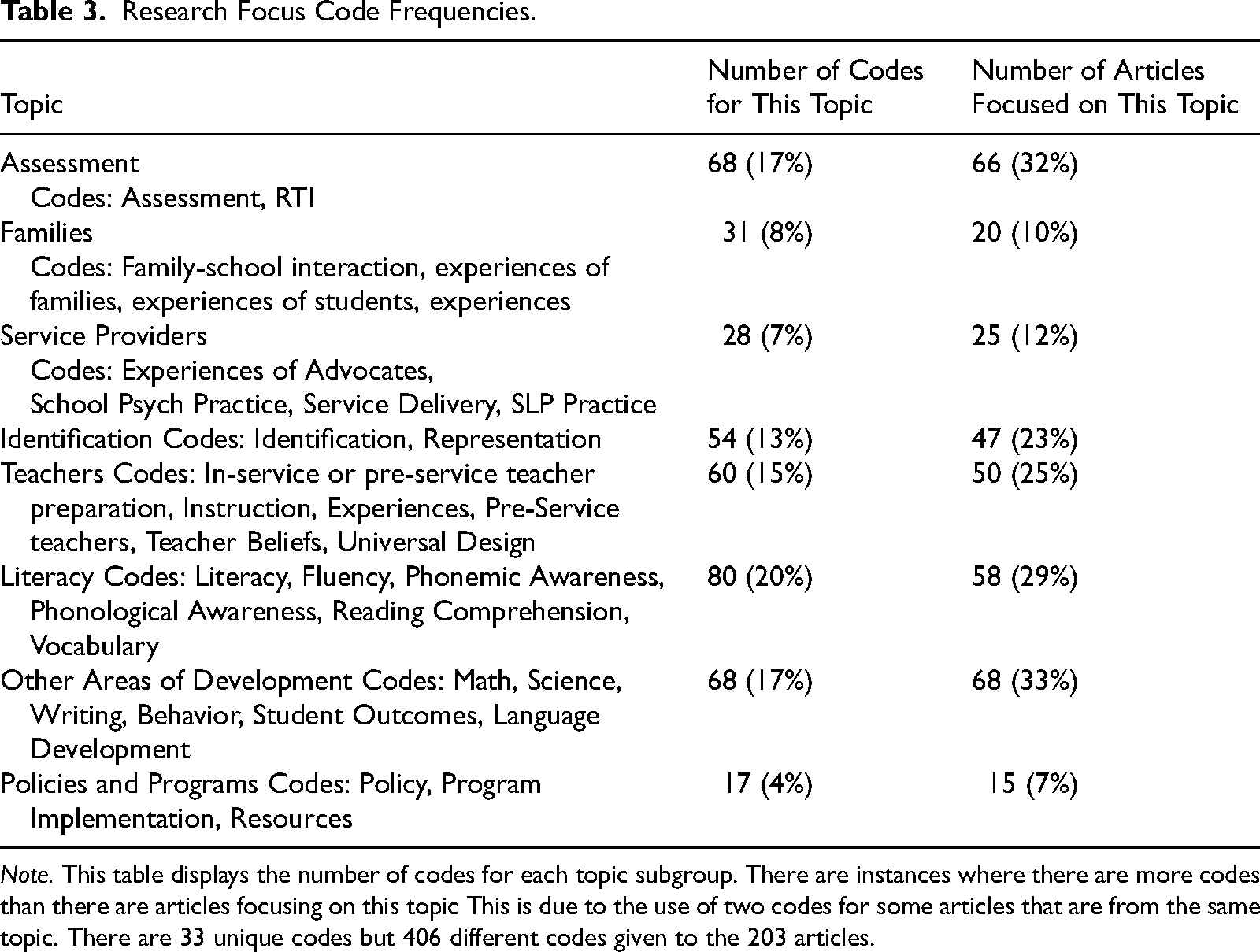
Note. This table displays the number of codes for each topic subgroup. There are instances where there are more codes than there are articles focusing on this topic This is due to the use of two codes for some articles that are from the same topic. There are 33 unique codes but 406 different codes given to the 203 articles.
The three most prominent foci were: assessment and identification, literacy, and teachers. Assessment and identification account for 93 (46%) of the articles within this review. This group includes studies that examined assessment procedures within speech and language, as well as identification of students for special education services. Response to Intervention (RTI) was also a code within this group and was examined in eight (4%) studies. Literacy was the focus of 58 (29%) articles within this review. This included research examining interventions to increase phonemic awareness, phonological awareness, vocabulary and fluency, as well as studies that examined factors impacting literacy and the learning of students. Moreover, the codes Fluency, Phonemic Awareness, Phonological Awareness, Reading Comprehension, and Vocabulary were all included. Finally, research focused on teachers accounts for 50 (25%) of the articles examined and included in-service or pre-service teacher preparation, instruction, experiences of pre-service teachers, and teacher beliefs. The bulk of this group were instruction focused studies, accounting for 33 (66%) of the teacher studies. Despite the call for further examination of teacher preparation, only nine (4%) articles focus on this area of research (McCray & García, 2002).
It is important to highlight some of the research foci that were subsets of specific themes. For example, within the Families theme, there were six (3%) studies that focused on students. Two foci areas that may be of interest to Speech and Languge Pathologists include Language Development, the focus of 37 (18%) studies, and SLP practice, the focus of seven (3%) studies. Literacy was the subject area most studied, but there were other areas of development that were researched as well. This included Math with 13 (6%), Science with three (1%), Writing with four (2%), and Behavior with five (2%). Although all of these subject areas are the focus in less than 10% of the articles reviewed, they demonstrate the range of subjects being considered when supporting bilingual students receiving special education services.
Discussion
Trends in Research Over 24 Years
We reviewed this body of research from the past 24 years to examine trends within studies of bilingual special education. Chronologically, we see two spikes in the research in 2006 and 2014. It is impossible to say with certainty what may have led to these spikes, but we can posit that the policy shifts in the early 2000s may have influenced this work in some way. The 2006 spike may be attributed to the alignment of IDEA with the NCLB of 2004 and the 2014 spike may be attributed to the requirement of research-based practices implemented in 2009 (U.S. Department of Education, 2024). For example, the negative impact of the implementation of NCLB towards English-only instruction may in part explain our reported spike in bilingual special education publications, around 2006, as researchers responded to the consequences of less bilingual programing for students by researching and demonstrating its worth on these students’ education. Whatever motivated researchers to conduct research and publish in this area, the special education journals published the bulk of this research.
Both chronologically and in the analysis of the disciplines of journals publishing this work, special education journals have been especially receptive and interested in publishing this work. The authors have seen anecdotal evidence of bilingual education focused journals publishing research interested in their intersection with special education. This includes a 2020 special issue in the Bilingual Research Journal, a 2021 special issue in TESOL Quarterly, and a 2025 special issue in the Bilingual Research Journal. Still, there is a need for the bilingual education journals to publish this work and an even greater need for these journals to be in communication with each other. This is especially important because the disciplines of journals can be influential in terms of how students are described, and which practices are chosen to support students.
Importance of Language Within Distinct, Yet Related Language-Significant Fields of Research
One of the most salient ways in which the fields of speech language pathology, special education, and bilingual education have differed in their approaches to researching and reporting on the intersection of bilingualism and disability is in the terminology and language used to describe students and to describe these students’ languaging practices. To flesh out this important difference, we coded for the diverse ways that students are categorized, the distinct language used to describe these students’ multilingualism and timestamped any changes in terminology and language used regarding these descriptions. Of the many patterns of language use that came out of our analysis, the two that we highlight here are 1). the use of English Language Learner (ELL) or English Learners (ELs) compared to other terms that do not focus on English first as the most important identity marker for these students (e.g., bilingual students, dual-language learners, multilingual students, emergent bilinguals, etc.) and 2). the emergence of the term translanguaging, as a way to talk differently about students’ use of their whole linguistic repertoire.
First, even with the emergence of updated terms to describe students who speak more than one language in U.S. schools, it is meaningful that so much terminology still places English first in student labels and that this may create a greater importance placed on English development over bilingual development or the use of holistic language practices, such as translanguaging (Przymus et al., 2020). To put it bluntly, educators and service providers in schools measure what they value and in turn value what they measure. A value and focus on English-first has and may continue to lead to separating students’ languages in evaluations, assessments, and practice. Our analysis has shown that terms like English Language Learner are still very prevalent in speech language pathology and in special education journals. This may be in part due to a greater focus on empirical, quantitative studies, where procedures and instruments continue to lend themselves to the separation of named languages (Garivaldo & Fabiano-Smith, 2023; Kangas, 2021). On the other hand, qualitative studies in bilingual education journals have focused on documenting the stories and experiences of emergent bilinguals with disabilities. This may have resulted in the change of terminology in these studies to labels that defocus English, such as emergent bilinguals and multilingual students.
Secondly, how students are categorized and labeled can influence how educators and service providers view their languaging practices. Whereas the field of bilingual education has been recognizing and valuing holistic language practices, such as translanguaging, since at least 2009, 4 the fields of speech language pathology and special education have been slower to embrace these linguistic ideologies. Most recently, however, researchers in bilingual speech language pathology have begun to reinterpret their own previously published research studies through a theoretical framework of translanguaging (Garivaldo & Fabiano-Smith, 2023). We see this as bold and innovative work that begins to address systems of practice that have been informed by a monolingual paradigm that historically have influenced practitioners and educators to separate named languages in assessment procedures and practice. In this work, Garivaldo and Fabiano-Smith (2023) also raise the importance of inviting and involving members from the bilingual communities being researched, as members of the research team. Through this approach, they posit that “translanguaging may improve understanding of languaging in bilingual/multilingual communities” (p. 765).
We argue that these language-based results indicate that for the future of bilingual special education to be most effective for the school-based and life-long goals of emergent bilinguals with disabilities, the next quarter century of research in bilingual special education must include greater interdisciplinary thought and collaboration. Not included in this discussion, but equally important, is how the fields of bilingual education and special education can learn from greater collaboration with speech language pathology researchers, especially around the use of dynamic assessment and the inclusion of language sample analyses of narration and story retells.
Strengths and Weaknesses of Research Foci in Bilingual Special Education
The large base of assessment and identification research from the last 24 years is particularly needed within this growing field of bilingual special education. Identification of bilingual students for special education is a complex issue that can include both over and misidentification (Keller-Allen, 2008; Landeros Wells & De La Garza, 2017). Previous literature highlighted the need for assessment research in combatting misidentification and we are heartened by the work that has gone into answering this call (Artiles & Ortiz, 2002; Bedore & Peña, 2008; Gorman et al., 2016; Miller et al., 2006; Miller et al., 2016; Peña & Bedore, 2017). Furthermore, qualifying bilingual students for special education services in order to get them extra supports does not provide them the supports they need. Instead, consistent access to bilingual programs and instruction are needed (Kay-Raining Bird et al., 2016a; Kay-Raining Bird et al., 2016b; Landeros Wells & De La Garza, 2017; Marinova-Todd et al., 2016; Pesco et al., 2016; Scherba de Valenzuela et al., 2016). The research on literacy instruction and intervention is especially encouraging to this end. That work is important in developing best practices for supporting students’ full linguistic repertoires within literacy instruction.
However, despite the strengths of this research body, there are a few weaknesses as well. The review returned a disappointing number of studies on teacher preparation and collaboration with families. Researchers found that special education teachers have not been trained to work with bilingual students (Landeros Wells & De La Garza, 2017; McCray & García, 2002; Wang & Woolf, 2015). The calls for more teacher preparation research in bilingual special education were made multiple times, but a dearth of research in this area remains.
Furthermore, there continues to be a need to study collaboration between families and schools (Zhang & Choh, 2010). There are only 16 (8%) articles addressing family experiences and school-family partnerships. The field has made great strides towards improving their assessment and instruction practices, but these practices will never be fully successful without preparing teachers to use them and developing strong partnerships with families.
Limitations
The articles yielded are limited by the databases and search terms used for this review. The team included as many of the available articles as possible by expanding the searches to five databases and searching the references of literature reviews and journal special issues. Additionally, the team included a number of different terms to account for the ways bilingual education and special education may be discussed within the literature, specifically expanding to speech and language pieces as well. However, our review did not include Assistive Technology or Sign-Language, and this may be an additional avenue to study bilingualism that was missed here. Furthrmore, during the searches, we uncovered that the decision for the second level of search terms to be school-focused may have eliminated articles we would have liked to include. Still, we believe this study presents the opportunity to examine the research being done in and alongside schools, which was our initial interest.
In the coding of these articles, we had two reviewers code all of the research questions or purpose statements. As these codes were grouped by theme, we believe the results account for the overall foci of the questions and provide a better understanding of the focus in the field. Furthermore, we hope that the collaboration and transparency utilized within this work supports the validation of these results (Brantlinger et al., 2005).
Future Research Directions
The findings from this systematic review point to a number of areas for future research. First, the methodology and context used throughout this research leaves a few gaps to be addressed. Future research should expand to include additional research not considered in this work. This could include dialects and languages that are not world or named languages (e.g., African American Vernacular English) and contexts outside of the United States. Furthermore, there is a noticeable difference in the number of quantitative and qualitative articles. Embracing qualitative research more might facilitate the inclusion of languages beyond the Spanish and English dichotomy and may provide for greater opportunities to engage families. Notably, research should include the development of collaborative partnerships between families and the schools. (Ortiz et al., 2020; Zhang & Choh, 2010).
Within research foci, the same call from 2002 persists (McCray & García, 2002). There is a need to expand teacher education research to examine the preparation of bilingual special education teachers. Considering that state education agencies, such as Texas, have begun developing bilingual special education standards, exams, and bilingual special education certification pathways, greater attention to the preparation of bilingual special educators will need to move beyond a mere call to action, to a necessity. Herein lies the need for the interdisciplinary collaboration called for throughout this review. In the preparation of new bilingual special education educators and service providers, bilingual departments and special education departments within colleges/schools of education need to collaborate more and both need to reach out across campus to speech language pathology professors and students. There is a great need for distinct, yet related fields to listen to each other and learn from each other regarding language and terminology used to categorize students and to describe their languaging practices.
Furthermore, in many educator preparation programs, special education and bilingual education faculty and students do not extensively collaborate and can be in different departments, leading again to different course work, a different preparation, and ultimately to different ideologies/knowledge around disability and language. This is especially true for those in education and communication sciences. Overall, this can result in these future service providers and educators reading different literature, being socialized to talk about students from varying perspectives, and being prepared to think about students, their disabilities, and their language practices in related, but subtly and importantly different ways. These different ways of thinking about language, lead to different expectations for students, different orientations of assessment, and potentially different visions of bilingual special education practice. With this in mind, we plan to explore the subset of language development focused articles (18%) alongside Speech and Language Pathologists to begin this collaboration and communication
An overarching take-away from our review is a call for continued interdisciplinary work at all levels. These levels need to include the preparation of future educators/service providers, professional development for in-service teachers and service providers, and interdisciplinary research on bilingual special education that includes all actors, such as the families and members of communities who support bilingual students with disabilities. In recognizing the diverse research foci and methods within this research, we hope to dive deeper into this data corpus to analyze the findings, theoretical frameworks, and interventions included here.
Conclusion
The state of bilingual special education has changed since the year 2000 in both policy and practice (State Board for Educator Certification, 2022; Tai, 2022; U.S. Department of Education, 2024; Wei & Ho, 2018). We sought to understand the focus of research on bilingual special education within the last 24 and a half years. Results paint a picture of practice where researchers have responded to calls to expand research in assessments and instruction but have not continued to develop best practices in teacher preparation or family-school partnerships and have remained largely siloed in terminology used to describe students and their languaging practices.
If bilingual special education programs and initiatives are to succeed, we must focus on what can be learned from past research and how current research, such as reimagining identification, assessment, and practice via a translanguaging lens and new ways of referring to students who are developing English as an additional language, such as emergent bilinguals with disabilities, might move the field forward (Garivaldo & Fabiano-Smith, 2023; Martínez-Álvarez, 2020; Przymus et al., 2020; Przymus & Alvarado, 2019). Above, we raised new questions about the work that needs to be done going forward. Some of these questions regard how to prepare future bilingual special educators and service providers, how to better collaborate with families and include members from communities being studied, and how to listen and learn from related language-based fields in order to use the most supportive language to describe students and their languaging practices. Answering even some of the questions raised in this review may lead to systemic changes that embrace linguistic diversity as a strength in educational settings, more interdisciplinary collaboration between speech language pathology, special education, and bilingual education scholars, and ideological preparation and practice that does not initiate from either a background in special education or bilingual education, but from both.
Footnotes

Author Note
We have no known conflict of interest to disclose. This research was completed through funding from the Alice Neeley Special Education Research and Service (ANSERS) Institute.
Declaration of Conflicting Interests
The authors declared no potential conflicts of interest with respect to the research, authorship, and/or publication of this article.
Funding
The authors disclosed receipt of the following financial support for the research, authorship, and/or publication of this article: This work was supported by the ANSERS Institute.