




Abstract
Students with mathematics difficulty (MD) frequently experience difficulty with language and communication in mathematics (math). This can impact student performance in word-problem (WP) solving and math writing (MW), two skills required by state standards and on high-stakes assessments. In this study, we added a MW component within a WP intervention. The goal was to explore the potential of supporting MW performance and WP performance through practice in reasoning and communicating. Grade 4 students with MD were assigned to one of three conditions: WP and MW intervention (WP + MW), WP alone intervention (WP-alone), and business-as-usual (BaU) with no intervention from the research team. Results indicated an advantage for the students in the WP + MW condition compared to the students in the WP-alone and BaU conditions on a MW rubric proximal to the intervention. We also identified a nonsignificant, but encouraging trend for WP solving for the students in the WP + MW and WP-alone conditions compared to the students in the BaU condition. Additionally, students in the WP + MW condition reported positive perspectives on participating in MW instruction. The study results demonstrate the potential for combining a MW component with a WP intervention, indicating the need for a larger-scale examination of MW instruction within a WP intervention.
Informative Mathematics Writing Within an Additive Word-Problem Intervention for Grade 4 Students with Mathematics Difficulty
Communication and problem solving in mathematics (math) are essential for success with math (National Council of Teachers of Mathematics [NCTM], 2000). Communication involves the language of math, of which a foundation is math reasoning and vocabulary. In this study, we examined supporting Grade 4 students’ math communication and problem solving via math writing (MW), one method of math communication (Casa et al., 2016). We explored using MW as a component of a word-problem (WP) intervention to primarily support communication in MW and generalize to WP performance, particularly for students with math difficulty (MD).
Mathematics Difficulty
Students experiencing MD include students performing below expectations in math. Researchers commonly define MD through a cut-off score ranging between the 10th to 35th percentiles (Nelson & Powell, 2018a). Students with MD frequently demonstrate low performance compared to their peers without MD on early numeracy, including counting, comparison, and number recognition (Geary, 2013; Nelson & Powell, 2018a). Later in the elementary grades, students with MD perform below their peers for place value, telling time, math fact fluency, and multi-digit computation (Andersson, 2010). Students with MD also perform below their peers for advanced math skills such as WP solving, fractions, and algebraic reasoning (Arsenault & Powell, 2022; Nelson & Powell, 2018a).
Mathematics Communication
Math communication involves verbal and nonverbal interactions to convey messages and meaning (Pimm, 2019). Sfard's (2008) theory of cognition and communication, known as the commognitive framework, outlines math knowledge as a discursive activity involving the communication of a mathematical way of using oral explanations, visual representations, and written explanations. To develop deep math knowledge, instruction must focus on communicating mathematically (Morgan et al., 2014). Such theory is represented in national standards. The NCTM (2000) standards emphasize organizing and consolidating math thinking through communication; communicating to others; analyzing and evaluating math thinking of others; and using math language to express math ideas (NCTM, 2000). Similarly, of the eight Common Core State Standards mathematical practices, Standards 3 and 6 reference communication. In Standard 3, students “construct viable arguments and critique the arguments of others.” In Standard 6, students “attend to precision,” which involves communicating precisely to others (National Governors Association Center for Best Practices & Council of Chief State School Officers, 2010). Within the classroom, math communication takes on multi-modal structures of oral, visual, and written communication (Morgan et al., 2014). Although these methods may occur simultaneously, for clarity, we define each separately.
One method of math communication—math discourse—occurs through oral explanations (Morgan et al., 2014). We define math discourse as teacher-to-student, student-to-student, or individual oral communication on math concepts and procedures (Xin et al., 2020). Math discourse strongly relates to successful math communication (Morgan et al., 2014). If students engage in math reasoning during discourse, they are likely to continue to engage in reasoning in problem solving (Xin et al., 2020). Yet, students with MD tend to avoid math discourse.
Math communication also occurs through conceptualizing math knowledge with visual representations (Sfard, 2008). Visual representations include concrete, gestural, pictorial, or abstract depictions of math concepts or procedures (Martinez-Lincoln et al., 2018). Without intervention, students with MD tend to have trouble communicating through visual representations, often demonstrating confusion and uncertainty (Woodward & Baxter, 1997).
Finally, students engage in math communication through MW—written composition with embedded representations (Casa et al., 2016). Although MW involves prerequisite skills focused on writing and math, which can be especially challenging for students with MD, written communication includes communication advantages (Powell & Hebert, 2016). The use of MW provides a method to share with external audiences and opportunities for independent math communication. It also leads to a deep understanding of math content because writing requires accurate representation of ideas (Pimm, 2019).
Mathematics Writing
Research separates MW into four genres: exploratory, creative, argumentative, and informative writing (Casa et al., 2016). In exploratory writing, students write to make sense of their own ideas about math concepts and problems. For example, when solving WPs, students may use exploratory writing by paraphrasing information before solving the WP (Swanson et al., 2019). In mathematically creative writing, students think creatively about concepts. Students may use mathematically creative writing to develop math vocabulary fluency by defining the vocabulary term and creating a WP with the term (Casa et al., 2016). With argumentative writing, students make a claim or critique the argument of others. For instance, students may review a pseudo student's claim, agree or disagree with the claim, and support their reasoning. This differs from informative writing because in argumentative writing students build a claim or a rebuttal in addition to providing information (Hughes et al., 2020). In informative writing, students write explanations about math concepts. For example, students might review the work of a pseudo student who made multiple errors, identify the errors, and explain how to solve the problem correctly (Arsenault et al., 2023). Informative writing is often used to assess conceptual understanding. In our study, we focused on informative writing because of its regular occurrence on high-stakes assessments (Powell & Hebert, 2022).
Mathematics-writing instruction
Half of educators report teaching MW in the classroom (Powell et al., 2021b). Educators use MW to support students’ communication in MW, math reasoning, or math vocabulary (Arsenault et al., 2025). Across genres, informative writing occurs the most frequently in research, instruction, and assessments (Powell et al., 2017; Powell & Hebert, 2022; Powell et al., 2021b).
Students participate in both indirect and direct MW activities. Indirect MW activities include opportunities to practice writing embedded within math-content or math-vocabulary instruction. They may focus more on broad math communication using a mixture of oral, visual, and written explanations. Fuchs et al. (2016) and Jayanthi et al. (2021) both used MW as a part of an explanation sequence also including oral and visual explanations of fractions. Alternatively, indirect MW may include limited teacher modeling and feedback. For example, indirect MW may include paraphrasing WPs, MW journaling, defining math vocabulary, or creating WPs (Chasanah et al., 2020; Swanson et al., 2019).
Direct MW activities include components of explicit instruction with guided practice or independent practice with supplements of teacher modeling or regular teacher feedback. Such direct MW activities may support math reasoning and math vocabulary understanding, but with an additional goal to improve math communication (Hacker et al., 2019; Kiuhara et al., 2020). Several researchers have investigated the impact of direct MW instruction for students with MD. Hebert et al. (2019) supported Grade 4 and 5 students in informative writing. Students responded to prompts with a worked example or an unworked problem. To respond, the students completed a three- to four-step process: read the problem, examine the pseudo-student's work for mistakes (for worked example problems), work the problem, and write about the process. Students learned to write using an introduction, body, and conclusion with math vocabulary. Results indicated a significant difference at posttest between the treatment and control groups for MW.
Kiuhara et al. (2020) supported students with MD in Grades 4 to 6 to develop argumentative writing with fractions. The instruction included the self-regulated strategy development (SRSD) framework—an attack strategy, graphic organizers, modeling, and opportunities for discussions—supplemented with defining vocabulary and note taking. The treatment group significantly outperformed the control group on partitioning a fraction using an area model or number lines. For MW, the treatment group significantly outperformed the control group on rhetorical elements, math reasoning, and total words written.
Hughes et al. (2019) provided informative MW instruction to students in Grades 4 to 6. Like several other MW studies with direct activities, they used the SRSD framework. For the attack strategy, students followed a six-step process: make sense of the WP, determine the plan to solve the problem, draw a representation of the problem, explain the problem solving and reasoning, conclude the paragraph by stating the answer, and systematically check their work. No significant differences emerged between the treatment and the control groups on MW.
Although direct MW activities include a primary goal to support communication, many such practices also include a secondary goal to support math performance. Previous MW studies have demonstrated mixed results for math performance (Hebert et al., 2019; Kiuhara et al., 2020). Therefore, in this study, we extend the research by examining how reasoning and communication through MW supports MW and generalizes to reasoning within math content (WP solving).
Difficulty with mathematics writing
Combining writing and math skills to complete MW responses, a complex task, proves to be especially challenging for students with MD (Arsenault et al., 2023). Although no study has compared MW responses of students with and without MD, Arsenault et al. (2023) reported that Grade 3 students with MD include few words, numbers, and symbols in their MW responses (M = 33.3). Hebert and Powell (2016) reported that Grade 4 students without MD, when responding to a similar prompt, wrote nearly twice as many words, numbers, and symbols (M = 59.0). When measuring the responses of Grade 3 students with MD to an informative MW prompt, students with MD performed low for organization, grammar, clarity and precision, math vocabulary, and math content (Arsenault et al., 2023). Of these writing components, organization can be especially challenging. Students with MD regularly complete written responses with essential components missing such as the introduction and reasoning for informative MW (Hughes et al., 2020).
Word-Problem Solving
In this study, we examined combining a direct MW activity with WP solving to explore the impact on MW and WP outcomes for students with MD. One effective method for supporting students with MD in WP solving is schema instruction (Fuchs et al., 2021). Schemas act as a conceptual structure allowing students to categorize WPs (Marshall, 1995). Students learn the common additive and multiplicative schemas based on student need and grade-level standards (Powell & Fuchs, 2018). The additive schemas, the focus of this study, include Total, Difference, and Change. In the Total schema, parts are put together for a total. In the Difference schema, two amounts are compared for a difference. In the Change schema, a starting amount increases or decreases for a new amount (Powell et al., 2021a).
Difficulty with word-problem solving
Many students with MD have difficulty setting up and solving WPs (Arsenault & Powell, 2022). A WP involves a written math story in which one or more steps must be completed to solve for an unknown. Solving WPs with accuracy can be complex due to linguistic and numerical factors (Daroczy et al., 2015). To solve a WP with accuracy, students must read the problem, interpret the language, interpret charts or graphs, set up needed equation(s), and compute with accuracy (Powell et al., 2021a). Linguistic complexity in WPs impacts student ability to read, interpret, and set up equations (Schleppegrell, 2007). Once students set up the equations, students must navigate computation complexity (Nelson & Powell, 2018b).
Purpose and Research Questions
We conducted an exploratory study to examine the potential promise and social validity of integrating a direct MW activity within a WP intervention. The study aligned with research focused on direct MW activities with a main goal to support communication through MW and a secondary goal to support math reasoning through WP solving. This study extended the research by pairing an explicit, brief, MW activity with WP instruction for single- and multi-step WP solving at Grade 4. Whereas previous research included more of a discourse focus, integrating MW as part of the problem-solving process, indirect MW activities (Fuchs et al., 2016), or a minimal emphasis on math content, focusing primarily on MW development (Hughes et al., 2019). For this study, we explored a novel structure of integrating MW with WP solving to (1) provide an initial examination of the impact of the intervention on MW and WP performance and (2) investigate the social validity of the MW activity. Such a study could provide insight into the need for a large-scale investigation integrating a MW activity into a WP intervention.
We asked three research questions. (1) To what extent does students’ MW performance improve after participation in the WP and MW (WP + MW) or WP alone (WP-alone) interventions compared to students in the business-as-usual (BaU) condition? (2) To what extent does students’ WP performance improve after participation in the WP + MW or WP-alone interventions compared to students in the BaU condition? (3) What is the social validity of including MW in the WP + MW intervention for Grade 4 students?
Method
Participants and Setting
We recruited 15 schools from an urban school district in the southwest United States to participate in a large, WP intervention study (i.e., the parent study) for the 2023–2024 school year. The school district consisted of 73,707 students with 6.0% identifying as Black, 4.8% identifying as Asian, 54.1% identifying as Hispanic, 30.7% identifying as White, and 4.3% as other. Of the students enrolled, 31.4% were dual-language learners, 16.4% received special education services, and 50.2% were classified as economically disadvantaged.
In September 2023, we screened 732 students from 48 Grade 4 classrooms from 15 schools to identify students with MD. Students qualified as experiencing MD if they performed at or below the 25th percentile on the Grade 4 WP Screener (Powell & Berry, 2020b), and if we obtained caregiver consent and student assent. Table 1 represents the demographic information for the 64 students with MD who participated for the duration of the study.
Participant Demographics.
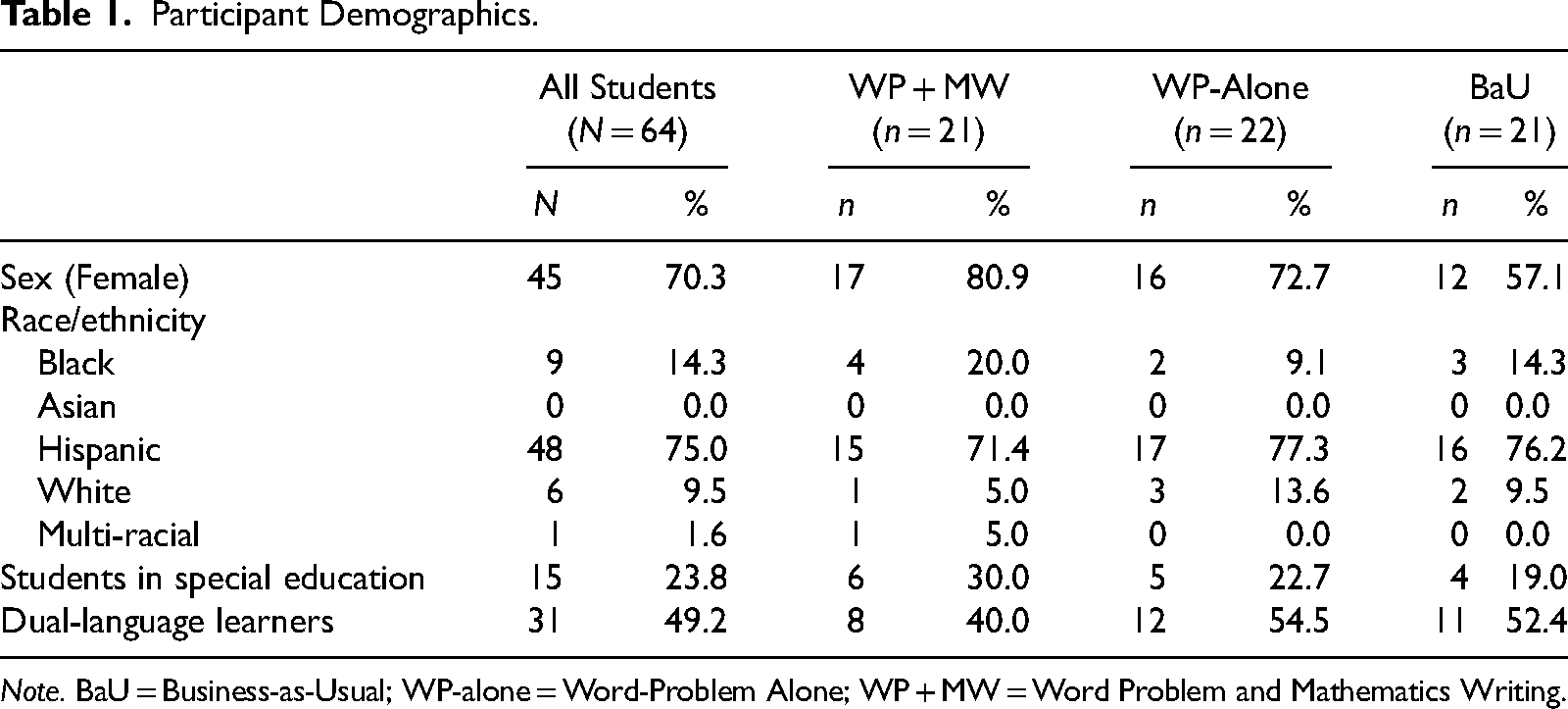
Note. BaU = Business-as-Usual; WP-alone = Word-Problem Alone; WP + MW = Word Problem and Mathematics Writing.
Research Design
To provide an initial exploration of the impact of adding a MW activity to a WP intervention, we sampled students from a parent study focused on WP solving and pre-algebraic reasoning. Of 732 students screened for the parent study, we identified 143 students with MD. For the parent study, we randomly assigned the students with MD to three conditions: WP + Pre-Algebraic Reasoning (n = 48), WP-alone (n = 47), or BaU (n = 48). Due to differences in instructional activities and WP solving strategies focused on pre-algebraic reasoning, we excluded the students from the WP + Pre-Algebraic Reasoning condition in this study; therefore, we do not mention them for the rest of the manuscript. For this exploratory study, we randomly assigned students within the WP-alone condition to WP + MW (n = 24) or WP-alone (n = 23). We also randomly selected 23 students from the parent study BaU condition to act as a control.
Attrition
The total attrition rate was 8.6%. The attrition rates by group were 12.5% for WP + MW, 4% for WP-alone, and 8.6% for BaU. A student dropped from WP + MW after Lesson 10 because of lack of conversational English. It was determined the student would best be served in the dual-language classroom rather than English-only intervention. Two students were removed from WP + MW because they did not complete a minimum number of lessons (i.e., 10 lessons) due to truant school attendance. A student in the WP-alone condition was dropped due to a medical related absence during posttesting. Two students left the BaU condition because they withdrew from the participating schools before posttesting occurred.
Interventionists
A total of 14 interventionists, consisting of 10 graduate researchers and four full-time researchers, completed all procedures. The graduate researchers were enrolled as graduate students in a college of education and the full-time researchers had backgrounds in education. All interventionists participated in five trainings. Before screening, the interventionists participated in three 3-hour training sessions: general behavior and intervention information, screening, and pretesting. Before the intervention, interventionists participated in a 3-hour training on WPs for two schema types (Total and Difference) and the intervention activities. Midway through the intervention, the interventionists also participated in a 2-hour training on the Change schema type and posttesting. After each training, interventionists practiced the assessments and lessons content with partners.
Procedures
We conducted the study from September to December. The study started after the initial school and teacher recruitment. The end dates were restricted by winter break in late December.
Screening and pretesting
We conducted screening and pretesting in September and early October. Screening consisted of one approximately 50-minute session. During screening, students completed the Grade 4 WP Screener (Powell & Berry, 2020b) and the MW Distal Assessment (Arsenault, 2023b). Students with MD then completed three pretesting sessions (approximately 60 minutes each) one-on-one in a quiet school setting. Within these sessions students completed the MW Proximal Assessment (Arsenault, 2023c) and the problems from the WP Solving measure.
Intervention
The one-on-one intervention began in October. The intervention included 20 approximately 35-minute lessons conducted in the school setting. The duration, 35 minutes, was agreed upon for the parent study between researchers and the school district as a feasible amount of time for supplementary instruction. Lessons 3 to 18 differed across the WP + MW and WP-alone intervention conditions. The number of lessons was chosen to provide an initial exploration of the concept of adding MW to a WP intervention. The intervention was implemented three times a week for 7 to 9 weeks, depending on student and interventionist absences.
Posttesting
All students participated in posttesting in December in the typical intervention space with a small group of students (approximately 35 minutes). During posttesting, all students completed the MW Proximal Assessment, MW Distal Assessment, and WP Solving. Students in the WP + MW condition also completed the Deck Logs: Social Validity (Arsenault, 2023a).
Intervention and Materials
Students participated in one of two intervention conditions adapted from Pirate Math Equation Quest (https://www.piratemathequationquest.com). The WP + MW and WP-alone conditions included four activities in common: Captain Cards, Buccaneer Problems, Shipshape Sorting, and Jolly Roger Review. The WP-alone condition also included Pirate Prep, a math-review activity, while the WP + MW condition included the direct MW activity, Deck Logs.
WP + MW and WP-alone students
Captain Cards
Students completed two 1-minute timings with math fact flashcards, with interventionist support, working to beat their score on the second round. Next, students graphed their daily high score. The flashcards included addition problems with addends from 0 to 9 and subtraction problems with minuends from 0 to 18 and subtrahends from 0 to 9.
Buccaneer Problems
The Buccaneer Problems, approximately 15- to 20-minutes, consisted of the core WP solving content. Lessons 1 and 2 focused on computation practice and labeling charts and graphs. Lessons 3 to 20 covered schema types (i.e., Total, Difference, and Change). For Lessons 3 to 7, students worked on single-step Total problems. In Lessons 8 and 9, students focused on single-step Difference problems. For Lessons 10 to 13, students focused on multi-step Total and Difference problems. During Lessons 14 to 18, students focused on single-step Change problems. For lessons 19 to 20, students reviewed all schema types.
To solve the WPs, students used the UPS 2 attack strategy. The UPS2 included eight steps: Understand by reading, Underline the label, Parenthesis around needed numbers, Put the numbers in order, Schema, Solve, Check the number answer, and Check the label answer. Interventionists used explicit instruction to support students to complete each WP.
Shipshape Sorting
In Shipshape Sorting, students sorted WPs read aloud by the interventionist on a mat for 2 minutes. The mat included a space for each schema type and a space for unknown problem types (i.e., T, D, C, and ?). After 2 minutes, the interventionist prompted the student to explain their reasoning for the schema type selection for two to three WPs.
Jolly Roger Review
The Jolly Roger Review activity included a two-part independent practice. First, students had 2 minutes to either complete single- and multi-digit computation problems (with and without regrouping and decimals) or classify comparison sentences. Students classified comparison sentences, typically found in Difference problems, by identifying the greater amount and the amount that was less. Second, the student had 2 minutes to complete one WP.
WP-alone students
Pirate Prep
After Captain Cards, for Lessons 3 to 20, the interventionist and the student engaged in an approximately 5-minute math-review activity. Topics included angles, converting numbers, fractions, geometry, money, patterns, and place value.
WP + MW students
Deck Logs
After the Buccaneer Problems, an approximately 6-minute MW activity was implemented from Lessons 3 to 18. The students wrote an explanation about a WP they solved during the Buccaneer Problems. Each Deck Log worksheet included a WP from the Buccaneer Problems completed earlier in the same lesson and the same MW prompt for all lessons.
The students completed the activity with the support of the Deck Logs poster (see the online Supplementary Materials). The attack strategy (i.e., step-by-step procedure with sentence starters), as noted on the Deck Log poster, included Writing Prep and Writing Time (Sacco et al., 2022). Writing Prep included: Read the prompt and identify the schema and equation. Then, students had 5 minutes to complete a response to the MW prompt using the four-step Writing Time process with the sentence starters: “I know this is a…”; “I know because…”; “Next, I set up…”; and “This is how I know…” During Writing Time, the student could orally rehearse with the intervention and reference the Deck Log word banks for each sentence starter. Components of explicit instruction were included throughout the Deck Logs. Student work samples from four different schema types throughout the intervention are included in Supplementary Materials.
Classroom Instruction
We collected survey data from classroom teachers on math instruction. Typical math instruction administered by classroom teachers for all students consisted of an average of 410.2 minutes per-week with an average of 128.3 minutes per-week of WP solving instruction. On average, classroom teachers had 7.3 years of experience teaching. For math curriculums, teachers most frequently used Stemscopes and Go Math. To support WP solving, teachers most often reported using multiple representations. Although infrequently, some teachers reported using an attack strategy or schemas. No teachers reported MW as part of instruction.
Fidelity of Implementation
We collected fidelity of implementation data for the interventions throughout the intervention. Fidelity of implementation checklists were split into subcategories for each activity, listing the required instructional components. An example of Lesson 15 Deck Logs fidelity checklist is in the online Supplementary Materials. Fidelity of implementation occurred through in person supervisory observations and audio-recorded observations. In person supervisory observations for both interventions occurred once every 3 weeks for each interventionist. Additionally, all sessions were audio-recorded, and we selected 20.0% of the audio-recordings, evenly distributed throughout the intervention, for analysis. Fidelity averaged 98.6% (SD = 0.02) for in person supervisory observations and 98.9% (SD = 0.02) for audio-recorded sessions.
Due to the novelty of the Deck Logs, we also included fidelity of implementation specifically for the Deck Logs. We completed one in-person supervisory observation focused on the Deck Logs for 42.9% of interventionists throughout the intervention. We also randomly selected 20.1% audio-recorded sessions, evenly distributed throughout the intervention, for fidelity of implementation of the Deck Logs. For the Deck Logs, fidelity averaged 88.1% (SD = 0.34) for in-person supervisory observations and 86.6% (SD = 0.13) for audio-recorded sessions.
We also tracked lesson completion and length for the WP + MW and the WP-alone conditions. The students in the WP + MW condition on average completed 18.4 lessons (SD = 2.2). Intervention lessons for students in the WP + MW condition lasted on average 35.3 minutes (SD = 6.5) and the Deck Logs activity lasted on average 6.0 minutes (SD = 1.4). The students in the WP-alone condition on average completed 20.1 lessons (SD = 1.7). Intervention lessons for students in the WP-alone condition lasted on average 33.0 minutes (SD = 6.4).
Measures
Word-Problem Screener
Students performing at or below the 25th percentile on the Grade 4 WP Screener (Powell & Berry, 2020b) qualified as experiencing MD. We developed this measure to be representative of WPs students set up and solve in Grade 4. Therefore, students who experienced difficulty (i.e., ≤ 25th percentile) could need targeted WP intervention. The Grade 4 WP Screener included 10 WPs: eight single-step and two multi-step WPs. The single-step WPs included five additive schema problems (Total, Difference, and Change) and three multiplicative schema problems (Equal Groups, Equal Shares, and Multiplicative Comparison). The two multi-step problems included an Equal Groups and Total problem and an Equal Groups and Equal Shares problem. The measure was scored for correct math answers and demonstrated a Cronbach's α of .86.
Mathematics-Writing Proximal Assessment
The MW Proximal Assessment (Arsenault, 2023c) included a WP for the students to solve in an informative MW prompt. For administration, the interventionist read the prompt: “Alex has 20 fidget spinners. Then, he bought four more fidget spinners. After school, he gave 17 fidget spinners away to his friends. How many spinners does he have now? Solve the WP. Explain the problem type and how you set up and solved the problem. Use the area to the right to write your response.” The interventionist provided 8 minutes, timed, for the student to respond. The WP was a Change problem with two changes (increase and decrease) and an unknown end (20 + 4 − 17 = _). The problem did not include irrelevant information, a graph, or a chart. To respond, students needed to explain the schema and how they set up and solved the problem (see Figure 1).
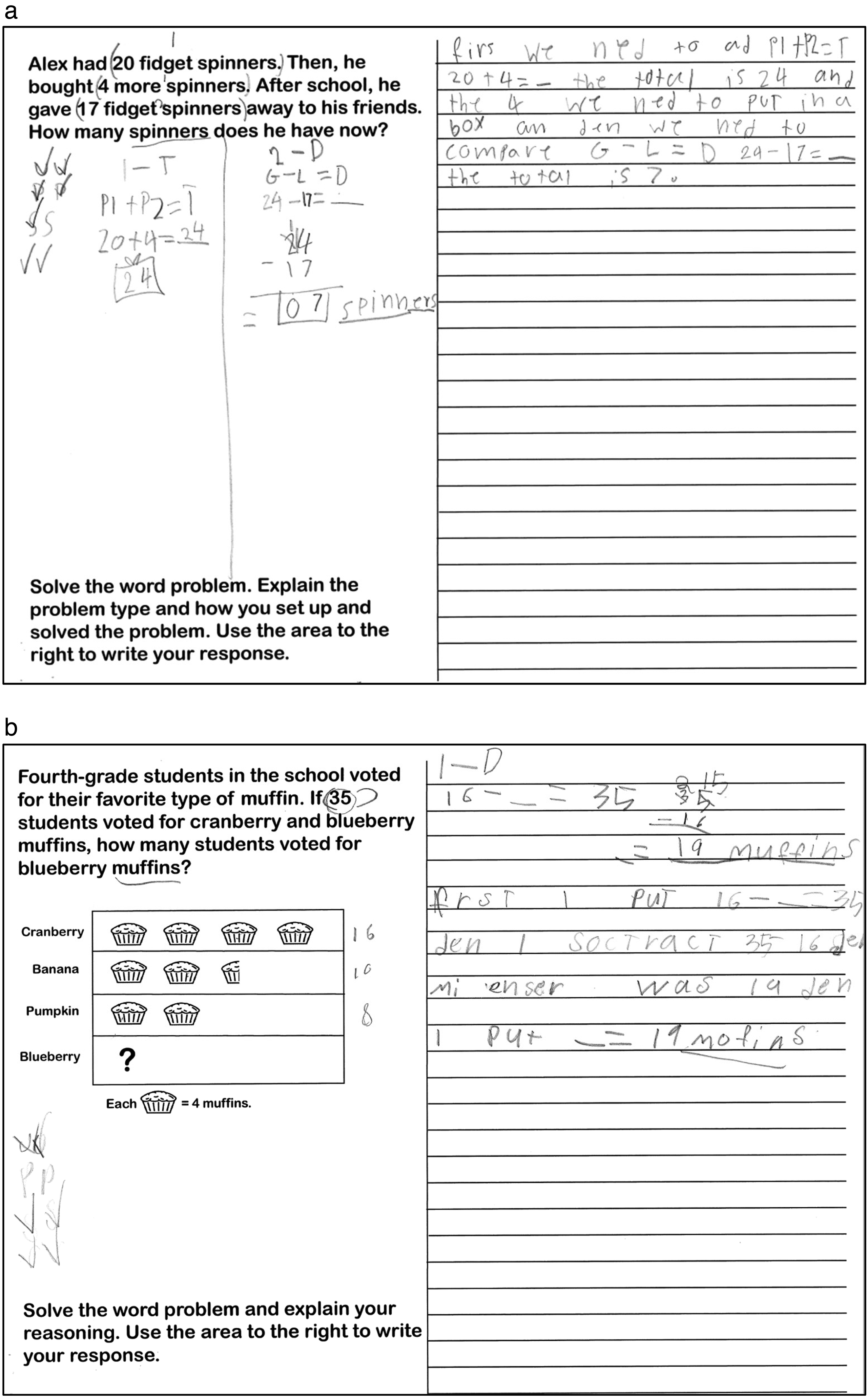
(a) Mathematics-Writing Proximal Assessment: Posttest Work Sample. (b) Mathematics-Writing Distal Assessment: Posttest Work Sample.
For the posttest only, student responses were scored based on a proximal Deck Logs Rubric. The rubric measured the alignment of student responses to the Deck Logs instruction. The rubric included categories for four steps: identifying the accurate schema, explaining the accurate schema, setting up the equations to solve the problem, and referring to the accurate solution. Students earned 2 points for each accurately completed step. Students earned 1 point if they did the step inaccurately for the problem (i.e., wrote the inaccurate schema). Students scored 0 points if they did not attempt the step.
For the pretest and posttest, student responses were also scored with a distal Elements Rubric. The Elements Rubric included itemized content categorized by writing, math vocabulary, and math sections. The writing section measured the introduction (1 point), conclusion (1 point), capitalization (2 points), and punctuation (2 points). For the introduction, students needed to restate the question. For the conclusion, students needed to provide a summative statement. The mathematic-vocabulary section included a list of likely math-vocabulary terms (43 points). Terms included common formal math-vocabulary terms for WPs (e.g., add, divide, equal, equation, schema, etc.) and terms related to accurate computations for this WP (e.g., change, increase, decrease, twenty, 3, +, etc.). The math content included the steps needed to accurately explain the schema type (6 points) and setting up and solving the problem (6 points). Math content focused on accurate explanations with identification of needed and relevant information (e.g., “Writes that the problem is a change problem, or a change occurs;” “Writes that an amount increases, or addition is needed;” etc.). The math content also focused on setting up and solving the problem with the needed numbers and computations (e.g., “Adds the starting amount [20] with the spinners he bought [4] as a number sentence or in an explanation;” “Accurately writes the sum [24] of 20 and 4 in a number sentence or in an explanation;” etc.).
Mathematics-Writing Distal Assessment
The MW Distal Assessment (Arsenault, 2023b) included a WP for the students to solve an informative MW prompt. For administration, the interventionist read the prompt: “Fourth-grade students in the school voted for their favorite type of muffin. If 35 students voted for cranberry and blueberry muffins, how many students voted for blueberry muffins? Solve the WP and explain your reasoning. Use the area to the right to write your response.” The interventionist provided 8 minutes timed for students to respond. The WP was a Total problem with a part missing, irrelevant information, and a pictograph (16 + _ = 35). The WP included the total (35 cranberry and blueberry muffins), but the students had to identify the known part (16 cranberry muffins from the pictograph). The prompt included instructions for the students to solve and explain their reasoning (see Figure 1). For the MW prompt, the language did not align closely with the Deck Logs and the features included in this WP typically challenge students with MD. Unknown parts prove to be complex because students frequently misunderstand the equal sign as an operator symbol, leading to computational errors. Students also regularly make errors when solving problems with charts (Arsenault & Powell, 2022).
Like the MW Proximal Assessment, we scored samples based on the Deck Logs Rubric and Elements Rubric. For posttesting only, in alignment with the MW Proximal Assessment, student responses were scored based on the proximal Deck Logs Rubric (see MW Proximal Assessment for a description of the Deck Logs Rubric). Student responses were also scored based on the Elements Rubric at pretest and posttest. The Elements Rubric for the MW Distal Assessment included the same writing, math-vocabulary, and math-content categories as the MW Proximal Assessment Elements Rubric (see MW Proximal Assessment for a full description). The rubric differed by content in the math-vocabulary and math-content categories. The math-vocabulary section terms (42 points) related to accurate computations for this WP (e.g., total, thirty-five, 10, =, etc.) in addition to the common formal math-vocabulary terms for WPs. The math content included the components needed to explain the schema type (9 points) and setting up and solving the problem (3 points). Math content focused on accurate explanations with identification of needed and relevant information to the schema time (e.g., “Writes that the total is provided;” “Writes that votes for cranberry and blueberry muffins [or 35] are needed to solve the problem;” etc.). The math content also focused on setting up and solving the problem with needed numbers and computations (e.g., “Subtracts the part [16] from the total amount [35] in a number sentence or explanation;” “Includes the accurate label for 19, students;” etc.).
Word-problem solving
At pretest and posttest, the students took a five-item WP measure with problems sampled from the Grade 4 WP Screener (Powell & Berry, 2020b) and Grade 4 WPs – Part 1, Part 2, and Part 3 (Powell & Berry, 2020a). The measure included four single-step WPs (Total, Difference, and Change) and one multi-step WP (Total and Difference). The interventionist read each WP out loud to the students and provided them with time to complete the problems (approximately 10 min). The WP Solving was scored for correct math answers (α = .78).
Deck Logs: Social Validity
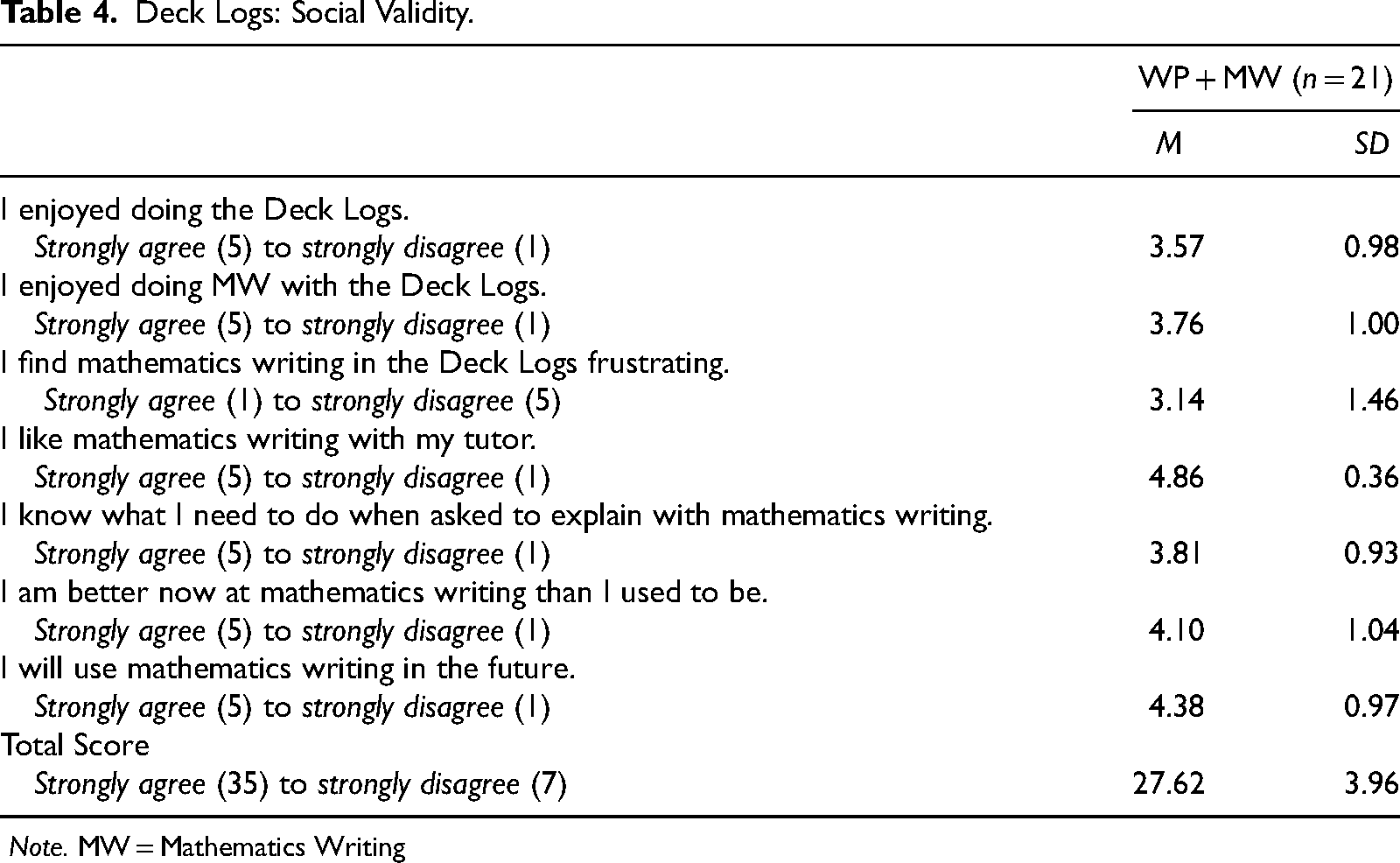
The Deck Logs: Social Validity (Arsenault, 2023a) included seven Likert scale questions (i.e., strongly agree, agree, neutral, disagree, and strongly disagree) and two open ended questions. Four Likert scale questions asked student opinions about MW and the Deck Logs: if the student enjoyed the Deck Logs, enjoyed writing in the Deck Logs, found MW frustrating in the Deck Logs, and liked MW with the interventionist. Two Likert scale questions focused on student perspectives on their MW ability: if they know what to do when asked to explain in MW and if they are better now at MW than before the intervention. One Likert scale question asked if the student believed they will use MW in the future. The two open ended questions focused on student opinions on their favorite things and challenges related to the Deck Logs. Interventionists read the instructions and questions, but students wrote all responses.
Reliability of Test Scoring
The first author trained five interventionists on the scoring methods. Then, the first author and the five interventionists scored all measures. The measures scoring training occurred in three 1-hour sessions: screening, pretesting, and posttesting. Two of the five interventionists participated in the screening training. These two interventionists then completed 100% double scoring of the measures administered during screening. One interventionist participated in the pretesting training. Then, this interventionist and the first author completed 100% double scoring of the measures administered during screening. Two interventionists participated in the posttesting training. These two interventionists then completed 100% double scoring of the measures administered during screening. After double coding, the first author supported the interventionists to resolve all scoring discrepancies (100% reliability).
After the first round of 100% double scoring, reliability was 96.8% for screening measures, 90.0% for pretesting measures, and 92.9% for posttesting measures. The first author acted as a third coder to resolve all discrepancies for 100% reliability for each measure from screening, pretesting, and posttesting.
Data Analysis
For our first two research questions, we ran one-way ANCOVAs and ANOVAs. To measure pretest comparability for the WP measure and the Elements Rubric for the MW measures, we ran a one-way ANOVA. Similarly, we ran a one-way ANOVA for the Deck Logs Rubric for the MW measures at posttest. For the Elements Rubric for the MW measures and the WP measure at posttest, we ran a one-way ANCOVA using pretesting data as the covariate. The ANCOVA included the posttest means and standard errors adjusted for covariate influences, controlling for group differences at pretest. When we identified a significant difference for the one-way ANOVA and ANCOVAs, we ran follow-up Bonferroni post-hoc testing and calculated effect sizes and confidence intervals using Hedges’ g. For our third research question focused on the social validity, we ran descriptive statistics (means and standard deviations) for the students in the WP + MW condition. We also completed a qualitative analysis of the open response questions on the social validity measure by categorizing student responses based on the content they enjoyed and found challenging for the Deck Logs.
Results
Pretest Comparability
Table 2 includes the MW and WP solving unadjusted pretest and posttest means and standard deviations across the conditions. Table 3 includes the main effect ANOVAs, ANCOVAs, and effect sizes for pre- and posttesting. For pretest, we measured comparability of student performance across conditions. For the MW Proximal Assessment, we identified no significant differences across conditions on the Elements Rubric: Writing and Vocabulary. There was a significant difference across conditions on the Elements Rubric: Math (p = .025). Post-hoc Bonferroni testing demonstrated that the WP-alone condition significantly outperformed the BaU condition (p = .036; ES = 0.78). There was no significant difference between the WP + MW and BaU conditions (p = .088, ES = 0.77) or between the WP + MW and WP-alone conditions (p = .527, ES = 0.10). For MW Distal Assessment, there were no significant differences across conditions on the Elements Rubric: Writing, Vocabulary, and Math.
Main Effect Means and Standard Deviations/Standard Errors.
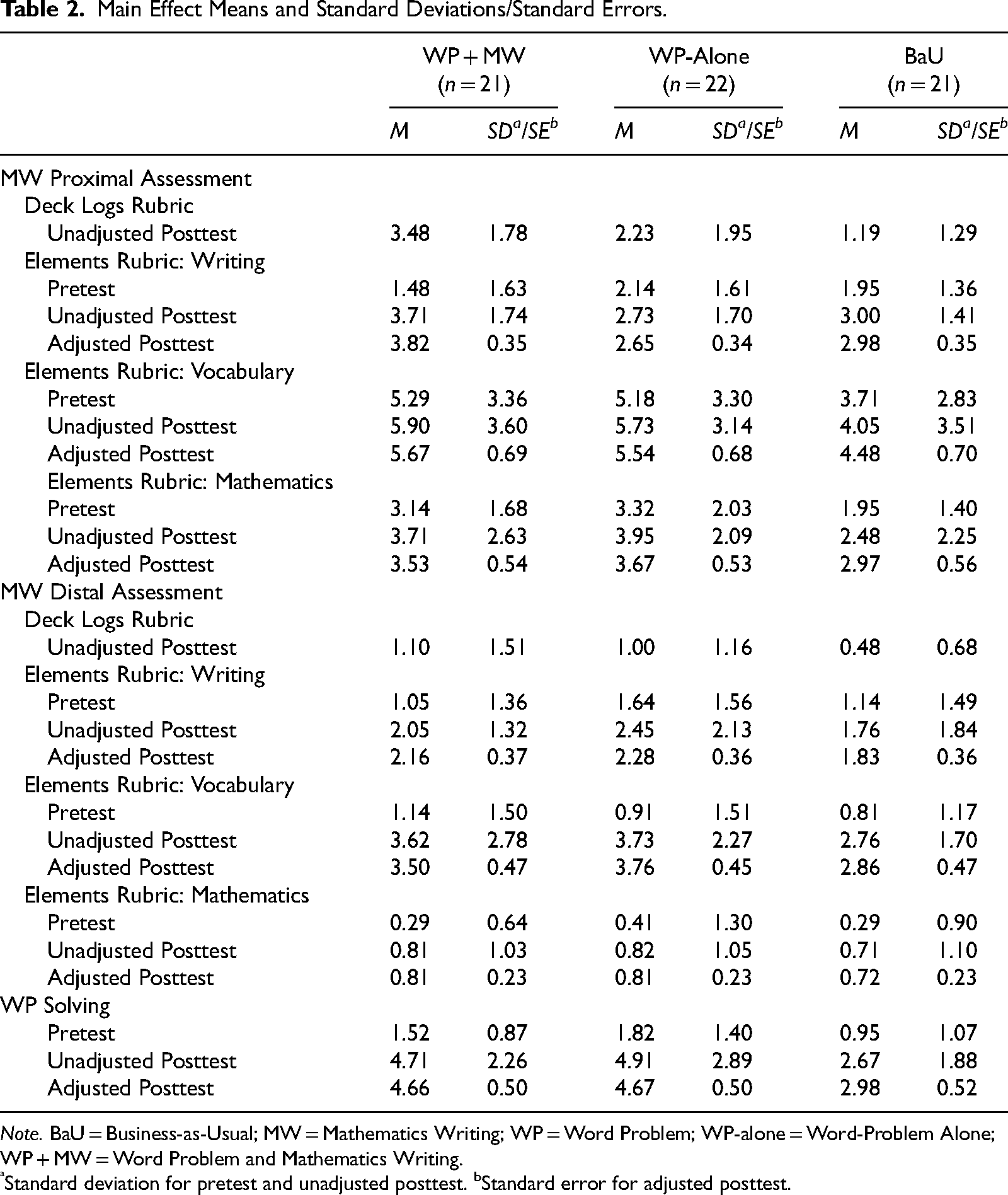
Note. BaU = Business-as-Usual; MW = Mathematics Writing; WP = Word Problem; WP-alone = Word-Problem Alone; WP + MW = Word Problem and Mathematics Writing.
Standard deviation for pretest and unadjusted posttest. bStandard error for adjusted posttest.
Main Effect ANOVA/ANCOVA and Effect Sizes.
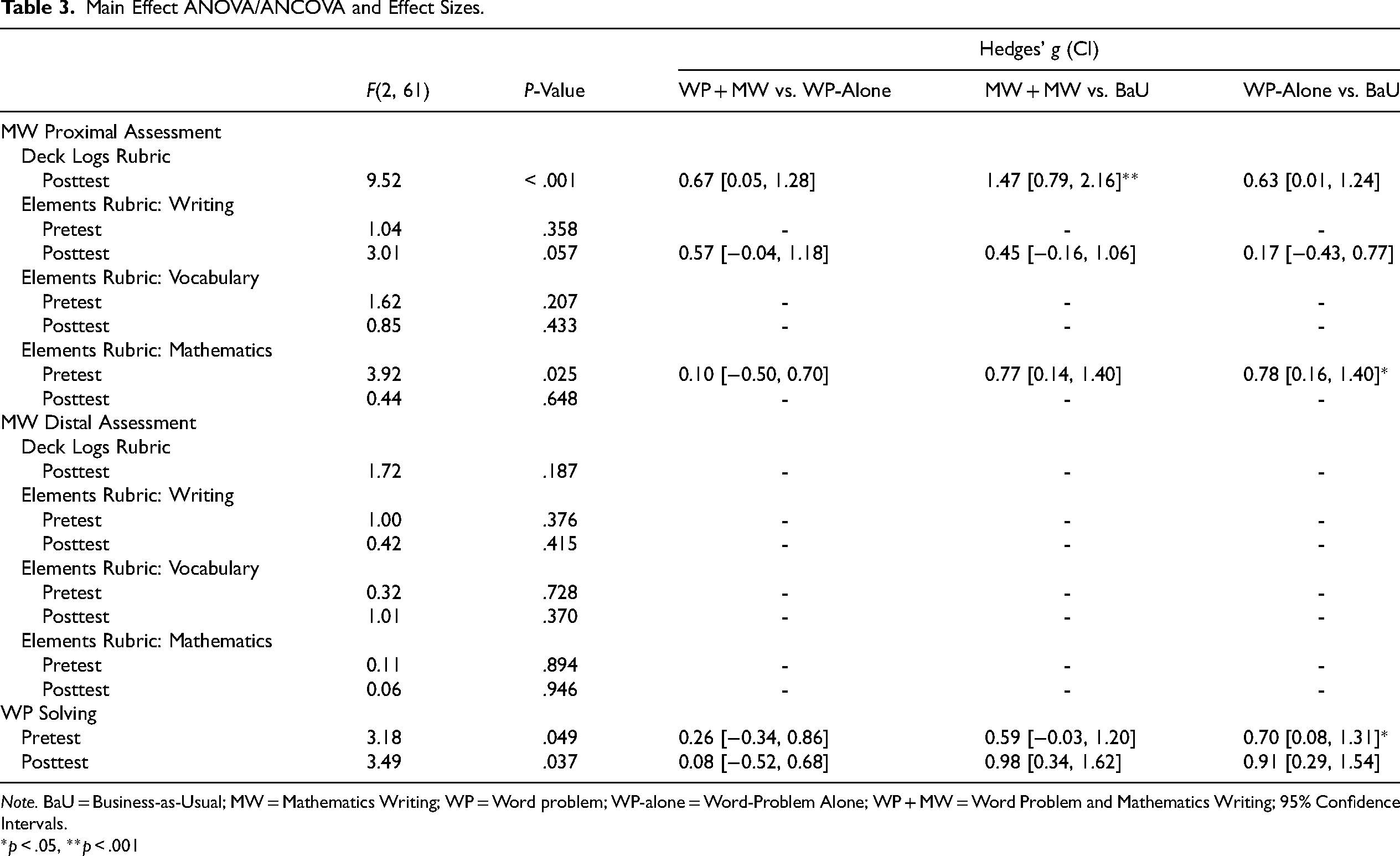
Note. BaU = Business-as-Usual; MW = Mathematics Writing; WP = Word problem; WP-alone = Word-Problem Alone; WP + MW = Word Problem and Mathematics Writing; 95% Confidence Intervals.
*p < .05, **p < .001
For WP Solving, at pretest there was a significant difference across conditions, (p = .049). The WP-alone condition performed significantly higher than the BaU condition (p = .047, ES = 0.70). The WP + MW and WP-alone conditions performed comparably (p = 1.000, ES = 0.26). The WP + MW and BaU conditions performed comparably (p = .330, ES = 0.59).
Impact of Mathematics-Writing Instruction
For Research Question 1, we measured performance of students with MD for MW after participating in one of the three conditions: WP + MW, WP-alone, or BaU. We examined performance on the MW Proximal Assessment and the MW Distal Assessment with both the Deck Logs Rubric (i.e., a proximal rubric) and the Elements Rubric (i.e., a distal rubric).
Mathematics-Writing Proximal Assessment
For a work sample for MW Proximal Assessment, see Figure 1. For the Deck Logs Rubric (a proximal rubric), we noted a significant difference at posttest across the three conditions, (p < .001). Follow-up testing indicated that students in the WP + MW condition significantly outperformed the students in the BaU condition (p < .001, ES = 1.47). There was no significant difference between the students in the WP + MW and WP-alone conditions (p = .057, ES = 0.67), although WP + MW students had an advantage over WP-alone students. Further, we identified no difference between the WP-alone and BaU conditions (p = .150, ES = 0.63).
For the Elements Rubric (a distal rubric), we examined student performance on writing, vocabulary, and math. For writing, the difference across conditions approached significance, (p = .057). Follow-up testing indicated no significant differences between students in the WP + MW and BaU conditions (p = .273, ES = 0.45) or WP-alone and BaU conditions (p = 1.000, ES = 0.17). Although the performance of students in WP + MW and WP-alone conditions did not significantly differ (p = .061, ES = 0.57), students in the WP + MW condition had an advantage over students in the WP-alone condition. Students across conditions performed comparably for vocabulary and math.
Mathematics-Writing Distal Assessment
For a work sample for MW Distal Assessment, see Figure 1. Table 3 includes the ANOVA and ANCOVA results for the MW Distal Assessment. We identified no significant differences across conditions on the proximal Deck Logs Rubric. For the distal Elements Rubric, students performed comparably across conditions for writing, vocabulary, and math.
Impact of Mathematics-Writing on Word-Problem Solving
For Research Question 2, we examined the performance of students with MD on WP solving after participating in the WP + MW condition compared to the WP-alone or BaU conditions. We identified a significant difference across the three conditions, (p = .037). Follow-up testing demonstrated no significant differences between students in the WP + MW and BaU conditions (p = .070, ES = 0.98), students in the WP-alone and BaU conditions (p = .075, ES = 0.91), and students in the WP + MW and WP-alone conditions (p = 1.000, ES = 0.08). The performance differences between students in the WP + MW and WP-alone conditions compared to the BaU condition did not significantly differ, but students in the WP + MW and WP-alone conditions had an advantage over students in the BaU condition.
Social Validity
To answer Research Question 3 on the social validity of MW in a WP intervention, we used the Deck Logs: Social Validity posttest results. Students in WP + MW demonstrated a slightly positive view of MW and the Deck Logs activity (M = 27.62, SD = 3.95, Range = 19 − 34). Table 4 includes student scores for the Likert scale questions with a minimum score of 7 (strongly disagree) and maximum score of 35 (strongly agree). Students also wrote responses describing their perspectives on the Deck Logs. When asked to report on their favorite thing about the Deck Logs, students provided a variety of responses. Some students enjoyed writing. One student stated, “my faverite things about the deck logs were I get to explan how I did it.” Other students enjoyed the math content. For instance, a student wrote, “how the numbers in the Deck Logs.” Yet others recounted enjoying getting help in math. A student said, “is helps me a lot really it helps me and I like about it is it looks lik it wad help me.”
Deck Logs: Social Validity.
Note. MW = Mathematics Writing
The students also noted a variety of complex Deck Log features. Six students stated that the writing was challenging. One student said the challenge of Deck Logs was “writting trying to rememder what to witte.” Students also indicated that the math was challenging. For example, a student recalled the challenge as, “Dat ai lern mor about math.” Another common challenge students reported was when they were required to complete Deck Logs without the initial supports (e.g., Deck Logs Poster). A student said the challenge “is that it was what out the key and the table that was challenging.”
Discussion
We explored incorporating MW into a WP intervention for students with MD. The goal was to identify if communication through MW supported MW performance and generalized reasoning in WP solving. To determine the promise and social validity of the MW component, we measured MW performance, WP performance, and social validity.
Impact on Mathematics Writing
For Research Question 1, we examined the performance of students across conditions on proximal and distal MW measures and rubrics. The MW Proximal Assessment included a MW prompt with language related to the Deck Logs. On the MW Proximal Assessment, we identified a significant difference across conditions at posttest for the Deck Logs Rubric (a proximal rubric). The students in the WP + MW condition performed significantly higher than the students in the BaU condition with a large effect size (ES = 1.47). Additionally, although not significant, the students in the WP + MW condition performed higher than the students in the WP-alone condition with a medium effect size (ES = 0.67). In contrast, students in the WP-alone and BaU conditions performed comparably. The Deck Logs Rubric results likely relate to student ability to generalize from the Deck Logs to a proximal rubric measuring a proximal assessment (Rojo et al., 2023). Such differences on a proximal rubric indicate student ability to accurately respond to MW prompts when exposed to quick, explicit MW practice with a WP intervention. With 16, 6-minute opportunities to practice MW within 20, 35-minute lessons, students in the MW intervention began identifying and explaining WP schemas. The results add to research modeling significant gains for studies, including higher dosages of MW instruction (Riccomini et al., 2024).
On the Elements Rubric (a distal rubric) for the MW Proximal Assessment, the difference across conditions approached significance, but follow-up testing indicated no significant differences. For writing we identified a non-significant medium effect size with the students in the WP + MW condition performing higher than students in the WP-alone condition (ES = 0.57). The students performed comparably across conditions for vocabulary and math. The results indicate that students were not fully integrating formal writing, vocabulary, and math content into their writing. The medium effect size for writing between the WP + MW and WP-alone conditions demonstrates promise for the use of relevant content in an introduction and conclusion, accurate punctuation, and accurate capitalization in their writing samples. Further research should investigate how to support students to generalize from creating a highly structured MW response to responses with robust writing, vocabulary, and math content.
For the MW Distal Assessment, students performed comparably across conditions at posttest. The lack of significant differences across the rubrics for the distal assessment likely relates to the structural complexities of the MW prompt and the math content in the measure. Students likely require additional practice opportunities to successfully respond to a MW prompt with the complexities included in the distal rubric. Our study, like other studies with non-significant MW outcomes (Bundock et al., 2021), provided a limited dosage for MW instruction. Students were exposed to on average 92.4 minutes of MW instruction. Studies with more opportunities to practice MW, either within sessions or across sessions, more frequently indicated significant MW effects (Hughes & Lee, 2020; Kiuhara et al., 2020).
The exploratory study trends, with limited dosage, demonstrated a proof of concept supporting the need for further investigations to integrate MW into a WP intervention to support MW. Immediate takeaways from the exploratory study model the potential value for integrating MW with WP solving in the classroom to support MW performance. Yet, with higher dosage, students may be provided not only with additional opportunities to respond, but also with further time to integrate varied instructional features, such as structured oral discussion, formal vocabulary practice, and opportunities to respond to varied prompts (Arsenault et al., 2025). Further research should investigate if additional opportunities to practice with varied instructional practices provides students practice being able to better generalize skills to MW prompts with complex structural features and math content.
Impact on Word-Problem Solving
For the WP Solving measure, we identified a significant difference across conditions. Follow-up testing indicated no significant differences between conditions, but some large effect sizes. Students in the WP + MW condition performed higher than students in the BaU condition with a large effect size but no significant difference (ES = 0.98). Similarly, the students in the WP-alone condition performed higher than the students in the BaU condition with a large effect size but no significant difference (ES = 0.91). Alternatively, there was a small effect size with no significant difference between the WP + MW and WP-alone conditions (ES = 0.08). The large effect sizes—without statistical significance—between the students in the intervention and the BaU conditions aligns with previous research on WP solving. That is, interventions focused on schema instruction, with a lower dosage, such as around 20 sessions, tend to show more moderate gains than interventions with a higher dosage, such as around 45 sessions (Powell & Fuchs, 2010; Powell et al., 2021a; Stevens et al., 2023). Although the gains were marginal between the intervention and the BaU condition, likely due to limited dosage, the gains align with research indicating that students exposed to MW and WP intervention outperform their peers not exposed to such intervention (Bundock et al., 2021; Hacker et al., 2019).
It is theorized that opportunities to practice written explanations about setting up and solving WPs with schema structures would support not only MW but also WP performance. Through Deck Logs, students experienced increased opportunities to discuss and express mathematical concepts and practice math vocabulary related to schema types. Yet, the students in WP + MW and WP-alone demonstrated no significant differences. Due to the non-significant difference and small effect size between the intervention conditions, it cannot be concluded from this exploratory study that MW influences math reasoning on WP solving. The large effect sizes between the intervention and BaU conditions were likely due to the content aligned across both conditions focused on WP solving and computation practice (Powell et al., 2021a). Such comparable performance could be due to a variety of reasons. First, the results may be the product of limited power and small sample sizes (Crutzen & Peters, 2017). Studies with short supplementary activities to WP solving frequently do not demonstrate significant differences across conditions for WP solving unless there is a more robust sample size (Powell et al., 2021a; Stevens et al., 2023). Second, the results may relate to the limited MW dosage. Interventions with high dosage (e.g., 19.70 hr) of both MW and WP content can lead to significant gains in math-content knowledge (Kiuhara et al., 2020). Or third, MW might not impact WP performance. Some previous studies have reported no significant effects on math content for students who had participated in a MW intervention or no difference between interventions with or without MW (Fuchs et al., 2016; Hebert et al., 2019). The trends in the exploratory study suggest the need for continued development work on integrating MW and WP before conducting a large-scale investigation or recommending MW as an effective method for WP solving.
Social Validity
For the third research question, we reviewed student perspectives on MW and the Deck Logs. Students reported agreeing with positive statements towards MW and the Deck Logs (M = 27.62, SD = 3.95). When asked about MW, on average students reported agreeing or strongly agreeing with statements such as knowing how to explain in MW, feeling confident in their improved MW skills, and believing they will use it in the future. Responses aligned with research indicating that students perceive MW as valuable and enjoyable (Powell et al., 2017). For the Deck Logs, students on average reported agreeing with statements such as enjoying the Deck Logs and enjoying the MW in the Deck Logs. Students also wrote that they liked the writing, the math, and that the Deck Logs helped them learn. Student statements aligned with reports from research with an attack strategy for MW. In Riccomini et al. (2024), students reported that the attack strategy was helpful and provided them with a process to follow.
Although the students reported positive perspectives on MW and the Deck Logs, they also noted concerns. Many students described challenges with writing and math. Students referenced experiencing difficulty as the scaffolds were removed from the Deck Log process. These limitations coincide with research reporting that students find MW difficult because it is hard to use words to describe math (Powell et al., 2017). Even though we recommend further research to refine the Deck Logs, the social validity responses indicate that implementing MW practice in the format of the Deck Logs may be a positive method for increasing opportunities for students to engage in MW.
Limitations
We identify several limitations to the study. First, we sampled students from a larger, intervention study. To account for this, we controlled for pretest scores for the final analysis. Second, the study was underpowered due to a limited sample size of 64 students with MD (Cohen, 1992; Crutzen & Peters, 2017). Although this limitation exists, the results can still be interpreted with the consideration that future research should be conducted with a greater sample size. Third, the study included a limited dosage of minutes of math instruction focused on MW and WP solving. Studies with significant MW effects reported including a higher dosage of MW instruction with approximately 300 to 600 minutes (Hebert et al., 2019; Hughes & Lee, 2020; Riccomini et al., 2024). WP solving interventions with higher dosage, approximately 1,300 to 1,400 minutes, tend to report stronger WP solving outcomes for students in the intervention conditions compared to BaU conditions (Powell et al., 2021a). Fourth, the typical classroom instruction did not emphasize MW, potentially threatening validity.
Future Directions for Research and Practice
This exploratory study provides evidence for the need to continue to integrate MW within WP interventions. Despite limitations, students in the WP + MW and WP-alone conditions demonstrated some significant and large effect sizes for MW and WP outcomes. A deeper investigation of the Deck Logs activity in a WP intervention with a robust sample size and higher dosage may provide further insight into the effects of integrating MW instruction into a WP intervention. Further investigations should also examine MW instructional components. The format of the instructional methods in MW instruction should be investigated, such as oral rehearsal, formal math-vocabulary instruction, varied MW prompts, and attack strategy structure.
Although classroom implementation of the current intervention may be limited due to the one-on-one delivery format, we can still make some recommendations for practitioners. First, for WP solving, we recommend supporting students with MD through explicit schema instruction. This study indicated large (non-significant) effect sizes for WP solving. Such effects for a low dosage study align with previous schema-instruction research (Powell & Fuchs, 2010; Stevens et al., 2023). Studies with higher dosage of schema instruction indicate significant results (Fuchs et al., 2021; Powell et al., 2021a). Second, we recommend pairing MW with math-content instruction. The students in the WP + MW condition demonstrated some significant gains compared to their peers on the proximal measure and rubric. These trends indicate that math-content instruction positively impacts student performance on MW (Arsenault et al., 2023, 2025). Third, we recommend using an explicit attack strategy to respond to MW prompts, providing students with a scaffold to engage in MW. Students also reported appreciating the attack strategy (Kiuhara et al., 2020; Riccomini et al., 2024). We make several recommendations based on the current intervention, but we also caution that exact replication in the classroom may be challenging due to the one-on-one delivery format, limiting feasibility. Future research should examine feasibility adjustments, such as small-group implementation, to measure generalizability to educator implementation.
Conclusion
We explored the effects of including MW within a WP intervention. The results included promising trends for MW and WP performance. The results align with research from WP intervention studies which are under-powered and include a low dosage of instructional time (Stevens et al., 2023). The study provides an initial foundation for future development work before a large-scale research investigation combines MW with WP interventions. We also recommend that practitioners consider using an attack strategy with instruction to support MW.
Supplemental Material
sj-docx-1-ecx-10.1177_00144029251397173 - Supplemental material for Informative Mathematics Writing Within an Additive Word-Problem Intervention: Exploring Mathematics-Writing and Word-Problem Outcomes for Grade 4 Students With Mathematics Difficulty
Supplemental material, sj-docx-1-ecx-10.1177_00144029251397173 for Informative Mathematics Writing Within an Additive Word-Problem Intervention: Exploring Mathematics-Writing and Word-Problem Outcomes for Grade 4 Students With Mathematics Difficulty by Tessa L. Arsenault and Sarah R. Powell in Exceptional Children
Footnotes
Declaration of Conflicting Interests
The authors declared no potential conflicts of interest with respect to the research, authorship, and/or publication of this article.
Funding
This research was supported in part by Grant R324A200176 from the Institute of Education Sciences in the U.S. Department of Education to the University of Texas at Austin. The content is solely the responsibility of the authors and does not necessarily represent the official views of the U.S. Department of Education.

Supplemental Material
Supplemental material for this article is available online.
References
Supplementary Material
Please find the following supplemental material available below.
For Open Access articles published under a Creative Commons License, all supplemental material carries the same license as the article it is associated with.
For non-Open Access articles published, all supplemental material carries a non-exclusive license, and permission requests for re-use of supplemental material or any part of supplemental material shall be sent directly to the copyright owner as specified in the copyright notice associated with the article.
