



Abstract
Noise exposure may interfere with concentration, learning, and executive functions. In children, in particular, the non-auditory consequences of acoustically inadequate conditions are a serious concern. This systematic review examined the evidence from 26 studies investigating the effects of noise on primary school children’s cognitive and academic performance. The reviewed studies show that speech noise significantly impairs children’s verbal working memory. Meanwhile, non-speech environmental noise appears to notably affect academic performance, particularly in reading. Other types of non-speech noise may, instead, even improve the cognitive performance of children, although only for children with low attentional skills. However, only a few studies have compared the impacts of speech and non-speech noise or explored noise effects across various cognitive tasks. And finally, there’s a shortage of both cross-sectional and longitudinal studies assessing developmental effects. Overall, this scarcity limits the ability to draw robust conclusions about noise effects on children’s cognitive and academic abilities.
Keywords
Introduction
Children experience significant fatigue due environmental noise during learning activities at home and school. Environmental noise has been extensively studied in relation to auditory or listening tasks (Hick & Tharpe, 2002). However, the impact of noise on human cognitive performance has frequently been overlooked (Jafari et al., 2019) and little attention has been paid to how noise impacts on children’s non-auditory cognitive (e.g., attention, memory; Basner et al., 2014) or learning performance (e.g., reading, writing, or math; Dockrell & Shield, 2006; Fernandes et al., 2019; Ljung et al., 2009). This systematic review aims to address this knowledge gap by synthesizing and discussing emerging literature on the cognitive effects of noise in learning contexts.
The non-auditory effects of noise on children’s cognitive and academic performance may vary based on noise characteristics (continuous, intermittent, impulsive, or low-frequency) and the type of cognitive tasks performed. Background noise, either informational (e.g., speech) or non-informational (e.g. unintelligible speech or non-speech noise), can originate externally (e.g., noise from adjacent classrooms or traffic) or internally classrooms, within the classroom, as a consequence of activity-related sounds like chair movements or babbling (Shield & Dockrell, 2004). In addition, susceptibility to noise may depend on the type of cognitive or academic ability performed. For instance, performance on verbal tasks such as reading and writing, involving verbal language, and non-verbal tasks, not reliant on language production and comprehension, may differ in their vulnerability to different babble noise. In this systematic review, our primary focus will be on academic tasks (such as reading, writing, and math) and a set of cognitive functions critical to children’s self-regulation in academic performance: executive functions (EF; Jacob & Parkinson, 2015).
EFs is an umbrella term for a set of higher-order cognitive skills (WM, response inhibition, cognitive flexibility) that allow top-down control and regulation of thought processes and goal-directed actions (Diamond, 2013; Karr et al., 2018; Rosenberg, 2015) and predict academic outcomes across schooling (Borella et al., 2010; Duncan et al., 2007; Gathercole et al., 2004).
Apart from noise quality and the type of cognitive task, individual factors such as age, cognitive skills or hearing loss can impact children’s susceptibility to noise (Söderlund et al., 2010). Thus, noise, activity and individual factors are all considered in this systematic review to account for how noise affects primary school children’s cognitive and academic performance.
The research on the cognitive effects of noise has seen growth in recent years. Mealings published a series of scoping reviews, focused on the impact of chronic and acute acoustic exposure on children’s attention and memory (Mealings, 2022a), as well as on the effects of classroom noise on children’s literacy skills (Mealings, 2022b), behaviors (Mealings, 2022c), and wellbeing (Mealings, 2022d). All these reviews have revealed global effects of a chronic exposure to noise, on children’s literacy, particularly in terms of reading accuracy and comprehension and mental wellbeing.
However, reviews that offer a comprehensive overview of the interaction between noise, tasks, and subjects variables are, to the best of our knowledge, still lacking. A systematic and critical examination of the findings in this field can not only point to directions for future studies, but also holds practical significance. It can indeed support policy decisions aimed at managing noise in schools.
Why Are Executive Functions an Important Target?
EFs are pivotal skills in learning and academic performance as they supervise performance in academic tasks and help sustain effort in those tasks under challenging or adverse conditions, such as noise. EF skills begin to develop shortly after birth, undergoes remarkable development during the preschool years (Anderson & Reidy, 2012), and progress throughout childhood and adolescence (Best & Miller, 2010), showing more pronounced growth during preschool, early school years, and adolescence (Anderson, 2002; Moriguchi, 2014; Zelazo et al., 2003). Any disruption or disorder in executive functioning inevitably results in learning impairments and reduced academic performance.
Three key executive functions crucial for academic learning are response inhibition, WM, and cognitive flexibility. Inhibition skills start developing in preschool years, continuing until approximately 5 to 8 years old (Romine & Reynolds, 2005), encompassing cognitive and behavioral aspects. Cognitive inhibition involves suppressing internal responses or ignoring irrelevant stimuli, aiding in planning and decision-making (Anderson, 2002). Behavioral inhibition involves controlling actions. Both skills significantly impact academic achievement (Duckworth et al., 2019). Inhibitory control is vital for text decoding and comprehension (Haft et al., 2019; McClelland & Cameron, 2019) and links to proficiency in mathematics and science (Gerst et al., 2017; Purpura et al., 2017).
Working memory (WM) develops linearly from ages 4 to 14. It relies on selective attention and executive control mechanisms to allocate attentional resources across memory tasks, involving active maintenance and manipulation of information (Engle, 2002; Wilhelm et al., 2013). Comprising three interlinked components—the phonological loop for auditory-verbal data, the visuospatial sketchpad for visual and spatial information, and the central executive overseeing these systems (Baddeley et al., 2019)—WM is crucial for updating, manipulating, and guiding cognitive processes such as reasoning, language comprehension, and arithmetic calculations. And thus, also academic performance in language and mathematics correlates with WM skills (David, 2012; Purpura et al., 2017).
Cognitive flexibility involves adapting cognitive strategies and behaviors to environmental changes. It develops significantly from age 7 to 9 and reaches maturation around the age 12 (Anderson, 2002). This ability to switch between patterns of thinking and manage multiple concepts is vital for children’s language development (Jacques & Zelazo, 2005), arithmetic skills (Bull & Scerif, 2001), problem-solving, creativity (Lin et al., 2014; Ritter et al., 2012), multitasking (Ionescu, 2012) and reading skills (Kercood et al., 2017).
Noise and Its Effects on Children’s EFs and Academic Skills
It has been theorized that noise exposure may adversely affect children’s cognitive development (Chere & Kirkham, 2021). Moreover, background noise can affect EFs concurrently and directly by diverting attentional resources or causing cognitive overload (Pichora-Fuller et al., 2016; Wetzel et al., 2021) and also indirectly by inducing distress, influencing EF development (Stansfeld & Clark, 2015; Blair, 2010). Given the crucial role of EFs in learning—requiring focus, attention, inhibition of irrelevant information, and processing relevant information in working memory—any noise-related impact on EFs may subsequently affect learning and academic achievements (van Kempen et al., 2010; Sörqvist, 2010).
Unsurprisingly, children are more susceptible to noise-induced interference than adults, both in auditory or non-auditory tasks (Klatte et al., 2013). Particularly, younger children, those with cognitive, learning disabilities, or auditory issues, may encounter the greatest challenges in handling noise intrusion (Arfé, Spicciarelli et al., 2021; Prodi & Visentin, 2015)
The Systematic Review (SR)
The systematic review aimed to address the following three research questions: (1) Do different noise sources (indoor, outdoor) and types of noise (verbal, non-verbal, or mixed) equally impact children’s cognitive functioning? (2) Which cognitive abilities and academic tasks are most vulnerable to background verbal and non-verbal noise? (3) How do individual factors like age or differences in memory and attention influence the effects of noise on children’s cognitive and academic performance?
Methods
The systematic review followed the Preferred Reporting Items for Systematic reviews and Meta-Analyses (PRISMA) statement (Page et al., 2021).
Inclusion Criteria
Studies included in this systematic review meet all of the following selection criteria:
Language: studies are written in English;
Year of publication: studies are published between 2005 and 2022;
Type of study: only original peer-reviewed research articles were included in the review. Reviews, systematic reviews, books, conference proceedings, and abstracts were excluded;
Topic: only studies addressing the cognitive effects of noise were considered. Studies evaluating the effects of noise during tasks assessing children’s executive functions (such as working memory and attention) or studies analyzing the effects of noise during learning tasks, such as reading, writing, and arithmetic abilities, have been taken into account;
Study sample: all selected studies involve participants between 6 and 10 years, corresponding to the first years of primary education. Research involving preschool children, pre-adolescents, adolescents, and adults, when considered relevant, have been used to discuss the results of the SR, but were not included in the summary table.
Studies that explored the effects of noise on auditory perception and studies in which there was no assessment of cognitive or academic skills were excluded from the SR.
These inclusion (and exclusion) criteria led to the selection of 26 studies. (See Figure 1)
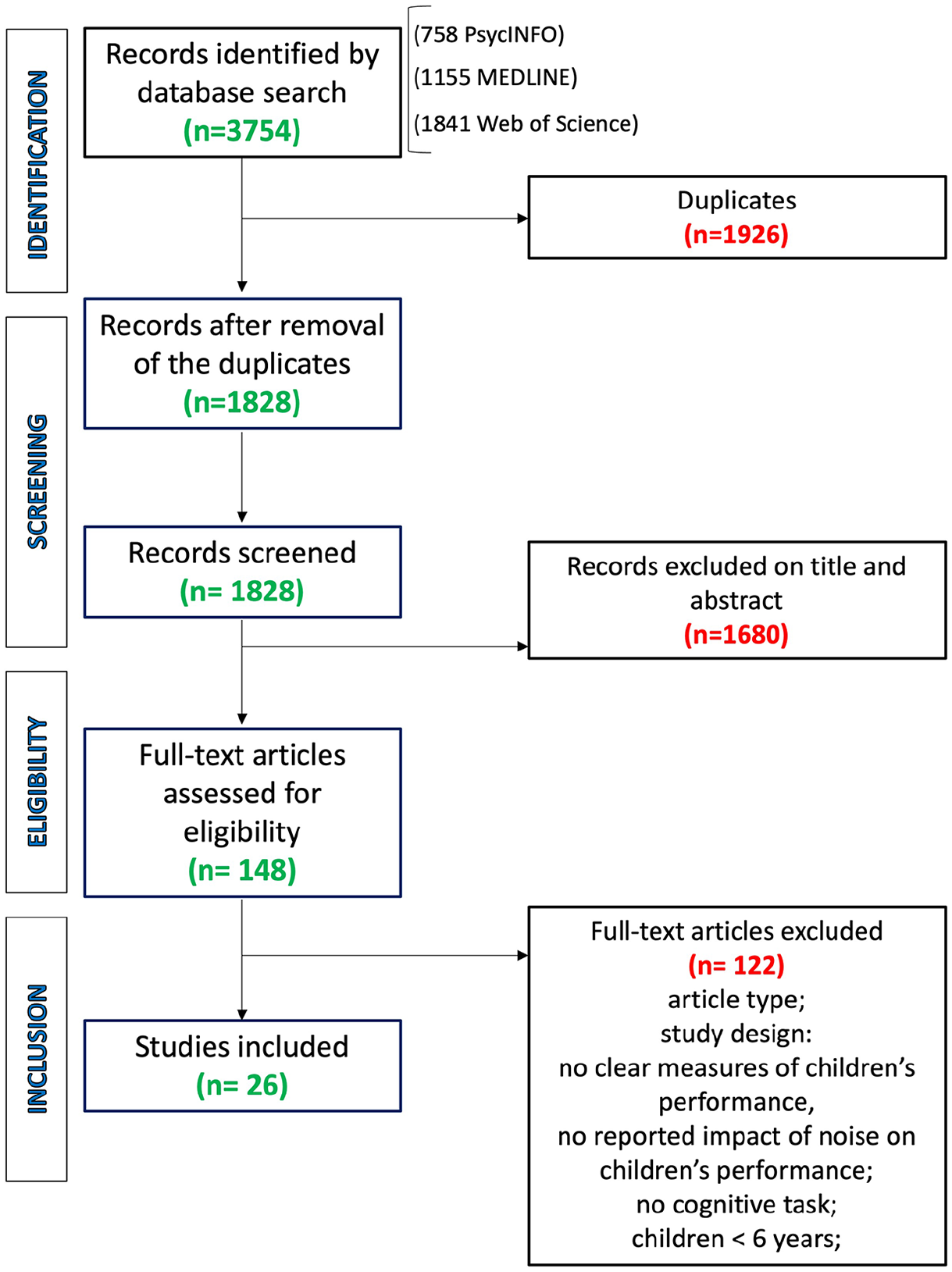
Database search and selection flowchart.
Search and Screening Procedures
Electronic literature search was conducted. Three databases were searched: PsycINFO, MEDLINE, and Web of Science.
Bibliographical research was performed on databanks using the following combination of keywords with the AND Boolean operator: “noise-children-classroom”; “noise-children-cognitive effort”; “noise-children-learning”; “noise-children-listening effort”; “noise-children-speech perception”. Keywords “speech perception” and “listening effort,” although not directly relevant to the review, were combined with “noise” and “children” as part of the search strategy to avoid overlooking potentially relevant articles where the concept of cognitive effort had also been addressed. The electronic search was conducted using Zotero software, and a search filter to limit results by publication date was applied in this initial selection phase.
In addition to this automatic electronic search, references of the articles assessed for eligibility and literature reviews, not included in the systematic review, were also examined to identify other relevant articles.
A total of 3754 records were initially identified through our literature search (PsycINFO = 758; MEDLINE = 1155; Web of Science = 1841). Following the removal of duplicates, 1,828 unique papers remained. The abstracts of these records underwent independent screening by two examiners (the first and second authors), excluding papers that did not meet one or more eligibility criteria. This process resulted in the identification of 148 candidate studies. Subsequently, the 148 full-text articles selected underwent review for potential inclusion in the systematic review. Both the first and second authors independently assessed all papers, achieving a 97% agreement. Any disagreements between the two examiners were resolved through discussion with the last author of the study to reach a consensus.
The initial disagreement between the first and second authors solely concerned the inclusion criterion related to the topic, specifically related to the type of cognitive or learning measure considered by a few studies. Disagreement between the first two authors for instance emerged when cognitive skills were measured by experimental or standardized tasks that were unfamiliar to them, thus making it difficult deciding about the study inclusion in the SR. For example, there was disagreement about including a study assessing children’s creativity in quiet and noisy settings through an idea generation task (Massonnié et al., 2019). It was eventually included since the type of task allowed for the assessment of children’s cognitive flexibility as an executive function. The last author, an expert in the field of cognitive assessment and learning in children with typical and atypical development, facilitated the discussion and resolution of these disagreements for those works.
Following this additional screening, 26 articles satisfied all the inclusion criteria. The most common reasons for excluding studies were: a) the paper reported measures of listening but not cognitive effort; b) measures of academic performance or executive functions (EFs) were unclear and/or insufficient information was provided to identify the dependent measure; c) measures of learning or EFs were provided, but not under noise conditions; d) the study involved preschoolers and/or older students.
Studies Coding and Quality Assessment
Starting from the identification phase, all studies were coded based on the following characteristics: author/authors; journal (peer-review or not); year of publication; publication type (experimental study, review, systematic review, book, conference proceeding, meeting abstract). Full-text articles assessed for eligibility were also categorized according to the following characteristics: sample size; task location (classrooms, other, not specified); participant age or grade level (involvement of primary school children); background noise (type and whether the study compared different types of noise); children’s characteristics (cognitive or learning disabilities; hearing impairment; bilingualism).
Articles reviewed in full-text format were ultimately evaluated for their methodological rigor (e.g., being experimental or quasi-experimental studies) and relevance.
Quality Assessment
A proper study design to evaluate the impact of noise on children’s cognitive performance should include a detailed description of the type of noise used during experimental tasks, along with a clear description of the tasks performed by the children. Studies were considered eligible for inclusion if they provided a comprehensive description of noise conditions, including types of noise used in experiments, sources, noise levels, and, if applicable, noise synthesis design. Additionally, studies needed to present data collected from cognitive tasks carried out under different acoustic conditions (quiet and noise, different types of noise or tasks varying in noise intensity). The cognitive tasks should be explicitly defined (e.g., in terms of measures of executive functions or learning performance) and include descriptions of the acoustic characteristics of the environments where the experimental sessions took place, task duration, and an overview of the experimental setup.
Results
Twenty-six articles were identified that met the inclusion criteria.
Table 1 summarizes the key information of each included study. It reports details about the study sample, acoustic conditions, type of noise utilized, dependent measures, and the nature of the noise effects.
Summary of Selected Literature Studies.
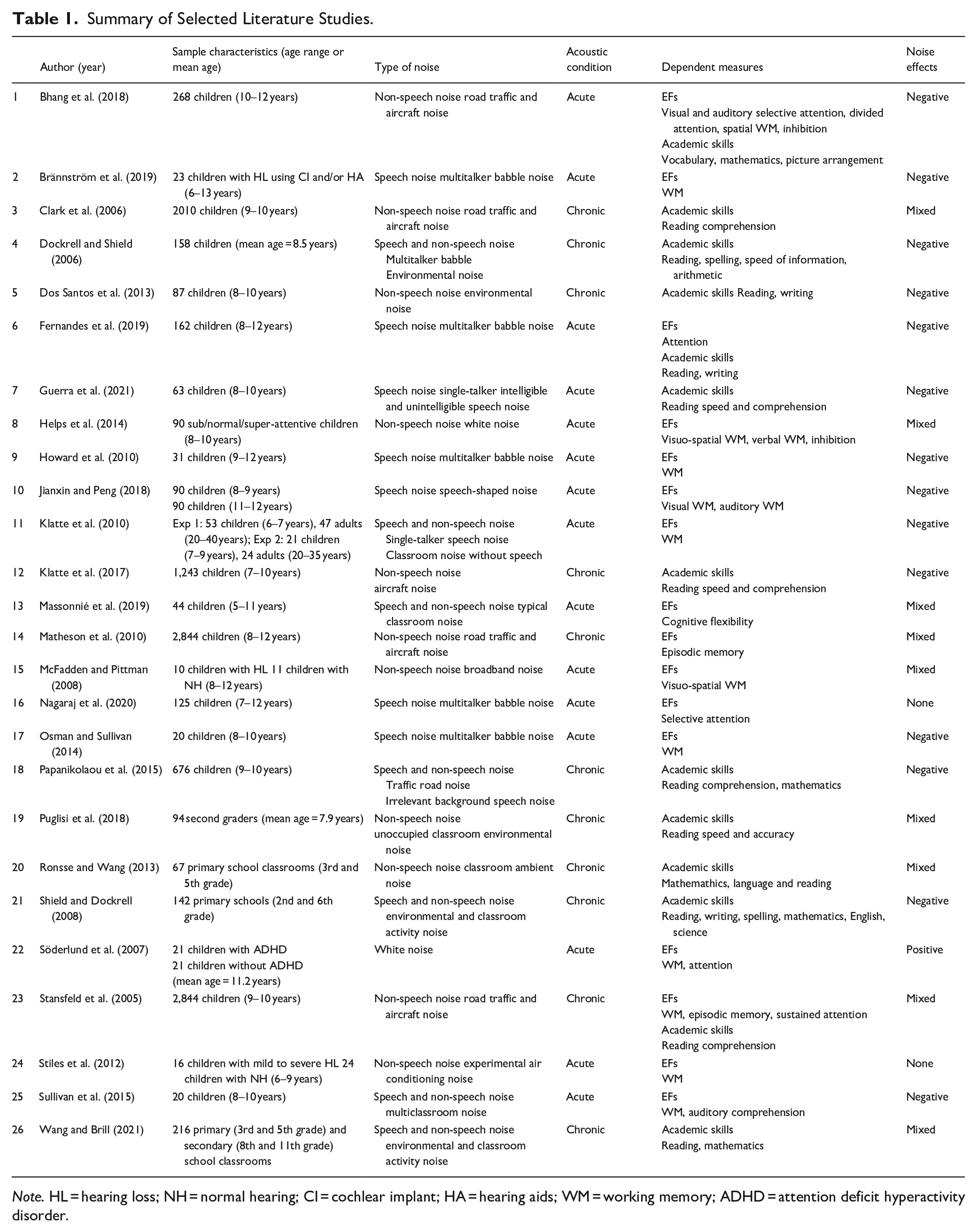
Note. HL = hearing loss; NH = normal hearing; CI = cochlear implant; HA = hearing aids; WM = working memory; ADHD = attention deficit hyperactivity disorder.
Additionally, a comprehensive summary of all 26 articles incorporated in the review is presented in an extended supplementary table (Extended Table). This detailed summary includes the research design, experimental tasks, as well as the primary findings and observed effects.
Included Studies
Thirteen of the twenty-six selected studies assess the impact of noise on children’s EF (2, 8, 9, 10, 11, 13, 14, 15, 16, 17, 22, 24, 25). Ten papers focused on children’s academic and learning skills (3, 4, 5, 7, 12, 18, 19, 20, 21, 26), and three works analyzed both EFs and learning (1, 6, 23) (see Table 1).
Almost all articles (n = 19) reported studies that involved normally hearing children with no neurological or learning problems. Only three studies involved children with hearing loss (2, 15, 24) and other four studies analyzed, respectively, children at risk for learning disorders (1), iper and sub-attentive children (8, 22), and children with certified special educational needs (4). Only one study (11) compared children to adults’ performance in noise.
Eight of the studies included in the SR explored the effects of speech noise on children’s cognitive or academic performance (2, 6, 7, 9, 10, 16, 17, 25), whereas 15 studies focused on non-speech noise, such as traffic and aircraft or white noise (1, 3, 5, 8, 12, 14, 15, 18, 19, 20, 21, 22, 23, 24, 26) (see Table 1). Only two articles compared the effects of different types of noise on children’s learning or EFs (4, 11) and one study used mixed noise (13).
The studies consistently highlight the detrimental impact of speech noise, such as babble noise, on memory, attention tasks, and overall learning activities. In contrast, findings regarding non-speech noise are less consistent. Both aircraft and traffic noise are reported to negatively affect children’s learning and executive functions (EFs), with noise intensity playing a crucial role: children’s performance generally declines with increased noise levels. Conversely, white noise, characterized by equal energy at all frequencies and often used as a masking sound, shows different effects depending on individual factors, such as presence or absence of cognitive or attentional disorders. Further details on these findings will be considered later in the discussion.
A distinction about noise type regards the acute and chronic nature of noise: acute noise refers to short-term exposure to noise, or experimentally induced loud or disruptive sounds, whereas for chronic noise researchers refer to a prolonged or continuous exposure to environmental noise over an extended period. Among the examined studies, 12 investigate the effects of chronic noise exposure, while 14 analyze the consequences of acute noise exposure. Unfortunately, only in two cases (14, 23) exposure to chronic noise was studied in relation to children’s EFs. The studies have indeed primarily focused on the effects of chronic noise on learning tasks.
The Effects of Noise on Children’s EF
Most of the studies focused on EFs examined the effects of acute noise on WM (2, 8, 9, 10, 11, 15, 16, 17, 24, 25) (see Table 1). Several studies investigated children’s attention and inhibition skills (1, 6, 8, 16, 22, 23), and one (13) assessed noise effects on children’s performance in creative tasks (e.g., idea generation tasks), which involve cognitive fluency.
The majority of studies have investigated the effects of babble noise, revealing significant negative impacts on children’s verbal WM (11). Nevertheless, as real-life settings encompass complex acoustic environments comprising both speech and non-speech noise, also the effects of background non-speech noise were considered, finding that also non-speech noise can adversely affect children’s EFs (1).
The studies show that children’s auditory working memory (AWM) performance is consistently hindered by unintelligible multi-talker babble noise, particularly at low signal-to-noise ratios (SNRs) (9, 17, 25). SNR denotes the ratio between desired signal power and undesired signal (or background noise) power, typically measured in decibels. Lower SNRs correspond to poorer performance in children.
Osman and Sullivan (2014) found that children’s WM performance decrease with increasingly degraded listening conditions, independently of the complexity of the WM tasks. Their study involved three subtests from the Working Memory Test Battery (Forward and Backward Digit Recall and a Listening Recall test) aurally administered in varying acoustic conditions (quiet, competing four-talker babble noise at 0 and −5 dB SNRs). Performance was highest in quiet conditions and significantly decreased with added noise, especially at −5 dB SNR. Interestingly, the impact of noise was similar across tasks of different complexities. Another study by Sullivan et al. (2015) revealed that children performed notably worse in multiclassroom noise compared to quiet conditions, particularly on AWM and comprehension tasks. Additionally, the relationship between AWM and listening comprehension was stronger in noisy settings, implying an increased reliance on WM during comprehension tasks in unfavorable acoustic environments.
Howard et al. (2010) employed a dual task paradigm, using a word recognition task as the primary task and a digit recall task as the secondary task, which involved displaying sets of five-digit numbers on a laptop monitor. They tested children in quiet and under varying SNRs (+4, 0, −4 dB) and found a negative effect of multitalker noise on digit recall as SNR became less favorable. In the single task condition, serial recall performance was minimally affected, but in the dual task setting, particularly at lower SNRs, there was a notable decrease of the digit recall task. According to the author, this suggests that increased effort in listening for the primary task in noise might have limited the cognitive resources available for the secondary task.
Another study (10) observed a relationship between SNR and reverberation time (RT) and performance in WM. The authors used three different RT (0.51, 0.80 and 1.18 seconds) and three different SNR conditions (3 dB(A), 9 dB(A), and 15 dB(A)) to investigate the effect of speech-shaped noise and reverberation on WM in 19 third and 19 sixth grade children. The findings indicated that as SNR increased and RT decreased, WM span scores also increased. Moreover, older children tended to achieve higher WM scores than younger children in similar acoustical settings.
Remarkably, in children with hearing impairment, WM performance appears to be affected by babble noise even in more favorable SNR conditions. Brännström et al. (2019) found that at 10 dB SNR, multi-talker babble noise notably decreased the serial recall performance of children with cochlear implants or hearing aids during a verbal WM task. These outcomes suggest heightened susceptibility to noise effects among children with hearing loss compared to typical hearing peers.
Regarding non-speech noise, like environmental and broadband noise, the findings are less consistent. Stiles et al. (2012) simulated air conditioning noise by filtering a broad-spectrum signal to match the noise used in a prior study. At low levels of simulated air conditioning background noise, they observed no impairment in working memory performance among children with mild to severe hearing loss or those with normal hearing. In another study (15), the impact of noise and hearing status on multitasking was examined. Children, both with minimal hearing loss and those with typical hearing, were asked to perform a word categorization task while performing some dot-to-dot games, in quiet and in broadband noise. The completion of dot-to-dot games was slower under multitasking conditions. Surprisingly, the dot rate was affected similarly in both quiet and noisy settings for both hearing-impaired and typically hearing children, despite the hearing-impaired children experiencing challenges with the word categorization task.
One of the most informative studies on classroom acoustics’ impact on children’s performance is Klatte et al.’s (2010). They investigated how irrelevant speech (a professionally read newspaper article) and typical classroom noise (typical mix of non-speech classroom noise, such as moving chairs, scraping feet and coughing) affected memory recall of visually presented common nouns. Both experiments had sound levels between 53 and 56 dB(A). The first tested first graders and adults with fixed list lengths; the second adjusted sequence lengths for individual spans, involving adults and second-to-third graders. Irrelevant speech equally affected both children and adults, while non-speech noise didn’t impact performance significantly. First graders performed better in silence compared to classroom noise. The finding that the impact of irrelevant speech is unrelated to age contrasts with Elliott’s (2002) study, where younger children were more affected. However, as noted by Klatte et al. (2010), the irrelevant speech was around 55 dB(A), while in Elliott’s study, it reached 72 dB(A). Additionally, Klatte et al. (2010) used an unknown foreign language as irrelevant speech, whereas Elliott used the participants’ native language. Overall, these findings suggest that louder sounds and meaningful speech, such as those used in Eliot’s study, can significantly impair younger children.
The largest study on children’s response to aircraft and road traffic noise is the RANCH project (Road traffic and aircraft noise exposure and children’s cognition and Health; 23). This cross-national, cross-sectional study evaluated chronic noise exposure’s impact on 2,844 children aged 9 to 10 from 89 primary schools near airports in the Netherlands, Spain, and the UK. Cognitive tests administered in class revealed no impact on children’s sustained attention from aircraft or road traffic noise. However, a linear relationship was observed between aircraft noise exposure and impaired memory recognition.
A subsequent study (14), part of the RANCH Project, focused on the effect of chronic aircraft and road traffic noise on children’s episodic memory, assessing delayed cue recall, delayed recognition, and prospective memory. Surprisingly, the findings were mixed: aircraft noise was found to be related to impaired memory recognition, while exposure to road traffic noise showed an unexpected association with improved cue recall. Instead, no significant associations were found between aircraft noise exposure and cued recall or prospective memory, nor between road traffic noise and recognition or prospective memory.
Although the effects of speech noise have been primarily explored in relation to memory tasks, some studies suggest that babble noise can also significantly affect children’s sustained attention. Fernandes et al. (2019) tested children aged 8 to 12 years, revealing that a 20 dB increase in speech noise, above the level of environmental noise, did not affect sustained attention performance. However, exposure to 40 dB of babble noise significantly reduced children’s attention, with noise effects being age-independent.
Nagaraj et al. (2020) assessed children aged 7 to 12 using a dichotic listening task to measure selective attention with and without multitalker babble. Noise susceptibility was quantified by error differences between these conditions, showing no significant correlation with age. Furthermore, there was no correlation observed between the extent of susceptibility to auditory distraction and the WM capacity of children.
In a study by Bhang et al. (2018), road traffic and aircraft noise had negative effects on children’s attention and cognitive performance. This study included a large number of children (268 elementary school students aged 10–12) who completed various EF tests measuring selective visual and auditory attention, divided attention, spatial working memory, cognitive inhibition, and attention allocation. A first group of children was exposed to background noise at 43.5 to 46.1 dB, while a second group was exposed to additional background noise of 15 to 17 dB (60.8–62.8 dB). The noise was a combination of road traffic and aircraft noise. Across tests, children exposed to higher noise levels generally scored lower. Significant differences emerged between groups, notably in response time for auditory attention, memory span, and correct responses in spatial working memory tasks. These noise-related differences also appeared between children with differing academic performance levels, suggesting a stronger impact of traffic noise on those with learning difficulties. We decided to include this study, despite the participants’ age being slightly older, as children’s grade level falls within the range considered in the SR.
Based on preliminary findings suggesting improved creative processes for adults in a moderate-noise environment (Mehta et al., 2012), Massonnié et al. (2019) explored the impact of noise (speech fragments, movement, and external noise) on children’s creativity in two idea generation tasks. Creativity and learning are interrelated, with the process of generating new ideas strictly associated with learning and changes in knowledge or behavior (Pang, 2015). The authors investigated the role of working memory, attention, and age in regulating the noise effect on creativity, discovering a negative impact of noise on creative processes, especially in younger children (5–8 years) with lower selective attention skills. These children provided fewer original ideas in noisy conditions, while those with higher selective attention were generally unaffected by noise.
As noted earlier, despite the consensus on the negative impact of background noise, not all studies consistently demonstrate impaired cognitive performance in children exposed to noise. For instance, Söderlund et al. (2007) reported a positive effect of noise on children with Attention-deficit-hyperactivity disorder (ADHD). In their study involving 42 children aged 9 to 13 years, with 21 diagnosed with ADHD, working memory and attention were assessed using a Self-performed task (SPT) for high recall and a Verbal task (VT) for low recall. The children were tested in both quiet and white noise conditions (white noise at 81 dB A). Results indicated that white noise improved the performance of the ADHD group but hindered the performance of the control group.
Another study by Helps et al. (2014) confirmed the positive impact of white noise on children’s attention skills. They explored how varying white noise levels affected children with different attention abilities. Their results validated that background white noise enhanced performance in inattentive children while hindering attentive ones. Assessing 25 super-attentive, 29 typically developing, and 36 sub-attentive children aged 8 to 10 using non-EF tasks (verbal episodic recall and delayed verbal recognition) and EF tasks (visuospatial working memory and Go-No-Go), they found that moderate white noise (75 dB) significantly decreased performance only in the super-attentive group for non-EF tasks. For EF tasks, the sub-attentive group showed significantly improved performance with a shift from low (65 dB) to moderate (70 dB) white noise, while the other groups didn’t exhibit significant effects.
Studies on the Effects of Noise on Children’s Academic Skills
The studies evaluating the effects of noise on children’s academic skills have mainly focused on reading (N = 7), and in particular, both on reading speed and reading comprehension. Reading speed, crucial in determining reading fluency or automaticity, is a key measure in assessing reading proficiency. Proficient readers typically exhibit fluent reading, but may experience slower speeds when encountering inconsistencies in text.
Guerra et al. (2021) assessed the reading skills of 63 third- and fourth-grade children in a single-talker speech-noise condition. The noise, either intelligible or unintelligible, was presented at two intensity levels (45–50 dB and 65–72 dB SPL). The study revealed that reading measures (fluency and comprehension) were differentially affected by acoustic (noise intensity) and semantic (speech noise intelligibility) characteristics. Reading speed was notably slowed by increasing speech-noise intensity, while higher intelligibility did not significantly impact it. In contrast, reading comprehension was more influenced by the semantic aspect, particularly affected by intelligible speech. Unlike reading speed, comprehension showed no significant sensitivity to noise intensity. Additionally, the intelligibility effect on comprehension was more pronounced in children with lower interference control, as indicated by lower scores on an auditory Stroop task.
Also, Bhang et al. (2018) study, described in the section dedicated to the effects of noise on EFs, tested the effects of noise intensity on reading speed, finding that reading speed was significantly affected by traffic noise (60.8–62.8 dB), that is, when children were exposed to an additional 15 to 17 dB over background noise. Contrasting results are reported by Fernandes et al. (2019). The authors investigated the influence of multitalker noise on reading speed among third, fourth, and fifth graders. While reading time progressively increased for fifth graders with noise exposure, it surprisingly decreased for third and fourth graders.
Another study by Puglisi et al. (2018) investigated the impact of classroom acoustics on the reading speed of 94 second-graders across three primary schools. The authors analyzed the effects of speech clarity (C50), a measure of sound power within the first 50 milliseconds of the impulse response and thereafter (Rakerd et al., 2018), as well as reverberation. The results showed a significant association between reading speed and speech clarity, while non-significant correlations with reverberation were found.
The absence of reverberation effects aligns with Ronsse and Wang’s (2013) findings. They investigated unoccupied classroom acoustical conditions, including background noise level and reverberation time, on third- and fifth-graders’ achievement scores. Ronsse and Wang observed non-significant correlations between reverberation time (RT) and children’s achievement. Additionally, significant negative correlations were found between background non-speech noise levels and language and reading scores of fifth-graders, while none of the background noise conditions significantly correlated with third-graders’ achievement scores.
In a large-scale study, Papanikolaou et al. (2015) assessed the effects of noise on children’s reading comprehension, finding different results from Guerra et al. (2021). Indeed, Papanikolaou et al. found a negative relationship between non-speech noise intensity and reading comprehension performance. The study involved 676 children aged 9 to 10 years from schools located in an area with a homogenous socioeconomic background. Participants were classified into three groups based on the level of exposure to traffic noise and found that children in low-level noise schools (55–66 dB) scored significantly better in reading comprehension than those in medium (67–77 dB) and high (72–80 dB) level noise schools.
Also in the RANCH study, researchers examined the link between aircraft and road traffic noise exposure intensity and reading comprehension (23; 3). They analyzed this relationship in over two thousand 9 to 10-year-old primary school children, using nationally standardized tests for reading comprehension. The findings, consistent across Netherlands, Spain, and UK, revealed a significant association between prolonged exposure to aircraft noise at school and lower reading comprehension. This effect wasn’t influenced by sustained attention, working memory, or episodic memory. The dimension of the effects remained consistent across studies, with a 5 dB difference in aircraft noise linked to a 2-month reading delay in the UK and a 1-month delay in the Netherlands. However, chronic exposure to road traffic noise at school didn’t show significant effects on reading comprehension. The authors suggested that the more intense and unpredictable nature of aircraft noise, along with its transient disruptions, might impair children’s concentration more than traffic noise, which is generally more predictable.
Klatte et al. (2017) obtained similar findings in a study on aircraft noise effects on reading, related verbal abilities, quality of life, and annoyance. Despite aircraft noise levels did not exceed 59 dB in the analyzed schools (compared to 77 dB in the Ranch Project), significant associations were observed between aircraft noise exposure and reduced reading performance. These effects were evident in a standardized reading assessment’s global score, comprising three subtests assessing reading speed and accuracy for words, sentences, and short paragraphs. Interestingly, the impact of noise wasn’t significant in analyses of children with a migration background, a condition often linked to lower reading achievement in European countries.
Other studies have linked noise to reading and writing accuracy. Dos Santos et al. (2013) assessed reading and writing performance in relation to level of noise in school environment and the use of lexical and phonological reading routes. Children exposed to school noise levels detrimental to the auditory integrity, above 80 dB(A), exhibited poorer performance compared to those exposed to levels below 80 dB(A), with impaired use of both phonological and lexical routes in reading and writing. Accuracy scores for nonwords were higher in children exposed to lower noise levels, indicating a general decrease in the use of both routes in those exposed to noise above 80 dB(A). Similar findings were reported by Fernandes et al. (2019), who tested children aged 8 to 12 in three conditions: exposed only to natural environmental school noise, with an additional 20 dB of interference noise (children’s loud conversation), and with interference noise produced at a level of 40 dB. In the case of 40 dB added to environmental noise, the authors observed more errors, particularly in nonwords, during a spelling dictation task, indicating a negative impact of noise on children’s sublexical spelling procedures.
A few studies also report negative effects of noise on children’s mathematical performance. For instance, children attending schools with environmental low noise levels (55–66 dB) tend to score better on mathematical tasks compared to those in high noise level schools (72–80 dB) (18). Additionally, arithmetic scores decrease when children are exposed to an extra 15–17 dB over a moderate traffic and aircraft background noise level of 43.5 to 46.1 dB (i.e., a level equal to 60.8–62.8 dB) (1).
Wang and Brill (2021) assessed 216 classrooms across four grade levels (3rd, 5th, 8th, and 11th grade children) for math and reading skills. They measured the average daily A-weighted equivalent level of non-speech noise, the daily difference between A-weighted equivalent levels of speech and non-speech noise (as a signal-to-noise ratio measure), and the mid-frequency averaged reverberation time. A significant correlation was observed between higher daily non-speech noise levels and lower math performance, while no significant noise effects were found on children’s reading performance (26). Contrary, other studies (e.g., 20) found that classroom background noise levels are not significantly correlated with math test scores.
A comprehensive study on noise’s impact on academic performance in the classroom is by Dockrell et al. (2006). They assessed the effects of speech and non-speech noise (multitalker babble noise and environmental noise, e.g., sirens and lorries) on reading, spelling, arithmetic, and nonverbal (speed of information analysis) tasks. The study involved 158 primary school children tested under three noise conditions: quiet, classroom babble noise, and babble noise mixed with traffic environmental noise. Performance on all tasks was lower in the babble noise condition compared to quiet, while nonverbal task performance was significantly better in quiet than in both babble and babble plus environmental noise. An unexpected finding was that in reading and spelling, children performed better in the babble plus environmental noise condition than in quiet. The authors speculated that this third noise condition might have encouraged children to actively focus on the task, redirecting their attention.
In a subsequent study by the same authors (21), the effects of chronic exposure to environmental (external) and classroom (internal) noise on primary school children’s academic achievements were examined. Standardized Assessment Tests (SATs) measured children’s attainments in reading, writing, spelling, mathematics (year 2), and English, mathematics, and science (year 6). Academic scores were correlated with noise levels and acoustic parameters inside and outside primary schools in different London boroughs. The study included outer and inner boroughs, excluding those exposed to aircraft noise. The findings revealed a detrimental effect of chronic exposure to both external and internal noise on children’s academic performance. External noise, particularly road traffic, had a significant negative impact on academic performance, with a greater effect on older children. In outer boroughs, mathematics was most affected by external noise, while in inner boroughs, it was English. Reading scores were negatively associated with external noise levels in all boroughs. The internal noise parameter most closely related to test scores was L90 (the A-weighted sound pressure level exceeded for 90% of the time interval considered) in occupied classrooms, showing significant correlations with all subjects except spelling (in second graders) and mathematics (in sixth graders).
Discussion
The SR had three main goals: (a) Analyze the different sources and types of noise in terms of their cognitive effects and impact on children’s learning; (b) Evaluate which executive functions and academic tasks are more susceptible to the influence of both verbal and non-verbal noise; (c) Try to understand how individual factors such as age or variations in memory and attention affect or mediate the impact of noise on children’s cognitive and academic performance.
Noise Sources and Noise Types
The analysis of relevant studies confirms that, both speech (babble) and non-speech (e.g., traffic, aircraft) noise, generally have a negative impact on children’s cognitive and academic performance.
Speech noise seems to have a particularly negative effect, although its impact has been examined mainly in relation to verbal WM or attentional skills. Non-speech noise, such as traffic or aircraft noise, has been found to negatively affect children’s academic abilities, such as reading, math and writing.
However, it is noted that not all noise effects are consistently negative; certain non-speech noises, such as white noise, can positively influence cognitive performance by improving attention, especially in children with attentional problems.
When analyzing the impact of different types of noise, it’s crucial to distinguish whether the study under examination follows an experimental or correlational approach. It is indeed crucial to note that, while experimental studies establish causal relationships between noise exposure and cognitive performance, correlational studies cannot demonstrate cause-and-effect connections. It can indeed be said that experimental studies have an advantage over correlational ones because they allow direct manipulation of noise conditions. This enables a clear comparison between noisy and quiet environments, resulting in a more accurate understanding of the direct effects of noise exposure.
In this literature review, which encompasses both experimental and correlational research, it can be noted that the impact of noise on EFs has been primarily analyzed by experimental studies, thus mainly focusing on the effects of acute noise.
Conversely, the analysis of the association between noise and academic performance has mostly been carried out through correlational studies, primarily assessing learning outcomes in association with chronic environmental noise exposure. This consideration, coupled with the unfortunate scarcity of studies directly comparing the effects of different types or sources of noise, results in insufficient evidence to conclude equivalent harm among different types of noise on children’s cognitive performance.
Experimental studies highlight that acute verbal noises negatively impact verbal WM, while correlational studies show chronic non-verbal noise adversely affects children’s academic performance, especially in reading. In both cases, noise intensity plays a crucial role. However, comparing the effects of different noise types on the same task or the same noise type on different cognitive tasks remains challenging.
Finally, it has emerged that almost all experimental studies have used homogeneous and continuous noise. Regarding the different nature of noise and its various sources, it is worth considering that transient noise might disrupt performance more than continuous noise. Therefore, the transient or continuous nature of the noise, in addition to its source (traffic or indoor speech noise), could be the crucial factor in explaining the effects of noise on children’s cognitive performance. In future studies, it would be interesting to experimentally compare the effects of both continuous and transient noise.
Cognitive Effect of Verbal and Non-Verbal Noise
Effects on Children’s EF
Researches investigating noise’s impact on children’s EFs mainly tested acute noise effects on tasks conducted under controlled noise conditions. The sole study exploring the correlation between chronic noise exposure and episodic memory found a linear relationship between exposure to aircraft noise and impaired recognition memory in children (14).
The studies on noise’s impact on EFs have focused on a limited range of EF skills, primarily verbal (N = 8) and non-verbal (N = 6) working memory (WM), and attentional skills (N = 4). The entirety of studies examining the effects of acute verbal noise on verbal WM has found negative effects of verbal noise, often through the Irrelevant Speech Effect (ISE). In the ISE, multitalker babble or similar irrelevant speech impairs serial recall in verbal tasks like recalling digits, letters, or words (Elliott & Briganti, 2012). Two explanations exist for this effect: the first suggests that working memory (WM) impairment occurs because irrelevant speech redirects attention away from the memory task. As this phenomenon relies on attentional resources, any noise, not just irrelevant speech, diverting attention may act as a distractor. The second explanation suggests that the effect arises from the automatic intrusion of irrelevant speech fragments into the verbal rehearsal process of the phonological loop. Here, only speech noise is believed to disrupt the verbal WM process due to its automatic encoding in verbal WM (11). Our systematic review challenges the attentional origin of the Irrelevant Speech Effect (ISE). Some studies indeed found no significant effects of non-speech noise on verbal working memory (WM) (11; 24). Only visuo-spatial WM performance was impacted by non-speech noise (1; 8; 10). Generally, the finding that speech is more distracting in verbal WM tasks than non-speech noise supports the phonological interference hypothesis of the ISE. This holds at least for older children and adults, who have developed rehearsal skills (Elliott & Briganti 2012) and greater control over their attentional processes. In younger children, more susceptible to distraction, attentional resources may have a greater role in the ISE. For example, Klatte et al. (2010) discovered that WM impairments due to non-speech noise were age-related, affecting only first-graders but not older children or adults.
Few studies have investigated the impact of noise exposure on attention, often considering attention as a mediating variable. Research on acute noise effects on attention indicates negative impacts on various attention types—visual sustained (6), selective, divided (1)—from both speech (6) and non-speech noise (1), with louder noise intensifying these effects. In summary, while children may adapt to noisy settings, heightened noise levels make sustaining attention and focus challenging. In contrast, chronic noise appears to have no significant effect on children’s attentional skills. For example, Stansfeld et al. (2005) observed that neither aircraft nor road traffic noise affected sustained attention.
Effects on Academic Skills
Unlike studies focusing on EFs, research investigating noise’s impact on learning performance have been primarily focused on chronic noise effects. Within learning skills, reading abilities have received most attention. All studies reveal that reading is significantly affected by both indoor and outdoor environmental classroom noise, which impacts various aspects of reading (speed, accuracy, comprehension). The majority of these studies (3; 4; 12; 18; 20; 21; 23; 26) analyzed the impact of non-speech noise like aircraft, traffic, and environmental noise. Fewer studies (4; 6; 7) evaluated reading under speech noise conditions.
Guerra et al.’s (2021) experimental study on acute noise and reading is particularly relevant here, revealing that speech noise’s aspects like loudness and intelligibility affect reading differently. Whereas speech noise loudness seems crucial for reading speed, intelligibility seems a key factor in reading comprehension. These effects stem from distinct roles played by perceptual and semantic processes in word recognition (reading speed) and comprehension. Louder noise slows early reading processes like letter-sound connections, while intelligible speech noise disrupts verbal working memory, engaging automatic semantic processes that hinder comprehension-relevant processes (Marsh et al., 2009). Guerra et al. (2021) study emphasizes the need for a thorough exploration of the specific cognitive mechanisms underlying noise interference in learning tasks.
Other studies on chronic noise effect have found that children’s reading comprehension is also impaired by non-speech noise (3; 23). These findings suggest that other types of interference, involving attentional resources, should be considered when assessing performance in complex academic tasks such as reading comprehension.
Arithmetic performance has also been examined in multiple studies, revealing impairment by both speech (4) and non-speech noise (1; 4; 18; 21; 26). Only one study, by Ronsse and Wang (2013), found no significant correlation between higher background noise from building mechanical systems and math achievement scores, whereas it was significantly correlated with reading comprehension. However, the noise levels in this study (ranging from 36 to 50 dBA) were generally lower compared to the other studies, suggesting that higher noise levels may be required to impair mathematical skills compared to reading skills.
The fact that only a few studies have examined the effects of noise on writing, discovering negative impacts, represents a significant gap in current literature. Writing tasks demand substantial linguistic, cognitive, and executive function resources (Arfé, Festa, et al., 2021; Berninger & Winn, 2006; Dockrell et al., 2019). Task-irrelevant sounds could impair writing by contrasting the cognitive processes involved and diverting attention. Writing proficiency involves various phonological, semantic, and syntactic processes, making it susceptible to disruption by irrelevant background speech. Background speech creates conflicts between phonological and semantic processes, notably affecting word generation within phrases and worsening semantic and grammatical accuracy in writing (Sörqvist et al., 2012).
Individual Differences and Susceptibility to Noise
The SR showed that age is a predominant factor influencing children’s susceptibility to noise. Generally, studies indicate that younger children exhibit lower performance under noise conditions compared to older peers and adults. As children grow, their developing EF enable them to handle classroom distractions, coinciding with improvements in academic skills like reading and writing, potentially reducing also vulnerability to noise disruptions at certain levels.
However, the findings from the reviewed studies display inconsistencies. Some research indicates a contrasting pattern, suggesting a heightened impact of noise on older children compared to younger ones. Notably, across studies where younger children exhibited greater susceptibility to noise (10, 11, 13), the focus was on assessing noise effects on EFs. Conversely, studies highlighting a stronger impact of noise on older children (6, 20, 21) centered on learning tasks like reading and writing. One plausible explanation for these disparities could stem from the developmental stage: younger children might be more susceptible to noise disruptions concerning EFs due to ongoing cognitive development, affecting their ability to concentrate and filter distractions. In contrast, older children engage in academic tasks that necessitate more complex cognitive abilities, thus making them more susceptible to noise interference as these tasks demand deeper and more elaborated information processing. In any case, these findings emphasize the need for comprehensive exploration of the relationship between children’s age and cognitive performance in noisy settings.
Above age, also individual differences in cognitive skills can influence/mediate the impact of noise on children’s performance. Sullivan et al. (2015) discovered a strong connection between higher verbal WM scores and improved performance on comprehension tasks in noisy environments. This suggests that a child’s ability to compensate for noise depends on their WM capacity. However, like for age effects also for the role of individual differences in cognitive skills findings are not always consistent. Nagaraj et al. (2020) found no significant correlation between susceptibility to speech noise and individual differences in WM capacity: children with greater WM capacity were not better at ignoring interference from speech noise than those with low WM capacity. These results indicate that the attention-controlled WM system may not effectively suppress the noise effect.
Nevertheless, if cognitive resources play a crucial role in mediating the cognitive effects of noise, children with developmental or learning disabilities might experience more significant challenges in noisy environments. Few studies have focused on special needs populations, including children with hearing loss or attentional deficits (2; 4; 8; 15; 24), sometimes revealing unexpected findings.
For instance, Söderlund et al. (2007) and Helps et al. (2014) found an inverse relationship between attention skills and white noise effects, supporting the stochastic resonance hypothesis. This theory suggests that noise in a non-linear system can enhance output signal quality (McDonnell & Ward, 2011). This phenomenon applies to various physiological systems; for example, noisy (stochastic) stimulation can be linked to improved cognitive functions. White noise, known for its equal intensity across frequencies, has shown positive effects on learning and memory, notably in ADHD and reading disability cases (Arfé et al., 2022; Pickens et al., 2019; Rausch et al., 2014; Söderlund et al., 2010, 2021). These benefits might involve dopaminergic neuromodulation and improved connectivity between midbrain regions and the superior temporal sulcus, critical in attention modulation. The Moderate Brain Arousal model (MBA) indicates that dopamine levels regulate the optimal noise level for cognitive performance, suggesting ADHD individuals might require more noise. In light of this, the findings from Helps et al. (2014) and Söderlund et al. (2007) are particularly relevant as they suggest that noise effects can vary based on the characteristics of the exposed subjects and underscore the importance of considering the interplay between noise and individual characteristics.
Limitations in the Current Literature and Future Directions
While research on noise’s impact on cognitive performance and learning has grown in the last two decades, this review highlights significant literature gaps. Few experimental studies (1; 6; 7) examine acute noise effects on learning or compare how different noise types affect the same cognitive tasks or populations. To our knowledge, except for Dockrell and Shield (2006), no studies compare speech and non-speech noise effects on primary school children’s academic performance, providing a significant area for further investigation.
Furthermore, we found only one study (7) comparing, verbal noise masking types: single talker, four talkers, multitalker noise. Such a comparison could be crucial in understanding speech noise interference. For instance, assessing the impact of the number of talkers on informational masking, which involves semantic interference at higher auditory and cognitive processing levels, may help elucidate how speech noise affects children’s cognitive performance (Jagadeesh & Uppunda, 2021). Fewer talkers in masking noise make distracting information more intelligible to listeners (Dekerle et al., 2014). Conversely, babble noise generated by many talkers can remove much of its informational content, rendering speech unintelligible (Van Engen et al., 2014) as multitalkers can mask each other. However, speech noise may still be a relevant (social) signal for children even when non-intelligible (Arfé et al., 2022). Contrasting these speech-noise conditions could aid in understanding how speech-noise impacts children’s cognitive performance at school.
In the field there is also scarcity of comprehensive analyses focused on the interaction between noise characteristics and cognitive tasks. Although some studies in this SR addressed this issue (1; 4; 6; 23), the literature remains limited with few replications and inconsistent findings. For instance, Dockrell and Shield (2006) discovered that conditions assumed to be worse for noise, like combined noise sources, didn’t necessarily produce stronger reading interference compared to isolated noise sources. Moreover, the same noise interference may have different effects across learning tasks, such as reading, writing, or math.
Another note concerns the scarcity of longitudinal studies on the causal impact of chronic noise exposure. Despite acute noise demonstrating immediate effects, evidence suggests that prolonged noise exposure significantly affects children’s cognitive development over time. Conducting longitudinal studies, particularly in examining complex environmental factors like chronic noise, is inherently challenging. Chronic environmental noise exposure often coincides with residing in low socio-economic status areas, near airports or train stations (Dale et al., 2015), and is linked to various health conditions such as distress, annoyance, sleep disturbances, metabolic issues, and heart disease (Clark & Paunovic, 2018b). These factors can influence learning, underscoring the need to control for them when investigating the longitudinal effects of chronic environmental noise on learning. Despite the difficulty, considering the potential long-term consequences and the accumulation of risk factors in exposed children, taking this issue seriously is imperative (Evans, 2004; Klatte et al., 2013).
A final important limitation in current research is the predominant use of homogeneous and continuous noise in experimental studies. However, in real-life, background noise is often intermittent, involving noisy periods, silent pauses, or interruptions, which might be more distracting. The scarcity of research on intermittent noise might be due to its unpredictability, irregular intervals, and complex variations in loudness, making it challenging to record or synthesize and assess its direct effects. Despite this, even in this case, it would be important to analyze the impact of this type of noise.
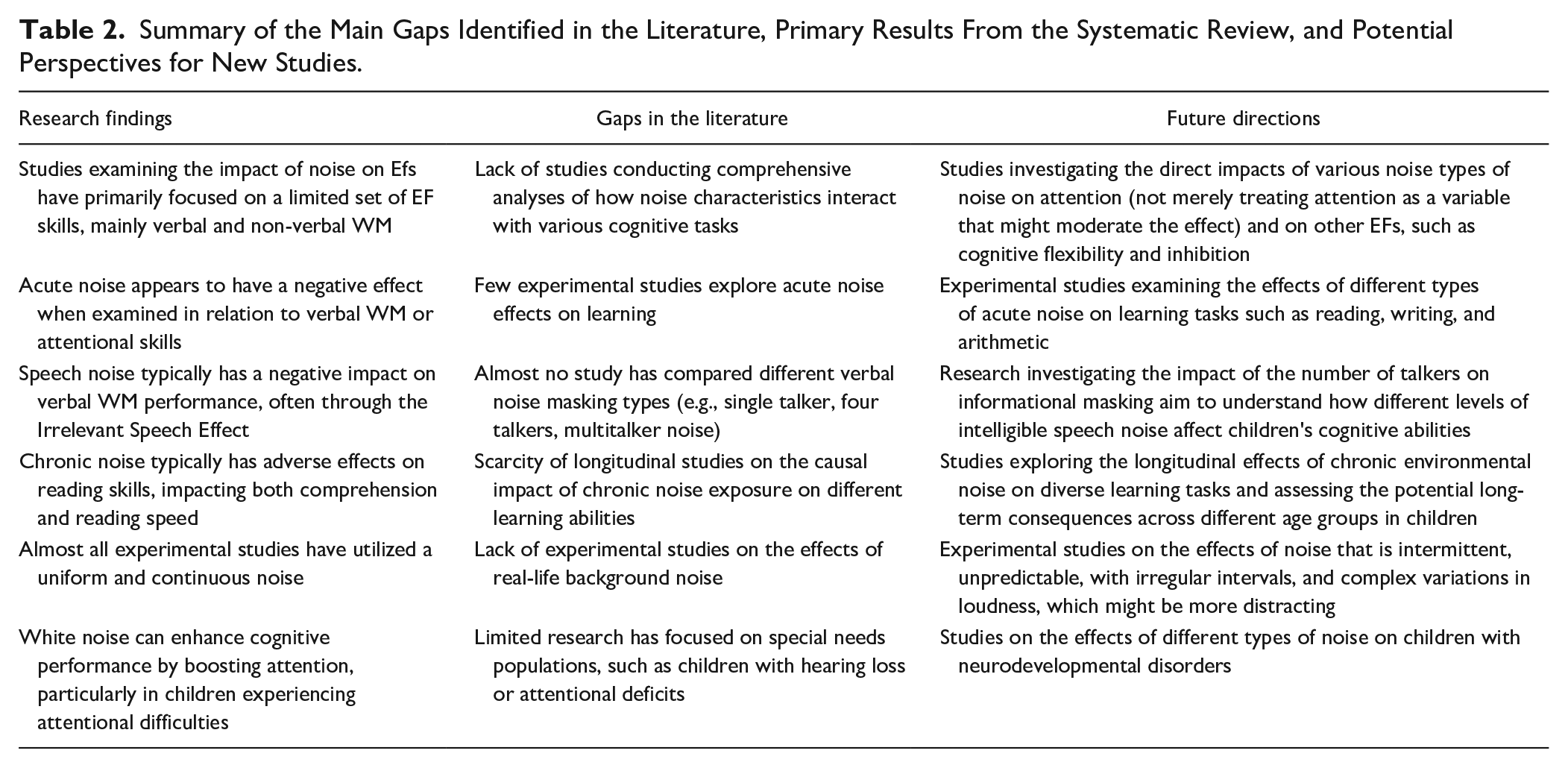
In Table 2, the main gaps identified in the literature based on the primary results from the analysis of the studies are summarized, along with potential perspectives for new studies aimed at addressing these gaps and advancing knowledge on the subject (see Table 2).
Summary of the Main Gaps Identified in the Literature, Primary Results From the Systematic Review, and Potential Perspectives for New Studies.
Conclusion
While the global impact of noise on well-being and cognition is well-documented (Clark & Paunovic, 2018a, 2018b), its specific effects on children’s cognitive functioning and learning remain largely underexplored. With this SR we attempted to systematically organize and discuss the research on the cognitive effects of noise in children, highlighting knowledge gaps and directions for future studies. There is agreement among the studies that both acute and chronic noise exposure, from moderate to severe levels, influence children’s cognitive and learning performance. The effects of chronic noise could be an area of particular interest for future research, due to their potential long-term consequences, especially considering that children spend most of their daily time in noisy environments. Since primary school children haven’t fully developed EFs and learning skills, their capacity to compensate for the effects of noise remains limited. Therefore, noise presents a threat for both their learning progress and overall well-being.
Reducing the impact of noise isn’t straightforward. To counter chronic environmental noise like road traffic, structural changes such as creating better acoustic learning spaces or using sound-absorbing panels in classrooms are essential. Yet, this literature review implies that these interventions might not be enough without interventions on classroom noise management strategies. When speech and activity noise disrupt learning, it’s crucial to combine improvements in classroom acoustics with behavioral programs teaching noise-management behaviors.
This review finally highlights that noise effects vary based on the individual characteristics of the students in a classroom. Non-speech and speech noise may impact some children differently, with some individuals, e.g., those with attentional problems, potentially benefiting from specific noise types and levels (8; 22). Recognizing the interplay between noise features (e.g., frequency, sound pressure, time distribution) and children’s individual characteristics (e.g., neurodevelopmental disorders) is essential. Further research is necessary to fully comprehend this interaction and its implications, representing a new frontier for acoustics and cognitive science researchers.
Supplemental Material
sj-docx-1-eab-10.1177_00139165241245823 – Supplemental material for The Effects of Noise on Children’s Cognitive Performance: A Systematic Review
Supplemental material, sj-docx-1-eab-10.1177_00139165241245823 for The Effects of Noise on Children’s Cognitive Performance: A Systematic Review by Flavia Gheller, Gaia Spicciarelli, Pietro Scimemi and Barbara Arfé in Environment and Behavior
Footnotes
Declaration of Conflicting Interests
The author(s) declared no potential conflicts of interest with respect to the research, authorship, and/or publication of this article.
Funding
The author(s) disclosed receipt of the following financial support for the research, authorship, and/or publication of this article: This work was supported by PON “Research and Innovation 2014-2020 D.M. 1062/2021. Project Title: Chi-CoEN (Children’s Cognitive Effort in Noise).

Supplemental Material
Supplemental material for this article is available online.
Author Biographies
References
Supplementary Material
Please find the following supplemental material available below.
For Open Access articles published under a Creative Commons License, all supplemental material carries the same license as the article it is associated with.
For non-Open Access articles published, all supplemental material carries a non-exclusive license, and permission requests for re-use of supplemental material or any part of supplemental material shall be sent directly to the copyright owner as specified in the copyright notice associated with the article.
