



Abstract
Nurturing relationships are crucial for adaptive child development. The objectives of the study were to investigate whether nature availability was associated with early nurturing parenting practices, mother-infant bonding, and infant socioemotional function. Data were from the Australian Temperament Project (n = 809 infants to 515 parents residing in Victoria, Australia) and were linked cross-sectionally to residential greenness (i.e., Normalized Difference in Vegetation Index). There were no observable associations between residential greenness within a 1,600 m network radius and parenting practices, mother-infant bonding, or infant socioemotional function. The findings were largely corroborated by sensitivity analyses (i.e., NDVI within 100, 250, 500, and 1,000 m and distance to park). Shorter distances to a park were associated with less hostile parenting. More residential greenness (1,000 and 1,600 m) was associated with stronger father-infant bonding and more hostile parenting amongst the most stressed parents in exploratory analyses. Residential greenness might be a socioecological precursor for father-infant bonding.
Nurturing Relationships and Early Childhood Development in Socioecological Contexts
Scientific evidence supporting the importance of nurturing parent-infant relationships for child development is incontrovertible (Belsky & Fearon, 2008; Bronfenbrenner, 1986; Sanders & Morawska, 2018; Shonkoff & Phillips, 2000). For instance, parental sensitivity, or the ability of the parent to recognize and respond to infant behavioral cues, predicts infant attachment security (De Wolff & van Ijzendoorn, 1997), which supports early childhood development. However, the family is positioned within a much broader socioecological context that has a bearing on the family resources and opportunities for quality caregiving (Belsky & Eggebeen, 1991; Belsky & Fearon, 2008; Lickenbrock & Braungart-Rieker, 2015). For instance, lower socioeconomic status has been found to be associated with suboptimal parenting quality (Booth et al., 2018; Dodge et al., 1994), perhaps through socially stratified levels of exposure to adversity and stressors that leave parents of low socioeconomic status overexerted and unwell (Shonkoff et al., 2012). Indeed, mental health is known to be determined by socioecological factors (Allen et al., 2014; Marmot, 2005; Silva et al., 2016; World Health Organization, 2014) and parental postpartum mental health has been found to predict maternal sensitivity (Bernard et al., 2018), attachment (Lefkovics et al., 2014; Ohoka et al., 2014), and child mental health and development (Rogers et al., 2020; Vänskä et al., 2017).
These mechanisms indicate the importance of investing in the broader socioecological context to provide scaffolding for the development of nurturing parenting styles with longer term benefits for infant development. This is particularly so across the first 1,000 days of an individual’s life which have a strong predictive impact on health and wellbeing over the life course (Hanson & Green, 2022; Linnér & Almgren, 2020). Further, it has been posited that earlier intervention provides larger human and economic benefits over time (Heckman, 2008). Therefore, it is of importance for both individuals and societies to identify modifiable conditions of and structures that support nurturing relationships during this phase of life.
Residential Greenness as an Ecological Modality to Support Nurturing Relationships
Public natural environments are promising for structural, population-level upstream health promotion and prevention because they are modifiable, last once implemented, and are widely accessible (Hordyk et al., 2015; Newman et al., 2015). There is evidence to suggest that presence of natural features and environments is associated with improved mental health in adults (Bratman et al., 2019; Mygind et al., 2019; van den Berg et al., 2015), and this could be speculated to support nurturing relationships and the bonding between a mother and her infant. Prerequisites for interactions with nature include both the presence of natural features and environments and contact with it, whether incidental or purposeful (Bratman et al., 2019). It is through these interactions with nature that presence of natural features and environments is thought to contribute to improved mental wellbeing and health through may be enhanced through healthy movement behaviors, social cohesion, and protection and recovery from stress (Bratman et al., 2019; Hartig et al., 2014; Konijnendijk et al., 2013; Kuo, 2015).
There is a small body of evidence that has investigated the association between natural features and environments with parenting. For example, research has linked the distance from children’s home to the nearest natural water pond, but not green space, to lower parenting stress in mothers to children aged 4 to 7 years (Balseviciene, Sinkariova, & Andrusaityte, 2014). This research has focused on associations between natural environments and aspects of parenting in families with school-aged children, but it is possible these associations have earlier origins. However, we are not familiar with any studies investigating associations between the presence of natural environments and interactional precursors to healthy child development such as parenting practices and infant-mother bonding, nor infant socioemotional function (Mygind et al., 2019; Mygind, Kurtzhals, et al., 2021).
There are two dominant perspectives on how nature experience might influence human wellbeing which then might be connected to parenting quality, mother-infant bonding, and infant socioemotional function. These are psycho-evolutionary theory and Attention Restoration Theory (ART). Psycho-evolutionary theory suggests that non-specific nature experience supports relaxation and stress recovery (Ulrich et al., 1991). The mechanism is proposed to act through an innate human affinity for natural features and environments that alleviates stress and helps recover homeostasis (Ulrich et al., 1991). Whereas this account proposes a universal grounding effect, ART (S. Kaplan, 1995; R. Kaplan & Kaplan, 1989) proposes that nature experience restores mental fatigue caused by modern lifestyles. ART hypothesizes that nature experience evokes a sense of awe and wonder and of being away from stressors, which stimulates effortless attention. Effortless attention, in turn, is thought to restore the capacity for directed attention, which is necessary for navigating stimuli-rich and busy modern environments.
Complex, changeable, and context-bound, nurturing parenting practices are characterized by more warmth, less anxiety, and less hostility (Belsky & Fearon, 2008; Sanders & Morawska, 2018; Shonkoff & Phillips, 2000). Such practices are formed by the parent’s characteristics (such as temperament and intelligence), socialization (such as early life modeling of parenting styles), and interaction with a child’s traits (Sanson et al., 2018). While classic theories conceptualize parenting practices as relatively static, contemporary accounts suggest that parenting is conditional on the socioecological contexts in which families live (Shonkoff & Phillips, 2000). With parenting practices being contingent upon the conditions in which they are embedded, it could be speculated that settings that afford nature experience that stimulate stress recovery and attention recovery might in turn increase the likelihood of quality parenting. A balanced and recharged parent would be expected to identify and process infant cues more acutely and accurately, as well as provide more sensitive and considered responses. Further, a balanced and recharged parent might be able to engage in more warm and contingent parenting as well as bonding. This might in turn contribute to infant socioemotional wellbeing and function. At the same time, nature exposure and experience might contribute to infant socioemotional function directly. In this way, the presence of natural features and environments, as a prerequisite for nature exposure and experience, might support nurturing relationships, mother-infant bonding, and infant socioemotional function through stress and attention recovery.
Purpose of the Present Study
In the present study, we investigated the associations of the presence of natural features and environments with parenting practices, infant-mother bonding, and infants’ socioemotional function in the first year of life. The presence of natural features and environments was operationalized as the average level of healthy vegetation close to home, that is, residential greenness.
Residential greenness was hypothesized to be associated with: (1) parenting practices characterized by more warmth, less anxiety, and less hostility, (2) stronger mother-infant bonding, and (3) higher levels of infant socioemotional competences and lower levels of problems.
Methods
Hypotheses and analyses were pre-registered to the Open Science Framework (Mygind, Greenwood, et al., 2022). We used data from the intergenerational cohort, the Australian Temperament Project (ATP). ATP recruited a representative sample of over 2,000 infants and their parents in 1983. Parents (Generation 1) and their offspring (Generation 2) have now been followed over three decades (16 waves) from 4 to 8 months into the 30s. Offspring of these original Generation 2 ATP participants were then recruited as part of the ATP Generation 3 (G3) Study. ATP has recruited and assessed over 1,167 G3 offspring born to 703 Generation 2 (G2) ATP participants since 2011. Data used in this study were sourced from ATP, except for residential greenness which was obtained through data linkage.
Sample
The analytical sample consisted of 809 infants (to 515 G2 ATP participants), residing in the state of Victoria, who provided data on any of the outcomes of interest or for whom residential address data were available when the child was 1 year old. This resulted in a sample of 71% of the infants to the G2 ATP participants (n = 1,138–703 G2 ATP participants) who had consented to partake in the ATP G3 study (Olsson et al., 2022).
Attrition was observed from the G2 ATP sample (n = 2,443) to the sample that was screened for eligibility for inclusion in ATP G3 (n = 1,701; Olsson et al., 2022). Compared to the full G2 ATP sample, the screened sample (n = 1,701) was characterized by fewer non-Australian born parents and somewhat higher education levels. Parents who assented to participate in the G3 study (n = 703) were otherwise broadly representative of those eligible to participate (n = 860) on baseline characteristics in 1983 (i.e., G1 education and country of birth and G2 biological sex, temperament, and behavior problems; Olsson et al., 2022).
Approval was granted for the ATPG3 study protocols by the Royal Children’s Hospital’s (RCH) Human Research Ethics Committee (HREC). Prior ATP waves were approved by the Human Research Ethics Committees at the University of Melbourne, the Australian Institute of Family Studies, and the Royal Children’s Hospital, Melbourne. Specific approval was obtained from RCH HREC (#34185) for geolocating participant addresses.
Outcome Assessment
Parenting Practices
Warm, anxious, and hostile parenting practices were measured using items from the parenting scales from the Longitudinal Study of Australian Children (Paterson & Sanson, 1999; Zubrick et al., 2014). Parents responded to four questions relating to warm parenting (e.g., “How often do you express affection by hugging, kissing, and holding (child name)?”), seven questions pertaining to anxious parenting (e.g., “A child is likely to get upset when s/he is left with a babysitter or carer”), and four questions representing hostile parenting (e.g., “When (child name) cries, he/ she gets on my nerves”; see Supplemental Material A for all the questions included in the scales). Responses were recorded on a 5-point scale, with higher scores reflecting greater warmth, anxiety, or hostility. Each of the scales were treated as continuous variables.
Mother-Infant Bonding
Mother-infant bonding was measured using the Maternal Postnatal Attachment Scale (MPAS; Condon & Corkindale, 1998) total score at 1 year of age. MPAS is a validated 19 item self-report questionnaire that is used to assess mother-to-infant bonding (e.g., “When I am caring for the baby, I get feelings of annoyance or irritation” or “When I am with the baby and other people are present, I feel proud of the baby”). The scale was treated as continuous variable.
Infant Socioemotional Function
Infant socioemotional problems and competences were measured using the validated Brief Infant Toddler Social Emotional Assessment (BITSEA) at 1 year of age (Briggs-Gowan et al., 2004). The 42-item BITSEA is a screener for socioemotional problems and competences and includes 11 competence items (e.g., “Tries to help when someone is hurt (e.g., gives a toy)”) and 31 problem items (e.g., “Cries or tantrums until he/she is exhausted”). The scales were treated as continuous.
Availability of Natural Features and Environments Assessment
Residential Greenness
Greenness surrounding the home was estimated using the Normalized Difference in Vegetation Index (NDVI). NDVI is a unit-less, commonly used, and effective measure of vegetation cover (Rhew et al., 2011). NDVI is calculated as the difference between absorbed (red) and reflected (near infrared) light by vegetation and is typically calculated using data from satellite sensors. The NDVI quantifies vegetation on a scale of -1 to 1. Although there are no distinct boundaries for different types of land cover, negative values typically reflect water surfaces, values around 0 little or no healthy vegetation, and values close to 1 dense vegetation. In analyses focusing explicitly on the presence or absence of vegetation, as is the case in this study, water bodies are typically excluded, and the scale from 0 to 1 used.
Calculation of participant level residential NDVI was conducted in several successive steps. First, an ATP data manager (CG) generated a deidentified dummy ID number for each participant. The dummy ID was then extracted along with the residential address. To convert residential address data into geographic coordinates, we then geolocated the participants’ addresses using ArcGIS Desktop version 10.8.1 (ESRI Inc., Redlands, CA, USA).
We then generated a 1,600 m road network buffer around these locations using the Network Analyst tool in ArcMap, version 10.7.1 (ESRI Inc., Redlands, CA, USA). A 1,600 m buffer was chosen because this distance is thought to reflect a 20 minutes walk and thus a range that most adults are considered capable and willing to walk to neighborhood destinations (Browning & Lee, 2017). We used 2020 road data from the Victorian Department of Environment, Land, Water, and Planning (DELWP). These buffers were then overlaid onto a NDVI raster map. The NDVI map was based on Tier 1 Landsat-7 and Landsat-8 surface reflectance imagery, which is available as open-source remote sensing images from the Google Earth Engine (Gorelick et al., 2017). The median NDVI was extracted for the years 2011 to 2019 using a custom script (Ramsey & Mavoa, 2021). The mean and standard deviation of NDVI within the year of collection of the children’s behavioral data was generated using the Zonal Statistics tool in QGIS Desktop (version 3.22.5).
Several additional exposure measures (NDVI within 100, 250, 500, and 1,000 m road network radii from home) were calculated for sensitivity analyses and for comparison with other current literature. We proposed that replication across one or more of these radii would be suggestive of a more robust association. The supplementary NDVI metrics were calculated in the same way as described above.
Distance to Park
Distance to nearest park was included as an alternative indicator of availability of natural features and environments for use in sensitivity analyses. It is worthwhile including this metric in conjunction with residential greenness because it specifies designated vegetated park space, whereas NDVI includes all vegetated space (whether it is public, private, accessible, or inaccessible) within the chosen radius; as such, residential greenness and distance to nearest park would be expected to correlate yet identify different aspects of nature availability. Both metrics have measurement strengths and weaknesses. For example, NDVI might include vegetation on privately owned land that is not practically accessible to the participants. Conversely, distance to park excludes all non-designated vegetation and includes parks with varying and unmeasured levels of vegetation. Weighing out these pros and cons, we consider NDVI slightly more appropriate for our purpose because it measures all available, if not practically accessible, natural features and environments, for example, neighboring gardens, street side trees, or small patches of greenery, that in turn more fully captures the range of possible passive and actives exposures.
We calculated the Euclidian distance from the child’s home to the centroid of the nearest park in QGIS Desktop (version 3.22.5) using the Distance to Nearest Hub tool after creating the park centroids with the Centroids tool. We used 2013 park data from the DELWP WMFEAT dataset (including the following feature subtypes; parks, conservation parks, cemeteries, national parks, gardens, city squares, amusement centers, and zoos).
Covariates
Covariates were identified in the existing literature and included child, parent, and neighborhood level variables (Mygind, Kurtzhals, et al., 2021). We included ATP derived indicators of child biological sex (binary, male or female); parental unemployment status (binary, yes or no); household weekly income (continuous); level of educational attainment (categorical, 1: year 12 or below, 2: trade, certificate, or diploma, 3: any university degree), and dimensional measures of stress (continuous), depression (continuous), and anxiety (continuous) measured using the Depression Anxiety and Stress Scales (DASS-21) (Lovibond & Lovibond, 1995). The data for these ATP derived indicators were collected when the infant was approximately 1 year of age. Neighborhood remoteness was measured using the 2016 Remoteness Structure Index from the Australian Bureau of Statistics (ABS) (binary, 1: Major Cities of Australia, 2: Inner Regional Australia, Outer Regional Australia, or Remote Australia). Area-level disadvantage was measured using the 2016 Socio-Economic Indexes For Areas (SEIFA) Index of Relative Socio-economic Disadvantage (IRSD) from ABS (continuous). Higher IRSD scores represent lower relative levels of disadvantage.
Statistical Analysis
Data Cleaning
Missingness ranged from 0.12% (e.g., residential greenness) to ~18% (i.e., infant socioemotional problems and competences) in the dataset (see Table 1). We accounted for missing data using Multiple Imputation. We used the R version 4.1.3 (2022-03-10) package “mice” (van Buuren & Groothuis-Oudshoorn, 2011) to generate and pool 50 datasets.
Sample Characteristics (n = 809).
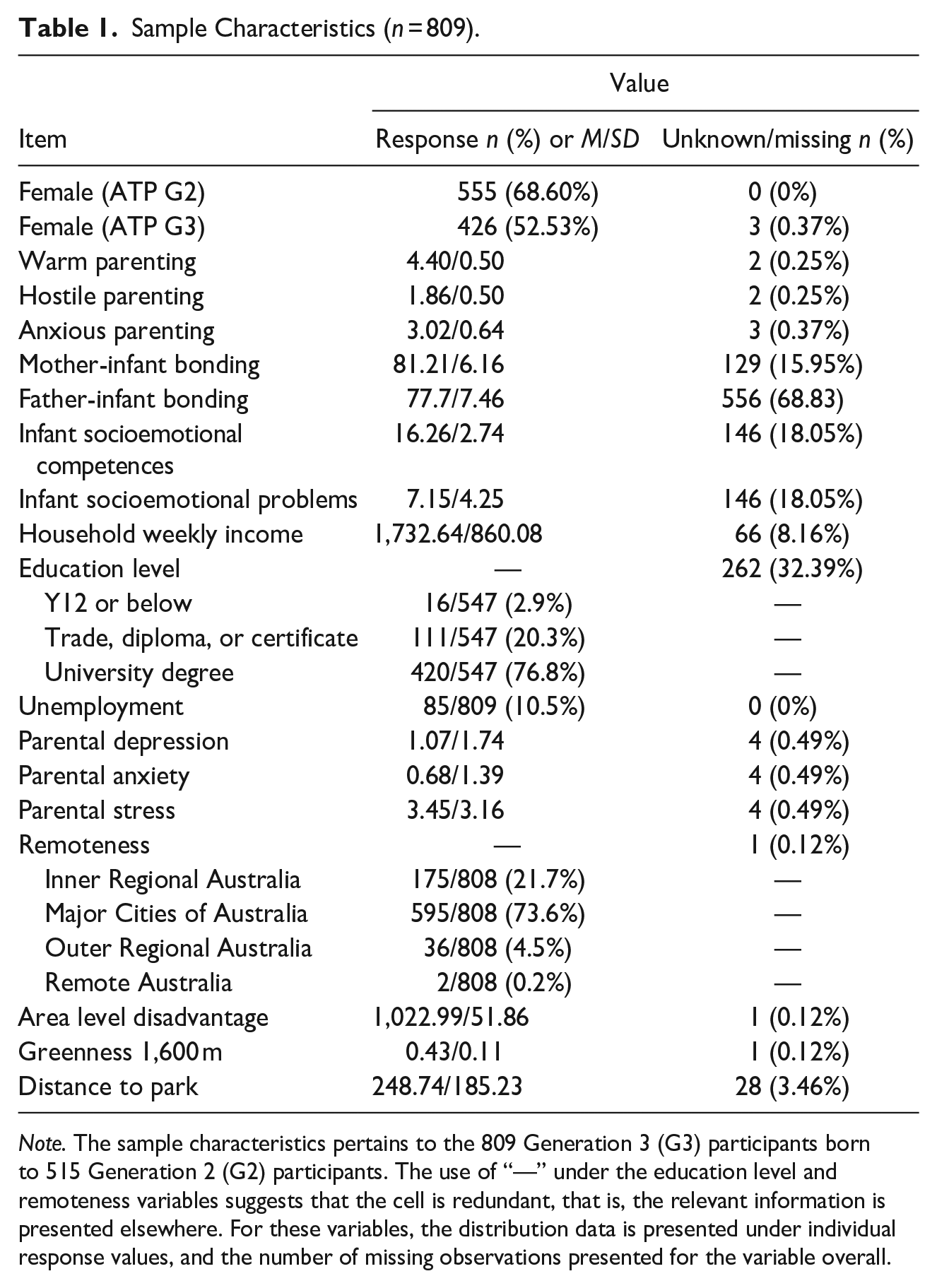
Note. The sample characteristics pertains to the 809 Generation 3 (G3) participants born to 515 Generation 2 (G2) participants. The use of “—” under the education level and remoteness variables suggests that the cell is redundant, that is, the relevant information is presented elsewhere. For these variables, the distribution data is presented under individual response values, and the number of missing observations presented for the variable overall.
Normal Probability Plots were used to evaluate the distribution of the data and to eyeball the data for potential outliers. Box Plots were used to supplement the identification of outliers. Grubb’s Test was used for testing for a single outlier and the Generalized Extreme Studentized Deviate (ESD) test when the number of outliers was unknown. If outliers were detected and presented unlikely values, they were considered missing data.
We observed extreme and implausible values in the household weekly income and distance to nearest park variables. We defined household weekly income values larger than 10,000AUD as outliers (resulting in 66 missing data points). According to the ABS, the highest 20% income households had approx. 2,234AUD weekly equivalized disposable household income in 2019 (Australian Bureau of Statistics, 2022). Factoring in income taxes, we deemed that excluding values below 10,000AUD might exclude true observations. The outliers were likely due to reporting error where questions were misinterpreted (e.g., reporting annual or monthly household income). We defined values of above 1,500 m to nearest park as outliers (resulting in a total of 28 missing data points). This was based on visually assessing the parent data (i.e., geolocated data prior to merging with the ATP data) in QGIS and comparison with the range of values found in extant research (Hooper et al., 2018). Outliers were likely caused by measurement error resulting from incompleteness in the DELWP map of green space. Specifically, the coverage tended to be more sporadic in Regional Victoria (when comparing the DELWP green space polygons with the QGIS topological base map), which would exaggerate distances to parks for participants residing regionally. These values where considered missing and are excluded from the analyses.
Main Analyses
We modeled the associations of interest with Generalized Estimating Equations (GEE) using the R package “geepack” (Højsgaard et al., 2006). GEE accounts for dependency amongst observations which we found to be necessary due to intra-class correlations above .05 (Sommet & Morselli, 2017). We specified the correlation structure as “exchangeable,” which assumes that correlations between pairs of observations within families remain constant.
Our main model of interest modeled the association between NDVI (1,600 m) and each of the outcomes (i.e., warm, anxious, and hostile parenting, mother-infant bonding, and infant socioemotional problems or competences), controlling for covariates spanning child sex, parent employment status, household income, level of education, mental health (stress, depression, and anxiety), remoteness, and area-level disadvantage. We also ran an unadjusted model and models with each covariate to investigate their individual impact on the association between greenness and the outcomes of interest (see Supplemental Material B for these results). We used the standard p < .05 criteria for determining if the regression models suggest that results are significantly different from those expected under the null hypothesis.
Sensitivity Analyses
Complete case analyses were conducted to assess the robustness of the main findings. The complete case analyses were conducted in the same way as the main analyses, with listwise deletion of participants with missing data.
The additional exposure measures, that is, NDVI within 100, 250, 500, and 1,000 m road network radii from home and distance to nearest park, were used as alternative indicators of availability of natural features and environments to investigate the robustness of the main findings. These analyses were conducted in the same way as the main analyses, with the supplementary exposure measures replacing the main exposure (NDVI within 1,600 m).
Exploratory Analyses
We conducted several exploratory, that is, not pre-planned or pre-registered, analyses. Specifically, we investigated associations between availability of natural features and environments and father-infant bonding and conducted several analyses to examine whether residential greenness interacted with the relationships observed in fully adjusted models between individual outcomes and covariates.
Our main analysis focused on mother-to-infant bonding. There is considerable evidence that connects mother-infant bonding to healthy child development, but calls have been made to investigate the role of fathers (Belsky & Fearon, 2008; Sarkadi et al., 2008). We therefore investigated the association between residential greenness and father-infant bonding in an exploratory analysis using the Paternal Postnatal Attachment Scale (PPAS) (Condon et al., 2008) total score at 1 year of age as an outcome. Like MPAS, PPAS is a validated 19 item self-report questionnaire that is used to assess father-to-infant bonding. The association was investigated in fully adjusted models using the same approach as the main analyses.
Further, we investigated if the observed associations between covariates and distinct outcomes would be moderated by residential greenness. We thus explored only covariates that were significantly associated with the outcomes in adjusted main models. These models suggested that warm parenting associated with parent unemployment, depression, and stress; anxious parenting associated with parent unemployment, depression, and stress; hostile parenting associated with remoteness, area-level disadvantage, and parent stress; mother-infant bonding associated with parent stress, depression, and education level; infant socioemotional competences associated with child sex, and infant socioemotional problems associated with parent stress. We created simple interaction models with the relevant covariates (e.g., parent stress), residential greenness, and an interaction term with the covariate and residential greenness (e.g., stress × residential greenness) as independent variables and the relevant parenting practice (e.g., hostile parenting) as the dependent variable. We observed a significant interaction only for residential greenness and parent stress on hostile parenting (p < .045). To investigate this further, we created a binary variable separating parents with DASS-21 scores equal to or above the 75th percentile (i.e., a score of five) from children of parents below the 75th percentile. The use of DASS-21 cut off was not practicable as less than five participants had scores above 15, that is, in the “mild” stress spectrum. We then ran the fully adjusted model as above for the two subgroups, that is, below the 75th percentile and above the 75th percentile.
Results
Sample Description
The sample consisted of ~53% female infants (n = 809) whose parents had a mean weekly household income of 1,731.64AUD (SD = 860.08), mostly held university degrees (~77%), and who predominantly lived in the major cities of Australia (~74%) within areas marginally less disadvantaged than the Victorian average [sample IRSD score mean ~ 1,023, Victorian IRSD M = 1,005 (Australian Bureau of Statistics, 2006)]. ATP participants generally reported low levels of parental depression, anxiety, and stress, and high levels of nurturing relationships, mother-infant bonding, and socioemotional function (see Table 1). For example, ATP participants reported high levels of warm parenting (M = 4.4, SD = 0.5), moderate levels of anxious parenting (M = 3.02, SD = 0.64), and low levels of hostile parenting (M = 1.85, SD = 0.5). The sample had an average of ~250 m (SD = 185.23) to the nearest park and resided in areas of varying levels of greenness, ranging from barren to densely vegetated (indexed by NDVI values between 0.11 and 0.8). The average NDVI score of 0.43 (SD = 0.11) corresponds roughly to healthy shrub or grassland or built-up environments with patches of denser vegetation (Aryal et al., 2022; Huang et al., 2021; Nightingale & Phinn, 2003).
Main Analyses
There was little evidence that warm, anxious, or hostile parenting, mother-infant bonding, and infant socioemotional problems or competences were associated with residential greenness (see Table 2).
The Unadjusted and Adjusted Association Between Residential Greenness (1,600 m Network Radius) and Each of the Outcomes of Interest.
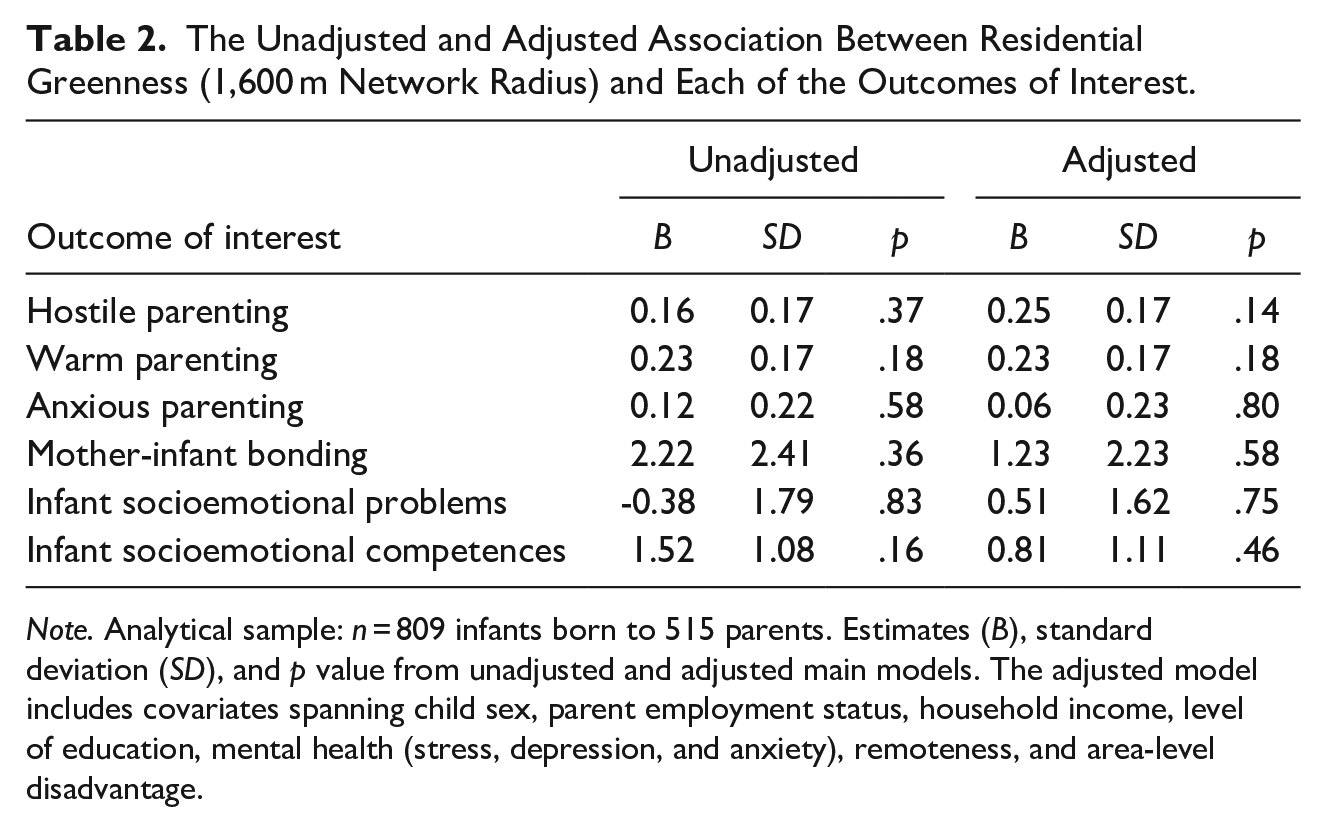
Note. Analytical sample: n = 809 infants born to 515 parents. Estimates (B), standard deviation (SD), and p value from unadjusted and adjusted main models. The adjusted model includes covariates spanning child sex, parent employment status, household income, level of education, mental health (stress, depression, and anxiety), remoteness, and area-level disadvantage.
Sensitivity Analyses
The main findings were largely corroborated by the sensitivity analyses: the complete case analyses and additional buffers all suggested that there were no observable associations between residential greenness and parenting practices, mother-infant bonding, and infant socioemotional function (see Supplemental Material C for sensitivity analyses). There was statistical evidence (i.e., p < .05) that shorter distance to park was associated with lower levels of hostile parenting, but the magnitude of this association was meaningless (i.e., B = 0.00018 which suggests a 0.00018 reduction in hostile parenting for every extra meter to nearest park, or a 0.18 reduction for every 1,000 m).
Exploratory Analyses
Residential greenness (1,600 m) was associated with stronger father-infant bonding parenting (B = 11.79, SD = 4.39, p = .008). As such, 0.1 NDVI unit increase was associated with 1.12 increase in father-infant bonding (on a scale from 19-95). The same was observed in the 1,000 m network radius, but not the 500, 250, and 100 m radii.
For the unstressed participants, that is, below the 75th stress percentile, there was no association between residential greenness (1,600 m) and hostile parenting. For participants with relatively higher stress, that is, above the 75th stress percentile, more residential greenness was associated with more hostile parenting (B = 0.93, SE = 0.27, p = .0006).
Discussion
We observed little evidence that residential greenness at 1 year of age was associated with hostile, warm, and anxious parenting, mother-infant bonding, and infant socioemotional problems and competences. Sensitivity analyses largely supported these results. The results were replicated across 100, 250, 500, and 1,000 m network buffers and complete case analyses. We observed an association between residential greenness (1,000 and 1,600 m) and stronger father-infant bonding. These results held across unadjusted and adjusted models (i.e., controlling for child biological sex; parental unemployment status; household weekly income; level of educational attainment; parental stress; parental depression; parental anxiety; neighborhood remoteness, and area-level disadvantage).
We are not familiar with any studies investigating associations between access to natural features and environments and parenting practices and mother-infant or father-infant bonding, nor infant socioemotional function (Mygind, Kjeldsted, et al., 2019; Mygind, Kurtzhals, et al., 2021). Balseviciene, Sinkariova, and Andrusaityte (2014) observed an association between distance to natural water ponds and parenting stress in Lithuanian mothers of children aged 4 to 7 years. Parenting stress is proposed to predict parenting practices and parent-child bonding, so the same would have been expected of these interactional indicators in extension of the experienced parenting stress. The Lithuanian study did not, however, observe an association between distance to green spaces (i.e., city parks larger than 1 ha with most of them having 65% land cover with trees) and parenting stress. Likewise, in our study, we did not find an association with parenting practices with residential greenness, and only found an association between distance to nearest park (regardless of size) and hostile parenting. Indeed, we suggest that the finding that hostile parenting associates with distance to nearest park should not be attributed too much importance until further confirmation of the finding because of the small size of the association (i.e., a 0.18 decrease in hostile parenting per 1,000 m increase in distance from nearest park) and the associated uncertainty (p = .046). It is, however, noteworthy that we observed an association between more residential greenness (1,000 and 16,000 m) and stronger father-infant bonding.
Initially, we proposed that residential natural features and environments were a prerequisite for nature exposure and experience which might support nurturing relationships through stress recovery (Ulrich et al., 1991) and attention recovery (R. Kaplan & Kaplan, 1989). Whilst seemingly plausible, in the light of the current findings, this reasoning could be problematic for a few reasons. First, parenting practices and bonding dynamics have previously been found difficult to alter, even by previous attempts that have been directly aimed toward parenting behaviors (Shonkoff & Phillips, 2000). Indeed, it is possible that parenting practices remain unchanged despite obtainment of stress and attention recovery from nature experience because parenting is so heavily reliant on socialization (e.g., on childhood modeling of warm parenting), or on other conditional factors that take precedence over natural surroundings (e.g., time and resource sufficiency). In other words, if the opportunities for these types of behavior do not exist because the parents are unfamiliar with such behaviors or is unable to practice them due to conditional factors, it is possible that such behavior will not arise, even if the parents do benefit in other ways from nature experience.
The observation that father-infant, but not mother-infant bonding, might suggest an engendered difference in the way natural features and environments is used. Indeed, young men have been observed to engage in nature-based recreation more so than young women (Rosa et al., 2020). If fathers use natural environments for bonding with their children, this might contribute to child socioemotional development over time. This speaks to the importance of social dynamics in the interaction with natural environments and the complex ways in which benefits are obtained, if at they are obtained at all. We are not familiar with research investigating determinants of nature contact in families with very young children, nor research investigating whether nature contact in such families is qualitatively or quantitatively different from families with older children. However, there is a body of research investigating determinants of nature contact in older children (e.g., Arvidsen et al., 2022; Skar et al., 2016; Soga et al., 2018). Interestingly, the social factors that have been found to associate with nature engagement differ between samples. In Danish children aged 6 to 15 years, parents reported that accessibility to multiple types of green space was a predictor of use over and above parent concerns around or support for green space use, which, however, also associated with nature contact (Arvidsen et al., 2022). In a Norwegian sample of parents to children aged 6 to 12 years, time pressure presented the largest factor predicting nature engagement, over and above accessibility and safety (Skar et al., 2016). Conversely, Japanese school-aged children, for example, did not report time pressures as a predictor of nature engagement (Soga et al., 2018). Instead, child and family members’ nature relatedness (i.e., the cognitive, affective, and experiential sense of connectedness to nature) associated with nature experiences. Methodological differences between these studies aside, it seems that the social factors that correlate with nature contact, and the degree to which accessibility of natural features and environments predicts nature contact, varies according to context.
It is also possible that parents do not acquire adequate stress or attention recovery from nature experience on a population level. Indeed, both theoretical accounts have seen empirical support in adults, but perhaps less convincingly than might be expected (Mygind, Kjeldsted, et al., 2021; Ohly et al., 2016; Stevenson et al., 2018). Effects of seated relaxation in nature on psychophysiological indicators of stress are, for example, not observable in past research (for a meta-analysis, see Mygind, Kjeldsted, et al., 2021). Core assumptions of the theories have also faced criticism. It has, for example, been posited that these mechanisms could be contingent upon sociocultural processes of enculturation to nature appreciation through which benefits are accrued rather than an innate adaptive response (Joye & Dewitte, 2018). As such, it is possible that population benefits are vastly more heterogeneous than widely supposed, perhaps even in a manner where populations who stand to benefit from access to nature are not the ones who hold the necessary traits or affinities from which to reap the benefits.
As discussed above, social dynamics within the family might play a part in the extent to which natural features and environments are used for nature contact and thus shape developmental outcomes. The social context in which the child is embedded might also shape the saliency patterns of the child, that is, the sensory data and experiences that the child will tend to pay attention to. Having a sibling, for instance, is speculated to stimulate more imitation-based learning whereas being an only child is thought to evoke more learning through independent exploration (Gil-Madrona et al., 2021). In extension, only children might be more likely to reap benefits of having access to natural features and environments than children with one or more siblings. Developmental factors may also play a role. For instance, older children can engage in more independent mobility, and thus environmental exploration, than younger children (Marzi & Reimers, 2018). There is some evidence to suggest that various indices of nature exposure and experience are associated with socioemotional benefits in older children (from ages 2 years; Davis et al., 2021; Jarvis et al., 2021; Mygind, Kurtzhals, et al., 2021). This could suggest that socioemotional benefits from nature exposure are not accrued until later in childhood. However, the consistency in the associations between nature exposure and distinct aspects of socioemotional function (e.g., emotional functioning or behavioral inhibition) appears limited when investigated at the level of the separate components (Mygind, Kurtzhals, et al., 2021). For example, Mygind, Elsborg, et al. (2022) identified an association between vegetation cover in and around the home with emotional functioning in Australian children aged two to five, while no such cross-sectional associations had previously been identified in this age group (Balseviciene, Sinkariova, Grazuleviciene, et al., 2014; Christian et al., 2017; Flouri et al., 2014; Scott et al., 2018). This has previously been interpreted as an indication that the associations might be conditional upon factors like sample composition or context, although these relationships are not fully indexed or understood (Mygind, Kurtzhals, et al., 2021).
To further our understanding of these conditional factors, we investigated whether covariates that were identified as predictors of the outcomes of interest would be moderated by residential greenness. Our exploratory analyses found no evidence of moderation of residential greenness on the relationship between the covariates (e.g., parent stress, household income, and education levels) and most of the outcomes. Counterintuitively, a positive association was observed between hostile parenting and residential greenness (1,600 m) among the top-most stressed parents with DASS-21 scores between 5 and 18. This association was observed in unadjusted and adjusted models. Considering the proposition that nature exposure and experience would support stress recovery, which we in turn suggested might promote positive parenting practices, this is surprising. Indeed, we would have expected that this subgroup would stand to benefit from higher residential greenness. Across most of the investigated models, parent stress appeared as a key predictor of interactional indicators and infant socioemotional function, and we propose that future research investigates parent stress as a moderator. Furthermore, it would be worthwhile to investigate and compare potential mechanisms whereby stressed parents use, or do not use, and experience their surroundings as opposed to parents reporting lower levels of stress. It should of course be mentioned that the top quartile subgroup was, mostly, below the DASS-21 cutoff for mild stress. Thus, the results are not applicable to clinically stressed individuals.
Strengths and Limitations
This study has both notable strengths and limitations. The study was pre-registered whereby all methods and statistical decisions were made prior to investigation of associations of interest to enhance analytical transparency. We employed a large prospectively collected dataset. Further, we used an objective measure to investigate residential greenness, and validated tools to assess relational and infant outcomes.
The cross-sectional design of our study is a notable weakness because causality cannot be implied, and because impacts of cumulative exposure to nature could potentially be associated with nurturing parenting relationships. It could, for instance, be worthwhile to investigate parental lifelong exposure to greenery in relation to nurturing parenting in offspring infancy. Unfortunately, this data was not available within the ATP. Further, it is possible that the impacts of exposure to nature manifest more clearly as the child grows older. Future studies could employ longitudinal samples to investigate associations with parental lifelong greenery and parenting practices over development. Furthermore, alternative relational aspects, such as parental sensitivity (especially paternal), might be associated with residential greenness and could be investigated in future studies.
Although the sample was derived from the representative ATP sample, selection seems to have occurred over the waves of measurement and across the generations. Attrition is to be expected of large, multigenerational cohorts, but the selection might have incurred sample bias. Although the ways in which various populations stand to benefit from nature exposure is not currently well understood (Mygind, Kurtzhals, et al., 2021), it is possible that it is the populations for whom benefits might be accrued that have been filtered out. For example, in this community sample, the parents were aged 29 to 35 years when the infants were recruited and there were very few participants who were stressed, depressed, or anxious as per DASS-21 cut offs. These are populations for whom the potential for increase in the outcomes of interest might be expected to be larger, broadly speaking. Further, the general level of greenness was fairly high. The result might be a ceiling effect and a type 2 error.
While NDVI is a widely used and validated indicator of residential greenness, and availability of greenness a prerequisite for nature exposure and experience, it is not intended as a direct measure of use of or interaction with nature (Donovan et al., 2022). As such, there is no guarantee that higher residential greenness also results in more or higher quality nature contact that can impact the outcomes of interest. If a neighbourhood is perceived as unsafe due to traffic or crime, for example, it might be less likely to be used despite green utilities. Furthermore, NDVI does not distinguish between private and publicly accessible vegetation. This limits the sensitivity of NDVI as an indicator of accessibility of natural features and environments. Although indexes have been developed to address the shortcomings of NDVI, for example the Natural Space Index (Rugel et al., 2017), these rely on data sources, for example, municipal and private databases, that might not be accessible or cover historical data. Indeed, the strength of NDVI is considered to lie in the availability of the underlying satellite imagery over time and places, and the ease and consistency with which the measure is generated which aids replicability across contexts (Rhew et al., 2011). Future research could focus more on interactions with nature or nature relatedness rather than provision of nature, or perhaps interactions between these factors.
Implications for Practice
We found little evidence for an association between residential greenness and parenting practices, mother-infant bonding, and socioemotional function in the first year of life, but inferences made on this ground should be made cautiously. Indeed, this study is, to our knowledge, the first to investigate these relational dynamics in association with residential greenness and we are not familiar with other studies that have analyzed infant socioemotional function. It cannot be precluded from a single study that such associations might exist. Further, the observation that shorter distances to parks were associated with less hostile parenting require further investigation before the idea of potential benefits of nature provision for nurturing relationships is discarded. The association between more residential greenness and stronger father-infant bonding suggests that there could be an engendered difference in the way parents use their environment, alone or with their child, and so the way this impacts bonding.
Considering these findings and the difficulty of impacting parenting practices (Shonkoff & Phillips, 2000), the importance of nurturing relationships for child development, and the population wide potential reach of residential greenness, the potentials of nature availability as an ecological modality should be investigated further, perhaps with a larger focus on the fathers.
We observed that sociodemographic variables, such as household income, parent mental wellbeing, and area-level socioeconomic disadvantage, were associated with some of the outcomes of interest. These factors are indeed widely identified as important predictors of nurturing relationships and child development (Shonkoff & Phillips, 2000). While residential greenness was mostly found not to moderate these indicators in this study, it might be valuable to identify mechanisms and interventions to modify these factors as an alternative or supplementary means to support nurturing relationships that support healthy child development.
Conclusions
We set out to investigate if residential greenness is associated with parenting practices, mother-infant bonding, and socioemotional function in the first year of life. Residential greenness was hypothesized to be associated with: (1) parenting practices characterized by more warmth, less anxiety, and less hostility, (2) stronger mother-infant bonding, and (3) higher levels of infant competences and lower levels of problem. We found no support for either of these hypotheses in our sample. In other words, we found little confirmatory evidence to suggest that residential greenness might be an ecological precursor of nurturing relationships that support early childhood development at this early stage of life. There was some evidence that distance to nearest park might associate with lower levels of hostile parenting, but we caution against attributing this overdue importance. We found exploratory evidence to suggest an association between more residential greenness and stronger father-infant bonding as well as some counterintuitive evidence that more residential greenness associated with more hostile parenting for the infants of parents who were in the topmost stressed quartile.
We propose that future studies investigate father-child relationships and employ longitudinal samples to investigate associations over development. Furthermore, alternative relational aspects, such as parental sensitivity (especially paternal), might be associated with residential greenness and could be investigated in future studies. Lastly, future research might benefit from focusing on interactions with nature or nature relatedness rather than provision of nature, or these factors in concert.
Supplemental Material
sj-docx-1-eab-10.1177_00139165231182686 – Supplemental material for Is Neighborhood Nature an Ecological Precursor of Parenting Practices, Infant-Parent Bonding, and Infant Socioemotional Function?
Supplemental material, sj-docx-1-eab-10.1177_00139165231182686 for Is Neighborhood Nature an Ecological Precursor of Parenting Practices, Infant-Parent Bonding, and Infant Socioemotional Function? by Lærke Mygind, Christopher Greenwood, Primrose Letcher, Suzanne Mavoa, Kate Lycett, Yichao Wang, Trine Flensborg-Madsen, Peter Bentsen, Jacqui A. Macdonald, Kimberly Thomson, Delyse Hutchinson, Craig A. Olsson and Peter G. Enticott in Environment and Behavior
Supplemental Material
sj-docx-2-eab-10.1177_00139165231182686 – Supplemental material for Is Neighborhood Nature an Ecological Precursor of Parenting Practices, Infant-Parent Bonding, and Infant Socioemotional Function?
Supplemental material, sj-docx-2-eab-10.1177_00139165231182686 for Is Neighborhood Nature an Ecological Precursor of Parenting Practices, Infant-Parent Bonding, and Infant Socioemotional Function? by Lærke Mygind, Christopher Greenwood, Primrose Letcher, Suzanne Mavoa, Kate Lycett, Yichao Wang, Trine Flensborg-Madsen, Peter Bentsen, Jacqui A. Macdonald, Kimberly Thomson, Delyse Hutchinson, Craig A. Olsson and Peter G. Enticott in Environment and Behavior
Supplemental Material
sj-docx-3-eab-10.1177_00139165231182686 – Supplemental material for Is Neighborhood Nature an Ecological Precursor of Parenting Practices, Infant-Parent Bonding, and Infant Socioemotional Function?
Supplemental material, sj-docx-3-eab-10.1177_00139165231182686 for Is Neighborhood Nature an Ecological Precursor of Parenting Practices, Infant-Parent Bonding, and Infant Socioemotional Function? by Lærke Mygind, Christopher Greenwood, Primrose Letcher, Suzanne Mavoa, Kate Lycett, Yichao Wang, Trine Flensborg-Madsen, Peter Bentsen, Jacqui A. Macdonald, Kimberly Thomson, Delyse Hutchinson, Craig A. Olsson and Peter G. Enticott in Environment and Behavior
Footnotes
Declaration of Conflicting Interests
The author(s) declared no potential conflicts of interest with respect to the research, authorship, and/or publication of this article.
Funding
The author(s) disclosed receipt of the following financial support for the research, authorship, and/or publication of this article: The Australian Temperament Project (ATP) Generation 3 study is located at The Royal Children’s Hospital Melbourne and is a collaboration between Deakin University, The University of Melbourne, The Murdoch Children’s Research Institute, The Australian Institute of Family Studies, The University of New South Wales, The University of Otago (NZ), La Trobe University and the Royal Children’s Hospital; further information available at  . This work was supported by the Australian Research Council [DP130101459; DP160103160; DP180102447], and the National Health and Medical Research Council of Australia [APP1082406]. We acknowledge all collaborators who have contributed to the ATP, especially founding investigators Profs Ann Sanson, Margot Prior, Frank Oberklaid, and Dr Diana Smart. Further we would like to thank Jessica Oakley for conducting the geocoding of the participant addresses. Finally, we would like to extend our gratitude to the participating families for their time and invaluable contribution to the study. LM was supported by Deakin University [PhD scholarship, without grant number]. PE was supported by a Future Fellowship form the Australian Research Council [FT160100077]. CO was supported by a National Health and Medical Council (NHMRC) of Australia Investigator Grant (and Fellowship) [APP10882406]. DH was supported by a National Health and Medical Council (NHMRC) of Australia Investigator Grant (and Fellowship) [APP1197488]. KL was supported by NHMRC Early Career Fellowship 1091124 and Honorary NHF Postdoctoral Fellowship [101239]. YW was supported by an Executive Dean Health Research Fellowship from Deakin University. The funders had no role in study design, data collection and analysis, decision to publish, or preparation of the manuscript. We would like to thank the participating children and parents, as well as the anonymous reviewers.
Supplemental Material
Supplemental material for this article is available online.
Author Biographies
References
Supplementary Material
Please find the following supplemental material available below.
For Open Access articles published under a Creative Commons License, all supplemental material carries the same license as the article it is associated with.
For non-Open Access articles published, all supplemental material carries a non-exclusive license, and permission requests for re-use of supplemental material or any part of supplemental material shall be sent directly to the copyright owner as specified in the copyright notice associated with the article.
