



Abstract
In recent years an increasing number of organizations have started to rethink their physical work environments and recognized the value of having activity-based workspaces (ABWs). This allows employees to choose freely between several work environments based on their specific task. There is growing debate amongst researchers about the effects of ABWs on employee behavior, but companies are still not aware of the options available or the consequences of moving to an ABW layout. This single-case, exploratory study uses 36 interviews and multiple data sources in a German organization leading in use of ABWs to generate insight into this topic. We develop a taxonomy of ABWs and analyze how various design parameters affect how people perform in ABWs regarding communication, leadership, working style, and work performance. We relate these findings to previous research and develop a cause-effects framework of ABWs. Against these findings, we generate recommendations for future research and practice.
Introduction
For a long time, organizations regarded workspace design as largely irrelevant to the outcomes of office work, and physical work environments (PWEs) were designed primarily to meet functional needs (Davis et al., 2011). However, as knowledge work became increasingly important, conventional workspaces began to be replaced by activity-based PWEs that allow employees to choose a working environment that is appropriate to their task (Gerdenitsch et al., 2018). The aim of this workplace transformation is to optimize the performance of people and organizations.
Today, the activity-based workspace (ABW) is increasingly used by small companies and large corporations alike to enhance employee productivity, idea generation, and collaboration (Wohlers et al., 2019). The aim is to provide different workspaces for tasks involving collaborative, concentrated, or routine work (Haapakangas et al., 2019), allowing employees to select from a range of different spaces according to their activities and needs (Appel-Meulenbroek et al., 2011). One implication of the ABW approach is that employees have no fixed desk in the workplace.
Despite ongoing debate among researchers about the effects of ABWs on employee behavior, there is no systematic or comprehensive account of this approach (Wohlers et al., 2019). Most of the existing research focuses on single effects (e.g., face-to-face communication, employee satisfaction) and the costs and benefits of ABWs as compared to traditional workspaces (van der Voordt, 2004a). This means there is no clear guidance for companies seeking to implement an ABW regarding the complex interplay between design parameters and the consequences of implementing such a layout. The present study aims to provide new insights into these issues by addressing the following research questions.
What design parameters should a company consider when designing an ABW?
What are the effects of ABWs on employees?
To gain a comprehensive insight into the practical application of the ABW concept, we used a qualitative research method by conducting a single-case exploratory study of a German organization regarded as a leader in this area. Using a qualitative case study design helps to answer our explorative research questions (Edmondson & McManus, 2007; Eisenhardt & Graebner, 2007) as this approach helps us to examine the complex and evolving phenomena of ABW in the field (Yin, 2017). In particular, we use data from 36 in-depth interviews with key internal and external stakeholders (employees/managers and architects, respectively). Moreover, to enrich the data for more comprehensive analysis, we also consulted internal documents.
The study contributes to the literature in two ways. First, it provides a framework that captures the complexity of modern office design, including various single effects (Elsbach & Bechky, 2007), using exploratory data to develop a model of ABWs that encompasses the main design parameters. Second, we elucidate how these design parameters affect a range of work-related variables, including work style, communication, leadership, and performance.
Theoretical Background
In recent decades, the design of PWEs to provide optimal support for employees (e.g., Block & Stokes, 1989; Goodrich, 1986) has attracted considerable research interest. There is evidence that PWE design affects multiple aspects of employee and organizational performance, including productivity (e.g., Larsen et al., 1998), efficiency (e.g., Veitch & Gifford, 1996), interaction and collaboration (e.g., Elsbach & Bechky, 2007; Hatch, 1987; Oldham & Brass, 1979; Oldham & Rotchford, 1983), communication (e.g., Allen, 1977; Allen & Henn, 2007; Boutellier et al., 2008), organizational culture (e.g., Kallio et al., 2015; Zerella et al., 2017), and employee mood (e.g. Kim & de Dear, 2013; Knez, 2001; Sundstrom et al., 1982).
Over time, companies have adopted various types of office design in pursuit of different goals. In the early 20th century, supervisors were positioned to have a good view of their subordinates in order to ensure accurate and efficient task performance (Suckley & Nicholson, 2018). In the 1950s, professionalization of knowledge work and the separation of business functions increased the need for private offices to enable independent work and concentration on a particular task. This prompted the development of cell-like office structures for working individually or in small teams (Kaarlela-Tuomaala et al., 2009), and this type of layout remains common in many industries (Elsbach & Bechky, 2007). In the 1960s, desks were often arranged irregularly in an open space to increase information flow and to reduce “silo thinking” (Sundstrom & Altman, 1989).
Some companies choose to mix several types of workspace, further increasing the complexity of achieving an optimal design. Traditional layouts typically involved a single workspace type (e.g., cell-like offices or open plan) to meet users’ general requirements, driven by corporate real estate managers’ focus on the most efficient use of space (van Ree, 2002). Conventionally, the only variations related to workspace elements that functioned as status symbols (e.g., office size, furniture quality) (Suckley & Nicholson, 2018). It was not until the 1990s that companies began to recognize office design as a tool for enhancing aspects of organizational performance (van Ree, 2002) such as working style and leadership (Danielsson et al., 2013).
Today, it is widely recognized that people show different working styles according to personal preferences or task requirements (Greene & Myerson, 2011), and organizations design their offices to offer a range of options to support specific needs. As employees can now use all available options independent of hierarchy, these changes in workspace design also tend to eliminate physical markers of status and functional group boundaries (Elsbach, 2003), supporting cross-functional collaboration (Avolio et al., 2009; Elsbach, 2003; Pitt & Bennett, 2008). The changes also affect the nature of leadership (Danielsson et al., 2013). Previously, a permanently assigned workplace ensured employees’ presence and accessibility and facilitated assessment (De Paoli & Ropo, 2015). Instead, digital tools for communication, traceability and findability (of appropriate employees) are used to ensure regular exchange (Kim et al., 2016). However, as hierarchical levels are replaced by team-based structures (Avolio et al., 2009), the ensuing distribution of managers and subordinates makes previous performance criteria obsolete (De Paoli & Ropo, 2015). Additionally, the need to work independently and beyond the constraints of time and place promotes trust-building and shared leadership for the efficient use of workplace options by subordinates (Baruch, 2001). The shift from individual to shared leadership increases managers’ credibility while affording employees greater autonomy to choose a workspace that suits them (Koclowski, 2010; Shaw, 1997).
Despite this shift in how we think about work, most companies still neglect the relationship between workspace design and leadership or task characteristics (Soriano et al., 2018). As yet, there is no clear framework for interpreting the effects of complex modern office design (Elsbach & Bechky, 2007), although some efforts have been made to investigate the effects of flexible and diversified layouts (Meinel et al., 2017; Thoring et al., 2018). For present purposes, we define activity-based workspaces (ABWs)—also referred to as “activity-based office concepts” (Appel-Meulenbroek et al., 2011, p. 122) or “activity-based flexible offices” (Gerdenitsch et al., 2018, p. 273)—as physical workspaces designed to provide optimal support for office activities of all kinds, routine or creative, involving individuals or teams and employees or leaders. Our use of the term is confined to workspaces that are explicitly designed by the employer, which excludes for example home offices and travel workspaces (although both play an important role in contemporary working life). To fully exploit the potential of ABWs, employees must be able (and allowed) to select the kind of functional space that best suits their task and situation. According to the proposed model, an ABW comprises three elements: (1) desk-sharing, (2) core functional workspaces, and (3) supportive functional workspaces. These elements are described in detail below.
Proposed Model of Activity-Based Workspaces
Desk-sharing
Also known as “hot desking” (Millward et al., 2007), switching workplaces through desk-sharing is a prerequisite for ABWs. Desk-sharing adds value to the provision of diverse spaces by unlocking their benefits for multiple users. Employees who actively share their desks are more visible and available for interaction than those who do not (Cai & Khan, 2010), and there is empirical evidence that desk-sharing increases communication (De Croon et al., 2005). However, there is also evidence that employees’ sense of personal identity and control is undermined by not having a personal workspace, resulting in lower levels of satisfaction (Danielsson & Theorell, 2018) and productivity (Brown et al., 2005; Millward et al., 2007).
The introduction of desk-sharing affects employees in different ways (Hirst, 2011), and workspace switching can lead to conflict if it violates employee habits or preferences. Elsbach (2003) reported that employees in ABWs often develop tactics for occupying the same desk every day, circumventing the desk-sharing approach. Hoendervanger et al. (2016) found that in an ABW, employee well-being and satisfaction depends on frequent switching behavior.
In short, desk-sharing appears to have several potentially conflicting effects. Nevertheless, it is clearly an important factor in ABW design (Gerdenitsch et al., 2018) and is therefore included in the proposed model.
Core functional spaces
Our review of the relevant literature suggests that two basic dimensions of workspace design directly affect productive work: individual-team and closed-open. Combining these dimensions produces four generic core functional spaces for productive work (see Figure 1). The key distinction is between closed and open spaces, reflecting the general recent shift from traditional enclosed cells to more open layouts (Sargent et al., 2017). This trend has been driven by higher worker density, the greater flexibility that open layouts offer, and the potential for enhanced communication, as well as reduced rental costs (Kaarlela-Tuomaala et al., 2009). The extensive data on the effects of open-office layouts (see De Croon et al., 2005 for a review) includes evidence that they increase cognitive workload (e.g., Oldham & Brass, 1979) and stress (e.g., Brennan et al., 2002) while reducing aural and visual privacy (e.g., Davis, 1984; Zalesny & Farace, 1987). While findings regarding the effects of open layouts on communication and interpersonal relations are inconsistent (De Croon et al., 2005), this is clearly a crucial factor in modern office design (Wineman et al., 2009).
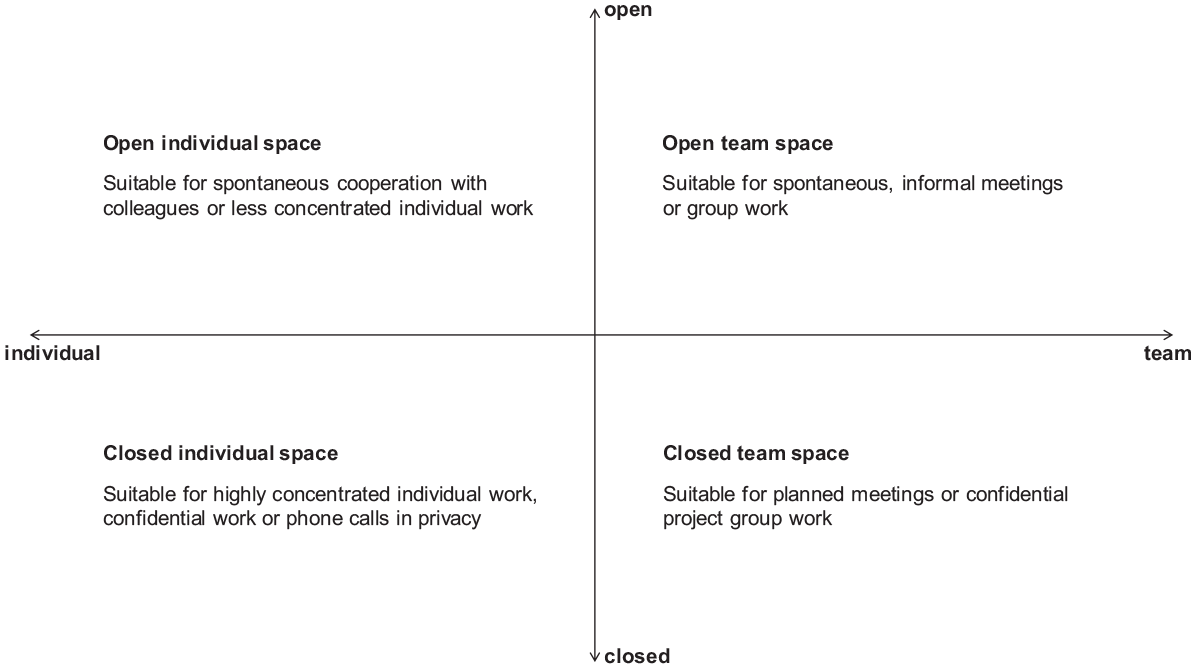
Taxonomy of core functional spaces.
Another important variable in this context is whether a workspace is designed for individuals or teams. Effective teamwork is a key success factor in today’s dynamic business world, and most of an organization’s work is likely to involve teams (Baker et al., 2006). This means that office design must facilitate collaboration between individuals (Elsbach & Bechky, 2007)—for example, by incorporating whiteboards or writable walls as aids to communication and collaborative problem-solving (Suchman, 1988).
As individual work remains important (Appel-Meulenbroek et al., 2011), office designs must also support individual concentrated work. This is important in the present context, as there are fundamental differences between working individually and in teams (Danielsson & Bodin, 2008). For example, while individual work tends to require silence and aural and visual privacy for concentration, teamwork benefits from interaction (Appel-Meulenbroek et al., 2011). To address these various requirements, companies typically use glass or solid partitions to divide the open office (Davis, 1984). This improves transparency and openness (Pitt & Bennett, 2008); for example, being able to see immediately whether a particular worker is in the office makes it unnecessary to interrupt them by knocking on their door. Glass partitioning also makes employee behavior more visible; while allowing for private conversation and concentration, this reduces visual privacy. Solid partitions provide visual privacy, but unless these extend from floor to ceiling, conversations can be overheard (Davis, 1984).
Clearly, then, it is difficult to balance environmental provisions for communication and collaboration on the one hand and private work on the other (Parkin et al., 2011). Nevertheless, the evidence suggests that many companies follow a “one-size-fits-all” approach, usually involving a move from closed to open office space that often reduces workplace satisfaction (Brennan et al., 2002). For that reason, the proposed model draws an explicit distinction between individual and team space design.
Supportive functional spaces
Beyond spaces designed to support productive work, an increasing number of office spaces appear to have no direct productive value (Zelinsky, 2006). As well as the familiar example of Google’s office slides, many companies now incorporate relaxation spaces, café bars, and sports facilities that, at first sight, do nothing to support productivity (Waber et al., 2014). However, by enhancing well-being, triggering creative inspiration (Meinel et al., 2017), and facilitating face-to-face interaction (Weijs-Perrée et al., 2020), these spaces indirectly support productive work (Zelinsky, 2006). For that reason, we characterize these office designs as “supportive.”
Based on the literature review, we propose that ABWs incorporate the three elements described above (see Figure 2), and this model informs the present analysis.
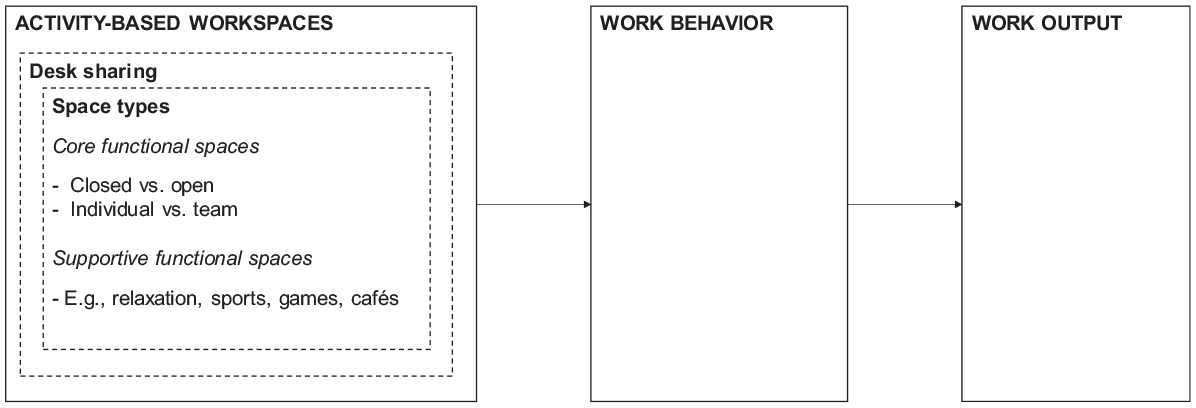
Model of activity-based workspaces.
Methodology
Research Setting
The present study explores the effects of ABW design parameters in a single case. As this is a neglected area of research, we adopted an exploratory approach based on grounded theory (Glaser & Strauss, 1967; Locke, 2001) and case evidence (Yin, 2017). Case studies are especially suitable for answering “how” and “why” questions in the early stages of research, where there is little available evidence about cause-effect relationships (Yin, 2017). Case study research must be conducted in a suitable real-world setting that can provide rich data (Eisenhardt, 1989).
For several reasons, we selected a medium-sized company in Germany. First, this was among the first organizations to introduce a new activity-based PWE; at the time of data collection, employees had 3 years of experience in the new environment. We assumed that, after this length of time, all relevant changes in employee behavior would be entrenched and therefore clearly reflected in our interviews, informal discussions, and observations. Second, rather than introducing only single provisions (such as desk-sharing), there was strong top management support in the case company for radical change based on all three elements of ABWs as described above. In the organization, great importance is laid on employees truly living activity-based work. For example, employees are trained and encouraged by the managers to change workplaces several times a day whenever they start a task with different requirements. Consequently, employees should not occupy the same desk the whole day but move to the workplace that offers the best conditions for their upcoming task. In addition, as this was a completely new building on a greenfield site, the entire company moved together, allowing maximum freedom to design ABWs in an optimal way, which would not have been possible in a pre-existing building. Third, because this company has just under 1,000 employees, all located on one site, it was ideal for the purposes of this study. We assume that companies with significantly more than 1,000 employees form subcultures or subgroups, which most likely influence the behavioral patterns of a majority of employees. This might reduce the uniformity of the overall company and thus the comparability of findings. In contrast, it can be assumed that for the case company in this study (just under 1,000 employees, all located at one site) formation of subgroups is not an issue thus representing an ideal case company for our study.
Our main source of data were 36 in-depth interviews with internal and external stakeholders including managers, change agents, and employees from the case company. One could ask whether self-reports of perceived effects (as in our interviews) are a valid source of data. One would easily agree that, for example, well-being and satisfaction are easily to self-assess since they are by definition states that can be immediately perceived through positive and negative emotions and perceptions in the work context (Haapakangas et al., 2018). In contrast, a measurement of (one’s own) productivity (ratio between input and output) in knowledge-producing organizations with desk-sharing is much more difficult. This is why van der Voordt (2004b), for example, distinguishes between five different types of measuring productivity in workspaces: Actual labor productivity (e.g., the number of phone calls per employee and per unit of time), perceived productivity (e.g., employee self-assessment through rating appreciation using a three- or five-point scale), amount of time spent (e.g., the amount of time lost by having to log on more frequently and to clear desks on a regular basis), absenteeism (e.g., form of non-productivity), and indirect indicators (e.g., motivation, effort, and perceived hindrances to efficient work). Hence, employee self-assessments and indirect indicators (as used in our study) are appropriate indicators to evaluate, for example, productivity in organizations. This is also in accordance with Kim et al. (2016). Moreover, next to the interviews we collected data from multiple sources, including direct observations during several site visits, internal, and external documents for triangulation purposes (Eisenhardt, 1989). In this way, we gained insights into how and why ABWs affected employees’ work behaviors.
Case Background
The case organization operates in the financial services sector. Founded in the 1950s, it now employs about 1,000 people at its German headquarters. Several years ago, the company began the process of designing and building a new four-floor headquarters with 15,000 square meters of office space. The trigger for the project was the end of the lease on the company’s previous building, and the move was seen as an opportunity to develop a PWE for the future that would better represent the organization’s norms, values, and culture.
Following the move to the new headquarters, the drastic change initially proved very disruptive. People experimented with different ways of using the new PWE and gradually learned how to make the most of it, but it took time for everyone to adapt. On the assumption that any changes in work-related behaviors and daily working life that persisted for 2 or 3 years could be considered permanent (Moyle & Parkes, 1999), we chose to collect the data in 2018, more than 3 years after the move.
Prior to the move, the PWE consisted of small offices (for one to three employees) and larger open-plan offices (for up to six employees). Each employee had a fixed desk station, and meeting rooms had to be booked. No space was provided for informal social interaction or short breaks from work. In contrast, the new ABW incorporated desk-sharing, core functional workspaces, and supportive functional workspaces. The organization began by implementing desk-sharing; employees no longer had designated workspaces and were expected to use any available space that suited their current task. This flexible access to an appropriate space for the task in hand is a prerequisite for activity-based working.
Secondly, core functional workspaces accommodate task-related activities ranging from creative or focused individual work to planned or unplanned formal or informal group work or meetings. As shown in Figure 1, the key dimensions of these spaces are open-closed and team-individual. Finally, supportive functional workspaces accommodate sports, play, recreation, and networking rather than active work on job-related tasks. As well as a canteen, a coffee bar, several self-service coffee points, and a games lounge (with a basketball hoop, table tennis, table soccer, and a games console), the company also provided for special recreation spaces, including an underwater world with treadmills, massage chairs, a swing, a hammock, a lounge, and a yoga room.
Data Collection and Analysis
Over a period of 1 month, we conducted 36 interviews by telephone. The participation of the interviewees was on a voluntary basis. The interviewees were informed before the beginning of the interview that their statements would be anonymized and therefore no conclusions could be drawn about them. For the later transcription, the interviews were recorded with a voice recorder. Furthermore, we visited the organization several times. During the on-site visits, informal conversations and observations enabled us to gain a better understanding of the different workspaces and how employees use them by applying the desk-sharing concept. To understand the new physical work environment from different perspectives, we selected a representative sample of interviewees who differed in terms of hierarchical level, gender, age group, and department. Table 1 summarizes their demographic profiles. Of the 36 interviews, 10 dealt with the goals and implementation of the new office layout (six with management board members, three with change agents, and one with the contracted interior designer). The interview guidelines applied to this group include the main topics goals of the new workplace design, implementation of the spatial design, transformation process and evaluation of the results. The remaining 26 interviews (9 with team leaders and 17 with employees with no management responsibility) dealt mainly with how the ABW influenced their daily work. The HR department of the organization supported us in selecting the interview partners. They provided us with a list of all employees (anonymously) that had already been working for the organization before the move. These employees were able to draw a pre-and-post comparison of their work environment. From this list we randomly and anonymously selected the interviewees according to demographic and hierarchical aspects of representativity. The research team then contacted the potential interviewees via e-mail (after they had been informed by the HR department) and informed them about the scope of the interview and the general topic; the exact questions were not sent to them in advance to avoid bias.
Overview of Interviewee Demographics.

There were four phases of data analysis. Adopting a typical case-based approach (Yin, 2017), the first phase drew on all of the available data and our impressions from the site visits to build a detailed shared understanding of the general situation and the workspaces. This first phase addressed the first research question: What design parameters should a company consider when designing an ABW? All of the research team members participated in specifying the design parameters in relation to the proposed model of ABWs.
In the second phase, the transcribed interview data and all other data from the observations and internal documents were analyzed for inductive first-order coding by one researcher. To avoid any bias, the interviewer was not involved (Miles & Huberman, 1994). To guide thematic development and subsequent data collection, we cycled between data analysis and the relevant literature, performing multiple iterations to develop the emerging codes (Locke, 2001). External documents (company website, press reports etc.) related to PWE were also integrated in this phase of the analysis.
In a further round of coding in the third phase, pairs of researchers gradually collapsed the codes into second-order categories that were essentially similar, with some variation in specific terms. Two researchers independently developed second-order codes as working labels for these categories, which contained the core statement in brief and could therefore still be regarded as meaningful. Subsequent consolidation by the same two researchers revealed any discrepancies, which were resolved by mutual agreement. This enabled us to move from tentative statements to more robust and theoretically relevant categories, always guided by the second overarching research question: What are the effects of ABWs on employees?
Finally, the research team gathered for a one-day workshop to aggregate the second-order categories into broader third-order themes. This enabled us to develop a grounded theoretical framework linking the various concepts that emerged from the data. In further iterations, we cycled between the emerging theoretical framework and the database to triangulate the informants’ observations with corroborating factual and historical data. In this way, the various data sources—employees and managers’ statements, our own observations, and internal documents—yielded second-order codes for changes in behavior attributable to the ABW. Following Locke (2001), we tested alternative conceptual frameworks before assembling the categories into an overarching model in line with the evidence. To enhance reliability, we repeatedly presented our analyses and interpretations to company representatives for feedback (Corbin & Strauss, 1990). We also discussed our findings with two experienced and independent external scientists with appropriate expertise in case studies (Hatch & Schultz, 2001; Kets de Vries, 1999). First-order codes, second-order categories, and third-order themes are set out in Table 2.
Overview of First-Order Codes, Second-Order Categories, and Third-Order Themes.

Note. n = number of according statements that have been paraphrased into first-order constructs or into second-order categories; employee & leader = the first-order construct was derived from both leader and employee statements.
Findings
The Impact of ABW on Communication
We identified three changes in employee communication that can be linked to the new ABW.
Methods of communicating
For several reasons, the introduction of desk-sharing and more open workspaces afforded employees much more direct contact with their colleagues. In the new headquarters, employees sit and work closely in an open working area with many more colleagues from other departments. As they must also change workstations more frequently in the ABW, they communicate more frequently with colleagues. Desk-sharing exposes employees to many more people than before as they move between supportive and core functional workspaces, and constantly meeting face-to-face has changed how employees communicate.
A further change is that communication increasingly occurs in personal conversations rather than by email and telephone.
“In the past, I used to talk on the phone a lot with colleagues; now, I only talk on the phone with external people [and] almost not at all with internal colleagues” (Employee #4).
Communication has also become much less formal. Because they run into each other in the hallway or at a coffee bar, employees discuss many topics directly and spontaneously, with less need to resort to formal meetings, email, or phone calls.
“A lot of communication takes place in the hallway [. . .]. I arranged a series of appointments that were canceled after two weeks because we saw each other so often that [. . .] what we wanted to discuss had already been addressed” (Manager #2).
The increased breadth and frequency of spontaneous informal communication in the aisles and over coffee can improve cooperation across organizational boundaries, helping to reduce silo thinking. As employees gain a better understanding of who is responsible for which domain, they can contact the appropriate person more quickly when a problem arises.
“One positive thing is that cooperation has improved significantly. The process has become much more communicative; you listen to conversations and intervene when you disagree, or when you think you can contribute something. Communication has become much more dynamic, with fewer boundaries between organizational units” (Manager #3).
If the appropriate person is not within reach for an exchange, the employee can call or use digital communication tools to contact and locate the person without concern.
“All of us no longer have a fixed workplace in the open workspace. For example, if I want to clarify something with a colleague, then I ask myself: Where is the person sitting? Maybe I can find him [her] in the home base. If not, I call him [her] or write a short message using our digital communication tool. Of course, it is exhausting, but you get used to it” (Employee #3).
However, spontaneous informal communication also introduces a higher level of risk in relation to commitments and agreements. At worst, employees may forget what was said in spontaneous or informal conversations with colleagues.
“By the time I get back to my workspace from the printer pool, I may already have spoken to three different people, and so I may have forgotten the content of the first conversation” (Employee #15).
Transparency of communication
The increased openness of the ABW ensures high levels of transparency. As there are no partitions between individual or team workspaces and team meeting rooms have glass doors and walls, employees are aware of all the activities in their immediate environment. This includes meetings between colleagues, making confidential conversations more difficult.
“The problem is that all our rooms are transparent—that is, made of glass—so that everyone can take a look. And this is difficult not only during job interviews but also when a colleague wants to move from department A to department B. He sits in the meeting room with a person from HR, for example, and his current manager or a colleague walks by and knows that this must be a job interview” (Team leader #8).
If the interview is unsuccessful, there may be a significant loss of trust between the employee in question and their colleagues or manager. In short, a transparent workspace increases communication but reduces the level of aural and visual privacy needed to maintain relationships and avoid negative rumors.
Intra- versus inter-departmental communication
The introduction of desk-sharing and open workspaces has scattered team and department members around the building. This means they are no longer within immediate reach of one another as they would be in an office with fixed workspaces. Instead, each employee finds a workspace that suits their task for the day ahead, perhaps sitting next to colleagues from different departments rather than members of their own team. For that reason, more effort must be invested in coordination and communication to ensure that all the members of a given team have all the relevant information.
“Under the activity-based workspace concept, communication within teams needs to be significantly strengthened to bring all team members up to the same level of knowledge” (Employee #9).
The loss of proximity to direct colleagues reduces intradepartmental communication, which means that employees no longer feel strongly connected to their team.
“In the past [in the old headquarters, with fixed workspaces], it was just like sitting in an office as a team. Back then, there was a level of team cohesion that no longer exists” (Employee #7).
Our data show that intradepartmental communication and cohesion are generally lower in the new headquarters, requiring greater effort to maintain the level of team cohesion associated with the previous office layout. On the other hand, interdepartmental communication has increased, confirming the view that ABWs reduce silo thinking. For example, supportive functional workspaces enable employees to get to know colleagues from other departments through the recreational facilities and coffee bars, enhancing interdepartmental communication and collaboration.
“In the old work environment, you just didn’t know your colleagues that well. Here [in the activity-based PWE], you are more likely to be in contact with your colleagues, even if you only exchange two or three words at the coffee bar. This way, you already have a completely different relationship with your colleagues than before, when you just met occasionally in meetings” (Employee #17).
In summary, interaction in the ABW between employees from different departments has improved interdepartmental communication while intradepartmental communication has diminished, or, at least requires more deliberate maintenance. Communication has become more frequent, as well as more informal, spontaneous, and transparent. This transparency means that management must strengthen visual and aural privacy to avoid negative rumors and to maintain relationships between colleagues.
The Impact of ABW on Leadership
Regarding leadership, the new ABW precipitated four changes.
Judgment by result
Traditionally, the company’s hierarchical, presence-based leadership structure meant that managers surrounded and controlled employees, assessing their performance on the basis of attendance, ad hoc assessment, frequency of consultation, and their manager’s daily observations. The shift to an ABW poses new challenges for leadership. Desk-sharing and the open workspace mean that employee tasks are not tied to a particular time or place, and employees and managers run into each other less often than before. This has changed the nature of performance evaluation, as employees must engage more in self-promotion to make their performance visible.
“What is perhaps not so good is that you now also have a certain responsibility to make yourself noticeable, communicating your successes to market your performance” (Employee #10).
From a managerial perspective, evaluating and managing employees has become more challenging. While the new ABW brings managers closer to their subordinates by eliminating managers’ offices, desk-sharing can also reduce contact with subordinates. Sometimes, managers sit among their employees to see what they do and achieve daily. Working alongside their subordinates, they can hear telephone calls and meetings, which helps them to understand the challenges their subordinates face.
“It is also very positive that the appreciation for the work of others has increased because you simply see more of what they are doing. You often hear what they talk about with customers or partners, and what challenges they face” (Team leader #6).
On the other hand, team members are not always working in their manager’s vicinity, either because they are working from home or desk-sharing somewhere else in the building. This is a significant change, as managers can no longer monitor attendance, day-to-day performance, or need for consultation, prompting a shift to judging performance on the basis of results rather than evaluating how those results are achieved.
“Basically, I think the development is good. The open approach and the paradigm shift toward judgment by results is the right way to go” (Manager #5).
In summary, the move to an ABW requires a change in how performance is evaluated, because previous sources of information (e.g., mere presence) for performance evaluation are not available anymore. Consequently, leaders and employees should engage in regular exchanges to define individual requirements and expectations as a basis for performance assessment.
Trust in subordinates
On arriving at work, employees and leaders choose a workstation that meets their own needs, including their task for that day. Managers may not sit in the same area as their team, and team members may also be dispersed. While the flexible use of diverse workspaces has become routine, leaders still sometimes wonder whether subordinates are conscientiously performing their tasks. The open design makes activities more visible, and the fact that the ABW accommodates both work and relaxation can lead to problems, as one manager explained.
“I am critical of these game consoles—the basketball, the table soccer. I might see a colleague at the soccer table when I have been waiting for an important response from him or her for three days. Our culture is not yet ready for me to go over and say, I’ll take your place in the game, please go and answer my email” (Team leader #1).
Conversely, employees often feel guilty when their leader sees them meeting someone at the coffee bar, as they are unsure whether interactions in these unconventional workspaces are perceived as work.
“I once had three meetings in a row at the cafeteria, and three times, my boss walked by. I felt guilty every time and worried that he would think all I do is drink coffee all day” (Employee #3).
Clearly, making optimal use of core and supportive functional workspaces demands a degree of mutual trust between managers and subordinates. This in turn can be linked to the need to judge employee performance by results rather than on the basis of how much time they spend in the coffee bar or the games corner. Building this trust requires managers to judge the results of joint work and to avoid micromanaging. As one employee explained, this requires a change in leadership style.
“I believe that managers need to trust their employees more because sometimes they don’t even know where their employees are. It happens that managers don’t see their employees for days, even though they are here in the building. They may be in meetings in other areas of the building or working on other projects in different project zones. I think trust plays a big part here” (Employee #13).
This change poses a challenge for managers, partly because personality plays a critical role in leadership style, as one manager explained.
“I believe that it depends on what kind of person you are—whether you are a leader who leads through control or through motivation. That varies from manager to manager, but I would say that the new environment has made these differences more visible” (Manager #6).
In conclusion, desk-sharing and the change from a closed to an open workspace requires leaders to place greater trust in their subordinates, regardless of how often they might see them in a supportive functional workspace not directly associated with productive work.
Leading by example
The transformation of the traditional workspace into an ABW dissolves many of the barriers between subordinates and managers. As employees have equal access to the various workspaces regardless of their position in the organization, managers do not have designated or separate offices. This elimination of physical barriers has made the hierarchy less apparent.
“My boss has become much more visible and accessible because managers now sit with the rest of their department and no longer have their own offices. The management board also sits in an open space, with no separate office. Of course, that makes communication much easier. You also feel that everyone is now on one level” (Employee #12).
This effect is reinforced by a shift to less formal dress.
“The dress code has changed. It was never really strict, but in the old work environment, all men wore a suit, shirt, and tie. Jeans were worn only on casual Friday, and one hoped not to have to go to the board” (Employee #8).
In summary, the elimination of designated managers’ offices and the emergence of a more informal dress code have diminished the sense of hierarchy and, in turn, the perceived distance between managers and subordinates. This also makes the employee’s job much easier and improves their productivity, as they can approach managers with queries and get specific information or feedback more promptly.
“The previous sense of inhibition toward managers is simply no longer there. This improves productivity and the quality of people’s work because problems or questions can be resolved quickly through exchanges with a manager” (Employee #14).
From the subordinate’s perspective, easier access to managers is clearly advantageous. However, this can be challenging for managers, who now have much less privacy because they are always available, which is a significant burden.
“Employees took advantage of this right from the start—not in a negative sense—because managers are integrated into departments and, therefore, always approachable. Of course, [we] thought this was great, but the managers found it a little difficult” (Employee #17).
In summary, abandoning individual offices in favor of desk-sharing and open workspaces means that managers must set a good example. In ABWs, leaders must be able to set clear rules about contact, conveying a sense of when and how to approach managers and colleagues. As well as having to judge by results and cultivate trust, managers must make subordinates feel that it is completely acceptable to work at the coffee bar or take a short break in the games corner. In short, the relationship between manager and subordinate must be founded on mutual trust, judgment by results, and good conduct on both sides.
Leading as a team
Desk-sharing and the shift to open workspaces has reduced the spatial distance between managers and subordinates. It has also increased cross-team exchange, as different teams and their leaders all share a single open workspace, and employees sometimes approach the manager of another department rather than their own, simply because they happen to be sitting next to each other on that day. This has transformed the leadership structure and how teams are led, requiring leaders of multiple related departments to work together as a team. As well as requiring greater coordination among the leaders, this has brought the various departments closer together—another example of how the ABW approach has helped to reduce silo thinking.
“The organizational structure and behavior of management have changed considerably. There are six different teams located on one floor; all do basically the same thing but have different team leaders. The management model has changed; rather than always going to their direct manager, people approach the nearest team leader. This means that the six team leaders lead the six teams together” (Employee #2).
From the employee’s point of view, desk-sharing and an open workspace facilitate task coordination. In contrast, leaders face challenges in relation to extended responsibility and the need to improve communication and coordination among themselves. This increased communication means that leaders must actively seek places and times to work undisturbed. According to one leader, “The constant responsiveness presents a challenge for managers. You need clear rules and agreements so that you can concentrate on your work without constant interruptions. You need agreements for that; you also need more coordination with other leaders” (Team leader #5).
In summary, the leadership style has changed, and the greater emphasis on leading as a team has reduced the boundaries between departments.
The Impact of ABW on Working Style
The ABW has increased employee autonomy in terms of task-related and social self-determination. The former refers to the independent selection of an appropriate workstation and responsibility for day-to-day planning while the latter refers to being able to choose one’s social environment and the people one works with.
Task-related self-determination
In an ABW, subordinates and managers must plan their working day in advance, selecting the most appropriate workspace for their task and deciding whether they will work alone or with colleagues. This encourages employees to organize their daily schedule and to think carefully about which workspaces are optimal for which activities. For example, an employee who plans to interview a job applicant—which may involve discussion of sensitive matters such as salary—needs a closed-team workspace to prevent colleagues from eavesdropping or observing. Open-team workspaces are more suitable for creative work such as team brainstorming. Having to choose the best workspace for daily activities promotes a much more structured approach to the working day and enhances autonomy, as one employee explained.
“If I manage to clarify what work I have to do and when and how, I can make optimal use of the environment here, adapting my space according to my schedule rather than vice versa. This has trained me to take much more responsibility than before for how I work” (Employee #1).
As well as promoting active planning of the working day, having to select a suitable workspace every day can result in competition for spaces. Sometimes, employees find that someone is already occupying the ideal space for their task, and they must use another less suitable workspace. According to one employee, this can prompt a race to arrive at the office first.
“Two days a week, I do not arrive at work until 9 a.m. You can imagine that the better-equipped workspaces with two screens are in scarce supply at 9 a.m. On two other days, I have the luxury of getting in early, which means I have a free choice [of workstation]” (Employee #3).
In summary, the ABW approach encourages both subordinates and managers to take more responsibility for their work schedule, as they must plan their daily activities and select the most suitable workspace for the task at hand.
Social Self-Determination
The ABW has also enabled greater social self-determination, especially because desk-sharing facilitates the increased movement of people. Because employees no longer sit in defined departments, and departmental boundaries have become blurred, employees can opt to work with colleagues from any department, deciding in advance whose support and information they will need. This means taking the initiative by approaching the colleague in question and perhaps looking for a desk nearby. While extroverted employees (who are naturally sociable and communicative) welcome this new way of working, introverts (who prefer to work with a small group of familiar colleagues) find this more intensive interpersonal exchange difficult, especially when engaging with unknown colleagues from other departments.
“You need a certain extroversion to be able to work in the new office layout” (Employee #11).
However, it seems that the ABW layout has encouraged introverted employees to gradually adopt their extroverted colleagues’ working style.
“Through increased interaction, I’ve opened up a lot more. Before, I used to work in a quiet room; I have simply become more open here and increasingly actively approach unknown colleagues” (Employee #5).
Another change in working style is that colleagues have become more aware of how their behavior affects others. The openness of the ABW and the practice of desk-sharing means that looking for a workspace, holding an employee meeting, or having an informal conversation is likely to distract others. The new layout requires people to behave more considerately to avoid any such disturbance, and this creates a reciprocal expectation that colleagues will consider each other’s needs by learning to interact accordingly. This learning process is mediated by open communication, as employees begin to talk openly about behaviors that disturb them and to reflect on how their own behavior affects others (e.g., eating at the workstation or chatting at a workstation rather than in a designated space).
“I think the way we deal with each other has changed tremendously; for example, although we are in an open space, and everything is much more open and networked, you have to leave people alone. [People have also learned] to be a bit more empathetic, approaching things with more sensitivity. In the beginning, people used to call over to colleagues, but this has lessened over time because we’ve all noticed that we’re often disturbed by this, and you don’t want to have to cope with such behavior all the time. After all, you want to be able to concentrate on your work. There’s clearly more consideration for others now” (Change agent #1).
In general, the ABW encourages employees work in a more socially self-determined way than before. As well as making active decisions about where to sit to complete a particular task, people have learned to show more consideration and to avoid disturbing each other.
The Impact of ABW on Performance
The move to an ABW has affected two aspects of performance—productivity and creativity (as evaluated by self-assessments and indirect indicators).
Productivity
Desk-sharing and the transition to a more open layout has led to more encounters between employees. Previously, employees might meet and greet only three or four people during an average working day; now, this figure has increased to twenty or more. As every encounter is an opportunity to get to know a new colleague and to exchange information, individuals’ networks have grown, stimulating wider collaboration. As a result, employees have broadened their organizational knowledge, at least in terms of knowing whom to approach for particular information.
“I now know who to ask when I have a question about a certain topic. Just this morning, I asked a colleague at the coffee machine if he knew who I could talk to about XY, and he immediately said that he was the contact person. I think it’s wonderful that we could clarify that right away—in the past, I would have searched for an eternity, but it’s faster now; I can clarify issues more quickly” (Employee #16).
As one manager noted, obtaining information happens more quickly in the new work environment, as does decision-making.
“I just get decisions faster. This allows me to work through things much faster; I can connect with someone straight away, and I do not have to wait forever for an answer. I can sort things out quickly” (Team leader #2).
Wider collaboration and personal networking has also boosted productivity according to the manager of the service unit.
“Shortly after the move, I recorded a jump in productivity (+6.7%) in the new PWE, without having made any significant changes to work processes. I attribute this improvement to the fact that the organization is even more transparent now, and collaboration has increased” (Manager #1).
Another worker offered a plausible explanation for this increase in productivity.
“In the past, if there was an issue I wanted to clarify, I would note it down for the next meeting with my colleague. Now, this colleague sits directly opposite me, so the issue gets cleared up in two minutes. It’s so direct and uncomplicated; things are quickly discussed and decided upon, whereas in the old building, you would have booked a meeting, met, made introductions and small talk [. . .] by the time you got to the point in a typical meeting, a quarter of an hour would have passed. Now, I only need five minutes” (Employee #14).
However, increased contact and collaboration and a more open layout have also created more distractions, making concentration more difficult.
“Sometimes, in the new environment, you feel you are distracting each other, and that you are not as productive as you might be. Noisy phone calls and shouting across tables can disturb colleagues because their work gets interrupted” (Employee #6).
As well as being more vulnerable to distraction, employees sometimes feel under pressure to respond quickly to inquiries; they interrupt their other tasks, which increases their stress level.
“On the other hand, everything has become faster, and it is harder to follow; rapid feedback is expected, and new topics and questions come up constantly. There is no clear rule, for example, about whether emails should be answered in the morning or in the afternoon; in fact, ever faster responses are expected” (Employee #11).
In general, productivity seems to increase in an ABW. However, the increased openness of the workspace increases distraction and perceived stress, which inhibits productivity.
Creativity
Desk-sharing and the shift from closed to open and from individual to team workspaces tends to increase creativity. The greater the exposure to information and interactions, the more likely it is that new ideas or solutions will emerge. Our findings confirm that the move to an ABW led to more frequent, personal, and spontaneous interactions and a shift from intradepartmental to interdepartmental communication—changes that may ultimately promote increased creativity.
“The new PWE is already helping creativity. Because I am meeting more people and collaborate and communicate with a greater variety of people each day, I get a broader range of information, perspectives, and opinions. This finds its way into my work and ultimately contributes to new creative outcomes” (Team leader #3).
Other employees agreed that interacting more with other people had made them more creative.
“In the old days, I might have had more peace and quiet to think about things on my own. But now, you have more inputs and cross-fertilization from others. If you have an idea, and the developer is sitting next door, he can give you his opinion. And that makes you more creative by taking account of more opinions. I have become more creative, in the sense that I consider many more aspects of a given topic” (Employee #5).
Distracting themselves for a while in the games lounge also helps people to feel more creative and to generate more ideas.
“A situation at the football table or at the basketball court with colleagues gave me an idea for something I could add to my boss’s presentation. So, there are moments in the new environment that inspire creativity” (Employee #16).
However, as well as increasing creativity, this greater exposure to different information and interactions can lead to exhaustion. As most employees of the case organization had not worked in an ABW before, they were used to sitting at the same workstation every day. Isolated from other colleagues and departments, they would typically see and speak to the same set of people all the time. In the new working environment, however, they sit next to different colleagues every day and communicate with people they have never met before. By coming into contact with many more people than in a traditional office layout, employees also assimilate new perspectives every day—for example, by meeting new employees or customers or overhearing nearby conversations. The open-office structure also means that they cannot always escape these external stimuli, which can sometimes be exhausting.
“[Working life] also became more strenuous, especially in the first weeks after the move. I was really tired and exhausted in the evening because I had to deal with so many more inputs. I used to read on the train ride home, but now I just sleep on the train. You’re not aware of everything, but you’re never alone in your office, and there’s always something happening around you” (Team leader #9).
In general, creativity seems to increase in an activity-based PWE, but the open layout also increases distraction and stress. Figure 3 extends the ABW model to take account of these findings.
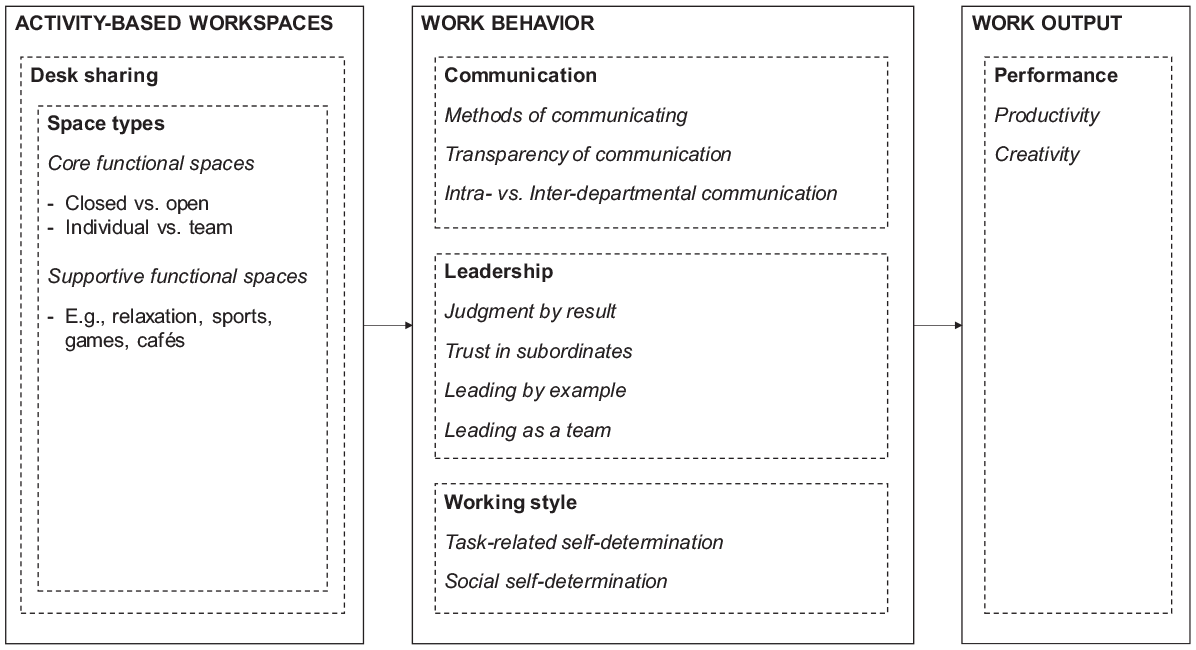
Cause-effects-model of activity-based workspaces.
Discussion and Future Research Agenda
The goal of the present study was to improve existing understanding of how modern ABWs impact on work behavior in terms of communication, leadership, working style, and performance. To that end, we first developed a conceptual model of ABW design parameters. We then analyzed how these parameters affect performance, with particular regard to three dimensions: desk-sharing, core functional workspaces, and supportive functional workspaces. Core functional workspaces were classified along two dimensions: open-closed and individual-team. In explicating the mechanisms underlying how an ABW affects communication, leadership, and working style, we found that these influence productivity and creativity. In this section, we reflect on our results, relating them to earlier research and suggesting avenues for future research.
Communication
Our findings confirm that the transition to ABW changes the nature of communication within an organization. First, communication increases because of desk-sharing, as people move around more; this aligns with Cai and Khan (2010) and De Croon et al. (2005). There is also evidence that the shift from closed to more open workspaces also increases communication (Kaarlela-Tuomaala et al., 2009), although findings regarding the precise nature of this effect remain inconsistent (De Croon et al., 2005). Increasing the proportion of team workspaces also encourages communication and collaboration because these spaces are designed to support communication and teamwork (Appel-Meulenbroek et al., 2011).
The pattern of communication also changes in ABWs, shifting the emphasis from intradepartmental to interdepartmental communication and so reducing silo thinking (Coradi et al., 2015). Regarding intradepartmental communication within ABWs, we found that intradepartmental communication confronts managers with serious challenges. For example, traceability of some team members is an issue that managers increasingly have to deal with. Typical solutions for this issue are regular team meetings or digital communication (Kim et al., 2016). Yet, the shift from intradepartmental to interdepartmental communication offers a significant added value for organizational learning and identification (Coradi et al., 2015; Hennessy & West, 1999). As employees get to know more of their colleagues and can access information from a wider range of people than in traditional layouts, easier and faster access to information and people accelerates task completion and decision-making, so increasing productivity. On that basis, we formulated our first proposition:
Proposition 1: In an ABW, desk-sharing and workspace openness increase interdepartmental communication, which in turn increases productivity.
We found that communication not only increased but also became more informal and spontaneous, as face-to-face communication became more common, with fewer emails and phone calls. There is evidence that higher performers in research and development settings communicate more informally with more people within the organization (Allen, 1977; Johnson et al., 1994). However, a more informal communication also increased the risk that statements or agreements during unplanned informal meetings in the hallways would not be considered binding or would simply be forgotten. This contrasts with Bernstein and Turban’s (2018) finding that open offices tend to reduce face-to-face communication as distractions increase. Similarly, De Croon et al. (2005) reported that more open workspaces make it harder to concentrate and so reduce productivity. Laurence et al. (2013) found that closed offices provide a greater sense of privacy, and that this reduces exhaustion. We can therefore conclude that ABWs support productivity only if open and closed workspaces are provided in equal numbers.
Proposition 2a: In an ABW, closed workspaces provide aural and visual privacy and support concentrated work, which increases productivity.
Proposition 2b: In an ABW, desk-sharing and workspace openness increase distraction and loss of information, which reduces productivity.
Desk-sharing and the shift from closed to more open workspaces can also increase creativity. The greater an employee’s exposure to different situations, new information, and interactions with others, the more likely it becomes that he or she will produce something new or creative. Our findings provide further evidence that ABWs support creativity by affording opportunities to incubate new ideas while relaxing or engaging in apparently distracting activities (e.g., in a games lounge) as well as during concentrated work.
Proposition 3a: In an ABW, desk-sharing and workspace openness increase interdepartmental communication, which increases creativity.
Proposition 3b: In an ABW, the increased availability of team workspaces and supportive functional workspaces increases informal interaction, distraction, and incubation, which increase creativity.
Proposition 2b posits that desk-sharing reduces productivity because it results in loss of information and increases distraction. However, desk-sharing also seems to be among the drivers of creativity in ABWs (see Proposition 3a). In other words, there appears to be a trade-off between productivity and creativity. Research on ambidexterity—that is, how organizations balance exploitation and exploration activities—has also investigated this phenomenon (e.g., Gibson & Birkinshaw, 2004).
Leadership
Our finding that the transition to an ABW also affects leadership aligns with Danielsson et al. (2013). Shifting from closed to more open workspaces and introducing desk-sharing encourages more flexible working in terms of both time and space. The distribution of managers and subordinates across core and supportive functional workspaces poses challenges for traditional performance evaluation techniques such as observation, and new evaluation criteria are needed (De Paoli & Ropo, 2015). In the present case, employees were judged on output rather than presence, which corroborates earlier research (Bernardino et al., 2012; Caillier, 2013; Vos & van der Voordt, 2001). On that basis, we formulated the following proposition.
Proposition 4a: In an ABW, desk-sharing in combination with workspace openness leads to greater spatial distribution of leaders and employees. In this environment, it is more effective to evaluate performance in terms of results rather than assessing work processes or depending on techniques such as observation.
Results-based evaluation depends on trust, which is fundamental to leaders’ credibility (Shaw, 1997). In line with Tschannen-Moran and Hoy (2000), our findings indicate that trust between subordinates and managers is especially important in ABWs that afford opportunities to work in seemingly unproductive spaces. To fully exploit the potential of ABWs, both managers and subordinates must recognize that any of the available workspaces can legitimately accommodate both productive and supportive activities.
Proposition 4b: In an ABW, the availability of supportive functional workspaces increases the importance of trust, and productivity and creativity are moderated by leadership styles that promote trust between managers and subordinates.
Trust-building leadership is a prerequisite for effective implementation of ABWs (Baruch, 2001; Blok et al., 2012). An organization’s leaders drive change by inspiring employees to trust them and to follow their example (Tucker & Russell, 2004). At first sight, ABWs seem to support this process, as managers and subordinates share the same workspaces and work in greater proximity than in traditional layouts. However, we found that managers consider open workspaces less suitable, as they lose privileges such as separate offices and privacy, which symbolized their position in the organizational hierarchy. This aligns with Zalesny and Farace (1987), who found that leaders experienced a loss of privacy in ABWs. We also found that managers in ABWs achieve greater success by embracing the advantages of eliminating physical barriers such as walls and by introducing a less formal dress code. In short, managers who can cope with the reduced salience of organizational hierarchy are better able to exploit the full potential of ABWs.
Proposition 4c: In an ABW, desk-sharing in combination with workspace openness reduces the salience of hierarchy. Managers’ ability to cope with this diminution of boundaries between subordinates and managers and to demonstrate how best to use the ABW moderates the effect of ABWs on productivity and creativity.
We also observed a shift from individual leadership to shared leadership, which is becoming increasingly common as team-based structures replace hierarchical organizations (Koclowski, 2010); this evolving approach is also known as “collective leadership” or “distributed leadership” (Avolio et al., 2009). Our findings indicate that this new form of leadership is encouraged by desk-sharing, greater employee autonomy, and changes in the spatial distribution of people, all of which contribute to ABW effectiveness. Although research on shared leadership is still in its infancy, early evidence suggests that it increases cohesiveness and enhances productivity (Carson et al., 2007; Hiller et al., 2006).
Proposition 4d: In an ABW, desk-sharing in combination with workspace openness prompts a shift toward shared leadership, which increases interdepartmental cohesiveness and productivity.
Working Style
We also identified changes in working style as a result of the move to an ABW. Since the move, task-oriented self-determination has increased, as employees must actively plan their daily activities and select an appropriate functional area before embarking on a task. This finding aligns with Kim et al. (2016), who also found that working in an ABW increased employees’ perceived control over their working day. On that basis, we formulated the following proposition.
Proposition 5a: Working in an ABW requires employees to coordinate and plan their activities, which increases task-oriented self-determination.
Informants also described an increase in social self-determination following the move to the ABW. As employees from different departments were in contact more often and became more aware of each other’s work, they also became more mutually considerate. Hall and Ford (1998) reported a similar finding; on investigating the relocation of two different teams to a single ABW, they discovered that team members showed greater empathy and mutual consideration following the move, as they were working much more closely and sharing the same noise and distraction problems.
Proposition 5b: Working in an ABW requires people to be more considerate in their dealings with colleagues, which increases social self-determination.
Implications and Limitations of the Study
The present findings offer guidance for organizations planning to implement an ABW. First, managers should know that activity-based working can be an effective means of increasing the frequency of personal, interdepartmental, and informal communication among employees and managers, so increasing employees’ productivity and creativity. However, managers should also be aware that moving to an ABW can be challenging because it changes how leadership works. In particular, hierarchical management must give way to team leadership and leading by example. Trust between managers and subordinates becomes more important, and performance evaluation must be based on results. People must also work in a more self-determined way if they are to make optimal use of the ABW approach. Finally, the interplay between different elements of the ABW is complex; for example, unless some closed workspaces are provided, the more open layout can increase distraction and inhibit productivity. It follows that implementing and managing an ABW presents ongoing challenges.
This study has some limitations. As we adopted a qualitative approach to data collection and analysis, the results are not generalizable. Although our propositions are based on several data sources, including interviews, direct observations, and relevant documents, all of these relate to a single case, and validation of our findings and propositions will require larger-scale research in multiple organizations and with additional quantitative data. For example, further research could build on our derived propositions and test them in more detail with quantitative data. Moreover, it would be useful to investigate how activity-based working varies across industries and in organizational cultures with different norms and values. Additionally, our interviewees’ views are subjective, and managers and employees who participated actively in the change process may perceive those changes more positively than people who did not participate. Furthermore, our sample did not include any employees who left the company after the move. However, the views of these employees could provide valuable additions to the conclusions we drew in our study. Further research is needed to explore whether and how participating and non-participating managers and employees or employees who left the company due to the move differ in this regard. Despite these limitations, we believe that the present study broadens the existing understanding of activity-based working and its effects within organizations. We hope that the suggested avenues for further research may help to guide future studies in this domain.
Footnotes
Declaration of Conflicting Interests
The author(s) declared no potential conflicts of interest with respect to the research, authorship, and/or publication of this article.
Funding
The author(s) received no financial support for the research, authorship, and/or publication of this article.
