




Abstract
Classrooms are noisy, yet little is known about pupils’ subjective reactions to noise. We surveyed 112 children between 8.70 and 11.38 years of age and extracted five dimensions in their reactions to noise by factorial analyses: (1) perceived classroom loudness, (2) hearing difficulties, (3) attention capture, (4) interference, (5) annoyance from noise. Structural Equation Models were run to better understand interindividual differences in noise interference and annoyance. Children reporting hearing and switching difficulties experienced more interference and annoyance from noise. Children who had a greater propensity for mind-wandering also experienced more interference from noise, but were annoyed by noise only to the extent that it produced interference—the relationship between mind-wandering and noise annoyance was indirect, and not direct, as was the case for reported hearing and switching difficulties. We suggest that the distinction between annoyance and interference has theoretical, empirical, and practical relevance for educational research.
Noise in the classroom
Classrooms are full of auditory inputs, such as sounds coming from outside (road traffic), from adjacent classrooms, from electronic devices (such as printers), or from children moving and chatting. Sounds can be mechanistically described as vibrations travelling through the air. The total sound intensity that teachers and children are exposed to during a school day can be estimated, on average, at 70 dB: This is equivalent to the sound intensity generated by a vacuum cleaner (Lundquist et al., 2000; Shield & Dockrell, 2004; Sjödin et al., 2012; Walinder et al., 2007). However, this average dB level can hide important fluctuations, such as moments of quiet work alternating with peaks of activity that can reach 130 dB, as reported in a Swedish preschool (Sjödin et al., 2012). A sound of 130 dB is beyond the threshold of pain and corresponds to the sound intensity generated by a jetliner starting close by. A good proportion of the sounds experienced in the classroom are unwanted and can therefore be qualified as noise (Erickson & Newman, 2017). Noise has been reported as one of the most problematic issues in preschools and primary classrooms (Barrett et al., 2016; Sjödin et al., 2012).
Characterizing a sound as noise involves a negative judgment, “[it] is subjective, and dependent on the internal state of the individual. Different individuals may exhibit unique responses to the same auditory stimuli” (Kanakri et al., 2017, p. 2). Because of the subjectivity of this judgment, existing studies about noise in schools have either adopted a survey methodology, capitalizing on respondents’ own definition of what constitutes a noise, or have experimentally operationalized “noise” as a sound that is irrelevant or incompatible with an ongoing task.
Studies assessing the acute impact of noise on school performance place children in a situation where they have to perform a given task (e.g., a reading comprehension or mathematics), while hearing a mix of environmental sounds, or verbal sounds (e.g., a conversation, a list of digits) that are on a completely different topic (Dockrell & Shield, 2006; Kassinove, 1972; Zentall & Shaw, 1980). Studies focused on chronic exposure to transportation noise compare children living in noisy areas (e.g., near an airport) and those living in quieter areas (Evans et al., 1995; Evans & Maxwell, 1997; Haines et al., 2002, Matheson et al., 2010; Stansfeld et al., 2005; Van Kempen et al., 2010). Globally, the impact of noise on cognitive performance varies depending on the type of noise (acute, chronic noise) and task (reading, attention, memory; for reviews, Evans & Lepore, 1993; Klatte et al., 2013). When collapsing across the different types of noise, acute noise is more likely to impact attention and memory skills, whereas chronic noise is the most detrimental for language skills.
Crucially, children’s subjective reactions to experimental noise (e.g., their feeling of needing to put some extra effort into the task in the presence of noise, or their degree of annoyance toward noise) is not directly related to the actual effect of noise on their performance (Hygge, 2003; Slater, 1968). In other words, some pupils are impaired by noise but do not feel very annoyed by it; whereas, other pupils are very annoyed but perform as well in silence as in noise. There is therefore a tension between the objective measurement of what constitutes an impairment caused by noise, and children’s own perception of the effects of noise. If one wants to foster learning and well-being in classrooms, it is therefore not enough to measure noise levels and to assess their general impact on performance through behavioral tasks (e.g., reading comprehension or mathematics). It is also important to try and identify those children who subjectively suffer the most from noise.
Inter-Individual Variability in Children’s Reactions to Noise
Community studies have raised awareness of children’s perception of noise. They have shown that children living near airports are more annoyed by noise than those living in quieter neighborhoods (Evans, et al., 1995; Haines & Stansfeld, 2000; Haines et al., 2001). Non-linear relationships have been reported, with annoyance levels increasing particularly for children exposed to more than 70 dB of aircraft noise, (Stansfeld et al., 2005) or railway noise (Lercher et al., 2000). With regards to road traffic noise, Lercher et al. (2000) and Stansfeld et al. (2005) reported a linear and positive relationship between children’s exposure to noise and their ratings of annoyance.
However, there is a lot of variability in children’s responses. Not all children find the noise annoying. In Haines and Stansfeld’s (2000) study, 79% of the children living near Heathrow airport reported being only a little bit, or not at all annoyed by noise. This is lower than the percentage of children in the control group (98%), but still quite a high percentage. These findings suggest that there is not a direct relationship between noise exposure and annoyance, since some children are exposed to a lot of environmental noise yet do not report feeling annoyed by it. The opposite is also true, with some children living in relatively quiet neighborhoods reporting high levels of annoyance toward noise.
Studies investigating transportation noise are only partly helpful for understanding the impact of classroom noise on children’s well-being. Indeed, aircraft and traffic noise have specific acoustic characteristics (intermittent, loud, and low frequency noise) that are different from the mix of babble and environmental noise children are exposed to in their classroom. These studies, therefore, do not represent the reality of schools which are only moderately exposed to these types of noise, and for which noise coming from outside is covered by children’s activities inside the classroom (Dockrell & Shield, 2004; Shield & Dockrell, 2004). The most annoying sources of noise reported by pupils and teachers are actually classroom chatter, and noise generated from movement (i.e., sounds from the corridor, the scraping of chairs and tables; Boman & Enmarker, 2004; Connolly et al., 2013; Enmarker & Boman, 2004; Lundquist et al., 2000). Again, although ratings of annoyance were, on average, moderate, substantial inter-individual variability was reported. Understanding the mechanisms behind this inter-individual variability might help to better identify which children are the most likely to suffer from noise and why, with the potential to develop solutions to alleviate their difficulties.
Understanding Noise Annoyance
As pointed out by Guski (1999), negative reactions to noise might be driven by the attitudes toward the source of noise, as well as the cognitive mechanisms and emotional reactions elicited by a specific sound, in a specific situation. Theoretical accounts highlight the role of judgments and attitudes toward a given sound (Guski, 1999; Stallen, 1999). According to the cognitive dissonance hypothesis, people weight the costs and benefits of their life choices, and try to reduce internal conflicts (Brown et al., 1985; Brown & van Kamp, 2005). Someone who voluntarily chooses to live in a noisy area (e.g., because the rent is cheaper), might still feel annoyed by the noise. However, to bring consistency to both their acts and judgments, they might end up changing their subjective perception of the noise, convincing themselves that noise is either necessary, or not so important, thereby overlooking its impact on wellbeing and explicitly reporting less annoyance. Social and emotional factors also play a role in judging the annoyance of a given sound. Perceiving other people’s conversations as a social signal instead of an intrusion into one’s privacy can be related to less annoyance toward that sound (for an adult study, Weinstein, 1978). Similarly, the tendency to be afraid of aircrafts, and to judge them as unsafe can be associated with more annoyance toward the sound they generate.
Most of the theoretical models about noise annoyance have been developed on adult populations, and it is therefore not clear to what extent they apply to children. The cognitive dissonance hypothesis, for example, implies a choice and subsequent reflection upon one’s living conditions, which is necessarily more relevant to adults. Furthermore, Haines and Stansfeld (2000) reported that prosocial behavior, fear of aircrafts, or perception of aircrafts’ safety were not related to children’s annoyance toward aircraft noise in a classroom context. Instead, annoyance was related to the fact that planes made it hard to think, or to work. Thus, annoyance was related to interference from noise.
This explanation has the advantage of generalizing to the multitude of noise sources that children are exposed to in their classroom: It is not specific to the noise coming from conversations, road traffic, devices, or aircrafts. It fits with Boman and Enmarker (2004)’s interpretation that “annoyance arises in a situation in which the sound and the person’s intended activities are incompatible” (p. 208). Such a definition implies that children subjectively perceive or feel an incompatibility between the noise and their task, which is different to experimental studies in which the noise is specifically designed to be irrelevant. In the classroom, children are engaged in learning activities most of the time. They report that noise is most annoying when they are doing an exam or a test, when they are highly engaged in their work (Connolly et al., 2013). Several words, such as “disturbance” (Stallen, 1999), or “distraction” (Boman & Enmarker, 2004; Kjellberg et al., 1996) have been used in the literature to describe this process, although we will use the term “interference” to be consistent across studies.
Noise Annoyance and Noise Interference: Two Potentially Separate Constructs
It is not clear from previous research whether interference and annoyance are overlapping constructs, or whether they might be dissociable and underlined by different cognitive mechanisms.
Analyzing the factorial structure of a questionnaire completed by 13- to 14-year-olds, Boman and Enmarker (2004) extracted a single factor comprising items related to interference (e.g., noise makes it difficult to concentrate), and annoyance/irritation. However, Stallen (1999) pointed out the importance of dissociating these constructs. Interference, or the difficulty of achieving goals when noise taxes resources that are less available for the main task, has more to do with cognitive mechanisms describing the interaction between a person and their environment. It does not contain an emotional reaction in and of itself. Annoyance, however, happens when the situation is aversive, or unwanted. In other words, depending on people’s capacity to cope with interference, they might be more or less annoyed by it. Coping strategies can be direct (e.g., directly acting on the noise, by reducing it, or negotiating with people responsible for the noise) or indirect, via cognitive mechanisms such as cognitive control (Guski, 1999). In line with this idea, Kjellberg et al. (1996), extracted two factors from an adult survey on noise at work: One factor was related to interference, one to annoyance. The Interference factor reflected the effects of noise on the work task, and difficulties in concentrating. The Annoyance factor was related to the number of actions taken to reduce the noise, and to how much attention was paid to the noise.
Experiencing Noise Annoyance and Noise Interference: The Case of Children with Hearing Difficulties
On the one hand, some children can experience both interference and annoyance from noise. This seems to be the case for children with clinical hearing impairment, who have been identified as especially vulnerable, due to their greater difficulty in understanding speech embedded in noise (Connolly et al., 2013; Picard & Bradley, 2001; Shield & Dockrell, 2003; Shield et al. 2010). This can interfere with learning when the teacher is explaining concepts, or during group work, when children communicate while being surrounded with high levels of background noise (Shield & Dockrell, 2004).
In Boman and Enmarker (2004) and Enmarker and Boman (2004), difficulties with hearing were assessed in a non-clinical and continuous way, by asking middle school children: (1) how good they consider their hearing to be; (2) to what extent they can hear when several people are talking at the same time; and (3) whether they tend to move closer to someone when that person is speaking. Difficulties with hearing were associated with being more annoyed by classroom noise, highlighting the need to take into account inter-individual variability in the general population.
Pupils who find it hard to hear in the classroom context might have difficulties with adapting to sounds, or developing strategies, such as trying to concentrate more on the learning goal (since this goal in itself is not properly understood). Figure 1a illustrates the fact that difficulties with hearing predicts both interference and annoyance via two, independent pathways. Whether hearing status predicts annoyance through interference (Figure 1b) has yet to be tested, since Kjellberg et al. (1996) did not test this indirect effect, and since Boman and Enmarker (2004) and Enmarker and Boman (2004) did not differentiate between interference and annoyance. Finally, a model combining both direct and indirect effects (Figure 1c) should be compared to the others to complete the picture.
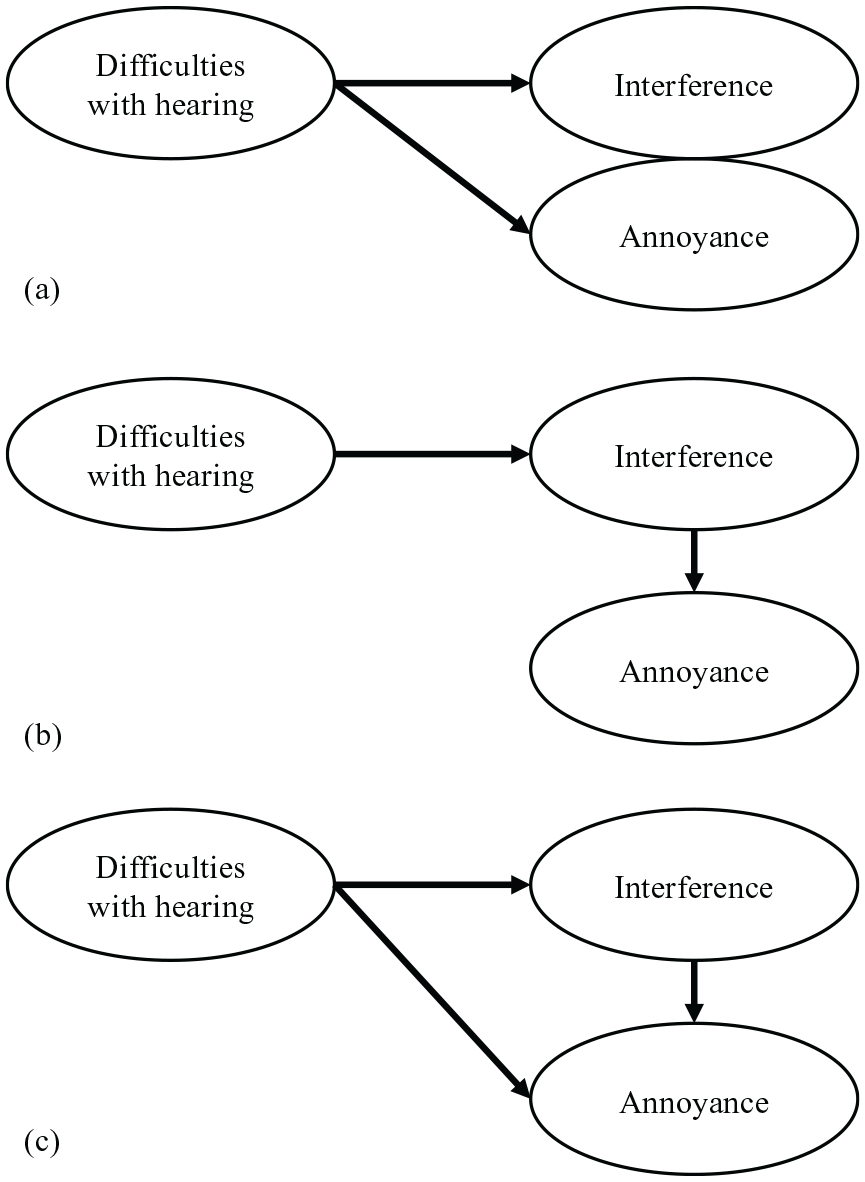
Difficulties with hearing can predict interference and annoyance from noise via (a) two separate direct pathways (Independent model), (b) an indirect effect on annoyance through interference (Indirect model), (c) both direct and indirect effects (Independent + Indirect model).
Experiencing Noise Interference but Not Noise Annoyance: The Case of Mind-Wanderers
Some children might experience interference from noise, but not find it annoying. This might be the case for pupils who have a greater propensity to let their minds wander. Mind-wandering happens when people are focused on things that are not related to their current task or to what is going on around them (Kam, 2017; Mrazek et al., 2013). Instead, attention is shifted to inward processes, such as personal thoughts and feelings. In the classroom context, pupils’ attention would be redirected away from the learning task (e.g., listening to the teacher or being engaged in homework), to focus on internal states of mind.
It might seem, at first, that such inward focus could reduce awareness of ambient noise. Indeed, according to Smallwood et al. (2007), mind-wandering is accompanied by a reduced processing of sensory information, since the cognitive resources used for mind-wandering are less available to encode information from the environment. However, as pointed out by Kam (2017), it all depends on the kind of external events that are occurring and mind-wanderers can still be sensitive to unexpected, surprising, or potentially dangerous stimuli. Since classroom noise contains a mix of diverse and irregular sounds (e.g., chatter, bells ringing, sounds coming from movement) it is possible that these sounds are detected even by pupils who tend to let their minds wander.
Furthermore, and contrary to Smallwood et al.’s (2007) theory that mind-wandering is demanding in terms of executive resources, some authors consider it a default mode, which needs to be regulated in order to focus on specific goals and tasks (McVay & Kane, 2010). In other words, people who often let their minds wander have more difficulties with controlling their thoughts. According to this account, if mind-wanderers notice irregular noise, and if they have difficulties focusing on their learning task to start with, they would be particularly vulnerable to noise interference. Laboratory studies on adults give weight to this hypothesis. Forster and Lavie (2014) showed that a greater propensity for mind-wandering was associated with more distraction from task-irrelevant visual distractors. Using two self-report questionnaires, Carriere et al. (2013) reported a positive correlation between mind-wandering and the tendency to experience interference from noise when engaged in tasks such as reading or working. To our knowledge, there have been no studies replicating these findings with children.
Of special interest to the discussion about the dissociation between interference and annoyance, mind-wanderers might not necessarily be annoyed by noise. When they experience interference, instead of focusing on the noise and getting annoyed by it, they could “escape” by primarily engaging with their own thoughts. In both situations, attention is decoupled, but mind-wandering could help to focus on positive feelings and thoughts, instead of focusing on unwanted sounds. As such, Boman and Enmarker (2004) suggest that mind-wandering could help pupils handle noise (Smallwood & Andrews-Hanna, 2013, for a fuller discussion of the costs and benefits of mind-wandering).
Studying inter-individual differences in pupils’ propensity to let their minds wander, along with their subjective report of noise interference and annoyance has both practical and theoretical interest. On the practical side, given the prevalence of mind-wandering in the classroom (Szpunar et al., 2013), we might want to know whether those pupils who do not seem to pay attention to a lesson (because they are engaged in their own thoughts) are relatively immune, or on the contrary particularly vulnerable to interference from noise. On the theoretical side, testing whether mind-wanderers experience interference from noise, yet are not necessarily annoyed by it, would provide a more stringent test of the hypothesis that these two constructs are connected, yet partly dissociated. We hypothesize that mind-wandering will predict interference from noise, but will not be directly related to annoyance. The extent to which mind-wandering predicts annoyance through interference (indirect effect) remains to be tested.
Coping with Noise Interference and Noise Annoyance: The Role of Switching Skills
Avoiding noise annoyance by “escaping” into mind-wandering might help improve well-being, but it might not be appropriate for fulfilling learning goals. Boman and Enmarker (2004) suggested another coping strategy: concentrating more on the learning task. In other words, children might choose to devote their attention and cognitive resources to their ongoing activity, even if they experience interference from noise. If interference is conceived of as a relative incompatibility between the perceived noise (e.g., a conversation), and the ongoing task (e.g., listening to the teacher, doing homework, Boman & Enmarker, 2004; Stallen, 1999), then the capacity to switch between one and the other might be of crucial importance. Switching is the capacity to alternate between two different tasks, or to focus one’s attention back to an activity after having been interrupted (Diamond, 2013). It relies on the capacity to inhibit unwanted representations (here, information coming from the noise), but also on the capacity to “load” representations for the task of interest (here, the learning task).
Laboratory studies have shown that children as young as 8 years of age are able to select, from multiple auditory channels, the channel they want to pay attention to, and to switch their attention based on instructions. These skills are developing throughout the elementary school years (Doyle, 1973; Geffen & Sexton, 1978; Pearson & Lane, 1991). However, it is unclear how these findings would translate into real life situations in which children are exposed to multisensory (visual and auditory) stimulations, while being engaged in complex learning activities. Carriere et al.’s (2013) study on adults suggests that having good switching skills is related to lower interference from noise. These authors used questionnaires to assess participants’ switching capacities and the impact of noise on their concentration in various everyday life settings. A replication on children is needed and could help to identify the protective factors that help children to cope with noise. Switching skills might be important for children to get “back on track” and to fulfill their goal despite the presence of distraction. However, it remains unclear how switching skills relate to annoyance. If noise interference is one of the main determinants of noise annoyance in school settings, then switching skills would predict annoyance through interference.
Aims of the Study
In summary, the present study will investigate the relationship between noise interference and noise annoyance in children. Following Kjellberg et al. (1996) and Stallen (1999), we suggest that noise interference and noise annoyance are independent, yet correlated constructs. Their dissociation might allow a better understanding of the cognitive mechanisms behind children’s reactions to noise and might help to identify different profiles of children who are more or less vulnerable to noise. Replicating findings from the existing literature, we predict that children with hearing difficulties would experience more interference from noise and be more annoyed by it, because they have difficulties to focus on their learning task. To further test the idea that annoyance is derived from interference (defined as an incompatibility between the noise and the task at hand), we expect children who report good switching skills to be better protected (e.g., experiencing less interference and, as a result, less annoyance), because they can focus back on their task after having been distracted. Finally, to test the dissociation between noise interference and annoyance, we will investigate mind-wandering, with the idea that children who report a greater propensity for mind-wandering would experience more interference from noise yet would not necessarily be annoyed by it. This is because children who mind-wander are, by definition not focused on their task. To address these questions, and following Boman and Enmarker (2004), we will combine factorial analyses with regression analyses in Structural Equation Models.
Methods
Participants
Neurotypical children between the ages of 8 and 11 were recruited from six French elementary classrooms in Corsica (equivalent of Year 5 and Year 6 in the UK). This age range was selected to make sure the children had sufficient reading skills to answer our survey as part of a group testing session. One classroom contained some children in Year 4, and parental consent was obtained for 121 pupils (8 Year 4s, 52 Year 5s, and 61 Year 6s). Year 4 students were excluded from the present analyses for the purpose of homogeneity. Data for one child, for whom hearing disorders were reported by the parents, were also removed from the analyses. The final sample includes 112 pupils, from 8.70 to 11.38 years of age (M = 10.03; SD = 0.60). The project received ethical approval from the University’s Departmental Ethics Committee. Following an opt-in procedure, all the participants gave verbal consent to participate, and written informed consent was obtained from their parent/legal guardian. The study was conducted in accordance with the Declaration of Helsinki. The six participating classrooms were under the jurisdiction of a French educational inspector who approved the ethical guidelines of the study.
The participating classrooms were situated in urban (four classrooms, n = 81) and suburban (two classrooms, n = 31) areas. Average noise levels in empty rooms, computed over 200 samples of 1 min recordings in the evening and night (World Health Organization, 2018), were at 30–40 dB (depending on the classroom). The minimal and maximal values recorded within the 200 samples were 29 dB and 45 dB respectively, indicating that the classrooms were not exposed to high levels of external noise (such as aircraft or railway noise). Noise levels in occupied classrooms (with children engaged in their daily activities) were at 46–54 dB on average (depending on the classroom), with a minimum value of 34 dB and a maximum value of 73 dB (see Picard & Bradley, 2001 for a comparison—in the present study, sound level meters were placed on the front wall of the classrooms, to avoid the visible intervention of an experimenter, which can explain the slightly lower values compared to other studies).
The layout of the classroom followed a traditional “row by row” design, children’s desks facing the blackboard or the interactive screen teachers used to deliver their lessons. In two of the classes, some desks were rotated, and the screen was therefore not directly in front of the children, but slightly on their right or left hand-side (see Appendix A). In all of the classes, children were sitting at individual desks, and there was no common area for children to be grouped within the classrooms (e.g., library corner, carpet).
Measures
All measures were part of a larger school survey. To counterbalance the presentation order of the different questions, half of the children were given version A (see Appendix B), and half of the children version B (see Appendix C). Children answered the survey in their usual classroom, in a collective session. Self-report was used as the main method to allow for comparison with previous studies assessing children’s reactions to noise in classroom settings (Boman & Enmarker, 2004; Connolly et al., 2013; Enmarker & Boman, 2004). Children were invited to answer based on how they had been feeling within the past 2 weeks. This was done to make sure that the measures would represent a variety of classroom situations, and to avoid the children focusing on specific events (e.g., noise levels in the classroom when they filled in the questionnaire).
Children’s reactions to noise
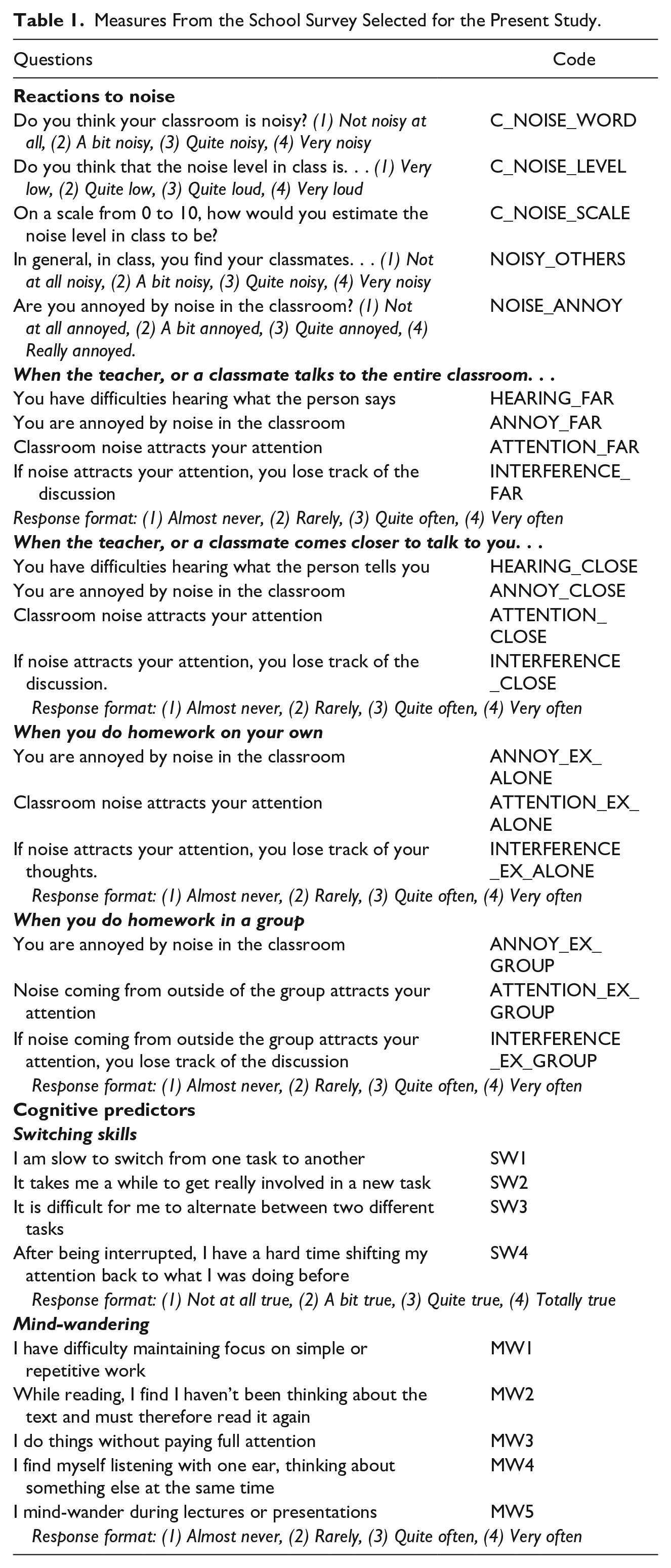
Five dimensions, related to children’s perception of, and reactions to noise, were defined a priori. They reflect: (1) the overall perception of noise levels in the classroom, (2) reported hearing difficulties, (3) attentional capture from noise (i.e., the fact that children notice noise), (4) interference from noise (i.e., the fact that noise catches children’s attention and interferes with their ongoing task), (5) noise annoyance. The last three sets of questions (attentional capture, interference, and annoyance related to noise), referred to various classroom situations, namely: (1) when the teacher, or a classmate talks to the entire classroom, (2) when the teacher, or a classmate comes closer to talk to the child, (3) individual work, (4) group work. This was done to reflect the broad range of learning activities children engage in. It seemed important to focus not only on speech comprehension problems, but also on individual work and group work which are regular learning activities. The exact wording of the questions and the response scales are reported in Table 1.
Measures From the School Survey Selected for the Present Study.
Switching skills and mind-wandering
The survey also included two sets of questions, measuring children’s switching skills and mind-wandering propensities. The questionnaire for switching skills was adapted from Carriere et al.’s (2013) Attentional Control Switching scale. Scoring was reversed so that higher scores indicate better switching skills. The mind-wandering questionnaire was borrowed from Mrazek et al. (2013). Higher scores correspond to a greater propensity for mind-wandering. The original items of both the switching and mind-wandering questionnaires are in Table 1. For the purpose of the study, they were translated into French and slightly reworded to be more child-friendly. For example, the item “I mind-wander during lectures or presentations” was written as “During lessons, I think about unrelated things.” The item “It is difficult for me to alternate between two different tasks” was reworded “It is difficult for me to juggle between doing two different things.” The French translation is available in Appendix B (questions 15–18 correspond to the switching questionnaire, questions 19–23 to the mind-wandering questionnaire).
Results
Descriptive Statistics
Descriptive statistics are reported in Table 2. One key feature of this data set is that children were nested within classrooms: They shared the same teacher, the same environment, and were thus able to influence each other. That is to say, observations were not completely independent. Intra-class correlation coefficients were computed for each variable in order to express the proportion of variance that was attributable to classes (Dorman, 2008; Field, 2018), and are reported in Table 2. Intra-class correlation coefficients above 10% can be considered to be a cause of concern (Byrne, 2013). However, the number of classrooms in our sample is too small to compute accurate parameters estimates at both the intra-group and inter-group levels. Since individual reactions to noise and cognitive abilities are the focus of our study, we centered every child’s score on the classroom’s mean to remove between-classrooms variance and obtain unbiased estimates at the individual level (Bell et al., 2018; Cheslock & Rios-Aguilar, 2011).
Descriptive Statistics for All the Variables.
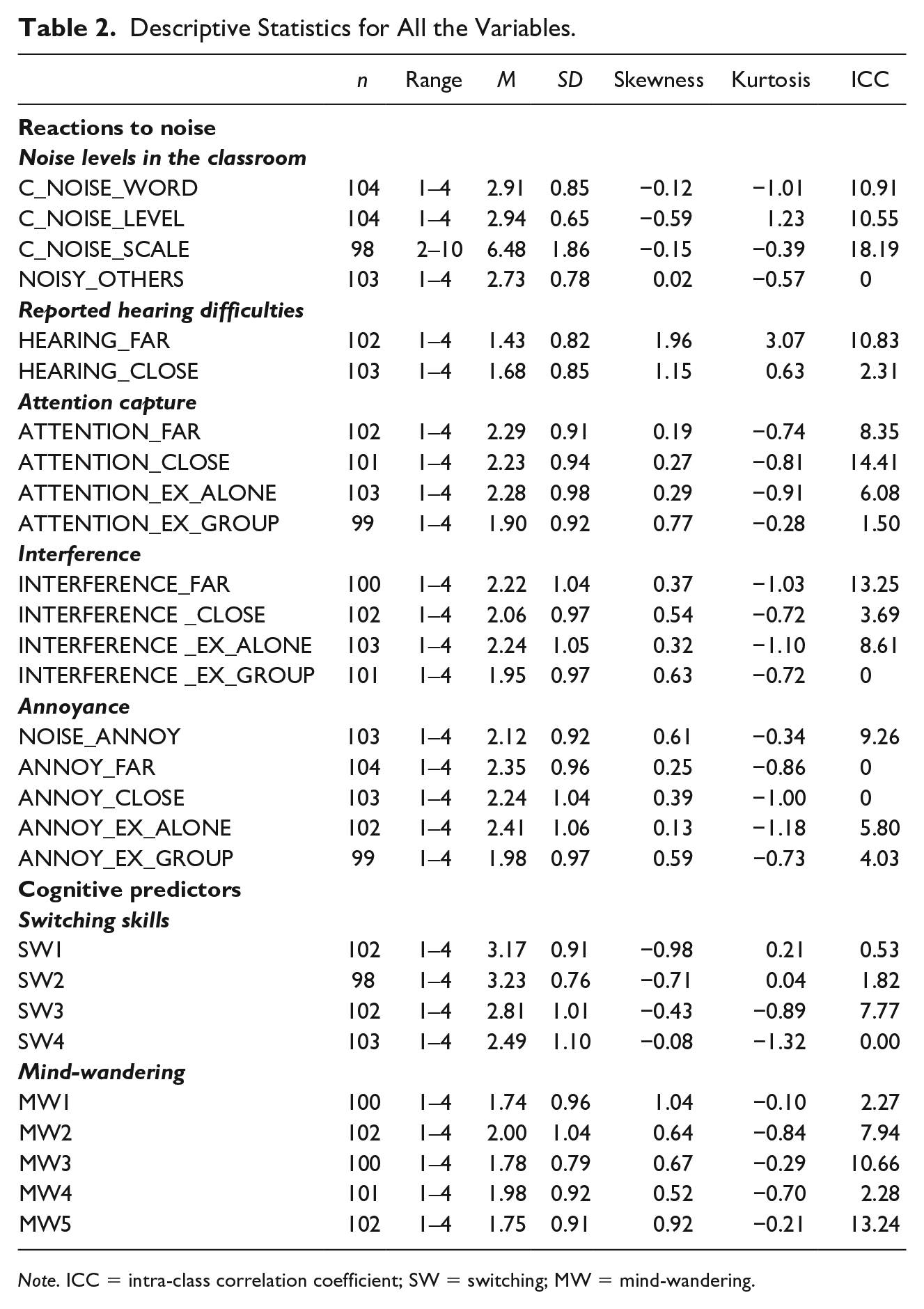
Note. ICC = intra-class correlation coefficient; SW = switching; MW = mind-wandering.
Overall, 9.25% of data points were missing, due to children’s absences or mistakes in writing in the booklets. Little’s (1988) MCAR test was nonsignificant (χ2 (593) = 614.28, p = .26), indicating that data were missing completely at random. For all the following analyses, we used the maximum likelihood estimation to deal with missing data (Schreiber et al., 2006), and the robust estimator in Mplus 6.12, which does not assume normal multivariate distributions.
Factorial Analyses
First, an exploratory factorial analysis was carried out on the measures related to children’s reactions to noise, in order to identify whether the items would correspond to the five categories we defined a priori. Geomin rotation was used since we expected the factors to be correlated (Kjellberg et al., 1996).
Following Boman and Enmarker (2004), inclusion criteria for the factors were eigenvalues >1 and at least two items with loadings >0.50. This led to the five-factors solution reported in Table 3.
Exploratory Factor Analysis on Items Assessing Children’s Reactions to Noise.
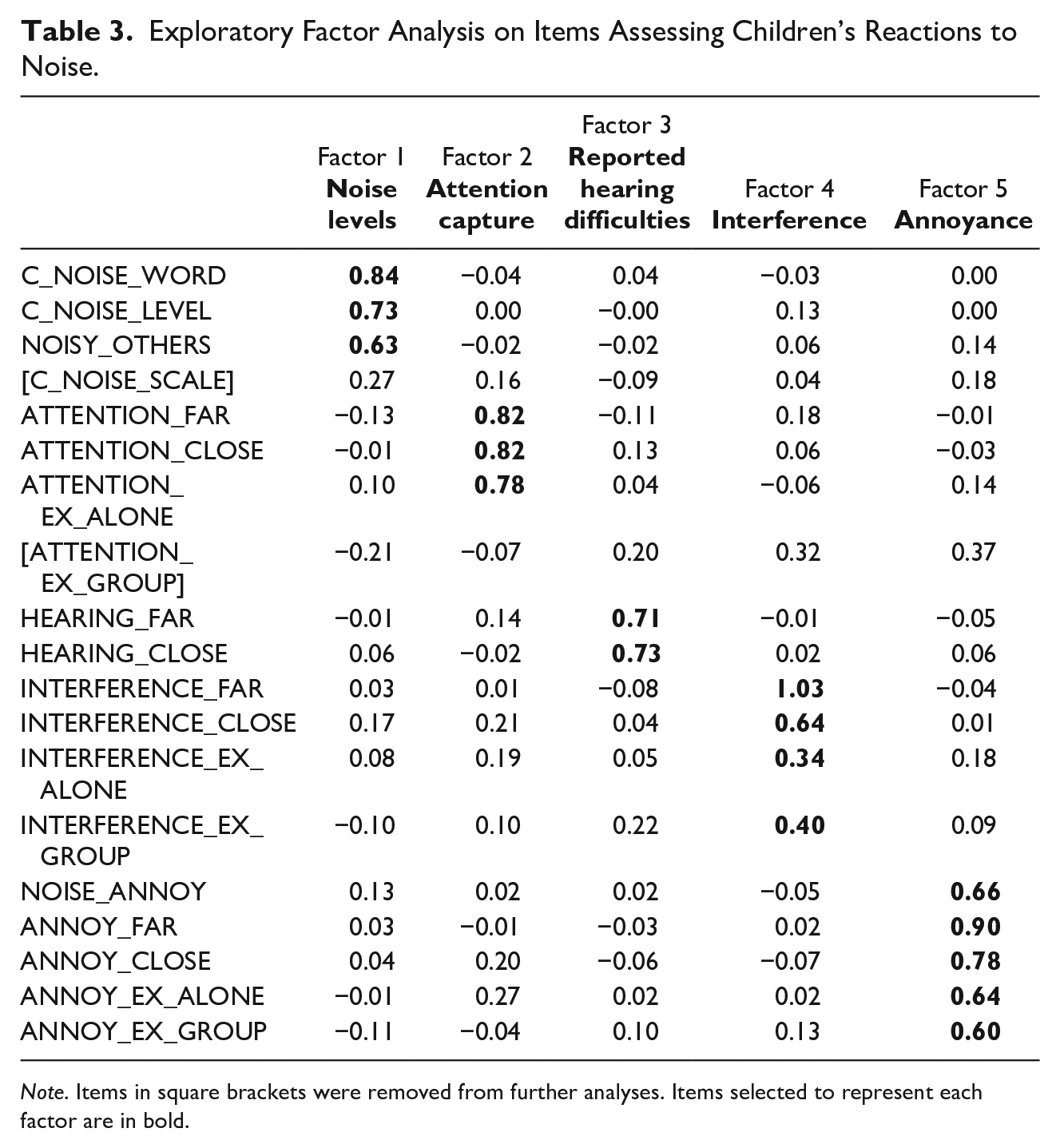
Note. Items in square brackets were removed from further analyses. Items selected to represent each factor are in bold.
One item did not have any factor loading >0.30 on any factor (C_NOISE_SCALE), and one item had loadings >0.30 on more than one factor (ATTENTION_EX_GROUP). These items were removed from further analyses.
A Confirmatory Factorial Analysis on the remaining 17 items yielded a model with adequate fit (χ2 (109) = 159.28, p = .001, CFI = 0.93, TLI = 0.91, SRMR = 0.08, RMSEA = 0.07, 90% confidence interval [0.04, 0.09]). Adequate indices of fit are indicated by a low and nonsignificant χ2 value (however, a big sample size often leads to a significant value), a Comparative Fit Index (CFI) above 0.9, a Tucker-Lewis Index (TLI) above 0.9, Standardized Root Mean Square Residual (SRMR) under 0.08, and a Root Mean Square Error of Approximation (RMSEA) under 0.08, ideally 0.05 (Wang & Wang, 2012).
Correlations between factors are reported in Table 4. All the factors were moderately to highly correlated to each other, with two exceptions: children’s estimations of noise levels in the classroom did not significantly correlate with their reported difficulties to hear, or with the tendency for noise to capture their attention.
Correlation between Factors of the Noise Sensitivity Questionnaire.
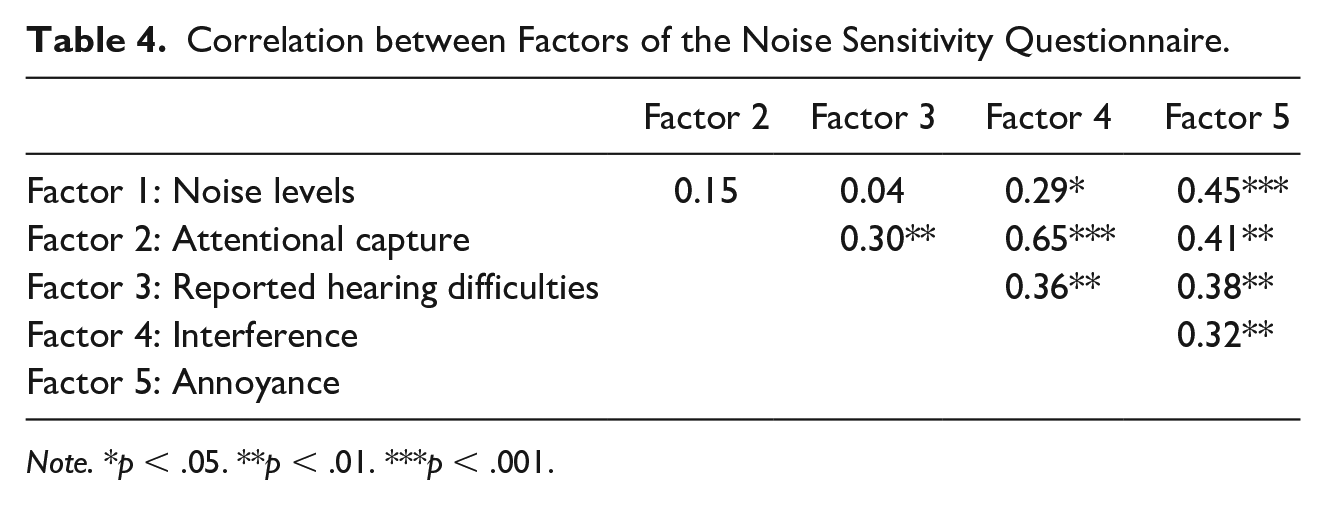
Note.*p < .05. **p < .01. ***p < .001.
Structural Equation Models
Factorial analyses indicated that noise Interference and noise Annoyance could be distinguished as two separate, yet correlated factors.
The next step was to test the three Structural Equation models presented in Figure 1, and to do so for each of our three predictors (difficulties with hearing, mind-wandering, switching skills). Indicators of model fit for the nine resulting models are in Table 5. We followed a two-steps process to select the best fitting model for each of our predictor—that is to say, to select the model that best represents how the predictor relates to noise annoyance and noise interference. First, indicators of model fit were examined for each alternative model. Only models with adequate fit were considered. As indicated earlier, in SEM, adequate fit indices are reflected by a low and nonsignificant χ2 value (although significant values can be obtained with a big sample size), CFI > 0.9, TLI > 0.9, SRMR < 0.08, RMSEA < 0.08, but ideally < 0.05 (Wang & Wang, 2012). Second, if, for the same predictor, two nested models had appropriate fit, a Satorra-Bentler Chi-Square difference test was run (Mplus, 2020). If that test was non-significant (indicating that the two models had equivalent fit), the more parsimonious model was chosen. If the test was significant, the best fitting model (with the lowest Chi-Square statistics) was chosen.
Indicators of Model Fit Corresponding to the Three Structural Equation Models depicted in Figure 1.
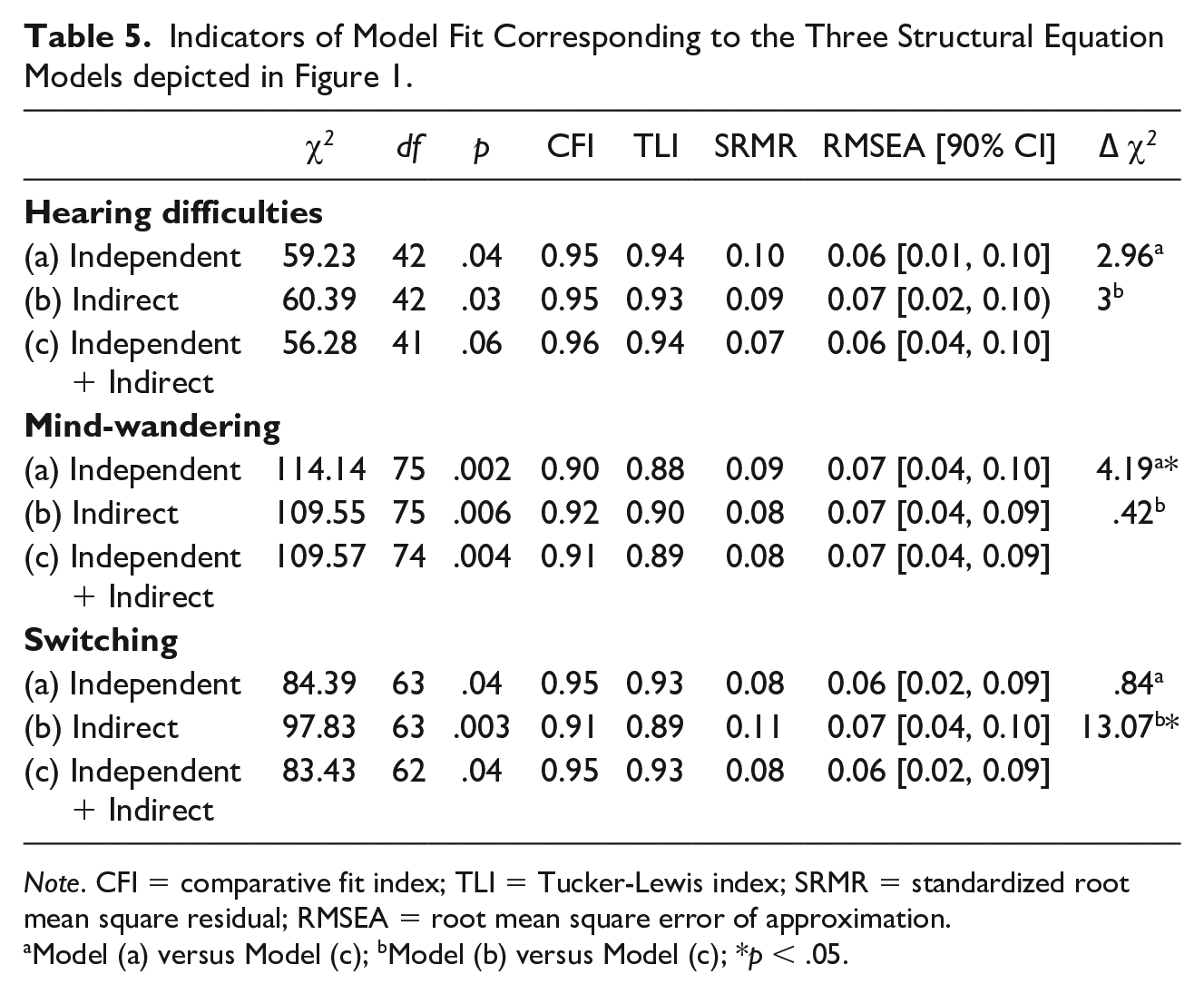
Note. CFI = comparative fit index; TLI = Tucker-Lewis index; SRMR = standardized root mean square residual; RMSEA = root mean square error of approximation.
Model (a) versus Model (c); bModel (b) versus Model (c); *p < .05.
Hearing difficulties
Only the model combining direct and indirect effects had a good fit—both the independent and indirect models having SRMR above 0.08. As shown in Figure 2, reported hearing difficulties significantly predicted both Interference (β = .34; p = .01) and Annoyance (β = .31; p = .02). Interference marginally predicted Annoyance (β = .21; p = .06). The sum of indirect effects from Reported hearing difficulties to Annoyance through Interference was estimated at 0.07 and was not statistically significant (p = .15). Overall, the model explained 18.3% of the variance in Annoyance scores, and 11.6% of the variance in Interference scores.
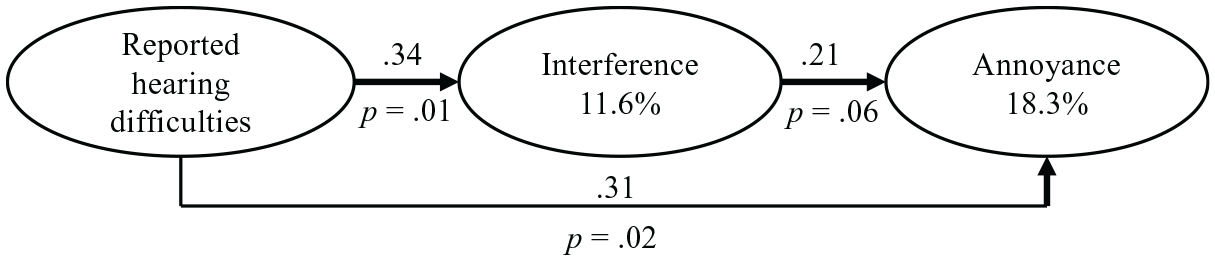
Structural Equation Model depicting the direct effect of reported hearing difficulties on noise interference and annoyance, as well as the indirect effect on annoyance through interference.
Mind-wandering
Only the indirect model had adequate fit—the independent model had a TLI below 0.90 as well as SRMR above 0.08; the combined model had a TLI below 0.90. As shown in Figure 3, mind-wandering significantly predicted noise Interference (β = .63; p < .001), which in turn, significantly predicted noise Annoyance (β = .29; p = .006). The sum of indirect effects from mind-wandering to Annoyance through Interference reached 0.18, with a p-value of .02. The model predicted 39.8% of the variance in Interference scores, and 8.5% of the variance in Annoyance scores.

Structural Equation Model depicting the indirect effect of mind-wandering on noise annoyance through noise interference.
Switching skills
Two models had an adequate fit: the independent model (with two directs effects on Annoyance and Interference), and the model combining these direct effects with an indirect effect on Annoyance through Interference. The Chi-Square difference test showed that the combined model did not have a significantly better fit. The independent model was therefore chosen for the sake of parsimony. As shown in Figure 4, better switching skills predicted less Interference (β = − .61, p < .001) and less Annoyance (β = − .60, p < .001) from noise. Overall, the model explained 37.3% of the variance in Interference scores and 36% of the variance in Annoyance scores.
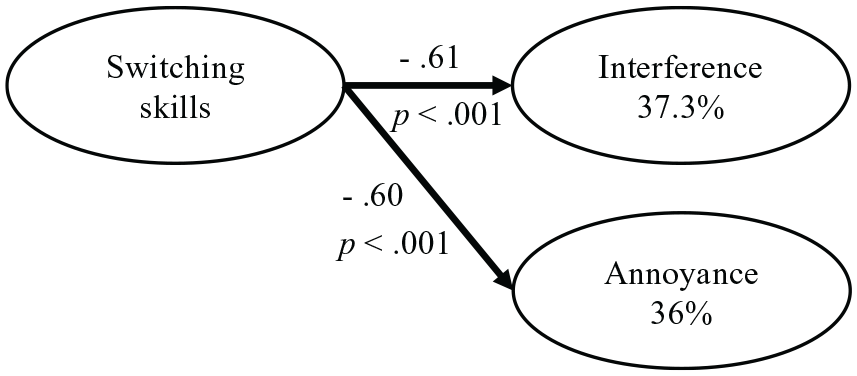
Structural Equation Model depicting the direct effects of switching skills on noise interference and annoyance.
Discussion
In the present study, 8- to 11-year-old children were asked to share their reactions to classroom noise. On average, the children found their classroom quite noisy, and they were moderately annoyed by noise (their overall ratings were close to those reported by Enmarker and Boman (2004) on their sample of 13- to 14-year-olds).
Noise Interference and Noise Annoyance: Two Separate Yet Correlated Constructs
Results from our factorial analyses showed that being annoyed by noise and experiencing interference with learning activities formed two correlated yet distinguishable dimensions. Although our results are based on a relatively small sample size (Mundfrom et al., 2005) compared to previous studies (Boman & Enmarker, 2004), they are in line with Kjellberg et al. (1996)’s empirical results on an adult population. It also fits with Stallen (1999)’s theoretical suggestion that annoyance reactions contain an emotional component that goes beyond the fact that, on a cognitive level, noise causes difficulties with achieving on-going goals and tasks.
However, this distinction between annoyance and interference was not found by Boman and Enmarker (2004). This could be due to the different items included in their analyses. The general factor of Annoyance reported by Boman and Enmarker (2004) included questions related to difficulties with concentrating on an ongoing task, and to the influence of noise on workload, which could be considered to represent interference. Their item related to the level of irritation by noise could correspond to annoyance (e.g., expressing a negative feeling). Three other items were a bit more ambiguous, reflecting disturbance, surprise, and “thinking about noise.” It is unclear whether these items describe a process of interference with one’s thoughts, the fact of having noticed the noise, and/or an emotional reaction, and this could explain why a broad Annoyance factor was extracted. Importantly, our factor of Interference specifically targeted the fact that noise was conflicting with an ongoing activity, making children lose track of their thoughts, work, or of an ongoing discussion in the classroom. This was different from simply noticing noise, as reflected in our factor of Attentional Capture.
The distinction between the Interference and Annoyance constructs helped to better understand inter-individual differences in children’s reactions to noise. Children who reported greater difficulties in hearing in the classroom, and in switching from one task to another, reported more interference and annoyance from noise. Children who had a greater propensity to let their minds wander also experienced more interference from noise but were only annoyed by noise to the extent that it produced interference – the relationship between mind-wandering and noise annoyance was not direct.
Children with Hearing Difficulties are More Distracted and Annoyed by Classroom Noise
Overall, children reported few difficulties with hearing when the teacher (or a classmate) was talking to them, or to the entire classroom. There was, however, inter-individual variability, with some children reporting more frequent hearing difficulties. For these children, noise seems to interrupt their ongoing activity, and to be particularly annoying.
It is worth noting that a model in which hearing difficulties independently predicts Interference and Annoyance, with no correlation between these two reactions to noise (as in Figure 1a), did not have a good fit. Similarly, a model specifying a strict indirect effect, with hearing difficulties predicting Annoyance through Interference (as in Figure 1b) did not have a good fit either. Our final model indicates that hearing difficulties predict both Interference and Annoyance, and that these two reactions to noise are in part related to each other, as indicated by a marginal indirect effect. However, formal comparisons between the combined model and each of the simpler models (predicting independent effects, or an indirect effect) were not significant.
Children reporting hearing difficulties might have troubles to understand speech in noise and might therefore lose track of the messages that are being communicated—three out of the four classroom activities that were included in our questionnaire required listening to other people. Annoyance ratings could partly relate to children’s overall frustration with communication and listening difficulties.
The assessment of hearing difficulties in the present study was subclinical and relied on self-report, since the number of children clinically referred for hearing problems (one) was too small to allow for group comparisons. However, in line with Boman and Enmarker (2004), our results suggest that hearing difficulties considered on a continuum can help explaining inter-individual variability in children’s reactions to noise.
Children with Switching Difficulties are More Distracted and Annoyed by Classroom Noise
Beyond hearing processes, our study included a questionnaire about switching skills. Children with lower switching skills typically have difficulties in moving from one task to another, or in re-focusing on an activity after having been interrupted.
Our results indicate that switching skills predict Interference and Annoyance via two, relatively independent pathways. The model specifying an indirect effect of switching skills on Annoyance through Interference did not have a good fit, and a model combining both independent direct effects and an indirect effect was no better than the simple, independent model, that was favored for the sake of parsimony. It is worth noting that reported switching skills explained a similar amount of variance in noise Interference and noise Annoyance (37.3% and 36% respectively).
The link between switching skills and Interference indicates that children with switching difficulties tend to lose track of a discussion more easily in the presence of noise, and also to have difficulties focusing on their own thoughts when engaged in solo work. This is in line with Carriere et al.’s (2013) findings on an adult population. Switching skills rely on the capacity to inhibit unwanted representations (also known as inhibitory control), and on working memory, to “load” representations for the task of interest (Diamond, 2013). Good inhibitory control and working memory have been identified as two protective factors reducing the impact of noise on performance, as assessed in behavioral tasks (Massonnié et al., 2019; Sörqvist, 2010; Sörqvist et al., 2010). Future studies assessing children’s switching skills with behavioral as well as self-report tasks would help to bridge the gap between these two strands of research, while allowing for a better understanding of the processes underlying noise interference.
Different mechanisms might be at play to explain why better switching skills are related to less annoyance from noise. Some strategies to reduce noise annoyance involve a re-evaluation of the noise source (Guski, 1999; Stallen, 1999), for example, perceiving an external conversation as a social signal instead of an intrusion on privacy. This would require the ability to change perspective flexibly, which is a component of switching skills (Diamond, 2013). Qualitative studies might be insightful to better understand children’s attitudes and annoyance reactions (Haines et al., 2003).
Children Who Tend to Let Their Minds Wander are More Distracted, But Not More Annoyed by Classroom Noise
A coping mechanism mentioned by children in Boman & Enmarker’s (2004) and Haines et al.’s (2003) interviews is to disappear into daydreams, or to think about something other than the noise. Our best fitting model indicated that mind-wandering only explains a small proportion of the variance in Annoyance (8.5%). Mind-wandering was indirectly, but not directly related to noise Annoyance: more mind-wandering led to more noise Annoyance only insofar as children were more distracted by noise. Mind-wandering explained a non-negligible 39.8% of the variance in Interference, an effect in line with theoretical (McVay & Kane, 2010), and empirical (Carriere et al., 2013; Forster & Lavie, 2014) accounts of mind-wandering as reflecting a lack of attentional control. In that sense, mind-wanderers would have difficulties focusing on their work or on an ongoing discussion in the presence of ambient noise. Note that this could reflect a lack of inhibition similar to that experienced by children with switching difficulties. In their adult study, Carriere et al. (2013) reported a positive correlation between self-report measures of mind-wandering and switching difficulties.
Explaining Noise Interference and Noise Annoyance in Classroom Settings
Our models explained a non-negligible proportion of variance in children’s self-report of noise Interference and noise Annoyance. The models with mind-wandering and switching skills as predictor variables respectively explained 39.8% and 37.3% of the variance in noise Interference. In comparison, reported hearing difficulties only explained 11.6% of the variance in noise Interference. Switching skills also explained 36% of the variance in Annoyance reactions. Hearing difficulties and mind-wandering respectively explained 18.3% and 8.5% of the variance in this variable. Thus, while other explanatory factors may also be at play, the present study has successfully identified several sources of inter-individual variability in children’s reported responses to noise in classroom settings. Switching skills seem to be a promising mechanism to further investigate.
Practical Implications for Educational Contexts
By examining three sources of inter-individual variability (reported difficulties with hearing, switching skills, and mind-wandering propensity), our study shows that there might be different cognitive mechanisms by which noise interferes with learning, and causes annoyance. This could be perceived as a challenge for educators and practitioners willing to improve children’s wellbeing in the classroom context. However, a closer look at current suggestions to help children from each of these three groups reveals some commonalities.
Children with difficulties with hearing would benefit from a higher signal to noise ratio. In other words, the target message (e.g., oral instructions given by the teacher) needs to be more distinguishable from the irrelevant background noise (Picard & Bradley, 2001; Shield & Dockrell, 2003). This could be done by: improving the classroom’s design in order to reduce reverberation time, increasing the loudness of the main message, reducing noise levels to start with (Crandell & Smaldino, 2000).
Acoustical regulations in the United-States and in the United Kingdom recommend an upper limit of L Aeq, 30min 35 dB and a reverberation time below .60 in unoccupied teaching spaces (Acoustical Society of America, 2010; Education Funding Agency, 2015). L Aeq is a measure of equivalent continuous sound pressure level during a specific time interval, adjusting for the varying sensitivity of the ear to sounds of different frequencies (World Health Organization, 2018). The reverberation time of a sound indicates the time required (in seconds) for the level of a sound to decay by 60 dB after it has been turned off (Acoustical Society of America, 2010). As such, acoustical regulations aim to ensure that classrooms are exposed to a low level of background noise coming from the outside and are equipped with an acoustical design that allows sounds to decay relatively quickly.
However, these recommendations are not systematically met (e.g., Ronsse & Wang, 2013; Shield & Dockrell, 2004). Asking teachers to further raise their voice does not appear to be a relevant long-term solution, since they are more at risk of developing voice problems (Martins et al., 2014). Accessible and affordable solutions to lower noise levels deserve further investigation. These could consist in physical (e.g., material to be installed in classrooms) as well as pedagogical (e.g., interventions to minimize noise generated by children when it is the most disturbing) solutions (Massonnié et al., 2020).
Beyond overall sound levels, the present study offers more insight into the cognitive mechanisms that underlie children’s subjective reactions to noise within a single classroom. In other words, it helps to better understand why some children are more vulnerable than others, and points toward some potential ways to alleviate their difficulties. For example, children with switching difficulties report more annoyance and interference from noise. They might benefit from interventions which reduce the amount of distractions that creates a need to switch. But given the difficulty to reduce sound levels, the possibility to help them improve their capacity to alternate between one task and another should be further investigated (Diamond & Lee, 2011; Diamond & Ling, 2016). Furthermore, raising awareness about mind-wandering could help students to detect the occurrence of daydreaming and to re-focus on the external task when engaged in learning. Overall, keeping in mind the sources of inter-individual variability might help to develop a more child-centered approach to the issue of noise in schools.
Supplemental Material
Appendix – Supplemental material for Learning in Noisy Classrooms: Children’s Reports of Annoyance and Distraction from Noise are Associated with Individual Differences in Mind-Wandering and Switching skills
Supplemental material, Appendix for Learning in Noisy Classrooms: Children’s Reports of Annoyance and Distraction from Noise are Associated with Individual Differences in Mind-Wandering and Switching skills by Jessica Massonnié, Philippe Frasseto, Denis Mareschal and Natasha Z. Kirkham in Environment and Behavior
Footnotes
Acknowledgements
We would like to thank Antoine Chélélékian, Julien Pons and Claude Mendivé, for their continuous support and confidence in the project. Their help in the funding and recruitment processes was invaluable. We are grateful to Roselyne Chauvin for her precious comments on the questionnaire assessing children’s reactions to noise. Finally, we would like to thank all the children and teachers who took part in the study.
Declaration of Conflicting Interests
The author(s) declared no potential conflicts of interest with respect to the research, authorship, and/or publication of this article.
Funding
The author(s) disclosed receipt of the following financial support for the research, authorship, and/or publication of this article: This work was funded by the Economic and Social Research Council (grant reference: 1788414), by the Centre for Brain and Cognitive Development of Birkbeck College, University of London, and by the Rectorat de Corse (Cellule Santé et Sécurité).

Supplemental Material
Supplemental material for this article is available online.
Author Biographies
References
Supplementary Material
Please find the following supplemental material available below.
For Open Access articles published under a Creative Commons License, all supplemental material carries the same license as the article it is associated with.
For non-Open Access articles published, all supplemental material carries a non-exclusive license, and permission requests for re-use of supplemental material or any part of supplemental material shall be sent directly to the copyright owner as specified in the copyright notice associated with the article.
