



Abstract
Given the urgency of climate change mitigation, motivating individuals to behave in sustainable ways constitutes a key challenge for environmental science. Although many studies evidence people’s long-lasting pro-environmental attitudes, such attitudes often do not translate into behavior. The present research hypothesizes that cognitive resources are a crucial moderator, explaining when pro-environmental attitudes turn into behavior. Specifically, we investigate the attitude–behavior gap while taking a “cognition perspective” on environmental behavior. Using experience sampling, the present research demonstrates that individual differences in central aspects of cognitive control (assessed by working memory capacity) moderate the relationship between environmental attitudes and behavior. Our correlational findings suggest that people with positive environmental attitudes also require high working memory capacity to behave in line with their ideals. Our results do not only provide empirical support for recent theorizing in environmental research, but, perhaps more importantly, might offer a central lever for behavioral change initiatives (e.g., “nudging”).
Keywords
Climate and environmental scientists speak with profound clarity about the immediate need to take action for a more sustainable world (Kolstad et al., 2014; Nielsen, 2017). At the same time, evidence from large-scale attitudinal studies conducted in regions as diverse as the European Union, China, and the United States (European Commission, 2014; Jones & Saad, 2018; Liu & Leiserowitz, 2009) suggests that most people do not only acknowledge that urgency but also feel a responsibility to act. However, environmental attitudes often do not fully translate into action (Juvan & Dolnicar, 2014; Kennedy, Beckley, McFarlane, & Nadeau, 2009). As a result, effective behavioral change remains a central challenge for theoretical and applied behavioral and environmental research alike. Yet, up to this day, many attempts to boost pro-environmental behaviors rely on campaigns targeting a change in people’s attitudes toward the environment.
However, a recent review highlights the need to better understand the cognitive processes involved in human behavior to gain a deeper understanding of the psychological drivers of “green” behaviors and, subsequently, to steer effective policy campaigns in climate change mitigation (Clayton et al., 2015). Current theorizing (Bamberg, 2013; Nielsen, 2017) in environmental research suggests that cognitive resources may play a relevant role in explaining environmental behavior. In particular, they may provide us with one explanation why attitudes do not always lead to corresponding behaviors (a phenomenon coined the attitude–behavior gap) (Juvan & Dolnicar, 2014; Kennedy et al., 2009; Nielsen, 2017).
According to the attitude–behavior gap, many people hold pro-environmental attitudes, yet often fail to live up to their ideals. The evidence on this phenomenon poses the question if and under which conditions behavioral change initiatives aiming at people’s attitudes are actually effective. For example, meta-analytical evidence of 53 intervention studies in the public health domain showed that initiatives targeted at attitudes have only a negligible effect on actual behavior (Michie, Abraham, Whittington, McAteer, & Gupta, 2009). Similarly, information campaigns about household energy consumption have been less effective than hoped (Abrahamse, Steg, Vlek, & Rothengatter, 2005). In stark contrast, recent studies that instead tapped into cognitive elements of human decision making by making engagement in “green” behaviors cognitively less effortful show large and persistent effects (Ebeling & Lotz, 2015; Tiefenbeck et al., 2016). Due to these diverging results, there is a growth in research focusing on cognition rather than attitudes (e.g., information campaigns) in promoting environmental behavior (Bamberg, 2013). And as a result, environmental scientists increasingly theorize whether environmental behavior can be better understood (and promoted) by taking research that gives a central role to cognitive control more closely into account (Nielsen, 2017; Weber, 2017).
Cognitive control describes the human ability to show thoughts and behaviors that are in line with current goals (Inzlicht, Bartholow, & Hirsh, 2015). It encompasses a variety of different functional components, such as inhibition, working memory, and cognitive flexibility (Steinbeis & Crone, 2016). For many daily actions, the behavioral default (which is convenient, effortless, and executed automatically) is harmful to the environment. Thus, to translate their pro-environmental attitudes to pro-environmental actions, people need to make considerable changes to their behavior. For example, to use less energy, one has to identify situations in which this is possible (e.g., showering), remember to switch from behavioral routines in these situations (e.g., turn off the water while lathering), forego immediately beneficial temptations (e.g., the pleasantness of warm water), and overcome distractions (e.g., thoughts and daydreams). Cognitive control is crucial for each of these steps, and required for a broad range of pro-environmental behaviors. Hence, cognitive control might be a relevant moderator and may be a variable worth investigating in the relationship between pro-environmental attitudes and pro-environmental behavior (see Figure 1). This would be in line with findings on prosocial behavior in general: It is known that prosocial or altruistic individuals are also more likely to engage in pro-environmental behavior (for a review, see Steg & Vlek, 2009). It is also well known that many prosocial behaviors require people to excerpt control processes to sacrifice a personal benefit for the sake of another person (Knoch, Pascual-Leone, Meyer, Treyer, & Fehr, 2006; Kocher, Martinsson, Myrseth, & Wollbrant, 2017; Steinbeis, 2018; Strang et al., 2014). Thus, because there is a link between control processes and prosociality, on one hand, and prosociality and pro-environmental behavior, on the other hand, it would be logical to also assume a link between control processes and pro-environmental behavior.
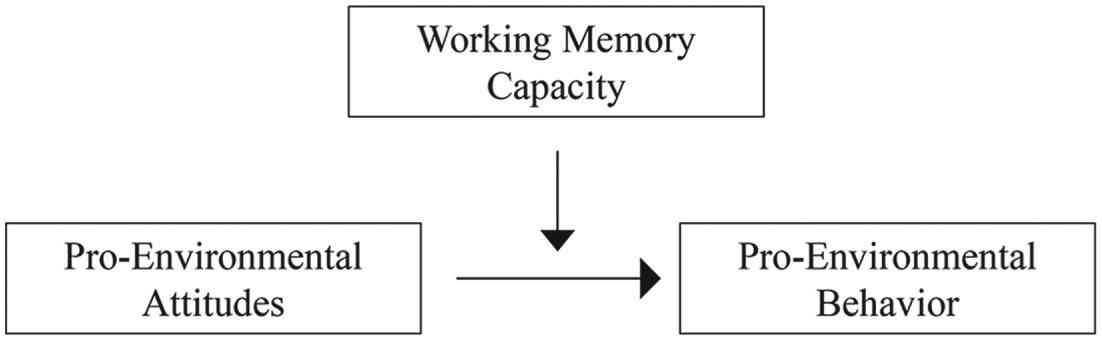
Conceptual model of the moderating effect of working memory capacity on the relationship between pro-environmental attitudes and pro-environmental behavior.
To measure cognitive control capacity, the present research focuses on working memory capacity because it remains relatively stable throughout most of adulthood (Alloway & Alloway, 2013; Klingberg, 2010) and has been shown to be related to control processes (Hofmann, Gschwendner, Friese, Wiers, & Schmitt, 2008; Schmeichel, Volokhov, & Demaree, 2008). Most importantly, it produces large enough variance to tap into differences in cognitive resources in the general population of healthy (i.e., nonclinical) adults (Chatham et al., 2011; Jarrold & Towse, 2006).
More specifically, our research design is operationalized by three temporally distant measurements (see the “Method” section for a detailed description). In one measurement, we assessed participants’ working memory capacity by administering the n-back task in the laboratory independently of attitudinal or behavioral measures. Several months later, participants engaged in the experience sampling part of the study. Facilitated by the emergence and ubiquitous use of smartphones, we relied on this method also coined “ecological momentary assessment” (Csikszentmihalyi & Larson, 2014; Shiffman, Stone, & Hufford, 2008). In our operationalization of experience sampling, participants are “pinged” multiple times a day and asked to immediately complete a short questionnaire asking about behaviors that occurred recently. Because participants only have to remember actions within the last hour(s) and data are collected over multiple days, this method makes it easier for participants to accurately recall behaviors (Scollon, Prieto, & Diener, 2003). Finally, again after several months, we assessed environmental attitudes using the “New Environmental Paradigm” (NEP; Dunlap, Van Liere, Mertig, & Jones, 2000). Our study design therefore combines several elements of the methodological toolbox currently employed across the behavioral sciences.
Method
Participants
Seventy-seven healthy students were initially recruited from the University Bern (57 females; mean age ± SD = 21 ± 1.8 years, range = 19-28). All participants gave written informed consent; the study was approved by the local ethics committee and conducted in accordance with the Declaration of Helsinki. Participants received a compensation of 25 Swiss Francs (CHF; 1 CHF ≈ 1 US dollar) plus an additional 2 CHF for each time they completed the experience sampling, resulting in a maximum of 30 CHF. Thus, participants could earn a total of 55 CHF.
Six participants did not execute the working memory task as instructed and pressed the response button virtually every time, resulting in false alarm rates of close to 1. We thus do not have a valid measurement of these participants’ working memory capacity, and their data were excluded from all further analyses, resulting in a sample size of 71.
Measures
Working memory capacity
To measure the working capacity of our participants, they completed a visual n-back task, a well-established test of working memory capacity (Sweet, 2011). In this task, participants sat in front of a computer screen and were presented with a continuous string of black consonants on a gray background, each presented for 500 ms. Between the trials, a fixation cross was shown for a duration of 2,000 ms. Participants were instructed to press a button every time the presented letter corresponded to that shown n trials before the current one. This part of the experiment consisted of three levels: 1-back, 2-back, and 3-back, consisting of 126 trials with 42 targets (one third of the trials) each. The levels were split into three even blocks, and the resulting nine blocks were presented in a pseudo-randomized order. Overall, our design is similar to versions of the n-back that are typically used (Brouwer et al., 2012; Forns et al., 2014; Schoofs, Preuß, & Wolf, 2008).
We calculated the sensitivity index d′ (integrating hits and false alarms) over all three blocks as an index of working memory capacity. D′ is a standard index for analyzing the n-back task (Bettcher et al., 2016; Forns et al., 2014; Ophir, Nass, & Wagner, 2009) and has been shown to have high psychometric qualities when assessing cognitive functions (Haatveit et al., 2010).
Daily pro-environmental behavior questions
The online questions on daily pro-environmental behavior were implemented using the Qualtrics survey software. The link to the experience sampling was distributed via text message using the online service SurveySignal. Participants received the link to the daily pro-environmental behavior questions 3 times per day (late morning, afternoon, evening) for five consecutive days. After these 5 days, participants were informed about their final compensation and were paid. The experience sampling consisted of five items on daily pro-environmental behavior. We deliberately did not focus on only one specific type of pro-environmental behavior, but rather chose items that covered a wide range of daily situations (littering in the street, not separating waste, not buying products that are not environmentally friendly, paying attention to not wasting water, ordering coffee in a reusable cup; see Supplemental Appendix A for the exact wording). For each behavior, participants were asked to indicate whether they showed the behavior in question since the last inquiry. On average, participants responded at 14.8 of the 15 experience-sampling time points (SD = 0.69; range = 12-15).
To analyze participants’ pro-environmental behavior, we first calculated the sum of pro-environmental behavior per day. We then checked whether participants’ pro-environmental behavior changed over the 5 days. To this end, we conducted a repeated-measures analysis of variance (ANOVA) with experimental day (1-5) as the time variable and daily pro-environmental behavior as the dependent variable. We found no systematic differences between the 5 days, F(4, 66) = 0.27, p = .895, η² = .016. Hence, we computed the arithmetic mean over all 5 days for all further analyses so that participants could have a pro-environmental behavior score between 0 and 15.
General attitudes toward the environment
To measure general attitudes toward the environment, we employed the NEP (Dunlap et al., 2000), the most widely used measure of environmental concern (Dunlap, 2008; Gifford, 2014). It consists of 15 items about environmental views (e.g., “If things continue on their present course, we will soon experience a major ecological catastrophe” or “Humans are seriously abusing the environment”). Participants responded on a 5-point Likert-type scale so that the strength of their pro-environmental attitudes could range between 1 and 5.
Procedure
To avoid carryover effects from one study part to the other, all measurements were separated in time. First, participants completed the n-back task to measure their working memory capacity in our lab. After a mean interval of 5 months, they were re-invited to participate in the experience-sampling study. They were familiarized with the use of the experience-sampling method and the content of each item, and were registered with the online software SurveySignal that distributed the links to the questions on pro-environmental behavior via text message. The actual experience sampling started 5 days later. After a mean period of 6 months, participants completed an online version of the NEP (Dunlap et al., 2000). See Figure 2 for a graphical representation of the procedure.
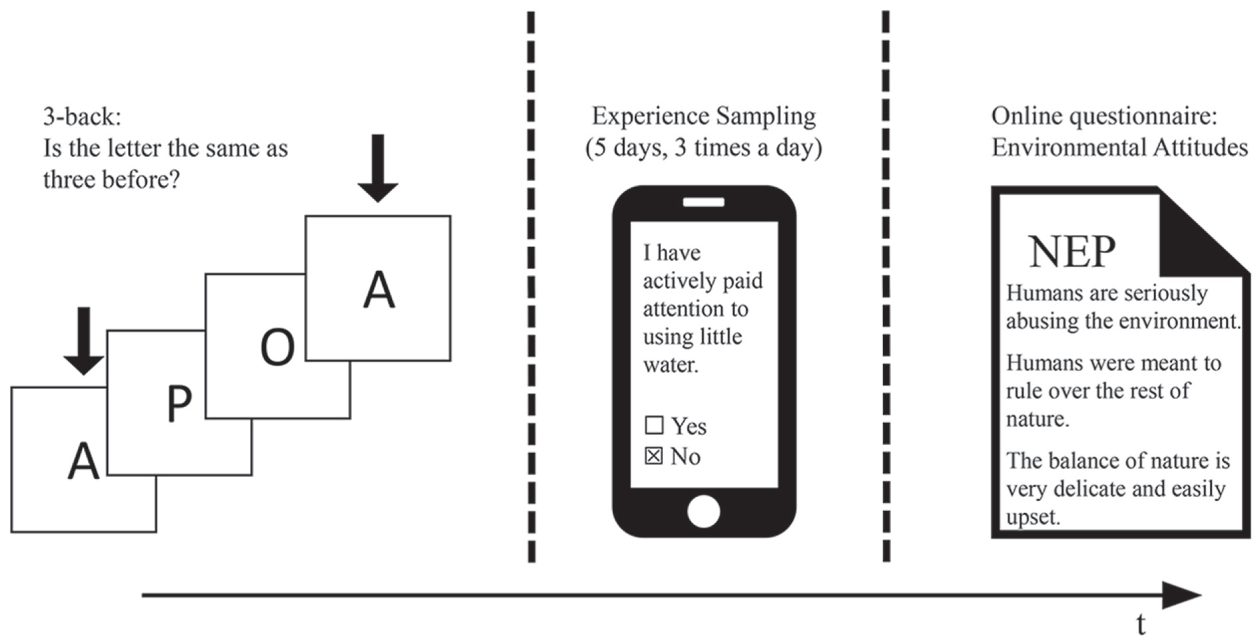
Graphical depiction of the experimental procedure.
Statistical Analyses
Analyses were performed using the statistics software R (R Core Team, 2016). A linear regression was calculated with the daily pro-environmental behavior as the dependent variable and d′, NEP score, and the interaction thereof as predictors.
To test the specific relevance of the interaction between working memory and environmental attitudes, we calculated a hierarchical linear regression analysis to compare the full model with a model that only contained pro-environmental attitudes and working memory as predictors, but not the interaction.
To analyze whether the experience-sampling items measured one underlying construct, we calculated an exploratory factor analysis.
Results
Turning to the results of the study, participants reported a mean daily pro-environmental behavior score of 5.35 (SD = 1.95; range = 2.8-10.2). On the NEP, they reported a mean of 3.33 (SD = 0.42; range = 2.37-4.36). The mean working memory score in our sample was 3.69 (SD = 0.42; range = 2.69-4.80). To assess the central hypothesis, namely, whether attitudes and behaviors are correlated only under the condition of high working memory capacity, we calculated a linear regression with participants’ NEP scores, their working memory score, and the interaction between the two to predict their mean daily environmental behavior score. Two participants showed an exceedingly large influence on the model (indicated by Cook’s distance greater than .25). These two participants were excluded and the regression was recalculated. The model was statistically significant and explained 21% of variance in pro-environmental behavior, F(3, 65) = 5.86, p = .001 (see Table 1 for the complete results).
Results of a Linear Regression With Daily Pro-Environmental Behavior as the Dependent Variable and Environmental Attitudes, Working Memory Capacity, and the Interaction of the Two as Predictors.
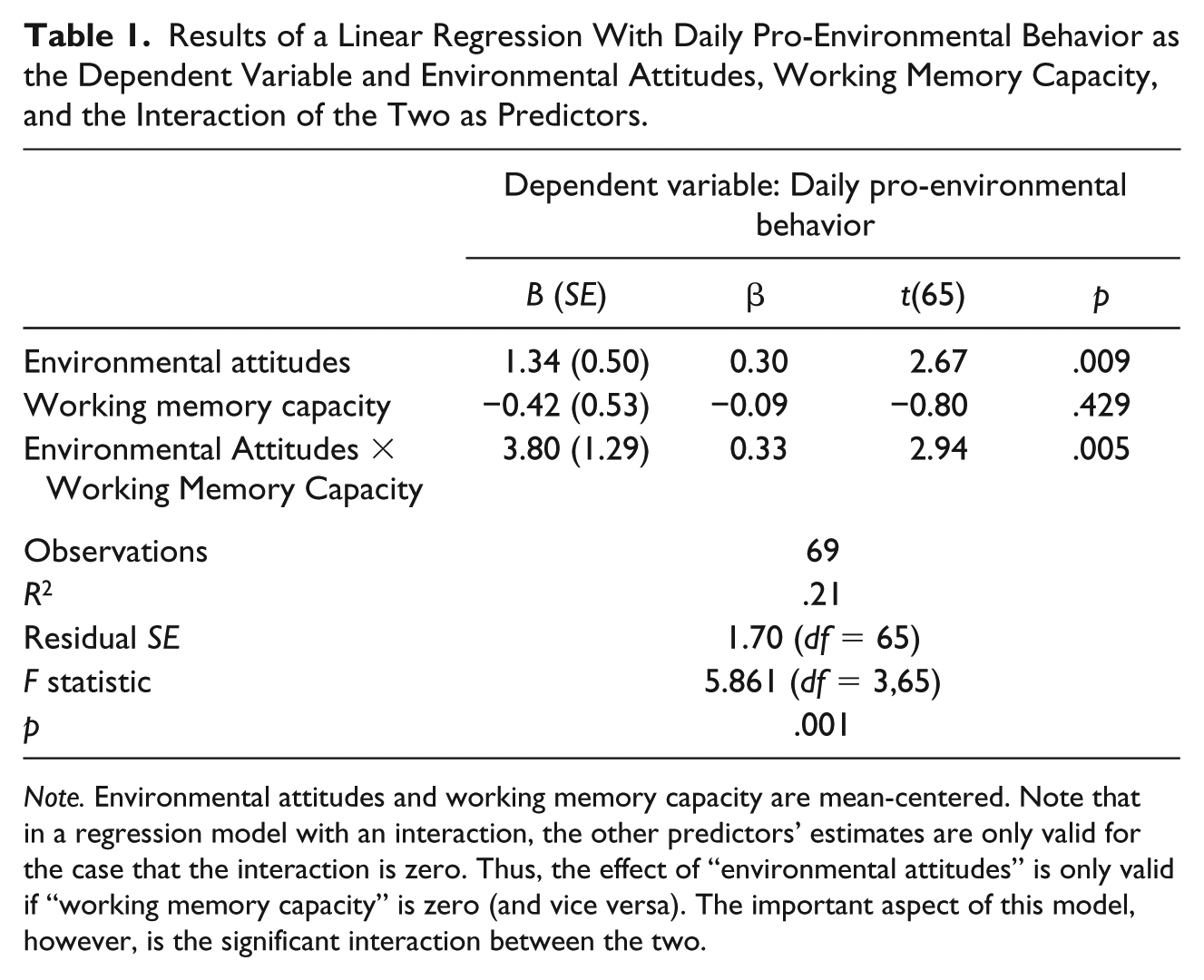
Note. Environmental attitudes and working memory capacity are mean-centered. Note that in a regression model with an interaction, the other predictors’ estimates are only valid for the case that the interaction is zero. Thus, the effect of “environmental attitudes” is only valid if “working memory capacity” is zero (and vice versa). The important aspect of this model, however, is the significant interaction between the two.
Importantly, the interaction between NEP and working memory score was a statistically significant predictor, p = .005. Figure 3 depicts this interaction. It should be noted that the model including the two outliers revealed the same pattern: The model was statistically significant, F(3, 67) = 5.50, p = .002, and the interaction between NEP and working memory score was a statistically significant predictor, p = .002. Using Pearson’s correlation, we checked whether the two predictors working memory score and NEP correlated significantly. This was not the case, r = .19, p = .105.
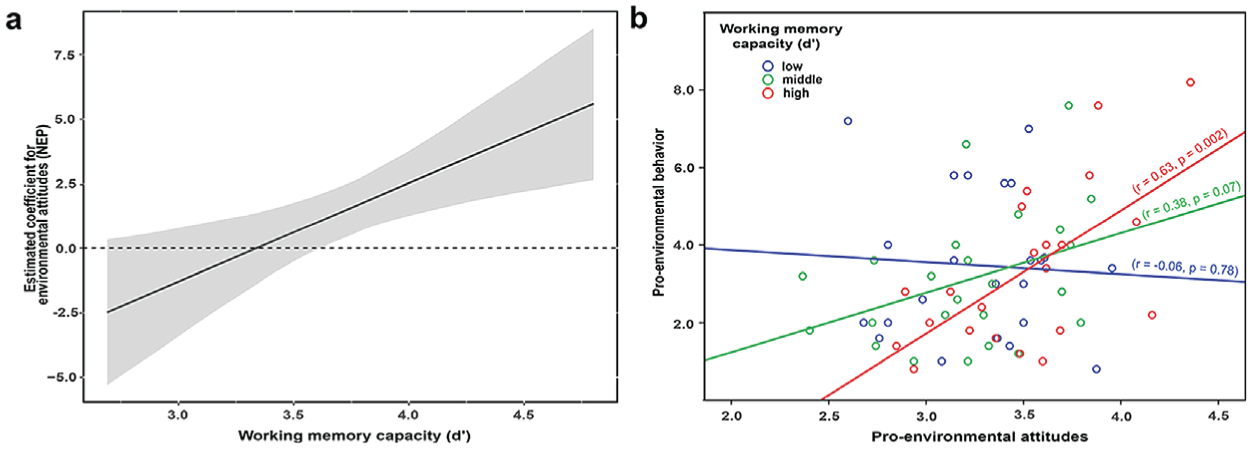
Graphical depiction of the interaction effect, that is, the strength of the connection between attitudes and behavior for changing working memory capacity.
To corroborate our finding, we used a hierarchical linear regression analysis to compare the model including the interaction between NEP and working memory score with a model that included both NEP score and working memory score as independent predictors, but not the interaction between them. The model without the interaction term was statistically significant, F(2, 66) = 1.80, p = .023 (see Table 2 for the complete results).
Results of a Linear Regression With Daily Pro-Environmental Behavior as the Dependent Variable and Environmental Attitudes and Working Memory Capacity But Without the Interaction of the Two as Predictors.
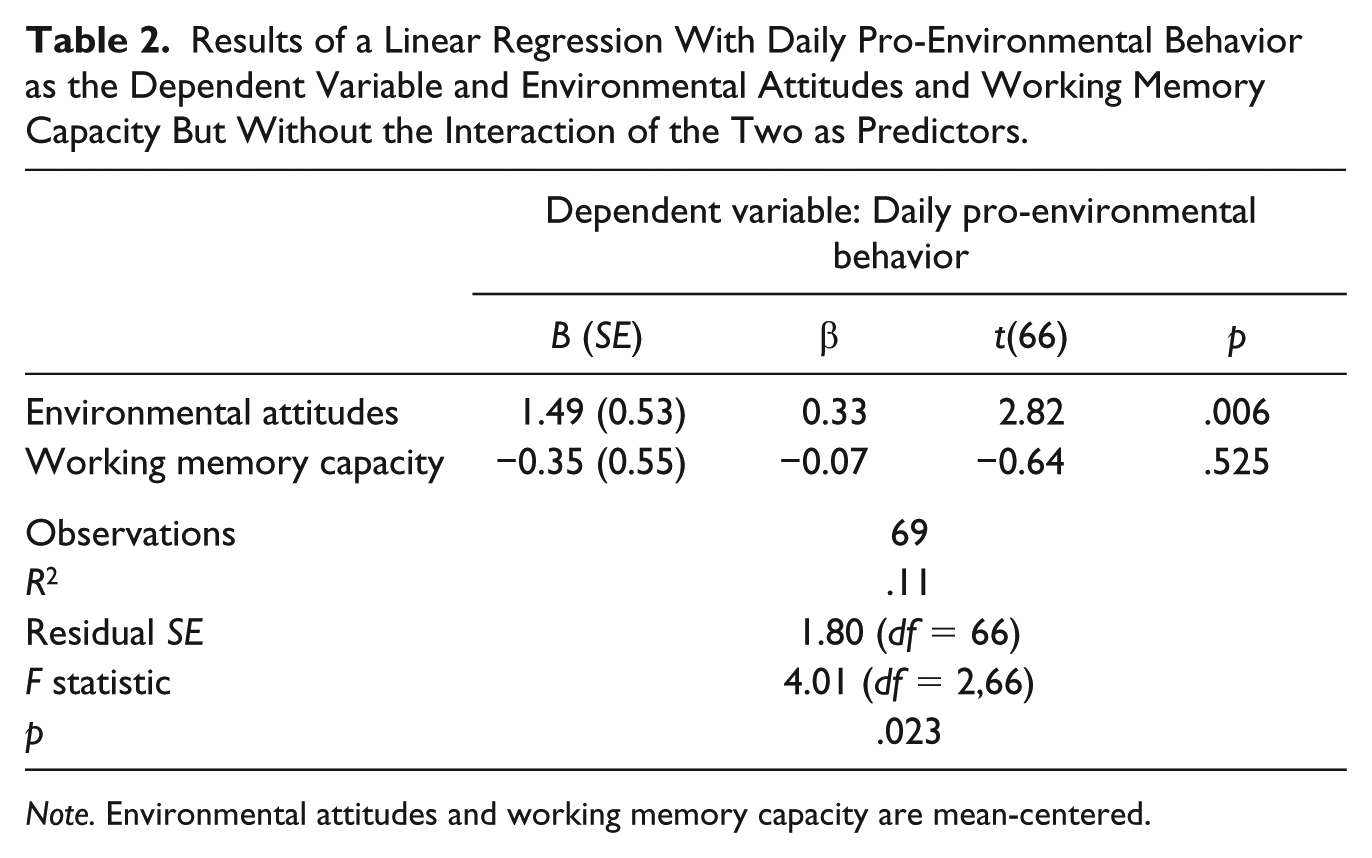
Note. Environmental attitudes and working memory capacity are mean-centered.
However, the full model explained significantly more variance, F(1, 65) = 5.86, p = .001, and R² rose significantly from .10 to .21. In addition, we calculated a linear regression with age and gender as additional covariates. After controlling for age and gender, the interaction between NEP and working memory remained a significant predictor (see Table 3 for the complete results).
Results of a Linear Regression With Age and Gender as Additional Predictors.
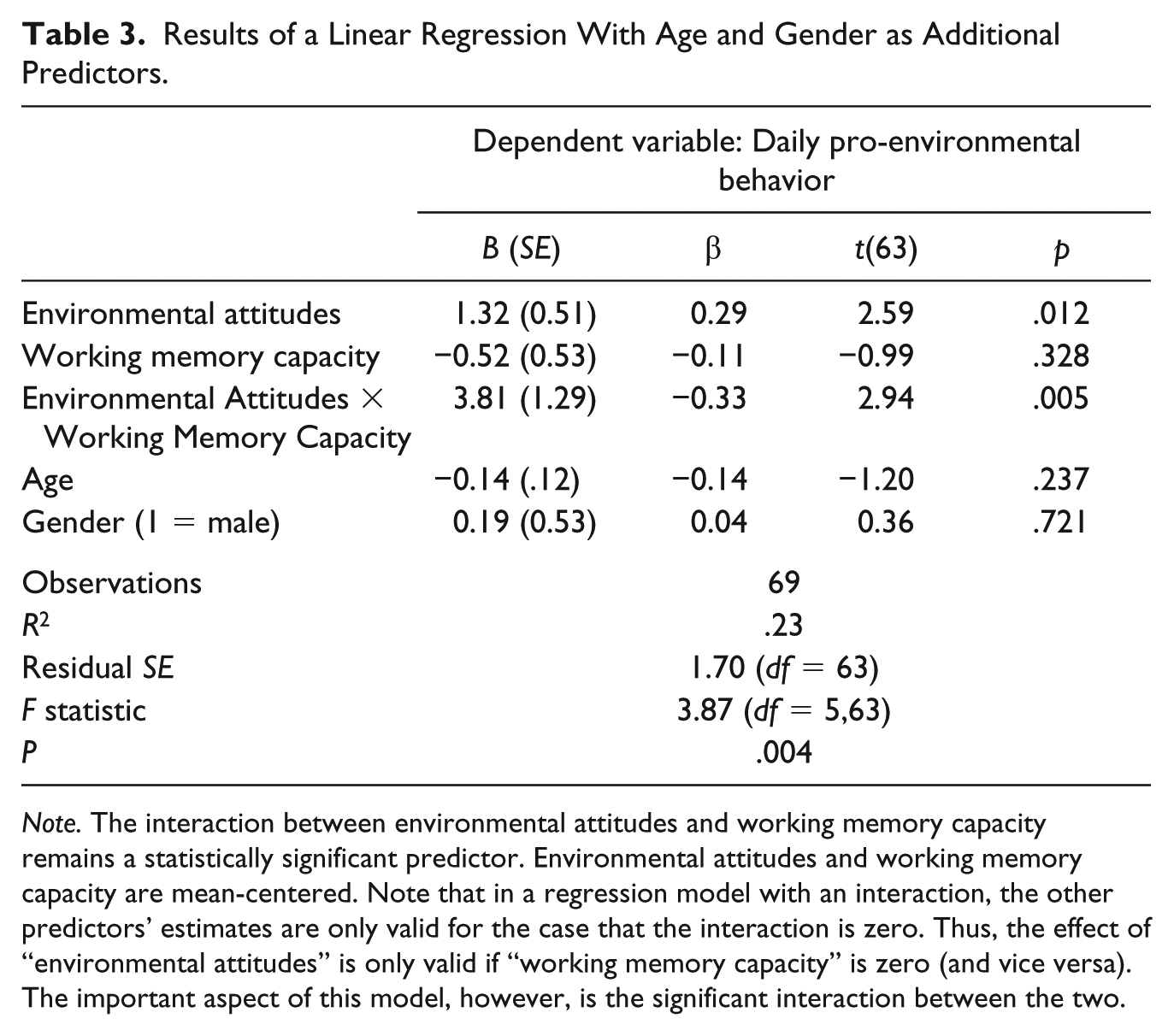
Note. The interaction between environmental attitudes and working memory capacity remains a statistically significant predictor. Environmental attitudes and working memory capacity are mean-centered. Note that in a regression model with an interaction, the other predictors’ estimates are only valid for the case that the interaction is zero. Thus, the effect of “environmental attitudes” is only valid if “working memory capacity” is zero (and vice versa). The important aspect of this model, however, is the significant interaction between the two.
To check whether our items measured one underlying construct of pro-environmental behavior, we calculated an exploratory factor analysis. Indeed, the analysis suggested a one-factor solution (see Supplemental Appendix B for details). When using the extracted factor scores as dependent variable (instead of the mean over all items), the interaction between working memory and pro-environmental attitudes remained a statistically significant predictor, both for the full sample (p = .005) and for the sample without the two outliers (p = .015), see Tables B2 and B3 in Supplemental Appendix B.
Following the suggestion of an anonymous reviewer, we also analyzed whether there were differences between the 1-back, 2-back, and 3-back with regard to the interaction with the NEP. To this end, we recalculated the regression reported above, but exchanged the overall d′ with the d′ per stage of the n-back. Indeed, the interaction between d′ and NEP was not a significant predictor of pro-environmental behavior for the 1-back and 2-back (p = .375 and .360, respectively), but was significant for the 3-back (p = .002; Supplemental Appendix C for the complete regressions). We assume that this is the case because the 1-back and 2-back were simply too easy for our sample of healthy university students, and most participants scored high. Indeed, the variance in our sample increases substantially with task difficulty (SD of d′ is 0.36, 0.45, and 0.52 for 1-, 2-, and 3-back, respectively).
With regard to our items, it should be noted that the first item (“I have dropped litter in the street and not picked it up”) was not very informative: Out of the 1,065 experience sampling points (71 participants × 5 days × 3 questionnaires per day), only 9 times did a participant report that they had littered. Because littering is still a theoretically relevant behavior and because an item with little to no variance does not compromise the informative value of the calculated mean over all items, we decided to leave this item in the analyses. Still, future studies might only want to use this item if there is reason to believe that it will be sufficiently informative for the sample at hand.
Discussion
The present research addressed the role of working memory as a crucial moderator explaining when environmental attitudes turn into corresponding behavior. Our study therefore provides first evidence that working memory capacity is a crucial factor in understanding the much-investigated link between pro-environmental attitudes and corresponding behaviors. We thus provide support for theorizing that argues cognitive resources are a relevant variable in whether or not pro-environmental attitudes and pro-environmental behavior relate to each other. We show that people with low cognitive resources fail to translate their pro-environmental attitudes into behavior, whereas those with high resources are well able to do so.
Our research provides support for attempts to adjust the conceptual framework in research on pro-environmental behavior to focus increasingly on the role of cognitive control (Nielsen, 2017). Importantly, while cognitive control capacity differs between individuals and can be conceptualized as a stable characteristic in humans, some results suggest that targeted interventions may help to improve both cognitive control in general and working memory specifically (Anguera et al., 2013; Klingberg, 2010). Indeed, in other contexts, working memory training has been shown to have real-life effects on cognitive control (Houben, Dassen, & Jansen, 2016; Houben, Wiers, & Jansen, 2011; Rass et al., 2015) because higher working memory capacity enables humans to overcome their (harmful) behavioral routines (e.g., drinking or emotional eating) for the sake of more beneficial behavioral alternatives. Analogously, it is possible that in our study, participants with higher working memory capacity managed to overcome (environmentally harmful) behavioral routines more successfully. It should be noted, however, that this remains somewhat speculative, as we did not explicitly measure the behavioral default or manipulate working memory capacity. In a related line of thought, our findings could also help to explain why popularized approaches such as “nudging” may promote pro-environmental behavior so effectively (Ölander & Thøgersen, 2014). Through the use of nudges, environmentally friendly behaviors typically become cognitively less effortful or even the effortless default (Marteau, Ogilvie, Roland, Suhrcke, & Kelly, 2011), as is the case in automatic enrolment such as the “opt-out” nudge (Ebeling & Lotz, 2015)—in other words, they reduce the “cognitive bandwidth tax” (Mullainathan & Shafir, 2013). Thus, with reductions in “cognitive bandwidth tax,” people might need less working memory capacity to maintain and shield a corresponding representation.
Research has also reported a moderate relationship between working memory capacity and intelligence (Ackerman, Beier, & Boyle, 2005). Hence, a potential alternative explanation for our results may be that measuring working memory capacity may just be a “proxy” for broader measurements of intelligence, which itself has been linked to environmental behavior (Markowitz, Goldberg, Ashton, & Lee, 2012). However, our research relied on a relatively homogeneous sample in terms of intelligence (i.e., Swiss university students), making it less likely that intelligence alone explains our result.
Another potential limitation of our study is the use of self-report measures. Although experience sampling overcomes some of the problems of traditional questionnaires (e.g., memory effects), we still rely on our participants’ willingness to accurately report their behavior. However, it is possible that they have other motives, for example, upholding their self-concept of being an environmentally responsible person. Because it is known that self-reported and objectively measured pro-environmental behavior can differ (Corral-Verdugo, 1997), future studies might want to use objective measures of pro-environmental behavior. For example, recent studies measured whether participants spent more money for environmentally friendly products when they could do grocery shopping in the lab (Demarque, Charalambides, Hilton, & Waroquier, 2015) or measured the use of warm water in the shower (Tiefenbeck et al., 2016). In addition, future studies might also want to explore whether our findings are specific to working memory capacity or whether they can be replicated with alternative measures of cognitive control, for example, a Go/No-Go task or a flanker task (in which participants have to react to a specific target while suppressing responses to simultaneously presented distractors). Similarly, one could complement our correlational field data with laboratory experiments, which might have less external validity but could allow to draw causal inferences by diminishing cognitive control.
Ultimately, however, our results call for caution about the role individuals might take to avert potentially catastrophic events like global climate change. Even people with strong positive attitudes toward the environment can fail to act accordingly because they lack the necessary cognitive resources to do so. Thus, rather than focusing on further raising the level of awareness about global environmental problems, policy makers might be advised to create decision-making environments in which people require less cognitive control to behave in an environmentally friendly manner or to systematically train executive functions in educational settings.
Supplemental Material
Appendix_3review – Supplemental material for Cognitive Resources Moderate the Relationship Between Pro-Environmental Attitudes and Green Behavior
Supplemental material, Appendix_3review for Cognitive Resources Moderate the Relationship Between Pro-Environmental Attitudes and Green Behavior by Benedikt P. Langenbach, Sebastian Berger, Thomas Baumgartner and Daria Knoch in Environment and Behavior
Footnotes
Declaration of Conflicting Interests
The author(s) declared no potential conflicts of interest with respect to the research, authorship, and/or publication of this article.
Funding
The author(s) disclosed receipt of the following financial support for the research, authorship, and/or publication of this article: This work was supported by a grant from the Mens Sana Foundation and the Jacobs Foundation.
Data Availability
The data to replicate all analyses are available from the authors upon request.
Supplemental Material
Supplemental material for this article is available online.

Author Biographies
References
Supplementary Material
Please find the following supplemental material available below.
For Open Access articles published under a Creative Commons License, all supplemental material carries the same license as the article it is associated with.
For non-Open Access articles published, all supplemental material carries a non-exclusive license, and permission requests for re-use of supplemental material or any part of supplemental material shall be sent directly to the copyright owner as specified in the copyright notice associated with the article.
